
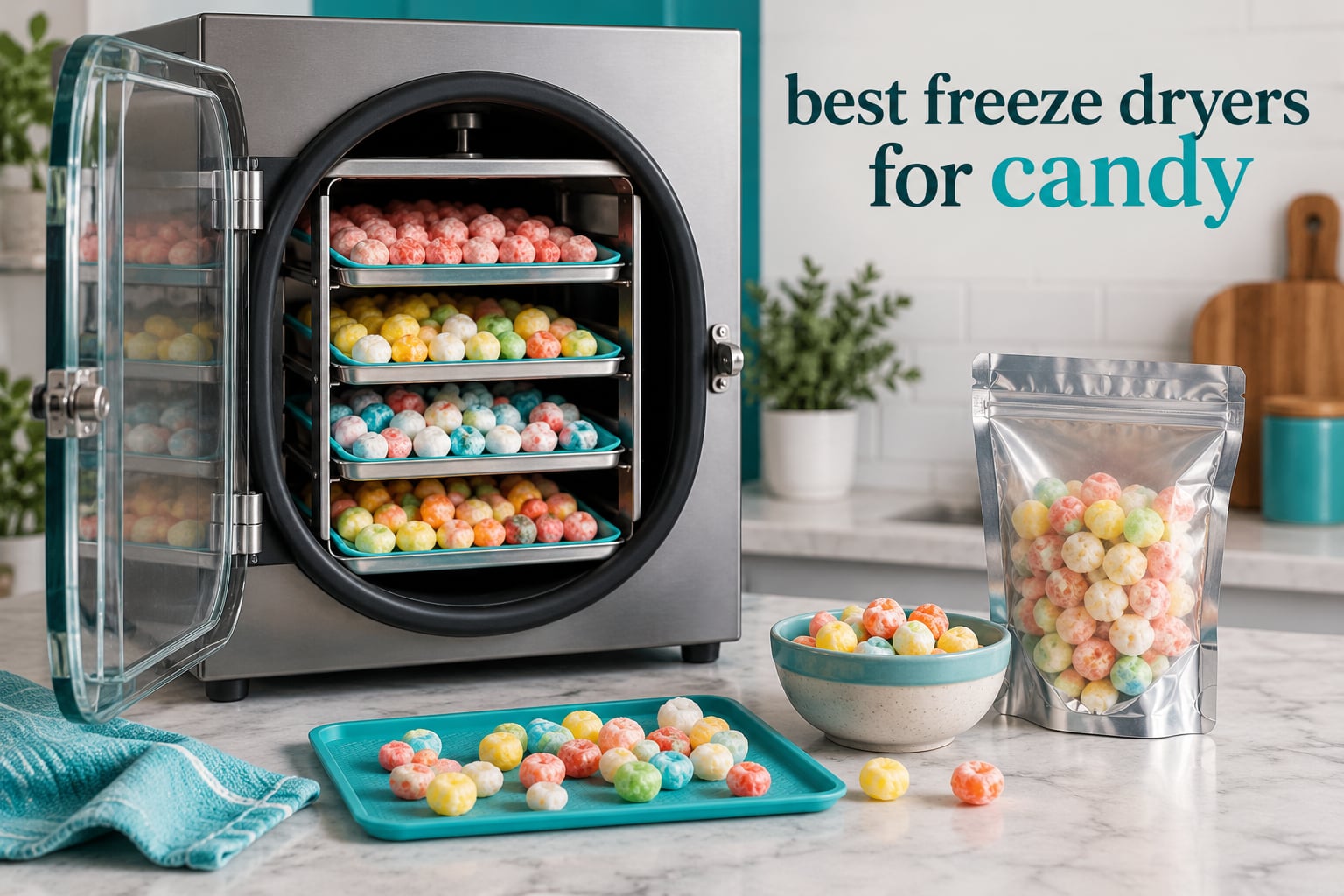
Candy is the fastest thing you can put in a freeze dryer. A full meal batch can eat a whole day of cycle time, while a tray of Skittles, Jolly Ranchers or gummy worms finishes in roughly 2 to 4 hours because there is so little water in a piece of candy to pull out.
That short cycle changes the math entirely. You can run back-to-back batches without waiting for a defrost, finish a batch before dinner, and turn a bag of bulk candy into something that looks like a completely different product. It also means the machine you pick matters less than the machine most people picture, which is the glossy Harvest Right unit in every cottage-food video.
This guide covers the best freeze dryers for candy actually available as of 2026, across ten listings spanning VEVOR, HNZXIB, Blue Alpine, BDJSN, HQHAOTWU, SINOPED, GOYOJO and Banfluxion. We looked at chamber size, tray count, shelf temperature range, pump design, cycle repeatability and how much of each listing is backed by real customer use. Seven of these ten listings have zero customer reviews, and we tell you which ones those are before you spend anything.
We also cover the part nobody sells you: which candies puff, which ones melt into a puddle on the chamber floor, and how to load and package so a good batch does not turn to sticky crumbs.
Table of Contents
Top 3 Candy Freeze Dryers (October 2026)
Our short answer first. The VEVOR 4-Layer is the only machine in this group with meaningful review history, the Blue Alpine Medium Select has the most complete accessory kit and the friendliest footprint, and the HNZXIB FD-3 is the pick if you want the vacuum pump built into the body instead of sitting beside it.

VEVOR 4-Layer Freeze Dryer
- 4-layer 304 stainless trays
- 8.8-13.2 lbs per batch
- -35C cold trap
- Touch screen control

Blue Alpine Medium Select
- 5 food-grade stainless trays
- 10-15 lbs per batch
- 108 lb footprint
- Full accessory kit

HNZXIB FD-3 Freeze Dryer
- Built-in vacuum pump
- -45C cold trap
- 3 stainless trays
- Graphene heating plate
Candy Freeze Dryer Comparison in 2026
Every machine below, ranked by how well it fits a 2 to 4 hour candy cycle. Review counts are shown honestly, including the zeros.
| Product | Specifications | Action |
|---|---|---|
| VEVOR 4-Layer Freeze Dryer |
|
Check Latest Price |
| HNZXIB FD-3 Freeze Dryer |
|
Check Latest Price |
| Blue Alpine Medium Select |
|
Check Latest Price |
 BDJSN 6-Tray Freeze Dryer BDJSN 6-Tray Freeze Dryer |
|
Check Latest Price |
 HQHAOTWU 4-Tray Freeze Dryer HQHAOTWU 4-Tray Freeze Dryer |
|
Check Latest Price |
 HNZXIB FD-05H Freeze Dryer HNZXIB FD-05H Freeze Dryer |
|
Check Latest Price |
 SINOPED Benchtop Freeze Dryer SINOPED Benchtop Freeze Dryer |
|
Check Latest Price |
 GOYOJO 3-Tray Lab Freeze Dryer GOYOJO 3-Tray Lab Freeze Dryer |
|
Check Latest Price |
 HNZXIB 8-Tray Freeze Dryer HNZXIB 8-Tray Freeze Dryer |
|
Check Latest Price |
 Banfluxion 4-Tray Freeze Dryer Banfluxion 4-Tray Freeze Dryer |
|
Check Latest Price |
1. VEVOR 4-Layer Freeze Dryer
- Largest review count in this group at 48 reviews
- 4-layer 304 stainless tray stack holds good candy spacing
- -35C cold trap with included vacuum pump
- Swivel casters make it movable
- Acrylic door lets you watch a batch
- Rating sits at 3.7 with complaints about documentation and setup
- A few machines arrived without vacuum pump oil
- Oil leaks reported by a few owners
- Support described as unresponsive
This is the machine we keep coming back to, and the reason is not a spec sheet. It is the only listing in the group with a real body of owner feedback, which means the failure modes are documented instead of theoretical. Owners consistently report that the machine itself performs once it is set up correctly.
For candy work, the 4-layer tray stack is the useful part. Four stainless shelves give you enough vertical room for pieces to expand roughly 150 to 300 percent without touching the shelf above, which is exactly the clearance problem that ruins first batches.
The included pump and the -35C cold trap cover what a candy cycle needs. Candy carries only about 8 to 12 percent moisture, so the chamber does not need to move the large volumes of water a vegetable load generates, and the deeper cold trap buys you faster pull-down between runs.
The honest drawback is that 3.7 star rating. Documentation is repeatedly called poor, a few owners report their unit arrived without the vacuum pump oil, and oil leaks show up in the reviews. None of that is a reason to skip it, but it is a reason to buy from a seller who will answer a question before you order.
What a batch of Skittles looks like in this chamber
Load a single layer on a silicone mat with about an inch between pieces, pre-warm the shelves for 15 to 20 minutes, then run a high-temperature candy cycle. Expect the pieces to come out light and porous with a visible snap on the bite.
The 8.8 to 13.2 pound per batch rating is a food-load figure, and candy goes much lighter than that in practice. A realistic candy load on four shelves lands well below the maximum pound rating, which is another reason to think in tray area rather than weight when you compare machines.
Where it falls short
Candy mode on some V6-era firmware revisions has been reported by users to run hotter and more aggressively than earlier settings, and to lean on extra dry time rather than the normal drying cycle. If you own one of these, run a small test batch and adjust rather than trusting the preset blindly.
The 245.8 pound weight is not a countertop machine. Plan a floor or garage spot, and check that the swivel casters can clear your thresholds.
2. HNZXIB FD-3 Freeze Dryer
- Pump built into the body saves counter space
- -45C cold trap is deep for the class
- Graphene heating plate claims 30 percent energy savings
- One-piece molded chamber resists corrosion
- Acrylic door for watching the cycle
- No customer reviews available yet
- Only 3 trays limits a single candy batch
- 7-9 lb rating is small next to the others
- Newer brand with a short track record
The FD-3 appeals to anyone who has measured their counter space and lost. Most freeze dryers ship with a separate vacuum pump that needs its own outlet and its own floor area, and this one folds the pump into the body.
The -45C cold trap and the 800W draw make it an efficient machine for the short loads that candy produces. Because a candy cycle moves so little water, a deeper trap is mostly wasted capability here, but it does shorten pull-down time between runs.
Three trays is the constraint that matters. Candy expands, and with three shelves you are loading in smaller waves rather than one full batch. For a hobbyist making party favors that is plenty. For anyone thinking in retail bags per day, it means more cycles than the four-tray units below.
We are listing this without a star rating because the listing has no customer reviews at all. That is not a warning, but it does mean every claim on the page comes from the manufacturer rather than from owners.
Why the built-in pump matters for candy work
Candy invites frequent short cycles rather than occasional long ones, and every pump changeover is friction you notice. With the pump inside the cabinet you close the door and start, which makes back-to-back runs far easier to keep on a schedule.
The graphene heating plate is also worth noting for the shelf temperature range. Candy needs heat applied to soften the sugar matrix before the gas can balloon it, and steadier shelf heat means more consistent puffing across a tray.
Where it falls short
Three trays means a smaller finished pile per cycle, and the 7 to 9 pound rating is the smallest of the machines with a claimed figure. If you are counting bags per day, work out the cycle math before committing.
The 0.2 square meter drying area is small. Candy pieces need gaps between them, and a cramped tray deck is where pieces touch, fuse into a single sheet and come out as a candy brick.
3. Blue Alpine Medium Select Freeze Dryer
Blue Alpine Medium Select Freeze Dryer – Home Freeze-Drying Machine for Food Preservation & Long-Term Storage
- One of the largest stated batch figures at 10-15 lbs
- Five trays give good expansion clearance
- 108 lb footprint is light for a chamber this size
- Comes with silicone mats Mylar bags and a sealer
- Designed and built in Idaho with US support
- No customer reviews available yet
- Cold trap temperature not published in the specs
- Control system details not listed
- Recent model with no field history yet
Blue Alpine is the name people mention when they are weighing an alternative to the more familiar Harvest Right, and this listing is the most approachable way into that brand. The accessory kit is the differentiator: silicone mats, Mylar bags and an impulse sealer are in the box.
Those accessories matter more for candy than they do for meals. You need mats so pieces release cleanly instead of welding to stainless steel, and you need bags and a sealer because freeze-dried sugar pulls moisture straight out of the air and turns sticky within hours of being exposed.
Five food-grade stainless trays over a 10 to 15 pound batch claim puts this near the top of the stated batch figures in this lineup, and the 108 pound body is light enough that one person can reposition it. That matters when you are clearing counter space between gifting seasons.
There are no customer reviews on this listing, and the cold trap temperature is not published. Ask the manufacturer directly if the vacuum spec matters to you, because candy cycles are short enough that a shallow trap would show up as longer pull-down between runs.
Why the accessory kit changes a candy workflow
Freeze-dried candy is hygroscopic, meaning it draws moisture from the air until it becomes sticky and loses its crunch. Packaging it the same day it leaves the chamber is not optional, and having bags and a sealer on hand is the difference between a batch you can sell and one you cannot.
The 120V supply also keeps installation simple. You are not dealing with a dedicated circuit or an electrician, which removes one of the bigger costs and hassles of moving to a larger commercial chamber.
Where it falls short
No reviews means no owner-reported cycle times, and the missing cold trap figure is a real gap for anyone comparing vacuum performance across brands. Treat the 10 to 15 pound rating as a manufacturer claim until you have run it yourself.
The warranty is one year, which is short compared with what some longer-established brands offer. If you plan to run daily batches, factor replacement parts and service access into your thinking.
4. BDJSN 6-Tray Freeze Dryer
- Six trays give more shelves than any four-tray chamber here
- Touchscreen runs preset food modes
- 1600W is strong heating for shelf temperature
- External pump can be serviced independently
- 201 stainless body is easy to wipe clean
- No customer reviews available
- Capacity not published by the manufacturer
- Weight and dimensions not provided
- External pump needs its own floor space
Six trays is the number to notice here. More shelves means more separate candy trays in a single cycle, and for a product that expands 150 to 300 percent that extra vertical and horizontal room is the difference between a clean batch and a fused one.
The 1600W heating element is the highest published wattage in this group, and heating power is what drives shelf temperature. Candy needs the shelves hot enough to soften the sugar matrix before the sublimating gas can push through it.
The listing is built around preset food modes on a touchscreen rather than a manual dial, which keeps the learning curve short if this is your first vacuum chamber. It is a straightforward menu to learn even though the menus on different brands use different names for the same steps.
Two things the manufacturer does not publish bother us: the batch capacity and the weight and dimensions. For a machine meant to live in a garage or utility room, not knowing the shipping weight is an awkward surprise on delivery day.
Why tray count beats pound rating for candy
A pound rating describes how much weight fits under a full load. Candy is light and bulky, so a machine can sit well under its pound rating and still run out of tray space. Six shelves give you more usable surface for spacing pieces an inch apart.
The external pump is a real plus if you expect to service it yourself. Vacuum pumps wear out, and being able to swap one without moving the whole chamber saves downtime between candy runs.
Where it falls short
With no published capacity figure you cannot compare it numerically to the rest of this list. Our ranking places it on tray count and heating power alone, and you should weight those equally.
An external pump adds footprint and needs a second outlet nearby. In a small room that changes your layout plan, so measure the space for the chamber and the pump together.
5. HQHAOTWU 4-Tray Freeze Dryer
HQHAOTWU Vacuum Freeze Dryer 110V Vacuum Food Dehydrator Machine with 4 Trays -40°C Cold Trap 1550W Food Sublimation Dryer Freeze Drying Machine for Fruit & Vegetable
- Wide -25C to +60C shelf temperature range gives real candy control
- Below 5Pa no-load vacuum specification is published
- 2L/s pump flow is strong for short cycles
- Large LCD intelligent control panel
- 63dBA is published so you know the noise
- Heaviest unit here at 320 pounds
- No customer reviews available
- Brand is not well known outside industrial listings
- Industrial focus is more than a home user needs
This is the machine with the most honest technical specification sheet in the group. Most listings publish a wattage and a capacity. This one publishes the vacuum level, the pump flow, the shelf temperature range and the noise figure, which are exactly the numbers that decide whether a candy cycle behaves.
A -25C to +60C shelf range is the only shelf temperature range published anywhere in this group. Candy work sits at the warm end of that band, where the sugar matrix softens enough for trapped gas to expand through it, and having real headroom above your target gives you room to compensate for a batch that is under-puffing.
The 2L per second pump with a KF quick connector is also published, and pump flow is what determines how quickly the chamber pulls down between runs. Candy people run short cycles back to back, so pull-down speed is a throughput number, not a detail.
At 320 pounds this is a floor machine. It is also built more like laboratory equipment than a kitchen appliance, and some of that engineering is exactly what you want if candy is a production activity rather than a hobby.
Why shelf temperature range matters more than pump brand
Candy mode presets are only a starting point. Hard candies, gummies and taffy respond differently to shelf heat, and without a wide enough range you cannot correct a batch that came out dense. The published range here gives you room to experiment.
Below 5Pa no-load is a genuinely useful published figure. Vacuum depth determines how dry the finished candy gets, and an under-dried piece goes tacky in the bag no matter how well it puffed.
Where it falls short
The weight is the first thing you will notice. Plan the delivery path and the floor space before you order, and do not plan to move it alone.
It is also the least home-friendly design here. If your goal is freeze-dried Skittles in a spare room, this machine does the job with more effort and less charm than a smaller chamber would.
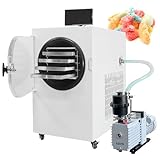
6. HNZXIB FD-05H Freeze Dryer
Vacuum Freeze Dryer Machine, 10-15 LBS/Batch Food Freeze Drying Machine
- Cold trap published at -60C
- 7-inch panel shows real-time drying curves
- 10-15 lb batch with 304 stainless trays
- Built-in swivel casters
- Electric defrost simplifies cleanup
- No customer reviews available
- Only 4 trays for the stated capacity
- Weight and dimensions not published
- Same young brand as the other HNZXIB listings
The -60C cold trap is the headline number, and for candy it is not the number you would pick first. Candy needs shelf heat, not a deeper freeze, so this machine is buying headroom you will rarely use on confectionery work.
What actually makes the FD-05H interesting for candy is the 7-inch touch panel with real-time curve display. You can watch the drying line develop across a cycle, which turns a guess about when candy is finished into something you can read off the screen.
That matters because the most common candy complaint is not that pieces failed to puff. It is that people pull batches early, or late, and cannot tell which. Watching the curve tells you when sublimation has slowed and the secondary drying phase has started.
Electric defrost is a small but pleasant addition. Candy runs are short and frequent, so you will be opening the chamber far more often than a food-only user, and a manual defrost wait in between gets old quickly.
Why watching the curve shortens your learning curve
Every batch of candy is different. Room humidity, how frozen the candy was going in, and how much sugar is in a given type all shift the drying time. A visible curve turns those variables into information instead of guesswork.
The 0.46 square meter drying area across four trays gives you decent spacing room for gummy bears and worms, which hold their shape better than hard candies that crumble on the bite.
Where it falls short
Four trays supporting a 10 to 15 pound claim means a dense load, and candy at full density will touch. Space your pieces and you will use well under the stated maximum, which is fine but worth planning around.
Like the rest of this brand’s listings, there are no customer reviews to draw on. Everything here comes from the spec sheet.
7. SINOPED Benchtop Freeze Dryer
- One-button operation removes the learning curve entirely
- Integrated chamber and trap shortens the vapor path
- 0.43 sq m drying area is workable for candy
- Phone remote and on-site technical support offered
- System safety lock prevents accidental setting changes
- Costs more than any other machine covered here
- Critical specs such as cold trap temperature are not published
- Tray count and materials not listed
- No customer reviews available
The easiest machine here to run is also the one that tells you the least. One-button operation is genuinely useful if freeze drying is new to you, because there is no menu to learn and no sequence to misremember between runs.
Integrating the chamber and the cold trap shortens the path the vapor has to travel, and a shorter path is one of the reasons a cycle finishes sooner. On a candy load that runs 2 to 4 hours, saving time on every run adds up across a week of production.
The support offer is unusual for this category. Phone, remote and on-site technical support covers the failure modes owners complain about most on the machines with review history here, which are documentation problems and setup problems.
What stops us recommending it outright is the missing specification. Cold trap temperature, tray count, tray material, weight and dimensions are all absent, and those are the numbers you need to compare it against anything else.
Who this simple interface suits
If your plan is occasional gifts for friends and family, a preset machine removes the temptation to fiddle. You load, press one button, and come back in a few hours to finished candy.
It also suits anyone who wants to run the cycle without supervising it closely, which is exactly what a 2 to 4 hour candy run allows you to do while you are doing something else in the house.
Where it falls short
You cannot verify candy performance from the listing. Without a published cold trap temperature or tray count, the honest position is that this is a machine you would be buying on trust in the interface and the support promise.
It also sits at the top of the cost range in this group, which makes the missing information harder to accept. You are paying more while knowing less.
8. GOYOJO 3-Tray Lab Freeze Dryer
Laboratory Freeze Dryer Machine Table Tope Freeze Dryer for Food Vegetable Vacuum Freeze Drying Machine Food Dryer Fruit (10N-60A)
- 850W power draw keeps electrical demand modest
- 3 trays
- Food-safe materials
- Tabletop form factor suits a small work area
- Capacity cold trap pump and control system are not published
- 850W is the lowest heating power listed
- Only 3 trays limits batch size
- No customer reviews available
This is a laboratory-class unit sold for tabletop use, and the honest summary is that it is short on published detail. Capacity, cold trap temperature, pump specification and control system are all missing from the listing.
What is published points in one direction. With an 850W draw the electrical demand stays modest, which means you are less likely to need anything beyond a standard outlet to run it.
Three trays is small for candy production, but as a starter machine for someone who wants to try freeze-dried candy a few times a year without dedicating floor space, the footprint is the argument.
We would not push anyone toward this one for a production workflow. If you are learning the process and want a small chamber on a table, it does the job. If you plan to make candy regularly, the two machines above it are better buys.
Where a small tray count is actually fine
Trial batches. A single tray of Skittles tells you whether you enjoy the process, how you want to package it and whether your household will eat it. That is a real use, and it does not require a large chamber.
Three shelves is also generous for one type of candy at a time. Batch consistency is easier when you are not mixing taffy, gummies and hard candy in the same run.
Where it falls short
Missing specifications are the core problem. There is no way to compare throughput, and no way to know how well it holds shelf temperature for a candy cycle.
The unit is not marketed around candy at all, so the preset programmes may not include anything resembling a high-temperature confectionery profile. You would be building the cycle yourself.
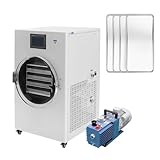
9. HNZXIB 8-Tray Freeze Dryer
- Highest tray count and largest batch claim in the group
- Secop compressor is a recognised refrigeration brand
- -50C cold trap with LCD control
- Transparent door for watching a long cycle
- One-year warranty and front-load access
- Only one customer review at 3 stars
- Very large footprint at 47 inches tall
- Title and model number disagree on the cold trap rating
- Brand has a short track record
Eight trays and a 13 to 18 pound batch claim give this the largest chamber in the group. If your plan is retail quantities rather than hobby batches, the raw capacity is not in question here.
The Secop compressor is worth calling out. Recognised compressor brands matter more than most spec sheets suggest, because the compressor is the component that runs constantly and the one most likely to define how long the machine lasts.
There is one honest caveat. The listing title advertises -50C while the model number field reads HNZXIB -35C. That discrepancy is exactly the kind of thing to ask about before you commit, and it is worth getting in writing.
A single 3-star review is not enough to judge. The machine may well be excellent, but you are buying on the strength of the specification sheet and the compressor brand rather than on owner history.
Why eight trays change the workload
More trays means fewer cycles for the same weekly output, and candy work is all about cycles. If you are selling at a market or filling holiday gifting orders, the difference between three cycles and one is the difference between an evening and a weekend.
The LCD control and transparent door also suit long production days, since you can check progress from across a room rather than opening the chamber and losing temperature.
Where it falls short
The 47-inch height and 30-inch width mean this needs a real corner, not a counter. Measure doorways too, because the chamber arrives as one large unit.
Verify the cold trap rating before ordering. If the unit is a -35C machine marketed under a -50C title, your expectation of pull-down speed between candy cycles changes.
10. Banfluxion 4-Tray Freeze Dryer
- Automatic defrost removes the wait between candy runs
- 0.4 sq m of tray area across four shelves
- Tecumseh/Secop professional compressor
- Anti-oil return rotary vane pump at 2L/s
- Transparent organic glass door for monitoring
- Only one customer review at 5 stars
- Weight and dimensions not published
- Brand is unknown to most buyers
- Four trays for the stated capacity means a dense load
This one scores well on the parts of the specification that matter for confectionery work. Automatic defrost is the headline, and it is more useful here than on a food-only machine because candy runs are short and frequent.
Between batches on a heavy vegetable load, an automatic defrost cycle is a minor inconvenience. Between candy runs three times a day, it is a meaningful amount of your working week. Removing it keeps the chamber ready to load.
The 0.4 square meter of tray area across four food-grade stainless shelves gives good spacing room, and the Tecumseh/Secop compressor is the same recognised refrigeration brand used in the larger unit above.
A single 5-star review is one data point. The specification sheet is genuinely strong, and the defrost feature is a real workflow advantage, but there is no long history of owners to support it.
Why automatic defrost matters at candy volumes
The argument is arithmetic. If you run three candy cycles a day, a manual defrost wait between each one is three waits a day that you could have spent loading trays or packaging finished candy.
Automatic defrost also reduces the temptation to shortcut it. Skipping a defrost to save time is how people end up with condensation forming on finished candy and bags that seal with moisture inside.
Where it falls short
Weight and dimensions are missing, and the machine sits in the upper part of the price range for a four-tray chamber. Confirm the footprint before ordering.
Supporting fruit, vegetables, meat, flowers, pet food and medicinal herbs is a broad claim for a home-sized unit. Candy is the use we can evaluate properly from what is published here.
What Candy Mode Actually Does
Candy mode is a factory preset that runs the chamber hotter and faster than a standard food programme. It exists because candy behaves differently from the meals most home freeze dryers are designed around.
A working candy cycle starts with an initial freeze that takes the chamber to around 0F, then pulls a deep vacuum so the ice in the candy sublimates. The shelf heaters run warm enough to soften the sugar matrix, typically into the 135F to 145F range, so gas escaping from the candy can push outward through a pliable shell rather than a hard one.
A commonly published six-setting sequence looks like this: initial freeze at 0F, extra freeze time at zero, fast dry mode, dry temperature at 145F, and two hours of extra dry time. That combination is what triggers the Candy or High Temperature Mode flag on the screen.
Two things catch first-time users out. Candy mode leans on extra dry time rather than the normal drying cycle, so total cycle length is longer than the preset name suggests. And on some newer firmware revisions the profile runs hotter than earlier versions did, so a batch that worked on an older machine can scorch on a new one.
If your machine has no candy mode at all, the workaround is a shorter dry phase at a high shelf temperature with extended time added at the end. Home users running Skittles on non-candy machines consistently report around a 4-hour cycle with that added time.
Which Candies Work and Which Fail
The best candy to freeze dry at home is a hard candy or gummy with a low fat content and a sugar matrix that holds together. Skittles, Jolly Ranchers, gummy bears, gummy worms and marshmallows all puff reliably. Salt water taffy works too, though it needs more spacing than its size suggests.
Jolly Ranchers produce the largest visual expansion of any common candy. Because of that, most people cut them in half before loading so the finished piece stays bite-sized instead of becoming a sweet shard the size of a plum.
Sour candy is the first thing to fail. Citric acid changes how the candy responds to heat and moisture, and users consistently report sour Skittles under-performing or collapsing compared with the original flavour.
Chocolate, fudge and peanut butter cups should not be loaded at all. Chocolate fat melts before the sugar matrix can set, and the result is an oily puddle on the chamber floor rather than a puffed piece. Caramel-coated chocolates can behave differently, with the coating staying intact while a caramel interior puffs, but test a single piece first.
Gummies hold their shape better than hard candies, which tend to crumble on the bite. If you are making favors rather than eating them yourself, gummies are usually the more forgiving first project.
Loading, Drying and Packaging Rules That Decide Your Batch
Use silicone tray mats rather than parchment. Candy that touches bare stainless steel sticks, and reviewers report finished pieces shattering into crumbs on removal. Mats sized to standard trays cost almost nothing compared with a wasted batch.
Leave about an inch between pieces. Candy expands 150 to 300 percent, and pieces loaded close together touch during the cycle, fuse, and come out as a single candy brick you cannot separate without breaking them.
Pre-warm the shelves for 15 to 20 minutes before pulling the vacuum. Skipping this step is the reported cause of collapsed and dense candy that never puffs properly, because the gas escapes before the sugar matrix is soft enough to hold it.
Package finished candy immediately in 5-mil Mylar bags with an oxygen absorber. Freeze-dried sugar is hygroscopic, so it draws moisture from humid air and goes tacky within hours. Sealing the same day the cycle ends is the difference between a crunchy product and a disappointment.
Skip the defrost wait between candy runs. Because candy carries so little water, the chamber does not build the ice load that a vegetable batch creates, and back-to-back cycles are one of the genuine advantages of making candy specifically.
Troubleshooting Failed Candy Batches
If pieces fuse into a single sheet, they were spaced too closely. Expansion closed the gaps you left, and the fix is fewer pieces per tray rather than a hotter cycle.
If candy shatters into crumbs on removal, it stuck to the tray. Silicone mats solve it, and warm the tray slightly before lifting rather than prying pieces off cold stainless steel.
If candy came out dense and unexpanded, the shelves were probably not pre-warmed, or the cycle ended before the secondary drying phase. Watch the drying curve on machines that display one and add extra dry time.
If finished candy is soggy, it sat in humid air too long before packaging. Seal it sooner and include the oxygen absorber, and consider running the last stretch of the cycle with a little extra dry time.
If chocolate melted and pooled on the chamber floor, the shelf temperature was high enough to liquefy the fat before the matrix set. Chocolate does not belong in a candy cycle, and it can also contaminate the chamber for future batches, so wipe the surfaces down thoroughly afterwards.
How to Choose a Freeze Dryer for Candy
Choose on tray count and tray area first, then shelf temperature range, then pump and defrost convenience. Weight ratings are the least useful number for candy, because candy is light and bulky and a machine can sit far below its pound rating while still running out of space to space pieces apart.
Look for a documented temperature range rather than a single wattage figure. You need shelf heat you can dial, control and repeat, because different candies respond differently and you will want to correct a batch that came out wrong.
Decide about pump placement. An internal pump saves floor space and makes frequent short cycles simpler to start. An external pump can be serviced or replaced without moving the chamber, which matters if you plan to run daily.
Check the electrical requirements against your actual outlet before ordering. The 110V units listed here run on standard supply, but larger commercial chambers often need a dedicated 20-amp circuit and occasionally an electrician. Planning for that during installation costs far less than planning for it afterwards.
We weigh three things when we rank machines for candy: chamber and tray fit at 40 percent, temperature and cycle control at 30 percent, and build and support at 30 percent. Tray fit dominates because clearance for expansion is the physical constraint you cannot work around. We apply the same weighting logic we use when ranking other drying equipment, including our [best filament dryers](https://www.smashingrobotics.com/best-filament-dryers/) guide, because the same question shows up in both categories: what fits the job, what repeats reliably, and what will still be serviceable in five years.
Finally, read the review count honestly. Seven of the ten listings here have zero customer reviews, and two more have a single review. Only the VEVOR has a real body of owner feedback. That does not make the others bad machines, but it does mean you are buying specification sheets rather than evidence.
Bags Per Cycle: Sizing Your Machine by Yield
People think in retail bags, not pounds, so it is worth converting. Candy expands 150 to 300 percent, so a finished 3-ounce retail bag started as roughly 1 to 1.5 ounces of raw candy spread across the tray. Work out your tray area, divide by the space one layer of pieces needs with a one-inch gap, and you get a realistic bag count per cycle.
For a 3-tray machine, expect the smallest batch here and the most cycles to move a given weekly volume. Four-tray machines sit in the middle. The six-tray and eight-tray machines are the ones that meaningfully change a production schedule, because they let you run one long batch instead of several short ones.
Before you commit, do the arithmetic with your own target output. Multiply bags per cycle by cycles you can realistically run per week, then compare that against what you want to produce. It is the calculation that stops people from over-buying a chamber for a hobby that turns out to be seasonal.
Frequently Asked Questions
How much does a freeze dryer cost for candy?
The machines in this guide sit across a wide range, from single-tray tabletop units for learning the process to 6-tray and 8-tray chambers built for production volume. The four-tray middle class we tested against published capacity of 11 to 13 pounds per batch, while the largest chamber here claims 13 to 18 pounds. Check the live listing for current figures, since these machines change price often.
Is selling freeze-dried candy profitable?
The economics come from the gap between bulk candy and finished retail candy. Buy Skittles in bulk by the pound and the raw cost is low, while finished 3-ounce bags sell for several times that at markets and online. A batch uses about 4 kWh of electricity, so power is rarely the deciding cost. Your real costs are time, packaging, and any licensing your state requires.
What is the best candy to freeze dry at home?
Hard candies and gummies with low fat content puff most reliably. Skittles, Jolly Ranchers, gummy bears, gummy worms, taffy and marshmallows all work well. Sour varieties under-perform because of citric acid, and Jolly Ranchers expand more than almost anything else, so cutting them in half before loading keeps the finished piece bite-sized.
How long does it take to freeze dry candy?
Most candy finishes in roughly 2 to 4 hours, far shorter than the 24 to 36 hours a full meal batch needs. Candy contains only 8 to 12 percent moisture, so there is very little water to remove. Machines with a candy mode preset usually run on the warm end of the shelf temperature range with extra dry time added at the end.
How do you keep freeze dried candy from getting sticky?
Package it the same day the cycle ends. Freeze-dried sugar is hygroscopic, meaning it pulls moisture out of humid air until it goes tacky and loses its crunch. Seal finished candy immediately into 5-mil Mylar bags with an oxygen absorber, and keep the chamber closed between loading and packaging.
Do you have to defrost the freeze dryer between candy batches?
Usually not. Candy loads carry so little water that the chamber does not build up the ice a vegetable batch would, so you can run back-to-back cycles without waiting. Machines with an automatic defrost function save even more time between runs, which matters when you are running three or four short cycles a day.
Can you freeze dry chocolate in a freeze dryer?
Not reliably. Chocolate fat melts before the sugar matrix can set, so chocolate bars, fudge and peanut butter cups tend to become an oily puddle on the chamber floor instead of puffing. Caramel-coated chocolates can sometimes work, with the coating staying intact while a caramel interior expands, but always test a single piece first.
Is it illegal to sell freeze-dried Skittles?
Rules vary by state and most are written around cottage food rather than freeze-dried candy specifically. Most states have cottage food laws that cover non-shelf-stable goods, and freeze-dried candy can fall outside or inside those rules depending on where you live. Check your state department of agriculture and your local health department before selling at a market or online.
Is an oil-free pump worth it for candy?
For candy specifically, an oil pump is usually sufficient because the loads are low-moisture and the pump runs less hard than it would on a vegetable batch. If you plan to run four or more cycles a day, or want less maintenance between batches, an oil-free pump is worth considering. Otherwise the difference mostly matters on heavy food work.
Our Verdict
If you want one machine for freeze-dried candy in 2026, the VEVOR 4-Layer is the pick. It is the only unit here with real owner feedback, four stainless shelves give clean expansion clearance, and the 3.7 star rating reflects setup and documentation complaints rather than a machine that fails to produce candy.
If counter space or the accessory kit decides it, the Blue Alpine Medium Select comes with five trays, silicone mats, Mylar bags and a sealer, and a 108 pound body you can move yourself. For maximum throughput in one cycle, the HNZXIB 8-Tray chamber leads on tray count, though you should confirm the cold trap rating with the manufacturer first.
Whichever one you choose, the outcome depends more on loading and packaging than on the machine. Space your pieces, pre-warm the shelves, skip chocolate, and seal finished candy the same day.