
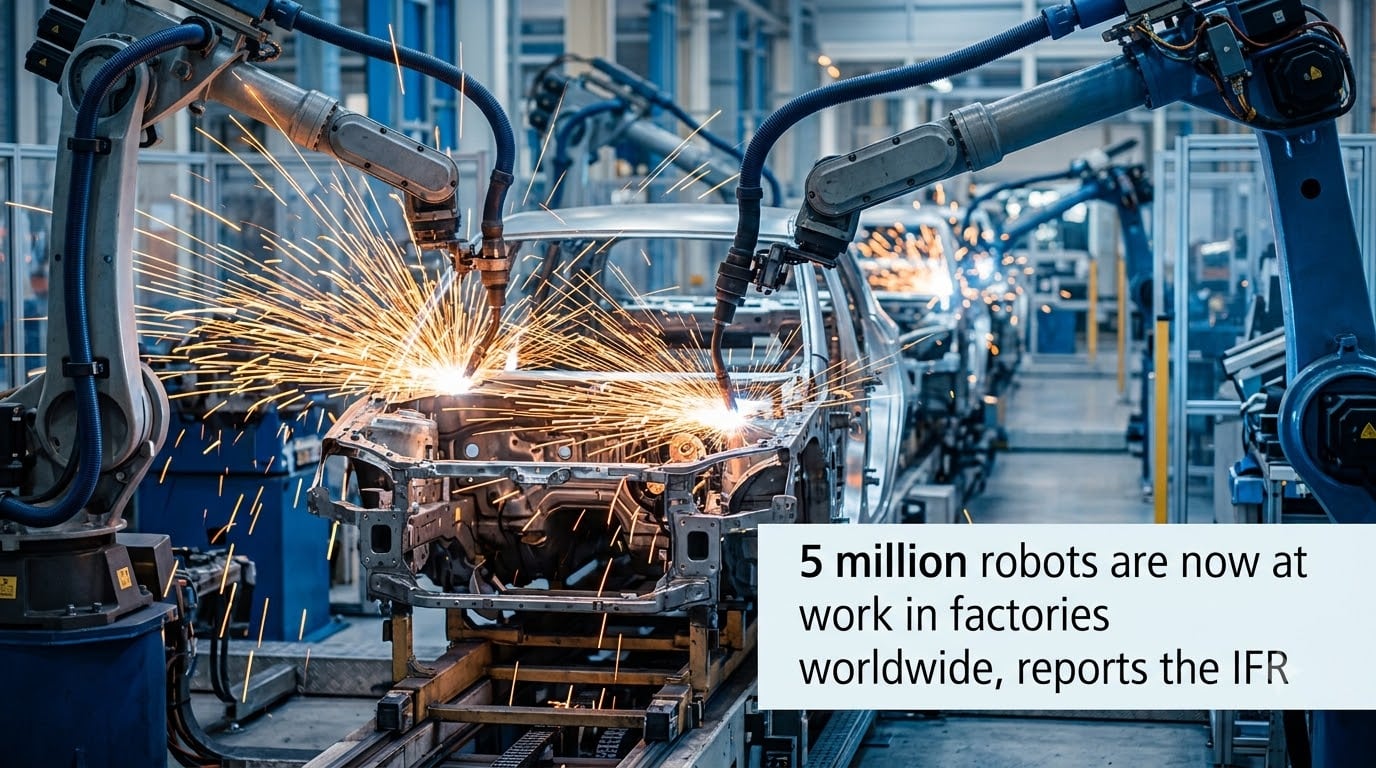
Industrial robots are no longer a glimpse of the future. According to the International Federation of Robotics, more than 5 million robots now work in factories worldwide, a record operational stock that has more than doubled in just seven years. Annual installations hit 542,076 units in 2024 alone, and the IFR expects demand to keep climbing toward 806,000 installations a year by 2029.
This is a story about the world’s most automated economies, the regions pulling ahead, and the sectors quietly reshaping how things get made. I’ll walk through the headline numbers, the country-by-country breakdown, the industries driving demand, and the technology and labor forces pushing automation forward. If you’ve followed our coverage of humanoid robots in factories, you’ll recognize many of these same forces at work, only at industrial scale.
Below is the World Robotics 2026 report, decoded.
Table of Contents
Key Statistics: The 5 Million Robot Milestone in 2026
The global operational stock of industrial robots reached a record 5 million units in 2026, a 9% jump over the previous year. Annual installations rose 11% to 542,076 units in 2024, the third consecutive year of double-digit growth in some regions and steady mid-single-digit growth worldwide.
To put the headline number in context: the IFR reported 2.4 million robots in operation in 2018. Seven years later, that figure has more than doubled, the fastest sustained expansion since the early waves of automotive automation in the 1980s. For comparison, the world’s operational stock was 1 million units in 2010, so the global installed base has quintupled in roughly 15 years.
Three terms are worth defining before we dig into the regions:
Operational stock is the total number of industrial robots currently installed and in use across factories. Annual installations counts new robots deployed in a single year. Robot density is the number of robots per 10,000 manufacturing employees, a useful way to compare automation intensity across economies of different sizes. The World Robotics report itself is the IFR’s annual statistical release, the source for every figure in this article.
The short version: more robots, faster adoption, denser factories.
Asia Remains the Center of Gravity for Robot Installations
Asia is home to the four largest industrial robot markets in the world, sometimes called the “big 4” of robotics. China, Japan, South Korea, and India together account for roughly 70% of all annual installations globally. China alone installed 295,000 units in 2024, more than every other country on earth combined.
South Korea remains the world’s most robot-dense economy, with roughly 1,000 robots per 10,000 manufacturing employees. Japan is the second-largest individual market by annual installations, though the United States recently overtook it for the number-two slot in absolute terms. India continues to post the fastest growth rate of any major market, more than 20% year-over-year, as local manufacturers scale up to serve a fast-urbanizing domestic economy.
Inside Asia, the common thread is scale plus policy. China’s multi-decade “Made in China” strategy, South Korea’s tax incentives for smart factory upgrades, and India’s Production Linked Incentive scheme have all converged to push robotics adoption into the mainstream.
China: The World’s Largest Industrial Robot Market
China installed 295,000 new industrial robots in 2024, accounting for 54% of global installations. China’s operational stock has now crossed the 2 million mark, more than the rest of the world combined if you exclude Japan, Germany, South Korea, and the United States.
Domestic suppliers now hold roughly 55% of the Chinese market, up from under 30% a decade ago. Brands like Estun, Inovance, and Siasun have moved from low-end components into articulated arms, SCARA robots, and even collaborative models for electronics assembly. The 110,000-robot gap between domestic suppliers and international suppliers narrowed further in 2024, according to the IFR.
By sector, electronics remains the largest customer for robots in China, followed by automotive (electric vehicles in particular), metal and machinery, and rubber and plastics. The growth in lithium battery manufacturing and solar panel production has been a quiet but consistent driver: both industries rely on pick-and-place, precision welding, and clean-room compatible automation that robots are uniquely suited to handle.
China’s lead isn’t accidental. The IFR attributes it to three forces working together: a national robotics strategy in place since 2015, a maturing domestic supplier base, and the ongoing wave of factory upgrades supporting electric vehicles, batteries, and consumer electronics.
The Americas: The US Overtakes Japan for Second Place
The United States installed roughly 38,000 industrial robots in 2024, overtaking Japan to become the world’s second-largest national market after China. America’s operational stock now sits near 500,000 units. Canada and Mexico together added around 9,000 units, and Brazil crossed 7,000 units in a single year for the first time.
The US figure reflects two structural shifts. First, reshoring: as labor costs rise in Asia and supply chain resilience becomes a board-level concern, US manufacturers are investing in domestic capacity, much of it automated from day one. Second, nearshoring: Mexico continues to absorb new factory construction aimed at serving the North American market, and Canada is growing its automotive and battery footprint as EV supply chains reorganize.
Brazil is the standout Latin American story. The country installed over 7,000 robots in 2024, the second-highest annual figure in its history. Automotive manufacturing is the dominant application, but the IFR notes growing adoption in food processing and pharmaceuticals as the country works to modernize its industrial base.
Tariff policy and trade tension get cited as near-term risk factors, but the IFR’s own data shows installation growth continuing across the Americas, suggesting that policy uncertainty is shifting where new factories are built rather than whether they are built.
Europe: Modest Growth With Germany Still Leading
Europe installed roughly 85,000 new industrial robots in 2024, an increase of about 5% year-over-year. The region accounts for around 16% of global installations, a stable but slow-growing share as Asia and the Americas pull ahead in absolute terms.
Germany remains the largest European market, with more than 28,000 installations in 2024, by far the biggest single country in Europe. Italy, France, Spain, and the UK round out the top five. The UK’s installation count spiked in 2023 on the back of a temporary capital investment tax credit and has since normalized; long-run UK adoption remains modest by European standards.
Germany’s automotive sector remains the single biggest customer for robots in Europe. BMW, Mercedes-Benz, Volkswagen, and their suppliers operate some of the most automated factories on the planet. Italy’s strength is in metalworking machinery, packaging, and general industry, while France is more balanced across automotive, food, and pharmaceuticals.
Europe’s slower growth rate is not a sign of stagnating automation. The region is catching up on robot density in non-automotive sectors, and the IFR expects European installations to accelerate as automotive electrification and battery production create new demand pockets.
Robot Density: The Top 10 Countries per 10,000 Manufacturing Employees
Robot density is the cleanest way to compare automation intensity across economies of different sizes. Here is the IFR’s latest ranking of the top 10 countries by robots per 10,000 manufacturing employees.
| Rank | Country | Robots per 10,000 Manufacturing Employees | Region |
|---|---|---|---|
| 1 | South Korea | 1,012 | Asia |
| 2 | Singapore | 770 | Asia |
| 3 | China | 470 | Asia |
| 4 | Germany | 429 | Europe |
| 5 | Japan | 419 | Asia |
| 6 | Switzerland | 293 | Europe |
| 7 | Sweden | 287 | Europe |
| 8 | Austria | 266 | Europe |
| 9 | United States | 295 | Americas |
| 10 | Taiwan | 220 | Asia |
South Korea is in a class of its own, the only country with more than 1,000 robots per 10,000 manufacturing workers. Singapore ranks second thanks to its electronics and precision engineering sectors, both of which run highly automated operations despite the country’s small labor force. China rounds out the top three and continues to climb every year.
Density rankings tell a different story than raw installations. China is number three in density but number one in absolute terms, because the country’s manufacturing workforce is enormous. Germany ranks fourth in density but sixth or seventh in absolute terms. South Korea is first in density but a distant fourth in annual installations behind China, the US, and Japan.
The take-away: density measures how automated a country’s existing factories are, while installations measure the pace of new automation being added. Both numbers matter, and they’re not the same.
Sector Breakdown: Where Industrial Robots Are Doing the Work
The IFR’s sector-by-sector data is where the report gets genuinely interesting, because it shows not just where robots live but what they’re doing.
Automotive remains the largest single customer for industrial robots, accounting for roughly 25% of all installations globally. Electric vehicle production has been the most active sub-driver over the past three years: battery pack assembly, motor manufacturing, and the welding and painting of new EV bodies are all robot-heavy tasks.
Electronics and semiconductors is the second-largest sector, with roughly 22% of installations. Pick-and-place, soldering, surface-mount placement, wafer handling, and final assembly are dominated by high-precision SCARA and six-axis robots, plus growing numbers of clean-room-compatible cobots.
Metal and machinery accounts for around 12% of installations, with welding, cutting, machine tending, and material handling as the main tasks. Rubber and plastics contributes about 7%, mostly through injection molding and extruder tending. Food and consumer goods, pharmaceuticals, and logistics round out the remaining share.
One quietly important trend: cobots, or collaborative robots that share workspace with humans, are growing fastest in sectors outside automotive, especially in small and medium-sized manufacturers that historically could not afford traditional industrial automation.
Why Robots Are Spreading: Technology Enablers and Labor Shortages
Two forces are pushing robot adoption faster than the raw economics would suggest: technology is making robots easier to deploy, and demographics is making them harder to avoid.
On the technology side, machine vision systems now allow robots to identify and pick unsorted parts straight from a bin, no fixturing required. AI-driven path planning reduces programming time from weeks to hours. Force-torque sensing and safety monitoring enable genuine human-robot collaboration without cages. Mobile manipulators, the same family of robots we covered in our piece on autonomous mobile robots, let factories reconfigure automation without rebuilding conveyor layouts.
On the labor side, manufacturing workforces are shrinking in most advanced economies. The IFR cites OECD data projecting a shortfall of 2 million open manufacturing jobs globally by 2030. Aging populations in Germany, Japan, South Korea, and increasingly China mean that factories cannot hire their way out of capacity constraints even when they want to.
The combined effect: robots are getting cheaper to deploy just as the alternative, more human workers, is getting harder to find. The same dynamic that drives adoption of window cleaning robots and delivery robots in service sectors is now reshaping the factory floor at industrial scale.
Outlook Through 2029: What the IFR Forecasts for Robot Demand
The IFR’s long-term forecast points to continued acceleration. Annual installations are projected to reach 806,000 units by 2029, a roughly 50% increase over the 2024 baseline. The operational stock is expected to keep growing, though at a slightly slower percentage pace as the base gets larger.
Regional growth rates will diverge. Asia will keep adding the largest absolute number of robots each year, but the Americas are forecast to grow faster in percentage terms as reshoring and nearshoring investments mature. Europe will likely continue its steady mid-single-digit growth as automotive electrification reshapes its factory footprint.
Three wildcards could shift the trajectory: the pace of humanoid robot deployment in industrial settings, the resolution of trade policy tensions affecting supply chains, and the speed of AI integration into mainstream industrial controllers. The IFR does not yet factor humanoid robots into its core forecast, a reminder that the 2029 outlook is a baseline, not an upper bound. For comparison, the precision-control and sensor-stack technology used in industrial arms is increasingly overlapping with the work happening in surgical robotics, a sign that cross-pollination between industrial and adjacent robotics categories is accelerating.
Frequently Asked Questions
Which country is no. 1 in robotics?
China is the number one country in robotics by every major measure. China installed 295,000 new industrial robots in 2024, more than half of all global installations in a single year, and its operational stock has crossed 2 million units. China is also number three in robot density globally, with 470 robots per 10,000 manufacturing employees, behind only South Korea and Singapore.
Who are the big 4 in robotics?
The big 4 in robotics refers to the four largest industrial robot markets in the world, all in Asia: China, Japan, South Korea, and India. Together they account for roughly 70% of all annual industrial robot installations worldwide. China is the largest by both absolute installations and operational stock; South Korea leads on robot density; Japan remains a major mature market; India is the fastest-growing of the four.
How many industrial robots are currently in operation worldwide?
According to the International Federation of Robotics, more than 5 million industrial robots are currently in operation in factories worldwide. The global operational stock crossed that threshold in 2025 and represents a 9% increase over the previous year. For comparison, the global operational stock was 2.4 million units in 2018, so the installed base has more than doubled in just seven years.
Who is the largest manufacturer of robots?
In China, the largest robot market in the world, domestic suppliers now hold roughly 55% of the local market, with Chinese companies like Estun, Inovance, and Siasun supplying more installed units than international competitors. Globally, the picture is mixed: Japanese suppliers (Fanuc, Yaskawa, Mitsubishi, Epson, Denso), Swiss-Swedish ABB, and German KUKA remain the dominant international brands, while Chinese domestic suppliers continue to gain share at home and expand abroad.
How many industrial robots were installed in 2024?
Industrial robot installations reached 542,076 units in 2024, an 11% increase over the previous year, according to the IFR World Robotics report. China accounted for roughly 295,000 of those installations, the United States for about 38,000, and Japan for slightly less. The IFR projects annual installations will reach 806,000 units by 2029.
What is robot density and which country has the highest?
Robot density is the number of industrial robots per 10,000 manufacturing employees, a standard measure of how automated a country’s factories are. South Korea has the highest robot density in the world at 1,012 robots per 10,000 manufacturing employees, the only country above 1,000. Singapore is second at 770, China third at 470, and Germany fourth at 429.
What 5 Million Robots in Factories Really Means for 2026
The headline number, 5 million industrial robots now at work in factories worldwide, is more than a statistical milestone. It marks the moment when industrial automation stopped being a feature of a few advanced economies and became the default posture of global manufacturing. China leads on volume. South Korea leads on density. The United States is rebuilding its domestic factory base with robots as the foundation. Germany is automating to deal with demographic constraints, not just labor cost.
For 2026 and the years immediately beyond, the IFR’s forecast is clear: more robots, faster adoption, and broader reach into sectors that have never been heavy automation users. The 5 million milestone is the floor, not the ceiling. If you’d like to see where these same technologies are landing outside the factory floor, our piece on delivery robots is a good place to start.