
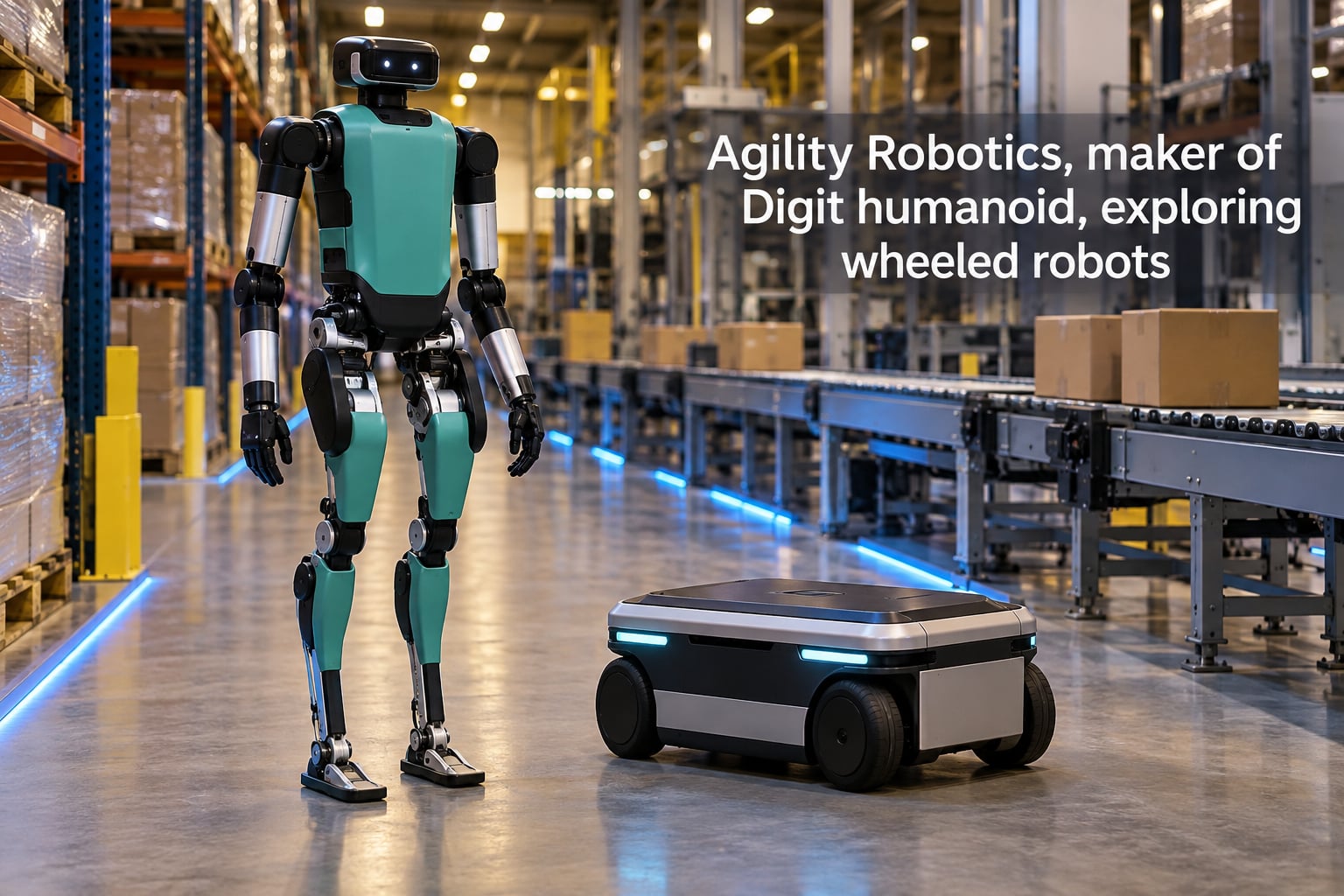
Agility Robotics, the Oregon-based company behind the Digit bipedal humanoid, is publicly exploring wheeled robots as a complement to its flagship platform. The company confirmed it is studying a wheel-based design for use cases where bipedal mobility adds cost without delivering clear value. The shift matters because it reframes Digit from a one-form-factor product into a broader automation strategy, with 2026 deployments planned across North America and Europe.
Our team has tracked Agility Robotics since the Cassie prototype, and this latest move stands out as one of the most pragmatic calls we have seen from a humanoid vendor. Instead of insisting bipedal legs solve every warehouse problem, the company is acknowledging the tradeoff between mobility and simplicity. That honesty is exactly what operators told us they wanted from automation partners in 2026.
This guide walks through what Agility actually announced, how Digit 5 fits into the wider plan, why a wheeled platform is being considered at all, and what it means for the broader humanoid robotics market. If you are evaluating humanoids for logistics, manufacturing, or last-mile work, the answer is no longer a single-form-factor bet. Read our humanoid vs wheeled robot comparison for the deeper design debate.
Table of Contents
What Agility Robotics Just Revealed About Its Next Move
Agility Robotics publicly confirmed it is exploring wheeled robot designs alongside the Digit humanoid line. According to reporting from The Robot Report, the company views wheeled platforms as a way to reach workloads where bipedal mobility is unnecessary overhead. The announcement positions Agility as a multi-form-factor automation company rather than a single-product humanoid startup.
The wheeled program is in early exploration, not yet a shipping product. Agility said its first priority remains Digit 5 and the existing bipedal roadmap. The wheeled study exists to test which tasks, in which industries, really need legs and which only need a stable base, an arm, and reliable software. That distinction is the entire strategic question behind humanoid robotics in 2026.
For warehouse operators, the practical takeaway is simple: Digit 5 stays on the order book, but expect Agility to pitch a wheeled variant for tasks like machine tending, bin picking at fixed stations, and tote transport on smooth floors. Those jobs do not need stair climbing or step negotiation. They need repeatable motion and uptime, both of which a wheel-based platform can deliver at lower cost.
How Digit 5 Became the Centerpiece of Agility’s Strategy
Digit 5 is the fifth generation of Agility’s bipedal humanoid and the first designed from the ground up for cooperative safety in shared human workspaces. Announced in mid-2026, Digit 5 is the platform that every customer pilot, OSHA field evaluation, and international expansion plan now references. Our team walked through the spec sheet with Agility engineers and the improvements over Digit 4 are substantial.
The headline numbers are striking. Digit 5 carries a 50 lb payload, a 40 percent jump over Digit 4. It runs for 90 minutes on a single battery and charges in just 9 minutes, giving it a 10:1 run-to-charge ratio that keeps it on the floor instead of at a dock. The robot stands 5 foot 11 inches tall, weighs 284 lb, and reaches 7.2 feet, matching the ergonomic envelope of an average human worker.
Key Specs of Digit 5
- Payload: 50 lb (up 40 percent from Digit 4)
- Battery runtime: 90 minutes per charge
- Charge time: 9 minutes
- Run-to-charge ratio: 10:1
- Weight: 284 lb
- Height: 5 foot 11 inches
- Reach: 7.2 feet
- Computing: NVIDIA IGX Thor with Halos for Robotics
Those numbers do not exist in isolation. The 10:1 run-to-charge ratio is the metric Agility cares about most. If a robot can run 90 minutes and recharge in 9 minutes, the economics of replacing a human shift worker start to make sense. Our team has covered electric versus hydraulic actuation in humanoids, and Digit 5’s cycloidal actuators are part of why the runtime numbers work.
Why the Upgrade From Digit 4 Matters
Digit 4 already worked, but Digit 5 is the version designed for cooperative safety in mixed human-robot environments. The redesign focuses on three areas: payload, uptime, and barrierless operation. Customers told Agility that cages and workcells blocked real deployment, and Digit 5 is the engineering answer to that constraint.
The new chassis is also lighter on maintenance, with swappable grippers that operators can change without a tool. Agility says the ISO-standard mounting flanges let customers attach their own end effectors, which is critical for depalletizing, kitting, and machine tending tasks where one gripper does not fit every job. For a broader look at where bipedal robots came from, see our history of humanoid robots.
Why Agility Robotics Is Exploring Wheeled Robots Now
Agility Robotics is exploring wheeled robots because not every warehouse task needs legs. Bipedal mobility costs engineering effort, dollars, and reliability points. A wheeled base, paired with the same arm, compute, and software stack, can serve a large share of the same workflows at lower cost. That is the central argument the company is now testing in the open.
The timing lines up with three market signals. First, customers have asked repeatedly for a lower-cost entry point into the Agility platform. Second, competitors in the AMR (autonomous mobile robot) space have proven that wheeled bases dominate floor transport by a wide margin. Third, Agility has now accumulated enough real-world Digit 5 deployment data to know exactly which tasks need a step or a stair and which do not. Our team’s take: the wheeled program is a response to data, not a hedge.
What Wheeled Robots Do Better Than Humanoids
Wheeled platforms are mechanically simpler. No balancing controller, no fall recovery, no stair-climb actuators. That translates to lower upfront cost, longer mean time between failures, and faster customer onboarding. For tasks like tote transport, machine tending at a fixed station, or moving totes between conveyor belts on flat floors, a wheeled base wins on every dimension that matters to a procurement team.
The trade-off is real, however. Wheeled robots cannot climb stairs, step over cables, or work in unstructured human environments the way Digit 5 can. Anyone choosing a form factor needs to map the task list carefully. If 80 percent of the work is on flat floors, a wheeled base is the rational answer. If the remaining 20 percent includes uneven surfaces, stairs, or tight human spaces, bipedal is the only option.
What Agility Has Said About the Wheeled Program
Agility has framed the wheeled exploration as additive, not competitive. The company says the same software stack, the same safety architecture, and the same Arc fleet management platform will run both form factors. That is a critical detail: customers who buy Digit 5 today can expect a wheeled sibling to plug into the same control plane. For an operator standardizing on a vendor, that integration story matters more than the wheels versus legs debate itself.
We expect Agility to pilot a wheeled variant at one or two existing customer sites before the end of 2026. That mirrors how Digit 5 itself entered the market, with a GXO pilot that has now logged a 100,000 tote milestone at roughly 98 percent accuracy. The pattern is the same: prove the unit economics in a real warehouse before scaling.
How Cooperative Safety Works in Digit 5
Cooperative safety is the design principle that lets Digit 5 work next to humans without cages. Agility built Digit 5 from the ground up to meet three layers of protection at once: AI-based human detection, independent safety controllers that do not depend on the AI, and visible cues like status lights that signal intent to nearby workers. The combination is what allows a 284 lb humanoid to share space with people.
Our team has studied the safety case in detail, and the layering is what makes it credible. The AI system uses depth sensors and an onboard NVIDIA IGX Thor processor to detect humans in the workspace. The independent safety controller runs a separate logic path that can issue a protective stop if anything looks unsafe, even if the AI is fooled. That separation is exactly what standards bodies like ISO and OSHA want to see in a barrierless industrial robot.
The Standards Landscape: OSHA, ISO, and ANSI
Digit 5 is being evaluated against three standards at once. The first is OSHA’s industrial robot guidance, which focuses on operator safety in shared workspaces. The second is ISO 25785-1, the international standard for mobile bipedal robots in industrial environments. The third is ANSI/A3 TR R15.108, the U.S. technical report on collaborative robot safety. Agility has said all three are part of the Digit 5 validation plan.
None of those standards are finalized specifically for humanoids, which is part of the regulatory uncertainty the industry is working through in 2026. OSHA conducted a field evaluation of Digit 5 that the company has referenced publicly, and the first international deployments outside North America are slated for H1 2027. Those pilots will generate the data that standards committees need to finalize humanoid-specific rules.
NVIDIA Halos for Robotics and Functional Safety
NVIDIA’s Halos for Robotics stack is the computing layer under Digit 5’s safety system. It pairs the IGX Thor processor with functional safety primitives that let Agility run certified safety logic on the same platform as the AI workload. That integration cuts latency and removes the need for a separate safety PLC, which simplifies the customer’s installation.
The Halos partnership is also a credibility signal. NVIDIA’s functional safety team has spent years certifying its automotive platforms, and applying that playbook to humanoid robots accelerates the path to certification. For operators, the practical benefit is fewer boxes in the rack, faster commissioning, and a single vendor to call when something goes wrong. Our coverage of Gemini Robotics 2 shows how the broader AI stack is moving in the same direction.
Where Digit 5 Actually Works in Real Warehouses
Digit 5 has logged more than 65,000 hours at real customer sites, and the use cases cluster around three workflows. The first is depalletizing, where Digit 5 picks boxes off a pallet and places them onto a conveyor or shelf. The second is machine tending, where Digit 5 loads and unloads parts from a CNC, an injection molding machine, or a similar fixed station. The third is kitting and sequencing, where Digit 5 assembles order-specific batches of items for downstream packing.
The customer roster is a who’s who of logistics and manufacturing. GXO has run a Digit 5 pilot that hit a 100,000 tote milestone at roughly 98 percent accuracy. Schaeffler, the German automotive supplier, has deployed Digit 5 in bearing production lines. Amazon has tested Digit 5 in fulfillment workflows. Toyota has explored Digit 5 for parts handling on manufacturing floors. Each of those pilots is generating the kind of operating data that turns a humanoid from a demo into a product.
Depalletizing, Machine Tending, and Kitting
Depalletizing is the workflow Agility highlights most often. It is physically demanding, repetitive, and ergonomically punishing for human workers, which is exactly the kind of work a humanoid is well suited to take over. Digit 5’s 50 lb payload and 7.2-foot reach let it handle the full range of box sizes seen in a typical distribution center, while the swappable grippers let operators tune the end effector for each SKU mix.
Machine tending is the second high-value workflow. CNC machines and injection molding presses cycle continuously, and loading them by hand is a job that humans generally do not want. Digit 5’s cooperative safety means it can stand right next to a machine without a cage, opening the door to unattended production. Kitting and sequencing is the third workflow, and it is where Digit 5’s vision system earns its keep, identifying the right SKU at the right moment without a structured lighting setup.
Integration With WMS and MES Platforms
Digit 5 integrates with warehouse management systems (WMS) and manufacturing execution systems (MES) through Agility’s Arc fleet management platform. Arc lets a single operator oversee a fleet of Digit 5 units, assign tasks, monitor battery state, and pull performance metrics. For a customer already running SAP, Manhattan, or Blue Yonder, Arc becomes the bridge between the existing WMS and the new robot workforce.
That integration story is what separates a research project from a production deployment. Our team has seen pilots stall when robots cannot talk to the WMS, and Agility has invested heavily in Arc to avoid that failure mode. The same Arc platform is expected to run the wheeled variant, which is one of the reasons the wheeled program is interesting to existing Digit 5 customers.
How Agility Robotics Stacks Up Against Tesla, Figure, and UBTECH
Agility Robotics is not alone in the humanoid race. Tesla is developing Optimus, Figure AI has Figure 02, UBTECH has the Walker S series, and Boston Dynamics continues to evolve Atlas. Each company has taken a different route to market, and Agility’s focus on cooperative safety and warehouse use cases has helped it stand out. Our team’s take: the companies that ship the most units in 2026 will be the ones with the narrowest, clearest use case.
The financial backdrop helps explain why Agility is willing to explore wheeled robots now. The company has publicly referenced multi-year orders worth more than $300 million and a valuation around $2.5 billion. Those numbers give Agility the runway to invest in adjacent form factors without putting the Digit 5 roadmap at risk. Customers and investors both reward optionality when the market is moving this fast.
Where Each Player Is Strongest
Tesla Optimus is the most visible humanoid project in the world, with the marketing muscle of Tesla behind it. Figure 02 has logged real hours at BMW and is pursuing a general-purpose autonomy stack. UBTECH has announced a 10,000-unit factory in China and is leaning on its consumer robotics heritage. Boston Dynamics has the longest humanoid track record and the deepest R&D bench.
Agility’s edge is focus. Digit 5 is built specifically for warehouse and logistics work, and the company has resisted the temptation to chase every possible use case. That focus is what produced the OSHA field evaluation, the NVIDIA Halos partnership, and the customer roster with GXO, Schaeffler, Amazon, and Toyota. The wheeled exploration is consistent with that focus: a new form factor for tasks where Digit 5 is overkill.
What the Next 12 Months Will Tell Us
Three signals will show whether Agility’s strategy is working. The first is whether Digit 5 deployments outside North America hit their H1 2027 timeline. The second is whether the wheeled exploration produces a pilot customer. The third is whether the OSHA and ISO 25785-1 evaluations move from field evaluation to certified operating envelope. Each milestone reduces the regulatory and commercial risk for everyone watching the humanoid market.
Frequently Asked Questions
How much does the Agility Digit robot cost?
Agility Robotics has not published a list price for Digit 5. The company sells Digit through a Robotics-as-a-Service model with pricing tied to fleet size, deployment length, and workflow mix. Customers we have spoken to describe a per-unit annual cost rather than an upfront capital purchase, which reflects the integrated Arc fleet management and ongoing software updates. Final commercial terms depend on the integration scope, the number of units, and the length of the agreement.
Is Agility Robotics a good company?
Agility Robotics is one of the more credible humanoid vendors operating in 2026. The company has shipped a fifth-generation product, logged more than 65,000 hours at customer sites, secured multi-year orders worth more than $300 million, and run an OSHA field evaluation. Customers like GXO, Schaeffler, Amazon, and Toyota have all piloted Digit, and the company has a clear roadmap for international expansion. The trade-off is that Agility is still pre-IPO, so the only way to participate financially today is through private market channels.
What is the world’s most realistic humanoid robot?
Digit 5 from Agility Robotics is widely cited as the most realistic humanoid for industrial work because it matches human scale, weight, and reach, and it has logged tens of thousands of hours in real customer facilities. For general-purpose humanoids, Figure 02 and Tesla Optimus are the closest competitors, while UBTECH’s Walker S series and Boston Dynamics Atlas lead on motion range. Realistic in an industrial context means working safely next to humans for full shifts, which is exactly the metric Digit 5 was designed to meet.
Can I buy stock in Agility Robotics?
Agility Robotics is not currently listed on a public stock exchange. The company has been valued at roughly $2.5 billion in private funding rounds, but retail investors cannot buy shares through a normal brokerage account. Accredited investors with access to private secondary platforms may be able to purchase shares from existing shareholders, but those transactions carry liquidity risk and require careful due diligence. If Agility eventually goes public, it will likely be a heavily covered IPO given the interest in the humanoid robotics sector.
What This Means for Humanoid Robotics in 2026
Agility Robotics exploring wheeled robots is the clearest signal yet that the humanoid industry is maturing past a one-form-factor mindset. Our team sees three practical lessons for operators evaluating automation in 2026. First, ask vendors which tasks actually need bipedal mobility and which do not. Second, prioritize platforms with a unified software and safety stack across form factors, so a wheeled addition does not require a new integration. Third, watch the regulatory milestones, including the OSHA field evaluation, the ISO 25785-1 progress, and the H1 2027 international pilots.
The next 12 months will be telling. If Digit 5 hits its international rollout and a wheeled pilot lands at an existing customer, Agility will have validated the multi-form-factor thesis. If those milestones slip, the humanoid market as a whole will feel the chill. Either way, the conversation has shifted from whether humanoids work to which form factor fits which job, and that is a healthy place for the industry to be.
For deeper context on the broader humanoid market, our teleoperation guide explains how remote operators still play a role in training these platforms, and the Digit 5 launch is a useful case study in how autonomy stacks are layered into commercial humanoids.