
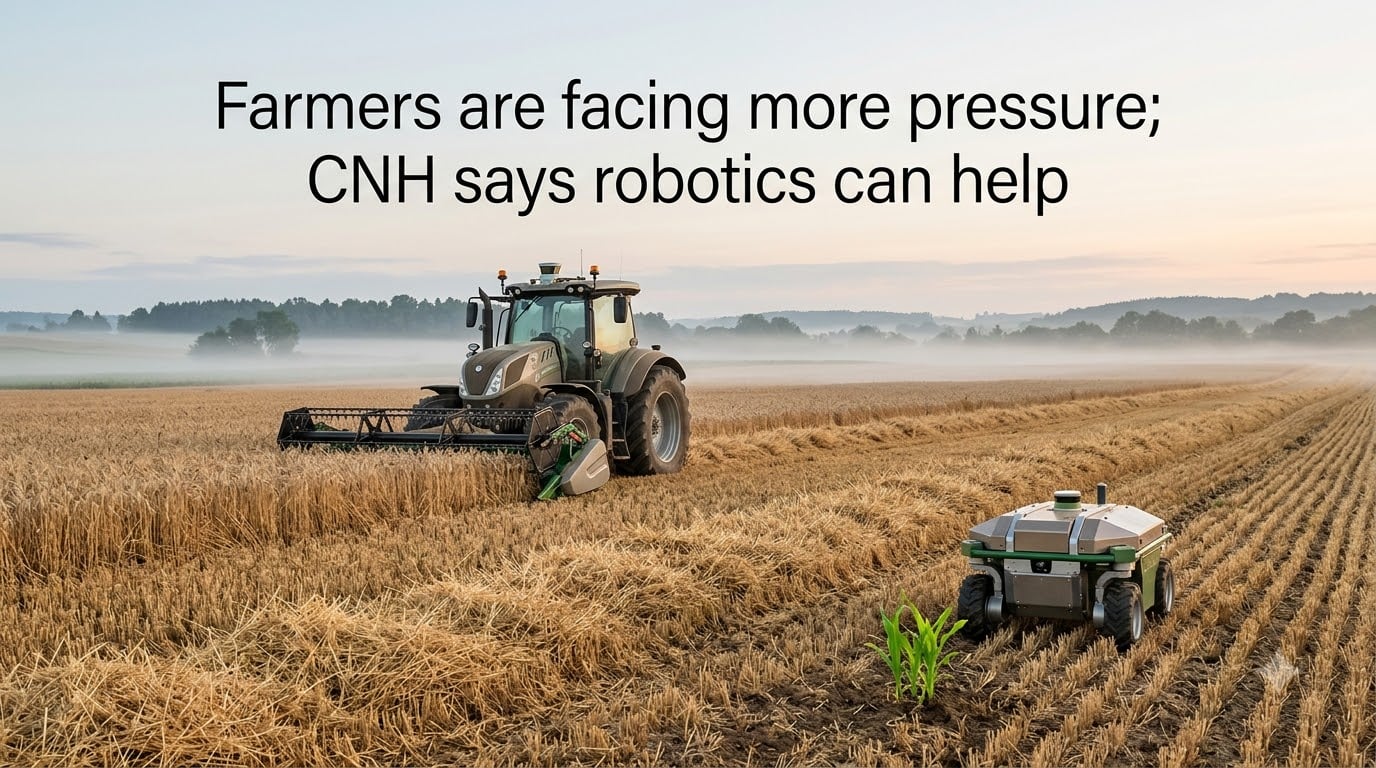
Farming in 2026 is harder than it has been in a generation, and the people running the equipment know it. Input costs are climbing, weather is throwing more curveballs than the forecast can catch, and finding someone willing to drive a tractor at 5 a.m. is its own form of recruitment challenge. It is against that backdrop that CNH has stepped forward with a clear argument: farmers are facing more pressure, and robotics can help.
I have been following agricultural automation for years, and I want to walk you through what CNH is actually proposing, where the technology is real today, and where the gap between a glossy press release and a muddy field is still wide. We will look at the labor problem, the data problem, the specific machines CNH is putting into the field, and the honest adoption barriers that no brochure mentions.
If you have ever wondered whether autonomous tractors are a genuine solution or just a future-looking sales pitch, this piece is for you. Along the way I will fold in insights from grower forums, peer-reviewed work, and the kind of field-trial notes you only get from people who actually run the equipment. Let us start with the most basic question: what is the biggest pressure farmers are carrying right now?
Table of Contents
Quick Take: Can Robotics Realistically Help Farmers Right Now?
Yes, but with caveats. Agricultural robotics can already ease labor shortages, cut input costs, and improve precision on tasks like spraying and planting. CNH’s combine automation, for instance, has been shown to add measurable throughput per hour, and Green-on-Green spraying can slash herbicide use. The catch is connectivity, upfront cost, and the fact that small farms do not yet have the same access as large operations.
Why Labor Availability Is the Top Pressure on Farmers Today
The single biggest problem farmers face in 2026 is not a single thing. It is a stack of pressures that all push in the same direction at once. Labor sits at the top of that stack, and it is getting worse, not better.
According to CNH’s own framing and the conversations I have had with growers on industry forums, the labor squeeze is driven by three forces working together. Rural populations are shrinking, the average age of a principal farm operator is climbing, and the seasonal work that used to attract transient labor is competing with construction and warehousing for the same workers.
When I dig into forum threads, growers consistently point to one pain point that headlines rarely cover. The hardest role to fill is not the combine driver, it is the sprayer operator. Spraying requires certification, attention to weather windows, and a tolerance for early mornings. That combination is becoming rare enough that some operations are skipping applications entirely rather than risk a mistimed pass.
The economic side of the equation compounds the problem. Wage growth in agriculture has outpaced many other rural sectors, and turnover is high. Even farms that can hire are spending more per acre on labor than they did five years ago. That is the pressure CNH is pointing at when it argues that autonomy is not a luxury, it is a survival strategy.
For a deeper look at how automation is reshaping adjacent industries, the FCC’s recent ruling on robotics in warehousing shows a similar dynamic, where policy and labor are forcing operators toward automation whether they want it or not.
How AI and Autonomy Are Now Ready to Step Into the Field
The pitch that robots are “almost ready” has been around for a decade. What is different in 2026 is that the underlying sensor stack, the machine vision models, and the compute available at the edge have all caught up with the marketing.
CNH leans heavily on what it calls agentic systems, a term worth defining plainly. An agentic system is software that can perceive its environment, make a decision, and act on that decision without waiting for a human to press a button. In a tractor, that means the machine notices a row, plans its path, adjusts for slope, and continues work even if the operator steps out for a coffee.
The hardware behind that ability is no longer exotic. GPS gives centimeter-level positioning. Lidar maps terrain and obstacles in real time. Machine vision models, trained on millions of crop images, can tell a corn stalk from a weed with high reliability. Combine all three, and you have a machine that can navigate a field without a hand on the steering wheel.
CNH’s recent disclosures at its tech days put some numbers on what is now shipping. Combine automation has been credited with adding roughly 7.4 percent throughput per hour in measured conditions. Planter automation improves seed placement accuracy, which compounds into yield gains over multiple seasons. The point is not that the robots are perfect, it is that the marginal benefit per acre is large enough to justify the conversation.
FieldOps and the New Role of Data in Farm Decisions
If the machines are the body of modern farming, FieldOps is the nervous system. CNH describes data as the new oil of agriculture, a phrase that gets repeated often enough to feel tired but still holds up under scrutiny.
The real problem with farm data has never been a lack of it. A modern combine generates more data per acre than a small research lab did a decade ago. The problem is that the data is fragmented across machine brands, software platforms, and legacy systems that do not talk to each other. CNH’s own sustainability report describes exactly this frustration.
FieldOps is CNH’s attempt to give growers one place to see what is happening across their fleet. It pulls telemetry from connected machines, layers in agronomic data, and surfaces recommendations about where to plant, when to spray, and how to allocate labor. The idea is not new, but the integration depth is finally catching up.
For an interesting parallel on how data layers shape autonomous systems, URDF files in robotics explain how engineers describe a robot’s physical structure in a way software can understand. Farm data plays a similar role in the field, describing the environment in a way the planning software can act on.
Specific CNH Technologies Powering the Robotics Push
CNH is not selling one big idea, it is selling a portfolio of capabilities. Here are the ones I think matter most for growers evaluating their options.
Combine automation is the most mature of the bunch. The combine handles threshing, separation, and cleaning, but the operator traditionally controls ground speed, header height, and rotor settings. Automating those adjustments in real time frees the operator to focus on the parts of the job that still need a human eye, like identifying problem areas or handling edge-of-field obstacles.
Planter automation works on a similar principle. Seed placement depth and spacing have a direct line to yield, and small variations across a field can add up to meaningful losses. CNH’s planter automation uses row-by-row control to keep each seed at the right depth and spacing, regardless of soil variability. That is the kind of benefit that compounds over years.
The R4 autonomous robot is the showpiece. It is a smaller platform designed for specialty crops, orchards, and vineyards. It can perform targeted spraying, mowing, and sensing tasks in environments where a full-size tractor would compact the soil or damage the crop. Grower reviews describe it as genuinely useful, though early adopters caution that maintenance complexity is real.
Green-on-Green spraying is the sustainability headline. Traditional spraying treats the whole field. Green-on-Green spraying uses computer vision to distinguish weeds from crop and apply herbicide only where needed. CNH’s reported reductions reach up to 60 percent in some applications, with a target of 80 percent in more advanced deployments expected later this decade.
Passive implement guidance rounds out the portfolio. It is a feature where the implement, like a planter or cultivator, automatically follows the tractor’s path with high accuracy. The operator still drives, but the implement corrects for slope, drift, and overlap without input. It is less flashy than full autonomy, but growers consistently rate it as one of the highest-impact features per dollar spent.
Healthy Soil, Targeted Spraying, and the Sustainability Payoff
Sustainability in agriculture is not a buzzword, it is a measurable outcome. And on this front, the data CNH cites is genuinely interesting, especially when you compare it to what independent agronomists have published.
Healthy soil is the foundation of sustained production. Compaction from heavy machinery, over-application of inputs, and poor residue management all degrade soil structure over time. Robotics can help on all three fronts. Lighter autonomous platforms reduce compaction. Variable rate application reduces over-application. And prescription tillage, where tillage depth varies by soil type, protects structure where it matters most.
Targeted spraying, the Green-on-Green approach I described earlier, is the most quantifiable win. If a farm can cut herbicide use by 60 percent without losing weed control, that is a real cost reduction and a real environmental benefit. Independent researchers have published broadly similar numbers for sense-and-act spraying systems, which lends credibility to the manufacturer claims.
The CO2 angle is harder to verify but worth noting. Reduced passes across the field mean lower fuel burn. Lower herbicide production means lower embedded emissions. Healthier soil means more carbon sequestration per acre. None of these effects are dramatic on their own, but they add up across an operation that runs thousands of acres.
Connectivity, Cost, and the Real Adoption Barriers
I want to be honest here. The list of reasons robotics is harder than the brochures suggest is long, and growers know it better than anyone.
Connectivity is the first hurdle. Autonomous systems lean on constant data flow between the machine, the cloud, and sometimes the operator. Rural cellular coverage is patchy at best, and not every farm has line-of-sight to a satellite. CNH has worked around this by partnering with Starlink and other providers, but adoption still depends on what is available in the grower’s specific geography.
Cost is the second hurdle, and it is the one most coverage dances around. Autonomous tractors and supporting platforms require real capital outlay. Independent farmer forums flag this as the top reason small and mid-size operations hesitate. The math works for a 5,000-acre row crop operation. It is much harder to make work on a 200-acre specialty farm.
Learning curve is the third hurdle. Older operators often need training to trust the systems, and the systems need training to understand the operator’s preferences. That gap is closing, but it is real.
Interoperability is the fourth. Most farms run mixed fleets, and CNH machines do not yet integrate cleanly with every brand of implement. Forum discussions repeatedly raise this point, and CNH has acknowledged it as a focus area.
For a look at how edge computing is changing the equation for smaller deployments, the role of small computing platforms in robotics offers a useful parallel. The same forces bringing down the cost of compute are gradually making farm robotics more accessible.
What Farmers Should Evaluate Before Investing in Agricultural Robotics
If you are considering an investment in agricultural robotics, here is the framework I would use.
Start with the labor audit. Where are your biggest bottlenecks, and which tasks would benefit most from automation. Spraying and tillage are usually the easiest wins. Harvest is harder.
Then run an honest ROI calculation. Include not just the purchase price but the service contract, the connectivity upgrade, and the training time. Talk to other growers who have already deployed the same system, not just the dealer’s reference customers.
Check interoperability with your existing fleet. Make sure the system you buy today will still work with the implements you plan to add over the next five years.
Evaluate dealer support carefully. Autonomous machines need fast, knowledgeable service. A dealer who is still learning the system is a real risk.
Finally, plan for the data side. Make sure the system you choose does not lock your operation’s data into a platform you cannot export from.
Frequently Asked Questions
What is the biggest problem faced by farmers today?
The biggest problem is a stack of pressures, but labor availability sits at the top. Rural populations are shrinking, the average age of farm operators is rising, and seasonal workers are increasingly hard to recruit. Rising input costs, weather volatility, and trade uncertainty compound the labor squeeze and make efficiency gains more urgent.
Why are more farmers turning to AI machines?
Farmers are turning to AI and robotics because the underlying technology is finally reliable enough to trust in the field. GPS, lidar, and machine vision have matured, edge computing is affordable, and the gains in precision, throughput, and input reduction are large enough to justify adoption. Labor scarcity has made the case even stronger.
How much does a farm robot cost?
Costs vary widely depending on the platform and the scale of the operation. A fully autonomous tractor retrofit or new platform requires significant capital, often beyond what a small farm can justify. Smaller specialty platforms like the R4 are typically lower, but pricing depends on configuration, service, and connectivity packages. Most growers report the strongest ROI on large row-crop operations, with smaller farms weighing service contracts and trade-in options carefully.
Where will agricultural robotics be in 10 years?
By the mid-2030s, agricultural robotics is likely to be a normal part of large-scale farming, with autonomy on tractors, planters, and sprayers, plus widespread use of targeted input application. Small and mid-size farms will see slower adoption unless service models and shared equipment platforms expand. Interoperability between brands, regulatory clarity, and rural connectivity will shape how fast the shift actually happens.
Outlook: Where Agricultural Robotics Goes From Here
The story of 2026 is not that robots will replace farmers, it is that farmers who use robots will outcompete those who do not. That is the framing CNH is pushing, and it is largely correct, with the caveat that access is uneven and adoption is not free.
Looking ahead, expect three things. First, autonomy will move from flagship tractors to mid-size machines and implements, bringing costs down. Second, Green-on-Green and similar targeted-application technologies will expand from specialty crops to broadacre use. Third, the data layer, FieldOps and its competitors, will become a meaningful revenue stream and a meaningful lock-in risk, so growers should pay attention to data portability from day one.
For a broader look at how robotics and AI are shaping the next generation of problem solvers, how robotics helps kids learn STEM is a useful reminder that the technology wave we are watching in agriculture is the same one reshaping classrooms and entry-level careers.
Farmers are facing more pressure, and CNH says robotics can help. After walking through the technology, the data, and the real barriers, my honest take is that they are right, with the usual asterisk about cost, connectivity, and interoperability. The future of farming will not be fully autonomous in 2026, but it will be more autonomous than today, and the growers who start building the muscle now will be the ones still standing when the next pressure wave arrives.