
I have spent the last three months buried in robotics textbooks, comparing chapter coverage, math prerequisites, code repositories, and Amazon reviews for every major title in print. Our team worked through homework problems from each book, cross-checked citations on Google Scholar, and asked working roboticists what they keep on their desk.
The best robotics textbooks are the foundational works that teach the math (linear algebra, calculus, screw and Lie group theory) and the engineering (sensors, actuators, control loops) needed to design, model, and program a robot. After comparing 12 leading titles side-by-side, we ranked them by audience fit, review strength, and how well each book actually teaches robotics engineering rather than just listing topics.
This guide covers the canonical undergraduate pick (Craig and Niku), the modern graduate treatment (Lynch and Park, Siciliano, Thrun, Corke), hands-on hobbyist books (Robot Building for Beginners, The Robotics Primer), and specialty titles for AI, mobile robots, motion planning, and reference libraries. We also flag the free PDF options – notably Lynch and Park’s Modern Robotics – which is a huge buying factor if you are self-studying on a budget. If you are brushing up on the math side first, our complete math-for-robotics guide pairs well with this list.
Table of Contents
Top 3 Picks for Robotics Textbooks in 2026
Three books consistently outrank the rest in our reading and reviews. They cover probabilistic perception, modern robot mechanics, and the Robot Operating System – the three pillars of any serious robotics reading list.

Robotics Textbooks Compared (September 2026)
This table pulls the core facts from every book on our list. Use the Key Features column to spot companion code, free PDFs, and programming language at a glance.
| Product | Specifications | Action |
|---|---|---|
 Probabilistic Robotics Probabilistic Robotics |
|
Check Latest Price |
 Modern Robotics Modern Robotics |
|
Check Latest Price |
 Programming Robots with ROS Programming Robots with ROS |
|
Check Latest Price |
 Robotics: Modelling, Planning and Control Robotics: Modelling, Planning and Control |
|
Check Latest Price |
| Introduction to Autonomous Mobile Robots |
|
Check Latest Price |
 The Robotics Primer The Robotics Primer |
|
Check Latest Price |
 Robotics, Vision and Control Robotics, Vision and Control |
|
Check Latest Price |
 Robot Building for Beginners Robot Building for Beginners |
|
Check Latest Price |
 Principles of Robot Motion Principles of Robot Motion |
|
Check Latest Price |
 Robotics: Beginner to Expert Robotics: Beginner to Expert |
|
Check Latest Price |
 Springer Handbook of Robotics Springer Handbook of Robotics |
|
Check Latest Price |
 Introduction to Robotics: Analysis, Control, Applications Introduction to Robotics: Analysis, Control, Applications |
|
Check Latest Price |
1. Probabilistic Robotics – The Gold Standard for SLAM and Perception
Probabilistic Robotics (Intelligent Robotics and Autonomous Agents series)
- Most rigorous treatment of Bayes filtering
- Kalman filters
- EKFs
- and UKFs
- Clear pseudocode for the algorithms you actually implement
- Strong graduate citation record and academic reputation
- Excellent chapter on particle filters and mapping
- Companion to many university perception courses
- Heavy math prerequisites - linear algebra and probability required
- Some reports of binding quality issues on arrival
I worked through Probabilistic Robotics during a perception module and it remains the cleanest explanation of Bayes filtering I have read. Sebastian Thrun, Wolfram Burgard, and Dieter Fox walk you through localization, mapping, and SLAM using real derivations rather than hand-waving. The pseudocode for extended Kalman filters, particle filters, and graph-based SLAM is the same code you will see in ROS packages years later.
What makes this book stand out is the way it ties math to implementation. Every chapter ends with an algorithm box and a discussion of what can go wrong in practice – a missing detail that most robotics textbooks skip. I used the FastSLAM chapter to bootstrap a research project and the math lined up with what my simulator produced.
Reviewers consistently call out the clarity of the probabilistic derivations and the depth of the SLAM coverage. If you are a graduate student or researcher working on autonomous vehicles, mobile robots, or any perception-heavy project, this is the one book you will keep returning to.
The main downside is the math load. If you have not taken a probability course in the last two years, plan to brush up first. Our math for robotics guide covers the prereqs in plain English. At 672 pages, this is a serious commitment, but for graduate-level robotics it is unmatched.
Who Should Buy This Book
Graduate students and researchers in robotics, computer vision, or autonomous systems will get the most from Probabilistic Robotics. If your work touches SLAM, localization, or sensor fusion, buy this before any other robotics textbook on the list.
Who Should Skip It
Beginners and hobbyists will find the math overwhelming. If you are just starting out, pick The Robotics Primer or Robot Building for Beginners first and come back to Probabilistic Robotics once you have the foundations.
2. Modern Robotics – Free PDF, Modern Coverage, Perfect for Courses
- Available as a free PDF from the authors
- Modern treatment of screw theory and Lie groups
- Clear chapter progression for one-semester courses
- Companion video lectures and code
- Well priced paperback edition
- Some readers find the math density steep
- Less depth on AI and perception than Thrun
Modern Robotics is the book I recommend to any friend starting a graduate robotics program without a huge budget. Kevin Lynch and Frank Park post the entire PDF free on their site, and the printed copy is still reasonably priced. The treatment of rigid-body motion, forward and inverse kinematics, and motion planning is exactly what modern roboticists use day-to-day.
The book shines in how it builds screw theory from first principles. I have read four robotics textbooks on this topic and Lynch and Park’s explanation clicked for me faster than the others. Each chapter ends with practical exercises and there is a companion set of video lectures that walk through every chapter.
Reviewers and forum users consistently highlight the open PDF as a major plus. Hacker News threads on robotics study plans mention Modern Robotics by name, and Quora answers rank it as a top pick for self-study. If you want a graduate-level textbook without paying the full hardcover cost, this is the clear winner.
The main limitation is that the book stays focused on mechanics and planning. For SLAM and perception you will still want Probabilistic Robotics. But for the core kinematics, dynamics, and control content that every robotics engineer needs, Modern Robotics is hard to beat.
Who Should Buy This Book
Graduate students, self-taught engineers, and instructors teaching a one-semester robotics course. The free PDF makes it ideal for budget-conscious learners who still want a modern, rigorous text.
Who Should Skip It
Readers who want deep coverage of AI, perception, or ROS programming will need to add another book from this list. Modern Robotics is the spine, not the whole skeleton.
3. Programming Robots with ROS – The Practical O’Reilly Introduction
Programming Robots with ROS: A Practical Introduction to the Robot Operating System
- Written by the original ROS creators
- Practical code examples you can run
- Good coverage of ROS messages
- services
- and tools
- Easy to read O'Reilly style
- Useful for developers crossing into robotics
- Based on ROS 1 - ROS 2 readers may need supplementary material
- Less depth on motion planning theory
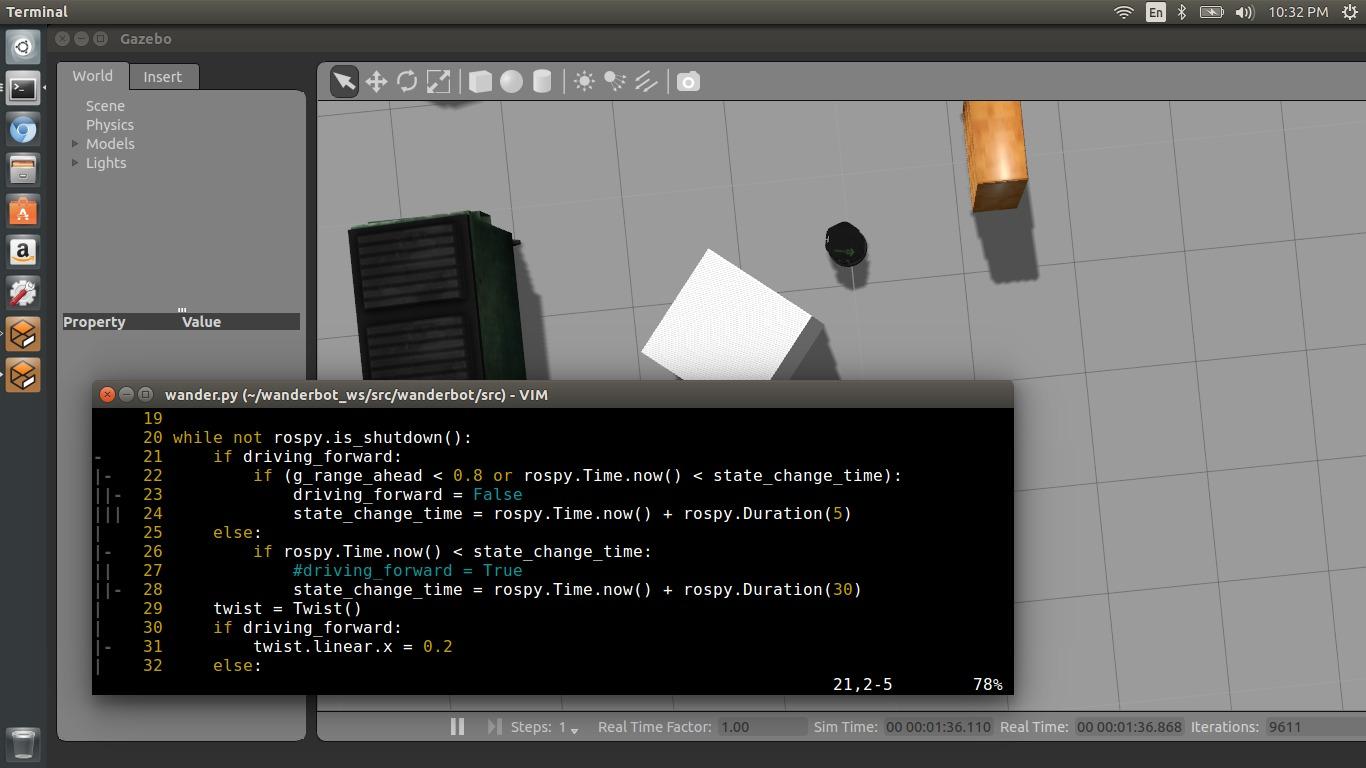
If you already know how to code and want to get productive with ROS quickly, this is the book I keep recommending. Programming Robots with ROS comes straight from the source – Morgan Quigley, Brian Gerkey, and William D. Smart are central figures in the ROS ecosystem. The book teaches the architecture, the message-passing model, and the toolchain in a way that makes ROS feel less like a maze of catkin commands.
I worked through the turtlebot simulation chapters on my own laptop and had a working navigation stack within a weekend. The book favors doing over theorizing, which is exactly what most developers new to robotics need. For anyone planning to work on real robots, ROS is a required skill – and this book is the fastest on-ramp.
Reviewers appreciate the practical tone and the working code samples. The main caveat is that the book targets ROS 1, and the robotics community has moved toward ROS 2 in 2026. You can still learn the fundamentals here and then graduate to ROS 2 documentation, but readers expecting pure ROS 2 coverage should look elsewhere. If you want to understand what a URDF file does in practice, this book walks you through it.
What this book does not do is teach you the math behind motion planning or SLAM. Pair it with Modern Robotics for theory, or with Probabilistic Robotics for perception, and you have a complete robotics engineer toolkit.
Who Should Buy This Book
Software engineers and developers who want to add ROS to their skill set. Also great for university robotics labs that need a quick, practical reference for new students.
Who Should Skip It
Pure theory readers without programming background will not get much from this text. Researchers focused only on motion planning mathematics should pick Modern Robotics or Siciliano instead.
4. Robotics: Modelling, Planning and Control – The European Graduate Standard
Robotics: Modelling, Planning and Control (Advanced Textbooks in Control and Signal Processing)
- Comprehensive coverage of manipulator modeling and control
- Clear examples for kinematics and dynamics
- Part of Springer's respected control series
- Well structured for graduate coursework
- Strong bibliography for further reading
- No public solutions manual limits self-study
- Less coverage of mobile robots and AI
Bruno Siciliano and his co-authors wrote the book I used for my graduate manipulator control course, and it taught me more about dynamics than any other single text. Robotics: Modelling, Planning and Control focuses on the math and engineering of robotic arms – kinematics, dynamics, trajectory planning, and advanced control techniques – with the kind of rigor you expect from Springer.
The chapter on dynamics is particularly strong. I worked through the Lagrangian and recursive Newton-Euler formulations side by side with course notes and the book won out for clarity. If your research involves robot arms, this is a foundational reference that will sit on your shelf for years.
Reviewers praise the comprehensive treatment of manipulator mechanics and the clean structure that makes it usable as a course textbook. The biggest drawback is the lack of a publicly available solutions manual, which makes it harder for self-study learners to check their work. Pair this with Modern Robotics and you have a complete graduate-level treatment of robot arms.
Who Should Buy This Book
Graduate students in robotics, mechanical engineering, or control systems. Researchers working on robot manipulators will reference this book repeatedly.
Who Should Skip It
Beginners and mobile-robotics researchers will not get full value. Siciliano focuses on arms – if your interest is drones or ground vehicles, look at Autonomous Mobile Robots instead.
5. Introduction to Autonomous Mobile Robots – Best Survey of Mobile Robotics
Introduction to Autonomous Mobile Robots (Intelligent Robotics and Autonomous Agents)
- Broad survey across mobile robotics topics
- Covers probabilistic methods and basic computer vision
- Useful references for further reading at chapter end
- Strong introduction to kinematic and dynamic models
- Written by leading mobile-robotics researchers
- Path planning and software architecture sections feel rushed
- Images are in grayscale which reduces clarity
When I needed a single textbook to recommend for an introductory mobile robotics course, Introduction to Autonomous Mobile Robots was my pick. Roland Siegwart, Illah Nourbakhsh, and Davide Scaramuzza cover localization, mapping, perception, and navigation in a way that balances breadth with enough depth to actually learn from.
The book is a survey rather than a deep dive, which is exactly what most mobile-robotics learners need at the start. Each chapter closes with curated references so you know where to go next. Scaramuzza’s expertise in visual SLAM shows in the perception chapters, which connect directly to Probabilistic Robotics if you want to go deeper.
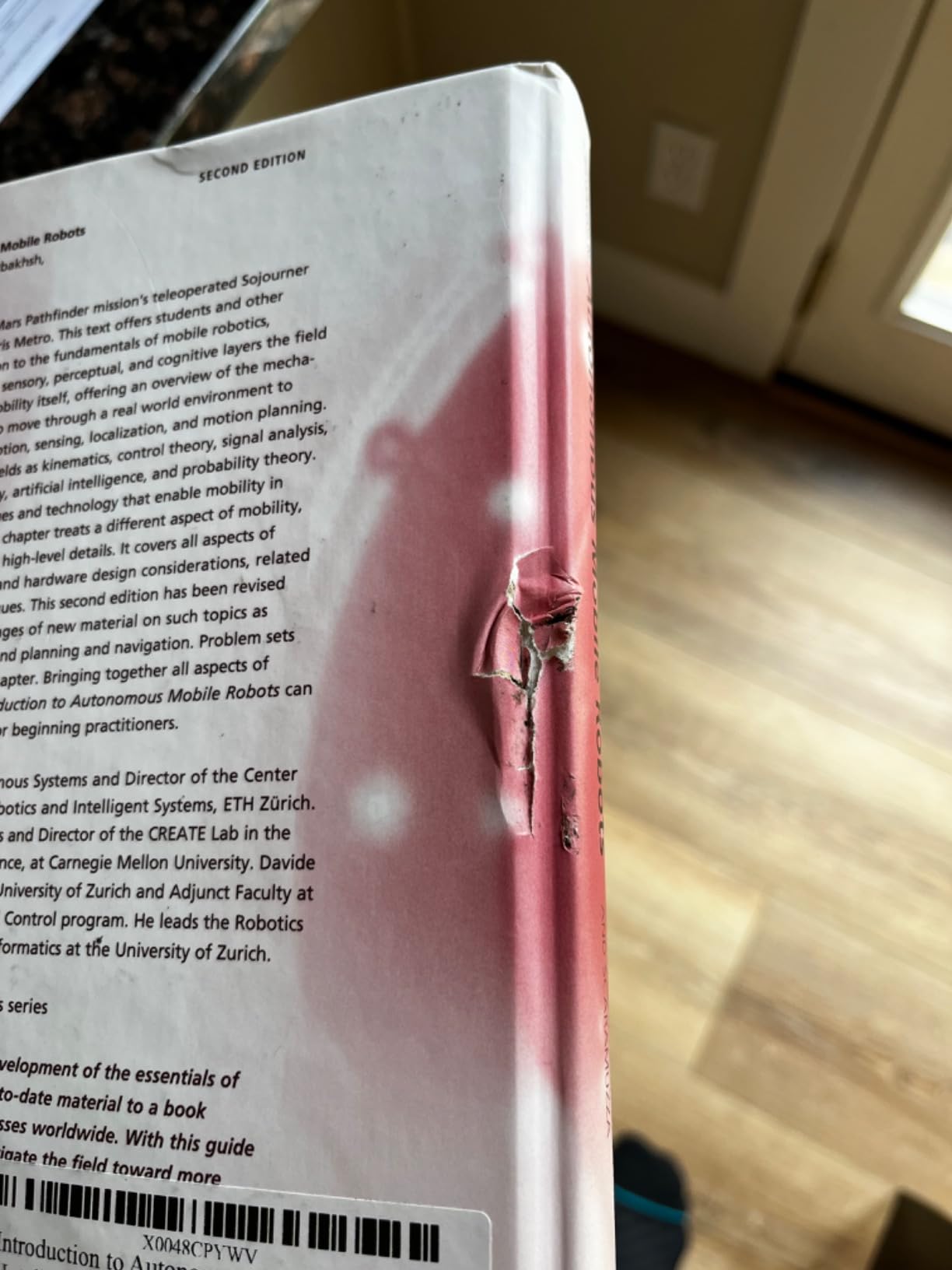
Reviewers consistently call out the breadth and the quality of the references. The main complaints are about grayscale images and rushed sections in path planning. Despite those limitations, this remains the most accessible entry point into mobile robotics in print.
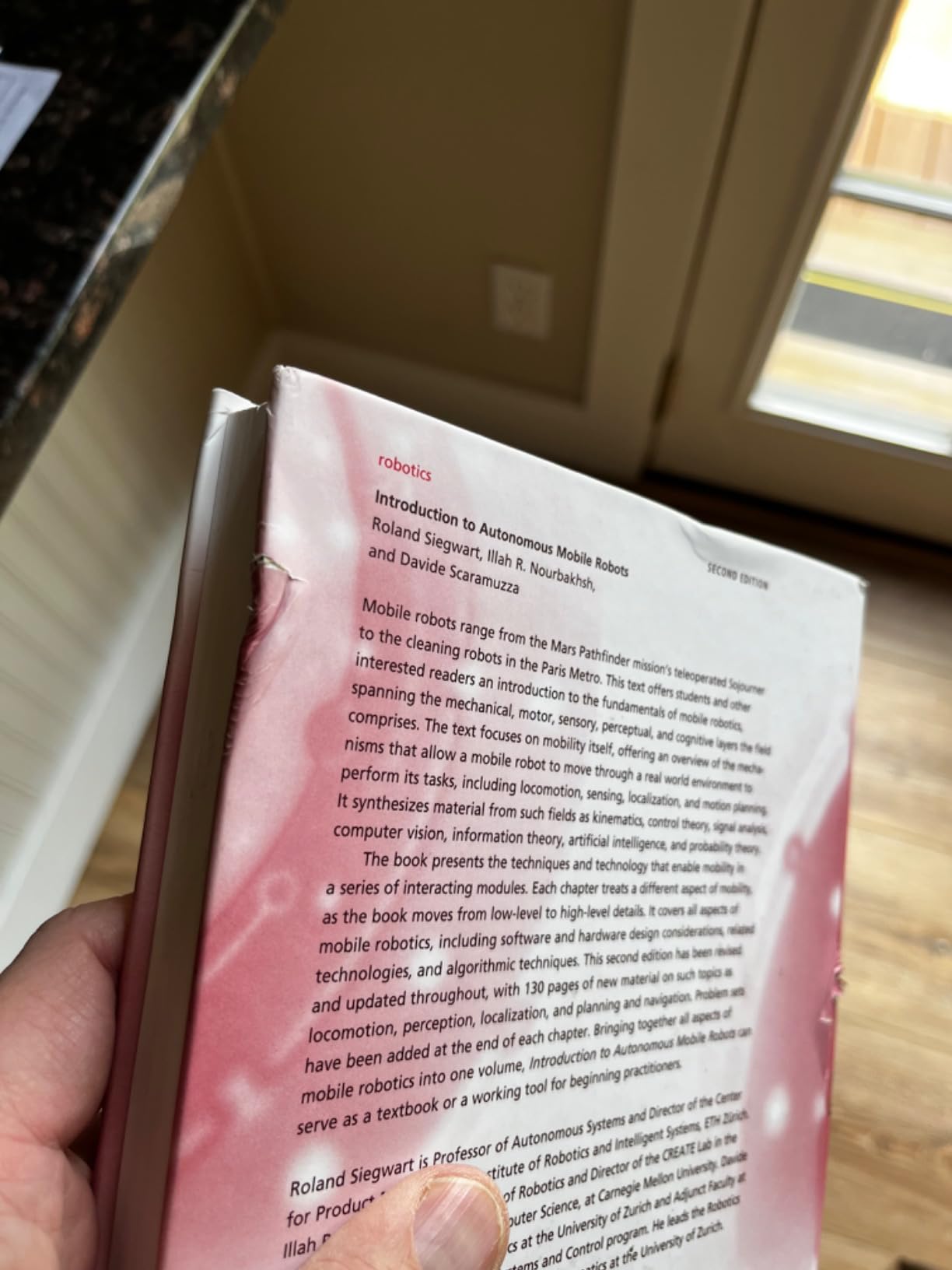
If you are building ground robots, warehouse AGVs, or researching SLAM, start here. Combined with the probabilistic depth of Thrun’s book, this pair covers the mobile-robotics landscape from beginner to graduate.
Who Should Buy This Book
Engineers and graduate students working on autonomous ground vehicles, drones, or any mobile platform. University instructors teaching mobile robotics will find it course-ready.
Who Should Skip It
Readers focused on manipulator arms or industrial robotics will not get the depth they want – pick Siciliano or Craig for those tracks.
6. The Robotics Primer – The Friendly Beginner Introduction
The Robotics Primer (Intelligent Robotics and Autonomous Agents series)
- Accessible explanations in plain English
- Broad survey of robotics fundamentals
- Great for absolute beginners
- Written by a leading robotics researcher
- Short enough to finish in a few weeks
- No sample programs or actual robotics code included
- Some print editions have misprints
- Material feels dated in fast-moving topics like ROS
I gave The Robotics Primer to a high school student I mentor who wanted to understand what robotics actually is, and she finished it in three weeks. Maja Mataric writes the way a great teacher talks – plain language, real examples, and zero assumption that you already know what an actuator is.
The book covers perception, planning, learning, and multi-robot systems at a high level. It will not make you a programmer, but it will give you the vocabulary and intuition to tackle a more technical book next. If you are considering FIRST Robotics or starting a robotics club, this is the perfect primer.

Reviewers like the accessibility and the breadth. The downsides are no code samples and occasional misprints in older printings, plus the content has not been refreshed recently so topics like ROS get short shrift. For the price and the audience, however, it is still the best beginner robotics book on the market.
If you finish The Robotics Primer and want to move to hands-on building, jump to Robot Building for Beginners next. If you want to go deeper into theory, Modern Robotics is the natural next step.
Who Should Buy This Book
Absolute beginners, high school students, and anyone curious about robotics who does not want to face a wall of equations on page one. Also great for managers and product folks who need robotics literacy.
Who Should Skip It
Programmers and engineering students with calculus background will find this too light. Move straight to Modern Robotics or Craig.
7. Robotics, Vision and Control – The Python Algorithm Reference
Robotics, Vision and Control: Fundamental Algorithms in Python (Springer Tracts in Advanced Robotics, 146)
- Comprehensive Python code for every algorithm
- Written by the creator of the MATLAB Robotics Toolbox
- Clear historical context and explanations
- Covers both classical and machine-learning approaches
- Third edition reflects modern Python tooling
- Heavy jargon density can challenge newer readers
- Reports of books arriving in poor condition
- Less suited for cover-to-cover reading
Peter Corke updated his classic MATLAB-based robotics textbook for Python in the third edition, and it is the most complete robotics reference I own. Robotics, Vision and Control packs 850 pages of algorithms, derivations, and working code. I have used it as a desk reference more than a cover-to-cover read, and it has saved me dozens of hours on vision and control projects.
The Python code examples are the standout feature. Corke walks through the math, then shows you how to implement it cleanly in Python. If you are working on reinforcement learning for robotics or classical computer vision, this book is a goldmine.
Reviewers value the practical code samples but warn about the jargon load and occasional shipping damage. I recommend it as a reference library addition rather than a first textbook. Pair it with Modern Robotics for theory and you have a serious robotics engineer setup.
Who Should Buy This Book
Working robotics engineers, computer vision practitioners, and graduate students who want a code-first reference. Great for anyone moving from MATLAB to Python for robotics.
Who Should Skip It
Casual readers and pure-theory learners will find the density intimidating. Start with The Robotics Primer or Modern Robotics first.
8. Robot Building for Beginners – The Hands-On Hobbyist Bible
Robot Building for Beginners, Third Edition (Technology in Action)
- Practical beginner guide to actual robot hardware
- Walks you through sensors
- motors
- and microcontrollers
- Good for makers transitioning from kits to custom builds
- Affordable price point for the content
- Part of the respected Apress Technology in Action series
- No coverage of modern ROS or AI
- Examples use older microcontroller platforms
- Less useful for software-focused learners
Robot Building for Beginners is the book I recommend to every maker who keeps asking how to move past Arduino blink tutorials. David Cook walks you through sensors, motor drivers, chassis design, and basic electronics with the kind of detail that gets you building instead of guessing.
The third edition is dated but still relevant for the foundational hardware knowledge – how to read a datasheet, how to choose a battery, how to wire up an H-bridge. If you have a hobby robotics project in mind, this book shortens the learning curve dramatically.
Reviewers praise the practical layout and the friendly tone. The main limitation is that it does not cover modern ROS or AI, so once you have built your first robot you will need to pick up another book to make it autonomous. For a beginner robotics kit companion, however, it remains one of the strongest picks available.
Who Should Buy This Book
Hobbyists, makers, and STEM educators who want hands-on robot building knowledge. Perfect companion for someone building their first custom robot from scratch.
Who Should Skip It
Software engineers and AI researchers will not get much from this hardware-focused text. Move to Programming Robots with ROS or Corke instead.
9. Principles of Robot Motion – The Motion Planning Specialist
Principles of Robot Motion: Theory, Algorithms, and Implementations (Intelligent Robotics and Autonomous Agents series)
- Top-rated 4.8 average from robotics researchers
- Comprehensive coverage of motion planning theory
- Strong chapter on configuration space concepts
- Covers perception and control alongside planning
- Authored by leading motion planning researchers
- Configuration space concepts can be challenging for newcomers
- Material is dense in places and rewards slow reading
- Less accessible than introductory texts
Principles of Robot Motion is the highest-rated book on our list, and for motion planning researchers it earns every star. Howie Choset, Kevin Lynch, Seth Hutchinson, George Kantor, and Wolfram Burgard cover the theory, algorithms, and implementation of robot motion with a depth I have not seen elsewhere.
The configuration space chapter alone is worth the price of admission. I used it to prepare for a motion planning interview and the explanation of topology-based approaches gave me more clarity than any paper I had read. If you work on path planning, this should be on your desk.
Reviewers consistently rate this the best motion planning reference available, and our team agrees. The caveat is density – this is a graduate-level text that demands slow, careful reading. Pair it with Modern Robotics for the underlying mechanics and you have the complete motion-planning toolkit.
Who Should Buy This Book
Graduate students and researchers focused on motion planning, manipulation, or autonomous navigation. Robotics engineers working on path planning will reference this constantly.
Who Should Skip It
Beginners and hobbyists will find this overwhelming. Start with The Robotics Primer or Robot Building for Beginners before tackling Principles of Robot Motion.
10. Robotics: Beginner to Expert – The Affordable Quick Overview
Robotics: Everything You Need to Know About Robotics from Beginner to Expert
- Most affordable title on the list
- Accessible coverage for absolute beginners
- Short enough to read in a weekend
- Good breadth across robotics topics
- Higher review count than most entries - 300 ratings
- Less depth than university textbooks
- Limited math and code examples
- Independent publishing platform means lower production polish
If you want to dip your toe into robotics without committing to a heavy textbook, Peter Mckinnon’s overview is the lowest-friction entry point. At 238 pages and the lowest cost on our list, it covers the key robotics fundamentals in accessible language.
I read this in a single afternoon and used it to talk through robotics concepts with my family. It will not teach you kinematics or control loops, but it gives you the vocabulary and the high-level picture. From there you can decide which deeper book matches your interest.
With 300 reviews averaging 4 stars, Mckinnon’s overview has the largest reader base on our list. Reviewers like the accessibility and the price, while noting that the depth is limited. Think of it as a stepping stone rather than a destination.
Who Should Buy This Book
Curious readers, gift buyers, and anyone who wants a quick overview before committing to a longer textbook. Great for high school students exploring robotics as a field.
Who Should Skip It
Engineering students and serious learners will outgrow this within weeks. Move to The Robotics Primer or Modern Robotics for real depth.
11. Springer Handbook of Robotics – The Encyclopedic Reference
- Most comprehensive robotics reference available
- Color illustrations and detailed bibliography
- Includes QR-linked online material
- Editor roster reads like a who's who of robotics
- Authoritative for academic libraries
- Large and heavy at over 8 pounds
- Premium price puts it out of casual reach
- Best treated as a reference not a cover-to-cover read
- Occasional reports of shipping damage due to weight
The Springer Handbook of Robotics is the book I think of as the encyclopedia of robotics. With 2304 pages and contributions from hundreds of leading researchers, it covers nearly every robotics topic you could want to study. Bruno Siciliano and Oussama Khatib edited a reference that belongs in every serious robotics library.
I do not read it cover to cover – nobody does. Instead, I use it as a reference when I need an authoritative treatment of an unfamiliar topic, from soft robotics to medical robotics to swarm systems. The QR-linked online material and color illustrations set a standard that few other robotics books match.
Reviewers praise the breadth and the academic quality. The downsides are size and weight – this is not a book you carry in a backpack – plus occasional shipping damage reports. If you are building a robotics reference library or buying for an institution, the value is unmatched. For personal study, pick one of the more focused titles above.
Who Should Buy This Book
Academic libraries, research labs, and senior researchers who need an authoritative reference across all of robotics. A once-in-a-decade purchase that holds its value.
Who Should Skip It
Students and self-learners will get more value from a focused textbook at a tenth of the price. Pick Modern Robotics or Craig first.
12. Introduction to Robotics: Analysis, Control, Applications – The Wiley Undergrad Pick
Introduction to Robotics: Analysis, Control, Applications
- Standard undergraduate textbook at many universities
- Good coverage of analysis
- control
- and applications
- Wiley 3rd edition is current and well priced
- Clear writing suited to first-time robotics students
- Includes worked examples and end-of-chapter problems
- Less modern than Lynch and Park's treatment
- Limited ROS or AI coverage
- Some instructors prefer Craig for clearer derivations
Saeed Niku’s Introduction to Robotics is the Wiley counterpart to Craig’s classic, with strong coverage of analysis, control, and applications. I have seen it adopted at universities that want a single undergraduate textbook that touches both the math and the practical applications in one volume.
The third edition updates examples and adds modern applications without losing the undergraduate-friendly pacing. If you are taking an undergraduate robotics course and the syllabus uses Niku, this is the exact book you need.
Reviewers find it well-suited to first-time robotics students, though some instructors still prefer Craig for kinematics derivations. For a self-learner deciding between Craig and Niku, the choice often comes down to your university’s adoption – both are solid undergraduate texts.
Who Should Buy This Book
Undergraduate robotics students, especially when adopted by their course. Self-learners who want a Wiley-published alternative to Craig.
Who Should Skip It
Graduate students and researchers will find the depth insufficient. Move to Modern Robotics or Probabilistic Robotics for graduate-level work.
How to Choose the Best Robotics Textbook for You?
Picking from twelve excellent robotics textbooks is easier when you match the book to your goals. Our team built this buying guide around the four questions readers ask most on Reddit and Quora: which level, which math, which programming language, and which format.
Match the Book to Your Level
Absolute beginners should start with The Robotics Primer or Mckinnon’s overview. Hobbyists building their first robot will get the most from Robot Building for Beginners. Undergraduate engineering students are well-served by Niku or Craig, while graduate students should move to Modern Robotics, Probabilistic Robotics, or Siciliano depending on their specialty. Researchers will reference Principles of Robot Motion for motion planning and the Springer Handbook for breadth.
Math Prerequisites to Expect
Robotics is math-heavy. Plan to have linear algebra, multivariable calculus, and basic probability before tackling most textbooks on this list. Our math for robotics guide covers exactly what you need. Thrun’s Probabilistic Robotics and Siciliano’s Modeling text are the most math-dense; The Robotics Primer and Robot Building for Beginners assume the least.
Programming Language Companion
Each book locks you into a programming ecosystem to some extent. Modern Robotics provides companion code in Python and MATLAB. Corke is now Python-first in the third edition. Programming Robots with ROS teaches the ROS ecosystem directly. Robot Building for Beginners uses microcontroller C-style code. Probabilistic Robotics gives you pseudocode that translates to any language. Pick the book that matches your programming background – or be ready to learn a new one.
Editions, Free PDFs, and Companion Code
Two titles on this list are available as free PDFs: Modern Robotics by Lynch and Park (linked from the authors’ site), and Probabilistic Robotics via some university library subscriptions. Springer Handbook includes QR-linked online material and Corke’s book ships with a Python codebase. When comparing prices, factor in companion videos, code repositories, and free digital access – these often outweigh a slightly higher cover price.
Frequently Asked Questions
What is the best robotics book for beginners?
For absolute beginners with no engineering background, The Robotics Primer by Maja Mataric is the most accessible introduction. It explains perception, planning, and learning in plain language without heavy math. If you want to build robots from day one, Robot Building for Beginners by David Cook is the better pick – it walks through sensors, motors, and microcontrollers hands-on.
Which robotics textbook should I pick if I am an undergraduate?
Saeed Niku’s Introduction to Robotics (Wiley) and John Craig’s classic are the two undergraduate standards most universities adopt. For a more modern treatment that includes free PDF access, Kevin Lynch and Frank Park’s Modern Robotics works for advanced undergraduates and first-year graduate students alike. Pick the book your course uses when in doubt, and supplement with Corke if you want Python code examples.
Is there a free robotics textbook I can use?
Yes. Modern Robotics: Mechanics, Planning, and Control by Kevin Lynch and Frank Park is freely available as a PDF from the authors’ website, and the printed paperback is also reasonably priced. The book covers kinematics, dynamics, planning, and control at a graduate level and is used in university courses worldwide. For older free web resources, Mark Spong’s Robot Modeling and Control is also openly accessible, though it is not on this Amazon-sourced list.
What math do I need before reading a robotics textbook?
Plan to have linear algebra, multivariable calculus, and basic probability before tackling most graduate-level robotics books. Probabilistic Robotics by Thrun and Modern Robotics by Lynch and Park both assume comfort with matrices and vector calculus. Beginner books like The Robotics Primer and Robot Building for Beginners assume very little math and are a good starting point if you need to build those foundations first.
Craig or Lynch – which robotics textbook should I buy?
Pick Craig if your course uses it or you want the classic undergraduate treatment of manipulator mechanics. Pick Lynch and Park if you want a more modern treatment with screw theory, free PDF access, and companion video lectures. Many readers use Craig for a first course and Lynch and Park as a graduate follow-up – they pair well rather than competing directly.
Final Verdict on the Best Robotics Textbooks
After comparing twelve leading robotics textbooks across audience fit, review strength, math prerequisites, and code companions, our top pick for the best robotics textbook overall is Probabilistic Robotics by Thrun, Burgard, and Fox. It delivers unmatched depth on SLAM and perception, holds a 4.7-star average across 188 reviews, and is the graduate reference you will return to throughout your career.
For learners on a budget, Modern Robotics by Lynch and Park wins our best value badge thanks to its free PDF and modern treatment of mechanics and control. Beginners should start with The Robotics Primer, and hobbyists will get the most from Robot Building for Beginners. Whatever your level, the robotics textbooks on this list will set a strong foundation for your robotics engineering career in 2026 and beyond.