
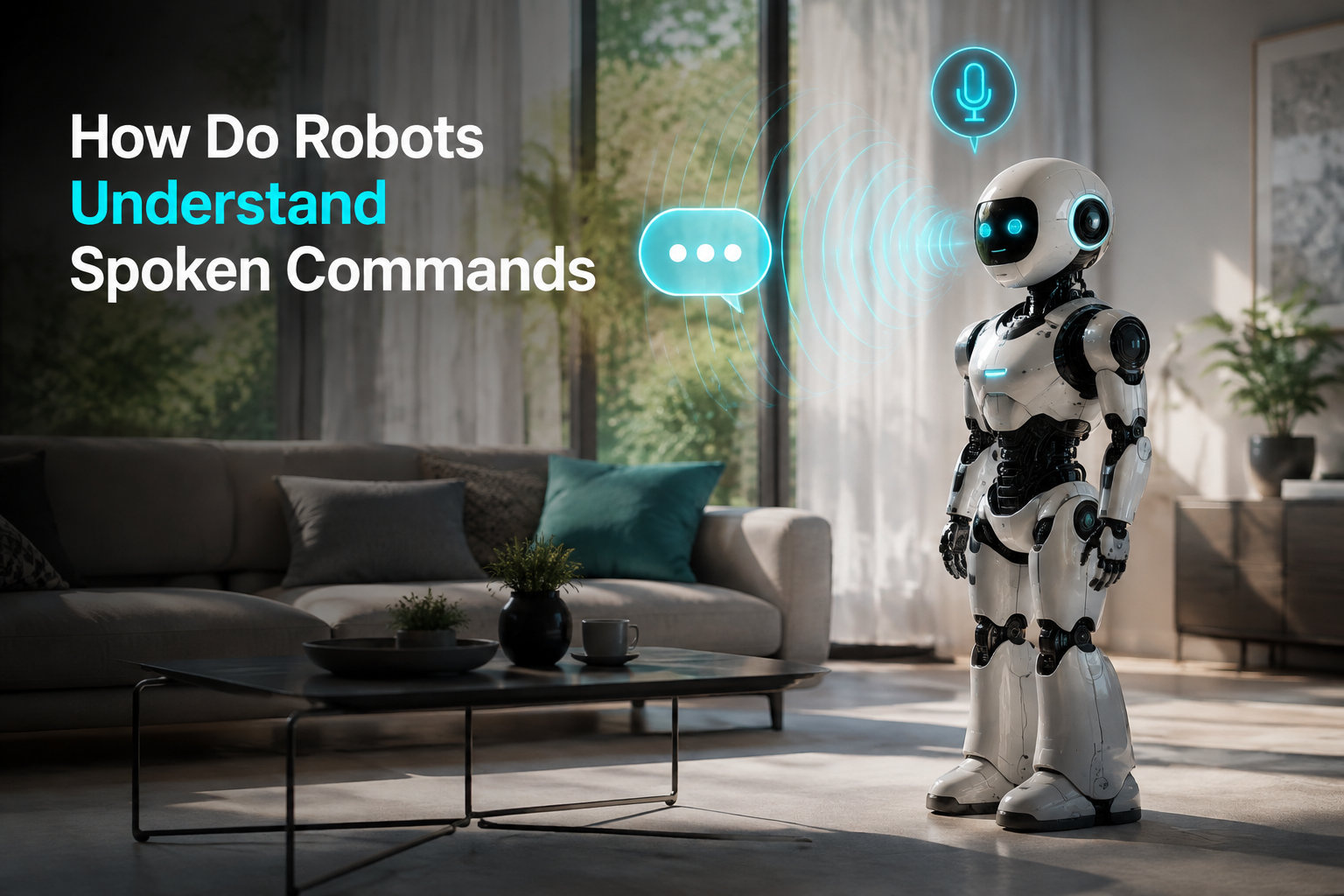
Robots understand spoken commands through a multi-step pipeline that turns your voice into action: microphones capture sound waves, automatic speech recognition (ASR) converts audio into text, natural language processing (NLP) figures out what you mean, and motion planning software decides what the robot should physically do. In short, a voice command is captured, transcribed, interpreted, and executed in under a second on modern systems.
I have spent the last several months digging into how this stack actually works, from the microphones on a Boston Dynamics Spot to the cloud language models that power a Tesla Optimus demo. In this guide, I will walk you through every layer, share the tradeoffs engineers wrestle with, and show you where the field is heading in 2026. If you have ever wondered whether your robot vacuum truly “understands” you, the short answer is yes and no. Yes, the pipeline is real. No, it is not magic. It is a careful assembly of signal processing, statistical models, and decision logic.
By the end, you will be able to explain exactly how do robots understand spoken commands to a friend, point out where each step can fail, and recognize the same pipeline in everything from a smart speaker to a surgical robot.
Table of Contents
How Do Robots Understand Spoken Commands From Start to Finish?
The full voice command pipeline has five core stages, and every robot that responds to speech runs some version of it. Understanding the whole flow makes it much easier to see why a robot sometimes mishears you or refuses to act.
- Audio capture — microphones pick up your voice and convert sound pressure into a voltage.
- Digitization — the analog signal is sampled and turned into a numeric waveform.
- Speech recognition — an ASR model transcribes the waveform into words.
- Language understanding — NLP and intent recognition extract the meaning.
- Action and response — the robot plans a movement, speaks back, or triggers an API.
Each stage takes milliseconds. A home assistant might finish the full pipeline in 300 to 800 milliseconds. Industrial robots with on-device models can do it in under 100. The clever part is not any single stage. It is how well they are stitched together so the robot can keep up with normal conversation without feeling laggy.
If you want a deeper look at how robots process data on board, our guide on edge AI in robotics covers the hardware side in detail.
How Robots Hear: Audio Capture and Digitization
Robots hear through microphones, and not all microphones are equal. Most modern robots use microphone arrays rather than a single mic, because a small ring of two to seven microphones lets the system figure out which direction your voice is coming from. That is called beamforming, and it is the reason a smart speaker across the room can still hear you clearly.
Once the mic captures your voice, the analog signal must be digitized. The system samples the waveform thousands of times per second, usually at 16 kHz or 16,000 samples per second, which is enough to capture the full range of human speech. Each sample becomes a number representing air pressure at a moment in time. That stream of numbers is what every downstream model actually works on.
Before any AI sees the audio, two pre-processing steps usually happen. A voice activity detector figures out when you are talking versus when the room is quiet, so the system does not waste compute listening to silence. A noise suppression filter strips out steady background sounds like fans, air conditioning, or highway noise. After those two steps, the clean waveform is ready for transcription.
The quality of this stage matters more than people think. If the audio is muddy, even the best ASR model will struggle. That is one reason robot makers obsess over microphone placement and shielding.
What Is Automatic Speech Recognition and How Does It Work?
Automatic speech recognition, or ASR, is the technology that turns audio into text. Think of it as a translator between sound and written words. Modern ASR systems do not just match sounds to letters. They use two cooperating models: an acoustic model that knows what phonemes sound like, and a language model that knows which word sequences are most likely in your language.
A phoneme is the smallest unit of sound in a language. English has about 44 of them, and the acoustic model learns to recognize each one across thousands of different voices, accents, and tones. The language model then steps in to resolve ambiguity. If the acoustic model thinks you said “recognize speech” or “wreck a nice beach,” the language model picks the more likely phrase based on context.
Today, the best ASR engines are built on deep neural networks, often transformer architectures trained on tens of thousands of hours of recorded speech. Whisper from OpenAI, Google USM, and Meta’s SeamlessM4T are good public examples. They handle dozens of languages, adapt to accents, and even pick up on tone of voice. The output is plain text like “robot, please pick up the red block.”
Accuracy matters here. The latest research papers report word error rates around 5 to 8 percent on clean English audio, which is roughly the same as professional human transcription. In noisy factory conditions, that number can climb to 15 percent or more, which is why industrial robots often wear headset-style mics close to the operator’s mouth.
How AI and Machine Learning Decode Spoken Commands
AI and machine learning are the engines that make voice command robots feel natural. They sit in two places: inside the ASR system and inside the language understanding layer. The models that power both are usually deep neural networks trained on enormous datasets.
Early ASR systems used hidden Markov models paired with Gaussian mixtures. They worked, but they required careful tuning for every new language or accent. Modern systems use end-to-end neural models. You feed in audio, and the model spits out text directly. Training these models takes millions of examples and serious compute, but the payoff is a single system that handles multiple speakers, accents, and noisy environments without hand-tuning.
On the language side, large language models like GPT-4, Claude, and open-source Llama variants have changed what is possible. Instead of writing rigid grammars to parse commands, engineers can now feed transcripts to an LLM and ask it to extract the intent. “Please clean the kitchen floor” becomes a structured request: action equals clean, target equals kitchen floor, timing equals now.
One trade-off: LLMs are large. Running a full 70-billion-parameter model on a small robot is impractical without a graphics card. That is why many teams run a small ASR model on-device, send the resulting text to a cloud LLM, and wait for the structured response. Latency, cost, and privacy all factor in. Our piece on robots that learn on the job explores this trade-off in more depth.
Why Natural Language Processing Matters for Robot Commands
Natural language processing, or NLP, is what turns raw text into something a robot can act on. Words alone are not enough. A robot needs to know the verb, the object, the location, and any constraints. “Pick up the box” is incomplete without knowing which box. “Pick up the small red box on the table” is much more useful.
Modern NLP pipelines for robotics typically do three things. First, intent recognition classifies the type of request — is this a navigation command, a manipulation command, or a question? Second, entity extraction pulls out the specific objects, places, and modifiers mentioned. Third, dialogue management tracks the conversation across multiple turns so the robot can ask for clarification if anything is missing.
Imagine telling a service robot, “Bring me a drink.” A good NLP layer will recognize the intent as fetch, notice that the object type is beverage but the specific drink is not specified, and respond with, “What would you like to drink?” That back-and-forth feels natural because the robot maintains context, not because it is improvising.
This is also where on-board communication matters. Once the NLP layer produces a structured command, the robot needs to send it to the right subsystem. We have a primer on CAN bus communication in robots if you want to see how commands flow inside the machine.
How Robots Turn Understanding Into Action
Once the robot knows what you want, the action layer takes over. This is where voice meets the physical world, and it is often the most underappreciated part of the pipeline. A human can grab a cup in a fraction of a second. A robot must plan the motion, check for collisions, and then execute the trajectory with millimeter precision.
For a mobile robot, action means path planning. The system calculates a route from the current location to the target, avoiding obstacles along the way. For a robotic arm, action means motion planning: computing joint angles, gripper approach vectors, and force profiles so the arm can grasp an object without knocking it over.
Action selection also relies on a skill library. Most robots do not generate new skills from scratch. They have a set of pre-built capabilities like pick, place, pour, push, and navigate. The NLP layer matches the intent to a skill, fills in the parameters, and the skill runs. If the requested action is outside the library, the robot typically tells the user it cannot comply.
For motion output, the robot uses servo motors and other actuators. The quality of those actuators directly shapes how smoothly the action looks. You can read about how they work in our guide to servo motors in robots.
Real-World Examples of Robots Understanding Spoken Commands
The voice command pipeline is no longer limited to research labs. You can see it in production robots across homes, hospitals, warehouses, and streets. Here are a few examples that show how the same basic stack powers very different machines.
Boston Dynamics Spot is a four-legged robot that responds to voice commands through a tablet interface and natural language chat. Operators can tell Spot to inspect a specific area, take a photo, or open a door. The voice pipeline runs mostly in the cloud, with local safety checks.
Tesla Optimus is a humanoid robot under active development. Tesla has demonstrated Optimus responding to verbal instructions to pick up objects and sort laundry. The system relies on Tesla’s in-house neural networks that share training data with the company’s Full Self-Driving project.
Sophia, the humanoid created by Hanson Robotics, holds natural conversations with people. Her pipeline combines ASR, dialogue management, and a scripted personality layer that produces facial expressions and speech.
Industrial collaborative arms from Universal Robots and FANUC accept voice commands for simple tasks like part loading or pick-and-place. Factory noise makes this harder, so these systems usually pair a noise-cancelling headset mic with a local on-device ASR model.
Home robots like Amazon Astro and robot vacuums from iRobot and Roborock accept short spoken instructions. The pipeline is lighter weight because the command vocabulary is small, but the underlying stages are identical.
Challenges and Limitations of Robot Voice Recognition
Even the best voice command systems hit walls. Knowing where they fail helps you set realistic expectations and design around the rough edges.
Background noise is the biggest problem. ASR accuracy can drop from 95 percent in a quiet room to 70 percent on a factory floor. Multi-microphone beamforming helps, but it does not eliminate the issue. Some robots now use bone-conduction headsets or close-range mics to work around this.
Accents and dialects are another hurdle. A model trained mostly on American English can struggle with Scottish, Indian, or West African accents. The fix is broader training data, and modern systems are getting noticeably better, but edge cases still trip them up.
Latency matters more than people realize. If a robot takes three seconds to respond, the conversation feels broken. Cloud-based systems struggle here, which is why on-device and edge AI approaches are gaining ground.
Ambiguity is the third big challenge. “Move the box” is fine if there is one box. With five boxes, the robot needs to ask, and the dialogue manager has to track the answer. Companies invest heavily in conversation design to handle these moments gracefully.
Finally, privacy and security are constant concerns. Always-on microphones capture a lot of incidental audio, which is why many robots now offer local-only modes, mute buttons, and on-device ASR for sensitive environments.
The Future of Voice-Controlled Robots in 2026
The next few years will push voice control in three directions. First, edge AI will move more of the pipeline on-device, cutting latency and improving privacy. Second, multimodal models will let robots combine voice, vision, and touch in a single reasoning step, so a robot can hear “pick that up” while looking at a cluttered table and figure out the right object from context. Third, personalized models will let robots learn your voice, your vocabulary, and your home layout so the system gets better the more you use it.
Open-source projects are also catching up. Tools like Whisper, Piper, and Llama let hobbyists build voice-controlled robots with consumer hardware. The same pipeline that powers a research robot at a university can now run on a Raspberry Pi 5 paired with a small neural accelerator.
The honest answer to how do robots understand spoken commands in 2026 is that they still rely on the same five-stage pipeline, but each stage is getting faster, smaller, and smarter. The robots of 2026 will not just hear you. They will anticipate you.
Frequently Asked Questions
How do robots understand spoken commands?
Robots understand spoken commands through a five-stage pipeline: microphones capture your voice, the system digitizes the audio, automatic speech recognition transcribes it to text, natural language processing figures out what you mean, and the action layer plans a physical response. Each stage takes milliseconds, so the full loop feels real-time.
What technology do robots use to understand speech?
Modern robots use deep neural networks for automatic speech recognition, transformer-based language models for understanding, and dialogue managers for conversation context. Common building blocks include Whisper, GPT-style models, and on-device ASR engines trained on thousands of hours of human speech.
Can robots understand multiple languages?
Yes. Multilingual ASR models like Whisper and SeamlessM4T can transcribe and translate dozens of languages. The challenge is the language understanding layer, which often needs separate training data for each target language to extract intents accurately.
How accurate are robot speech recognition systems?
In clean conditions, the best systems reach word error rates around 5 to 8 percent, similar to a human transcriber. In noisy factories or with strong accents, accuracy can drop to 70 to 85 percent. Industrial setups often use close-range microphones to keep accuracy high.
How does a robot voice work when it talks back?
Robots speak using text-to-speech, or TTS, which is the reverse of speech recognition. A TTS model turns text into a waveform, often using neural vocoders that produce natural-sounding voices. Some robots use recorded snippets, but modern systems generate speech in real time, which is how they can pronounce new words on the fly.
Do AI robots talk to each other?
Yes, robots can talk to each other using structured messages over networks, but they rarely use spoken language. Machine-to-machine communication is more efficient with JSON, MQTT, or ROS topics. Spoken voice is reserved for human-robot interaction because it carries tone, intent, and accessibility benefits that structured messages do not.
Final Thoughts on How Robots Understand Spoken Commands
The pipeline is straightforward once you see it. Microphones, ASR, NLP, action planning, and motion. Each piece is hard on its own, but together they let a robot hear you, understand you, and do something useful about it. The robots of 2026 are quieter, faster, and more private than the ones from a few years ago, and the trend will only accelerate as edge AI and multimodal models mature.
If you want to experiment, start small. A Raspberry Pi, a USB microphone, and an open-source ASR model can get you a working voice-controlled robot in a weekend. The same five stages I walked you through will run on your kitchen table, and that is honestly the best way to internalize how it all fits together.