
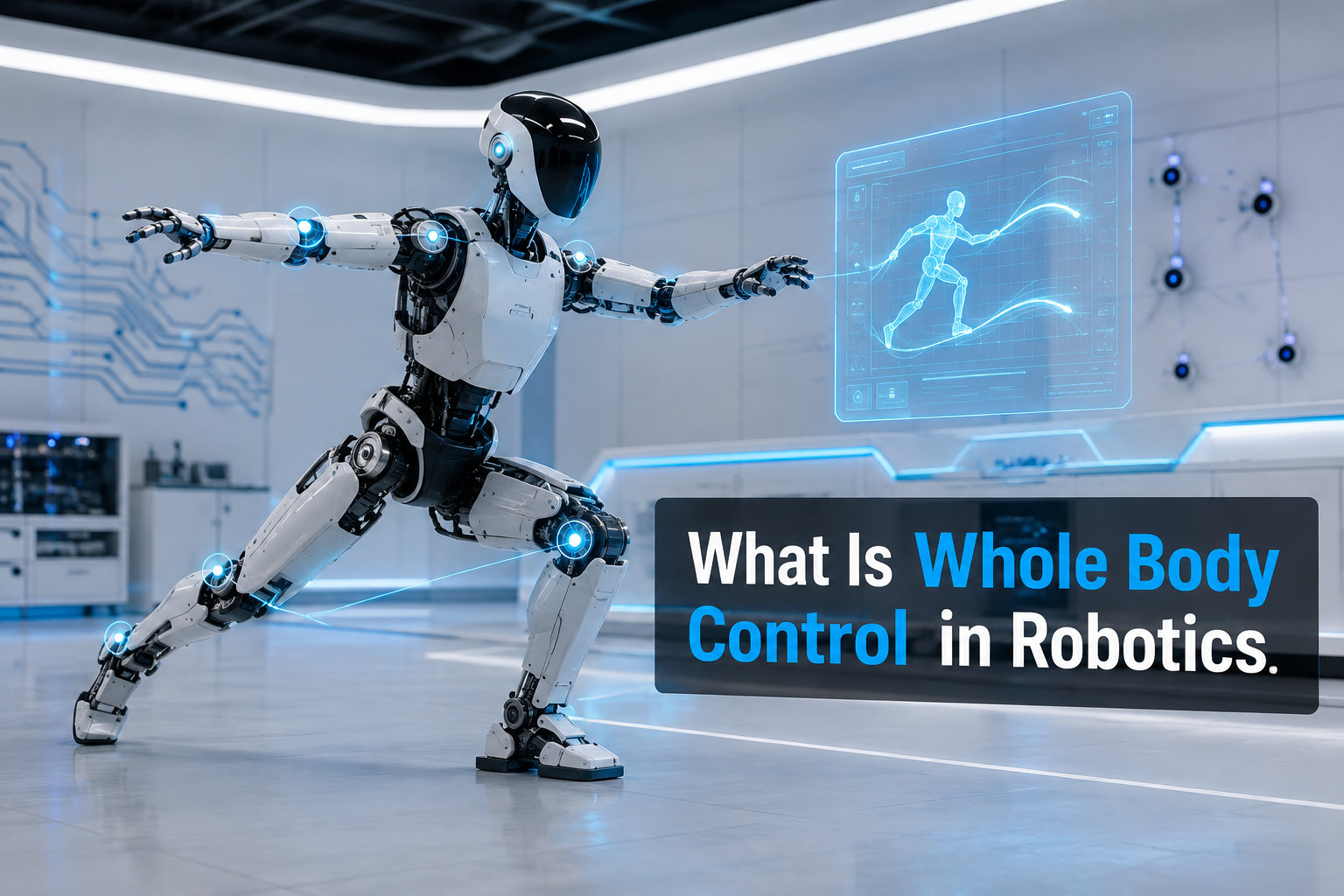
Whole body control in robotics is a control approach that coordinates all joints and links of a robot simultaneously to achieve task-space objectives while maintaining balance and satisfying physical constraints. Instead of telling each motor what to do one at a time, the controller thinks about the whole robot as one system working toward a goal.
I have spent the last several years covering humanoid robotics, and I can tell you that whole body control is the difference between a robot that shuffles awkwardly and one that moves like it understands physics. It is the framework that makes a humanoid robot reach for a cup without falling over, climb stairs while carrying a box, and recover from a shove without a human operator stepping in.
This guide breaks down the concept from the ground up. You will learn the technical foundations, the math behind hierarchical control, the practical applications in real robots, and where the field is heading in 2026. Whether you are a student, a robotics engineer, or simply curious about how humanoid robots work, you will find something useful here.
Table of Contents
What Is Whole Body Control in Robotics
Whole body control, often abbreviated as WBC, is a robotic control framework that manages coordinated, multi-task control for robots with high degrees of freedom. It treats the entire robot body as a single, unified system rather than a collection of independent joints.
The key idea is simple to state but hard to implement. A humanoid robot has 20 to 50 actuated joints. Each joint can produce torque, and every movement of one joint affects every other joint through the physics of the body. WBC solves this coupling problem by working in task space, the language of goals like “move the hand here” or “keep the center of mass over the feet,” rather than joint space, the language of “rotate this motor by X degrees.”
When we talk about “degrees of freedom” in robotics, we mean the number of independent ways a robot can move. A human arm has 7 degrees of freedom from shoulder to wrist. A full humanoid robot can have 30 or more. Traditional control methods struggle when the number of tasks approaches the number of degrees of freedom, because there are not enough motors to do everything at once. Whole body control solves this with mathematical optimization.
WBC also enforces constraints. A walking robot must keep its feet on the ground, must not exceed joint torque limits, and must not let its center of mass fall outside the support polygon. These constraints are baked into the control problem from the start, not handled as a separate stability check after the motion is planned.
How Whole Body Control Works
Whole body control works by solving an optimization problem at every control cycle, typically running at 100 to 1000 Hz. The controller takes in the current state of the robot, a set of tasks with priorities, and a set of constraints, then computes the joint torques needed to make progress on the tasks while respecting the constraints.
Here is the step-by-step process that happens inside a typical WBC system.
Step 1: Define tasks in task space. The controller receives a list of objectives expressed as errors to minimize. A hand reaching task might be “minimize the distance between the gripper and the target.” A balance task might be “keep the center of mass projection inside the support polygon.” A posture task might be “return the arms to a neutral position.”
Step 2: Map tasks to joint space using Jacobians. The Jacobian matrix relates joint velocities to end-effector velocities. It is the mathematical bridge between “what the hand should do” and “what each motor should do.”
Step 3: Resolve conflicts through hierarchical optimization. This is where the magic happens. Tasks are organized into priority levels. A higher-priority task, like keeping balance, is satisfied first. Lower-priority tasks, like reaching smoothly, are allowed to use whatever “leftover” control authority exists in the null space of the higher-priority tasks.
Step 4: Compute joint torques via inverse dynamics. Given the desired accelerations and the robot’s dynamic model (mass, inertia, gravity), the controller computes exactly how much torque each motor must produce.
Step 5: Apply torques and repeat. The new joint torques are sent to the motors, sensor data comes back, and the cycle starts again at the next timestep.
The whole process happens in a few milliseconds. Modern humanoid robots like those from Boston Dynamics, Agility Robotics, and Unitree use variants of this loop. The differences come down to how tasks are prioritized, how the optimization is solved, and whether the dynamics model is learned or analytical.
Operational Space Control
Operational space control is the predecessor and foundation of modern WBC. Developed by Oussama Khatib in the 1980s, it introduced the idea of controlling a robot in the space where the task actually lives. If the task is to move a cup, the relevant space is the position and orientation of the hand, not the angle of every joint in the arm.
Operational space control computes the joint torques needed to produce a desired force or motion at a specific point on the robot, while accounting for the dynamics of the entire mechanism. The math is elegant, but the original formulation assumed a single task. Real robots have many tasks running at once. That limitation is exactly what whole body control was designed to overcome.
Task Space vs Joint Space Control
Task space control and joint space control are two different ways of telling a robot what to do. Understanding the difference is essential for grasping why WBC matters.
In joint space control, you specify the desired angle, velocity, or torque for each joint individually. This is the older, simpler approach. It works well for robots with simple geometries, like a 6-axis industrial arm performing a single pick-and-place operation. The challenge comes when you need the hand to follow a path in 3D space, because you have to compute the inverse kinematics yourself and hope the robot does not hit singularities or joint limits along the way.
In task space control, you specify what you want the end-effector (or center of mass, or any other point of interest) to do. The controller figures out the joint motions automatically. This is more intuitive and dramatically more powerful for complex robots, because you can layer multiple task-space objectives on top of each other.
| Feature | Joint Space Control | Task Space Control |
|---|---|---|
| Control variable | Individual joint angles or torques | End-effector pose, forces, or body positions |
| Best suited for | Simple robots, single tasks | Complex robots, multi-task scenarios |
| Singularity handling | Manual avoidance required | Handled by the controller |
| Constraint integration | Difficult | Natural fit |
| Computational cost | Lower | Higher |
Whole body control is essentially task space control taken to its logical conclusion. Instead of controlling one end-effector, you control every meaningful point on the robot simultaneously, and you do it with a strict priority order so that critical tasks like balance always win.
Hierarchical Control Architecture
Hierarchical control is what makes whole body control practical for robots with many simultaneous objectives. The idea was formalized by Luis Sentis and Oussama Khatib in their seminal 2007 paper on whole-body control frameworks.
In a hierarchical controller, tasks are assigned priority levels. The controller solves a stack of quadratic programs, one per priority level, where each level is allowed to operate only in the null space of all higher-priority tasks. The null space of a task is the set of joint motions that do not affect that task at all. By projecting lower-priority tasks into this null space, the controller guarantees that higher-priority tasks are never violated.
A typical priority stack for a humanoid robot looks like this.
Priority 1: Safety and balance. The robot must not fall. The center of mass must stay over the support polygon. Contact forces must remain within friction cones.
Priority 2: Operational tasks. The hand must follow the commanded trajectory. The foot must step in the right place during locomotion.
Priority 3: Postural and regularization tasks. Return the arms to a neutral pose. Avoid joint limits. Minimize energy use.
The optimization at each level respects all higher-priority constraints. If the robot is about to fall, the reaching task is sacrificed to maintain balance. If the hand is free to move, the controller uses the leftover authority to keep the body in a comfortable posture.
Mathematically, this is implemented using null space projection matrices. The projected Jacobian for a lower-priority task is computed by multiplying its Jacobian by a projection matrix that filters out anything that would interfere with higher-priority tasks. The result is a clean separation of concerns that the robot can execute in real time.
Balance and Constraint Management
Balance is the hardest problem in humanoid robotics, and whole body control handles it through explicit constraint formulation. The controller treats balance not as a separate module, but as a first-class citizen in the optimization.
The most common balance representation is the zero-moment point, or ZMP. The ZMP is the point on the ground where the net moment of the inertial forces equals zero. If the ZMP stays inside the support polygon formed by the robot’s feet, the robot is in static equilibrium. WBC controllers use the ZMP as a constraint, solving for joint torques that keep the ZMP where it needs to be.
For more dynamic motions, WBC uses the capture point, the point on the ground where the robot would have to step to come to a complete stop. By keeping the capture point within a reachable region, the controller ensures that the robot can always recover from its current motion.
Contact constraints are equally important. When a robot’s foot is on the ground, it cannot move downward through the floor. When a hand is pushing against a wall, the contact force must stay within the friction cone to prevent slipping. WBC encodes these as linear constraints in the optimization, and the solver enforces them exactly.
Torque limits and joint limits are also constraints. Every motor has a maximum torque it can produce, and every joint has a range of motion. A well-designed WBC system will automatically slow down or modify a task to stay within these physical limits, rather than failing or producing jerky motion at the boundary.
Applications in Humanoid and Legged Robotics
Whole body control is most visible in humanoid and legged robots, where the high number of degrees of freedom and the need for dynamic balance make traditional control approaches impractical.
Humanoid robots like Atlas (Boston Dynamics), Digit (Agility Robotics), and H1 (Unitree) all rely on WBC or closely related methods. The controller manages walking, stair climbing, manipulation while standing, and recovery from pushes. Recent demonstrations from companies like Figure AI and Tesla with their Optimus robot show increasingly fluid whole-body behaviors, suggesting that WBC implementations are continuing to mature.
Quadruped robots also benefit from whole body control, especially when they need to manipulate objects with a robotic arm mounted on their back. The ANYbotics ANYmal and Boston Dynamics Spot both use WBC variants to coordinate leg motions with arm motions while maintaining stability.
Mobile manipulators, which are wheeled bases with robot arms, use WBC to coordinate base motion and arm motion. A simple example: a robot rolling toward a table while extending its arm to pick up an object. Without WBC, the arm motion would fight the base motion. With WBC, the controller treats them as a single coordinated task.
Service and industrial robots are starting to adopt WBC as well. As robots take on more complex tasks in unstructured environments, the ability to layer tasks and handle constraints gracefully becomes a competitive advantage.
If you want to read more about how the latest humanoid platforms are putting these ideas into practice, I recommend checking out our coverage of recent advances in whole-body control in commercial systems.
Recent Advances in Whole Body Control
The field of whole body control is moving fast, and 2026 has already brought several major developments. The biggest shift is the integration of learned policies, often based on large neural networks, with traditional WBC solvers.
Foundation models for robotics, like NVIDIA’s GR00T and Google’s Gemini Robotics, are starting to provide high-level task planning and behavior primitives that WBC executes at the low level. The foundation model decides what the robot should do, and the WBC system decides how the robot should do it while staying balanced and respecting constraints.
Learning-based approaches, including reinforcement learning and imitation learning, are also being used to train WBC policies directly. Instead of hand-coding the task hierarchy, researchers train neural networks that output joint torques given the current state and the desired task. The work from Cheng et al. on expressive whole-body control for humanoid robots is a good example of this direction.
Another trend is the move toward real-time WBC on edge hardware. Earlier WBC systems required powerful desktop computers. New implementations run on compact, low-power processors, making it practical to deploy WBC in robots that need to be untethered and operate for hours on battery power.
Open-source frameworks like Pink (from INRIA), the WBC software from the Humanoid Robot Project, and various ROS 2 packages are lowering the barrier to entry. A graduate student today can get a working WBC stack running on a simulated humanoid in a matter of days, a task that would have taken months a decade ago.
Frequently Asked Questions
What is whole body control in robotics?
Whole body control is a robotic control framework that coordinates all joints and links of a robot simultaneously to achieve task-space objectives while maintaining balance and satisfying physical constraints. It treats the entire robot as one unified system rather than a collection of independent motors.
How does whole body control work?
Whole body control works by solving an optimization problem at every control cycle. It defines tasks in task space, maps them to joint motions using Jacobians, resolves conflicts through hierarchical priority levels, and computes the joint torques needed to satisfy the highest-priority tasks first while using leftover authority for lower-priority goals.
What is the difference between task space and joint space control?
Task space control specifies what the robot should do in terms of end-effector positions, forces, or body movements, and the controller figures out the joint motions. Joint space control requires you to specify the angle, velocity, or torque of each joint individually. Whole body control uses task space because it allows multiple objectives to be layered cleanly.
Why is whole body control important for humanoid robots?
Humanoid robots have many degrees of freedom and must maintain balance while performing tasks like walking, reaching, and manipulating objects. Whole body control is the only practical way to coordinate all of these requirements simultaneously without falling over, exceeding joint limits, or fighting the physics of the body.
Who invented whole body control?
The foundations were laid by Oussama Khatib in the 1980s with operational space control, which introduced the idea of controlling robots in task space. The modern whole body control framework, with its hierarchical priority system, was formalized by Luis Sentis and Oussama Khatib in their 2007 paper on the whole-body control framework for humanoids.
What robots use whole body control today?
Most modern humanoid and quadruped robots use some form of whole body control, including Atlas from Boston Dynamics, Digit from Agility Robotics, H1 from Unitree, and ANYmal from ANYbotics. Mobile manipulators and some advanced service robots also use WBC to coordinate base and arm motions.
What are the main challenges of implementing whole body control?
The biggest challenges are computational cost, the need for accurate dynamic models of the robot, handling model inaccuracies and sensor noise, and tuning the task hierarchy for every new behavior. Real-time optimization at 100 to 1000 Hz is demanding, and small errors in the dynamics model can lead to instability or jerky motion.
Conclusion
Whole body control in robotics is the framework that makes humanoid robots look graceful instead of clumsy. By coordinating every joint around task-space goals and respecting physical constraints through hierarchical optimization, WBC turns a collection of motors into a single, capable body.
Key takeaways from this guide: WBC works in task space, not joint space. It uses strict task priorities so balance always wins. It encodes contact, torque, and joint limits as hard constraints in the optimization. And it is the foundation of nearly every modern humanoid robot you see in 2026.
If you are working on a robotics project that involves multiple simultaneous tasks, a high-DOF system, or contact-rich manipulation, learning whole body control is one of the best investments you can make. Start with the foundational papers by Khatib and Sentis, experiment with an open-source framework like Pink, and explore how the latest foundation model work is changing what WBC can do.
The next article in this series will walk through a practical implementation of a hierarchical WBC stack on a simulated humanoid, with code you can run yourself. Stay tuned.