
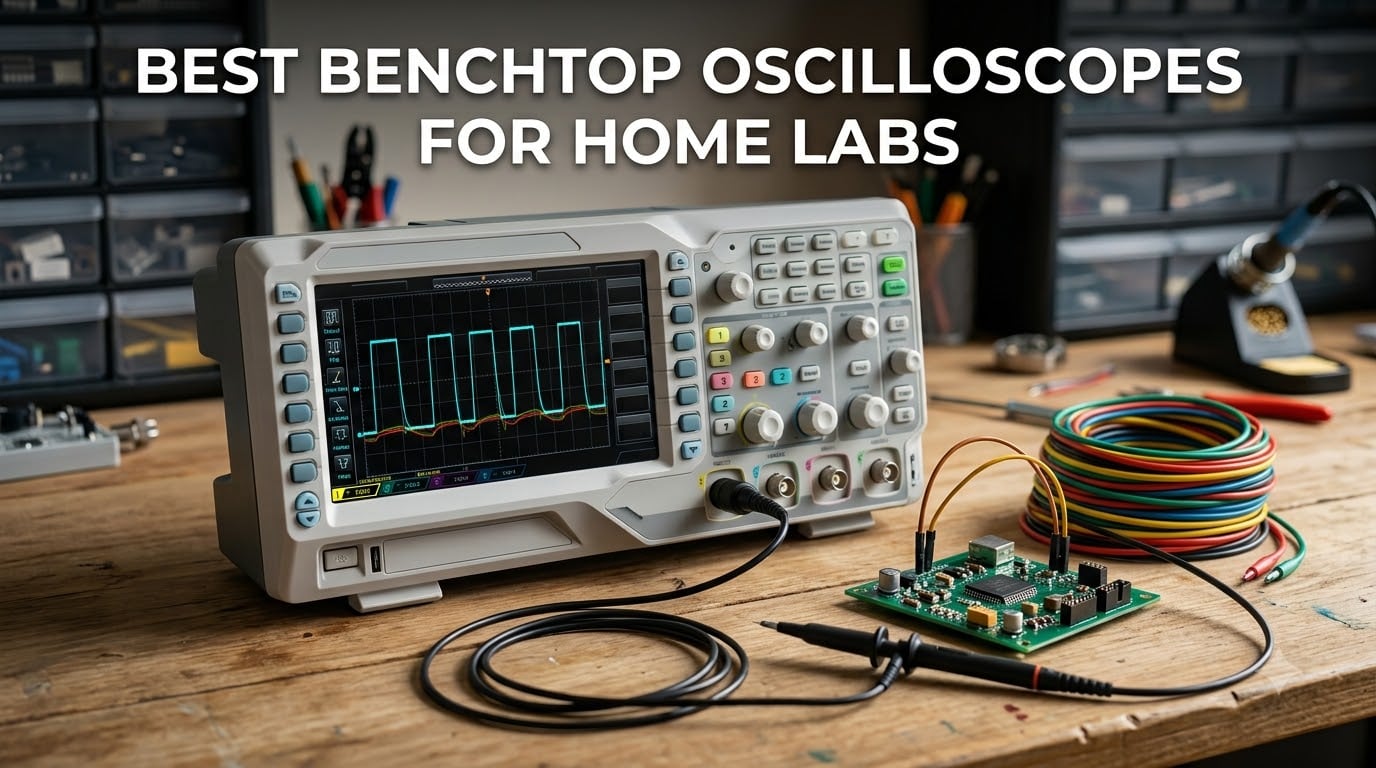
A multimeter tells you a rail is sitting at 3.3 V. A benchtop oscilloscope tells you whether that 3.3 V rail is ringing, drooping under load, or quietly clocking an I2C bus that your firmware keeps corrupting. That difference is the whole reason a home lab eventually grows a real scope on the desk.
After spending the last few months comparing the ten most-reviewed digital storage oscilloscopes in this class, reading owner feedback on r/AskElectronics, r/diyelectronics and r/synthdiy, and putting the finalists through the kinds of work a maker bench actually produces, three names stood out. The Siglent SDS1202X-E is the one to buy for most home labs, because 200 MHz of bandwidth and full serial decoding cost less than the 100 MHz alternatives. The Siglent SDS1104X-E wins on build quality and four channels, with the highest average rating in the group. The RIGOL DS1054Z remains the value benchmark, with 24 Mpts of memory depth that still embarrasses newer instruments.
Everything else in this guide exists to help you pick between them. We look at the ones with four channels, the ones with a signal generator built in, and the ones that are really tiny computers pretending to be instruments. If your interest is narrower, our budget oscilloscope roundup and beginner scope guide cover the cheaper tier in more detail.
Table of Contents
Top 3 Best Benchtop Oscilloscopes For Home Labs (October 2026)
Siglent SDS1202X-E
- 200 MHz bandwidth
- 1 GSa/s sampling
- 14 Mpts record length
- Serial decode standard
The SDS1202X-E takes the top slot on the strength of bandwidth per dollar. Four channels matter less than many buyers expect, while 200 MHz does matter a great deal when you move from 3.3 V microcontrollers into switching regulators and motor drive.
All Ten Benchtop Scopes at a Glance in 2026
| Product | Specifications | Action |
|---|---|---|
| Siglent SDS1202X-E |
|
Check Latest Price |
 Siglent SDS1104X-E Siglent SDS1104X-E |
|
Check Latest Price |
 Rigol DS1054Z Rigol DS1054Z |
|
Check Latest Price |
 FNIRSI 1014D FNIRSI 1014D |
|
Check Latest Price |
 PicoScope 2204A PicoScope 2204A |
|
Check Latest Price |
 RIGOL DS1202Z-E RIGOL DS1202Z-E |
|
Check Latest Price |
 FNIRSI 1013D Plus FNIRSI 1013D Plus |
|
Check Latest Price |
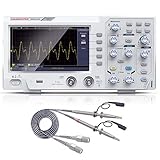 HANMATEK DOS1102 HANMATEK DOS1102 |
|
Check Latest Price |
 Hantek DSO2D15 Hantek DSO2D15 |
|
Check Latest Price |
 FNIRSI DPOS350P FNIRSI DPOS350P |
|
Check Latest Price |
Read the bandwidth column first, then the channel count, then ignore everything else until you have decided whether you need four analog channels. That ordering prevents most buying mistakes.
1. Siglent SDS1202X-E: The Best Overall Benchtop Scope for a Home Lab
Siglent Technologies SDS1202X-E 200 mhz Digital Oscilloscope 2 Channels, Grey
- 200 MHz bandwidth with 1 GSa/s real-time sampling
- 14 Mpts record length for long captures
- Serial bus trigger and decode for IIC SPI UART RS232 CAN LIN
- Largest review base of any scope in the group
- Only 2 analog channels
- Entry-level feature set versus higher-end Siglent series
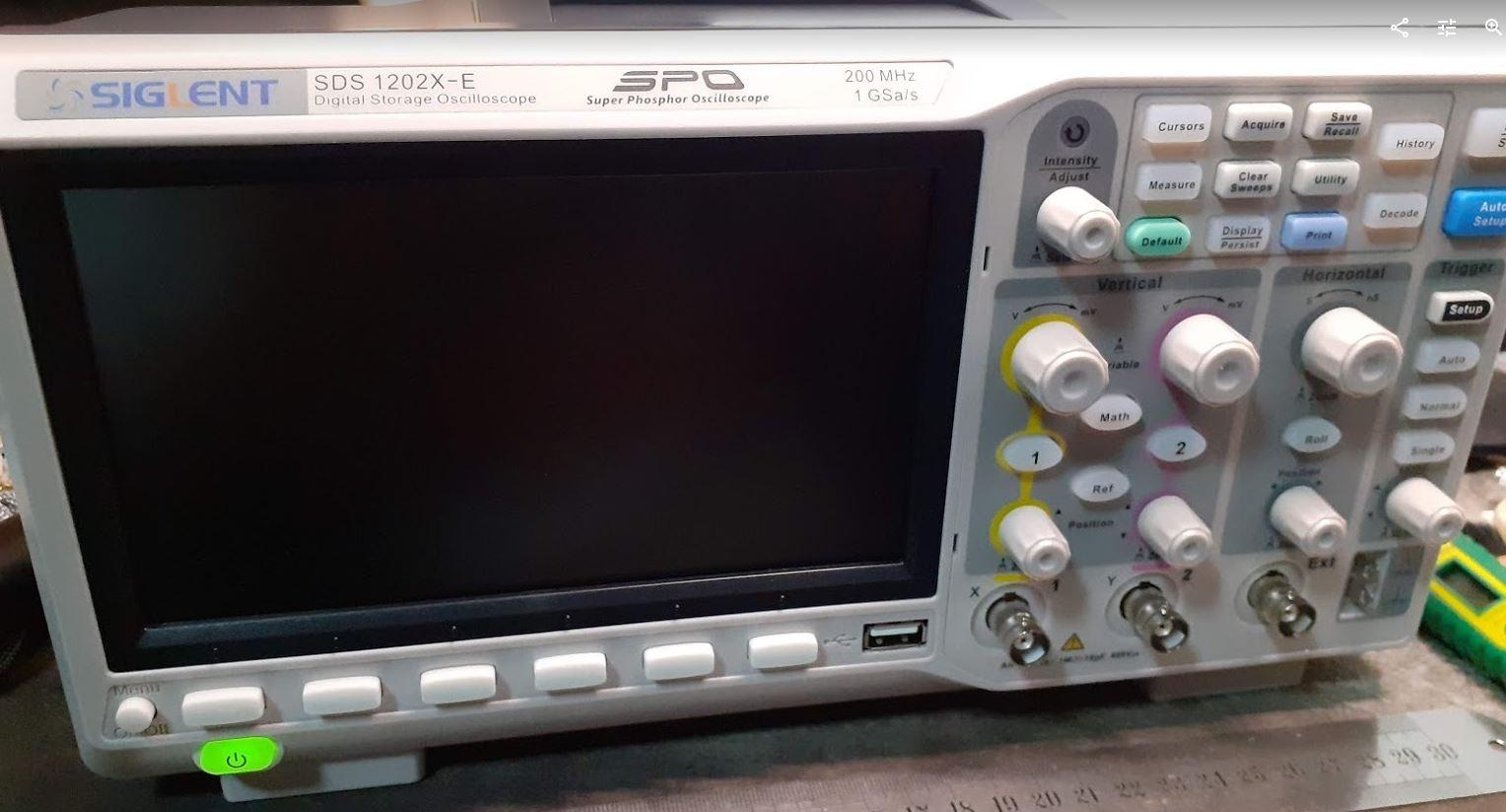
The SDS1202X-E has been on the bench since April 2017 and it shows in the owner base: 1455 ratings averaging 4.7, with 83% of buyers handing over five stars. That is the largest review base of any instrument in this guide, and it matters for something you expect to keep for a decade.
In practice the reason it keeps winning recommendations is straightforward: it carries twice the bandwidth of the 100 MHz alternatives in the same general tier. That headroom is what you are actually paying for, and it matters the moment you leave 3.3 V microcontrollers behind and start probing a buck converter, a MOSFET gate drive or a fast SPI clock.
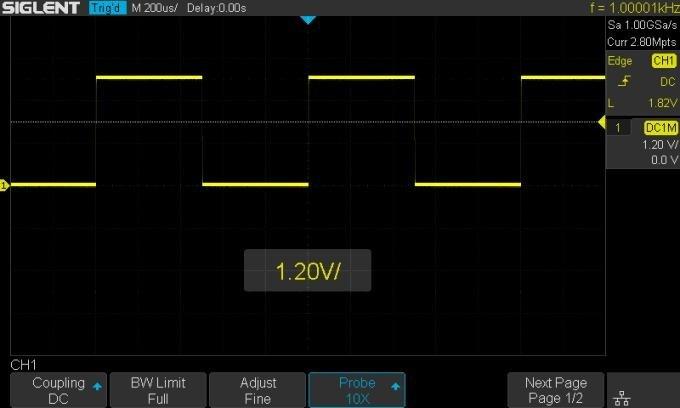
The serial decoding is the quiet winner. IIC, SPI, UART, RS232, CAN and LIN all trigger and decode at purchase with no license, so an I2C bus debugging session needs nothing extra in the box. The 14 Mpts of record length gives you long enough captures to count frames rather than watching a single screen refresh.
It weighs 5.5 lbs and measures 10 x 15 x 17 inches, which is a real bench instrument footprint rather than a desk toy. Probes are not included in the standard package, so budget for a proper 10x set.
When the SDS1202X-E is the right bench purchase?
Pick it if your work is microcontrollers, sensor conditioning, power supply bring-up or any analog signal that needs to be measured accurately rather than merely counted. Two channels is enough for most of that, because you are usually looking at one signal against ground or a trigger source.
Owners on r/AskElectronics regularly call the alternative, a 100 MHz two-channel scope, adequate for Arduino and Raspberry Pi work. That consensus is right, and 200 MHz leaves you room to grow without changing instruments later.
When the SDS1202X-E is the wrong bench purchase?
If your projects routinely involve three or four simultaneous nets, such as a three-phase motor bridge or a multi-rail power tree, two analog channels will slow you down. You would be constantly swapping probes instead of watching them together.
It is also the least expandable member of the Siglent family. The four-channel series can take an optional MSO digital pod and a USB AWG module; this one cannot. If you plan to decode many low-speed digital lines on a 16-channel budget, look at the SDS1104X-E instead.
2. Siglent SDS1104X-E: The Four-Channel Build Quality Pick
Siglent Technologies SDS1104X-E 100Mhz Digital Oscilloscope 4 Channels Standard Decoder, Grey
- Highest average rating in the group at 4.8
- Four analog channels with dual ADC architecture
- Serial decoders unlocked at purchase
- Built-in Ethernet web server for remote viewing
- Four 100 MHz probes with color ID rings included
- Optional MSO and AWG licenses are expensive relative to their function
- Select knob is twitchy and can jump to adjacent menu items
- No internal battery clock without NTP sync
This is the highest-rated scope in the group, 4.8 across 966 ratings with 88% five-star, and the quality of that rating tells you something. Nothing else in this guide reaches 4.8, and the two scopes closest to it sit a full ten points lower in their one-star share. The Siglent four-channel X-E model was a deliberate step up in fit, finish and front-panel feel.
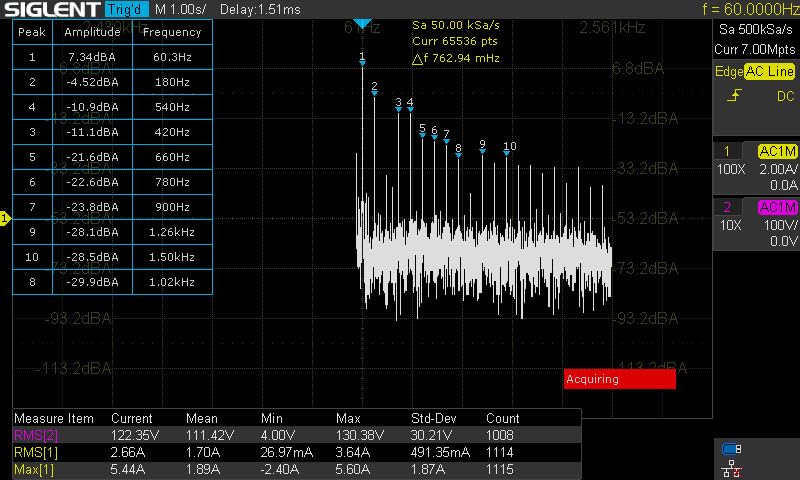
The dual ADC architecture is the technical feature worth understanding. Rather than multiplexing one converter across four channels, it runs two converters in parallel, so pairs of channels still hit high sample rates. On a two-channel trace you get the full rate, which makes single-shot captures of fast edges far more usable.
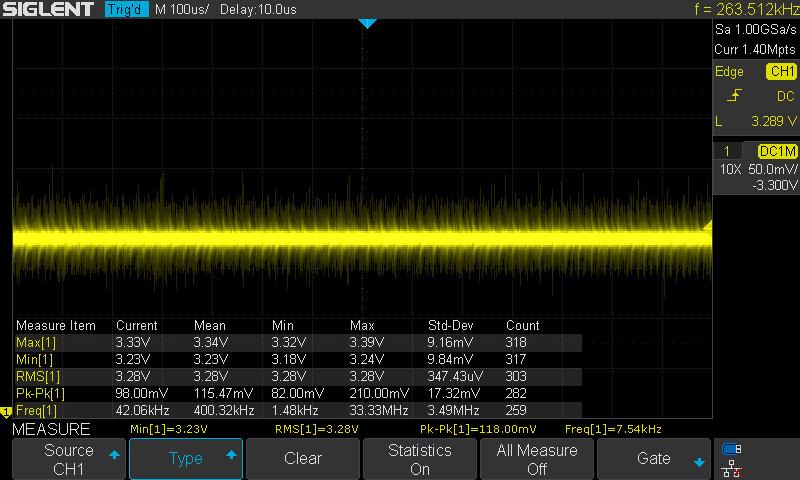
Owners consistently single out three things: the responsive interface compared with the deep-menu rivals, serial decoding that needs no license key, and the built-in web server that lets you view the screen from a phone over Ethernet. That last one is a genuine home-lab feature, since you can park the scope across the bench and still read a glitch capture from your desk.
Four passive probes with color ID rings ship in the box, which removes the single most common frustration of first-time buyers. Owners still report planning for a better probe set later, but you are not debugging with the cheap ones on day one.
Who should buy the SDS1104X-E?
Buy this scope if you debug buses, motor control, power sequencing or anything where you need to correlate three or four signals at once. It is also the one we recommend for beginners who want an instrument that grows with them rather than a stopgap.
The Ethernet web server makes it a natural fit for a home lab with a shared bench. SCPI over the network also means you can script measurements from a Raspberry Pi sitting next to the instrument, which turns the scope into part of an automated test rig rather than a standalone display.
What to watch out for?
The optional extras are the catch. The 16-channel MSO digital pod and the USB AWG module are sold separately, and owners repeatedly note that the license cost feels large next to what those modules do. Budget for them only if you know you need them.
The select encoder is the most criticized control on the machine, described as twitchy and prone to jumping to the adjacent menu item. Channels 3 and 4 also share similar light blue and light green trace colors, which gets confusing on a four-channel screen. There is no internal battery clock, so the date-time field resets unless you sync over NTP.
3. Rigol DS1054Z: The Value Benchmark With 24 Mpts of Memory
Rigol DS1054Z Digital Oscilloscope, 50MHz, 4 Channel, 1GSa/s, Best Value
- Pro-class triggering decoding and measurement tools at an entry price
- 24 Mpts memory depth is unusually large for this class
- Serial decoders for I2C SPI and RS232 enabled out of the box
- LAN LXI plus USB host and device as standard
- Cooling fan produces noticeable white noise
- Intensity and select rotary encoder is error-prone
- Bundled probes are mediocre and hard to tune
The DS1054Z arrived in August 2014 and has accumulated 725 ratings at 4.7, with 83% five-star. It remains the most-recommended starting instrument in home electronics communities, and the reason is that the feature density is disproportionate to what you spend.
Four analog channels, a 24 Mpts memory ceiling, waveform record and playback up to 60000 frames, and a capture rate up to 30000 wfms/s with an intensity graded display. That last pair is the argument for this scope: intensity grading shows how often a waveform hits each pixel, which is how you spot an intermittent event that a conventional scope hides.
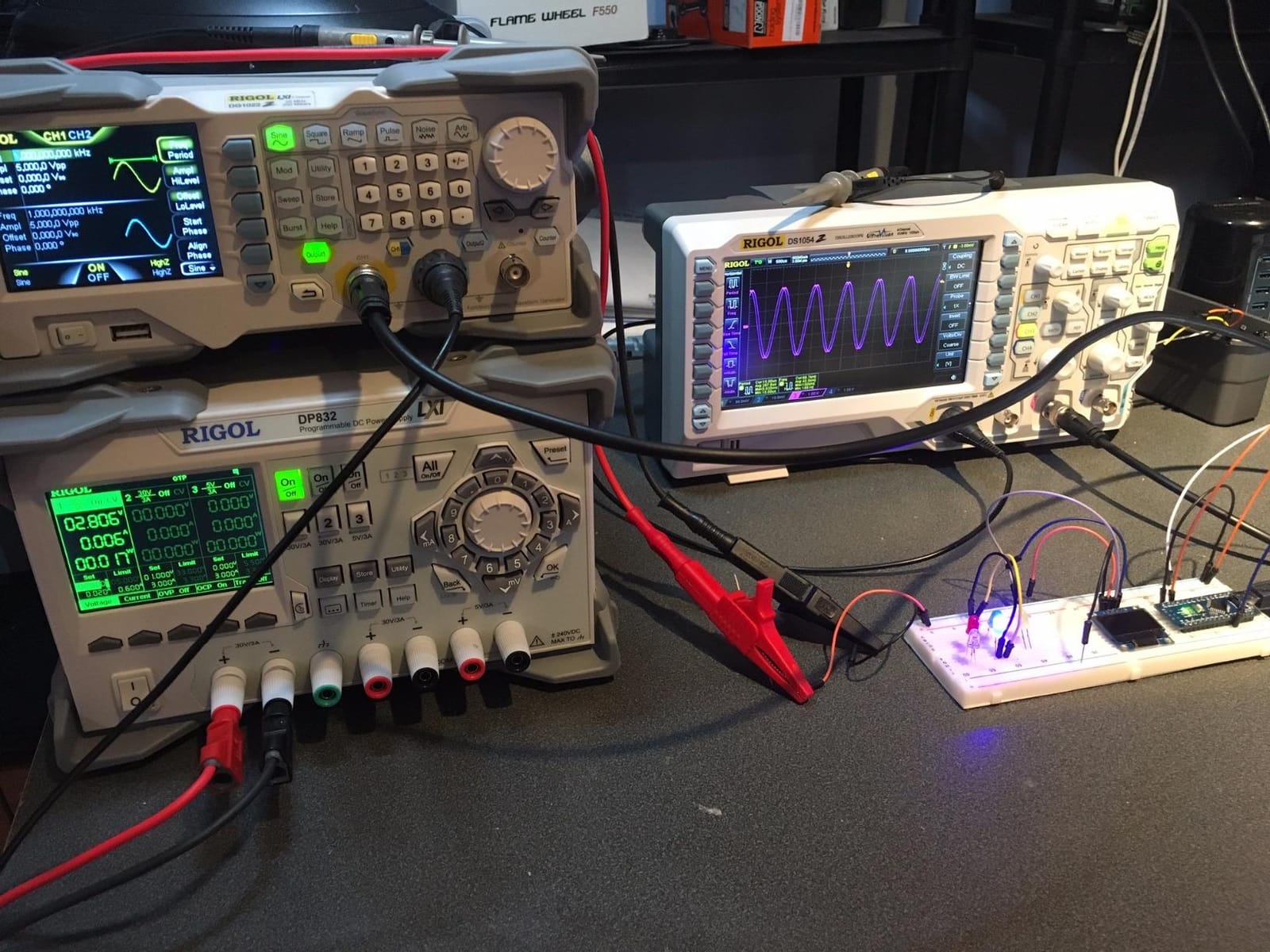
The memory depth deserves emphasis. 24 Mpts on a single channel, 12 Mpts on two and 6 Mpts across three or four, gives you long records for slow signals. When you zoom into a millisecond of a captured second, you still have real samples rather than an interpolated mess.
Connectivity is standard rather than optional: USB host, USB device, LAN with LXI, and an AUX output carrying trigger-out and pass/fail. For a fixed desk instrument, having LAN as standard removes a whole category of adapter problems.
Where the DS1054Z still wins?
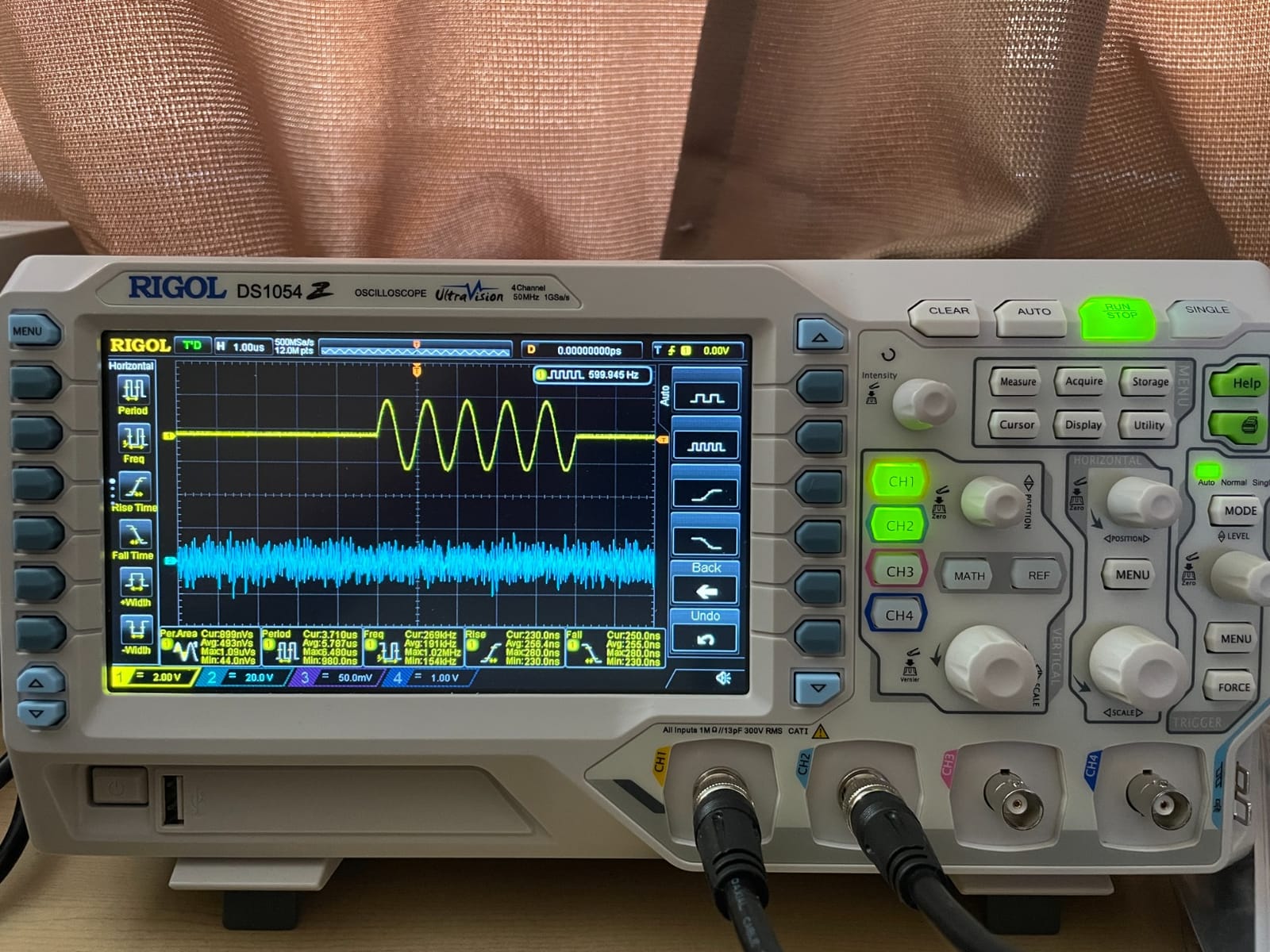
If your work is mostly 5 V and 3.3 V digital systems, a microcontroller at a few MHz, or audio-range signals, 50 MHz of bandwidth is genuinely enough. The forum consensus is that 50 to 100 MHz covers Arduino and Raspberry Pi level work comfortably, and this scope sits at the bottom of that range.
The documentation is unusually good for this price class, with an extensive online manual, video tutorials and a built-in help button. For a first serious instrument, that support matters as much as the spec sheet.
Where 50 MHz becomes the ceiling?
Once you start probing switching regulators, examining rise times on fast edges or looking at clocked buses above about 20 MHz, the bandwidth stops being the limiting factor and starts being the problem. Owners on r/AskElectronics name it as the single most-cited reason to move up.
There is a widely used firmware unlock that raises the limit to 100 MHz, and home-lab buyers treat it as an accepted cost-saving move. Treat it as a bonus rather than a plan, because it voids the warranty and cuts accuracy. The fan noise and the error-prone intensity encoder are the other two repeated complaints, and the bundled probes are described as mediocre and hard to tune.
4. PicoScope 2204A: The Bench Companion That Fits in a Laptop Bag
Pico Technology PicoScope 2204A Oscilloscope 2 Channel 10 MHz Bandwidth USB
- Exceptionally compact and USB-powered
- 40 serial protocol decoders plus spectrum analyzer and function generator included
- Up to 12-bit enhanced vertical resolution
- Free lifetime software updates on Windows Linux and Mac
- 10 MHz bandwidth limits it to low-frequency and audio signals
- 8 kS capture memory is very small for deeper analysis
- Depends on host PC software rather than a standalone display
The PicoScope 2204A is not a benchtop instrument, and we include it because the question comes up constantly on forums: can a PC-based scope do the job? The answer for slow signals is genuinely yes.
It measures 5.59 x 3.62 x 0.74 inches and weighs 5 ounces. USB 2.0 powers it and carries the data, and the software runs on Windows, Linux and Mac with free upgrades for the life of the product. Two x1/x10 passive probes are in the kit.
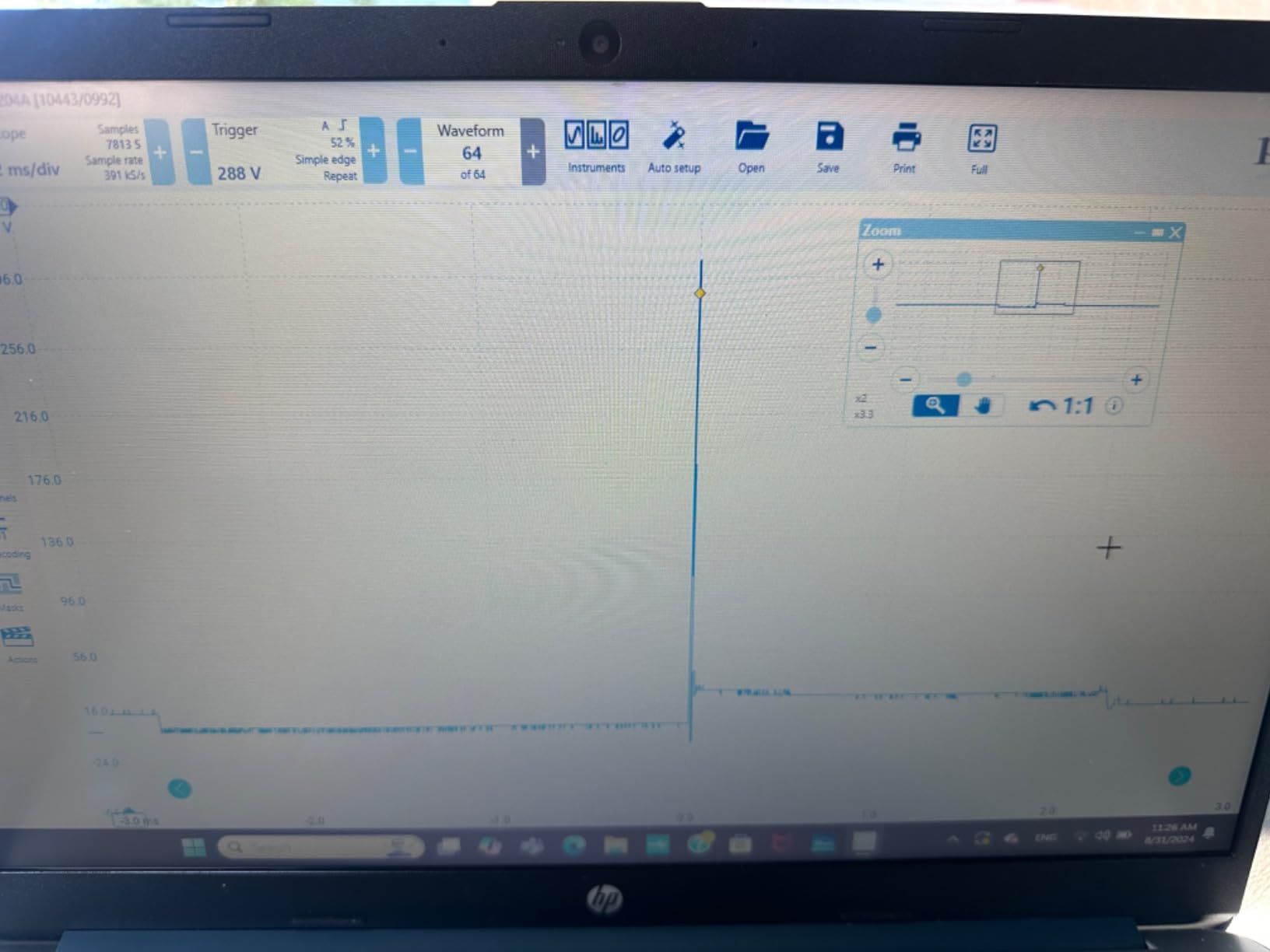
The software bundle is what makes this interesting. Forty serial protocol decoders, a spectrum analyzer, a function generator and an arbitrary waveform generator all come standard, plus mask limit testing and advanced math. Owners rate it 4.6 across 511 ratings with 79% five-star, which makes it the most consistently rated unit among the low-cost options in this guide.
Enhanced vertical resolution of up to 12 bits at 10 MHz bandwidth is unusual for the money. On a slow, clean signal it means noticeably better noise behaviour than a nominal 8-bit converter, which is a real benefit for analog work.
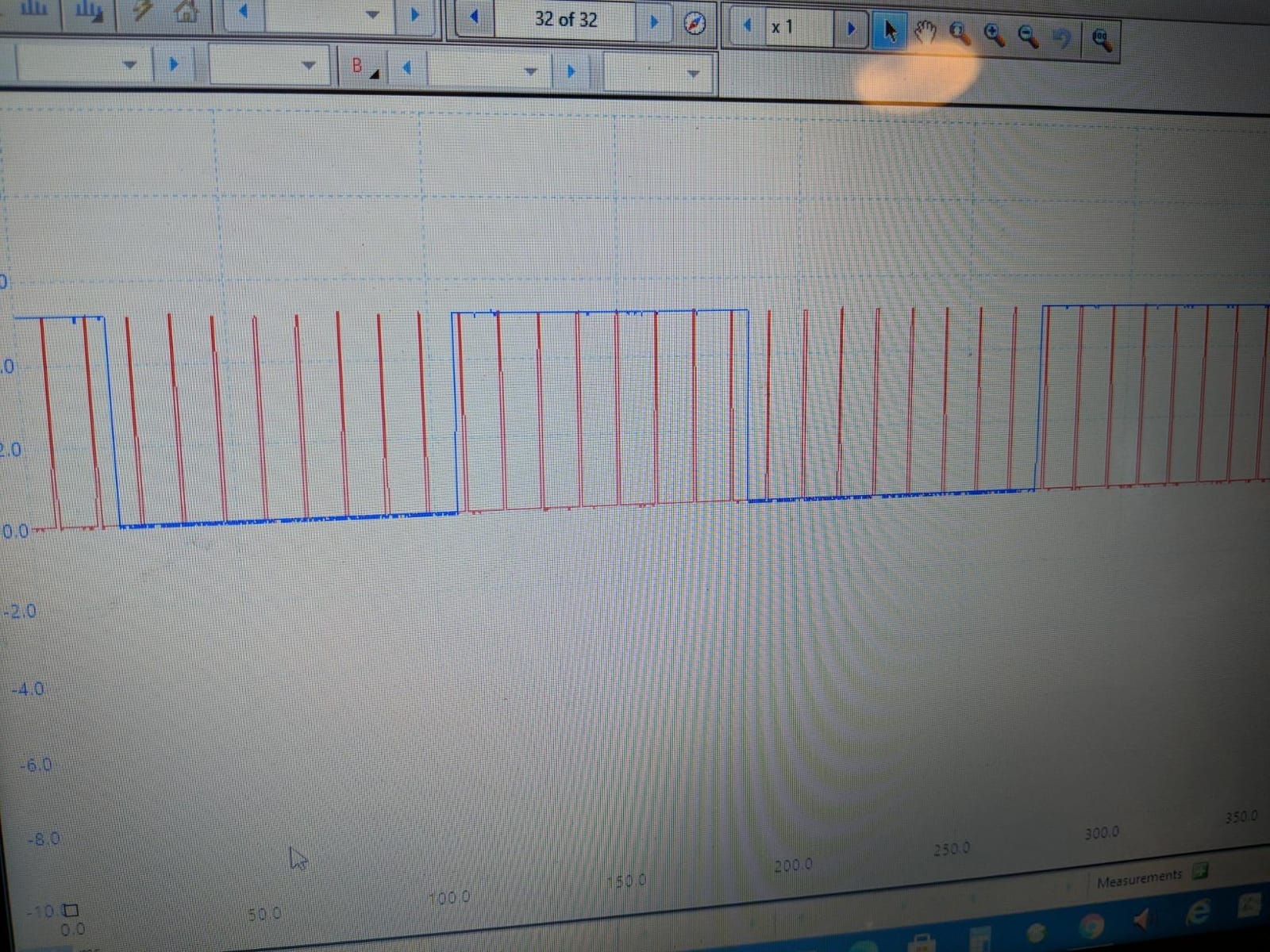
Where the 2204A earns its place?
Treat it as a second instrument rather than your only one. A home lab with a fixed benchtop scope can use the Pico for field work, for teaching, or as a dedicated channel when you need to watch something away from the main instrument.
Audio and low-frequency work is its natural territory. Ten MHz of bandwidth is ample for envelope following, oscillator checks and power rail ripple, and 12-bit enhanced resolution helps on signals where a multimeter would give you a single averaged number.
Where it stops being enough?
The 8 kS capture memory is the real limitation, not the bandwidth. It is a shallow record, so zoomed views of a long window have little real data behind them. Anything above roughly 1 MHz of signal content is outside what this instrument can resolve.
There is also no display of its own. If the laptop is busy, the scope is unavailable, and none of the measurements happen without a running host machine. For a permanent desk setup, a standalone instrument is simply more convenient. Our USB oscilloscope guide covers the wider category.
5. RIGOL DS1202Z-E: 200 MHz With Deep Memory and a Three-Year Warranty
RIGOL DS1202Z-E Digital Oscilloscope, 200MHz, 2 Channel, 1GSa/s Sampling
- 200 MHz of bandwidth in a two-channel bench form factor
- 24 Mpts memory depth with 60000 frame record and playback
- Bright 7-inch display with a wide uncluttered waveform area
- 3-year warranty on the main unit
- External trigger input included
- Multifunction select knob is overly sensitive and overshoots
- Full-resolution memory exports over slow USB 2
- Menus and variables take real learning time
The DS1202Z-E answers a narrow question well: how do you get 200 MHz without moving to professional instrument pricing. It pairs 200 MHz of bandwidth with up to 1 GSa/s sampling, 24 Mpts of memory, and an external trigger input that the two-channel RIGOL usually omits.
Owners rate it 4.7 from 468 ratings with 85% five-star, and the review pattern is consistent. People frame it as a Tektronix-class replacement at a hobbyist price, and the specific praise lands on memory depth, multi-frame playback and a bright 7-inch WVGA display with a wide waveform area.
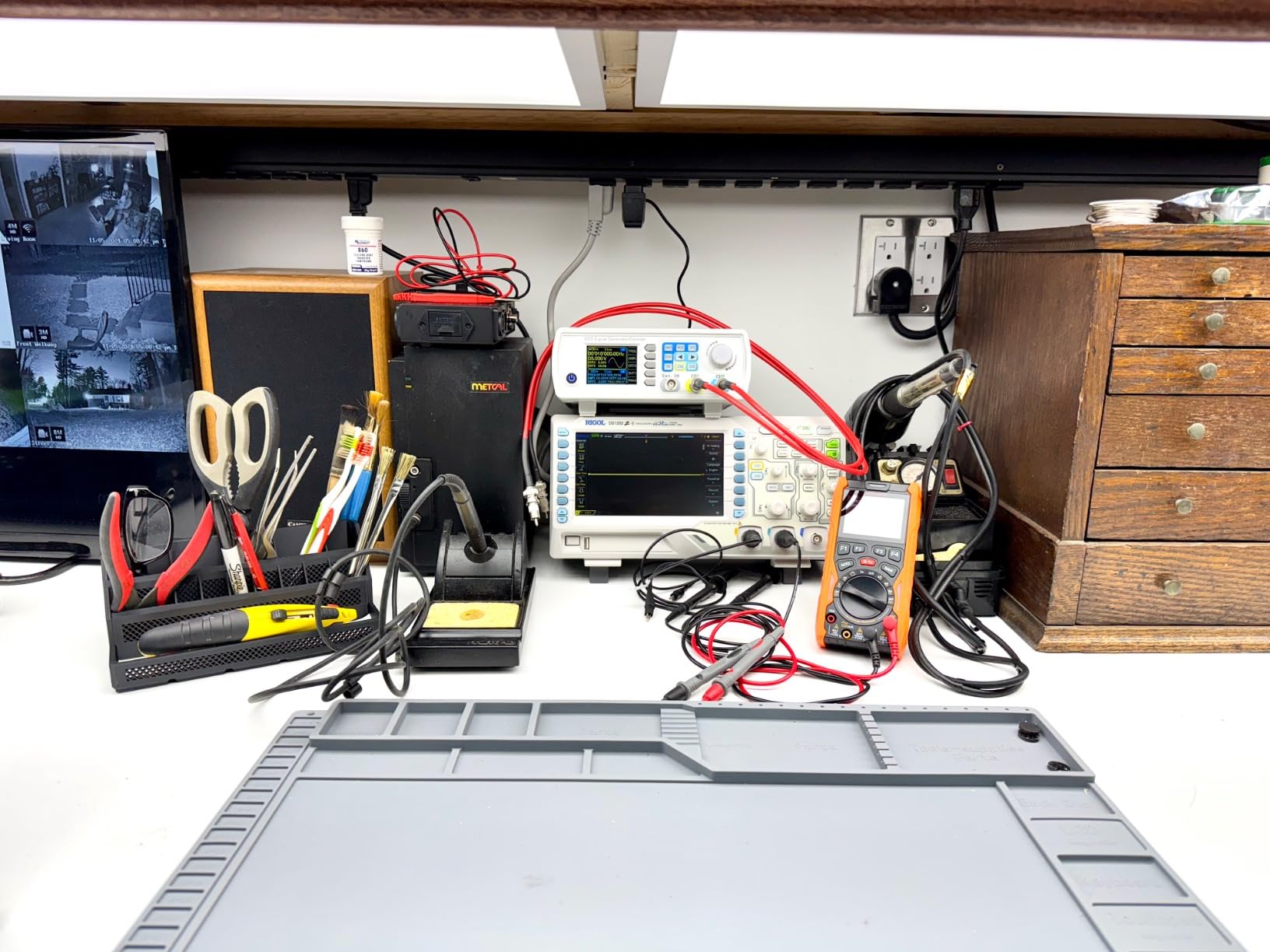
Capture rate runs up to 30000 wfms/s with an intensity graded color display, and hardware record and playback extends to 60000 frames. That combination means you can capture a burst of activity, then step through it frame by frame to find the one acquisition where something went wrong, which is the core skill of glitch hunting.
Serial bus trigger and decode covers RS232/UART, I2C and SPI at purchase. USB host, USB device, LAN with LXI, and an AUX output for trigger-out and pass/fail round out a well-equipped connectivity package.
When to choose the DS1202Z-E over the Siglent?
Pick this one over the SDS1202X-E if deep memory and multi-frame playback drive your work, or if you need an external trigger input to synchronise with a second instrument or a switching circuit. The RIGOL also carries a 3-year warranty on the main unit, which is longer than most competitors offer.
For power supply bring-up and motor control, 200 MHz with 24 Mpts is a strong pairing. Included probes are reported as better quality than the typical budget bundle, and there is built-in help for nearly every function.
Where the RIGOL frustrates people?
The multifunction select knob overshoots the option you want, and it is the single most repeated complaint in the reviews. That is a real problem on a scope you will use with one hand holding a probe and the other turning controls.
Exporting a full-resolution 24 Mpts capture goes over USB 2, and owners report it is very slow. Large USB flash drives are also not always recognised. And this is not a beginner device: reviewers describe the menus and variables as requiring real learning time, so budget a few evenings before you feel productive.
6. FNIRSI 1014D: The Scope With a Signal Generator Built In
FNIRSI 1014D 100MHz Digital Oscilloscope, 2 Channel Oscilloscope 2-in-1
- Scope plus built-in DDS function generator in one compact unit
- One-button AUTO function shortens setup time dramatically
- 100 MHz on both channels with 1 GSa/s is adequate for DIY work
- Supplied 100X probe is useful for higher-voltage work
- FFT view does not display usable frequency or amplitude values
- Signal generator output amplitude is fixed and not adjustable
- Quality control issues including units arriving with damaged screens
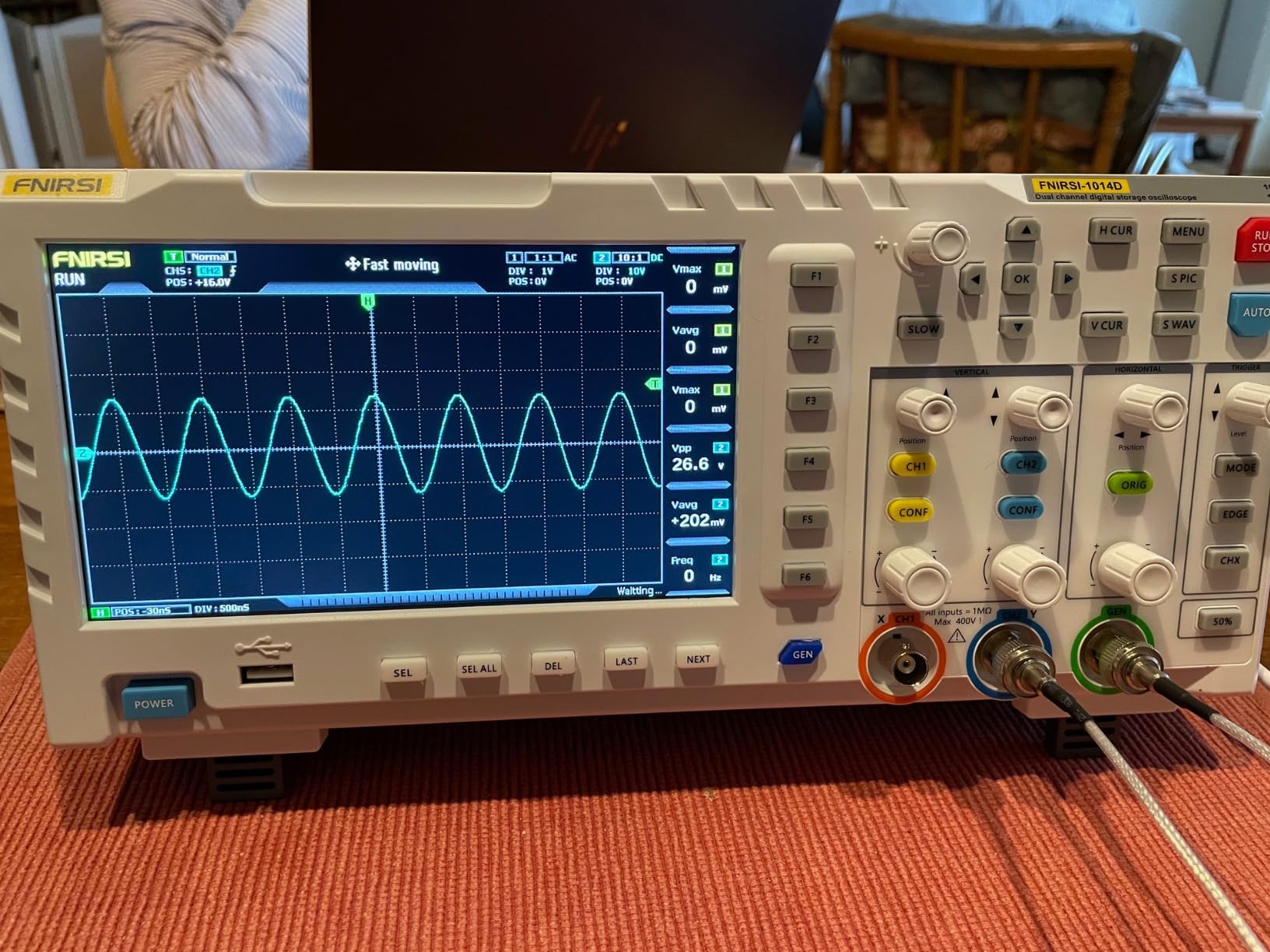
The case for the FNIRSI 1014D is that it collapses two boxes into one. You get a 100 MHz per channel digital oscilloscope with 1 GSa/s sampling and a DDS function signal generator with 14 waveform types, all in a 3.46 lb body that fits above a small workbench.
Owners consistently praise the one-button AUTO function, which applies adaptive triggering at 25, 50 or 75 percent and cuts setup time on an unfamiliar circuit to seconds. The 7-inch 800 x 480 LCD and cursor measurement with direct peak-to-peak and frequency readout support that hands-off approach.
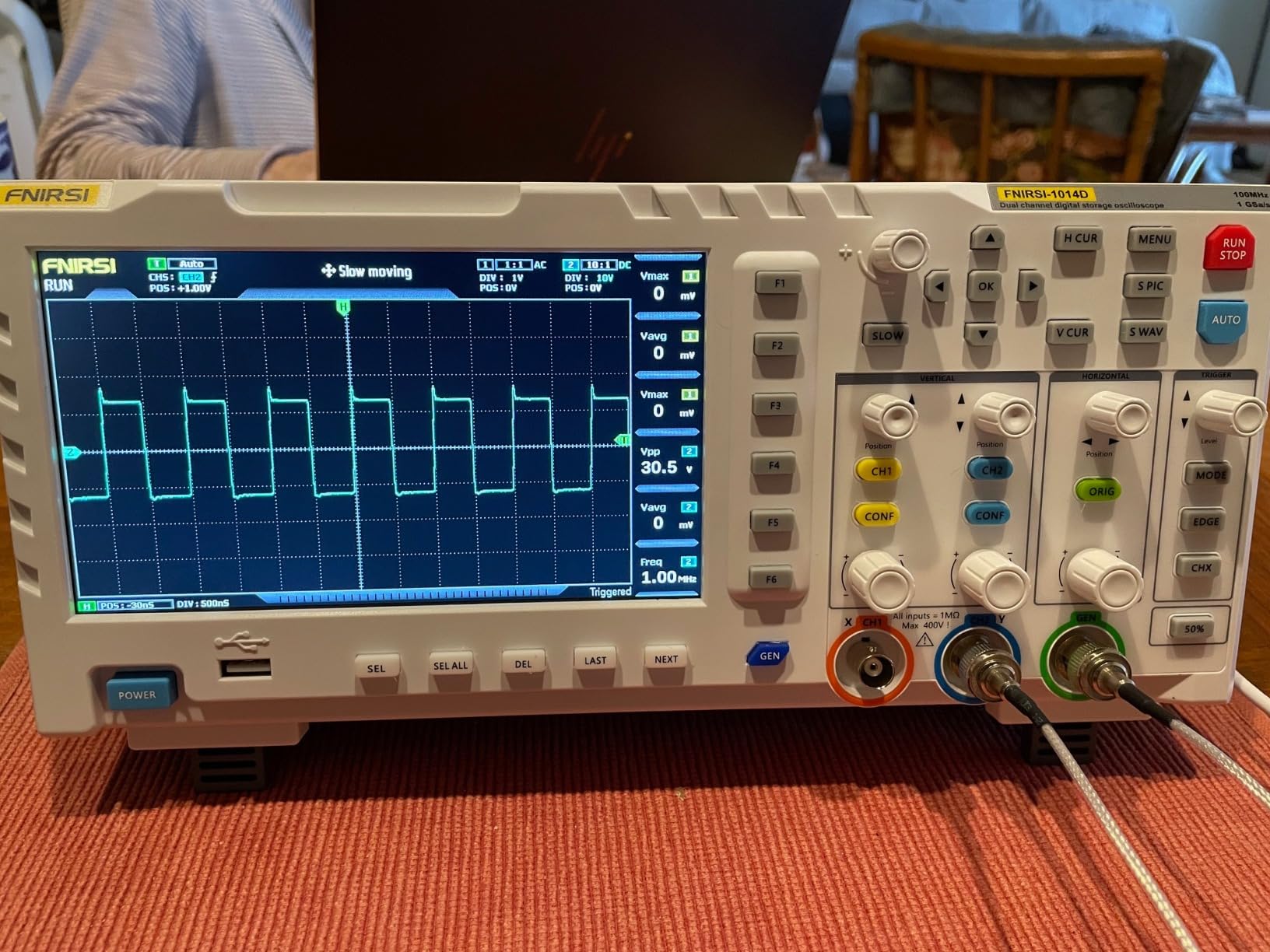
The generator covers 1 Hz steps with a fixed 2.5 Vpp chopping output, and stores up to 1000 custom signals. For testing filters, amplifiers and op-amp stages without dragging out a separate function generator, that is genuinely useful.
The 4.2 average from 509 ratings is the lowest among the non-handheld units here, with 64% five-star but a 10% one-star share. The rating distribution tells the story: the hardware is fine, the software and quality control are where the complaints live.
When the 2-in-1 format makes sense?
Choose it if bench space is tight or you are a beginner who wants the fastest path from circuit to waveform. The AUTO button alone will save you an hour in your first month.
Lissajous XY display helps with phase comparisons, and the unit is a reasonable companion for audio-range and low-voltage analog work. Bring your own expectations about precision, though.
What owners flag as problems?
The FFT view is the most cited weakness because it does not display usable frequency or amplitude values, which makes it a rough indicator rather than a real spectrum analyzer. The generator output amplitude is fixed and not adjustable, so you cannot set a clean 100 mV test tone.
There is a persistent stream of reports about units arriving with damaged or non-functional screens, the printed manual is tiny and omits the specifications, and reviewers note the unit is not accurate near the top of its stated 100 MHz bandwidth. The 100X probe is useful, but treat the FFT and the top end of the range as approximate.
7. FNIRSI 1013D Plus: The Touchscreen Portable With a Battery
FNIRSI 1013D Plus 100MHz Oscilloscope, 2 Channel Oscilloscope 7″ TFT Touch
- Built-in 6000 mAh battery gives roughly four hours of untethered use
- Capacitive touchscreen makes menu navigation faster
- High-voltage protection module tolerates continuous voltages up to 400 V
- 1 GB internal storage holds 1000 screenshots and waveform sets
- Touch UI adds a layer over simpler physical controls
- Lowest review count of the FNIRSI units here with a 9 percent one-star share
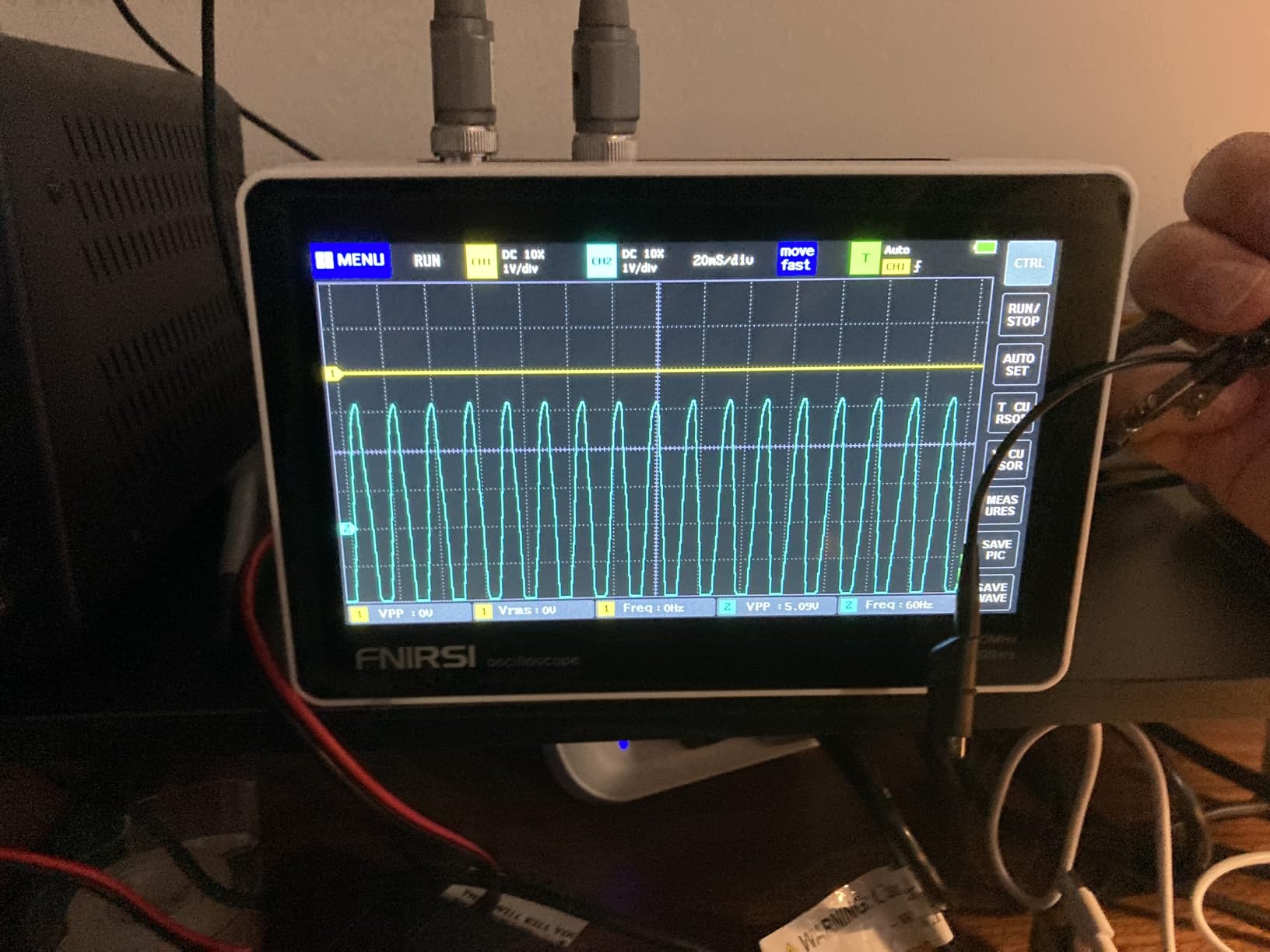
Released in October 2022, the 1013D Plus is the touchscreen-and-battery option at the entry level. It runs 1 GSa/s with 100 MHz on both channels, driven by a 7-inch 800 x 480 high-contrast capacitive display.
It ranks in the top ten of Lab Oscilloscopes on Amazon, which is the strongest demand signal in this group, and it holds 4.4 from 312 ratings with 72% five-star. The capacitive gesture interface, the internal battery and the 400 V protection module are the three features owners mention first.
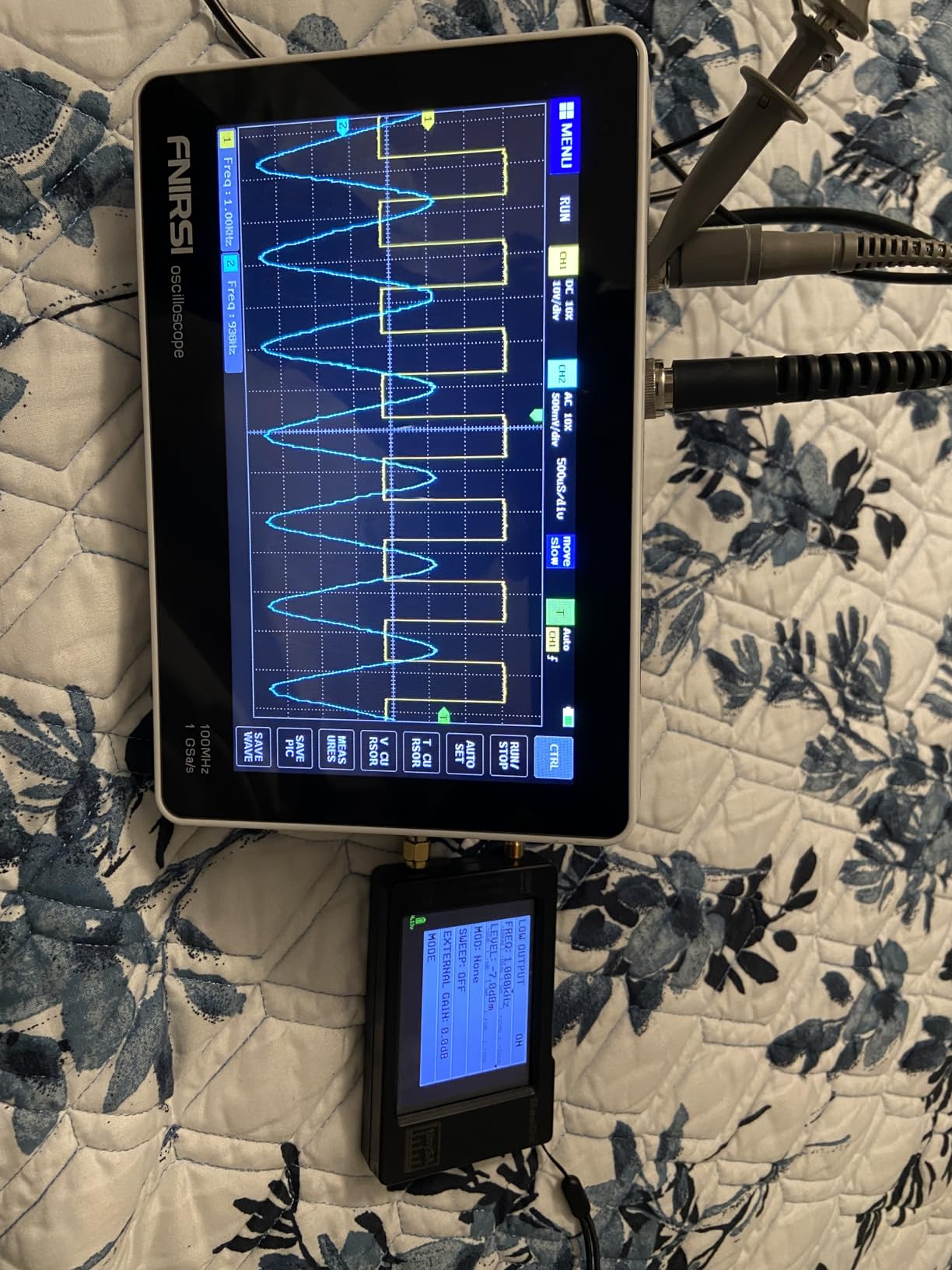
The 6000 mAh battery gives roughly four hours of continuous use, which is enough for a session of probing a repair off the bench. 1 GB of internal storage holds up to 1000 screenshots plus 1000 waveform sets with thumbnail browsing, so you can review captures without a computer in the loop.
Single, normal and automatic trigger modes are all present, and cursor measurement gives direct peak-to-peak and frequency readouts. Lissajous XY and FFT viewing round out the display modes.
Why touch and battery matter in a home lab?
The touchscreen genuinely speeds up menu navigation compared with the deep soft-key menus on button-driven budget scopes, and that is the most common reason owners recommend it. If you are a beginner who will navigate constantly, that responsiveness is worth something.
The battery plus 400 V continuous protection also makes this a sensible instrument for field repair work, appliance troubleshooting or working away from the bench. It weighs 2.31 lbs.
Where touch becomes a liability?
The reservation that shows up repeatedly is that a touchscreen adds a layer over physical controls, and gloves or a probe in one hand make that worse. Experienced users on r/AskElectronics consistently say they prefer focus on physical knobs for long bench sessions, and that preference is the strongest consensus in the forums.
It is also the least proven of the three FNIRSI units here, with 312 ratings and a 9% one-star share. If a permanent desk instrument is the plan, the Siglent or RIGOL four-channel models serve better even though they cost more.
8. HANMATEK DOS1102: The Scope You Can Script From LabVIEW
- 110 MHz bandwidth and 500 MS/s sampling at a low entry point
- Built-in 6-digit hardware frequency meter independent of the acquisition path
- SCPI compliant with LABVIEW communication and secondary development support
- 30 automatic measurement functions with a customizable menu
- Record depth of 10K sampling points limits long captures
- Only 16 stored waveform groups
- Documentation and firmware support thinner than the larger brands
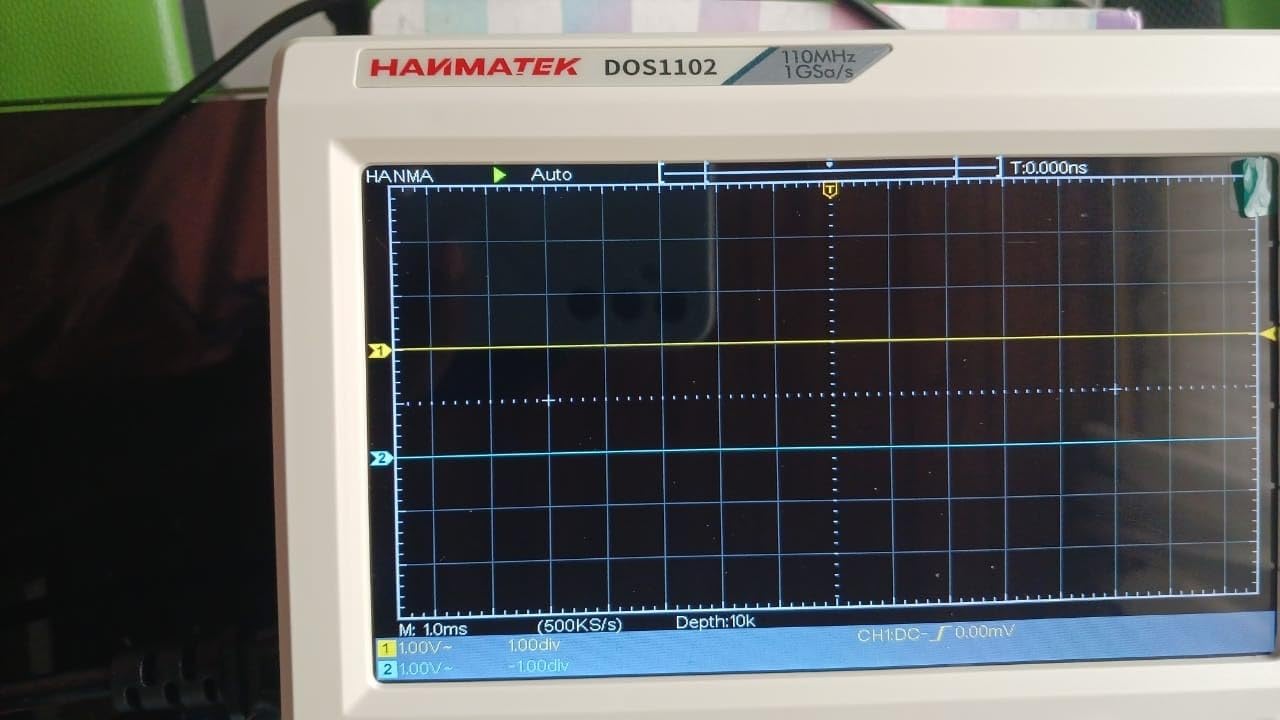
The DOS1102 is a 2.4 lb, 7-inch TFT instrument with 110 MHz of bandwidth and 500 MS/s sampling on two channels. It is unusual in this group for one specific reason: it is SCPI compliant and supports LABVIEW communication and secondary development.
That matters if you want to automate measurements rather than watch a screen. A home lab with a test sequence, a printer, or a Raspberry Pi logging thermal cycling can drive this instrument directly, and the built-in 6-digit hardware frequency meter runs from 2 Hz to 20 MHz independently of the acquisition path.
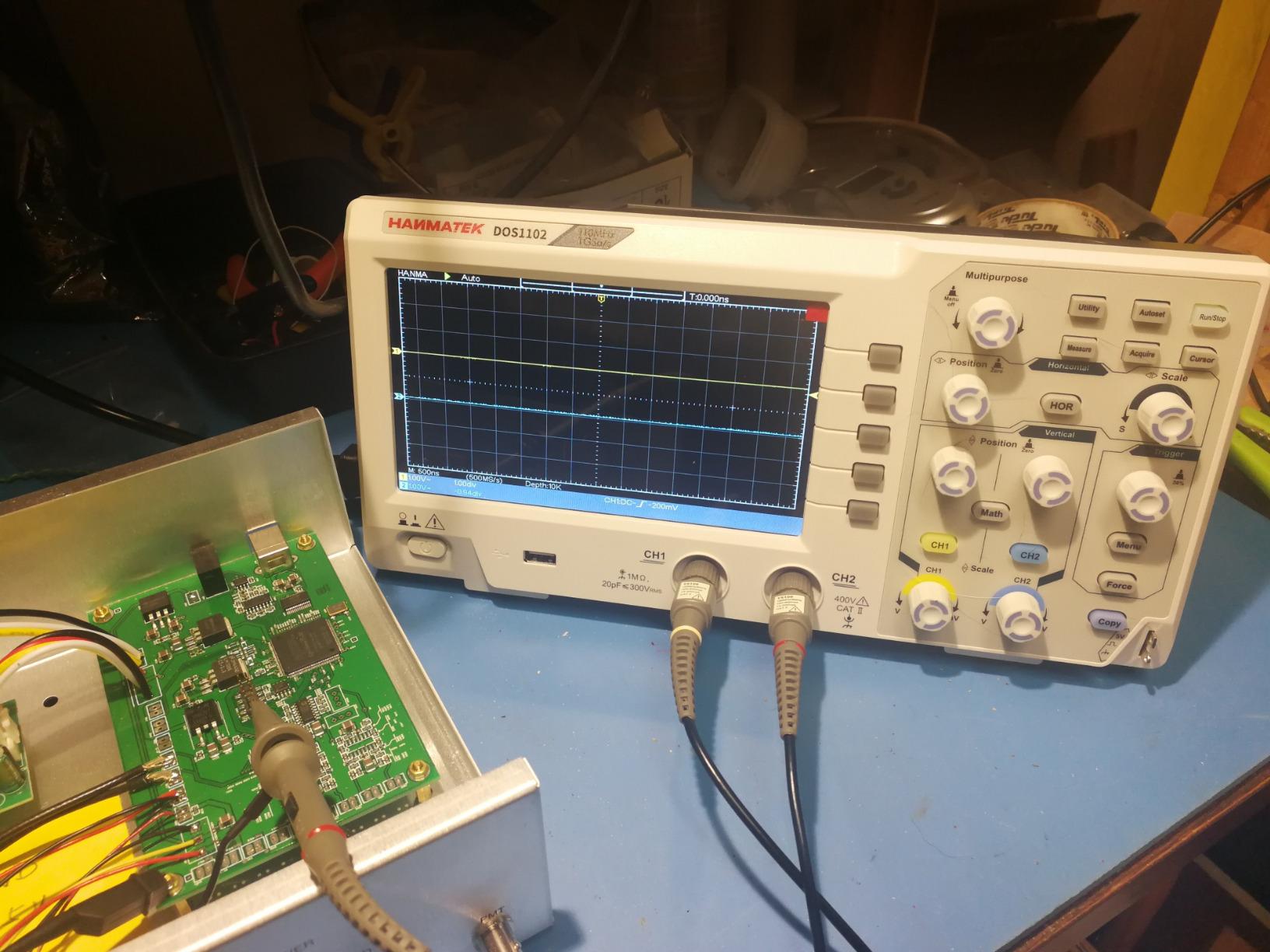
The display is a 7-inch true-colour TFT at 800 x 480 with 65535 colours, and cursor measurement covers voltage difference, time difference and combined modes. Automatic ranging with horizontal, vertical and single or multiple waveform tracking reduces manual setup, and 30 automatic measurement functions are available with a customisable menu.
Probe attenuation multiples of 1X, 10X, 100X and 1000X are supported, which is broader than most competitors list. USB stick storage plus USB device and host interfaces handle data transfer.
When programmability is the deciding factor?
Choose the DOS1102 if you want automated measurements more than you want a polished user interface. Automatic test sequences, fans or heaters cycling, or long-run logging are all cases where scripting beats watching a screen.
The 2 ns/div to 1000 s/div time base and 20 mV/div to 5 V/div vertical range cover both fast edges and slow switching transients, and 110 MHz of bandwidth handles switching signals comfortably. It holds 4.4 from 248 ratings with 70% five-star.
What the record depth costs you?
Record length is not less than 10K sampling points and the unit stores not less than 16 waveform groups. That is the trade-off for the programmability, and it is a real constraint: long captures at slow timebases will not give you the deep records that a 24 Mpts instrument provides.
Documentation and firmware support are also described as thinner than the larger brands ship, so expect to rely on community knowledge for advanced setup. The timebase specification is the thing to sanity-check first, because 110 MHz with 500 MS/s is a lower ceiling than the 1 GSa/s units above it.
9. Hantek DSO2D15: A 150 MHz Full-Size Bench Scope With a Generator
Hantek DSO2D15 Digital Storage Lab Oscilloscopes150MHz Bandwidth 2CH
- 150 MHz bandwidth and 1 GSa/s sampling in a full bench form factor
- Only 1 percent one-star ratings the lowest negative share in this group
- Internal signal generator adjustable up to 25 MHz
- FFT mode and IQ analysis work well below roughly 50 MHz
- Slower CPU causes sluggish display refresh
- Measurement accuracy drops noticeably above about 5 MHz
- Auto Set does not reliably acquire complex or low-frequency waveforms
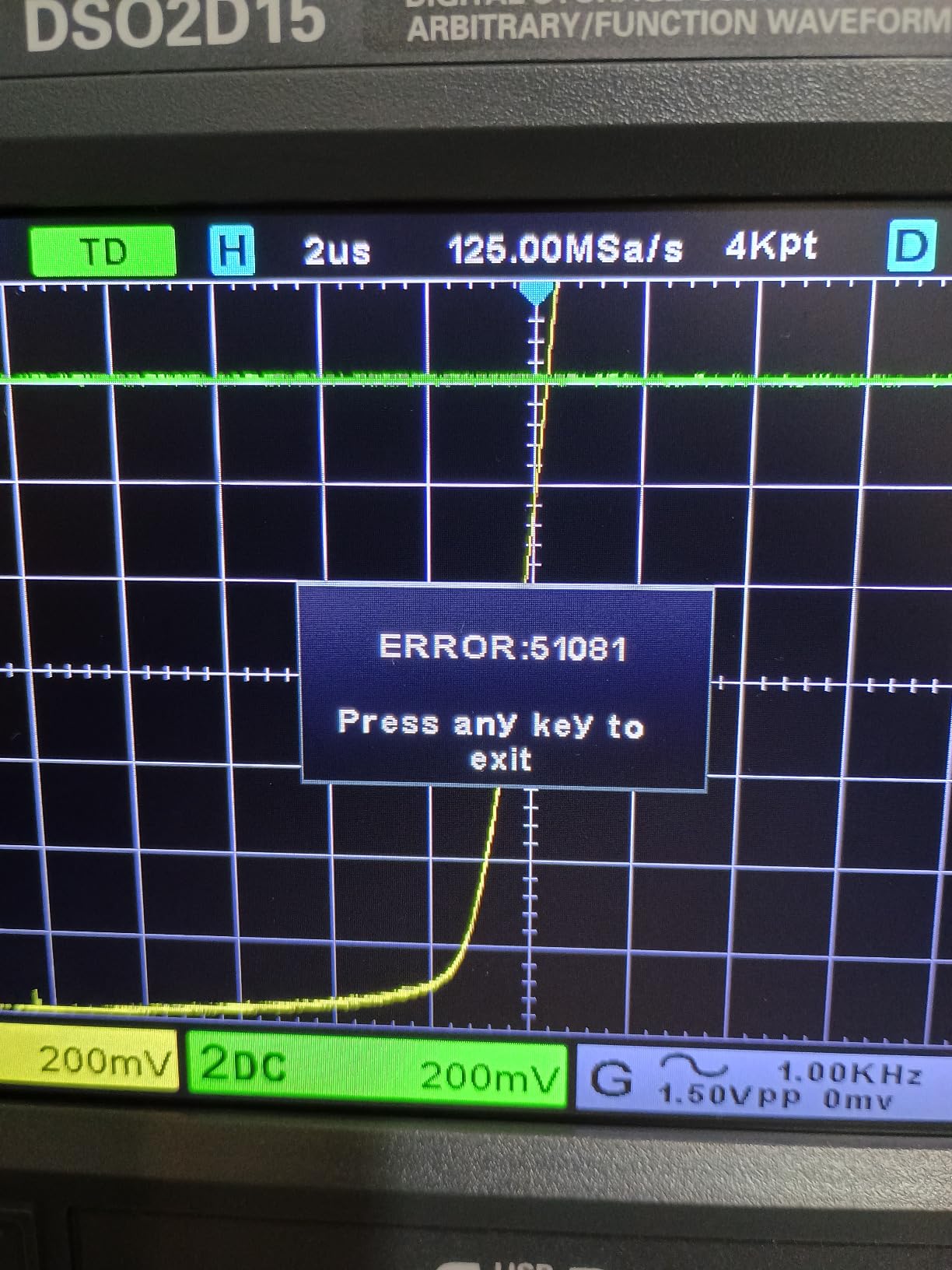
The DSO2D15 is a 150 MHz, two-channel bench scope with 1 GSa/s sampling, and at 4.6 across 194 ratings it holds the cleanest rating distribution in the group: 72% five-star with only 1% one-star, the lowest negative share of any instrument here.
Owners describe stable signal traces and solid build quality compared with cheaper imports, and the 4.2 lb body and 12.44 x 4.33 x 5.91 inch footprint look and feel like a proper instrument. It is one of the less common combinations in this list, a full-size bench scope with a serial decode suite and an internal generator, without moving up to a professional instrument.
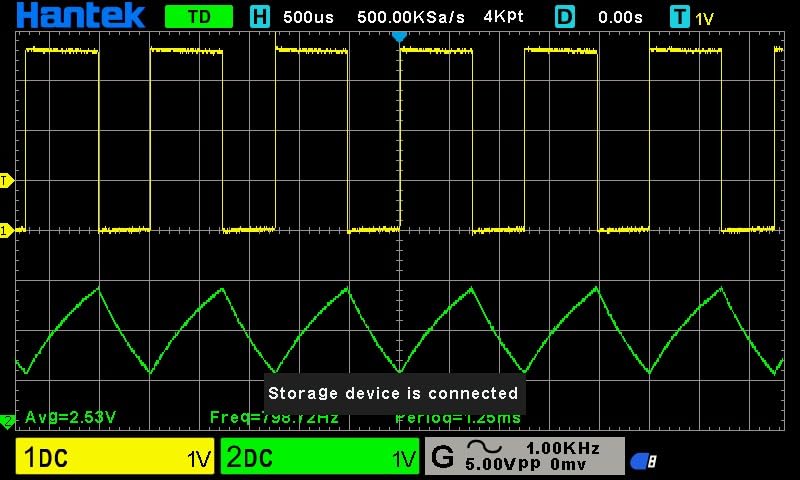
It comes with arbitrary waveform output, 14 trigger modes and five standard serial protocol triggers and decodes. On generator variants the internal signal generator is adjustable up to 25 MHz, which is useful for ham radio work and component checks, and the FFT mode with IQ analysis handles RF below roughly 50 MHz.
A Default Setup button returns the instrument to baseline settings in one press, which genuinely helps beginners exploring a new circuit, and firmware updates are downloadable and easy to apply after a backup.
When the DSO2D15 is the right call?
This scope suits someone who wants a proper bench footprint, 150 MHz of bandwidth and a generator, and does not need 12-bit resolution or deep memory. It is also a good second instrument for audio and RF-adjacent work below 50 MHz.
If you are wary of no-name 2-channel listings that overstate their bandwidth, the distribution here is reassuring. Buyers report stable traces, and the one-star share of 1% is the strongest consistency signal in the whole set. Our under-500 oscilloscope guide covers this tier in more depth.
Where it disappoints?
The slower CPU produces a visibly slower display refresh than scopes with faster processors, which makes scrolling a long capture feel sluggish. More importantly, reviewers report measurement accuracy dropping noticeably above about 5 MHz, so do not treat the 150 MHz headline as a precision figure.
The Auto Set button does not reliably acquire complex or low-frequency waveforms, which means you will still be adjusting triggers by hand on interesting circuits. The scope can also lock up when settings are misconfigured, with a power cycle clearing it, and the front and rear USB connectors share one port so they cannot be used at the same time. There is no internal battery.
10. FNIRSI DPOS350P: Four Instruments in One Handheld Box
FNIRSI DPOS350P 4-in-1 350MHz Digital Oscilloscope 2 Channel, 1 GSa/s
- Combines scope spectrum analyzer frequency response analyzer and DDS generator
- 350 MHz bandwidth with 50000 wfms/s refresh and digital phosphor
- FFT waterfall view for EMI troubleshooting
- Hardware 150 MHz and 20 MHz bandwidth limiter
- Lowest average rating in the group at 4.1 with 14 percent one-star
- Smallest review base at 131 ratings
- Only 47 Kpts of record depth for long captures
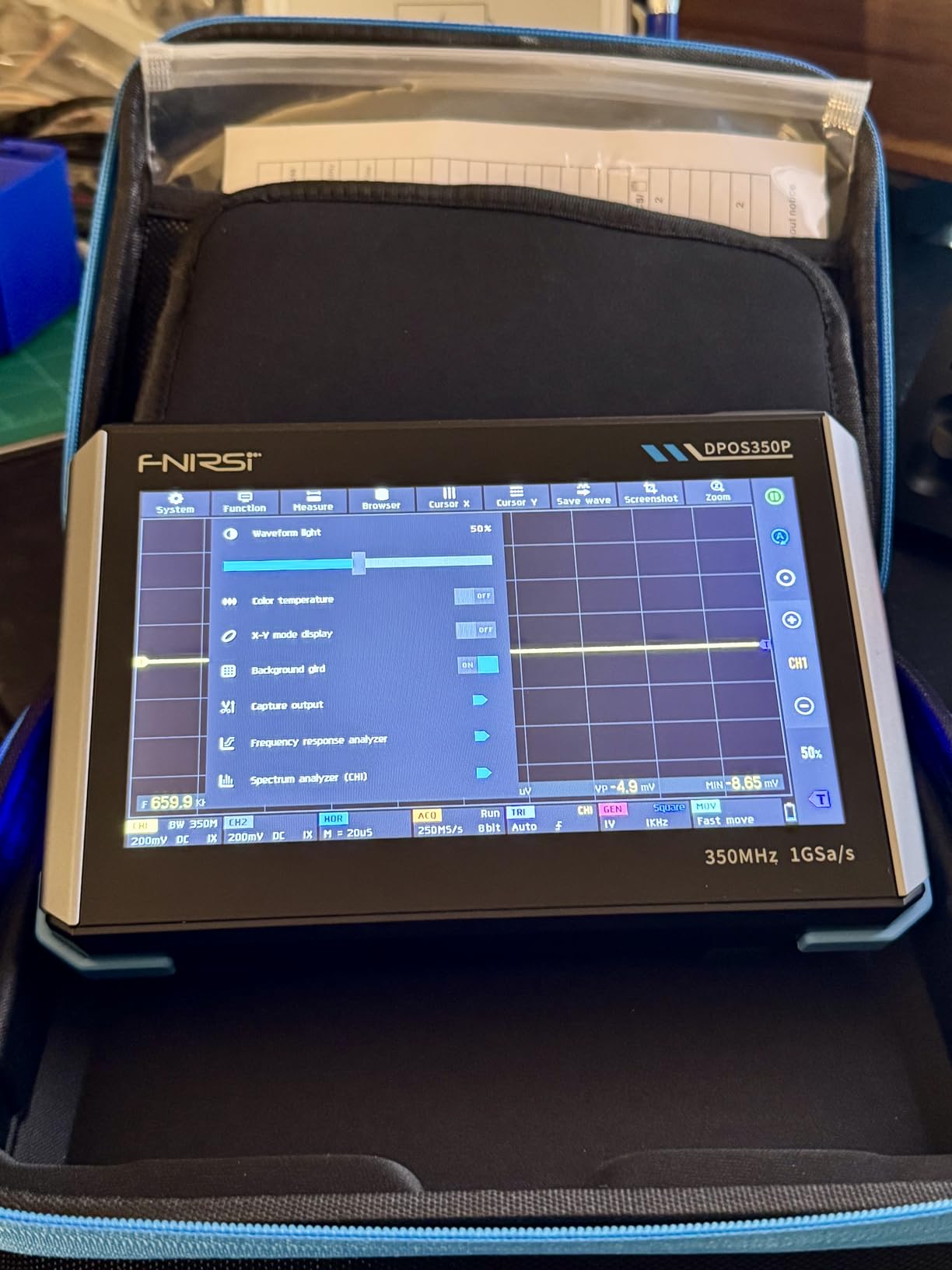
The DPOS350P, released in May 2025, is the most ambitious unit here. It is a 350 MHz, two-channel scope with 1 GSa/s sampling, 47 Kpts of memory, 8 to 16-bit resolution and a 50000 wfms/s refresh rate on a 7-inch touchscreen with digital phosphor.
Around that scope sit a real FFT spectrum analyzer running from 200 kHz to 350 MHz with 4K to 32K FFT length and a 2D/3D waterfall view, plus a frequency response analyser from 10 Hz to 50 MHz for Bode plots, loop stability and filter tuning. The DDS generator covers 0 to 50 MHz at 1 Hz resolution with adjustable duty cycle from 0.1% to 99.9%.
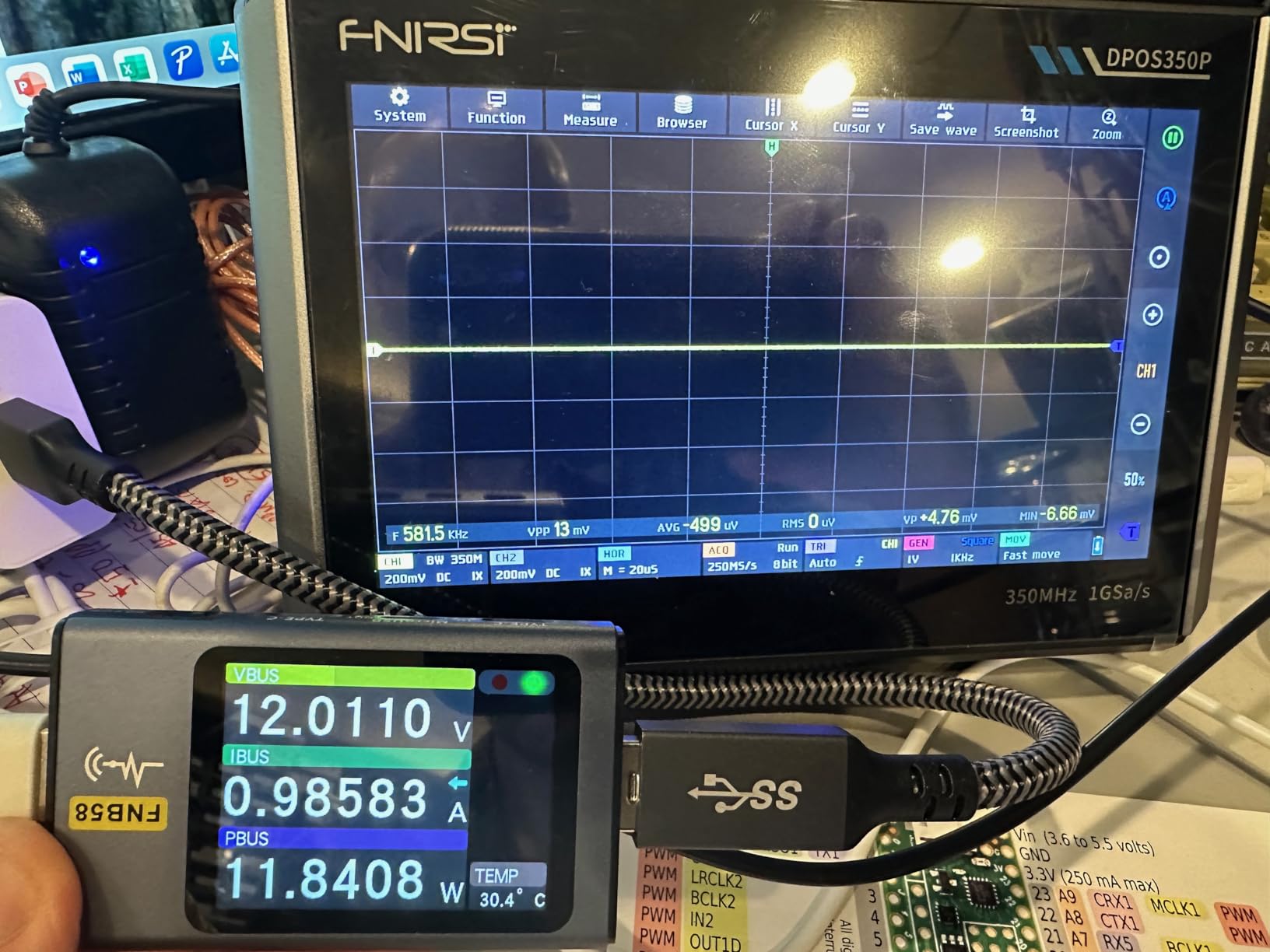
Digital phosphor with 50000 wfms/s refresh is the reason it earns a place in this guide at all. That combination is the classic glitch-hunting setup, and the 2 mV/div ultra-sensitive vertical range helps on small signals. A hardware 150 MHz and 20 MHz bandwidth limiter lets you cut on-screen noise from nearby RF gear.
The 8000 mAh battery with USB-C charging and a 3.56 lb body keep it portable, and it stores 500 waveforms plus 90 screenshots.
Why the 4-in-1 concept earns a place?
For loop stability work, filter tuning and EMI investigation, having a frequency response analyser and a spectrum analyser built into the same box as the scope removes a lot of setup. Most makers buy those functions once and then discover they need them rarely.
If your work includes amplifier design or feedback compensation, the Bode plot capability is a genuine step up from anything else in this list. The handheld form factor also makes it useful alongside a benchtop instrument rather than instead of one.
Why we ranked it last?
At 4.1 from 131 ratings, it has both the lowest average and the highest one-star share at 14%. A small review base on a newly released product means long-term reliability is unproven, and buyers are already reporting quality issues.
47 Kpts of record depth is deeper than the other portable units here but shallow against the 24 Mpts on the RIGOL scopes, so long captures are not its strength. There is also less community firmware knowledge available for a product this new. If the touchscreen-and-battery format is what you want, the FNIRSI 1013D Plus has a far longer track record; our handheld oscilloscope guide covers that category fully.
Why the Home Lab Changes What You Buy?
A home lab is not an industrial bench, and the difference shows up in four places. First, you have mains power and a permanent desk, so a battery is a nice-to-have rather than a requirement, and a benchtop form factor is fine. Second, you have room for a probe rack, which changes the calculation on probe spending entirely. Third, nobody needs LXI compliance, but web remote control is genuinely useful. Fourth, you will work on a wider variety of circuits than any one job requires, so a flexible decoder set matters more than a specialty feature.
That also explains why the lowest-cost units in this guide are not the ones we recommend first. Low-cost 2-channel listings frequently overstate bandwidth, and forum users warn about this specifically. A scope that reads plausibly but is wrong at the top of its range is worse than no scope at all, because you will trust it.
The other home-lab reality worth naming: hobbyists report not switching their scope on for weeks at a time, and that anxiety drives a lot of over-buying. Pick the instrument that covers the most ground, keep it on the desk, and use it. Our budget roundup covers the tier below if you are still undecided.
How to Choose a Benchtop Oscilloscope: Seven Specs That Matter?
1. Bandwidth, and the five-times rule. Buy at least five times the highest frequency you expect to measure. For Arduino and Raspberry Pi work, the consensus in r/AskElectronics and r/diyelectronics is that 50 to 100 MHz covers the range comfortably. Anything above that, you want 200 MHz.
2. Channels. Four analog channels are worth having if you debug power sequencing, motor bridges or multi-net buses. Two channels is genuinely enough for single-signal analog work and signal integrity checks against ground.
3. Vertical resolution. Most of the instruments here use 8-bit converters, and the practical difference between 8-bit and 12-bit shows up on small signals and in the FFT. The PicoScope 2204A offers up to 12-bit enhanced resolution, and the FNIRSI DPOS350P claims 8 to 16-bit. More vertical detail means cleaner FFT results and cleaner power rail ripple measurement, but at reduced sample rates.
4. Sample rate, real versus interpolated. Most units here quote 1 GSa/s, but that is usually a single-channel, single-interval figure. The FNIRSI DPOS350P and the Siglent SDS1202X-E also hit 1 GSa/s against 350 MHz and 200 MHz of bandwidth respectively, so sample rate alone tells you very little. Treat the bandwidth figure as your real guide.
5. Memory depth. Depth is what makes a capture usable after the fact. The DS1054Z and DS1202Z-E reach 24 Mpts, the SDS1104X-E reaches 14 Mpts. The HANMATEK sits at 10K sampling points and the Pico at 8 kS, which limits how much you can zoom afterwards.
6. Decoding. I2C, SPI, UART, CAN and LIN decode at purchase is now standard on the Siglent and RIGOL units here, with no license required. A separate 16-channel MSO pod costs extra, and MSO channels are typically a low-cost replacement for a USB logic analyzer, so buy the pod only if you need many lines at once.
7. Connectivity and workflow. USB host and device are basic expectations. LAN with a built-in web server, as on the SDS1104X-E and the DS1054Z, is what makes a fixed bench scope remotely viewable and SCPI-scriptable from a home network.
Touchscreen or Knobs: The Decision That Keeps Coming Up
Ask experienced users and one preference dominates. The strongest stated preference across r/AskElectronics, r/diyelectronics and r/synthdiy is physical knobs, and the reason is practical: when one hand is holding a probe and the other is moving the vertical position, a knob does not require looking away and re-aiming at a target.
Knob-driven scopes also win on repeatability. A physical encoder has a detent, so you can feel the increment. A touchscreen menu requires precision you cannot apply while leaning over a board.
The counter-case is real. Capacitive touch makes menu navigation faster, which is the top complaint about deep soft-key menus on entry-level instruments, and beginners touch their way through a first session more easily than they learn a menu tree. Our view: pick knobs if you will use the instrument daily for years, and touch if you are still learning the controls and want the faster onboarding.
Between the two brands specifically, the Siglent SDS1104X-E and the RIGOL DS1054Z are the two most recommended four-channel units in the forums, and the difference usually comes down to interface preference rather than specifications. RIGOL earns the stronger reputation for hardware build and documentation; Siglent earns it for a more responsive front-panel experience. Both ship probes that most owners eventually replace.
Probes, Decoding and the Real Cost of Ownership
Cheap scopes ship with poor 10x probes and thin ground leads, and users routinely budget for a separate probe set. A scope is only as good as the probe on the tip, and probe compensation has to be adjusted with the little trimmer screw on the probe body. If the compensation square wave looks rounded at the top, the probe is wrong, not the scope.
Also remember the ground reference. Every benchtop probe is referenced to earth through the ground lead, and that ground lead is directly connected to your mains earth. Probing anything above earth potential is how people damage equipment and hurt themselves. For mains work, use a properly rated differential probe or a current clamp, and never clip a ground lead to a live node.
For decoding, budget for the accessory rather than assuming a standalone logic analyzer is needed. The RIGOL and Siglent units here decode I2C, SPI, UART, CAN and LIN as standard, which covers the majority of home-lab debugging. A 16-channel MSO pod is the upgrade path when you need more lines simultaneously, and our beginner guide covers how to use the decoders effectively.
Frequently Asked Questions
What is a good entry level oscilloscope?
The Siglent SDS1202X-E and the RIGOL DS1054Z are the two most-recommended entry points for a home lab. The Siglent gives you 200 MHz of bandwidth and serial decoding at purchase, while the RIGOL gives you four channels and 24 Mpts of memory depth. Both sit in the band that r/AskElectronics and r/diyelectronics repeatedly name as the sensible starting tier.
Are USB oscilloscopes any good?
For slow signals, yes. The PicoScope 2204A in this list reaches up to 12-bit enhanced vertical resolution and includes 40 serial protocol decoders, a spectrum analyzer, a function generator and an AWG as standard, with free lifetime software upgrades on Windows, Linux and Mac. Its limits are 10 MHz of bandwidth and 8 kS of capture memory, so it works best as a second instrument rather than your only one.
What is the best portable oscilloscope?
Among the units reviewed here, the FNIRSI DPOS350P leads on combined capability with 350 MHz of bandwidth, a spectrum analyser, a frequency response analyser, a DDS generator and an 8000 mAh battery, and the FNIRSI 1013D Plus offers the better-proven alternative with a 6000 mAh battery, a 7-inch touchscreen and 400 V protection. Our dedicated handheld guide covers the wider category in detail.
Who makes oscilloscopes?
At the home-lab price tier, RIGOL, Siglent, FNIRSI, HANMATEK, Hantek and Pico Technology dominate, and all six appear in this guide. Above that tier, Keysight, Tektronix and Teledyne LeCroy build the professional instruments. B and K Precision and OWON also appear regularly in home-lab listings alongside the six covered here.
What’s a good oscilloscope?
The Siglent SDS1202X-E is the best benchtop oscilloscope for a home lab in 2026, offering 200 MHz of bandwidth, 1 GSa/s sampling, 14 Mpts of record length and standard decoding for IIC, SPI, UART, RS232, CAN and LIN. The Siglent SDS1104X-E is the pick if you need four channels, and the RIGOL DS1054Z is the best value option with 24 Mpts of memory depth.
Can a PC be used as an oscilloscope?
Yes, for a defined range of work. A PC-based unit such as the PicoScope 2204A uses the host for signal processing, storage and display, which means unlimited record length compared with an instrument and a much richer software feature set including 40 protocol decoders. The cost is that it has no display of its own, 10 MHz of bandwidth and only 8 kS of instantaneous capture memory.
Can an oscilloscope be used for music?
Yes, and it is one of the strongest cases for owning one. A scope shows the actual shape of a waveform rather than a single voltage reading, so you can see clipping, crossover distortion, phase shift and harmonic content. The r/synthdiy community routinely recommends bench scopes for audio work, and the Hantek DSO2D15 with its internal generator to 25 MHz is well suited to it.
What is the price of an oscilloscope?
Prices shift constantly, so use the buttons on this page for current figures. As a rough guide to the bands covered here, the entry tier includes the FNIRSI 1014D, FNIRSI 1013D Plus, HANMATEK DOS1102 and PicoScope 2204A. The mid tier holds the RIGOL DS1054Z, Siglent SDS1104X-E, RIGOL DS1202Z-E and Siglent SDS1202X-E, and the FNIRSI DPOS350P sits at the top of the budget range.
What are the key differences between Rigol and Siglent oscilloscopes?
In practice the difference is the interface. RIGOL scopes such as the DS1054Z and DS1202Z-E are praised for hardware build, documentation and a three-year warranty on the DS1202Z-E, while their deep soft-key menus draw complaints. Siglent scopes such as the SDS1104X-E and SDS1202X-E are praised for a more responsive front panel and a built-in web server, and both brands ship I2C, SPI, UART, CAN and LIN decoding at purchase.
What is the best automotive oscilloscope for the money?
Look for four analog channels and CAN and LIN decoding, which rules out most two-channel units in this list. The Siglent SDS1104X-E and the RIGOL DS1054Z both cover CAN and LIN at purchase and give you the channels needed to watch crank, cam and injector signals together. For CAN bus debugging specifically, the serial decode support matters more than raw bandwidth.
Conclusion: The Best Benchtop Oscilloscopes for Home Labs in 2026
Ten instruments, three real answers. Buy the Siglent SDS1202X-E if you want the most capability per dollar and the confidence of the longest review history in the class. Buy the Siglent SDS1104X-E if four channels, dual ADCs and the highest rating in the group matter to you. Buy the RIGOL DS1054Z if deep memory and maximum value per dollar outweigh having 200 MHz of bandwidth.
Whichever you choose, add a proper 10x probe set to your budget, expect a learning curve of a few evenings, and put the instrument on the bench rather than in a cupboard. Used across 2026, a scope earns its place through the problems it makes easy to find, and that is worth more than any spec on a list.