
Bank fishing is the hardest version of this sport because you are casting into water nobody has ever shown you. The best portable fish finders for shore fishing fix exactly that problem, and after working through manufacturer specifications, thousands of owner reviews and real deployment reports, we can tell you which of the ten models on the market are worth your time.
Two formats cover almost every need. A dedicated display gives you a screen, a battery and a built-in GPS that works whether your phone is dead or not. A castable sonar is a small pod you throw into the water and read on a phone, which is faster to deploy but ties your session to that phone. The Garmin STRIKER 4 is our best overall pick, the Deeper PRO+ 2 gives you the most scanning options from a bank, and the Garmin STRIKER Cast is the one to buy for mapping water you have never fished.
One note before you read on. The forum argument about castable sonar is genuinely split, with some anglers calling them a waste of money and others calling them the reason they catch fish. The honest answer is that both are right in specific conditions, and this guide spends a lot of effort explaining where the dividing line falls rather than splitting the difference. If you also fly a drone over water to scout structure, our guide to the best drones for fishing covers the scouting half of the same problem.
Table of Contents
Top 3 Portable Fish Finders For Shore Fishing (October 2026)

Garmin STRIKER 4
- CHIRP sonar with Clear Vu scanning
- Built-in GPS waypoint map
- Readable 3.5 inch LCD in sun
- IPX7 water rating
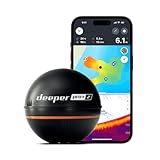
Deeper PRO+ 2
- Wide mid and narrow beams
- Built-in GPS bathymetric maps
- Accuracy to 330 ft
- Only 3.2 ounces

Garmin STRIKER Cast
- Quickdraw 1-foot custom contours
- 10+ hour internal battery
- Streams to phone or tablet
- 200 ft streaming range
All 10 Picks at a Glance in 2026
This table covers every unit in the roundup, in ranked order, with the specs that actually change the outcome from a bank or a dock. Full depth of review follows underneath.
| Product | Specifications | Action |
|---|---|---|
| Garmin STRIKER 4 |
|
Check Latest Price |
| Deeper PRO+ 2 |
|
Check Latest Price |
| Garmin STRIKER Cast |
|
Check Latest Price |
 Humminbird PiranhaMAX 4 Humminbird PiranhaMAX 4 |
|
Check Latest Price |
 Deeper START Deeper START |
|
Check Latest Price |
 ReelSonar iBobber ReelSonar iBobber |
|
Check Latest Price |
 Humminbird HELIX 5 CHIRP GPS G3 Humminbird HELIX 5 CHIRP GPS G3 |
|
Check Latest Price |
 LUCKY FFC1108 LUCKY FFC1108 |
|
Check Latest Price |
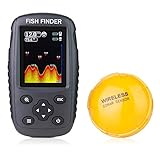 Venterior Portable Rechargeable Fish Finder Venterior Portable Rechargeable Fish Finder |
|
Check Latest Price |
 LUCKY 1108CP LUCKY 1108CP |
|
Check Latest Price |
1. Garmin STRIKER 4 Is the Best Overall Pick for Shore Fishing
Garmin 010-01550-00 Striker 4 with Transducer, 3.5″ GPS Fishfinder with Chirp
- Crisp CHIRP arches with strong target separation
- Screen stays readable in full sunlight
- Built-in GPS waypoint map for marking brush piles and stumps
- Clips out of the tilt bracket for transport
- Reports water temperature and battery voltage
- Battery sold separately
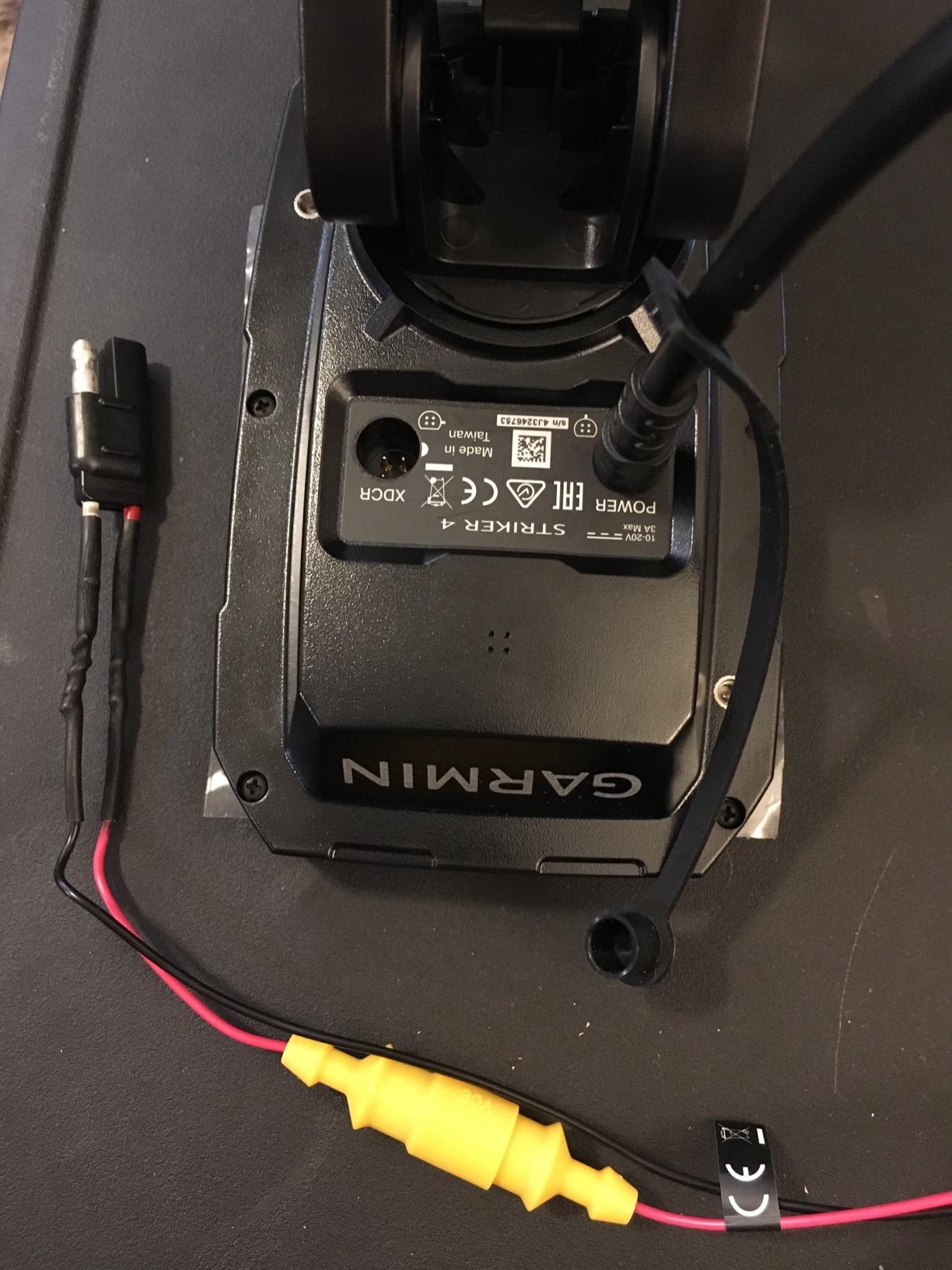
- Thin power leads need careful securing
- 3.5 inch screen limits detail
The STRIKER 4 is the unit we keep coming back to because it does the thing that matters most from a bank: it stays readable when the sun is high and the screen is angled back at you. Owners rate it 4.6 out of 5 across more than 9,300 reviews, and 79 percent of those are five-star, the highest share of five-star ratings among the ten models here.
CHIRP sonar is the technical headline here. In plain English, CHIRP means the unit sweeps a wide band of frequencies instead of pinging one tone, so the returns separate more cleanly. On this unit that means a fish standing over a weed line reads as a fish over a weed line rather than one merged blob.
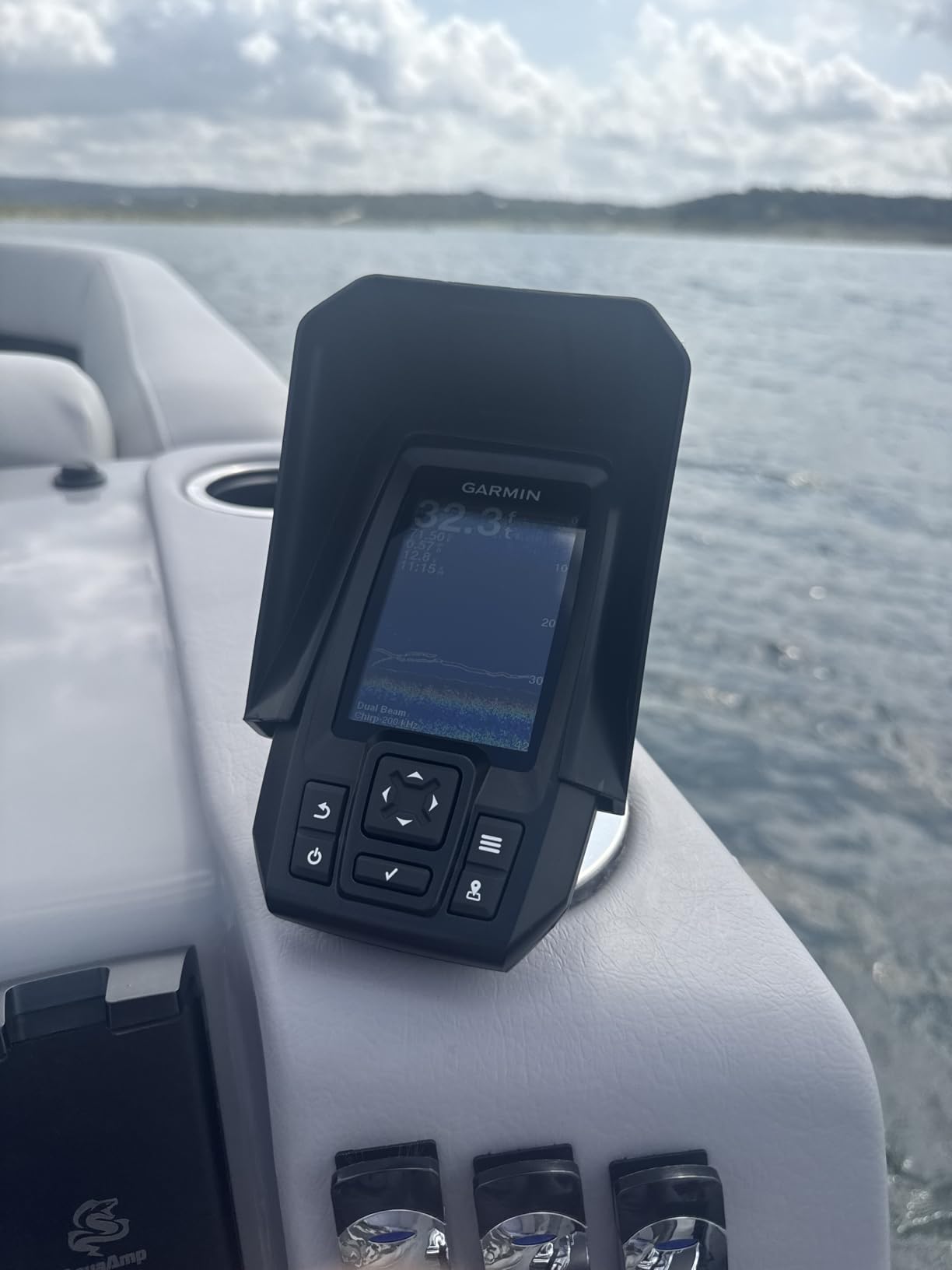
The Clear Vu scanning mode pushes further than the wording suggests, producing near photographic images of structure for shallow work, and the flasher mode covers ice fishing and vertical jigging if your season runs into winter. Maximum depth is listed at 1,600 ft in freshwater and 750 ft in saltwater, which is far more than you will ever reach from a bank.
Being honest about the flaws matters more than the spec sheet here. The battery is not included and has to be bought separately, and the thin power leads are the single most common complaint in the reviews, with owners reporting they need reinforcement or proper strain relief before they trust them in water.
Running a wired unit from a bank
This is a corded fish finder, so the honest answer to the most common question in shore forums is yes, but you need a plan. A portable battery pack, a fused power lead and a floating transducer on a short line is the standard bank setup, and plenty of anglers run it exactly that way from a dock or a jetty.
If you are not willing to carry a battery and manage cable, read the castable sections before buying this. The convenience of a dedicated display is real, and so is the rig that comes with it.
What a 3.5 inch screen gives up?
The 3.5 inch diagonal display is the compromise that makes this unit portable at all. It shows depth, structure and fish arches clearly, but it cannot show a large side-imaging view or a detailed map alongside the sonar the way a 5 inch screen can.
For a bank angler scanning a 50 metre drop-off, that is rarely the deciding factor. For someone who wants to read contours and sonar at the same time, it is.
2. Deeper PRO+ 2 Has the Best Casting Reach and Beam Options
- Three beam options for coverage or detail
- Built-in GPS builds bathymetric maps
- Own Wi-Fi so no mobile data is used
- Only 3.2 ounces on the line
- Maps save automatically in the app
- Requires a phone or tablet running the app
- Costs more than the Deeper START
- Connection and accuracy complaints appear in a share of one-star reviews
The PRO+ 2 is the strongest castable sonar in this group, with the longest quoted range and the tightest target separation of the castables here, and it is the reason a lot of bank anglers moved off dedicated displays entirely. Three selectable beams let you scan a wide area quickly or switch to a narrow beam and drill into one spot, and the quoted accuracy reaches 330 ft.
Target separation is quoted at 0.4 inches in narrow beam and 1 inch in wide and mid beams. That is the number that tells you whether a tight cluster of two fish reads as two fish, and it is the spec most worth understanding before you buy any castable.
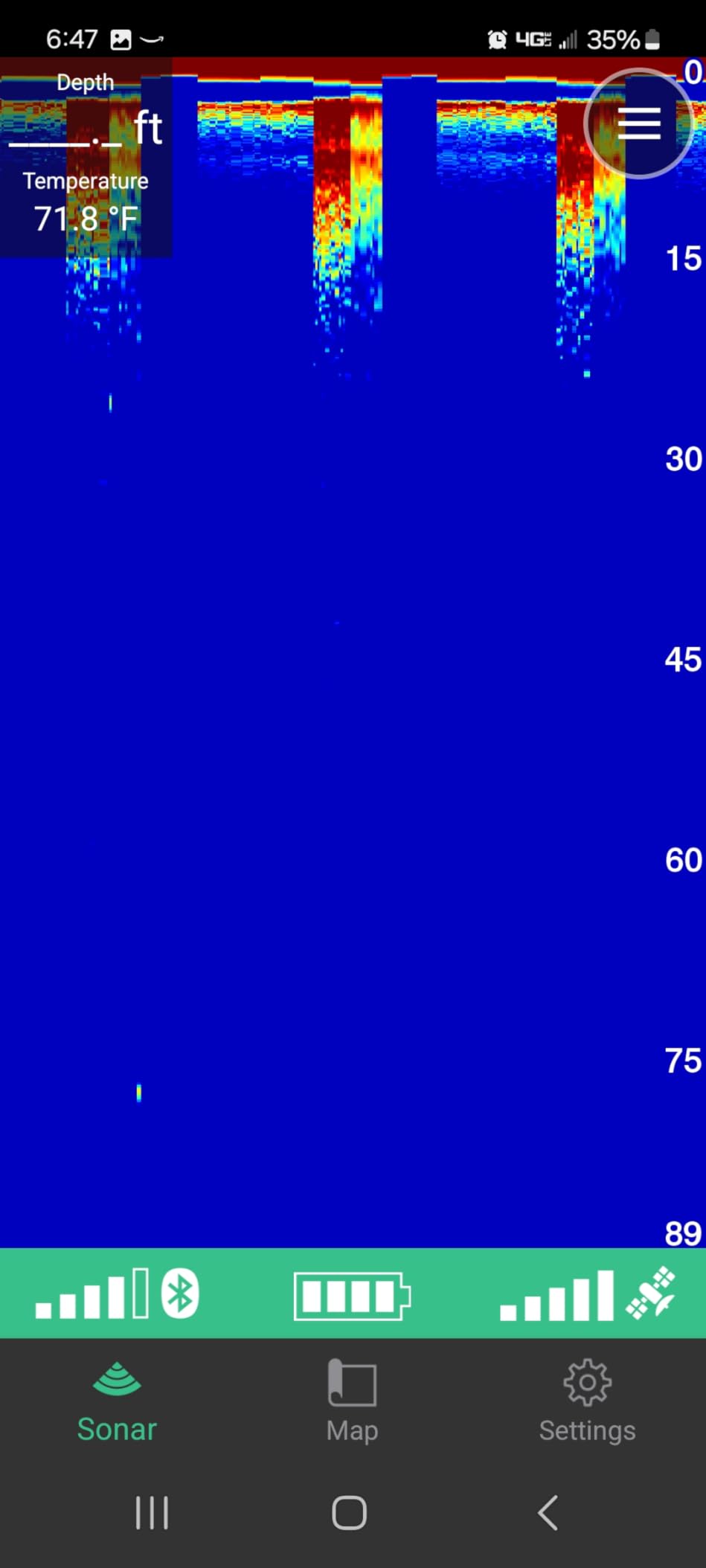
The built-in GPS is what separates this from entry-level castables. It creates bathymetric maps from shore, dock or bank, saved automatically in the Fish Deeper app, so a productive afternoon on unfamiliar water becomes a map you can fish again next month.
Review scores here are the widest spread of any unit we covered, 4.2 out of 5 with 68 percent five-star but a 12 percent one-star share. Praise focuses on the multi-beam scanning and the light 3.2 ounce body. Criticism focuses on dropped Wi-Fi connections and readings some owners find less consistent than Deeper’s own entry models.
Choosing the right beam for the water you are casting at
Wide beam is a coverage tool and narrow beam is a detail tool. Fan-cast with the wide beam to find the drop-off, then switch to narrow once you are over structure and want to know whether the returns are fish or rock.
Skipping this step is the most common reason beginners think castable sonar is a gimmick. The wide beam alone, at range, will show you plenty of bottom and very little you can act on.
What the phone dependency costs in the field?
The app is genuinely good, with automatic map saving and no reliance on mobile data because the unit runs its own Wi-Fi. The real cost is that the phone is now the display, the power source for a full day and the thing most likely to fail.
A power bank in a weather pouch solves most of it, and a second rod dedicated to deploying the sonar keeps your hands free. What it does not solve is a dead phone in the middle of a spot you finally found.
3. Garmin STRIKER Cast Is the Best for Mapping Water You Have Not Fished
- Quickdraw contours build 1-foot custom maps
- 10+ hours on the internal rechargeable battery
- Powers on when it floats
- Includes carrying bag and 20 ft tether
- 2-D and ice flasher modes
- Sonar only appears on a paired phone or tablet
- Map performance depends on the phone
- 200 ft range reduces coverage on open water
The STRIKER Cast answers a specific gap in this list: a castable unit with real mapping that also runs all day. Quickdraw contours builds custom one-foot contour maps as you fish, and a community layer lets you download maps other anglers have drawn.
Setup is the quiet strength here. Download the app, pair the device, and you are casting in minutes, with no menus to learn and no wires to secure. Owners rate it 4.4 out of 5 with 72 percent five-star, and the battery figure of 10+ hours on the internal USB-rechargeable cell covers a full day.
It is rated for 20 lb test line or higher, which is a sensible guard given you will be casting this thing rather than lowering it, and the body carries IPX6 and IPX7 ratings. A 20 ft tether and a carrying bag are included, so a shoulder bag on a walk-in needs nothing extra.
The limitation is range. Streaming works to 200 feet, which covers most bank and pier fishing comfortably but shrinks quickly on a wide lake or a long open shoreline. The same 200 ft is the maximum depth figure.
Marking a spot and finding it again next week
This is where the built-in GPS earns its place. A productive hour on a river bend produces a contour map with the drop-off drawn in, and the next trip starts with the map instead of a guess.
For anyone fishing water they do not know, or water they know but have never seen the bottom of, that is the feature that justifies carrying a phone at all.
Whether 200 feet is enough range for your water
Work out the distance you actually cast before you commit. On a steep reservoir bank or a narrow river you rarely get past 100 feet, and 200 ft is generous. On a wide reservoir or a bay, you will hit the limit regularly.
If your fishing regularly exceeds that range, the Deeper PRO+ 2 in the previous section is the better cast, and this is the single clearest trade-off between the two.
4. Humminbird PiranhaMAX 4 Shows the Sharpest Down Imaging on a Dedicated Screen
- Sharp Down Imaging of timber brush and pilings
- Dual beam for detail or wide coverage
- 4.3 inch color screen readable in bright sun
- Simple menu system
- Fish ID+ with fish and depth alarms
- Corded electric power needs a bank power source
- Transom transducer favours a boat
- 4.3 inch screen is small for combined views
Down Imaging is the feature experienced anglers ask for by name, and this is one of the few dedicated screens here that has it. The view looking straight down shows timber, brush, bridge pilings and rocks with a level of definition that 2-D sonar alone cannot match.
It shares the STRIKER 4’s 4.6 rating but on a much smaller review base of around 640, with 77 percent five-star and 16 percent four-star. The screen brightness in direct sun and the straightforward menu system draw most of the praise.
Dual beam sonar lets you trade detail for coverage, and Fish ID+ marks targets on screen while depth and fish alarms cover the case where you are watching the water rather than the display. The tilt and swivel mount makes it easy to angle the screen toward a standing angler.
The most serious complaint in the reviews is not a feature issue at all. It is a single report of a unit failing after a storm with no repair path, which is a reminder to check warranty terms carefully regardless of brand.
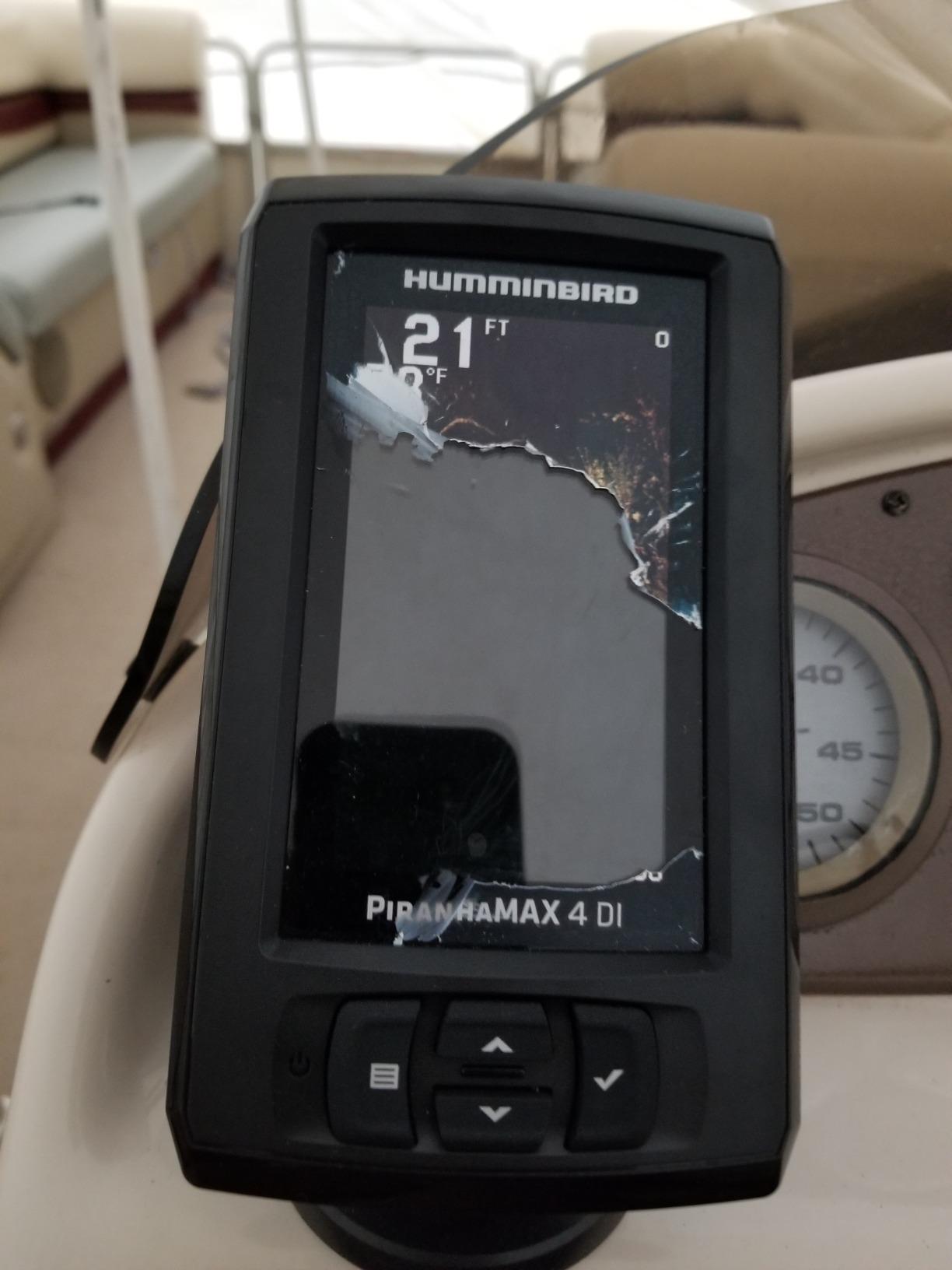
Powering a corded unit from a shoreline
Power source is the first thing to solve, not the last. A portable battery pack with a fused lead is the standard shore answer, and it pairs with a floating transducer held at a set depth on a short line.
Once that is in place, the transom mount in the box stops being a limitation because you are not using it as a transom mount. Kayak anglers get the same benefit from a scupper mount.
Reading Down Imaging on a 4.3 inch screen
Down Imaging is a wide strip of information, and a 4.3 inch screen compresses it. It is still enough to spot a brush pile or a timber edge, which is what you are casting at.
If your priority is a large image rather than a large feature set, the HELIX 5 further down gives you 5 inches of color TFT and a much wider view, and it is a heavier package to carry.
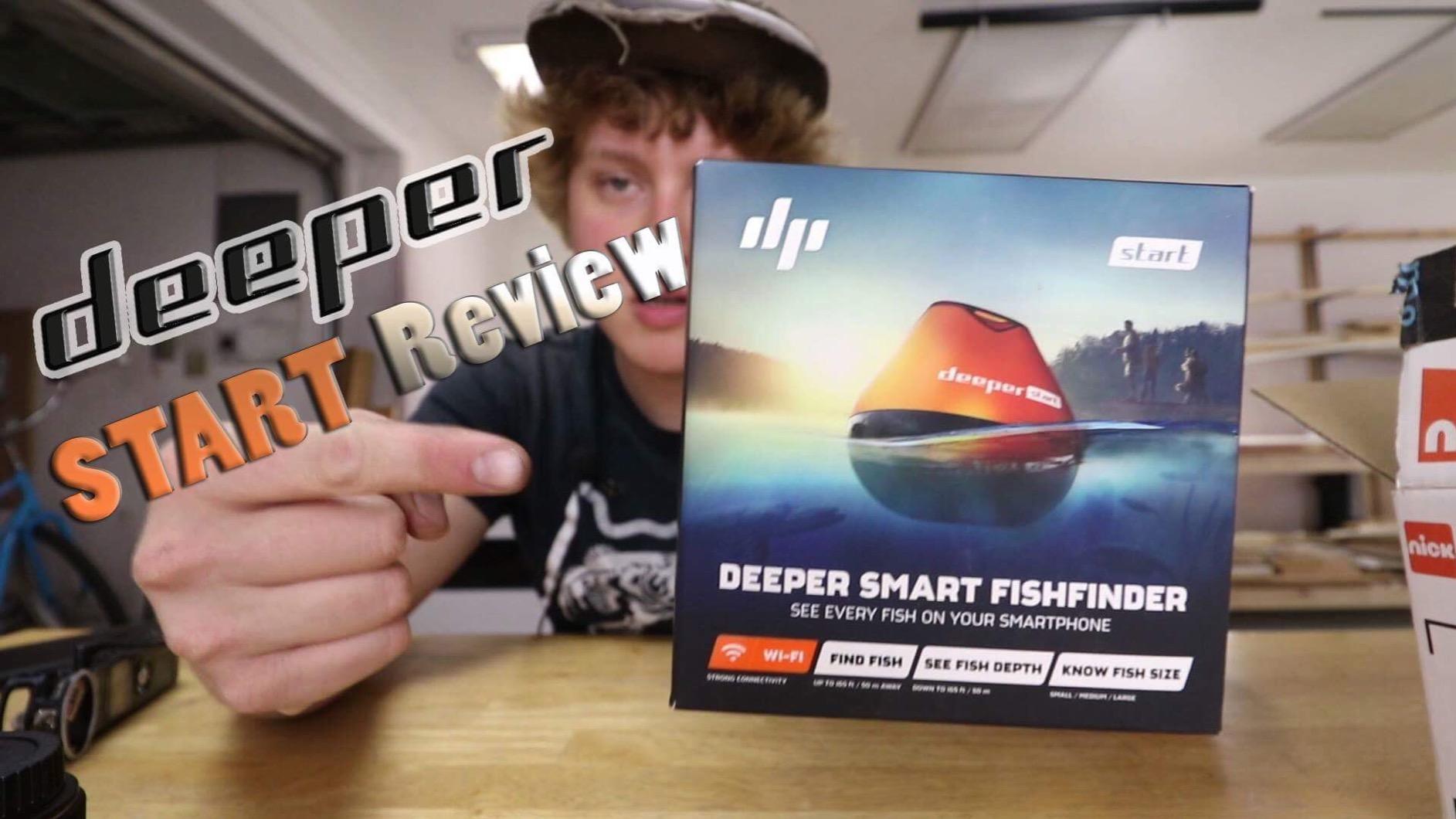
5. Deeper START Is the Easiest Castable to Get Working
- Cable-free body with no external battery
- Generates its own Wi-Fi so no mobile data is used
- Every scan saves with time and location
- 6 hours of battery
- Free app for iOS and Android
- Requires a phone to view the sonar
- 40 degree beam narrows coverage at range
- Occasional wireless dropouts reported
The START is the simplest possible introduction to castable sonar. No wires, no external battery, no mounting, and it generates its own Wi-Fi so your scan history is not eating mobile data. You attach it to a line, cast, and the app draws the bottom.
It holds 4.1 out of 5 across more than 3,000 reviews with 60 percent five-star. Reviewers repeatedly single out accurate depth and bottom contour readings, and a dependable 6 hour battery that covers a half-day session with time to spare.
Every scan is saved automatically with time and location, so even the entry model builds a usable record of a good afternoon. Casting distance is quoted at 165 ft with a 40 degree beam, and a night fishing mode is included.
Charge time is 2.5 hours for 6 hours of use, which means an overnight charge covers a full day. The body weighs 0.08 kg, and with no cable to coil there is nothing else to pack.
What a 40 degree beam leaves out at range?
A 40 degree beam is narrower than the wide beams on more capable units, so the covered wedge of water grows slowly as the pod gets further from you. Owners note that at longer range the search area feels narrow.
Close in, which is where most bank anglers work, it is more than adequate. If you regularly fan-cast a 100 foot radius looking for a drop-off edge, the narrower beam is a real limitation.
Six hours of runtime against a full day of fishing
Six hours is enough for a morning or an evening session and marginal for an all-day push. A power bank charging the phone while the app runs keeps the practical problem manageable, since the phone is the display.
For anyone fishing full days, read the battery figures on the Garmin STRIKER Cast and the ReelSonar iBobber before deciding this is enough.
6. ReelSonar iBobber Lasts a Full Day on a Single Charge
Reelsonar Portable Fish Finder Accurate Fish Depth Finder with Depth Range of 135 feet 10+ Hours Battery Life with iOS & Android App Wireless
- 10+ hours of battery for a full day
- Buoyant and waterproof design
- Fish alarm and strike alert
- Works with iOS Android and smartwatches
- Pocket-sized and easy to cast
- Bluetooth range holds about 40-50 feet from the phone
- Needs roughly 5 ft of water for accurate readings
- Dropouts and faster-than-advertised drain reported
With more than 6,600 reviews, the iBobber has the largest owner base of any phone-based castable in this roundup, and the consensus is consistent. Owners call it a great-value, easy-to-use shore tool with reliable depth readings and battery life that outlasts a normal day.
It is also the friendliest unit in the list for a first-time sonar user, because the app draws depth-tagged, colour-coded fish icons rather than raw returns. You learn to read sonar faster when the screen is telling you what it thinks it sees.
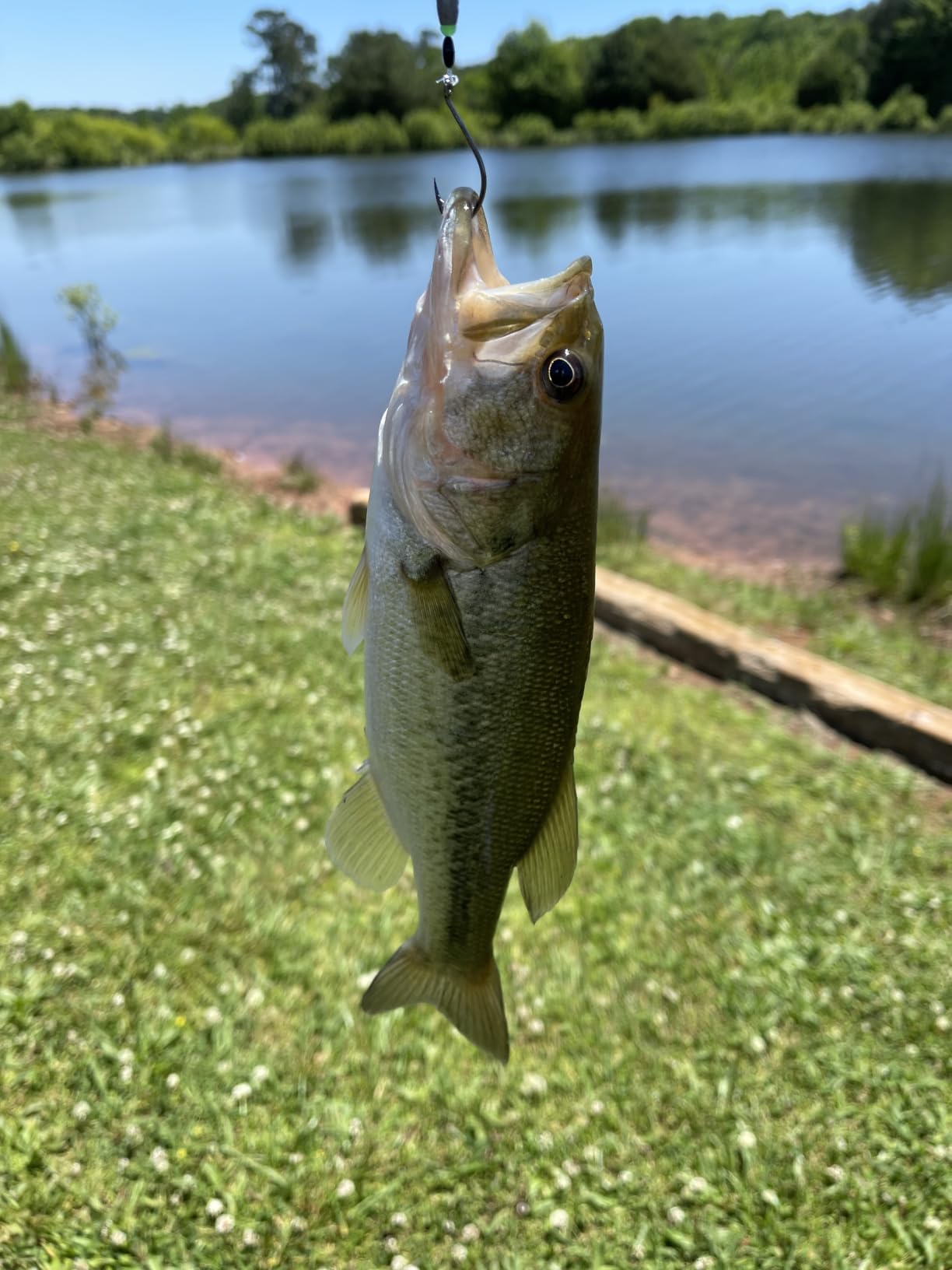
The fish alarm tells you when fish gather under a dock or piling, and the strike alert fires when something is biting. It works on ice as well as water, in fresh or salt, and it is small enough that the sonar pod fits in a jacket pocket between casts.
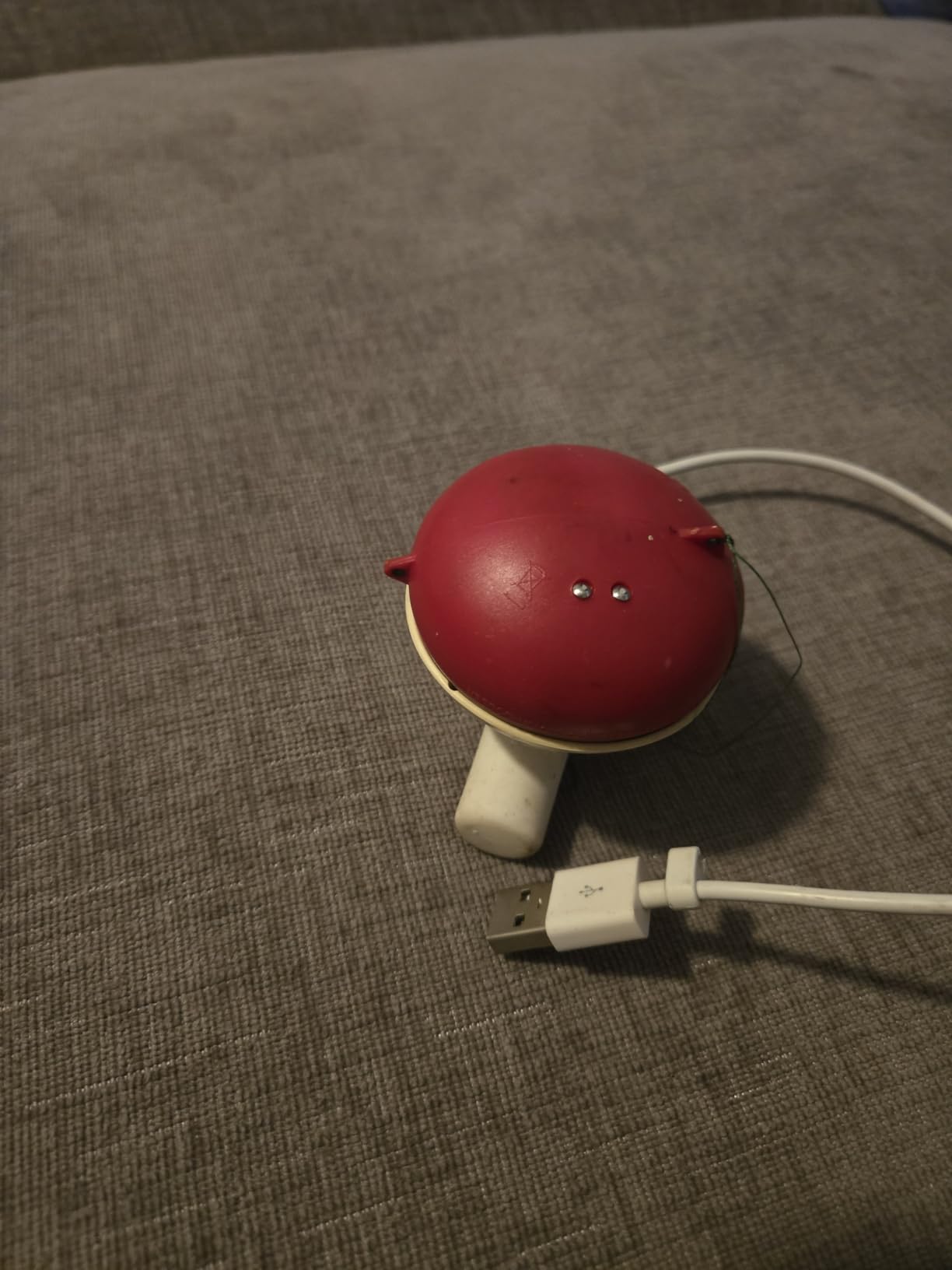
The battery is the standout spec. A 10+ hour rechargeable runtime covers a full day on a single charge and matches the Garmin STRIKER Cast, and reviewers confirm it holds up across a day, though a minority report drain running ahead of the claim.
Where the 40-50 foot Bluetooth limit bites?
Bluetooth here holds roughly 40 to 50 feet between the pod and the phone, so you are not streaming across a long cast. You cast, retrieve, and read the screen once the pod is close enough to connect.
That habit is fine for structure hunting but useless for a live real-time read at range, and it suits steep banks and lakes far better than shallow creeks.
Why the fish icons help beginners?
Reading raw two-dimensional returns takes practice, and it is the reason some anglers conclude sonar does not work. Colour-coded fish icons remove that barrier entirely, at the cost of letting the unit guess wrong sometimes.
Use the icons to build intuition quickly, then move to a unit that shows you the raw return when you want to judge size and spacing yourself.
7. Humminbird HELIX 5 CHIRP GPS G3 Gives You the Biggest Readable Screen
Humminbird Helix 5 G3 GPS Fish Finder with Transducer & Dual Spectrum Chirp Sonar
- Dual Spectrum CHIRP with wide and narrow modes
- Large 5 inch color screen
- Basemap covers 10000+ lakes and US coastlines
- AutoChart Live records contours as you fish
- Softkey keypad works in any weather
- Heaviest unit here at 2.1 pounds
- Corded power and transom mount favour boats
- AutoChart Live holds about eight hours of onboard recording
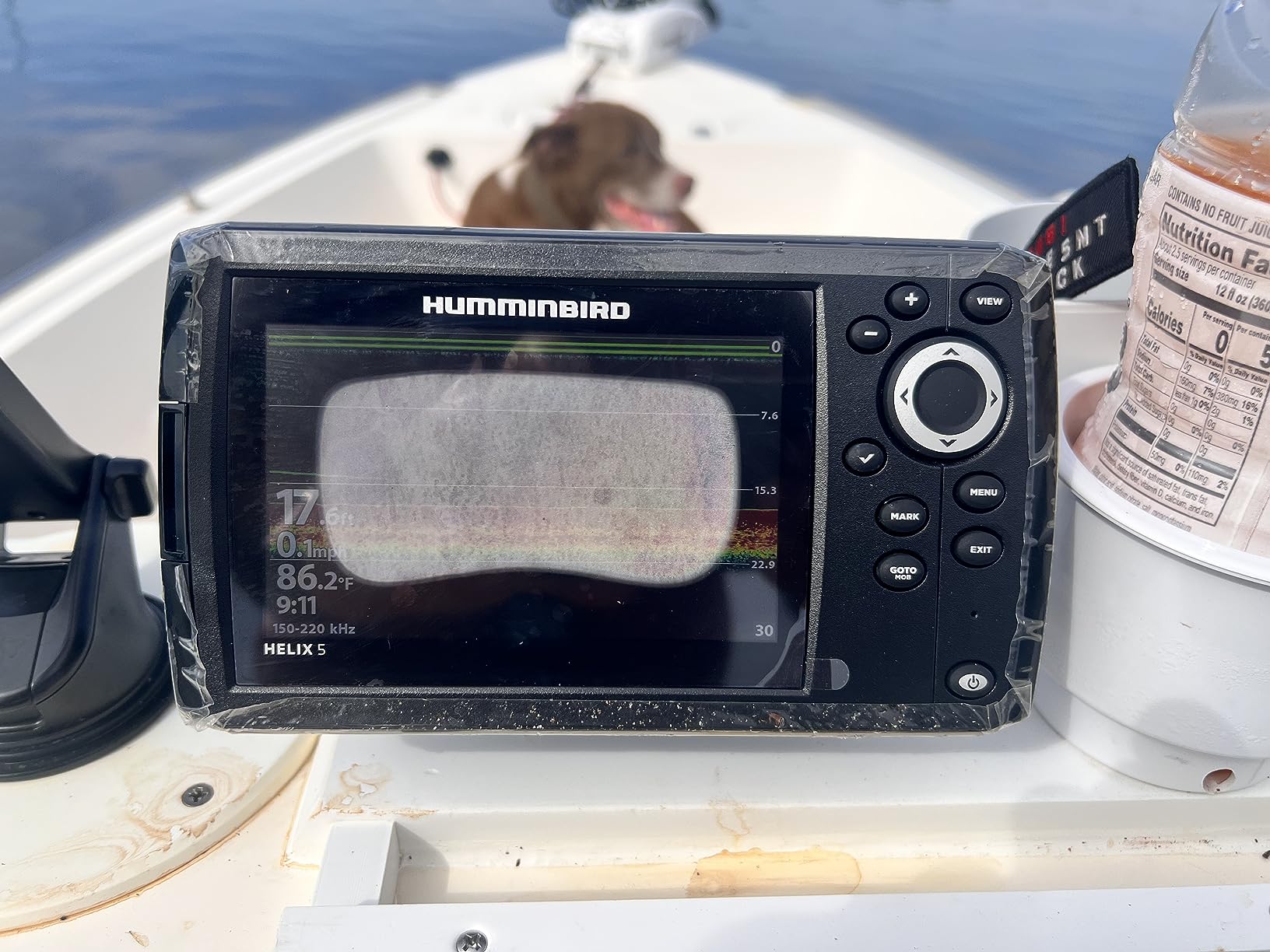
The HELIX 5 is the top of this list for image size and onboard detail. A 5 inch color TFT screen paired with Dual Spectrum CHIRP sonar and a Low-Q transducer gives the sharpest 2-D target separation of any dedicated display we covered.
Owners rate it 4.4 out of 5 with 74 percent five-star, and the recurring positives are the large readable screen, the clarity of the CHIRP returns and the convenience of a portable unit rather than a permanently installed one.
Mapping is where this earns its weight. The Humminbird Basemap covers more than 10,000 lakes and the continental US coastlines, and AutoChart Live records depth contours, bottom hardness and vegetation as you fish, with about eight hours of onboard recording.
If you outgrow that, it accepts LakeMaster, CoastMaster and Navionics charts and AutoChart Zero Line SD cards. The softkey keypad is designed to stay usable in any weather, which matters more than it sounds with wet hands on a bank.
Carrying a 2.1 pound kit down a bank
Two point one pounds is the heaviest thing here, and that weight is felt on a long walk to a remote shoreline. It is a carry-a-few-hundred-metres package, not a hike-in package.
Compare it with the 3.2 ounce Deeper PRO+ 2 or the 8 ounce STRIKER 4 before committing, especially if you fish water with a rough approach path.
Basemap and AutoChart Live for uncharted water
Eight hours of onboard recording is a full day on most water, and the contour data it produces means every session makes the next one better. The preloaded basemap means you have a chart before the first cast.
That combination is the reason to spend at this level, and for a shore angler mapping a lake they have never fished it is a genuine advantage over every castable in this list.
8. LUCKY FFC1108 Is the Best for Night Fishing From the Bank
- Self-contained handheld with no phone needed
- Built-in fish-attracting lamp with a transparent cover
- Sensor runs about 10 hours per charge
- Simulation mode for practising menus
- Adjustable sensitivity alarms and zoom
- Handheld runs about 4 hours per charge
- Sensor takes time to connect once wet
- Drifts in wind and can read rocks as fish
The FFC1108 is the one unit here built for night work. The fish-attracting lamp sits under a transparent cover so you can see the sensor in the dark, and that combination of lamp and a self-contained colour screen is what makes it work after sunset.
Wireless range is quoted at 492 feet with the antenna extended, the longest on any unit here, and depth detection runs to 147 feet. It also needs no app, no pairing and no phone.
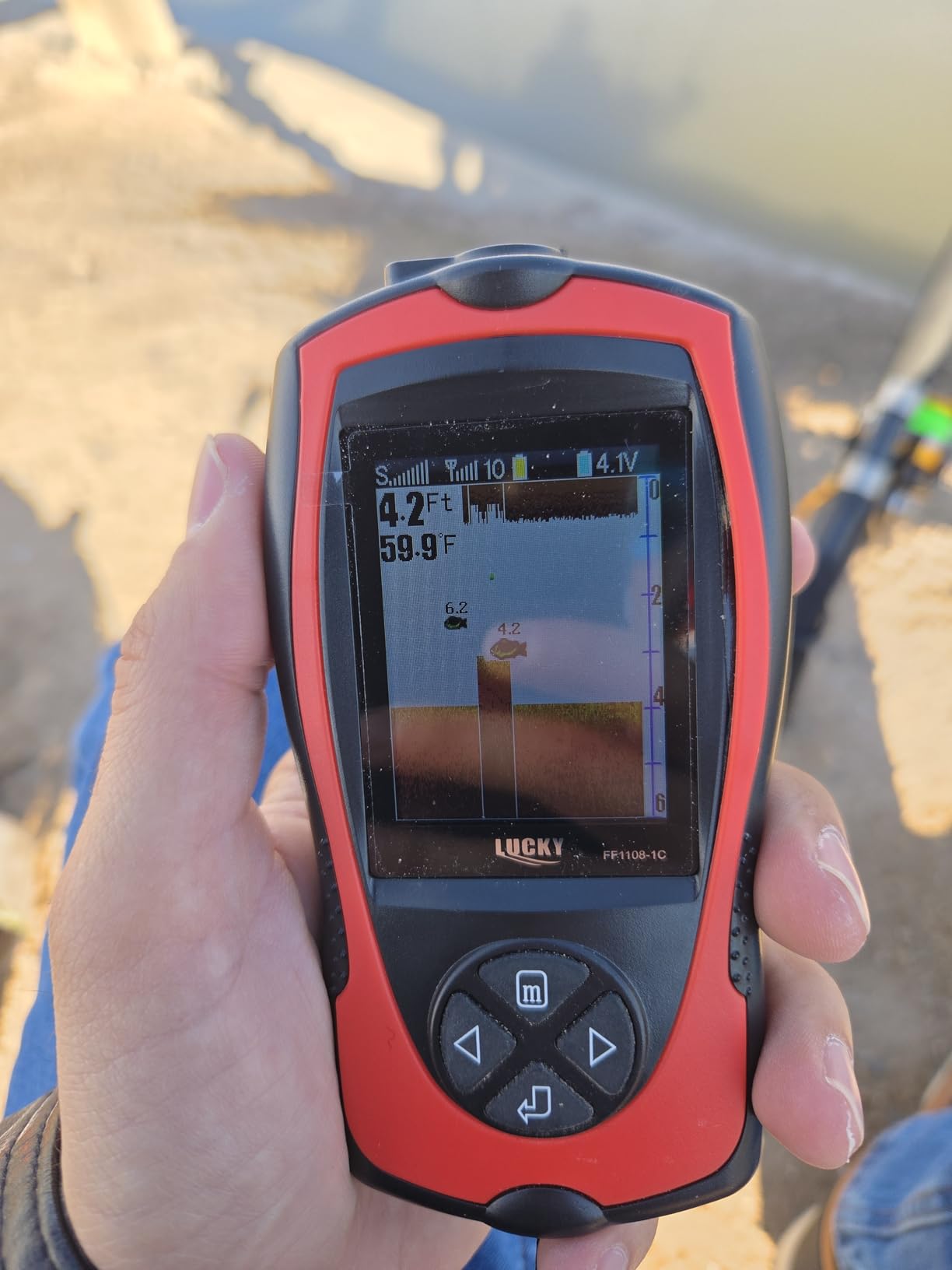
Owners rate it 4.1 out of 5 across roughly 950 reviews with 61 percent five-star, and the most common praise is for the bright colour screen, the lamp and the fact that the sensor runs so much longer than the handheld.
The screen reports water depth, temperature, fish size and bottom contour, with adjustable sensitivity, brightness, depth range, zoom and alarms. Simulation mode lets you learn the menus on dry land, which sounds minor until you try changing settings in the rain at night.
Fishing after dark with the lamp
The lamp draws attention to the sensor, which draws attention to your line, which is exactly what happens to a shallow-feeding fish at night. It is the feature that makes this worth owning over a cheaper daytime unit.
Night users also like that nothing has to be readable in sunlight, since the screen is only ever read in the dark or in glare off moving water.
Drift and the four hour handheld limit
Four hours of handheld runtime is the constraint, and the sensor needs added weight to reduce drift. In chop, a tie point that is not level can tip the sensor out of the water and cost you the reading.
Owners also report small rocks being read as fish icons, and the sensor needing a few seconds to wake and connect once it hits the water. Factor all three into your expectation of what a cast returns.
9. Venterior Portable Rechargeable Fish Finder VT-FF005 Has Its Own Screen
Venterior Portable Rechargeable Fish Finder Wireless Sonar Sensor Fishfinder Depth Locator with Fish Size, Temperature, Bottom Contour, Color Display
- Comes with its own color display
- Works straight out of the box
- Selectable screen background for sun or night
- 262 ft wireless range
- Two-year warranty
- Receiver runs about 3 to 4 hours
- Wide 105 degree beam trades detail for coverage
- Less reliable behind a moving boat or through an ice hole
The VT-FF005 answers the phone dependency objection more directly than any other phone-based unit here, because the handheld it comes with has a 2.6 inch colour TFT screen of its own. Nothing to pair, nothing to charge but the receiver, nothing to drop in the water.
Wireless range between the sensor and the handheld is quoted at 262 feet, with a depth range of 2.6 to 164 feet and a 105 degree beam. The depth and beam figures are among the most generous quoted by any castable in this roundup.
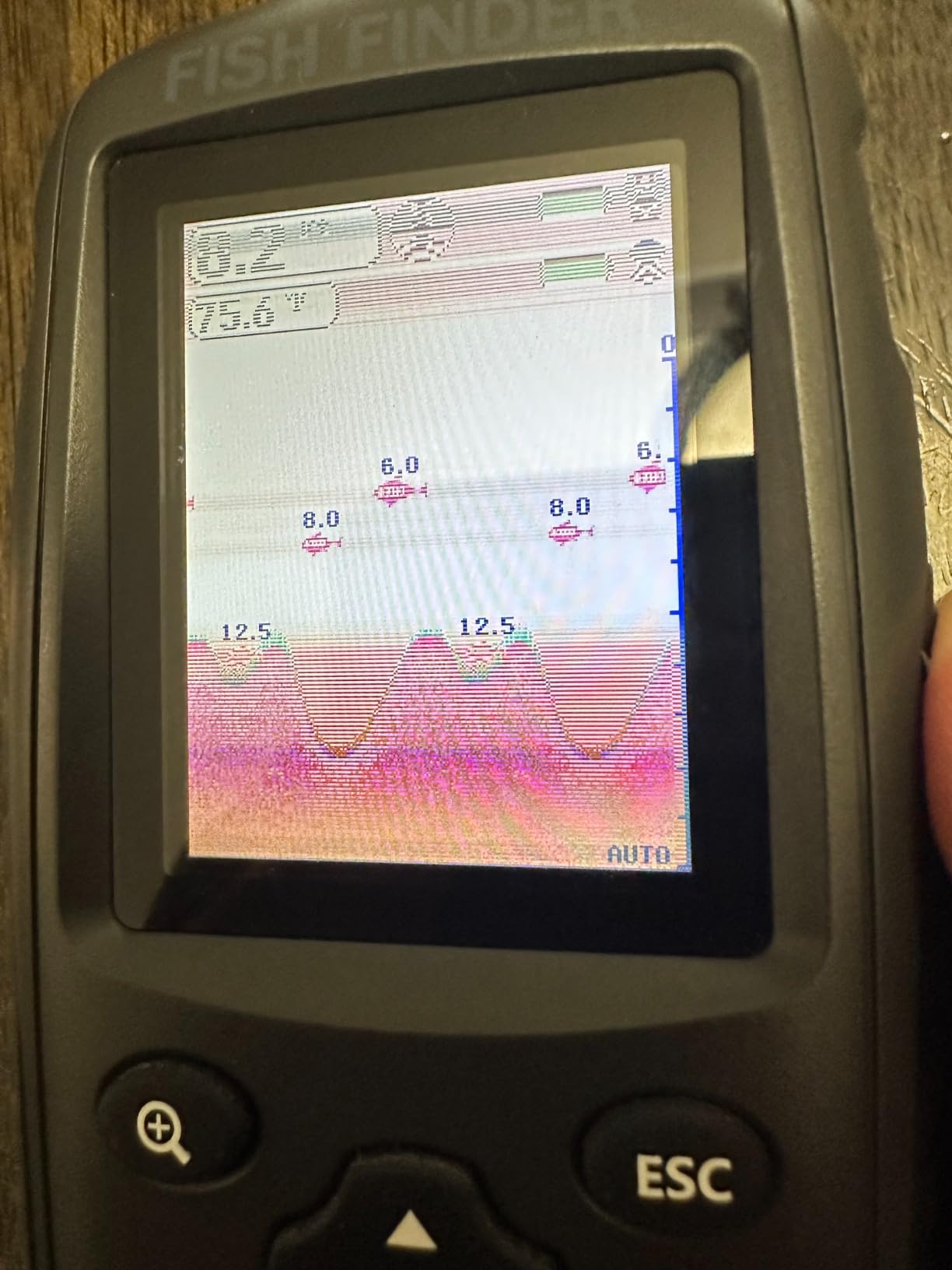
Owners rate it 4.3 out of 5 from about 1,100 reviews with 66 percent five-star, calling it portable, budget-friendly and immediately usable. The selectable black or white background is a small touch that matters when you are switching between full sun and dusk.
It shows depth, water temperature, fish size, fish depth and bottom contour, and it carries a two-year warranty with support that owners report responding within a day. That warranty is longer than most of what is listed here.
A 105 degree beam versus narrow-beam detail
A 105 degree cone covers a lot of water from close range, which is useful for sweeping a shallow bay or working a channel edge. It also means adjacent returns merge more easily, so a tight group of fish looks like one mark.
If you care about telling one fish from two or judging size, a narrower beam option is worth more to you than wide coverage is.
Getting more than three hours from the receiver
The receiver runs roughly 3 to 4 hours of continuous use, the shortest handheld runtime among the units here. Spare cells or a small power pack for the receiver is the practical answer.
Reviewers also note reduced reliability when the sensor is towed behind a moving boat or used through an ice hole, so treat it as a shore and kayak tool rather than a small-boat one.
10. LUCKY 1108CP Is a Budget Pick That Belongs on a Kayak, Not a Bank
- Simplest way to add sonar to a kayak
- One-hand size with a neck strap
- Wide 3 to 328 ft depth range
- Shows weed sand and rock bottom
- Backlight for sun or darkness
- Transducer must be in the water or mounted in a hull
- No fish size grading
- Will not read through fiberglass
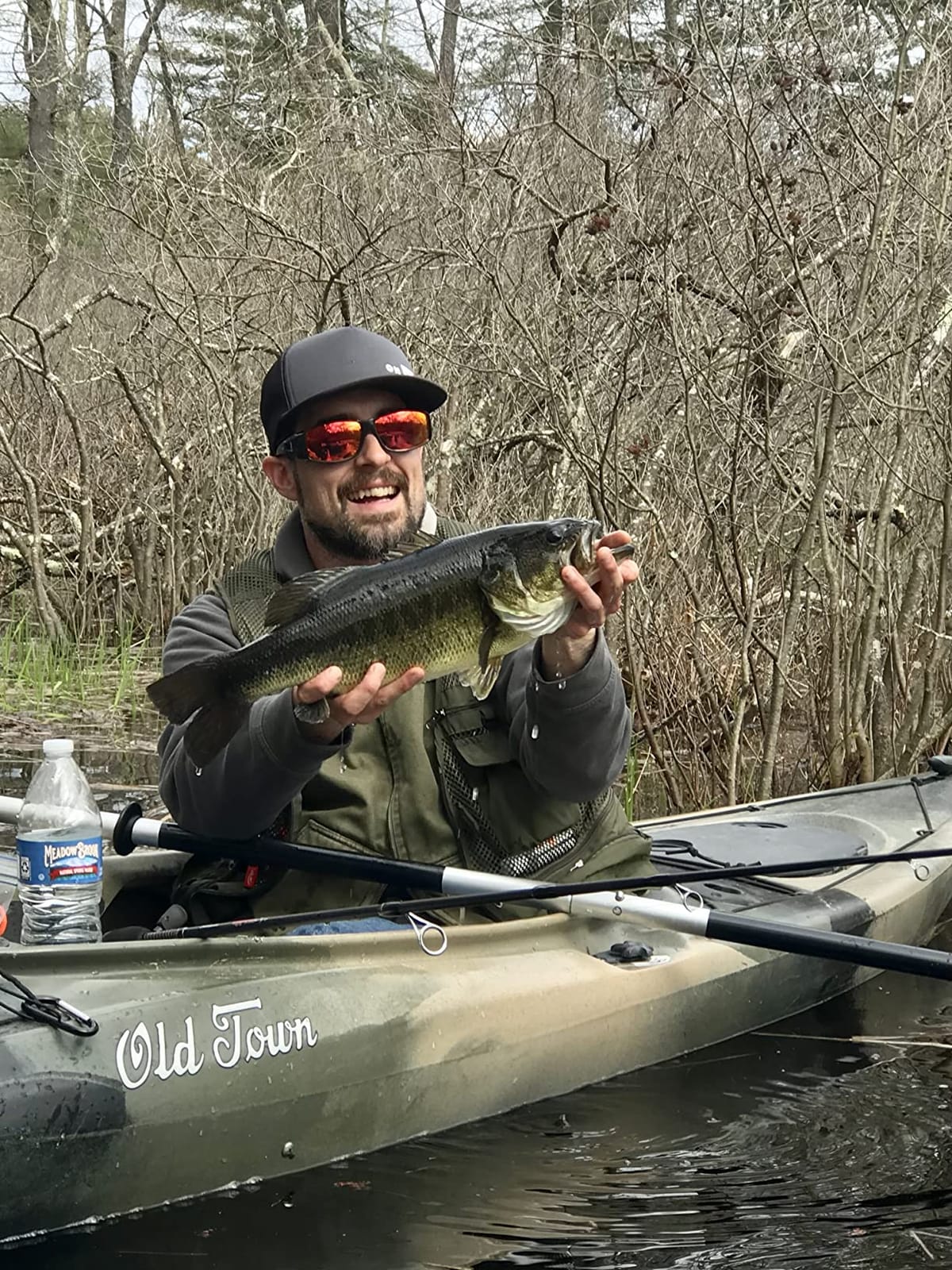
We are including this one with a warning attached, because it is genuinely useful to a large group of readers and genuinely wrong for a pure bank angler. The transducer attaches to a kayak or boat hull, and it has to be in the water or in a hull to return any reading.
Within that limit it does its job well. Owners rate it 4.1 out of 5 from more than 3,200 reviews, and treat it as a basic, inexpensive way to reveal ledges and drop-offs from a kayak rather than as anything more ambitious.
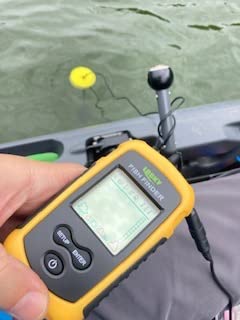
The depth range of 3 to 328 feet is far wider than anything you will fish from a kayak, and the 2 inch LCD is readable enough with the backlight on. Five levels of sensitivity help in clear or turbid water, and the display switches between feet and meters.
It is a small, cheap, honest tool that tells you how deep the water is and what kind of bottom is under you, and owners run it for 4 to 5 hours on a set of batteries, or longer in battery save mode.
Why it only works from a boat or kayak?
There is no way to cast this from a bank because the sensor is physically wired to the display. From shore, the whole rig is limited by cable length, which is the single most common reason bank anglers return wired units rather than keep them.
If your water is reached by kayak, or you rent canoes and pontoons on occasion, that limitation simply does not apply to you.
What you give up without fish size grading?
Without fish size grading the unit picks up minnows alongside bass, so you cannot tell a feeding hatch from a holding fish. Treat every mark as a fish and you will chase noise for an afternoon.
It also will not read through a fiberglass hull, which rules out many of the sit-inside kayaks that are otherwise ideal for this. A portable unit is the better buy for that combination.
How We Chose These 10?
We ranked six criteria, in this order. Sonar clarity and target separation came first, because a sharp return you can interpret beats every other feature. Shore deployment came second, since a unit you cannot rig from a bank does not belong in this list at all.
Power management ranked third, with a battery figure that covers a working day treated as the benchmark. Portability weighed next, measured in weight and pack size rather than marketing language. Versatility across shore, dock, kayak and ice followed, and build support came last.
What we did not do is claim a season of lab testing. The comparisons here are built from published manufacturer specifications and from patterns in owner reviews, cross-checked so that conflicting figures appear as cons rather than being quietly dropped. Where reviews disagree, such as the Deeper PRO+ 2, we say so.
How to Rig a Fish Finder From Shore?
This is the part almost no other guide explains, and it is the part that decides whether a portable unit works from land. There are three methods, and which one you can use is determined by the unit you bought, not by the unit you wanted.
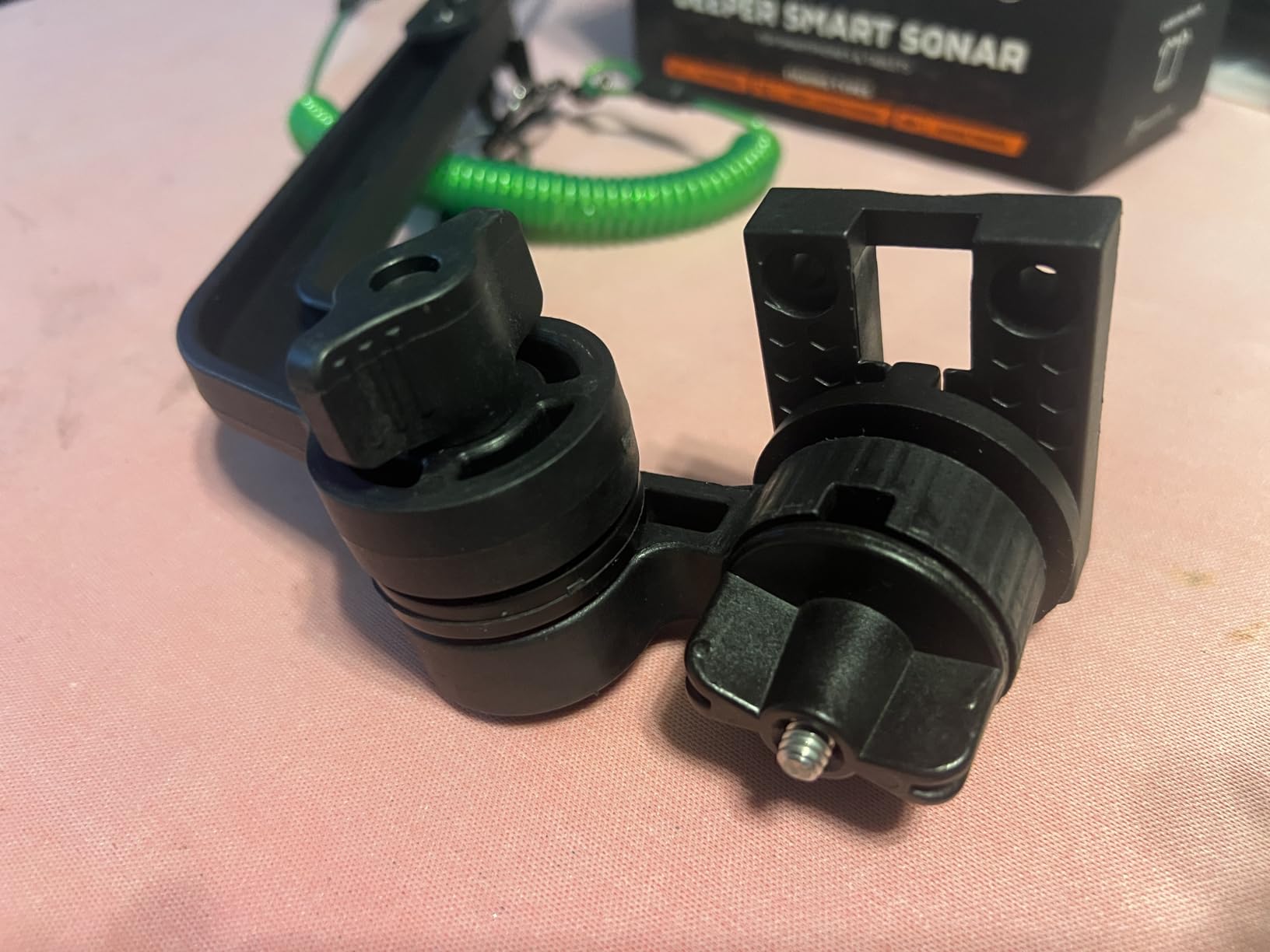
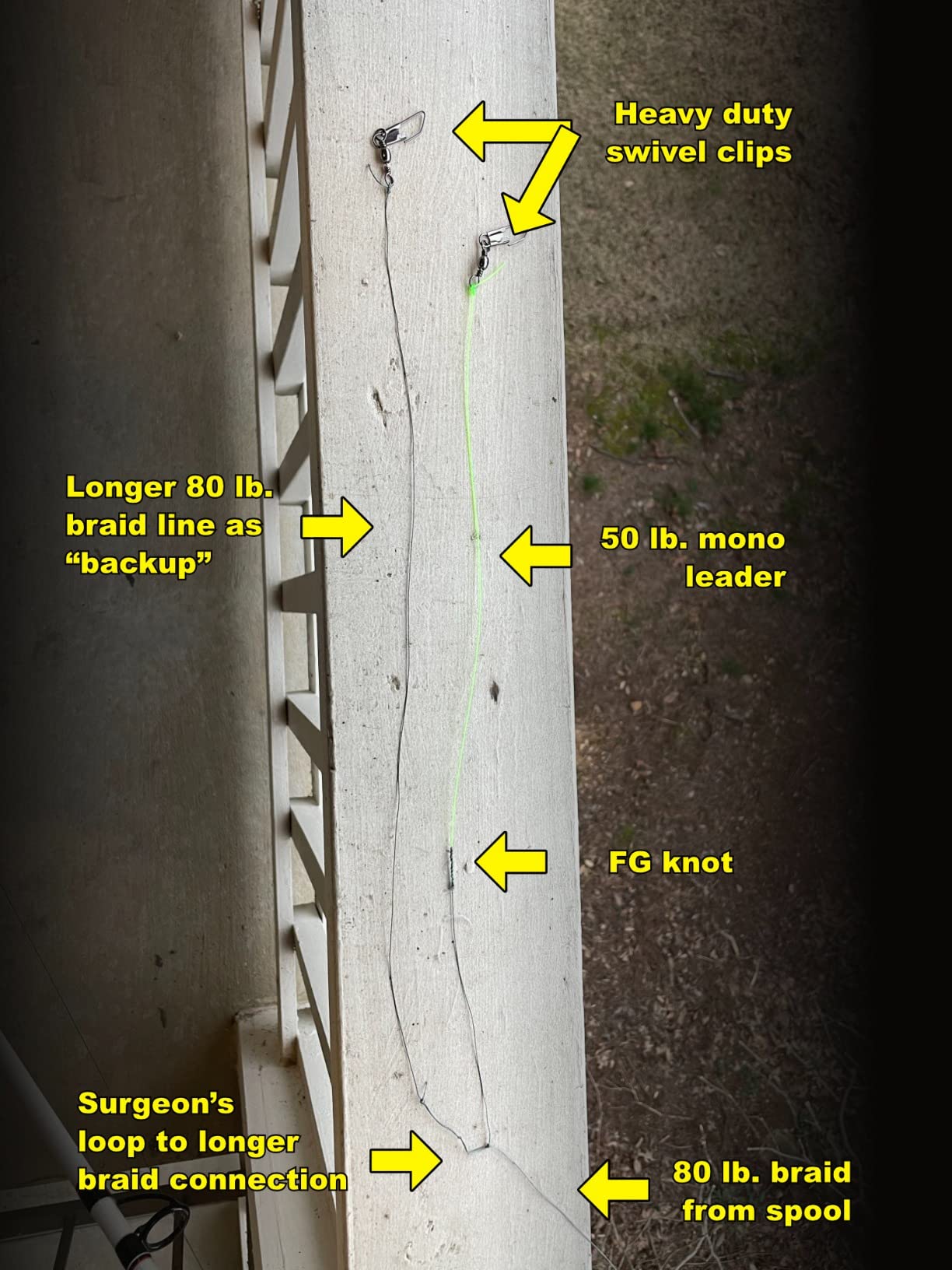
Method one: castable sonar on a separate rod. Tie the pod to a dedicated medium or heavy rod spooled with heavier braid, so scouting casts do not fight the same tackle as your fishing rod. Cast beyond the drop-off, watch the screen as it comes back, then mark or record the spot. The pod does the travelling, which is the whole point of this format.
Method two: a mounted transducer on a piling or bank stick. Clamp or suction-mount the transducer to a dock piling, a jetty leg, a submerged branch or a driven bank stick, keep it at a fixed depth, and read a stationary picture of the structure in front of you. This is the only method that gives you a live view from a fixed position, and it is how the wired dedicated-display kits are meant to be used from land.
Method three: rod-holder pole deployment. Slide a pole into a rod holder with the transducer cable running down it, drop the tip near the bottom, and clamp the pole to the bank or a piling. This gives you a vertical read of a column of water, which is the cheapest way to find a drop-off and the easiest to set up in wind.
On retrieval, the one technique that consistently improves a castable scan is to cast parallel to a drop-off rather than straight across it, and to retrieve at roughly one foot per second. Faster retrieves smear the display, slower ones lose contact, and casting along the edge rather than over it means the edge stays in the sonar cone for the whole retrieve.
Reviewing your recordings before the next trip is just as useful as the scan itself, and a good portable monitor makes it easy to compare contours from one session with the map you are building for the next.
Buying Guide: How to Choose a Portable Fish Finder?
Castable sonar or a dedicated display
Choose a castable if you want to scan water beyond the bank, travel light and do not mind a phone. Choose a dedicated display if you want to fish without thinking about battery life, read in direct sun without glare, or never touch your phone near the water. That is the entire decision, and every other spec is secondary to it.
Reading the specs: beam angle, target separation and max depth
Beam angle is the width of the sonar cone. Wide beams cover more water and merge nearby returns, narrow beams show detail and separate targets. Target separation is the closest two objects the unit can display as separate, and lower numbers are better.
Ignore maximum depth almost entirely for bank fishing. Anglers usually work within roughly 50 metres of shore, and a unit claiming 1,600 feet is not going to be limited by the river in front of you. Accuracy in shallow water matters far more, which is why the 40 degree beam and the 3 ft minimum depth figures deserve a closer read than the headline depth number.
GPS, waypoint marks and full mapping are three different things
Built-in GPS is a position fix. A waypoint map lets you mark a brush pile and steer back to it. Full mapping draws the bottom contour and stores it. A unit can have all three, two, or one, and the terms get used loosely in listings.
For repeated trips to known water, a waypoint map is enough. For water you have never seen, you want real mapping, which is the STRIKER Cast with Quickdraw contours or the HELIX 5 with AutoChart Live.
Making the phone-as-display setup work
Phone dependency is the most repeated complaint in shore-fishing discussions, and it is mostly solvable. Carry a power bank, keep the phone in a weather pouch away from the water, raise brightness for glare and drop it for battery, and download the app before you leave the house so a bad signal never blocks the first cast.
Anglers on fishing forums raise one point consistently and they are right about it. The real risk is not rain, it is a phone that dies at the exact moment you found a good spot. If that possibility ruins your trip, buy a model with its own screen, and the LUCKY and Venterior options here both do that.
It is also worth remembering that a long day on the water is not over when you pack up. Pairing the session with our portable speaker picks makes the debrief on the tailgate a good one, which matters more to most anglers than any single spec on this list.
Water ratings and cold-weather battery behaviour
IPX7 means immersion to one metre for 30 minutes and is the rating that matters for a transducer that will be in the water. IPX4 means splash resistant only, which is fine for a display in a jacket pocket and not fine for anything submerged. Lower numbers mean less protection, so a transducer with no rating is worth treating with care.
In winter, expect shorter runtimes than the quoted figure, since cold reduces the output of a rechargeable cell before it reduces anything else. Budget for a shorter session, and note that a flasher mode on a unit like the STRIKER 4 or the STRIKER Cast is what actually makes ice fishing practical rather than a compromise.
Entry, mid-range and premium tiers
Entry level is where the LUCKY models, the Venterior and the Deeper START sit, and they cover depth and basic bottom structure. Mid-range adds beam options, GPS and mapping, which is where the Garmin STRIKER Cast and the Deeper PRO+ 2 sit. Premium buys a dedicated screen, CHIRP quality and onboard chart storage, which is the STRIKER 4, the PiranhaMAX 4 and the HELIX 5.
If you fish the same three spots every month, entry level is genuinely enough. If you walk onto unfamiliar water and want to know what is under you before you cast, mid-range is where the value sits. If your phone is already your weak link all season, spend the premium.
Frequently Asked Questions
What is the best portable fish finder for shore fishing?
The Garmin STRIKER 4 is the best overall portable fish finder for shore fishing because it combines CHIRP sonar, a screen that stays readable in direct sun, a built-in GPS waypoint map and an IPX7 rating in a package you can carry to a bank. It is a wired unit, so you also need a portable battery and a floating transducer rig. If you would rather not carry power, the Deeper PRO+ 2 is the strongest castable option.
How do I use a fish finder from shore without a boat?
You have three options. Cast the sonar pod on a separate medium or heavy rod and read it on a phone or handheld as it comes back. Clamp or suction-mount a transducer to a dock piling, jetty leg or a driven bank stick at a fixed depth and read a live picture from a stationary position. Or slide a pole into a rod holder with the transducer cable down it and clamp the pole to the bank for a vertical read of a column of water. Wired units need a portable battery as well.
Do portable fish finders actually work for bank fishing?
Yes, with conditions. They work best within roughly 50 metres of shore, where a fixed mounted transducer or a short cast reaches good water. They are less useful on a wide open shoreline where you need to scan 200 feet or more, and a 40 degree beam at long range shows you very little. Shallow-water accuracy matters far more than maximum depth, and that is where most entry-level units hold up well.
Do I need GPS on a portable fish finder?
It depends on how often you return to the same water. A waypoint map lets you mark a brush pile, a drop-off or a good channel edge and steer back to it later, which is the single most useful feature for a shore angler fishing known water. For water you have never fished, you want full contour mapping such as Quickdraw on the Garmin STRIKER Cast or AutoChart Live on the Humminbird HELIX 5. Without GPS, every trip starts from scratch.
Are castable fish finders worth the smartphone dependency?
They are worth it if you travel light, want to scan water beyond the bank, and can keep a phone charged. A power bank, a weather pouch and downloading the app before you leave solve most of the problem. They are not worth it if your phone already struggles all day, because the real risk is not rain but a flat battery at the moment you find a good spot. In that case buy a unit with its own screen, such as the Venterior VT-FF005 or the LUCKY FFC1108.
Which Portable Fish Finder Should You Buy?
Buy the Garmin STRIKER 4 if you want one model that does everything well and you are willing to carry a battery. It is the best overall choice for shore fishing because the screen, the sonar and the GPS all hold up, and a review base of more than 9,300 owners is the strongest evidence in this roundup.
Buy the Deeper PRO+ 2 if scanning water beyond the bank is the point, and the Garmin STRIKER Cast if mapping unfamiliar water and finding it again matters more than range. If your phone is already a liability on a full day, choose a model with its own screen, which narrows the field to the LUCKY FFC1108 and the Venterior VT-FF005.
Whichever you choose, the rig matters more than the model. Cast parallel to the drop-off, retrieve at about one foot per second, and give any spot you find a name or a waypoint before you pack up. That is how the best portable fish finders for shore fishing pay for themselves in a single afternoon.