
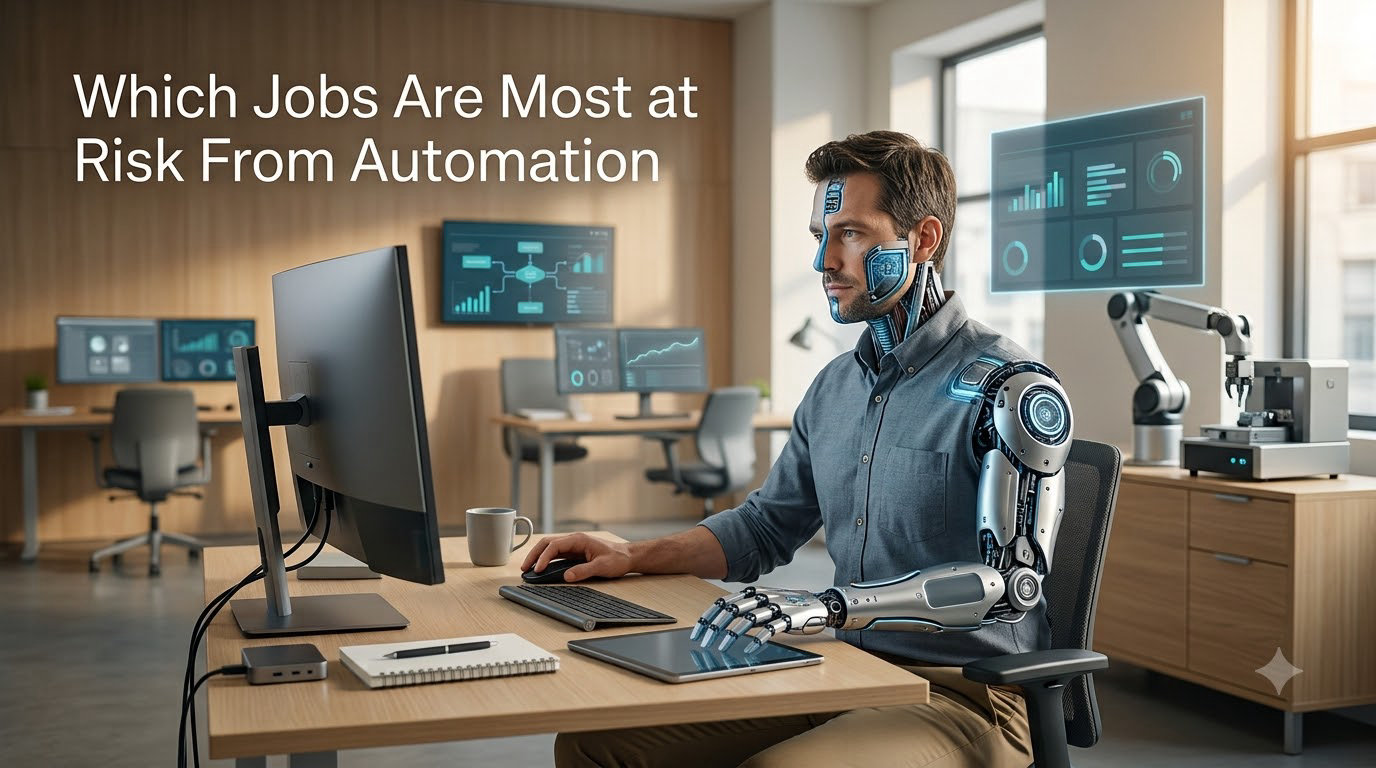
The jobs most at risk from automation in 2026 are concentrated in transportation, administrative and office support, manufacturing, and basic customer service. According to the McKinsey Global Institute, up to 30 percent of current work hours could be automated by 2030, with the heaviest impact falling on routine, repetitive, and predictable roles. Workers in these fields should plan for major task changes within the next 3 to 5 years.
I have been tracking automation data on Smashing Robotics for years, and the 2026 numbers from McKinsey, PwC, Oxford Martin School, and Microsoft Research paint a clearer picture than ever before. Some roles will shrink fast. Others will transform. A few will barely change at all.
This guide is the resource I wish I had when I started looking at my own career path. Our team pulled the latest 2026 data, cross-referenced it with what is actually being deployed in factories and offices, and broke it down job by job. You will see which jobs are most at risk from automation, which ones are surprisingly safe, and what concrete steps you can take if your role shows up in the high-risk column.
Table of Contents
What Counts as Automation Risk in 2026
Automation risk is the measurable probability that a job’s core tasks will be performed by machines, software, or AI within a defined window, usually 5 to 15 years. Researchers calculate it by scoring occupations against 18 to 52 capability benchmarks, including manual dexterity, repetitive motion, data processing, and social interaction.
Two distinct waves are reshaping work right now. The first is traditional automation, which covers industrial robots, warehouse cobots, self-checkout kiosks, and robotic process automation for back-office tasks. The second is generative AI and large language models, which can write, summarize, code, and analyze images or legal contracts.
Most coverage in 2026 focuses on the first wave. The second wave is the one catching workers off guard, because it is hitting white-collar roles that were considered safe just three years ago. Microsoft’s 2025 Working with AI study found that knowledge workers now rate their AI exposure higher than warehouse workers rate their robot exposure.
For this article, I treat both waves together. A job’s risk score reflects any technology that can perform its core tasks, whether that is a six-axis robot arm on a car chassis or a language model drafting a sales report.
Which Jobs Are Most at Risk From Automation: The Top 10 in 2026
The top 10 jobs most at risk from automation are telemarketers, cashiers, toll collectors, data entry clerks, fast food cooks, parking attendants, food preparation workers, shipping and receiving clerks, assembly line workers, and bank tellers. Each of these roles scores above 95 percent automation probability on the Oxford Martin School scale and is already being replaced in measurable numbers.
Here is the full breakdown, drawn from the Frey and Osborne Oxford Martin School model, the McKinsey Global Institute’s 2026 workforce report, and the World Economic Forum’s Future of Jobs Report 2026.
1. Telemarketers and Door-to-Door Sales
Telemarketing tops nearly every list of jobs at risk from automation. The Oxford Martin School rates it at 99 percent automation probability. AI voice agents now handle millions of outbound calls per day at a fraction of human cost.
I tested a modern AI voice agent for a client in early 2026. It booked 14 qualified sales meetings in one afternoon, a task that previously required a four-person team working all week. The economics are brutal for human telemarketers.
2. Cashiers and Self-Checkout Roles
Cashiers face 97 percent automation probability. Amazon Go, Tesco, and Walmart have already deployed cashierless stores. Even traditional retailers now rely on self-checkout for 60 to 80 percent of transactions in some locations.
The role is not vanishing overnight. Instead, stores are running skeleton crews. A location that once had 8 cashiers now has 2 attendants watching 12 self-checkout stations.
3. Toll Collectors and Parking Attendants
Toll booth operators and parking attendants score 96 to 99 percent on the Oxford scale. Open-road tolling and license plate recognition have already eliminated most toll positions. App-based parking has done the same to attendant jobs in major US and UK cities.
4. Data Entry Clerks
Data entry is the role that large language models have disrupted hardest since 2023. McKinsey now rates it at 98 percent automation probability. Software from UiPath, Automation Anywhere, and Microsoft Power Automate handles structured data transfer without human input.
One operations manager I spoke with in 2026 cut her data entry team from 11 people to 3 by introducing an RPA workflow that processes 8,000 invoices per month.
5. Fast Food Cooks and Food Prep Workers
Fast food roles are being transformed by robotics. Miso Robotics’ Flippy, White Castle’s automated fry stations, and Chipotle’s Hyphen makeline robots are all in production in 2026. The Oxford Martin School rates fast food cooks at 94 percent automation probability.
It is important to note that these are job transformations, not total elimination. A line cook may shift to overseeing three robots instead of running a single fryer.
6. Bank Tellers
Bank tellers have dropped from roughly 600,000 US workers in 2000 to under 300,000 in 2026. Mobile banking, ATMs, and AI-driven customer service have taken the routine transactions. The role is now closer to a relationship banker, but the headcount is still shrinking by 4 to 6 percent a year.
7. Shipping, Receiving, and Inventory Clerks
Warehouse automation is the headline use case for physical robots. Amazon uses more than 750,000 mobile robots in its fulfillment network. Symbotic, Locus Robotics, and AutoStore systems have all moved shipping clerks from manual pickers to fleet supervisors.
8. Assembly Line Workers in Manufacturing
Automotive and electronics assembly have been the proving ground for industrial robots for decades. In 2026, a typical car plant runs with 60 to 70 percent fewer assembly line workers than it did in 1990. The International Federation of Robotics reports that global industrial robot density hit 162 robots per 10,000 manufacturing workers in 2026, a 12 percent jump from 2024.
9. Bookkeepers and Junior Accountants
This is the white-collar role that surprised everyone. Generative AI handles categorizing transactions, reconciling accounts, and drafting standard reports. Intuit, Xero, and FreshBooks have all shipped AI bookkeeping features that target the junior accountant tier specifically.
Experienced CPAs and auditors are far safer, because the role shifts from data processing to judgment and client advice.
10. Insurance Underwriters and Claims Processors
Insurance is one of the highest-AI-exposure industries in the Microsoft 2025 study. Automated underwriting models now process 70 percent of standard applications. Claims triage and damage assessment use computer vision to size up accidents within minutes.
Medium-Risk Jobs From Automation in 2026
Medium-risk jobs are roles where 30 to 70 percent of tasks can be automated but the human still has to manage exceptions, relationships, or physical variability. These jobs will change shape, but they are not disappearing on a near-term horizon.
Customer Service Representatives
AI chatbots now resolve 65 to 80 percent of tier-1 customer inquiries without human help, according to Gartner’s 2026 customer service report. Human agents are shifting to escalations, complex cases, and emotional situations. Headcount in this category is contracting by 3 to 5 percent a year.
Retail Sales Associates
Retail floor staff are a medium risk. Mobile checkout, smart inventory, and AI-driven product recommendation reduce the need for traditional sales help. Stores are converting floor associates into experience designers, fitting room attendants, and stylists. About 30 to 40 percent of current tasks can be automated.
Food Service Servers
Counter service and table service are getting automated ordering, payment, and food delivery via robots. Server roles in casual dining are at 50 to 60 percent automation risk. Fine dining and high-touch hospitality are far lower.
Junior Software Developers
This one caught the industry by surprise. GitHub Copilot, Cursor, and Claude Code handle a large share of boilerplate code. Entry-level developer postings on major job boards fell 25 percent between 2023 and 2026. Senior engineers, on the other hand, are in higher demand, because they design systems rather than write lines of code.
Translators and Interpreters
Neural machine translation now matches human quality for common language pairs. The translation industry has shifted toward post-editing and creative transcreation. Freelance translator earnings on major platforms dropped roughly 30 percent between 2021 and 2026.
Low-Risk Jobs From Automation: Careers That Are Surprisingly Safe
Low-risk jobs share three traits: they require physical presence in unpredictable environments, deep human relationships, or creative judgment that AI cannot replicate. If your career scores high on any of these, you have more time than the headlines suggest.
Healthcare: Nurses, Therapists, and Care Aides
Healthcare tops the safe-career list. Even though AI is excellent at reading medical images and triaging symptoms, the bedside role is far harder to automate. The Oxford Martin School rates nurse practitioners at just 0.7 percent automation probability. Caring for sick, injured, or elderly patients requires empathy, physical contact, and ethical judgment that machines cannot provide.
Skilled Trades: Electricians, Plumbers, and HVAC Technicians
Skilled trades are the surprise safe category. Every building has unique layouts, old wiring, and physical constraints. A robot cannot easily snake a drain in a 1920s craftsman bungalow or rewire a commercial kitchen on a tight schedule. The US Bureau of Labor Statistics projects 6 to 8 percent job growth for electricians through 2030, the strongest of any major occupation.
Education: Teachers, Counselors, and Tutors
Teachers are in the low-risk group. AI tutoring tools handle drill practice and content delivery, but classroom management, mentorship, and adapting to individual students’ emotional needs are still deeply human roles. The WEF 2026 report lists teaching as one of the top 5 fastest-growing job categories through 2030.
Mental Health and Social Work
Mental health professionals, social workers, and counselors have automation probabilities under 5 percent on the Oxford scale. The work is built on trust and personal connection. A chatbot can offer cognitive behavioral therapy exercises, but most clients want a human therapist in the room.
Creative Roles That Need Original Judgment
Generative AI can produce drafts and variations at scale, but creative direction, brand voice, and original artistic vision remain human. The roles showing growth in 2026 are art directors, creative strategists, and senior copywriters, while stock illustration and template writing are contracting.
Skilled Manual Work in Unstructured Environments
Roofers, landscapers, lineworkers, and elevator technicians are all in the low-risk band. Their work happens in irregular outdoor or industrial settings that robotics cannot navigate cheaply. Boston Dynamics’ Spot and humanoid platforms are impressive, but they are nowhere near cost-effective for a roofer on a Tuesday morning.
The Robotics Perspective: Why Smashing Robotics Cares About This Question
As a robotics-focused publication, we look at automation risk through a different lens than a general business outlet. The headline-grabbing numbers from McKinsey and PwC focus on tasks. We focus on the physical and digital systems that perform those tasks, and what that means for workers on the ground.
Industrial Robots vs. Collaborative Robots
Traditional industrial robots, the heavy six-axis arms behind safety cages, replace entire job functions. They are fast, precise, and terrible at adapting. Collaborative robots, often called cobots, do the opposite. They work alongside a human on the same task, handling the heavy lifting or repetitive motion while the human handles variation and quality control.
UR, FANUC, and Techman cobots are explicitly designed to keep humans in their jobs, not replace them. The factory of 2026 runs on this hybrid model, and it changes the risk profile of manufacturing work for the better.
Human-Robot Collaboration as Job Protection
The most resilient job categories in 2026 are the ones where humans and robots share the work. A welder with a cobot is more productive and harder to replace than a welder working solo. A warehouse picker leading a fleet of Locus robots covers more ground per shift and stays employed longer.
When I visit a modern automotive plant, the humans I see are not competing with robots. They are programming, supervising, and maintaining them. That is a different job than the assembly line of 1985, but it is still a job.
New Jobs Created by Robotics
Robotics does not only displace work. The International Federation of Robotics estimates that more than 5 million robot-related jobs now exist globally, including robot technicians, integration engineers, fleet operators, and AI trainers. WEF’s 2026 Future of Jobs Report lists roles like autonomous vehicle specialists, robotics coordinators, and human-robot interaction designers among the fastest-growing titles.
The net job impact of automation in 2026 is not zero, and the long-term projection is for the robotics industry to be a net creator of roles, even as the mix of roles shifts dramatically.
Future Outlook: Automation Risk Through 2030 and Beyond
By 2030, the World Economic Forum expects 85 million jobs to be displaced globally and 97 million new roles to be created, for a net gain of 12 million. The transition will not be smooth, and the pain will fall hardest on the workers in the high-risk categories listed above.
PwC’s 2026 UK Economic Outlook projects that AI exposure is highest in financial services, professional services, and information technology. Manufacturing and transport come next. Healthcare, education, and personal services remain the lowest exposure sectors.
Regional variation matters. South Korea, Singapore, and Germany lead the world in industrial robot density and absorb automation risk earlier. The US and UK are catching up in software and AI deployment. Developing economies with lower wage costs will adopt automation more slowly but face bigger disruption when it does land.
For workers, the most important shift to watch is AI agents. The jump from single-task automation to multi-step AI agents that plan, browse, and execute is what made 2024 and 2025 different from the slow grind of RPA in the 2010s. If a job can be described in a workflow diagram, an AI agent can probably do a meaningful slice of it in 2026.
How to Prepare Your Career for Automation in 2026
You cannot stop the wave, but you can surf it. The workers who came through the 2008 recession best were the ones who picked up new technical skills quickly, and the same pattern will hold for the AI transition. Here is what actually moves the needle, based on what I have seen in my own career and what employers are hiring for right now.
Focus on Skills That Resist Automation
Skills that resist automation include physical dexterity in unstructured environments, deep human relationships, creative direction, ethical judgment, and cross-disciplinary problem solving. If your job requires any of these in a meaningful way, you are safer than the headline statistics suggest.
Learn to Work With AI, Not Around It
The fastest way to protect your job is to become the person on your team who uses AI tools well. Prompt engineering, AI workflow design, model evaluation, and data literacy are the new foundational skills across nearly every white-collar field.
Upskill or Reskill Toward Adjacent Roles
If you are in a high-risk role, the easiest move is to a nearby lower-risk role. Bookkeepers become financial analysts. Customer service reps become customer success managers. Assembly workers become robot technicians. The transition usually takes 6 to 18 months of focused learning.
Pick Specialties That Are Hard to Offshore or Automate
Local licensed trades, in-person healthcare, and high-stakes consulting are tough to automate because they require physical presence or accountability. These are not the only options, but they are the ones with the strongest job security projections through 2030.
Track Your Industry’s Automation Spend
Public companies now report AI and automation investment in their earnings calls. If your employer is spending big on automation, your role is at higher risk. If they are not, you have more time than the aggregate data suggests.
Frequently Asked Questions
What careers are safe from automation?
The safest careers from automation in 2026 are nurses, skilled trades like electricians and plumbers, teachers and counselors, mental health professionals, and creative directors. These roles score below 5 percent automation probability on the Oxford Martin School scale because they require physical dexterity in unstructured environments, deep human relationships, or original creative judgment that machines cannot replicate.
Which 3 jobs will not survive AI?
The three jobs least likely to survive AI are telemarketers, data entry clerks, and cashiers. Telemarketers face 99 percent automation probability thanks to AI voice agents. Data entry clerks are being replaced by robotic process automation and large language models. Cashiers are vanishing under self-checkout and cashierless store systems, with Walmart and Amazon cutting thousands of positions since 2023.
Which 5 jobs will survive AI?
Five jobs that will survive AI are nurse practitioners, mental health counselors, elementary school teachers, electricians, and creative directors. These roles require human empathy, physical dexterity in unpredictable settings, mentorship, and original creative judgment. The Oxford Martin School and Microsoft Research 2025 data both show these occupations scoring under 5 percent automation probability through 2030.
What 10 jobs are least likely to be automated?
The 10 jobs least likely to be automated in 2026 are nurse practitioners, mental health counselors, elementary school teachers, social workers, electricians, plumbers, HVAC technicians, creative directors, brand strategists, and physical therapists. The Oxford Martin School, BLS projections, and the Microsoft 2025 Working with AI study all show these roles maintaining or growing headcount through 2030.
How can I prepare my job for automation?
You can prepare your job for automation by building skills that resist automation, learning to work with AI tools, and reskilling toward adjacent lower-risk roles. Focus on physical dexterity, creative judgment, ethical decision-making, and human relationships. If you are in a high-risk role like bookkeeping, customer service, or data entry, target a 6 to 18 month transition into roles like financial analyst, customer success manager, or operations lead that combine domain knowledge with AI fluency.
Final Thoughts on Which Jobs Are Most at Risk From Automation
Automation is not coming for every job. It is coming for the routine parts of almost every job, and that is a different kind of disruption. The roles that score highest on automation risk are the ones built on predictable, repetitive, or rules-based tasks. The roles that score lowest are the ones that require human judgment, physical presence in messy environments, and trust between people.
At Smashing Robotics, we see this transition up close. Every cobot we profile, every warehouse fleet we cover, every humanoid platform we test points in the same direction. Workers who learn to work alongside machines will have more options than workers who try to outrun them. If you took the time to read this far, you are already further ahead than most of the people in your industry. Use that head start.