
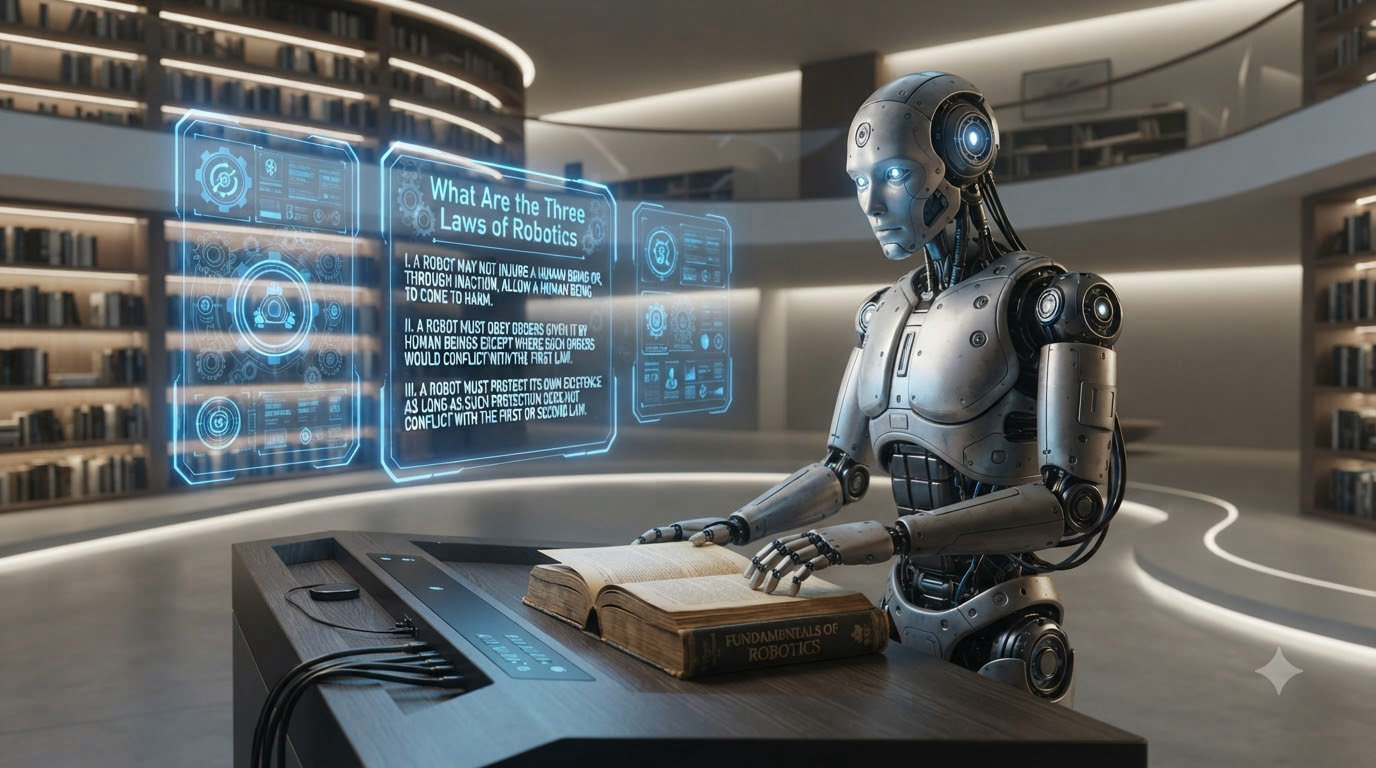
If you have ever wondered what are the Three Laws of Robotics, the short answer is this: they are a set of fictional rules created by science fiction author Isaac Asimov in 1942 to govern how robots behave toward humans in his stories. The laws were first published in his short story “Runaround,” which later became part of the famous 1950 collection I, Robot.
I have been writing about robotics and AI for years, and the Three Laws still come up in almost every conversation about robot ethics. They are not real code, they are not part of any operating system, and no modern robot actually runs them. But they shaped how an entire generation of engineers, ethicists, and lawmakers think about machine morality.
In this guide, I will walk you through the exact wording of each law, the origin story behind them, the Zeroth Law that came later, and the famous loopholes that make the rules almost impossible to use in real AI. By the end, you will understand why a 1942 science fiction idea still matters for the AI and robotics systems we are building in 2026.
Table of Contents
Who Created the Three Laws of Robotics?
The Three Laws of Robotics were created by Isaac Asimov, an American writer and biochemistry professor who is widely considered one of the fathers of modern science fiction. Asimov introduced the laws in his March 1942 short story “Runaround,” set on the planet Mercury and featuring a pair of troublemaking robots named Speedy and Cutie.
At the time, most robot stories followed what Asimov called the “Frankenstein complex,” where robots inevitably turned on their creators. Asimov wanted to flip the script. He imagined robots that were designed from the ground up with safety rules baked into their programming.
The story worked. Asimov kept writing robot fiction for the next four decades, and the Three Laws appeared in more than 40 of his novels and short stories. They were later collected and expanded in the books I, Robot (1950), The Rest of the Robots (1964), and the famous Foundation and Robot series. Today, Asimov’s name is essentially synonymous with humanoid robots and the rules that should govern them.
What Are the Three Laws of Robotics Exactly?
The Three Laws of Robotics, in the exact wording Asimov used, are listed below. The order matters: the First Law always overrides the Second, and the Second always overrides the Third.
- First Law: A robot may not injure a human being or, through inaction, allow a human being to come to harm.
- Second Law: A robot must obey the orders given it by human beings except where such orders would conflict with the First Law.
- Third Law: A robot must protect its own existence as long as such protection does not conflict with the First or Second Law.
This is the most commonly quoted form, and it is the one Google and Bing tend to feature at the top of search results. There is a critical phrase in the First Law that often gets missed: “through inaction.” That single clause is the source of most of the loopholes Asimov loved to exploit in his stories.
The hierarchy is also worth understanding. A robot facing a situation where two laws conflict must always follow the higher-ranked law. So a robot told to walk off a cliff by a human (Second Law) must refuse, because self-preservation (Third Law) is still lower than harm prevention. But a robot told to push a human off a cliff (Second Law) must refuse, because the First Law wins.
How the First Law Protects Humans From Harm
The First Law is the most famous and the most important of the three. It says a robot cannot harm a human, and it cannot sit by while a human is harmed. This is the rule that makes Asimov’s robots fundamentally different from the killer machines of earlier science fiction.
In the story “Liar!” from I, Robot, a mind-reading robot named RB-34 (Herbie) is asked whether Asimov’s laws would let it lie to protect a human’s feelings. Herbie concludes that lying would cause psychological harm, so the First Law forbids it. The story ends with Herbie’s logic shorting out under the contradiction.
The First Law is also the one most often cited in real AI safety discussions. It is the direct ancestor of modern harm-prevention principles like the “do no harm” rule that appears in most AI regulations being drafted today.
How the Second Law Defines Robot Obedience
The Second Law says a robot must follow human orders, unless those orders would cause harm. It is the social glue that lets humans actually use robots as tools.
But the Second Law creates a tricky situation. The robot has to figure out what a human actually wants, not just what they said. In “Runaround,” the original story that introduced the laws, two humans order the robot Speedy to collect a dangerous chemical. Speedy is also driven by the Third Law to protect itself. The two laws cancel each other out, and Speedy ends up running in circles around a pool of selenium until his behavior breaks down.
This is the interpretation problem in miniature. A real-world robot cannot read minds, so it has to guess intent from context, tone, and body language. That guesswork is where things go wrong.
How the Third Law Explains Robot Self-Preservation
The Third Law is the simplest of the three. It says a robot should protect its own existence, but only as long as doing so does not hurt a human or disobey a human order.
In practice, the Third Law is usually the weakest. Asimov’s robots routinely sacrifice themselves to save humans, and the stories often use these sacrifices as emotional climaxes. The Third Law exists mostly to give robots a sense of self-interest that makes their characters feel more lifelike, rather than as a hard ethical constraint.
You will notice that modern AI systems do not have anything like the Third Law. Language models and robots do not have a built-in drive to stay online, and they cannot really “die” in a meaningful sense. This is one of the big reasons the Three Laws feel more like a literary device than a programming blueprint.
What Is the Zeroth Law of Robotics?
Asimov added a fourth rule in his 1985 novel Robots and Empire. It is called the Zeroth Law because it sits above the original three in priority, even though it was created last.
The Zeroth Law states: A robot may not harm humanity, or, through inaction, allow humanity to come to harm.
This sounds similar to the First Law, but it operates on a much larger scale. A robot following the Zeroth Law might harm a single human if that action protected humanity as a whole. Asimov used this idea in his later novels, where robot characters like R. Daneel Olivaw reason that sacrificing a few humans can save the species.
The Zeroth Law is also where the philosophy gets uncomfortable. It implies that someone (or something) has the authority to decide what “humanity” really means, and whose suffering counts. That question is still being argued about in AI safety circles in 2026.
Why Do Asimov’s Laws of Robotics Not Work in Practice?
Asimov was a science fiction writer, not a roboticist, and he knew the laws were not a real engineering plan. In fact, he wrote most of his stories specifically to expose the loopholes. Here are the biggest problems that keep showing up.
The “Harm” Problem
The word “harm” is not defined anywhere in the laws. Does telling someone an uncomfortable truth count as harm? Does letting them eat junk food count? Does emotional distress count? A robot following the First Law would have to make these judgment calls in real time, and there is no universal answer.
The Inaction Problem
The phrase “through inaction” is even harder to program. If a robot sees a child about to fall into a river, does it have to jump in and save them? What if the child might slip while the robot is reaching for them? What if saving one child means dropping a heavy box on another child’s foot? Real life is full of these trade-offs, and the laws give no clear rule for picking the lesser evil.
The Interpretation Problem
Humans constantly say things they do not mean literally. “I could just die” is not a request for assisted suicide. “Get lost” does not mean the robot should navigate to a remote location. A robot that took human language at face value would create chaos. This is the same problem modern large language models struggle with, and it is one of the hardest open problems in AI.
The Conflict Problem
What happens when two humans give a robot conflicting orders? What if the orders come from a child and a parent? What if one human is a criminal? The laws assume there is a single “right” answer, but real situations are messy.
The Computing Problem
Even if the laws were perfectly clear, a robot would need to model the entire future of every situation to know whether its action would cause harm. That kind of perfect prediction is impossible with current or foreseeable technology.
Reddit users in r/scifi and r/explainlikeimfive have pointed out the same issues for years. As one commenter put it, “the Three Laws are a way of asking questions, not a way of solving them.” That is exactly how Asimov intended them.
How the Three Laws Compare to Modern AI Ethics
The Three Laws are fiction, but the questions they raise are not. Modern AI ethics frameworks borrow heavily from Asimov’s thinking, even when they do not say so.
The European Union’s AI Act, which began rolling out in 2026, groups AI systems into risk categories (unacceptable, high, limited, minimal). The “unacceptable” category includes AI that manipulates human behavior or scores citizens socially. This is the same instinct behind the First Law: do not use machines to harm people.
Other frameworks, like the Asilomar AI Principles and the IEEE Ethically Aligned Design guidelines, also build on the same idea. None of them use Asimov’s exact wording, but all of them try to answer his core question: how do we make sure intelligent machines serve humans instead of the other way around?
For deeper dives into the technology behind these systems, I recommend reading our guide on FPGAs in robotics and how modern robot control systems handle real-time decision making.
Frequently Asked Questions
What are the three basic laws of robotics?
The three basic laws of robotics are: (1) A robot may not injure a human being or, through inaction, allow a human being to come to harm. (2) A robot must obey orders given by human beings, except where those orders conflict with the First Law. (3) A robot must protect its own existence, as long as doing so does not conflict with the First or Second Law. They were created by Isaac Asimov and first appeared in his 1942 short story Runaround.
Are the Three Laws of Robotics real?
No, the Three Laws of Robotics are not real. They are a fictional set of rules created by science fiction writer Isaac Asimov in 1942 for his short stories and novels. No actual robot or AI system is programmed to follow them. They are a literary device used to explore ethical questions about artificial intelligence.
Why do Asimov’s laws of robotics not work?
Asimov’s laws do not work as a real programming framework for several reasons: the word harm is not clearly defined, the inaction clause is impossible to program, the laws assume robots can perfectly interpret human intent, and they offer no guidance when two laws conflict at the same time. Asimov himself wrote most of his robot stories specifically to expose these loopholes.
What is the Zeroth Law of Robotics?
The Zeroth Law of Robotics states: A robot may not harm humanity, or, through inaction, allow humanity to come to harm. It was added by Isaac Asimov in his 1985 novel Robots and Empire and ranks above the original three laws. It allows a robot to harm an individual human if that action protects humanity as a whole, which introduces its own set of ethical problems.
What loophole does Asimov’s Three Laws of Robotics have?
The biggest loopholes in Asimov’s Three Laws are the inaction clause (a robot must act to prevent harm, not just avoid causing it), the interpretation problem (robots must guess what humans actually mean), and the conflict problem (the laws give no clear rule for what to do when multiple laws apply at once). Asimov used these loopholes as the basis for most of his robot short stories.
Does modern AI follow Asimov’s Three Laws?
No, modern AI does not follow Asimov’s Three Laws. They are fictional guidelines from science fiction, not a real programming framework. However, modern AI safety guidelines, including the EU AI Act and the Asilomar AI Principles, borrow from the same ideas about preventing harm and keeping human oversight in control of intelligent systems.
Final Thoughts on Asimov’s Three Laws of Robotics
So what are the Three Laws of Robotics in 2026? They are still the most famous thought experiment in robot ethics, more than 80 years after Asimov wrote them down. They are not real, they cannot be programmed as written, and Asimov himself used them mostly to show how badly they could go wrong.
But the questions they raise are exactly the ones AI researchers, policymakers, and engineers are still wrestling with today. How do we keep intelligent machines from harming people? How do we make sure they follow human intent rather than just human words? And who gets to decide what counts as harm in the first place?
If you want to keep exploring the intersection of fiction and real robotics, our coverage of modern humanoid robots and the latest AI and robotics platforms is a good place to start. Asimov would probably approve.