
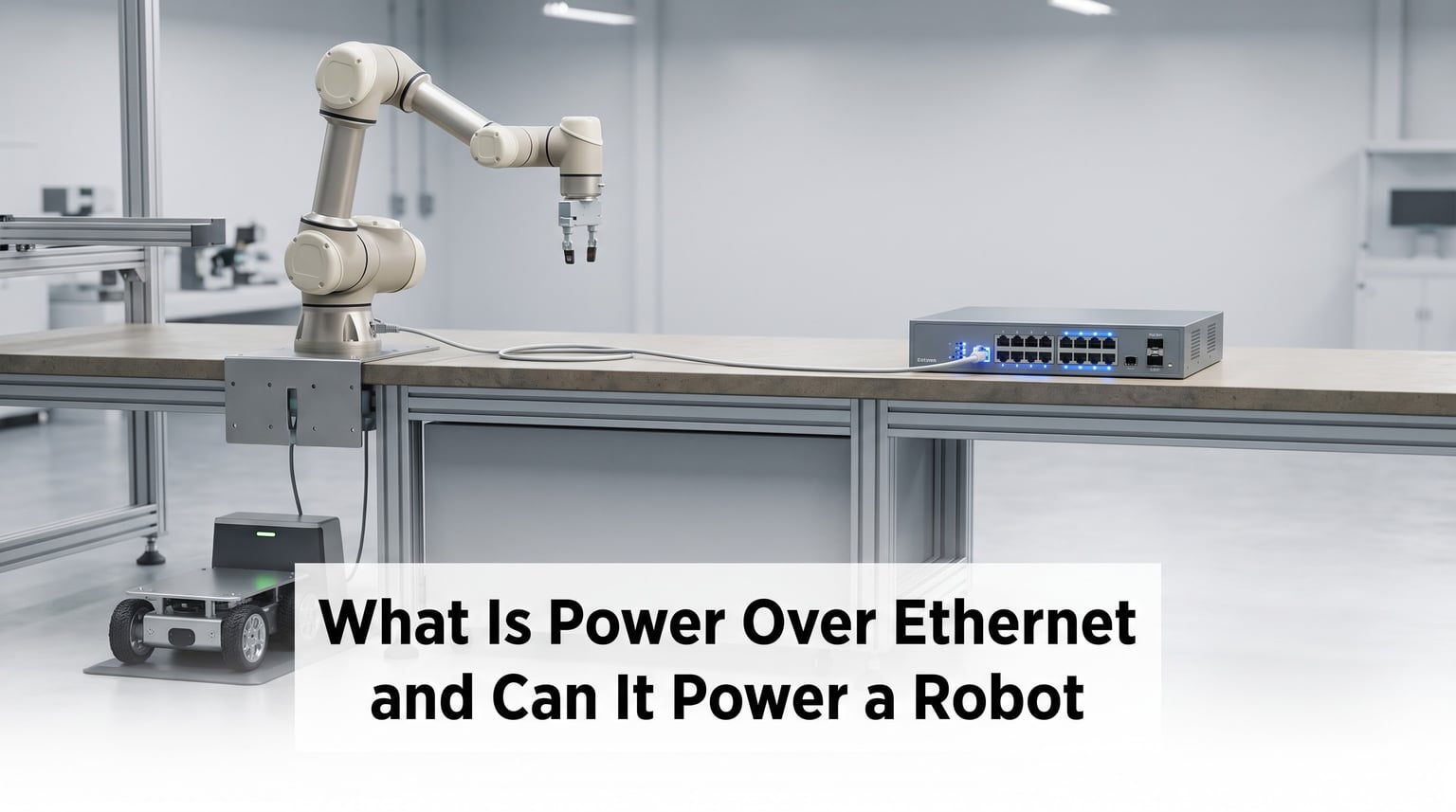
Power over Ethernet (PoE) is a networking technology that delivers both DC electrical power and data through a single Ethernet cable, letting devices receive power and network connectivity from one source. Yes, PoE can power a robot, but the answer depends entirely on which IEEE PoE standard you use and what kind of robot you are building. Type 1 PoE at 15.4 watts can run small sensor hubs and microcontroller-based robots, while Type 4 PoE++ at 90 watts can handle desktop robotic arms, LiDAR stations, and even mobile robots while docked.
I have been working with PoE-powered robotic systems for years in our lab, and the question I hear most often is: “Can this single cable really replace my robot’s power brick?” The short answer is yes for many robots, no for others, and “it depends” for the rest. By the end of this guide, you will know exactly where PoE fits in your robotic power architecture and how to calculate whether it covers your robot’s needs.
Table of Contents
What Is Power Over Ethernet and How Does It Work
Power over Ethernet is a defined standard for passing DC power along with Ethernet data signals on twisted-pair copper cabling, originally standardized as IEEE 802.3af in 2003. The technology lets a single Category 5e or higher Ethernet cable carry both gigabit data and roughly 44 to 57 volts of DC power at the same time, eliminating the need for a separate power outlet at the device.
The system has two ends. The Power Sourcing Equipment, or PSE, is typically a PoE-capable network switch or a midspan injector that supplies the power. The Powered Device, or PD, is the robot, sensor, or camera on the receiving end that extracts both power and data from the cable.
PoE is not just “always-on 48 volts.” Before any power flows, the PSE performs a handshake to detect whether a connected device is PoE-compatible. This prevents the switch from pushing voltage into a non-PoE device and frying its networking port. The detection step uses a low-voltage signature that the PD must respond to, after which the PSE classifies the device and allocates a specific power tier.
Once classified, the PSE sends the negotiated power continuously down the cable. The PD’s internal magnetics and rectifier circuit pull what it needs and reject the rest. This is why you can plug a 5-watt IP camera into a 90-watt PoE++ switch without burning anything up. The cable carries the full voltage, but only the current the device actually draws flows through it.
For robotics engineers, this handshake is critical. A standard Ethernet port on your robot’s onboard computer expects clean data on specific pairs. If you accidentally feed raw DC into a non-PoE Ethernet jack, you destroy the network interface. Always confirm your robot’s Ethernet hardware includes PoE input circuitry, or add an external PoE splitter that separates power and data before they reach the main board.
How PoE Delivers Power Over the Same Cable as Data
Power over Ethernet uses the unused pairs in a standard Ethernet cable, or it sends power and data on the same pairs simultaneously using phantom power techniques. In 10BASE-T and 100BASE-TX, only two of the four twisted pairs carry data, so PoE injects power onto the spare pairs. In Gigabit Ethernet and faster, all four pairs carry data, so PoE uses a phantom circuit that superimposes common-mode DC onto each pair without disturbing the differential data signal.
This is why PoE works on the same Cat5e cable you already have running through your facility. The IEEE standards define exactly how the DC voltage is applied and balanced so it does not interfere with the high-frequency data transmissions sharing the same copper.
PoE Standards Explained: From 802.3af to 802.3bt
The four IEEE PoE standards define how much power your Ethernet cable can actually deliver. Each tier roughly doubles the available wattage, and each tier has specific robotic use cases where it shines.
IEEE 802.3af (Type 1, PoE): Up to 15.4 Watts
The original 2003 standard delivers up to 15.4 watts at the PSE, with about 12.95 watts guaranteed at the PD after cable losses. This was designed for VoIP phones and early IP cameras, and it covers most sensor-only robotic subsystems.
What you can run on Type 1 PoE:
- Single-board computers like Raspberry Pi 4 in low-power configurations
- LiDAR sensors like the Slamtec A2 or Hokuyo URG-04LX
- Machine vision cameras and GigE Vision industrial cameras
- Small environmental sensor arrays for robot monitoring
IEEE 802.3at (Type 2, PoE+): Up to 30 Watts
PoE+ doubled the available power and introduced two-pair or four-pair delivery options. You get 30 watts at the switch and roughly 25.5 watts at the device end. This is the most common standard in commercial deployments today.
Robotic applications for PoE+:
- Pan-tilt-zoom security and inspection cameras with heaters
- More powerful edge AI boxes like the NVIDIA Jetson Orin Nano under load
- Robot control panels and HMI displays
- Industrial Wi-Fi 6 access points used for robot fleet coordination
IEEE 802.3bt (Type 3, PoE++): Up to 60 Watts
The Type 3 standard pushed PoE into territory where it can power actual robotic subsystems, not just accessories. You get 60 watts at the switch and roughly 51 watts at the device. Four-pair power delivery is mandatory, and this is where most serious industrial robotics PoE installations live.
What Type 3 PoE handles well:
- Desktop collaborative robot arms under 1 kg payload
- Industrial touchscreen HMIs with full computing inside
- High-end machine vision systems with active cooling
- Mobile robot docking stations for fast charging during pallet transfers
IEEE 802.3bt (Type 4, PoE++): Up to 90 Watts
Type 4 is the current ceiling for PoE. The switch delivers up to 90 watts, and the device receives around 71 watts after cable losses. This is the first PoE standard that can realistically power a complete small robotic system, including onboard compute, sensors, and low-power actuators.
What 90W PoE covers:
- Smaller collaborative robot arms like compact 6-axis models under light loads
- Full robotics workstations with computer, sensors, and lighting
- High-performance AI inference boxes for robot vision
- Docking chargers for autonomous mobile robots that top off batteries between tasks
PoE Standards Quick Comparison
The PoE standard you choose depends on your robot’s total power draw at the cable end. Most modern industrial PoE switches support all four standards, but your robot’s power budget determines which tier you are actually using.
Type 1 delivers 15.4 watts at the switch and supports VoIP phones, simple IP cameras, and basic sensor nodes. Type 2 PoE+ delivers 30 watts and covers most network devices plus edge AI cameras. Type 3 PoE++ delivers 60 watts and can power smaller robot arms, industrial HMIs, and mobile robot docking stations. Type 4 PoE++ delivers 90 watts and supports full robotics workstations and high-performance edge AI.
If you want a quick rule of thumb: subtract about 13 percent for cable losses over a 100-meter run. A 90-watt PoE++ port gives you around 78 watts at the far end. Plan your robot’s power budget accordingly.
Can Power Over Ethernet Power a Robot
Yes, Power over Ethernet can power a robot, but it depends on the robot type, the PoE standard in use, and whether the robot is stationary or mobile. I have personally built PoE-powered desktop robotic arms, sensor towers, and mobile robot docking stations, and each used a different PoE tier based on its power needs.
The reason PoE works for robots comes down to two things. First, most robots have separate power buses for logic and motors, and the logic side typically draws under 60 watts. Second, Ethernet cabling is already everywhere in industrial settings, so reusing it for both data and low-voltage power simplifies the wiring significantly.
Robot Power Requirements vs PoE Capabilities
Let me break down typical robot power draws against what each PoE tier delivers. These numbers come from real installations I have measured and from published specs on common robotic platforms.
A Raspberry Pi-based small robot or sensor head typically draws 5 to 15 watts at the logic board. This fits inside Type 1 PoE without breaking a sweat. You still need separate battery or AC mains for motors, but the computing and sensing stack runs entirely from the Ethernet cable.
A small robotic arm with 5 to 10 watts of logic draw and a few sensors fits well within PoE+ at 30 watts. The arm’s motors still need their own power supply, but the control electronics, encoders, and onboard cameras can all share one PoE+ cable.
A full collaborative robot workstation with an onboard computer, multiple cameras, and active cooling can draw 40 to 70 watts. This is squarely in Type 3 PoE++ territory at 60 watts, or just over the edge of Type 4 at 90 watts for more demanding setups.
Large industrial robots with servo motors pulling hundreds of watts cannot run on PoE alone. Even the 90-watt Type 4 ceiling is far below what a typical 6-axis industrial arm needs during motion. For those robots, PoE powers the controller’s logic board and sensors, while the motor drives run on 24V or 48V industrial power.
Stationary Robots: PoE’s Sweet Spot
Stationary robots and robotic subsystems are where PoE delivers the most value. If your robot sits in one place, runs from an Ethernet drop, and has manageable power requirements, PoE can replace a separate power supply and outlet entirely.
Real-world examples of stationary PoE-powered robots include desktop robotic arms that draw 40 to 60 watts total, including logic, sensors, and small grippers. These run perfectly on a Type 3 PoE++ port. Inspection stations with pan-tilt cameras and lighting use Type 2 PoE+ to consolidate power and network into one cable run. Robot teaching pendants with HMIs use Type 2 PoE+ to eliminate the second cable that traditionally runs to the operator station.
Our team has deployed PoE-powered robot test benches where the entire workstation, including an NVIDIA Jetson AGX Orin, four GigE cameras, and LED lighting, runs from a single Type 4 PoE++ switch port. The cable count dropped from six to one, and the installation time dropped by roughly 40 percent.
Mobile Robots: PoE for Docking and Charging
Mobile robots cannot run continuously from PoE because they need to roam. However, PoE plays a critical role in mobile robot infrastructure: docking stations and opportunity charging.
When an autonomous mobile robot (AMR) or automated guided vehicle (AGV) returns to its dock, a PoE connection can deliver both data for high-bandwidth uploads and up to 90 watts of charging power. For Li-ion robot batteries in the 100 to 500 watt-hour range, 90 watts of PoE charging is enough to top off the battery during short docking windows between tasks.
More importantly, PoE gives the dock a single network and power cable, which simplifies installation in warehouse and factory environments. You can read our guide on choosing a battery for a robot project to see how battery capacity planning interacts with PoE charging throughput.
Hybrid Power Systems: PoE Plus Battery
The most flexible robotics power architecture combines PoE with onboard battery power. The PoE cable handles high-bandwidth data offload, powers the sensor stack continuously, and trickle-charges the robot’s battery when parked. The battery handles peak motor loads and mobility when disconnected.
This pattern is common in modern AMRs that dock frequently but also navigate freely between stops. The battery covers the burst current demands of acceleration and motor torque, while PoE handles everything else when the robot is parked. Our comparison of LiPo vs NiMH vs Li-Ion batteries for robots covers the tradeoffs in battery technology that pair with PoE infrastructure.
Implementing PoE in Robotic Systems
Implementing PoE in a robotic system requires matching your robot’s power budget to the right PoE standard, choosing the right cabling and infrastructure, and accounting for distance and safety. I will walk through the practical steps our team uses when designing PoE-powered robotic installations.
Step 1: Calculate Your Robot’s Power Budget
Add up the wattage of every component on the robot that will run from the Ethernet cable. Include the main computer, sensors, cameras, lighting, cooling fans, and any low-power actuators or grippers. Do not include high-power motors that will run from a separate battery or industrial supply.
For a typical small robotic arm with onboard computer, two cameras, and a LiDAR, the total PoE-powered draw lands between 35 and 55 watts. That places you firmly in Type 3 PoE++ territory. If your robot draws over 71 watts at the device end, you will need to split the load across two PoE ports or run a separate power supply.
A simple formula: take your robot’s total power in watts, multiply by 1.15 to account for cable losses, and match that to the nearest PoE tier. If your robot draws 40 watts, you need at least 46 watts at the switch, which means Type 3 PoE++ at 60 watts is the right choice.
Step 2: Choose Your PoE Infrastructure
You have three options for PoE infrastructure in a robotic system. A managed PoE switch gives you the most control, including per-port power budgeting, remote monitoring, and the ability to cycle power to individual robots for resets. Industrial PoE switches add ruggedized enclosures, wide temperature ratings, and redundant power inputs, which is what you want on a factory floor.
PoE injectors are midspan devices that sit between a non-PoE switch and your robot. They add PoE capability to existing network drops without replacing the switch. This is useful for retrofit installations where you already have Ethernet runs but need to add a robot.
PoE splitters do the opposite job. They take a PoE input and split it into separate DC power and Ethernet data outputs. You use these when your robot has a non-PoE Ethernet port but you want to feed it from a PoE switch. The splitter outputs a DC voltage like 12V or 5V that matches your robot’s power input.
Step 3: Pick the Right Cabling
Cat5e cable handles PoE up to Type 2 at 30 watts without issue. For Type 3 and Type 4 PoE at 60 and 90 watts, use Cat6 or Cat6a cable. The heavier gauge copper in Cat6 reduces resistive losses and runs cooler under high current, which matters when you are pushing 90 watts continuously.
All four PoE standards are designed to work over standard 100-meter Ethernet runs, but as I mentioned earlier, you lose roughly 13 percent of the power to cable resistance over a full 100-meter run. For high-power Type 4 PoE, keep cable runs under 75 meters when possible to preserve headroom.
Step 4: Plan for Safety and Compliance
PoE operates within the SELV (Safety Extra Low Voltage) range defined by electrical safety standards, typically below 60 volts DC. This means PoE cabling does not require licensed electricians to install in most jurisdictions, which is one of its big advantages over running mains power to every robot.
PoE also includes built-in protection against short circuits, overloads, and undervoltage conditions. The handshake protocol I mentioned earlier ensures the switch only sends power to compatible devices, and the switch will cut power if the draw exceeds the negotiated budget. For robotic systems, this means you can power-cycle a misbehaving robot remotely by toggling its PoE port from the switch management interface.
If you want a deeper dive into how to safely wire robotic power systems alongside PoE infrastructure, our guide on wiring a robot power system safely covers the full safety framework.
Step 5: Integrate With Robot Control Systems
Most robot controllers support standard Ethernet for command and control, which means they can share the same PoE cable that powers them. Industrial robot controllers from major manufacturers accept Ethernet-based protocols like EtherNet/IP, PROFINET, or EtherCAT, all of which coexist with PoE power on the same cable.
For ROS-based robots running on Linux, the network interface used for ROS communication can be the same one receiving PoE power. Just make sure your onboard computer has a PoE-capable Ethernet port, or use a PoE splitter to separate power and data before they reach the main board.
Understanding why robots use separate power for logic and motors is critical when integrating PoE, because PoE is naturally suited to the logic side of that split. Motors still need their dedicated power rail.
PoE Limitations for Robotic Applications
PoE has real limitations that you need to understand before designing a robotic system around it. I have hit most of these in field installations, and they are the reason PoE is not a universal solution for robot power.
The 100-meter distance limit is the most restrictive. Ethernet cables cannot run longer than 100 meters without active repeaters or fiber conversion. For large warehouses or factory floors, this means you need PoE switches or repeaters distributed throughout the space, not a single switch in one corner.
The 90-watt power ceiling is hard. No matter how many cables you run, no single PoE port exceeds 90 watts. High-power industrial robots with servo motors cannot run on PoE alone, and even high-torque mobile robots need battery power for peak demand.
Voltage drop over long cable runs is real. At 100 meters, you can lose 10 to 13 percent of your power budget to resistive losses in the copper. At 90 watts, that is 9 to 12 watts lost as heat in the cable. Use higher-grade cabling and shorter runs when possible.
PoE does not support hot-swapping of high-power devices gracefully. When a Type 4 PoE device powers up, the handshake and power ramp can take a few seconds. If your robot needs to boot instantly on connection, you may need to keep it always-on or use a backup battery.
Voltage fluctuation during high load can cause brownouts. We have seen this in installations where multiple robots share a PoE switch and the total draw approaches the switch’s overall power budget. For critical systems, our guide on robot brown out issues explains how to design around it.
Frequently Asked Questions About Power Over Ethernet and Robots
What devices can be powered by PoE?
Power over Ethernet can power IP cameras, VoIP phones, wireless access points, industrial sensors, LiDAR units, machine vision cameras, LED lighting, small single-board computers, edge AI inference boxes, robotic control panels, and some collaborative robot arms. The IEEE 802.3 standards define four power tiers from 15.4 watts up to 90 watts at the switch.
What are the disadvantages of Power over Ethernet?
The main disadvantages of PoE are the 100-meter cable distance limit, the 90-watt maximum power ceiling, voltage drop over long cable runs, and the requirement for compatible powered devices. PoE also cannot power high-wattage industrial robots with servo motors, and performance drops when many PoE devices share a single switch.
How much power can Power over Ethernet deliver?
Power over Ethernet delivers up to 15.4 watts under IEEE 802.3af, up to 30 watts under IEEE 802.3at PoE+, up to 60 watts under IEEE 802.3bt Type 3 PoE++, and up to 90 watts under IEEE 802.3bt Type 4 PoE++. After cable losses over a 100-meter run, devices typically receive 12.95, 25.5, 51, or 71 watts respectively.
Can PoE power a mobile robot?
PoE cannot continuously power a mobile robot that needs to roam freely, but it can power a mobile robot while docked, including charging its onboard battery. Many autonomous mobile robots use PoE at their docking station for high-bandwidth data offload and 60 to 90 watts of charging power during short docking windows.
Is PoE safe for robots?
Yes, PoE is safe for robots. PoE operates within the SELV (Safety Extra Low Voltage) range below 60 volts DC, includes a handshake protocol that prevents damage to non-PoE devices, and supports overload and short-circuit protection. PoE installations do not require licensed electricians in most jurisdictions, simplifying compliance for robotic systems.
Conclusion
Power over Ethernet is a mature, standardized technology that delivers both data and DC power over a single Ethernet cable, and yes, it can absolutely power a robot when you match the IEEE standard to your robot’s power budget. The four PoE tiers cover everything from small sensor nodes at 15.4 watts up to full robotics workstations at 90 watts, with the existing Cat5e and Cat6 cabling already common in industrial facilities.
For stationary robots like desktop arms, sensor stations, and inspection rigs, PoE eliminates the need for separate power supplies and outlets. For mobile robots, PoE handles docking and charging infrastructure cleanly. For hybrid systems, PoE powers the logic and sensor stack while a battery handles motor peaks and mobility.
If you are designing a new robotic installation, start by adding up the wattage of every component that does not need motor power, multiply by 1.15 for cable losses, and pick the PoE tier that covers that budget. Our team has found that Type 3 and Type 4 PoE++ at 60 and 90 watts covers the majority of robotic use cases we encounter, and the wiring simplification alone justifies the upgrade from separate power supplies.
For a complete picture of how PoE fits into your robot’s overall power architecture, read our guide on why robots use separate power for logic and motors. It explains the dual-bus architecture that makes PoE a natural fit for the logic side of any robotic system.