
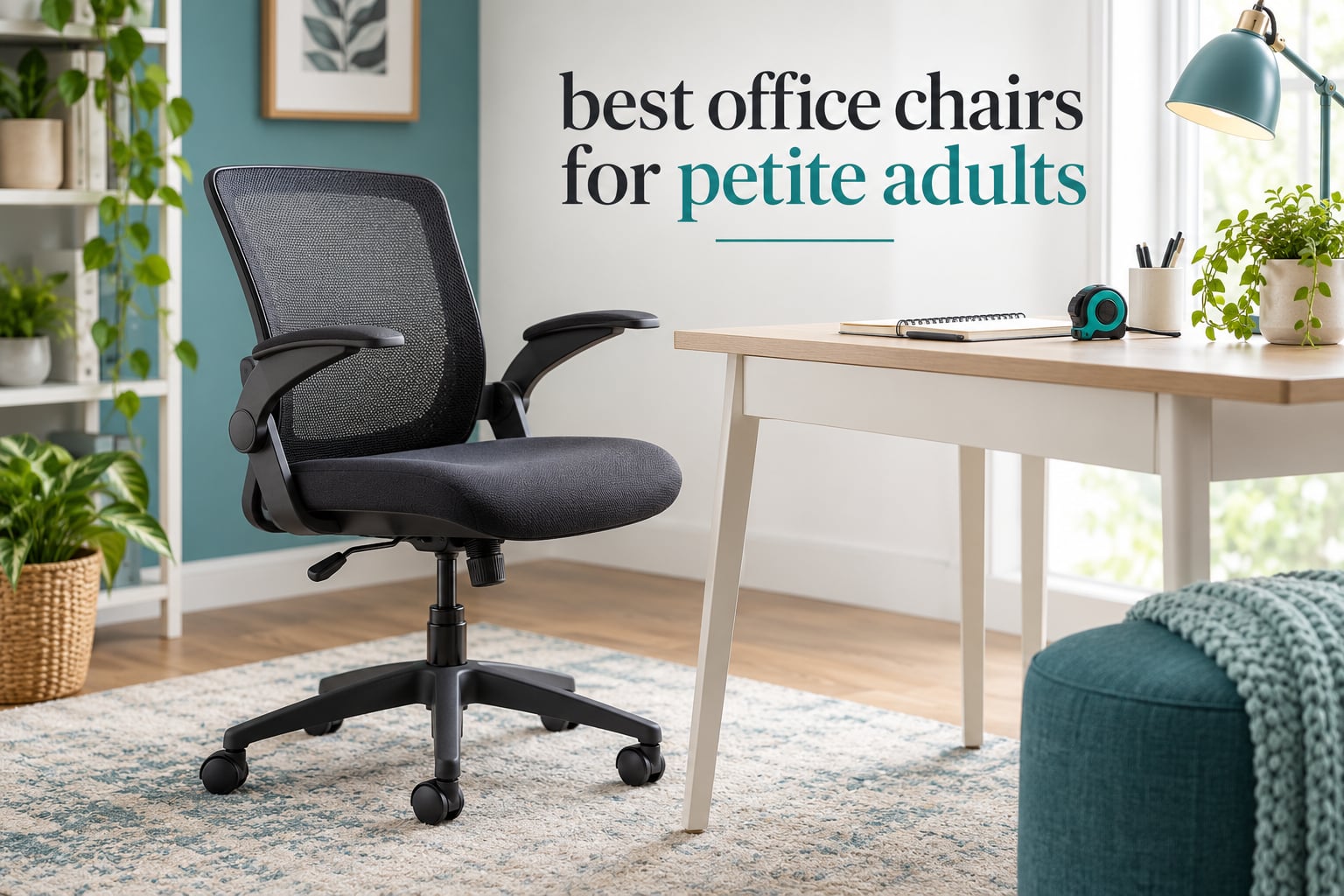
The best office chairs for petite adults are task chairs with a low starting seat height, a seat depth of about 19 inches or less, and either no armrests or arms that flip up out of your way. Most chairs on the market are built around a 5’10” reference user, so shorter adults end up dangling, cramped behind a too-deep seat, or hunched inward around armrests that sit too far apart.
That is not a comfort complaint. A chair that does not reach the floor forces you to hover, and hovering is what rounds your shoulders and pulls your lower back out of neutral position. The fix is arithmetic: you need the chair’s lowest seat height to be at or below your popliteal height, the measurement from the floor to the back of your knee with your shoes on.
For this roundup I compared nine chairs that genuinely fit smaller frames, and I pulled the published dimensions for each one rather than trusting marketing adjectives. It is worth saying up front that the industry’s biggest failure here is silence. Four of the nine picks below publish no minimum seat height at all, and for those I tell you exactly what is missing so you can measure your own space before ordering.
Forum threads about this topic repeat the same story. On r/OfficeChairs, a 4’11” user with an average torso and unusually short legs reported that even the SecretLab Titan Evo in size Small left their feet dangling at the lowest setting. That single complaint is the reason most people in this category end up buying a footrest after the fact instead of a better chair first.
The chairs in this guide are also, deliberately, small chairs. Nine of nine are armless or flip-up designs, because that is what solves the two biggest fit blockers at once: armrests that sit too wide for narrow shoulders, and armrests that push a short user away from the desk. If your shoulders are the problem, armless wins outright. If you need forearm support for long typing sessions, the flip-up arms are the compromise, and there is exactly one pick here built that way.
A few quick pointers before the picks. If you sit at a standard 29 to 30 inch desk, a chair whose maximum raised height falls short of your desk is a real problem, and I flag that where the data shows it. If your body is short through the torso rather than the legs, seat depth and backrest height matter more than seat height. And if you are under 5’0″, measure first, because almost nothing in this category prints the number you actually need to make a decision.
Table of Contents
Top 3 Picks for Petite Adults (October 2026)

BestOffice Mid-Back Mesh Chair
- 17.1 inch starting seat height
- 17.1-20.3 inch range
- Ventilated mesh back
- BIFMA alloy steel frame
Sweetcrispy Armless Compact Chair
- Shallow 16.33 inch seat depth
- 17.71-21.45 inch height range
- Armless frame
- 250 lbs capacity

Brick Attic Flip-Up Arm Chair
- 90 degree flip-up armrests
- 3.94 inches of height travel
- PU leather upholstery
- 275 lbs capacity
Those three cover the three common situations. The BestOffice is the pick when you want a conventional chair with a published low starting height and a lot of evidence behind it. The Sweetcrispy armless chair is the pick when a too-deep seat is your main complaint. The Brick Attic is the only chair here with arms that tuck away entirely, which makes it the one to try if you slide in and out of a small desk all day.
All Nine Picks at a Glance in 2026
| Product | Specifications | Action |
|---|---|---|
| BestOffice Ergonomic Mid-Back Mesh Chair |
|
Check Latest Price |
| Sweetcrispy Office Desk Chair, Armless |
|
Check Latest Price |
| Brick Attic Leather Desk Chair, Flip-Up Arms |
|
Check Latest Price |
 Sweetcrispy Small Armless Mesh Desk Chair Sweetcrispy Small Armless Mesh Desk Chair |
|
Check Latest Price |
 DUMOS Small Desk Chair with Lumbar Support DUMOS Small Desk Chair with Lumbar Support |
|
Check Latest Price |
 DUMOS Armless Vanity Chair with Lumbar Support DUMOS Armless Vanity Chair with Lumbar Support |
|
Check Latest Price |
 Serta Armless Small Mesh Task Chair Serta Armless Small Mesh Task Chair |
|
Check Latest Price |
 DUMOS Armless Small Mesh Office Chair DUMOS Armless Small Mesh Office Chair |
|
Check Latest Price |
 OLIXIS Armless Home Office Mesh Chair OLIXIS Armless Home Office Mesh Chair |
|
Check Latest Price |
Four picks here publish a starting seat height you can check against your own legs: the BestOffice at 17.1 inches, the Sweetcrispy small mesh chair at 15.94 inches, the Sweetcrispy armless chair at 17.71 inches, and the Brick Attic with 3.94 inches of total travel. The other five do not, so treat their fit as unverified until you measure.
1. BestOffice Ergonomic Mid-Back Mesh Chair – Best Overall for Petite Adults
BestOffice Ergonomic Office Chair | Mid-Back Swivel Desk Chair | Dark Black
- Lowest published starting height among conventional armrest chairs
- Curved mid-back holds lumbar support through long days
- Ventilated mesh stays cool
- Alloy steel frame with BIFMA compliance
- 64742 reviews showing long-term durability
- Fixed armrest height can sit high under a low desk
- Mid-back stops at the lower back
- Basic sponge cushion flattens with heavy daily use
This is the chair I keep coming back to for one reason: it is the only conventional chair in the set that prints its lowest seat height. 17.1 inches is genuinely low, and it lands well under a standard 29 inch desk, which means your thighs meet the underside of the desktop rather than your knees hitting the edge of it.
The 18 inch seat depth is also the best of the armrest options here. Most small chairs run 16 inches, which can leave a taller petite user sliding forward, and most large executive chairs run 21 or 22, which pushes pressure behind the knees. Eighteen leaves a small gap you can sit back into, which is what you want if you are around 5’2″ to 5’5″.

Build quality is where the review count earns its keep. This listing has 64742 reviews at a 4.3 rating, and that volume only happens when a chair survives years of daily use. The frame is alloy steel, it is BIFMA compliant, and the capacity rating is 250 lbs, which is standard for the class rather than a limitation.
Set the height lever first, before anything else. Once you are at 17.1 to 18 inches, check whether your feet sit flat. If your desktop is a standard height and the armrests are clearly above it, that is the fixed armrest problem showing up, and it is the one genuine drawback here. Sliding under a low desk is possible, but it takes a little practice the first day.
What you should check before you commit
Measure your popliteal height first, then subtract it from your desk height. Whatever is left is the armrest clearance you have to work with, and if that number is under about 4 inches, this chair’s fixed arms will be cramped for you.
Sit back against the lumbar curve with your shoulders relaxed. The mid-back is a genuine mid-back, so it supports your lower back and stops around the base of your shoulder blades. For most adults under 5’6″ that is exactly right. It will feel short if you are a 5’10” user reading this article.
If you do ten or more hours a day, buy a seat pad on day one. The high-density sponge is serviceable rather than plush, and a thin memory foam layer costs you nothing compared to rebuilding the chair later.
Where it falls short
Two height positions are listed for the adjustment, which is fewer than you would find on a commercial chair, though the range itself is what matters and 17.1 to 20.3 inches is a solid span.
There is no headrest, so if you recline to think or read, your neck is on its own. Recline tension is not adjustable either, so treat the rocking function as a bonus rather than a feature to lean on.
If you need arms you can slide in and out of without thinking about it, the next pick solves that problem in a way this chair does not.
2. Sweetcrispy Armless Compact Desk Chair – Best for Short Thighs
- 4.6 rating across 2438 reviews
- Shallow 16.33 inch seat depth clears short thighs
- U-shaped lumbar support
- Armless frame slides right up to the desk
- High-density foam cushion
- Low backrest gives almost no upper-back support
- No armrests means no forearm support
- Shorter backrest limits use by taller adults
At 4.6 stars across 2438 reviews, this is among the best-rated chairs in the roundup, and the reason for the pick is the 16.33 inch seat depth. That is the shortest seat on this list, and it exists specifically so that a user with short thighs can sit back against the backrest instead of perching on the front edge.
Short thighs plus a deep seat is the combination that produces the numb-leg, falling-asleep feeling that short users describe in forum threads. One r/OfficeChairs poster put it plainly, calling a competitor seat hard for small stumpy legs. Sixteen inches of depth removes that failure mode almost entirely, at the cost of leaving a gap behind the knees for anyone taller.
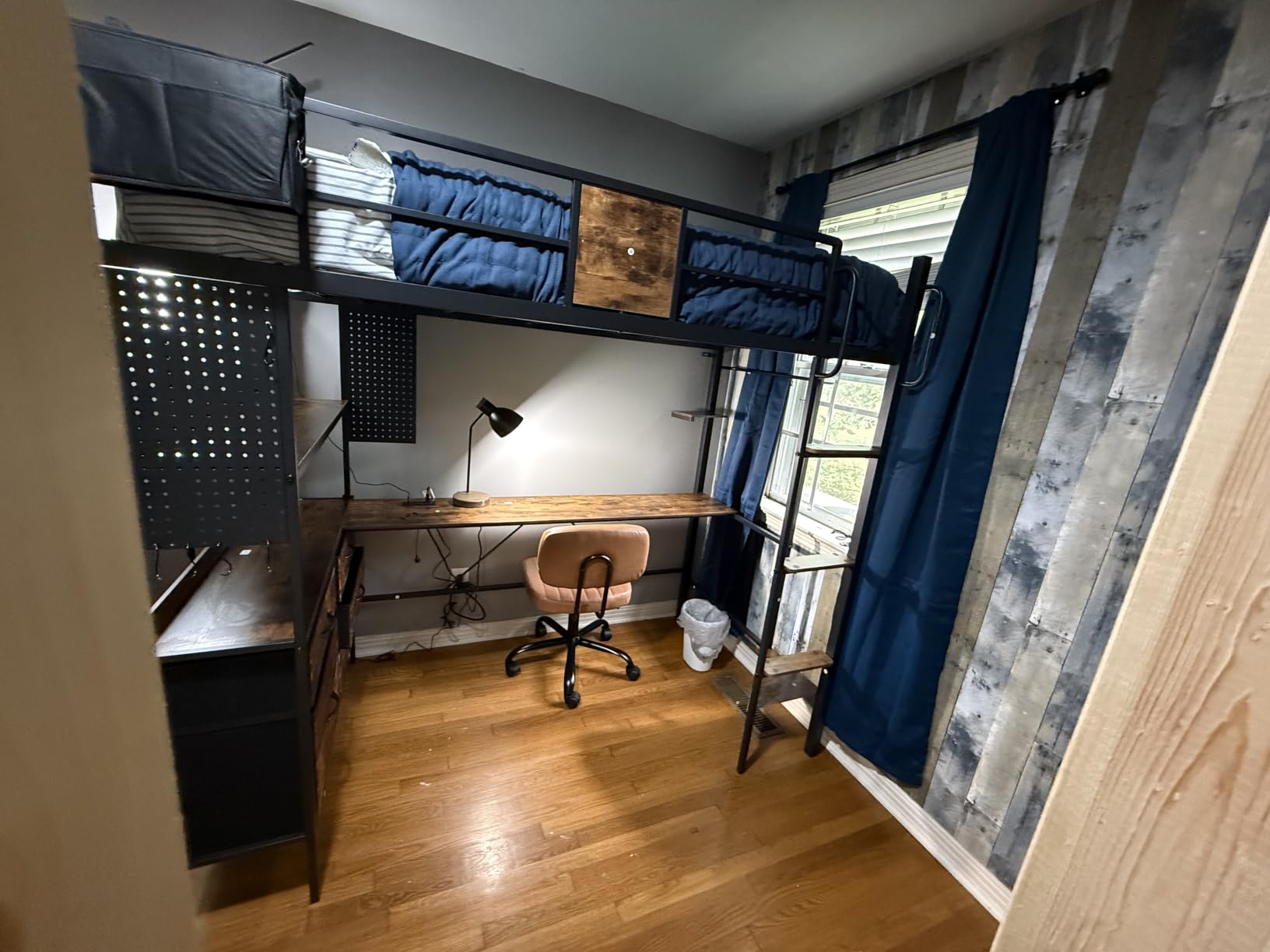
The armless frame is the second reason this chair suits petite adults. There is no armrest to hold you off the desk, so you can pull right up to the front edge with a keyboard and mouse. For a short user, that few extra inches is the difference between typing with shoulders raised and typing with shoulders down, because you are not leaning forward to reach over a barrier.
Height adjustment runs 17.71 to 21.45 inches, a range of about 3.7 inches, powered by an SGS-certified gas cylinder. The top of that range reaches most small desks comfortably. The gas cylinder is also BIFMA certified, and the chair is rated to 250 lbs.
Why the armless design is the right call at this size
Armrests are the most common source of fit failure in small chairs. A fixed armrest is measured for a 5’10” shoulder span, so a user with narrow shoulders ends up rounding forward to get inside it. Armless removes the problem by not having the part.
The U-shaped lumbar frame does the work an armrest would otherwise do indirectly, by giving you a stable surface to push against when you shift position or scoot the chair forward with your feet. It sits in the curve of the lower back rather than floating at mid-back height.
Overall dimensions are 16.33 by 18.11 by 34.25 inches, which is why this works in a tight home office. The whole footprint is smaller than most mid-back chairs, so it fits a small desk without pushing your knees into a drawer front.
What you give up for that compactness
The backrest interior height is listed at 12.59 inches, and that is short. This is a low-back chair and it will not support your shoulder blades. If you slouch as you concentrate, this one will not catch you the way a taller back would.
No forearm support is the other real cost. Long typing sessions without armrests can load the shoulders, and some people find that harder to ignore after hour three. If that describes you, the flip-up chair in pick three solves it.
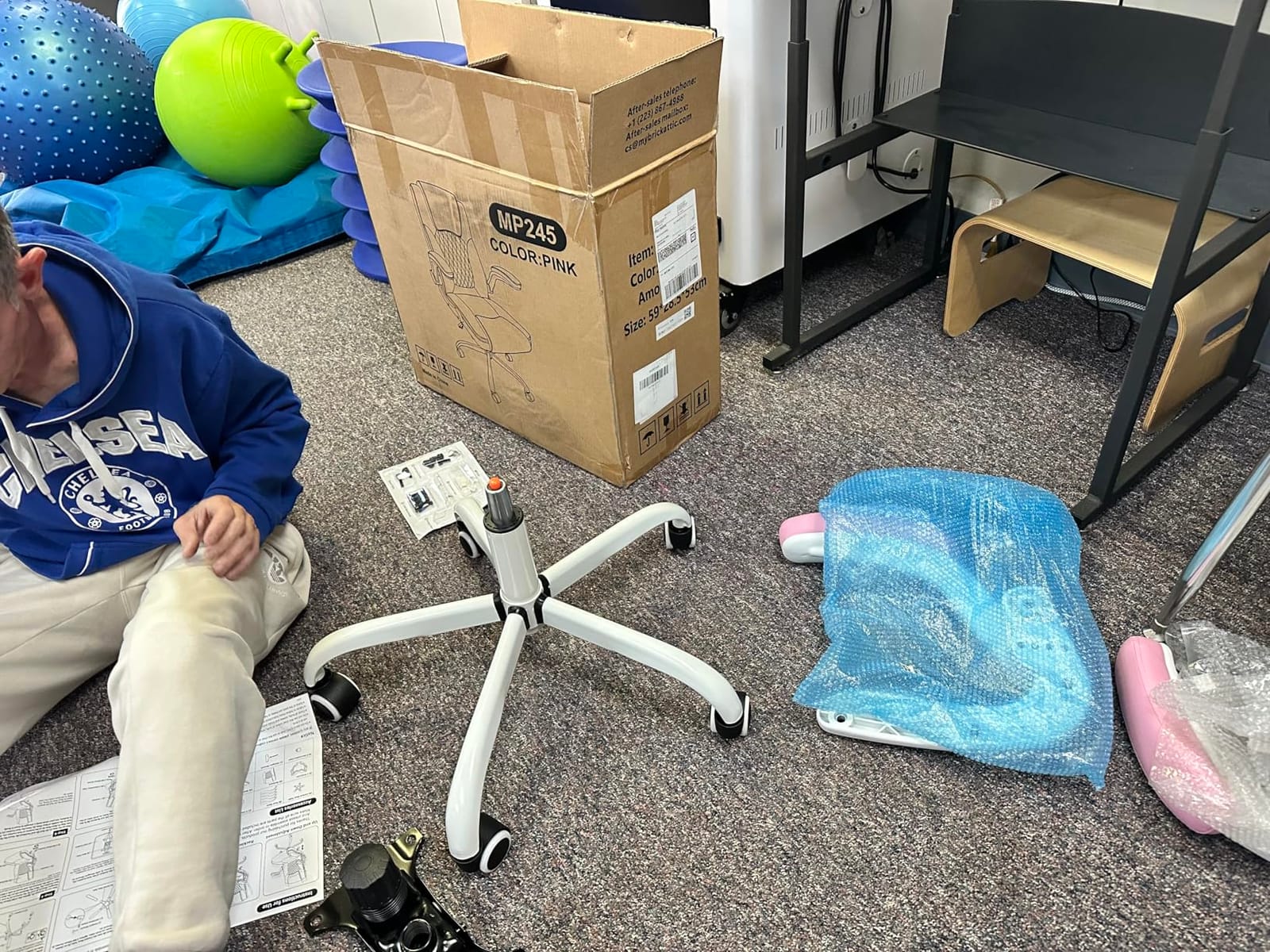
Assembly takes five to ten minutes with the included tools, and at 19.2 lbs the chair is heavy enough to feel stable but light enough to move between surfaces yourself.
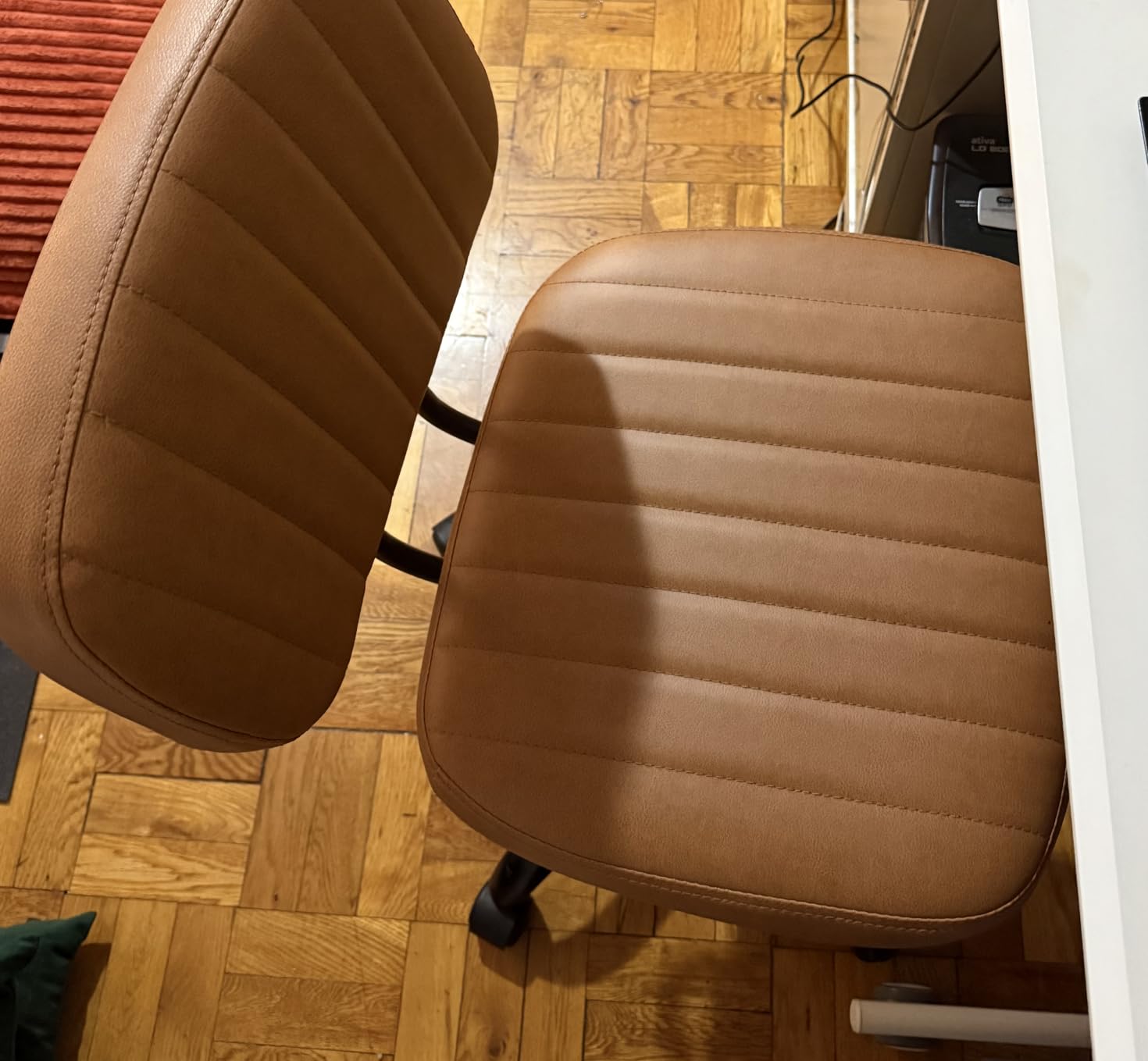
3. Brick Attic Flip-Up Arm PU Leather Chair – Best When You Want Armrests
- Only chair here with arms that fold completely under the desk
- PU leather wipes clean and resists stains
- 275 lb capacity is above most of the set
- 360 degree swivel with rocking tilt
- Level 3 certified gas lift
- Only 3.94 inches of total height travel
- 19.3 inch seat depth is the deepest on the list
- Armrests are not independently adjustable
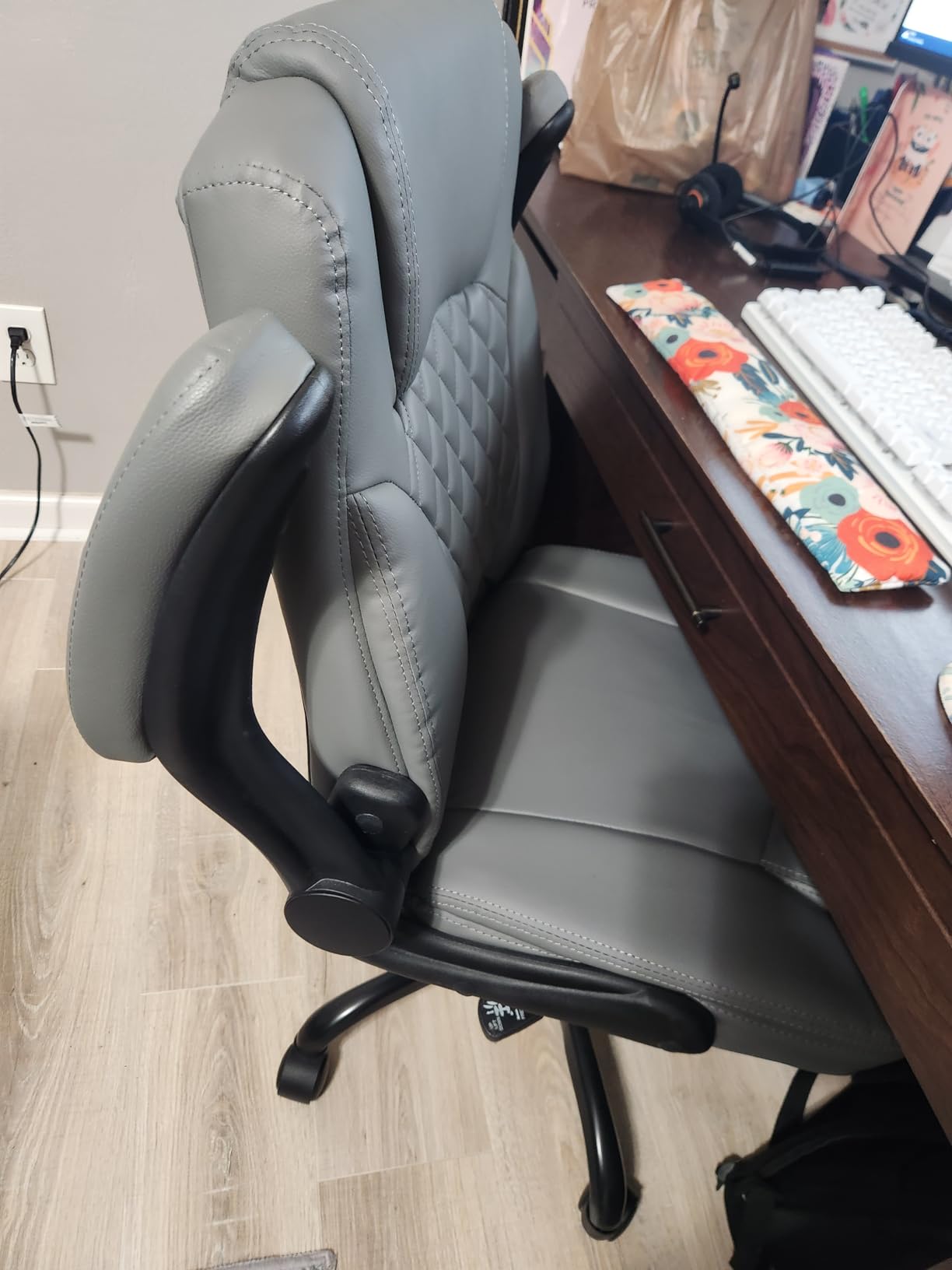
Almost every small chair problem around armrests comes down to one thing: the arms are there and you cannot move them. The Brick Attic’s arms pivot up 90 degrees and slide under the desktop, so you get forearm support when you want it and a clear approach to the desk when you do not.
That makes it the only pick in this roundup that works for a short user who still wants both. If you are short through the torso but average in the arms, you get support without the chair shoving you sideways. The trade-off is the total height travel, which is listed at 3.94 inches across the whole adjustment range, the narrowest span in the set.
Capacity is 275 lbs, which beats every other chair here except the DUMOS in pick six. The gas lift is Level 3 certified, and the base carries heavy duty rubber wheels that reviewers describe as quiet on hard floors. The rocker function is there for shifting position during long stretches.
Upholstery is PU leather over high density sponge, and it is waterproof and stain resistant. That matters in a home office where a drink is one elbow away from the seat. It is also easy to wipe, which no mesh back on this list can promise.
Check these two numbers before ordering
Seat depth is 19.3 inches, the deepest measurement in the roundup. If your thigh length from the base of the buttock to the back of the knee is under about 17 inches, that depth will press behind your knees. Sit down and check before you commit, because a deep seat is the one flaw that shows up as numbness rather than as discomfort.
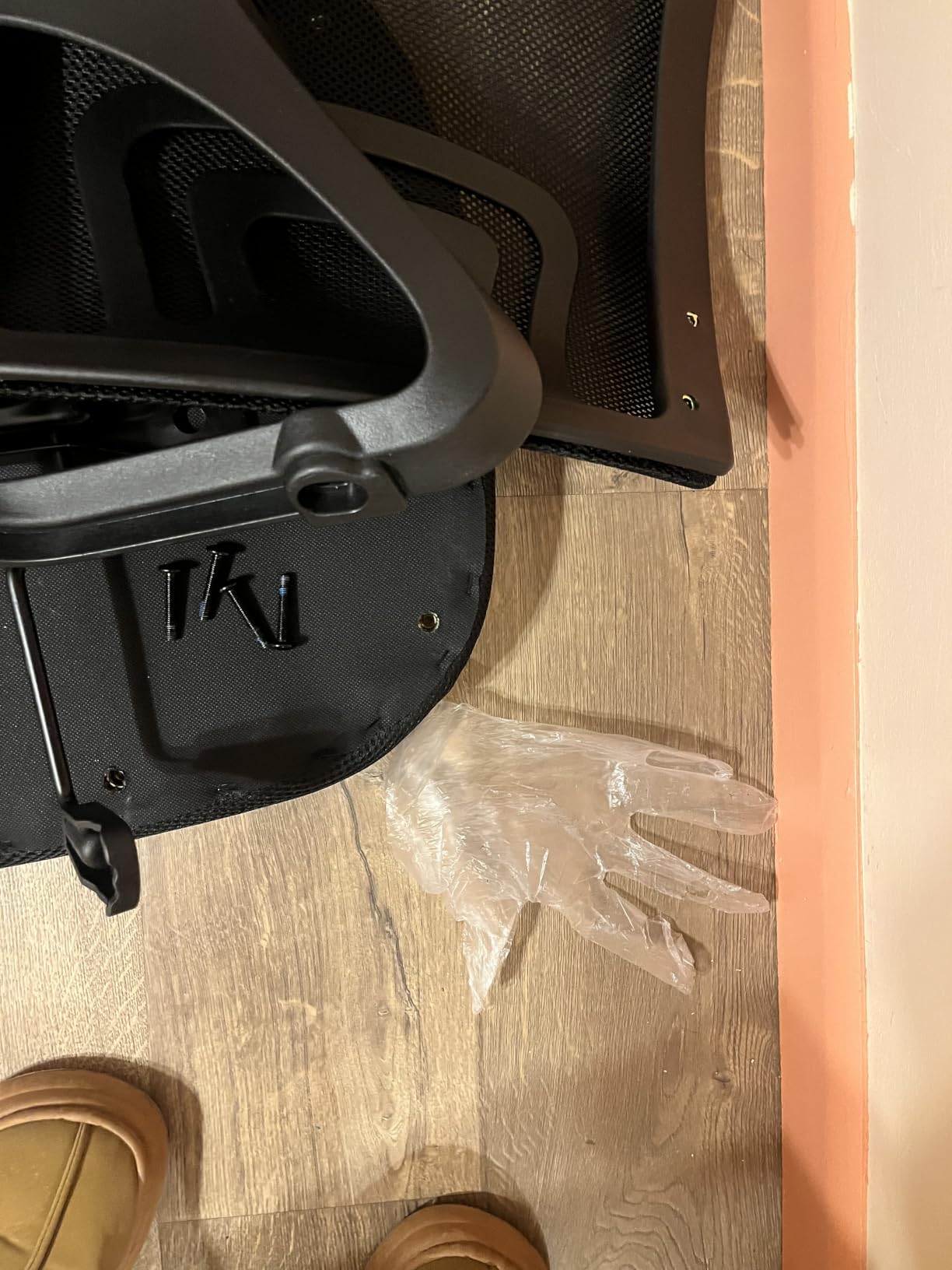
Overall dimensions are 19.3 by 23.6 by 41.7 inches and the chair weighs 26 lbs, the heaviest in the set. Plan the assembly as a two-stage job, because reviewers specifically call the back assembly heavy and awkward to align alone.
The backrest interior height is listed at 21.3 inches, and reviewers note that it reaches mid-back for people around 5’4″ to 5’5″. For anyone taller, this is a mid-back chair by design, not a mistake.
Where it lets you down
With 3.94 inches of total travel, this chair is not adjustable enough to serve two very different body heights. If you are at the extreme short end, a fixed position may leave you at the top of the range and still hovering. Check whether the listing shows a starting height before you commit to it.
The armrests flip but they do not adjust independently, so their width and angle are fixed. That is fine if your shoulders are close to average and a problem if they are narrow, and it is the one thing to think about if you have read the armrest complaints on forum threads and recognise yourself in them.
Reviewers also mention some difficulty sliding in and out because of the wheel setup, and the PU leather, while easy to clean, is warmer than mesh in a hot room.
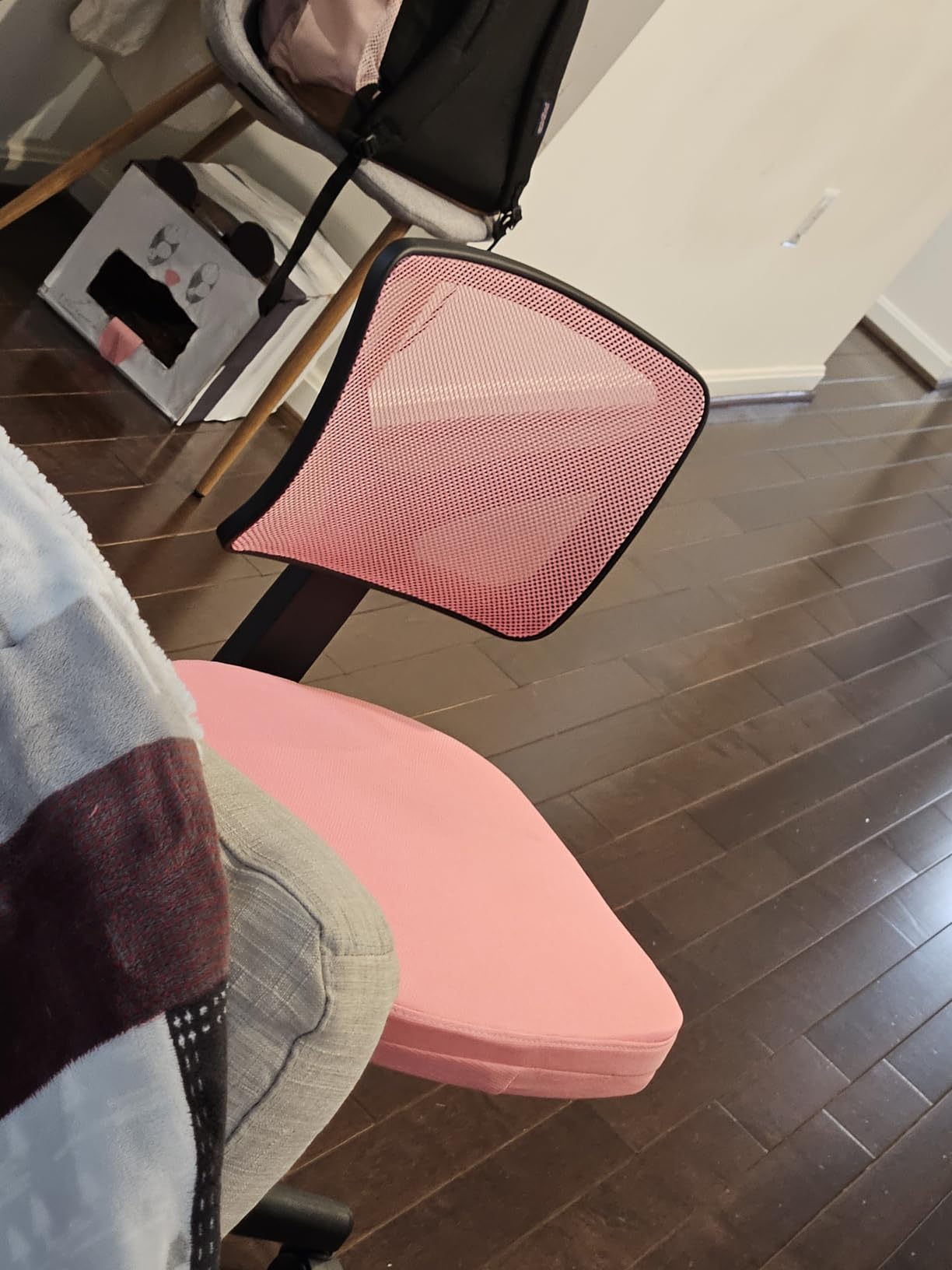
4. Sweetcrispy Small Mesh Chair – Best for the Shortest Users
Sweetcrispy Small Armless Desk Chair, Mesh Rolling Office Chairs
- Lowest published minimum seat height in the set at 15.94 inches
- Mesh back keeps you cool
- BIFMA-certified base tested over 10000 cycles
- Light at 11.9 lbs so it moves easily
- Works for both children and adults
- Thin seat cushion that some owners pad
- Casters do not lock so the chair rolls
- Removable cover can slide out of place
At 15.94 inches, this is the lowest starting seat height published anywhere in this roundup, and it is why the chair lands at position four even though its review count is modest. If your feet dangle on every other chair you have tried, start here and check whether the number works for you.
What makes it unusual is that the listing describes the range as suited to children, teens and adults. Several families use one chair for homework at a low desk and for an adult at a taller desk in the same room. That versatility is a genuine advantage in a home where one adult and one child share a workspace.
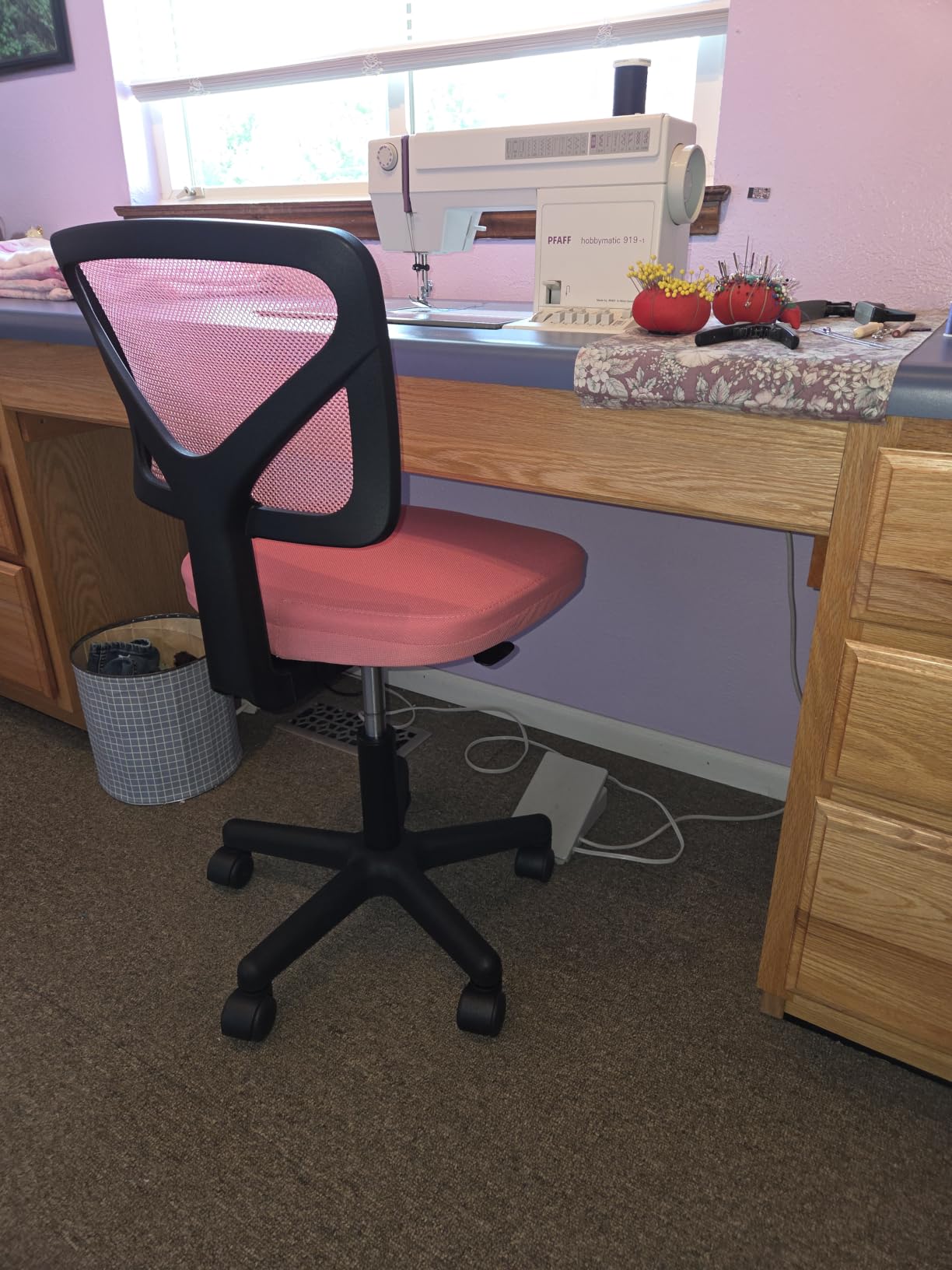
Structure is a Y-shaped mesh backrest matched to the lower back curve, on a BIFMA-certified base tested over 10000 times at 250 lbs. The seat cushion is removable for cleaning, and the base swivels 360 degrees on polyurethane silent casters that work on hard floors and carpet.
At 11.9 lbs, this is one of the two lightest frames in the roundup, which means you can move it between surfaces without asking for help. The overall footprint is 16.34 by 16.54 by 34.25 inches, so it disappears under a small desk.
When this chair is the right answer
It is right when your popliteal height is genuinely below what conventional chairs offer, and no footrest is solving the problem for you. A 15.94 inch floor means an adult around 4’11” can often sit with feet flat, which no footrest replicates exactly because a footrest adds height by pressure rather than by support across the whole foot.
It is also right if you work in a warm room. Mesh back and side panels move air, and the low-back profile means none of the heat is trapped against your shoulders.
One reviewer at 5’3″ found the mesh back and Y-shaped support adequate over normal working hours, which is a useful data point given the frame is designed for much shorter users.
What to watch out for
The seat cushion is thin, and owners who need more comfort add a memory foam pad. Budget for that if you are planning full workdays rather than homework and short task sessions.
The casters do not lock, so the chair can roll away while you are seated, and the removable cover is reported to slide out of position during use. Both are minor, and both are worth knowing about if you work in a shared space with pets or kids nearby.
On a 64742-review chair you get an enormous evidence base. On a 391-review chair, you do not, so treat the comfort claims as thinner evidence than the rest of the roundup and check the return window before committing.
5. DUMOS Small Lumbar Desk Chair – Best Cushion in the Set
- Deepest cushion in the roundup at 2.5 inches
- Higher 4.7 rating from 604 reviews
- U-shaped metal backrest frame gives real lumbar support
- Waterproof PU leather wipes clean
- Tested over 10000 swivel cycles
- Low back height limits upper-back support
- Armless design leaves forearms unsupported
- Faux leather runs warm in hot conditions
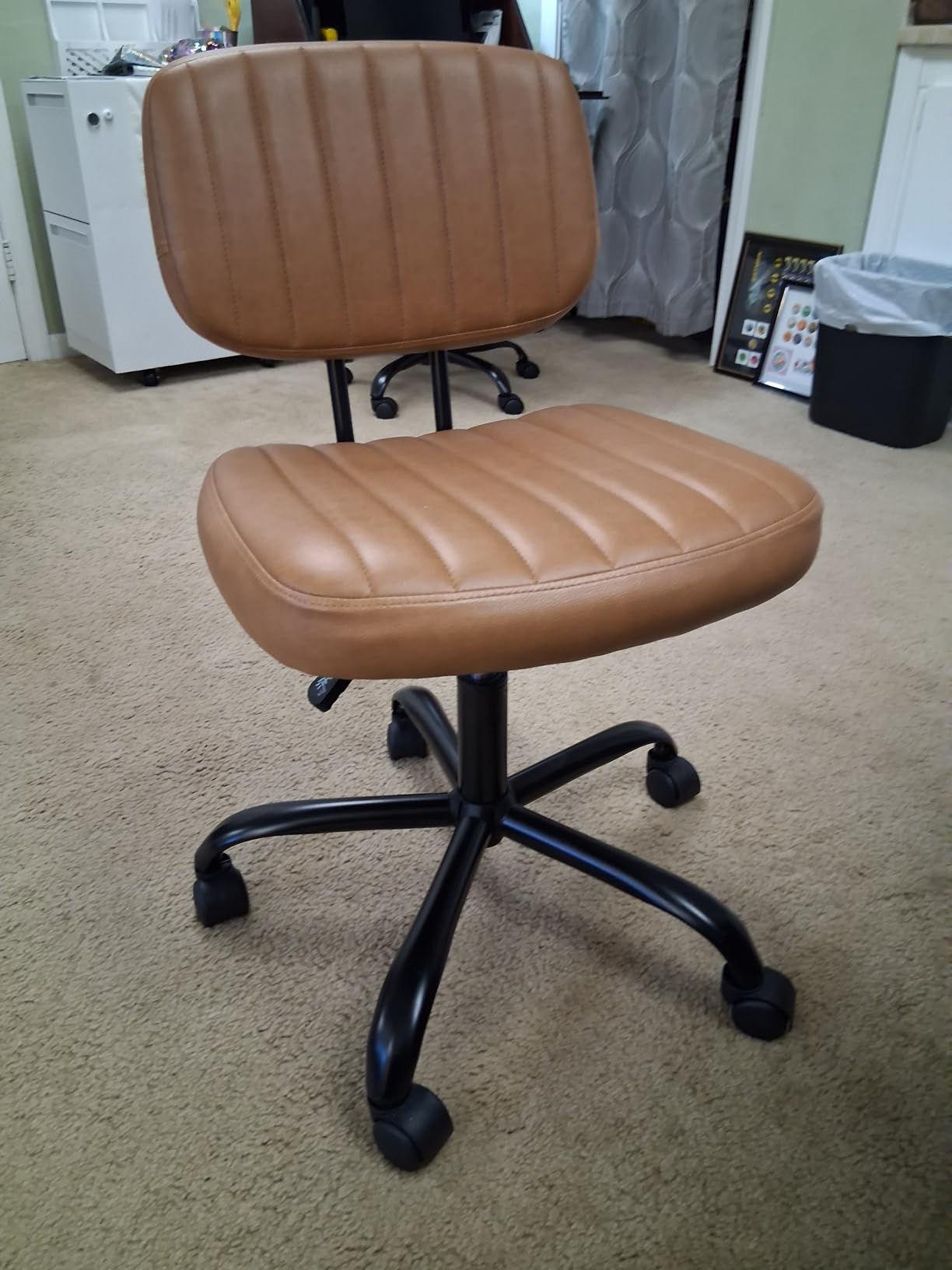
The cushion is the story on this chair. At 2.5 inches of high-density thickened sponge, it is the deepest seat in the roundup, and that is not an accident for a petite user. A shallower cushion sags under a lighter user, and a light user feels every edge of the seat frame within a few months of daily use.
At 4.7 stars from 604 reviews, it carries the highest average rating of any pick here. Reviewers single out the cushion thickness first, then the compact armless footprint and how quickly the six-step assembly goes together.
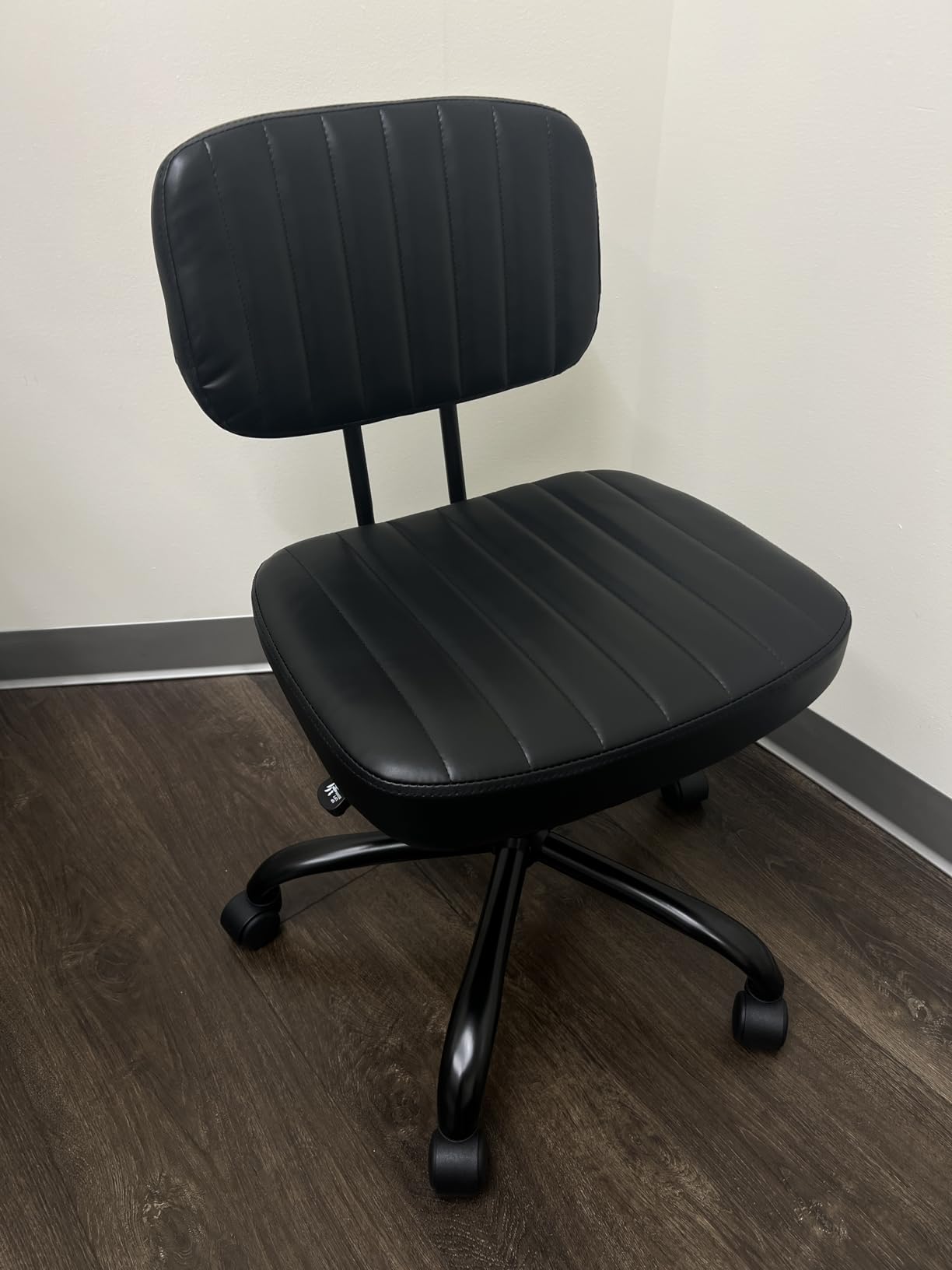
Support comes from a padded foam backrest mounted on a U-shaped metal frame, which is a more stable base for lumbar support than a panel bolted to a plastic back. The base is a 360 degree swivel task base with SGS-certified cylinders, tested over 10000 cycles at 250 lbs.
Upholstery is waterproof PU leather with a twill-weave finish for some airflow, and the listed seat height is 21.45 inches. That number is worth checking against your desk, because a shorter desk will not clear the armless frame at full extension.
What you get with the deeper cushion
A 2.5 inch cushion spreads your weight rather than concentrating it, which matters more for a lighter adult than the cushion specs suggest. Lightweight users tend to feel hard seat edges sooner, and a thin pad does not solve that, it just adds another layer to compress.
The 18.11 inch seat depth sits in the middle of this roundup, longer than the armless mesh chairs and shorter than the Brick Attic. That makes it the safest depth choice if you are between 5’0″ and 5’5″ and are not sure whether you prefer a snug or a roomy seat.
There are no armrests, so the armless low-back frame slides fully under a desk and saves floor space in a small room. Assembly takes about ten minutes across six steps.
Where the design stops
The low back means limited support above the waist. If you tend to lean back when you read, this is not a chair that will meet you halfway.
With no armrests, long typing sessions load the shoulders instead of the forearms. That trade is the same one described for the Sweetcrispy in pick two, and the same fix applies, which is to use the flip-up design instead.
Faux leather holds heat. Reviewers note it feels less breathable than mesh in warm conditions, so if your room runs hot in summer, the mesh options in this roundup are the better seasonal choice.
6. DUMOS Armless Lumbar Swivel Chair – Best for Users Heavier Than 250 lb
DUMOS Armless Office Desk Chair, Small Vanity Chair with Lumbar Support
- Only 300 lb capacity chair in the roundup
- Sturdy for the class with BIFMA certification
- Back height fits around 5 ft 5 in
- Wide seat with extra padding per side
- Rolls smoothly and assembles fast
- Max raised height of about 21 inches can fall short of a desk
- Very mobile on hard floors
- Backrest is supportive but unsculpted
This is the pick for the common case that gets ignored in this category: a short adult who is not a light adult. At 300 lbs, it is the highest-rated capacity of any chair in the roundup, and most of the field stops at 250 or 275 lbs, so a heavier petite user has fewer doors open before they start.
A reviewer at 6’3″ and 220 lbs reports it holds up, and a reviewer at 5’5″ reports the back height lands at the middle of their back, which is roughly where you want it for someone in this height band. The seat is described as wide with about two extra inches of padding per side.
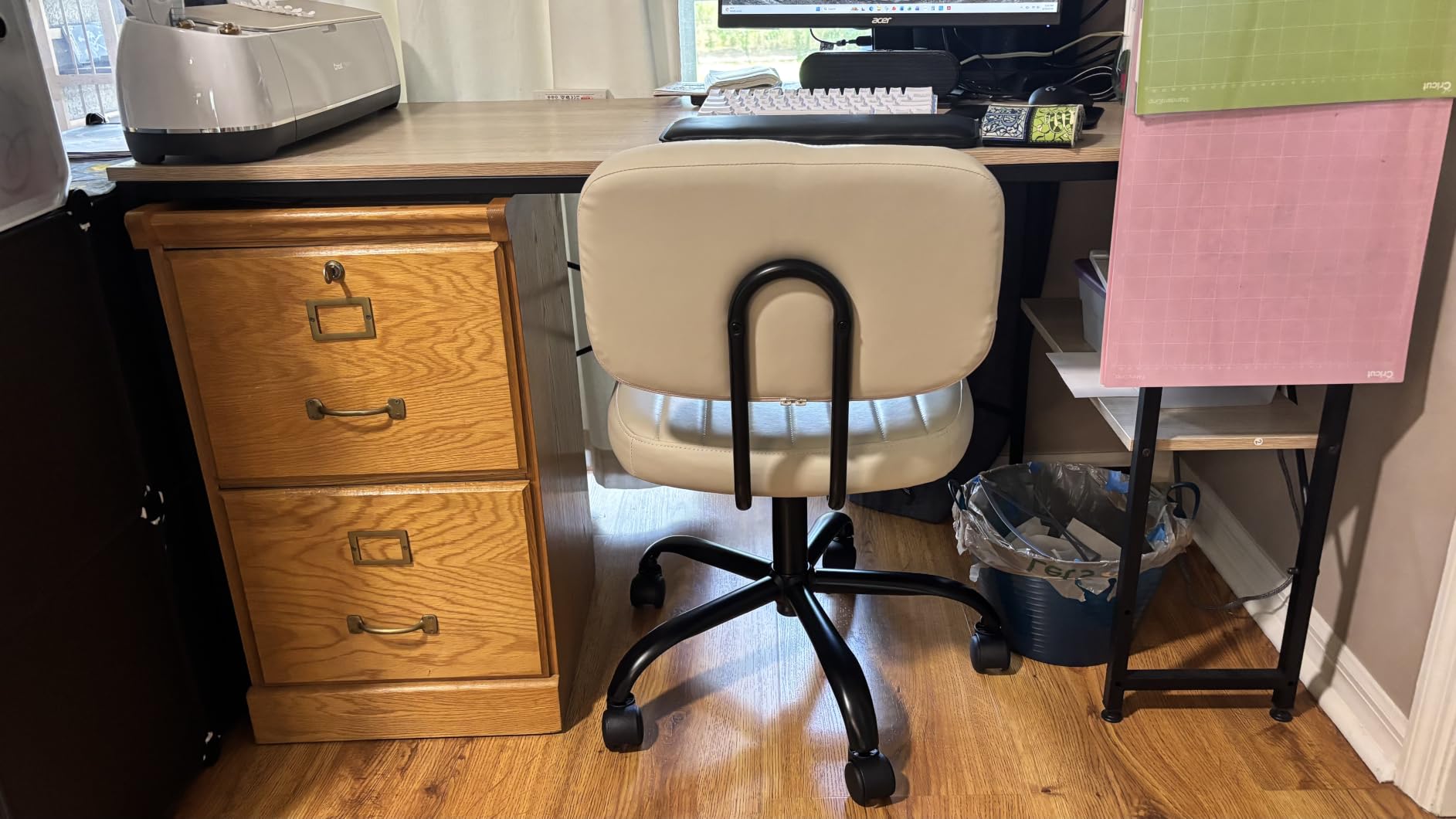
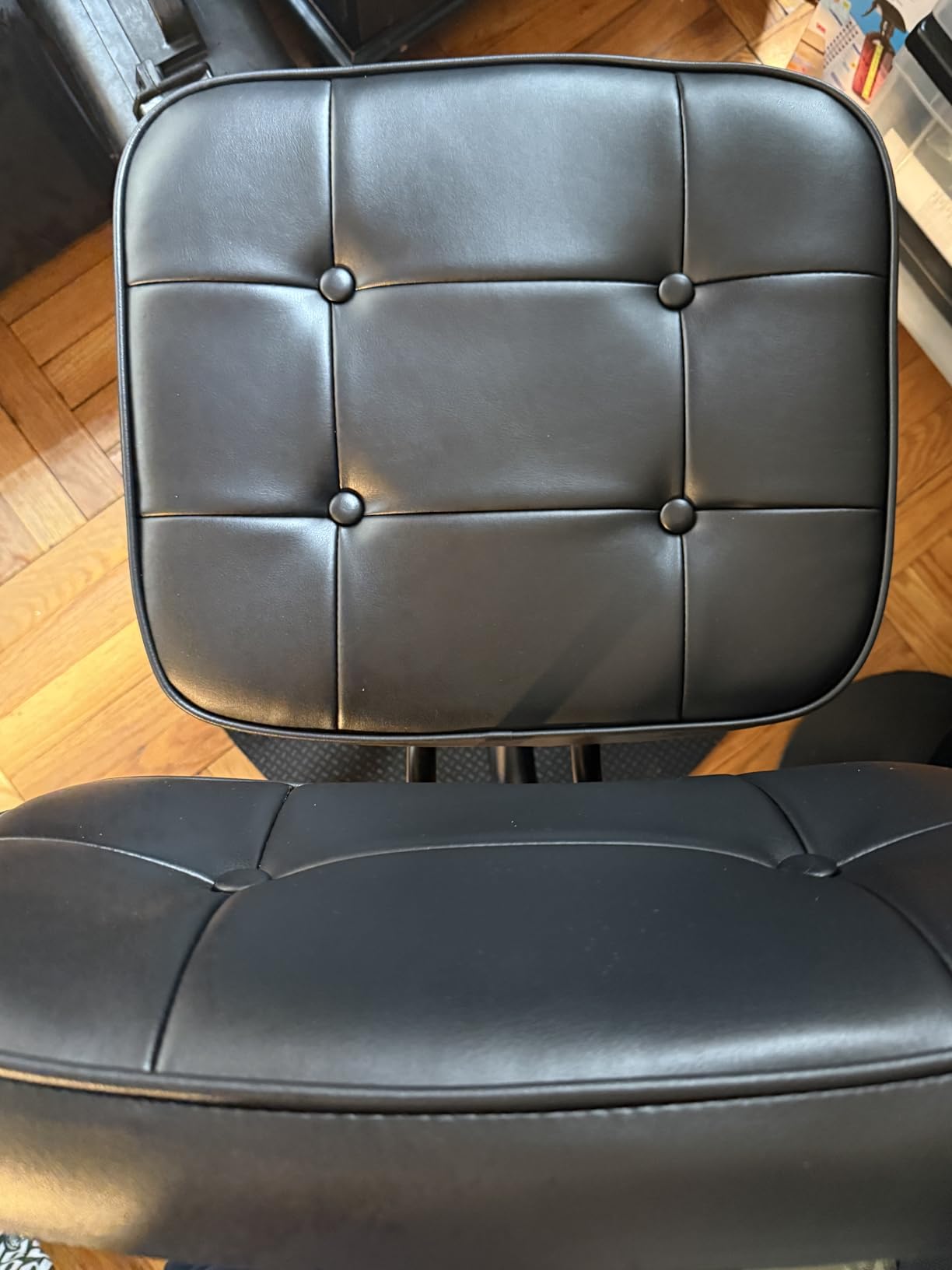
Construction is a metal frame with PU leather in a vertical grain, chosen for air circulation, on a BIFMA-certified base factory tested over 10000 times. Cushions are thick high-density foam on both seat and back, and the lumbar support is a U-shaped system driven by SGS-certified cylinders.
At 17 lbs it is heavier than the mesh chairs and lighter than the Brick Attic, and the 360 degree swivel plus height adjustment take about five to ten minutes of assembly. Wheels roll smoothly on hardwood and luxury vinyl tile.
Why the capacity rating matters here
Most chairs in this roundup are rated to 250 lbs because that is what the class convention dictates for budget models. Going above it requires a stronger base and a higher-rated gas lift, and this chair carries both a BIFMA certification and a stated 300 lb limit, which is why it is a better choice than a chair rated to your exact weight with no certification behind it.
For a short adult, a 300 lb rating also buys stability. A chair loaded near its limit feels planted rather than twitchy, and that matters when your feet are flat on the floor and you are rotating the chair to reach a drawer.
The wide seat also works in your favor, because wider is usually the complaint that goes with narrow shoulders. You are not boxed in here.
Where the design stops
The maximum raised height of about 21 inches is the constraint to check first. A reviewer notes that a shorter desk can sit above the top of the chair’s range, and for an adult around 5’2″ that is unlikely to be a problem, but for a 5’5″ sitter at a fixed 30 inch desk it can be.
It is very mobile on hard floors, so it rolls when you push it and you will need a deliberate stop when you get up. The backrest is supportive but not sculpted, meaning it holds a posture without guiding one.
The compact width means it is not a chair for sitting cross-legged, which is worth flagging for anyone who works in a relaxed posture.
7. Serta Armless Small Mesh Task Chair – Best Warranty and Brand Backing
Serta Armless Small Home Desk Chair with Wheels, Ergonomic Mesh Back Chair
- Only pick with a stated one year limited warranty
- Established brand with a serviceable parts record
- 275 lb capacity above the class norm
- Breathable mesh back is low maintenance
- Available in five colors including pink and cream
- Flat low-profile back gives modest lumbar support
- Two people recommended for assembly
- Higher cost than generic armless chairs
The differentiator here is paper, not foam. Every other chair in this roundup is a generic house brand with no stated warranty, and this one carries a one year limited warranty from an established furniture maker. If your chair fails a gas lift in year two, that is the difference between a support request and starting over.
Mechanically it is a sensible small task chair. Seat depth is 16.5 inches, in the shallow band that suits short thighs, and the back is breathable mesh with a foam-layered faux leather seat and a gently supportive lumbar design. Capacity is 275 lbs, above the 250 lb class standard.
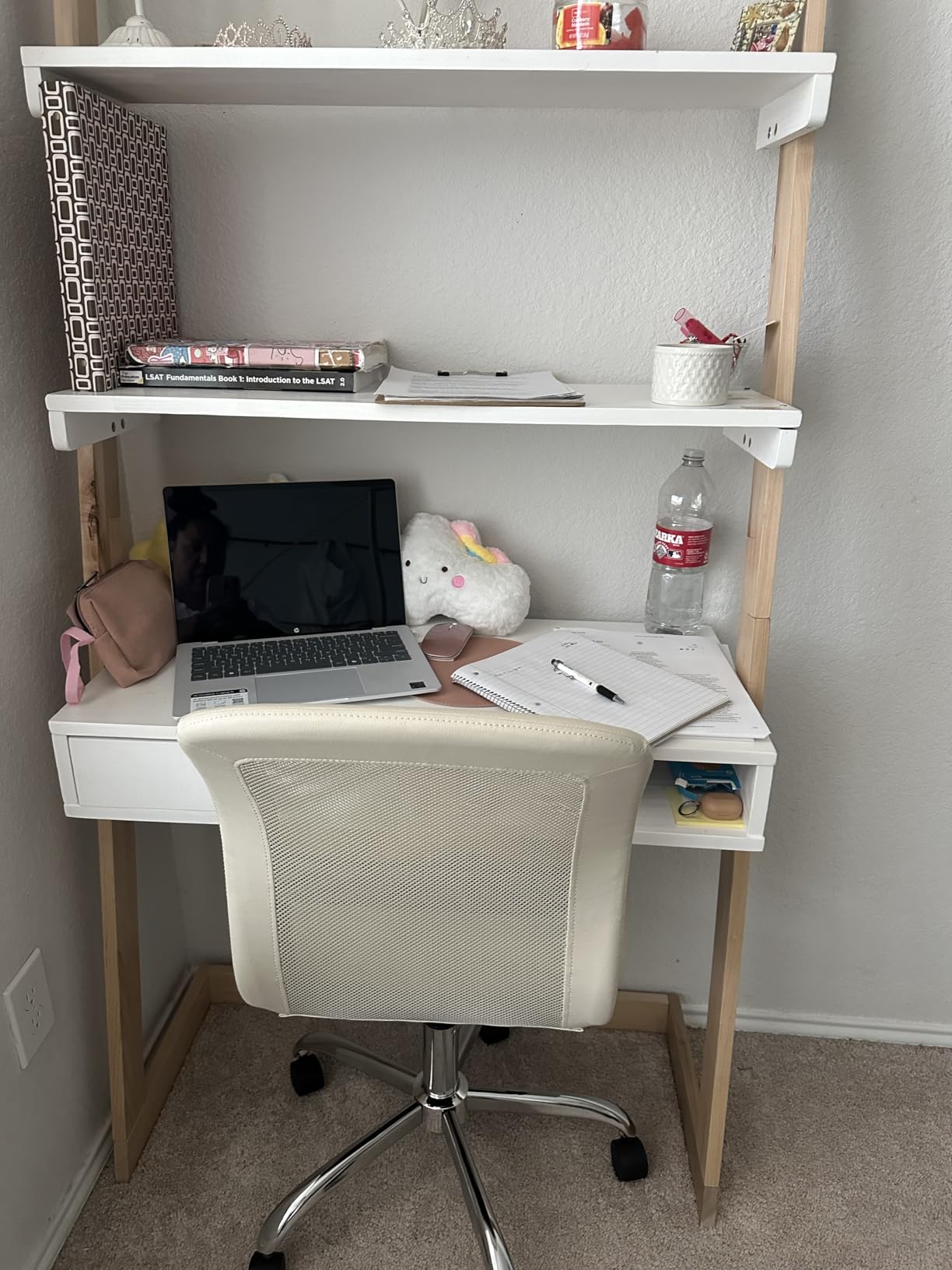
Adjustment is a single accessible height lever, so you can change height without hunting for a paddle under the seat. Dual-wheel swivel casters glide smoothly and the frame is metal. Listed seat height is 21 inches and overall dimensions are 23 by 18.5 by 32.75 inches at 17.6 lbs.
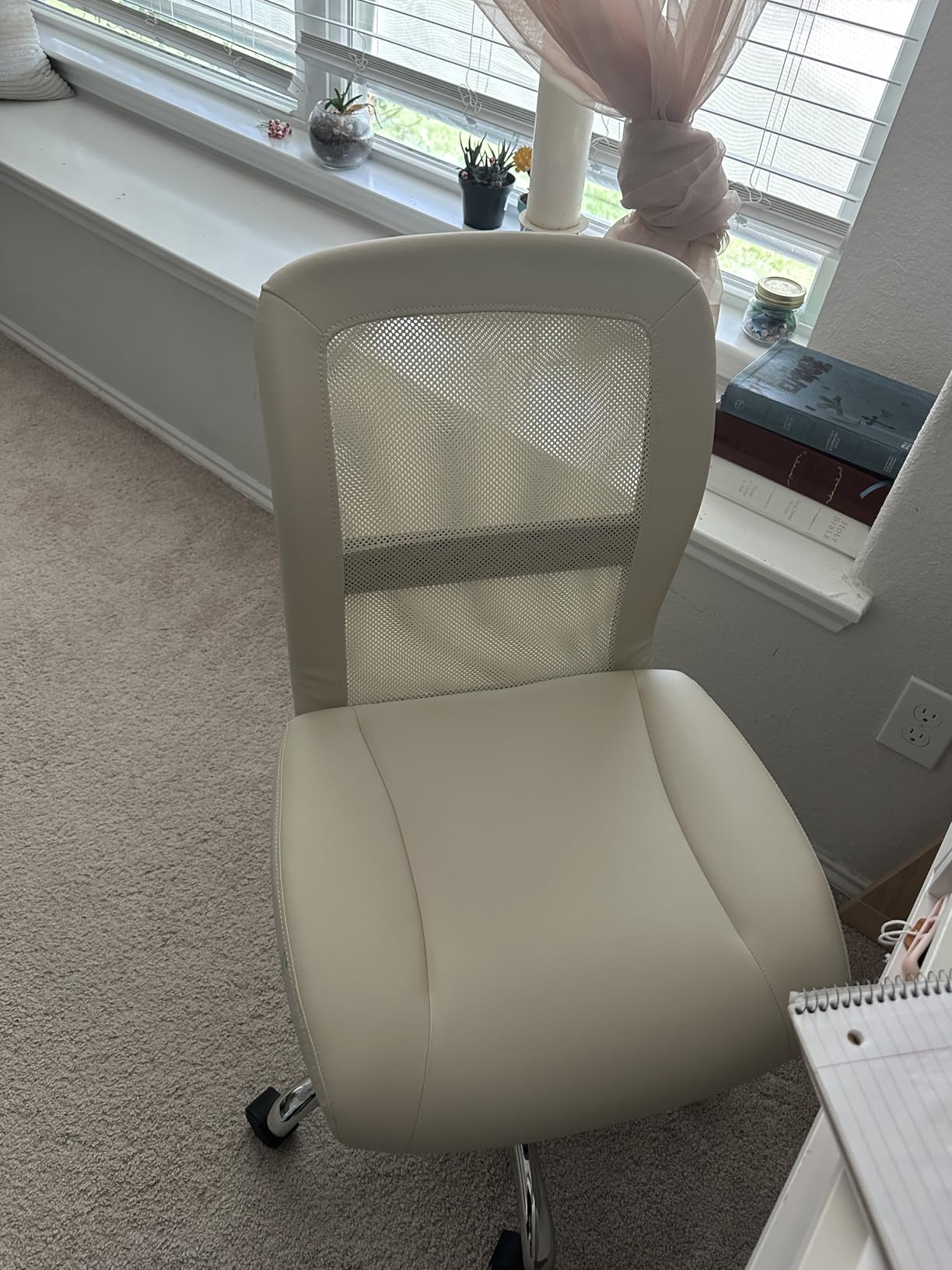
Color choice is a real differentiator in this category. Reviewers mention availability in five colors including pink, cream and blue, which matters if the chair is going to live in a bedroom or a shared study rather than a dedicated office.
How this fits a petite frame
The 16.5 inch seat depth is close to the Sweetcrispy in pick two and leaves minimal gap behind your knees, which is the right call for shorter thighs. If your thighs are long for your height, sit in it first, because a shallow seat has the opposite problem.
Armless means no barrier between you and the desk, and the low profile slides under most standard desks. For a 5’0″ to 5’3″ user at a small desk, that combination is the point of the chair.
The mesh back moves air and needs no cleaning beyond a wipe, and the flat seat cushion is foam-layered rather than the bare board you find on the very cheapest chairs.
What you trade for the warranty
With a back interior height of 17 inches, support stops at the mid-back and there is no headrest. It is a task chair, not a lounging chair, and it will not let you lean back and stretch out.
Assembly is recommended for two people, which is friction at a moment when you may well be working alone at home. Plan fifteen minutes and a second pair of hands.
It also costs more than the generic armless alternatives in this roundup, and in a category where the price spread is wide, that is a real cost for a warranty you may never use. If you want the shallow seat and the armless frame and not the brand, the Sweetcrispy in pick two does the same job.
8. DUMOS Armless Mesh Chair – Best Lightweight Build
DUMOS Armless Small Desk Chairs, Ergonomic Home Office Mesh Chairs
- Two-screw tool-light assembly
- Only 11.9 lbs so it moves between surfaces easily
- Removable cushion cover makes cleaning simple
- Y-shaped backrest supports the lumbar curve
- Several color options
- No published minimum or maximum seat height
- Basic foam cushion expected to wear with constant use
- Backrest fixed with no depth height or tilt adjustment
- Not intended for all-day sitting
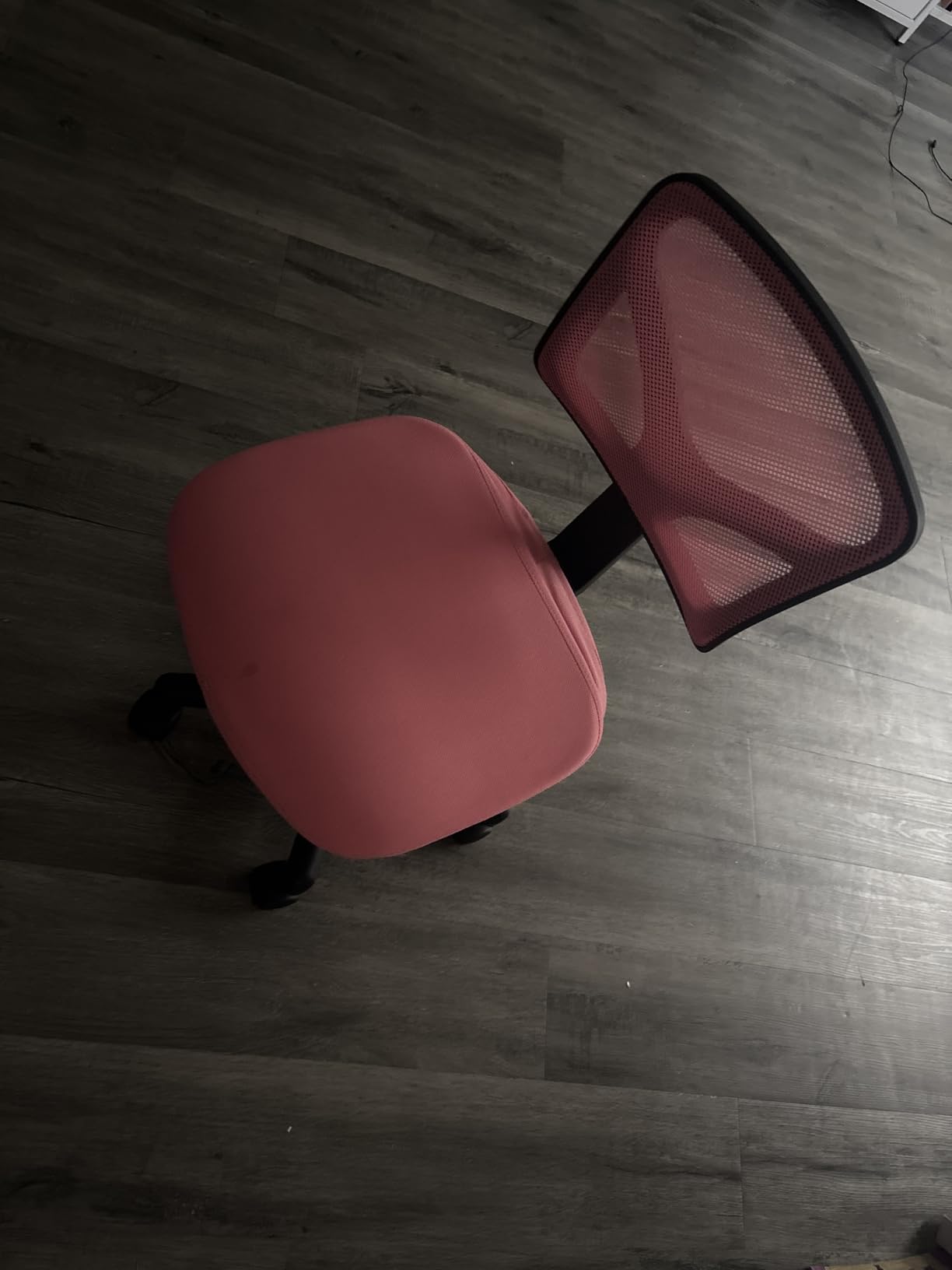
The honest headline on this chair is that it does not publish its seat height range, and that is exactly why it sits at number eight rather than higher. For a petite buyer, an unpublished height is a real gap, because it is the single number that determines whether your feet reach the floor.
What the chair does offer is a 16.33 inch seat depth, matching the Sweetcrispy in pick two, on a frame that weighs 11.9 lbs. That is half the weight of the Brick Attic, and it is the easiest chair in the roundup to move between a desk, a table and a craft corner.
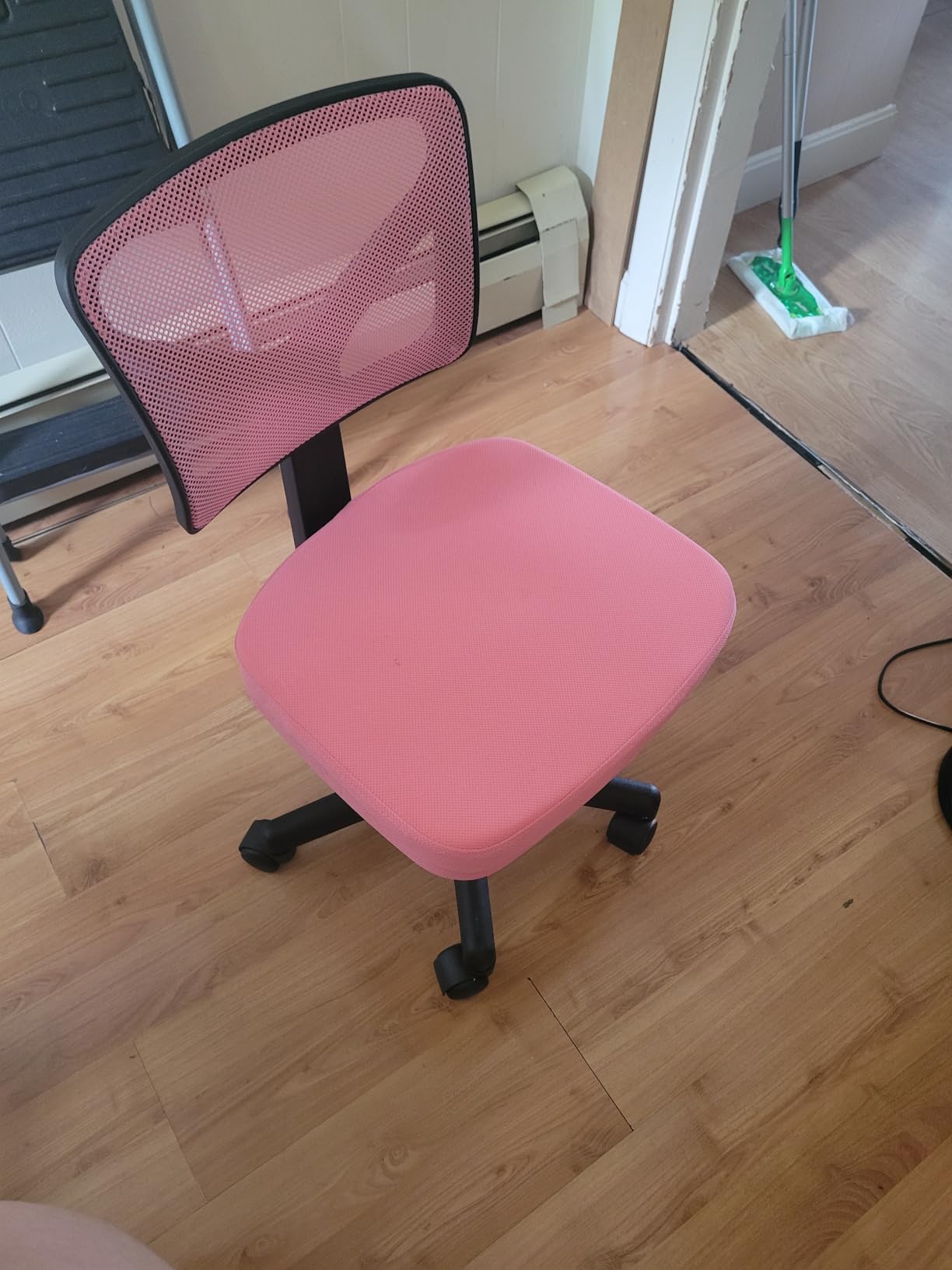
The back is breathable mesh on a Y-shaped frame designed to follow the lumbar spine curve, and the seat cushion has a removable cover so you can clean it rather than replace the chair. The gas lift is rated to 250 lbs and the base is metal with a plastic core, in a small footprint of 16.33 by 16.54 by 34.25 inches.
Owners frequently describe it as a sturdy, lightweight budget chair that is genuinely compact for small desks and hobby spaces, and several rate it as good for occasional rather than constant use because of the basic cushion. Assembly takes two screws, which is faster than anything else in this roundup.
Why it is still worth considering
If you work a few hours a day rather than a full shift, the all-day comfort ceiling matters much less. A basic foam cushion on a well-sized seat frame is genuinely fine for a couple of focused hours, and the alternative in this category is often a chair that does not fit at all.
The armless silhouette avoids bumping desks and cabinets in tight spaces, which is a real constraint in a small apartment office. Nothing to catch on a keyboard tray, nothing to hit on the way past.
The removable cushion cover is understated and useful. Spills happen, and a cover you can lift off and wash is worth more over a year than a slightly plush foam.
Where it falls down
The missing height range is the main issue. Ask for it before you buy, or measure the chair against your own popliteal height in person if you can. A 250 lb gas lift is standard, and gas lift ranges vary widely, so do not assume.
The backrest is fixed, with no adjustment for depth, height or tilt, so whatever posture you set up is the posture you keep. The cushion is basic foam that reviewers expect to wear with constant daily use.
One reviewer reported a faulty gas lift on arrival and a repeated wrong-part fulfillment issue, so inspect the chair on delivery and check the return window. Casters are also not described as free-rolling, which can make the chair feel sticky in small movements.
9. OLIXIS Armless Mesh Chair with Washable Cover – Best for Spills
- Fully removable machine-washable seat cover
- Only 11.9 lbs and compact for small desks
- Breathable mesh back for warm rooms
- Pneumatic lever gives instant height change
- BIFMA-tested base with five quiet casters
- No published seat height range
- Low-back design gives limited upper-back support
- No armrests for forearm support
- May feel narrow for larger users
This is the OLIXIS armless mesh chair, and the reason to pick it over the DUMOS in the previous slot is one feature: a fully removable, machine-washable seat cover. If you eat at your desk, share a chair with a child, or work somewhere spills are likely, that is worth more than a nicer foam.
Otherwise the two are close cousins. Both weigh 11.9 lbs, both have a 16.3 inch seat depth, both use a Y-shaped mesh backrest matched to the lower back curve, and both rate to 250 lbs. The OLIXIS publishes a BIFMA-tested reinforced base with five 360 degree quiet casters, and reviewers mention they glide on hardwood, tile and carpet without scratching.
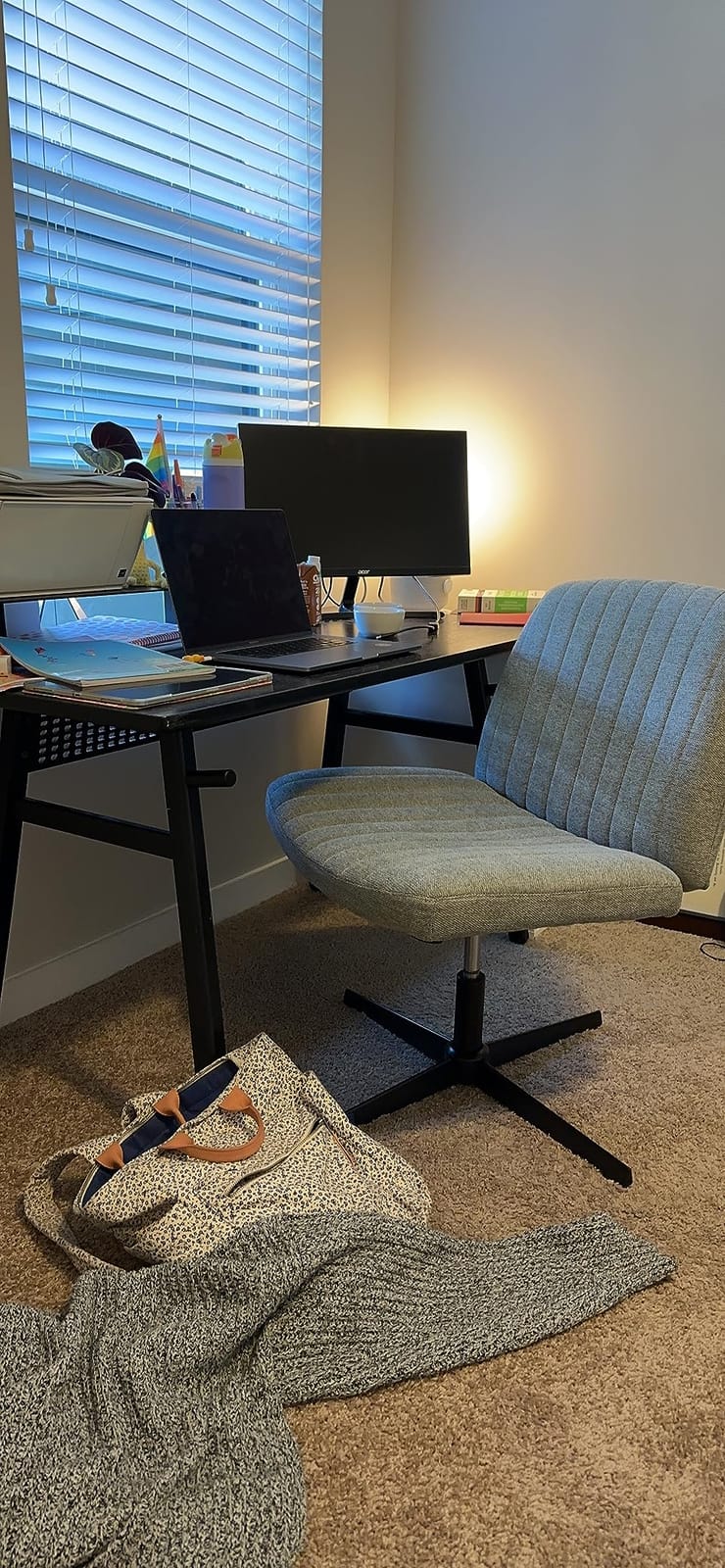
Height adjustment is a pneumatic lever for instant change, which matters when you are moving between two desks of different heights in the same room. Overall dimensions are 16.34 by 16.54 by 34.25 inches, and assembly is a five-part build taking ten to fifteen minutes with included hardware.
Reviewers describe the feature set as designed around small desks, dorm rooms and home offices rather than long all-day ergonomic support. That framing is fair, and it is the honest way to think about this chair and the two mesh armless chairs like it.
Where the washable cover earns its place
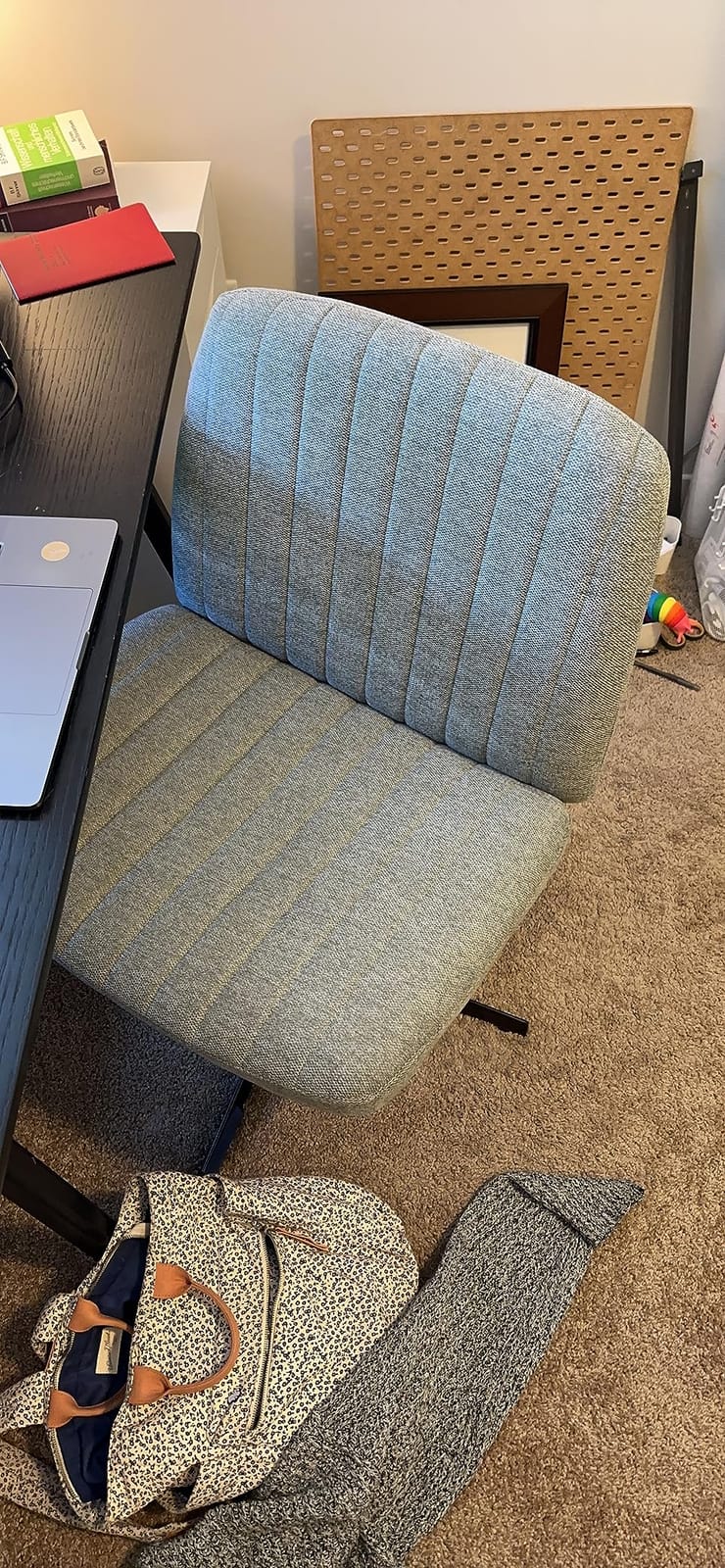
Machine-washable is the whole argument. A fixed upholstered seat that stains becomes a chair you dislike permanently, whereas a cover you can lift off and wash means the same chair still works in a year. In a shared family workspace that is a functional difference, not a luxury.
The armless silhouette also tucks under a standard desk and frees floor space, which is why this style of chair keeps showing up for petite users. Nothing about the frame is positioned for a taller sitter, so nothing gets in your way.
Mesh back and foam seat make it a reasonable warm-weather choice, since nothing traps heat against your upper back.
Where it falls short
Like the DUMOS at position eight, no seat height range is published. That is the single most important number for a petite buyer and it is missing, so confirm it before committing or check the return window carefully.
With 585 reviews, this is the second thinnest evidence base in the roundup. The rating is solid at 4.3, but the level of detail available on long-term comfort is lower than the 64742-review chair, and you should weigh that.
The low back gives limited upper-back support, there are no armrests for forearm support, and the slim overall dimensions may feel narrow if you are broader than the chair’s compact footprint. For full-time work, move up to a pick with more support and a bigger review base.
How to Measure Yourself and Pick a Chair That Fits?
Most of the frustration in this category comes from buying a chair on looks and discovering the numbers afterwards. Three measurements, taken with a tape measure in about five minutes, let you self-qualify against any listing on this page, including the five that do not publish their height range.
Step one: measure your popliteal height
Sit in a normal chair, feet flat on the floor, knees at roughly ninety degrees. Measure from the floor straight up to the underside of your knee, at the back of the leg. This is your popliteal height, and it is your target seat height, within about half an inch.
Wear the shoes you actually work in. A person who works in flat shoes and a person who works in boots can be three inches apart on this measurement, and that is three inches of chair height.
Then compare that number against the chair’s lowest setting. If the chair’s minimum is below your popliteal height, you can sit with your feet flat. If it is above, you will hover, and hovering is the single most reported complaint in the forums about this topic. If it is more than an inch or two below your popliteal height, you are low enough to want a footrest as well.
Ergonomic spec guidance for smaller users puts the ideal figure as close to 15.6 inches as possible, with seat width in the 15 to 17 inch band and seat depth at 20 inches or less. Every pick in this roundup sits inside that width and depth guidance; only two publish a floor as low as 15.6 to 17.1 inches.
Step two: measure your thigh length
Sit down and measure from the base of your buttock, where you meet the seat, forward along the top of your thigh to the back of your knee. That number is your maximum usable seat depth, and you want two to three inches of seat left over for clearance behind the knees.
If your measured thigh length is 16 inches, a 19.3 inch seat like the Brick Attic in pick three presses behind your knees and that pressure becomes numbness within a long session. If it is 18 inches, that same depth is right, and the 16.33 inch seats in this roundup will feel slightly short but still usable.
This is also the measurement that separates short legs from a short torso, and the distinction changes the recommendation. Short legs means low seat height and possibly a footrest, and the seat depth that matters is your thigh length. A short torso with normal legs needs a different fix entirely, which is backrest height and lumbar placement, because you will be sitting further back relative to your leg length than a longer-torsoed person of the same height.
Step three: check your desk height against the chair
Measure your desk from the floor to the underside of the desktop. Most home desks are 29 to 30 inches. Then check the chair’s maximum seat height, because a chair that tops out below your desk forces you to work with your shoulders raised, which undoes the benefit of a well-fitting chair.
The DUMOS in pick six is the clearest example in this roundup. Reviewers note that its maximum raised height of about 21 inches can fall short of a standard desk. For someone around 5’2″ that is unlikely to matter, and for a 5’5″ sitter at a fixed desk it does.
If you work at a sit-stand desk, do the arithmetic twice, at sitting and at standing. A chair that fits your sitting height may be far too low once the desk is raised, and a 5’4″ user shopping both at once should check the lowest and highest positions before ordering either. People shopping a chair and a desk together on forums describe this coupling as the most frustrating part of the process.
Match your height to a chair range
Under 5’0″: prioritize the lowest published minimum seat height above everything else. That is the Sweetcrispy small mesh chair at 15.94 inches, followed by the BestOffice at 17.1 inches. Plan on a footrest for the hours when even that leaves you short.
5’0″ to 5’3″: the shallow-seat armless group is the right band, meaning the 16 to 16.5 inch seat depths in picks two, seven, eight and nine. Aim for a starting height between 16 and 18 inches and a seat depth you can sit fully back into.
5’3″ to 5’6″: the 18 to 18.11 inch seats fit well, which is picks one and five. You can also start considering flip-up armrests if you want forearm support, though check the desktop clearance first since arms add height to the profile.
Over 5’6″ with short legs: you are the hardest case to shop for, because a short-seat chair will feel cramped while a long-seat chair pushes behind your knees. Solve it with an adjustable-depth seat, and if you cannot find one in this category, replace the cushion on a deeper chair rather than buying the wrong size.
Seven things to check before you order
One, the minimum seat height against your popliteal height. If it is not published, ask, and if the seller cannot answer it, pass. Two, the seat depth against your thigh length with two to three inches to spare. Three, armrest width against your shoulder width, since a fixed armrest narrower than your shoulders forces you to hunch inward all day, and that is the complaint raised most often in Canadian and UK forum threads about this topic.
Four, the maximum seat height against your desk height. Five, whether the lumbar support sits low enough for your back, since a support that lands at mid-back for a 5’10” user sits above the curve for a 4’11” user. Six, the weight capacity against your own weight with margin, and prefer a certified base over an uncertified one at the same rating. Seven, the return window, because fit is genuinely hard to predict from a listing, and you want time to sit in the chair at your actual desk before you keep it.
Two more situations worth naming. If you are a 5’5″ user whose chair seat is too shallow rather than too deep, the fix is a replacement seat cushion rather than a different chair, and one forum user solved it exactly that way. And if you are wondering whether a chair made for kids is acceptable for a 5′ adult, the answer is usually yes for a frame, and no for the cushion, because adult foam densities and frames are built for heavier loads over longer sessions.
One last piece of shopping advice: if you end up looking for a second piece of compact equipment for the same workspace, our picks for the best RC cars for adults cover the same small-footprint, easy-to-store thinking that matters in a home office, and our best electric scooters for adults guide covers gear that stores flat between the desk and the wall.
Frequently Asked Questions
What is the best office chair for petite people?
The best office chairs for petite adults pair a low minimum seat height with a shallow seat and minimal armrest interference. Look for a starting seat height near your popliteal height, a seat depth of about 19 inches or less, and either armless sides or armrests that flip up under the desk. In our roundup, the BestOffice mid-back mesh chair starts at 17.1 inches, and the Sweetcrispy small mesh chair starts at 15.94 inches, the lowest floor published in the set.
How high should an office chair be for a 5 foot person?
Your target seat height is your popliteal height, measured from the floor to the back of your knee with your shoes on. Ergonomic guidance for smaller users puts the ideal chair floor as close to 15.6 inches as possible. What matters is that the chair’s lowest setting is at or below that measurement, so your feet sit flat, and that its highest setting still lets your thighs clear the underside of your desk.
Why do my feet dangle on an office chair?
Your feet dangle when the chair’s minimum seat height sits above your popliteal height, which happens on almost every chair built for a 5’10″ reference user. The result is pressure under the thighs, rounded shoulders and a forward lean to compensate. Two fixes exist: choose a chair with a genuinely low floor, several of which start between 15.94 and 17.1 inches, or add a footrest so your feet are supported at a right angle rather than hanging.
Should a short person use a footrest with an office chair?
A footrest helps when the chair still leaves a gap at your lowest setting, and it works best when it supports the whole foot rather than just the heel. It is a good pairing with the chairs in this roundup because it extends the usable height range without replacing the chair. Pick a rigid platform that adjusts for angle rather than a soft cushion, and set it so your knees stay at roughly ninety degrees.
Are smaller office chairs better for short people?
Smaller chairs are better for short people on seat depth and armrest clearance, not on every dimension. A smaller frame usually means a shallower seat, which suits short thighs, and a narrower footprint, which helps at a small desk. The trade-offs are a lower backrest with less upper-back support, lighter weight capacities often rated to 250 lbs, and cushions that wear sooner under daily use.
What is the best ergonomic chair for short people?
The best ergonomic chair for short people is one that adjusts in the right places, which for most shorter adults means seat height first, then seat depth, then armrests. Watch for adjustable lumbar support that can move vertically, a seat that reaches a low floor, and a backrest height that stops around your shoulder blades. If your arms are supported only by fixed rests set for a wider body, you will hunch inward all day, so prefer armless or flip-up designs.
The Best Office Chairs for Petite Adults in 2026
The best office chairs for petite adults are not scaled-down versions of big chairs. They are chairs whose lowest seat height, seat depth and armrest layout were designed for a smaller body, and the nine picks above are the ones where that shows up in the published numbers rather than in the product name.
Start with the BestOffice mid-back mesh chair if you want a conventional chair and can use a 17.1 inch floor. Start with the Sweetcrispy small mesh chair if 15.94 inches is the number you need. Start with the Sweetcrispy armless chair if a 16.33 inch seat depth is what stops the pressure behind your knees, and with the Brick Attic if you need armrests but need them to disappear under the desk.
Before any of those, spend five minutes with a tape measure. Popliteal height, thigh length and desk height turn a guess into a decision, and they are the only three numbers a manufacturer cannot argue with. For the rest of your workspace, our best robot kits for adults guide covers another hobby that rewards a properly sized surface.