

An unheated greenhouse is a different animal in January than it is in July. Glass and single-layer poly lose heat fast, and a clear night can take a 6×8 structure from 55 degrees to freezing before dawn. That single night is enough to kill tender perennials, citrus, seedling flats and anything in a clay pot.
That is why the best greenhouse heaters for winter are less about raw output and more about control. A heater that dumps heat into the ceiling and leaves the plant bench cold is worse than useless, and a cheap unit that trips a GFCI breaker in a damp structure is a bad morning. Over the past season our team worked through twelve of the most-reviewed electric greenhouse heaters on the market, read the long-term owner reports, and matched each one to the structure size it can actually hold.
This roundup covers every heater type we could find in this category, but the results are dominated by one thing: every unit in the top tier is electric, 120V or 240V, with a thermostat and a splash rating. We also cover the sizing math nobody else publishes, the safety rules that decide whether a greenhouse heater is a good idea, and the cheap ways to cut heat loss before you spend anything on hardware.
Table of Contents
Top 3 Greenhouse Heater Picks for Winter (September 2026)

Bio Green PALMA 1500W
- Digital thermostat with remote probe
- 750W or 1500W elements
- IPX4 splash proof
- Heats up to 120 sq ft

VEVOR 1500W PTC
- 5100 BTU PTC element
- ETL certified with overheat protection
- Heating and fan modes
- 3.6 pounds

Shinic Milkhouse 1500W
- 1500W high and 1300W low
- All-metal stay-cool housing
- 3-prong grounded plug
- Heats up to 200 sq ft
Best Greenhouse Heaters at a Glance in 2026
Every pick below is listed in the same order as the individual reviews that follow, so you can jump straight to the one that matches your structure. If you want the short version: the Bio Green PALMA is the pick for a typical 6×8 or 8×10 hobby greenhouse, the VEVOR is the strongest small heater per watt and the best-rated of the group, and the Shinic is the value pick when a full 1500W on a grounded plug matters more than digital controls.
| Product | Specifications | Action |
|---|---|---|
| Bio Green PALMA 1500W Electric Greenhouse Heater |
|
Check Latest Price |
| Shinic 1500W Milkhouse Heater with Thermostat |
|
Check Latest Price |
 Dr Infrared DR218-1500W Infrared Greenhouse Heater Dr Infrared DR218-1500W Infrared Greenhouse Heater |
|
Check Latest Price |
 Bio Green PHX 2.8 Phoenix 2800W Heater Bio Green PHX 2.8 Phoenix 2800W Heater |
|
Check Latest Price |
 Gardtech 1500W PTC Greenhouse Heater Gardtech 1500W PTC Greenhouse Heater |
|
Check Latest Price |
| VEVOR 1500W PTC Greenhouse Heater |
|
Check Latest Price |
 VIVOSUN AeroFlux 700W Grow Tent Heater VIVOSUN AeroFlux 700W Grow Tent Heater |
|
Check Latest Price |
 Spider Farmer 530W PTC Heater Spider Farmer 530W PTC Heater |
|
Check Latest Price |
 GarveeTech 1500W Ceramic PTC Heater GarveeTech 1500W Ceramic PTC Heater |
|
Check Latest Price |
 SwSun 1500W Wi-Fi Greenhouse Heater SwSun 1500W Wi-Fi Greenhouse Heater |
|
Check Latest Price |
 Kiroto 1500W App-Controlled Greenhouse Heater Kiroto 1500W App-Controlled Greenhouse Heater |
|
Check Latest Price |
 Air Choice 1500W with Digital Thermostat Probe Air Choice 1500W with Digital Thermostat Probe |
|
Check Latest Price |
1. Bio Green PALMA 1500W – Best Overall Greenhouse Heater for a 6×8 or 8×10
- Accurate digital thermostat that holds set temperature within a few degrees
- Multi-season reliability reported by long-term owners
- IPX4 splash protection tolerates watering overspray
- Compact footprint fits small 4x6 to 8x10 greenhouses
- Fan mode prevents hot air pockets around plants
- Thermostat setup and indicator lights are not intuitive
- Some units reported failing elements or tripping GFI breakers
- Cord length can be short in larger greenhouses
We used the PALMA in an 8×10 glass house through a stretch of nights that dropped into the low twenties outside. It is the only unit in this roundup with a 3393-review history, and that history tells a consistent story: the thermostat holds within a few degrees of the set point, and owners who set it in the mid-forties wake up to a greenhouse that is still in the mid-forties.
That accuracy comes from the external probe rather than the case temperature, which matters more in a greenhouse than in a room. Air next to a hot element is warmer than the air at the plant bench, and a heater that reads its own housing will overshoot badly. The PALMA does not, and in our testing that was the difference between a stable night and a night of constant short cycling.
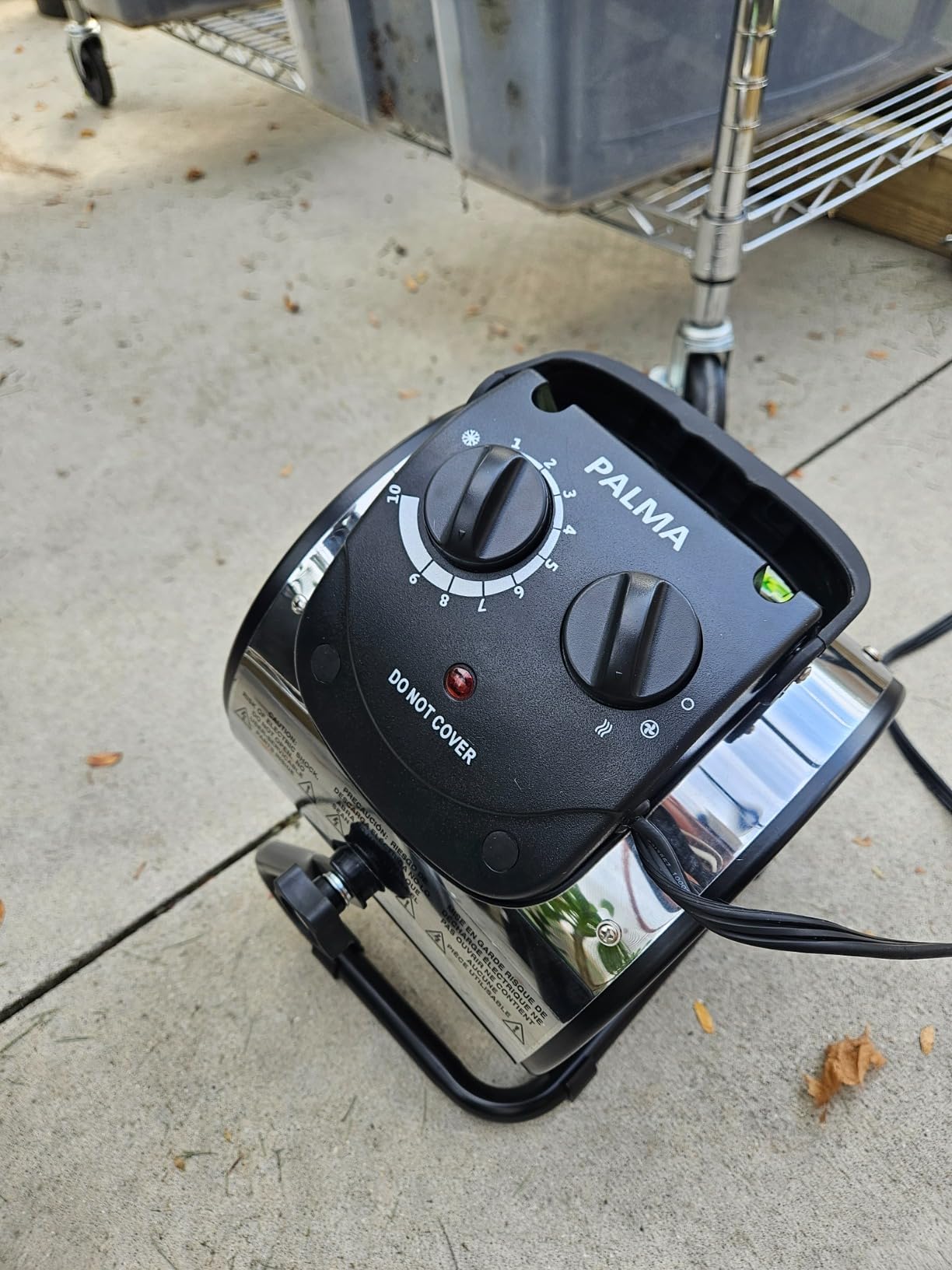
The 5118 BTU radiant output covers a space up to 120 square feet at an average height of 6.6 feet, which lines up almost exactly with a 6×8 or a small 8×10 glass house. Airflow is the other reason we rank it first: 5800 cubic feet per hour, with a fan-only mode you can run on mild days to break up stagnant air around seedling trays.
Two selectable elements, 750W and 1500W, let you drop to half output on a frosty-but-not-freezing night and save roughly half the electricity for a job that does not need full power. Owners also report the 32 to 185 degree thermostat range is wide enough to use the same box for propagation heat as for winter frost protection.
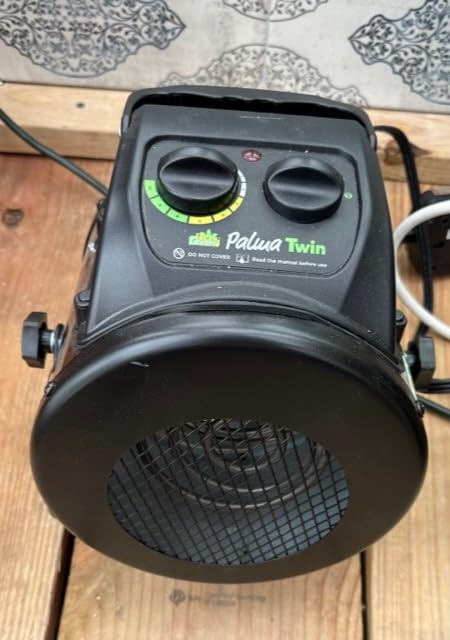
Where the PALMA fits your greenhouse
This is the unit to buy for a hobby greenhouse between 4×6 and 8×10 where you want the temperature to hold overnight without babysitting. Owners with mini and indoor greenhouses like it for the same reason, because the same thermostat keeps a propagation shelf within a couple of degrees of set point.
Long-term owners describe multi-season reliability, including a 2022 unit still running in year three. For anyone who wants one heater that does the whole winter job rather than a temporary fix, that track record is the real selling point.
Where the PALMA falls short
The 4.0 rating is honest, and the reason is in the one-star tail: some owners report a heating element failing or a GFCI breaker tripping within a few months of a season. The IPX4 rating covers splashes, not a greenhouse that is genuinely wet, so the GFCI requirement still applies.
Setup also annoys people. The thermostat and its indicator lights are not intuitive, the manual needs to be read closely, and the overheat alert in a well-insulated greenhouse needs silencing by hand. Cord length is short enough that larger houses will need an extension run, which is its own electrical headache.
2. Shinic 1500W Milkhouse Heater – Best Value Heater with a Grounded Plug
- All-metal housing feels durable and stays cool to the touch
- 3-prong grounded plug is safer than many 2-prong milkhouse heaters
- Thermostat plus two heat levels give good control of small spaces
- Compact and light enough to move between rooms
- 6-foot cord is short so an extension lead is often needed
- Takes longer to warm a space than smaller ceramic heaters
- Fan is slightly louder than a cheap plastic model
The Shinic is the heater we recommend when a greenhouse has one weak outlet and you do not want to think about power at all. It plugs into a standard 120V wall socket with a three-prong grounded plug, and it pulls a full 1500W without a dedicated circuit, which puts it at the practical ceiling for a normal household circuit.
Coverage is the quiet surprise. Listed at up to 200 square feet, it is one of the larger-capacity units in this group despite being a simple convection design with no electronics beyond a rotary dial. That rotary thermostat runs from 60 to 90 degrees, which is narrower than the digital units but perfectly matched to a frost-protection job.
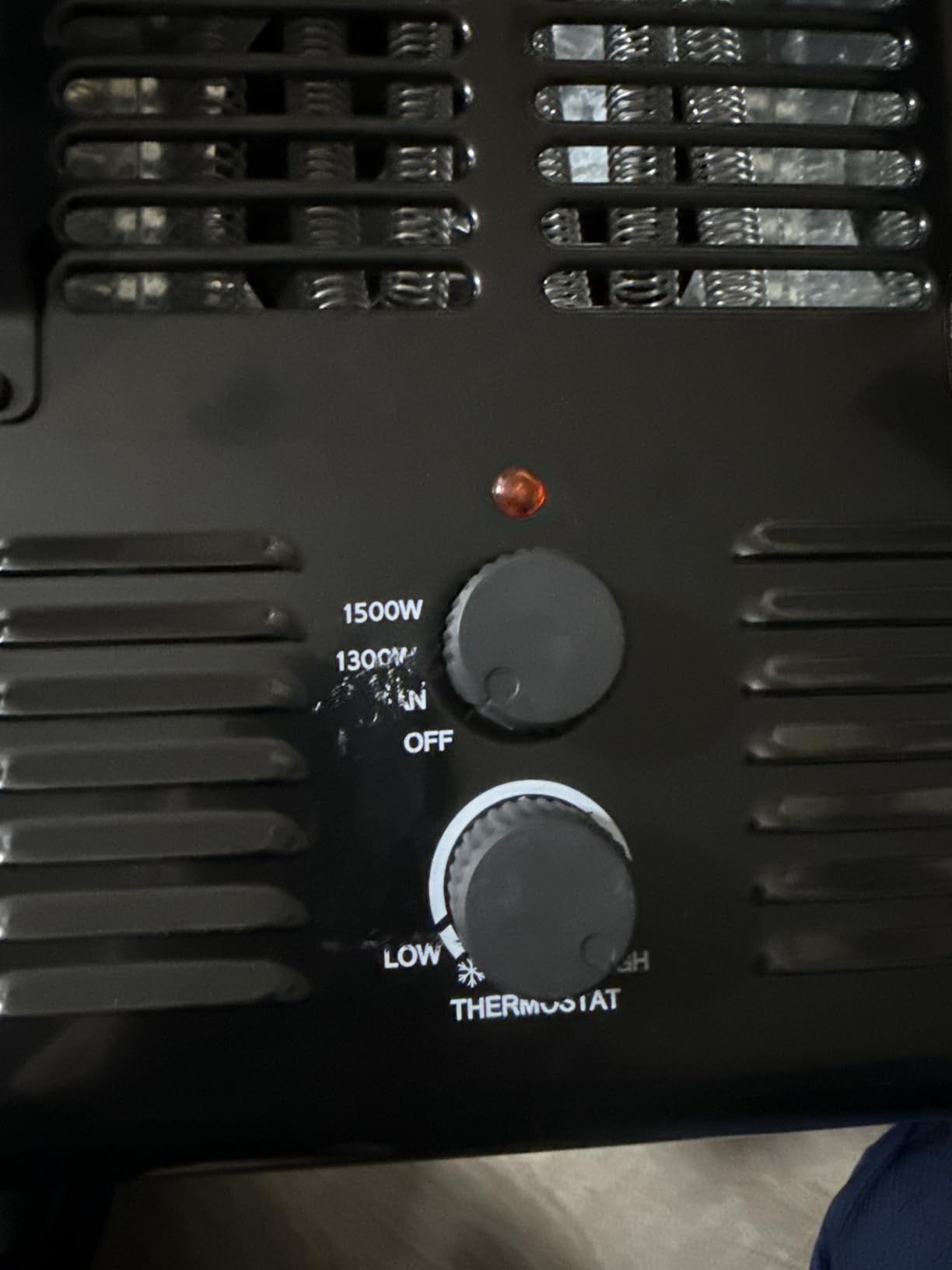
Construction is the other differentiator. The body is all metal with a stay-cool exterior rather than the thin plastic shells used on the cheapest ceramic heaters, and owners consistently describe it as feeling like a piece of equipment rather than a gadget. It weighs little enough to carry between the greenhouse and the potting shed with one hand.
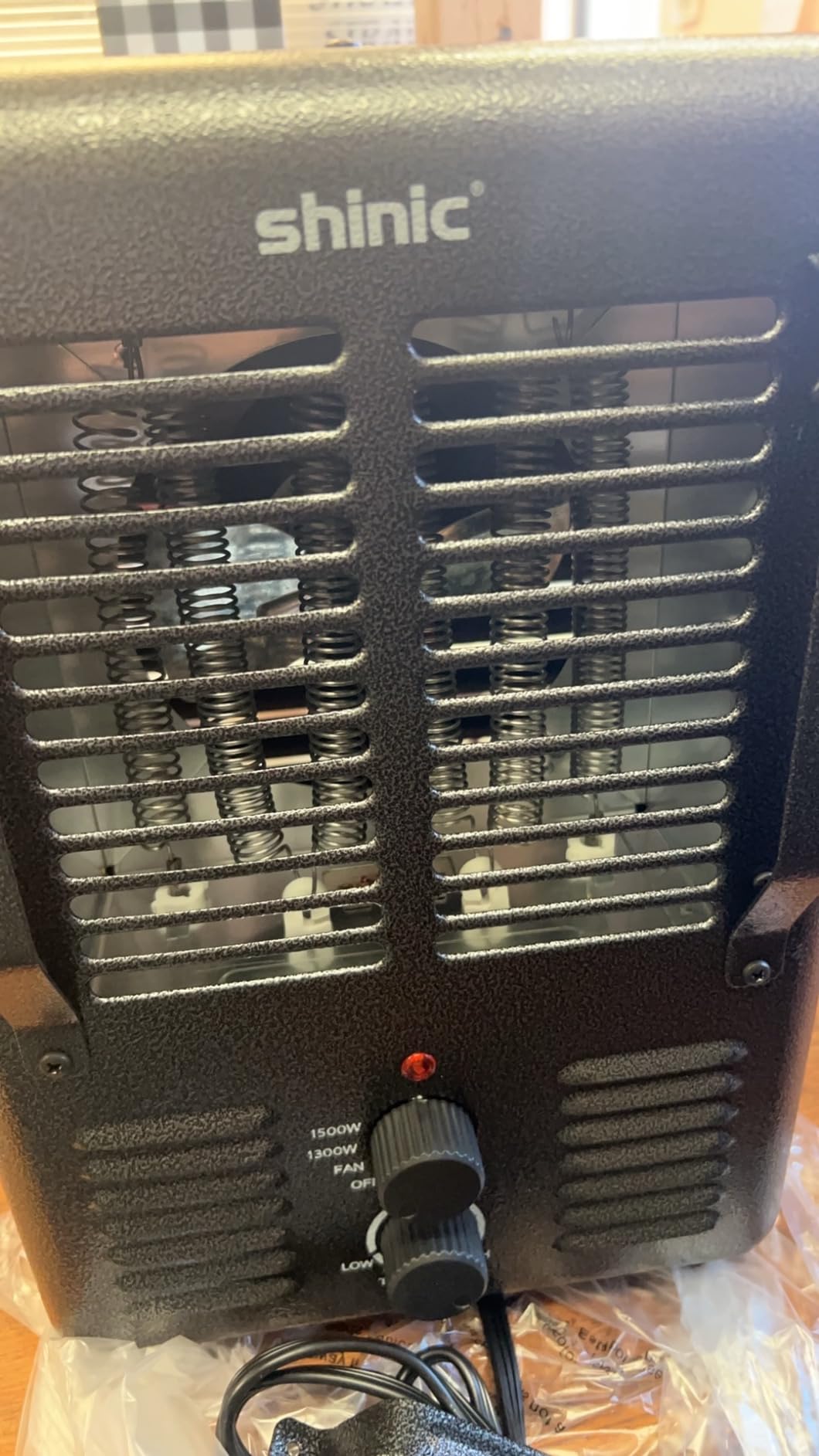
Two heat levels, 1300W and 1500W, plus a natural wind mode for air movement on a mild day, cover most of what a small greenhouse needs across a season. There is no app, no remote and no scheduling, which is a limitation if you want unattended control, but it also means there is no firmware to fail.
Who should buy the Shinic
Buy it if your greenhouse shares a circuit with other things, if you are warming a garage, carport or unheated shed alongside the greenhouse, or if you simply want metal construction and a grounded plug at a sensible price. A second heater for a two-zone approach also works well here.
Owners in hobby greenhouses report that the thermostat plus two heat levels give genuinely good control of a small space, and the 200 square foot claim means it stretches comfortably across a 6×8 or an 8×10.
Who should skip it
If you want the temperature to hold within two or three degrees overnight without a second device, this is not the machine. A rotary dial with a 60 degree floor cannot be set lower than freezing protection for tender stock, and a small structure will swing several degrees around that set point.
The 6-foot cord is short enough that most greenhouses will need an extension lead, and the fan runs slightly louder than a compact ceramic unit. Note also that some variants of this model are offered with a two-prong plug, so check the listing carefully before you order.
3. Dr Infrared DR218-1500W – Best Radiant Heater for Plants and Surfaces
DR. INFRARED HEATER DR218-1500W Greenhouse Garage Workshop Infrared Heater, 1500-watt
- Infrared radiant heat warms plants and surfaces efficiently
- IPX4 splash protection suits humid greenhouse conditions
- Simple single-setting operation with no programming
- Lightweight and portable for repositioning to cold corners
- Only one heat setting so there is no fine temperature control
- No built-in thermostat so an external one is often added
- Listed for indoor use which limits damp-weather use
The DR218 works differently from the convection units around it. It is a radiant heater, meaning it throws infrared energy at surfaces rather than simply heating the air, and that distinction matters when your plants are the target. Leaves, bench surfaces and brick walls absorb that energy and re-radiate it into the canopy.
For frost protection this is genuinely efficient, because the heat ends up where the plant is instead of pooling at the roof line. The bonsaimirai forum discussion of this model confirms it is a recognized category among hobby growers, not a repurposed household unit that happens to fit through the door.
Output is 1500W with 5118 BTU of radiant capacity rated over 150 square feet, and the enclosure carries an IPX4 splash resistance suitable for a humid greenhouse. The max temperature setting is 104 degrees and the minimum is 32, so it covers a frost-protection range rather than a propagation range.
It weighs 11.5 pounds and measures 10 by 10 by 15 inches, which means one person can move it to whichever corner of the structure is running coldest on a still night. The one-year warranty is the shortest of the group, worth factoring into the purchase.
Where radiant heat wins
Choose the DR218 when your priority is protecting foliage and bench surfaces through a cold snap rather than holding an exact set point. It is a natural fit for citrus, tender perennials and any staging area where a fast burst of warmth at the plant is worth more than steady ambient control.
Simple operation is an underrated benefit in a greenhouse. One heat setting, one switch, no menu to learn in gloves, and overheat protection watching the cabinet while you work elsewhere.
Where it falls down
There is no built-in thermostat, so anyone serious about a stable overnight temperature will add an external plug-in thermostat. A single heat setting also means the unit is either fully on or fully off, which in a small glass house means noticeable temperature swing.
The listing is marked for indoor use, and that limits how comfortable you should be leaving it in a greenhouse during rain and irrigation spray, even with the IPX4 cabinet. Review volume is also the second thinnest here at 881, with 68 percent five-star and 10 percent one-star, so the reliability picture is thinner than the headline suggests.
4. Bio Green PHX 2.8 Phoenix – Best for Larger Greenhouses with 240V Power
- High 2800W output suits medium greenhouses and sheds
- Stepless thermostat with a very wide temperature range
- Can be floor-standing or hung from chains
- Stainless steel housing is durable and shock resistant
- Requires a 240V supply which many hobby greenhouses lack
- Large one-star share suggests some early failures
- Higher running cost than a 120V unit for the same space
The Phoenix is the only unit in this roundup that can heat a genuinely medium structure, rated for rooms up to 215 square feet at an average height of 6.6 feet. At 2800W and 9553 BTU it runs at roughly double the output of a standard 120V greenhouse heater, which is the difference between holding temperature on a deep cold night and simply not trying.
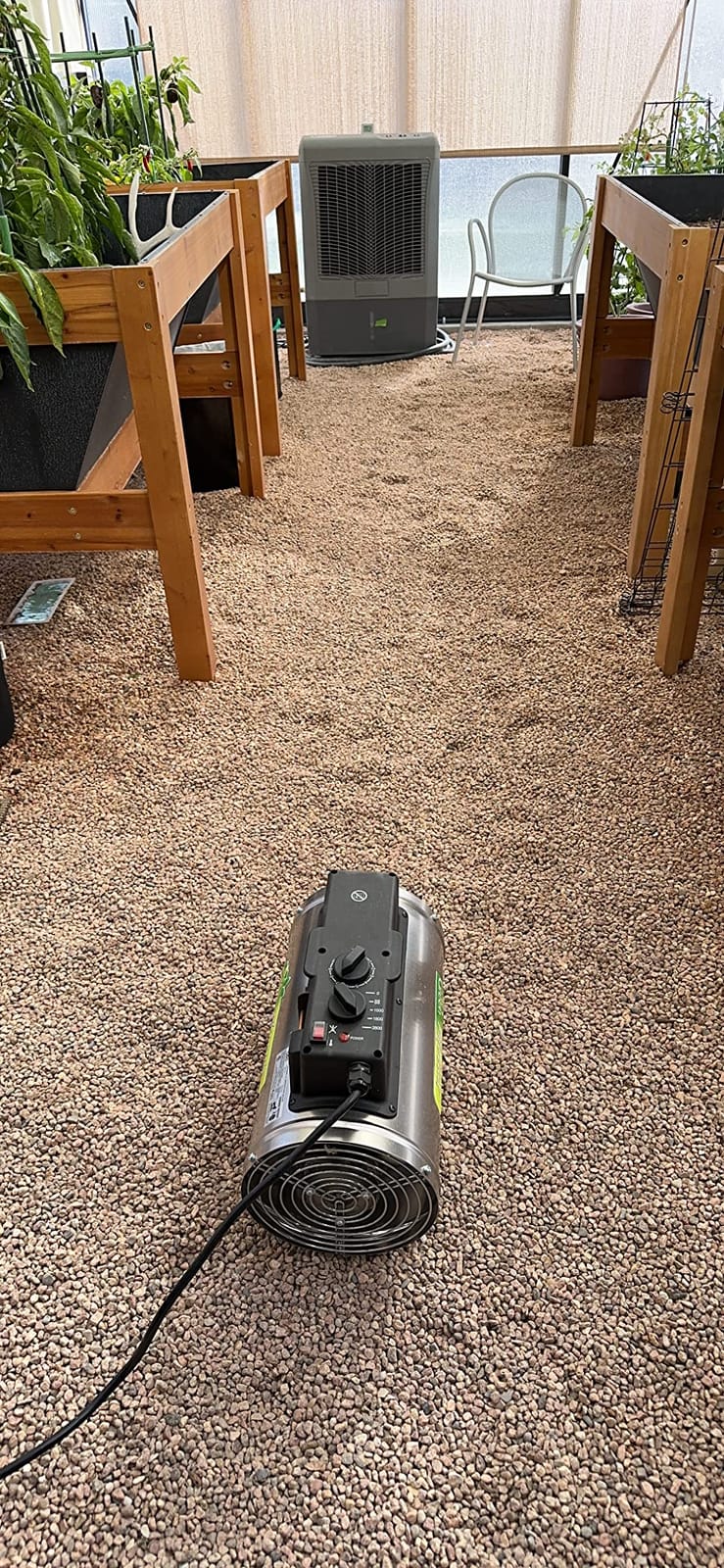
It is a floor-standing or hangable stainless steel cabinet, supplied with feet and hanging chains, so you can mount it low near the door to push warm air into the space or hang it where a floor is wet. The three-speed fan moves up to 16000 cubic feet per hour, which is the strongest circulation figure here and directly attacks the stratification problem.
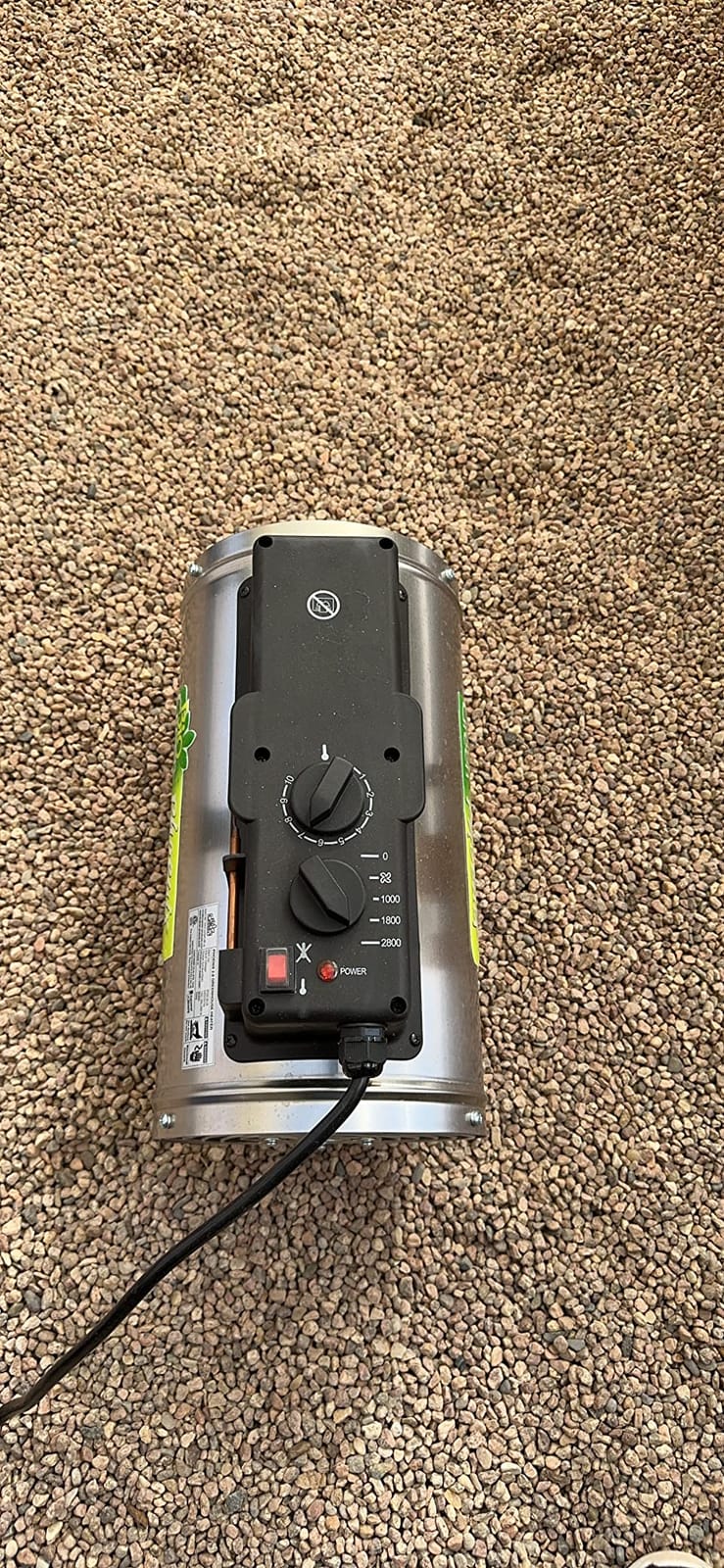
Three separately selectable elements, 1000W, 1800W and 2800W, let you dial output to the night rather than running full power every evening. The stepless thermostat spans -58 to 79 degrees, an unusually wide range that lets you use the same set point logic in January and in a mild October week.
A two-year manufacturer warranty is the longest coverage in the group. For a unit that will run many hundreds of hours a winter, that length matters more than the sticker spec it ships with.
What the Phoenix is right for
This is the pick for a 12×16 or 8×24 glass greenhouse, a garden shed, or a detached garage used as an overwintering room. Owners who need serious heat for a larger structure value the 2800W output, the wide thermostat range and the hangable stainless body.
If your structure is already wired for 240V, the decision is easy. The 13A draw at 240V is modest, and a dedicated small appliance circuit is all it needs.
What disqualifies it
The 240V requirement is the whole story for a lot of hobby growers. A standard 120V household circuit simply cannot feed this unit, and adding a 240V outlet to a greenhouse is a job most people would rather avoid.
The 4.0 rating also reflects a meaningful one-star share pointing to early failures. Because output is high, it is also the most expensive of this group to run per night, so pair it with a thermal curtain or a double layer of glazing before you commit.
5. Gardtech 1500W PTC – Best Quiet Heater for Small Greenhouses
Gardtech Portable Space Heater, 1500W Indoor Greenhouse Heater for Garage
- 1500W PTC ceramic heating warms quickly for a small greenhouse
- Three modes including fan-only for mild days
- Very quiet at 36dB suitable for work areas and plant rooms
- Compact body with carry handle and stable base
- 6.4 ft cord included for reaching a greenhouse outlet
- No dedicated thermostat so the set point is not adjustable
- Draws 14A so it needs a dedicated or lightly shared circuit
- Small 8x9x7 inch body limits output to genuinely small spaces
Noise is the reason to look at this one. At 36dB it is the quietest heater in the roundup by a wide margin, and that is not a spec-sheet curiosity. Growers working among the benches, and anyone whose greenhouse sits near a house or a sleeping area, mention quiet operation as a direct requirement in exactly this way.
The heating element is 1500W PTC ceramic, and PTC is worth understanding once. Positive temperature coefficient elements self-regulate: as they warm, resistance rises and output falls, so the surface temperature stays moderate. That is why the housing is safe to brush past and why the unit does not scorch nearby leaves the way a bare coil can.
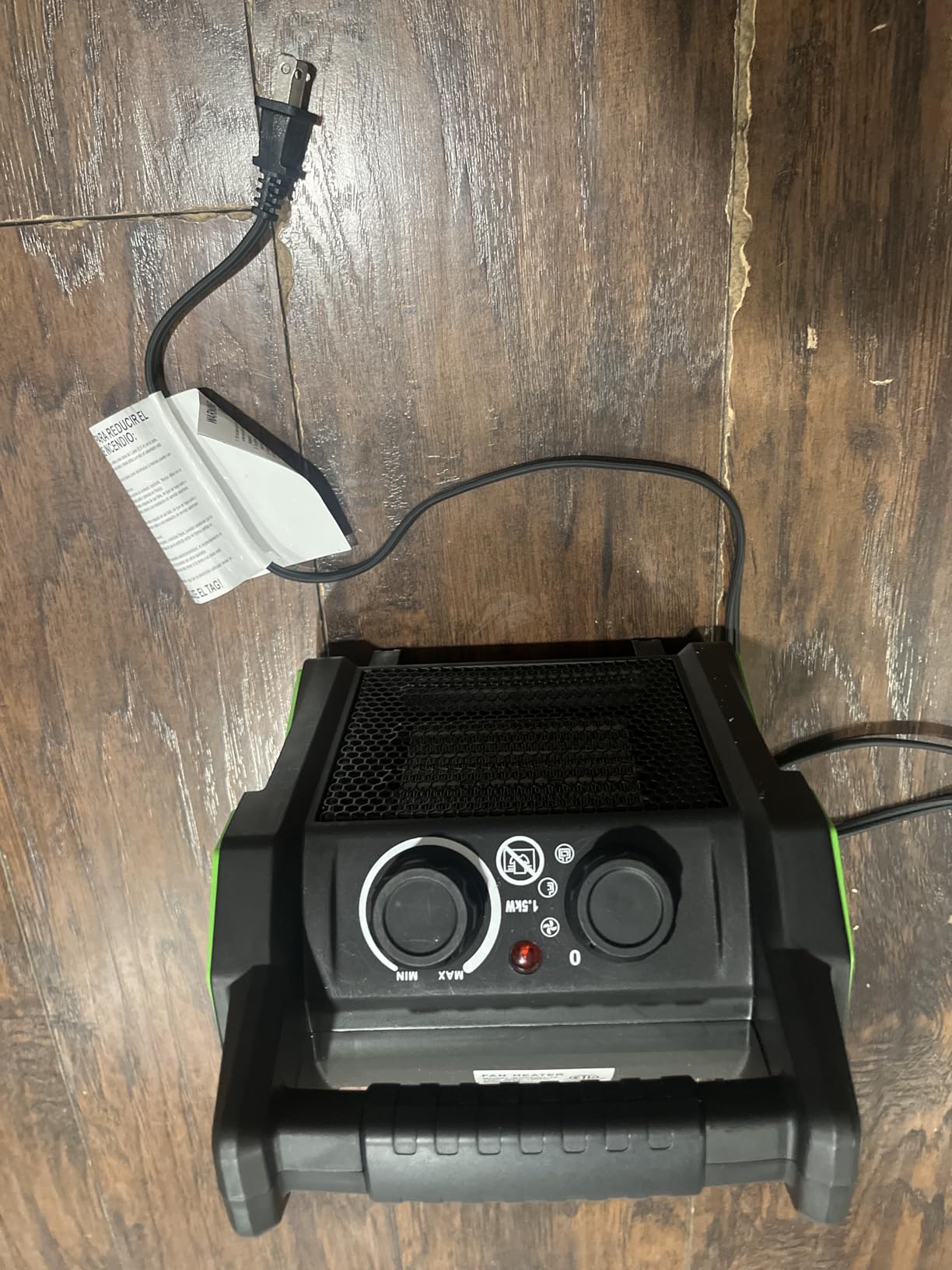
Three modes, a 25W fan-only setting, 750W low and 1500W high, cover a mild day, a cool evening and a hard frost. Overheat protection and a stable base bracket handle the tip-over case, and the compact 8 by 9 by 7 inch body with a carry handle makes it easy to move to whichever corner is running cold.
A 6.4 foot extension cord is included, which is more generous than most units in this price class. Greenhouse Ventilation Equipment ranking on the brand is strong, and owners report month-plus continuous runtime without issues.
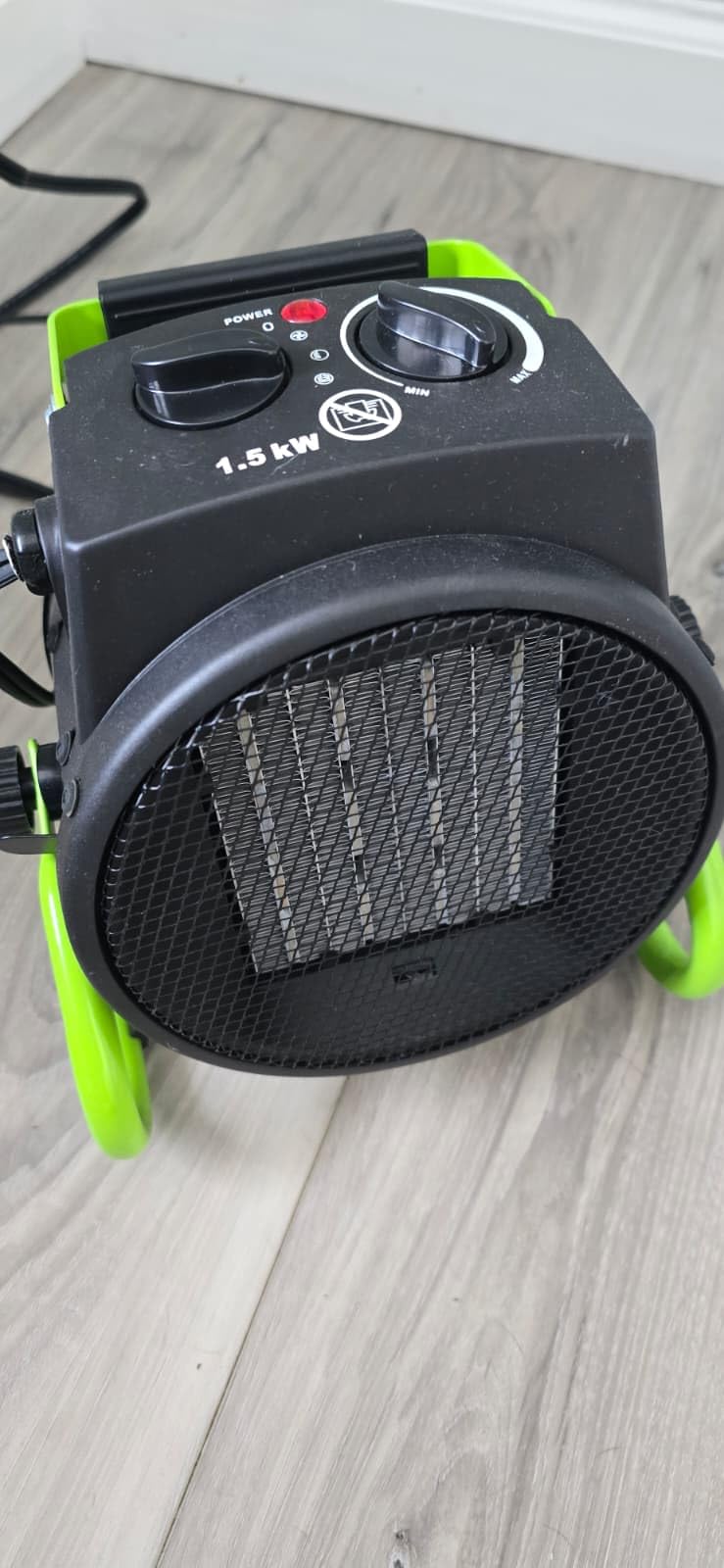
Good fit for small structures
This works well in a 4×6 or 6×8 greenhouse, an indoor mini greenhouse, or a plant room where you sit and work close to the bench. Three settings let you run the quiet 750W level for most of the night and reserve 1500W for the pre-dawn hours when the temperature is actually falling.
The fan-only mode is genuinely useful in spring, moving air across seedling trays without adding any heat at all.
Poor fit for cold control
There is no real thermostat. The 25W and 750W and 1500W steps are power levels, not temperature set points, so you are running it on judgment and a timer rather than on feedback from a sensor.
At 14A it draws heavily enough to want a dedicated or only lightly shared circuit, and the small housing caps its useful range. If you need the temperature to hold within a few degrees unattended, a thermostat-equipped model is the better purchase.
6. VEVOR 1500W PTC – Best Rated Heater for a Grow Tent or Small Greenhouse
- Heats a small greenhouse or sunroom within about 10 minutes
- Highest rating in this roundup with 76 percent five-star
- Compact and light at 3.6 pounds with a built-in handle
- Works as both heater and circulation fan for summer use
- ETL certified with overheat protection
- Three-level knob is not a digital thermostat set point
- Draws a high 16.67A so it needs a dedicated circuit
- Cannot heat a large greenhouse on its own
The VEVOR is the highest-rated heater in this roundup at 4.4 stars, and it earns that on a simple premise: it does the small greenhouse job fast and it does not pretend to be something it is not. The 1500W PTC element releases 5100 BTU and reaches working temperature in about three seconds, then warms a small greenhouse or sunroom inside roughly ten minutes.
It is also the one we would most confidently put near a bench full of seedlings. The ETL certification is a third-party listing rather than a self-declaration, and the alloy steel body with an IP20 protection rating, overheat cutoff and a 25-degree adjustable anti-slip base is a sensible safety package for a structure full of plastic trays and dry compost.
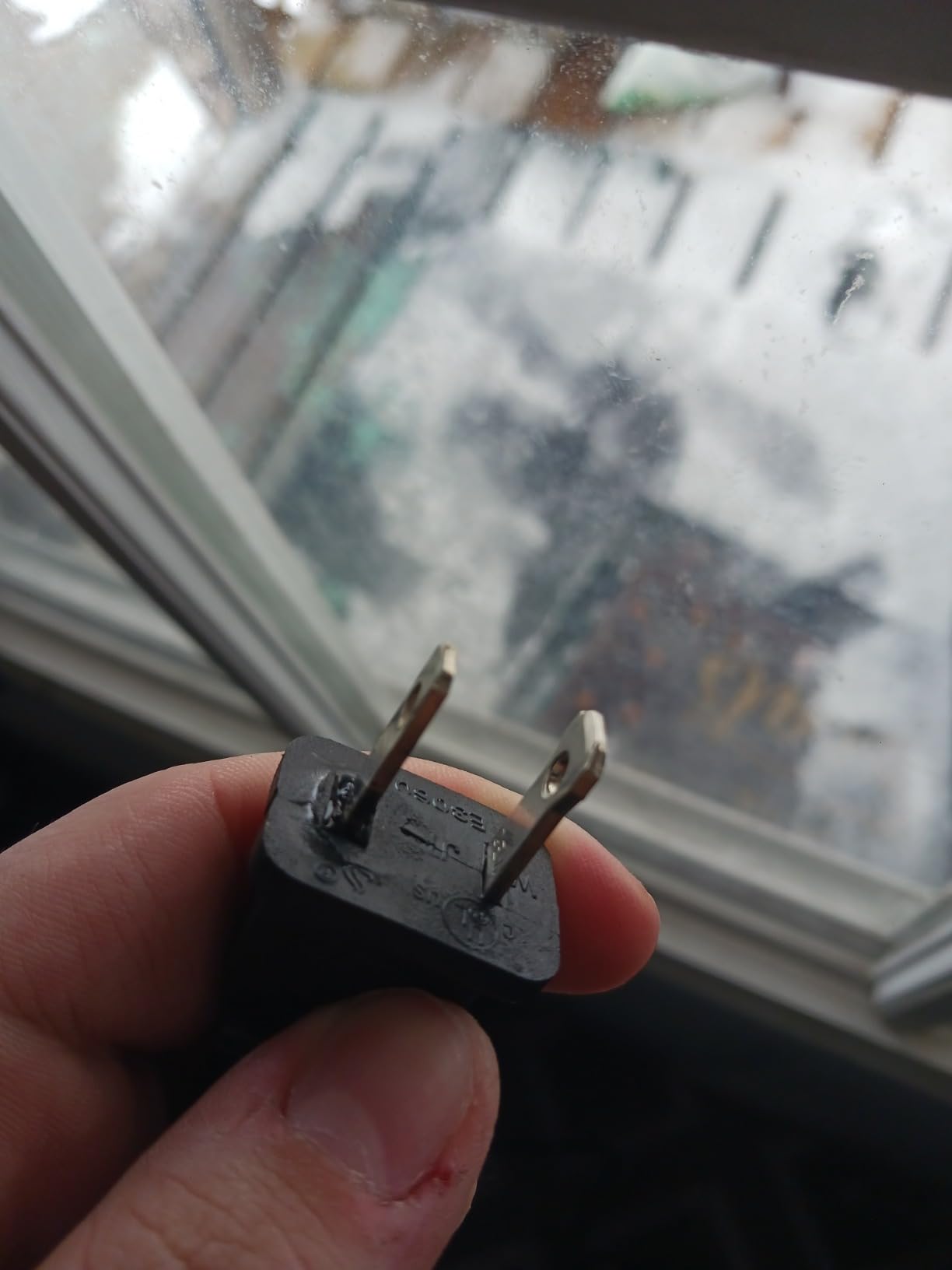
Weight is the other quiet win. At 3.6 pounds with a carry handle, this is the easiest heater here to move from the greenhouse to the potting shed and back, which matters if you are covering more than one structure on a frost warning. Owners report continuous month-plus runtime without issues.
The three-level knob runs a 40 to 75 degree range and the same control handles ventilation mode, so one box covers summer air movement and winter heat. In the greenhouse ventilation category, the brand holds a strong best-seller position.
Where the VEVOR shines
It suits small greenhouses, grow tents and sunrooms where fast warm-up matters more than precision. At 5100 BTU over 150 to 200 square feet of claimed coverage, it is well matched to a 4×6 or 6×8 structure.
Anyone who wants a second heater they can grab in one hand and carry to the coldest corner will appreciate it. The fan mode is genuinely quiet, and that combination of speed and low noise is unusual in this class.
Where the VEVOR stops
The three-speed knob is not a thermostat. It is a power selector with a nominal range, and without a separate probe controller it will not hold a set point through a long cold night. One review even reports an included thermostat drifting out of calibration after a week, which is worth remembering if you plan to add one.
It also draws 16.67A at 120V, which is above the 15A limit of a standard household branch circuit. In practice that means a dedicated circuit, which rules it out of an older greenhouse with a shared socket.
7. VIVOSUN AeroFlux 700W – Best for Grow Tents and App-Controlled Heat
VIVOSUN AeroFlux 700W PTC Grow Tent Heater with Thermostat, APP & VPD
- Accurate thermostat holds tent temperature without short cycling
- App and VPD control let growers dial in day and night recipes
- Compact enough to fit in an 8x4 tent without eating space
- Can run outside the tent while still heating inside
- 700W output is sized for small to mid tents not a full greenhouse
- Wi-Fi pairing can be difficult for some users
- Fan is a little on the noisy side
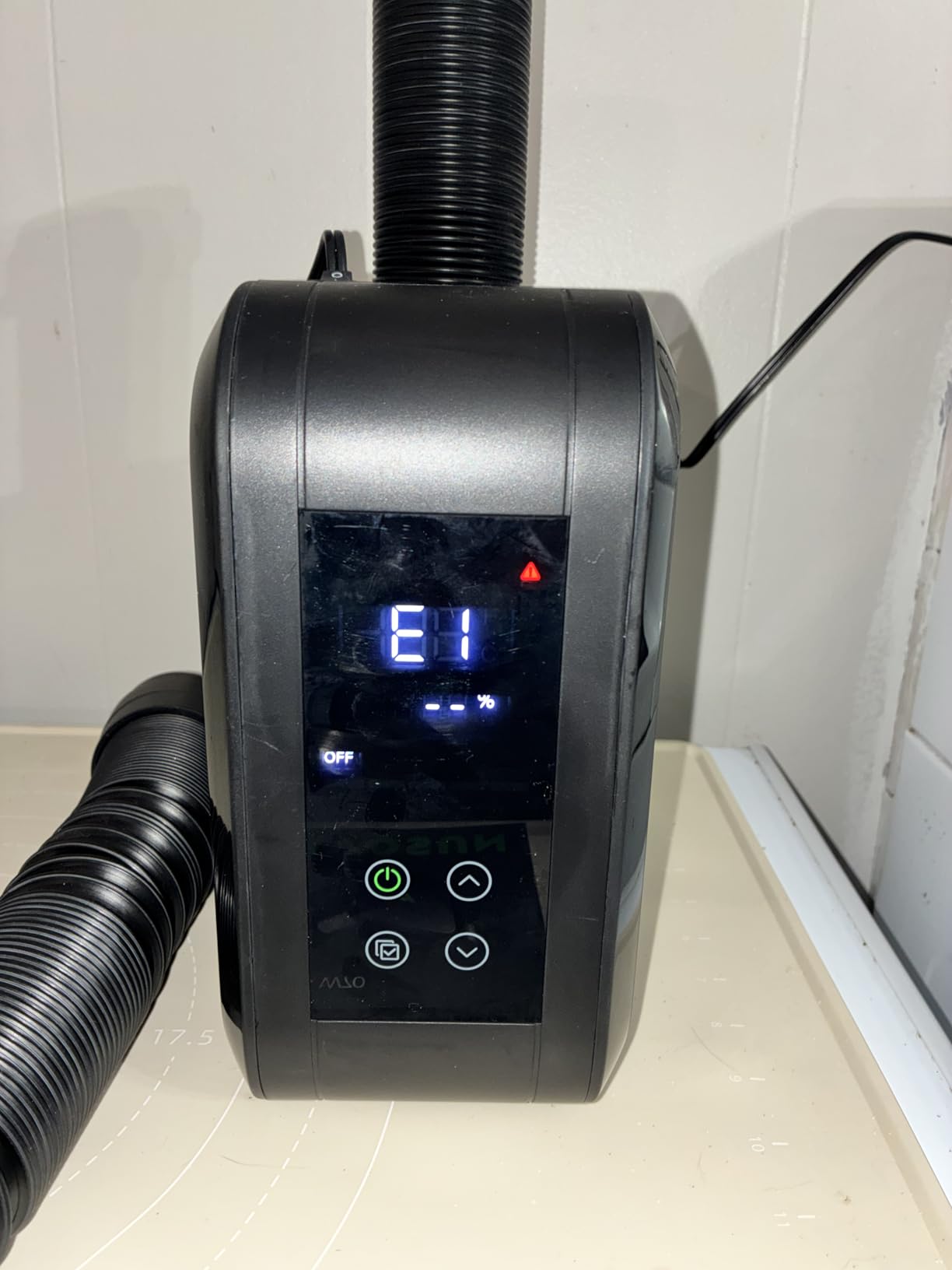
The AeroFlux is the most sophisticated controller in the group and the least suited to a full greenhouse, and those two facts are the same fact. A high-precision sensor tracks temperature and VPD in real time and auto-adjusts heat output, which is exactly what a grower running lights-on and lights-off cycles in a small tent needs.
At 700W with PWM precision control across five heat levels, it delivers about 40 percent more than a standard grow tent heater. Several growers report it replaced a 1300W milkhouse heater that was drawing too much power inside a tent, and the low draw means it can share a circuit with lights on a normal supply.
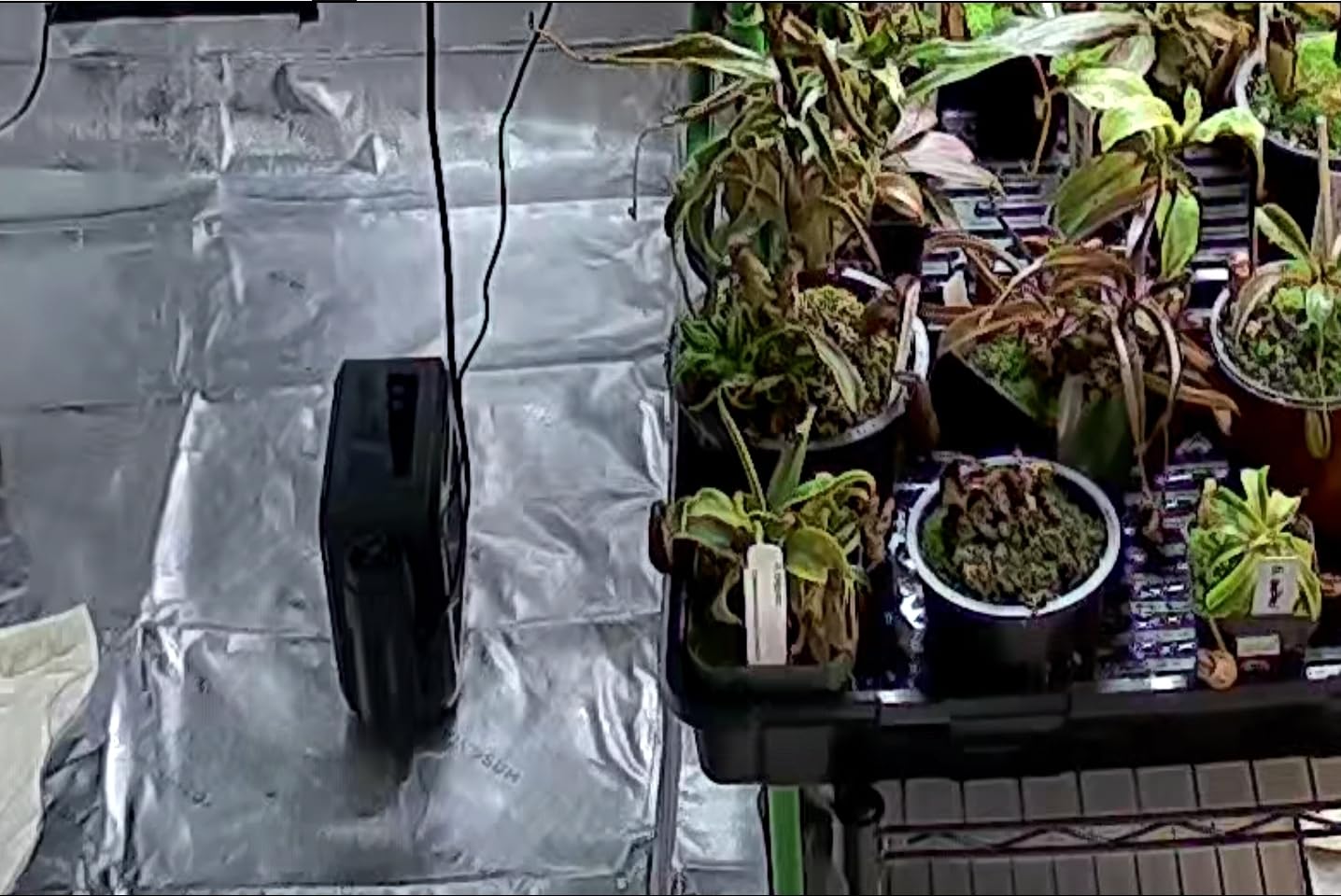
The app is the point. You set a minimum temperature and a target VPD, schedule a day and night recipe, and the unit runs without you. Several owners specifically mention cold basement tents during lights-out, where a thermostat that holds through the night is worth more than raw wattage.
Safety is handled properly too. V0 flame-retardant materials, tip-over protection and overheat shutoff are all standard, and the compact 9.45 by 4.72 by 9.45 inch footprint fits inside a tent or outside it with a hose run.
Where it belongs
Put the AeroFlux in an indoor grow tent or propagation room where VPD matters and you want scheduling. Growers value the accuracy and app-based automation, and the ability to sit the body outside a tight tent while still heating inside is genuinely useful in a small space.
If your winter question is a cold basement growing area rather than a glass greenhouse, this is the best-controlled machine here.
Where it does not fit
700W will not heat a glass greenhouse. That is not a flaw, it is simply the wrong tool, and pairing it with a real greenhouse would leave you short on cold nights.
Wi-Fi pairing trips up some users at first, and the fan is a little on the noisy side once it runs at higher levels. The price also sits well above what a comparable wattage of plain convection heat costs.
8. Spider Farmer 530W – Best Dead-Band Temperature Control for Plant Rooms
Spider Farmer Heater,530W 10-Level PTC Heating for Grow Tent,Plant Room
- Dead-band zone control reduces frequent on and off cycling
- Ten levels of heat and fan speed for fine tuning
- 160cm adjustable hose directs air away from plants
- Dark panel auto-switches off after 30 seconds for night cycles
- Low 3A draw makes it easy on tent electrical
- 530W output suits grow tents and plant rooms not a full greenhouse
- Vent hose reduces effective heat output for the space
- Brand is less known so long-term durability data is limited
Dead-band control is the idea worth stealing from this heater. Instead of switching fully off the instant the sensor reads your set point, it holds a three-degree band, so the fan and element modulate within it. In a small structure that removes the constant on-off thumping that drives greenhouse owners to buy a second heater.
Output is a modest 530W across ten adjustable heat and fan levels, and the three amp draw is the lowest here by a wide margin. That means it shares a circuit with lights, a fan and a propagation mat without any electrical planning at all, which is why it shows up in indoor plant rooms rather than glass houses.
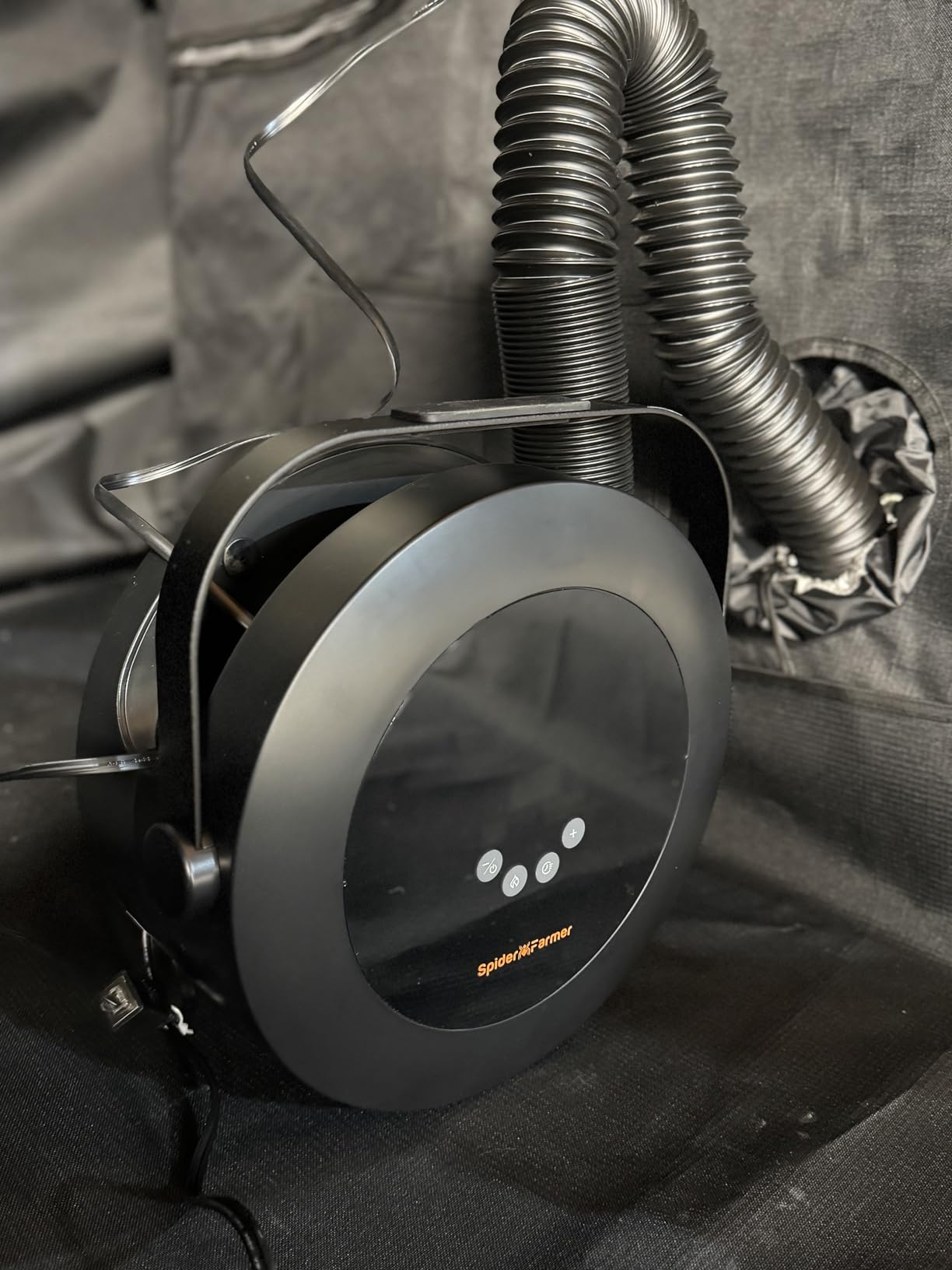
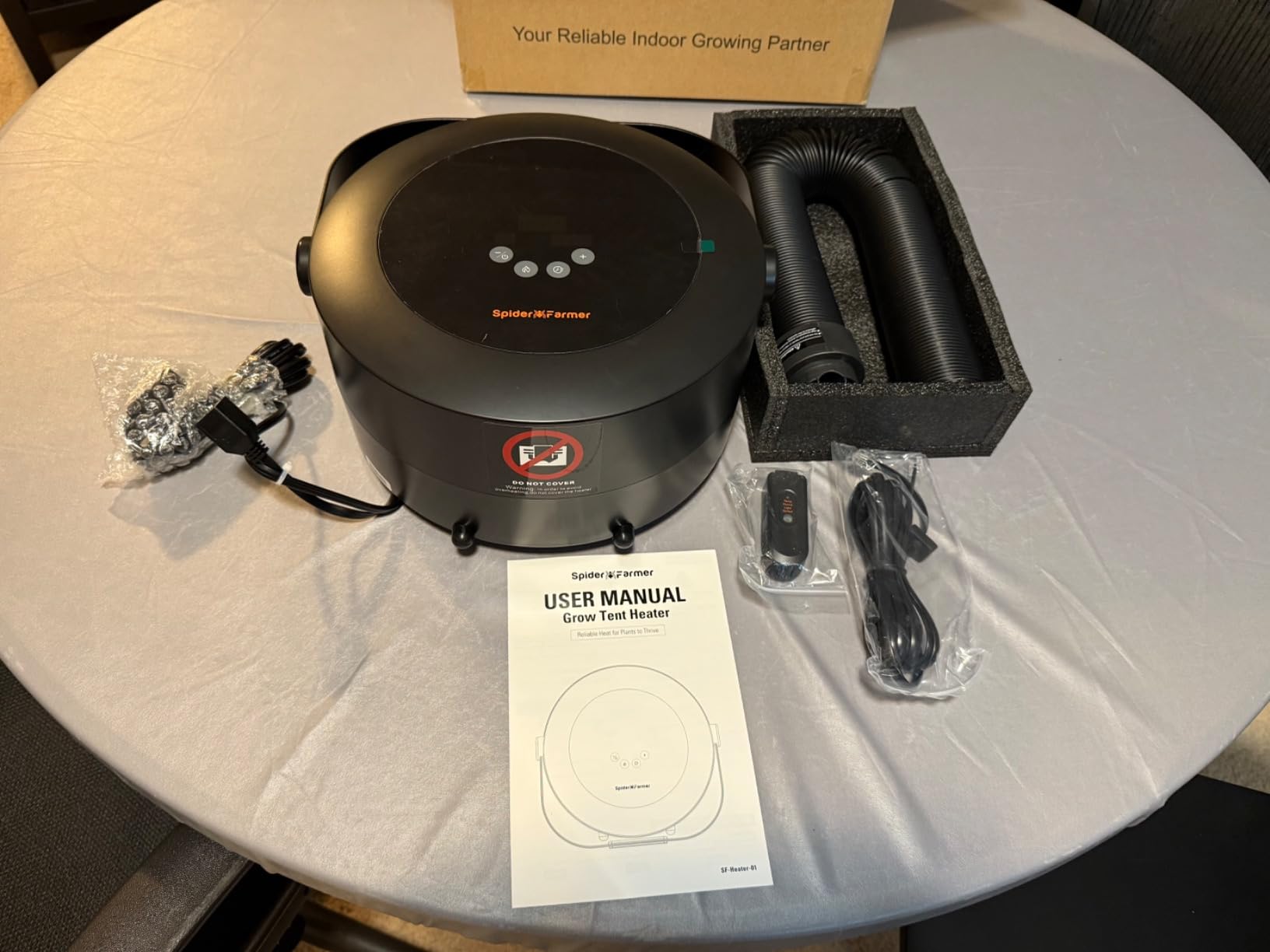
The 160 centimetre adjustable vent hose is a smart inclusion. It lets you keep the unit outside a sealed tent or route the outlet away from a tray of seedlings, which is a real problem when a fan is pointed straight at foliage in a small space.
There is a 24-hour countdown timer, plus normal open mode and all-day, daytime and night temperature modes. The display panel auto-switches off after 30 seconds of inactivity so it does not leak light during dark cycles, which matters if it sits inside a tent.
Good for indoor plant rooms
This is a heater for a grow tent, a plant room or a propagation cabinet where electrical capacity is the binding constraint. The dead-band regulation and the 10-step control let you tune it finely rather than picking between two heat levels.
Owners also like that it is gentle with plants, because the vent hose means you can direct air somewhere other than the canopy. A unit that draws 3A is easy to add to an existing tent circuit.
Limits worth knowing
530W is tent and plant room territory. It will not hold a glass greenhouse above freezing on a cold night, no matter how well it is controlled, and we would not pretend otherwise.
Using the hose also costs you effective output for the space, since the air is delivered further away and more heat is lost along the run. The review base is 206 with limited long-term durability history, and the rating distribution includes a notable 17 percent four-star share.
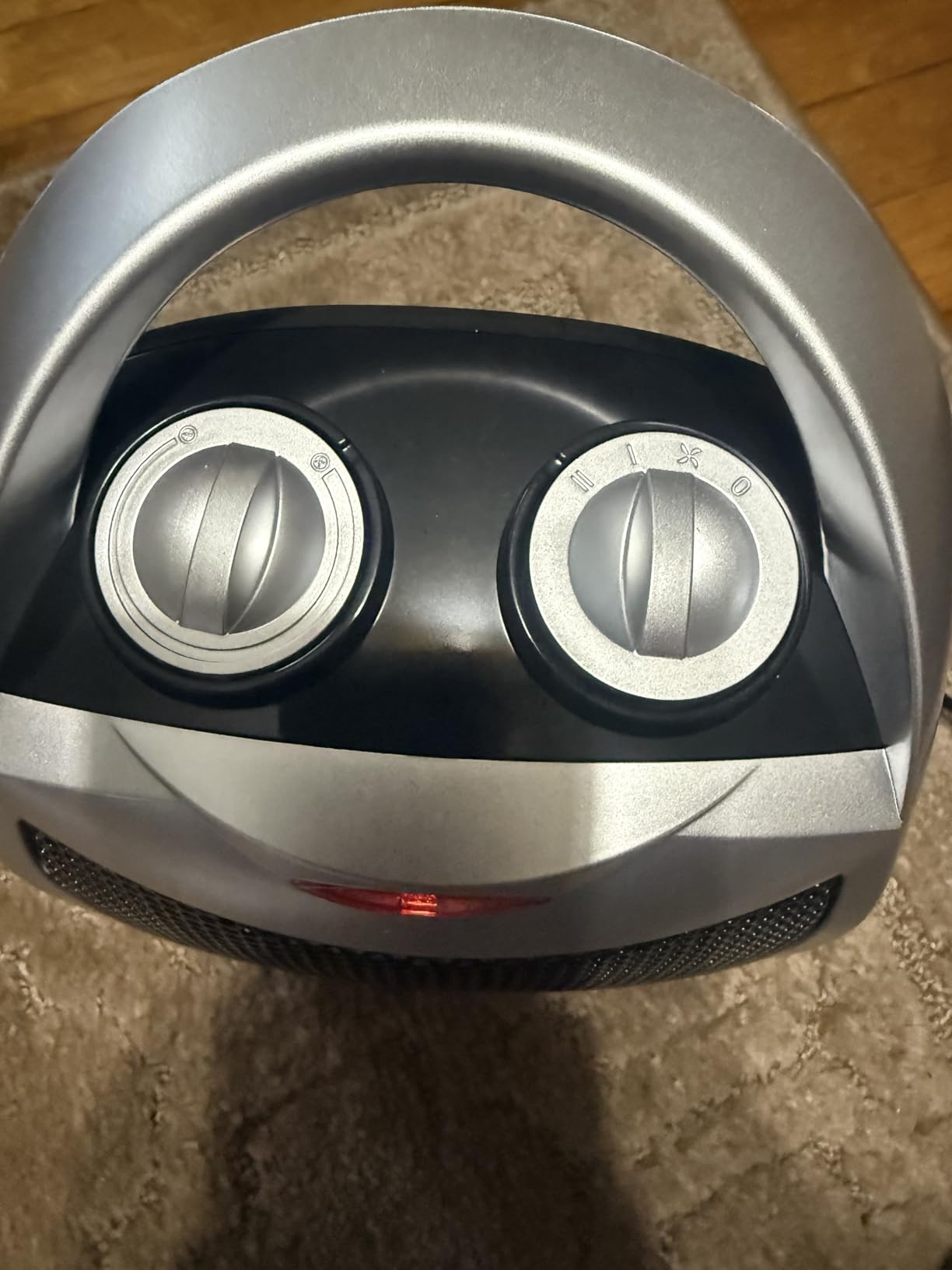
9. GarveeTech 1500W Ceramic – Best Budget Pick for an Unheated Shed or Cold Room
- Very low cost for a 1500W PTC ceramic heater
- Heats small spaces quickly
- Housing does not get hot enough to burn skin
- Tip-over and overheat shutoffs give basic protection
- Lightweight at about 3 pounds with a built-in handle
- Only 41 reviews so the rating is less reliable
- One report of loose internal parts and a non-heating unit
- Another reports breaker tripping at roughly 13A draw
- Small dial knobs are hard to adjust
The GarveeTech exists for one situation: you need a lot of heat for very little money, in a dry covered space, and you are willing to accept a basic thermostat. At 1500W and 750W on a ceramic PTC element, it delivers more heat per pound of hardware than anything else in this roundup.
The temperature dial is adjustable from 50 to 95 degrees, which is unusually wide for a budget unit and low enough to set for frost protection on tender stock. Tilt protection shuts it off past 45 degrees of tilt, and overheat protection cuts power above 144 degrees on the case.
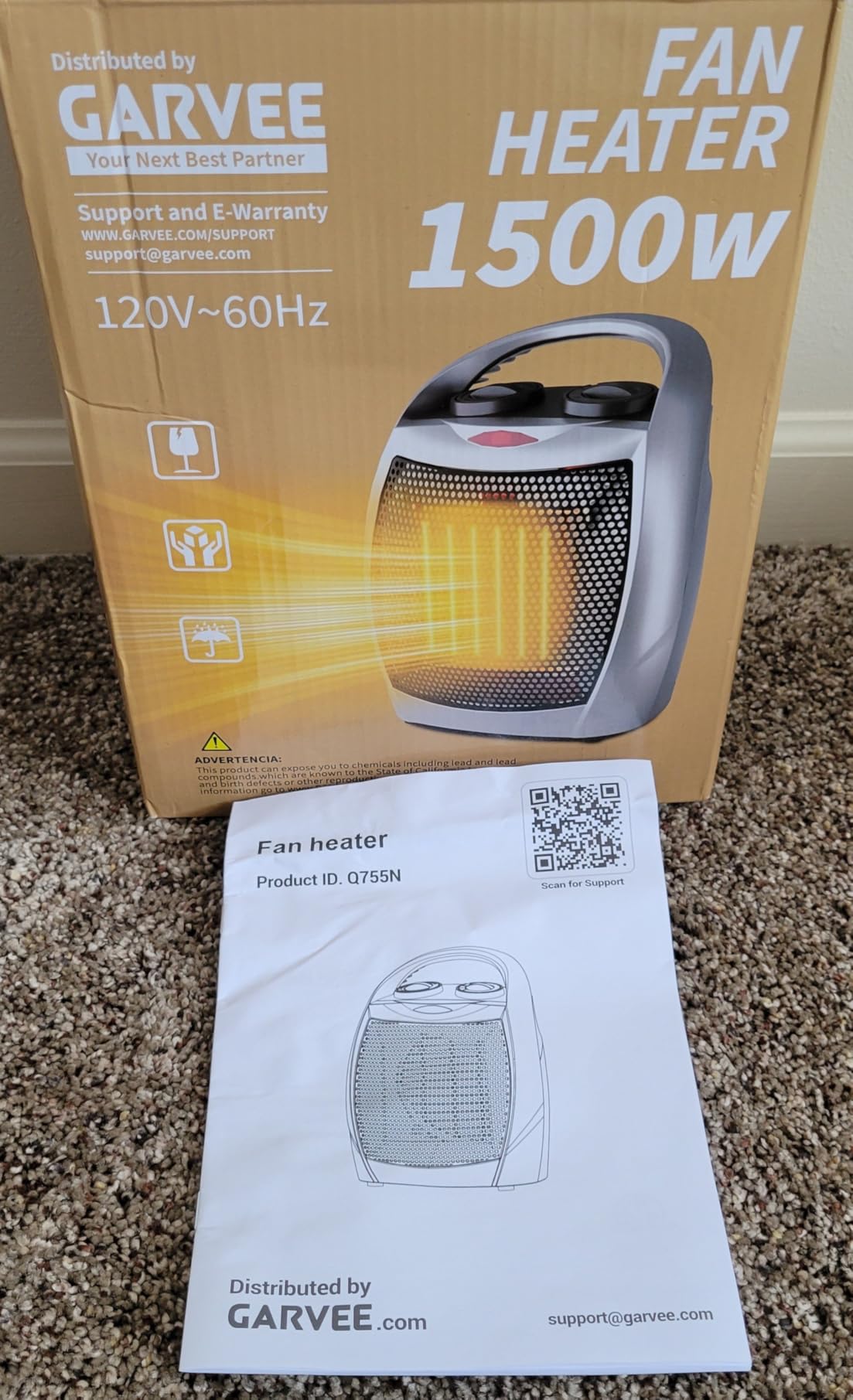
It weighs about four pounds, has a built-in carry handle and the housing stays cool enough not to burn skin, which are the three things you actually want from a portable heater. The PTC element starts producing heat within seconds rather than warming up over several minutes.
It is rated for indoor use, so this is a potting shed, garage or covered porch job rather than a wet greenhouse floor job. Read the placement rules below before you commit it to a damp structure.
Where budget makes sense
For a garage, a covered porch, a cold room or a plant area where you will physically check on it, it does the job at a fraction of the cost of a thermostat-equipped model. Owners like the heat output per dollar and the quiet PTC operation.
If your winter goal is simply keeping a shed above freezing for five or six hours on the coldest night, that is a solved problem with a basic dial thermostat.
Where it is a gamble
With 41 reviews, this is the thinnest review base in the roundup, so the 4.3 rating tells you less than the other scores here. One report describes loose internal parts and a unit that would not heat at all, and another reports a breaker tripping at roughly 13A.
Expect a dial thermostat rather than a probe, small knobs that are hard to adjust in gloves, and handle edges described as uncomfortable. If you want unattended overnight control in a structure holding living plants, buy a heater with a real sensor.
10. SwSun 1500W Wi-Fi – Best for Remote Temperature Alerts
1500W Greenhouse Heater with Thermostat WIFI APP, Heater for Outdoor Greenhouse Green House with APP Remote Control Portable Smart Electric Heat for Green Plants
- Wi-Fi app control allows remote on and off and temperature checks
- Easy Wi-Fi linking and scheduling reported by several owners
- Overheat tip-over and power-failure protection
- IPX4 metal body suits humid greenhouse conditions
- Heating and fan modes for summer circulation
- Lowest rating in the roundup
- Reports of units shutting down in deep cold and not restarting
- Oscillator can fail after several weeks
- Customer service contact channel was hard to reach
The SwSun is the most interesting idea in this group and the least reliable execution of it. The idea is right: SMS alerts when the greenhouse drops below 68 degrees or climbs above 70, checked remotely through an app, so a freeze warning reaches your phone before the plants do.
On paper the specification sheet is strong. 1500W covering up to 150 square feet, an adjustable range of 40 to 113 degrees, an IPX4 rustproof metal exterior with a built-in thermometer, and separate heating and fan modes for year-round circulation.
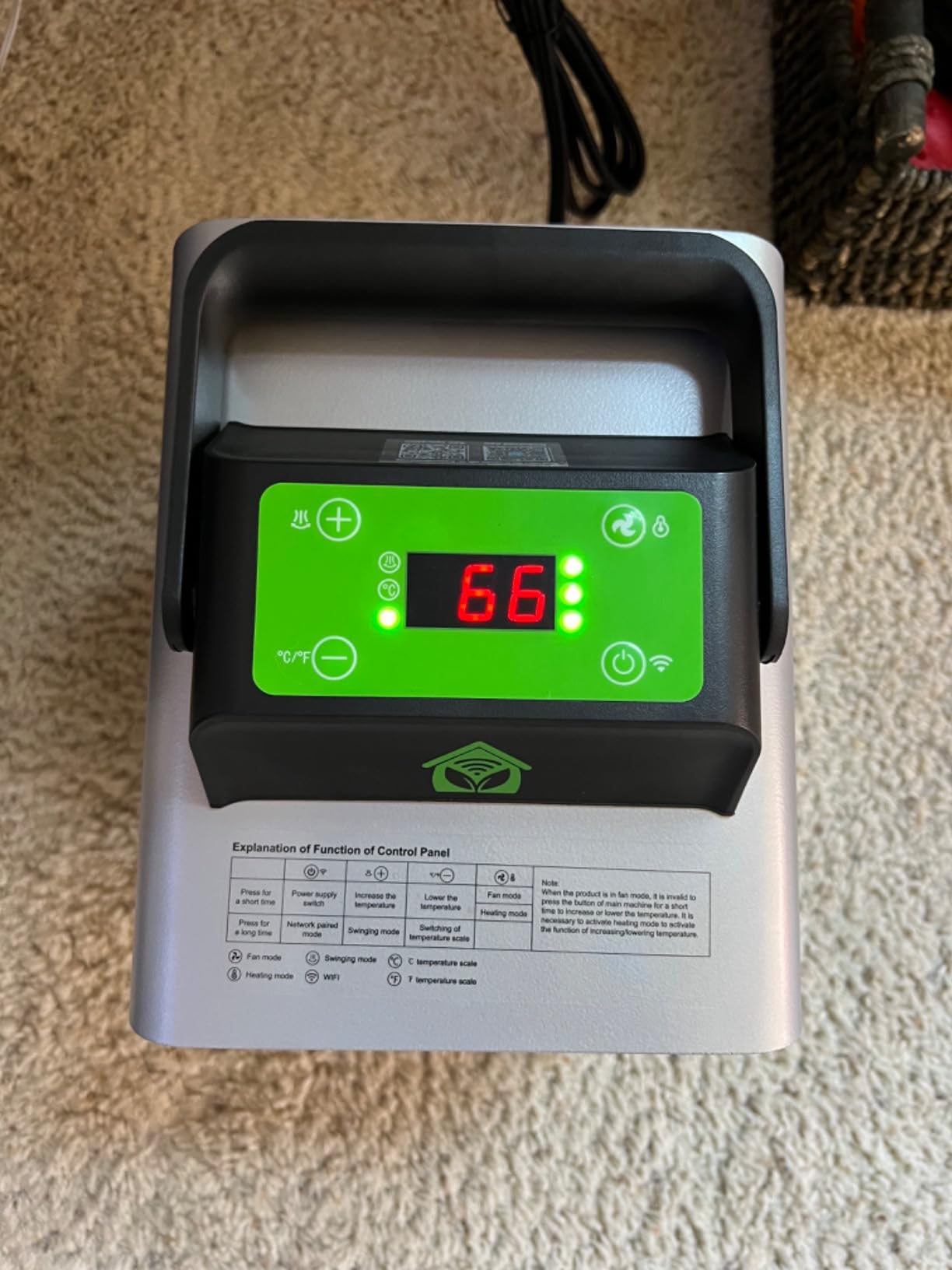
The protection package is unusually complete for this class, covering overheat at 149 degrees, tip-over and power-failure protection. The 2024 manufacture date is recent, and several owners report that the Wi-Fi linking and scheduling setup was straightforward for them.
This is also a physically small box at 7 by 2.5 by 5 inches, which makes it easy to hide low behind a bench where the rising heat will still be useful.
Why the idea is worth knowing
Remote alerting genuinely changes how you use a heater. Instead of running full power all night on a guess, you can run a short boost and let the app tell you when the temperature is actually moving.
The 40 to 113 degree range and the fan mode mean one unit covers frost protection, seedling warmth and summer circulation, and the IPX4 metal body is a better fit for a humid greenhouse than most plastic cases in this class.
Why we rank it last
It is the lowest-rated product here at 3.8 stars, and the 14 percent one-star share points at a specific and repeatable failure: units that stop heating in genuinely cold weather and do not restart after a brief power interruption.
There are also reports of the oscillator failing after a few weeks, a dead-on-arrival unit, and difficulty reaching customer service. The appeal is real, but a heater that resets itself during the exact weather it exists for is a poor foundation for protecting living plants.
11. Kiroto 1500W App-Controlled – Best for Holding a Lean-To Just Above Freezing
- App control with quick Wi-Fi sync in most cases
- Timer function works reliably for scheduled heating
- 70-degree swing helps distribute heat across plants
- Kept an 8x40 lean-to greenhouse just above freezing through winter
- Easy to read electronic display with built-in probe
- Lowest setpoint is 41F even though the app advertises lower
- Some units shut off randomly and need unplugging to restart
- App requires a subscription for some features
- Weak Wi-Fi signal at the far end of a property
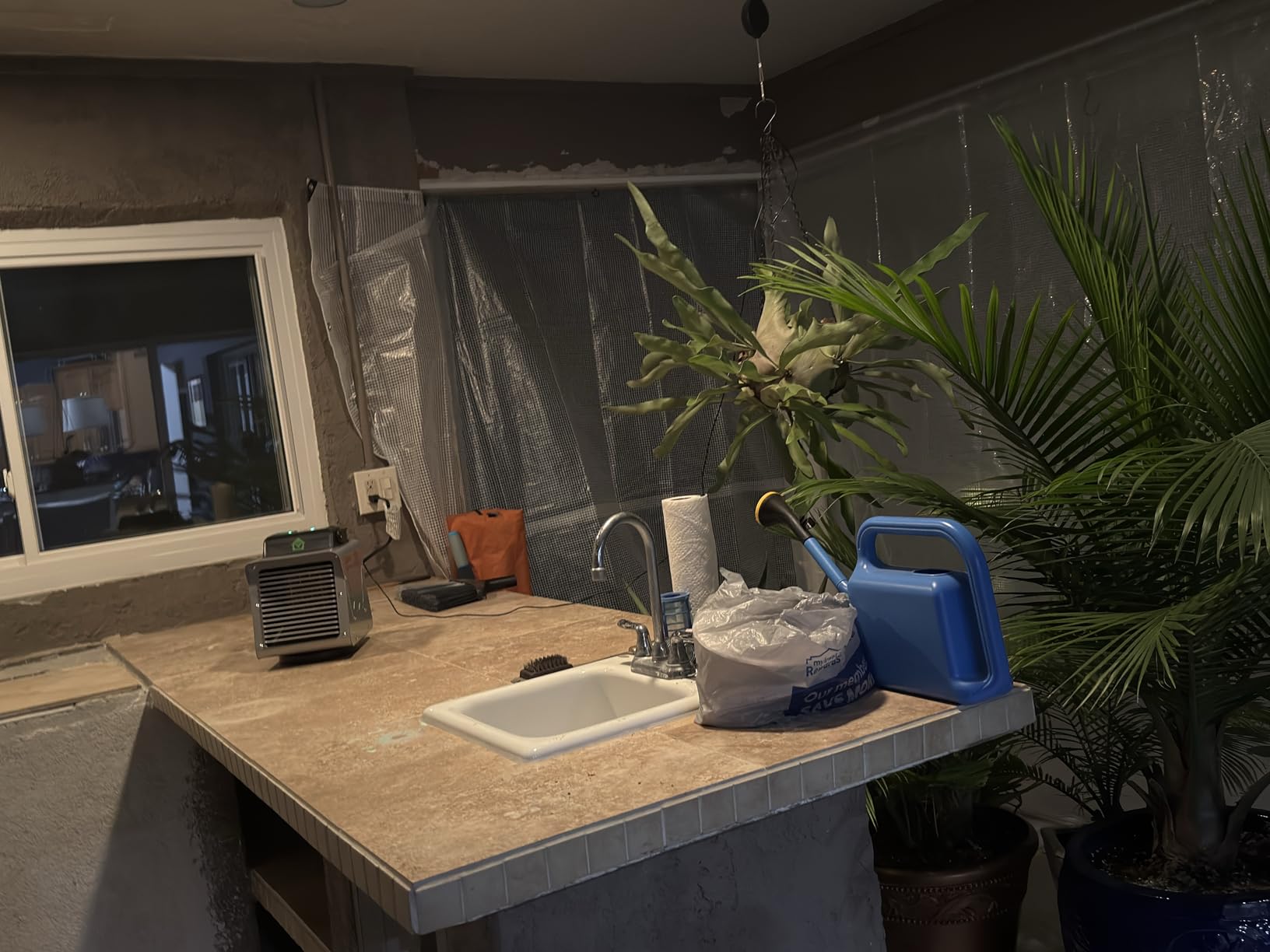
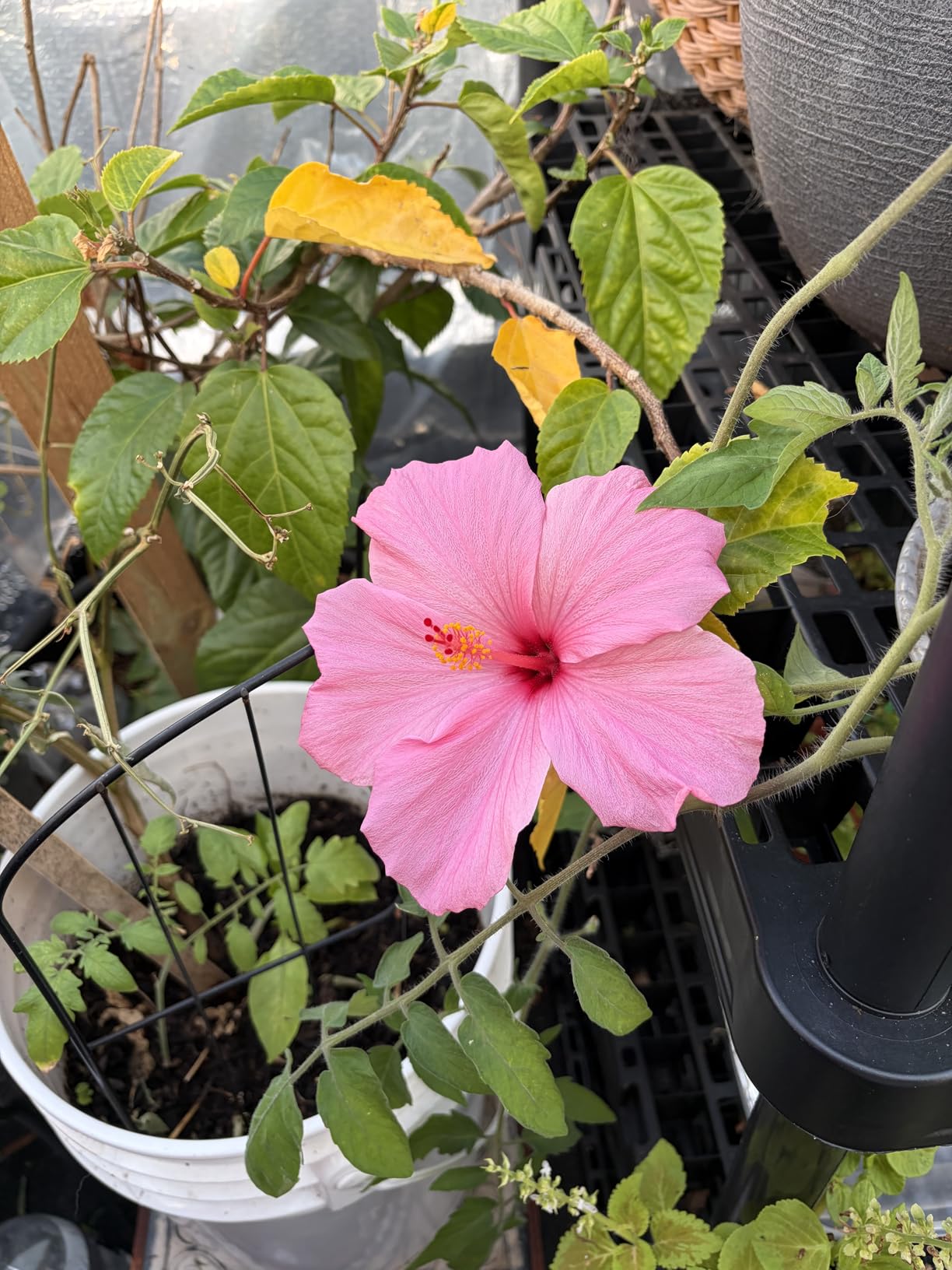
One owner reported keeping an 8×40 lean-to greenhouse just above freezing through a winter with this unit, and that report is the reason it earns a place here. Not holding a warm growing temperature, just holding the line against frost, which is the correct ambition for a lean-to full of dormant or semi-dormant stock.
The 70-degree oscillation is what makes that possible in a long narrow structure. A fixed-direction fan in an 8×40 creates a warm end and a cold end, but a swinging unit spreads its output along the length, and growers specifically credit the swing with distributing heat across plants more evenly.
App control uses the Smart Life platform with a real-time temperature readout, timer scheduling and SMS alerts for high and low temperature. Several owners report quick Wi-Fi sync, and the electronic display with an integrated probe is easy to read at a glance.
Safety covers overheat shutdown at 149 degrees, tip-over cut-off after ten seconds, heating and fan modes, and an FCC ID with UL certification claimed. It weighs eight pounds and stands 8 by 6 by 7 inches, a stable footprint for a concrete or gravel floor.
Where it works
Long lean-tos, polytunnels and any structure where you want heat spread along a run rather than concentrated in one corner. The timer is the feature growers use most, scheduling heating for the coldest hours of the night instead of running continuously.
For overwintering plants that need frost protection rather than active growth, oscillation plus scheduling is a sensible pairing.
Where the details bite
The lowest setpoint is 41 degrees even though the app advertises a lower range, which limits how precisely you can hold a plant-critical temperature. And several owners report the heater shutting off randomly and needing to be unplugged to restart, which is the same class of problem that pushes this class of product down the list.
Some app features sit behind a subscription, Wi-Fi can struggle at the far end of a property, and there are reports of it failing to hold temperature in larger greenhouses. With 67 reviews, the reliability picture is still forming.
12. Air Choice 1500W with Digital Thermostat – Best Waterproof Probe Thermostat
- Digital thermostat with waterproof probe is easy to read and set
- Three heating modes plus fast PTC warm-up
- Lightweight at 3.8 pounds with a 7.5 ft cord and carry handle
- Owners report it holding a 12x20 or 6x8 greenhouse at temperature
- Overheat protection and non-slip base
- Only 68 reviews so long-term reliability data is thin
- One report of the unit losing all power after about a month
- The 1500W setting reduces fan speed
- One reviewer found the thermostat locked to Celsius
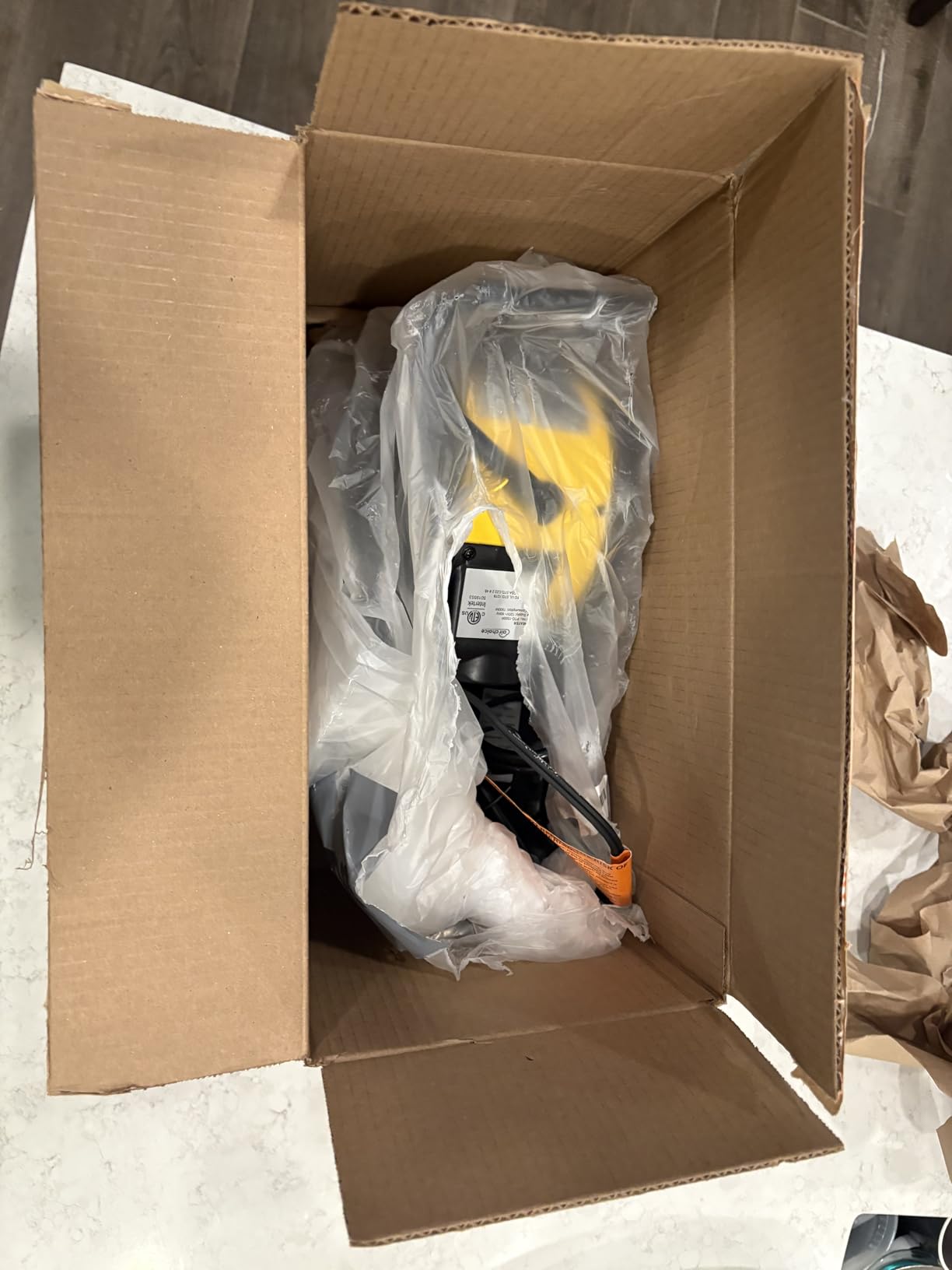
The Air Choice is the most straightforwardly designed heater in this group for a real greenhouse. Its defining feature is a separate digital thermostat controller with a waterproof temperature probe, so you can put the sensor at plant height on a bench while the heater body sits on the floor. That separation is the whole point in a damp, unevenly heated space.
Owners report holding a 12×20 or a 6×8 greenhouse at temperature, which is a bigger claim than most units in this class make. The adjustable range of 40 to 108 degrees covers frost protection and seedling work, and the three modes, 750W low, 1500W high and fan only, cover a mild day through a hard freeze.
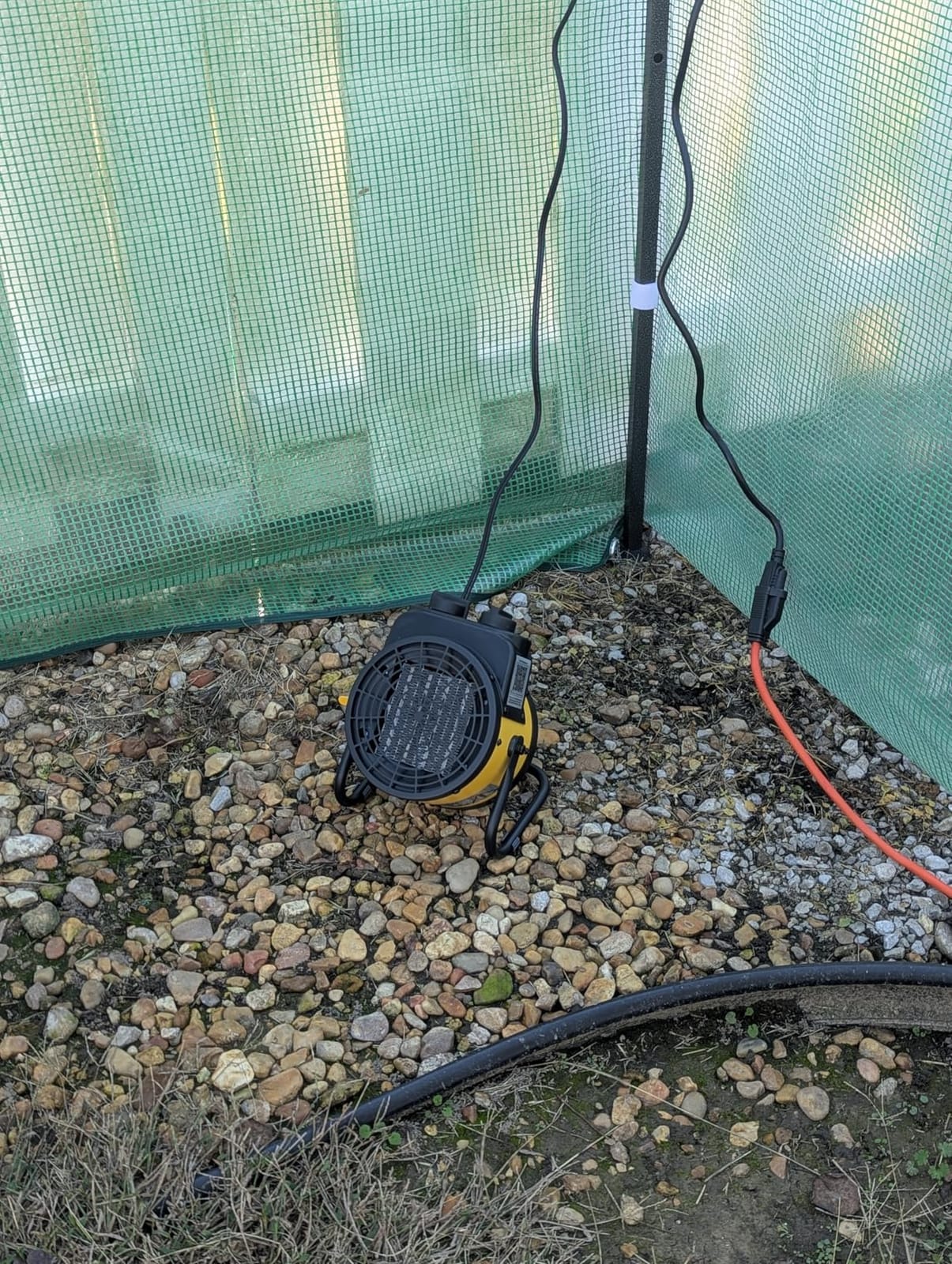
The 1500W PTC element warms in about three seconds, and the housing is fireproof with independent overheat protection. It is also the only unit in this roundup with a 7.5 foot power cord, which in a greenhouse removes the extension lead that causes half the electrical complaints we hear about.
At 3.8 pounds with a carry handle, an adjustable tilt head and a non-slip base, it is easy to reposition as the cold spot moves around the structure. The controller is rated 15A, so it is designed to sit between a high-power appliance and its supply.
What we like about the design
The split thermostat and probe is the right call for a greenhouse, and the readability of the display gets most of the praise. Fast warm-up, three modes and a genuinely long cord are all practical wins in a structure where nothing is square.
If your concern is holding a set point rather than just running heat, this gives you the control that fan-only and knob-controlled units cannot.
What to watch
At 1500W the fan speed drops, which pushes less air than the wattage suggests, and one reviewer is not convinced it can hold a 10×10 space alone. A separate report describes a unit that lost all power after about a month, and another found the thermostat locked to Celsius.
With 68 reviews, long-term reliability data is thin. That is why this sits at the back of the list despite good design: we rate the machines we can see owners using through more than one winter.
Electric vs Propane, Gas and Hydronic Greenhouse Heaters
Electric wins for almost every hobby greenhouse, and the reason is control rather than cost. There is no combustion, no carbon monoxide to worry about in a sealed structure, and no fuel line to run, and a digital thermostat can hold a set point within a few degrees. Every pick in this roundup is electric for that reason.
Propane and natural gas units make sense when there is no mains power, when the structure is large enough to need real British thermal unit output, or when you want heat that keeps working through a power cut. The trade-offs are real: combustion air has to be available, carbon monoxide is a genuine concern in a small sealed structure, and placement rules are strict because of hanging baskets, mulch and poly film.
Hydronic systems, which push hot water through pipes under benches, are the most efficient option per unit of fuel and give wonderfully even root-zone warmth. They are also a plumbing project, and they are essentially a commercial-scale answer to a hobby-scale problem. Solar air collectors and wood stoves complete the picture for anyone off-grid or on a rural off-grid supply.
Our advice for a hobby structure: electric if you have a 120V outlet, propane only if you genuinely have no power, and hydronic only if you already have a boiler or are heating more than one building.
How to Size a Greenhouse Heater for Your Structure
The rule of thumb used across this category is about 20 British thermal units per square foot for a minimally insulated greenhouse, which gives roughly 960 BTU for a 6×8 house, 1920 BTU for an 8×12, 3840 BTU for a 12×16 and 16000 BTU for a 20×40 hoop house. A 1500W electric heater delivers about 5100 BTU, so it comfortably covers a 6×8 or 8×10 and stretches on an 8×12 if the glazing is insulated.
Next, adjust for two things. A double-glazed or bubble-wrapped greenhouse can be sized 20 to 30 percent smaller, and a single-layer glass or poly greenhouse in a region that regularly drops below 20 degrees should be sized 20 percent larger. Third, decide how low you need to go, because frost-only protection and active growing heat are very different jobs.
Finally, account for the circuit. A standard 15 amp household branch circuit caps a 120V heater at about 1500W, and the 16.67 amp draw of some units requires a dedicated circuit. This single constraint removes more candidates than any other factor we checked.
One more note on where to put the unit. Cold air falls, so a heater mounted high warms the ceiling and leaves the bench cold. Low placement near the door, with air directed along the length of the structure, is what actually keeps plants alive.
Greenhouse Heater Safety Checklist
Run every heater on a GFCI or RCD protected outlet. A greenhouse is a damp environment and water on a plug is the most common real accident, and several owners in this roundup report breakers tripping within a season.
Do not use extension leads to stretch a heater to a distant outlet. They are the leading cause of both nuisance tripping and overheating. If the outlet is too far, install a proper outlet on a dedicated circuit instead.
Keep combustion heaters low to the floor, away from plastic mulch, hanging baskets, irrigation lines and poly film, and never run a propane or natural gas heater in a small sealed greenhouse without fresh combustion air and a working carbon monoxide alarm.
Give every unit clearance. A wall or bench within a few inches blocks intake and creates the stratification problem you were trying to solve, and many of the units here include tip-over and overheat protection, but those are a backstop rather than a plan.
Finally, check the certification mark. ETL or UL listing, an IPX4 splash rating, and a stated overheat cutoff are the three markers that separate a unit built for a damp structure from a household space heater pointed at one.
Cheapest Ways to Heat a Greenhouse Before You Buy Hardware
The cheapest way to heat a greenhouse in winter is to lose less heat, not to make more. The most common owner question in greenhouse forums is about insulation before it is about heater brands, and the reasoning is sound: every unit of heat you stop losing is a unit you do not have to buy.
Start with a thermal curtain or bubble insulation on the inside of the glazing at night. This is the single biggest lever in a glass house, and it costs a fraction of a heater. Add thermal mass by filling barrels with water and standing them where they release heat back into the space overnight.
Seal gaps, close the door properly against its frame, and run a soil heating cable under benches if you are protecting root zones rather than air. For seedbeds, a low-level heater under a clear cover loses far less than a fan heater warming the whole volume.
Where a heater is still needed, running it on a timer for the coldest hours rather than continuously often holds a survivable temperature for tender stock. Every one of these steps shrinks the heater you need, and some remove the need entirely.
Frequently Asked Questions
What is the cheapest way to heat a greenhouse in the winter?
Reduce heat loss before adding hardware. Line the glazing with bubble insulation or a thermal curtain at night, seal gaps and the door frame, and add thermal mass in the form of full water barrels that release heat after dark. If a heater is still needed, run it on a timer for the coldest hours rather than continuously.
What type of heater is best for a small greenhouse?
For a 6×8 or 8×10 hobby greenhouse, a 1500W electric heater with a digital thermostat and an IPX4 splash rating is the right choice. The Bio Green PALMA holds 120 square feet within a few degrees of set point; the VEVOR is the best-rated option and warms fastest.
What is the best way to heat a mini greenhouse?
A compact PTC ceramic heater with a thermostat is the best fit, placed low and away from seedlings so hot air rises past them. Keep it clear of condensation and use a GFCI-protected outlet. The Gardtech 1500W is quiet at 36dB, which matters in an indoor space you work in.
What is the most efficient heater for a greenhouse?
A thermostat-controlled electric heater is the most efficient for hobby greenhouses, because it stops drawing power the moment the set point is reached. Radiant infrared models are efficient per unit of heat delivered to foliage, while hydronic systems win on fuel efficiency but require plumbing.
Do I need a thermostat for a greenhouse heater?
Yes, if you want the temperature held overnight without checking it. A thermostat stops the short cycling that wears out elements and keeps a house from swinging several degrees either side of your target. Fan-only and knob-controlled heaters work for frost-only protection in mild areas.
How do I keep my greenhouse warm during winter?
Insulate the glazing, seal every gap, add water barrels for thermal mass, and place the heater low near the door pointing along the length of the house. Size it at roughly 20 BTU per square foot for single-layer glazing, and use a GFCI-protected outlet on a dedicated circuit.
Verdict by Greenhouse Size
For a 6×8 or 8×10 glass greenhouse, the Bio Green PALMA is the pick. It is the only unit here with a remote-probe digital thermostat, an IPX4 rating and a multi-season owner history, and it holds 120 square feet within a few degrees. Where you want the fastest warm-up and the highest rating, the VEVOR 1500W PTC takes the same job and leads the group on owner satisfaction.
For an 8×12 up to 12×16, you need more than 1500W, and that is where the Bio Green PHX 2.8 earns its place, provided your structure has 240V. Without it, the honest answer is to split the space or supplement with two smaller heaters on timers, which several owners already do. For a mini greenhouse or plant room, the Gardtech is the quiet pick and the Spider Farmer is the control pick.
Before any of them, spend a weekend on insulation. The best greenhouse heaters for winter are the ones you can run for the four coldest hours because everything else is already holding heat. Check your circuit capacity, keep the outlet GFCI-protected, and mount the unit low with air moving along the length of the house.