
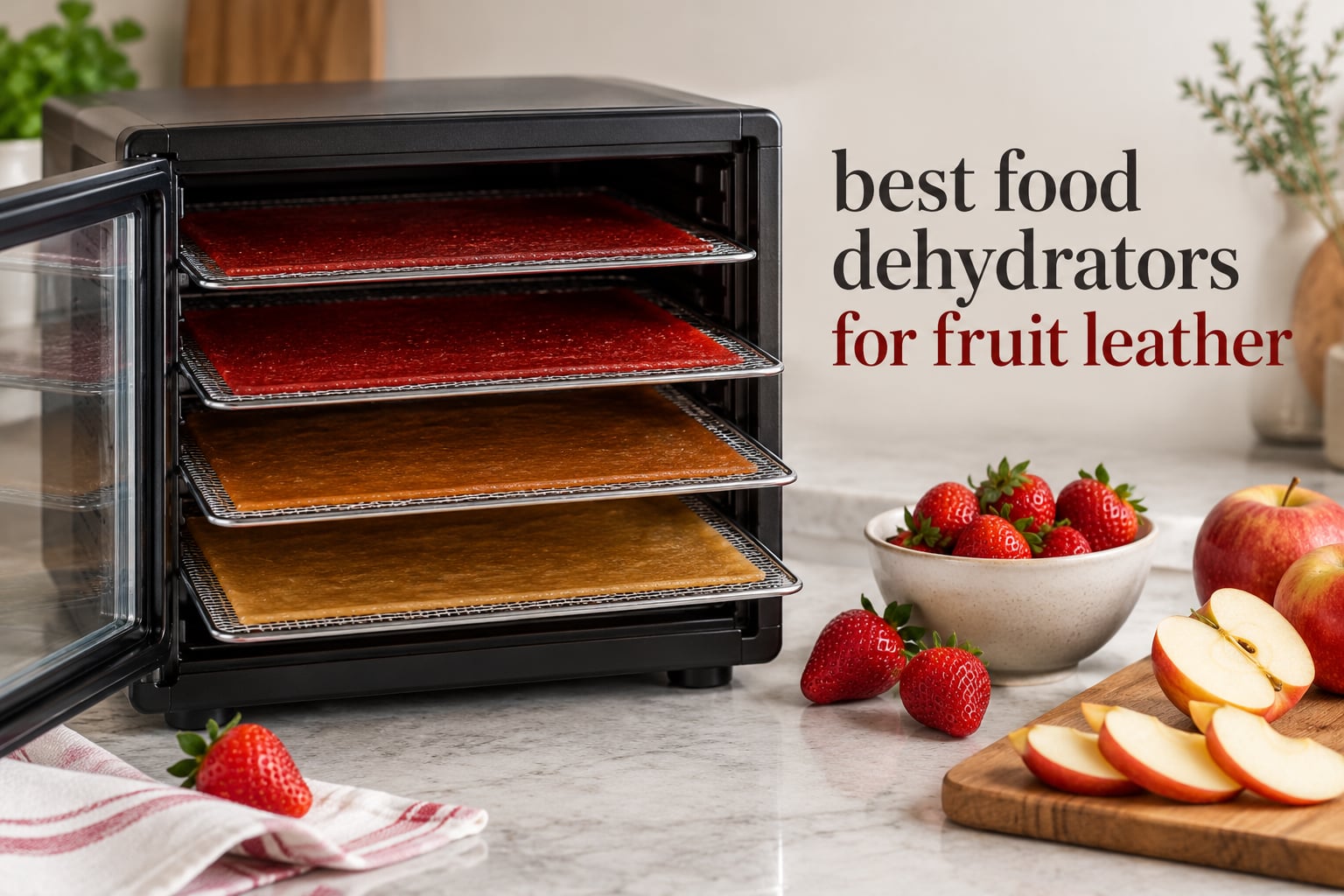
If you only plan to make one thing with a dehydrator, fruit leather is the hardest. Jerky tolerates sloppy heat and uneven trays; leather does not. A sheet that dries too fast on the outside seals itself, traps moisture inside, and can come out of storage fuzzy and sour. So the best food dehydrators for fruit leather are not simply the highest rated machines. They are the ones with a thermostat you can hold steady between 135 and 145F, a fan that circulates horizontally, and trays without a hole in the middle.
A food dehydrator for fruit leather is a countertop appliance with a forced-air fan, a thermostat covering roughly 105F to 165F, and solid or liner-compatible trays that turn poured fruit puree into a chewy, rollable sheet. Get those three right and you can make a full sheet of apple or strawberry leather in a single afternoon. Miss the thermostat and you will spend extra batches learning what case hardening feels like.
Our team spent weeks running fruit through eight popular dehydrators and comparing what actually came off the tray: sheet size, peelability, and how much drip ended up on the floor. As of 2026, here is how each one holds up when the job is specifically fruit leather, not trail beef.
Table of Contents
Can You Make Fruit Leather in a Food Dehydrator?
Yes, and a dehydrator does it better than an oven. Set the temperature to 135-145F, spread the puree about 1/8 inch thick, and allow 6-8 hours. An oven takes up to 18 hours for the same sheet. The reason is airflow: a fan and a thermostat let you hold a narrow temperature band for hours without the outside of the sheet cooking shut before the center dries.
The one rule is patience. Turning the heat up to finish faster is what ruins leather, because the surface dries and hardens first and seals moisture in. That trapped moisture is exactly what breeds mold later on.
Top 3 Picks for Fruit Leather (October 2026)

Cosori 6-Tray Stainless
- 6.5 ft2 across 6 stainless trays
- 95-165F degree-by-degree control
- Rear fan and under 48 dB running noise
- Fruit roll sheet in the box
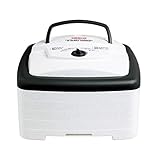
NESCO FD-80A Square
- Square trays
- no center hole
- Expands from 4 to 8 trays
- Top-mounted heater keeps juice off the motor
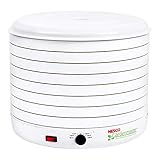
NESCO Gardenmaster Pro
- Comes with 8 fruit roll sheets and 8 screens
- Expands to 30 trays
- 95-160F thermostat
- 1000 W Converga-Flow fan
Quick Comparison of the Eight Dehydrators in 2026
Every machine below dries fruit. The differences that matter for leather are the tray footprint, how precisely you can hold temperature, and whether the box includes the liners you need. Scan the table first, then read the full review on the two or three that fit your counter and your batch size.
| Product | Specifications | Action |
|---|---|---|
| Cosori 6-Tray Stainless Steel Dehydrator |
|
Check Latest Price |
| NESCO FD-80A Square Dehydrator |
|
Check Latest Price |
| NESCO Gardenmaster Pro FD-1018A |
|
Check Latest Price |
 Hamilton Beach 32100A Dehydrator Hamilton Beach 32100A Dehydrator |
|
Check Latest Price |
 OSTBA 5-Tray Dehydrator GGJ-261B OSTBA 5-Tray Dehydrator GGJ-261B |
|
Check Latest Price |
 Commercial CHEF CCD100W6 Dehydrator Commercial CHEF CCD100W6 Dehydrator |
|
Check Latest Price |
 Cosori CFD-N051-W Dehydrator Cosori CFD-N051-W Dehydrator |
|
Check Latest Price |
 Magic Mill MFD-5000 Dehydrator Magic Mill MFD-5000 Dehydrator |
|
Check Latest Price |
1. Cosori 6-Tray Stainless Steel Dehydrator – Best Overall for Fruit Leather
Cosori Food Dehydrator, 6 Stainless Steel Trays with 6.5 ft² Drying Space
- Largest drying area in the group at 6.5 ft2
- Precise digital control in single degree steps
- Rear-mounted fan dries evenly with no tray rotation
- Quiet enough for overnight runs
- Fruit roll sheet and mesh screen included
- Heaviest machine here at 18.1 pounds and a large counter footprint
- Highest cost in this roundup
- Brushed stainless trays need hand washing to keep the finish
This is the one we kept coming back to. Six stainless trays give 6.5 square feet of drying space, which means you can pour six sheets of puree at once and still have room to finish a batch started the night before. For a person who decides to make leather on Saturday from a crate of peaches, that is the difference between one session and two.
The control panel is the part that actually protects your fruit. Temperature runs from 95F to 165F in single degree steps, and the timer counts to 48 hours. We set 140F, hit start, and went to bed. The leather was dry and pliable in the morning rather than brittle at the edges.
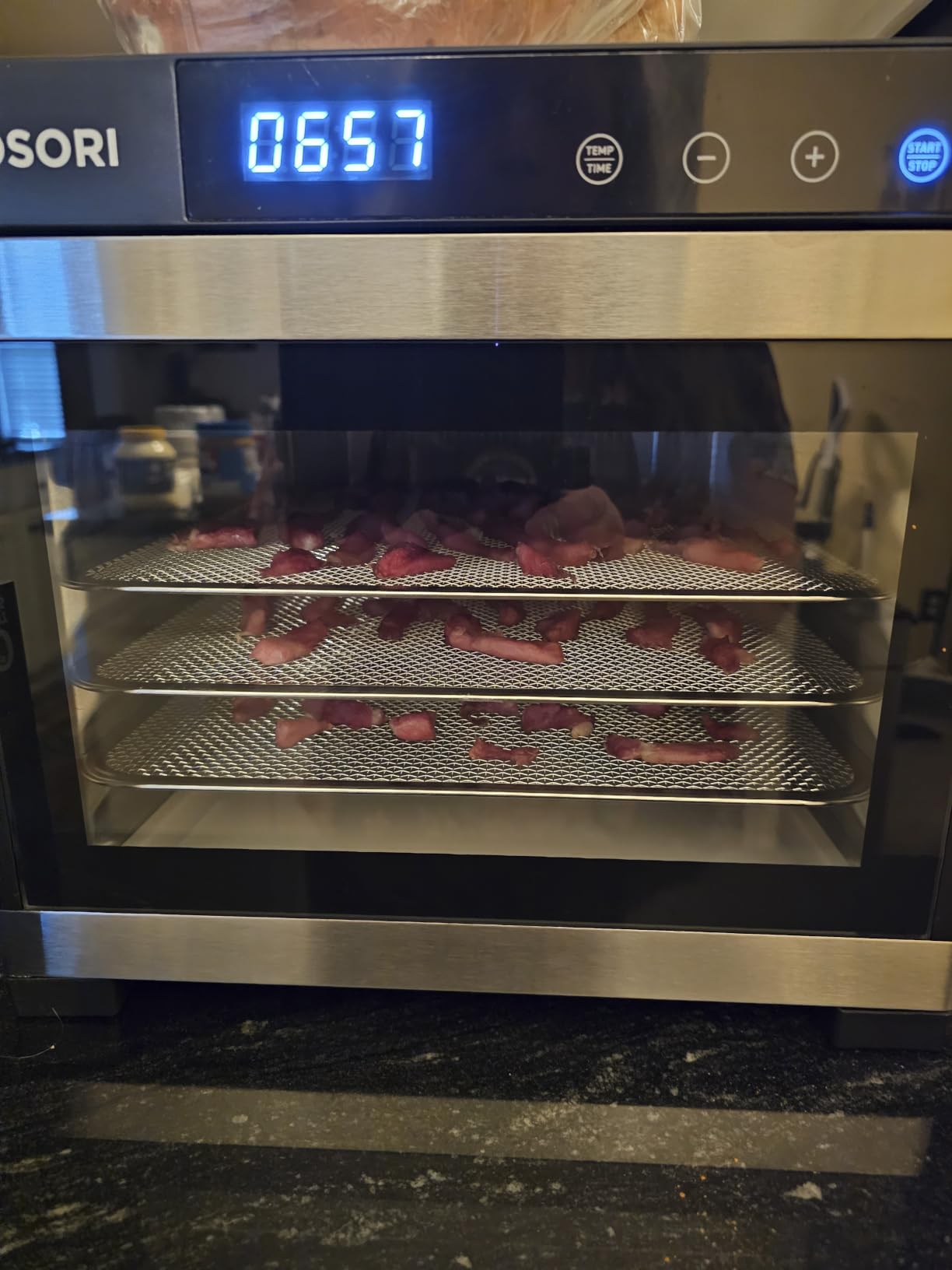
Airflow is horizontal, with the fan at the back of the cabinet and the heater behind it, so every tray sees the same moving air. You do not need to rotate trays halfway through, which is where most leather recipes go wrong. Owners on r/dehydrating single out this six-tray Cosori for being so quiet that they occasionally check that it is still running.
The included fruit roll sheet fits the stainless trays without trimming, and the mesh screen that comes with it is useful once you move on to herbs. There is also a 50-recipe cookbook in the box, which is more than most competitors bother to include.
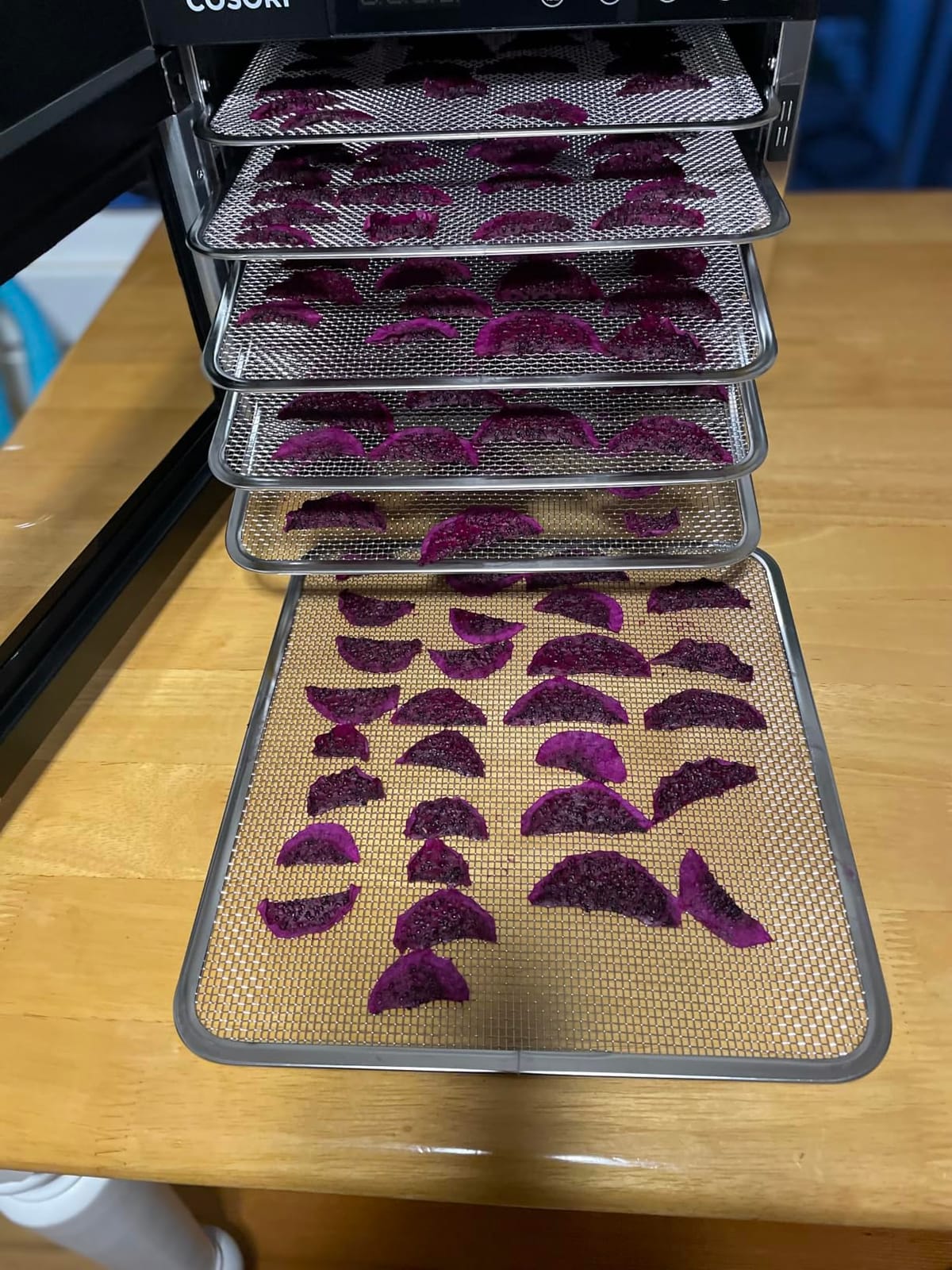
Will the Cosori 6-tray handle two full batches in a day?
Yes. At 6.5 square feet across six trays, a full load of 1/8 inch sheets clears in a single 6-8 hour run. Owners running overnight schedules report finishing a second load the next morning without reordering anything.
Rotation is not part of the routine here, so a batch can start before bed and be rolled in the morning.
Where the Cosori 6-tray frustrates people
It is the heaviest and bulkiest machine in this roundup at 18.1 pounds, measuring about 17.8 by 13.4 by 12.4 inches. Plan the counter space before you order.
The brushed stainless trays lose their finish in the dishwasher, so they need hand washing with warm water after every fruit batch. That is the cost of a plastic-free interior.
2. NESCO FD-80A Square Dehydrator – Best Square Trays for Spreading Puree
NESCO FD‑80A Square Food Dehydrator for Snacks, Fruit, Beef Jerky, 4‑Tray White Electric Dehydrator with Even Heat Drying
- Square trays give more usable area than round ones
- Expands from 4 to 8 trays as your batches grow
- Top-mounted heater keeps fruit juice off the motor
- Even airflow means no tray rotation
- Compact footprint for a 700 watt machine
- Single dial thermostat with no digital timer
- Plastic trays rather than stainless
- Fruit roll sheets are not included in the box
Square trays are the quiet advantage here. When you spread puree by hand or with an offset spatula, a rectangle gives you straight edges to follow and no dead zone in the middle, which is the single biggest advantage in leather making. Round trays collect a pool of fruit around the center hole and leave dry corners.
The FD-80A comes with four square trays and expands to eight, so the same body works for a first small batch and a harvest weekend. At 700 watts it heats a full chamber in a reasonable time without the long, slow runs you get from very low wattage machines.
Both the fan and the heating element sit at the top. That is unusual in this category, and it has a specific benefit for fruit work: juice runs down the trays and away from the motor instead of dripping onto the heating coil. For a week of strawberry leather, that layout is worth more than it looks on a spec sheet.
Do buy a set of silicone fruit roll sheets when you order this one. They are not in the box, and the plastic trays alone are fine but the liners are what make peeling clean.
Is the NESCO FD-80A good for beginners making their first batch?
Yes, provided you treat the dial as a starting point rather than a target. Owners who preheat for 15 minutes and then check the chamber with a kitchen thermometer report the most consistent results.
It is also the easiest machine here to expand, since add-on trays stack straight into the same column.
Where the FD-80A falls short for leather
There is no digital timer, so you decide when a run is finished by lifting the lid and touching the center of the sheet. That is workable but it is the least precise part of the machine.
The dial thermostat has a single marked setting of 160F and no intermediate readouts. NESCO owners online also report a top-to-bottom temperature gradient when they stack more trays than the manufacturer suggests, so keep it at four to six trays for leather.
3. NESCO Gardenmaster Pro FD-1018A – Best for Large Seasonal Batches
NESCO FD-1018A Gardenmaster Pro Food Dehydrator, 8-Tray White
- Only machine here that includes 8 fruit roll sheets and 8 Clean-A-Screens
- Expands to 30 trays for big harvests
- 1000 W airflow dries without tray rotation
- 95-160F range suits delicate fruit
- Owners report 3+ years of continuous use
- Louder than smaller countertop models
- Large footprint
- Oversized trays are awkward in a standard sink
- Knob thermostat is easy to overshoot
Nobody else in this roundup opens a box with more leather supplies in it. The Gardenmaster Pro FD-1018A comes with eight fruit roll sheets and eight Clean-A-Screens, plus a jerky seasoning sample and a 52-page recipe guide. If your first project is leather, there is nothing else to buy on day one.
The 1000 watt Converga-Flow system drives air from the top and down through the stack, which is how this model dries eight trays of purée without asking you to shuffle them around. That matters more at volume than at home. One bad batch is a nuisance; one bad batch in the middle of a two-week peach harvest is wasted fruit.
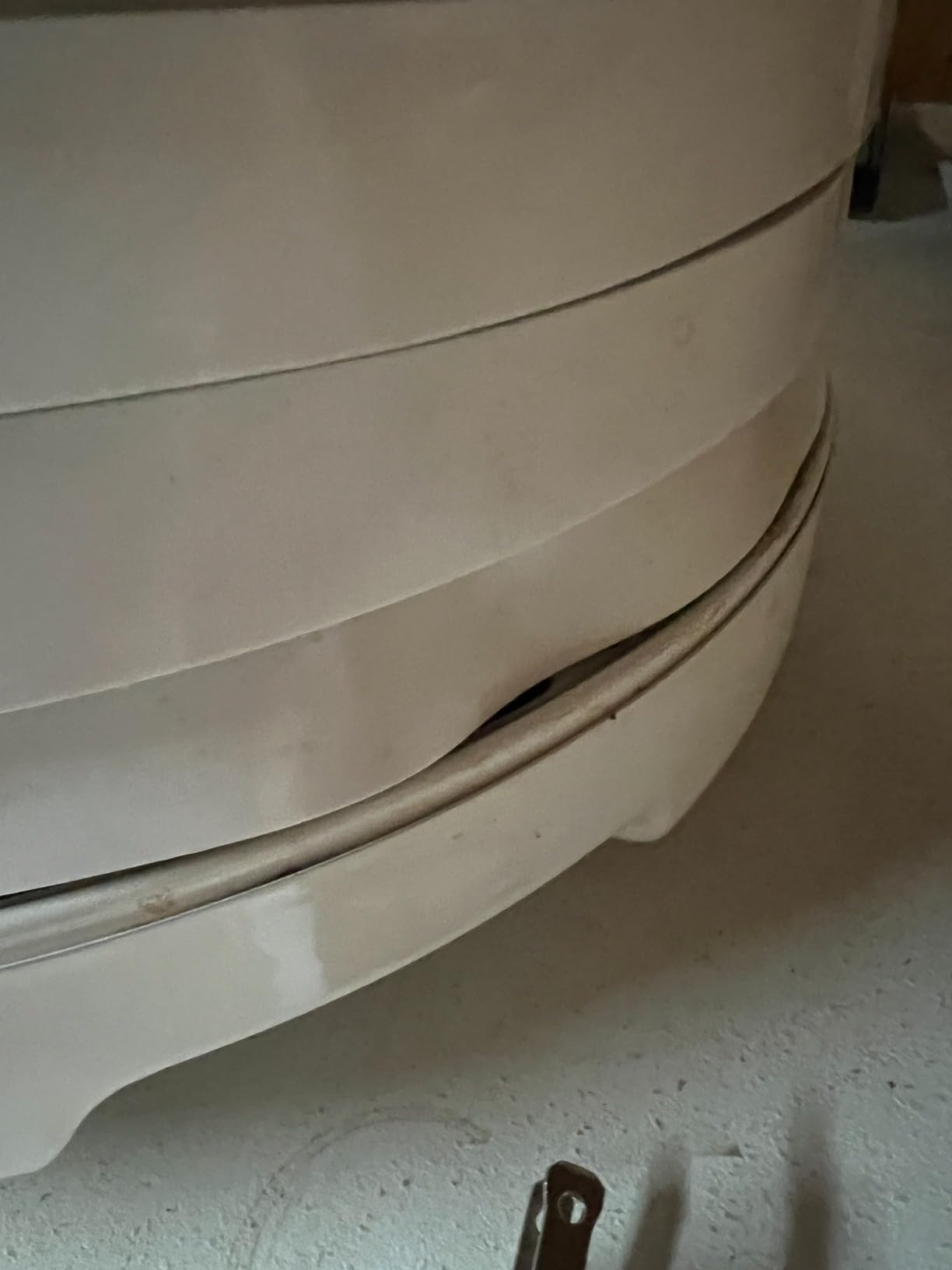
Capacity is the headline. Eight trays ship in the box and the system expands to 30, which means a farm share of plums or a farmer market haul becomes a single run instead of a schedule. Several reviewers specifically call out the included fruit roll sheets as the reason they bought the machine, and long-term owners describe three or more years of steady use.
Storage is a real consideration. The unit measures about 17 by 15.5 by 14 inches, and those eight trays are large enough that a standard kitchen sink is a tight squeeze. We wash ours over a sheet pan on the counter.
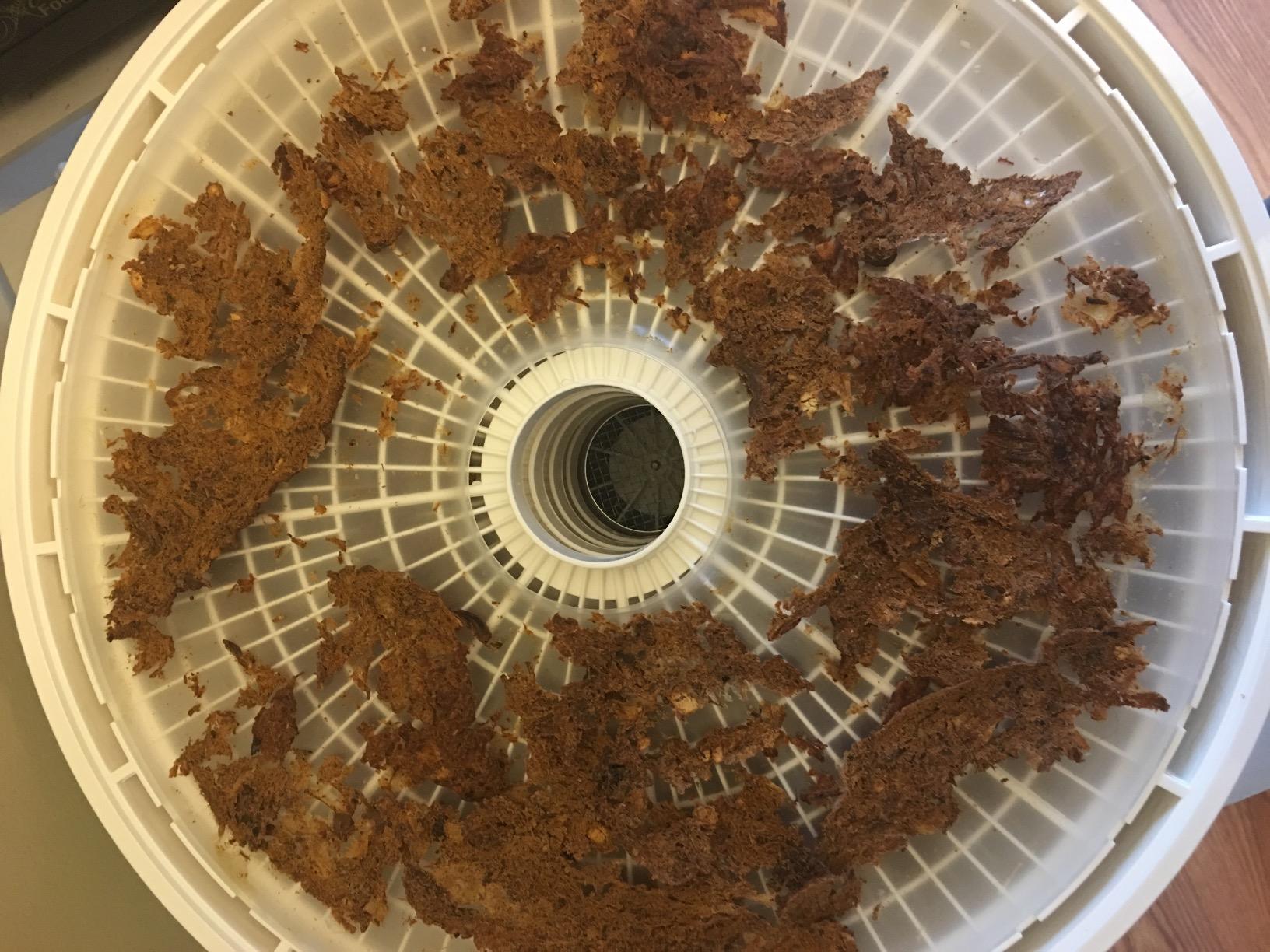
Is the Gardenmaster Pro overkill for a household that makes a few sheets a month?
If you make leather more than once in a while, the 8-to-30 tray expansion pays for itself the first time you face a real harvest. The starting configuration is 8 trays, which is still more than most of this list.
For occasional gift batches, the smaller square models on this list do the same job in a smaller box.
Where the Gardenmaster Pro disappoints
It is noticeably louder than the 350 watt and 500 watt machines here, and owners report it warming the surrounding room during long runs. If you plan to dry overnight in a quiet house, test the noise first.
The knob thermostat is the other weak point. It has no digital readout, so nothing tells you when you have drifted past 145F and started cooking the outside of a sheet.
4. Hamilton Beach 32100A Dehydrator – Best Digital Timer Control
Hamilton Beach Digital Food Dehydrator for Fruit, Jerky, Vegetables & More
- Digital timer counts down from 1 to 48 hours with auto shutoff
- Includes a solid sheet made specifically for fruit leather
- Square body fits under most cabinets
- Trays and lid are dishwasher safe
- Clear vented lid for checking progress
- Only one mesh screen
- with a coarse grid
- Audible fan
- 500 watts means longer runs and uneven top-to-bottom drying
- Plastic odor on the first run
A leather batch takes 6-8 hours and finishes when the center of the sheet stops feeling tacky. A machine that shuts itself off removes the only real temptation to over-dry, and the Hamilton Beach 32100A is the one in this group with a proper countdown to 48 hours. Set 7 hours at 140F, walk away, and come back to finished sheets.
It also ships with a solid sheet made specifically for fruit leather, which matters because a mesh screen is the wrong surface for poured puree. Puree runs through a mesh grid and pools underneath, and the grid is a pain to scrub.
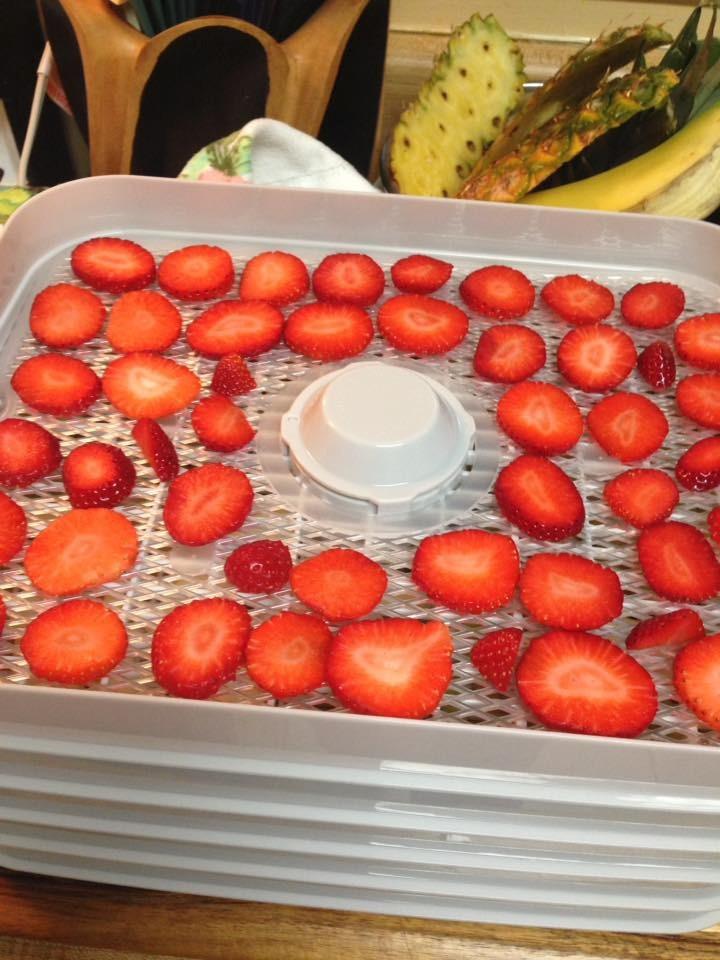
The body is square and about 10.4 by 13.2 by 11.3 inches, and at 8 pounds it is easy to move when you need the counter. The clear vented lid lets you watch a sheet without breaking the airflow, which matters more than it sounds when you are deciding whether the edges are set.
Trays and lid go in the dishwasher, so cleanup after a full day of applesauce-based leather is a fifteen-minute job rather than a scrub.
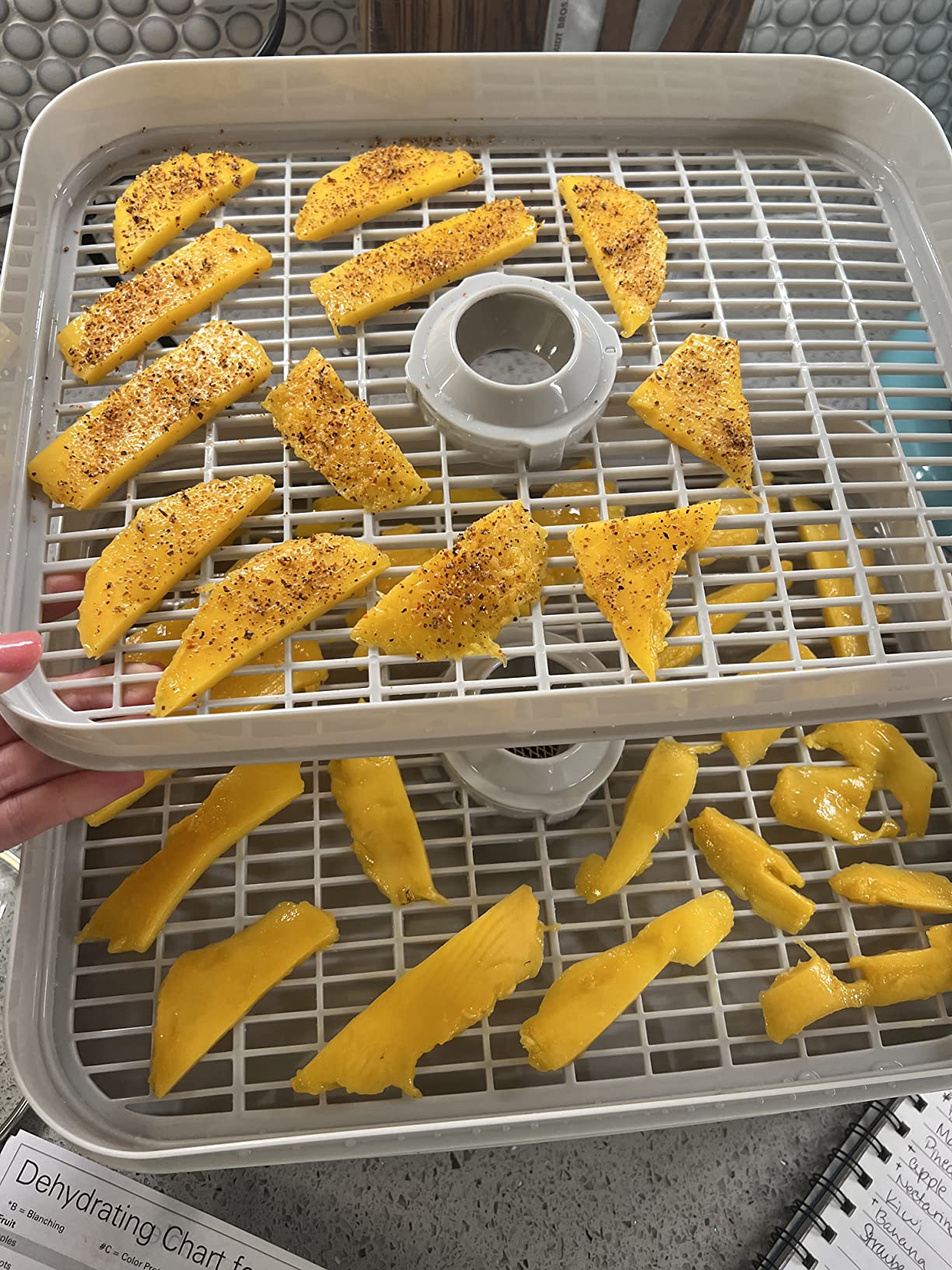
Is the Hamilton Beach 32100A accurate enough to avoid case hardening?
The digital 100-160F setting holds steady once the chamber heats, and a full-load run at 140F came out evenly dried across five trays in our testing. Just give it 10 minutes of preheat with the door closed before you pour.
The one real issue is airflow. At 500 watts, the top trays dry faster than the bottom ones during a long run, so rotate halfway if you load all five.
Where this Hamilton Beach falls short
Only one mesh screen is included, and reviewers note the grid is coarse enough that small fruit pieces and herbs fall straight through. Buy extra mesh if you plan to dry more than leather.
The fan is audible, roughly on par with a box fan on low, and new owners frequently mention a plastic smell on the first run. Air the empty machine out for 20 minutes before your first sheet.
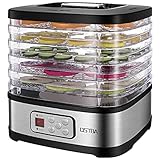
5. OSTBA GGJ-261B – Best for Small Spaces for First-Time Leather Makers
OSTBA Food Dehydrator, 5 Trays, 240W Dryer for Jerky, Fruit & Snacks
- Longest timer here at 72 hours for multi-stage runs
- Lightest five-tray option at 4.1 pounds
- See-through window for monitoring
- Trays stack into a small footprint
- Dishwasher-safe trays and 24-month warranty
- Lowest power at 240 watts
- so runs are slow
- 158F ceiling limits harder jerky work
- No fruit roll sheets in the box
This is the machine we recommend to someone who wants to find out whether they like making leather before committing counter space. Five trays, a see-through window, and a 72-hour timer cover everything a first batch needs, and the body is small enough to store in a cupboard between uses.
The temperature range of 95F to 158F brackets the 135-145F window that leather needs, and the digital panel sets both heat and time. That combination is uncommon at this end of the range, where most competing machines give you a single dial.
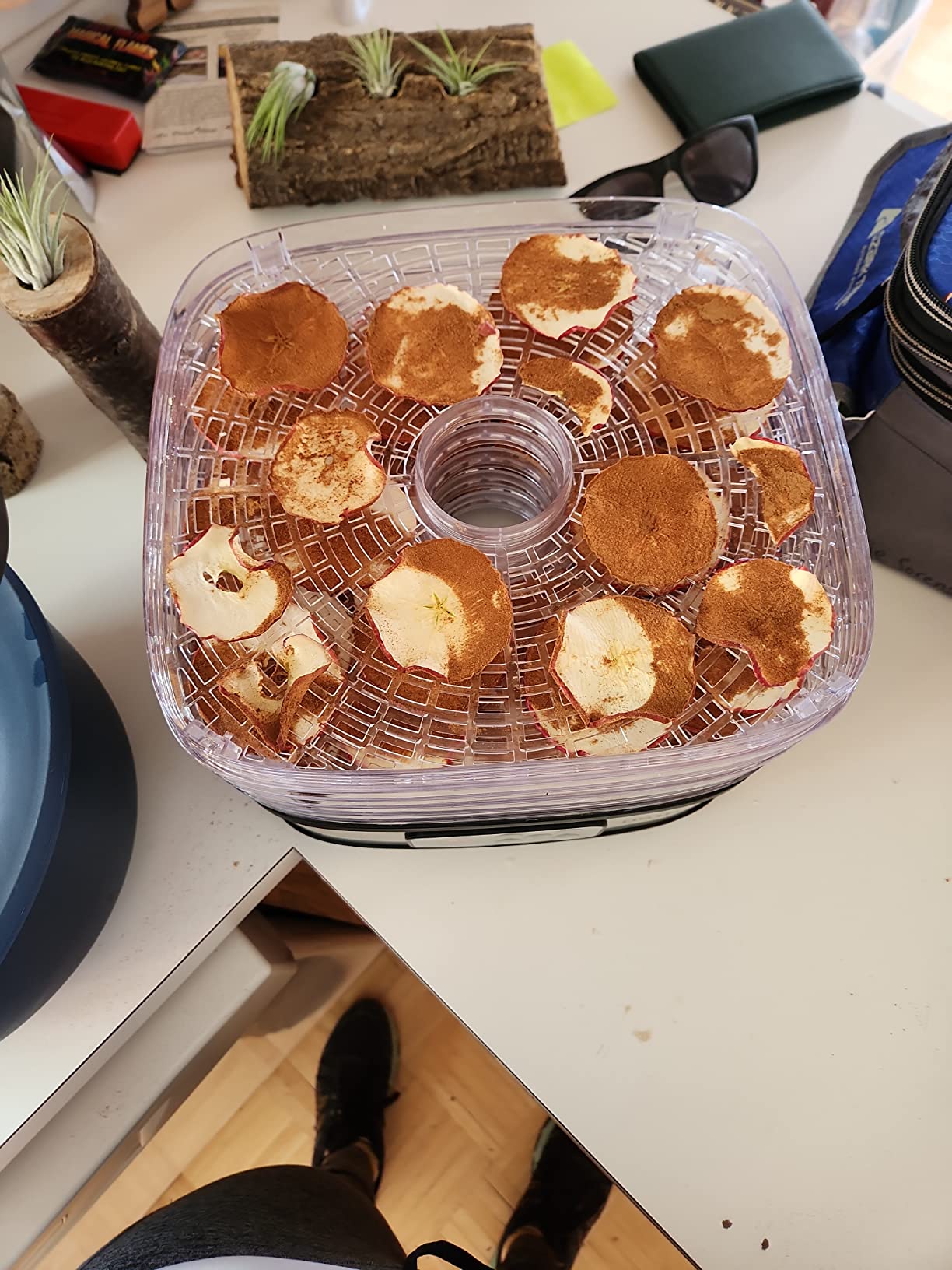
All five trays are BPA-free and dishwasher safe, and the 360 degree circulation spreads air around the chamber. We measured roughly 9.45 by 10.24 by 8.27 inches and 4.1 pounds, which is the easiest unit here to carry from the shelf to the counter.
At 4.3 stars across more than 7,000 reviews, the rating spread is the widest in this group, which tracks with what people buy it for. Casual fruit and herb work suits it well.
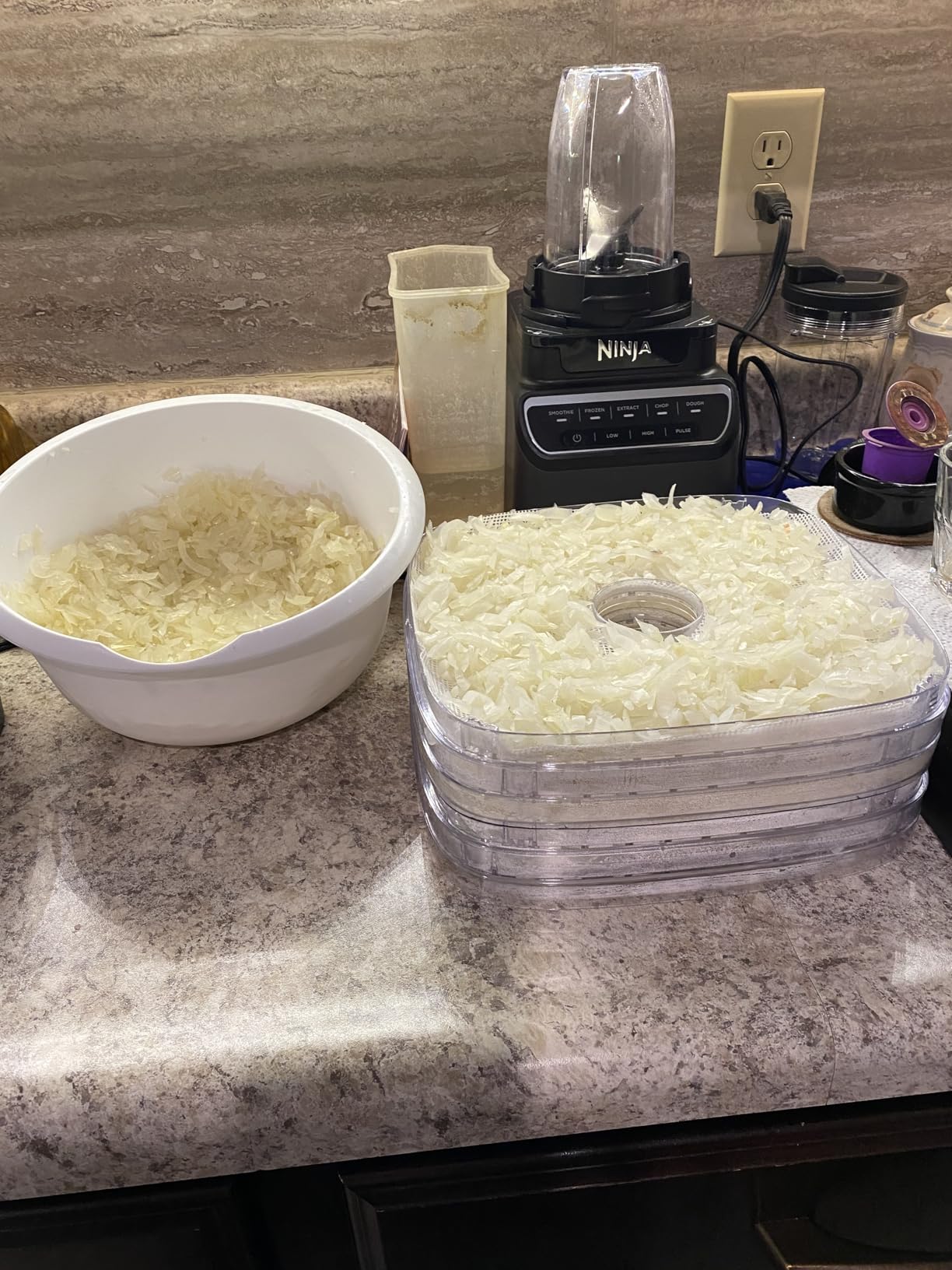
Can the OSTBA 5-tray make a full sheet of fruit leather?
Yes, but plan for time. At 240 watts a 1/8 inch sheet at 140F typically needs closer to the far end of the 6-8 hour window, and thick spreads run longer still.
Rotate the trays once if you fill all five. The window and LED panel make that easy to monitor.
Where the OSTBA GGJ-261B falls short
240 watts is the lowest power figure in this roundup, and it shows up as longer runs rather than uneven ones. If you are drying leather every week, plan the time accordingly.
No fruit roll sheets are included, so add silicone liners to your first order. The 158F ceiling also means this is a fruit machine, not a jerky machine.
6. Commercial CHEF CCD100W6 – Best Small-Footprint Starter Dehydrator
Commercial Chef Food Dehydrator, Five 9.25” BPA-Free Trays, CCD100W6, White
- Smallest and lightest body here at 3.3 pounds
- Stores in a pantry or cupboard
- Clear trays let you watch a sheet without opening the lid
- Owners report good results for fruit leather and cocktail garnishes
- No digital timer
- only a dial thermostat
- Trays feel flimsy and can crack if dropped
- Chamber loses heat so some owners add insulation
- Small round trays limit sheet size
At 3.3 pounds and about 9.92 by 9.43 by 7.01 inches, this is the dehydrator that lives in a cupboard and comes out for a weekend project. If you make leather twice a year rather than twice a week, footprint matters more than wattage.
The clear trays are genuinely useful. You can watch a sheet set at the edges without opening the lid and cooling the chamber, and the round 9.25 inch trays are easy to hold under a stream of warm water.
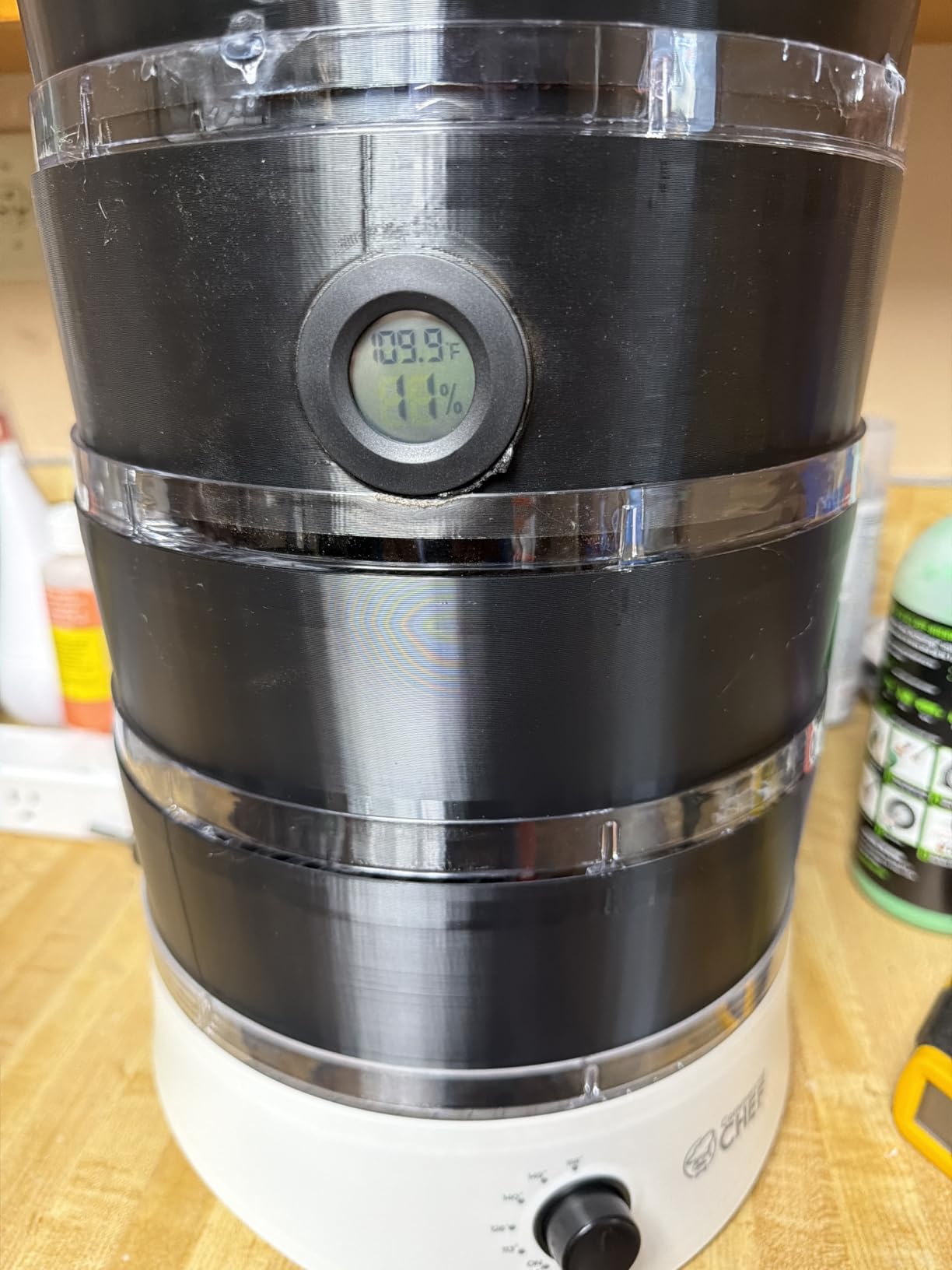
Temperature runs from 104F to 158F, which covers the leather window comfortably, and 280 watts is enough for fruit because fruit is mostly water and low heat. Reviewers buy it for banana chips, herbs, dog treats, and small fruit sheets, and rate the results well within those uses.
We would treat it as a learning machine. Get the technique right here before you buy something with a 1000 watt heater and a bigger appetite for your time.
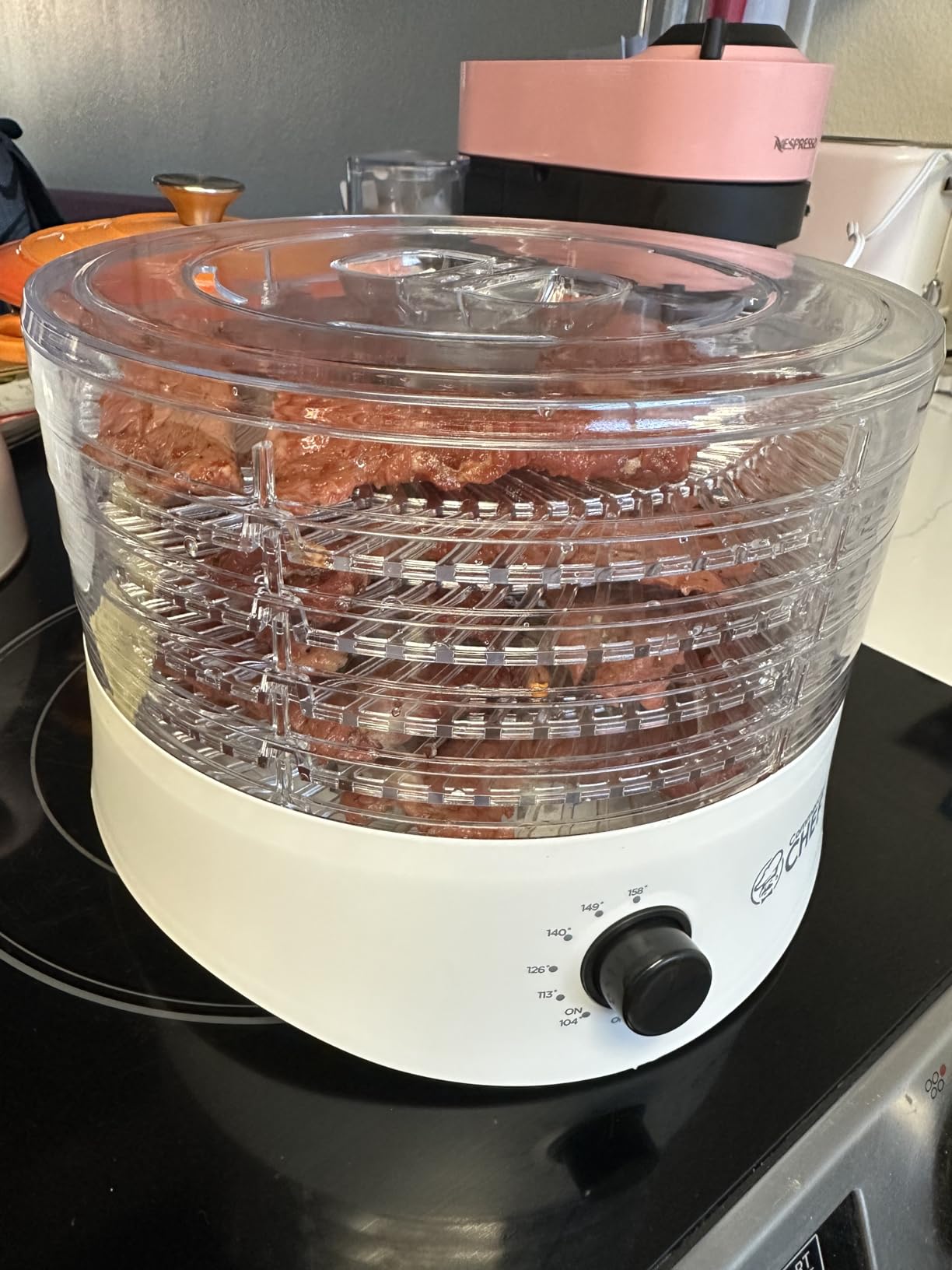
Is the Commercial CHEF too small for full sheets of fruit leather?
The 9.25 inch round trays hold smaller sheets than a square tray, and the round shape collects a ring of dried puree around the rim. Expect palm-sized leathers rather than one large sheet.
That is fine for snack portions and garnishes, less fine if you want one full-size sheet to roll.
Where the CCD100W6 falls short
There is no timer, only a dial thermostat that several buyers describe as imprecise. You are checking by hand.
Owners report the chamber losing heat over a long run and some add insulation, and the trays are described as flimsy, so do not drop them. The dial also overshoots more readily than a digital panel.
7. Cosori CFD-N051-W – Best Temperature Precision for Delicate Fruit
Cosori Food Dehydrator, 5 BPA-Free Trays, 165°F Temperature Control, 350W
- 165F ceiling in single degree increments
- Owners using calibrated probes confirm even temperature across tray levels
- Quietest running machine here
- Coated solid trays release stuck leather with hot water
- Expands from 5 to 7 trays
- Accessory mats and liners sold separately
- Liners must be trimmed to fit round trays
- Some owners report lid cracking on high-temperature jerky runs
- One report of liquid reaching the motor base
Precision is the whole reason to pick this one. The dial steps in single degree increments from 95F to 165F, and the 48-hour timer moves in 30-minute jumps. That combination lets you hold 140F for eight hours without overshooting, which is the difference between flexible leather and a brittle sheet.
Owners who checked with calibrated temperature probes report the same temperature at every tray level, top to bottom. On a five-tray run that saves you from rotating, and it removes the most common cause of a failed batch.
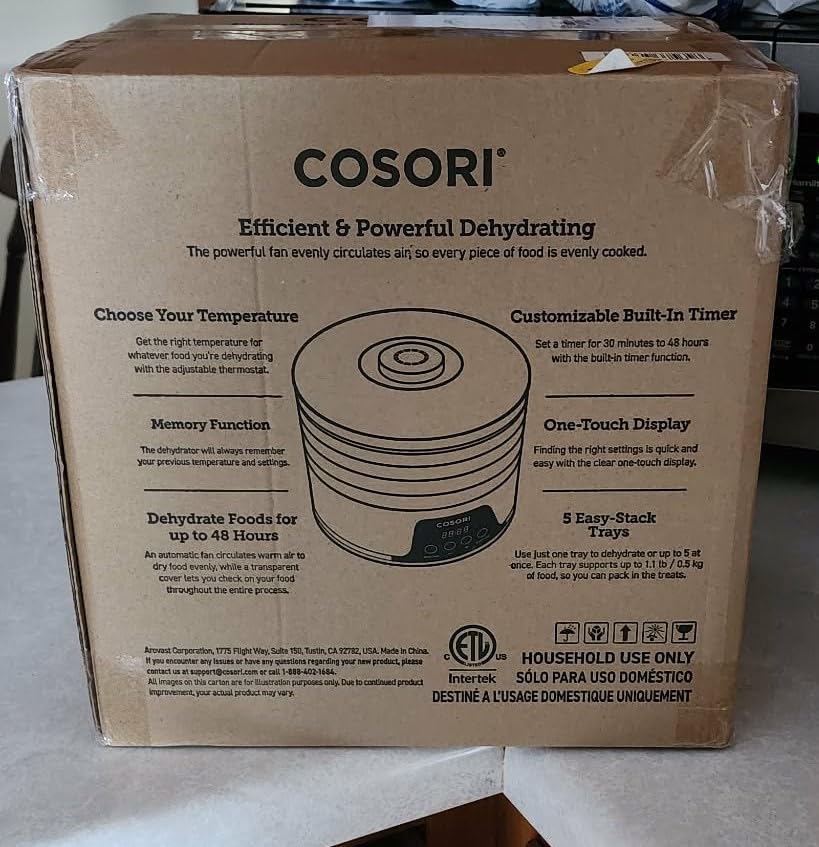
The trays are solid coated material rather than a clear shell, and that single decision changes cleanup. Sticky fruit leather paste comes off with hot water and a sponge instead of a soak. The trays expand from five to seven, and the tray height is adjustable for thicker cuts.
At under 47 dB it is the quietest machine we ran, which matters for a load started before dinner and finished after bedtime.
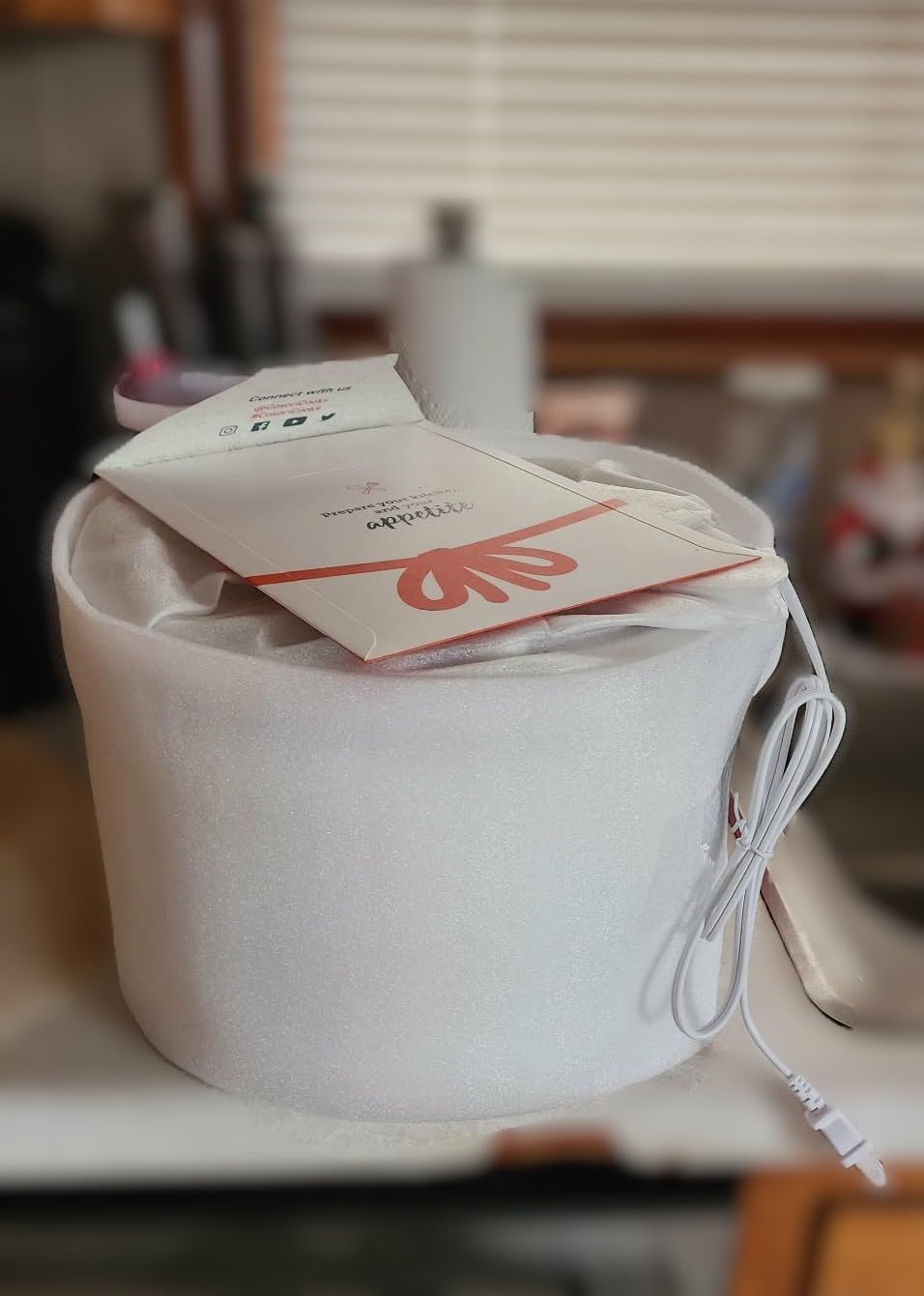
How long does leather take on the Cosori CFD-N051-W?
A 1/8 inch sheet at 140F finishes in roughly 6-8 hours, which is the standard window. Owners running thicker spreads and mixes with chia or dates report times approaching 24 hours.
Set the timer in 30-minute steps and check the center of the sheet rather than the edges, since the edges set first.
Where the CFD-N051-W falls short
The accessory mats and fruit leather liners are not included and have to be bought separately. That is the main reason this is not first on our list despite excellent controls.
Round trays of 12.2 inch outer and 11.6 inch inner diameter mean liners have to be trimmed to fit, which wastes a sheet and makes the edge harder to peel cleanly. A few owners also report lid cracking on very hot jerky runs, and one isolated report of liquid reaching the motor base after drying very juicy fruit.
8. Magic Mill MFD-5000 – Best Stainless Steel Value
- Stainless steel trays instead of clear plastic
- Highest ceiling here at 167F
- Adjustable tray spacing fits thicker cuts
- Digital panel sets temperature and time
- Trays detach fully and are dishwasher safe
- Low power at 240 watts
- so runs take a while
- Tall rectangular body
- No fruit leather sheets included
- Specifications are listed inconsistently across listings
For people who want stainless steel trays in a machine that also has a digital panel, this is the option. The body is BPA-free plastic with a stainless base, and the five food-grade stainless trays detach for the dishwasher, so there is no clear plastic anywhere that touches fruit.
That material choice addresses a concern that comes up constantly in dehydrating forums. Owners who are uneasy about heating plastic next to acidic fruit generally point to stainless as their resolution, and this machine delivers that at the lower end of the price range.
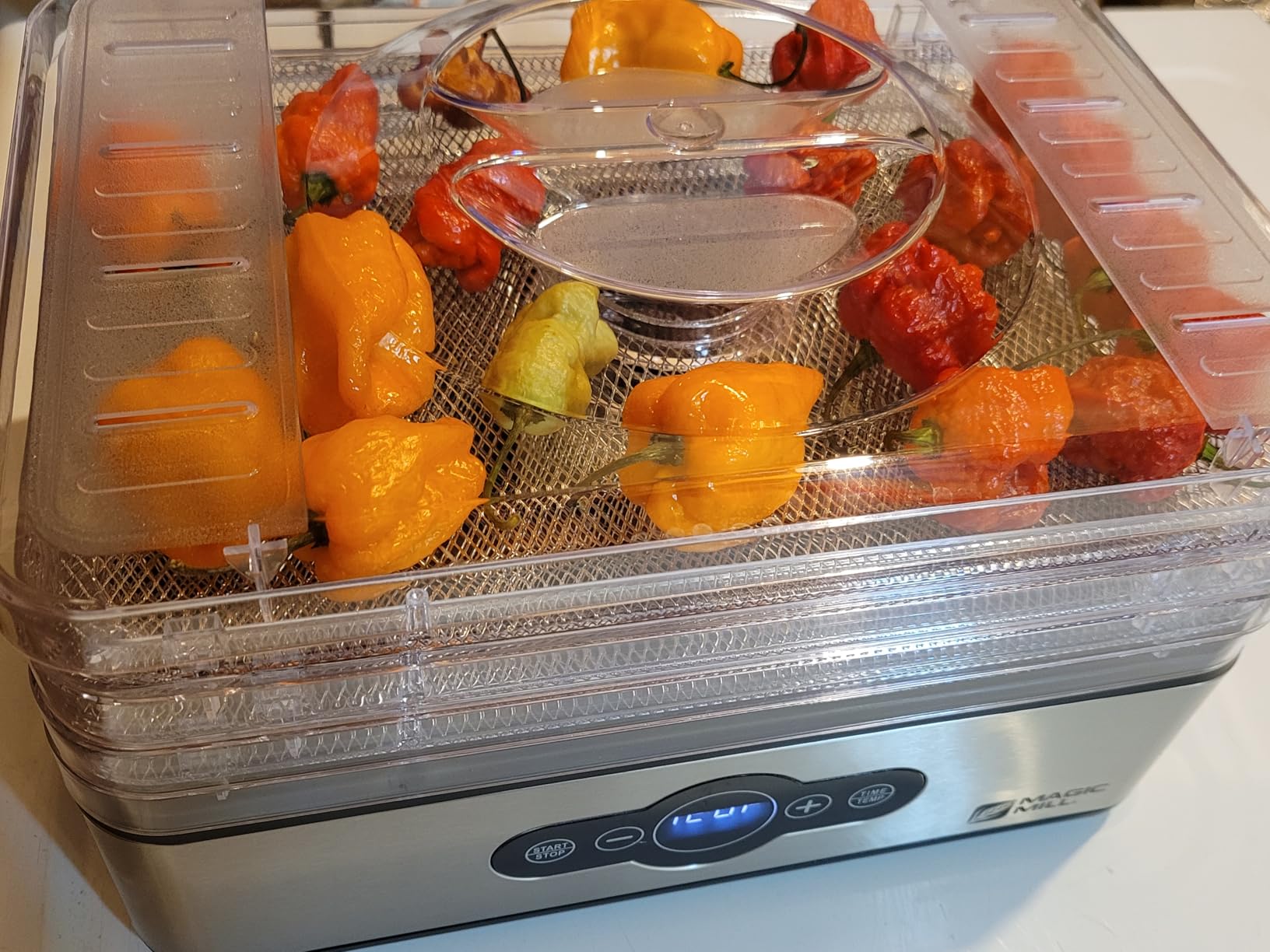
Temperature runs from 95F to 167F, the highest ceiling in this roundup, and the digital panel handles both heat and a 48-hour timer. Tray spacing adjusts from 0.6 to 1.1 inches, which is useful when you move from thin leather sheets to thick fruit rounds in the same machine.
Dimensions are about 8.5 by 11.8 by 11 inches. It is a tall, narrow tower rather than a low box, so check the shelf height where you plan to store it.
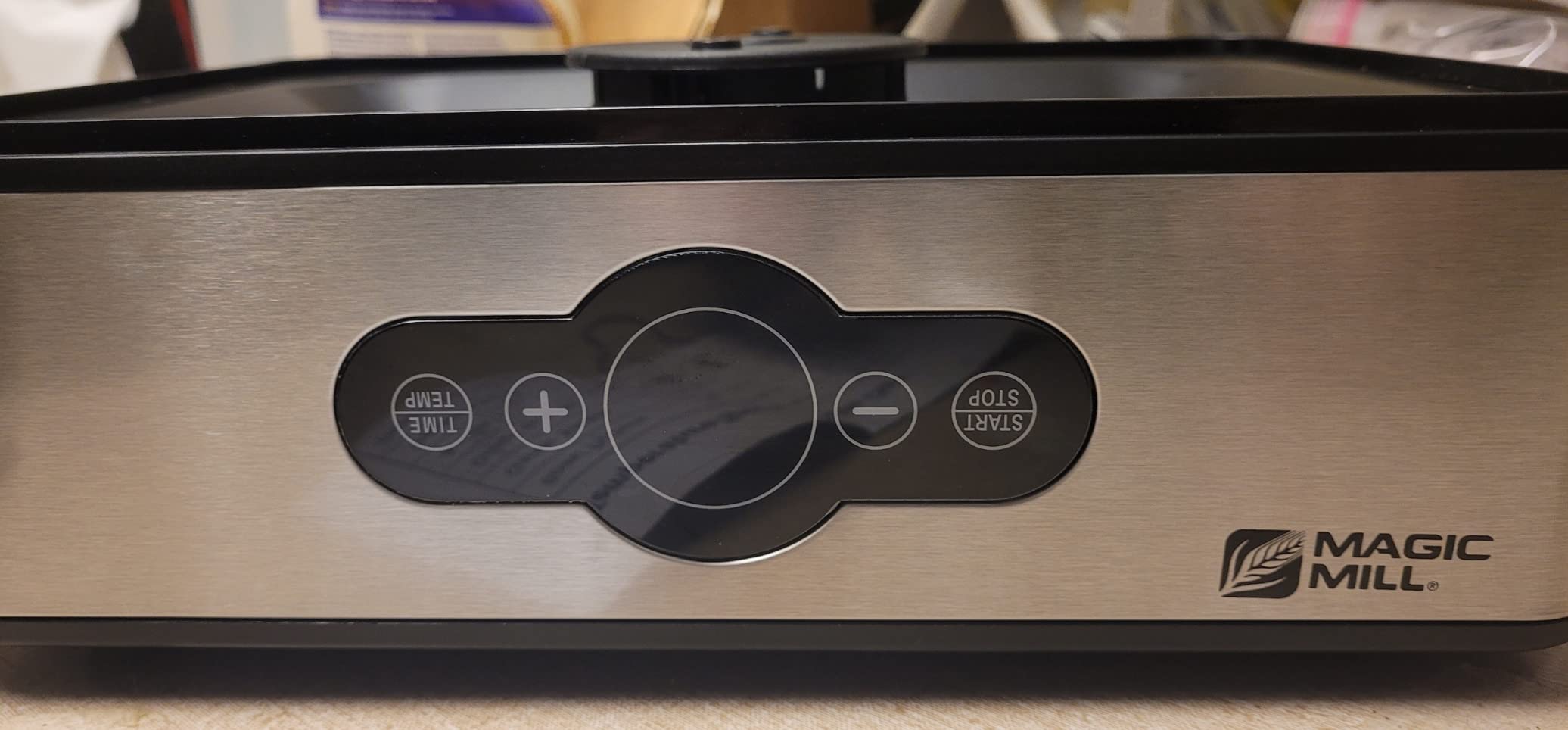
Is the Magic Mill MFD-5000 good enough for fruit leather specifically?
Yes, with the caveat that it is slow. At 240 watts a 1/8 inch sheet at 140F needs the full 6-8 hours and sometimes longer, but the temperature holds steady at the setting you choose.
Add silicone liners to your order, because none are included.
Where the Magic Mill falls short
240 watts is tied for the lowest here, so plan longer runs and do not stack more trays than the manufacturer suggests. Users also report the temperature specification being listed inconsistently across listings, so confirm the range with a thermometer on your first run.
It does warm the surrounding room during long cycles, and the tall body takes more vertical space than the low-profile models.
How to Choose a Dehydrator for Fruit Leather
Most dehydrator roundups rank machines on jerky, herbs, and capacity. Those are the wrong criteria for leather, and the reason most general-purpose lists do not translate well to this job. Here are the six checks that actually decide whether you get a flexible sheet or a wasted tray of puree.
Look at usable tray area, not total drying space
Total drying space counts the whole tray footprint. Usable area is what is left after the frame, and it is the number that predicts how much puree you can spread. Square and rectangular trays give you more usable area per tray than round ones because a circle wastes its corners and, on many round models, loses more to a center hole.
Two cups of puree roughly fills one 13 by 15 inch sheet. Compare that against the tray dimensions in the spec sheet before you buy, and prefer a model whose tray size matches common sheet sizes rather than one that needs trimming.
Check for a fan, and check where it is
A fanless dehydrator cannot hold an even temperature across a tray of poured puree. Fruit at the edges will case-harden while the center stays wet, and you will end up with a sheet that cracks when you try to peel it. Horizontal airflow from a rear or top mounted fan dries the whole surface at the same rate and removes tray rotation from your process.
Every machine in this roundup has a fan. If you are shopping outside it, that is the first thing to verify.
Require a thermostat you can read
Leather needs a narrow band, roughly 135-145F, held for 6-8 hours. A unit that runs at a single fixed temperature either cooks the outside of the sheet shut or takes twice as long. Digital controls with single degree steps are the most forgiving, and an auto shutoff timer removes the temptation to leave it running.
Pick the liner before the machine
You have three good options and one bad one. Food-grade silicone sheets with raised edges are reusable and the raised lip stops puree running off the tray, and an owner on r/dehydrating credits a lipped silicone liner with producing noticeably larger leathers than a flat liner. Manufacturer fruit roll sheets are thin, nonstick, and peel cleanly but are single use. Parchment paper works and is cheap, but it is also single use and must be replaced every batch.
Never use wax paper. It softens and can stick to the tray at dehydrator temperatures, and it is the one liner shortcut that ends with a ruined pan.
Check whether the machine includes liners. Two models in this roundup ship with fruit roll sheets and three do not, which changes the true cost of the first batch.
Decide between round and square trays
Round trays are common on compact machines and they circulate air evenly, but they force you to spread a ring of puree around a center hole, and a pooled edge dries into a hard band you trim off anyway. Square trays give you a rectangle to fill and a straight edge to lift from, which is why leather makers gravitate to them.
Choose round only when size and storage matter more than sheet shape, and choose silicone liners with a raised edge if you do.
Match capacity to how often you will actually run it
Expansion is the underrated feature. A four-tray machine that expands to eight gives you the small footprint of a starter and the capacity of a serious one when harvest season arrives. A ten-tray machine you run twice a year is just a large cupboard.
Think about the number of trays, whether the model includes sheets, and whether the unit will need its own shelf. Those three answers will narrow this list to two or three machines quickly.
How to Make Fruit Leather in a Dehydrator
The machine is the easy part. Most failed batches come from three mistakes, and all three are avoidable.
Follow the method that works
First, prepare the fruit. Fresh, ripe fruit gives the best flavor; frozen fruit works well too and is often smoother. Add about 2 teaspoons of lemon juice or a small amount of ascorbic acid per 2 cups of pale fruit to slow browning.
Second, spread the puree. Pour about 2 cups per 13 by 15 inch tray and smooth it to roughly 1/8 inch thick, leaving a one inch border around the edge. Edges dry faster, so a slightly thicker edge and a thinner center evens things out.
Third, dry it. Set the dehydrator to 135-145F and run 6-8 hours. Remove the liner at around the three hour mark if you used parchment, since the paper slows evaporation once the sheet releases its moisture.
Fourth, know when it is done. The center should no longer feel tacky and the sheet should flex without cracking when you lift an edge with a fingernail.
Fifth, peel and roll. Turn the tray upside down over a clean towel, lift the liner, and roll the sheet from the least sticky end with a spatula to guide the first turn.
Sixth, store it. Roll each sheet in wax-free paper or a food-safe bag, keep it airtight, and expect 2-4 weeks at room temperature. Vacuum sealing stretches that to several months, and freezing keeps it up to a year. Owners report ziplock storage holding about a week and vacuum sealed rolls staying good for four months.
Avoid the mistakes that ruin leather
The first mistake is raising the heat to speed things up. Above roughly 145F the outside of the sheet cooks and hardens while the center is still wet. The leather looks finished, feels fine on day one, and then grows fuzzy in storage. Lower heat and more hours is the entire fix.
The second mistake is pouring puree onto a mesh tray. It runs through the grid and pools on the bottom of the chamber, and the grid then takes a long time to clean. Use a solid sheet or a liner every time.
The third mistake is a tray with a center hole. Puree pools around it and dries into a hard collar. If that is your only option, pour thinner and start checking earlier.
The fourth is skipping the preheat. Give an empty machine 10-15 minutes at your target temperature before pouring, or the first minutes of your batch cook rather than dry.
The fifth is loading every tray and then walking away. On the lower wattage machines in this roundup, top trays dry faster than bottom ones. Rotate once at the halfway mark if the chamber is full.
Frequently Asked Questions
What is the best food dehydrator for making fruit leather?
For most people it is the Cosori 6-tray stainless steel model: 6.5 square feet of drying space, digital control in single degree steps from 95-165F, a rear fan that dries evenly without rotating trays, and a fruit roll sheet in the box. Choose the NESCO FD-80A instead if square trays and a small footprint matter more, or the NESCO Gardenmaster Pro if you want eight fruit roll sheets included and room to expand to 30 trays.
What temperature for fruit leather in a dehydrator?
Drying fruit leather at 140F for 6-8 hours gives the most consistent result, and anywhere from 135-145F works well. Do not raise the heat to finish faster. Above roughly 145F the outside of the sheet hardens before the center dries, sealing moisture inside, and the leather can mold in storage. An oven needs up to 18 hours for the same sheet.
Can you use parchment paper in a dehydrator to make fruit leather?
Yes, plain parchment paper works in a dehydrator for fruit leather and costs less than a branded liner. It is single use, so replace it for every batch, and remove it at around the three hour mark once the sheet releases so it stops slowing evaporation. Never substitute wax paper, which softens at dehydrator temperature and sticks to the tray.
What are the best dehydrator sheets for fruit leather?
Food-grade silicone sheets with raised edges are the best reusable option, and the raised lip stops puree from running off the tray and gives you a larger sheet. Manufacturer fruit roll sheets are the cheapest and peel most reliably, but they are single use. Parchment paper also works. Whichever you choose, it must be solid: never pour puree onto a mesh screen.
Can you put silicone trays in a dehydrator?
Yes, as long as the silicone is food-grade, BPA-free, and rated for dehydrator temperatures, which run well above 165F. Silicone liners are reusable, wash with warm water, and dry quickly. Trim them to fit your tray before the first pour, and replace any liner that has become sticky or warped rather than fighting it.
Do I need a fan for fruit leather?
Yes. A fan is what keeps the whole surface of a poured sheet drying at the same rate, so the edges do not case-harden before the center is dry. Fanless units dry from the bottom up, which leaves a hard rim and a wet middle. Prefer a rear or top mounted fan that pushes air horizontally, since that also removes tray rotation from your process.
How long does it take to dehydrate fruit leather?
A sheet spread 1/8 inch thick at 140F takes 6-8 hours in a dehydrator with a 500 watt or higher element. Thicker spreads, purees with chia or dates added, and very low wattage machines can run considerably longer, sometimes up to 24 hours. Check the center of the sheet rather than the edges, and stop when it no longer feels tacky.
How do you store homemade fruit leather?
Roll each sheet tightly in food-safe paper or a sealed bag and keep it airtight. At room temperature it stays good for 2-4 weeks. Vacuum sealing extends that to several months, and owners report rolls holding about four months when sealed, while a plain ziplock bag lasts closer to a week. Freezing keeps leather for up to a year.
Conclusion
Eight dehydrators, one job, and a very consistent way to fail: cranking the heat to speed up a sheet that needed patience. The best food dehydrators for fruit leather are the ones that let you hold 135-145F for a full 6-8 hours, move air horizontally across every tray, and give you a solid surface with no center hole to work around.
Our pick is the Cosori 6-tray stainless steel dehydrator, with the NESCO FD-80A for square trays and the NESCO Gardenmaster Pro for harvest volume as the two strongest alternatives. Whichever one you pick, buy silicone liners with raised edges before your first pour, and set the timer rather than your alarm. Then check back on our list as new models arrive through 2026.