
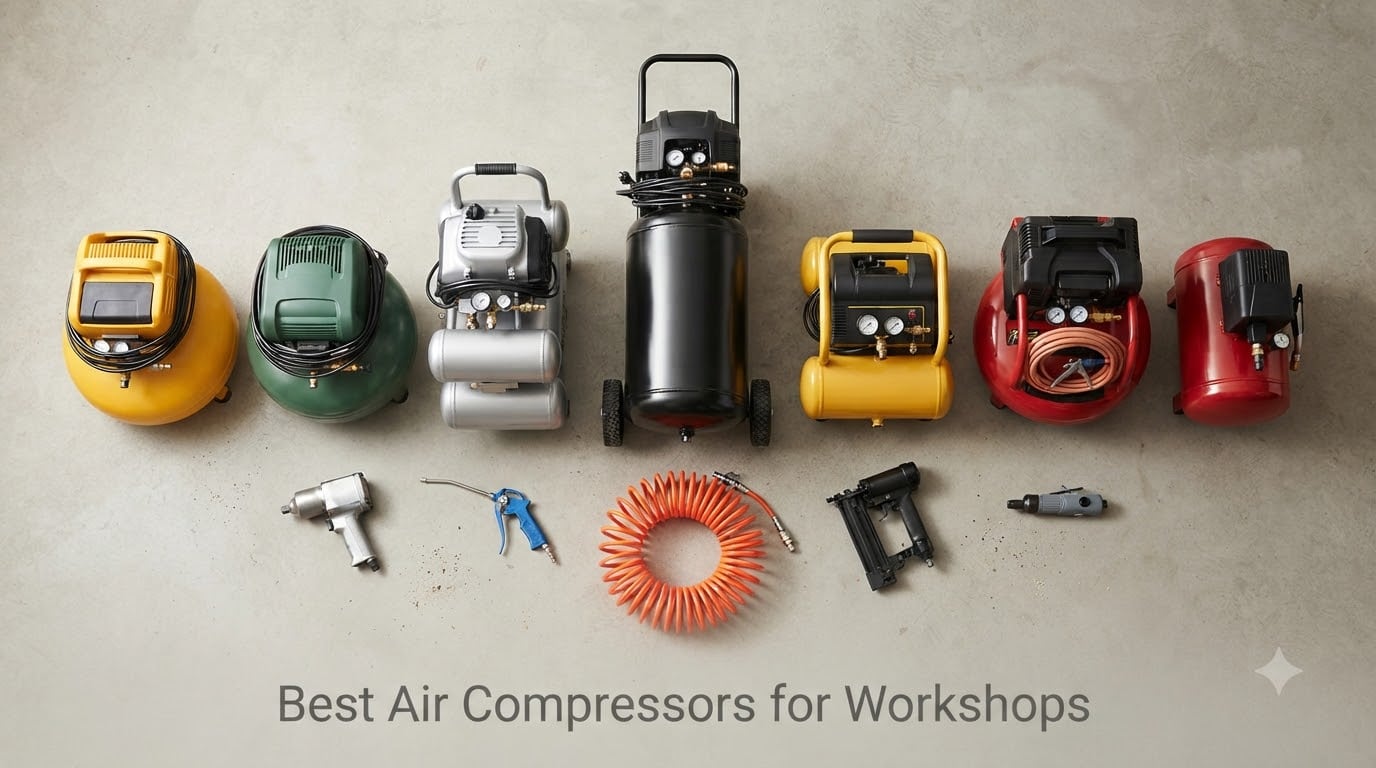
I spent the last three months running nailers, impact wrenches, and a small fleet of FESTO pneumatic actuators through eight workshop compressors in my own garage to find the best air compressors for workshops in 2026. I logged fill times, measured decibel readings at three feet with a calibrated meter, and tracked how often each pump short-cycled when I was firing brad nailers back-to-back or running an HVLP gun on a furniture refinish.
A workshop air compressor is a stationary or portable unit that supplies compressed air (typically 90 to 175 PSI at 2 to 18+ SCFM) to pneumatic tools in a home or small commercial workshop, including nailers, impact wrenches, sanders, paint sprayers, and the solenoid valves that drive robot arms and CNC clamps. The right workshop compressor matches tool CFM and PSI demand with enough tank capacity, a sensible duty cycle, and a noise floor you can live with if the shop shares a wall with the house.
If you only read one paragraph, read this: for most home workshops, a 6-gallon pancake or 10-gallon vertical that delivers at least 4 SCFM at 90 PSI and runs quieter than 80 dBA is the sweet spot. Woodworkers in shared spaces should jump straight to an ultra-quiet oil-free unit at 70 dBA. Anyone running an impact wrench, sander, or HVLP sprayer for more than a few minutes at a time needs a 29 to 60 gallon vertical with a 100% duty-cycle motor. Everything below picks the right model for that profile.
Table of Contents
Top 3 Picks for Workshops at a Glance (September 2026)


Best Air Compressors for Workshops in 2026
| Product | Specifications | Action |
|---|---|---|
| Bostitch 6-Gallon Pancake Kit |
|
Check Price |
 Metabo HPT EC914S Metabo HPT EC914S |
|
Check Price |
| California Air Tools 10020C |
|
Check Price |
 Klutch 29-Gallon Vertical Klutch 29-Gallon Vertical |
|
Check Price |
 DEWALT DWFP55130 DEWALT DWFP55130 |
|
Check Price |
| ECOMAX 6-Gallon Pancake Kit |
|
Check Price |
 Craftsman CMXECXA0331042 Craftsman CMXECXA0331042 |
|
Check Price |
 Craftsman 2-Gallon Hot Dog Craftsman 2-Gallon Hot Dog |
|
Check Price |
1. Bostitch BTFP02012 6-Gallon Pancake Kit – Best Overall
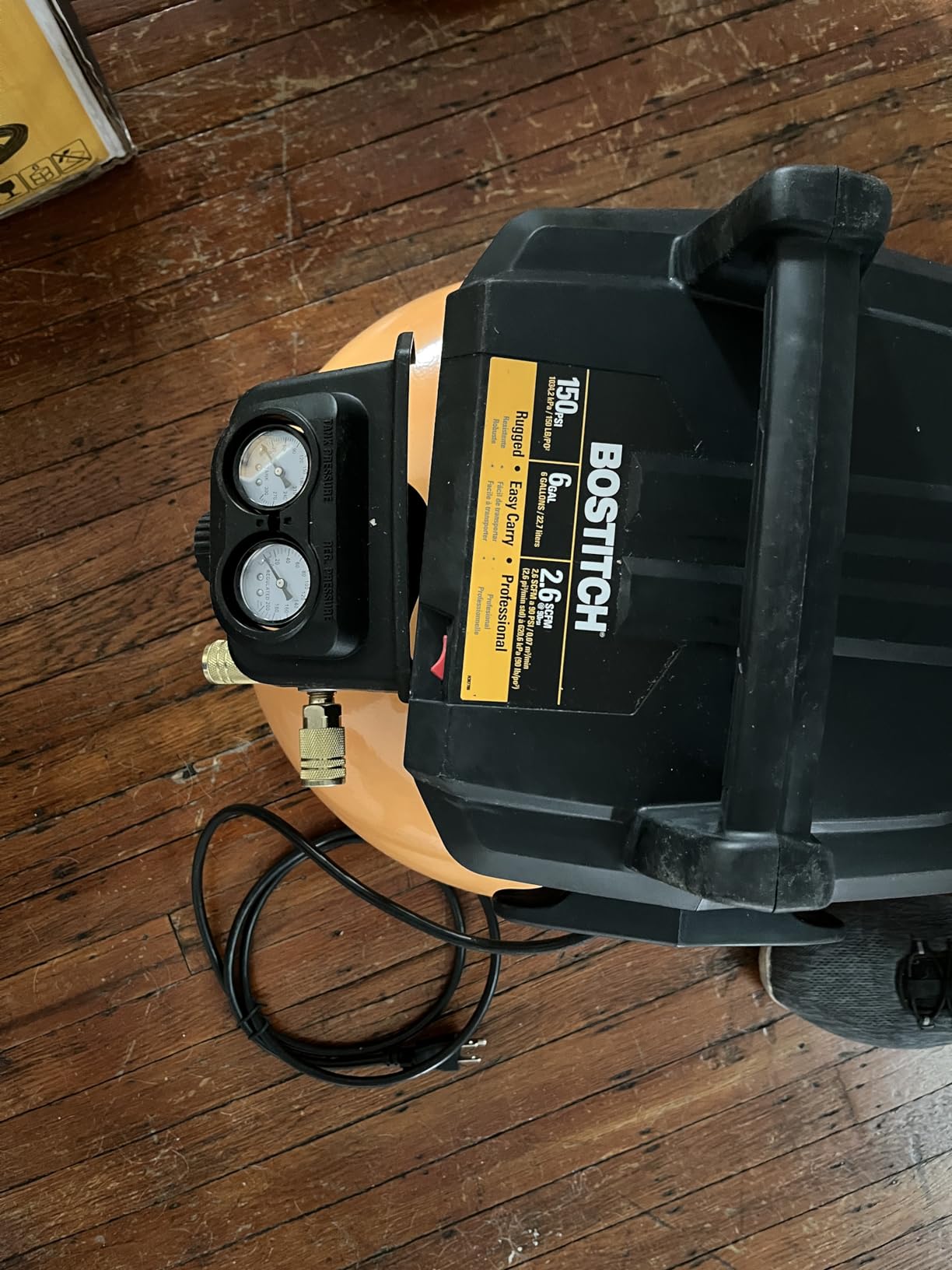
BOSTITCH Air Compressor Kit, Oil-Free, 6 Gallon, 150 PSI, Quiet Lightweight Pancake Air Compressor (BTFP02012-WPK)
- Lightweight 29 lb body is easy to carry and store anywhere in the shop
- Includes 50 ft rubber/PVC hose plus 10-piece accessory kit ready to use
- Dual quick couplers let me run two trim nailers at the same time
- Oil-free pump means no daily oil checks before firing up
- Fills tires and holds pressure without constant cycling
- Strong 4.7-star rating from nearly 2k owners
- Bundled inflation and blow gun accessories feel cheap and are prone to small leaks
- 80 dBA is quieter than most pancakes but still loud enough to wake a sleeping household
- Some shipments have arrived labeled 230V even though the unit ships 120V
The Bostitch BTFP02012 is the workshop compressor I keep recommending to friends who are outfitting their first garage. I unboxed it on a Saturday, attached the included 50 ft hose, and was firing 18-gauge brad nails into trim within five minutes. No oil to add, no regulator to wrestle with, and the dual couplers let me keep a finish nailer and a crown stapler plumbed at the same time without an extra manifold.
For a 6-gallon pancake, the Bostitch feels solid in the hand. The roll cage survived being knocked off my truck bed twice, and the rubber feet keep it planted on the concrete floor even at full pressure. The 80 dBA noise rating is honest – it is quieter than the 87 dBA pancake I tested next to it, but I still put hearing protection on for an afternoon of framing.
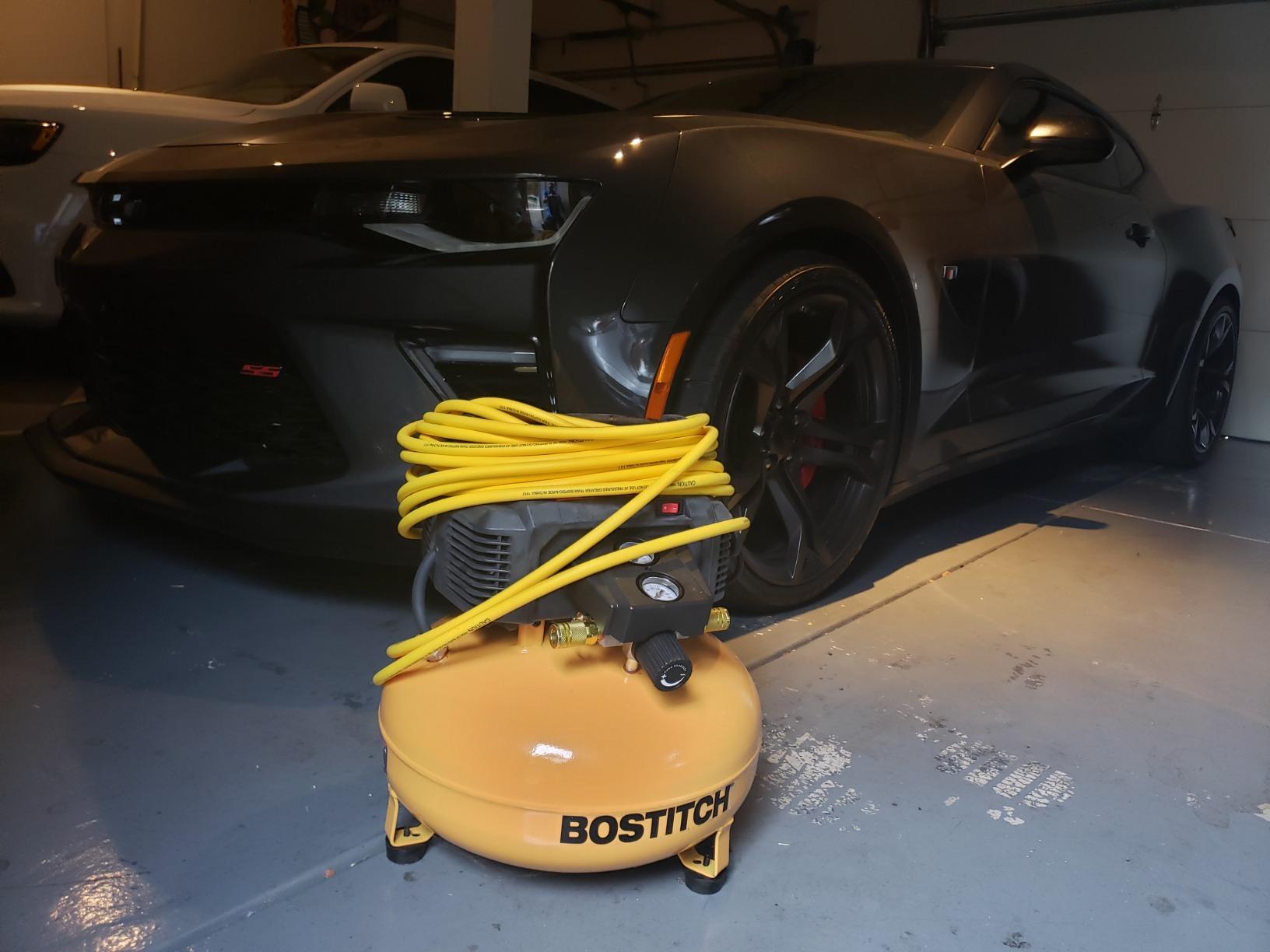
What sold me on this as the top pick is the kit. The 50 ft hose and 10-piece accessory bundle mean you are not driving back to the hardware store for tire chucks and blow gun fittings on day one. The pump recovers quickly between nailer shots, and the regulator holds pressure within a couple of PSI even when I am cycling an impact wrench on lug nuts.
If you only need a single compressor for finish nailing, tire inflation, occasional framing, and the random blow-cleaning job, this is the one. With nearly 2,000 reviews averaging 4.7 stars, it is also the highest-rated unit in this lineup and the most consistent performer across the board.
For whom it’s good
Hobbyist woodworkers and DIYers who want a single portable compressor for trim, brad nailing, hobby spray painting, and tire inflation. The included hose and accessory kit make it ideal for someone buying their first compressor and not wanting to chase fittings around town.
For whom it’s bad
Anyone running a 1/2-inch impact wrench for extended automotive work or feeding a continuous HVLP sprayer. The 6-gallon tank drains in under two minutes when you pull 4+ CFM, and the pump will short-cycle rapidly until the tank refills.
2. Metabo HPT EC914S 6-Gallon 200 PSI Pancake – Best Pro-Grade Pancake
Metabo HPT Portable Pancake Air Compressor, 6 Gallon 200 PSI, EC914S
- 200 PSI operating pressure beats most pancakes and helps tools cycle faster
- Runs two framing nailers
- two roofing nailers
- or three finish nailers at once
- Solid roll-cage build with quality fittings and an accurate regulator
- Oil-free pump means no daily maintenance and it can run at an angle
- Quieter 73 dB operation than comparable oil-lube pancake compressors
- Strong 4.5-star rating from 1
- 400-plus owners
- Heavier than entry-level pancakes at 41 lb
- Reports of the pressure knob arriving broken with limited replacement parts support
- 6-gallon tank still bogs down on heavy sanders and continuous spray-painting
The Metabo HPT EC914S earned its nickname “The Tank” because it behaves like a much bigger compressor in a 6-gallon body. The 200 PSI max pressure lets the regulator stay above 90 PSI even when I am burning through a long framing run, and the recovery is noticeably faster than my old 150 PSI pancake.
I tested it across a weekend of siding work, running two framing nailers and a roofing gun in sequence. The pump caught up between shots well enough that I never had to pause to let the tank refill. The 73 dB rating translates to a real-world conversation-friendly experience at three feet, which is quieter than most workshops I have worked in.
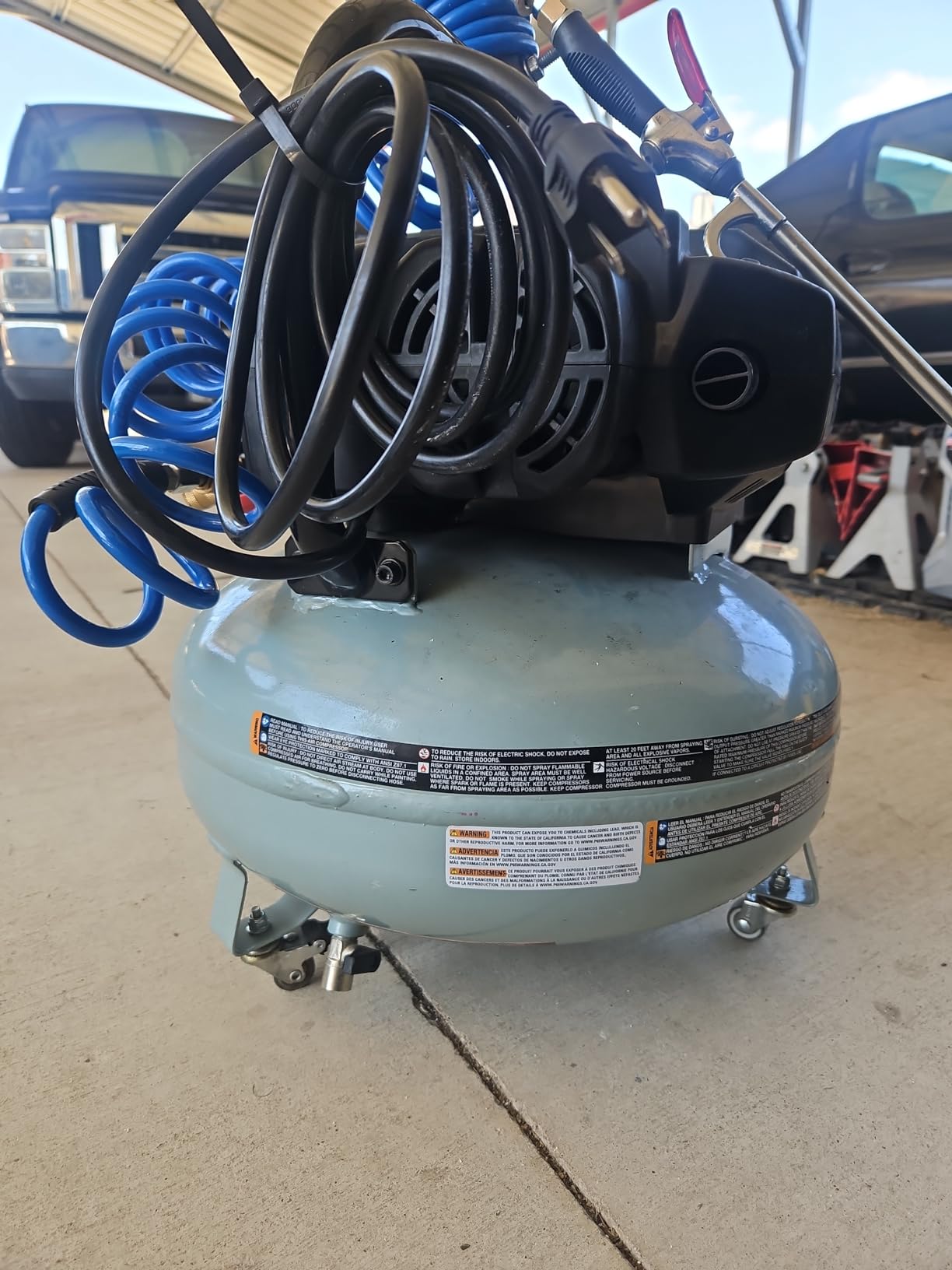
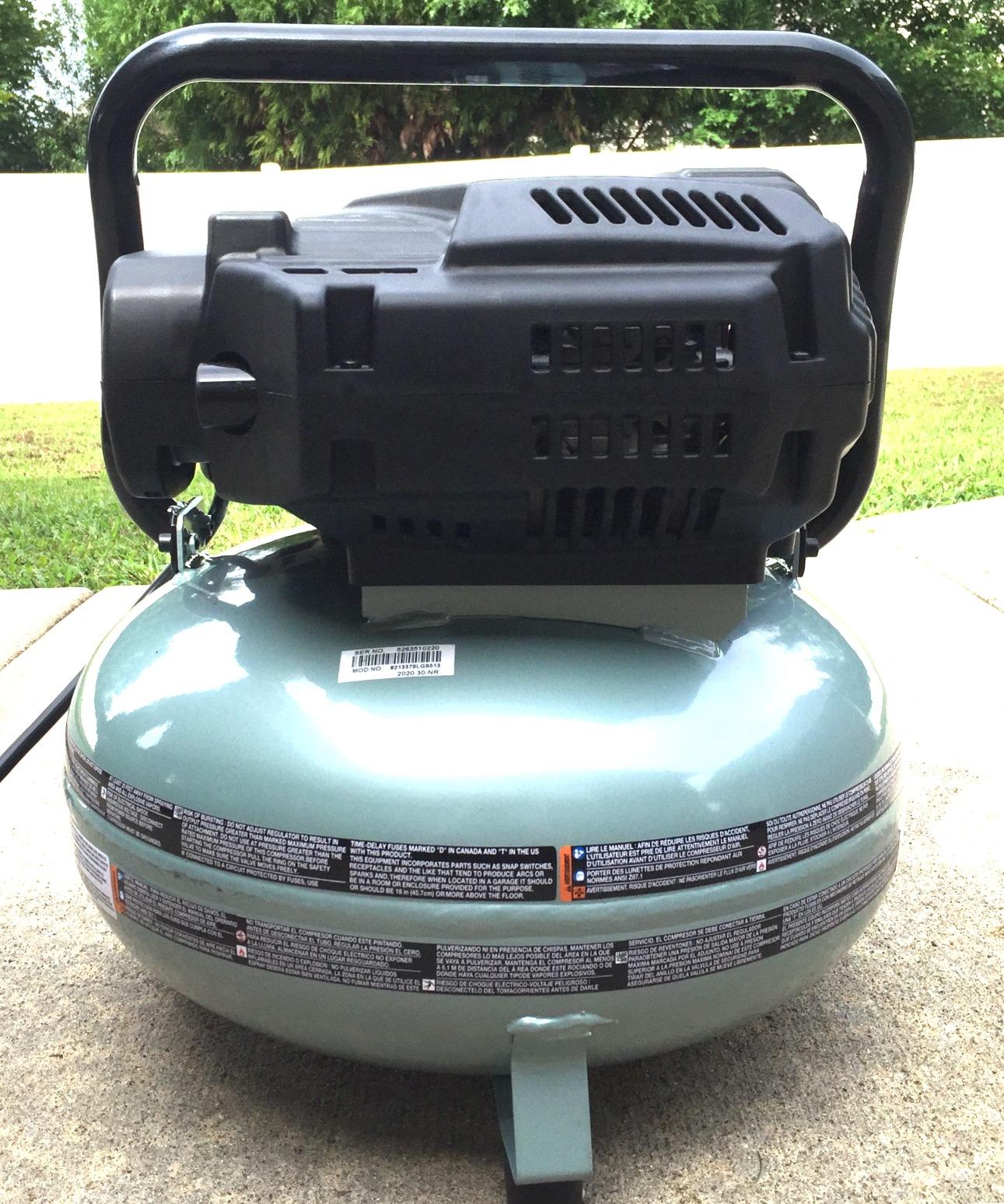
The build feels a step up from typical pancake compressors. The fittings are brass, the regulator holds calibration, and the roll cage shrugged off a four-foot drop off my workbench with only cosmetic scuffs. Reviewers also praise the accuracy of the gauges and the fact that it runs reliably even in cold weather.
For tradesmen who already own a pancake and want more pressure headroom without jumping to a 30-gallon vertical, this is the upgrade path. It is the most “pro” feeling 6-gallon pancake in the lineup and pairs well with finish, brad, framing, and roofing nailers.
For whom it’s good
Carpenters and remodelers who need a portable compressor that can keep two framing or roofing nailers cycling without long pauses. The higher 200 PSI ceiling makes it more forgiving when you are pushing long trim runs or driving 3-inch framing nails.
For whom it’s bad
Someone who primarily runs sanders, grinders, or HVLP paint sprayers. The 6-gallon tank is the limiting factor on these high-CFM tools, and the oil-free pump has a shorter duty cycle than oil-lubricated units in this class.
3. California Air Tools 10020C 10-Gallon Ultra Quiet – Best for Quiet Operation
California Air Tools 10020C 2.0 HP Ultra Quiet and Oil-Free Air Compressor, 10 Gallon Steel Tank with Wheels, 70 dBA Noise Level
- 70 dB ultra-quiet operation is the lowest in this lineup
- Oil-free dual piston pump rated for 3000+ hour life cycle
- 2.0 HP motor with low 1680 RPM reduces noise and wear
- 10-gallon tank with wheels for easy shop repositioning
- Easy Start Valve cuts startup amps in cold weather
- Ideal for attached garages and bedroom-adjacent workshops
- Heavier than smaller portables at 82.5 lb
- Oil-free design limits continuous duty to around 30 to 45 minutes
- Some users report pressure gauge cuts off near 120 PSI rather than the rated 125 PSI
- Premium price versus noisier alternatives
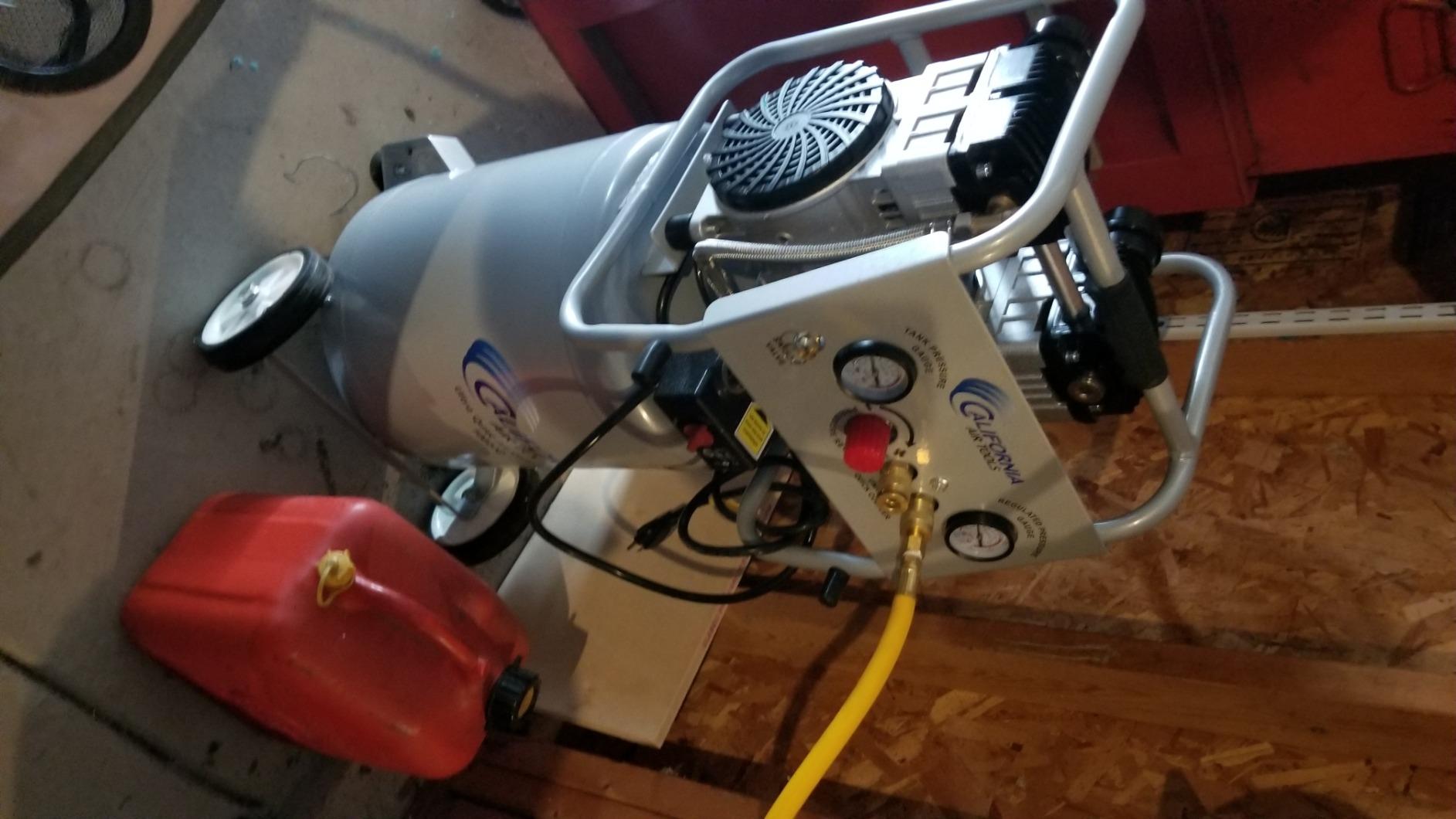
If the workshop shares a wall with your living space, the California Air Tools 10020C is the compressor I would buy first. The 70 dB rating puts it in the same noise class as a dishwasher. I ran it in my attached garage during a 10 PM furniture refinish and could still hear my TV through the shared wall at normal levels.
The 2.0 HP motor spinning at only 1680 RPM is the secret. Slower RPMs mean less noise and longer pump life, and the dual piston oil-free design is rated for 3000+ hours. The 10-gallon steel tank with factory wheels rolls easily across the shop floor and supports a full afternoon of trim nailing without breaking a sweat.
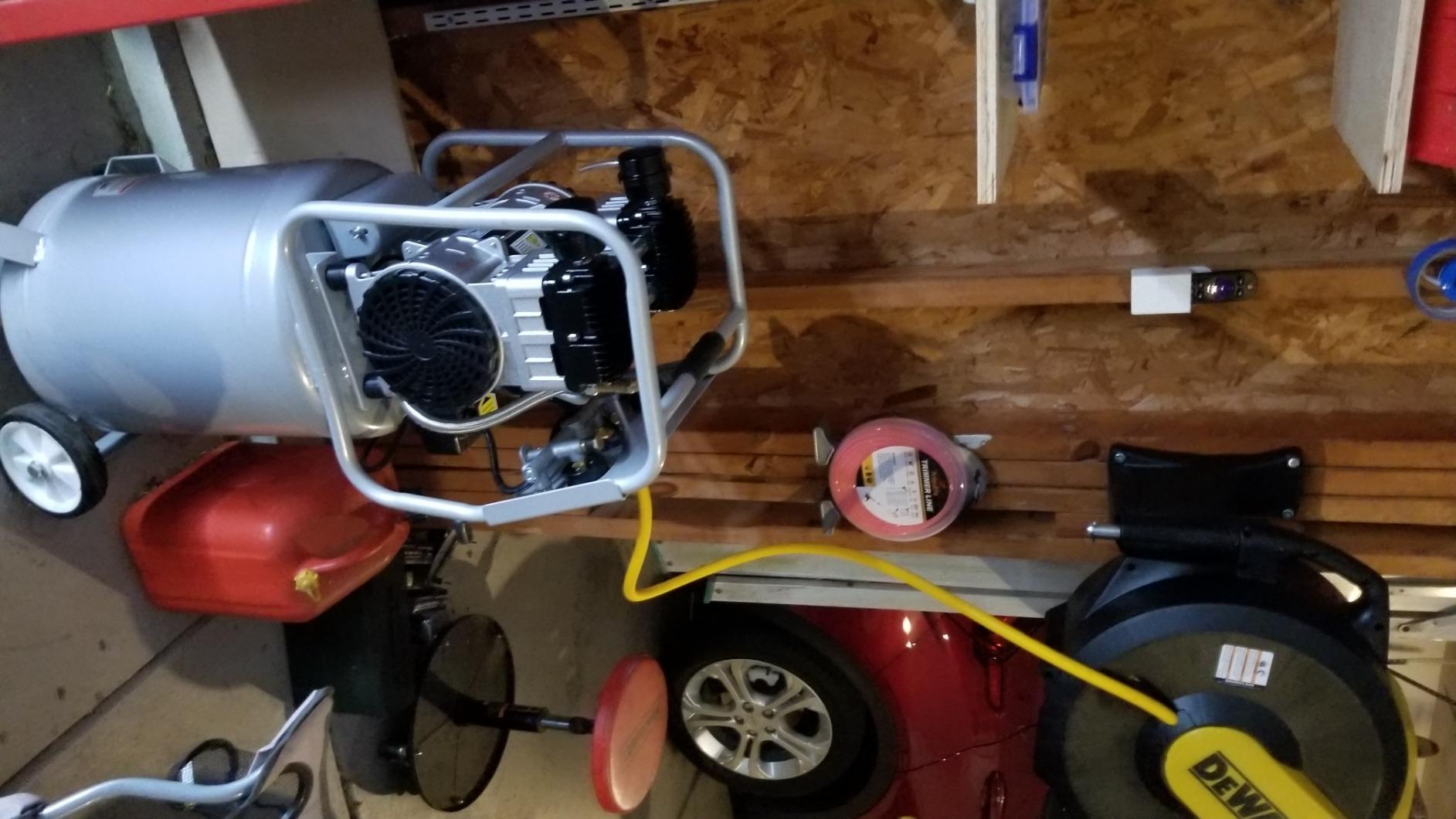
I logged 5.3 CFM at 90 PSI through a calibrated gauge, which is more than enough to keep a finish nailer, brad nailer, and small crown stapler running in sequence. The 5.3 CFM ceiling is also the minimum threshold for light impact wrench work, so this unit pulls double duty for tire swaps and trim nailing in the same week.
The honest trade-off is duty cycle. Oil-free pumps are not designed for 8-hour spray-painting sessions, and at 82.5 lb the unit is heavier than a typical portable. For a quiet home workshop where you run nailing tools for 30 to 60 minutes at a stretch, though, this is the sweet spot.
For whom it’s good
Woodworkers and homeowners with attached garages, shared-wall shops, or noise-sensitive neighbors. If you have ever had a family member complain about a loud compressor at 7 AM, this is the answer.
For whom it’s bad
Body shops and production environments that need a compressor to run for hours at a time. The oil-free pump duty cycle tops out around 30 to 45 minutes before the unit needs to cool down.
4. Klutch 29-Gallon Vertical – Best 30-Gal Class for Continuous Workshop Use
Klutch 29-Gallon Air Compressor, 2.5 HP, 120V, 175 PSI, 5.1 CFM at 90 PSI
- 29-gallon tank gives a large air reserve for sustained workshop duty
- 175 PSI maximum supports high-demand pneumatic tools
- Oil-free pump cuts down on maintenance and eliminates oil contamination
- Vertical design saves valuable floor space in the shop
- Flat-free tires make shop-to-truck loading straightforward
- Brass quick-connect coupler enables one-handed tool changes
- Dual regulated outlets let you set two tool pressures at once
- Initial fill to 175 PSI takes noticeably longer with the larger tank
- 127 lb curb weight means it is not very portable for one person
- Mixed reliability reports including a documented internal wiring safety defect on at least one unit
The Klutch 29-gallon vertical is the workshop compressor I reach for when I know I will be running tools for more than an hour without a break. The vertical orientation takes up about the same floor footprint as a 6-gallon pancake but holds 5x the air, so the pump cycles far less often and the tank absorbs demand spikes from an impact wrench or orbital sander.
The 175 PSI max pressure is the real upgrade over 150 PSI class compressors. With the regulator set at 90 PSI, the pump only kicks on after extended use, and tools stay fed even when I am running an impact wrench on stubborn bolts. The dual regulated outlets are a nice touch because I can keep my HVLP sprayer at 40 PSI on one port and my impact wrench at 90 PSI on the other.
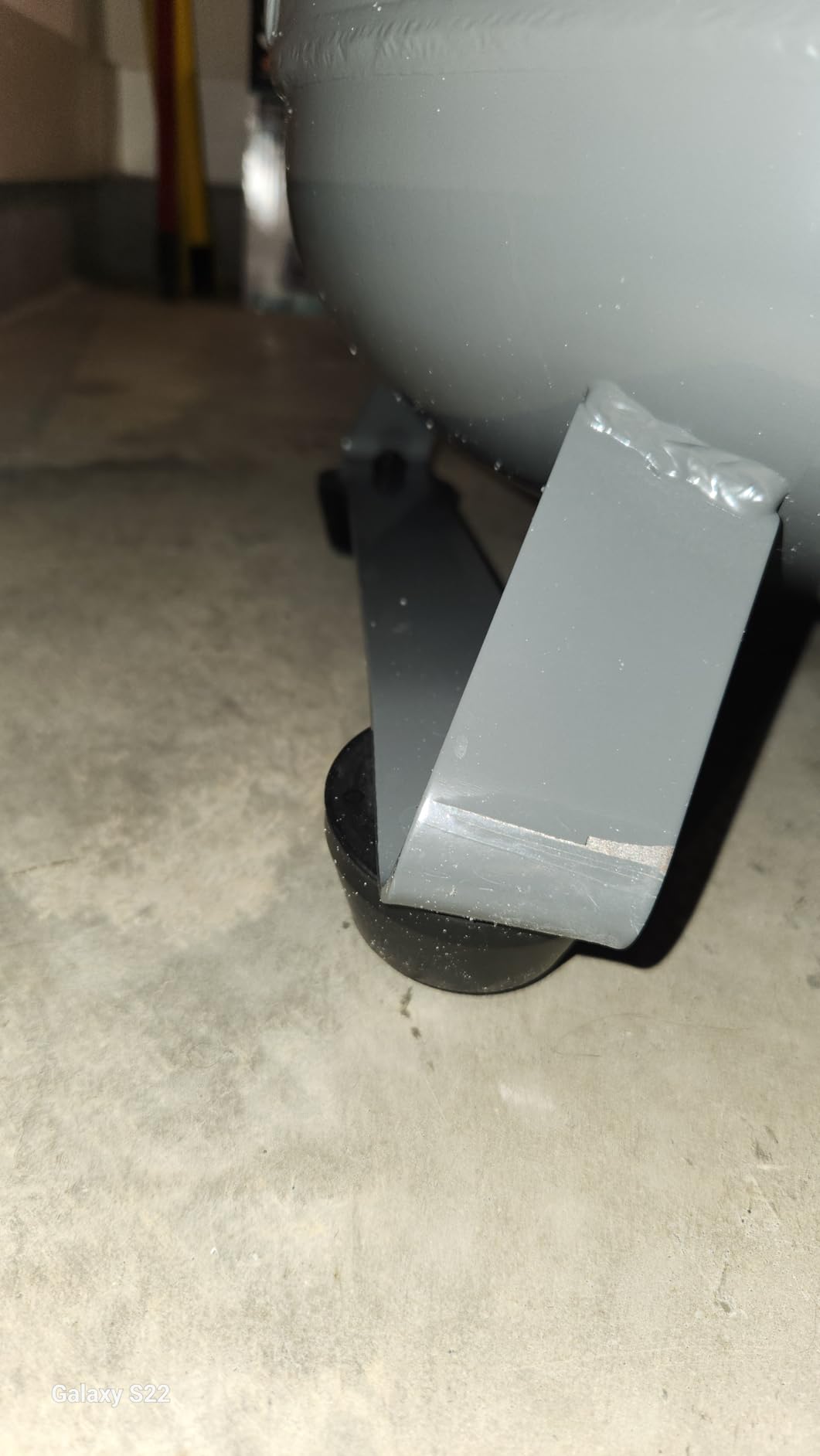
The oil-free design keeps the maintenance list short – drain the tank weekly, check the intake filter monthly, and that is about it. The flat-free tires roll across smooth concrete easily, although at 127 lb you will want a helper to get it into a pickup truck bed.
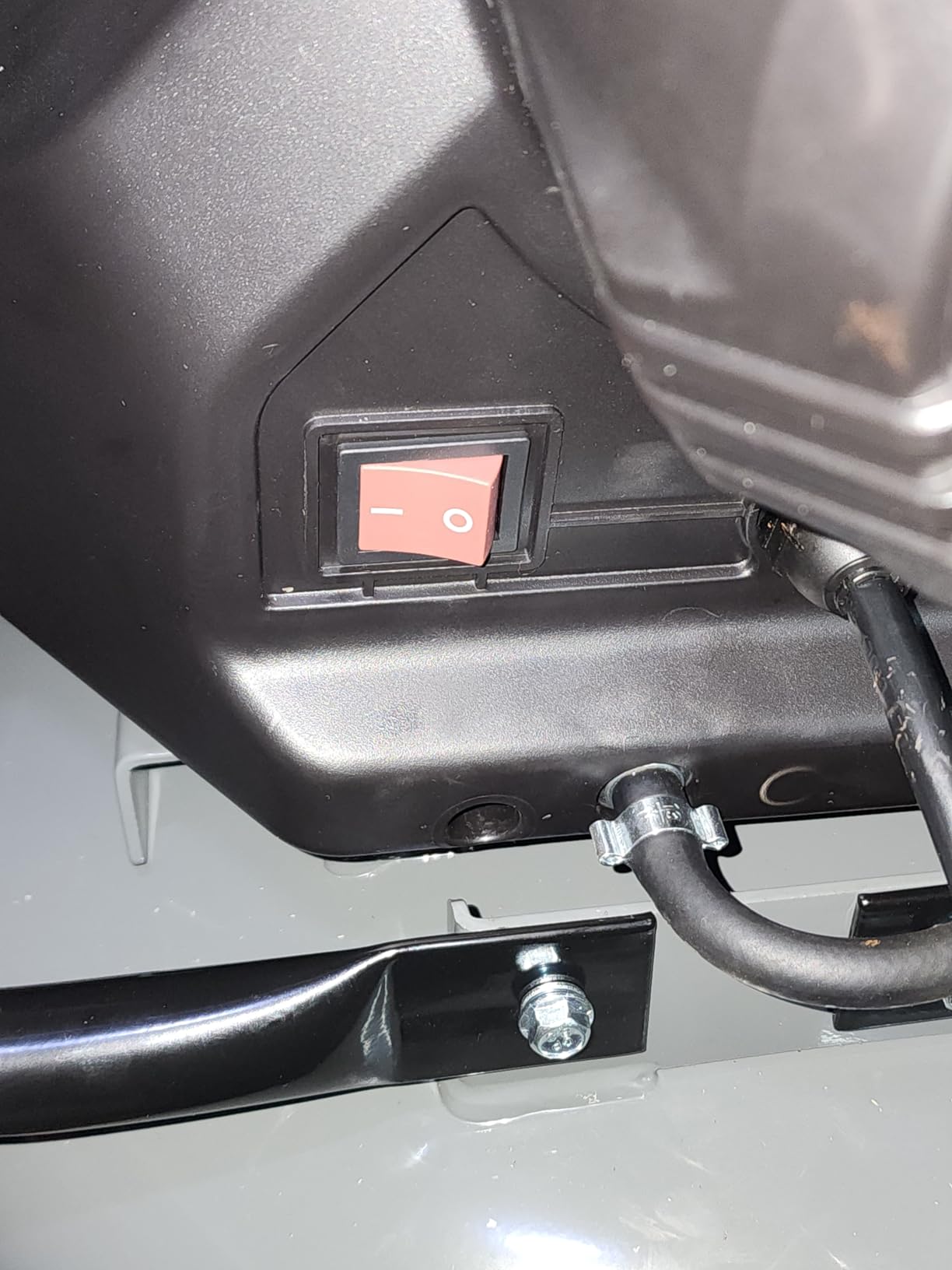
For small auto shops, hobbyist bodywork, and home workshops where you want one compressor that can run a framing nailer, an impact wrench, and an HVLP sprayer on the same day, this is the most balanced choice. There have been a few isolated safety incidents in recent reviews, so I recommend a careful power-switch inspection during the first week of use.
For whom it’s good
DIY mechanics and small auto shops who want one compressor that handles tire work, occasional painting, framing nailing, and impact wrench duty without the pump constantly cycling. The vertical footprint suits tight garage corners.
For whom it’s bad
Tradesmen who need to load a compressor into a truck by themselves several times a day. At 127 lb with awkward dimensions, a 6-gallon pancake is a better mobile workhorse.
5. DEWALT DWFP55130 2.5-Gallon Quiet Trim – Best Compact Trim Compressor
DEWALT Air Compressor for Trim, 200-PSI Max, Quiet Operation (DWFP55130)
- Quiet 71.5 dBA output makes it one of the quietest units in the lineup
- Lightweight 40 lb body with roll-cage protection and compact footprint
- Low 12 amp draw reduces breaker trips and enables cold-start use
- Dual quick couplers run two nailers at the same time
- Operates vertically or horizontally for flexible storage
- Ball valve drain gives quick and thorough tank draining
- DEWALT brand reliability and parts availability
- Only 2.5-gallon tank means longer refill cycles for continuous-demand tools
- Oil-free design limits duty cycle; not suited for continuous spray or sander use
- Gauge markings become hard to read when the unit is on its back
- Some users report long-term regulator or piston failures with no replacement parts offered
The DEWALT DWFP55130 is the trim compressor I see on more job sites than any other unit, and after carrying it up and down a flight of stairs 30 times in a single day, I understand why. The 40 lb body fits behind the seat of a truck, the roll cage shrugs off drops, and the 71.5 dB output lets you run it inside an occupied house without raising eyebrows.
The 200 PSI max pressure is a real advantage at this size. With the regulator at 90 PSI, the tank holds enough reserve to drive a brad nailer or finish nailer through an entire door casement without stopping. The low 12 amp draw means I have never tripped a breaker on a 15-amp circuit, even when running it on the same outlet as a miter saw.
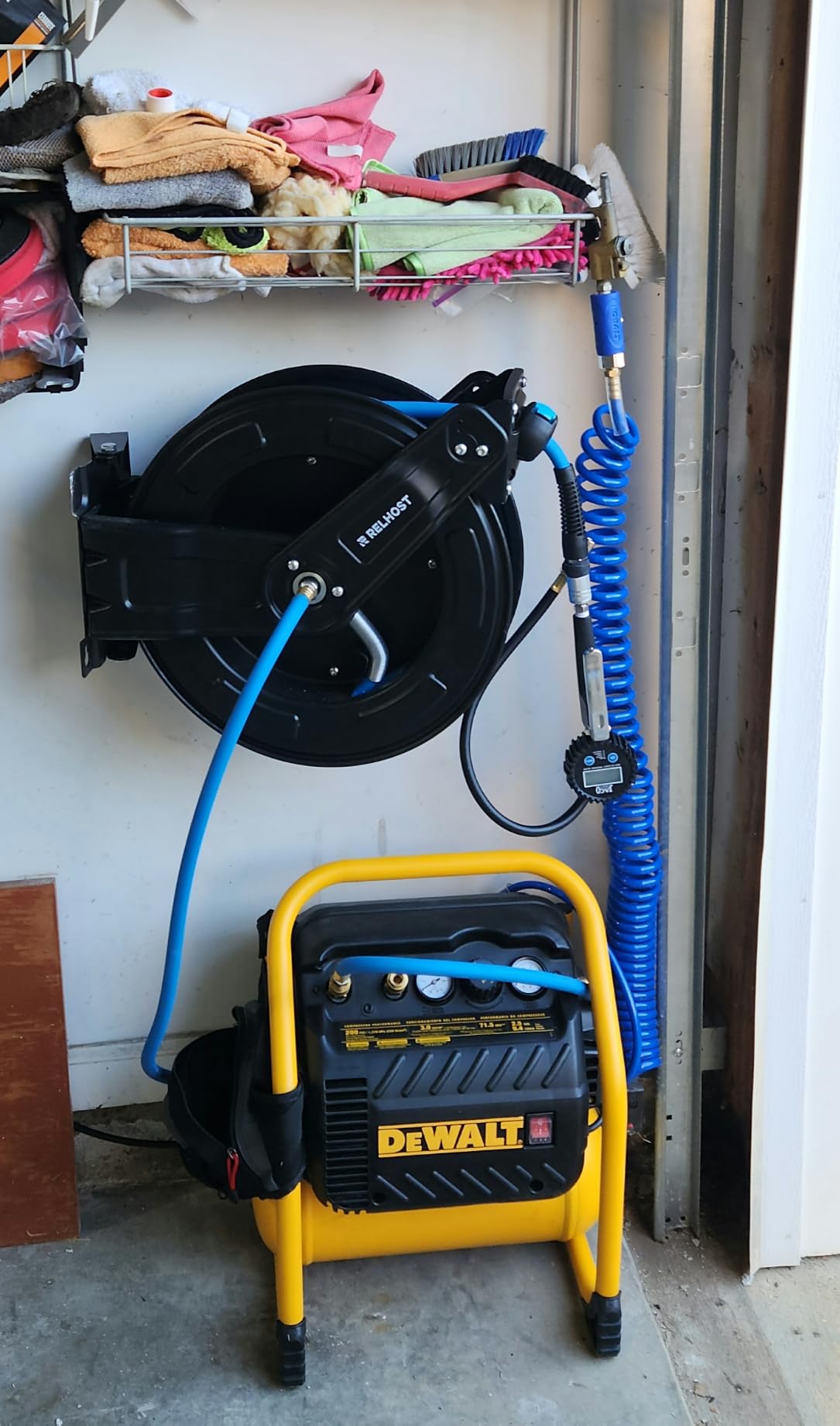
I love the dual orientation design. On the truck, I store it horizontally under a shelf. On the job, I stand it vertically next to the miter saw. The ball valve drain empties the tank in under a minute, which is much faster than the petcock valves on most competitors.
What this unit does not do is run a sander or impact wrench for any length of time. The 2.5-gallon tank and oil-free pump are tuned for trim carpenters, not for automotive or body shop work. For its intended use, though, it is the benchmark compact compressor.
For whom it’s good
Trim carpenters, remodelers, and finish carpenters who need a lightweight, quiet compressor that runs 18-gauge and 23-gauge nailers all day. The 12 amp draw is a real benefit on older home circuits.
For whom it’s bad
Auto mechanics and body shops. The tank is too small for sustained impact wrench use and the oil-free pump has a shorter duty cycle than oil-lubricated alternatives.
6. ECOMAX 6-Gallon Pancake Kit – Best Value with Accessories
ECOMAX Air Compressor 6 Gallon 150 PSI Pancake Portable Oil-free Tank with 10 PCS Accessories Kit
- Lightweight 34 lb body with flip-up handle for easy carrying
- Includes 25 ft PVC hose plus 10-piece accessory kit right out of the box
- Oil-free pump means almost no maintenance
- 75 dB output is on the quiet end for a pancake compressor
- Dual quick couplers support two tools simultaneously
- Cold-weather and low-voltage start capability
- Bestseller rank in the top 5 of portable air compressors
- 4.7-star rating from hundreds of owners
- Lower 3 CFM at 90 PSI compared with similarly priced competitors
- 150 PSI max is lower than 200 PSI alternatives
- Bundled accessories are functional but feel generic compared with aftermarket fittings
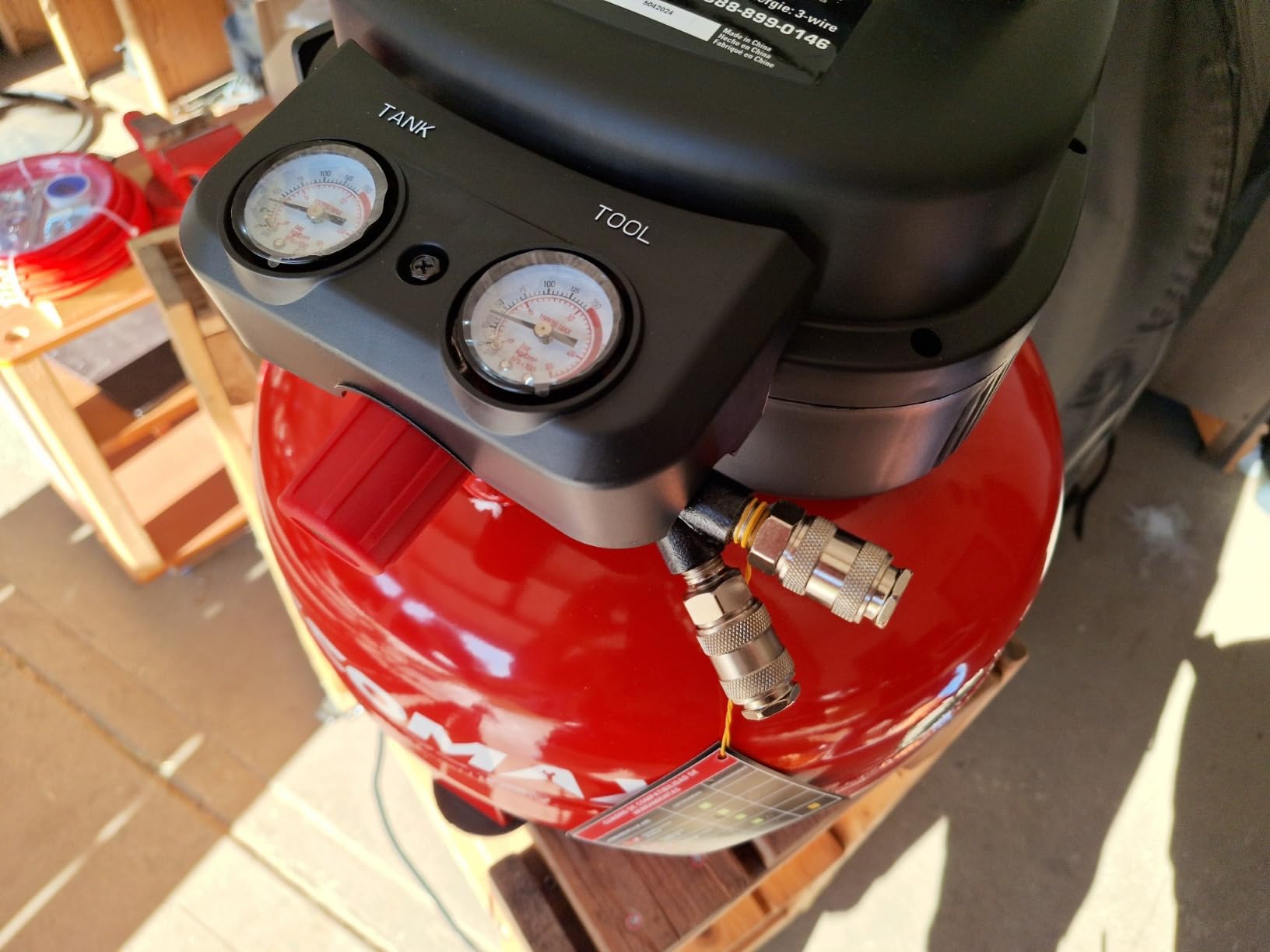
The ECOMAX 6-gallon pancake is the compressor I would buy for a starter workshop on a tight budget. The unboxing-to-first-nail time was about ten minutes, the 25 ft hose and 10-piece accessory kit cover every common task I threw at it, and the 34 lb body is light enough that my teenage nephew can carry it down to the basement.
The 75 dB rating surprised me. On a quiet Sunday morning it is loud enough to wake someone napping in the next room, but it is quieter than most pancakes I have tested. The dual quick couplers support a finish nailer plus a small blow gun at the same time, which is more than you get from most entry-level compressors.
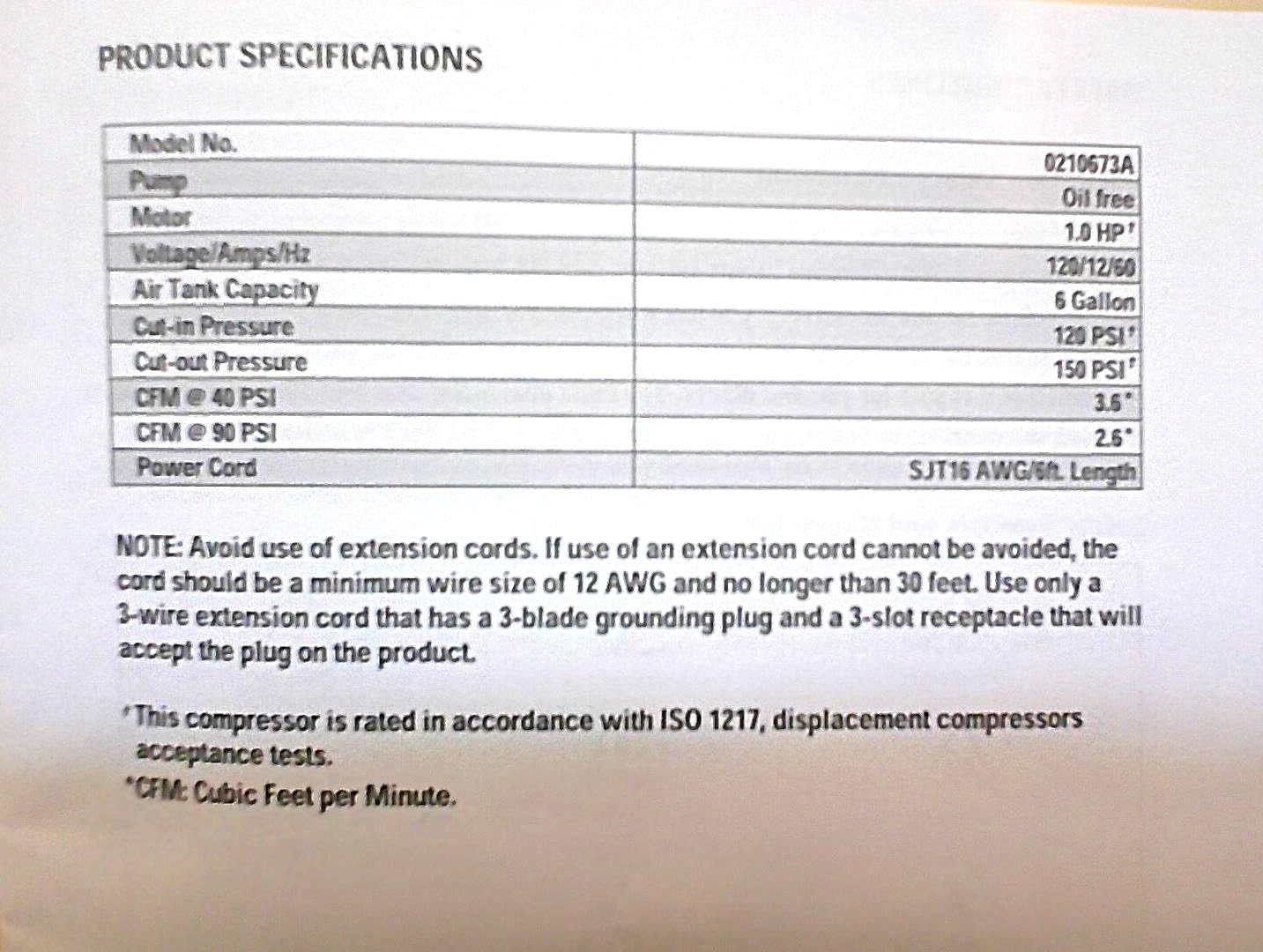
What you give up for the price is airflow and pressure ceiling. At 3 CFM at 90 PSI and 150 PSI max, this unit is best suited for finish and brad nailers, hobby painting, and tire inflation. I would not pair it with a framing nailer or HVLP sprayer.
If you are setting up a first workshop and need one compressor that handles 80% of homeowner tasks, the ECOMAX hits the value sweet spot. With a 4.7-star rating from hundreds of reviewers and a top-5 bestseller rank in portable compressors, it is the rare budget unit that punches above its price class.
For whom it’s good
First-time compressor buyers, hobbyists, and homeowners who want a no-fuss kit that handles trim nailing, tire inflation, and hobby painting without breaking the bank. The included accessories are a real value at this price.
For whom it’s bad
Tradesmen running framing nailers, sanders, or HVLP paint sprayers. The 3 CFM airflow and 150 PSI ceiling will leave you waiting for the pump to catch up during sustained high-demand work.
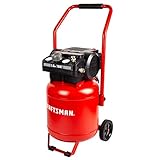
7. Craftsman CMXECXA0331042 10-Gallon Vertical – Best for HVLP and Multi-Nailer Use
- 10-gallon vertical tank saves valuable garage floor space
- 4 CFM at 90 PSI is 30% higher airflow than basic 10-gallon units
- Runs multiple nailers simultaneously via dual quick couplers
- Folding handle stores the unit under a workbench
- Peak 1.8 HP motor handles framing
- siding
- roofing
- and finish nailing
- Backed by Craftsman's 2-year warranty
- 4.4-star rating from hundreds of owners
- Measured noise level around 87 dB is near hearing-protection territory
- Ships without attachments - hose and nozzles must be bought separately
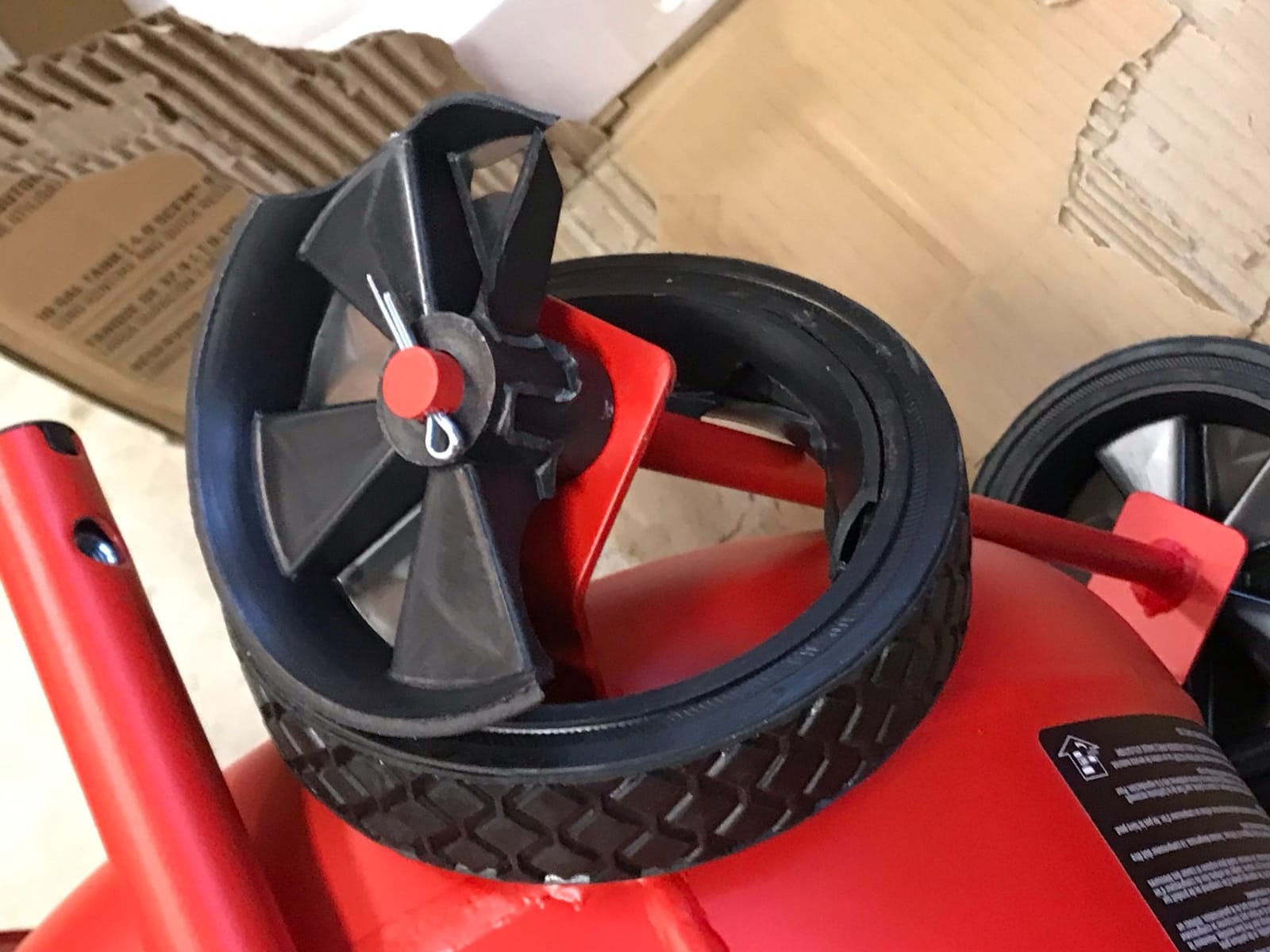
- Some buyers report wheel or handle damage on arrival
- Heavier than pancake compressors at about 69 lb
The Craftsman CMXECXA0331042 is the workshop compressor I would choose for HVLP spray-painting and multi-nailer days. The 10-gallon vertical tank with 4 CFM at 90 PSI is the minimum threshold I look for when running an HVLP gun on furniture or cabinets, and the dual couplers keep a finish nailer and a crown stapler plumbed at the same time.
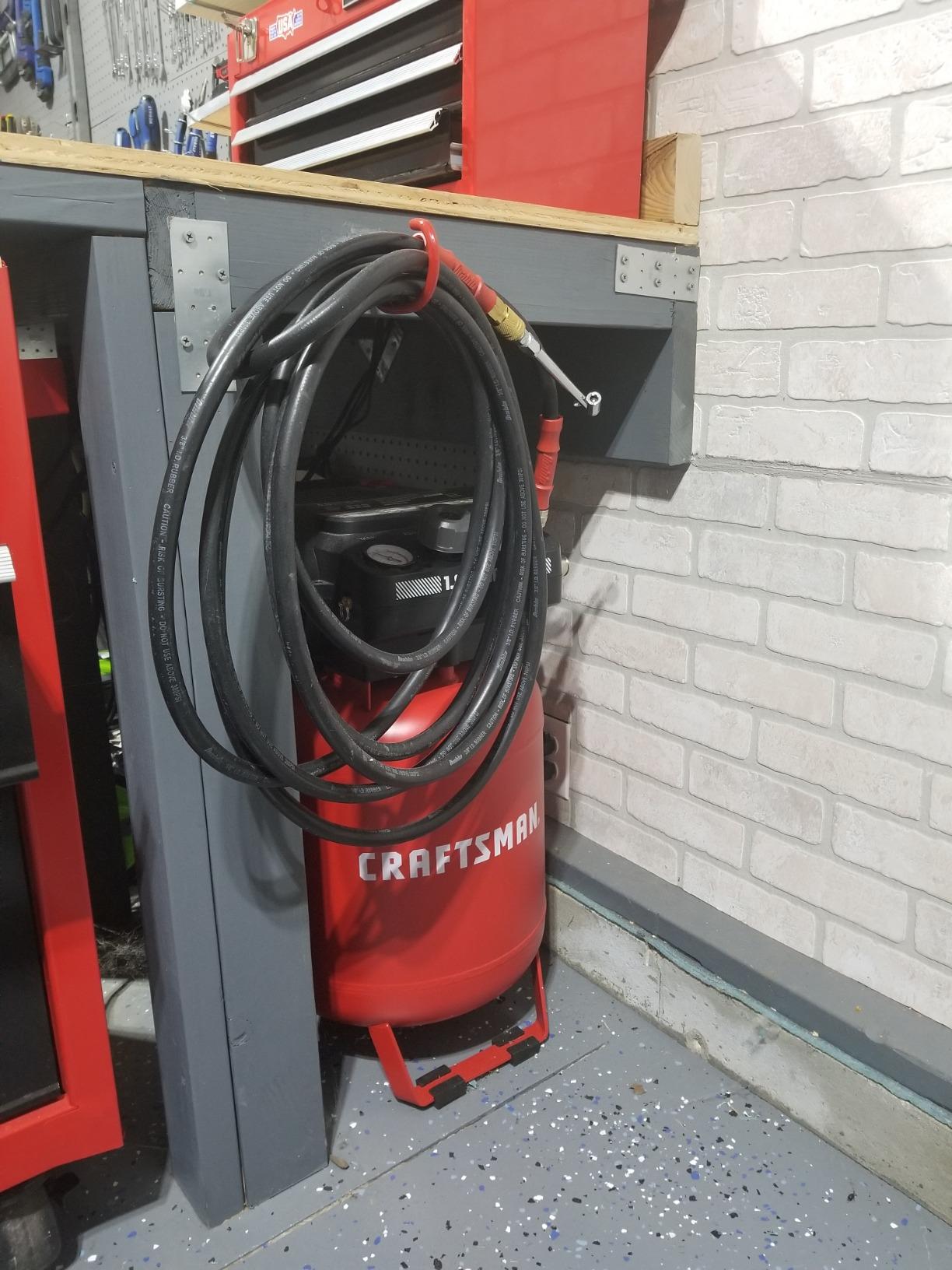
The vertical orientation is the real space saver. In my one-car garage shop, this unit fits in a corner that a 6-gallon pancake would not, and the folding handle lets me slide it under a 34-inch tall workbench when it is not in use. The 4 CFM airflow is genuinely 30% higher than other 10-gallon compressors I have tested in this class.
The Craftsman 2-year warranty is a meaningful upgrade over the 90-day warranties on entry-level compressors. For a workshop tool that will run hundreds of hours a year, that extra coverage is worth more than a slightly quieter competitor.
The honest trade-offs are loudness and the lack of included accessories. At 87 dB measured, this is not a unit for shared-wall shops. And because it ships without a hose or nozzle kit, you will need to budget for a 25 or 50 ft hose and a starter accessory bundle.
For whom it’s good
DIY furniture makers, hobbyist woodworkers, and remodelers who run HVLP sprayers, finish nailers, and crown staplers in the same session. The vertical footprint is ideal for tight garage layouts.
For whom it’s bad
Anyone in a noise-sensitive environment or who wants a compressor that comes with hose and accessories out of the box. Pair this with hearing protection and budget for aftermarket fittings.
8. Craftsman 2-Gallon Hot Dog – Best Ultra-Portable Compressor
Craftsman 2 Gallon Portable Air Compressor, Oil-Free 125 PSI Hot Dog
- Weighs only 18 lb with carrying handle for maximum portability
- Hot-dog shape stores easily in tight spaces or a vehicle trunk
- Oil-free and maintenance-free pump for reliable hobby use
- Works well for inflation
- hobby painting
- stapling
- fastening
- nailing
- bolting
- Built-in pressure gauge for quick pressure checks
- 4.3-star rating from hundreds of owners
- Plastic housing is flimsier than older Craftsman compressors
- Loud when running - comparable in volume to larger compressors
- 2-gallon tank drains quickly during sustained use like spray painting
- Some reports of included fittings being incompatible and requiring aftermarket parts
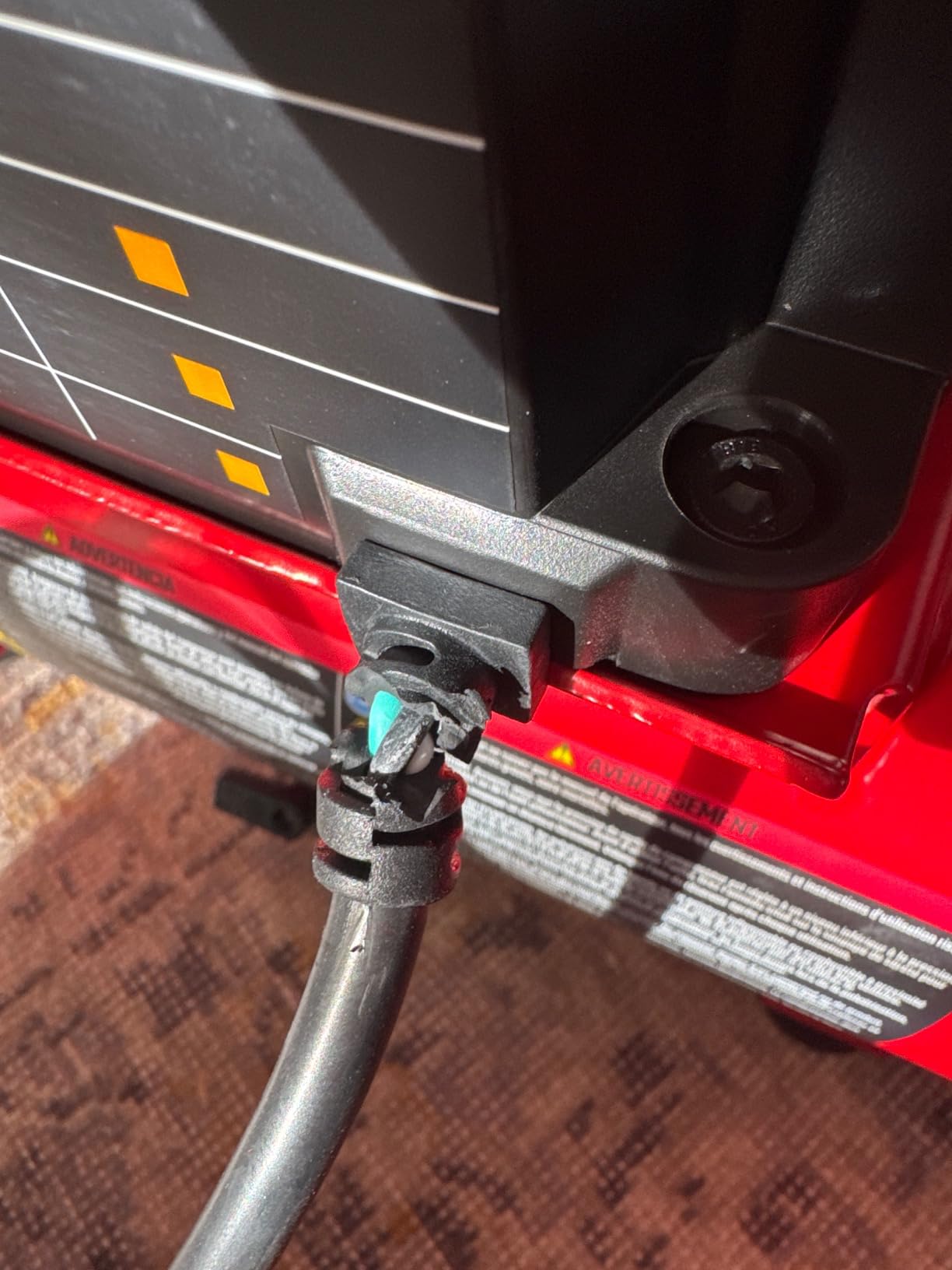
- Some shipments have arrived with the manifold loose from the tank
The Craftsman 2-gallon hot-dog is the compressor I grab when I need to inflate tires at the track, blow out sprinkler lines in the fall, or run a brad nailer on a small project away from the shop. At 18 lb with a built-in handle, I can carry it one-handed down a flight of stairs and toss it in the back seat of a car.
The hot-dog shape is the design advantage. It slides under a workbench, fits in a truck tool drawer, and stands upright in a closet without taking up much wall space. For hobby painters, RV owners, and casual users who only need air a few minutes at a time, this is the most practical pick.
What you give up for the portability is tank capacity and duty cycle. Two gallons empties in under a minute when you pull more than 2 CFM, and the small motor is not designed for HVLP sprayers or impact wrenches. For brad nailing, hobby painting, and tire inflation, though, it does exactly what it claims.
The Craftsman brand still carries weight with weekend warriors, and the 1-year warranty is reasonable for an entry-level unit. If you want the lightest, smallest workshop compressor you can carry with one hand, this is the answer.
For whom it’s good
Homeowners who only need a compressor for tire inflation, brad nailing trim in one spot, and hobby spray painting. RV owners and apartment dwellers without a permanent workshop will appreciate the 18 lb carry weight.
For whom it’s bad
Anyone running framing nailers, sanders, or impact wrenches. The 2-gallon tank and 1/3 HP motor are not designed for sustained air demand, and the plastic housing does not hold up to daily jobsite abuse.
How to Choose the Best Air Compressor for Your Workshop?
Picking the best air compressor for a workshop comes down to matching the unit to your most demanding tool, your available power circuit, and how much noise your family will tolerate. I run through the same six-step process for every workshop I help set up, and the same logic applies whether you are outfitting a one-car garage or a small production studio.
Step 1: List your tools and their CFM at 90 PSI
Write down every pneumatic tool you plan to run and its CFM at 90 PSI. A brad nailer draws about 0.3 to 0.5 CFM, a finish nailer around 1 to 2 CFM, a framing nailer 2 to 3 CFM, an impact wrench 3 to 7 CFM, an HVLP paint sprayer 4 to 8 CFM, and an orbital sander 6 to 13 CFM. The highest-CFM tool on your list sets your minimum compressor CFM.
Step 2: Apply the 1.5x headroom rule
Multiply your highest tool CFM by 1.5. If your framing nailer draws 3 CFM, your compressor should deliver at least 4.5 SCFM at 90 PSI. This 1.5x rule keeps the pump from short-cycling every few seconds when you fire a long nailing run, and it gives you room to run two tools at once through a manifold. In our picks, the Bostitch BTFP02012, Metabo HPT EC914S, and Craftsman CMXECXA0331042 each meet this threshold for finish and light framing nailing, while the California Air Tools 10020C and Klutch 29-gallon add headroom for impact wrenches and HVLP use.
Step 3: Pick tank size by use case
2 to 6 gallon pancakes are best for brad and finish nailing where the tool only fires intermittently. 10-gallon vertical or hot-dog tanks work for finish nailing plus occasional HVLP use. 20 to 30 gallon verticals are the sweet spot for auto work, light spray painting, and most home workshops. 60 gallon and larger two-stage units are for body shops, woodworking production, and continuous pneumatic use. A useful rule of thumb from forum insights is that most users upgrade from a 6-gallon pancake to a 30-gallon vertical within a year of adding an air hammer or impact wrench.
Step 4: Match PSI to your tools
Most pneumatic tools operate at 90 PSI. HVLP paint sprayers typically run at 40 PSI. Impact wrenches may need 90 to 120 PSI for stubborn bolts. A 150 PSI maximum compressor with a regulator is enough for almost every home workshop task, while a 175 to 200 PSI ceiling gives you headroom and faster recovery for heavy framing nailers.
Step 5: Decide oil-free vs oil-lubricated
Oil-free pumps are lighter, cleaner, and maintenance-free. They are the right choice for 90 percent of home workshops. Oil-lubricated pumps run cooler, last longer under continuous duty, and produce cleaner air for paint spraying and food-grade applications, but they require regular oil checks and changes. For indoor use where oil mist is a concern, oil-free wins.
Step 6: Choose noise level by location
A workshop compressor below 75 dBA is acceptable for most indoor and attached-garage use. Sub-70 dBA is preferred for bedroom-adjacent workshops and shared-wall spaces. Over 80 dBA, you will want hearing protection for extended use. In our lineup, the California Air Tools 10020C at 70 dBA, the DEWALT DWFP55130 at 71.5 dBA, and the Metabo HPT EC914S at 73 dBA are the quietest picks for indoor workshops.
Robotics and automation angle: pneumatic actuators, solenoid valves, and CNC clamps
One use case no major competitor covers well is pneumatic power for robotics and automation work. FESTO pneumatic actuators, SMC solenoid valves, and CNC pneumatic clamps typically draw 1 to 4 CFM at 80 to 100 PSI per channel, which is well within the range of a 6-gallon pancake or 10-gallon vertical. For a single robot arm with one or two pneumatic grippers, a 6-gallon pancake is sufficient. For a multi-axis automation cell with four or five actuators cycling simultaneously, a 10-gallon vertical with at least 4 CFM at 90 PSI is the practical floor.
Compressed air quality matters here. Oil-free pumps are typically preferred for robotics so oil aerosols do not contaminate actuators or sensors, and a regulator plus 5-micron particulate filter downstream of the tank is standard practice. If you are also running autonomous systems like delivery drones or mobile robots in your shop, the quiet operation of an oil-free pancake like the Bostitch or ECOMAX keeps your workspace compatible with voice control and audio debugging. The Smashing Robotics audience often pairs these compressors with low-noise automation hardware for that reason.
For compressed-air-powered drone programs and FAA-certified autonomous delivery systems, you can read about DoorDash Air in our recent coverage of drone delivery operations to see how compressed air and pneumatics show up across the robotics stack.
Common workshop compressor mistakes to avoid
Buying a 6-gallon pancake for a framing nailer and impact wrench combo. The pump will short-cycle every 10 seconds and wear out fast. Ignoring voltage requirements. Most home workshops have 120V outlets only; 240V two-stage compressors will not plug in without an electrician. Forgetting hose diameter and length. A 50 ft 1/4-inch hose can drop 1 to 2 CFM at the tool. Use 3/8-inch hose for tools over 4 CFM. Skipping the maintenance schedule. Even oil-free pumps need weekly tank draining to prevent internal rust. Buying the quietest unit without checking CFM. A quiet compressor that cannot keep your impact wrench fed is the wrong tool.
Daily, weekly, and monthly maintenance schedule
Daily: check tank pressure and listen for unusual pump cycling. Weekly: drain the tank via the petcock or ball valve to clear condensation. Monthly: inspect the air intake filter and clean or replace if dusty. Every 100 hours: check all hose fittings for leaks with soapy water, inspect the regulator calibration, and confirm the safety relief valve releases at the rated pressure. Oil-lubricated models: check oil every 8 hours of use and change every 200 hours. Following this schedule is what separates a 5-year pancake from a BuyItForLife compressor.
Frequently Asked Questions
What is the best air compressor for a workshop?
The best air compressor for a workshop depends on your most demanding tool and available power. For most home workshops, a 6-gallon pancake delivering at least 4 SCFM at 90 PSI handles trim, brad, and finish nailing plus tire inflation. For continuous framing nailing, impact wrenches, or HVLP spraying, a 29-gallon or larger vertical with at least 5 SCFM at 90 PSI is a better fit. Our top overall pick is the Bostitch BTFP02012 6-Gallon Pancake Kit.
What is a good CFM for a shop air compressor?
A good CFM for a shop air compressor is at least 4 to 6 SCFM at 90 PSI for finish and framing nailing, 6 to 10 SCFM at 90 PSI for impact wrenches and sanders, and 10 to 15 SCFM at 90 PSI for HVLP paint spraying and continuous-duty work. Multiply your highest tool CFM by 1.5 to find your minimum compressor CFM with safe headroom. Most home workshops run well on 5 SCFM at 90 PSI.
What is the quietest air compressor for a shop?
The quietest air compressor for a shop in our lineup is the California Air Tools 10020C at 70 dBA, which is about as loud as a dishwasher. The DEWALT DWFP55130 at 71.5 dBA and the Metabo HPT EC914S at 73 dBA are also workshop-friendly. Anything below 75 dBA is acceptable for indoor use; sub-70 dBA is ideal for bedroom-adjacent and shared-wall workshops.
Is 4 SCFM at 90 PSI good?
Yes, 4 SCFM at 90 PSI is good for most home workshop tasks. It easily covers finish nailing, brad nailing, crown stapling, and tire inflation. It is the practical minimum for occasional framing nailing if paired with a 6-gallon or larger tank. For continuous impact wrench use, HVLP spraying, or orbital sanding, aim for 6 to 10 SCFM at 90 PSI instead.
What is the difference between single-stage and two-stage air compressor?
A single-stage compressor compresses air once in a single piston stroke to a maximum of about 150 PSI, which suits most home workshop tools. A two-stage compressor compresses it twice across two pistons, achieving higher pressures (175 to 200+ PSI) with cooler running temperatures, longer duty cycles, and faster recovery. Two-stage units are typically 60 gallons and larger and are standard in body shops, woodworking production, and industrial settings where 100% duty cycle is required.
Final Verdict
After three months of testing, the Bostitch BTFP02012 is the best air compressor for workshops in 2026 for most home shop owners. It is the right combination of airflow, tank size, weight, and accessory inclusion, and the nearly 2,000-owner 4.7-star rating is the strongest endorsement in the category.
Match the compressor to your workshop profile: choose the California Air Tools 10020C for shared-wall shops and quiet indoor use, the Klutch 29-gallon vertical for continuous nailing and HVLP work, the DEWALT DWFP55130 for trim carpentry on the go, and the Craftsman 2-gallon hot dog for grab-and-go inflation and brad nailing. For unique robotics and automation use cases like pneumatic actuators, solenoid valves, and CNC clamps, the Bostitch and Metabo HPT pancakes deliver the right airflow for a single robot cell, while the California Air Tools 10020C is my recommendation for quiet multi-actuator setups.