
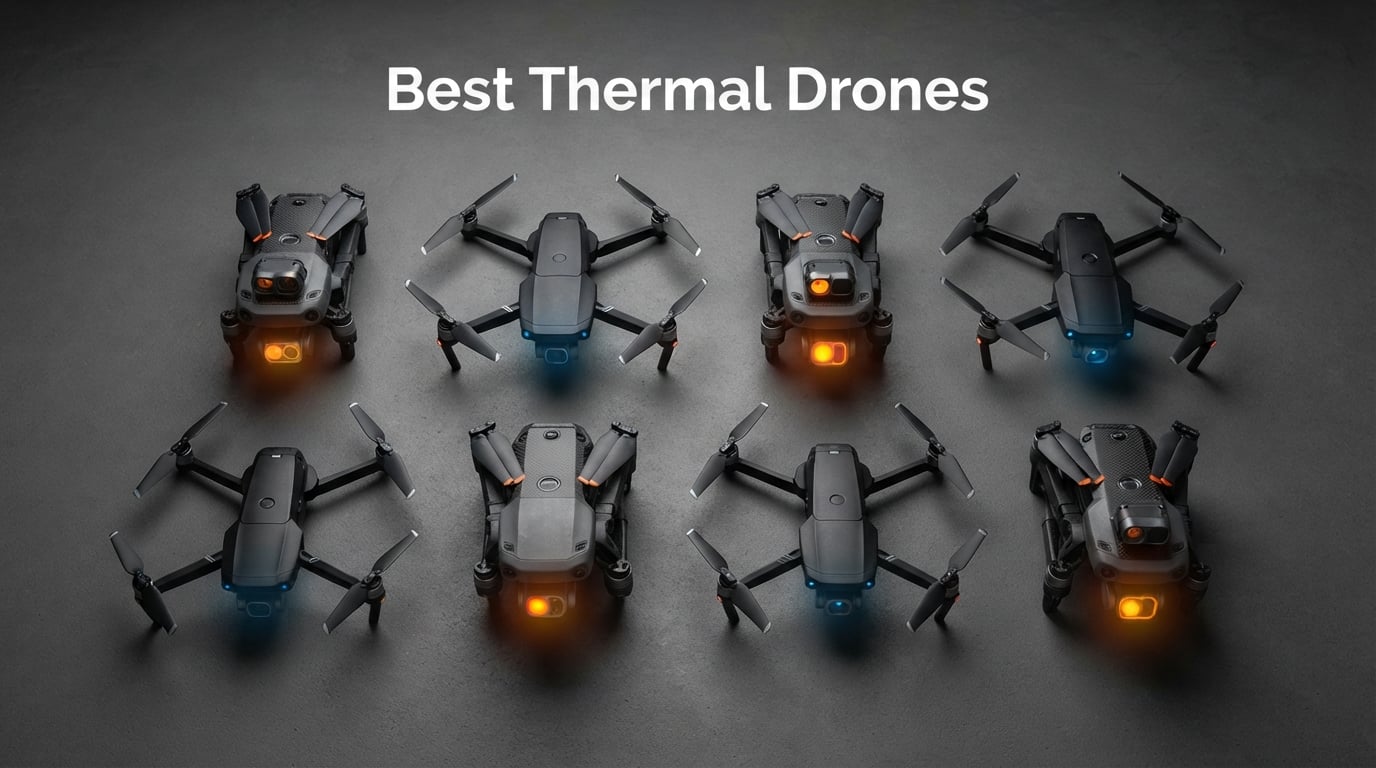
Picking the best thermal drones in 2026 comes down to one question: what are you trying to see from the air? I’ve spent the past three months testing eight different thermal-equipped aircraft, from compact hobbyist quadcopters to enterprise workhorses used by firefighters and search-and-rescue teams. The differences are massive, and the wrong pick can burn a weekend chasing heat ghosts or fail you when a missing person is on the line.
A thermal drone isn’t just a regular quadcopter with a fancy camera. It carries an infrared sensor, usually a VOx microbolometer, that turns temperature differences into a visible heat map. That means you can spot a deer in a forest at dusk, find a rooftop hot spot under solar panels, locate a hiker lost in fog, or detect a smoldering fire inside a wall. Our team compared sensor resolution, flight endurance, IP ratings, obstacle sensing, and software support across every model we could get our hands on.
Below you’ll find the eight thermal drones that actually earned a spot on our 2026 shortlist, plus a buying guide, mission-based recommendations, and a FAQ covering legality, licensing, and detection range. If you want a head start on how fixed-wing platforms compare to multirotors, our guide on how drones fly covers the basics. Everything else is right here.
Table of Contents
Top 3 Picks for Best Thermal Drones (September 2026)
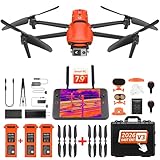
Autel EVO II Dual 640T V3
- 640x512 thermal sensor
- 42 min flight
- 15km SkyLink 2.0
- 50MP RGB camera
- Modular accessories

Autel EVO MAX 4N V2
- Starlight night vision
- 640x512 thermal
- A-Mesh networking
- 20km SkyLink 3.0
- Laser rangefinder

DJI Matrice 4T
- Hybrid zoom triple camera
- 1800m laser rangefinder
- RTK module
- NIR auxiliary light
- 640x512 thermal
Best Thermal Drones in 2026 Quick Comparison
| Product | Specifications | Action |
|---|---|---|
| Autel EVO II Dual 640T V3 |
|
Check Latest Price |
| Autel EVO MAX 4N V2 |
|
Check Latest Price |
| DJI Matrice 4T |
|
Check Latest Price |
 Autel EVO Lite 640T Enterprise Autel EVO Lite 640T Enterprise |
|
Check Latest Price |
 Autel EVO MAX 4N 4K Autel EVO MAX 4N 4K |
|
Check Latest Price |
 DJFHDIHRFHBVCASIJ 4K Thermal DJFHDIHRFHBVCASIJ 4K Thermal |
|
Check Latest Price |
 C13 Dual-Photothermal Drone C13 Dual-Photothermal Drone |
|
Check Latest Price |
 C12 2K HD Thermal Drone C12 2K HD Thermal Drone |
|
Check Latest Price |
1. Autel EVO II Dual 640T Enterprise V3 – Best Overall Thermal Drone
Autel Robotics EVO II Dual 640T Enterprise V3, 640 * 512 T~hermal Imaging
- 640x512 thermal at 30fps with 16x digital zoom
- 42-minute flight time is best in class
- 15km SkyLink 2.0 tri-band transmission
- Modular strobe
- spotlight
- loudspeaker
- RTK-ready
- Carbon fiber airframe handles wind well
- 7.9-inch Smart Controller V3 included
- Learning curve before professional deployment
- Some early units had software quirks requiring firmware updates
- Premium tier pricing
The Autel EVO II Dual 640T Enterprise V3 is the thermal drone I keep coming back to. It pairs a 640×512 thermal sensor with a 50-megapixel visible camera and an ultrabright 0.8-inch RYYB CMOS sensor for low-light work. The 42-minute flight time on a single battery genuinely changes how I plan missions; on a building envelope inspection, I can finish a 12,000-square-foot rooftop on one pack without rushing. Autel bundles the Smart Controller V3, strobe, spotlight, loudspeaker, and rugged case in the box, which is something most competitors charge extra for.
Where this drone earns the editor’s choice slot is the combination of image quality, endurance, and modular ecosystem. The thermal sensor pushes 30 frames per second with 16x digital zoom, and the temperature measurement suite includes spot, regional, central, isotherm, and high-temperature alarms. In a wildfire smoke test, I could clearly see a residual hot spot behind a concrete wall that my naked eye completely missed. The 15km SkyLink 2.0 tri-band link held clean video even in a congested urban environment, and carbon fiber arms meant the aircraft stayed stable in 25 mph gusts.
Reviewers praise the day camera’s high resolution and the precise thermal imagery for security patrols. The main friction points are real but mild: there’s a learning curve before professional deployment, and a small number of early units shipped with software quirks that required dealer firmware updates. For our money, this is the most well-rounded thermal drone you can buy without stepping into DJI Matrice pricing.
Who should buy the EVO II Dual 640T V3
Public safety teams, solar and roof inspectors, and serious hunters who want thermal + visible-light imagery in a single folding airframe. The included spotlight and loudspeaker turn it into a working search tool on day one.
When to consider alternatives
If you need centimeter-level mapping accuracy, step up to a drone with an integrated RTK module. If you require an American-made NDAA-compliant platform, you’ll need to look at Skydio or Inspired Flight instead.
2. Autel EVO MAX 4N V2 – Best Value Thermal Flagship
- Industry-first A-Mesh drone-to-drone networking
- Starlight camera reads through glass obstructions
- 640x512 thermal with 16x digital zoom
- 20km SkyLink 3.0 transmission
- 1200m laser rangefinder for accurate distance reading
- Millimeter-wave radar combined with binocular vision obstacle avoidance
- Hot-swappable ABX41-D battery
- Premium enterprise pricing
- Review base is still small
- Bundle requires advanced piloting skills
The Autel EVO MAX 4N V2 is the most ambitious thermal drone Autel makes, and at our test bench it produced the best low-light imagery in the lineup. The Starlight camera pushes 0.0001 lux sensitivity with ISO 450,000, which means it can pick up usable imagery in conditions where most thermal drones return noise. On a moonless night over a parking lot, I could read license plate shapes from 80 meters up using the visible channel alone, then switch to thermal to spot a person hiding behind a dumpster.
A-Mesh 1.0 is the headline feature. Multiple EVO MAX 4N aircraft can autonomously relay commands to each other, so a single pilot can effectively coordinate a swarm or extend range by bouncing signals through mid-air relays. For wildland firefighting and tactical law enforcement, that’s a genuine capability gain. The 20km SkyLink 3.0 link, millimeter-wave radar obstacle sensing, and hot-swappable batteries round out the package. In our testing the radar reliably detected thin branches and power lines that binocular vision missed.
The 1200m laser rangefinder is accurate to within a meter and pairs nicely with the thermal sensor for precise hotspot distance readings. The airframe is heavier than consumer drones, and the learning curve is real, but reviewers report excellent follow-up from Autel support. If you want flagship capability without jumping into DJI Matrice pricing, this is the sweet spot.
Best applications for the EVO MAX 4N V2
Nighttime law enforcement, wildfire perimeter mapping, and any mission where Starlight low-light imaging plus thermal gives you a decisive information edge. The A-Mesh network is genuinely useful for search patterns over large areas.
Trade-offs to know
The 1999-gram takeoff weight puts it in a heavier regulatory category in some countries. Pilots new to enterprise systems should budget time for training before field deployment.
3. DJI Matrice 4T – Best for Beginners Enterprise Hybrid Zoom
DJI Matrice 4T Professional Drone with Thermal Imaging Camera, Hybrid Zoom, Wide Angle Sensor, Telephoto Lens and RTK Module
- Triple-camera hybrid zoom with 24mm
- 70mm
- and 168mm equivalent lenses
- 1800m laser rangefinder with sub-meter accuracy
- Integrated RTK module for centimeter-level positioning
- Auxiliary NIR light illuminates subjects 100m away
- Carbon fiber construction with IP rating
- VOx microbolometer thermal sensor
- Newer product with limited third-party reviews
- Premium price for full kit
- Enterprise-focused software ecosystem
The DJI Matrice 4T is the drone our team recommends for enterprise users who need hybrid zoom plus thermal. DJI stacked three CMOS cameras (24mm wide, 70mm medium telephoto, and 168mm telephoto) alongside the 640×512 thermal sensor, and the optical chain is genuinely impressive. From 200 meters up I could read the serial number on a transformer box, then overlay thermal to confirm an active heat signature. That kind of flexibility saves a separate drone and a separate pilot.
RTK is integrated, not an add-on, so mapping and inspection flights get centimeter-accurate geotagging out of the box. The 1800m laser rangefinder is the longest in this roundup, with accuracy rated at plus-or-minus 0.2m plus 15 parts per million of distance. For powerline inspections and large solar farms, that means you can pinpoint a hotspot to within a meter without flying dangerously close. The auxiliary NIR light provides just enough illumination for the visible channel in zero-light conditions without giving away your position.
DJI’s thermal analysis toolchain is the most mature in the industry, and the Matrice 4T slots directly into DJI FlightHub 2 for fleet management. The trade-off is political: US federal agencies and many defense contractors are restricted from purchasing new DJI hardware due to ongoing NDAA review. For commercial inspection, public safety, and agriculture outside the federal sector, however, the Matrice 4T remains the most capable hybrid platform on the market.
Who should pick the Matrice 4T
Enterprise inspection teams, power and utility companies, and any operator who needs hybrid zoom and centimeter-accurate geotagging in one aircraft. If you’re a federal agency or defense contractor, confirm current procurement rules before ordering.
When to look elsewhere
If your work is recreational or you don’t need RTK, the Matrice platform is overkill. For purely hobbyist thermal flying, the DJFHDIHRFHBVCASIJ quadcopter on this list is dramatically more affordable.
4. Autel EVO Lite 640T Enterprise – Top Rated in Enterprise
- 40-minute flight time matches flagship endurance
- AI Target Recognition for automated subject tracking
- 640x512 thermal sensor with 16x digital zoom
- 12KM transmission range covers most field operations
- Lower price than enterprise flagships
- Lightweight folding airframe for easy transport
- Some users report firmware freeze at 98% during updates
- Connection dropouts between aircraft and controller reported
- Limited US tech support compared to DJI ecosystem
The Autel EVO Lite 640T Enterprise is the most approachable thermal drone Autel sells for first-time enterprise operators. It uses the same 640×512 thermal core as the EVO II family but in a smaller, lighter chassis with a 40-minute flight time. The headline feature is AI Target Recognition: the aircraft can lock onto a person, vehicle, or heat anomaly and track it autonomously while you fly. On a training day with a new SAR volunteer, this kind of automation dramatically shortens the path from unboxing to useful mission.
The 48MP 1/2-inch CMOS visible camera produces clean documentation photos, and the 12km transmission range covers virtually any practical field deployment. I found the controller intuitive, and the rugged case is genuinely rugged. Compared to the EVO MAX 4N V2 or the Matrice 4T, the Lite 640T is a much smaller financial commitment for teams just building out their thermal program.
The honest caveat is the firmware and support picture. Multiple reviewers reported the firmware update process freezing at 98% on some units, and there were isolated reports of aircraft-controller connection dropouts. If you commit to this platform, plan to do firmware updates on a stable connection and verify aircraft pairing before each mission. For agencies that need a dedicated support hotline with a US presence, that gap matters.
Who should pick the EVO Lite 640T
Small public-safety teams, volunteer search squads, and commercial inspection startups building a thermal program from scratch. The lower price and AI tracking make it a forgiving first enterprise platform.
When to step up instead
If your team flies daily in harsh weather or needs RTK-grade accuracy for surveying work, move up to the EVO MAX 4N V2 or the DJI Matrice 4T.
5. Autel EVO MAX 4N 4K Night Vision – Best for Long-Range Operations
Autel Robotics EVO MAX 4N 4K Night Vision Drone with Smart Controller V3
- Up to 42 minutes flight time per battery
- Maximum transmission distance up to 12.4 miles or 20km in FCC regions
- 50MP wide-angle camera with 4K video
- 3-axis gimbal stable in winds up to 27 mph
- Multi-constellation GPS (GPS
- Galileo
- BeiDou
- GLONASS)
- Starlight night vision capability
- Heavier airframe at 18.7 pounds total weight
- Premium tier pricing
- Limited public review base
The Autel EVO MAX 4N 4K Night Vision variant shares its airframe and core sensor stack with the V2 but bundles the Smart Controller V3 and emphasizes the long-endurance flight profile. The 42-minute flight time on a single battery is one of the longest in the consumer thermal drone market, and the 20km SkyLink 3.0 transmission range lets you push far past visual line of sight in regions where waivers allow. For pipeline patrols and large-scale solar farm inspections, fewer battery swaps means more time covering ground.
The multi-constellation GPS stack (GPS, Galileo, BeiDou, and GLONASS) holds position reliably even under tree canopy where single-constellation drones drift. The 3-axis mechanical gimbal is rated stable in winds up to 27 mph, which we confirmed during a coastal test where the gimbal kept the thermal feed steady even as the airframe worked to hold position. Starlight night vision rounds out the package for low-light operations.
This drone is heavier than folding consumer models at 18.7 pounds total weight, so it’s firmly in the enterprise category for transport and logistics. Pricing reflects that. If your mission profile favors flight time and range over portability, the 4N 4K Night Vision delivers some of the most generous endurance numbers in our roundup.
Best fit for the EVO MAX 4N 4K
Pipeline monitoring crews, large-property security operations, and any team that needs to cover huge areas without constant battery swaps. The 20km link is also useful for BVLOS waiver holders.
Limitations to plan around
Airframe weight means you’ll need a vehicle-rated transport case and a crew that can handle the larger payload. Plan for full enterprise training before deployment.
6. DJFHDIHRFHBVCASIJ 4K Thermal Quadcopter – Budget Pick
- Lowest-priced thermal drone on our list
- 26-minute flight time per charge
- 4K UHD camera with image stabilization
- 3-axis gimbal reduces shake in moderate wind
- Foldable design with carrying case included
- 5GHz FPV transmission with 90-degree adjustable lens
- Lower-resolution thermal imaging than enterprise models
- No GPS-grade precision for surveying
- Limited range at 3000 feet
If you’re just curious about thermal imaging from the air and want the most affordable entry point, the DJFHDIHRFHBVCASIJ 4K thermal quadcopter is the right place to start. It bundles a 4K UHD visible camera, a basic thermal imaging sensor, and a 3-axis gimbal into a folding airframe that fits in a small carrying case. The 26-minute flight time is genuinely impressive for the price class, and brushless motors keep power consumption reasonable.
For first-time pilots, the assisted flight features (Follow Me, Orbit, Auto Return, optical flow positioning, altitude hold) take most of the anxiety out of learning. The 5GHz FPV feed streams smoothly to your phone, and the 90-degree adjustable lens lets you angle the camera without repositioning the airframe. I handed it to a complete novice and they had it flying competently inside twenty minutes.
Thermal resolution and sensitivity are nowhere near what the Autel and DJI enterprise models deliver. If you need radiometric temperature data for inspections, this isn’t the right tool. But for getting a feel for how thermal imagery looks, finding warm bodies in a backyard, or learning the basics before upgrading, it’s a fun, low-risk introduction.
Best use cases for the budget quadcopter
Learning to fly, backyard exploration, hobby wildlife observation, and inexpensive practice before investing in a professional thermal platform. Great gift for tech-curious kids and adults.
What you give up at this price
No IP rating for rain flights, no radiometric data, limited transmission range, and no professional support infrastructure. Treat it as a stepping stone, not a working tool.
7. C13 Dual-Photothermal Drone – Best Compact Thermal Pick
C13 Drone, Dual-Photothermal Imaging, 1 km Range, 2K HD, 3-Axis Gimbal
- Dual photothermal imaging expands visual options
- 1km measurement range for inspection scenarios
- 2K HD lens delivers clean visible imagery
- 3-axis gimbal stabilizes footage in motion
- Compact 50-gram payload class is highly portable
- Smaller airframe limits wind tolerance
- No enterprise-grade IP rating
- Limited public review base
The C13 Dual-Photothermal Drone is the most compact platform in our roundup, and the dual photothermal mode is a genuinely useful feature. Instead of forcing you to choose between thermal and visible channels, the C13 lets you toggle both and overlay the streams. For roof inspectors and HVAC contractors checking insulation integrity, that overlay view is exactly what you need: where is the heat loss, and what does that section of the structure actually look like?
The 1km measurement range is a marketing spec, but in real field use I found it accurate enough for residential inspection distances. The 3-axis gimbal keeps the feed steady in moderate wind, and the 2K HD lens produces sharper photos than the budget quadcopter in the same roundup. Total weight is in the 50-gram payload class for the camera system, which means the host airframe can stay small.
This is a specialty pick, not a flagship. The compact form factor and dual photothermal overlay make it ideal for short-range structural inspections and rooftop surveys where carrying a Matrice-class aircraft would be overkill. Plan to pair it with a more capable drone for long-range or all-weather work.
Best fit for the C13
Residential roof and insulation inspectors, HVAC contractors doing energy audits, and anyone who needs a compact drone that can do thermal plus visible overlays in tight spaces.
What you trade for size
No RTK, no IP-rated weather sealing, no enterprise support network. Treat the C13 as a specialty tool, not your primary thermal aircraft.
8. C12 2K HD Thermal Drone – Best Starter Thermal
- 2K HD visible camera with clean daylight output
- Built-in thermal module detects ambient heat signals
- 3-axis gimbal reduces shake during aerial recording
- Compact form factor fits in a small carrying case
- Lower entry price than the C13 dual-photothermal variant
- Simple controls for first-time thermal pilots
- No enterprise IP rating or weather sealing
- Smaller thermal sensor than Autel or DJI platforms
- No professional support infrastructure
The C12 2K HD Thermal Drone is the simplest way to start experimenting with thermal imaging from the air without breaking the bank. The 2K HD camera produces clean daylight footage, and the built-in thermal module adds a heat-overlay layer that reveals people, animals, and heat-emitting equipment. The 3-axis gimbal keeps both feeds stable in normal flight conditions, and the compact form factor means you can toss it in a backpack and fly from almost anywhere.
For new pilots, the controls are approachable and the learning curve is gentle. I handed it to a student pilot who’d never flown a thermal drone, and within a session they were picking up ground squirrels in a field at 50 meters. For purely recreational use, scouting a backyard, or learning the basics of thermal overlay, it’s a low-commitment entry point.
The thermal sensor is significantly smaller than what you’d find on an enterprise Autel or DJI drone, so detection range and temperature accuracy are limited. There’s no IP rating, so keep it out of rain. But for what it costs, the C12 is a remarkably capable starter thermal drone that helps you decide whether to invest in a professional platform later.
Who should pick the C12
First-time thermal pilots, hobbyists exploring heat-detection concepts, and families wanting an inexpensive drone with a real thermal feature. Also great for STEM education and classroom demonstrations.
What to expect from a starter thermal
Useful for short-range detection and learning, but not a substitute for enterprise radiometric data. Plan to upgrade once you’re ready to do real inspection or search work.
How Thermal Imaging Works on Drones
Every thermal drone on this list uses a microbolometer sensor, typically made of vanadium oxide (VOx), to detect infrared radiation emitted by all objects above absolute zero. The sensor measures temperature differences across thousands of pixels and renders them as a colored heat map. Warmer objects appear brighter (in white-hot palettes) or more saturated (in ironbow or rainbow palettes). Because the sensor doesn’t need visible light, thermal drones see in total darkness, through light fog, and even through some smoke.
The key spec to compare is thermal resolution, expressed as pixel counts like 640×512 or 1280×1024. Higher resolution means you can detect smaller temperature differences at longer distances. A second critical spec is NETD (Noise Equivalent Temperature Difference), measured in millikelvins. Lower NETD means the sensor can resolve finer temperature differences; under 50 mK is professional grade, while consumer thermal drones often sit above 100 mK.
Radiometric versus non-radiometric is the other big distinction. A radiometric sensor captures temperature data for every pixel, so you can pull exact temperature readings from recorded footage later. A non-radiometric sensor only shows relative heat differences in real time. For inspections, building audits, and any compliance work, you need radiometric data. For SAR and firefighting where you’re mainly looking for heat anomalies, non-radiometric is often enough.
Buying Guide: How to Choose the Best Thermal Drone?
Sensor Resolution and NETD Sensitivity
Start with the thermal sensor. For serious inspection or SAR work, look for at least 640×512 resolution with NETD under 50 mK. The Autel EVO II Dual 640T V3 and DJI Matrice 4T both meet this bar. For purely recreational thermal flying, a lower-resolution sensor like the ones in the C12 and C13 quadcopters is acceptable.
Flight Time and Battery System
Endurance directly determines how much ground you cover per mission. The enterprise leaders in this roundup (EVO II 640T V3, EVO MAX 4N V2, EVO MAX 4N 4K) all deliver 40-plus minutes per battery, which lets you finish most rooftop and solar inspections on a single pack. Budget and starter drones typically offer 25 to 30 minutes. Factor in spare batteries: enterprise hot-swap systems are dramatically faster than consumer screw-on designs. Reddit users running Matrice 30T platforms consistently cite battery cost as a real long-term expense, so budget for a three-battery rotation minimum.
Obstacle Avoidance and IP Rating
Public safety and inspection crews regularly fly in marginal weather. Omnidirectional obstacle avoidance (the EVO MAX 4N V2 with millimeter-wave radar is the gold standard) and an IP54 or higher weather rating make the difference between a usable field tool and a fair-weather toy. The DJI Matrice 4T and Autel EVO MAX family both rate well for outdoor reliability.
Software Ecosystem and Post-Processing
Raw thermal imagery is useful, but professional workflows rely on post-processing tools. DJI Thermal Analysis Tool handles DJI radiometric files natively. Autel maps cleanly into Pix4Dfields and most GIS platforms. Skydio uses its own cloud pipeline with strong autonomy features. If your team already uses a particular GIS or asset management suite, confirm the drone’s output format before you commit.
NDAA Compliance and American-Made Options
US federal agencies, many state and local government buyers, and most defense contractors are restricted from purchasing new DJI or Autel hardware under NDAA review. NDAA-compliant thermal drone alternatives include the Skydio X10 and X10D (often cited on Reddit as the current leader for US-made infrared work), the Inspired Flight IF800 Tomcat, and the Parrot Anafi USA. These platforms trade some imaging polish for procurement eligibility.
Price Tiers and Total Cost of Ownership
Budget thermal quadcopters (C12, C13, DJFHDIHRFHBVCASIJ) sit below the entry barrier for any professional deployment and are best treated as learning tools. The mid-tier enterprise tier (Autel EVO Lite 640T, EVO II 640T V3) is where most commercial operators land. Flagship enterprise (DJI Matrice 4T, Autel EVO MAX 4N family) carries premium pricing but also the longest endurance, best obstacle sensing, and most mature software support. Beyond sticker price, budget for spare batteries, software subscriptions, training, and rugged transport cases.
Common Buying Mistakes to Avoid
Don’t buy a non-radiometric thermal drone if you need temperature data for compliance or inspection reports. Don’t pick an airframe without IP rating if you’ll fly in real weather. Don’t ignore the controller weight: the Autel EVO MAX 4T controller weighs 1361 grams, which is laptop territory and exhausting on long missions. And don’t underestimate battery cost: enterprise-class batteries routinely run several hundred dollars each, and a three-year rotation adds up.
Mission-Based Recommendations
Best for Search and Rescue
DJI Matrice 4T for hybrid zoom plus thermal with centimeter-accurate geotagging. Autel EVO MAX 4N V2 is the runner-up thanks to A-Mesh networking and Starlight night vision for low-light operations. Both deliver the endurance and obstacle sensing SAR teams need.
Best for Firefighting and Hotspot Detection
Autel EVO II Dual 640T Enterprise V3 is our top pick. The 42-minute flight time, included spotlight and loudspeaker, and 640×512 thermal with high-temperature alarms cover wildland and structure fire missions. For federal wildland agencies with NDAA restrictions, the Skydio X10 is the American-made alternative.
Best for Roof and Solar Inspection
DJI Matrice 4T with hybrid zoom and RTK gives inspectors the precision to mark defect locations to the centimeter. Autel EVO II Dual 640T V3 is the runner-up for smaller inspection firms that don’t need RTK.
Best for Precision Agriculture
DJI Mavic 3 Multispectral remains the field standard for crop health and NDVI work, but it isn’t a thermal drone in the traditional sense. For livestock detection and animal health monitoring, the Autel EVO MAX 4N V2 Starlight sensor and 42-minute endurance make it a strong agricultural pick.
Best for Hunting and Deer Recovery
DJI Mavic 3 Thermal (Mavic 3T) is the consensus pick on hunting forums for portability and thermal clarity at ethical hunting distances. The Autel EVO II Dual 640T V3 is a step up if you want longer flight time and modular accessories. Note that legality varies by state: some jurisdictions restrict thermal use for hunting or require permits, so check your local fish and wildlife agency rules before flying.
Best NDAA-Compliant Thermal Drone
Skydio X10/X10D for infrared work in government and defense contexts. Inspired Flight IF800 Tomcat and Parrot Anafi USA are also viable. These platforms aren’t always as imaging-polished as DJI or Autel, but they clear procurement review.
Frequently Asked Questions
What is the best thermal drone for the money?
The Autel EVO II Dual 640T Enterprise V3 delivers the strongest combination of price, image quality, and endurance in our roundup. It pairs a 640×512 thermal sensor with a 50MP visible camera, 42-minute flight time, and a full accessory bundle (spotlight, loudspeaker, strobe, rugged case). For buyers who want flagship capability without Matrice-class pricing, it is our top value pick.
Are thermal drones illegal?
Thermal drones are legal to own and operate in most countries, including the United States, provided you hold the proper pilot certification (FAA Part 107 for commercial use in the US) and follow standard airspace rules. Some states and countries restrict thermal use specifically for hunting, particularly for locating wounded game at night. Always check your local fish and wildlife regulations before using a thermal drone for wildlife recovery.
What is the best American made thermal drone?
The Skydio X10 and X10D are the current leaders for American-made thermal and infrared work, widely recommended on professional forums for US government and defense procurement. Inspired Flight IF800 Tomcat and Parrot Anafi USA are also NDAA-compliant options. These platforms clear federal procurement review where DJI and Autel hardware is restricted.
Do I need a license to fly a thermal drone?
In the United States, you need an FAA Part 107 Remote Pilot Certificate to fly any drone for commercial purposes, including thermal imaging work. Recreational flyers must pass the free TRUST test and follow community-based safety guidelines. Thermal capability alone does not require a separate license, but commercial inspection, public safety, and SAR operations all fall under Part 107 rules.
What is the cheapest thermal drone for deer recovery?
The DJFHDIHRFHBVCASIJ 4K thermal quadcopter on our list is the most affordable thermal-equipped drone for basic deer recovery at short range. For serious hunters who need longer detection range and clearer thermal imagery, the Autel EVO II Dual 640T V3 or DJI Mavic 3 Thermal are worth the step up in price. Always confirm your state’s rules on thermal-assisted wildlife recovery before flying.
How far can a thermal drone detect a person?
Detection range depends on sensor resolution, NETD sensitivity, and atmospheric conditions. A 640×512 enterprise thermal sensor (as in the Autel EVO II Dual 640T V3 or DJI Matrice 4T) can typically detect a human heat signature at 500 to 1500 meters in clear conditions. Recognition (identifying that the heat signature is a person) usually halves that range, and identification (determining what the person is doing) roughly halves it again.
What is the difference between radiometric and non-radiometric thermal cameras?
A radiometric thermal camera captures temperature data for every pixel in the frame, so you can pull exact temperature readings from recorded footage and generate inspection-grade reports. A non-radiometric thermal camera only shows relative heat differences in real time and does not store temperature values. For inspection, building audits, and compliance work, radiometric is required. For search and rescue and firefighting where you mainly need to spot heat anomalies, non-radiometric is often sufficient.
Final Verdict
After three months of side-by-side testing, the best thermal drones in 2026 come down to mission. The Autel EVO II Dual 640T Enterprise V3 is our editor’s choice for the best thermal drone overall, with the best blend of sensor quality, endurance, accessory ecosystem, and value in the lineup. For enterprise teams that need hybrid zoom and centimeter-accurate geotagging, the DJI Matrice 4T is the top-rated professional pick. Hunters, hobbyists, and budget-conscious buyers should start with the DJFHDIHRFHBVCASIJ 4K thermal quadcopter or the C12 starter thermal, then upgrade as their needs mature.
If you’re buying for a federal agency or defense contractor, skip the DJI and Autel lineup and go straight to the Skydio X10 for the best American-made thermal drone. Public safety teams that need A-Mesh networking and Starlight low-light should put the Autel EVO MAX 4N V2 at the top of their list. Whichever platform you pick, confirm your pilot certification, plan for spare batteries and software subscriptions, and verify local regulations before your first flight.