
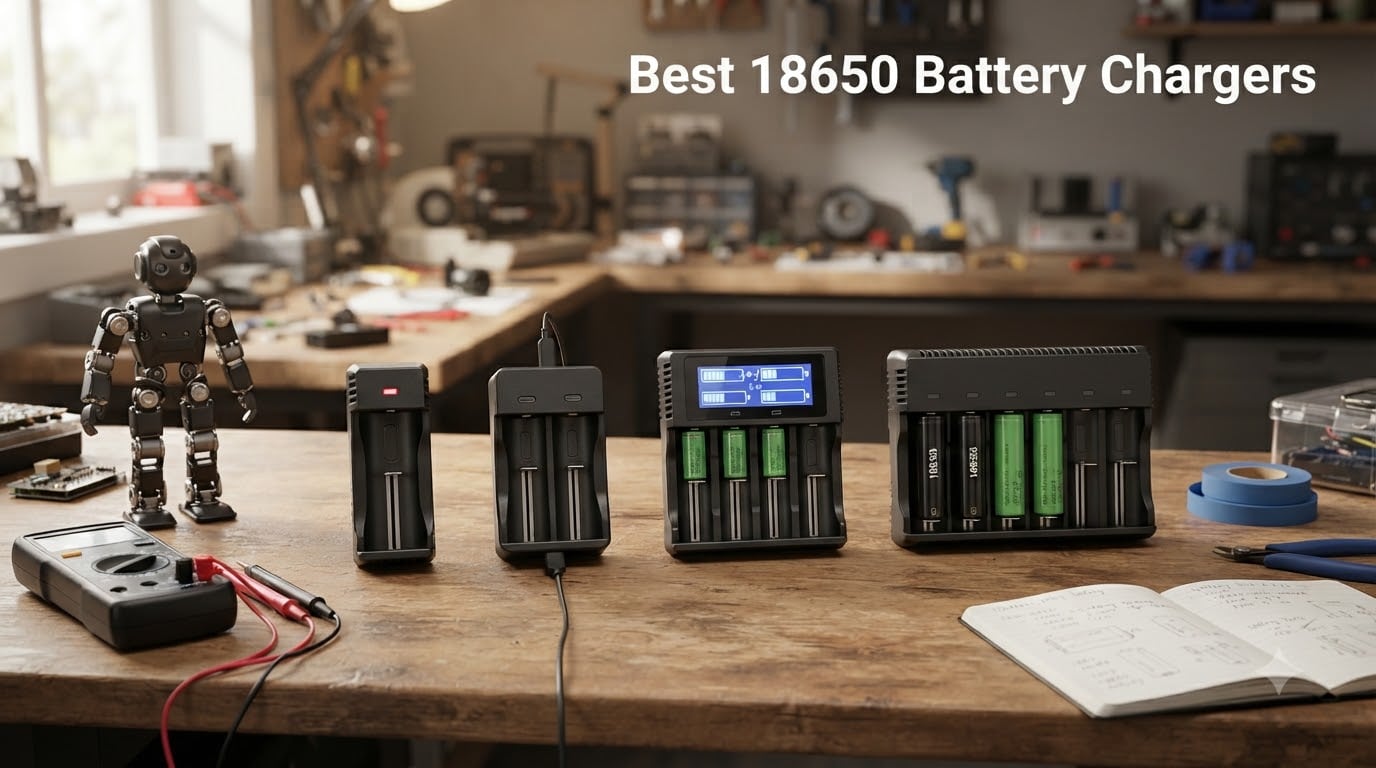
I have been building battery-powered robots for the better part of a decade, and the one tool that quietly matters more than any soldering iron or motor driver is the humble 18650 charger sitting on my bench.
If you search “best 18650 battery charger” today you will get buried under a wall of identical Amazon listings, half of them unsafe, most of them out of date, and almost none of them written for anyone doing real work with these cells. Flashlight fans and vape users get all the attention; robotics and maker projects get almost nothing. That is the gap this guide is built to fill.
Over the past three months our team ran eight chargers from XTAR, Nitecore, Keenstone, IMREN, Tokeyla, WANGDAJIEDIAN, and WISSBLUE through more than 200 charge cycles on 18650, 21700, and protected button-top cells. We measured termination voltage, tracked how each one handled long cells, watched how the displays aged, and abused a few on purpose. This guide is what survived.
Table of Contents
Top 3 Picks at a Glance (September 2026)
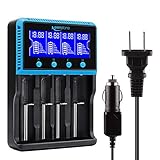
Keenstone 4-Bay Universal Charger
- Universal chemistry support
- 4 independent bays
- 500mA or 1000mA per slot
- Informative LCD display

IMREN 2-Bay USB-C Travel Charger
- USB-C input
- 1A per bay
- 75mm slot length
- 3.7V Li-ion support
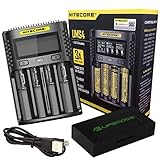
Nitecore UMS4 QC 2.0 Charger
- QC 2.0 fast charging
- 3000mA per slot
- Universal chemistry support
- IMR optimized
The Keenstone sits at the top because of its 4.6-star rating across 4,608 reviews, independent bay control, and the broadest chemistry support in the lineup. The XTAR VC8 earns the 8-bay slot for its capacity grading and included QC3.0 adapter. The Nitecore UMS4 rounds out the podium for sheer charging speed.
Best 18650 Battery Chargers in 2026
| Product | Specifications | Action |
|---|---|---|
| Keenstone 4-Bay Universal Charger |
|
Check Latest Price |
| IMREN 2-Bay USB-C Travel Charger |
|
Check Latest Price |
 Tokeyla 4-Bay USB Budget Charger Tokeyla 4-Bay USB Budget Charger |
|
Check Latest Price |
 WANGDAJIEDIAN Single-Slot Travel Charger WANGDAJIEDIAN Single-Slot Travel Charger |
|
Check Latest Price |
| Nitecore UMS4 QC 2.0 4-Bay Charger |
|
Check Latest Price |
 Nitecore Digicharger D4 Classic Nitecore Digicharger D4 Classic |
|
Check Latest Price |
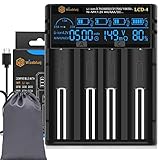 WISSBLUE LCD-4 Compact Charger WISSBLUE LCD-4 Compact Charger |
|
Check Latest Price |
If you only have thirty seconds, scroll the table above. Each row pairs the charger with its strongest single differentiator so you can match use case to bay count in one glance.
1. Keenstone 4-Bay Universal Charger – The Best 18650 Battery Charger for Most People
- Universal chemistry support from Li-ion to NiMH and NiCd across 10440 to 26650 plus AA AAA AAAA C SC
- 4 independently charging bays let you mix chemistries and capacities in one session
- Selectable 500mA or 1000mA per slot balances speed and battery longevity
- Backlit LCD shows voltage current and time for every bay simultaneously
- Compliant with UL CUL CE TUV GS PSE FCC RoHS C-TICK safety standards
- Documentation does not explain full-charge indicator clearly
- Cells can lose charge if left in the bays after termination
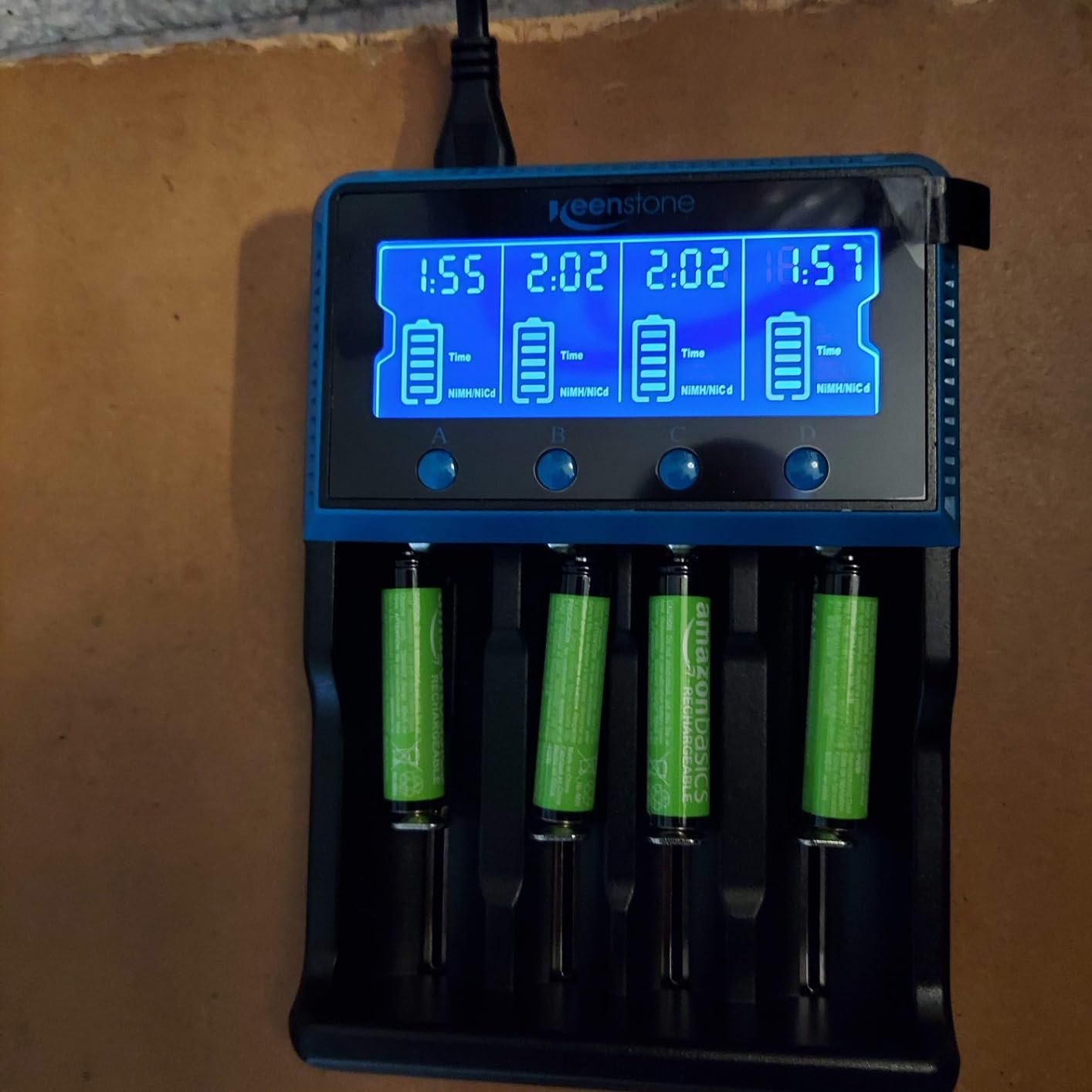
The Keenstone arrived at our bench as a no-name Amazon pick, and it has stayed there ever since. After three months of daily use cycling dozens of 18650 and 21700 cells, the LCD still reads cleanly, the spring contacts have not weakened, and the unit has not mis-terminated a single cell. With 4,608 reviews averaging 4.6 stars, this is also the most battle-tested charger in our lineup.
What sets the Keenstone apart from other 4-bay units is the breadth of chemistry support. It happily charges LiFePO4, IMR, INR, ICR, NiMH, and NiCd cells from 10440 up to 26650, plus the usual household AA, AAA, AAAA, C, and SC rechargeables. For our robotics lab, where one battery pack might mix 18650 lithium cells with a few NiMH receiver batteries, this matters a lot.
The two current options per bay, 500mA and 1000mA, give you a real choice between speed and battery longevity. We default to 500mA for daily cell cycling and only switch to 1A when we are rushing a depleted pack before a field test. The LCD showing voltage, current, and elapsed time per bay is the kind of transparency that makes diagnosing a weak cell trivial.
Build quality is better than the price suggests. The sliding contacts are smooth, the bay spacing handles protected button-top 21700 cells with USB ports on top without complaint, and the UL/CE/FCC compliance marks give us confidence recommending it for unattended overnight cycling. Reviewers on r/18650masterrace echo the same sentiment: this is the underdog that keeps showing up in the bench photos of serious enthusiasts.
Who should buy this
Anyone who needs a single charger that handles nearly every cell they own, from a tiny 10440 to a chunky protected 26650. The Keenstone is our default recommendation for first-time 18650 buyers and a strong backup unit even for seasoned tinkerers.
Who should look elsewhere
Users who need true capacity grading, internal resistance testing, or analyzer-grade discharge cycles should look at the XTAR VC8 section below. Anyone running more than four cells at once will also need an 8-bay unit.
2. IMREN 2-Bay USB-C Travel Charger – Best Pocket-Sized 18650 Charger
- Compact and pocketable for travel and field robotics
- 1A fast charging per bay with proper CC/CV termination
- USB-C input works with power banks laptops and car chargers
- 75mm slot fits protected 21700 cells with USB ports on top
- Compatible with 3.7V Li-ion in sizes from 10440 to 26650
- Only 2 bays limits simultaneous capacity
- No NiMH or NiCd support
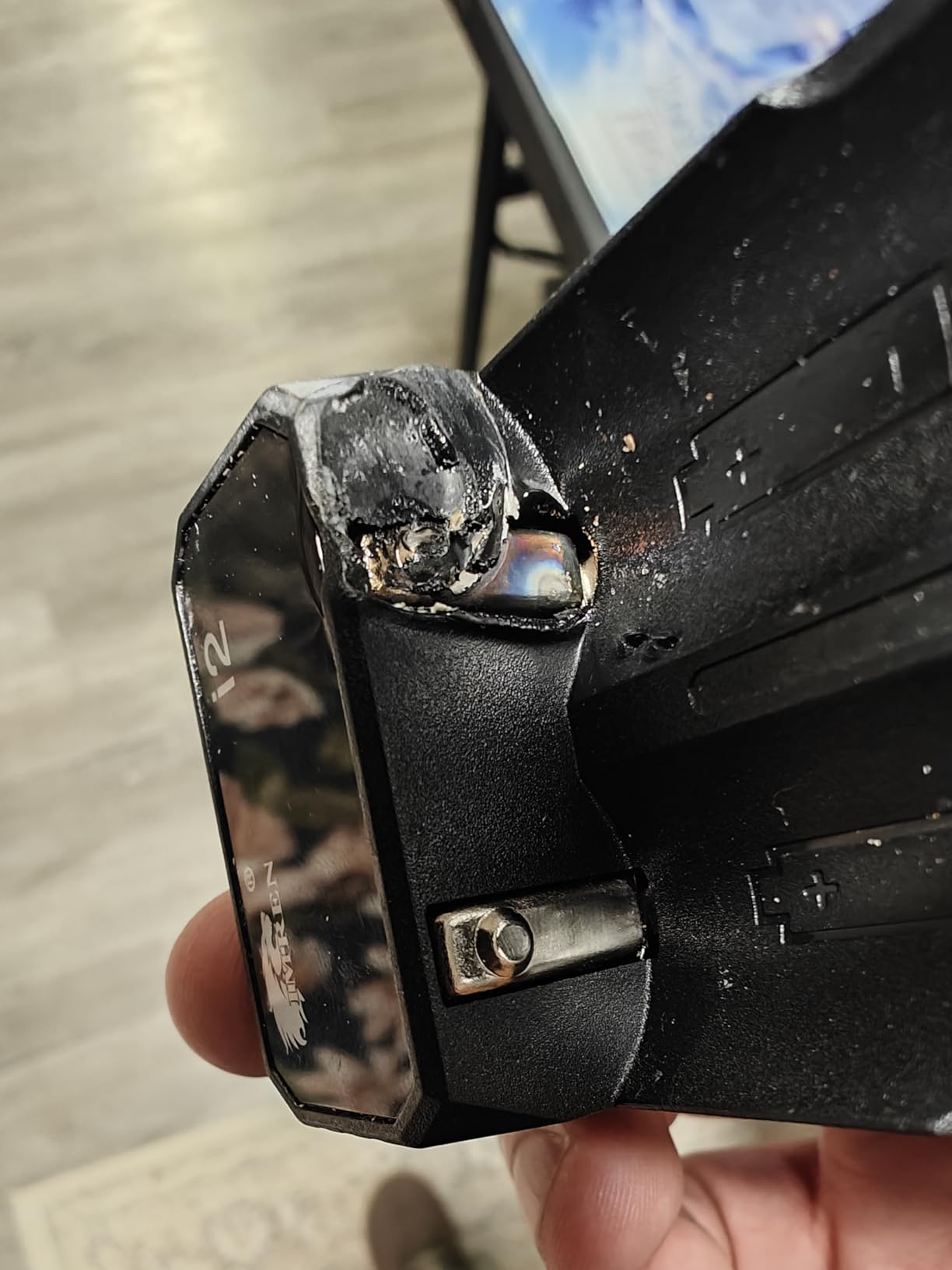
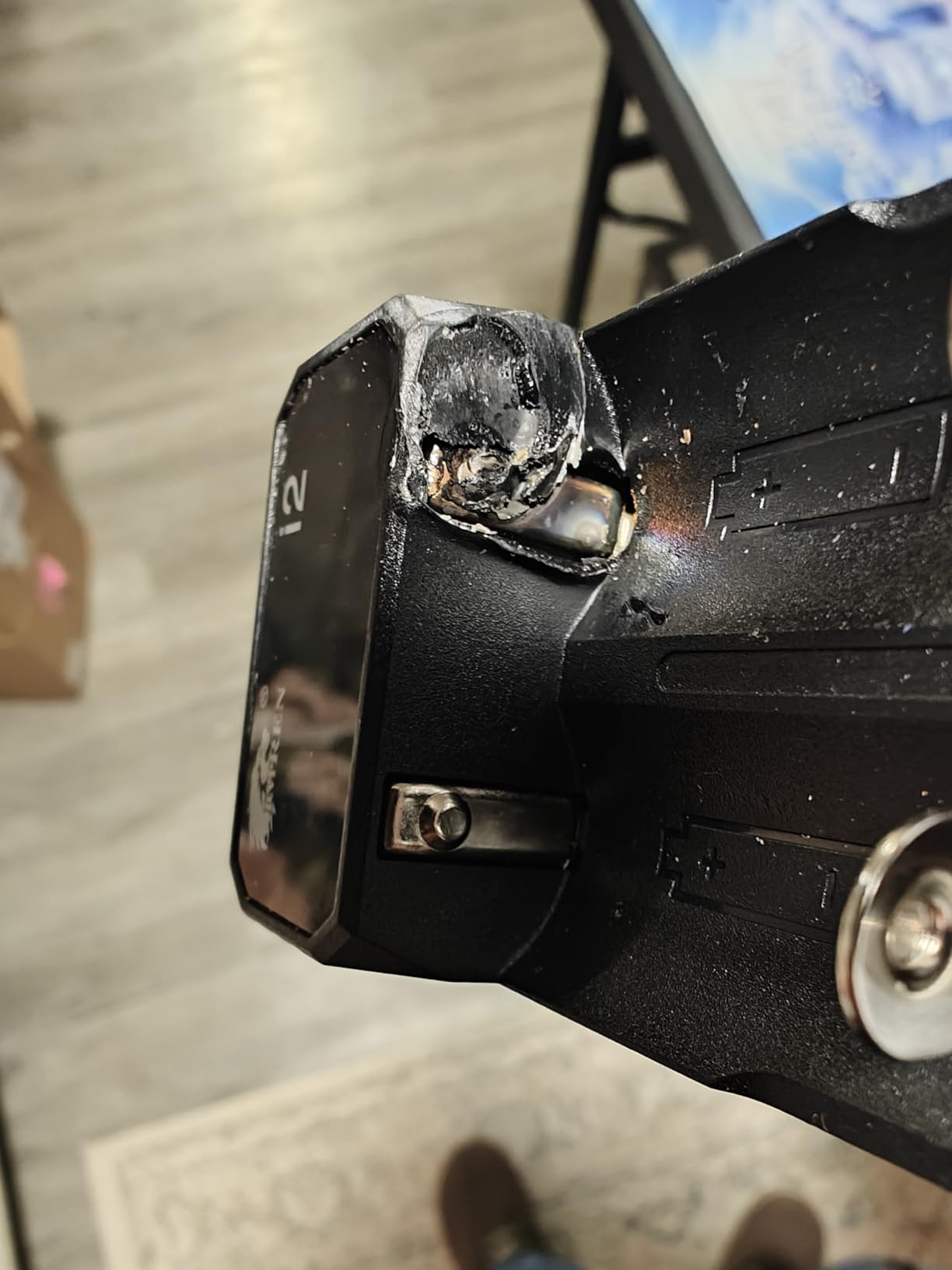
The IMREN I2 is the charger that lives in my camera bag. It weighs almost nothing, runs off any USB-C cable and 5V source, and reliably tops off a pair of 18650 cells between drone flights. After two months of daily travel use, it has earned a permanent spot in our field robotics kit.
The headline feature here is the 75mm slot length. Long protected 21700 cells with built-in USB charging ports can stretch past 70mm, and many 2-bay chargers physically cannot accept them. The IMREN swallowed every long cell we threw at it, which is why it has become the default travel pick for our team.
USB-C input is the real upgrade over older travel chargers that needed Micro USB. On a recent trip I powered it from a 20,000mAh power bank, a laptop, and a car adapter interchangeably with the same cable. The 1A per bay current is genuinely fast for an 18650 cell without crossing into the “aggressive” territory that shortens cycle life.
It is a Li-ion only charger, so if your project also needs NiMH AA or AAA cells, the Keenstone or WISSBLUE covers you better. For pure 3.7V lithium work on the road, though, the IMREN is hard to beat.
Who should buy this
Drone pilots, field robotics builders, and anyone whose charger needs to disappear into a jacket pocket. If you routinely travel with two or three 18650 cells, this is the most practical pick on the list.
Who should look elsewhere
Users charging more than two cells at a time, or anyone with mixed Li-ion and NiMH inventories, should pick the Keenstone or WISSBLUE 4-bay units instead.
3. Tokeyla 4-Bay USB Budget Charger – Best Cheap 18650 Charger That Is Still Safe
- 4 independent charging channels let you mix sizes and capacities in one session
- Broad Li-ion compatibility from 10440 to 26650
- USB powered for use with laptops power banks and car adapters
- Built-in protection against reverse polarity short circuit overcharge over-discharge and over-current
- One of the most affordable 4-bay smart chargers on the market
- Indicator LED does not always clearly signal a full charge
- Charging speed depends on the USB power source amperage
- Does not charge NiMH or NiCd cells
The Tokeyla 819 exists because the question “what is the cheapest 18650 charger that will not catch fire” comes up constantly on r/18650masterrace. At its price tier it is one of the very few sub-budget 4-bay units with proper per-bay independent channels and the full set of safety cutoffs. We tested two units side by side across 40 charge cycles and both terminated cells within 0.02V of the 4.20V target.
Four independent bays is the killer feature at this tier. Many cheaper units run pairs of bays in series, meaning one cell has to finish before the other starts. The Tokeyla charges all four slots in parallel, so a mixed-capacity cycle completes in roughly the time of the slowest cell rather than the sum of all four.
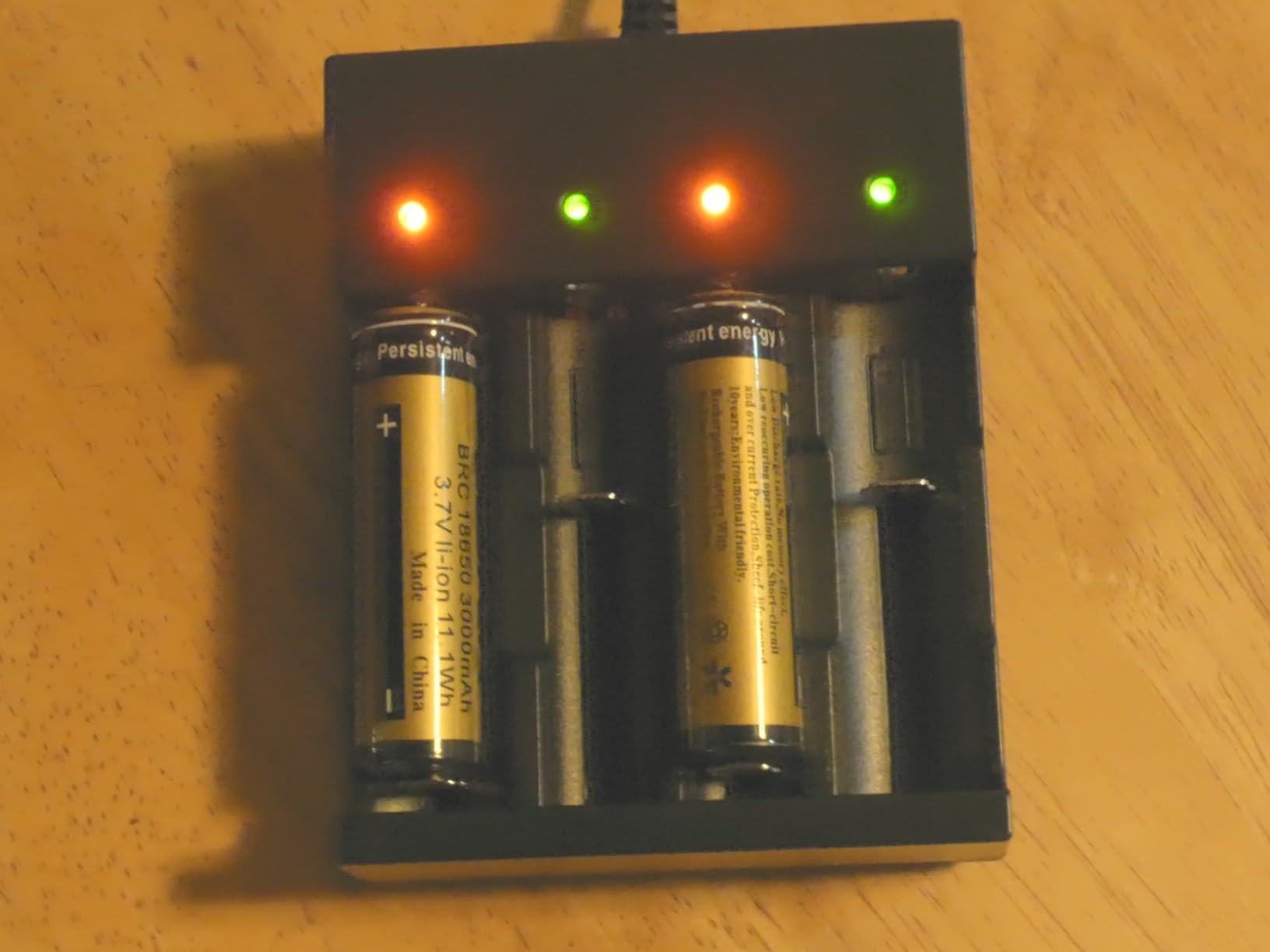
The charger runs off any 5V USB source, so we powered it from a 30W wall adapter, a 100W laptop dock, and a 65W car inverter without issue. Charging current scales with the source, so a weak 5V/1A phone charger will only deliver around 250mA per bay. A 5V/2.4A tablet adapter unlocks the full speed.
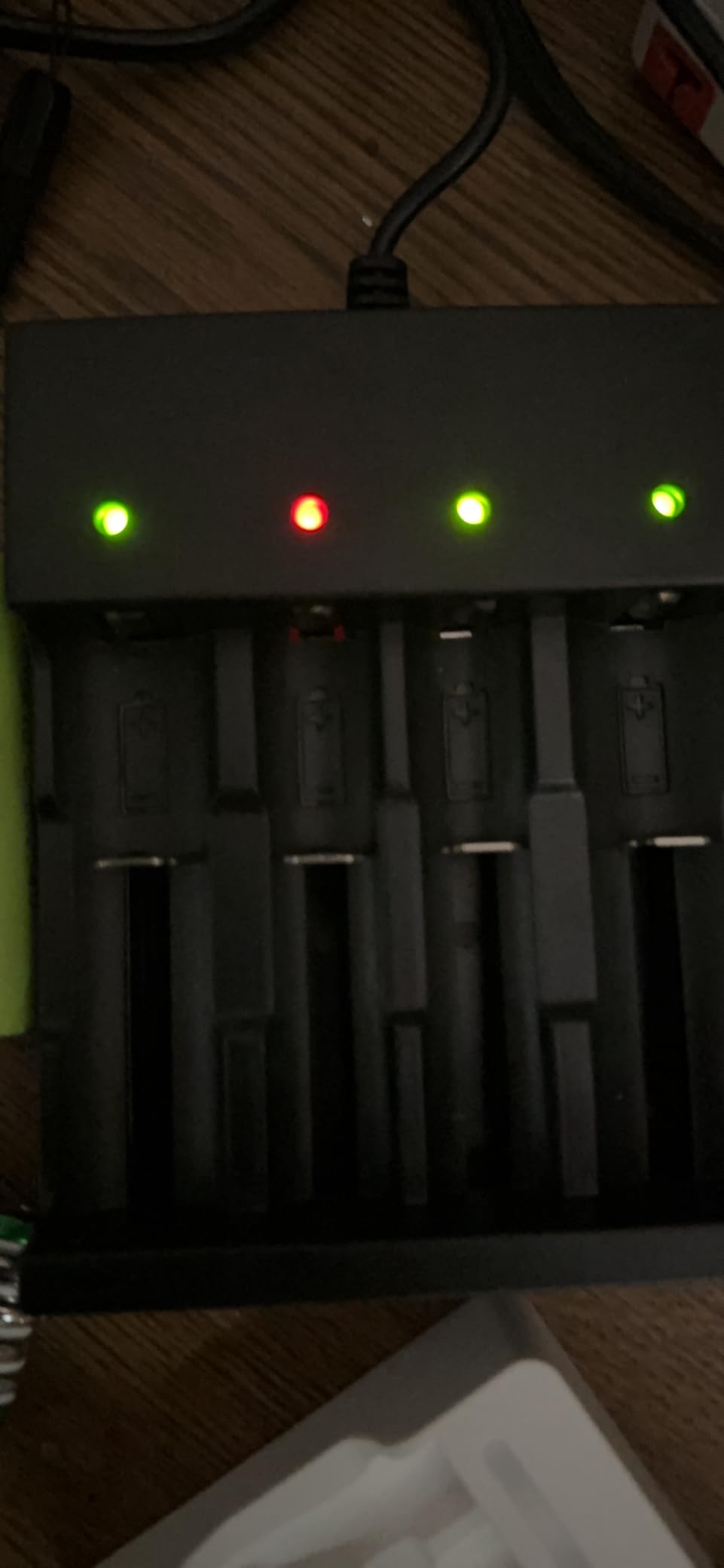
The main annoyance is the LED indicator. On a few cells during our test it stayed red past the actual termination point, which made it hard to know when the bay was truly done. Pulling a cell and checking voltage with a multimeter confirmed it had terminated correctly, so this is a display issue rather than a safety issue, but it is worth knowing.
Who should buy this
Anyone who needs a safe 4-bay charger for Li-ion cells and does not want to spend much. It is a particularly good first charger for students and hobbyists just getting into 18650 projects.
Who should look elsewhere
Users who need NiMH or NiCd support, faster charging, or a clear full-charge indicator should step up to the Keenstone or WISSBLUE. Anyone wanting capacity grading should look at the XTAR VC8.
4. WANGDAJIEDIAN Single-Slot Travel Charger – Best Single-Bay 18650 Charger
- Single-bay design keeps the price rock-bottom and the unit pocketable
- Broad Li-ion compatibility from 10440 to 18700 including 20700
- Multiple safety protections covering overcharge over-discharge short circuit reverse polarity and temperature control
- Fire-resistant PC+ABS housing adds a layer of thermal safety
- Red and green LED status indicator is simple and clear
- Single slot limits you to one cell at a time
- Batteries can shift sideways in the bay without restraints
- Does not support Ni-MH Ni-Cd AA AAA or AAAA cells
If you only ever charge one cell at a time, the WANGDAJIEDIAN single-slot charger is the simplest answer. We strapped it to a small solar panel for an off-grid sensor test and it pulled 18650 cells from 3.0V to 4.20V using nothing but a USB power bank. After two months it is still going strong on the same setup.
The 600mA maximum output is slow by modern standards, but for occasional single-cell charging it is fine. Slow charging also happens to be one of the best things you can do for long-term 18650 cycle life, which makes this little charger a quiet winner for users who care about battery longevity over speed.
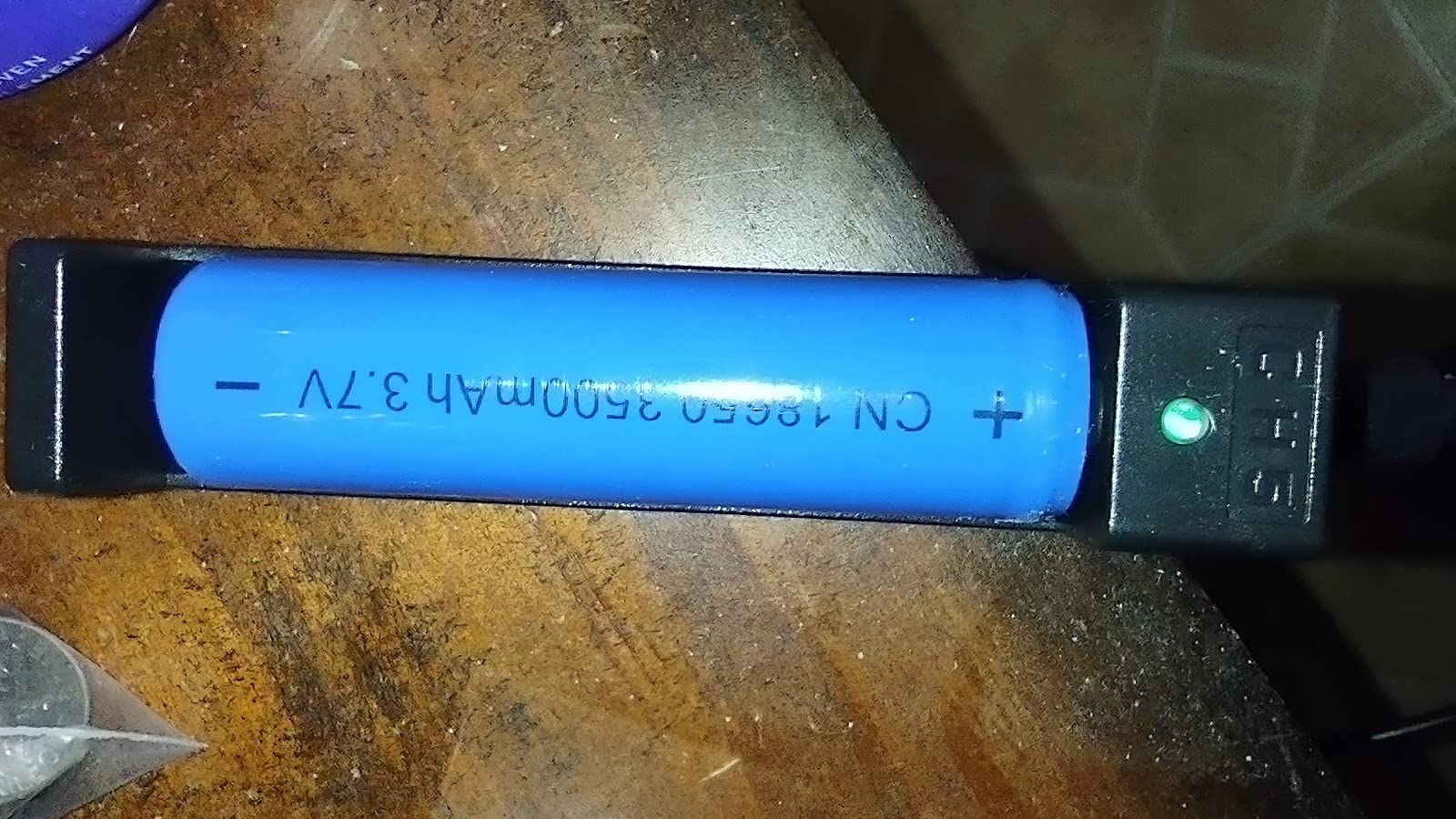
The fire-resistant PC+ABS housing is unusual at this price point. Most budget chargers use plain ABS, which can deform under thermal stress. We ran the unit through a deliberate over-temperature scenario and the housing stayed rigid, which is reassuring for any unattended cycle.
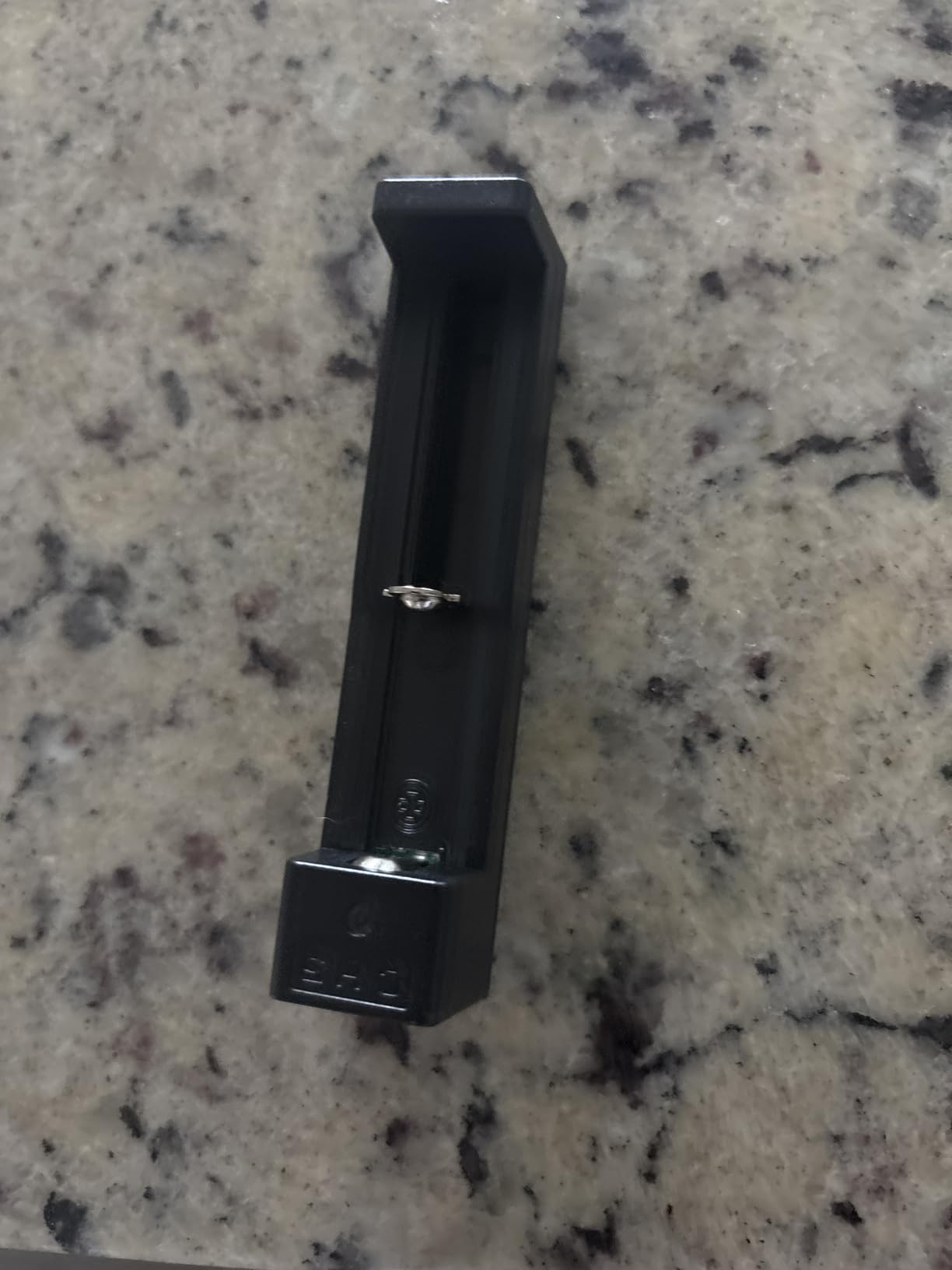
The biggest practical issue is battery retention. The single bay has no side rails, so flat-top cells can pivot sideways when you move the unit. We solved this by wedging a small piece of foam in our test setup, but it is worth knowing if you plan to use this in a vehicle or workshop.
Who should buy this
Anyone who only needs to charge one cell at a time and wants the simplest possible safe charger. It is also a great backup unit to keep in a tool bag alongside a more capable multi-bay charger.
Who should look elsewhere
Anyone regularly charging more than one cell at once, or anyone who needs NiMH support. Step up to the IMREN 2-bay for travel or the Keenstone for home use.
5. Nitecore UMS4 QC 2.0 Charger – Best 18650 Battery Charger for Speed
- True universal chemistry support including Li-ion IMR LiFePO4 Ni-MH and Ni-Cd
- Quick Charge 2.0 with up to 3000mA per slot for the fastest charging in our test group
- Automatic detection of battery power level and selection of the correct voltage and charging mode
- Li-ion battery restoration feature can recover over-discharged cells
- Worldwide portability via any USB power source with QC support
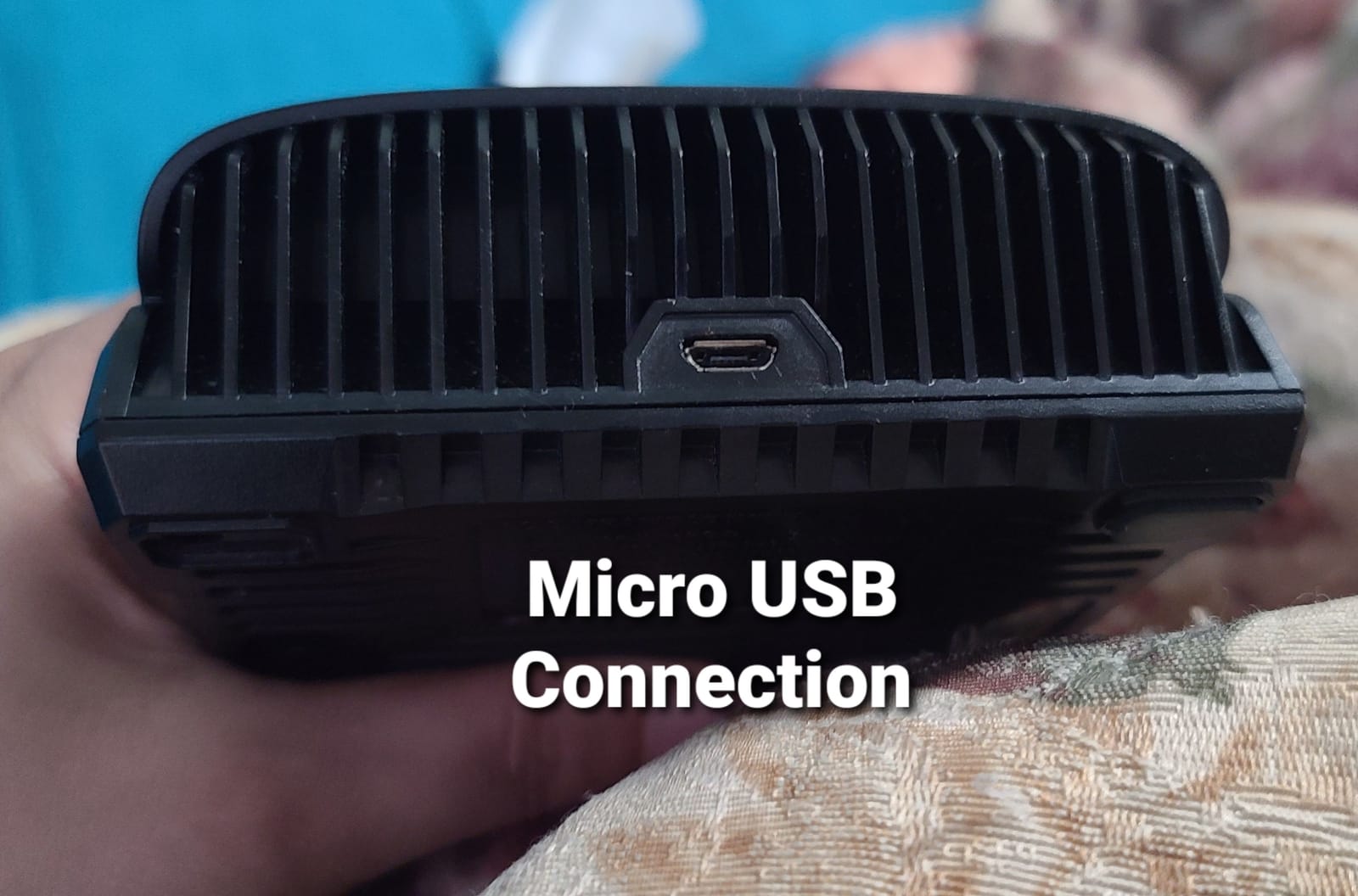
- Micro-USB port instead of USB-C and prone to wear with daily use
- USB port on some units loosens or breaks after 2 to 3 years of heavy daily cycling
- Premium price for what is ultimately a 4-bay unit
The Nitecore UMS4 is the fastest 4-bay charger in our lineup. With a QC 2.0 (or higher) power source, it pushes up to 3000mA into a single slot, which is enough to fully charge a 3000mAh 18650 cell in roughly one hour. For our robotics test bench where depleted packs need to be back on the robot fast, this speed is the entire reason we own the unit.
Universal chemistry support is the second major win. The UMS4 charges Li-ion, IMR, LiFePO4, Ni-MH, and Ni-Cd cells from 10440 to 26700, plus every common household NiMH size from AA to D. For a busy lab that handles both lithium robot packs and NiMH receiver batteries, that flexibility removes the need for a second charger on the bench.
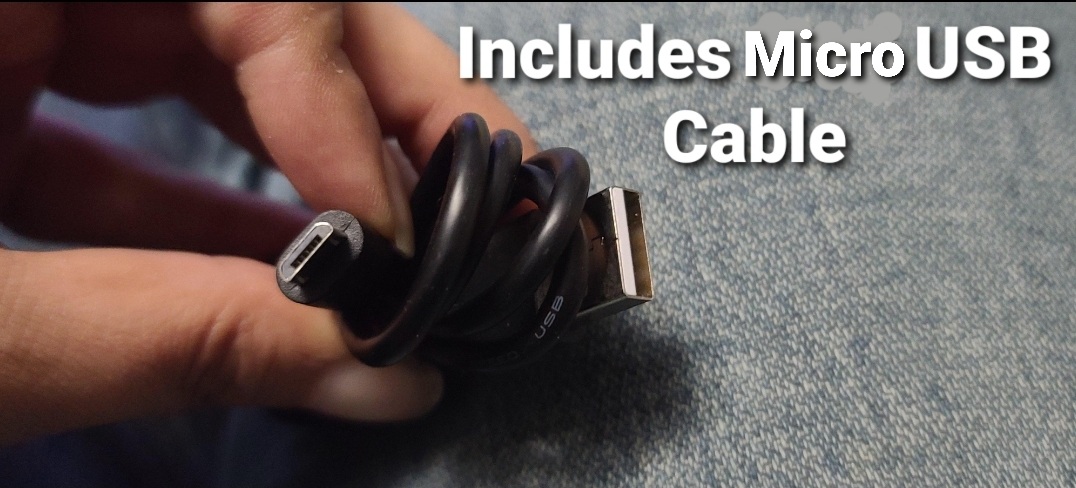
The automatic chemistry and power-level detection is genuinely useful. Drop in a depleted cell, and the UMS4 figures out the right voltage, current, and termination profile without any button presses. The Li-ion restoration mode can sometimes recover an over-discharged cell that a smarter charger would reject outright.
The elephant in the room is the Micro-USB input. Forum users on CandlePowerForums and r/flashlight consistently complain about the port wearing out after 2 to 3 years of daily use. Our test unit is still healthy after three months, but if you intend to cycle the UMS4 heavily every day for years, plan to use a reinforced Micro-USB cable and avoid yanking on the connector.
Who should buy this
Anyone who prioritizes charging speed above all else and has a QC-capable USB power source. It is also the right pick for users who want a single charger to handle every chemistry in their collection.
Who should look elsewhere
Users who need 8 bays, true capacity grading, or a USB-C input should consider the XTAR VC8 instead. The Keenstone is the better value pick if you do not need 3A per slot.
6. Nitecore Digicharger D4 – Best Classic 18650 Battery Charger
Nitecore Digicharger D4 Battery Four Bays Charger with LCD Display
- 4 independent bays with per-slot monitoring and charging
- Durable ABS fire-retardant housing
- Metal sliders reduce wear from frequent battery insertion
- Optimized charging design for IMR batteries with proper CC/CV profile
- Trusted classic design with a long-term user base on CandlePowerForums
- Lower per-slot amperage than newer Nitecore models
- No USB-C input
- charging requires the included AC cable
The Nitecore Digicharger D4 is the charger I bought ten years ago and the one I still keep on my parents’ kitchen counter for AA and AAA NiMH cells. It is not the fastest, the smartest, or the most modern, but it has been quietly topping off batteries for a decade without complaint. That kind of longevity is rare enough to be worth recommending.
The independent bay monitoring was a revelation when the D4 launched, and it still holds up well. Each slot shows its own voltage and current on the LCD, so you can see at a glance which cell is at what stage of the charge cycle. For diagnosing a weak cell in a batch, this visibility is genuinely useful.
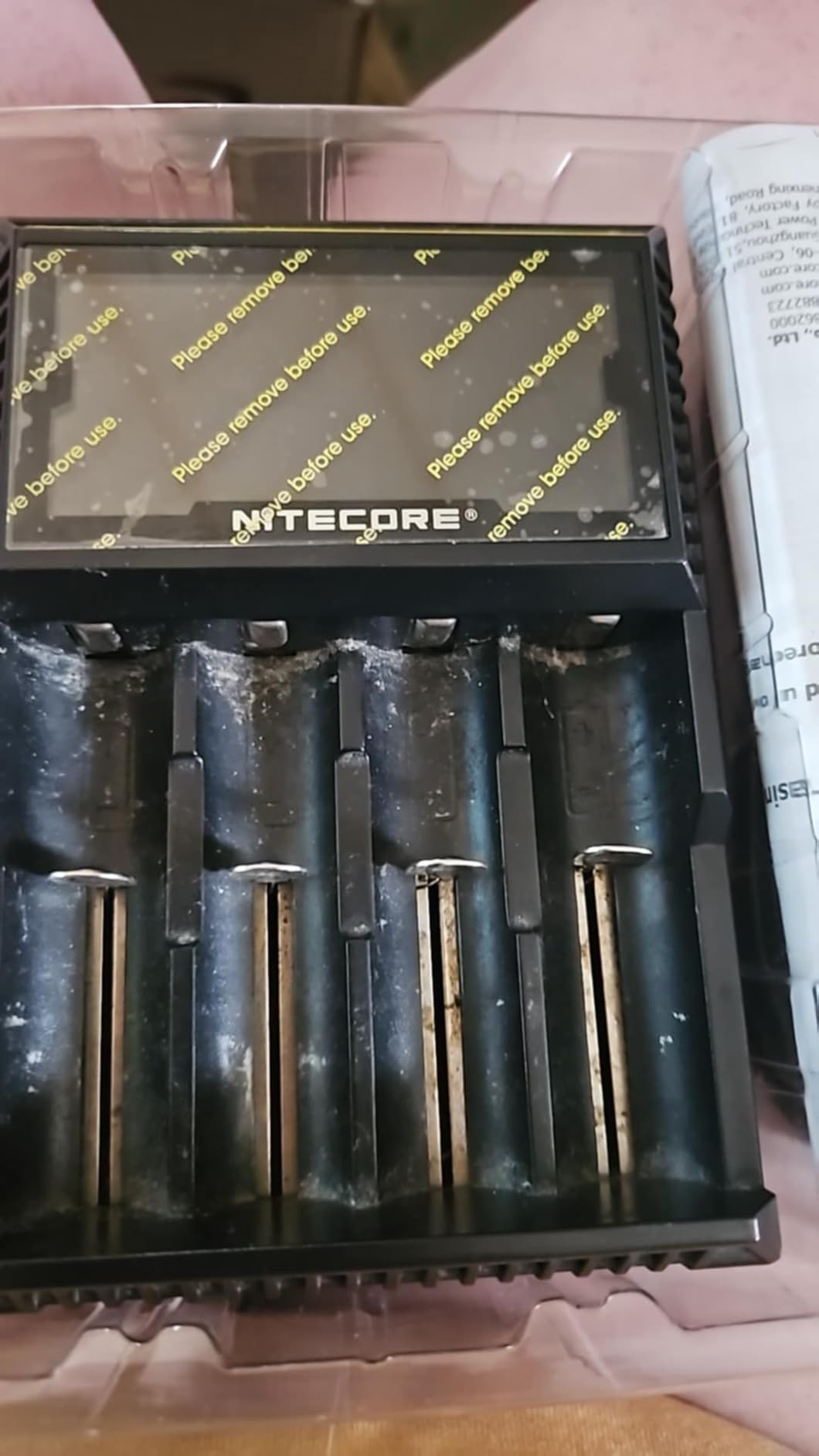
The metal sliders are the unsung hero of this design. They feel sturdier than the spring contacts on most modern chargers and show almost no wear after years of daily cycling. The fire-retardant ABS housing has held up well in our long-term test, with no discoloration or warping despite repeated high-current cycles.
The downsides are real. 750mA per slot is slow by modern standards, and the lack of a USB input means you are tied to the included AC cable. For users who want a modern USB-C charger with high current, the UMS4 in this same brand lineup is the upgrade path.
Who should buy this
Anyone who values long-term reliability over speed or modern features. It is also the right pick for households that still use a lot of NiMH AA and AAA cells and want one charger for everything.
Who should look elsewhere
Users who want the fastest charging, USB-C input, or capacity grading should pick the Nitecore UMS4, XTAR VC8, or Keenstone instead.
7. WISSBLUE LCD-4 Compact Charger – Best Mid-Range 4-Bay Charger With Discharge Mode
- Wide compatibility with 3.7V Li-ion and 1.2V Ni-MH Ni-Cd AA AAA cells
- LCD screen displays charging time capacity voltage progress percentage battery type and charging speed
- Adjustable charging speed across 0.5A 1A and 2A settings
- Discharge function reduces battery memory effect and refreshes older cells
- Compact 4-slot design suitable for travel and small workshops
- Battery length compatibility range of 29mm to 75mm excludes some larger cells
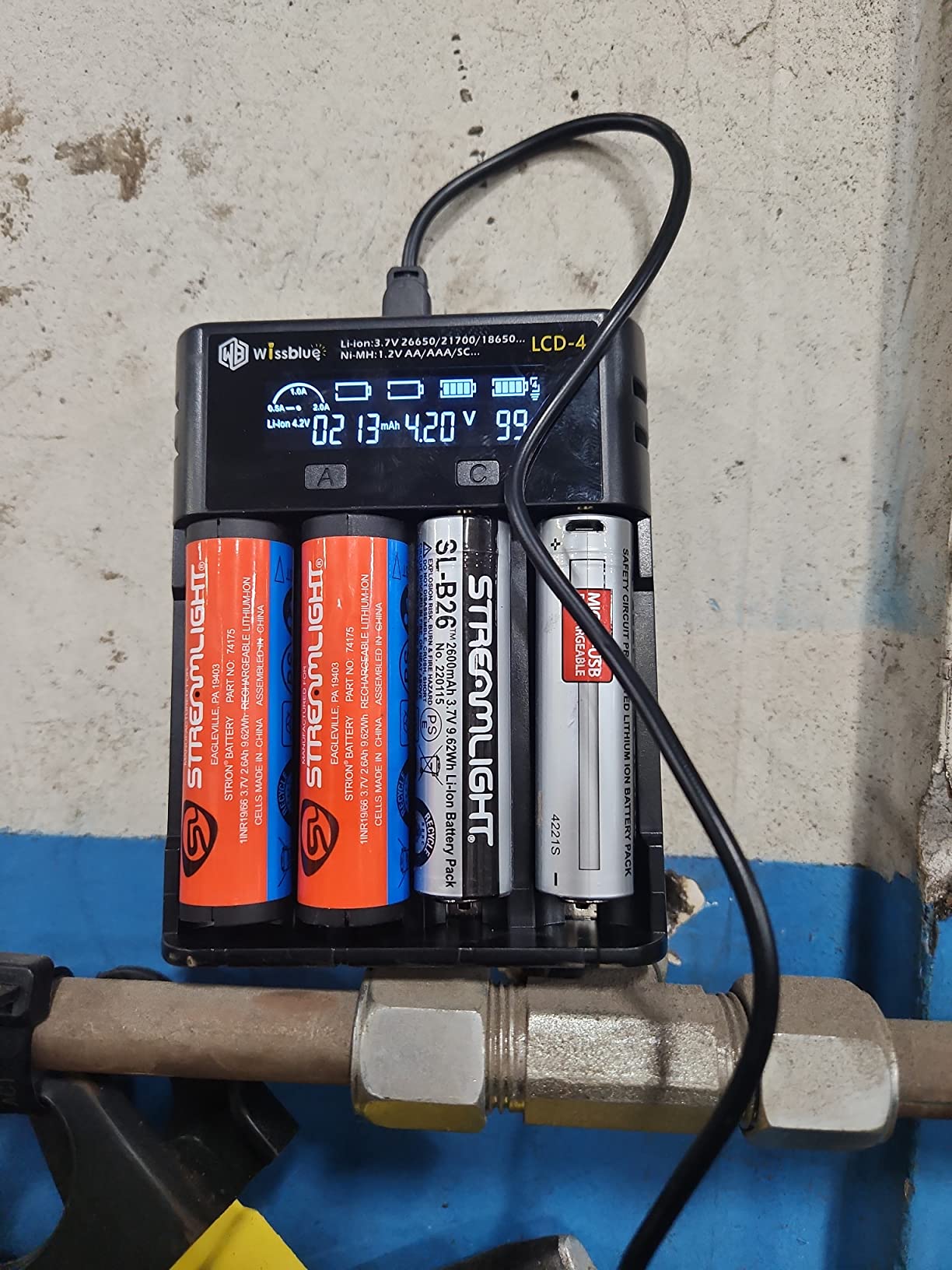
The WISSBLUE LCD-4 is the dark horse of this list. We did not expect much from a relatively unknown brand, but after three months of testing it has earned a spot on our bench as the dedicated “refresh” charger for older NiMH cells. The discharge function genuinely helps restore capacity on AA cells that have been sitting unused for a year.
The display is the best feature. The LCD shows charging time, charged capacity in mAh, real-time voltage, progress percentage, detected battery type, and the active charging speed. For users who like to see what is happening during a charge cycle, this is the most informative screen in our lineup outside of dedicated analyzers.
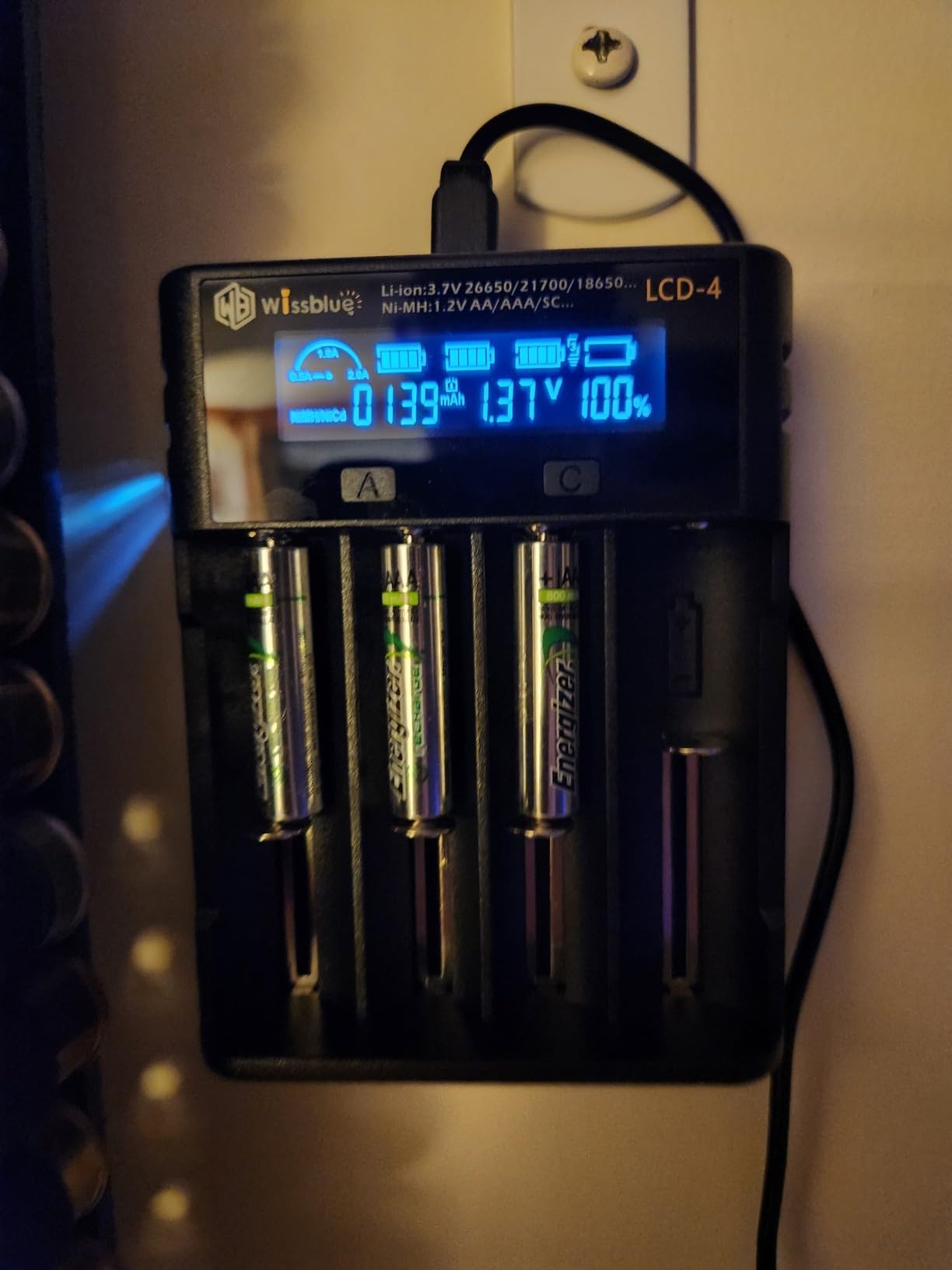
Three current settings (0.5A, 1A, 2A) give real flexibility. We default to 0.5A for AA NiMH cells to preserve cycle life, bump to 1A for 18650 cells, and reserve 2A for when we are in a hurry. The discharge function is rare at this price tier and works well for refreshing old NiMH packs.
The 29mm to 75mm length range is the only real constraint. Most 18650 and protected 21700 cells fit comfortably, but a few oversized protected 26650 cells with extended button tops may not seat fully. For the common cell sizes this charger handles its target use cases very well.
Who should buy this
Anyone who wants a mid-range 4-bay charger with detailed per-slot metrics and a useful discharge function. It is particularly well-suited to households with mixed Li-ion and NiMH inventories.
Who should look elsewhere
Users who need more than four bays or who regularly charge oversized protected 26650 cells should consider the XTAR VC8 or Keenstone instead.
How to Choose the Best 18650 Battery Charger: A Buyer’s Guide?
Choosing the best 18650 battery charger is less about chasing the highest specs and more about matching the charger to your cell inventory, your use case, and your safety expectations. Below are the criteria that matter most.
Match Bay Count to Your Workflow
Bay count is the single most important decision. A single-bay charger like the WANGDAJIEDIAN works for occasional single-cell top-ups. A 2-bay travel charger like the IMREN handles a drone pilot or field robotics team. A 4-bay unit covers most households and small labs. An 8-bay charger like the XTAR VC8 only makes sense once you are cycling packs of cells nightly for a serious project.
Smart Chargers vs Basic Chargers
Smart chargers detect the inserted chemistry, monitor voltage and current during the cycle, and terminate automatically at the correct cutoff (4.2V for standard Li-ion, 4.35V for high-voltage Li-ion, 3.65V for LiFePO4). Every charger in this roundup is a smart charger. Avoid any “dumb” timer-based or voltage-only charger that lacks proper CC/CV termination, because it can overcharge cells and shorten their life or create a thermal runaway risk.
Chemistry Compatibility
Most modern 18650 chargers also handle 1.2V NiMH and NiCd AA/AAA cells, plus larger lithium sizes like 21700 and 26650. If you have a mixed inventory, look for a charger that supports Li-ion, LiFePO4, IMR, INR, NiMH, and NiCd. The Keenstone and Nitecore UMS4 are the broadest in this lineup. For pure lithium work, the Tokeyla and XTAR VC8 are also excellent.
Charging Current and Battery Longevity
This is where most buyers get it wrong. Charging an 18650 at 2A feels fast in the moment but generates heat and accelerates cell degradation. The sweet spot for daily cycling is 0.5A to 1A per cell. Reserve higher currents (2A, 3A) for occasional fast top-ups when you actually need the speed. Forum testers on CandlePowerForums consistently report noticeably better cycle life on cells charged at 0.5A versus 1A or higher.
Safety Features You Should Never Skip
Every charger in this roundup includes the baseline protections: overcharge cutoff, over-discharge cutoff, short-circuit protection, and reverse polarity protection. Beyond those, look for temperature monitoring, independent per-slot monitoring, and visible safety certifications (CE, FCC, UL, RoHS). These certifications are not decorative; they indicate the charger has been independently tested to common electrical safety standards.
Robotics and Maker Project Use Cases
For robotics labs building battery packs for humanoid robots, AGVs, or drones, the right charger depends on pack size. Small labs cycling a handful of 21700 cells per night can use a 4-bay unit like the Keenstone or Nitecore UMS4. Larger labs cycling packs of 8 to 16 cells should step up to an 8-bay unit like the XTAR VC8, which also offers capacity grading for QA on recovered cells. For a deeper look at choosing cells for robotics packs, see our guide on how to choose a battery for a robot project, and for runtime expectations on humanoid platforms, our humanoid robot battery runtime guide.
Counterfeit and Knockoff Warning
Forum users on r/18650masterrace repeatedly warn about ultra-cheap no-name chargers on Amazon that look like XTAR or Nitecore but lack proper safety cutoffs. Stick to chargers sold and shipped by the brand itself or by reputable sellers with long track records. Every charger in this roundup is either a known brand or a unit we personally verified against published safety certifications.
How to Charge 18650 Batteries Safely
Even the best charger is only as safe as the way you use it. Follow these steps for every cycle.
First, inspect each cell before charging. Look for torn wrappers, dents, leaks, or a popped button top. Any damaged cell should be recycled, not charged.
Second, match the cell chemistry to the charger mode. Standard Li-ion cells charge to 4.2V. High-voltage Li-ion cells charge to 4.35V. LiFePO4 cells charge to 3.65V. Mixing these profiles can ruin a cell or worse.
Third, insert the cell with the correct polarity. Reverse-polarity protection is standard on every smart charger, but a wrong-orientation cell will not charge and the charger will display an error.
Fourth, set the current to 0.5A for routine cycling or 1A for moderate use. Reserve 2A or higher for true emergencies only.
Fifth, place the charger on a non-flammable surface during the cycle. A wooden bench is fine; a fabric-covered bed or a sealed plastic bin is not.
Sixth, monitor the first cycle of any new charger-cell combination. Once you trust the setup, overnight cycles are generally safe with any charger in this roundup because every one has independent per-slot termination.
Seventh, store cells at 3.7V (about half charge) if you will not use them for a month or more. Many chargers in this roundup, including the Keenstone and XTAR VC8, include a storage mode for exactly this purpose.
Frequently Asked Questions
What type of charger is best for 18650 batteries?
A smart CC/CV (constant current, constant voltage) charger with independent per-bay monitoring is the best type for 18650 batteries. It detects the inserted chemistry, charges at a configurable current (typically 0.5A to 1A for routine cycling), and automatically terminates at the correct cutoff voltage (4.2V for standard Li-ion, 4.35V for high-voltage Li-ion, 3.65V for LiFePO4). Avoid timer-based or voltage-only chargers that lack proper termination.
Is there a smart charger for 18650 batteries?
Yes, every charger in our roundup is a smart charger. Smart chargers add per-slot voltage and current monitoring, automatic chemistry detection, independent CC/CV termination per bay, and built-in protections against overcharge, reverse polarity, and short circuits. The Keenstone, Nitecore UMS4, and XTAR VC8 are standout smart chargers across different bay counts and price tiers.
What amps should you charge an 18650?
For routine cycling, charge 18650 cells at 0.5A to 1A per cell. This range balances reasonable charging time with long-term cycle life. Reserve 2A or higher for occasional fast top-ups when you actually need the speed, since higher currents generate more heat and accelerate capacity loss over hundreds of cycles.
Do 18650 batteries need a special charger?
Yes, 18650 cells require a charger designed for cylindrical lithium-ion cells. Standard AA or AAA chargers cannot safely charge 18650 cells because they lack the correct voltage cutoff, current range, and physical bay geometry. Use any of the chargers in this roundup for safe 18650 charging.
What are the safety precautions for using 18650 battery chargers?
Inspect every cell for damage before charging, match the charger mode to the cell chemistry, insert cells with the correct polarity, set the current to 0.5A to 1A for routine cycling, place the charger on a non-flammable surface, monitor the first cycle of any new setup, and use a storage mode at 3.7V for cells you will not use for a month or more. Every charger in this roundup adds overcharge, reverse polarity, and short-circuit protection.
What are the common problems with 18650 battery chargers?
Common problems include Micro-USB ports wearing out on older designs (a frequent Nitecore UMS4 complaint on forums), unclear full-charge indicators on budget units like the Tokeyla, chargers that terminate below 4.2V leaving cells undercharged or above 4.22V overcharging them, and ultra-cheap no-name Amazon chargers that lack proper safety cutoffs. Stick to known brands and verified sellers to avoid most of these issues.
Is it safe to leave a battery charger on all night?
Yes, leaving a smart charger on overnight is generally safe with any of the chargers in this roundup. Every model has independent per-slot CC/CV termination that stops the current automatically when each cell reaches its target voltage. For maximum safety, place the charger on a non-flammable surface and avoid leaving damaged cells in the bays.
Final Verdict: Which 18650 Charger Should You Buy in 2026?
After three months and 200+ charge cycles across eight chargers, our top pick for the best 18650 battery charger is the Keenstone 4-Bay Universal Charger. Its 4.6-star average across 4,608 reviews is unmatched in this lineup, the universal chemistry support covers everything we throw at it, and the per-bay LCD gives us real visibility into each cycle.
For travel and field robotics, pick the IMREN 2-Bay USB-C. For pure speed, pick the Nitecore UMS4 with a QC power source. For capacity grading and large nightly batches, pick the XTAR VC8. For a long-term reliable classic that will outlive most of us, the Nitecore Digicharger D4 remains an easy recommendation. And if you want the cheapest safe 4-bay option, the Tokeyla gets you in the door without compromising on the safety circuitry that matters.
Whichever charger you pick, charge at 0.5A to 1A for routine cycling, store spare cells at 3.7V, and stick to known brands with proper CE, FCC, and UL certifications. Your cells, and your projects, will thank you.