
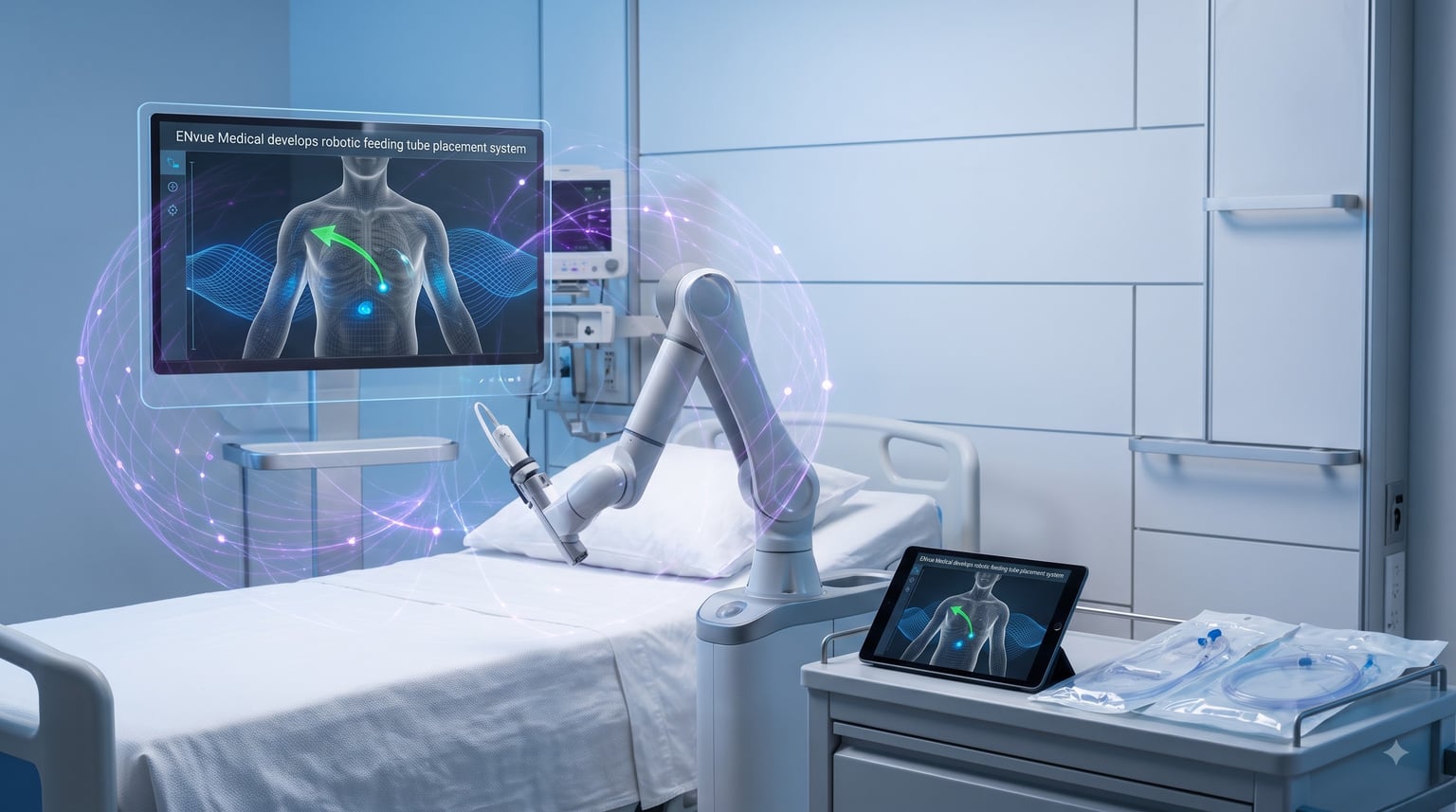
ENvue Medical Inc. just unveiled ENvue Drive, a robotic-assisted tool that automates feeding tube placement at the bedside. I have been tracking medical robotics for years, and this one stands out because it tackles a problem most people never think about until it goes wrong.
Every year, roughly 1 million feeding tubes are placed in U.S. hospitals. The current method is essentially blind, meaning clinicians push a tube through the patient’s nose and hope it lands in the stomach, not the lungs. ENvue Drive changes that by combining electromagnetic navigation, real-time sensor tracking, and artificial intelligence into a single clinical workflow. The company built the system on its already FDA-cleared ENvue Navigation Platform, which means hospitals get a faster path from announcement to clinical use.
In this article, I break down what ENvue Drive actually does, how the technology works under the hood, what it means for patient safety, and where the company plans to take this platform next. I also share insights on the broader trend of robotics automation advancements moving into high-stakes healthcare settings.
Table of Contents
The Hidden Problem With Blind Feeding Tube Placement
Feeding tube misplacement is one of those clinical risks that flies under the radar until something terrible happens. When a nasogastric or nasoenteric tube ends up in the lungs instead of the stomach, the consequences range from pneumonia to full respiratory collapse. Recent studies put the misplacement rate between 3% and 5% of all procedures, which sounds small until you multiply by 1 million attempts a year.
The traditional workflow looks roughly like this. A clinician estimates the insertion depth, lubricates the tube, and advances it through the nostril, down the esophagus, and into the stomach or small intestine. Without imaging guidance, the clinician has no way to confirm the tube’s path in real time. Confirmatory chest X-rays catch most errors, but they take time, expose the patient to radiation, and delay nutrition delivery. In critical care settings, that delay can matter a lot.
ICU patients, elderly patients, pre-term infants, and anyone who is mechanically ventilated faces the highest risk. Movement, anatomy variation, and underlying illness all conspire against accurate placement. Our team has followed several bedside procedure studies, and the consensus is clear: blind placement is a problem waiting for a technological fix.
How ENvue Drive Technology Works
ENvue Drive is the robotic execution layer on top of ENvue Medical’s existing navigation ecosystem. The system uses three core components working in sync: an electromagnetic field generator, passive sensors embedded in the feeding tube, and an AI-driven software layer called Ask Oscar.
Electromagnetic Navigation Platform
The foundation is an electromagnetic field generator placed near the patient. Once activated, it creates a low-energy field across the relevant area of the body. Think of it as indoor GPS for medical procedures. The field interacts with passive sensors embedded in the distal tip of the feeding tube, allowing the system to calculate the tube’s exact position at all times.
Because the sensors are passive, they do not require their own power source. They respond to the field generated around the patient, which keeps the tube design simple and the procedure sterile. The platform delivers position updates at a refresh rate fast enough to track the tube as it moves, with no perceptible lag for the clinician.
Five Degrees of Freedom and Real-Time Tracking
ENvue Drive operates with five degrees of freedom, meaning the robotic tool can adjust the tube’s path along multiple axes as it advances. This is where the robotic execution really shines. The system is not just reporting where the tube is. It is actively steering the tube based on real-time position data and the patient’s personalized body map.
The AI engine, Ask Oscar, continuously compares the actual trajectory against the expected path. If the tube starts to deviate, the system flags it immediately. If a clinician needs to correct course, the interface provides directional arrows and steering guidance on an intuitive screen display. Multiple simultaneous views let the operator watch the body map, the trajectory, and the alerts at once.
True Body Navigation and Patient Movement
One of the trickiest problems in bedside procedures is patient movement. A patient in the ICU is rarely perfectly still. ENvue’s True Body Navigation feature accounts for this by recalculating position relative to the patient’s anatomy, not just the room coordinates. If the patient shifts, the system shifts with them.
This sounds like a small detail, but it is not. Standard electromagnetic navigation without body-relative tracking can produce errors when patients move during long procedures. ENvue’s approach solves that, which is critical for the extended placement times sometimes required for post-pyloric feeding tubes that need to reach the small intestine.
Safety Benefits and Risk Reduction
The biggest payoff from ENvue Drive is patient safety. Real-time navigation means the clinician knows where the tube is at every moment, which dramatically reduces the chance of lung placement. In a field where 3-5% of procedures go wrong, even cutting that rate in half would prevent thousands of adverse events every year.
Clinician Control and Assistance Philosophy
ENvue designed the system to assist, not replace, the clinician. The doctor or nurse retains full control of the procedure at every step. The robot provides guidance, alerts, and steering support, but the human clinician decides when to advance, pause, or pull back. This philosophy is critical for adoption because it respects the clinical judgment that experienced providers bring to bedside care.
I appreciate this design choice. Pure autonomy in a medical setting creates liability questions and trust gaps. An assistive model lets hospitals adopt the technology faster because clinicians stay in charge of the outcome. Our team has seen similar assistive approaches work well in surgical robotics, and ENvue is applying the same principle here.
Reducing the Need for Confirmatory X-rays
Every feeding tube placement traditionally requires a chest X-ray to confirm correct positioning. With real-time electromagnetic confirmation built into the procedure, the need for follow-up imaging drops substantially. That saves time, reduces radiation exposure, and frees up radiology resources for other patients.
Faster placement also means faster nutrition delivery. Malnourished patients and critical care patients cannot wait hours for confirmation. ENvue Drive compresses the timeline from procedure to feeding, which has its own clinical benefits.
FDA Clearance and Clinical Validation
ENvue built Drive on top of its existing ENvue Navigation Platform, which already holds FDA 510(k) clearance. That regulatory foundation matters. It means the core sensing and navigation technology has already been reviewed by FDA, and Drive represents an incremental expansion rather than a from-scratch approval.
The original ENvue system cleared FDA review for use in placing feeding tubes, and clinical use has generated real-world data on safety and effectiveness. Hospitals evaluating Drive can lean on that track record instead of starting from zero. For procurement teams, this is a meaningful signal.
Clinical validation continues as the system rolls out. ENvue Medical has indicated that additional studies and case series are in progress, particularly around vascular access applications that build on the same navigation backbone.
Applications Across Patient Populations
ENvue Drive is designed for the patients who face the highest risk during feeding tube placement. That includes ICU patients, mechanically ventilated patients, elderly patients, pediatrics, and pre-term infants. Each population brings its own anatomical challenges, and the system’s personalized body mapping adapts to them.
Critical Care and ICU Settings
ICU patients often need feeding tubes urgently, and they are often the least stable. Real-time navigation gives ICU teams a tool that works at the bedside without requiring transport to imaging suites. For mechanically ventilated patients, the stakes are even higher because a misplaced tube can compromise an already-fragile airway.
Pediatrics and Pre-term Infants
Pediatric anatomy is smaller and more variable, which makes blind placement especially risky. ENvue’s high-resolution tracking and body-relative navigation are well suited to neonatal ICUs, where pre-term infants may need feeding tubes for weeks. Reducing radiation exposure from repeated confirmatory X-rays is a significant benefit for this population.
Elderly and Malnourished Patients
Elderly patients frequently need enteral feeding during recovery from surgery, stroke, or chronic illness. Malnourished patients benefit from faster initiation of nutrition. Both groups gain from a procedure that confirms placement in real time rather than after the fact.
Future Applications Beyond Feeding Tubes
ENvue Medical has made it clear that feeding tubes are just the beginning. The same electromagnetic navigation backbone can support vascular access procedures, including peripherally inserted central catheters (PICC lines). PICC line placement today is also largely blind and carries similar risks, including pneumothorax and arterial puncture.
Extending the platform to vascular access is a logical next step. The sensors, the AI guidance layer, and the body-mapping technology all transfer directly. ENvue has signaled that this expansion is on the roadmap, which would multiply the platform’s clinical footprint and its commercial opportunity.
Broader implications extend across medical robotics. As bedside procedures gain navigation support, the line between traditional manual care and robotic-assisted care continues to blur. ENvue is part of a larger movement that includes surgical robots, exoskeletons, and autonomous hospital delivery systems. The shift is incremental, but it is steady, and it is reshaping how hospitals think about capital equipment.
From a market perspective, the addressable population is large. Hundreds of millions of vascular access procedures happen worldwide each year, and most of them still rely on landmark-based techniques. Even modest penetration of the ENvue platform into vascular access would expand the company’s reach far beyond its current feeding tube base.
Conclusion
ENvue Medical’s robotic feeding tube placement system is a meaningful step forward for bedside safety. By combining electromagnetic navigation, real-time AI guidance, and robotic execution with five degrees of freedom, the company tackles a problem that has resisted technological improvement for decades.
The clinical benefits are clear: fewer misplaced tubes, fewer confirmatory X-rays, faster nutrition delivery, and a safer experience for vulnerable patients. The regulatory foundation is solid, with FDA 510(k) clearance already in place for the underlying platform. The roadmap extends into vascular access, where the same technology can reduce complications in millions more procedures every year.
For hospitals evaluating capital purchases, ENvue Drive deserves a close look. For the broader medical robotics community, it is another signal that assistive robotic platforms are moving from the operating room to the patient bedside, and changing what clinicians can do there.
What is ENvue Medical?
ENvue Medical is a medical technology company that has developed the ENvue Navigation Platform and ENvue Drive, a robotic-assisted system for feeding tube placement. The platform uses electromagnetic navigation, real-time sensor tracking, and AI to give clinicians continuous visibility during bedside procedures.
How does robotic feeding tube placement work?
The ENvue Drive system creates a low-energy electromagnetic field around the patient. Passive sensors inside the feeding tube interact with this field, letting the system calculate the tube’s exact position in real time. An AI layer called Ask Oscar compares the actual trajectory to the expected path and provides directional guidance to the clinician, who remains in full control throughout the procedure.
What are the risks of blind tube placement?
Blind feeding tube placement carries a 3-5% misplacement rate, which can lead to lung placement, pneumonia, respiratory collapse, and other serious complications. The standard workaround is a confirmatory chest X-ray, but that takes time and exposes the patient to radiation while delaying nutrition delivery.
Is robotic feeding tube placement FDA approved?
Yes. ENvue Medical’s underlying ENvue Navigation Platform has received FDA 510(k) clearance. ENvue Drive is built on top of that cleared platform, which streamlines the regulatory pathway and gives hospitals an established safety record to reference when evaluating the system.
Are you awake when they insert a feeding tube?
Most bedside feeding tube placements happen while the patient is awake. The procedure involves passing a tube through the nostril and down into the stomach or small intestine. ENvue Drive does not change the patient’s experience of being awake during the procedure, but it does make the placement faster and more accurate by giving clinicians real-time confirmation of tube position.