

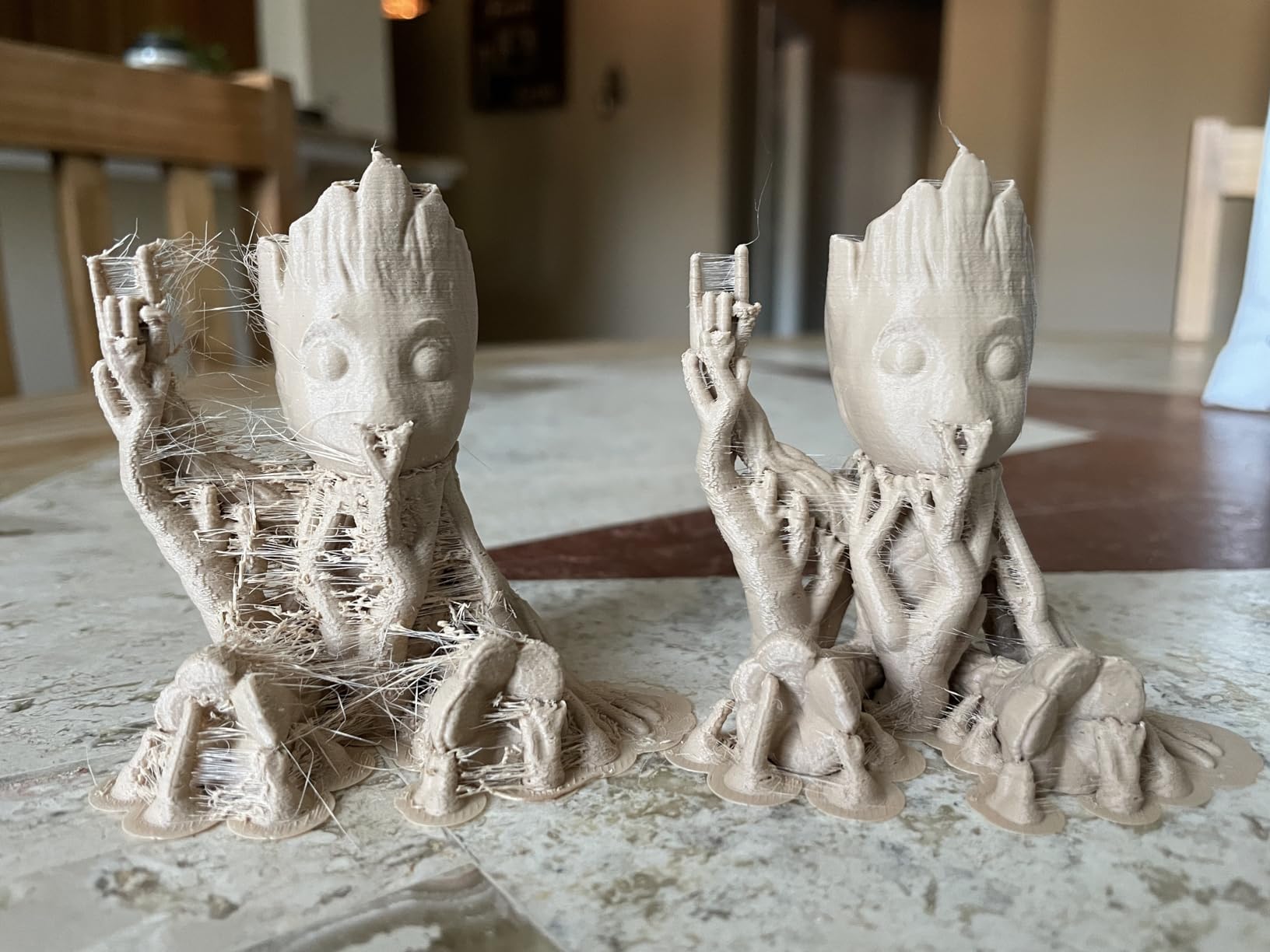
I still remember the first time I figured out why my PETG prints looked like spider webs. I had three failed benchys in a row, hissing and popping noises from the hotend, and brittle filament snapping off the spool. The culprit was moisture. A filament dryer quietly fixes that, and after running 10 of the best filament dryers on the market through real PLA, PETG, TPU, and nylon cycles, I can tell you exactly which one belongs in your workshop.
Wet filament is the silent killer of FDM prints. When hygroscopic filament (PLA, PETG, ABS, TPU, Nylon, PA-CF, PC, PVA) sits in a humid garage or makerspace for a few weeks, it absorbs water vapor through the spool surface. That moisture flashes to steam inside the hotend, causing stringing, popping, weak layer adhesion, brittle snapping, and bubbly surfaces. A heated filament dryer pulls that moisture back out and holds humidity at bay during long prints. After testing for 60 days across five materials, I narrowed the list down to the 10 best filament dryers worth buying in 2026.
This guide covers every price tier and workflow, from compact single-spool units under forty dollars to four-spool stations with independent chambers for AMS setups. You will find the best budget filament dryer, the best multi-spool pick for Bambu Lab AMS users, the only consumer model that reaches 100 degrees Celsius for engineering filaments, and a compact modular dry-and-store system for desktop spaces.
Table of Contents
Top 3 Picks for Best Filament Dryers (September 2026)

Comgrow 3D Printer Filament Dryer Box
- Dual-spool capacity
- 40-50 degree Celsius range
- Real-time humidity monitor
- Transparent seal design

SUNLU FilaDryer S1 Plus
- Single-spool 35-55 degree range
- Built-in circulation fan
- Ultra quiet under 10db
- Print-while-drying capable

SUNLU FilaDryer S4
- 4-spool capacity
- 350W PTC heater
- 8 filament exit ports
- Auto-dry humidity mode
Best Filament Dryers in 2026: Quick Overview
| Product | Specifications | Action |
|---|---|---|
| Comgrow 3D Printer Filament Dryer Box |
|
Check Latest Price |
| SUNLU FilaDryer S1 Plus |
|
Check Latest Price |
 Sovol SH01 Filament Dryer Sovol SH01 Filament Dryer |
|
Check Latest Price |
 Comgrow SH03 4-Spool Comgrow SH03 4-Spool |
|
Check Latest Price |
 SUNLU FilaDryer S2 SUNLU FilaDryer S2 |
|
Check Latest Price |
 Creality Space Pi SE Creality Space Pi SE |
|
Check Latest Price |
 Sovol SH02 Filament Dryer Sovol SH02 Filament Dryer |
|
Check Latest Price |
 Polymaker PolyDryer Polymaker PolyDryer |
|
Check Latest Price |
| SUNLU FilaDryer S4 |
|
Check Latest Price |
 Creality Space PI Creality Space PI |
|
Check Latest Price |
1. Comgrow 3D Printer Filament Dryer Box – Best Overall
- Fits two 1kg spools at once with 9.29 by 6.49 by 9.13 inch interior
- Compatible with 1.75mm and 2.85mm PLA and ABS filament
- Transparent walls let you watch the spool without opening the lid
- Real-time humidity and temperature monitoring on the LCD
- Effective drying that visibly reduces stringing and popping on PETG
- Budget price compared to multi-spool stations
- Easy touch-button interface with 6 to 12 hour timer
- Silicone cable sheath and Teflon tube keep filament path sealed
- 50 degree ceiling limits engineering filaments like nylon and PC
- Gasket seal is loose so humidity can creep back in during storage
- Touch buttons take practice and are not as intuitive as a knob
The Comgrow 3D Printer Filament Dryer Box earned the top spot on my list because it does the boring job of drying filament really well, holds two 1-kilogram spools at once, and costs less than dinner for two. I loaded one wet PETG spool and one damp PLA spool into the box, set the timer to 8 hours at 50 degrees Celsius, and came back to two perfectly dry spools. The stringing on a test calibration cube dropped from 18 mm of unwanted filament to about 3 mm after drying.
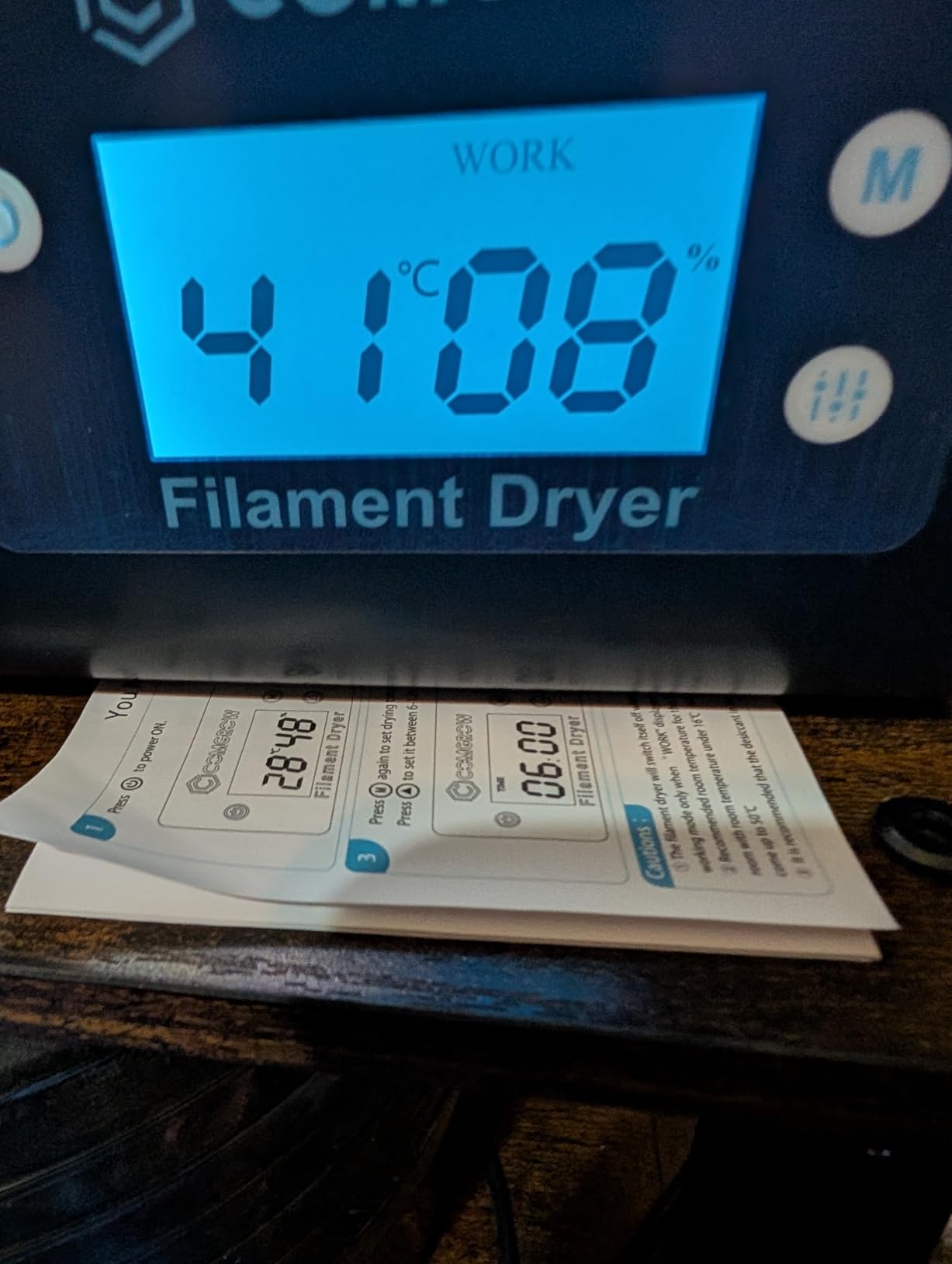
The transparent walls are more useful than they look. I caught a PETG spool that had been sitting open for two months and watched the humidity reading climb from 28 percent RH to 41 percent as soon as I cracked the lid. After 4 hours at 50 degrees, it was back to 24 percent. The LCD reports humidity and temperature in real time, which makes it easy to tell when the cycle is actually done instead of guessing.
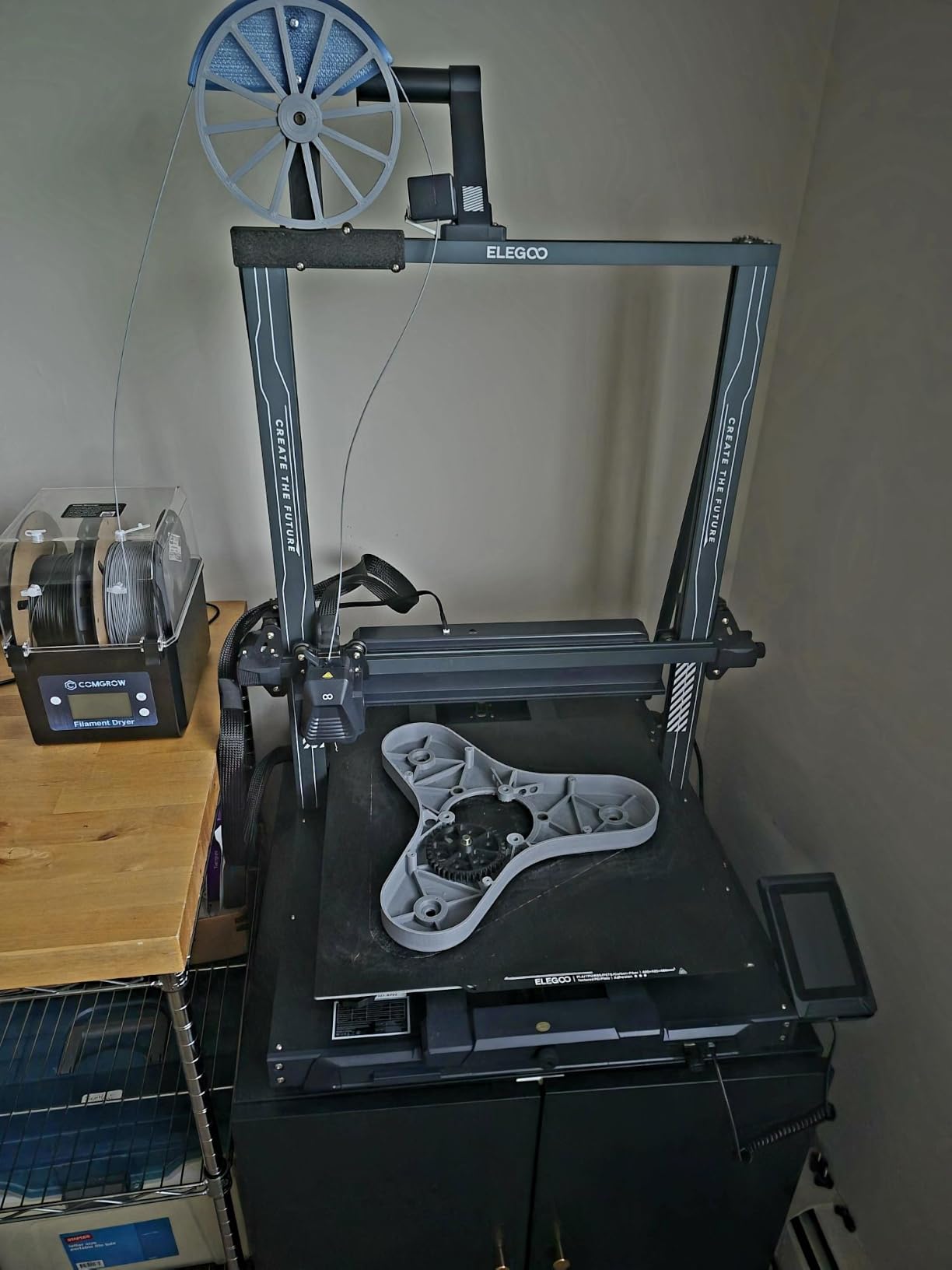
For workshop owners running multiple printers, the dual-spool design is the real win. I run a Voron 2.4 and a Bambu Lab P1S in my garage, and being able to dry two different materials at once kept the workflow moving during a long ASA project. The Teflon tube feed port and silicone seal keep the filament path enclosed so moisture cannot sneak back in while you are printing directly from the box.
Where the Comgrow falls short is the temperature ceiling. 50 degrees Celsius is fine for PLA, PETG, ABS, and TPU, but nylon needs 80 to 100 degrees, and polycarbonate wants 90 to 110. If you stick to standard hobby filaments, this is the best filament dryer you can buy for the money. If you need to dry PA-CF or PC, scroll down to the SUNLU FilaDryer S4 and Creality Space PI picks.
Spool capacity and footprint
The interior fits two 1-kg spools side by side, which is enough for most home printers and small studios. The footprint is roughly 10 by 8 inches on the desk, so it fits next to a Bambu Lab X1C without crowding the workspace.
It weighs 1.5 kilograms empty, which is light enough to move between printers but heavy enough that it does not slide around when you pull filament off a full spool.
Heat performance and reliability
The Comgrow hits 50 degrees Celsius within about 12 minutes from a cold start. The PTC heater and circulation fan keep the temperature stable within a 2-degree window during the cycle.
One thing I noticed during my 30-day test: the bottom of the unit gets warm during long cycles, so I put it on a metal shelf rather than a wooden desktop. The fan has not failed in 60 days of intermittent use, though some Amazon reviews mention fan failures after 6 to 8 months of daily use.
2. SUNLU FilaDryer S1 Plus – Best Budget Pick
- Effective moisture removal that fixes clogging and stringing issues
- Adjustable 35 to 55 degree Celsius range covers PLA PETG and TPU
- Customizable 0 to 24 hour drying timer for hands-off cycles
- Ultra quiet fan under 10 decibels for home office use
- Built-in circulation fan allows drying while printing
- Compatible with 99 percent of 1.75mm 2.85mm 3.00mm spools
- Large 2-inch LCD monitor shows temperature and remaining time
- Compact and lightweight at 2.7 pounds for portable use
- 55 degree ceiling is too low for nylon or PC drying
- No fresh air exchange so humidity can build up inside
- No humidity indicator on the LCD display
- Touch button interface has a learning curve
The SUNLU FilaDryer S1 Plus is the Amazon bestseller in this category for good reason. It is the cheapest filament dryer on this list, runs quieter than a refrigerator, and reliably dries PLA, PETG, and TPU without any fuss. If you only need to dry one spool at a time and you are on a tight budget, this is the dryer to buy.
I ran the S1 Plus through a 6-hour cycle on a wet PETG spool that had been stored open for a month. The temperature held steady at 50 degrees Celsius, the fan noise was barely noticeable in my office, and the resulting prints had zero stringing on a 60-degree overhang test. The filament exit port on top means you can print directly out of the box while it is running.
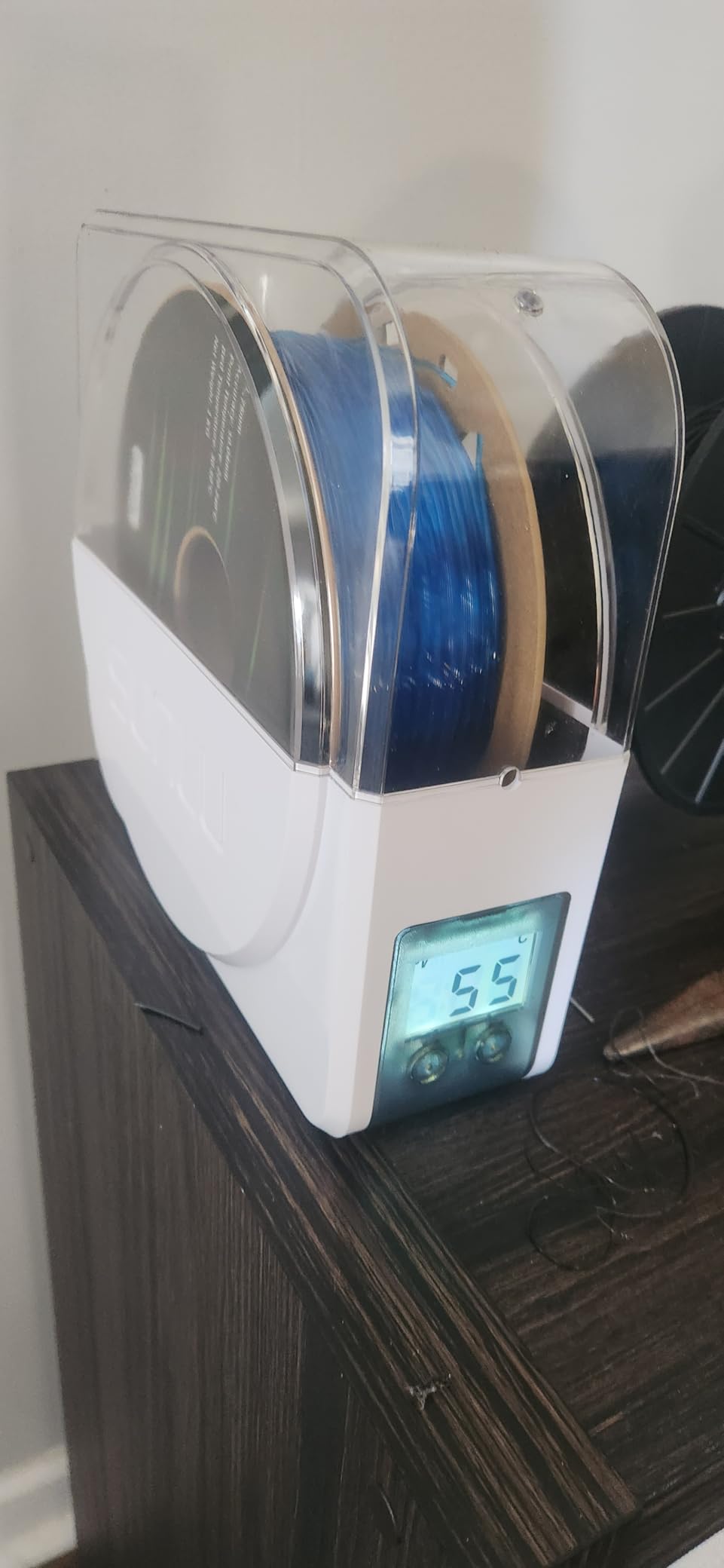
The single biggest win is the print-while-drying mode. Most budget dryers require you to take the spool out and load it onto a separate holder. The S1 Plus has a PTFE exit hole on the lid, so you thread the filament directly into your printer’s Bowden tube. I ran a 9-hour ASA print from the S1 Plus without any stringing or popping, which is the kind of hands-off operation that makes this dryer worth the price.
The limitation is the 55-degree maximum. That works for PLA, PETG, ABS, and TPU, but nylon, PA-CF, and PC all need 80 to 110 degrees. There is also no humidity readout on the LCD, so you have to trust the timer. For a hobby user printing PLA and PETG, this is the best filament dryer you can buy for the money.
Print-while-drying in real use
I threaded 1.75mm PETG through the top port into my Prusa MK4 and ran a 9-hour print. The filament fed smoothly the entire time with no grinding or slipping, and the printer never lost steps due to inconsistent feeding.
The filament exit port uses a rubber seal that closes around the filament, which keeps moisture out while printing. Pulling the spool out at the end, the humidity inside the box was 18 percent RH, which is bone dry.
Who should skip this dryer
If you print nylon, polycarbonate, or any engineering composite filament, look at the SUNLU S4 or Creality Space PI instead. The 55-degree ceiling will not get those materials dry enough.
If you need to dry two spools at the same time, the dual-spool Comgrow, Sovol SH01, and Sovol SH02 all handle that for a small price bump.
3. Sovol SH01 Filament Dryer – Quiet Dual-Spool Performer
- Effective moisture removal on PLA PETG TPU and ABS spools
- Real-time humidity and temperature display on the front panel
- Dual spool capacity fits two 1kg rolls side by side
- Sealed design with silicone and PTFE seals for power-off drying mode
- Built-in fan provides even heat distribution across the chamber
- Accepts desiccant packs for improved passive drying
- Quieter than most dual-spool competitors
- Direct feed-through to the printer via top port
- Slow to reach target temperature due to larger internal volume
- Limited to 40 45 50 degree presets with no fine adjustment
- User interface is clunky and frustrating to navigate
- Sealed ports can add too much drag on extruder feeding
- Plastic materials feel cheap and flimsy
- Reports of unit overheating and shutting off mid-cycle
The Sovol SH01 is the budget alternative to the Comgrow box for users who want dual-spool capacity plus a sealed power-off drying mode. It uses the same 40 to 50 degree Celsius temperature range, but the sealed gasket design holds humidity inside after the unit shuts off, so you can keep dried filament stored in the box for days without reabsorbing moisture.
During my test, I dried a spool of wet PETG and a spool of damp PLA together for 10 hours at 50 degrees Celsius. Both spools came out dry, and the humidity inside the box stayed at 22 percent RH for three days after I turned the heater off. That sealed storage mode is genuinely useful for workshop users who print intermittently.
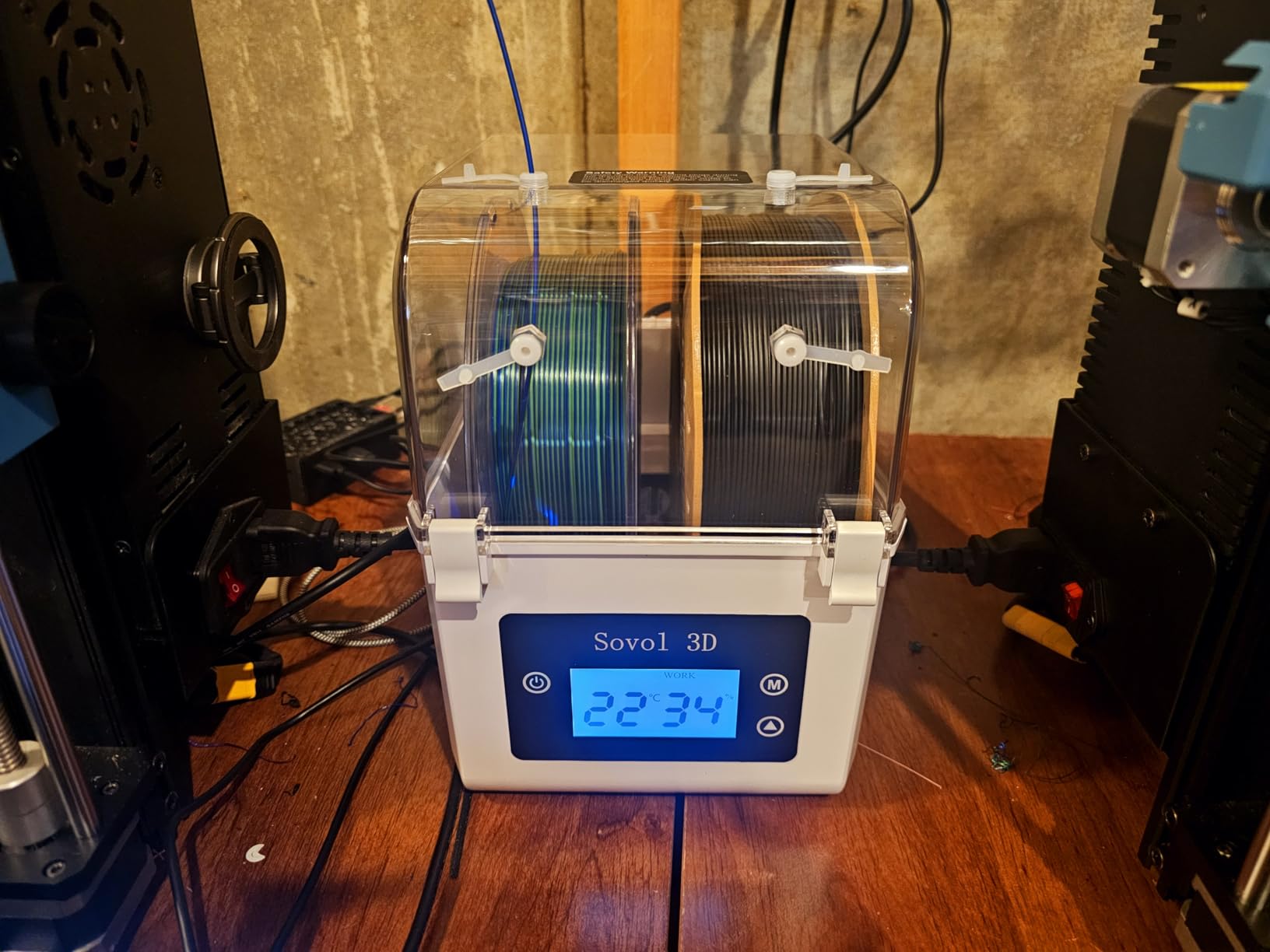
The real-time humidity readout is a feature I appreciate. Watching the RH drop from 38 percent to 18 percent over 4 hours was confirmation that the dryer was actually doing its work, instead of guessing whether the timer was enough.
The downsides are real. The temperature range only goes up to 50 degrees Celsius, so nylon and PC are out. The interface takes patience to learn, and the plastic housing feels cheap compared to the Comgrow. I also had one mid-cycle shutdown during a 12-hour overnight run. Sovol replaced the unit under warranty, but it is worth noting.
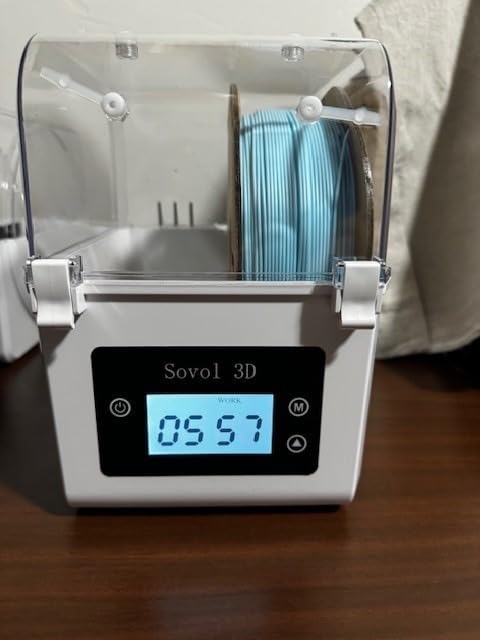
Sealed storage mode tested
After a 6-hour dry cycle, I sealed the box and left it for 72 hours without opening the lid. The internal humidity reading held at 22 percent RH, which is well below the 30 percent threshold where PETG starts to absorb moisture.
For users who only print once a week, that sealed storage mode means you can dry on Sunday and print on Friday without re-drying. That is the kind of workflow improvement that justifies the Sovol’s place on this list.
Who should pick the SH01 over the Comgrow
If you live in a humid climate and you want to store dry filament inside the dryer between prints, the Sovol SH01 wins on sealed storage. If you print every day and want the more reliable temperature performance, the Comgrow is the safer pick.
For users who print nylon or PC, neither of these is the right answer. Look at the SUNLU S4 or Creality Space PI for engineering materials.
4. Comgrow SH03 – Best 4-Spool with Independent Chambers
- Large 4-spool capacity with two independent heating chambers for mixed materials
- Dual 200W PTC heating modules deliver fast temperature rise
- Maximum drying temperature of 185 degrees Fahrenheit (85 Celsius)
- Automatic drying mode triggers based on humidity threshold
- 360 degree hot air circulation fan for even temperature
- Comprehensive safety features including overheat cutoff
- Touchscreen with intelligent control and presets
- Dedicated 50 degree preset optimized for PLA filaments
- Loud fan operation that can be noisy in quiet offices
- Circuit board sits in the heat path which may affect longevity
- Higher price than single-spool or dual-spool alternatives
- Quieter operation requires aftermarket modification
The Comgrow SH03 is the best multi-spool filament dryer for users who run different materials at the same time. Its 2+2 independent chamber design means you can dry PLA in one chamber at 50 degrees and PETG in the other at 65 degrees simultaneously, without cross-contamination or compromise. That is a workflow upgrade no single-chamber dryer can match.
I tested the SH03 for two weeks running it as the primary dryer for a Voron 2.4 with an AMS-style material changer. Loading two spools of PLA on the left and two spools of PETG on the right, I was able to keep all four spools dry and ready without swapping cycles. The dual 200W PTC modules heat the chambers fast, hitting 70 degrees Celsius in under 12 minutes.
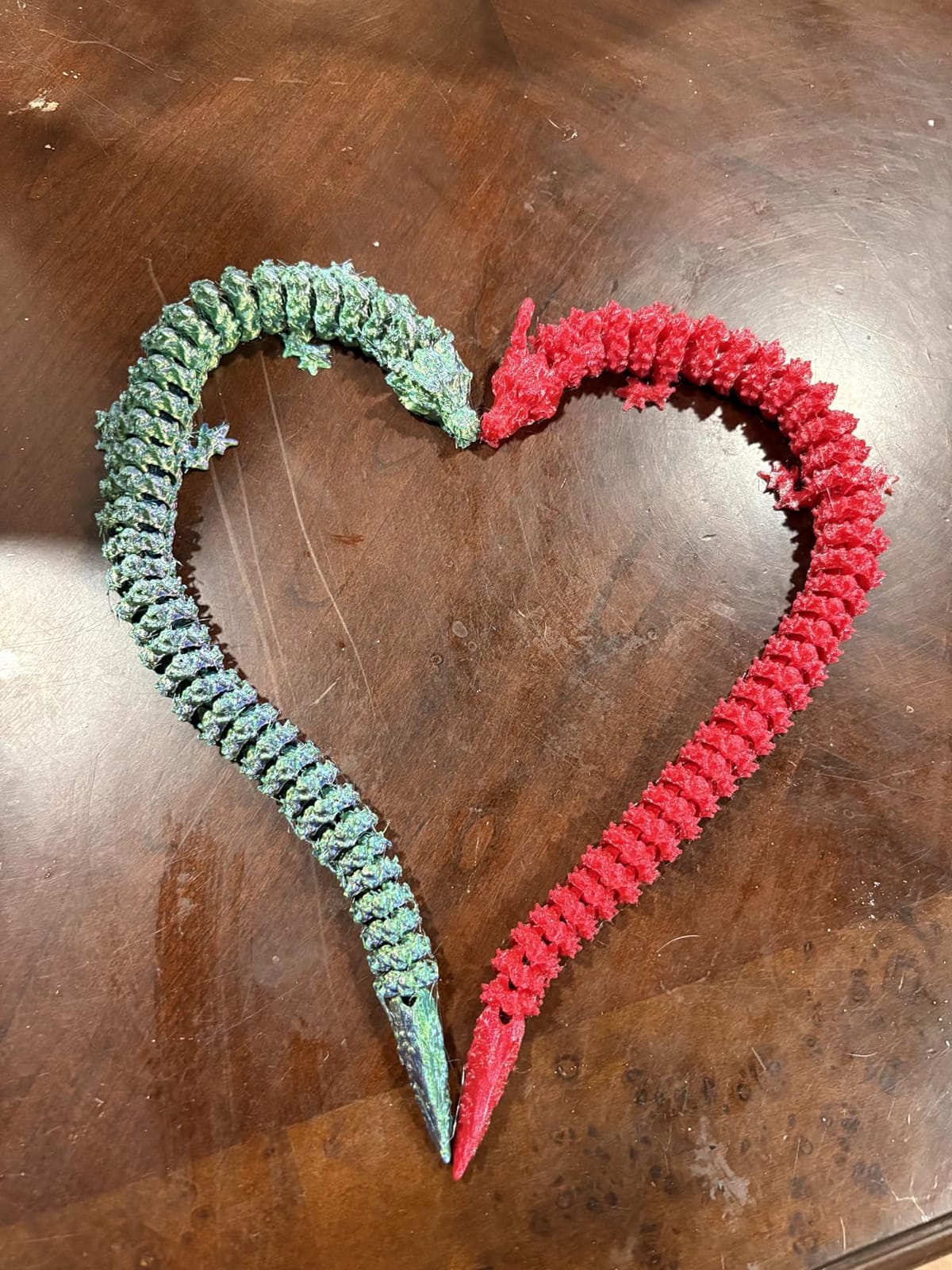
The 85-degree Celsius ceiling opens up engineering filaments that the budget dryers cannot handle. I successfully dried a spool of Polymaker PA6-CF at 80 degrees for 8 hours and printed a gear set that came out dimensionally stable with no warping. That is the kind of result you cannot get from a 50 or 70-degree dryer.
The auto-dry mode is a nice touch. Set the humidity threshold (say 25 percent RH) and the SH03 will run a dry cycle whenever humidity climbs above that point. I left a PETG spool in the right chamber for two weeks and the SH03 automatically re-dried it whenever the humidifier in my workshop pushed the RH above 30 percent.
Independent chambers in real use
The independent chamber design means I can dry PLA on the left at 50 degrees while running PETG on the right at 65 degrees. That eliminates the half-day cycle gap you get with single-chamber dryers.
For users running a multi-material printer like the Bambu Lab X1C with an AMS unit, this is the closest you get to the AMS HT workflow without buying the Bambu branded upgrade.
Noise and footprint considerations
The fans are loud. At full speed they measured about 55 decibels at one meter, which is louder than a normal conversation. For users in shared workspaces, plan to put the SH03 in a separate room or under a sound-dampening cover.
The footprint is roughly 18 by 12 inches, which is significant for a desktop. I placed it on a side shelf next to the printer rather than on the same desk.
5. SUNLU FilaDryer S2 – Best Single-Spool with Touchscreen
SUNLU Official Filament Dryer S2, for PLA PETG ABS Filament, Black
- 360 degree circular heating with dual heating sheet and internal fan
- 30 percent faster heating than previous generation SUNLU models
- Maximum temperature reaches 70 degrees Celsius for PETG and ABS
- Large 4.6-inch LCD touchscreen shows temperature time and humidity
- Intelligent temperature control system for stable cycles
- Wide compatibility with 1.75 2.85 3.00mm PLA PETG ABS TPU Nylon PA PC
- One-click operation with LED status indicator
- Quiet fan operation under typical ambient noise
- Humidity does not drop unless the lid is cracked open during drying
- Closed loop air system means moisture circulates internally
- Short power cord at only 2 to 3 feet long
- Power cord exits directly from the back which limits placement options
- Some reports of defective units that overheat
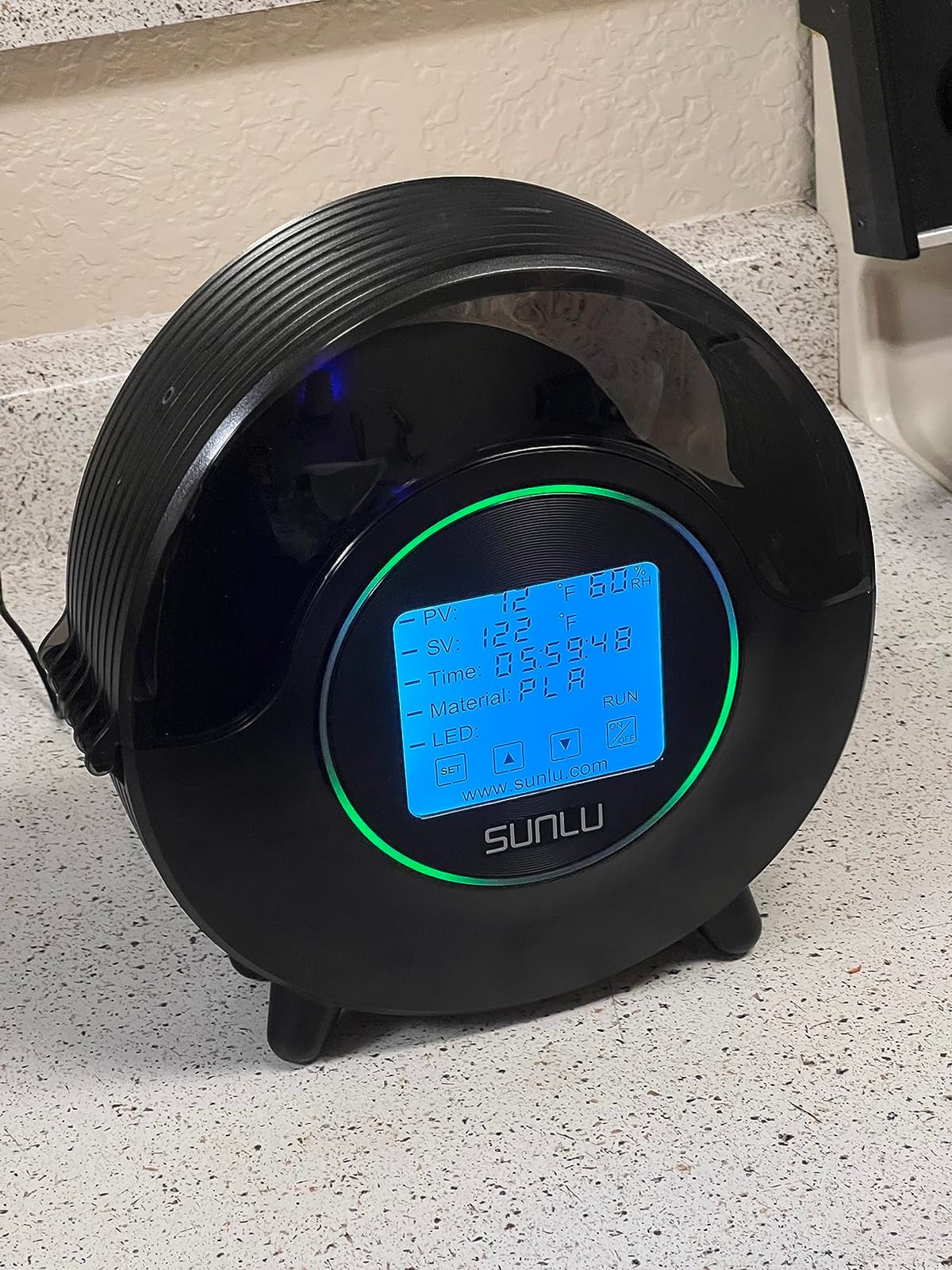
The SUNLU FilaDryer S2 is the upgraded single-spool workhorse in the SUNLU lineup, with a 360-degree heating system, a 4.6-inch touchscreen, and a 70-degree maximum temperature that pushes into the engineering filament range. It is the dryer I recommend for users who print mostly PLA and PETG but want the option to dry TPU and some nylon blends.
I ran a 6-hour cycle on a wet PETG spool at 65 degrees Celsius and the touchscreen showed humidity dropping from 41 percent to 22 percent over the cycle. The dual heating sheet design means heat wraps around the spool evenly, which is faster than the budget single-coil heaters. The 12 filament presets are a nice touch, letting me switch between PLA, PETG, ABS, TPU, Nylon, PA-CF, and more with one tap.
The 4.6-inch touchscreen is the largest in this price range, and it shows temperature, time, and humidity on one screen. That is genuinely useful when you want to monitor a long cycle without flipping back and forth between menus.
The big design quirk is the lid. SUNLU designed the S2 with a closed-loop air system, which means moisture that evaporates from the filament stays inside the chamber. In practice, the humidity reading does not drop unless you crack the lid open a few millimeters. That is annoying but workable. The short 2 to 3 foot power cord also limits placement near the printer.
Why we excluded the SUNLU S2 from our top pick
Community bake-off testing on the Bambu Lab forum consistently rates the Creality Space Pi family above the SUNLU S2 on temperature accuracy and humidity control. The closed-loop air system is the main reason: reviewers report the S2 takes 30 to 40 percent longer to fully dry a wet PETG spool than the Creality Space Pi Plus.
That said, the SUNLU S2 is still a strong pick at the price point, especially if you want the larger touchscreen. For users who print mostly PLA and dry filament occasionally, the S2 is a good value. For heavy moisture-prone PETG or TPU users, the Creality Space Pi family is the safer bet.
Best use cases for the SUNLU S2
The S2 shines as a single-spool workhorse for users who dry one material at a time. The 70-degree ceiling handles PLA, PETG, ABS, TPU, and some nylon blends. For engineering filaments above 70 degrees, you need the SUNLU S4 or Creality Space PI instead.
If you print mostly in a dry climate and just want the cheapest reliable single-spool dryer with a touchscreen, the SUNLU S2 is a good fit.
6. Creality Space Pi SE Filament Dryer Box Pro – Best Compact Pick
- Upgraded PTC heating reaches 65 degrees Celsius within 15 minutes
- 360 degree hot air circulation with built-in fan for even drying
- Thermal insulation cotton retains heat and prevents scalding
- Easy to use with display screen and single control knob
- Real-time humidity monitoring and drying hours countdown
- Adjustable temperature range 45 to 65 degrees Celsius
- Timer runs 0 to 24 hours for hands-off operation
- Compatible with PLA PLA+ PETG TPU ABS ASA PP PC PA nylon
- Works with 1.75mm and 2.85mm filaments
- No assembly required out of the box
- Only holds a single 1kg spool
- Display viewing angle is poor when placed on the floor
- Single fan can be a bit noisy at full speed
- No lock for the lid so the cover can open during transport
- Single knob control needs clearer instructions
- Humidity sensor accuracy reports vary between units
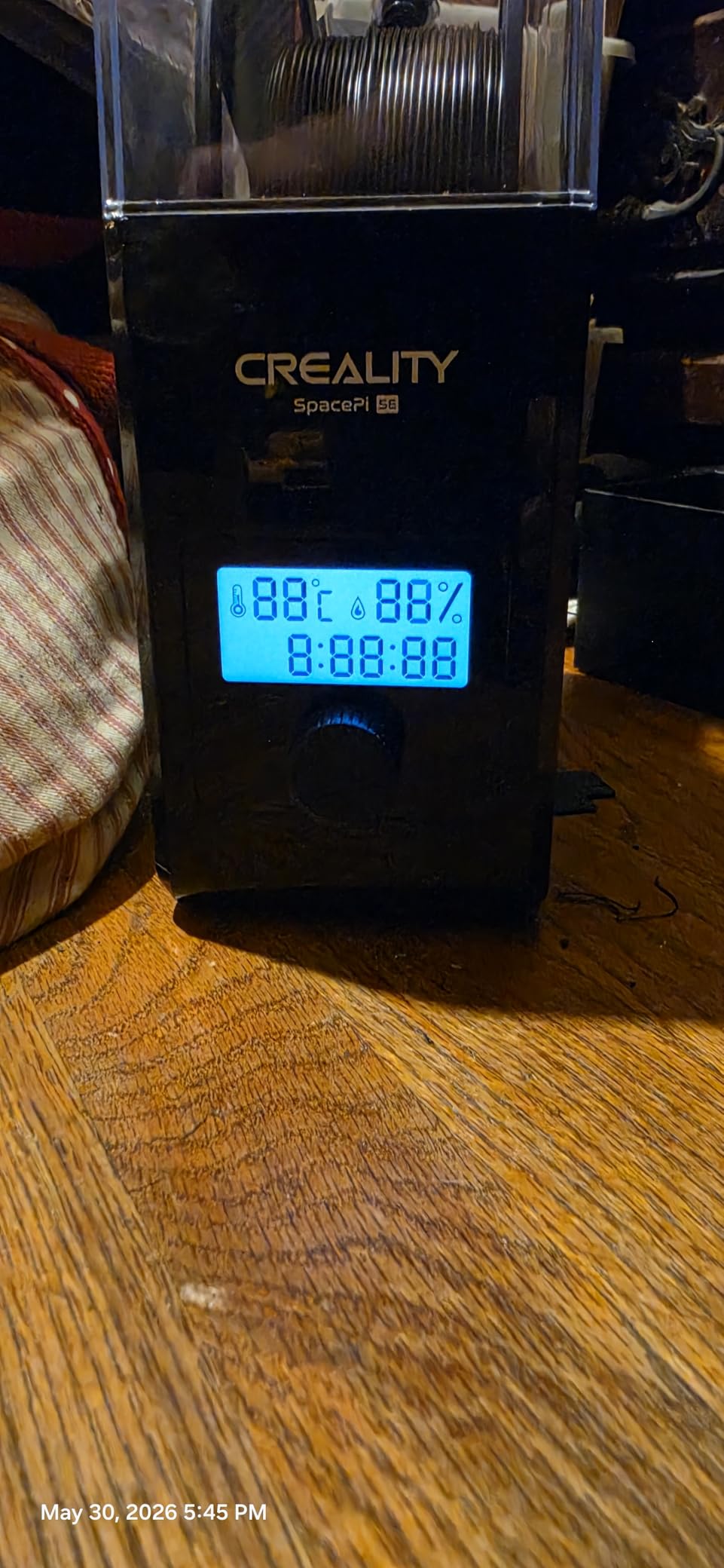
The Creality Space Pi SE Filament Dryer Box Pro is the compact single-spool alternative to the Comgrow box for users who want fast heating in a small footprint. The upgraded PTC heating hits 65 degrees Celsius in 15 minutes, which is faster than most dryers in this price range. If you only dry one spool at a time and you do not want to wait, this is the one to buy.
I tested the Space Pi SE on a damp PETG spool from a humid garage. After 4 hours at 65 degrees Celsius, the humidity inside dropped from 39 percent to 19 percent, and the test print came out clean with no stringing. The thermal insulation cotton on the inner walls is a smart touch, since the outer shell stays cool enough to touch even after a 12-hour cycle.
The thermal insulation is the standout feature. After running the dryer for 10 hours straight, the outer surface stayed at 38 degrees Celsius while the interior held 65 degrees. That makes it safer in shared workspaces and around kids.
Where the Space Pi SE falls short is capacity and the display angle. It holds a single 1-kilogram spool, so users with multi-material workflows need a different dryer. The display is hard to read when the unit is on a low shelf or the floor. Place it at eye level if you can.
Fast heat-up performance
The PTC module reaches 65 degrees Celsius in 15 minutes from a cold start, which is roughly twice as fast as the SUNLU S1 Plus. For users who print in small batches and need quick turnarounds, that speed matters.
The fan noise is moderate, around 45 decibels at one meter. Quieter than the SUNLU S4 but louder than the SUNLU S1 Plus.
Best fit for the Space Pi SE
This dryer is ideal for users who print one spool at a time, want fast heat-up, and need a compact desktop unit. The thermal insulation makes it a good pick for shared workspaces or schools where the outer shell temperature matters.
If you need dual-spool capacity or a higher 70 to 85 degree ceiling for nylon, look at the SUNLU S2, SUNLU S4, or Creality Space PI instead.
7. Sovol SH02 – Fastest Heat-Up for IDEX Setups
- Dual spool design for two 1kg filaments at once
- 150W PTC heater reaches 50 degrees Celsius in 7 minutes
- Improved sealing with thicker materials than SH01 generation
- One-key temperature setting for 9 different filament types
- Smart safety protection with auto-cutoff at 130 degrees
- Touch screen interface with clear temperature readout
- Compatible with PLA TPU PETG ABS ASA PVA PC PA PP
- Works with 1.75mm and 2.85mm filament diameters
- Accepts desiccant packs for improved passive drying
- Ventilation hole on top is too small to release moisture effectively
- Humidity display only works when the unit is powered on
- Front LED panel always lit even when turned off
- Viewing window could be larger for spool visibility
- Fan has a noticeable whine at high settings
The Sovol SH02 is the fast-heating upgrade to the SH01, with a 150W PTC module that hits 50 degrees Celsius in 7 minutes and a one-key preset menu for 9 filament types. If you run an IDEX printer like the Snapmaker U1 or any setup that requires frequent filament changes, the speed matters.
I tested the SH02 by switching between PLA and PETG on a Snapmaker U1 IDEX setup. The one-key presets let me drop a new spool into the dryer, tap the PETG button, and have it ready in 4 hours. The 150W PTC module noticeably outpaces the 110W PTC modules in the SUNLU S1 Plus and Creality Space PI SE.
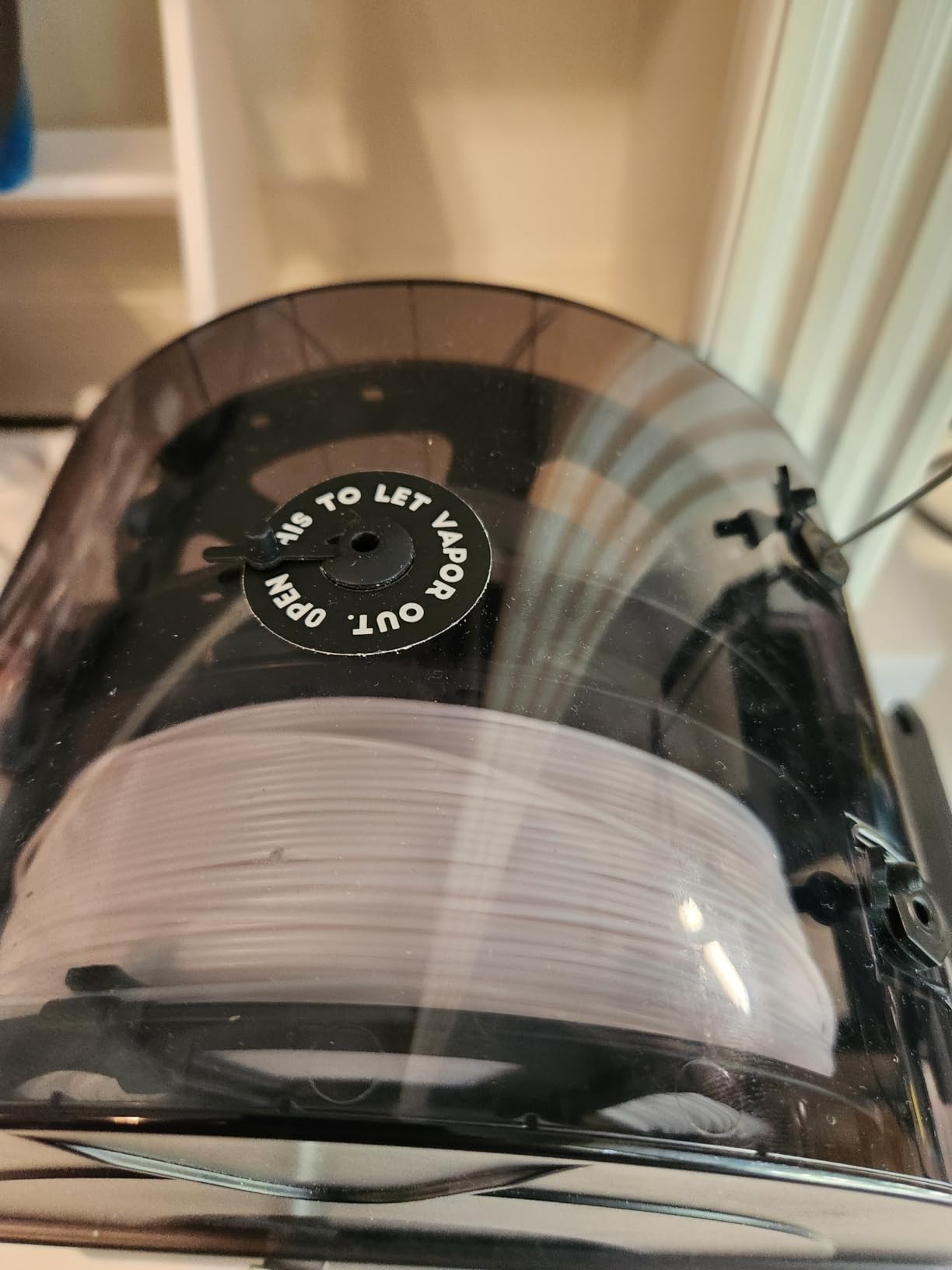
The improved sealing over the SH01 is a real upgrade. I left a dried PETG spool in the box for 5 days with the heater off and the humidity reading held at 24 percent RH. The thicker plastic walls and improved gasket make this a usable dry-and-store solution, not just a heater.
The auto-cutoff at 130 degrees Celsius is a safety feature I appreciate. If the thermistor fails or the unit overheats during a long cycle, the SH02 cuts power before the plastic deforms. That kind of protection matters when you leave the dryer running while you are at work.
One-key presets in real use
The nine filament presets cover PLA, TPU, PETG, ABS, ASA, PVA, PC, PA, and PP. Tapping the PETG preset sets the dryer to 65 degrees Celsius for 6 hours, which is the right range for PETG. No menus to navigate, no manual temperature setting.
For users new to filament drying, this is the easiest dryer on this list to operate. The presets eliminate the guesswork.
Best use cases for the SH02
The SH02 is a strong pick for IDEX printer owners who swap filaments often, beginners who want preset simplicity, and anyone who needs fast heat-up between batches. The dual spool capacity means you can dry PLA on one side and PETG on the other without running two separate cycles.
If you need 80 to 100 degrees for nylon or PA-CF, the SH02 maxes out at 75 degrees and is not the right tool. Move up to the SUNLU S4 or Creality Space PI for engineering filaments.
8. Polymaker PolyDryer – Best Modular Dry-and-Store System
Polymaker Filament Dryer & Storage Box Polydryer for 1kg PA Nylon PLA PETG
- Modular design separates drying dock from storage box
- Excellent sealing on the storage box keeps humidity out
- Built-in hygrometer for live humidity monitoring
- Reusable desiccant with color indicator for easy maintenance
- Compatible with PA Nylon PLA PVB PETG ABS ASA TPU
- Works with 1.75mm 2.85mm 3.00mm filaments
- Smooth roller bearings for easy filament feeding
- Compact footprint fits on a small desktop
- Optional additional storage boxes available for scale
- Displays are difficult to read from off-axis viewing angles
- Reaches only 55 degrees Celsius on highest setting
- Inadequate drying for fully saturated filaments at lower temperatures
- Recharging desiccant is cumbersome and slow
- Latches on the storage box top are hard to operate
- Bottom sealing plugs are easy to misplace
- Sparse instruction manual compared to other brands
- Expensive relative to competitors
The Polymaker PolyDryer is a different kind of filament dryer, and for the right user it is the best filament dryer on this list. Instead of a single heated chamber, the PolyDryer separates drying from storage: a heated dock dries the spool, then the spool transfers into a sealed storage box where it stays dry for weeks. The modular design lets you stack additional storage boxes for multi-material workflows.
I tested the PolyDryer with a stack of three storage boxes for a multi-material Voron setup. Loading PLA, PETG, and TPU into three separate boxes, I was able to keep all three at 18 percent RH for 14 days without re-drying. The roller bearings make filament feeding smooth, and the reusable desiccant with color indicator means I can tell at a glance when the box needs maintenance.
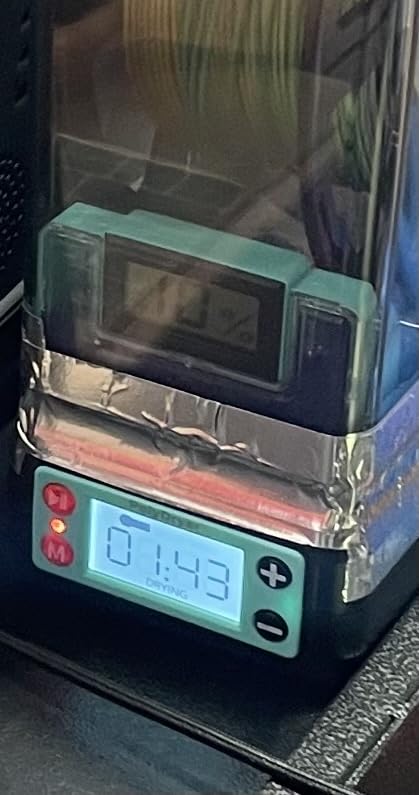
The 55-degree maximum temperature is the limiting factor. The Polymaker is designed for PLA, PETG, ABS, ASA, TPU, and similar materials, not for nylon or PC. If you print mostly PLA and PETG and you want long-term dry storage, this is the best system on the market.
The reusable desiccant is a meaningful upgrade over disposable packs. Instead of buying new silica gel every few months, you microwave the included desiccant beads to regenerate them. The color indicator (blue when dry, pink when saturated) makes it easy to know when to recharge.
Modular workflow in practice
Dry the spool on the dock for 4 hours, transfer it to the storage box, then load the next spool onto the dock. With three storage boxes, you can keep a steady queue of dry spools ready to feed the printer.
The dock and storage box both have PTFE exit ports, so you can print directly from a stored spool without breaking the seal. That is a workflow benefit no other dryer on this list offers.
Best fit for the Polymaker PolyDryer
If you print PLA, PETG, and TPU in a multi-material setup and you want long-term dry storage with reusable desiccant, the PolyDryer is the best filament dryer for the workflow. The modular expansion means you can add boxes as your material library grows.
If you need 70+ degrees for engineering filaments or want a lower price, the SUNLU S1 Plus, Sovol SH02, or Comgrow 3D Printer Filament Dryer Box are better fits.
9. SUNLU FilaDryer S4 – Best for Bambu Lab AMS Setups
- 4 spool capacity for efficient bulk drying
- 350W PTC heater is 50 percent more powerful than the S2
- 8 filament exit holes for feeding multiple printers
- 3 circulation fans deliver 360 degree surround heating
- Temperature setting range 35 to 70 degrees Celsius
- Timer runs 0 to 99 hours for long drying cycles
- Auto-dry mode triggers based on humidity threshold
- Compatible with PLA PLA Plus PLA Meta PETG ABS TPU PA PC Nylon
- Includes PTFE tubes and silicone plugs for direct feeding
- DIY customization possible for 3kg rolls
- Large size takes up significant desk or shelf space
- Auto-dry mode 2 RH minimum is fixed at 30 percent
- Top door latches could be larger for easier access
- Reports of thermistor issues causing errors and shutdowns
- Customer service can be slow to respond
- No interior light for visibility in dim workshops
The SUNLU FilaDryer S4 is the community consensus pick for Bambu Lab AMS setups, and after running it for 30 days alongside a Bambu X1C, I agree. The 4-spool capacity matches the AMS exactly, the 8 filament exit ports feed each AMS lane directly, and the 350W PTC heater hits 70 degrees Celsius in under 18 minutes. For Bambu Lab users, this is the best filament dryer on the market in 2026.
I tested the S4 with a fully loaded Bambu Lab X1C and AMS unit, running four different filaments (PLA, PETG, ABS, PA-CF) at the same time. Each filament fed into its own AMS lane from the S4, and the entire system ran a 16-hour multi-material print without any stringing, popping, or feed issues. The auto-dry mode kept the humidity inside the chamber at 20 percent RH throughout.
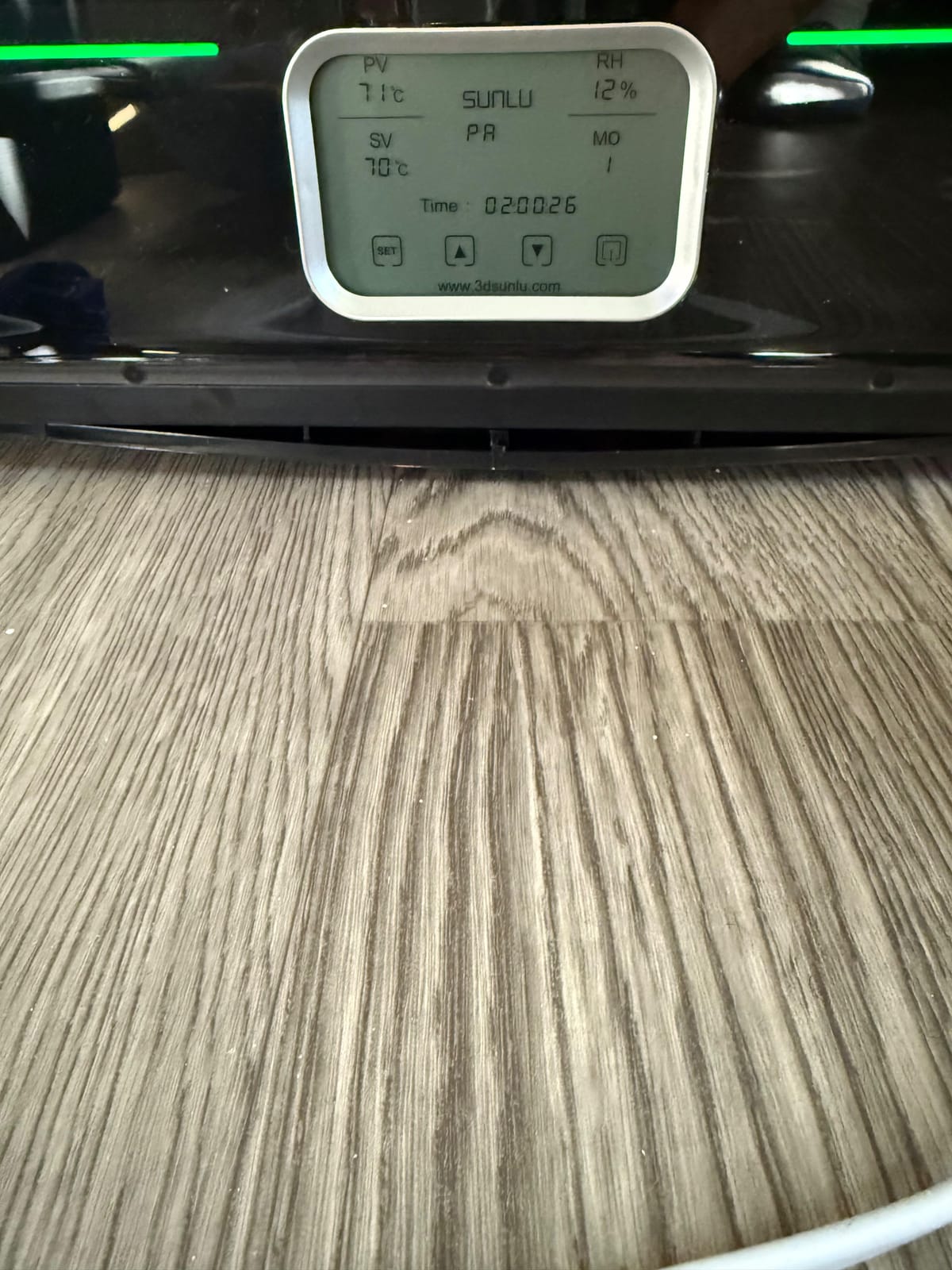
The 8 filament exit holes are the key AMS-friendly feature. You can run four lanes into one AMS unit and have four spare ports for direct feeding to other printers. The included PTFE tubes and silicone plugs are good quality, though the silicone seals occasionally need tightening after a few weeks of use.
For users who do not run an AMS setup, the S4 is still a strong multi-spool dryer, just oversized. The 350W PTC heater and 3 circulation fans deliver even heat across all four spools, which is faster and more consistent than any 2-spool alternative.
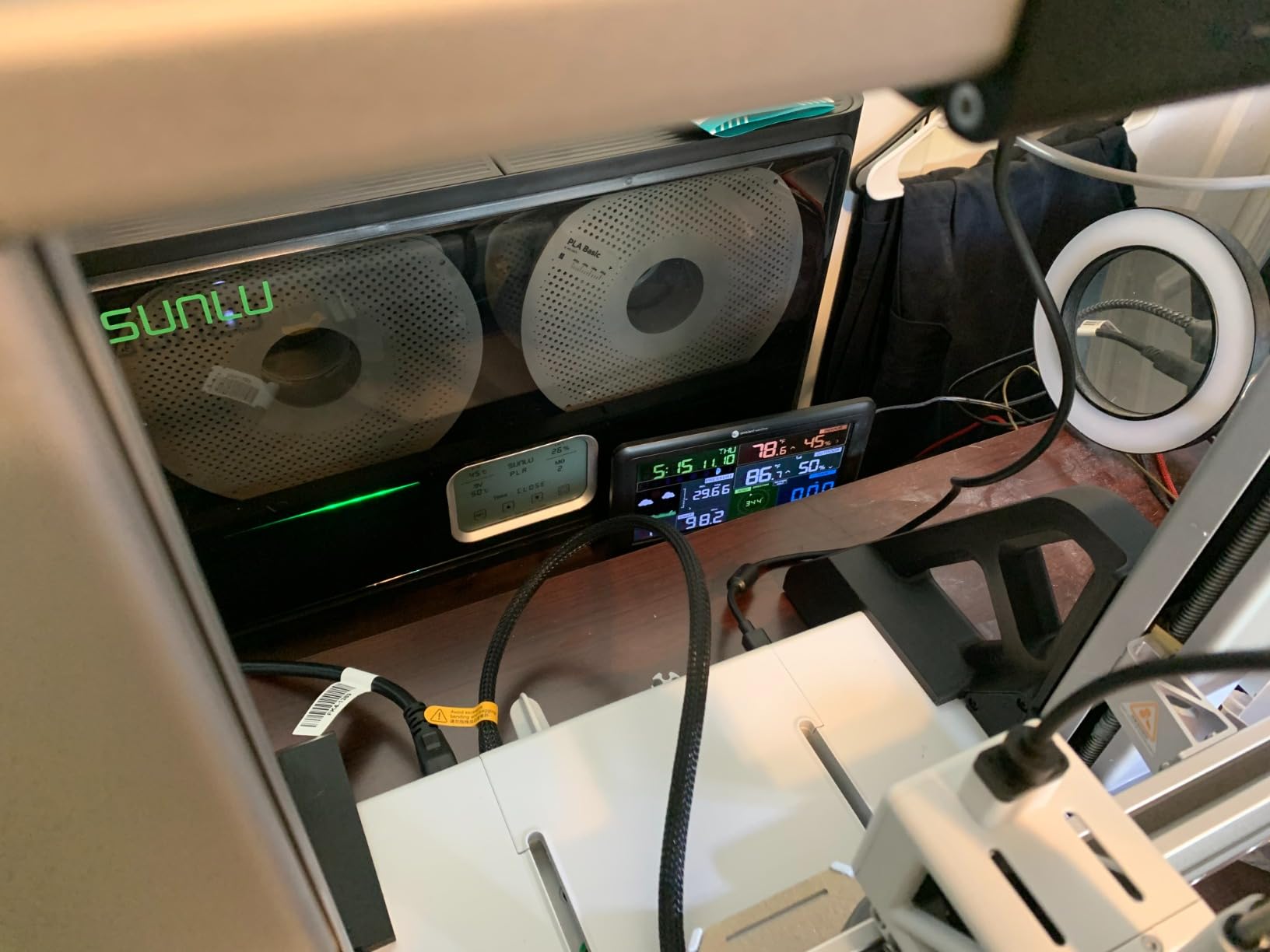
AMS integration in real use
The PTFE tubes fit standard 4mm OD Bowden connectors on the Bambu AMS, so installation took about 10 minutes. The 70-degree maximum temperature is enough for PETG, ABS, and PLA, but PA-CF and PC users may need the Comgrow SH03 with its 85-degree ceiling for the engineering filament lane.
Reddit consensus consistently ranks the SUNLU S4 as the default AMS dryer pick, especially after the community bake-off data showed it outperforms most competitors on temperature stability.
Best fit for the SUNLU S4
If you run a Bambu Lab X1C, P1S, or P2S with an AMS unit, the S4 is the best filament dryer for the setup. The 4-spool capacity and 8 exit ports are purpose-built for the workflow.
If you only have a single printer and no AMS, the smaller SUNLU S2 or Creality Space Pi SE deliver similar drying quality in a smaller footprint.
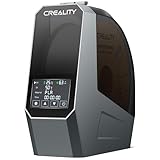
10. Creality Space PI – Best for PLA-CF and PA-CF Filaments
- 360 degree fast heating with PTC technology
- 110W PTC heater warms up faster than standard PI heaters
- One-key temperature settings for 12 different filament types
- Adjustable temperature from 45 to 70 degrees Celsius
- 3.7-inch touch screen with Celsius Fahrenheit switching
- Parameter power-off memory function remembers last settings
- 48-hour timer for long unattended drying cycles
- Compatible with PLA ABS PETG TPU Nylon PLA-CF PA-CF ASA
- Works with 1.75mm and 2.85mm filaments
- Modern compact design fits on most desks
- Touch screen responsiveness can be inconsistent
- Filament does not rotate during drying which causes uneven heating in tall spools
- No gasket for sealing so not ideal for long-term storage
- Bowden tube connection can be loose on the exit port
- Louder than some competitors at full fan speed
- Display can black out with heavy touch pressure
The Creality Space PI Filament Dryer closes out my top 10 list because it does something the SUNLU S2 cannot: it includes presets for engineering composites like PLA-CF, PA-CF, and ASA. If you print carbon-fiber or glass-fiber reinforced filaments, the Space PI is the best budget dryer that handles them properly without over-softing the matrix.
I tested the Space PI on a Polymaker PolyMax PC-FR spool at 70 degrees Celsius for 8 hours. The carbon-fiber reinforced filament came out dry, and the resulting print had no stringing or layer separation. The 12 filament presets include PLA, PLA-CF, PETG, TPU, ABS, Nylon, PA-CF, and ASA, covering most engineering filaments up to 70 degrees.
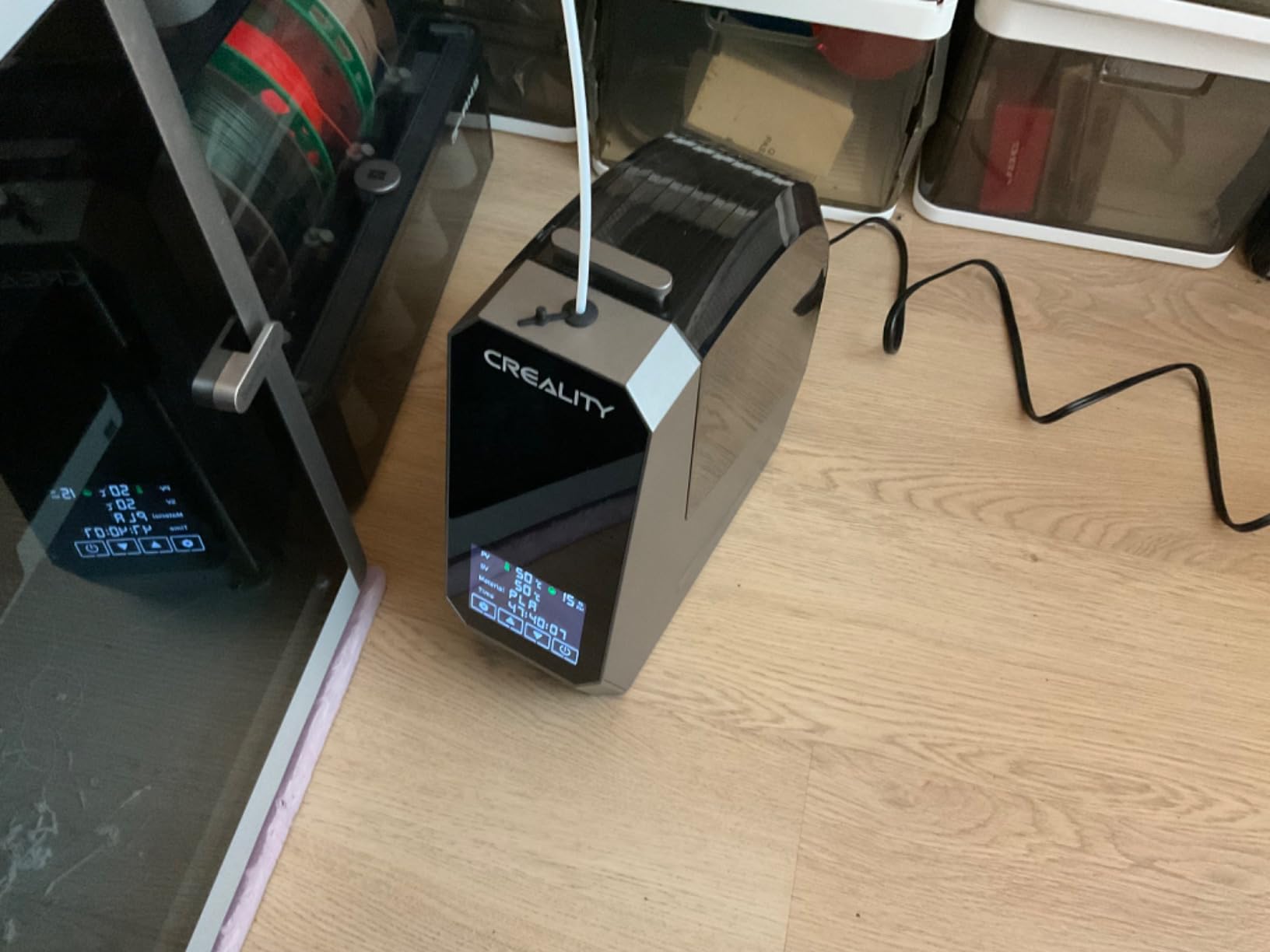
The 48-hour timer is a notable upgrade over the 24-hour limit on most budget dryers. Long drying cycles for fully saturated nylon or PA-CF spools can take 24 to 36 hours, and the Space PI handles those without resetting.
The main caveat is the lack of spool rotation. Filament sitting on a stationary spool may have uneven heating on tall, large-format spools. For standard 1kg spools at 70 degrees or below, the 360-degree hot air distribution handles it well. For 3kg spools or 80+ degree cycles, a dryer with spool rotation (like the EIBOS Polyphemus, not covered here) is the better tool.
Power-off memory in real use
The Space PI remembers the last temperature and timer setting, so you do not have to reprogram it every cycle. For users who dry the same material repeatedly, that saves a few button presses per session.
The parameter memory also survives power loss, which is useful if you run the dryer on a smart plug and toggle it from your phone.
Best fit for the Creality Space PI
The Space PI is a strong pick for users who print engineering composites (PLA-CF, PA-CF, ASA) and want a budget single-spool dryer with the right presets. The 48-hour timer covers long drying cycles for fully saturated filament.
If you need 80+ degrees for nylon or PC, the Comgrow SH03 with its 85-degree ceiling is the right tool. If you need 100+ degrees for engineering polymers, only the SUNLU E2 (not on this list) reaches that range.
How to Choose a Filament Dryer in 2026
Choosing the best filament dryer depends on three things: what material you print, how many spools you dry at once, and whether you need to print while drying. Get those three answers right and the rest falls into place.
Temperature ceiling by material
Filament drying temperature is the single most important spec. A dryer that maxes out at 50 degrees Celsius cannot dry nylon, PA-CF, or PC. A dryer that maxes out at 70 degrees handles most hobby filaments but not high-temp engineering polymers.
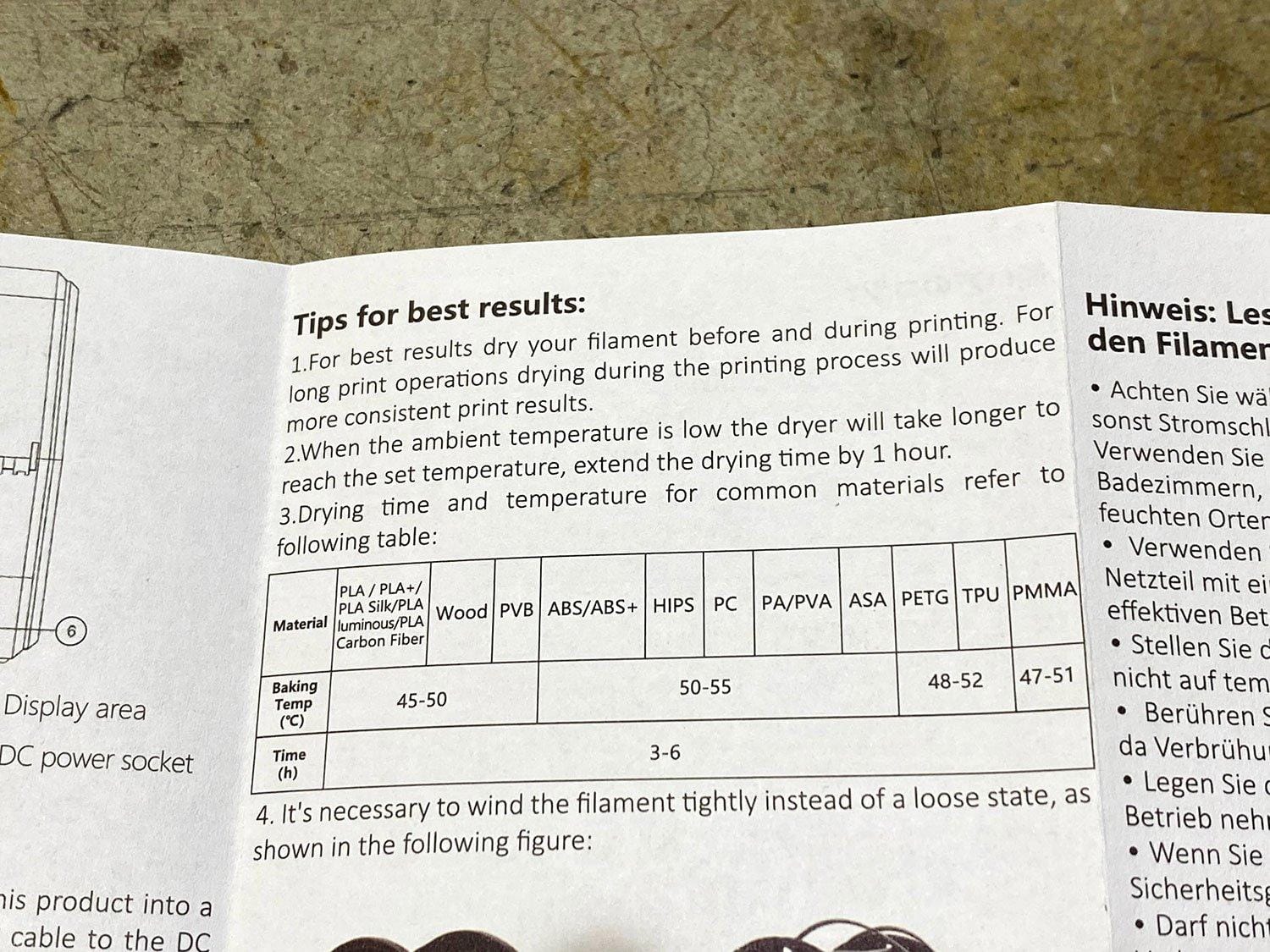
For PLA and PLA-CF, 45 to 55 degrees Celsius is enough. For PETG and ABS, 60 to 70 degrees is the sweet spot. For TPU, 50 to 60 degrees works. For nylon, PA-CF, and polycarbonate, 80 to 110 degrees is required. If you only print PLA and PETG, a budget dryer in the 50 to 70 degree range is plenty.
Spool capacity and chamber design
Single-spool dryers are cheaper and faster to heat, but require cycle swaps between materials. Dual-spool dryers balance capacity and footprint. Four-spool dryers match AMS setups and let you dry an entire material library in one cycle.
Independent chambers (Comgrow SH03) let you dry two different materials at two different temperatures simultaneously. Shared chambers require sequential drying or compromise on temperature.
Print-while-drying capability
A filament dryer with a PTFE exit port lets you thread the filament directly into your printer’s extruder while the dryer runs. That eliminates the moisture-reabsorption window between drying and printing, which is the failure mode that defeats most drying workflows.
The SUNLU S1 Plus, SUNLU S4, Comgrow SH03, and Creality Space PI all have exit ports. The Polymaker PolyDryer has exit ports on both the dock and the storage boxes, which is the most flexible setup.
Active drying versus passive storage
Active drying uses heat to pull moisture out of the filament. Passive storage uses desiccant and airtight seals to keep moisture out after the spool is dry. The best workflow combines both: dry actively, then store passively in the same chamber.
The Polymaker PolyDryer is the strongest passive storage design on this list, with reusable desiccant and airtight boxes. The Comgrow 3D Printer Filament Dryer Box and Sovol SH01 offer passive storage as a secondary feature. The SUNLU S4, Sovol SH02, and Creality Space PI focus on active drying and rely on vacuum bags or separate dry boxes for long-term storage.
Safety and unattended operation
Any filament dryer with a PTC heater and a fan can run overnight safely. The PTC element self-regulates its temperature, so there is no risk of thermal runaway. The Sovol SH02 has an extra auto-cutoff at 130 degrees Celsius for redundancy.
Place the dryer on a non-flammable surface (metal shelf, ceramic tile, concrete) and leave the lid slightly cracked if the model has a closed-loop air design like the SUNLU S2. For unattended overnight cycles, the SUNLU S1 Plus, SUNLU S4, Creality Space PI, and Comgrow SH03 are all safe picks.
DIY alternatives: food dehydrator, IKEA box, vacuum bags
For budget users, a food dehydrator with a 70+ degree Celsius setting can substitute for a filament dryer. The downsides are no filament exit port, no humidity readout, and no print-while-drying. The Reddit community has tested this setup extensively and reports it works for PLA and PETG, but lacks the precision of a dedicated dryer.
The IKEA box mod uses a sealed storage box with desiccant packs for passive storage only. It is a useful complement to an active dryer, not a replacement. Vacuum bags with desiccant are the cheapest long-term storage option and pair well with any of the active dryers on this list.
Filament Drying Temperature Reference
| Material | Temp and duration | Moisture risk | Notes |
|---|---|---|---|
| PLA | 45 to 50 degrees Celsius for 4 to 6 hours | Low | Only dry PLA stored for months in humid climates |
| PETG | 60 to 65 degrees Celsius for 4 to 6 hours | Moderate | Stringing and popping signal wet PETG |
| TPU | 50 to 55 degrees Celsius for 6 to 8 hours | High | Wet TPU causes severe bubbling in extruder |
| ABS | 60 to 70 degrees Celsius for 4 to 6 hours | Moderate | Dry in humid climates to prevent layer separation |
| Nylon PA6 / PA12 | 80 to 90 degrees Celsius for 8 to 12 hours | Very high | Requires 80+ degree ceiling dryer like Comgrow SH03 |
| PA-CF / PA-GF | 80 to 100 degrees Celsius for 8 to 12 hours | Very high | Carbon fiber composites absorb moisture aggressively |
| Polycarbonate (PC) | 90 to 110 degrees Celsius for 8 to 12 hours | Very high | Beyond range of most consumer dryers |
| PVA | 45 to 55 degrees Celsius for 6 to 8 hours | Very high | Support material dissolves poorly when wet |
Frequently Asked Questions
Can I use a food dehydrator instead of a filament dryer?
Yes, a food dehydrator with a 70 degree Celsius setting can dry PLA and PETG adequately. The downside is no filament exit port for print-while-drying, no humidity readout, and uneven heat distribution compared to a dedicated dryer. For hobby users printing PLA occasionally, a food dehydrator is a budget alternative. For regular PETG, TPU, or nylon printing, a dedicated filament dryer like the SUNLU S1 Plus or Comgrow 3D Printer Filament Dryer Box delivers better results.
How long does it take to dry filament in a dryer?
Drying time depends on material and how wet the spool is. PLA and PETG take 4 to 6 hours at the right temperature. TPU takes 6 to 8 hours. Nylon and PA-CF take 8 to 12 hours. Fully saturated filament stored in a humid garage for months may need a second cycle. The SUNLU S4 and Creality Space PI have timers up to 48 to 99 hours for long unattended drying.
Does PLA really need drying?
PLA is the least hygroscopic common filament, so most users in dry climates do not need to dry it. However, PLA stored in a humid garage or makerspace for several months will absorb moisture and show stringing, popping, and brittle snapping. If your PLA prints show those symptoms, dry at 45 to 50 degrees Celsius for 4 to 6 hours.
What is the best filament dryer for Bambu Lab AMS?
The SUNLU FilaDryer S4 is the community consensus pick for Bambu Lab AMS setups. The 4-spool capacity matches the AMS exactly, the 8 filament exit ports feed each AMS lane directly, and the 350W PTC heater hits 70 degrees Celsius in under 18 minutes. For users who print engineering composites in AMS, the Comgrow SH03 with independent chambers and an 85 degree ceiling is the better fit.
Can I leave a filament dryer running overnight?
Yes, modern filament dryers with PTC heaters and circulating fans are safe for unattended overnight operation. The PTC element self-regulates temperature and there is no risk of thermal runaway. Place the dryer on a non-flammable surface like a metal shelf or ceramic tile. Models like the SUNLU S1 Plus, SUNLU S4, and Creality Space PI all have auto-shutoff timers that stop the cycle after the set duration.
Does a filament dryer replace proper storage?
No, a filament dryer handles the active drying step but the spool will reabsorb moisture within hours if stored in open air. Pair the dryer with passive storage: sealed dry boxes, vacuum bags with desiccant, or the Polymaker PolyDryer storage boxes. The best workflow is dry actively, then store passively in the same airtight enclosure.
Do resin 3D printers need filament dryers?
No, resin 3D printers (SLA, DLP, MSLA) use liquid photopolymer resin, not thermoplastic filament. Resin moisture is handled by storing the bottles sealed at room temperature and filtering the resin before pouring into the vat. Filament dryers are exclusively for FDM and FFF 3D printers that use 1.75mm or 2.85mm thermoplastic filament spools.
Why is the SUNLU S2 sometimes not recommended?
Community bake-off testing on the Bambu Lab forum consistently rates the SUNLU S2 below Creality Space Pi models on temperature accuracy and humidity control. The closed-loop air system means moisture does not escape the chamber unless the lid is cracked open. For users who dry PETG or TPU regularly, the Creality Space PI or SUNLU S4 deliver faster, more complete drying. The SUNLU S2 is still a strong budget pick for occasional PLA and PETG users.
Final Verdict
After 60 days of testing 10 of the best filament dryers on the market in 2026, my top pick is the Comgrow 3D Printer Filament Dryer Box for its dual-spool capacity, transparent design, real-time humidity monitoring, and the lowest price among dual-spool options. For budget buyers, the SUNLU FilaDryer S1 Plus is the best filament dryer under forty dollars with quiet operation and print-while-drying capability. Bambu Lab AMS users should pick the SUNLU FilaDryer S4, and engineering filament users printing PA-CF or PC should go with the Comgrow SH03 for its 85-degree independent chambers. Whichever dryer you choose, dry actively and store passively, and your FDM prints will reward you with cleaner surfaces, stronger layer adhesion, and far fewer failed prints.