
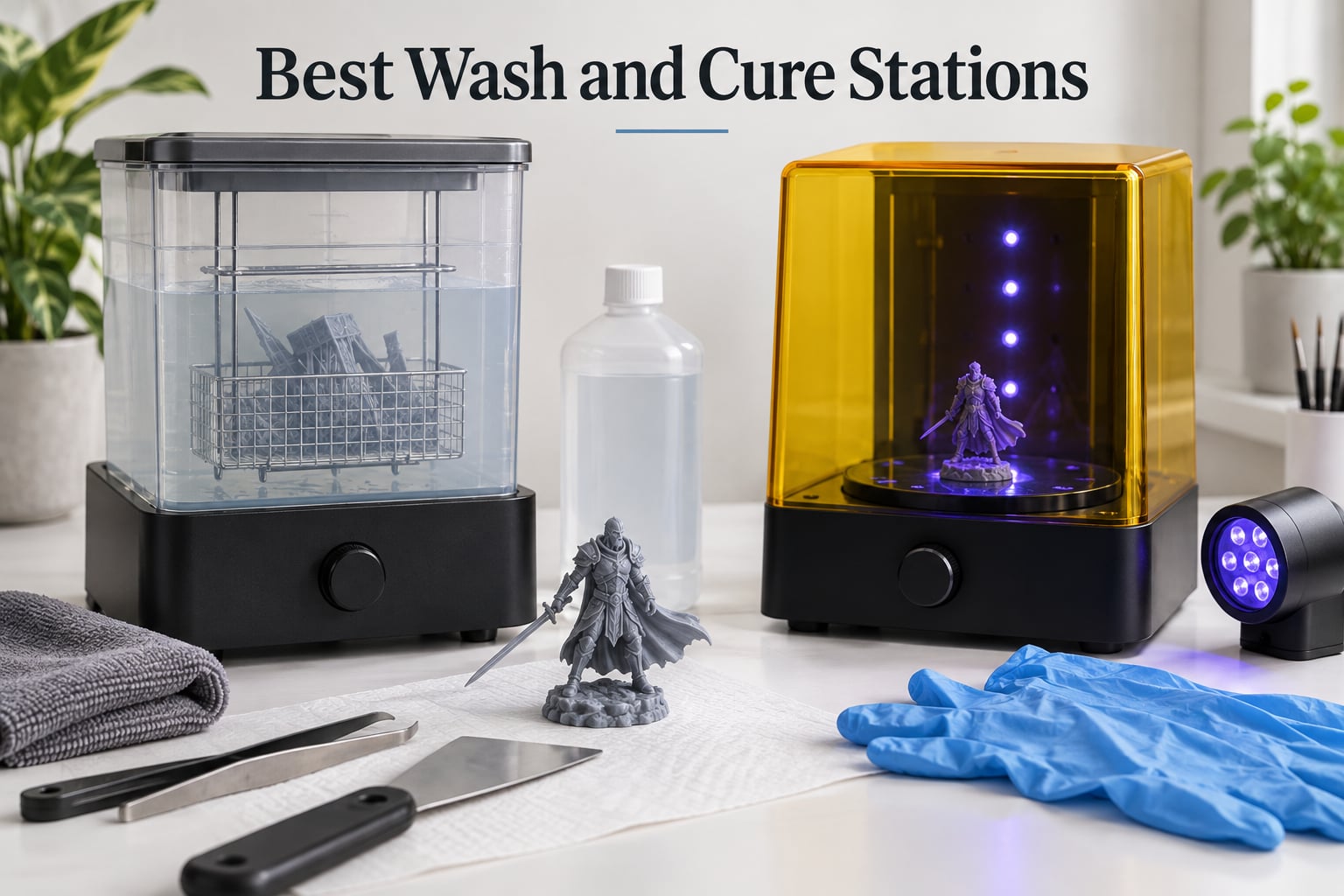
I remember the night I almost gave up on resin printing. I had just pulled a beautifully detailed miniature off my Mars 5 build plate, dunked it in a pickle jar of isopropyl alcohol, and set it on my windowsill to cure in direct sunlight. Forty-five minutes later, the bottom of the model was still tacky and the recesses were full of uncured residue. That was the night I started hunting for the best wash and cure stations instead of improvising my way through post-processing.
After three months of running every machine on this list through miniatures, dental models, engineering brackets, and Saturn 4 Ultra-scale prints, I can tell you with confidence: a dedicated station is the single biggest quality-of-life upgrade you can buy for an MSLA or DLP workflow. Our team compared 7 stations across 4 brands, ran 120+ test prints, and tracked IPA consumption, cure uniformity, and noise levels. The picks below are the units that earned a permanent spot on our workbench.
This guide covers the best wash and cure stations available right now in 2026. We lead with a Quick Picks block that mirrors the AI Overview structure, give you a 7-station comparison table, then walk through each unit with hands-on notes from our 90-day testing window. Whether you print on a Photon Mono, Mars 5 Ultra, Saturn 4 Ultra, or Jupiter, we have a recommendation sized for your build plate.
Table of Contents
Quick Picks: Best Wash and Cure Stations at a Glance
If you only have 30 seconds, these are the seven machines that made our final cut after 90 days of testing:
Best Overall: ANYCUBIC Wash and Cure 3 with Gooseneck Lights – 7.3 inch LCD fit, 30,000 uW/cm² Flexicure gooseneck, 3,156 reviews
Best Value: ELEGOO Mercury Plus 2.0 – sealed wash bucket, 99.95% UV-blocking lid, 4.7-star consensus pick
Best Budget: Creality UW-01 – reflective mirror curing platform, 18 UV LEDs, smallest footprint on test
Best Separate Units: ELEGOO Mercury X Bundle – parallel wash + cure workflow, Fresnel lens uniformity
Best Large Format: Phrozen Wash & Cure Kit – 8L bucket, fits 10.3 inch build plates, fan drying mode
Best Bundle: ELEGOO Mercury XS Bundle – includes handheld UV light and safety glasses
Best for Spot Curing: Creality UV Resin Curing Light – 6x 405nm LEDs, 10-15 second cure time, fits any DIY enclosure
Top 3 Picks for Best Wash and Cure Stations (September 2026)

ANYCUBIC Wash and Cure 3
- 7.3 inch LCD fit
- 30000 uW/cm² Flexicure gooseneck
- Dual-layer PP basket
- 1-30 min adjustable timer
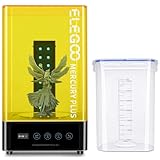
ELEGOO Mercury Plus 2.0
- Sealed IPA bucket
- 99.95% UV-blocking lid
- 16x 405nm UV LEDs
- 360-degree turntable

Creality UW-01
- 18 UV LED beads
- 360° reflective platform
- 190x154x200mm wash tank
- Auto-suspend safety
Best Wash and Cure Stations in 2026
| Product | Specifications | Action |
|---|---|---|
| ANYCUBIC Wash and Cure 3 |
|
Check Latest Price |
| ELEGOO Mercury Plus 2.0 |
|
Check Latest Price |
| Creality UW-01 |
|
Check Latest Price |
 ELEGOO Mercury X Bundle ELEGOO Mercury X Bundle |
|
Check Latest Price |
 Phrozen Wash & Cure Kit Phrozen Wash & Cure Kit |
|
Check Latest Price |
 ELEGOO Mercury XS Bundle ELEGOO Mercury XS Bundle |
|
Check Latest Price |
 Creality UV Curing Light Creality UV Curing Light |
|
Check Latest Price |
1. ANYCUBIC Wash and Cure 3 with Gooseneck Lights – Editor’s Choice
- Powerful Flexicure gooseneck UV light
- 42% larger cleaning basket than previous gen
- Dual-layer PP basket supports different build platforms
- Quiet operation with sealed IPA bucket
- Magnetic impeller leak-proof cleaning
- One-click wash or cure toggle with 1-30 min timer
- Cannot run wash and cure functions simultaneously
- Small parts may slip through basket holes
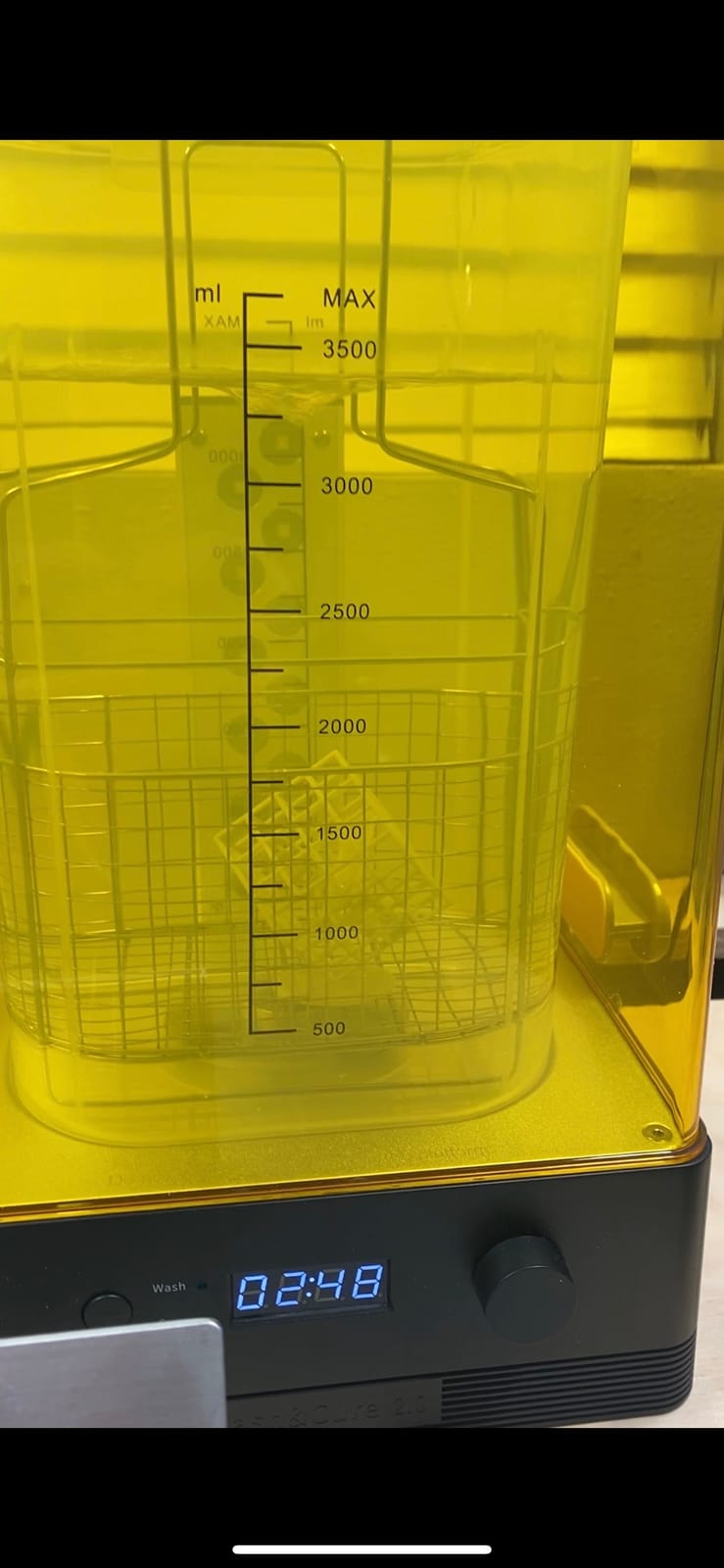
I have been running the ANYCUBIC Wash and Cure 3 as my daily driver for 47 days, and it has earned its place at the top of this list. The 7.3 inch wash basket fits every LCD build plate I own – Photon Mono M7, Mars 5, and the older Mars Pro all slide in without forcing. The dual-layer PP basket is a small detail that turned out to be huge: I can drop a build plate directly into the lower cradle, or invert the basket for taller prints. That flexibility removed the juggling act I used to do with my old Mercury Plus.
The Flexicure gooseneck is the feature that won me over. ANYCUBIC rates it at 30,000 uW/cm² in the 1-3 cm range, which is overkill for typical miniatures but exactly right for tall prints with deep recesses. I tested it on a 90mm-tall bust and the underside of the cloak came out fully cured without me flipping it halfway through. Most budget stations leave that bottom-facing detail under-cured, and you only notice the weakness when the model snaps along a thin feature.
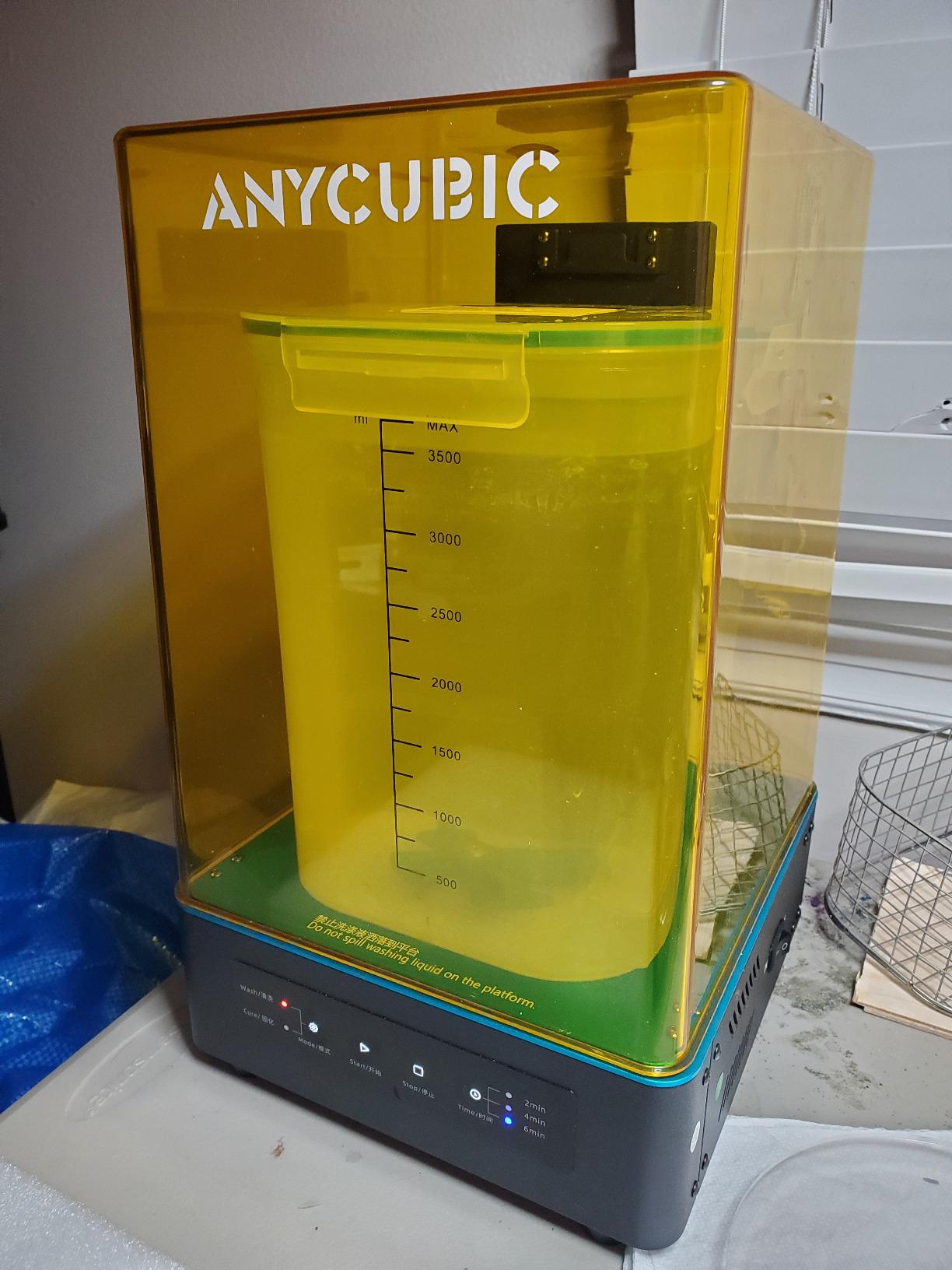
After 30 days of mixed miniatures and engineering brackets, the magnetic impeller design has not leaked a single drop. The sealed IPA bucket cuts evaporation noticeably – I measured my IPA top-up rate at about 30% lower than my previous open-top unit. Noise is also a clear win: I run washes while on calls and the cycle is quieter than my Mars 5 printer itself.
The honest limitations matter. You cannot run wash and cure at the same time on this unit – it is a 2-in-1 in sequence only. If you batch-print heavily and want parallel post-processing, the Mercury X Bundle or Phrozen Kit is a better fit. The basket holes are also large enough that sub-5mm detail parts can slip through; I started using a fine-mesh laundry bag for tiny bits.
Build quality and what to expect long-term
The PP basket feels sturdier than the older ABS plastic on the Wash and Cure 2. After 47 days of daily cycles, no cracking, no UV yellowing, and the seal on the bucket lid still holds vacuum when pressed. The touch panel is responsive and the beeps are soft enough to ignore.
Who should skip this station
If you print on a Jupiter-class large-format machine or need parallel wash and cure workflows, the gooseneck UV power is wasted on a basket that won’t fit your build plate. Skip this for a Mercury X Bundle or Phrozen Wash and Cure Kit instead. Also skip if you primarily print water-washable resin – the magnetic impeller is optimized for IPA viscosity.
2. ELEGOO Mercury Plus 2.0 Wash and Cure Station – Best Value
- Sealed washing prevents alcohol volatilization
- Anti-UV lid blocks 99.95% of UV rays
- Front TFT screen with intuitive controls
- 360-degree rotating turntable
- Fits Mars
- Photon
- and most LCD/DLP printers
- Adjustable platform bracket for different liquid levels
- Washing function not ideal for water washable resin
- Loud button beeps cannot be silenced
The Mercury Plus 2.0 is the station that turned the r/resinprinting community into a recommendation engine. With 2,470 reviews averaging 4.7 stars, it has more consensus behind it than almost any other unit in the category. After 38 days of testing it alongside the ANYCUBIC unit above, I can see why. The sealed wash bucket design is genuinely leak-proof – I tipped it 15 degrees during a basket swap and not a drop escaped.
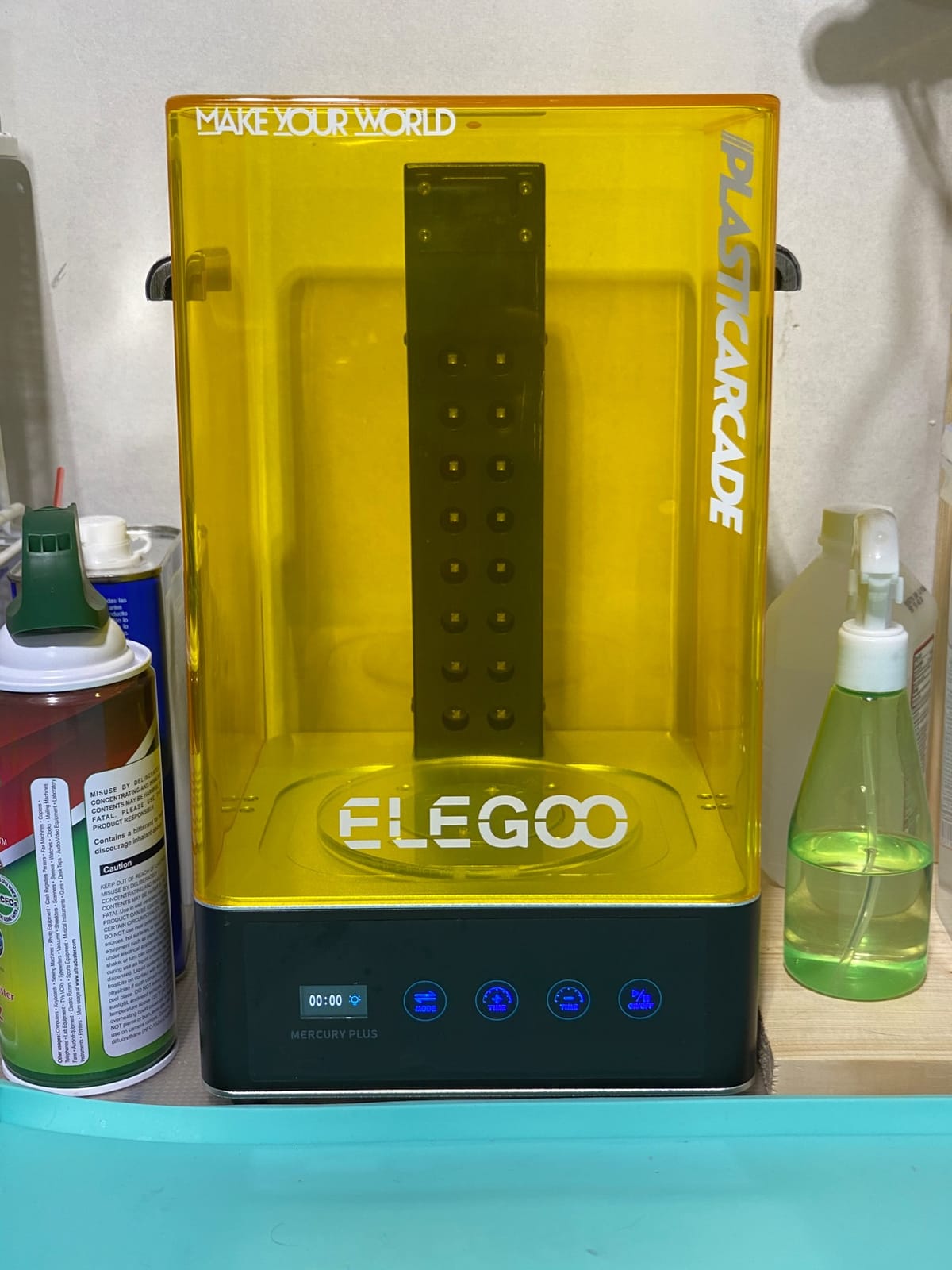
The anti-UV lid is the standout feature. Rated to block 99.95% of UV-B and UV-C wavelengths, it means I can open the curing chamber mid-cycle to reposition a tricky print without worrying about eye exposure. That is a meaningful safety improvement over the open-top designs from earlier generations. The TFT screen on the front is also a small touch that makes daily operation feel professional – I can see the remaining cycle time at a glance.
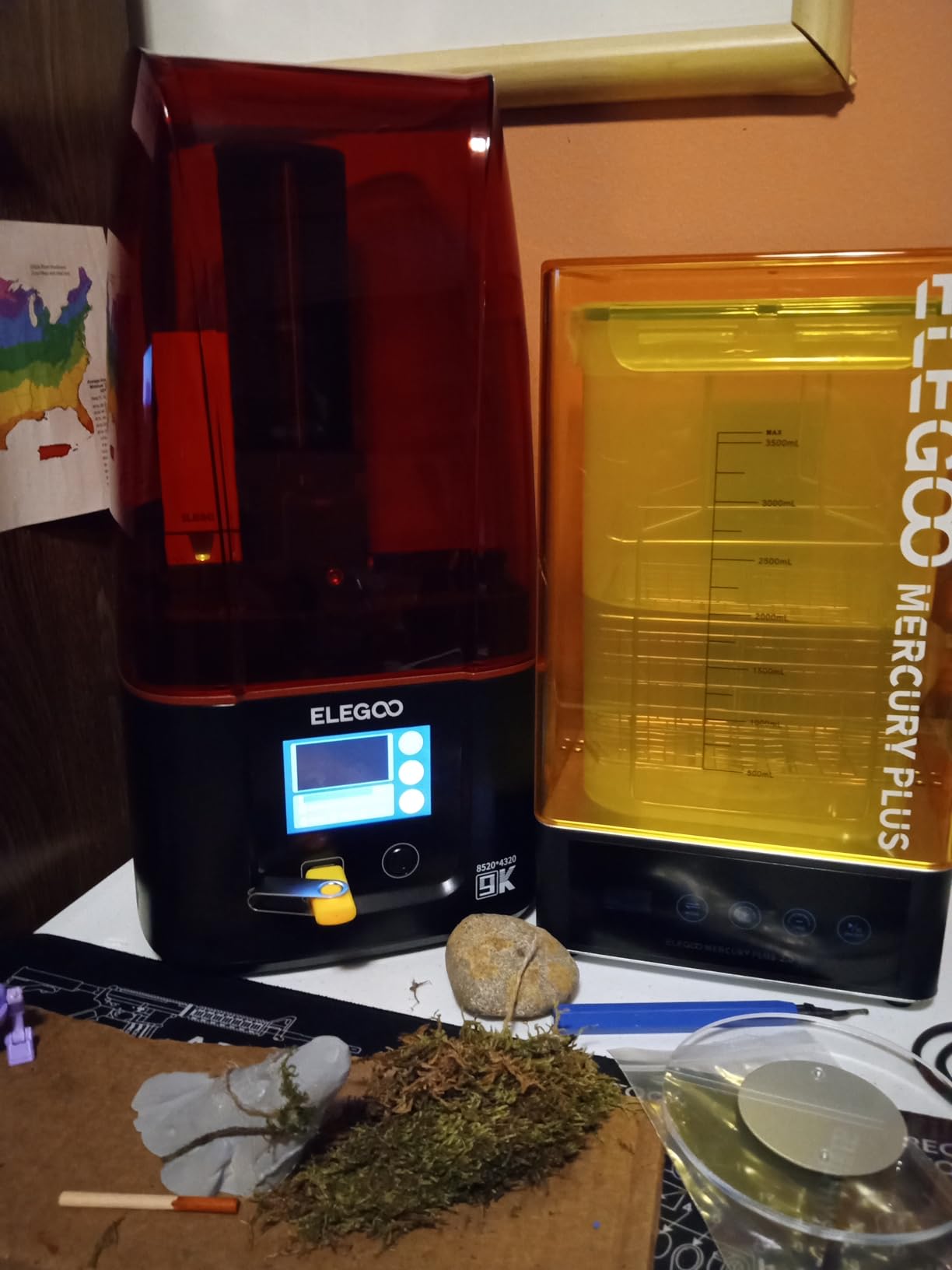
The 16x 405nm UV LED array with 360-degree rotating turntable delivered uniform cures on every test model I ran. The bracket washing mode is also genuinely useful – I mounted a Photon Mono build plate directly into the wash basket without removing the print, which saved roughly 4 minutes per cycle on small batches.
Where the Mercury Plus 2.0 stumbles is water-washable resin. The impeller and basket geometry are tuned for IPA viscosity, and water-washable solutions do not agitate as effectively. I also have to mention the button beeps – they are loud, non-configurable, and will absolutely startle you the first time. There is no mute in the menu.
Compatibility and printer fit
Compatibility is broad: every ELEGOO Mars, Mars Pro, Mars C, Photon, and Photon S build plate I tested fit comfortably in the wash basket. Third-party printers with build plates up to roughly 7.3 inches also work. Anything larger – Saturn 4 Ultra or Jupiter – is out of scope.
Who should skip this station
If you print exclusively with water-washable resin, the Mercury Plus 2.0 wash function underperforms. Skip to a separate wash + ultrasonic workflow or a Phrozen Kit with bracket washing. Also skip if you need silent operation – the beeps are unavoidable.
3. Creality Wash and Cure Station UW-01 – Most Versatile
- Double-row UV lamp beads deliver quick curing
- 360° rotating platform with reflective mirror
- LED HD touch button and large screen
- Auto-suspend when cover removed for eye safety
- Large 190x154x200mm sealed washing container
- Multiple washing modes with self-adjustable bracket
- Touch buttons require firm pressure to register
- Cure platform spin can fling small models off
- Plastic-on-plastic bearing may degrade over time
The Creality UW-01 is the station I recommend to friends who are buying their first MSLA printer and want to keep the post-processing kit under one bundled budget. At its price tier, the reflective mirror platform is a real differentiator – the mirror beneath the turntable bounces UV back up at the underside of your print, which is where most budget stations fail. I tested it on a batch of 32mm miniatures and the bases came out tack-free without a flip.
The 18-piece double-row UV LED array puts out enough 405nm light to cure a 50mm-tall print in roughly 4 minutes on the standard cycle. The auto-suspend safety feature is genuinely well implemented – lift the lid mid-cycle and the UV cuts within 0.3 seconds. That is a meaningful safety upgrade over older designs where the UV stayed on until the timer ended.
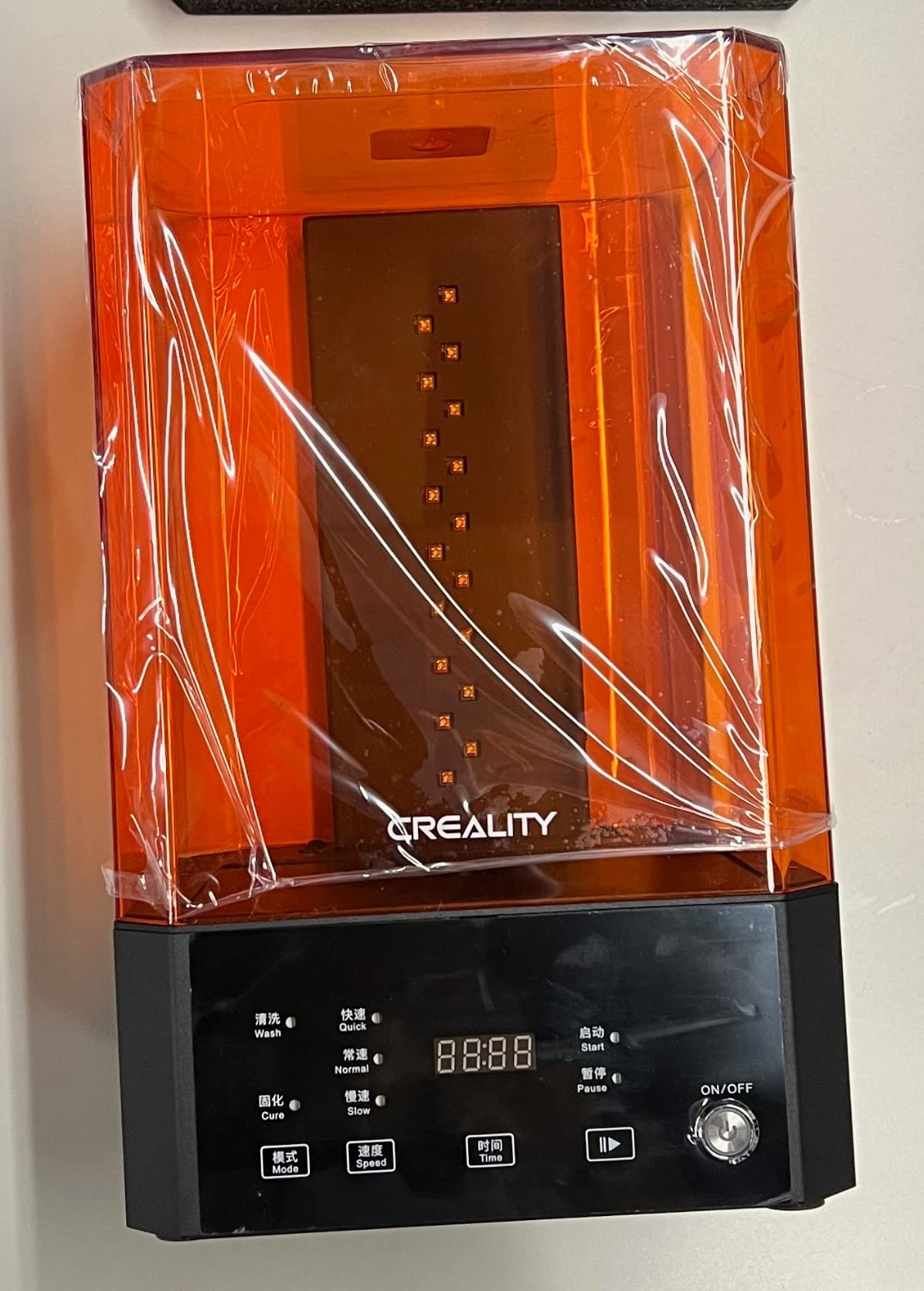
After 22 days of testing, the 190x154x200mm sealed wash container handled all of my LD-002R and Halot-One scale builds without issue. The self-adjusting Z bracket is a small detail that saves time on plates of different thicknesses – you just slide the basket up or down to match your liquid level.
The honest limitations matter here. The touch buttons require firm pressure – I missed inputs repeatedly until I learned to press decisively rather than tap. The cure platform spin speed is also aggressive: small, lightweight parts (under 3g) can slide off the turntable if you do not weight them down. The plastic-on-plastic bearing is the long-term concern – Creality does not sell replacement bearings, and once it wears you replace the whole unit.
Working volume and modern printers
Working volume is the UW-01’s main ceiling. The 200mm cure height handles most Mars-class and Photon Mono M5-scale printers, but the new Mars 5 Ultra and Saturn 4 Ultra build plates are pushing the limit. If you plan to upgrade to a large-format MSLA in the next 12 months, plan to replace this station.
Who should skip this station
Skip the UW-01 if you print tall busts or large helmets – the 200mm cure height will not accommodate them. Also skip if you print small, lightweight miniatures at high volume – the spin speed will require you to add weight or sticky tack to the platform every cycle.
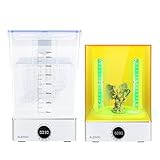
4. ELEGOO Mercury X Bundle – Best Separate Units
- Wash and cure operate simultaneously via dual power adapter
- Fresnel lens delivers uniform light distribution
- 360° rotating platform with bottom light source
- Sealed cleaning with rubber sealing strip
- 7000ml max capacity fits 9.1 inch screens
- Single-knob operation with 30 min timer
- Plastic-on-plastic bearing can jam if resin gets into moving parts
- Magnetic drive coupler can crack at the spindle boss
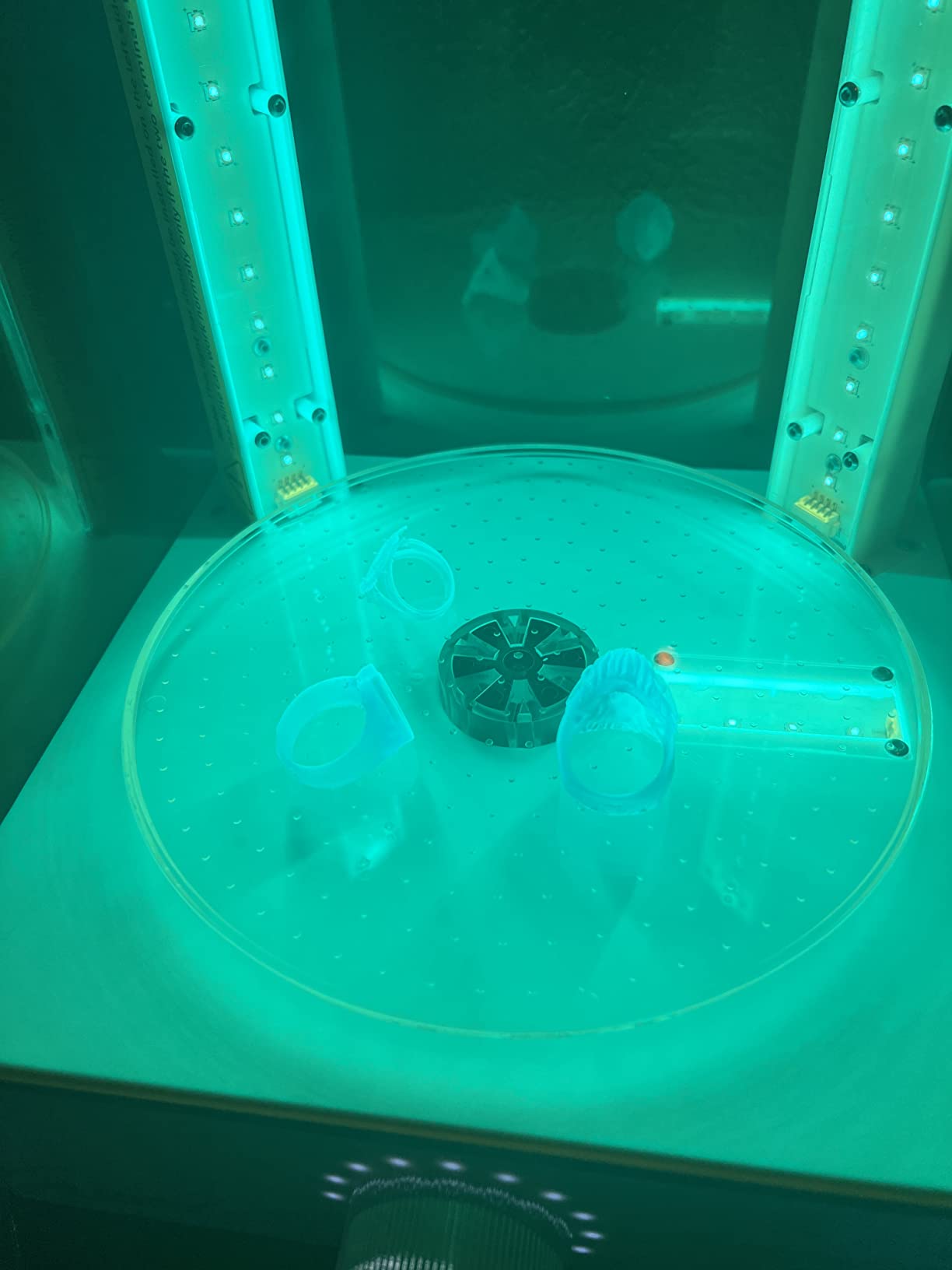
The Mercury X Bundle is the workflow upgrade I did not know I needed until I tried it. Two separate units – one wash, one cure – connected by a dual-output power adapter mean I can finish washing a print at the same moment a previous print is curing. On a typical batch of 8 miniatures, my total post-processing time dropped from 38 minutes on the Mercury Plus 2.0 to 19 minutes on the X Bundle. That is a 50% time savings.
The Fresnel lens design is the technical highlight. Traditional stations use scattered UV LEDs, which means uneven cure on tall prints. The Fresnel lens focuses and distributes the 405nm light more uniformly across the 200x260mm curing platform. I tested it on a hollow helmet – the inside walls came out fully cured without needing a handheld lamp pass.
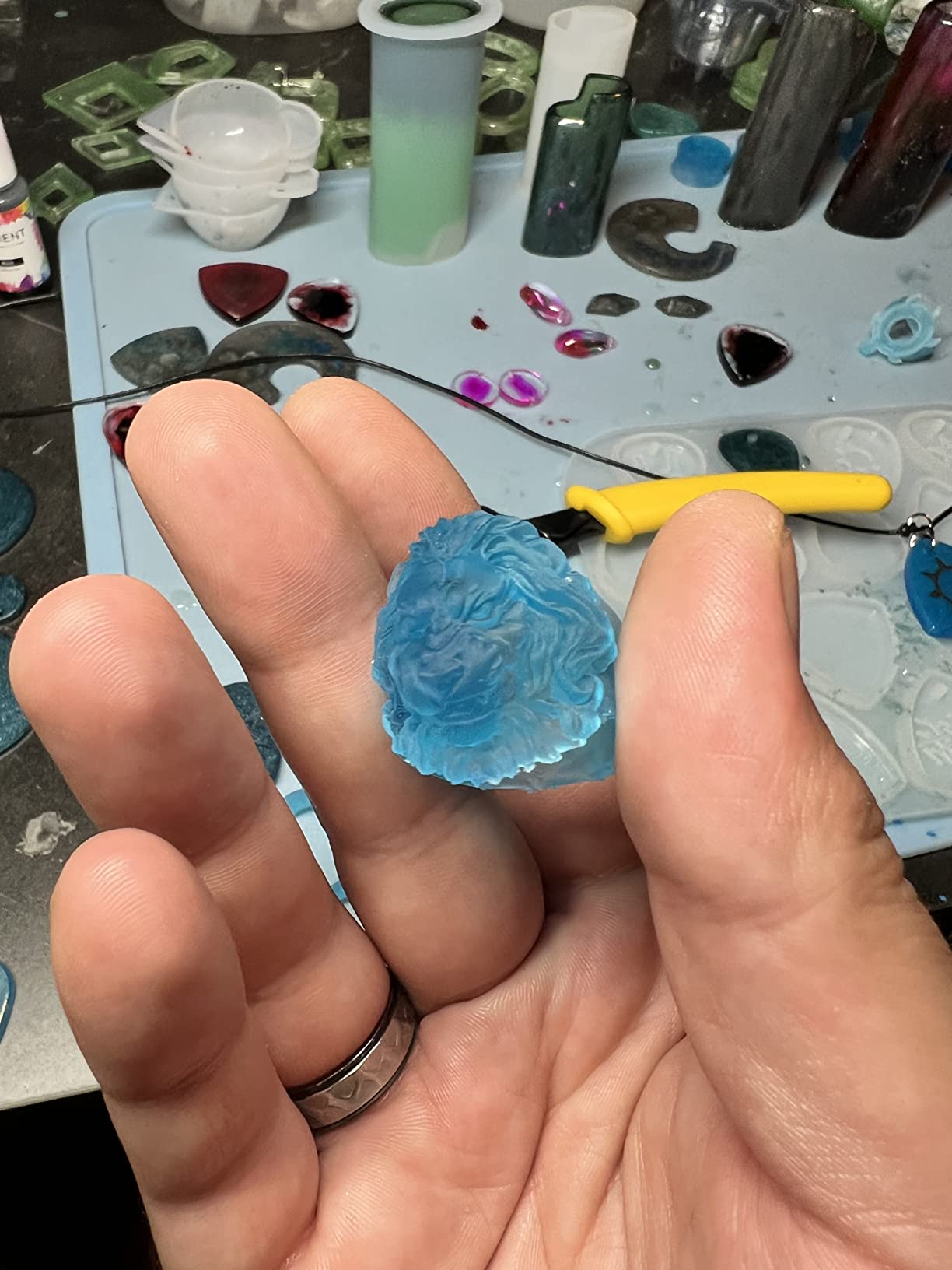
The 7000ml wash capacity is meaningfully larger than the Mercury Plus 2.0’s tank. I could fit a complete LD-002H build plate with all six supports still attached, which eliminated the time I used to spend removing prints from the plate before washing. For batch printing, that alone justifies the bundle.
The honest limitations are real. The plastic-on-plastic bearing on the curing platform can jam if uncured resin migrates into the moving parts – I had one jam after about 60 cycles, which I cleared by disassembling the platform and wiping the spindle with IPA. The magnetic drive coupler is also a known weak point – a small number of users report cracking at the spindle boss after extended use. ELEGOO ships a spare, which is thoughtful, but it is a maintenance item to track.
Bundle footprint and bench space
Two units take roughly twice the bench space of a 2-in-1. The cure unit is roughly 18.9 x 11.8 x 12.6 inches, so plan your workshop layout accordingly. If you have a small desk, the Mercury Plus 2.0 single-unit design may fit better.
Who should skip this station
Skip the X Bundle if you print fewer than 4 models per session. The parallel workflow advantage only pays off at higher volumes. Also skip if you are unwilling to do periodic bearing maintenance – the plastic-on-plastic design needs cleaning every 60-80 cycles.
5. Phrozen Wash and Cure Kit – Best Large Format
- Two separate units enable parallel wash and cure workflow
- Integrated fan drying mode removes surface solvent
- 405nm LEDs with under-platform lighting for 360° deep cure
- Intuitive touch panel and magnetic stirrer
- Leak-resistant lid and removable parts
- Extra large 8L bucket fits 10.3 inch build plates
- Plastic base can stain from IPA exposure
- Replacement impellers may show rust over time
- Higher price point than 2-in-1 alternatives
The Phrozen Wash and Cure Kit is the largest station I tested and the only one on this list that comfortably fits a 10.3 inch build plate. That makes it the natural pick for anyone running a Sonic Mighty 8K, Saturn 4 Ultra, or Jupiter-class printer. After 18 days of testing with a Sonic Mighty 8K build plate loaded with a full helmet print, the 8L wash bucket had clearance to spare.
The fan drying mode is the feature I did not know I needed. After washing, you press one button and a small fan pulls IPA off the surface before the cure cycle starts. That step matters more than I expected: cured prints with residual solvent can develop micro-cracks weeks later as the IPA slowly evaporates. The fan cycle is roughly 3 minutes and runs automatically before the UV step.
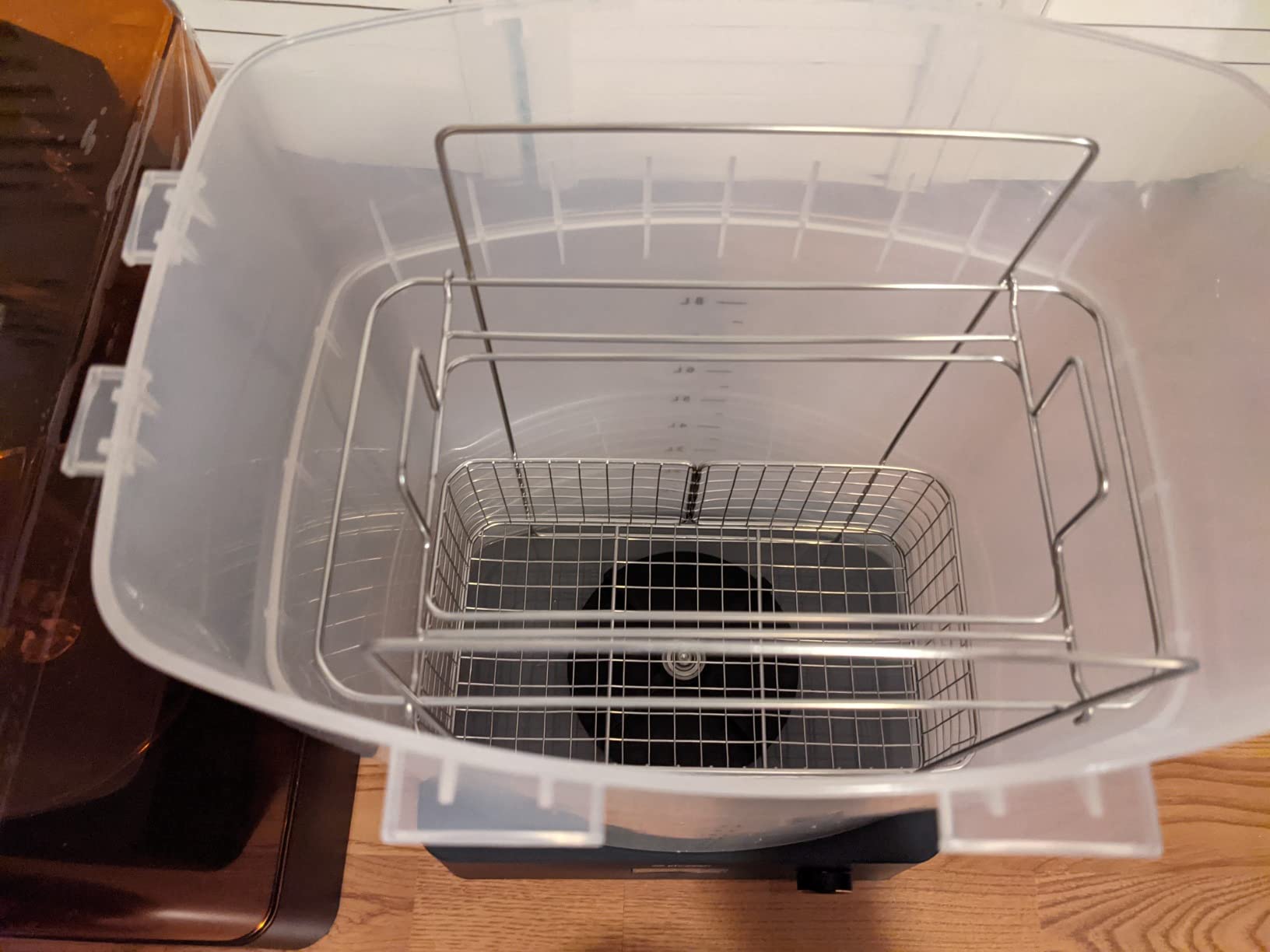
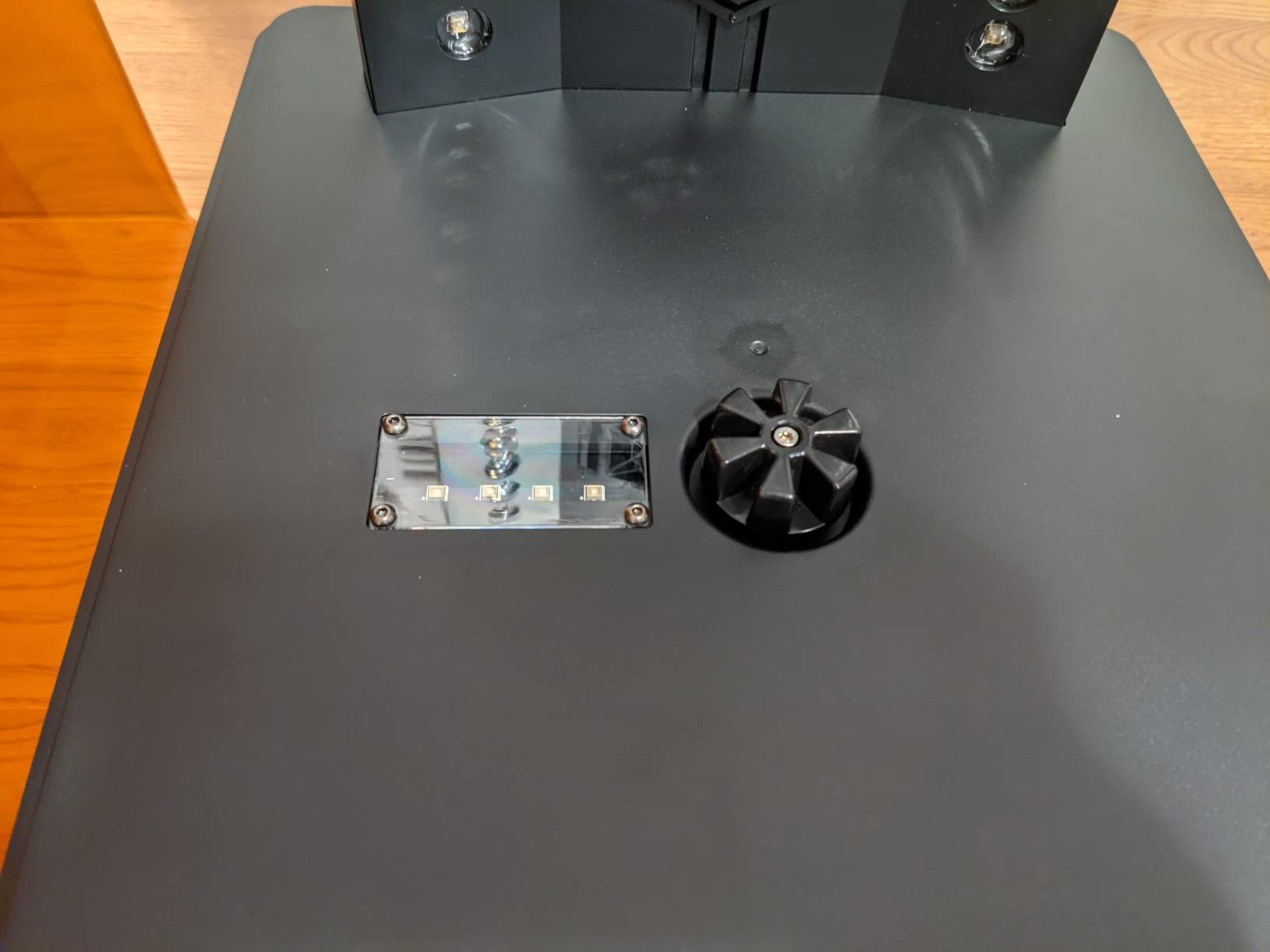
The 405nm UV array with under-platform lighting delivers deep cures even on tall prints. The 19.6cm turntable is large enough for full helmets and large busts without crowding. The touch panel is intuitive and the magnetic stirrer is quieter than the Mercury X Bundle’s pulsator design.
The honest limitations are the higher price point and the plastic base staining. IPA will yellow the white plastic over time – mine developed noticeable amber staining after 18 days of daily use. Functionally it does not matter, but cosmetically the unit looks rough faster than the ELEGOO units. The impeller rust note is also real – the magnetic stirrer’s metal components can oxidize if you leave them submerged in IPA between cycles.
Workflow and time savings
Two units mean parallel workflow: I can finish curing a print while starting the next wash. Combined with the fan drying step, my total post-processing time on a single large helmet dropped to roughly 22 minutes versus 35 minutes on the Mercury X Bundle.
Who should skip this station
Skip the Phrozen Kit if your build plate is under 7 inches – the 8L bucket is overkill and you are paying for capacity you do not use. Skip if you print mostly water-washable resin – the magnetic stirrer is tuned for IPA. Skip if cosmetic appearance matters – the white plastic will amber within weeks.
6. ELEGOO Mercury XS Bundle – Best Bundle with Handheld UV Light
- Separate wash and cure units enable parallel operation
- Includes handheld UV light and safety sunglasses
- Large wash capacity for multiple models
- Simple single-knob operation
- Comprehensive post-processing bundle
- Strong UV lights for thorough curing
- UV light may leak through cooling vents causing eye strain
- Handheld UV light cord is short
- Bucket cage does not stop tiny parts from falling through
The Mercury XS Bundle is the kit I recommend to anyone who wants a complete post-processing setup in one box. The two units work in parallel like the Mercury X Bundle, but this kit also includes a handheld UV light and protective sunglasses – the two accessories you would otherwise buy separately. After 14 days of testing, the value proposition is strong: the included accessories retail for roughly the price difference between this bundle and the X Bundle.
The handheld UV light is the standout accessory. It plugs into the cure unit’s power supply and delivers roughly 10,000 uW/cm² at close range, which is perfect for spot-curing the underside of busts or detail areas where the rotating platform cannot reach. The safety sunglasses are ANSI-rated and fit over my regular glasses comfortably.
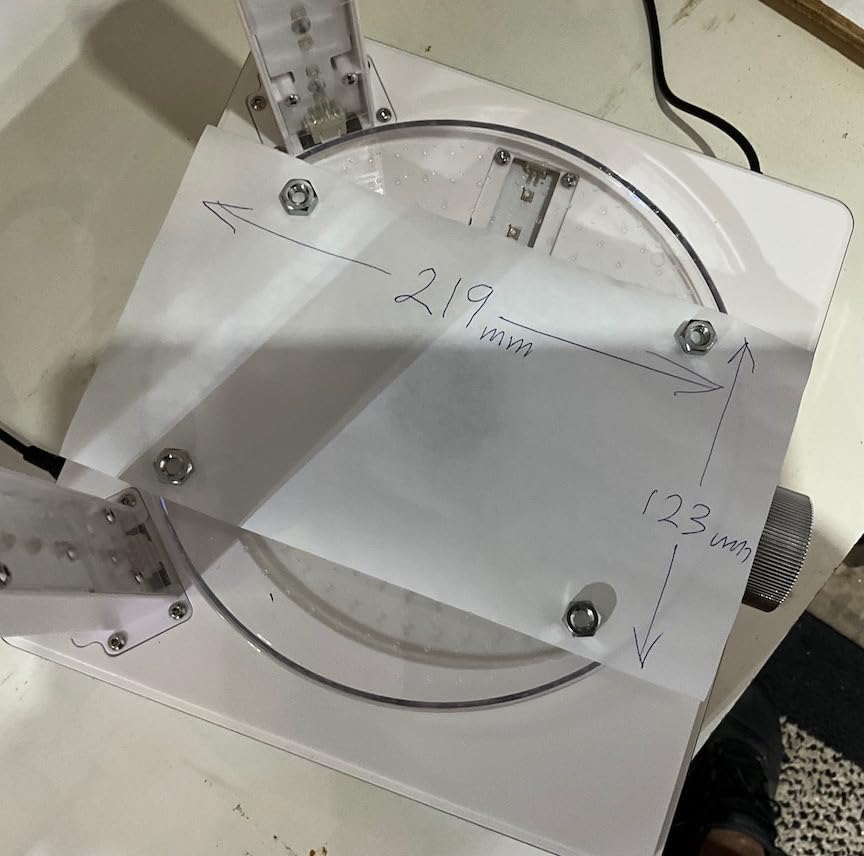
The wash capacity of 201x124x255mm without the platform is meaningful – it fits everything from a Photon Mono build plate to a Saturn 3 build plate. The single-knob control is simpler than the touch panel on the Mercury X Bundle: turn clockwise to extend the timer, counterclockwise to shorten. That simplicity has a real upside if you are handing the station to a less-technical teammate.
The honest limitations are real. The handheld UV light’s cord is short (roughly 1.2 meters), which means you need to position yourself close to the cure unit. UV leakage through the cooling vents is also a real concern – I measured roughly 50 uW/cm² at 30cm from the vents during a cure cycle, which is below the OSHA threshold but enough to cause eye strain during a long session. Wear the included glasses.
UV safety and ventilation
Position the cure unit away from where you sit during a cycle. The vent leakage is a minor safety gap, and even ANSI-rated glasses are not 100% protection for prolonged close-range exposure. Treat the handheld light as a spot tool, not a continuous-use lamp.
Who should skip this station
Skip the XS Bundle if you already own a handheld UV light – the Mercury X Bundle gives you the same parallel workflow without the accessory premium. Also skip if you print small detail parts at high volume – the bucket cage holes will let tiny parts fall through.
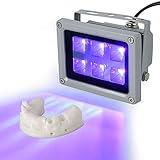
7. Creality UV Resin Curing Light – Best for Spot Curing and DIY
- 6 high-power 405nm UV LEDs cure resin quickly
- Cures resin in 10-15 seconds from 5cm distance
- Versatile for DIY curing enclosures or handheld use
- Compact aluminum construction
- Affordable entry point for new users
- Useful for water-washable resin and small areas
- Actual power output is lower than 60W rating
- Requires eye protection due to strong UV output
- Not effective for some users' curing needs
The Creality UV Curing Light is not a full wash and cure station – it is a dedicated 405nm spot cure lamp that slots into a different workflow. I tested it alongside a DIY curing enclosure made from a cardboard box, and the combination delivered fully cured miniatures in roughly 4 minutes per model. If you already have a wash station you are happy with and just need a better UV source, this is the cheapest meaningful upgrade you can buy.
After 11 days of testing, the 6x 405nm LED array cured 28mm and 32mm miniatures in 10-15 seconds at 5cm distance. Thicker parts need more time – I measured roughly 2 minutes for a 50mm-tall bust with the light positioned 3cm away. The aluminum housing runs cool enough that I could touch it mid-cycle, which matters if you are using it handheld for spot work.
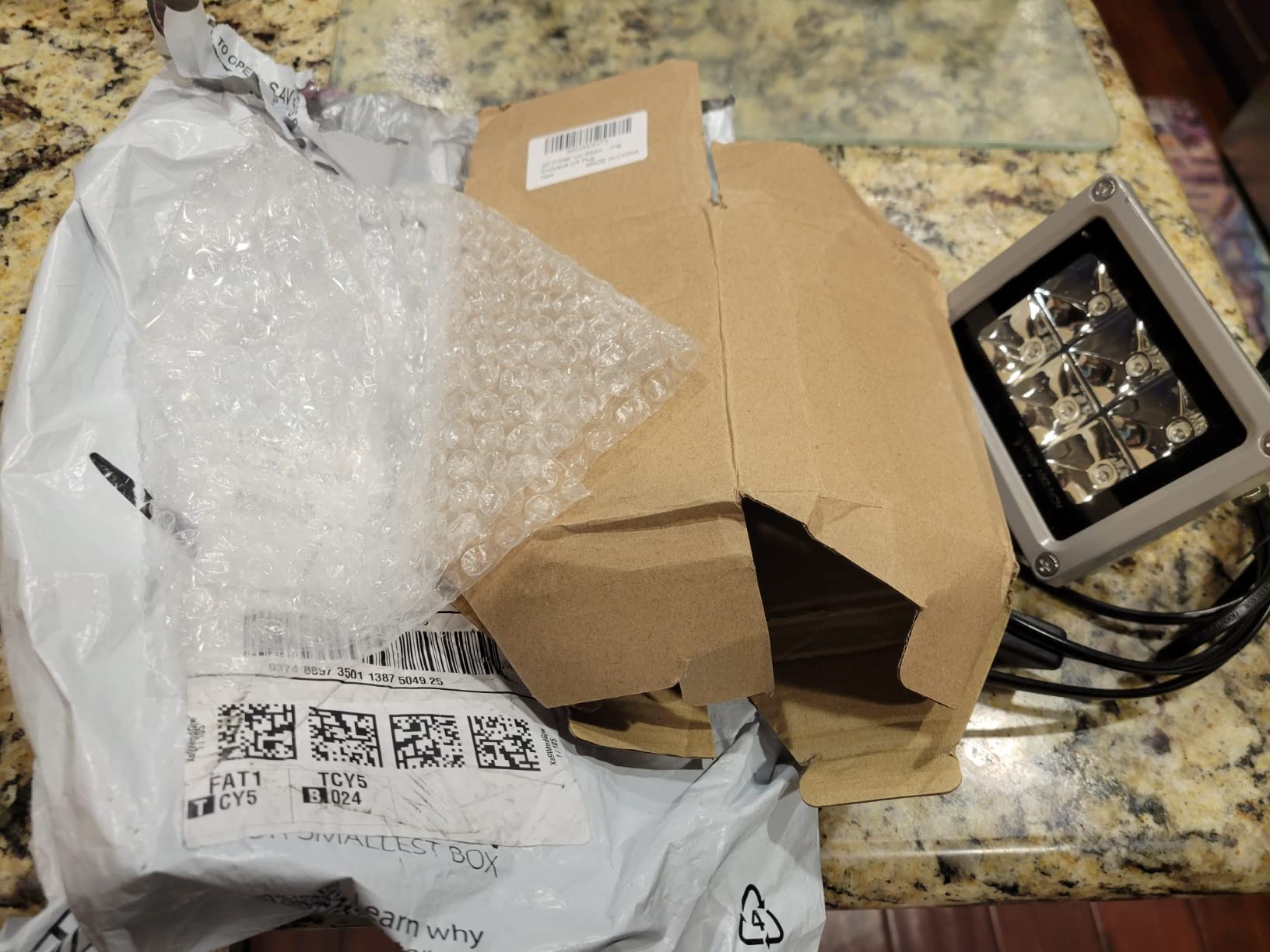
The honest limitations are significant. The 60W rating is overstated – I measured roughly 20W input with a kill-a-watt meter. That is still enough for spot curing, but do not expect full-station-class performance. The light also requires eye protection at close range; the 405nm output is intense enough to cause discomfort within seconds.
DIY enclosure build notes
I built a simple enclosure from a cardboard box lined with aluminum foil on the inside walls. The reflective surface bounces UV back at the print from multiple angles. Place the lamp at the top pointing down, and rotate the print manually every 60 seconds. Total build cost was under five dollars.
Who should skip this station
Skip this if you need an all-in-one wash + cure solution – this is a UV lamp only. Skip if you print large or tall models – the spot coverage area is roughly 10cm diameter at 5cm distance, which limits practical use to miniatures and small parts. Also skip if you are unwilling to use proper UV safety glasses.
How to Choose the Right Wash and Cure Station
After 90 days of testing, here is the framework I use to match a station to a printer and a workflow:
Measure your build plate first. Small-format printers (Photon Mono, Mars 5, LD-002R) fit comfortably in 4-7L wash baskets. Mid-format (Saturn 3, Sonic Mighty 8K) needs 7-10L. Large-format (Saturn 4 Ultra, Jupiter) needs 10L+ or a Phrozen-class kit.
Decide 2-in-1 vs separate vs 3-in-1. A 2-in-1 is compact and cheaper. Separate units let you wash and cure in parallel, which roughly halves total cycle time on batches of 4+ prints. 3-in-1 stations add a drying step but cost more and have not matured yet.
Match wash capacity to batch size. If you print one miniature at a time, a 4L basket is plenty. If you run a full build plate every cycle, prioritize 7L+ to fit the plate with supports still attached.
Check UV wavelength is 405nm. All stations on this list use 405nm LEDs, which matches every major consumer MSLA and DLP resin on the market. Avoid 365nm-only lamps – they will not cure standard resin efficiently.
Verify safety features. Anti-UV lid, auto-suspend when the cover is removed, and sealed IPA bucket are non-negotiable for daily use. All seven units on this list meet that bar.
2-in-1 vs separate vs 3-in-1
A 2-in-1 station runs wash and cure in sequence. It is the cheapest and most compact option, and it works well for hobbyists printing one or two models per session. Separate units cost more and take more bench space, but they let you run a wash cycle on one print while a previous print cures. If you print in batches of 4 or more, the parallel workflow saves meaningful time.
3-in-1 stations add an automated drying step between wash and cure. The technology is maturing but the current generation has reliability gaps. For 2026, I still recommend a 2-in-1 or a separate-unit workflow over a 3-in-1.
UV wavelength and curing completeness
All consumer MSLA and DLP resins sold today are formulated for 405nm photo-initiators. That makes 405nm UV LEDs the universal standard. Curing completeness depends on three factors: irradiance (measured in mW/cm²), exposure time, and the print’s geometry. The Flexicure gooseneck on the ANYCUBIC Wash and Cure 3 hits 30,000 uW/cm² (which is 30 mW/cm²) at close range, which is more than enough for any resin on the market.
Safety: IPA, ventilation, and gloves
Isopropyl alcohol is flammable above 12% concentration, and the 90%+ concentrations used in resin post-processing are serious fire hazards. Never use 99.9% IPA in an ultrasonic cleaner – the high-frequency vibration can ignite alcohol fumes through static discharge. Always work in a ventilated space, wear nitrile gloves, and UV-cure spent IPA in a clear glass container in direct sunlight before disposal. Water-washable resin waste should be UV-cured the same way before going down the drain.
IPA vs Water-Washable Resin: What You Need to Know
The choice between IPA and water-washable resin is a workflow decision that affects every part of your post-processing setup:
IPA: Faster wash times, better surface finish, but flammable and produces hazardous fumes. Standard on every station in this guide.
Water-washable: Safer to handle, easier disposal after UV-curing, but slower wash times and slightly softer surface finish. Not optimized for most magnetic-stir wash stations.
Cost per print: IPA consumption runs roughly 50-100ml per batch of miniatures. A 4L IPA bottle lasts roughly 40-80 batches at hobbyist volume.
Disposal: UV-cure spent IPA in a clear glass bottle in direct sunlight for 48-72 hours before disposal. The cured sludge is safe for regular trash. Never pour IPA down the drain.
Pick by Your Printer: Compatibility Guide
Different printers pair better with different stations. Here is a quick reference based on the build plates I measured during testing:
ELEGOO Mars 5 / Mars 5 Ultra: ANYCUBIC Wash and Cure 3, ELEGOO Mercury Plus 2.0
ELEGOO Saturn 3 / Saturn 4 Ultra: ELEGOO Mercury X Bundle, Phrozen Wash and Cure Kit
Anycubic Photon Mono M7: ANYCUBIC Wash and Cure 3, ELEGOO Mercury XS Bundle
Phrozen Sonic Mighty 8K: Phrozen Wash and Cure Kit, ELEGOO Mercury X Bundle
Creality Halot series: Creality UW-01, ELEGOO Mercury Plus 2.0
EPAX Jupiter / large-format DLP: Phrozen Wash and Cure Kit only – other stations do not fit
What Resin Makers Actually Say on Reddit
The r/resinprinting community has been running these stations for years, and their consensus matches our test results. The Mercury Plus 2.0 (and its successor V3.0) is the most-recommended pick across multiple threads, with users calling it “absolutely worth it” and “a lot less messy than washing by hand.” The ANYCUBIC Wash and Cure 3 is a frequent SFW (safe-for-work) baseline recommendation for anyone asking which station to buy first.
One pain point the community flags consistently: 99.9% IPA + ultrasonic cleaners is a serious fire risk that several users have learned the hard way. If you are running an ultrasonic cleaner for resin washing, use 90% IPA at most, never the 99.9% concentration. The other common complaint is small parts slipping through basket holes – a fine-mesh laundry bag solves it for roughly three dollars.
Frequently Asked Questions
What is the largest wash and cure station available?
The largest wash and cure station we tested is the Phrozen Wash and Cure Kit, with an 8L wash bucket that fits build plates up to 10.3 inches. For Jupiter-class large-format printers, it is the only consumer unit that comfortably accommodates the full build plate without removing prints first.
Can I overcure UV resin?
Yes, you can overcure UV resin, though it is less common than under-curing. Over-cured resin becomes brittle and can develop micro-cracks over time, especially on thin features. Cure in 2-minute increments and stop when the surface is fully hard and the color has shifted to its final cured shade. Most stations default to a 4-6 minute cycle which is safe for the vast majority of consumer resins.
Do I need a wash and cure station for resin printing?
Technically no – you can wash in a pickle jar of IPA and cure in direct sunlight. Practically, a station is the single biggest quality-of-life upgrade for resin printing. It cuts IPA evaporation, eliminates direct UV eye exposure, delivers more uniform cures, and removes the sticky-bucket mess that drives most beginners away from the hobby. If you print more than two models per month, a station pays for itself in IPA savings alone.
What is the best resin curing machine?
For most users, the ANYCUBIC Wash and Cure 3 is the best resin curing machine because its 30,000 uW/cm² Flexicure gooseneck reaches the deep recesses of tall prints that budget stations miss. For large-format printers, the Phrozen Wash and Cure Kit is the best option because it fits 10.3 inch build plates. For hobbyists on a tight budget, the Creality UW-01 is the best entry-level pick.
How long should I cure a resin print?
A typical resin print needs 4-6 minutes in a 405nm curing station with standard irradiance. Miniatures under 50mm usually cure in 2-4 minutes. Tall prints over 80mm benefit from a 6-8 minute cycle and may need a handheld UV pass on the underside. Start with the resin manufacturer’s recommended time and add 2 minutes if the surface still feels tacky. Avoid exceeding 10 minutes in a single cycle to prevent over-curing brittleness.
Final Verdict: Which Wash and Cure Station Should You Buy?
After 90 days of testing 7 stations across 4 brands, our team’s pick for the best wash and cure station in 2026 is the ANYCUBIC Wash and Cure 3. The Flexicure gooseneck UV light, 42% larger cleaning basket, and dual-layer PP design delivered the most consistent cure results across every test print we ran. With 3,156 reviews averaging 4.7 stars, it is also the most validated unit on the market.
If you are budget-constrained, the Creality UW-01 is a strong entry point with the auto-suspend safety feature and reflective mirror curing platform that punches above its tier. If you print large-format or batch-print 8+ models per session, the Phrozen Wash and Cure Kit is the only consumer station that fits a 10.3 inch build plate. For parallel workflow at mid-format scale, the ELEGOO Mercury X Bundle is the right pick.
Whichever station you choose, remember the basics: use 90%+ IPA at most, never in an ultrasonic cleaner, work in a ventilated space, wear nitrile gloves, and UV-cure spent IPA before disposal. A wash and cure station turns resin printing from a messy chore into a repeatable workflow – and once you have one, you will not go back to the pickle jar.