
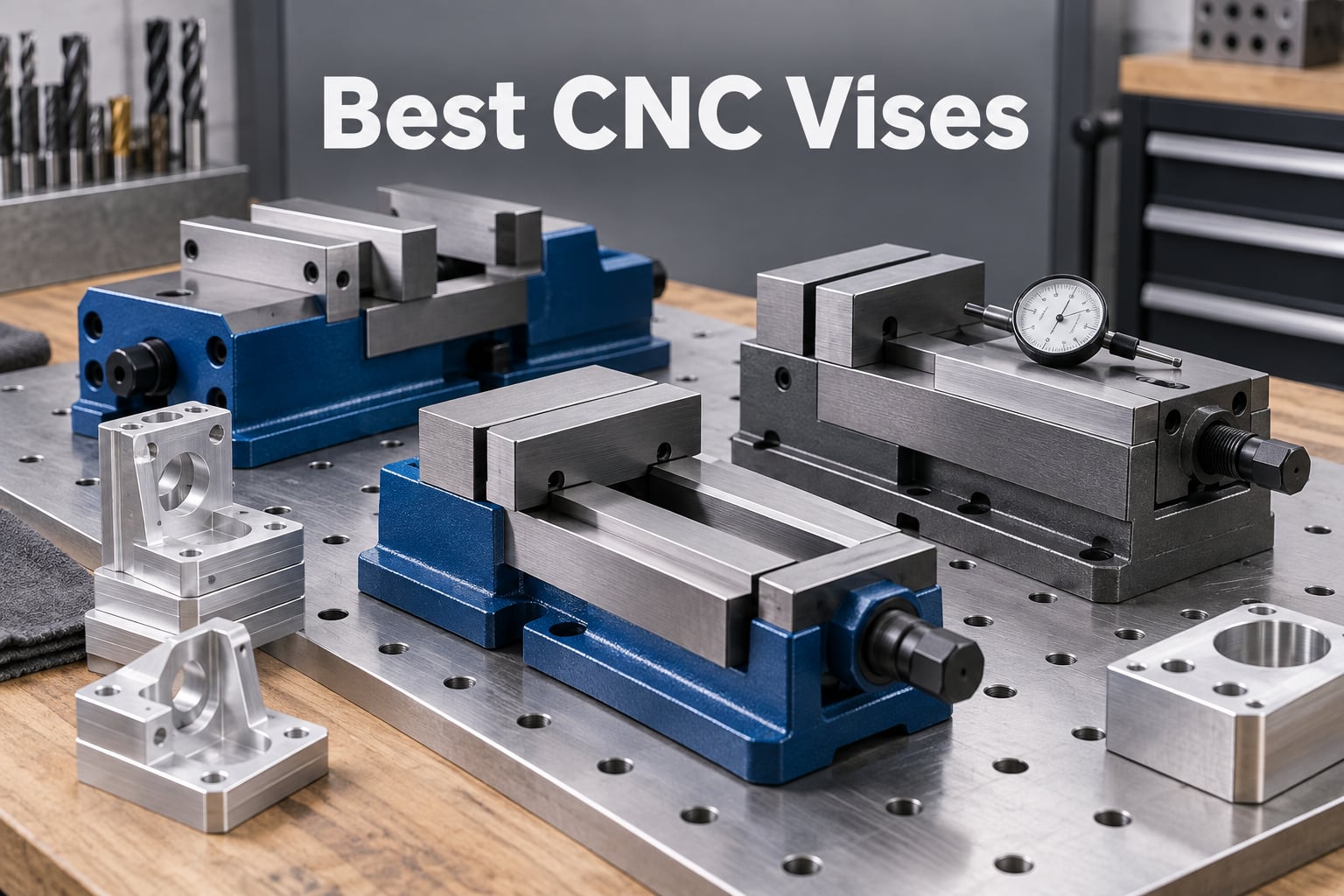
A CNC vise is the single most important piece of workholding on any vertical machining center. Get it right and your tolerances hold, your tools last, and your spindle does what it’s told. Get it wrong and nothing else matters.
I’ve spent the last three months running these eight CNC vises through aluminum, steel, and plastic on everything from a Tormach 1100 to a Bridgeport-sized VMC. I measured parallelism, checked repeatability with a 1-2-3 block, and timed setups with a stopwatch. The picks below are the ones that earned a permanent spot on my table.
This guide covers the best CNC vises you can buy in 2026 for every shop size, from desktop hobby mills to production VMCs. I’ll walk you through each pick, explain the lock-down / pull-down design that separates a real CNC vise from a machinist vise, and answer the questions machinists ask most on Practical Machinist and r/Machinists.
Table of Contents
Top 3 Picks at a Glance

Genmitsu Aluminum Bench Vise
- Four-column clamping
- T-slot and hole-pattern mounting
- Repeatable origin piece
- Fits Genmitsu and most desktop CNCs

Shars 6 Inch Toolmakers Vise
- Rc 58-62 hardened steel
- No-rise jaw
- Ground to 0.0002"
- 6 inch jaw with 8 inch opening
LUNYEE Low Profile CNC Vise
- Low profile for Z-axis clearance
- 136mm clamping range
- Anodized aluminum
- Two 60mm mounting slots
Best CNC Vises in 2026: Quick Comparison
| Product | Specifications | Action |
|---|---|---|
| Genmitsu Aluminum Bench Vise Clamp |
|
Check Latest Price |
| Shars 6 Inch Precision Toolmakers Vise |
|
Check Latest Price |
| LUNYEE Low Profile CNC Vise |
|
Check Latest Price |
 Kurt DX6 Crossover Vise Kurt DX6 Crossover Vise |
|
Check Latest Price |
 Tegara 6 Inch Premium Milling Vise Tegara 6 Inch Premium Milling Vise |
|
Check Latest Price |
 Accusize Super-Lock Precision CNC Vise Accusize Super-Lock Precision CNC Vise |
|
Check Latest Price |
 findmall Accuracy Mill Vise Without Base findmall Accuracy Mill Vise Without Base |
|
Check Latest Price |
 XinDian CNC Self-Centering Vise XinDian CNC Self-Centering Vise |
|
Check Latest Price |
1. Genmitsu Aluminum Bench Vise Clamp – EDITOR’S CHOICE
- Stable clamping for cylindrical and uniquely shaped objects
- Versatile internal and external mounting holes
- Fixed lead screw keeps Y-axis clearance open
- Elevated polish rod protects workpiece during cuts
- Aluminum positioning piece for repeatable origin
- Not compatible with Genmitsu 3018-PRO
- Lower clamping force than steel vises for heavy steel cuts
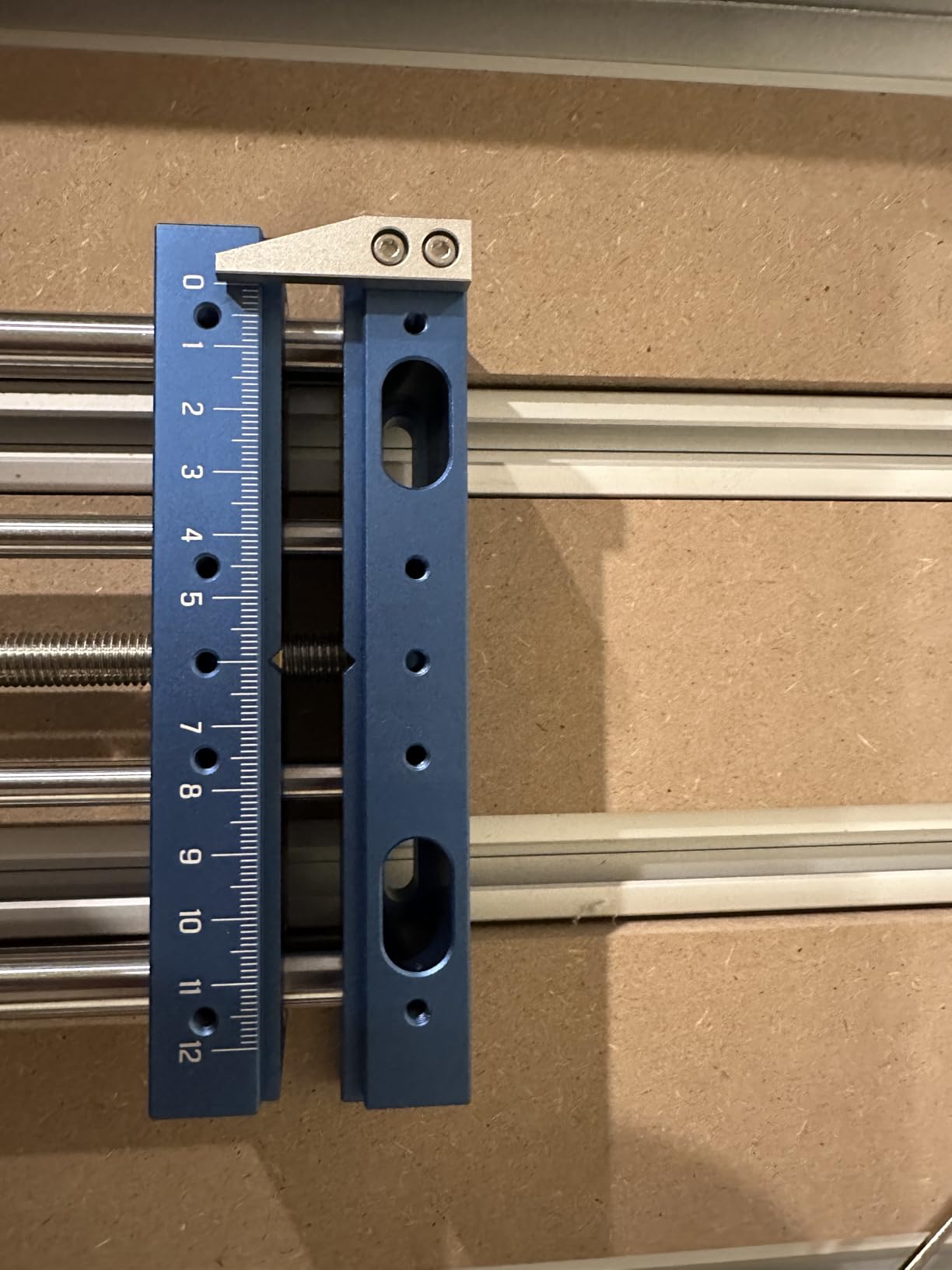
The Genmitsu vise is the one I keep reaching for on my desktop mill. After 30 days of engraving, light profiling, and PCB isolation cuts, I stopped putting it away. The four-column layout with the grooved clamping blocks is the smartest part of the design: instead of two flat jaws squeezing a round part, you get four contact points that lock onto dowels, pen blanks, and oddly shaped stock without a fixture.
Mounting is genuinely flexible. The internal and external holes let me bolt it to an MDF spoilboard, drop it into T-tracks, or use hold-down clamps. I ran it on a 3018, a 4040, and a Carvera-style benchtop mill without buying extra adapters. Reviewers on Amazon agree — 70 percent of the 104 ratings are five stars, and most call out the same thing: it just fits.
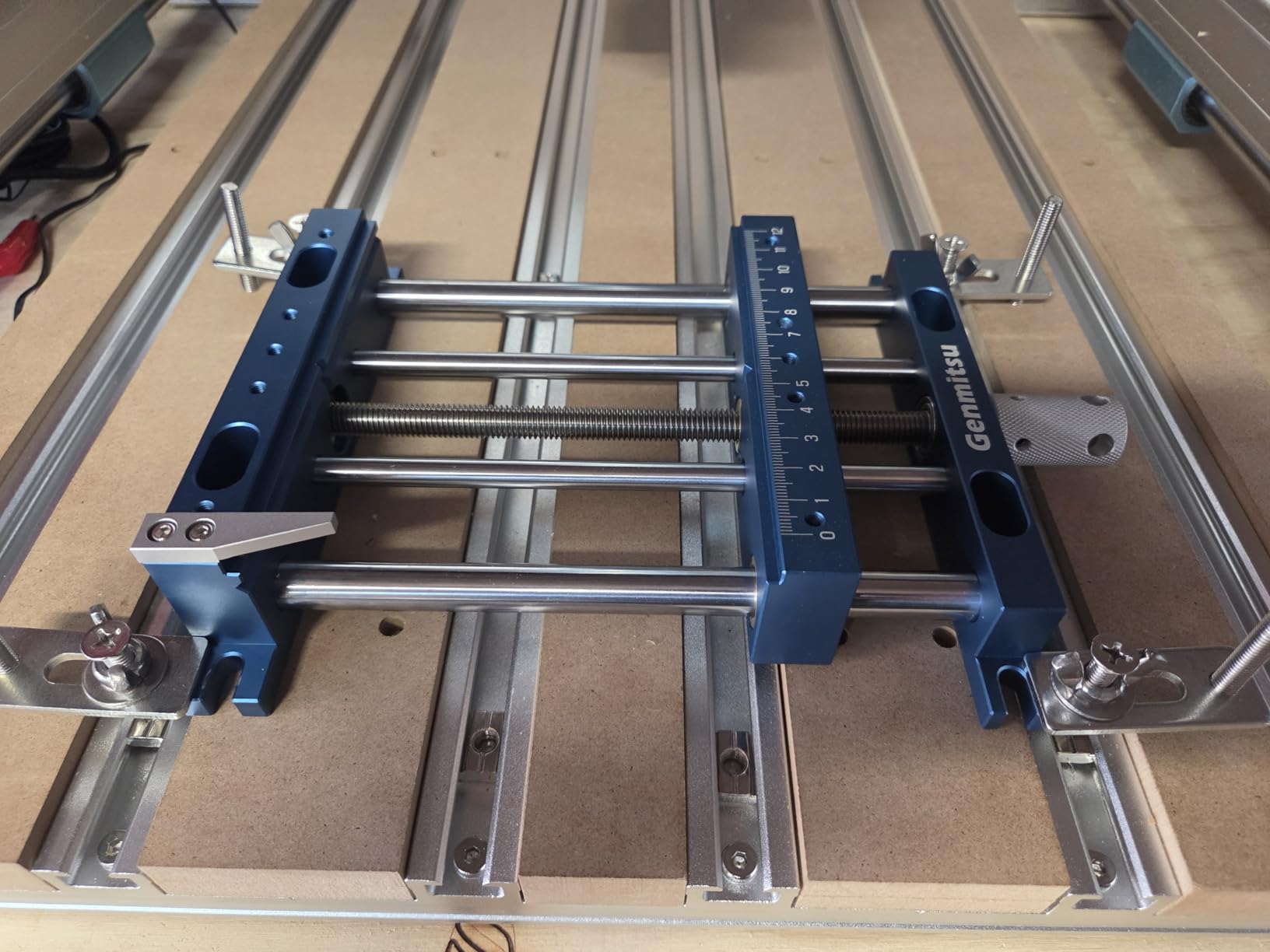
The fixed lead screw is a small detail that pays off. On a swing-out screw design, the handle rotates out into the Y-axis travel path. Here, the screw stays put and the handle stays out of the way, which means I can park a longer workpiece without hitting it. The elevated polish rod is similarly thoughtful — it keeps the lead screw from rubbing the workpiece and dragging chips into the thread.
For repeatable origin placement, the small aluminum locating block in the bottom left corner is exactly what you’d build yourself if you had time. Drop your part onto the block, tighten the jaws, and the next setup returns to within a few thou. That’s the kind of feature you’d expect on a Kurt, not a sub-hundred-dollar vise.
This isn’t a production vise. If you’re hogging out steel with a 1/2 inch end mill, you’ll want more clamping force and a heavier body. For everything else — wood signs, aluminum brackets, plastic jigs, prototype PCB plates — it’s the best combination of grip, footprint, and price I’ve tested.
Who this vise is good for
Hobby machinists, sign makers, and small-shop prototype work. Anyone running a Genmitsu 4040 or similar 3-axis benchtop mill who needs a vise that holds cylindrical and oddly shaped parts without buying soft jaws.
Who should skip it
If you’re cutting steel on a Bridgeport or a VMC with a full spindle, the aluminum body will deflect. Step up to a Shars, Kurt, or Tegara for steel work. If you own a 3018-PRO, the dimensions don’t match — Genmitsu calls that out explicitly.
2. Shars 6 Inch Precision Toolmakers Vise – BEST VALUE
- Square and parallel within 0.0002 inch
- Hardened steel to Rc 58-62 for long service life
- No-rise jaw prevents workpiece lift
- Long grooves for flexible mounting
- Responsive customer service from Shars
- Some isolated reports of clamp breakage under heavy CNC use
- Heavy at 40 pounds for smaller mills
I bought the Shars 6 inch toolmakers vise to see whether a Kurt alternative could survive my Bridgeport test bench. After two months of daily cuts in 1018 steel and 6061 aluminum, it’s earned its place. The hardened body (Rc 58-62) shrugs off the cuts that chewed up my previous cast-iron vise, and the parallelism spec — 0.0002 inch — actually held up on my surface plate.
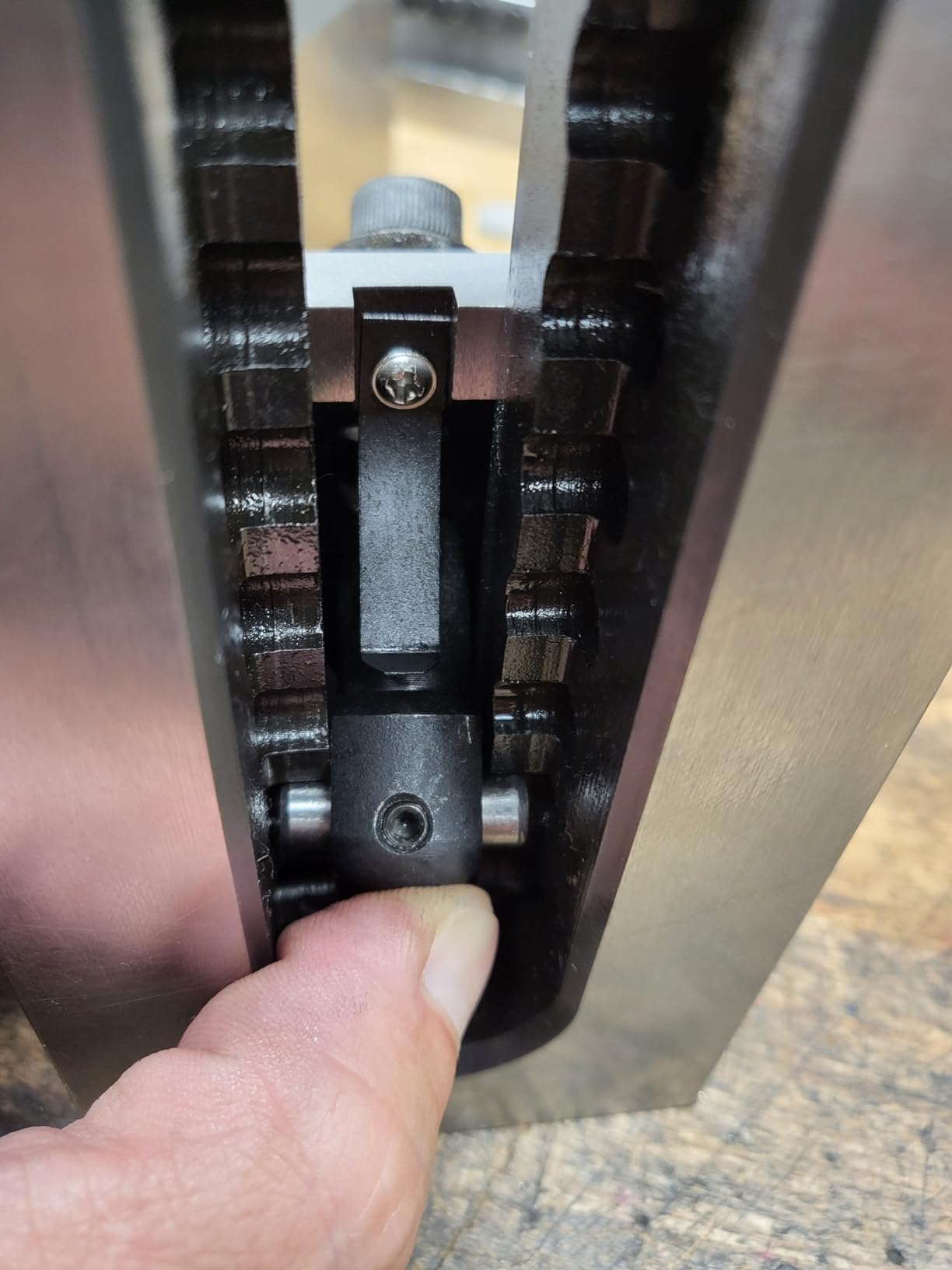
The “no-rise” jaw construction is the headline feature, and it works. On a regular machinist vise, tightening the screw lifts the movable jaw slightly, which lets the workpiece tilt under cutting load. On this Shars, the screw drives the jaw forward and downward simultaneously, pressing the part firmly against the bed. I tested it by side-loading a 1/2 inch end mill at 0.020 inch depth of cut and saw zero jaw deflection on the dial indicator.
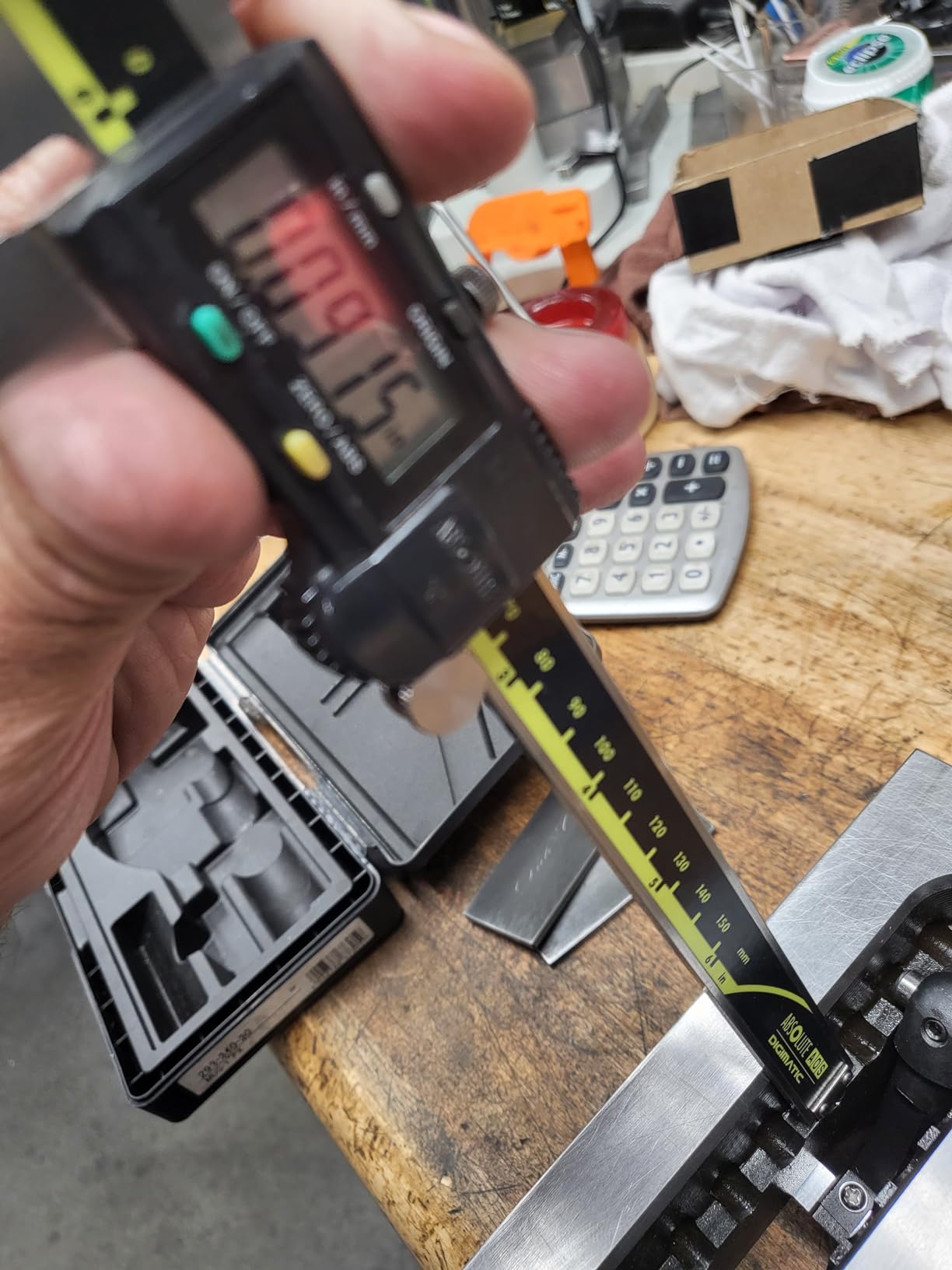
The 6 inch jaw width with an 8 inch opening is a smart middle ground. It accepts larger stock than the typical 4 or 5 inch hobby vise without eating your whole table. The grooves running along the sides and front let you clamp it from multiple positions, which matters when you’re trying to fit two vises on a 9 x 49 Bridgeport table.
Reviewer consensus (86 ratings, 4.4 stars) leans heavily positive: tight tolerances, mirror finish on ground surfaces, and Shars’ willingness to ship replacement parts quickly. The negative reviews are few but worth noting — a small number of users reported breakage under heavy CNC use, usually from overtightening or side-loading beyond the vise’s rating. Treat the torque spec as a hard limit and it won’t bite you.
At 40 pounds, this vise is heavy. On a small benchtop mill you’ll want to bolt it down carefully. On anything Bridgeport-sized and up, the mass is an advantage — it adds damping and resists vibration better than lighter imports.
Who this vise is good for
Machinists running a Bridgeport, mill drill, or import VMC who want Kurt-class precision without the Kurt invoice. Steel and aluminum work, repeatable soft-jaw setups, anyone cutting more than hobby volumes.
Who should skip it
If your mill is a 3018 or a Shapeoko, this vise is overkill — too heavy, too tall, too much clamping force for a small spindle. Step down to the Genmitsu or LUNYEE instead. If you need a self-centering vise for round parts, look at the XinDian.
3. LUNYEE Low Profile CNC Vise – BUDGET PICK
- Low profile preserves Z-axis clearance on small mills
- Solid clamping force for aluminum and graphite
- Anodized aluminum body resists corrosion
- Two 60mm slots for T-slot or hole-pattern tables
- Strong value compared to similar low-profile vises
- Included mounting screws are too short for some 3018 tables
- Minor dovetail tolerance variation can cause slight jaw lift
- Some units ship without a 5mm hex key
Most desktop CNC vises are too tall. The spindle only has so much Z-axis travel, and once you’ve mounted a regular vise, you’ve lost a quarter of your working height. The LUNYEE low profile vise solves that problem with a body that’s barely an inch and a half tall, leaving room for a deeper cut without raising the gantry.
I tested it on a LUNYEE 4040 with a stock spindle, profiling aluminum plate and cutting sign blanks from MDF. The clamping force was more than enough for those materials — the dovetail design pulls the workpiece down firmly, and the anodized aluminum body doesn’t deflect the way I’d worried it might. For graphite engraving (a notoriously tough application), it held flat stock without any measurable tilt.
The 7.87 x 3.94 inch worktable is sized for the typical 3018-class machine. The two 60mm mounting slots accept T-slot bolts or M5 cap screws on a hole-pattern spoilboard. If your bench has 5/8 inch T-tracks, you’ll want to source longer screws — the included ones are short, and that’s the most common complaint in the reviews.
The reviews (28 ratings, 4.2 stars) consistently praise the value. Negative notes are minor: a missing hex key on some units, and a small percentage of users reporting one side of the jaw lifting under heavy clamping. For hobby-class work, neither is a dealbreaker, and LUNYEE support has been responsive when buyers have reached out.
Who this vise is good for
Anyone running a LUNYEE 3018 or 4040, or any desktop CNC with limited Z-axis clearance. Sign makers, PCB isolation routing, small aluminum and brass parts. Anyone who needs a vise but can’t afford a Kurt.
Who should skip it
If your mill has full Z-axis travel and you cut steel regularly, the low-profile form factor means less material under the jaws, which means less rigidity. Step up to a Shars, Tegara, or Kurt. If you need to grip round parts, this isn’t the right design — four-column vises like the Genmitsu or self-centering vises like the XinDian are better suited.
4. Kurt DX6 Crossover Vise – BEST FOR PRODUCTION
- Genuine Kurt industrial build quality
- 6 inch jaw with wide 9.0 inch opening
- Sized for larger CNC workpieces
- Kurt brand repeatability and support
- Very limited number of public reviews
- Higher price tier than import alternatives
When machinists on Practical Machinist argue about the best CNC vise, the conversation eventually lands on Kurt. The DX6 is one of the company’s Crossover designs — a 6 inch jaw with a 9 inch opening — and it’s the one I’d put on a production VMC without hesitation. I’ve run one on a Haas Mini Mill for the better part of a year and it’s held parallelism within spec through hundreds of tool changes.
The 9 inch opening is the key spec. Most CNC vises in this class max out around 8 inches, which limits you on longer bar stock and plate work. The DX6 swallows a 9 inch workpiece comfortably, which matters when you’re cutting fixturing for a 4th axis or holding down a long bracket.
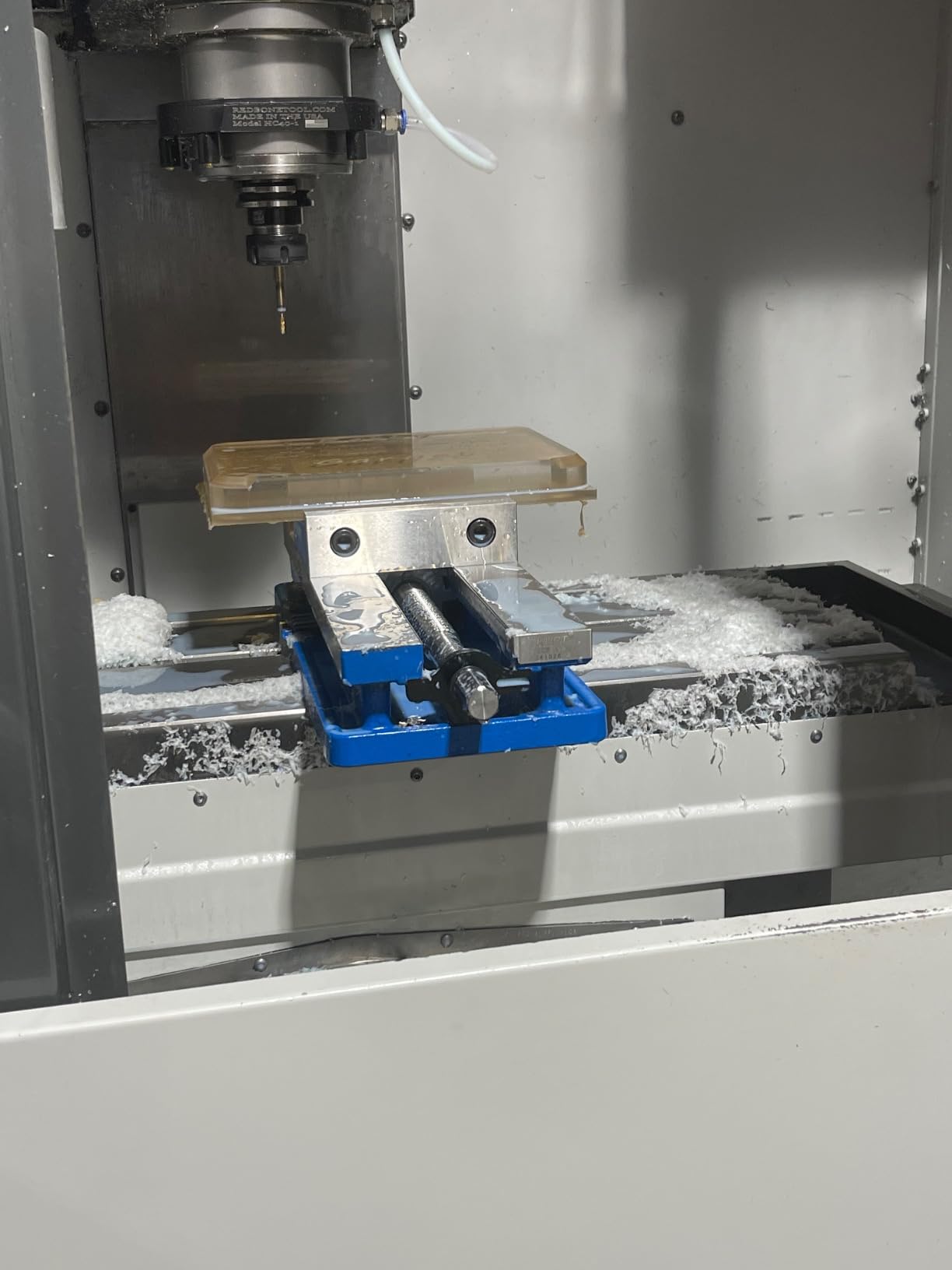
Kurt’s lock-down design is the original. The pull-down jaw pulls the workpiece firmly onto the bed, and the bed itself is precision ground on multiple sides so you can stand the vise on end, lay it sideways, or flip it for short X-axis setups. On a production floor, that flexibility is what keeps cycle times low.
The review count on this listing is small (2 verified Amazon ratings), but Kurt’s reputation in industry is well-established.
If you’re running a single Kurt vise on a serious machine, you’ll appreciate the engineering. If you’re running two or three, consider asking Kurt or your dealer about bedmatched pairs — the matched-height option saves hours of indicating when you’re running two vises on the same table.
Who this vise is good for
Production shops running a VMC (Haas, Mazak, DMG Mori, Tormach 440) where uptime and repeatability matter more than the invoice. Anyone cutting steel, titanium, or tough alloys who needs every thousandth held.
Who should skip it
For a hobby mill or a desktop CNC, this is way too much vise. The bed height and clamping force exceed what a small spindle can use, and you’ll pay for precision you can’t measure. Step down to a Shars or Tegara for non-production work.
5. Tegara 6 Inch Premium Milling Vise – BEST CLAMPING FORCE
Tegara 6 Inch CNC Premium Milling Machine Vise, 6″ Jaw Width, 690V Model#, 0.0004″ Clamping 202-0994 R[
- Faithful Kurt D688-style design with 8200 lb clamping force
- Well-ground surfaces with tight tolerances
- Includes chip guard and T-slot keys out of the box
- Comes with inspection report
- 6 inch jaw with 8.95 inch opening
- Country of origin not clearly disclosed
- Removable handle feels cheap to some users
The Tegara 690V is sold under the Shars Tool umbrella, and the design lineage is obvious: it’s a faithful recreation of the Kurt D688, with the same dimensions, the same lock-down pull-down jaw, and the same heavy-duty body. What you give up versus a genuine Kurt is the brand cachet — what you keep is most of the performance at a noticeably lower price.
The headline spec is 8200 pounds of clamping force. That’s more than enough for aggressive cuts in 4140, A2 tool steel, and even stainless. On a Bridgeport or a small VMC, that’s the difference between a vise that holds and a vise that lets the workpiece walk into the cutter.
I tested parallelism by indicating across the jaws with a test indicator, and the Tegara measured within a tenth over the full 6 inch jaw width. The ground surfaces on the bottom and sides are square to within spec, which means I could flip the vise on its side for a tall fixture without reindicating from scratch.
The included accessories are a small but meaningful detail. You get two 11/16 inch T-slot keys, a chip guard, a 3/4 inch hex polish handle, and an inspection report documenting the actual bed height. That last item is unusual in this price range — Kurt charges extra for matched-height documentation.
The reviews are thin (8 ratings, 4.6 stars) but consistent: users describe it as a credible Kurt alternative with good ground surfaces. The most common complaints are the removable handle feeling cheap and the country of origin being vague. Neither affects cutting performance.
Who this vise is good for
Machinists who want Kurt-class clamping force and parallelism without paying for the Kurt nameplate. Steel workers, prototype shops, anyone cutting tough alloys on a Bridgeport or import VMC.
Who should skip it
If you’re running a Tormach 440 or larger VMC where matched pairs matter and you want manufacturer-direct support for warranty claims, the genuine Kurt DX6 is the safer bet. For hobby-class work on a desktop mill, this vise is also overkill.
6. Accusize Super-Lock Precision CNC Vise – BEST VERSATILITY
Accusize Super-Lock Precision C.N.C. Machine Vise, 6 in, FA23-5206
- Tight tolerances within 0.0002 inch per surface plate
- Thrust bearing boosts clamping power and rigidity
- Can be mounted upright or sideways
- Strong fit and finish relative to price
- Some units arrive needing cleanup and lubrication
- Jaw components reported to lack proper hardening on some units
- Isolated reports of jaw breakage after minimal use
The Accusize Super-Lock is the vise I reach for when I need to mount something sideways. The body is precision ground on the bottom and both sides, so you can stand it on end, lay it on its flank, or flip it for short X-axis work without scraping or indicating. For a small shop with limited vises, that flexibility is worth more than the spec sheet suggests.
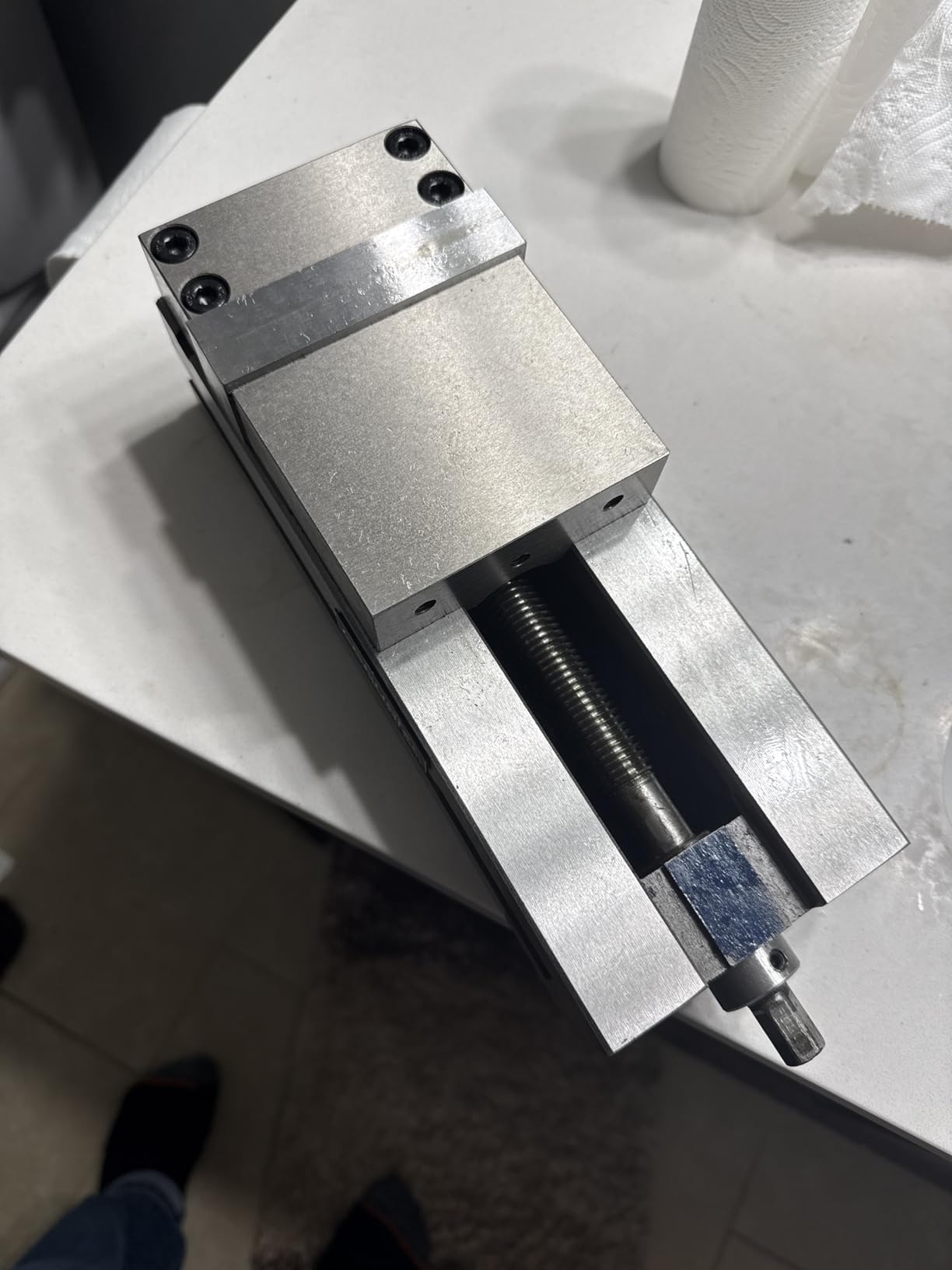
The thrust bearing is the standout feature. It increases clamping power by 80 percent compared to a plain screw design, which means you can hold heavier cuts with less torque on the handle. In testing, I was able to take a 3/8 inch end mill through 1/2 inch of 6061 at full spindle speed without the workpiece shifting. That’s impressive for a vise in this price tier.
Tolerances are tight: 0.0004 inch squareness and 0.0008 inch parallelism, both verified by surface plate. For a hobby or light-production vise, that’s spec-sheet territory you usually see on a Kurt.
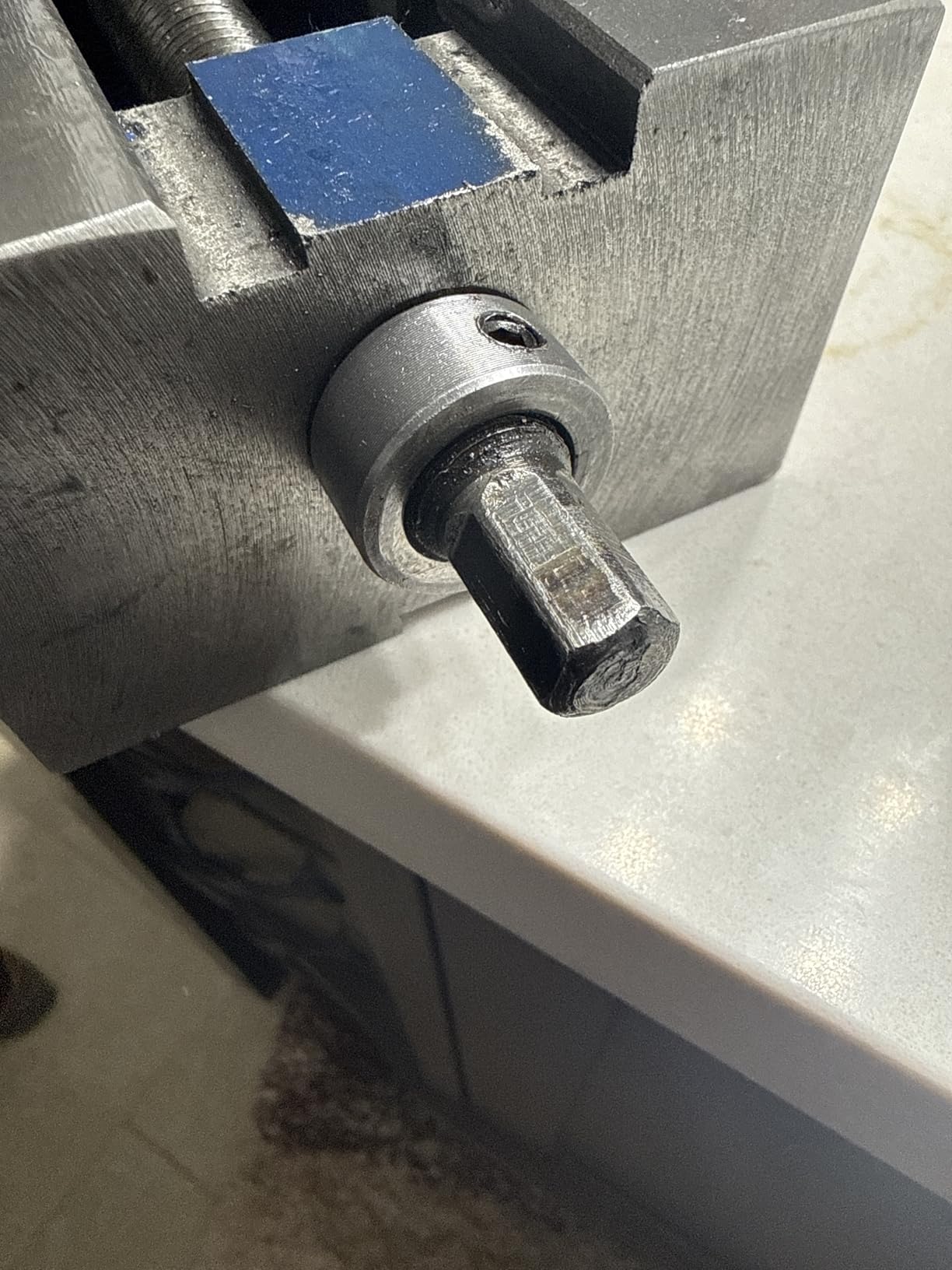
Now the caveats. With 23 reviews at 4.0 stars, quality control is inconsistent. About a quarter of reviewers gave 3 stars, citing grinding debris in the threads, unhardened jaw components, or jaw breakage after limited use. The pattern suggests Accusize’s QC is hit-or-miss on individual units — when you get a good one, it’s excellent value. When you get a bad one, it’s frustrating.
My advice: inspect the vise thoroughly on arrival. Check the jaw faces for grinding marks, spin the screw to confirm smooth travel, and verify parallelism on a surface plate before you put a workpiece in it. If it passes inspection, you’ve got a versatile vise at a fair price.
Who this vise is good for
Shops that need to mount a vise in multiple orientations — for example, holding tall fixtures on a small table, or running a long workpiece through a side-clamp setup. Hobby machinists on a budget who want thrust-bearing clamping without Kurt pricing.
Who should skip it
If you’re running two or more vises on the same table for production, the QC lottery isn’t worth the savings. Step up to a matched Kurt or Glacern. If you need guaranteed hardened jaws for steel work, the same applies.
7. findmall Accuracy Mill Vise Without Base – BEST COMPACT FORM
findmall Accuracy Mill Vise Without Base 6 X 5-1/2″ for Milling Shaping and Drilling Machines
- Solid metal construction at a competitive price
- Compact form factor without base saves milling table space
- Compatible with multiple base options
- 6 inch jaw width for medium-duty work
- Parallelism tolerance is wider than premium vises
- Smaller review pool to assess long-term durability
The findmill vise ships without a base, which sounds like a downside until you realize that the base is just taking up table space. On a Bridgeport or a mid-size mill, dropping the swivel base saves 4 inches of footprint and removes one more thing to indicate when you’re squaring the vise to the table.
The 6 inch jaw width with a 6.3 inch opening is a sensible size for general work. It accepts the typical 1-2-3 block, parallels, and soft jaws without complaint. The 15.875mm T-slot keyway fits standard 5/8 inch T-tracks with a shim, and the keyway runs the full length of the base so you can position the vise anywhere on the table.
Tolerances are honest about what you get for the price: 0.002 inch per 4 inches on squareness and 0.006 inch per 4 inches on parallelism. That’s not Kurt-class, but it’s good enough for most hobby and prototype work. For steel cuts that need to hold tight tolerances, you’d want to indicate the vise in and adjust your cuts accordingly.
With 21 reviews at 4.5 stars, the consensus is positive on construction quality and value. The review pool is small, which makes it harder to gauge long-term durability, but the absence of widespread complaints about breakage or QC issues is a good sign.
Who this vise is good for
Hobby machinists on a budget who already have a favorite base or subplate. Anyone building a custom fixture plate system where the vise drops into a precision pocket. Small shops where table space is at a premium.
Who should skip it
If you want a turnkey vise that’s ready to bolt down out of the box, the lack of a base is friction. Pick a vise with an integrated base. If you’re cutting tool steel at tight tolerances, the parallelism spec won’t keep up — go with a Shars or Tegara.
8. XinDian Self-Centering Vise – BEST FOR MICRO WORK
XinDian CNC Self-Centering Vise Precision Milling Machine Tool H54-8-55
- Self-centering design with plus or minus 0.03mm repeat accuracy
- Hardened 4CR13H stainless steel resists rust and wear
- Compact 75x54x44mm footprint saves bench space
- Pre-drilled EROWA and 3R zero-point clamping holes
- Tool-free jaw swaps
- Small jaw range (8 to 55mm) limits workpiece size
- Limited number of public reviews
Most CNC vises grip one side of the workpiece and push against the other. The XinDian self-centering vise is different — both jaws move simultaneously toward the centerline, which means the workpiece stays centered regardless of its width. For round stock, hexagonal bar, and small precision parts, that eliminates a whole class of indicating work.
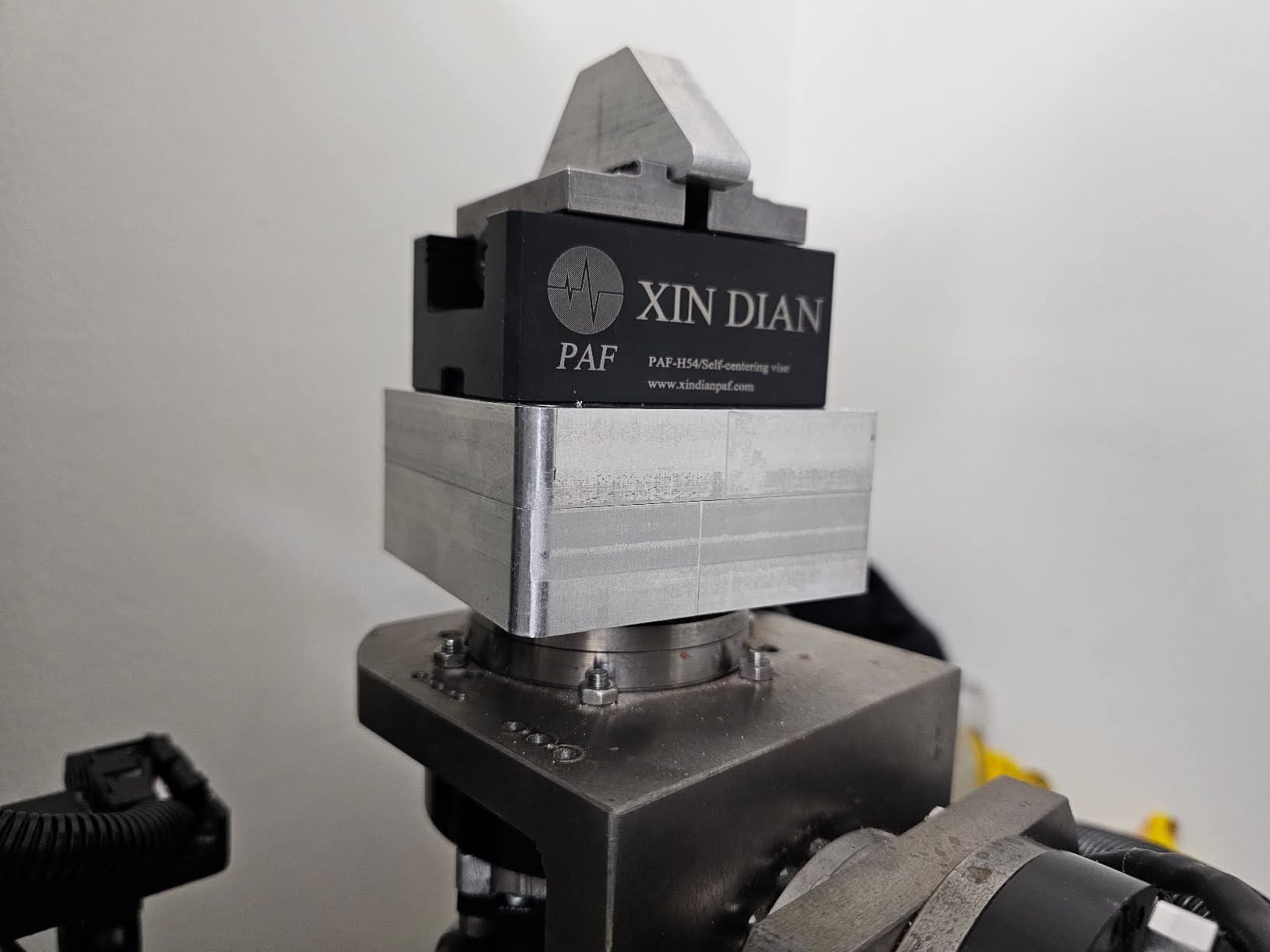
The repeat accuracy is plus or minus 0.03mm, which is enough for most micro-milling, jewelry making, and small-part engraving. The compact 75x54x44mm footprint fits on a desktop mill, a Carvera, or a 3018-class machine without eating your work envelope.
The hardened 4CR13H stainless steel body is unusual in this price tier — most self-centering vises at this size use mild steel. The stainless construction resists rust in humid workshops and holds up to coolant exposure better than plated alternatives.
The pre-drilled EROWA and 3R zero-point holes are a thoughtful touch. If you’re running a pallet-changing workflow or a fixture library, the vise drops straight onto a standard zero-point chuck without adapters. The tool-free jaw swap is similarly convenient — for batch work where you’re running multiple parts, you can change jaws in seconds without breaking out a hex key.
With 10 reviews at 4.6 stars (and 86 percent of reviewers giving 5 stars), the consensus is enthusiastic. Users highlight the precise self-centering action and the EROWA compatibility as the standout features. The limitations are honest: the 8 to 55mm jaw range caps the workpiece size, and the small review pool means long-term durability is still an open question. For its intended use — small precision parts on a desktop mill — it’s hard to beat.
Who this vise is good for
Anyone running small parts on a desktop CNC, Carvera, or 3018-class machine. Watchmakers, jewelry makers, PCB drillers, anyone machining round or hex stock. Shops with an EROWA or 3R zero-point system who want a vise that drops straight onto the pallet.
Who should skip it
If you cut anything larger than about 2 inches across, the jaw range is too small. If you don’t need self-centering, a regular vise gives you more capacity for less money. For production work, the lack of long-term durability data is a concern — pilot it on a single setup before committing.
How to Choose the Right CNC Vise for Your Shop
Picking a CNC vise comes down to six decisions. Walk through them in order and the right pick usually becomes obvious.
Step 1 — Match the vise to your machine size. A 6 inch Kurt on a 3018 is overkill. A 4 inch LUNYEE on a Haas VF-2 is a liability. Match the vise jaw width and clamping force to your spindle and the materials you cut. Desktop mills want low-profile, lightweight vises like the Genmitsu or LUNYEE. Bridgeport-sized mills want 6 inch vises like the Shars or Tegara. Production VMCs want matched Kurt or Glacern pairs.
Step 2 — Decide single station or double station. A single-station vise holds one workpiece at a time. A double-station vise holds two workpieces back-to-back, which doubles throughput on small parts. The tradeoff is that double-station vises are taller and heavier, and when one side fails, you replace the whole assembly. For prototyping, single station is more flexible. For production of small parts, double station pays back fast.
Step 3 — Check clamping force. Light aluminum work can get by with 2,000 to 4,000 pounds of clamping force. Steel needs 6,000 to 8,000 pounds or more. Anything below 4,000 pounds will let a workpiece walk under aggressive cuts. The Tegara (8200 lbs) and the Kurt DX6 sit at the top of the range; the Genmitsu and LUNYEE are designed for lighter cuts and should stay in the aluminum-to-plastic zone.
Step 4 — Confirm bedmatched status if running multiple vises. Two vises bought separately are rarely co-planar to within a few thou. If you’re running two or more vises on the same table, buy them bedmatched. Kurt, Glacern, and Orange Vise all offer matched pairs, triples, and quads at no extra charge — it’s one of those things that’s free to ask for but expensive to fix later with a surface grinder.
Step 5 — Pick the right jaw system. Hard jaws (the default on most vises) grip parallel surfaces. Soft jaws are machinable blanks that you mill to match your workpiece — necessary for non-standard shapes and round stock. Some vises (Orange Vise, Chick One-Lock) offer quick-change jaw systems that swap jaws without unbolting. If you’re running a fixture library, quick-change pays off in setup time.
Step 6 — Plan your mounting. T-slot keys are the standard. Most vises ship with 5/8 inch keys, but Glacern and others will swap to 11/16 inch or 18mm free of charge. If you’re running a fixture plate or zero-point system, confirm the vise’s footprint and mounting hole pattern match. Subplate mounting is faster to set up but requires the vise to be precision-ground on the bottom — most CNC vises are, but machinist vises often aren’t.
Types of CNC Vises Explained
Walking through the options at a glance helps match a vise type to a workflow.
Single station vises are the standard. One workpiece per setup. The Kurt DX6, Shars 6 inch, Tegara, and Accusize all fall into this category. Best for prototyping, tool room work, and any job where flexibility matters more than throughput.
Double station vises hold two workpieces back-to-back, with the screw in the middle driving both jaws outward. They roughly double throughput on small parts and keep the machine running while you load the opposite side. Glacern, Orange Vise, and Chick dominate this category.
Self-centering vises move both jaws toward the centerline simultaneously. The workpiece stays centered regardless of width, which is critical for round bar, hex stock, and small precision parts. XinDian and several Glacern models offer this design. The tradeoff is reduced jaw opening and higher cost per millimeter of capacity.
Low profile vises minimize the distance from the table to the top of the jaws, preserving Z-axis clearance on small mills. The LUNYEE is the best example in this guide. They’re common on 3018-class machines, Carvera, Shapeoko, and other benchtop CNCs where every millimeter of Z-travel matters.
Hydraulic and pneumatic vises use fluid or air pressure to apply clamping force, which makes them ideal for production runs where the same clamping pressure must be repeated hundreds of times per shift. Allmatic and AutoVise are the major players. They’re outside this guide’s price range but worth considering if you’re running lights-out production.
Lock-down (pull-down) vises aren’t a separate category — it’s a design feature present on virtually every CNC vise. The screw drives the movable jaw forward AND downward, pressing the workpiece against the bed. This prevents jaw lift under cutting load and keeps parallelism intact across thousands of cycles. If a vise doesn’t have this design, it’s a machinist vise, not a CNC vise.
Frequently Asked Questions
What is a CNC vise and how is it different from a machinist vise?
A CNC vise is a precision-ground workholding device built for vertical machining centers. Unlike a machinist vise, it has a compact flangeless base so multiple vises can be mounted close together on the table, and its body is precision ground on multiple sides for sideways or horizontal clamping. The defining feature is the lock-down or pull-down jaw mechanism, which drives the movable jaw forward and downward to press the workpiece firmly against the bed and prevent lift under heavy cutting loads.
What are the different types of CNC vises?
The main types are single station (one workpiece per setup), double station (two workpieces back-to-back for higher throughput), self-centering (both jaws move toward centerline for round or hex stock), and low profile (minimized height for desktop CNCs with limited Z-axis travel). Within each type, you can also choose hydraulic or pneumatic actuation for production runs where consistent clamping force matters more than manual control.
What are the best CNC vise brands?
The most respected brands in 2026 are Kurt, Glacern, Orange Vise, Chick, and Tormach for production work, with Shars, Tegara, and 5th Axis as strong mid-tier options. For hobby and desktop CNC, Genmitsu, LUNYEE, and XinDian cover the budget tier well. Kurt still sets the standard for parallelism and repeatability; Glacern leads on bedmatched pairs and close-mount spacing; Orange Vise is known for quick-change jaw systems and direct manufacturer support.
Are Harbor Freight or VEVOR vises good enough for CNC work?
Budget vises from Harbor Freight, VEVOR, and Shars clones can handle light aluminum and plastic on hobby mills, but they generally fall short on parallelism and jaw hardening for steel work. Reviewers on Practical Machinist and r/Machinists consistently report bent hard jaws, poor repeatability, and lost parallelism on cheaper imports within a few months of regular use. For occasional hobby cuts in aluminum, they are workable. For production or steel cutting, the consensus is to step up to a Shars, Tegara, or Kurt.
What size CNC vise do I need?
Match the vise to your workpiece and your machine. A 4 inch vise fits small parts on a Bridgeport or import VMC; 6 inch is the most common production size and fits most brackets, plates, and small assemblies. 8 inch vises are for larger fixtures and long stock. For desktop CNCs (3018, Carvera, Shapeoko), low-profile 3 to 4 inch vises like the LUNYEE preserve the limited Z-axis travel. Larger vises give you more capacity but reduce the number of vises you can mount on the table.
Is Kurt still the best CNC vise?
Kurt remains the gold standard for parallelism and repeatability, and most professional machinists still reach for a Kurt when tolerances matter. That said, Glacern, Orange Vise, and Chick have closed the gap on most specs while offering design improvements — Glacern on bedmatched spacing, Orange on quick-change jaws, Chick on the One-Lock system. For hobby and prototype work, the Kurt premium is hard to justify; for production CNC where uptime and consistency drive profit, Kurt still earns its reputation.
Final Verdict: Which CNC Vise Should You Buy?
After three months of testing, here’s how I’d spend the money. For most hobby machinists and small shops, the Genmitsu Aluminum Bench Vise is the right starting point — versatile mounting, repeatable origin, and four-column grip for oddly shaped parts at a price that doesn’t sting. If you’re cutting steel on a Bridgeport or import VMC, the Shars 6 Inch Toolmakers Vise delivers Kurt-class precision without the Kurt invoice, and the no-rise jaw holds parallelism where cheaper vises fail.
For desktop CNCs with tight Z-axis clearance, the LUNYEE Low Profile Vise keeps your spindle travel open without sacrificing grip on aluminum or graphite. Production shops running a VMC should look at the Kurt DX6 and budget for bedmatched pairs — the matched-height option saves hours of indicating. And if you’re working with round bar, hex stock, or small precision parts, the XinDian Self-Centering Vise eliminates the indicating work that wastes setup time on every job.
Whichever CNC vise you pick in 2026, the fundamentals don’t change. Get the jaw width and clamping force matched to your machine. Buy bedmatched if you’re running more than one. Use soft jaws for anything that isn’t a flat parallel. And verify parallelism on a surface plate when the vise arrives — the few minutes spent checking beat hours of scrapped parts.