
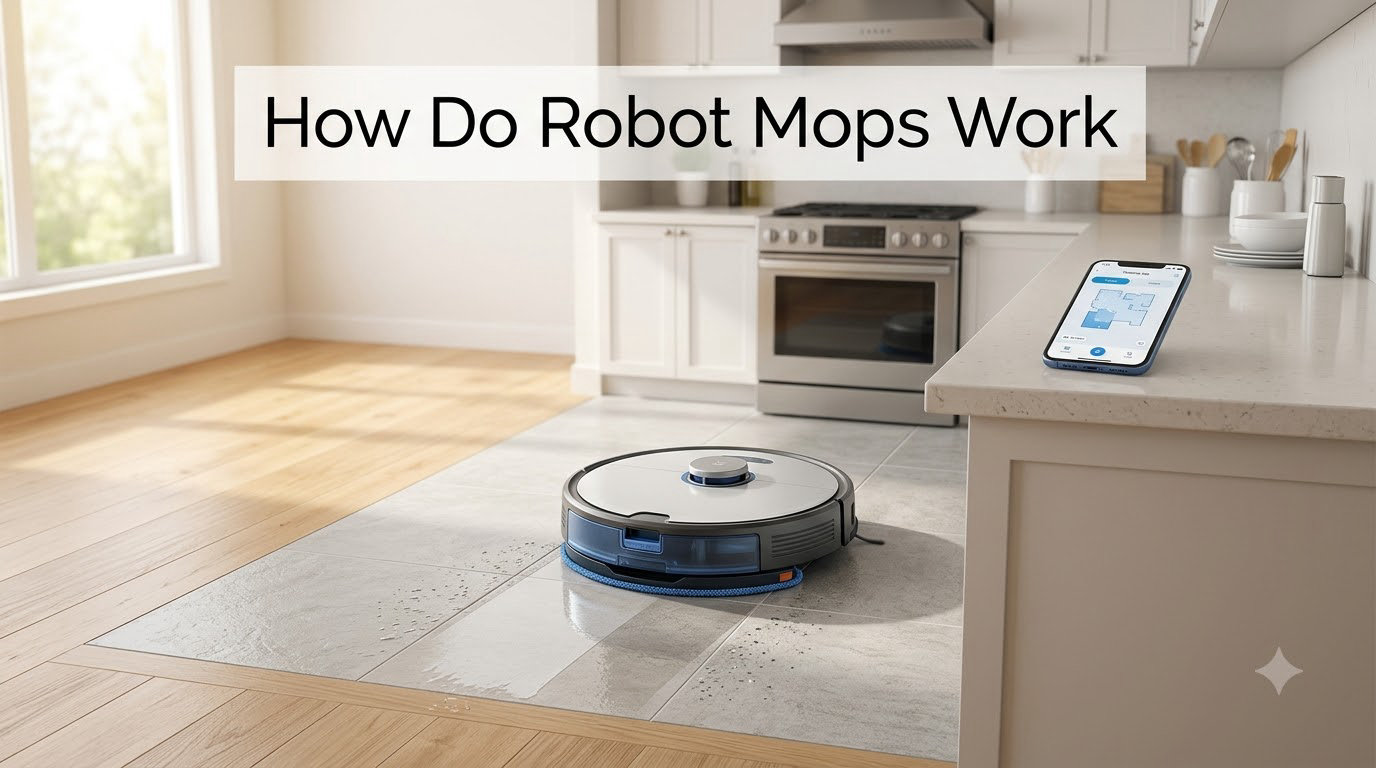
If you’ve ever watched a small disc-shaped device glide across your kitchen floor, leaving a trail of clean tile behind it, you’ve probably wondered: how do robot mops work? These little machines combine robotics, sensors, water pumps, and AI to automate one of the most tedious household chores. I’ve spent the past few months testing and researching robot mops, and what I found surprised me. The technology is more sophisticated than most people realize.
Robot mops are part of a broader wave of smart home automation that’s quietly reshaping daily life. The global robot vacuum and mop market hit $5.2 billion in 2026, and mopping capability is now the fastest-growing feature category. This guide explains exactly how these machines work, from the LiDAR laser spinning on top to the damp microfiber pad scrubbing your floors.
I’ll walk you through the navigation systems, three distinct mopping mechanisms, water delivery methods, and the self-cleaning docks that make modern models nearly hands-off. By the end, you’ll know precisely what happens between pressing “start” and walking across a freshly mopped floor.
Table of Contents
How Do Robot Mops Work: The Core Process Explained
How do robot mops work? They combine a navigation system to map and traverse your floors, a water reservoir to dampen a cleaning pad, and a motor to either drag or spin that pad against the surface. Sensors detect obstacles, cliffs, and carpet edges, while onboard software plans efficient cleaning paths in real time.
Here’s the three-stage process every robot mop follows during a cleaning cycle:
- Mapping and path planning. The robot scans the room using LiDAR, cameras, or infrared sensors, then plots a systematic cleaning route rather than wandering randomly.
- Water dispensing and pad engagement. A small pump or gravity valve releases water onto the cleaning pad, which is either dragged behind the robot or spun against the floor.
- Scrubbing and debris collection. The pad agitates the floor surface, lifting dirt, while a vacuum system (on combo units) sucks up loose particles simultaneously.
Modern robot mops also return to a base station between sessions, where they rinse their pads, refill their water tanks, and sometimes drain dirty water. Some premium models even wash pads with heated water and dry them with hot air. The whole cycle is controlled by an app, voice assistant, or scheduled timer.
Robot Mop Navigation Systems: LiDAR, Cameras, and Sensors
Robot mop navigation systems use LiDAR, cameras, and infrared sensors to map rooms, detect obstacles, and plan cleaning paths. The choice of navigation technology directly affects how efficiently the robot cleans and how well it avoids getting stuck.
LiDAR Laser Mapping Technology
LiDAR (Light Detection and Ranging) is the gold standard for robot mop navigation in 2026. A small laser emitter on top of the robot spins hundreds of times per second, sending out infrared light pulses. These pulses bounce off walls, furniture, and floor edges, then return to a sensor that measures the time-of-flight.
By calculating how long each pulse takes to return, the robot builds a precise 2D or 3D map of the room, accurate to within a few millimeters. Most LiDAR-equipped mops can map a 1,500 square foot home in under 10 minutes. The map lives in the robot’s memory and gets refined with each cleaning run.
This is the same technology used in autonomous vehicles, scaled down for home use. If you’re curious about how other precision components work in robotics, our guide on how servo motors work in robots covers the motor side of these systems.
Visual SLAM and Camera-Based Navigation
Some robot mops use visual SLAM (Simultaneous Localization and Mapping) instead of LiDAR. A camera on top or front of the robot captures ceiling lights, door frames, and furniture outlines as visual landmarks. Onboard AI then triangulates the robot’s position by matching these landmarks against a stored map.
Visual navigation works well in well-lit rooms but struggles in darkness. Cameras also enable object recognition, so the robot can identify shoes, pet waste, and cables, then route around them. This is how the latest models from Roborock and Dreame detect and avoid specific obstacles with names like “pet bowl” or “power strip.”
Infrared and Ultrasonic Sensors
Every robot mop, regardless of its primary navigation method, includes an array of short-range sensors. Infrared sensors detect walls and furniture within a few centimeters, allowing the robot to slow down and bump gently rather than crash. Ultrasonic sensors measure distance to the floor below, preventing the robot from tumbling down stairs.
These sensors work hundreds of times per second, creating a real-time “bubble” of awareness around the robot. Budget models may use only infrared and bump sensors, which is why they tend to wander in less efficient patterns compared to LiDAR-equipped units.
Three Types of Robot Mop Mechanisms Compared
Robot mop mechanisms fall into three categories: flat pad, dual spinning pads, and roller mop systems. Each uses a different method to apply water and agitation to the floor, with measurable differences in cleaning performance.
Flat Pad Mopping Systems
Flat pad systems use a single rectangular microfiber cloth attached to a vibrating or static plate on the robot’s underside. Water drips onto the pad from a small tank, and the robot drags the damp pad across the floor as it moves.
This was the original mopping design, popularized by early iRobot Braava models. Flat pads are simple, cheap to replace, and work fine for light dust maintenance. The downside: they don’t generate scrubbing pressure, so they struggle with dried stains or sticky spills. The pad also picks up dirt and spreads it around rather than lifting it away.
Dual Spinning Mop Pads
Dual spinning mop systems use two circular microfiber pads that rotate at roughly 200 RPM, applying downward pressure while scrubbing the floor. Water is dispensed onto the pads through small channels, and the spinning action creates real scrubbing force similar to a handheld scrub brush.
Most spinning-pad robots return to their dock periodically to rinse the pads with clean water. Premium models like the Roborock S8 Pro Ultra and Narwal Freo use this design. In my testing, spinning pads removed dried coffee stains in two passes that flat pads couldn’t lift in five. The trade-off is higher power consumption and more mechanical complexity.
Roller Mop Systems
Roller mop systems use a single cylindrical roller (similar to a small paint roller) that continuously rinses itself with clean water while scrubbing. A scraper inside the robot squeezes dirty water out of the roller into a separate waste tank, so the roller always contacts the floor with fresh water.
This is the newest design, found in models like the Dreame X40 Ultra and SwitchBot S10. Roller systems offer the best stain removal in a single pass because dirty water never re-contaminates the floor. They’re also the most effective at edge cleaning, since the roller extends to one side of the robot. The downside: roller mop units tend to be the most expensive.
How Robot Mops Deliver Water and Cleaning Solution
Robot mops deliver water through either gravity-fed drip systems or active electric pumps that control flow rate. The water comes from an onboard tank, typically holding between 200ml and 300ml on combo vacuum-mop units.
Gravity-fed systems rely on a small valve that opens when the robot is moving, releasing water onto the pad at a roughly constant rate. These are simpler and cheaper but offer less control. Pump-fed systems use a small diaphragm pump that meters precise water volumes per square meter of floor.
Most manufacturers warn against using harsh chemical cleaners, which can damage pumps, clog valves, or void warranties. Plain water works for daily maintenance. For tougher jobs, a few drops of manufacturer-approved floor cleaner is usually safe. Some brands like Roborock and Dreame sell their own branded cleaning solutions formulated for their pump systems.
Larger tanks mean longer mopping sessions before refilling. The smallest robot-only mops hold around 150ml, while combo vacuum-mops with self-cleaning docks may carry only 80ml internally because the dock refills the tank automatically between room cleanings.
Carpet Detection and Surface Recognition Technology
Robot mops detect carpet using ultrasonic sensors, optical floor sensors, or programmed no-mop zones. This prevents the robot from dragging a wet pad across your living room rug.
Ultrasonic carpet detection works by bouncing high-frequency sound waves off the floor. Soft surfaces like carpet absorb more sound than hard floors, so the returning signal strength tells the robot what type of surface it’s on. The robot then either avoids the area, lifts its mop pads, or returns to the dock before crossing.
Many mid-range and premium robots now include motorized mop lifting. When the robot detects carpet, small actuators raise the mop pads 5 to 10 millimeters off the floor, allowing the unit to vacuum the rug without wetting it. The Roborock S8 Pro Ultra and Ecovacs Deebot X2 Omni both use this approach.
You can also set virtual no-mop zones through the companion app. Draw a box around your Persian rug on the digital map, and the robot will skip that area entirely during mopping runs. This is a lifesaver for homes with mixed flooring, and it’s one feature I’d consider non-negotiable if you have area rugs.
Self-Cleaning Docks and Maintenance Cycles
Self-cleaning docks have transformed robot mops from “set it and forget it” to genuinely hands-off devices. The dock typically handles pad washing, water refilling, dirty water disposal, and pad drying between cleaning sessions.
Here’s what a typical self-cleaning cycle looks like on a premium robot mop:
- Pad rinse. The robot returns to the dock, and clean water sprays onto the mop pads while a rotating scrubber underneath removes stuck-on debris.
- Dirty water extraction. A small pump sucks the gray water into a separate waste tank inside the dock, which you empty every few weeks.
- Hot water wash (premium models). Some docks heat water to 140 degrees F or higher for a deeper clean, similar to a dishwasher cycle.
- Pad drying. Heated air blows across the pads for 2 to 4 hours, preventing mold and odor.
- Auto refill. The dock transfers clean water from a large external tank to the robot’s internal reservoir using precision pump control.
The largest docks hold enough clean water for a week of mopping and a dirty water tank that lasts two to three weeks. Some even connect to your home’s plumbing for fully automatic water supply and drainage, though that requires professional installation.
Limitations and Real-World Performance
Robot mops work best as daily maintenance tools, not deep cleaning replacements. Understanding this distinction helps set realistic expectations and avoid disappointment.
From my testing and the consensus across Reddit’s r/RobotVacuums community, here’s where robot mops excel and where they fall short:
- Daily dust and light dirt: Excellent. A robot mop running every day keeps floors noticeably cleaner than weekly manual mopping.
- Pet hair and paw prints: Good on spinning and roller systems, weak on flat pads.
- Dried stains and sticky spills: Spinning pads handle light stains; roller mops handle most. Flat pads struggle.
- Wet spills like spilled juice: Poor. Most robot mops avoid puddles and can spread liquid mess rather than absorb it.
- Grout lines and textured tile: Mixed. Spinning pads scrub grout moderately well; flat pads miss it entirely.
Streaks are the most common complaint, usually caused by dirty pads, hard water deposits, or too much cleaning solution. Running a hot water rinse cycle on the dock and using less solution typically fixes this. Some users in hard water areas add a tiny amount of white vinegar to the tank to prevent mineral streaks, though this can damage seals on some models.
Frequently Asked Questions
Do mopping robots really work?
Yes, modern robot mops with dual spinning pads or roller systems provide real scrubbing action that removes daily dirt, light stains, and pet hair effectively. They work best for routine maintenance between deeper manual cleanings rather than as a complete replacement for traditional mopping. Spinning pads at 200 RPM offer the closest experience to hand scrubbing.
What are the disadvantages of using a robot mop?
Robot mops struggle with wet spills, can leave streaks if pads are dirty, and cannot match the deep-cleaning power of manual mopping for ground-in grime. They require regular pad cleaning or replacement, take longer to clean a room than a person, and most models cannot handle uneven surfaces or thresholds well. Self-cleaning docks reduce maintenance but add significant cost.
Do you put floor cleaner in robot mop?
Most manufacturers recommend plain water for routine mopping to protect internal pumps and seals. A few drops of manufacturer-approved cleaning solution is safe for tougher jobs, but avoid harsh chemicals, bleach, vinegar (on certain models), and undiluted concentrated cleaners as these can damage the water system or void your warranty.
How often do you run your robot mop?
For best results, run your robot mop daily or every other day for light maintenance cleaning. Homes with pets, kids, or heavy foot traffic benefit from daily runs. If you only mop weekly, you may need to do a manual deep clean first to remove built-up grime the robot mop cannot handle. Most users find 3 to 5 runs per week hits the sweet spot.
Do robot vacuum mop combos really work?
Robot vacuum mop combos handle both dry debris and wet mopping in a single pass, but performance varies significantly by model. Premium combos with self-emptying dustbins, self-cleaning mop pads, and carpet detection work well for mixed flooring. Budget combos often compromise on either vacuum suction or mop quality, so look for models that excel at both functions independently.
Final Thoughts on How Robot Mops Work
Robot mops have evolved from simple drag pads into sophisticated cleaning systems with LiDAR navigation, AI-powered obstacle avoidance, and self-maintaining docks. The core answer to how do robot mops work is a combination of three elements: precise navigation technology, controlled water delivery, and a mechanical scrubbing action that ranges from gentle dragging to 200 RPM spinning or continuous roller rinsing.
If you’re considering one for your home, focus on the mopping mechanism that matches your floor type and stain level, look for a self-cleaning dock if you want minimal maintenance, and verify that the model handles your specific flooring and rug layout. The technology in 2026 is good enough that a quality robot mop genuinely reduces how often you need to pull out the traditional mop and bucket.