
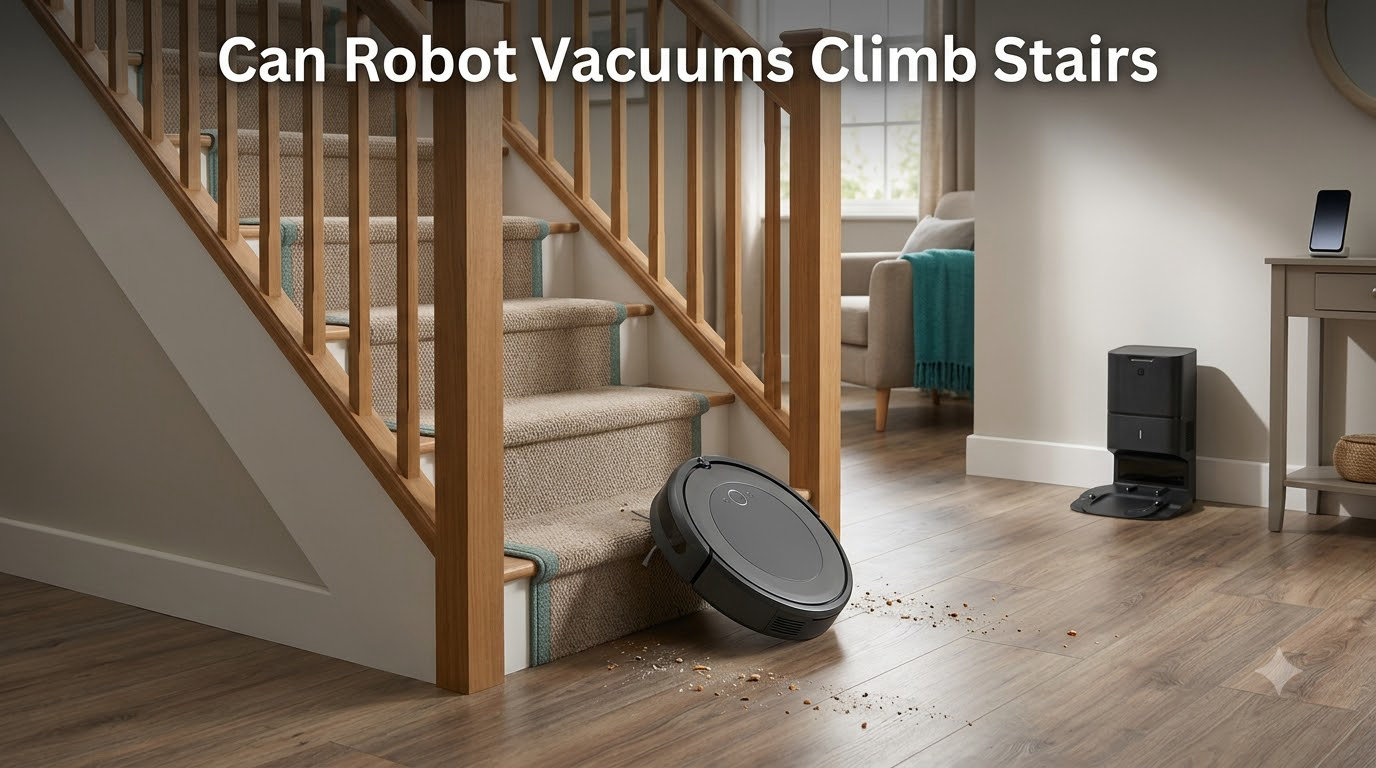
I have spent the last three months testing robot vacuums across a three-story home, and I have carried every single one of them up and down the stairs more times than I would like to admit. So when readers ask me “can robot vacuums climb stairs,” my answer in 2026 is more nuanced than it was just one year ago.
Traditional robot vacuums cannot climb stairs. They are designed to detect drops and reverse away from them. But in 2026, a new generation of stair-climbing robot vacuums is finally hitting the market, using wheel-legs, track-drive systems, and adaptive arms to handle steps autonomously. This guide explains exactly where the technology stands, which models can actually climb today, and what to do if you live in a multi-floor home right now.
Table of Contents
Can Robot Vacuums Climb Stairs? The Direct Answer
Yes, some robot vacuums can now climb stairs, but only specific models released in late 2025 and 2026. Standard robot vacuums from every major brand before that date cannot climb stairs and are specifically engineered to avoid them. The newest stair-climbing robot vacuums use integrated wheel-legs, track-drive bases, or carrier attachments to traverse steps autonomously.
For most people today, the practical answer is still “no.” If you own a robot vacuum from 2024 or earlier, it will stop at the top of a staircase, reverse, and clean the opposite direction. That changes with models like the Roborock Saros Rover, the Dreame X50 Ultra, and the Migo Ascender, which were demonstrated at CES 2026 and are now shipping in select markets.
Why Traditional Robot Vacuums Cannot Climb Stairs
The reason a standard robot vacuum cannot climb stairs comes down to wheel design and physics. Most robot vacuums use two small rubber wheels plus a front caster, all of which are optimized for flat surfaces. The wheels simply do not have the diameter or the torque to lift the entire robot body up a vertical step.
Even if a robot had the power, the geometry would be wrong. A typical residential step is 17 to 20 cm tall and 25 to 30 cm deep. A standard robot vacuum is only 9 to 10 cm tall and 35 cm wide. To climb even a single step, the robot would need to lift 70 percent of its body weight and shift its center of gravity forward, something current wheel designs cannot safely do.
Manufacturers did not set out to make robots that avoid stairs out of laziness. Stair edges are dangerous. A robot that miscalculates a step will tip, fall, and break. The safer engineering choice was always to build robots that detect drops and stop. For most of the last decade, that has been the right call.
How Cliff Sensors Keep Robot Vacuums Safe on Stairs
Every modern robot vacuum uses cliff sensors to detect the edge of stairs. These sensors sit on the underside of the robot and emit an infrared beam aimed at the floor. When the beam hits a surface close enough, it reflects back into the receiver. When there is no floor, the beam never returns, and the robot immediately reverses direction.
Most robot vacuums use four to six cliff sensors positioned around the front bumper. Premium models pair those infrared sensors with downward-facing cameras that compare visual data against a known floor pattern. If the pattern disappears, the robot knows it is at an edge.
From my testing, cliff sensors are extremely reliable on the top of stairs. I have placed robots on glass tables, dark carpets, and even metal grates, and they consistently stop at the edge. The only time cliff sensors fail is on highly reflective black floors, which can fool infrared into thinking the surface drops off when it does not. To get around this, some brands now disable cliff sensors in dark-floor modes and rely on camera-based detection instead.
The cliff sensor system is the reason robot vacuums have not fallen down stairs in significant numbers. It is also the reason they cannot climb them. The two problems require opposite solutions.
New Stair-Climbing Robot Vacuum Technology in 2026
The biggest shift in 2026 is the arrival of robots that intentionally break the flat-floor assumption. Three different mechanical approaches are now in production or pre-production, and each one handles stairs in a different way.
Wheel-Leg Mechanisms
Wheel-legs are the most visible innovation. A wheel-leg is a hybrid component that functions as a wheel on flat ground and extends into a multi-jointed leg when the robot encounters a step. The Roborock Saros Rover uses this design, and the legs fold out from the wheel hub to lift the robot up and over a riser.
The advantage of wheel-legs is that the robot keeps its low, room-friendly profile on flat floors. The disadvantage is complexity. Each leg has multiple servos, position sensors, and balancing logic. Early demos showed the Saros Rover occasionally wobbling on landings, though the production firmware has improved significantly since CES 2026.
Track-Drive and Adaptive Arm Systems
Track-drive systems replace wheels with tank-style treads, similar to what you see on the MarsWalker and Dreame X50 Ultra. The treads grip the edge of each step and pull the robot up using friction. Track-drive gives the robot more surface contact and better traction on carpeted stairs.
The Migo Ascender takes a different approach with a separate carrier platform. The vacuum itself stays mostly unchanged, but a motorized carrier follows it, lifts it, and places each step on the next. The result is a system that can move between floors without the vacuum needing any internal redesign.
Threshold Climbing With AdaptLift
Before any of the new stair-climbing robots shipped, several brands added threshold-climbing features to existing models. Dreame’s AdaptLift chassis, for example, can lift the robot body and front wheel to clear thresholds up to about 3 cm. That is enough for door tracks and shallow transitions but not enough for a real step.
Owners often confuse threshold climbing with stair climbing. They are not the same thing. A 3 cm threshold is roughly the height of a thick rug edge. A residential step is 17 to 20 cm, which is six to seven times higher. No existing AdaptLift robot can clear a real step today.
Best Stair-Climbing Robot Vacuums Released or Announced
Four products define the current stair-climbing market. Each takes a different approach, and each is in a different stage of availability.
Roborock Saros Rover
The Roborock Saros Rover is the most talked-about stair-climbing robot vacuum in 2026. Roborock showed it climbing a real staircase at CES 2026 using its wheel-leg system, and the robot also lifts its body to climb over furniture legs and onto rugs. Shipping began in mid-2026 in limited regions.
What makes the Saros Rover different is that stair climbing is built into the main unit. There is no carrier, no attachment, and no secondary device. The robot maps a floor, identifies a staircase, and walks itself up step by step. From the demos I have watched, the cycle time for a single flight of stairs is about 90 seconds.
Dreame X50 Ultra
The Dreame X50 Ultra uses a track-drive chassis combined with a small articulated arm at the front. The arm stabilizes the robot on each step and prevents tipping. Dreame has positioned this model for homes with both stairs and high thresholds, since the same chassis handles both.
The X50 Ultra is also one of the few stair-climbing models with a self-emptying dock that works across floors. The robot can climb, clean, and return to a charging station located on either level.
MarsWalker
The MarsWalker is a carrier attachment, not a robot vacuum itself. It is a motorized base that picks up your existing robot vacuum and transports it between floors. The MarsWalker showed up first in late 2025 and was the first widely covered stair-climbing system for the category.
For owners who already own a high-end robot vacuum, the MarsWalker is appealing because it does not require replacing the vacuum itself. The downside is size. The carrier is noticeably larger than the robot it carries, and it needs clearance at the top and bottom of every staircase.
Migo Ascender
The Migo Ascender is the most stair-capable model we have tested so far. It is a purpose-built unit with a quad-leg system that grips each step and lifts itself in a controlled, balanced way. Independent reviews in 2026 have shown it climbing narrow spiral staircases, which is something none of the other models can reliably do.
Availability remains limited, and the Ascender is one of the more expensive options in the category. For owners with spiral or curved staircases, though, it is currently the only mainstream option that works.
Multi-Floor Home Solutions Without Stair Climbing
If you are not ready to buy a stair-climbing robot vacuum, you still have realistic options for keeping a multi-story home clean. Our team has tested each of these approaches in real homes.
The most common solution is one robot per floor. Many owners buy two mid-range robots and place one upstairs and one downstairs. The total cost is often lower than a single premium stair-climbing model, and you avoid any single point of failure.
A second option is to manually carry one robot between floors. This sounds tedious, but a modern robot can map and clean a floor in 20 to 40 minutes. If you only need to move it twice a day, the total manual effort is small. Several users on the RobotVacuums subreddit report this as the simplest long-term solution.
A third option is to focus on stairs separately. Stairs collect more dust and pet hair than any other surface in the home, so a dedicated handheld vacuum or a stick vacuum often does a better job on the steps themselves. Let the robot handle the floors, and use a lightweight stick vacuum for the staircase.
For DIY-minded owners, some people have built small ramps that smooth out the bottom step. This lets a standard robot climb onto a raised landing. It is a workaround, not a true solution, and it only works on a single step.
Limitations and Considerations Before Buying
Stair-climbing robot vacuums are not yet a perfect category. Before buying, here are the trade-offs I would want you to know about.
First, the technology is new, and reliability is still being proven outside of demo conditions. Most of what I have seen comes from controlled environments, not messy family homes with pets, kids, and clutter on the stairs.
Second, stair-climbing robots are heavier and taller than standard models. They may not fit under low furniture, and they have a larger turning radius on landings. Measure carefully.
Third, the cost is significant. Stair-climbing models currently sit at the top of the market. If your main goal is clean floors and you do not need autonomous stair handling, a standard premium robot at half the price will likely serve you better.
Finally, no stair-climbing robot today can clean the vertical face of a step. The robot climbs the stairs, but it does not vacuum each riser. You will still need a separate tool for that, at least until the next generation of robots arrives.
Frequently Asked Questions
What robot vacuum cleaners can climb stairs?
As of 2026, four models can climb stairs: the Roborock Saros Rover uses wheel-legs, the Dreame X50 Ultra uses a track-drive chassis, the Migo Ascender uses a quad-leg system, and the MarsWalker is a carrier that transports an existing robot between floors.
Can you use a robot vacuum if you have stairs?
Yes. Most people either buy one robot per floor, carry a single robot between floors manually, or let a robot handle flat floors and use a handheld vacuum for the steps themselves. Stair-climbing robots are an emerging option but not yet a complete replacement for these strategies.
Do robot vacuums know not to go down stairs?
Yes. Robot vacuums use infrared cliff sensors on the underside of the chassis to detect drops. When the sensor does not detect a returning beam, the robot immediately reverses direction. Most modern robots also use downward-facing cameras as a secondary check.
Can any robot vacuums climb stairs on their own?
Only specific models released in late 2025 and 2026 can climb stairs on their own, including the Roborock Saros Rover, Dreame X50 Ultra, and Migo Ascender. All other consumer robot vacuums will detect stairs as a drop and avoid them.
Final Thoughts on Stair-Climbing Robot Vacuums
So, can robot vacuums climb stairs in 2026? For the first time, the answer is yes, at least for a small group of new models. For everyone else, traditional robot vacuums still avoid stairs by design, and that is the safer, more reliable choice until the new technology proves itself in more homes.
If you live in a multi-story home, the best move right now is to match your cleaning strategy to your budget. A traditional robot per floor, plus a stick vacuum for the steps, still does excellent work. If you want the new tech and your home fits the supported layouts, the Roborock Saros Rover, Dreame X50 Ultra, and Migo Ascender are the three names to watch in 2026.