
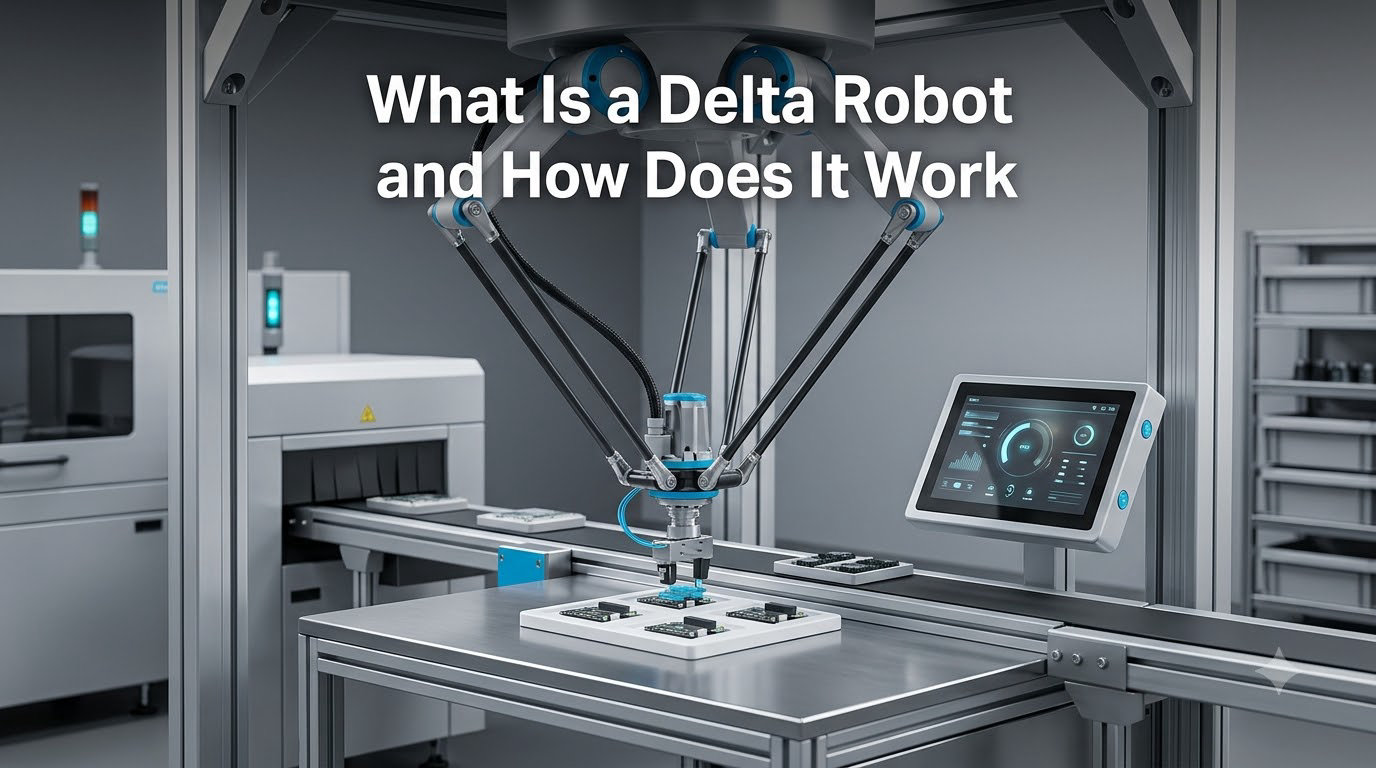
If you have ever watched a high-speed packaging line place chocolates into trays at 200 picks per minute, you have already met a delta robot. These spider-like machines sit above conveyor belts in food plants, electronics factories, and pharmaceutical lines, moving so quickly that the eye can barely follow them. In this guide, our team breaks down what a delta robot is, how its parallel mechanism produces such extraordinary speed, and where you will find one working today.
By the end, you will understand the parallel kinematic chain that defines the design, the role of parallelograms in the arms, the difference between a delta robot and a serial robot, and why this category of parallel robot became the workhorse of high-speed pick and place automation in 2026.
Table of Contents
What Is a Delta Robot
A delta robot is a type of parallel robot consisting of three arms connected to universal joints at the base. Its key design feature is the use of parallelograms in the arms, which constrains the end effector to pure translational motion along the X, Y, and Z axes while keeping its orientation fixed.
Unlike a serial robot, where each joint supports the weight of every joint after it, a delta robot mounts all of its motors in a fixed overhead base. The moving arms stay light because only thin links and a small platform travel through space. This is the single most important reason a delta robot can reach accelerations of 10 to 20 g and cycle rates of 60 to 300 picks per minute.
You will also see delta robots called parallel kinematic robots, spider robots, or toaster robots in some shop-floor slang. The name “delta” comes from the shape of its working envelope, which forms a roughly triangular dome beneath the base.
Who Invented the Delta Robot
The delta robot was invented by Reymond Clavel, a professor at the École Polytechnique Fédérale de Lausanne (EPFL) in Switzerland, in the early 1980s. The story behind the design is one of the most charming in industrial robotics history.
Clavel was working with a chocolate manufacturer who needed a way to place pralines into boxes without crushing them. The conventional serial arm of the day was either too slow, too inaccurate, or too heavy to handle delicate chocolates at production speeds. Clavel’s solution was to flip the design: put the motors above the work area, connect them with parallel linkages, and let only a small platform move below. He filed the original patent in 1985, and the first commercial delta robot was deployed a few years later.
Clavel’s invention opened an entirely new field of parallel robots. Today, more than 40 years later, the same basic architecture still dominates high-speed pick and place applications around the world.
Mechanical Design and Key Components
A delta robot has a small number of parts, and each one plays a clear role in keeping the moving mass low and the structure stiff. Understanding these components is the foundation for understanding how the robot achieves its speed.
The base platform is the fixed upper structure. It holds the three servo or stepper actuators that drive the arms, plus the controller, cabling, and often the vision system. Because all heavy components stay in the base, the moving parts below can be extremely light.
The three arms are the visible “legs” of the robot. Each arm is a pair of parallel linkages forming a parallelogram, connected to the base by a rotating joint. The arms are usually made from carbon fiber, aluminum, or composite materials to minimize inertia while maintaining stiffness.
Universal joints sit at both ends of each arm, allowing the parallelograms to swing freely without binding. The parallelograms are the secret to the robot’s behavior: because opposite sides of each parallelogram stay parallel, the end effector cannot rotate. It can only translate.
The end effector, also called the tool or gripper, attaches to the small triangular platform at the bottom of the arms. Depending on the application, this can be a suction cup, a mechanical gripper, a magnetic pickup, or even a 3D printing nozzle. Because the end effector maintains a constant orientation as it moves, vacuum-based pick and place tools work especially well.
Finally, the controller coordinates the three actuators. Given a target position, the controller solves inverse kinematics to compute the exact angle each arm must reach, then drives the motors in synchrony.
How a Delta Robot Works
Delta robot kinematics is what makes the design feel almost magical the first time you see it. Three arms rotate independently, yet the end platform moves as if guided by an invisible rail along three perpendicular axes.
The starting point is the parallelogram constraint. Each arm is a closed four-bar linkage, so its lower end moves on a sphere around a fixed point on the upper arm. When you connect three such arms to a single platform, the geometry forces the platform to stay parallel to the base. That eliminates the three rotational degrees of freedom and leaves only translation along X, Y, and Z.
Forward kinematics answers the question, “If the three arm angles are these values, where is the end effector?” This is straightforward: each arm angle defines a geometric constraint, and the platform position is the intersection of those constraints. Forward kinematics in a delta robot is well-behaved and quick to compute.
Inverse kinematics is the harder direction, and the one the controller actually needs: “To put the end effector at point P, what should each arm angle be?” Mathematically, this involves solving a system of equations. Practically, modern controllers use precomputed lookup tables or iterative solvers that run in microseconds, which is essential when you are trying to hit 200 picks per minute.
The reason delta robots are so fast is that all three motors sit in the fixed base, so the only mass that accelerates is the three thin arms and the small end platform. Low moving mass means low inertia, which means you can push the motors hard without breaking the structure. Combined with the high stiffness of a parallel kinematic chain, the result is a robot that can place objects within a fraction of a millimeter at blistering speed.
Delta Robot Variants
The three-arm translational delta robot is the most common, but Reymond Clavel and the engineers who followed him have produced several important variants. Each one trades off workspace, payload, and rotational capability for different applications.
The 4-DOF delta robot adds a rotational axis at the end effector, usually by mounting the tool on a rotating spindle driven by a fourth actuator. This is useful when the robot needs to orient parts, such as placing a label or screwing on a cap.
The 6-DOF delta robot replaces the parallelograms with universal joints, which removes the orientation constraint and gives the platform full six degrees of freedom. These robots are rare in industry but appear in flight simulators, motion platforms, and high-precision assembly research, where the additional dexterity matters more than raw speed.
The Pocketdelta is a compact, entry-level industrial delta often used in education and small automation cells. The Delta cube is a cube-shaped variant with a different mechanical layout but the same parallel kinematic principle. The milliDelta, developed at Harvard in 2018, is a microscopic version smaller than a coin, designed for microscale assembly and surgical applications.
Common Applications of Delta Robots
Delta robots excel anywhere you need to move small, lightweight items at very high speed with repeatable accuracy. A few application areas dominate global deployments in 2026.
Pick and place packaging is the classic use case. Bottles, blister packs, cookies, and confectionery items move along a conveyor, and the delta robot transfers them into trays, boxes, or cartons. The fast cycle time and gentle motion make it ideal for fragile products.
Food industry applications are especially common. Delta robots handle raw chicken, baked goods, and fresh produce under hygienic conditions. Many food-grade delta robots use stainless steel and food-safe lubricants, and their open structure makes washdown cleaning easy.
Electronics assembly uses delta robots for placing components on printed circuit boards, sorting tiny parts, and packaging finished devices. Their precision and clean motion suit cleanroom environments where dust and vibration are a concern.
Pharmaceutical and medical device manufacturing relies on delta robots for filling, capping, and inspecting vials and syringes. Repeatability within a few hundredths of a millimeter helps maintain dosage accuracy.
3D printing is a popular hobbyist application. Delta-style 3D printers use the same kinematic structure to move a print head, taking advantage of the lightweight arms to keep the print head quick and accurate.
Warehousing and order fulfillment are newer applications where delta-inspired robots sort parcels and pick individual items from bins before shipping.
Advantages of Delta Robots
The mechanical structure of a delta robot produces a cluster of benefits that are difficult to match with any other robot type. The advantages below are the reasons industrial buyers keep specifying delta robots for high-speed lines.
Extreme speed is the headline advantage. Modern industrial delta robots can exceed 300 picks per minute, often at accelerations above 10 g. No serial arm can match that cycle rate while staying accurate.
High precision and repeatability come from the stiffness of the parallel kinematic chain. Position repeatability of 0.1 mm or better is typical, even at full speed.
Low inertia is a direct result of placing all actuators in the base. The moving arms and platform can weigh only a few hundred grams, which is why the robot can start, stop, and reverse direction so quickly.
High stiffness makes the structure resistant to deflection under load, which keeps the tool on its intended path even at high acceleration. This is also why delta robots perform well in precision assembly.
Hygienic and easy to clean, the open design with no grease-lubricated joints near the food zone suits food and pharmaceutical applications. Many models are washdown-rated.
Simple end effector integration follows naturally from the constant orientation of the tool. Vacuum grippers, mechanical fingers, and vision systems all mount easily and behave predictably.
Limitations and Disadvantages
Delta robots are not the right tool for every job. The same parallel structure that delivers speed also creates some inherent constraints you should know before specifying one.
Limited workspace is the most common trade-off. The reachable volume forms a flat dome beneath the base, and reach is small compared to a serial arm of the same envelope size. For deep bins or wide pallets, a serial or gantry robot is usually a better fit.
Low payload capacity comes from the lightweight arms. Most industrial delta robots handle between 1 and 8 kg. Heavy parts or large grippers require stiffer, slower designs.
Kinematics complexity is hidden but real. The inverse kinematics math is non-trivial, and while modern controllers handle it, hobbyists and engineers building their own systems often hit a steep learning curve.
Higher upfront cost than a simple Cartesian gantry can be a factor for low-volume applications, although the throughput gains often pay back the investment quickly in production environments.
Delta Robot vs Serial Robot
The choice between a delta robot and a serial robot usually comes down to speed versus reach and payload. A quick side-by-side comparison helps clarify when to pick each one.
A serial robot, such as a six-axis articulated arm, stacks its joints in a chain. Each motor supports the weight of every joint and link after it, so the moving mass is high. Speed is moderate, but reach and payload are excellent, and the tool can access a large, irregular workspace.
A delta robot spreads its actuators across a parallel structure connected to a single end platform. Moving mass is low, speed is extreme, but reach is small and payload is limited. The workspace is a regular dome shape.
Choose a delta robot when you need to pick and place small items at high speed on a fixed conveyor or feeder. Choose a serial robot when you need to reach into deep fixtures, lift heavy parts, or access complex 3D paths such as welding or painting.
DIY and Hobbyist Delta Robots
For makers and robotics students, the delta robot is one of the most rewarding projects to build. The parts list is short, the motion is dramatic, and the kinematics is rich enough to teach real engineering.
Most hobbyist builds use three NEMA 17 stepper motors, printed or laser-cut parallelogram arms, universal joint bearings or ball joints, and a controller such as an ESP32, Arduino with a CNC shield, or a dedicated Smoothieware board. Open-source firmware like Marlin supports delta kinematics out of the box, which removes the hardest software step.
Online communities on Reddit, Hackaday, and the RepRap forums share printable STL files, wiring diagrams, and tuning tips. A working hobbyist delta can be assembled in a weekend for a few hundred dollars in parts, and the same design scales up to a real 3D printer or pick and place machine with only a few changes.
The tradeoffs hobbyists report are predictable: stepper motors limit speed compared to industrial servos, and small parallelogram flex introduces tiny errors at the tool. For learning kinematics, however, a homebrew delta is hard to beat.
Frequently Asked Questions
What is a delta robot in simple terms?
A delta robot is a parallel robot with three arms that hangs over a work area. The arms use parallelograms so the end effector only moves up, down, left, right, forward, and back without rotating, which lets the robot pick and place small items very quickly.
What is a delta robot used for?
Delta robots are used for high-speed pick and place tasks such as food packaging, pharmaceutical filling, electronics assembly, and 3D printing. Their speed and accuracy make them ideal for moving small, lightweight items in production lines.
Who invented the delta robot?
Reymond Clavel, a professor at EPFL in Switzerland, invented the delta robot in the early 1980s. He designed it to handle chocolates in a confectionery factory without crushing them, and the first commercial units were deployed in the late 1980s.
What are the disadvantages of delta robots?
The main disadvantages of delta robots are a small workspace shaped like a dome, limited payload capacity (usually 1 to 8 kg), and more complex kinematics than a simple serial arm. They are also more expensive upfront than basic Cartesian systems, although the throughput usually justifies the cost.
How fast is a delta robot compared to a serial robot?
A typical industrial delta robot can perform 60 to 300 picks per minute, with accelerations of 10 to 20 g. Comparable serial articulated arms rarely exceed 30 picks per minute for the same payload range, which is why delta robots dominate high-speed packaging and assembly lines.
Final Thoughts on Delta Robots
A delta robot is a parallel robot with three arms and parallelogram linkages that keeps its end effector level while moving at high speed. Invented by Reymond Clavel at EPFL in the 1980s, it became the standard for high-speed pick and place in food packaging, electronics, pharmaceuticals, and 3D printing.
Our team recommends studying the kinematics of a delta robot if you are learning industrial automation, and considering a real industrial unit if you run a high-volume line where cycle time directly affects profit. For hobbyists, building a small delta with an ESP32 controller and open-source firmware is one of the best ways to understand parallel mechanisms hands-on.
Want to see a delta robot in action? Watch a slow-motion video of a packaging line online, and you will instantly see why the parallel structure has stayed the gold standard for fast pick and place for four decades.