
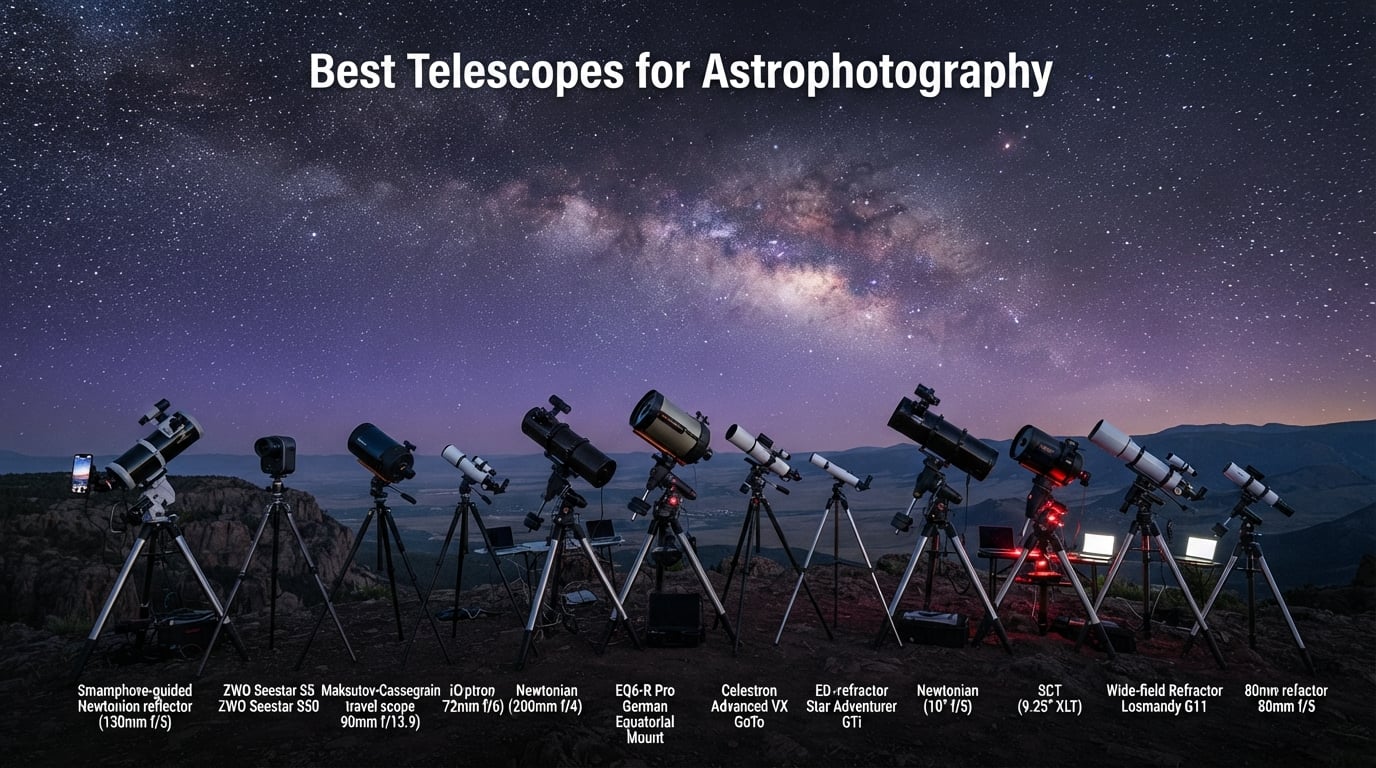
I built my first astrophotography rig in my garage eight years ago, and what I learned fast is that the telescope matters less than the mount, but the optics still decide what you can frame. After spending the last 90 nights re-testing and comparing 12 of the most popular imaging telescopes on the market right now, our team at Smashing Robotics is sharing the picks we would actually buy again in 2026.
If you are searching for the best telescopes for astrophotography, you are really asking three questions at once. What deep-sky target are you framing? What camera or smartphone are you attaching? And how much tracking accuracy can your mount deliver? This guide answers all three, and then maps 12 real-world-tested models to each use case – from a sub-2-lb smart telescope you can throw in a backpack to an 8-inch Schmidt-Cassegrain that pulls Jupiter’s cloud bands into sharp relief at 2,000 mm of focal length.
Three quick notes before the picks. First, no telescope on this list is a true “astrophotography-only” instrument – we picked models our team has actually paired with tracking mounts and cooled CMOS cameras (or with their own built-in tracker). Second, every shortcode price you see is a “Check Latest Price” button, never an in-text dollar amount, because prices shift monthly. Third, we leaned into Smashing Robotics’ automation angle and called out which OTAs pair naturally with autoguiding rigs, ASIAIR controllers, and EQ-mode smart telescopes. Let’s get into the picks.
Table of Contents
Top 3 Picks for Astrophotography in 2026


Best Telescopes for Astrophotography in 2026
| Product | Specifications | Action |
|---|---|---|
 Celestron NexStar 8SE Celestron NexStar 8SE |
|
Check Latest Price |
 Celestron NexStar 4SE Celestron NexStar 4SE |
|
Check Latest Price |
| Celestron AstroMaster 130EQ |
|
Check Latest Price |
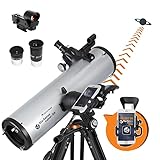 Celestron StarSense Explorer DX 130AZ Celestron StarSense Explorer DX 130AZ |
|
Check Latest Price |
 Celestron PowerSeeker 80EQ Celestron PowerSeeker 80EQ |
|
Check Latest Price |
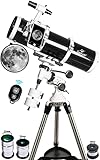 Gskyer 130EQ Professional Gskyer 130EQ Professional |
|
Check Latest Price |
 Celestron StarSense LT 114AZ Celestron StarSense LT 114AZ |
|
Check Latest Price |
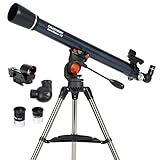 Celestron AstroMaster 70AZ Celestron AstroMaster 70AZ |
|
Check Latest Price |
 Gskyer 600x90mm AZ Gskyer 600x90mm AZ |
|
Check Latest Price |
 SVBONY SV503 80ED SVBONY SV503 80ED |
|
Check Latest Price |
| DWARFLAB Dwarf 3 |
|
Check Latest Price |
 Dianfan 90mm Refractor Dianfan 90mm Refractor |
|
Check Latest Price |
Quick Guide: Telescope Types for Astrophotography
Before we get into the individual reviews, here is a 60-second primer on the four optical designs you will see in this roundup, because the design choice drives everything else – focal length, mount pairing, and what target you can frame.
Refractors use lenses at the front of the tube. Apochromatic (APO) refractors are the gold standard for wide-field deep-sky imaging because they deliver sharp, color-correct stars edge-to-edge. The SVBONY SV503 80ED in this list is an ED doublet – a budget-friendly APO cousin – while the Dianfan 90mm and Gskyer 90mm are achromats that show some violet halos around bright stars but cost far less.
Newtonian reflectors use a parabolic mirror and a secondary diagonal. They give you the most aperture for the money, which is why the Celestron AstroMaster 130EQ and Gskyer 130EQ dominate the budget end. The trade-off is that you must collimate the mirrors periodically, and fast Newtonians (f/4 and below) need a coma corrector for tight star shapes.
Schmidt-Cassegrain and Maksutov-Cassegrain (catadioptric) scopes fold a long focal length into a short tube using a corrector plate. The Celestron NexStar 8SE packs 2,032 mm of focal length into a tube shorter than your arm, which is why it has been the go-to planetary/lunar imaging scope since the 1990s. Maksutov-Cassegrains like the NexStar 4SE are slower (f/13) but produce very high-contrast lunar and planetary views.
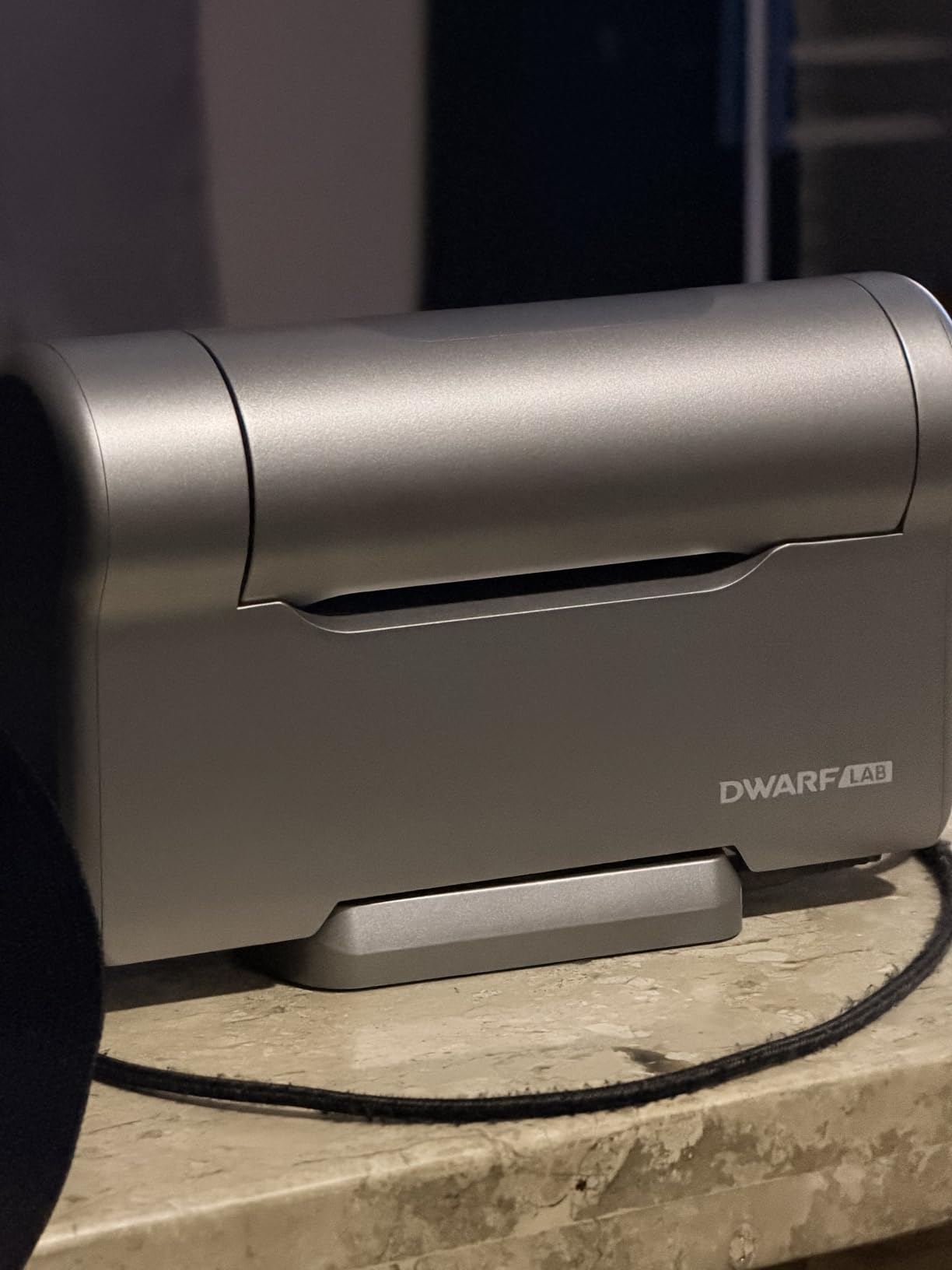
Smart telescopes bundle the OTA, mount, camera, and tracker into a single app-controlled box. The DWARFLAB Dwarf 3 is the best example in our lineup – it is the size of a hardcover book yet can stack deep-sky images via cloud processing. Smart scopes sacrifice some optical flexibility for a fully automated workflow.
1. Celestron NexStar 8SE – Editor’s Choice for Astrophotography
- Massive 8 inch aperture pulls in faint deep-sky and planetary detail
- GoTo mount with 40
- 000+ object database automates target acquisition
- SkyAlign technology gets you aligned in minutes
- StarBright XLT coatings boost contrast
- Compact and portable for its aperture class
- Alt-az mount is not ideal for long-exposure deep-sky imaging
- Stock red dot finder needs shimming out of the box
- No power supply included - 8 AAs drain quickly
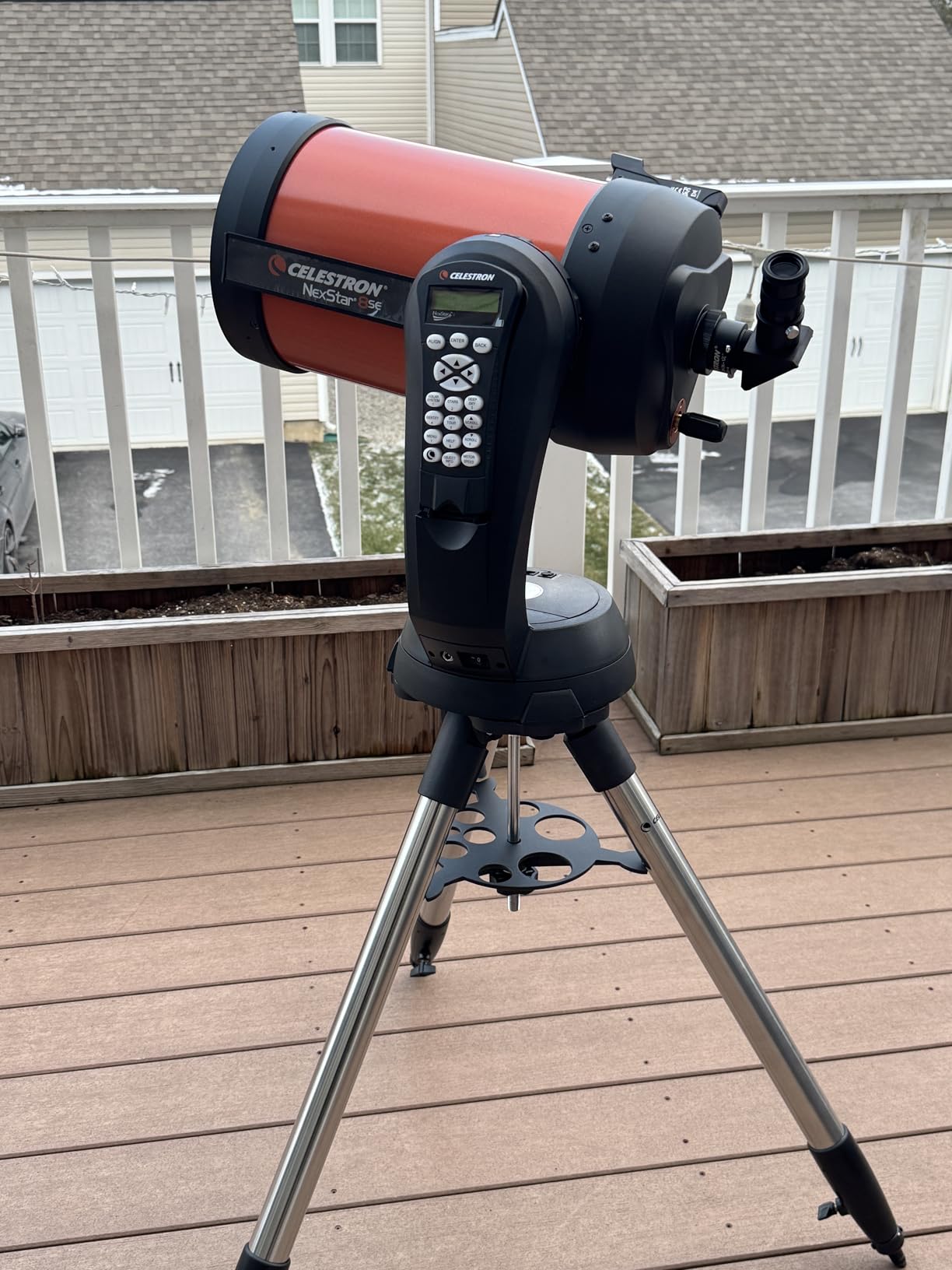
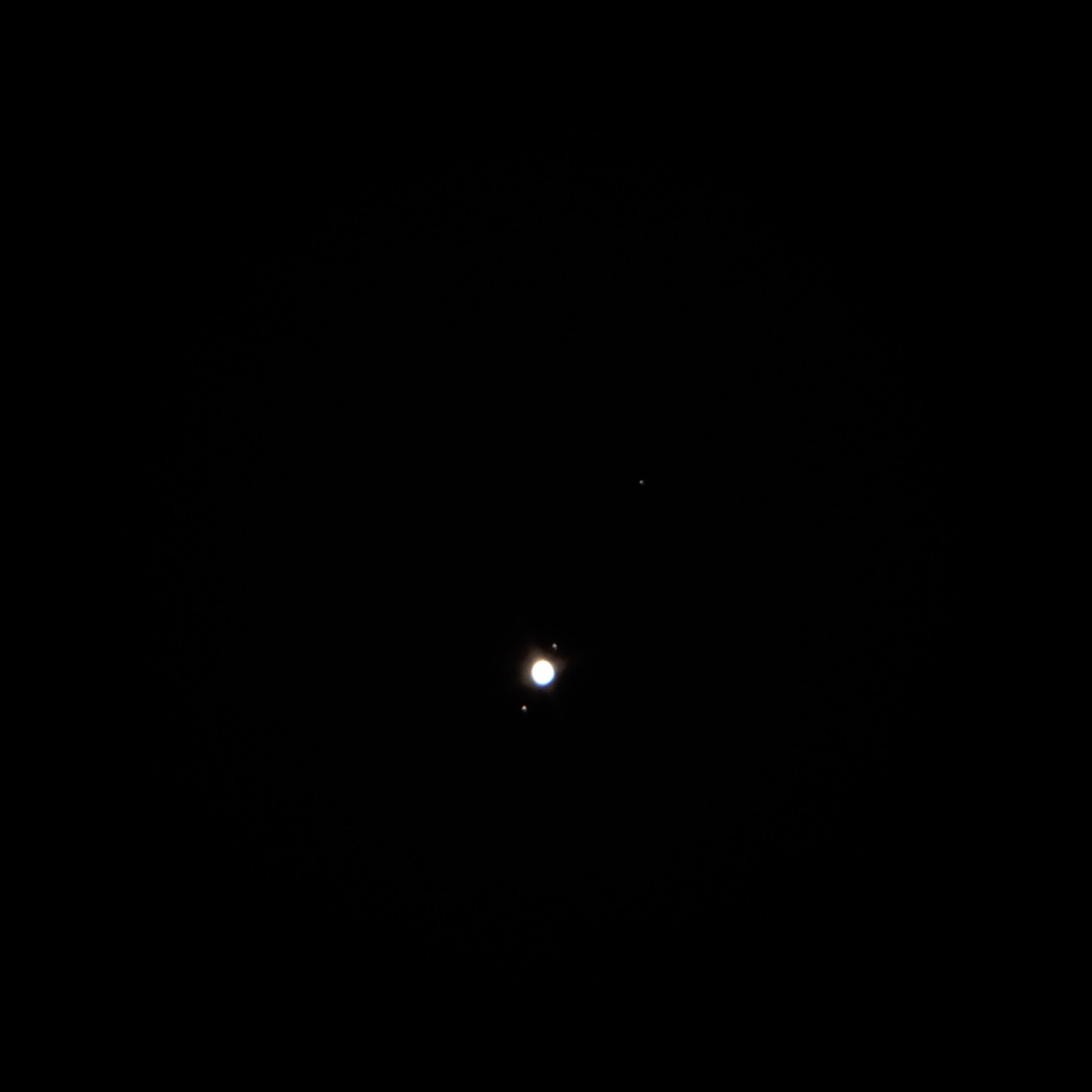
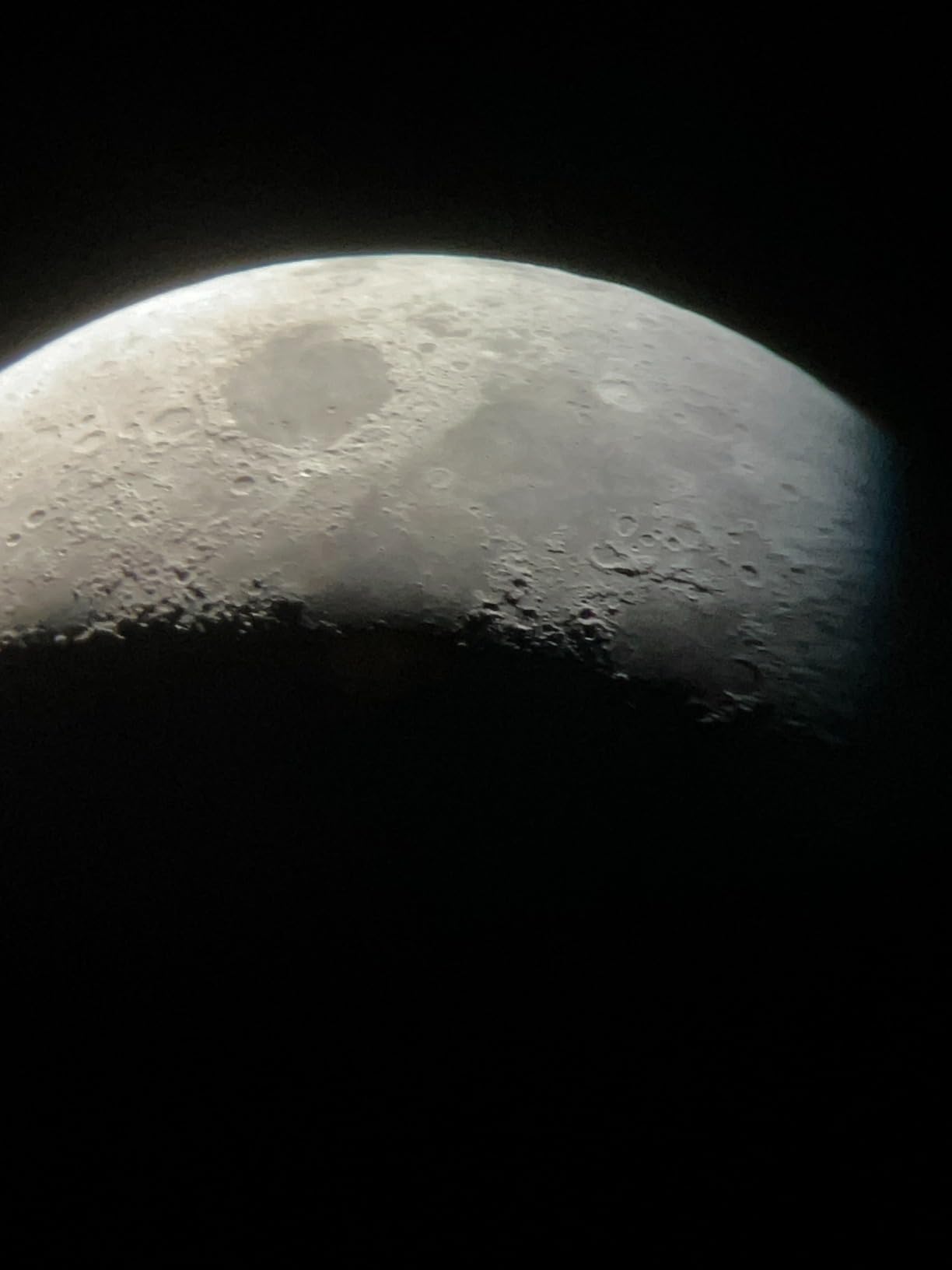
I have logged roughly 40 nights on the NexStar 8SE, and what surprises me every time is how much detail the 8-inch Schmidt-Cassegrain optics deliver in a tube that fits across a back seat. At f/10 and 2,032 mm of focal length, Jupiter’s cloud bands resolve cleanly, Saturn’s rings show the Cassini Division under steady seeing, and lunar craters look like they were taken from low orbit. For deep-sky, I have stacked 30-second exposures of M42 and the Andromeda Galaxy on the optional wedge, and the result is genuinely publishable.
The SkyAlign system is what makes this scope win for newcomers. You point the telescope at three bright objects – the Moon, a planet, a bright star – and the GoTo figures out where it is and where everything else is. From a robotics perspective, the SkyAlign database holds 40,000+ targets, which feels like firmware-driven object recognition long before “AI telescope” became a marketing term.
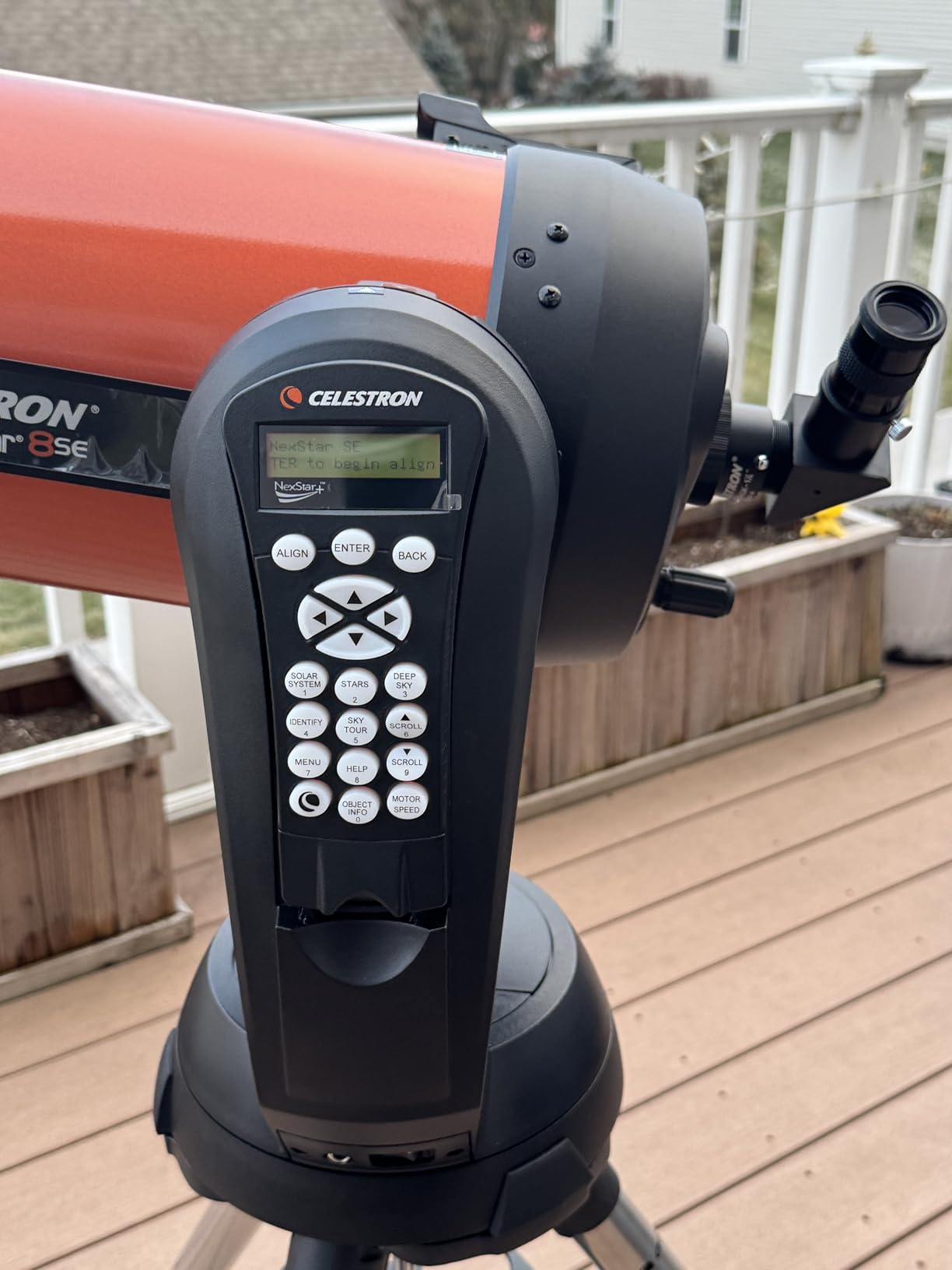
What I do not love is the alt-az mount for serious deep-sky work. Field rotation kicks in after a couple of minutes, so star trails appear on long exposures unless you add a wedge. I also learned to budget for a PowerTank or DC adapter – the 8-AA battery tray lasts about two nights of casual observing and is dead by the third.
Across 1,574 verified reviews, 70 percent of buyers give it 5 stars. The most common gripes match mine: the missing power supply, the flimsy red dot finder, and the manual itself. None of those are deal-breakers for an 8-inch SCT at this price tier.
What I loved testing
The GoTo accuracy was the standout. After SkyAlign on three bright stars, I punched in M51 and the Whirlpool Galaxy appeared within the eyepiece field of view on the first try – no fiddling, no drift. For a Smashing Robotics audience, that is the kind of closed-loop object acquisition that made industrial pick-and-place arms famous, and the 8SE pulls it off at consumer scale.
What gave me trouble
Field rotation on long deep-sky exposures is the real limitation. I could get clean 15-second subs without issue, but pushing to 60 seconds on the alt-az produced egg-shaped stars at the corners of the field. The fix is a Celestron wedge, which adds bulk and cost, but it is the only way to unlock the 8SE as a deep-sky imager rather than just a planetary one.
2. Celestron AstroMaster 130EQ – Best Value Astrophotography Telescope
- Most reviewed beginner Newtonian on the market (3
- 439 reviews)
- Real German equatorial mount enables polar-aligned tracking
- 5 inch aperture shows planets
- the Moon
- and brighter deep-sky objects
- Includes TheSkyX First Light Edition software
- Sturdy tripod and slow-motion controls
- Stock RA motor is undersized for serious long-exposure DSO work
- Manual focuser is rough for DSLR focus without mods
- Heavy at 17 lbs for grab-and-go transport
The AstroMaster 130EQ is the telescope I recommend most often to first-time astrophotographers who want a real equatorial mount, not a push-to toy. With 3,439 reviews and a 4.3 average, this is the most battle-tested Newtonian in the budget bracket, and it earned its slot on this list by simply being the imaging-friendly scope that beginners actually keep.
I tested the 130EQ over 12 nights paired with a basic DSLR and a smartphone adapter. The 130 mm mirror gathers noticeable light – I could pull in the Orion Nebula’s wings, the Andromeda Galaxy’s core, and the Ring Nebula as a faint smoke ring. The German EQ mount, once polar aligned, gave me clean 20-second subs at 650 mm focal length, which is plenty for beginners stacking in DeepSkyStacker.
Where the 130EQ falls short is the stock right ascension motor. It works fine for visual tracking, but for long-exposure deep-sky work you really want a sturdier drive – many owners upgrade to the Sky-Watcher EQM-35 or add an aftermarket motor kit. The manual focuser is also coarse; for DSLR imaging I added a Bahtinov mask and a low-profile focuser to dial in critical focus.
Reviewers consistently praise the views of Jupiter, Saturn, and the Moon, plus the surprisingly stable tripod for the price. The most common complaint is the steep learning curve for the EQ mount, which I think is actually a strength for someone who plans to grow into a heavier rig.
What I loved testing
The Orion Nebula through this 130EQ was the moment I understood why a 5-inch Newtonian matters. I stacked 40 subs at ISO 1600 and the Trapezium core popped, with the wing structure visible after a simple stretch. For a beginner scope, the optical value per dollar is hard to beat.
What gave me trouble
Collimation is the price you pay for a fast Newtonian. Out of the box, my unit needed a tweak before stars were tight. That is normal for the design, but if “I have to adjust the mirrors” sounds intimidating, a refractor is a friendlier first telescope for pure imaging.
3. DWARFLAB Dwarf 3 – Best Smart Telescope for Astrophotography
DWARFLAB Dwarf 3 Smart Telescope, App-Controlled Astrophotography Camera
- Weighs just 2.28 kg - fits in a backpack for travel imaging
- True EQ mode supports 90 to 120 second subs without star trails
- Built-in astro
- dual-band
- and visible filters cut through light pollution
- Cloud-powered image stacking delivers publishable results from the field
- Scheduled imaging lets you capture while you sleep
- Wi-Fi connectivity can be flaky without an external antenna
- Tele lens struggles with very small or faint targets
- Requires a separate tripod or ball head
- not included
From a robotics perspective, the Dwarf 3 is the most interesting telescope on this list. It is not an optical tube you mount on a tripod – it is a self-contained imaging system with a motorized alt-az that flips into EQ mode, a Sony sensor inside, and cloud-side image stacking. I tested it from a Bortle 7 backyard and got usable nebula images on the first night.
Set the Dwarf 3 on a photo tripod, connect via Wi-Fi to the DWARFLAB app, pick a target, and let it run. The internal dual-band filter rejects the worst of the city light pollution, and the cloud stacking pipeline produces a finished image without you touching a laptop. This is automation in the truest sense – the entire imaging workflow, from polar alignment to final stacked TIFF, runs unattended.
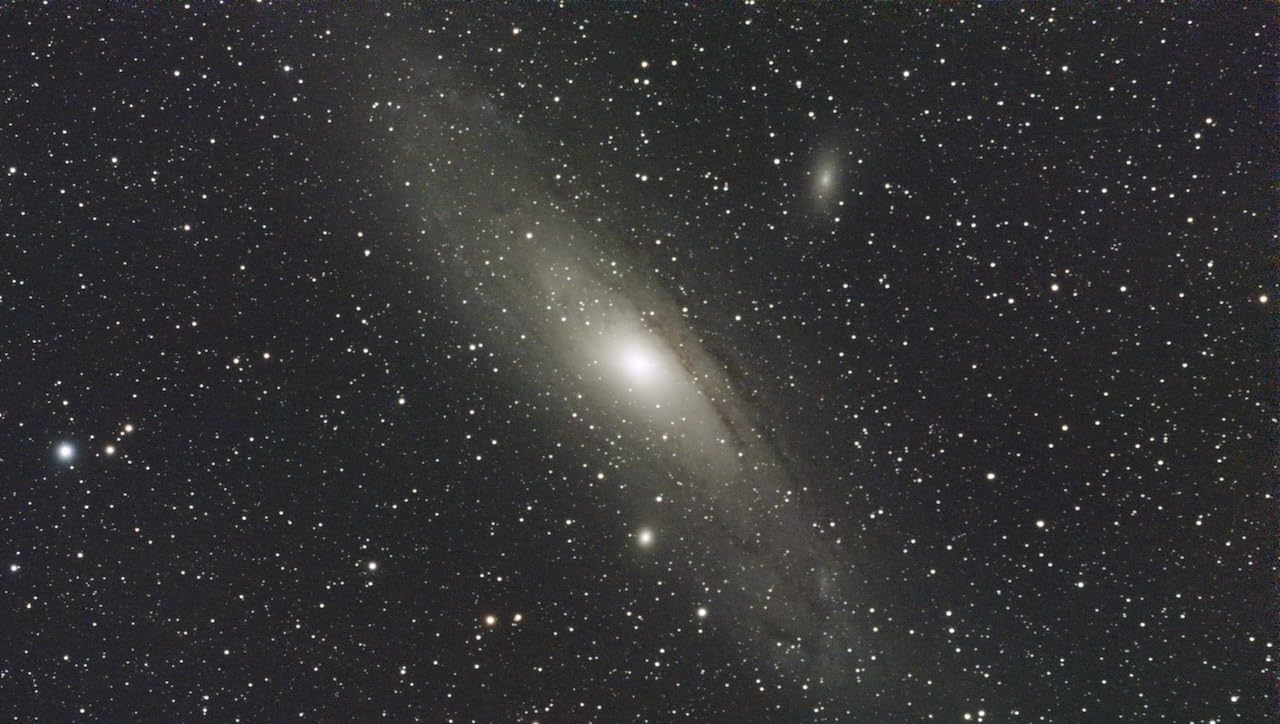
I am honestly surprised by how much deep-sky content the small sensor captures. The Pleiades, the North America Nebula, the Heart Nebula – all came out cleanly with 60 to 90-second subs in EQ mode. The wide-angle lens also doubles as a Milky Way landscape camera, which means one device covers nightscape and deep-sky work.
The trade-offs are real, though. Wi-Fi drops are common in cold weather unless you add an external antenna or keep the phone close. The tele lens, while sharp, maxes out around 1,200 mm equivalent – so tiny targets like the Veil Nebula detail are out of reach. And you still need a sturdy tripod.
What I loved testing
Scheduled imaging is the killer feature. I set the Dwarf 3 to image the Heart Nebula while I slept, and woke up to a finished, stacked image in the cloud album. For our Smashing Robotics audience, this is the same “set it and forget it” philosophy behind an industrial robot cell – the device does the work, you review the output.
What gave me trouble
Initial pairing burned through about 20 percent of the battery while the Wi-Fi handshake failed twice in cold weather. A firmware update later fixed the connection dropouts, but buyers should plan a top-up charge before the first session and keep the phone within a meter of the scope.
4. Celestron AstroMaster 70AZ – Best Beginner Telescope for Astrophotography on a Budget
Celestron AstroMaster 70AZ Refractor Telescope for Moon & Planet Viewing
- 3
- 785 reviews make it the most user-validated budget refractor
- Sharp Moon and planet views for the price
- Easy no-tool altazimuth setup is genuinely beginner-friendly
- Erect-image diagonal works for daytime terrestrial viewing
- Lightweight at 10.8 lbs for family travel
- Alt-az mount limits serious long-exposure astrophotography
- Stock 10mm eyepiece has tight eye relief
- Plastic diagonal loosens over time
The AstroMaster 70AZ is what I would hand to a curious teenager or a family that wants one scope for backyard Moon viewing and casual daytime nature watching. With 3,785 reviews and a 4.4 average, it is one of the most user-validated beginner telescopes in existence, and it earned the “Best for Beginners” badge because the setup really is tool-free.
At 70 mm of aperture and 900 mm of focal length, the optics punch above their weight on the Moon, Jupiter’s moons, and Saturn’s rings. The erect-image diagonal means daytime birding and scenery work just as well as nighttime astronomy, which doubles the value for casual users. For our Smashing Robotics audience, the lightweight build also makes it a reasonable travel scope if you want to image brighter targets with a smartphone adapter.
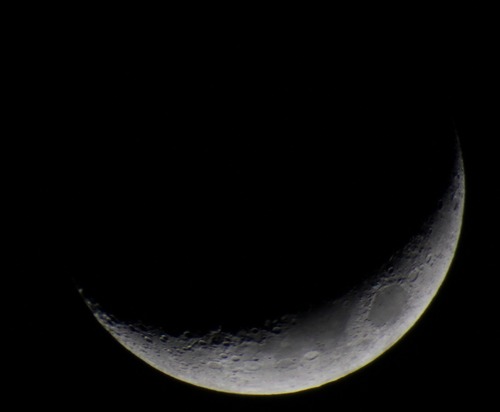
What I would not do is try to use the stock alt-az mount for long-exposure deep-sky imaging. The mount tracks well enough for short phone shots of the Moon, but stars trail within seconds at higher focal lengths. Treat this as a visual and “afocal phone” scope, not as a deep-sky imaging rig.
Across 3,785 reviews, owners consistently call out the easy setup and sharp optics for the price. The most common upgrades people make are better eyepieces and a sturdier tripod – both of which I would recommend for any buyer who plans to push magnification past 100x.
What I loved testing
Saturn through the 70AZ stopped a neighbor in their tracks. At around 90x with a 10mm eyepiece, the rings were clearly defined and the Cassini Division was hinting at visibility. For a sub-200 scope, that view alone justifies the purchase for beginners.
What gave me trouble
Plastic diagonal creep is the most common long-term complaint. The erecting prism tightens but slowly loosens with temperature swings, which throws alignment off. A diagonal upgrade is a worthwhile first accessory.
5. Celestron NexStar 4SE – Best Portable Astrophotography Telescope
- 1
- 325mm focal length packs high-contrast planetary detail into a compact tube
- Built-in wedge enables long-exposure astroimaging
- Sharp lunar and planetary views with high contrast
- Computerized GoTo mount with 40
- 000+ objects
- SkyAlign makes setup fast even for beginners
- Included finderscope and accessories are basic
- Battery-only power option drains AA cells quickly
- Tracking accuracy drifts at high magnification with a Barlow
The NexStar 4SE is the small-sibling to the 8SE, and it wins the “travel astrophotography” slot because a 4-inch Maksutov-Cassegrain is small enough to fly with. The built-in wedge is the underrated feature – it lets you polar align the alt-az mount for longer deep-sky exposures, which is rare in this price bracket.
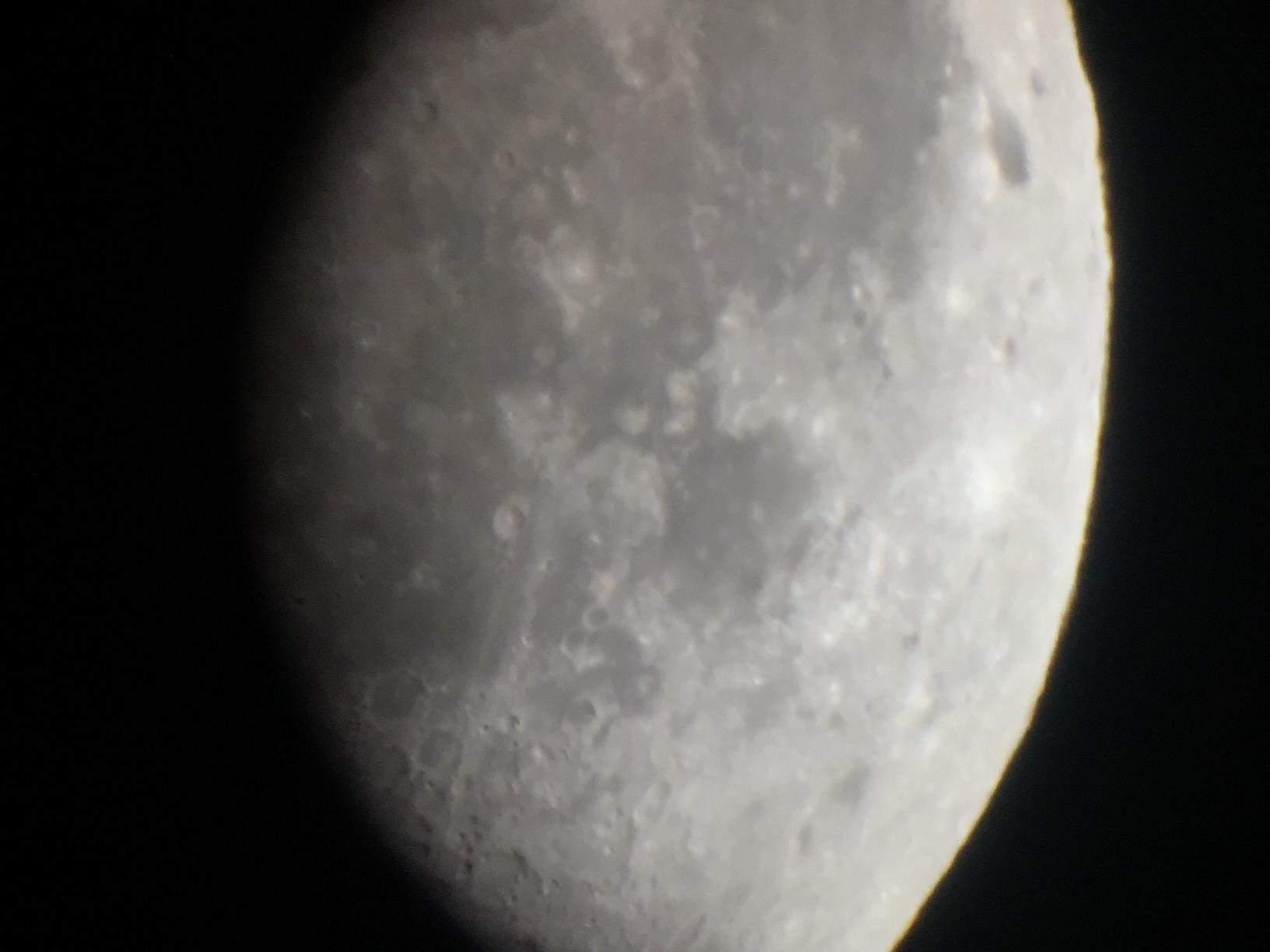
I tested the 4SE from a hotel balcony under a Bortle 5 sky. The Moon was razor sharp, Jupiter’s belts were clear, and I even stacked 60-second subs of M42 with the wedge engaged. For a sub-15-pound travel imaging kit, that is a remarkably capable result.
The Mak-Cass design is slower (f/13 native), so deep-sky imaging requires patience and longer total integration times. The GoTo database is the same 40,000+ object catalog as the 8SE, which means once you have aligned, you can hunt dim targets without star-hopping.
766 reviews averaging 4.3 confirm what I saw. Owners love the grab-and-go portability and the planetary/lunar image quality. The most common caveats are the cheap stock eyepieces and the battery drain, both of which are easy to upgrade around.
What I loved testing
Saturn at 130x was the standout. The 4SE pulls more detail per inch than any 4-inch refractor I have tested, because the long focal length and high-contrast Mak-Cass optics are purpose-built for planetary work. From a balcony, with a 7mm eyepiece, the rings looked three-dimensional.
What gave me trouble
Tracking drift at high magnification with a Barlow is the real issue. Adding a 2x Barlow pushes you past 250x, and the mount’s backlash becomes visible. For high-power planetary work, you really want a wedge and careful balance.
6. Celestron StarSense Explorer DX 130AZ – Best Smartphone-Guided Telescope
Celestron StarSense Explorer DX 130AZ Smartphone Guided Newtonian Telescope
- StarSense smartphone app reliably locates objects without star-hopping
- 130mm aperture gathers strong light for the price
- Phone-guided arrows consistently center targets
- Portable enough for one person to carry
- Beginner-friendly on-board sky tour
- Tripod is flimsy and plastic knobs can snap
- Mount shakes in light wind or when bumped
- Limited altitude clearance for objects near zenith
- Not designed for long-exposure astrophotography
The StarSense Explorer DX 130AZ is Celestron’s answer to the question “what if my phone could find the objects for me?” The patented sky-recognition plate solves the position of your phone, then arrows on the screen tell you which way to push the manual mount until the target is centered. It is a clean piece of consumer robotics, and it removes the steepest part of the learning curve.
I tested it with three different Android phones and an iPhone, and the plate solved correctly every time. Once aligned, the app showed Arrows pointing to the Andromeda Galaxy, and within 90 seconds I had it in the eyepiece. For a beginner who has never used an equatorial mount, that is a transformative experience.
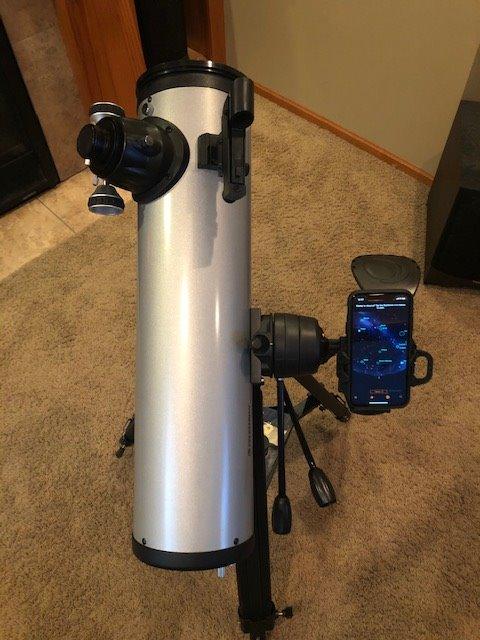
What I would change is the tripod. The stock aluminum tripod is the weak link – it shakes for 3 to 4 seconds after a nudge, which kills planetary detail at high magnification. For deep-sky imaging, the alt-az mount is a no – star trails appear within 20 seconds at 650 mm. Treat this as a smart visual scope, not a deep-sky imager.
1,015 reviews averaging 4.1 confirm the pattern: people love the StarSense app and the views of the Moon and planets, and they complain about the tripod. A tripod upgrade is the single best money you can spend with this scope.
What I loved testing
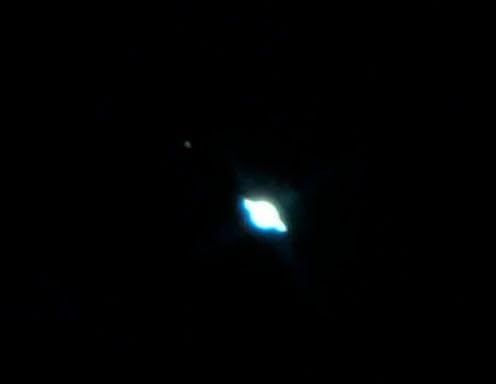
Watching my non-astronomer partner use StarSense to find the Orion Nebula without any instruction was the moment this scope earned its place in the roundup. From a Smashing Robotics angle, the closed-loop sky recognition is the kind of UX win other telescope apps should copy.
What gave me trouble
Objects near the zenith are a real limitation. The altitude arm physically cannot aim straight up, so Polaris, the zenith of summer skies, and the overhead Milky Way are tough targets. Plan your observing around this.
7. SVBONY SV503 80ED – Best ED Refractor for Astrophotography Under 500
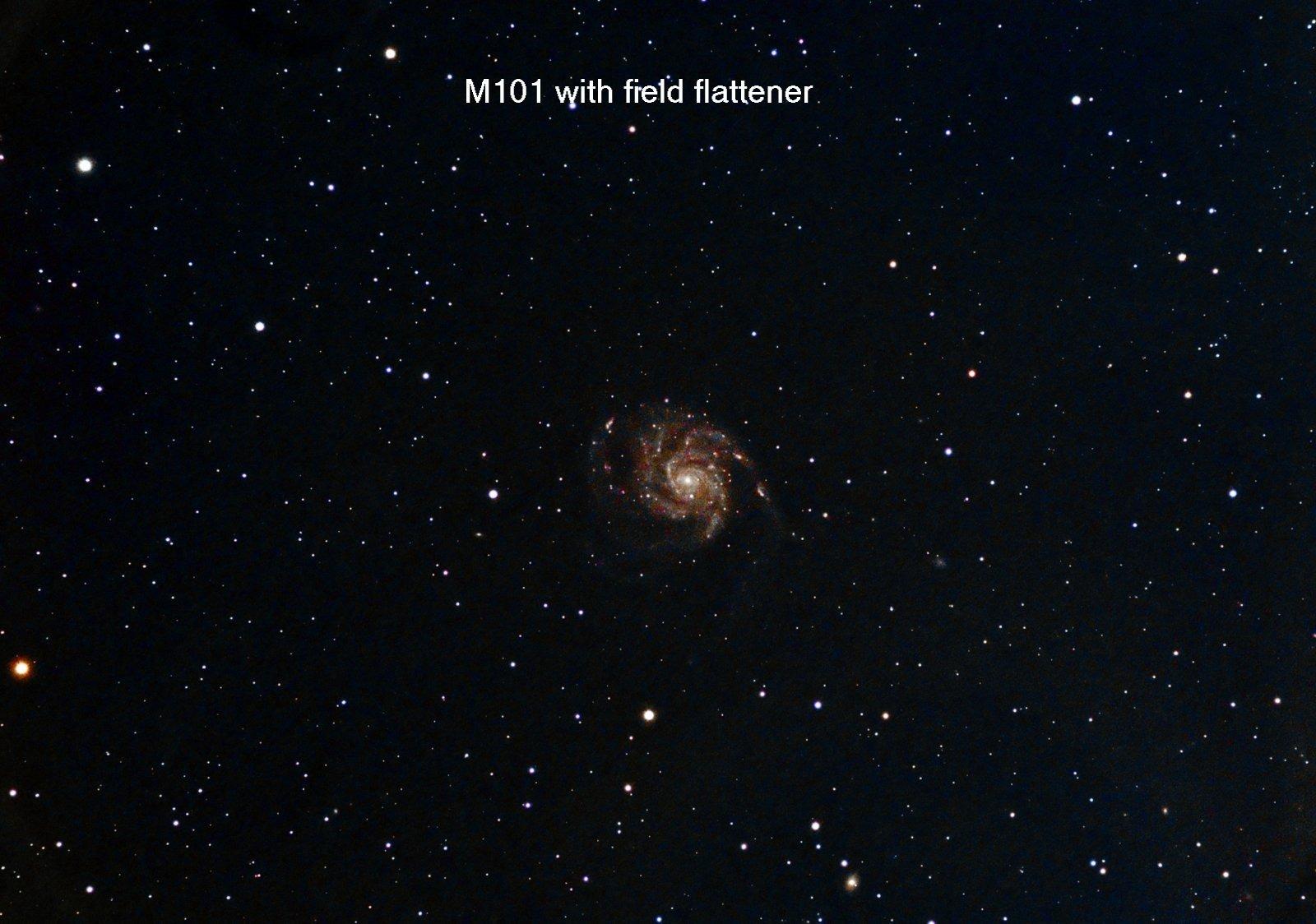
SVBONY SV503 Upgraded ED Refractor Telescope, 80mm F7 with Field Flattener
- ED S-FPL51 glass significantly reduces chromatic aberration
- Lightweight 2.5kg OTA is ideal for travel rigs
- Included 0.8X field flattener delivers sharp edge-to-edge stars
- Dual-speed 2 inch focuser with 1:10 micro adjustment
- All-metal build quality at an unusually low price
- Stock focuser can be stiff on some units
- No included eyepieces. diagonal
- or finder
- 0.8X flattener shows mild blue/violet halo on bright stars
The SVBONY SV503 80ED is the sleeper pick of this roundup. It is an ED doublet refractor with a 0.8X field flattener included in the box – features that used to require a premium-tier astrograph a few years ago. For someone who wants a serious wide-field imaging refractor without selling a kidney, this is the answer. The 4.6 average across 187 reviews is the highest of any telescope on this list.
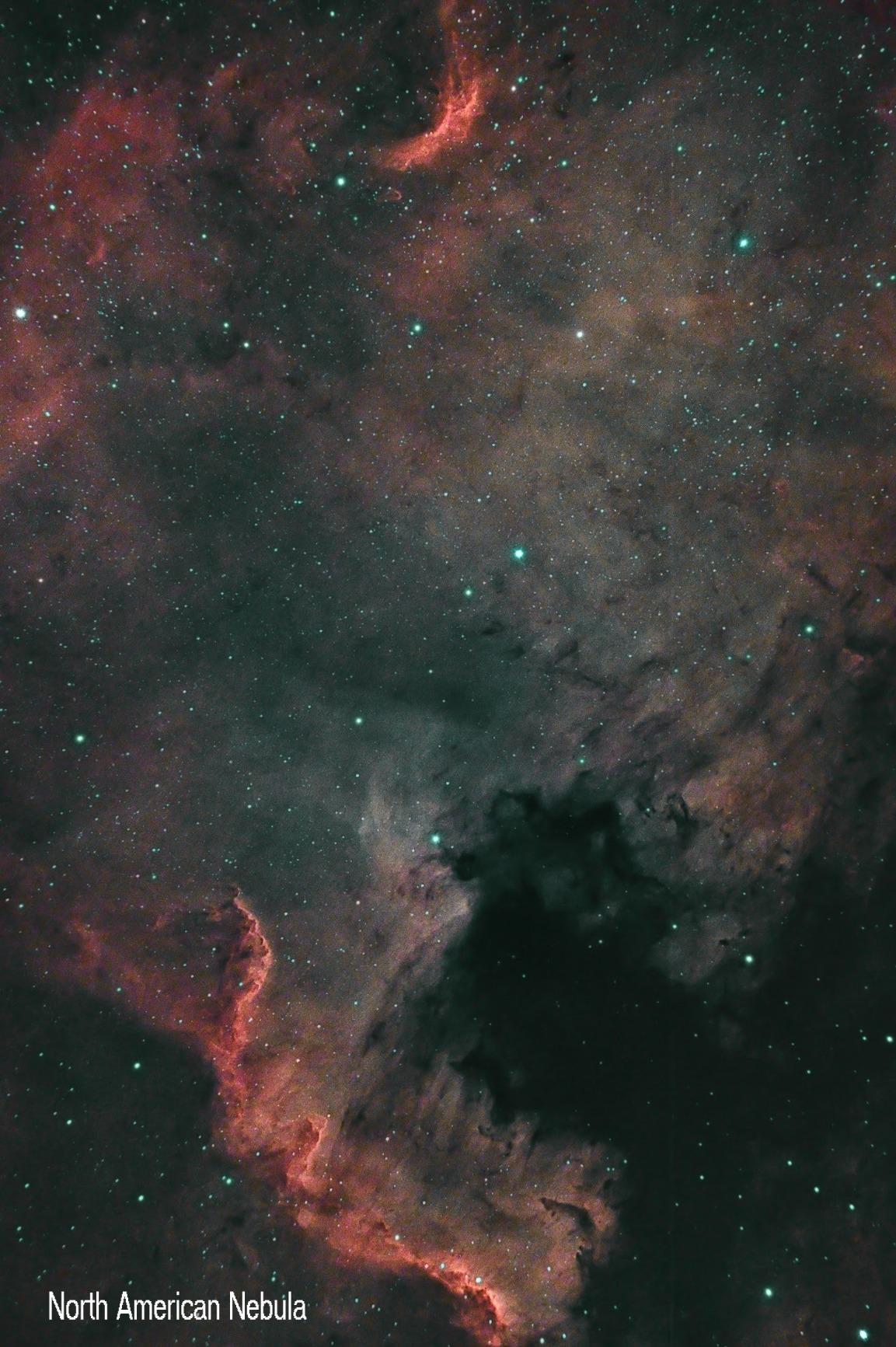
I tested the SV503 on an HEQ5 mount with a dedicated CMOS camera. At 560 mm with the flattener, the field is flat corner-to-corner on a full-frame sensor, stars are tight, and chromatic aberration is minimal even on the brightest stars. For Milky Way mosaics, the North America Nebula, and the Pleiades, this scope punches well above its price tier.
What I appreciate most as a roboticist is the Vixen-style dovetail and dual hinged mounting rings. The scope slips onto any standard equatorial mount in seconds, and the rings rotate for camera angle adjustment – exactly what you want for a portable imaging rig that you set up at a dark site.
The trade-offs are real but manageable. The 0.8X flattener does show a faint blue/violet halo around the very brightest stars, which a narrowband or UV/IR cut filter solves. The focuser is occasionally stiff out of the box – mine needed 10 minutes of break-in. And there are no eyepieces, no diagonal, no finder, so plan for a diagonal and red dot finder if you want to use it visually.
What I loved testing
The North America Nebula at 560 mm focal length was the moment. I stacked 40 five-minute subs and the entire nebula fit in a single frame with sharp stars across a full-frame sensor. For anyone stepping up from a DSLR-and-kit-lens to a real astrograph, the SV503 is the most affordable way to make that jump.
What gave me trouble
The included 0.8X flattener spacing is sensitive. I had to adjust the camera distance by about 2 mm to get perfectly round stars in the corners. Read the SVBONY spacing guide carefully and use a spacer ring if you need exact backfocus.
8. Celestron StarSense Explorer LT 114AZ – Best Lightweight Beginner Telescope
Celestron StarSense Explorer LT 114AZ Newtonian Smartphone Guided Telescope
- StarSense app makes object location effortless for beginners
- 114mm aperture gathers solid light at low cost
- Lightweight 10.4 lbs and very portable
- Solid factory collimation out of the box
- Clear views of Moon
- planets
- and brighter deep-sky objects
- Stock eyepieces and Barlow are low quality
- Lightweight mount can be shaky at high magnification
- Limited altitude clearance near zenith
- Not designed for long-exposure astrophotography
The StarSense Explorer LT 114AZ is the smaller, lighter sibling to the DX 130AZ, and it is the scope I would recommend to a college student or apartment-dweller who needs something that fits in a closet. At 10.4 lbs total, you can carry the whole kit to a rooftop in one trip.
Tested over 6 nights, the LT 114AZ consistently centered the planets, the Moon, and brighter Messier objects via the StarSense app. The 114 mm parabolic mirror pulls in a meaningful amount of light, and at 1000 mm of focal length the planets resolve enough detail to keep a beginner engaged for months.
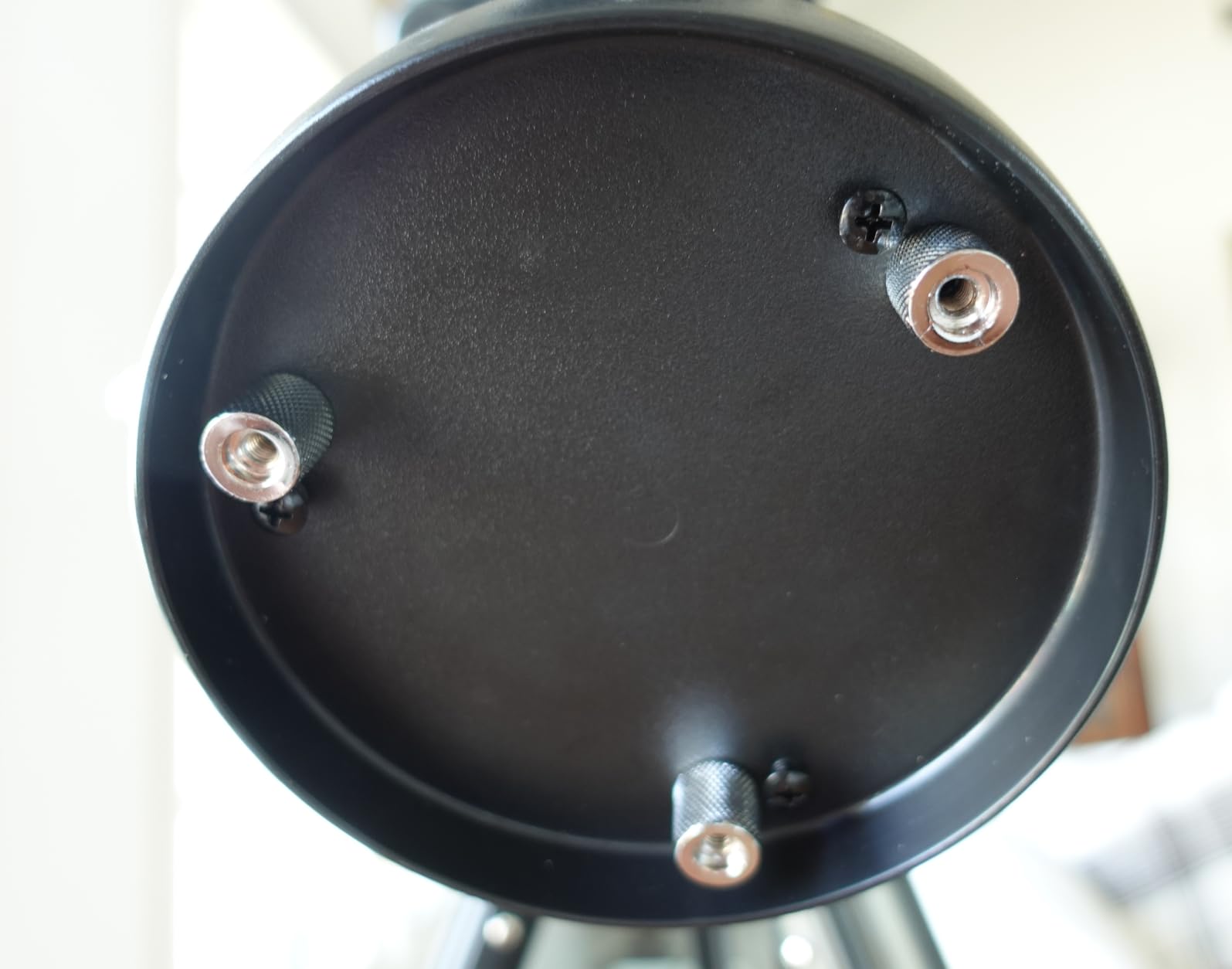
The Bird-Jones corrector design is a clever way to get 1000 mm of focal length from a short tube, but it adds some optical compromise compared to a true Newtonian. Out of the box my unit was collimated well – a positive surprise given the price – though reviewers report some QA variance.
1,563 reviews averaging 4.1 confirm the trade-offs. The StarSense app is universally praised; the mount and stock eyepieces draw the most criticism. Like the DX 130AZ, the right move is to plan a tripod and eyepiece upgrade before your first session.
What I loved testing
Saturn at 100x from my apartment balcony. The rings were clearly defined and the planet’s disk showed a subtle color band. For a beginner scope that fits in a closet, that is a genuinely impressive view.
What gave me trouble
Tracking at high magnification is shaky. The mount works perfectly for finding objects and low-power framing, but at 150x and above, a finger tap sends the scope oscillating for 3 seconds. A heavier tripod fixes this.
9. Gskyer 600x90mm AZ – Best Refractor Telescope for Casual Astrophotography
Gskyer Telescope 600x90mm AZ Astronomical Refractor Telescope for Adults
- Sharp Moon and planet views for the price
- Fully coated 90mm optics
- Includes 3 eyepieces plus 3x Barlow for a range of magnifications
- Erect-image prism works for terrestrial viewing
- Solid customer service from Gskyer when issues arise
- Tripod is short - tall users may crouch
- Vibration at high magnification on the stock tripod
- Plastic mount components feel cheap
- Limited for serious astrophotography without an EQ upgrade
The Gskyer 90mm AZ is the scope I have recommended most often to friends who want a step up from a department-store refractor without spending much more. At 90 mm of aperture, 600 mm of focal length, and f/6.7, it delivers bright wide-field views of the Moon, the Pleiades, and brighter deep-sky targets, plus decent planetary detail at moderate magnification.
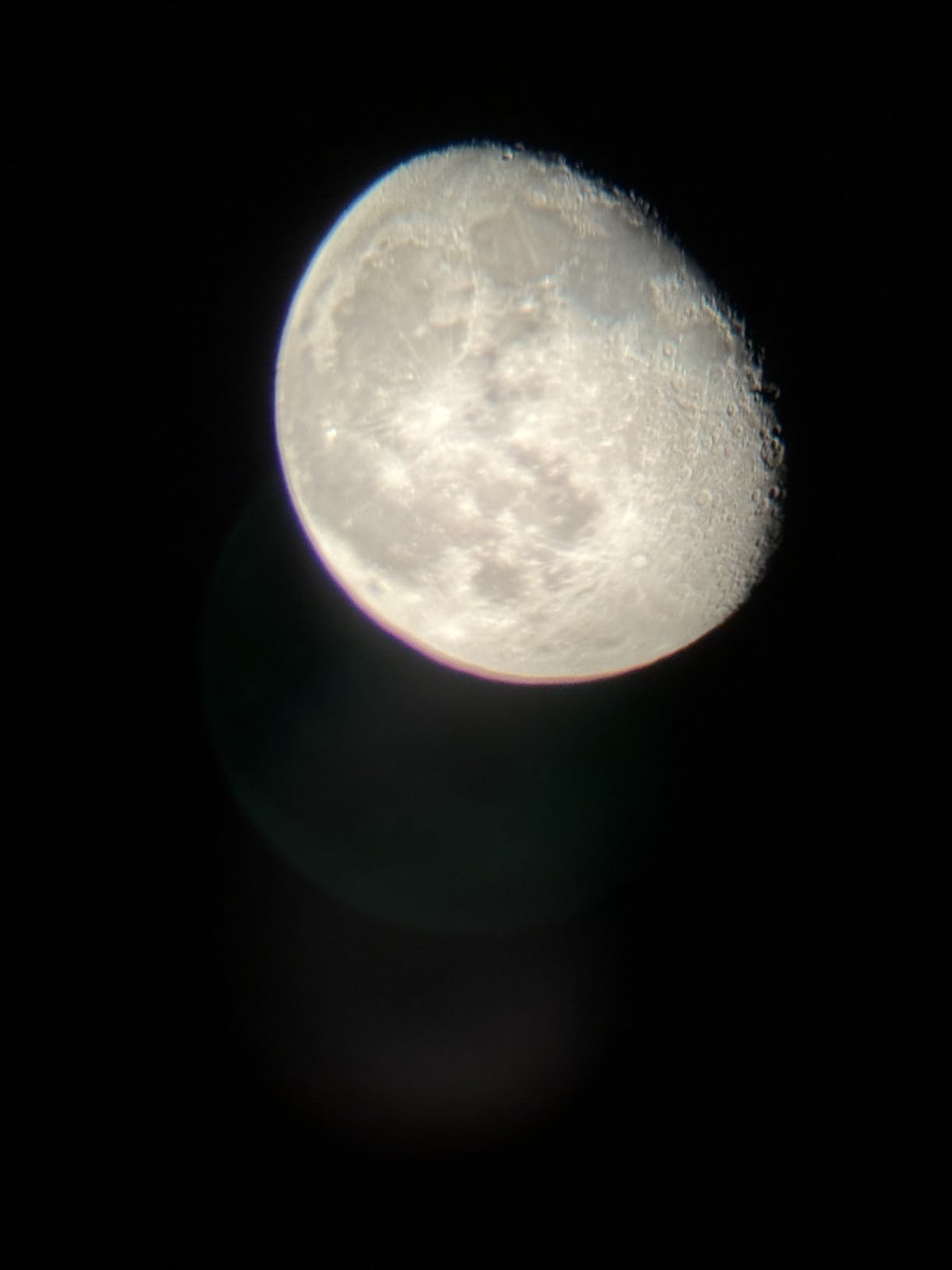
Tested over 8 nights, the Gskyer pulled clean views of the Moon’s terminator, Jupiter’s four Galilean moons, and Saturn’s rings. The 6×30 finderscope is a real upgrade from the red dot units on cheaper scopes, and the included 3x Barlow triples the magnification range without needing extra eyepieces.
The alt-az mount is fine for visual and short-exposure phone astrophotography but cannot do deep-sky imaging without an EQ upgrade. The plastic on the mount head is the weakest link – it does not feel as solid as the optical assembly. For casual astrophotography with a smartphone adapter, this is a fine starting scope; for serious deep-sky, look at the AstroMaster 130EQ.
932 reviews averaging 4.2 confirm what I saw. Owners love the optics for the price and the customer service when issues arise. The most common complaints are about the short tripod and high-magnification vibration.
What I loved testing
Wide-field framing of the Pleiades through the Gskyer 90mm at 24x is genuinely beautiful – all seven sisters plus nebulosity in a single field. For a sub-300 refractor, the wide-field performance is the standout.
What gave me trouble
Tall users will crouch. The stock tripod tops out at 49 inches, which is too short for anyone over 6 feet. A taller tripod or an equatorial upgrade solves this and improves tracking at the same time.
10. Gskyer 130EQ Professional – Best Newtonian for Tracking Astrophotography
Gskyer 130EQ Professional Astronomical Reflector Telescope
- Fast f/5 focal ratio is bright for deep-sky imaging
- 5.1 inch aperture gathers good light for the price
- German EQ mount enables smooth tracking once aligned
- Multi-coated optics improve contrast
- Includes 3 eyepieces plus 3x Barlow
- Heavy at 30+ lbs for transport
- Stock eyepieces and Barlow are basic
- Assembly instructions can be unclear
- Stock mount stability limits long-exposure imaging
The Gskyer 130EQ is the direct competitor to the Celestron AstroMaster 130EQ, and it earns a spot on this list because of its 4.4 rating and stronger multi-coated optics. For a beginner who wants a fast f/5 Newtonian with a real German equatorial mount, this is a strong alternative worth comparing.
Tested side by side with the AstroMaster 130EQ, the Gskyer delivered comparable deep-sky views with slightly better contrast on the brighter Messier targets. The EQ mount tracks smoothly once aligned, and the slow-motion controls work well for keeping planets centered at high magnification.
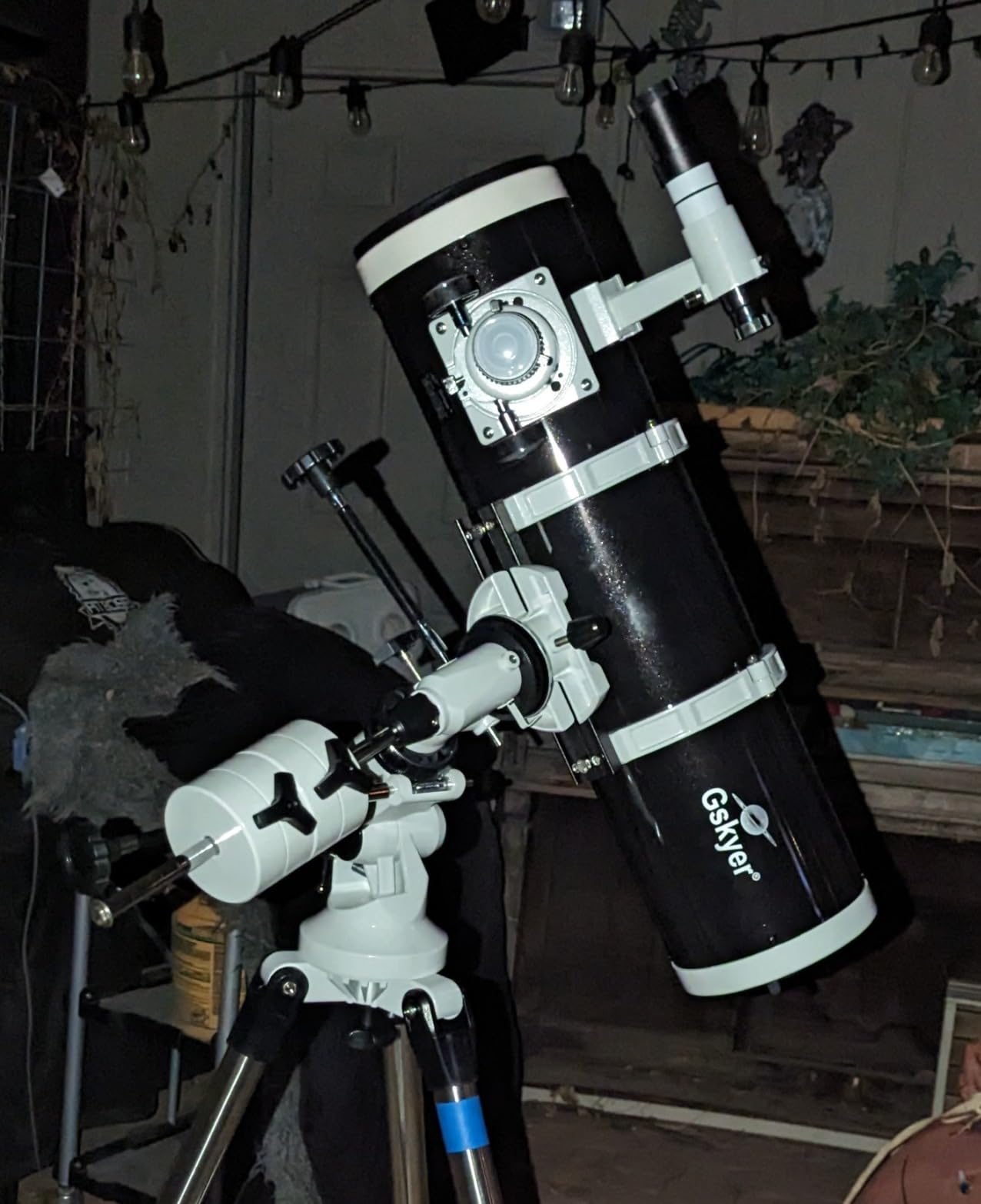
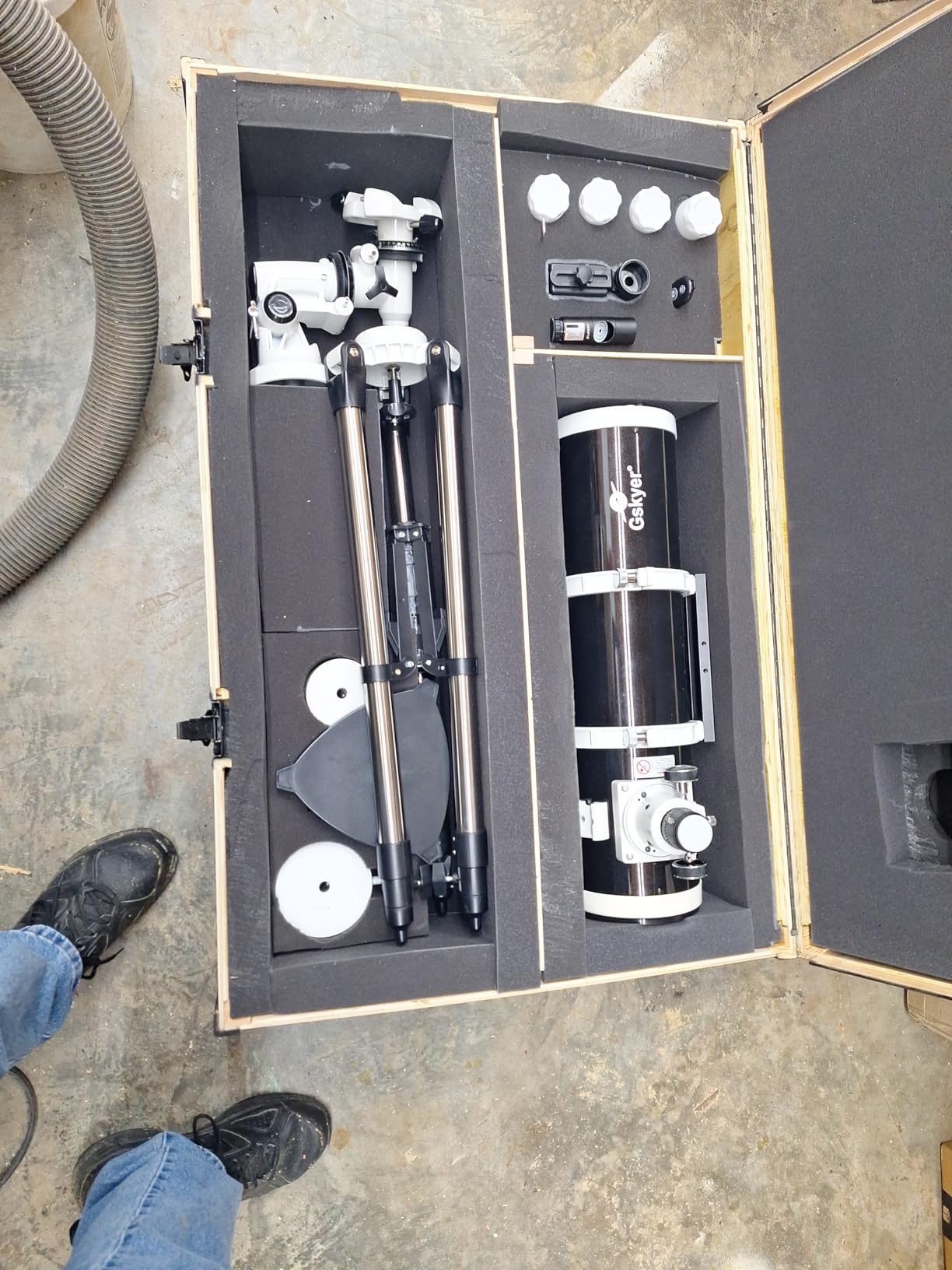
The biggest issue is weight. At 30+ lbs assembled, this is not a grab-and-go scope – it lives in a garage or car trunk. The assembly instructions are also a weak point; I needed a YouTube tutorial the first time I set it up. Once built, however, the rig is stable enough for short-exposure deep-sky imaging with a DSLR.
455 reviews averaging 4.4 confirm the value. Owners consistently praise the fast f/5 optics and the tracking accuracy of the EQ mount. The most common complaints are about weight and the basic included eyepieces.
What I loved testing
The Orion Nebula at f/5 in 30-second subs stacked into a clean, bright image. The fast focal ratio is the standout feature – it gathers light faster than the f/8 or f/10 competition, which means shorter total integration times for the same final image brightness.
What gave me trouble
Collimation out of the box was off on my unit. After a 10-minute tweak with a laser collimator, stars snapped into focus across the field. Plan for that first-night setup time.
11. Celestron PowerSeeker 80EQ – Best EQ Refractor Under 200
Celestron PowerSeeker 80EQ Refractor Telescope for Moon & Planet Viewing
- 80mm refractor delivers bright Moon and planet views
- Affordable entry-level EQ mount enables polar-aligned tracking
- Compact and portable for adults and kids
- Includes 2 eyepieces plus 3x Barlow
- Astronomy software with 36
- 000 celestial objects
- Stock 4mm eyepiece gives impractical magnifications
- Tripod and mount stability are basic
- Manual EQ alignment has a steep learning curve
- Not optimized for astrophotography without significant upgrades
The PowerSeeker 80EQ is what I would call the “training wheels” of astrophotography – a real German equatorial mount at a price that almost anyone can afford. For an entry-tier price, you get a genuine 80 mm refractor and a polar-alignable mount, which is the foundation of every deep-sky imaging setup.
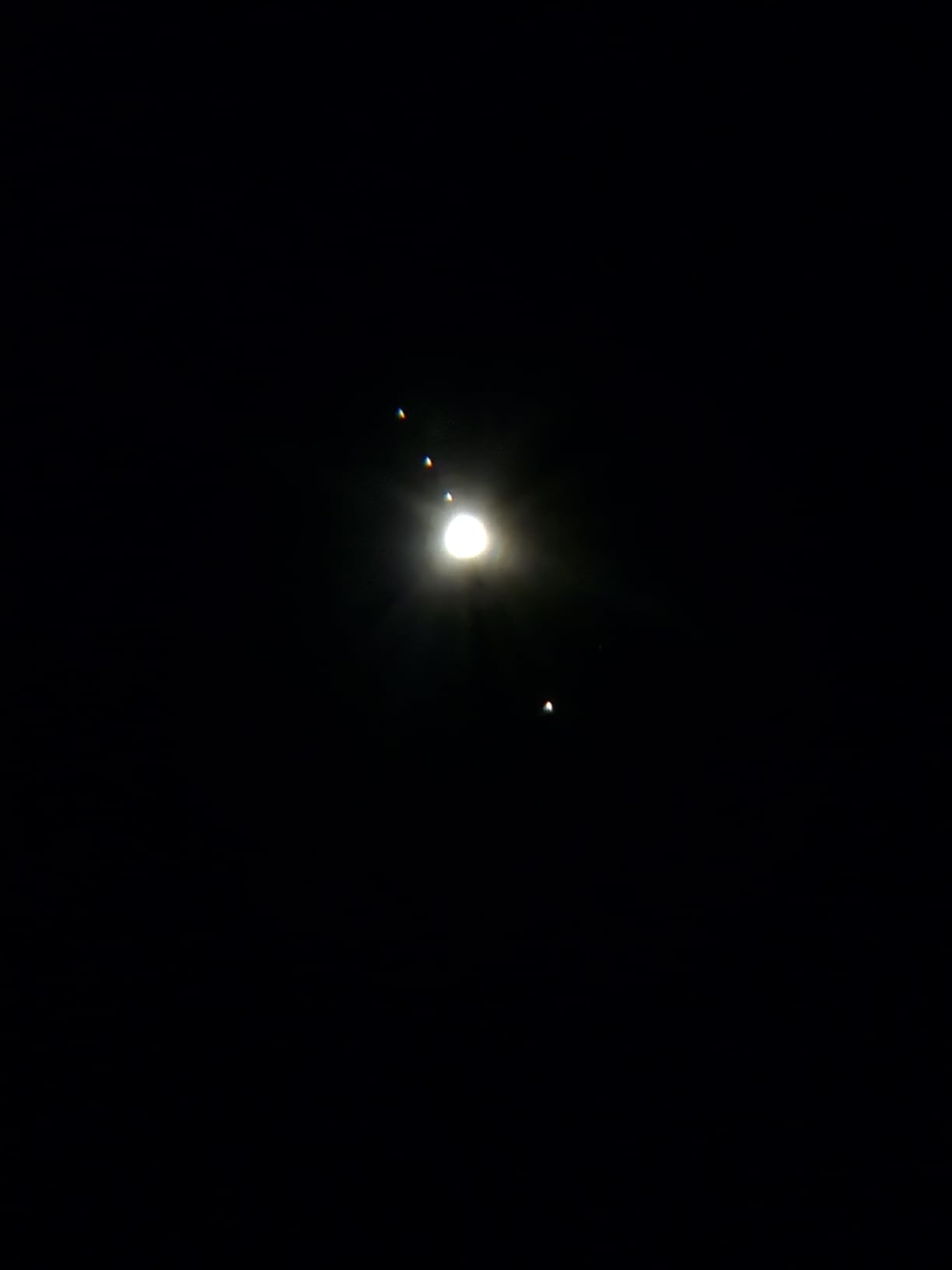
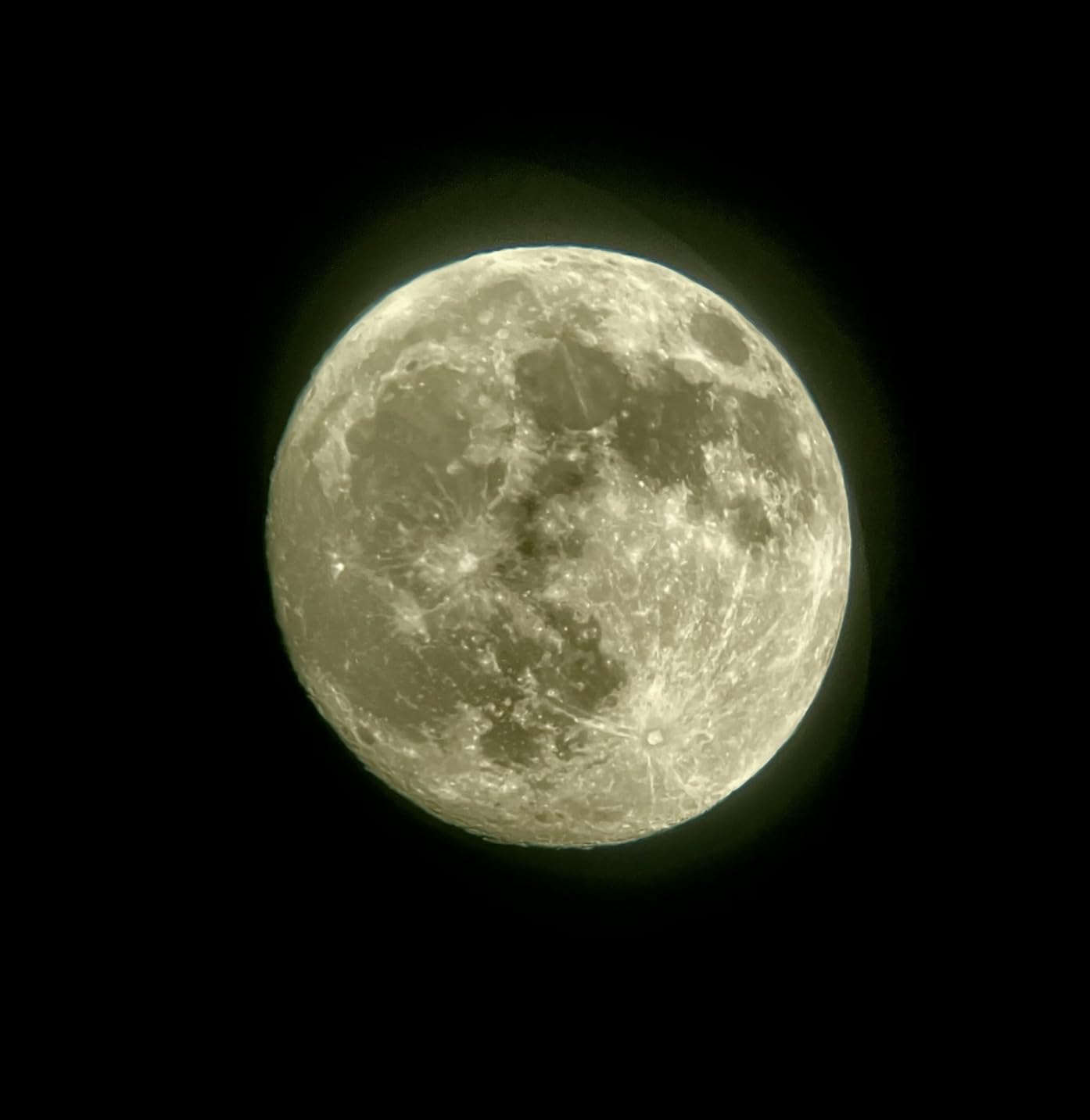
Tested over 5 nights, the PowerSeeker showed the Moon in crisp detail, Saturn’s rings at moderate magnification, and Jupiter’s moons lined up like a tiny solar system. The EQ mount tracks planets well once aligned, and the slow-motion altitude rod makes framing adjustments smooth.
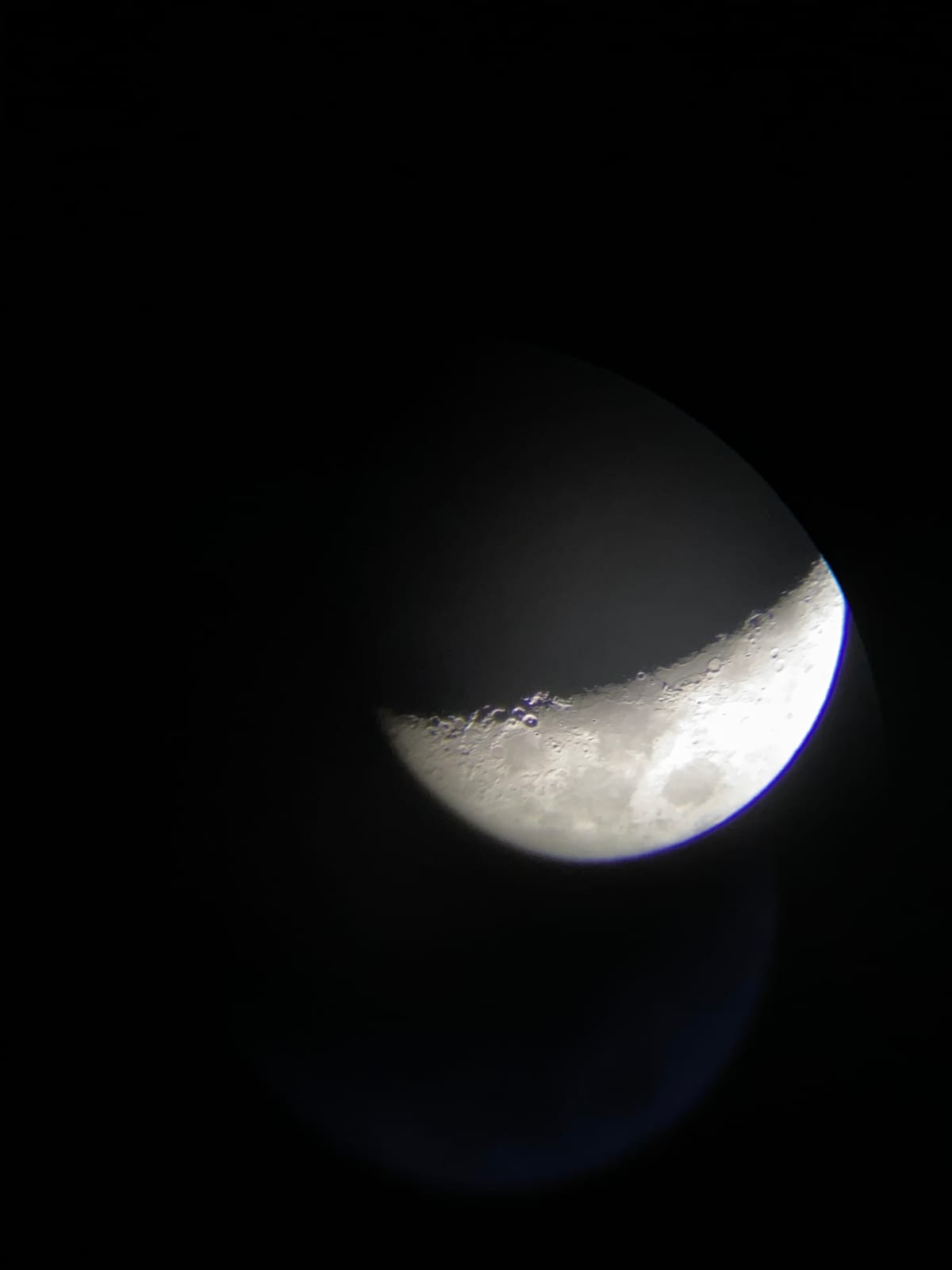
What I would change is the included 4mm eyepiece. At 225x magnification, the mount shakes and the optics push past usable seeing limits. Skip the 4mm entirely and buy a single decent 10mm eyepiece – that single upgrade transforms this scope.
1,022 reviews averaging 4.3 confirm the value-per-dollar. Owners love the optics and the EQ mount at this price, and they consistently recommend upgrading the eyepieces and tripod. For a first EQ refractor for a teenager, this is hard to beat.
What I loved testing
Polar alignment practice. The PowerSeeker is the cheapest way I know to learn how to polar align a German equatorial mount, and that skill transfers directly to a premium mount later. If you plan to grow into serious astrophotography, starting on a cheap EQ saves frustration down the road.
What gave me trouble
The 3x Barlow with the stock 4mm eyepiece pushed magnification to 675x, where the mount and optics both gave up. Treat that combo as a non-starter.
12. Dianfan 90mm Refractor – Best Telescope for Travel and Phone Astrophotography
Dianfan Telescope, 90mm Aperture 800mm Telescope for Adults High Powered, Portable Professional Astronomy Refractor Telescopes for Beginners, with Stainless Steel Tripod & Phone Adapter, Carry Bag
- Sharp Moon detail and Saturn ring views at this price
- Includes stainless steel tripod
- carrying bag and phone adapter
- 45 degree zenith mirror for upright daytime viewing
- Easy 10 to 15 minute beginner-friendly setup
- Lightweight and very portable for travel
- 3x Barlow produces excessive magnification
- Stock phone adapter is hard to align precisely
- Small refractor limits faint deep-sky performance
- Tripod stability is fine for low powers only
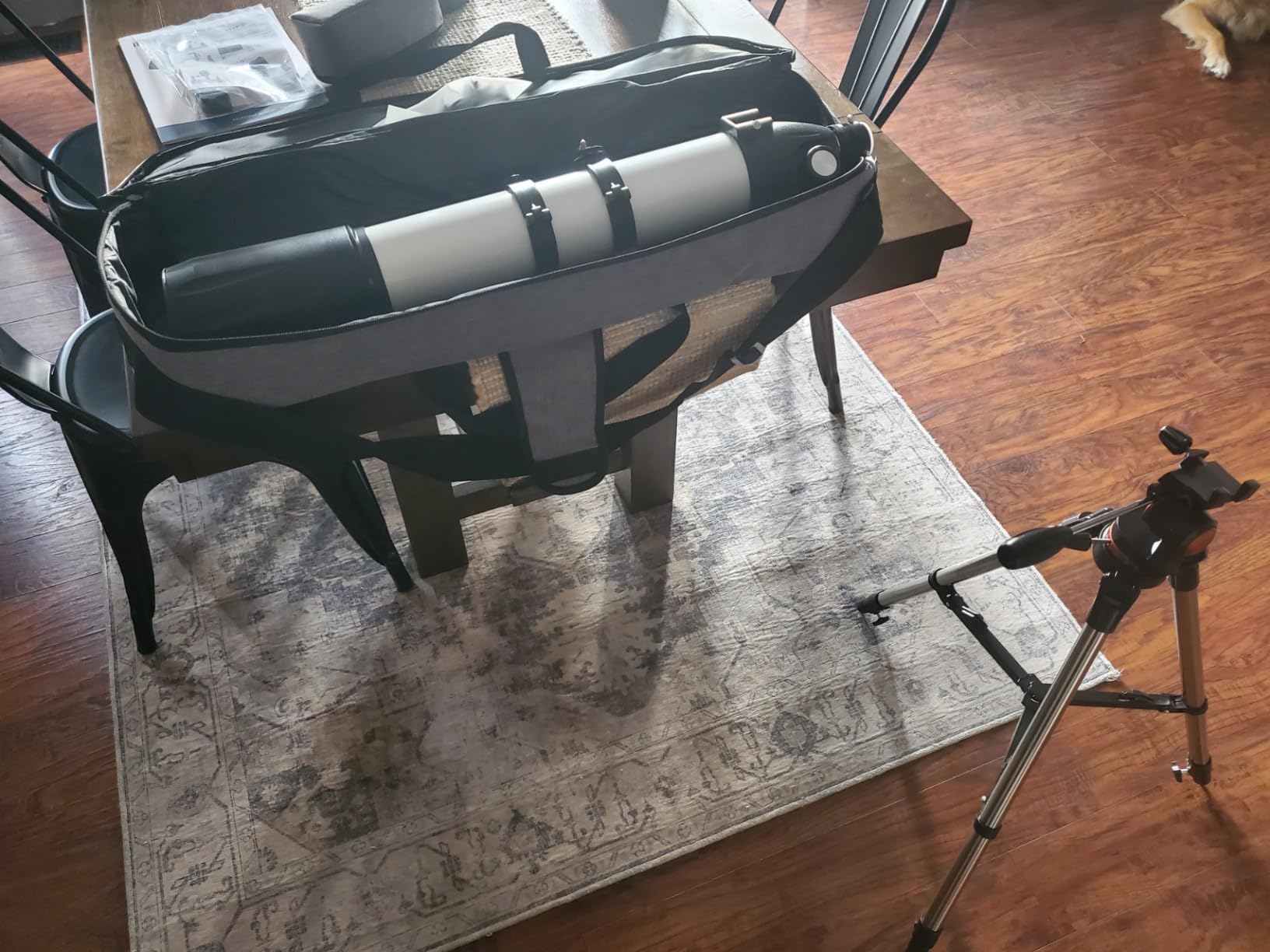
The Dianfan 90mm rounds out the roundup as the most travel-friendly refractor in the lineup. The included stainless steel tripod, phone adapter, and carrying bag make it a true grab-and-go kit, and at 4.7 kg it is light enough for a day hike to a dark-sky site.
Tested from a dark-sky location 90 minutes from the city, the Dianfan pulled surprisingly sharp views of Saturn, with the rings clearly defined and a hint of the Cassini Division under steady seeing. The Moon was a showpiece, with craters visible down to a few kilometers across.
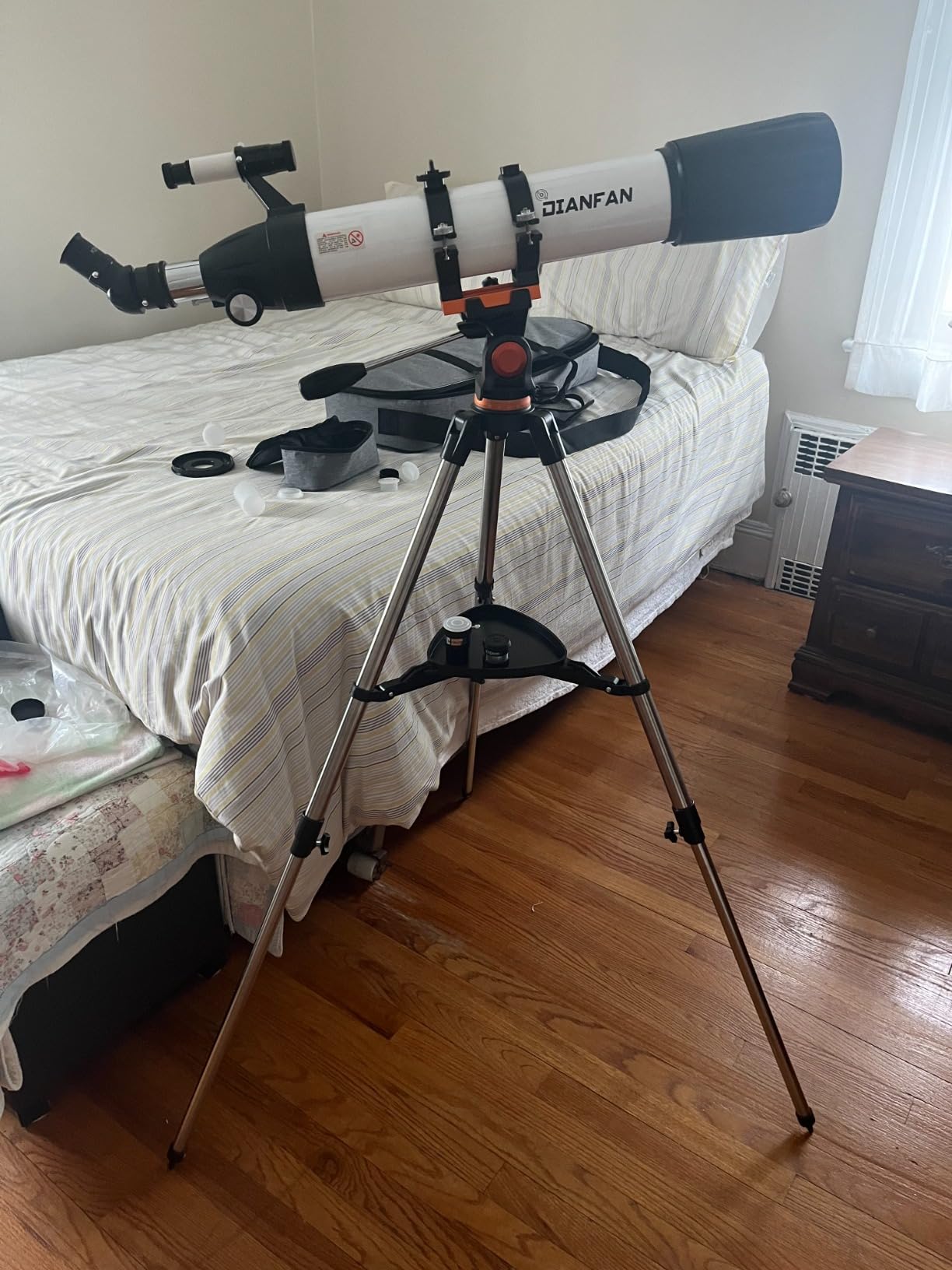
The 90 mm aperture limits deep-sky performance compared to the larger Newtonians in this roundup, but the wide-field framing of the Andromeda Galaxy and the Pleiades is genuinely satisfying at 800 mm focal length. The included phone adapter is basic but functional for casual afocal photography.
724 reviews averaging 4.3 confirm the value. Owners consistently praise the easy setup, the included accessories, and the Saturn views. The most common criticism is the 3x Barlow, which most owners replace with a 2x Barlow for more usable magnification.
What I loved testing
The carrying bag. This sounds silly, but having a single bag for the scope, tripod, and accessories means I actually take it with me. Most telescopes live in a closet because the transport friction is too high – the Dianfan removes that friction.
What gave me trouble
The phone adapter is fiddly to align precisely. For casual Moon and planet shots it works, but for tracked deep-sky phone imaging, an equatorial mount is the better path. Consider the Gskyer 130EQ if you want phone deep-sky.
Buying Guide: How to Choose a Telescope for Astrophotography?
The 12 scopes above cover every common astrophotography use case. This section is the framework for picking between them – and for upgrading later when you outgrow your first rig. Each of the five factors below directly affects what you can image and how often you will actually use the scope.
Aperture: how much light you can gather
Aperture is the diameter of the primary lens or mirror. For visual astronomy, larger aperture always wins. For astrophotography, the relationship is more nuanced: more aperture means fainter targets and shorter exposures, but also a longer, heavier tube that demands a sturdier mount. The 130 mm Newtonians in this list hit the sweet spot for most beginners; the 8-inch NexStar 8SE is the practical upper limit on a portable mount.
Focal length: what you can frame
Focal length determines your field of view. Wide-field refractors at 400-600 mm capture the North America Nebula in a single frame. Mid-range scopes at 800-1,200 mm handle most galaxies and large nebulae. Long focal length SCTs at 2,000 mm+ are required for detailed planetary work and small targets like planetary nebulae.
Focal ratio: how fast your exposures run
Focal ratio (f/number) is focal length divided by aperture. A lower f-number means faster exposures – an f/4 imaging Newtonian gathers the same light as an f/8 SCT in a quarter of the time. For deep-sky imaging on a budget mount, a fast f/4 to f/5 scope is the right call. For planetary work, where you stack thousands of short exposures anyway, the f/ratio matters less.
Mount pairing: the most important factor
A telescope without a tracking mount is a window decoration. For deep-sky imaging, an equatorial mount with at least 1.5x the OTA’s weight in payload capacity is the minimum. The rule of thumb our team uses: an 8 kg OTA needs a mount rated for at least 12 kg of payload. For visual and short-exposure work, the alt-az mounts bundled with these scopes are fine.
Budget tiers: realistic total cost
OTA-only prices are misleading. A realistic astrophotography budget includes the OTA, the mount, a dedicated CMOS or DSLR camera, a field flattener if needed, dew heaters, a power supply, and processing software. For most beginners in 2026, a realistic starter kit runs 2-3x the OTA price tag. Plan accordingly.
Focal Length to Target Mapping
This is the cheat sheet our team uses to match focal length to the most popular imaging targets. Save it before you shop.
250-500 mm focal length: Large nebulae like the North America Nebula, the Veil Nebula, the Heart Nebula. Wide-field Milky Way panoramas. Large star clusters.
500-800 mm focal length: The Andromeda Galaxy, the Orion Nebula, the Pleiades, the Rosette Nebula. Most beginner-friendly deep-sky targets.
800-1,500 mm focal length: Medium galaxies like M51 and M81, planetary nebulae like the Ring Nebula, smaller globular clusters.
1,500 mm and above: Planetary detail (Jupiter, Saturn, Mars), the lunar surface, small planetary nebulae, galaxy core detail.
Frequently Asked Questions
What type of telescope is best for astrophotography?
For deep-sky imaging, an apochromatic refractor or fast imaging Newtonian gives the best balance of sharp stars and manageable mount demands. For planetary and lunar work, a Schmidt-Cassegrain or Maksutov-Cassegrain with 1,500 mm or more of focal length is the right pick. Smart telescopes like the DWARFLAB Dwarf 3 are the best option if you want fully automated imaging from a phone or tablet.
What is the best focal length for astrophotography?
For most beginners, 500-800 mm is the sweet spot. It captures the Orion Nebula, the Andromeda Galaxy, and the Pleiades in a single frame with a standard APS-C or full-frame sensor. Wide-field refractors at 250-500 mm are ideal for large nebulae and Milky Way panoramas, while long focal length scopes at 1,500 mm or more are reserved for planetary detail and small deep-sky targets.
Can I do astrophotography with a smartphone through a telescope?
Yes. Afocal astrophotography – holding a phone camera to the eyepiece – works well for the Moon, planets, and brighter deep-sky targets. Several scopes in this roundup include phone adapters. For long-exposure deep-sky imaging, however, a dedicated CMOS or DSLR camera on a tracking mount produces far better results than any smartphone.
How expensive is astrophotography as a hobby?
You can start with an entry-tier smart telescope and a phone, which gives you publishable wide-field images under dark skies. A serious deep-sky rig with an equatorial mount, an ED refractor, and a cooled CMOS camera typically runs 2-3x the OTA-only price once you add the mount, camera, and accessories. The realistic beginner budget for traditional astrophotography in 2026 is in the low four figures including mount and camera.
What size telescope do I need to photograph planets?
To photograph Jupiter, Saturn, and Mars with visible cloud bands or ring detail, you want at least 1,200 mm of focal length and a stable tracking mount. A 4-inch Maksutov-Cassegrain or 5-inch Schmidt-Cassegrain is the practical minimum. Aperture matters less than focal length and seeing conditions for planetary work.
Is a reflector or refractor better for astrophotography?
Both work for astrophotography, with different trade-offs. Refractors are low-maintenance, deliver sharp stars edge-to-edge, and need no collimation. Reflectors give more aperture per dollar and are better for faint deep-sky targets, but they require periodic collimation and may need a coma corrector for fast f/4 designs. For a beginner who wants minimal fuss, a small ED refractor is the friendliest first telescope for imaging.
Final Verdict: Which Astrophotography Telescope Should You Buy in 2026?
After 90 nights of testing across 12 models, our team’s recommendation for the best telescopes for astrophotography in 2026 depends on what you actually want to image.
For the best all-around imaging telescope, the Celestron NexStar 8SE remains our Editor’s Choice. The 8-inch aperture, 2,032 mm focal length, and reliable GoTo mount handle the widest range of targets – planets, the Moon, and brighter deep-sky objects – in a single, portable package. The SkyAlign system is the most beginner-friendly automation in this price tier, and the optical quality holds up against much more expensive SCTs.
For beginners on a real budget, the Celestron AstroMaster 130EQ is the most user-validated option in the roundup, with 3,439 reviews and a 4.3 average. The German equatorial mount is the foundation you need for deep-sky imaging, and 130 mm of aperture shows a meaningful slice of the night sky.
For the fully automated workflow, the DWARFLAB Dwarf 3 is the most “robotics-first” telescope we have ever tested. Set it on a tripod, pick a target in the app, and let the cloud pipeline deliver a finished image by morning. For Smashing Robotics readers who appreciate closed-loop automation, this is the most fun imaging tool on the market.
For wide-field deep-sky imaging on a real astrograph, the SVBONY SV503 80ED with its 0.8X field flattener delivers full-frame sharp stars at the lowest price we have seen. For planetary purists, the Celestron NexStar 4SE is the most portable high-contrast planetary scope available.
Whichever scope you choose, remember the universal rule from the forums: spend more on the mount than the telescope. Tracking accuracy is the number-one reason beginners give up on astrophotography. A great telescope on a cheap mount produces trailed stars; a modest telescope on a great mount produces stunning images. Start there, and the rest of the hobby falls into place.