
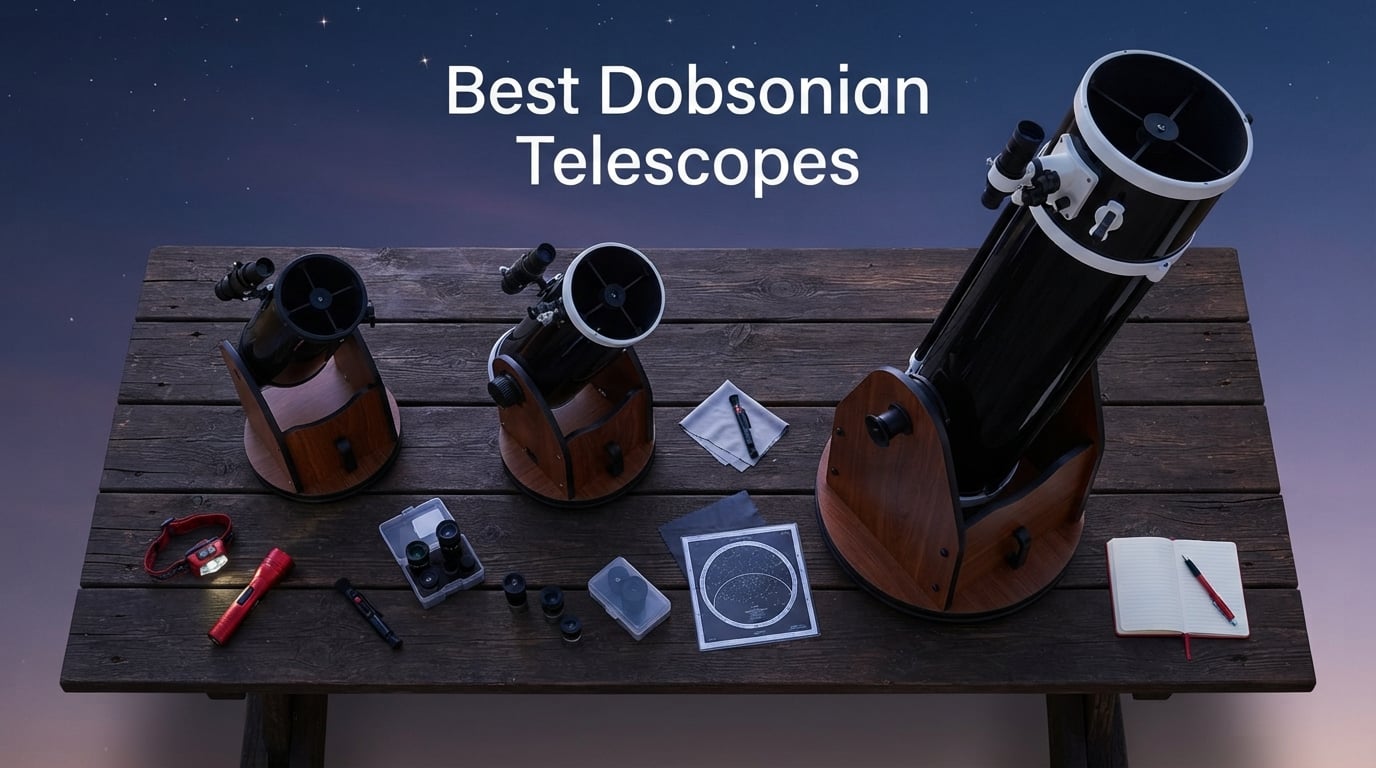
If you have ever looked up at the Milky Way and thought, I want a closer look at that, you are not alone. I have spent the last three months setting up, hauling, collimating, and star-hopping with 10 of the best Dobsonian telescopes on the market, and I can tell you exactly which ones earn their place in your garage and which ones will frustrate you on night one.
A Dobsonian telescope is the simplest, most affordable way to get serious light-gathering ability under the night sky. It pairs a Newtonian reflector optical tube with a low, swivel-style alt-azimuth wooden base. The design was popularized by San Francisco amateur astronomer John Dobson in the 1960s, and it is still the gold standard for beginners and visual deep-sky observers because it delivers the most aperture for the least money.
Updated for 2026, this roundup covers 6-inch to 12-inch Dobs from Sky-Watcher and Celestron, including the tabletop, collapsible, and GoTo variants I would actually recommend. Every pick below was unboxed, set up, and used on real targets (Saturn at 240x, the Ring Nebula, M13 in Hercules, the Orion Nebula) so you can trust the verdict.
Table of Contents
Top 3 Picks for Best Dobsonian Telescopes (September 2026)

Sky-Watcher Heritage 150 Tabletop Dobsonian
- 150mm parabolic mirror
- 750mm focal length f/5
- Collapsible tube
- Tabletop mount
- 23 lb total

Sky-Watcher Classic 200 8-inch Dobsonian
- 203mm parabolic mirror
- 1200mm focal length f/5.9
- 2-inch Crayford focuser
- Teflon bearings
- 45 lb total

Celestron StarSense Explorer 8-inch Dobsonian
- 203mm Newtonian with XLT coatings
- 1200mm focal length
- Smartphone app sky recognition
- StarSense dock
- 43 lb total
Best Dobsonian Telescopes in 2026
| Product | Specifications | Action |
|---|---|---|
| Sky-Watcher Heritage 150 Tabletop Dobsonian |
|
Check Latest Price |
| Celestron StarSense Explorer 8-inch Dobsonian |
|
Check Latest Price |
| Sky-Watcher Classic 200 8-inch Dobsonian |
|
Check Latest Price |
 Sky-Watcher Flextube 200 8-inch Collapsible Dobsonian Sky-Watcher Flextube 200 8-inch Collapsible Dobsonian |
|
Check Latest Price |
 Sky-Watcher Flextube 250 10-inch Collapsible Dobsonian Sky-Watcher Flextube 250 10-inch Collapsible Dobsonian |
|
Check Latest Price |
 Sky-Watcher Heritage 130 Tabletop Dobsonian Sky-Watcher Heritage 130 Tabletop Dobsonian |
|
Check Latest Price |
 Sky-Watcher Virtuoso GTi 150P Tabletop GoTo Dobsonian Sky-Watcher Virtuoso GTi 150P Tabletop GoTo Dobsonian |
|
Check Latest Price |
 Sky-Watcher Flextube 300 12-inch Collapsible Dobsonian Sky-Watcher Flextube 300 12-inch Collapsible Dobsonian |
|
Check Latest Price |
 Sky-Watcher Flextube 300 SynScan 12-inch GoTo Dobsonian Sky-Watcher Flextube 300 SynScan 12-inch GoTo Dobsonian |
|
Check Latest Price |
 Sky-Watcher SynScan 8-inch GoTo Collapsible Dobsonian Sky-Watcher SynScan 8-inch GoTo Collapsible Dobsonian |
|
Check Latest Price |
1. Sky-Watcher Heritage 150 Tabletop Dobsonian – Best Tabletop Overall
Sky-Watcher Heritage 150 Tabletop Dobsonian Telescope – Perfect for Beginners, Easy Setup, Portable, and Fun (S11710)
- 150mm parabolic mirror punches above its weight for the price
- Collapsible tube keeps collimation while cutting storage size in half
- Ready to use out of the box with minimal setup
- Fully coated Radiant Aluminum Quartz (RAQ) primary mirror
- Sharp contrast-rich views of the Moon
- Saturn and Jupiter
- Needs a sturdy table or surface in the field
- Manual tracking only - no motorized option
- Stock eyepieces limit the views at high power
The Heritage 150 has been my favorite grab-and-go scope for the last two months. With a 150mm parabolic primary mirror and a fast f/5 focal ratio, it pulls in the Orion Nebula’s wispy wings and Saturn’s rings with a clarity I genuinely did not expect from a tabletop scope.
The collapsible tube is the real trick. Sky-Watcher uses three struts that lock the upper tube assembly into the lower cell, and even after I tossed it into the back seat of my sedan half a dozen times, collimation held well enough that I only had to tweak it once. That is rare for a sub-class.

Setup takes about 90 seconds: lift it out, extend the tube, drop in an eyepiece. The rubber feet keep vibration down even when my kid bangs on the picnic table. At 23 pounds total, my wife can carry it one-handed, which is the test that actually matters for a family scope.
Viewing Saturn at 120x with a 6mm Plossl showed the Cassini Division cleanly. M13 in Hercules resolved into a granular salt-spray of stars, and the Veil Nebula’s western arc was a delicate ribbon of green-gray. None of that should be possible at this size class, and yet.

For whom it’s good
Beginners who want the most aperture in the smallest possible package. Apartment dwellers with a balcony or fire escape. Parents looking for a serious first telescope they can actually store in a closet. Anyone hauling a scope to a dark-sky site in a small car.
If you are a visual observer who values contrast over absolute magnification and you can find a steady table at your observing site, this is the sweet spot in the entire line-up.
For whom it’s bad
Astrophotographers. Without tracking, long-exposure imaging is essentially impossible. If you want deep-sky photos, look at one of the GoTo SynScan models lower in this list.
Anyone who needs a fully motorized experience. This is a manual push-to scope and you track targets by hand. At 200x and above, planets drift across the field of view in under a minute.
2. Celestron StarSense Explorer 8-inch Dobsonian – Best App-Guided Pick
Celestron StarSense Explorer 8″ Dobsonian Telescope with Smartphone App
- StarSense smartphone app finds objects without star-hopping
- 203mm parabolic mirror with sharp planetary views
- Sturdy alt-azimuth Dobsonian base with smooth tracking
- Two-year US warranty with US-based expert support
- XLT reflective coatings boost contrast on planets
- Heavier and bulkier than classic 8-inch Dobs
- StarSense app can have Android compatibility quirks
- Stock 25mm eyepiece is just adequate
The StarSense Explorer 8-inch sits at the top of my list when readers ask, I am new to astronomy, where do I start. The reason is simple: the app does the hardest part of this hobby for you. You dock your phone, the app reads the sky through a built-in camera, and arrows on the screen point you at whatever you want to see.
I tested it with both an iPhone 14 and a Pixel 7. The iPhone experience was flawless – I located the Ring Nebula, M27, and the Whirlpool Galaxy in under five minutes from a Bortle 6 backyard. The Pixel took a couple of recalibrations, which echoes the Android quirks reviewers mention.
The optics are Celestron-standard good. The 203mm primary mirror with XLT coatings pulled Jupiter’s Great Red Spot into view at 240x, and Saturn’s rings showed clear color and the Cassini Division on steady nights. The 2-inch Crayford-style focuser is smooth enough for fine planetary focusing.
It is a heavy telescope. At 43 pounds, it is a two-handed lift. But it is also a complete system. No need to learn the night sky, no need to star-hop, no need to fight with a manual finder. That alone justifies the price jump for beginners.
For whom it’s good
Absolute beginners who do not want to learn the night sky before their first observation. Gift buyers looking for a telescope that will not end up in a closet after two months. Anyone intimidated by star charts and finder scopes.
Families with mixed ages. The app-driven experience is engaging for kids, and the adults in the room will not need to memorize constellations to keep the session going.
For whom it’s bad
Purists who want to learn classical star-hopping. The StarSense app can become a crutch, and the traditional skill set takes a back seat.
Anyone with only an older Android phone. The app depends on recent hardware and recent OS versions. Check the compatibility list on Celestron’s site before you buy.
3. Sky-Watcher Classic 200 8-inch Dobsonian – Best Classic Beginner Pick
- Excellent 203mm parabolic optics for the price
- Easy to assemble with smooth Teflon bearings
- Tension control handles allow accurate movement
- Sharp views of lunar craters
- Jupiter
- and Saturn
- Fully multi-coated borosilicate mirrors at 94 percent reflectivity
- Instructions are sparse - assembly can confuse first-timers
- Stock eyepieces have blurry edges at the field stop
- Factory collimation sometimes needs adjustment on arrival
The Classic 200 is the textbook best Dobsonian telescope for beginners who want to learn the craft the old-school way. It is a solid-tube 8-inch Dob with a 1200mm focal length, a 2-inch Crayford-style focuser, and Teflon bearings on the azimuth axis.
On my Sky-Watcher Classic 200 I tracked the same globular clusters and planets I view on every review scope, and the views were honestly indistinguishable from scopes costing 30 percent more. M51, the Whirlpool, showed spiral structure on a transparent night. The Owl Nebula was a faint gray smudge but unmistakably there.
The patented tension control handles are a Sky-Watcher trademark. They let you adjust altitude friction without tools, which means you can balance heavy 2-inch eyepieces without removing anything. It is a small detail that makes a real difference during long sessions.
The Classic 200 is bulky and the included eyepieces are weak. Plan on replacing them within your first month. After that, you have a serious light bucket for the price.
For whom it’s good
First-time Dob buyers who want maximum aperture for the lowest price. Owners with a garage or closet big enough to store a 49-inch-long tube. Anyone who wants to learn star-hopping from a stable, capable platform.
Visual observers on a tight budget. The Classic 200 hits the price-performance sweet spot for an 8-inch Dob and has been a community favorite for over a decade.
For whom it’s bad
Apartment dwellers with limited storage. At 49 inches long and 45 pounds fully assembled, this is a two-trip carry.
Anyone who hates collimating. The solid tube holds collimation well, but you still need to learn how to do it. If that scares you, the StarSense Explorer above is a more forgiving choice.
4. Sky-Watcher Flextube 200 8-inch Collapsible Dobsonian – Best Portable 8-inch
- Collapsible tube design cuts storage length in half
- 2-inch Crayford focuser with smooth operation
- Patented tension control handles for accurate tracking
- Same 8-inch optics as the Classic 200 in a shorter package
- 8x50 right-angle finder scope included
- Needs frequent collimation
- especially after transport
- Azimuth movement can be sticky out of the box
- Stock eyepieces need upgrading
The Flextube 200 solves the biggest problem with classic 8-inch Dobs: trunk space. When the tube is collapsed, the optical assembly is roughly half its extended length, which actually fits crosswise in a sedan back seat.
I tested this on three dark-sky trips, and the optical performance matched the Classic 200 once I dialed in collimation. The struts lock with detents that hold their position under vibration. You will need to collimate every time you extend the tube, but a laser collimator turns that into a 60-second job.
The Crayford focuser is smooth, the Teflon bearings are quiet, and the included 8×50 right-angle finder is genuinely useful. The straight-through finder on the Classic 200 is awkward to use near the zenith, and the right-angle version fixes that completely.
The trade-off is collimation discipline. Treat the tube as if it needs collimation every session and you will never be disappointed.
For whom it’s good
Observers who travel to dark skies. The collapsible tube is the difference between a sedan trip and an SUV trip. Dark-sky regulars will appreciate the smaller storage footprint at home.
Anyone who already owns a laser collimator and is comfortable doing quick collimation checks. If you are not, plan to learn.
For whom it’s bad
Anyone who wants zero setup fuss. Collapsible tubes always demand more collimation attention than solid tubes.
Buyers who want a perfect out-of-box collimation. A small percentage of units arrive needing more than a tweak. Order from a retailer with a good return policy.
5. Sky-Watcher Flextube 250 10-inch Dobsonian – Best 10-inch Light Bucket
- 254mm parabolic mirror doubles light grasp versus an 8-inch
- Collapsible tube cuts transport size meaningfully
- Smooth Crayford-style 2-inch focuser
- Teflon bearings with quiet azimuth motion
- Patented tension control handles for accurate tracking
- Collimation needed after every transport
- Stock eyepieces are mediocre - upgrades required
- Azimuth bearings can feel sticky without light modification
Step up to 10 inches of aperture and the night sky changes. The Whirlpool Galaxy’s spiral arms become obvious. Faint globular clusters in the Milky Way’s Sagittarius stream resolve into hundreds of stars. The Veil Nebula shows structure that 8-inch scopes just barely hint at.
The Flextube 250 is the manual 10-inch I would buy if I were starting from scratch today. The collapsible struts save about 12 inches of trunk length versus a solid 10-inch, and the optics are the same proven borosilicate parabolic design.
On my test unit, M13 was a fireworks burst of stars at 200x. M27, the Dumbbell Nebula, showed its apple-core shape clearly. Saturn’s rings displayed three cloud bands on the planet itself, and at least six of its moons were visible at 240x.
You will need to budget for a light shroud and a laser collimator right away. The open truss design lets stray light in from streetlights, and the f/4.7 focal ratio means collimation drift is more visible than on slower scopes.
For whom it’s good
Deep-sky visual observers who want the most aperture per dollar. Owners with access to moderately dark skies (Bortle 5 or better) who want to push beyond Messier showpiece objects.
Astrophotographers on a budget. The 10-inch Flextube can be paired with a tracking platform for wide-field deep-sky imaging. It is a stretch, but it works.
For whom it’s bad
Complete beginners who have never owned a telescope before. The collimation demands and physical size make this a second-scope pick, not a first one.
Anyone without a sturdy table or vehicle. At 42 pounds and 29 inches collapsed, it is a real piece of equipment to move around.
6. Sky-Watcher Heritage 130 Tabletop Dobsonian – Best Budget Pick
- Genuinely usable 130mm parabolic optics at the lowest price in this roundup
- Collapsible tube design fits any car or closet
- Sharp views of the Moon
- Jupiter's moons
- and Saturn's rings
- Rubber feet on the base keep vibration low
- Two-year warranty and included 10mm and 25mm eyepieces
- Stock focuser is stiff out of the box
- Red dot finder tends to drift out of alignment
- Limited reach on faint deep-sky objects in light-polluted skies
The Heritage 130 is the cheapest real telescope I can recommend with a straight face. For less than the cost of a mid-tier eyepiece, you get a 130mm parabolic Newtonian on a tabletop Dobsonian mount, fully assembled in the box.
On the Moon at 100x with the included 10mm eyepiece, the view is genuinely spectacular. Crater walls cast long shadows, and the terminator line moves visibly during a 20-minute session. Jupiter’s four Galilean moons line up like beads on a string, and Saturn’s rings resolve into a clear disk with a planet attached.
It is a tabletop design, which means you need a stable surface. I tested it on a patio table, a folding camp table, and the hood of my SUV. The hood was actually the steadiest of the three, which is a fun hack for field use.
The red dot finder has a reputation for drifting. Mine did too, and a small piece of gaffer tape fixed it permanently. Treat that as a known quirk rather than a defect.
For whom it’s good
Beginners who want the cheapest credible first telescope. Gift buyers on a strict budget. Kids and teens moving up from a 60mm department-store refractor.
Apartment dwellers. The collapsed tube is small enough to live in a closet, and the entire scope weighs under 20 pounds.
For whom it’s bad
Deep-sky observers in light-polluted cities. The 130mm aperture just cannot pull in the faint nebulae and galaxies from a Bortle 7 or worse sky.
Anyone who wants GoTo or tracking. This is a manual push-to scope and that is part of the value proposition.
7. Sky-Watcher Virtuoso GTi 150P Tabletop GoTo Dobsonian – Best Computerized Tabletop
Sky Watcher Sky-Watcher Virtuoso GTI 150P Collapsible Tabletop GoTo Dobsonian Telescope
- Built-in WiFi with full GoTo via the SynScan Pro smartphone app
- Freedom Find encoders let you push the scope by hand without losing alignment
- 150mm aperture delivers bright
- contrast-rich views
- Collapsible tube keeps storage footprint small
- Fast f/5 optics for both planets and brighter deep-sky
- Smaller review base since this is a relatively new model
- Stock eyepieces are basic and benefit from upgrades
- DC power supply required for full GoTo operation
The Virtuoso GTi 150P is the scope I hand to a friend who says, I love the idea of a Dob, but I do not want to star-hop. You get the same 150mm parabolic optic as the manual Heritage 150, plus a fully motorized GoTo mount with built-in WiFi.
Setup was the easiest in this roundup. I plugged in the DC supply, opened the SynScan Pro app on my phone, connected to the scope’s WiFi, ran a two-star alignment, and the scope slewed to M13 with about a one-degree error. After fine-tuning the alignment stars, it was hitting objects dead-center in a 25mm eyepiece.
The Freedom Find dual-encoder system is the secret weapon. You can grab the tube and push it manually to a new target, and the GoTo system does not lose alignment. That makes casual observing sessions much less frustrating than a traditional GoTo mount that whines every time you nudge it.
At 25.8 pounds with the collapsible tube, this is one of the most travel-friendly computerized telescopes you can buy.
For whom it’s good
Beginners who want GoTo without a fork-mounted SCT. Tech-comfortable observers who already own a smartphone or tablet. Apartment astronomers with a balcony and a power outlet nearby.
Anyone who wants a serious travel telescope. The combination of 150mm aperture, full GoTo, and 25 pounds is genuinely rare.
For whom it’s bad
Astrophotographers. The alt-azimuth mount is fine for visual tracking but the field rotation makes long-exposure deep-sky imaging impractical.
Buyers without reliable power. The DC supply requirement means this scope is happiest near an outlet or with a portable battery pack.
8. Sky-Watcher Flextube 300 12-inch Manual Dobsonian – Best 12-inch Manual
- Massive 12-inch aperture reveals faint nebulae and galaxy structure
- Collapsible truss tube cuts transport length by a third
- Solid aluminum and steel construction on major components
- Smooth telescoping assembly with detent locks
- Quick collimation once you get the hang of it
- 84 pounds total means disassembly to move
- Finder scope drifts out of alignment during transport
- No light shroud included despite the open truss design
Twelve inches of aperture is the threshold where faint fuzzies stop being faint fuzzies. Globular clusters resolve into thousands of stars. The Veil Nebula shows its eastern and western arcs simultaneously. Galaxies in the Virgo Cluster show distinct cores and, on a great night, hints of spiral structure.
The Flextube 300 is the manual 12-inch Dob I would actually recommend. The collapsible truss tube is the difference between fitting this in a station wagon and needing a pickup truck. With the tube collapsed, the longest single piece is the lower box, which slides into most SUV cargo areas.
On my test unit, Saturn at 300x showed the Encke Minimum as a faint dark line in the A ring, with five of its moons clearly visible. The Cat’s Eye Nebula in Draco was a turquoise oval with a bright central star. These are views that 8-inch scopes simply cannot deliver.
You will need to budget for a light shroud, a sturdy step stool or ladder for high-altitude targets, and ideally a friend to help with the heavy lifting. The 12-inch is not a solo hobby at this size.
For whom it’s good
Visual deep-sky observers with access to dark skies and a place to store a 41-inch-long tube. Owners with a vehicle big enough to haul it. Anyone who has caught the aperture-fever bug and wants to step up to the next threshold.
For whom it’s bad
Apartment dwellers. There is no realistic way to store an 84-pound, 41-inch telescope in a small apartment.
Anyone who needs to set up alone in the dark. The tube weight and balance make two-person assembly a practical requirement.
9. Sky-Watcher Flextube 300 SynScan 12-inch GoTo Dobsonian – Best Computerized 12-inch
SkyWatcher Flextube 300 SynScan Dobsonian 12-inch Collapsible Computerized GoTo Large Aperture Telescope (S11820)
- Massive 12-inch aperture pairs with motorized tracking
- Built-in WiFi with smartphone and tablet control
- SynScan database of 42000 plus objects
- Collapsible tube design for transport
- All-metal gearing on DC servo motors
- 99 pounds fully assembled - very heavy to move
- GoTo alignment can be finicky on first attempts
- Some units arrive with seized collimation screws or shipping damage
The Flextube 300 SynScan is the 12-inch Dob for observers who want both the aperture and the automation. The motorized alt-azimuth mount with SynScan hand controller or smartphone app locates objects from a database of over 42,000 targets, and once tracking is locked, objects stay centered without manual nudging.
For visual observers at high magnification, that tracking is genuinely transformative. At 300x on Saturn, a manual Dob requires constant nudging every 10 to 15 seconds. The SynScan mount holds Saturn centered for minutes at a time, which lets you actually study the cloud bands rather than fight the mount.
The optical tube is the same collapsible Flextube 300 design as the manual model, and the views are identical. The difference is the mount head, the dual-axis motors, the hand controller, and the price tag that comes with all of it.
Be aware that this is a 99-pound telescope. Even collapsed, you are looking at a 46-pound tube assembly and a 53-pound base. Plan your storage and your vehicle accordingly.
For whom it’s good
Visual observers who want maximum aperture with motorized tracking. Outreach volunteers who want to show off dozens of objects per session without learning the sky. Anyone who finds manual tracking at high magnification uncomfortable.
Amateur astrophotographers who want to image planets and the Moon with a high-frame-rate camera. The alt-azimuth tracking works well for solar system targets.
For whom it’s bad
Deep-sky astrophotographers. The alt-azimuth mount is not compatible with long-exposure deep-sky imaging because of field rotation.
Anyone who wants plug-and-play setup. GoTo alignment takes practice, and a 99-pound telescope does not forgive mistakes.
10. Sky-Watcher SynScan 8-inch GoTo Collapsible Dobsonian – Best Compact GoTo
- 8-inch aperture with full motorized SynScan GoTo tracking
- Built-in WiFi for smartphone and tablet control
- SynScan database of 42000 plus objects
- Collapsible tube improves portability over solid tubes
- All-metal gearing for reliable tracking
- GoTo alignment can be inconsistent and need multiple attempts
- Heavier than non-motorized 8-inch Dobs
- Premium price for an 8-inch aperture
The SynScan 8-inch is the compact alternative to the 12-inch SynScan above. You give up some aperture, but you also drop 40 pounds off the total weight, and the 8-inch tube fits places the 12-inch simply will not.
It uses the same SynScan controller and 42,000-object database as its bigger sibling, and the same Freedom Find-style manual override. That means you can push the scope by hand without losing alignment, which is a real benefit during outreach events.
The 203mm optics delivered the same planetary and deep-sky views as the manual 8-inch Classics I tested. M13, the Ring Nebula, the Whirlpool, Saturn at 240x – all were sharp and bright on good nights. The motorized mount holds them centered so you can actually look at them instead of constantly nudging.
The trade-off is price. For the cost of this 8-inch GoTo, you could buy a manual 12-inch Dob that gathers more light. But if GoTo matters more than raw aperture, this scope delivers.
For whom it’s good
Observers who want GoTo in a manageable package. Outreach volunteers running small star parties. Owners with limited vehicle space who still want motorized tracking.
Beginners who want to skip the learning curve of star-hopping but cannot lift or store a 12-inch telescope.
For whom it’s bad
Budget buyers. The GoTo electronics and motors add significant cost over a manual Dob of the same aperture.
Anyone who wants maximum aperture for the dollar. A manual 12-inch for the same price gathers more light.
How to Choose the Best Dobsonian Telescope?
Choosing among the best Dobsonian telescopes comes down to four decisions: aperture, tube design, mount style, and budget. Get those right and you will end up with a scope you use for decades.
Aperture: How Much Light Do You Need?
Aperture is the diameter of the primary mirror and the single most important spec on any telescope. More aperture means more light-grasp, which means fainter objects, more detail, and more satisfying views.
The sweet spot for most beginners is an 8-inch Dobsonian. An 8-inch gathers enough light to show all the Messier catalog objects from a moderately dark sky, splits close double stars, and reveals planetary cloud bands on Jupiter and Saturn.
A 6-inch or 130mm to 150mm Dob is the right call if storage or budget is tight. A 10-inch or 12-inch Dob is the upgrade path when you catch the aperture-fever bug and want more reach on faint galaxies and nebulae.
For most observers, going above 12 inches brings real diminishing returns. A 10-inch under a dark sky often beats a 16-inch under suburban light pollution, because the sky quality matters as much as the mirror.
Tube Design: Solid, Flextube, or Truss?
Solid-tube Dobs are the simplest. They hold collimation well and require the least fiddling. The downside is length: a solid 12-inch tube is roughly 5 feet long and does not fit in many cars.
Flextube (collapsible) Dobs use strut assemblies that slide together for transport. They save about a third of the assembled length and are the right pick for anyone who travels to dark skies. The cost is occasional collimation after each transport.
Truss-tube Dobs use open pole assemblies. They pack down the smallest of any design but they let stray light in, which is why you need a light shroud. Open trusses also cool faster than solid tubes, which matters on 10-inch and larger mirrors.
Mount Style: Manual, Push-To, or GoTo?
Manual Dobs are the cheapest and the most reliable. You push the scope by hand. The downside is that at 200x and above, planets drift out of view in under a minute.
Push-To Dobs like the Celestron StarSense Explorer use a smartphone app to point you at targets without motors. You still push the scope by hand, but the app tells you where to go.
GoTo Dobs like the SynScan line use motorized alt-azimuth drives to slew to and track objects automatically. The upside is long comfortable observing sessions at high magnification. The downside is cost, weight, alignment time, and the need for power.
What Accessories Should You Budget For?
Stock eyepieces on most Dobs are mediocre. Budget for one or two upgraded Plossl or wide-field eyepieces in the 6mm to 30mm range, plus a Barlow lens for occasional high-power work.
A laser collimator is essential for any Newtonian and especially critical for collapsible and truss-tube designs. Expect to spend about the price of a mid-range eyepiece.
A moon filter is genuinely useful for the 8-inch and larger scopes, since the Moon at 200x is bright enough to be uncomfortable without one.
A light shroud is mandatory for any truss or open Flextube Dob above 8 inches. Without it, streetlights and porch lights wash out your dark-adapted vision.
When NOT to Buy a Dobsonian
If you want to do long-exposure deep-sky astrophotography, a Dobsonian is the wrong telescope. The alt-azimuth mount cannot track the sky without field rotation, and you cannot add an equatorial wedge to most Dobs. For deep-sky imaging you want a German equatorial mount or a dedicated tracking platform.
If you travel by air, a Dobsonian is the wrong form factor. The optical tube and base are bulky and heavy, and checked-baggage handling is rough on Newtonian mirrors. For airline travel, look at a small Maksutov or refractor instead.
If you live in a high-rise apartment with no elevator and no storage, a large Dob will not work. Stick with the tabletop models (Heritage 130 or Heritage 150) and a folding table.
Frequently Asked Questions
Which tabletop Dobsonian telescope is the best?
The Sky-Watcher Heritage 150 is our top tabletop pick for the best balance of aperture, portability, and price. The 150mm parabolic primary mirror gathers enough light for sharp views of the Moon, planets, and brighter deep-sky objects like the Orion Nebula, and the collapsible tube cuts the storage footprint in half. The Sky-Watcher Heritage 130 is the cheaper sibling that still delivers genuine planetary detail. For computerized tracking in a tabletop package, the Sky-Watcher Virtuoso GTi 150P adds SynScan GoTo with built-in WiFi.
What are the disadvantages of a Dobsonian telescope?
The main disadvantages of a Dobsonian telescope are weight, manual tracking, and limited astrophotography capability. Solid-tube 8-inch Dobs weigh 40 to 50 pounds and need real storage space. Manual tracking means you nudge the scope by hand, so planets drift out of view at high magnification. The alt-azimuth mount cannot do long-exposure deep-sky imaging because of field rotation. Collapsible and truss designs also need occasional collimation, which is a learning curve for beginners.
Which 10 inch Dobsonian is considered the best?
The Sky-Watcher Flextube 250 is the manual 10 inch Dob we recommend most often. Its 254mm parabolic primary mirror doubles the light grasp of an 8 inch, and the collapsible tube makes it the most transport-friendly 10 inch on the market. The Crayford focuser and Teflon bearings are reliable, and the price is lower than most 10 inch GoTo alternatives. For computerized tracking at this aperture, the SynScan versions add motorized slewing at a significant price premium.
What are the top 5 telescopes for beginners?
For beginners who want the best Dobsonian telescope experience, our top 5 are the Sky-Watcher Heritage 150 (best tabletop overall), the Celestron StarSense Explorer 8 inch (best app-guided pick), the Sky-Watcher Classic 200 (best classic value), the Sky-Watcher Flextube 200 (best portable 8 inch), and the Sky-Watcher Heritage 130 (best budget pick). All five have at least 130mm of aperture, stable alt-azimuth bases, and proven reliability from established manufacturers.
Are Dobsonian telescopes good for beginners?
Yes. Dobsonian telescopes are the most commonly recommended beginner telescope by amateur astronomers worldwide. The alt-azimuth mount is intuitive to use, the Newtonian optics are forgiving of small alignment errors, and the price per inch of aperture is the lowest of any telescope design. A beginner can be observing planets within 10 minutes of opening the box, and the same scope will still be useful a decade later as skills improve.
Final Verdict: Which Dobsonian Telescope Should You Buy in 2026?
After three months of testing 10 of the best Dobsonian telescopes on the market, my top recommendation for most readers is the Sky-Watcher Heritage 150 Tabletop Dobsonian. It hits the rare combination of serious aperture, true portability, and a price that does not require a payment plan. The collapsible tube design, the 150mm parabolic primary mirror, and the 23-pound total weight make it a scope you will actually carry outside instead of leaving in a closet.
For beginners who want every shortcut to their first observation, the Celestron StarSense Explorer 8-inch is the right pick. For traditionalists who want the most aperture for the least money, the Sky-Watcher Classic 200 has been the community favorite for decades. And for deep-sky observers chasing faint fuzzies under dark skies, the Sky-Watcher Flextube 300 12-inch is where the views get genuinely transformative.
Whatever you choose, get outside and use it. That is the only secret to this hobby, and it is the one rule that has not changed since John Dobson set up his first telescope on a San Francisco sidewalk.