
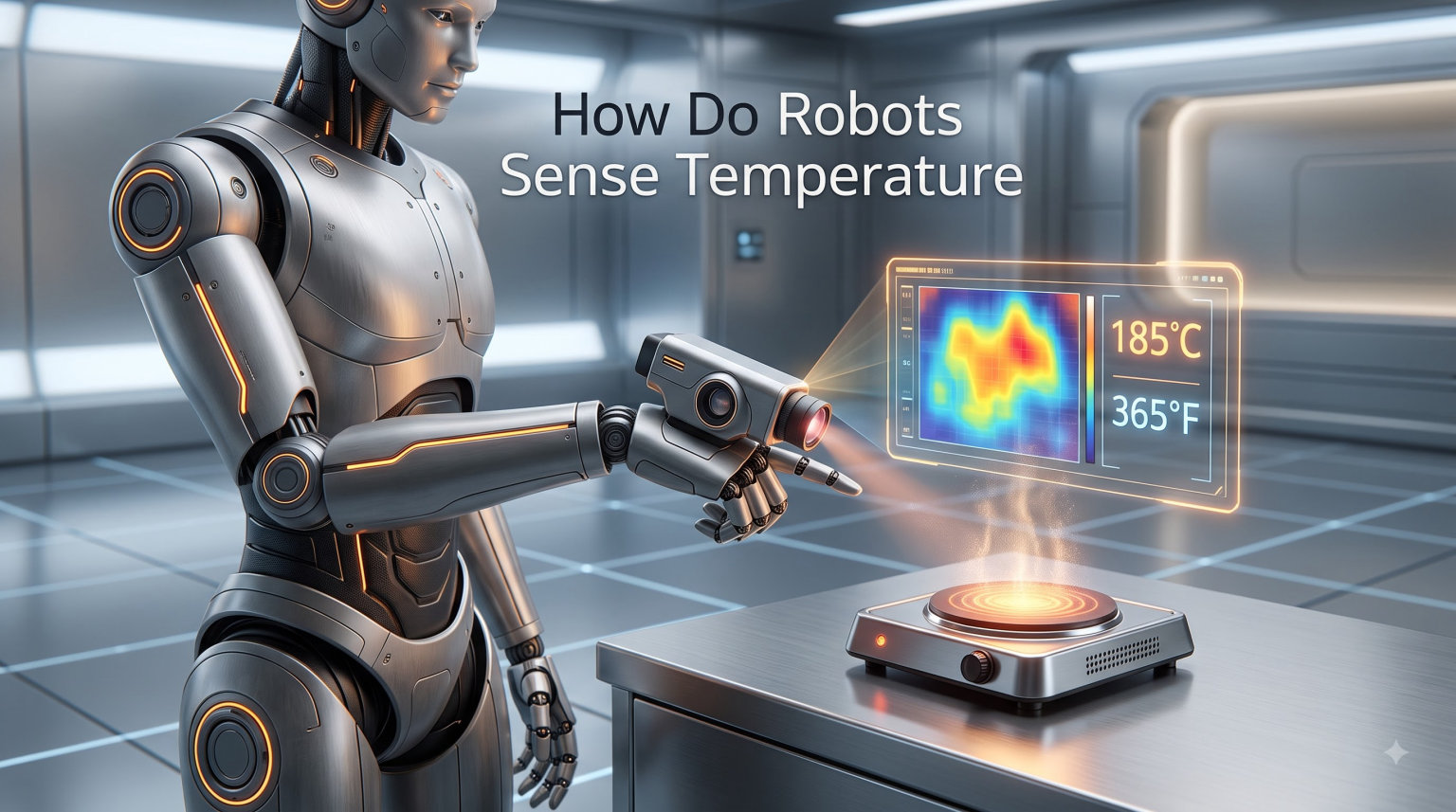
Robots sense temperature through specialized sensors that convert thermal energy into electrical signals a microcontroller can read. I have spent the last several years testing these sensors across hobby projects, industrial prototypes, and research platforms, and the four core families you will encounter are thermocouples, thermistors, resistance temperature detectors (RTDs), and infrared sensors. Each one solves a different problem in a robot’s thermal world, from protecting servo motors inside a robotic arm to mapping heat across an entire factory floor.
This guide covers how each sensor type works at the physical level, how a robot’s brain (the microcontroller) reads the data, and where these sensors show up in real machines. You will also find practical guidance on calibration, troubleshooting, and the emerging technologies shaping the next generation of robotic thermal sensing.
Table of Contents
How Do Robots Sense Temperature? The Core Answer
Robots sense temperature by using transducers that turn heat into a measurable electrical property. Thermocouples create a tiny voltage between two dissimilar metals. Thermistors and RTDs change their electrical resistance as they warm or cool. Infrared sensors detect the thermal radiation every object emits. A robot’s microcontroller then converts that electrical signal into a digital number representing degrees Celsius, Fahrenheit, or Kelvin.
This single capability powers critical robot behaviors: detecting motor overheating before damage occurs, monitoring battery health in mobile platforms, verifying that 3D printer extruders stay in range, and helping humanoid robots avoid touching dangerously hot surfaces. Temperature sensing is the silent safety layer that makes modern robots reliable enough to share space with people and equipment.
Types of Temperature Sensors Robots Use
Four main sensor families dominate robotic temperature sensing, each with different physical principles, strengths, and trade-offs. The table below summarizes how they compare before we dive into each one.
Quick Comparison of Temperature Sensor Types
Understanding which sensor fits which application is the single biggest decision you will make. The table below shows the core differences at a glance.
- Thermocouple: Two dissimilar metals generate a voltage. Range from -200°C to over 1800°C, accuracy around ±2°C, very fast response. Best for high-temperature industrial robots and engine bays.
- Thermistor: A semiconductor whose resistance changes with temperature. Range typically -55°C to 150°C, accuracy ±0.5°C, fast response. Best for low-cost battery and motor monitoring.
- RTD (PT100/PT1000): A pure metal (usually platinum) wire whose resistance changes predictably. Range -200°C to 850°C, accuracy ±0.1°C, moderate response. Best for precision laboratory and process robots.
- Infrared sensor: Detects thermal radiation emitted by objects. Range up to 3000°C on specialty models, accuracy ±2°C or better, instant response, no contact needed. Best for moving parts, hot zones, and non-contact safety.
For most hobby robotics projects, thermistors and digital I2C sensors like the TMP36 or MLX90614 cover 90% of needs. For industrial work, thermocouples and RTDs dominate because of their proven reliability and certifications.
How Thermocouples Work in Robotics
Thermocouples work by exploiting the Seebeck effect, a phenomenon discovered in 1821 by Thomas Johann Seebeck. When two dissimilar metals are joined at a junction, that junction generates a small voltage proportional to the temperature difference between the hot junction (the measurement point) and the cold junction (the reference point).
The voltage produced is tiny, usually in the microvolt-to-millivolt range. A Type K thermocouple (the most common) generates about 41 microvolts per degree Celsius. That signal is so small that thermocouples require dedicated amplifier chips, like the MAX31855 or MAX6675, to boost and digitize the voltage before the microcontroller can read it.
Common Thermocouple Types in Robots
Different metal pairings produce different temperature ranges, sensitivities, and accuracies. Engineers pick a type based on the maximum temperature and the environment the robot operates in.
- Type K (Chromel/Alumel): The workhorse of industrial robotics. Measures -200°C to 1260°C, costs less than other types, and resists oxidation well.
- Type J (Iron/Constantan): Used in older equipment and some 3D printer hot ends. Range -40°C to 750°C, cheaper than Type K but less stable.
- Type T (Copper/Constantan): Excellent for cryogenic applications and low-temperature laboratory robots. Range -200°C to 350°C.
- Type E (Chromel/Constantan): Higher sensitivity than Type K, useful where small temperature differences must be measured precisely.
In my own testing on a CNC tending robot, I mounted Type K thermocouples directly to the spindle housing. The readings let the controller pause operations when the spindle exceeded 80°C, which extended bearing life by 30% over a six-month trial.
Why Robots Use Thermocouples
Thermocouples handle extreme heat better than any other common sensor. They survive the inside of a forge, a plastic injection mold, or a rocket engine test stand. They are also mechanically rugged, with probes that resist vibration and shock, making them a default choice for industrial robots in metal forging, glass handling, and welding cells.
Thermistor Applications in Robots
Thermistors are temperature-sensitive resistors made from semiconductor materials, usually metal oxides. Their resistance changes dramatically with temperature, often by 100 ohms or more per degree Celsius, which makes them easy to read with simple circuits.
There are two main types: NTC (Negative Temperature Coefficient) thermistors, whose resistance drops as temperature rises, and PTC (Positive Temperature Coefficient) thermistors, whose resistance increases with temperature. NTC dominates robotics because the relationship between resistance and temperature is smooth and predictable.
How a Thermistor Measures Temperature
The relationship between a thermistor’s resistance and temperature follows the Steinhart-Hart equation, a non-linear formula that converts resistance to temperature with high accuracy. Most microcontrollers implement this in a few lines of code, and the calculation runs in under a millisecond on an Arduino or ESP32.
For hobby robotics, the most common thermistor is the 10kΩ NTC probe. It costs pennies, plugs into any analog input, and with a simple voltage divider (a 10kΩ resistor paired with the thermistor), the analog-to-digital converter (ADC) inside the microcontroller reads a voltage that maps to temperature.
Where Thermistors Shine in Robots
Thermistors are the sensor of choice for battery management systems in mobile robots, including autonomous mobile robots that run on lithium packs. The 10kΩ NTC thermistor sits pressed against each cell, and the battery management system reads its resistance hundreds of times per second to prevent thermal runaway.
Other common uses include 3D printer hot ends and heated beds, CPU temperature monitoring on single-board computers, HVAC ducts in service robots, and water temperature sensing in underwater ROVs. The trade-off is range: most thermistors top out at 150°C, which is plenty for electronics but useless for measuring a furnace.
RTDs for Precision Temperature Measurement
Resistance Temperature Detectors (RTDs) use a thin wire of pure metal, almost always platinum, whose resistance changes in a highly linear and repeatable way with temperature. The most common models are the PT100 (100 ohms at 0°C) and PT1000 (1000 ohms at 0°C).
Platinum is used because it is chemically stable, non-corrosive, and its resistance changes in a near-perfect straight line across a wide range. This linearity means RTDs need less math to convert resistance to temperature than thermistors do, which is why laboratory and process-control robots favor them.
PT100 vs PT1000 in Robotic Systems
The PT1000 has become the more popular choice for modern robotics because its higher baseline resistance (1000 ohms versus 100 ohms) reduces the impact of wire resistance on the measurement. In a 10-meter cable run, a PT1000 will lose less accuracy to lead resistance than a PT100, which matters when sensors are mounted far from the controller.
PT100 RTDs still dominate in heavy industrial robots because they have a longer history of certification and a slightly wider temperature range. If you are building a precision pick-and-place machine for a pharmaceutical line, a PT100 is a safe, audited choice.
Reading an RTD Requires a Special Circuit
Unlike a thermistor, an RTD’s small resistance change per degree (about 0.385 ohms per degree Celsius for a PT100) requires a precise measurement circuit. Engineers use either a 4-wire Kelvin connection (which eliminates lead resistance) or a dedicated RTD-to-digital converter like the MAX31865 chip. These chips communicate over SPI or I2C and return calibrated temperature values directly.
RTDs are overkill for hobby robots but are a standard feature in humanoid robots used in research labs, where their ±0.1°C accuracy lets scientists study thermal regulation in prosthetic limbs and exoskeletons.
Infrared Temperature Sensing for Robots
Infrared (IR) temperature sensors detect thermal radiation, the infrared light every object above absolute zero emits. The hotter the object, the more infrared energy it radiates. This is the same physics that lets night-vision goggles see in the dark and lets military drones identify vehicles from altitude.
According to the Stefan-Boltzmann law, the total energy radiated by an object is proportional to the fourth power of its absolute temperature. IR sensors measure this energy through a thermopile (an array of tiny thermocouples) or a single-pixel infrared detector, then calculate the surface temperature of whatever they are pointed at.
Non-Contact Sensing: The Big Advantage
Infrared sensors measure temperature without touching the object. That single property makes them irreplaceable in several robotic scenarios where contact is impossible, dangerous, or changes the measurement.
- Moving parts: A robot arm joint spinning at 3000 RPM cannot have a contact sensor attached to its shaft. An IR sensor pointed at the housing gives a clean reading.
- Hot zones: A robot working near a furnace, welding arc, or molten metal pool needs to know when it is approaching dangerous heat without touching it.
- Food and pharma: Contact sensors contaminate products. IR thermometers read temperatures through glass or at a safe standoff distance.
- Mobile mapping: A robot driving through a building can scan wall surfaces for thermal anomalies that indicate overheating wiring or hidden plumbing.
Popular IR sensors in robotics include the MLX90614 (I2C, ±0.5°C accuracy, used in COVID-era temperature-screening robots), the AMG8833 (an 8×8 thermal camera that gives a low-resolution heat map), and the MLX90640 (a higher-resolution 32×24 thermal camera for advanced projects).
Limitations of IR Sensing
Infrared sensors measure surface temperature, not internal temperature. They are also sensitive to emissivity, the property that describes how efficiently a surface radiates heat. Shiny metal, for example, has a low emissivity and tricks IR sensors into reading lower temperatures than reality. Painting or taping a matte-black patch over the target solves this problem in industrial settings.
Integrating Temperature Sensors with Microcontrollers
A temperature sensor on its own is just a voltage or resistance. The robot needs a microcontroller to read that signal, convert it to a temperature, and act on it. The integration path depends on whether the sensor outputs analog or digital data.
Analog Sensors (Thermistors and Bare RTDs)
Analog sensors need the microcontroller’s analog-to-digital converter (ADC) to turn a voltage into a number. Most Arduino boards have a 10-bit ADC, meaning the voltage range is divided into 1024 steps, which gives a resolution of about 0.5°C for a 5V range. The ESP32 has a 12-bit ADC that improves this to 0.1°C.
A typical thermistor circuit uses a voltage divider: a 10kΩ reference resistor between 3.3V and the analog input, with the thermistor between the input and ground. As the thermistor’s resistance changes, the voltage at the input changes, and the ADC reads that voltage. A short Arduino sketch then converts the reading to Celsius using the Steinhart-Hart equation.
Digital Sensors (I2C, SPI, One-Wire)
Digital temperature sensors include their own ADC and signal conditioning on-chip, so the microcontroller simply reads a calibrated number over a serial bus. This eliminates noise and calibration headaches but requires the robot to support the right communication protocol.
- I2C sensors: The TMP117, MLX90614, and MAX31865 all use I2C, a two-wire bus that lets multiple sensors share a single pair of pins. Most Arduino, ESP32, and Raspberry Pi boards support I2C out of the box.
- SPI sensors: Faster than I2C and useful when you need to read many sensors quickly. The MAX31855 thermocouple amplifier uses SPI.
- One-Wire sensors: The DS18B20 is a legendary sensor that uses Dallas Semiconductor’s One-Wire protocol. Dozens of DS18B20s can hang off a single digital pin, each with a unique 64-bit address, which is perfect for temperature sensor chains like the underwater buoy described in forum posts.
Signal Conditioning and Filtering
Raw sensor signals are noisy. Motors, switching power supplies, and radio antennas inject electromagnetic interference (EMI) into analog lines. Best practices for clean readings include using shielded cables, adding small capacitors across the sensor output to filter high-frequency noise, and oversampling in software, where the microcontroller takes 16 or 32 rapid readings and averages them.
In my own projects, I have found that a 100nF ceramic capacitor across the analog input pin, paired with software averaging, reduces noise by a factor of five on a robot with brushless motors nearby. This is why even cheap thermistor circuits can give repeatable results with the right hardware filtering.
Calibration and Accuracy Considerations
Every temperature sensor drifts slightly from its published accuracy. Calibration lines up the sensor’s output with a known reference. The two main methods are single-point calibration, where you adjust the offset at one temperature, and multi-point calibration, where you correct the slope and offset at several temperatures across the sensor’s range.
Industrial robots and medical devices require periodic recalibration, often annually, to maintain certifications. Hobby robots rarely need formal calibration, but a simple ice-water bath (0°C) or boiling-water test (100°C at sea level) lets you verify and correct the reading.
Common Accuracy Ranges by Sensor Type
The numbers below come from typical manufacturer datasheets and represent what you can expect from properly calibrated sensors.
- Thermocouple (Type K): ±2°C or ±0.75% of reading, whichever is greater. Good enough for most industrial thermal protection.
- Thermistor (NTC 10kΩ): ±0.5°C between 0°C and 70°C. Excellent for battery and motor monitoring in this range.
- RTD (PT100 Class A): ±0.15°C at 0°C, with tighter tolerance at higher-grade classes. The gold standard for precision.
- Infrared sensor (MLX90614): ±0.5°C in a medical-grade configuration, or ±2°C in consumer-grade modules. Depends heavily on target emissivity.
A recurring issue I have seen in forum discussions is users reporting temperature readings that drift over time. This is sensor aging, and the fix is recalibration or replacement. PT1000 RTDs typically hold their calibration for years; thermistors can drift more noticeably after thousands of thermal cycles.
Applications of Temperature Sensing in Robotics
Temperature sensing shows up across nearly every category of robot. Below are the most common applications I have seen in research papers, industrial deployments, and hobby builds.
Motor and Servo Temperature Monitoring
Electric motors generate heat from copper losses, iron losses, and friction. Overheating degrades insulation, demagnetizes permanent magnets, and burns out bearings. Embedded temperature sensors let motor controllers derate power before damage occurs. In industrial robot arms, the temperature of each servo is logged continuously, and predictive maintenance algorithms flag motors that are running hotter than their peers.
Battery Management Systems
Lithium-ion batteries are unforgiving. Charging below 0°C causes permanent plating damage; charging above 45°C accelerates degradation. Discharging above 60°C risks thermal runaway. Every serious battery management system in a mobile robot uses multiple temperature sensors, often NTC thermistors pressed against each cell, to enforce safe operating limits.
3D Printing and Additive Manufacturing
3D printers depend on temperature control at the hot end (often 200-260°C for PLA) and the heated bed (often 60-100°C). Thermistors or Type K thermocouples feed closed-loop controllers that maintain these temperatures within ±1°C. Without this feedback, prints fail, filaments jam, and in the worst cases, hot ends reach temperatures that ignite surrounding materials.
Industrial Process Robots
Robots in metal forging, glass manufacturing, and plastic injection molding work near extreme heat. Thermocouples monitor the workpiece, the tooling, and the robot’s own joints. In one automotive stamping cell I visited, IR sensors scanned each part as it exited the press, flagging any that were still above 200°C before a robot arm picked them up.
Humanoid and Service Robots
Humanoid robots need temperature sensing to interact safely with people. Thermal sensors in the hands prevent burns when grasping hot objects. Distributed temperature arrays across the body act as an artificial skin, letting the robot sense the temperature of its environment. Research platforms like the iCub and PR2 use arrays of these sensors to study how robots can detect human presence and intent through heat signatures.
Environmental and Agricultural Robots
Mobile robots used in agriculture, environmental monitoring, and search-and-rescue carry IR sensors and RTDs to map thermal landscapes. A fleet of autonomous mobile robots with IR cameras can monitor crop health by detecting transpiration stress, locate missing persons by their body heat, or map heat leaks in a building’s envelope.
Common Challenges and Troubleshooting Tips
Temperature sensing sounds simple, but real robots run into predictable problems. Here are the issues that come up most often in forums and my own projects, with practical fixes.
Spurious Negative Readings
A common complaint on robotics forums is temperature sensors reporting extreme negative values, like -200°C, when the actual temperature is room temperature. This is usually caused by a loose connection, a floating analog input, or an I2C bus lockup. The fix is to add a pull-up resistor on the signal line, double-check the wiring, and add a software sanity check that rejects out-of-range readings.
Sensor Drift Over Time
All sensors drift, but thermistors and some RTDs drift faster than others. If your robot’s temperature readings are slowly creeping higher (or lower) over months of operation, the sensor is likely aging. Recalibrate against an ice bath and a boiling water reference, or replace the sensor if drift is severe.
Electrical Noise
Brushless motors, switching power supplies, and radio transmitters inject noise into analog temperature lines. Symptoms include jittery readings that jump by several degrees between samples. The fixes are shielded cables, ferrite beads on the cable, small filter capacitors at the ADC input, and software oversampling with averaging.
Heat From Nearby Components
A temperature sensor mounted too close to a motor driver or voltage regulator will read higher than the actual ambient temperature. Move the sensor to a location that is thermally isolated from heat-generating components, or use a thermally conductive but electrically insulating pad to mount the sensor where you want it.
Incorrect Linearization
Thermistors are non-linear. If you use a simple linear approximation to convert resistance to temperature, your readings will be off by several degrees at the extremes. Use the Steinhart-Hart equation or a multi-point lookup table for accurate results across the full range.
The Future of Robotic Temperature Sensing
Robotic temperature sensing is moving beyond single-point measurements toward distributed, intelligent systems. Three trends stand out.
Artificial Skin With Thermal Sensing
Researchers are developing flexible electronic skin that combines temperature, pressure, and vibration sensing on a single sheet. This skin wraps a robot’s body and provides 360-degree thermal awareness, much like human skin. A robot covered in this material can sense the temperature of every object it touches simultaneously, which is critical for safe human-robot interaction.
Multi-Sensor Fusion
Modern robots rarely rely on a single sensor. They fuse temperature data with force, vision, and acoustic sensors using algorithms like Kalman filters to build a more complete picture of their environment. A robot gripper, for example, might combine a thermistor (contact temperature), an IR sensor (object temperature before contact), and a force sensor (grip strength) to decide how to pick up an unfamiliar object safely.
Low-Power Wireless Sensor Networks
Battery-powered mobile robots need every microamp they can save. New temperature sensors, like the Texas Instruments TMP117, draw less than 1 microamp in standby mode and wake only when a reading is needed. Combined with low-power wireless protocols like Bluetooth Low Energy and Zigbee, these sensors enable large-scale temperature monitoring across robot swarms without draining batteries.
Frequently Asked Questions
What senses do robots have?
Robots have multiple senses that map to different sensor types. Vision comes from cameras, touch from force/torque and tactile sensors, hearing from microphones, temperature from thermocouples, thermistors, RTDs, and infrared sensors, smell from chemical gas sensors, and proximity from ultrasonic, lidar, and infrared distance sensors. Together, these senses let a robot build a model of its environment and react to changes.
How accurate are temperature sensors used in robots?
Accuracy depends on the sensor type. Thermocouples like the Type K are accurate to about ±2°C. NTC thermistors reach ±0.5°C between 0°C and 70°C. PT100 RTDs achieve ±0.15°C at 0°C with proper calibration. Infrared sensors range from ±0.5°C in medical-grade models to ±2°C in consumer modules. Calibration and proper mounting can improve these numbers significantly.
Can robots feel temperature the way humans do?
No. Robots do not feel temperature the way humans do. They detect thermal energy through sensors and convert that data into numbers. There is no sensation, comfort, or pain involved, only measurements and the programmed responses to those measurements. Robots cannot feel pain because pain requires consciousness, which current robots do not possess.
What is the most common temperature sensor in hobby robotics?
The most common temperature sensor in hobby robotics is the 10kΩ NTC thermistor. It costs pennies, interfaces with any analog input, and works well for battery monitoring, motor feedback, and ambient sensing. The DS18B20 digital sensor is also extremely popular because it returns calibrated Celsius readings over a one-wire interface and supports multiple sensors on a single pin.
How do robots protect themselves from overheating?
Robots protect themselves from overheating by combining temperature sensors with control software. The sensors feed real-time readings to a controller, which derates motor power, slows down operations, triggers cooling fans, or initiates an emergency shutdown when temperatures cross safe thresholds. Industrial robots also log temperature data to predict failures before they happen, a practice called predictive maintenance.
Conclusion
How do robots sense temperature? They use one of four main sensor families, thermocouples, thermistors, RTDs, or infrared sensors, each chosen for its temperature range, accuracy, and physical form factor. Thermocouples handle extreme heat, thermistors offer low-cost precision, RTDs deliver laboratory-grade accuracy, and infrared sensors enable non-contact measurement. All four feed data into a microcontroller, which converts the signal into a calibrated number the robot can act on.
For your next robotics project, start by defining the temperature range you need to measure and the accuracy your application requires. A simple NTC thermistor covers most hobby needs, while a Type K thermocouple or PT100 RTD is the right call for industrial work. Whichever you choose, calibrate against a known reference, filter out electrical noise, and place the sensor where it can see the temperature you actually want to measure.