
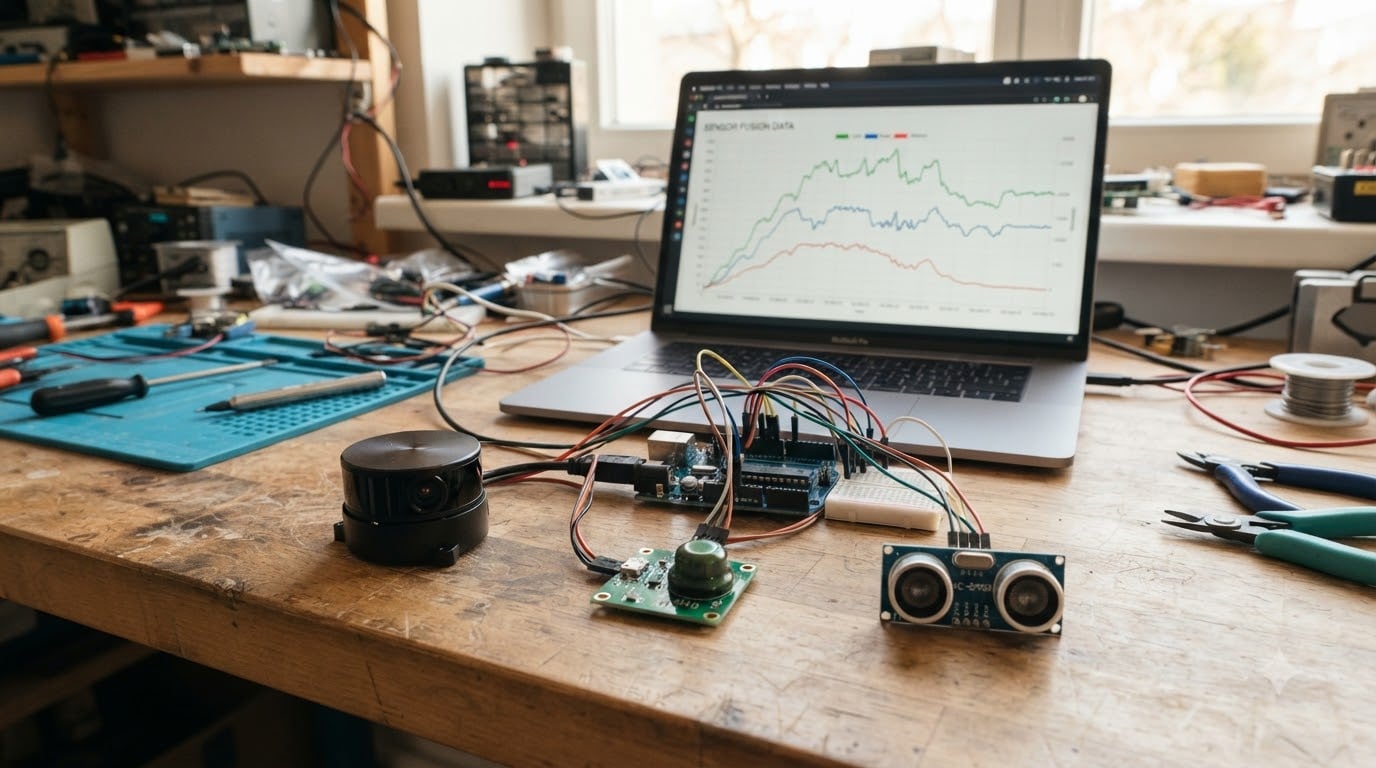
If you are picking a distance sensor for a robot, you have probably landed on three names over and over: LiDAR, Radar, and Ultrasonic. Each one measures how far away an object is, but they do it with completely different physics, and that physics decides what your robot can actually see.
LiDAR uses laser pulses for millimeter-level precision, Radar uses radio waves for long-range detection in harsh weather, and Ultrasonic uses sound waves for low-cost short-range proximity sensing. LiDAR is the right choice when you need a precise 360-degree point cloud for SLAM. Radar wins in rain, fog, dust, and at ranges of hundreds of meters. Ultrasonic is unbeatable on price and still the default for cliff detection, liquid level measurement, and basic bump-and-go robots.
In this guide I will walk you through how each sensor works, where it breaks, and how to pick the right one for your specific robot. We will also cover the hybrid sensor fusion approach used in most serious autonomous platforms, the Tesla sensor debate, and an Arduino code example you can copy and run tonight.
Table of Contents
How LiDAR Works: Laser Pulses and Time of Flight
LiDAR stands for Light Detection and Ranging. A LiDAR sensor fires a very short laser pulse, typically at 905 nm or 1550 nm wavelength, and measures how long it takes for the photon to bounce off a surface and return. Multiply that round-trip time by the speed of light, divide by two, and you have the distance to the object.
Time-of-Flight (ToF) Principle
Every LiDAR is fundamentally a time-of-flight (ToF) sensor. The faster the laser pulse returns, the closer the object. This is the same physics behind radar and ultrasonic, just with a different wave. Light is so fast that LiDAR electronics have to measure picosecond-scale delays, which is why LiDAR units historically cost far more than ultrasonic or radar modules.
Modern LiDAR modules use a clever indirect measurement: they fire a continuous modulated laser beam and compare the phase shift of the reflected signal to the outgoing signal. Phase-shift LiDAR is cheaper, more accurate at short range, and is the dominant architecture in consumer robotics modules like the RPLiDAR A1 and YDLIDAR X4.
1D, 2D, and 3D Scanning Methods
A single laser beam gives you a single distance reading, useful for nothing more than a tape measure. The real power of LiDAR comes from scanning. A 1D LiDAR, like the VL53L0X, fires one beam straight ahead and reports the distance to whatever is in front of it. A 2D LiDAR spins a laser around 360 degrees and produces a flat ring of distance points called a scan. A 3D LiDAR uses multiple laser rows or a MEMS mirror to stack these rings into a full point cloud.
For most hobbyist and AGV applications, a 2D LiDAR is the sweet spot. The RPLiDAR A1 produces around 8000 points per second across a full 360-degree sweep, and that is more than enough to drive the ROS Navigation Stack and build a real SLAM map with Hector SLAM or GMapping.
Solid-State and MEMS LiDAR
Spinning LiDAR units have moving parts, which is a problem if your robot vibrates, falls over, or operates in a dusty environment. Solid-state LiDAR removes the spinning motor entirely. MEMS LiDAR uses a tiny silicon mirror to steer the beam, and optical phased array LiDAR steers it with no moving parts at all. These are the architectures powering newer consumer products like the Apple iPad Pro LiDAR and the Luminar Iris automotive sensor.
For robotics builders today, MEMS LiDAR modules like the Livox Mid-360 and Innovusion Falcon K are dropping in price every year. By 2026 you can buy a 3D MEMS LiDAR for a research robot for less than what a 2D spinning unit cost in 2019.
How Radar Works: Radio Waves and the Doppler Effect
Radar stands for Radio Detection and Ranging. Instead of laser light, radar emits radio waves, usually in the 24 GHz, 60 GHz, or 77 GHz bands, and listens for the echo. Radar has been used since World War II for everything from aircraft tracking to weather forecasting, and it is now one of the most important sensors in robotics and ADAS.
The Doppler Effect and FMCW Basics
Most modern robotics radar uses a technique called Frequency Modulated Continuous Wave (FMCW). The radar transmits a chirp, a signal whose frequency rises linearly over a few milliseconds, then listens for the echo. The receiver mixes the echo with a copy of the transmitted signal and measures the beat frequency. The beat frequency is proportional to the distance to the target.
Because the chirp repeats thousands of times per second, radar can also measure the Doppler shift, the change in frequency caused by a moving target. This is how a radar sensor can tell the difference between a parked car and one driving toward you, and how it can measure velocity directly. A camera cannot do that. Ultrasonic cannot do that. Only radar gives you a direct, instantaneous velocity measurement per object.
Radar Frequency Bands Explained: 24, 60, and 77 GHz
Radar frequency is not a marketing detail. It is a fundamental tradeoff between range, resolution, antenna size, and regulatory cost. The three bands you will see in robotics are 24 GHz, 60 GHz, and 77 GHz, and they each have a very different personality.
- 24 GHz narrowband – The classic industrial radar band. Wavelength around 12.5 mm, antenna about the size of a credit card, range up to about 100 m on a good day. Used in older ADAS blind-spot monitors and many industrial level sensors. Now being phased out in automotive in favor of 77 GHz, but still everywhere in robotics.
- 60 GHz (mmWave) – Wavelength about 5 mm, so the antenna is tiny. This is the band used by the Texas Instruments IWR6843 and the LD2410 presence-detection modules you can buy for under $10. Best for short range (under 50 m) and high resolution. Excellent for indoor human presence detection and gesture recognition.
- 77 GHz – The modern automotive long-range radar band. Wavelength about 4 mm, antenna small, range up to 250 m or more. Required by Euro NCAP for new cars. Available to hobbyists only in the form of modules salvaged from older vehicles, because the FCC and EU regulators restrict 77 GHz emissions.
For most hobby robotics projects in 2026, a 60 GHz mmWave module like the LD2410 or HLK-LD2410C is the right choice. They are cheap, work indoors, and detect humans and small objects through smoke, fog, and dust that would blind any camera.
mmWave Radar Modules for Robotics
The big change in robotics over the last few years is that mmWave radar modules have become affordable. The LD2410 from Hi-Link costs around $7 and detects human presence and breathing from up to 5 m. The RCWL-0516 is a 3.2 GHz Doppler radar module that costs about $2 and triggers when something moves in front of it. These are not precision distance sensors, but they are unbeatable for presence detection through walls and obstacles.
How Ultrasonic Sensors Work: Sound Waves and Echolocation
Ultrasonic sensors emit a high-frequency sound wave, usually at 40 kHz, well above human hearing. The sound wave travels through the air at about 343 m/s, hits an object, and bounces back. Measure the round-trip time, divide by the speed of sound, divide by two, and you have the distance. Bats have been using this technique for 50 million years; the HC-SR04 just does it with electronics.
Piezoelectric Transducers and HC-SR04
The heart of an ultrasonic sensor is a piezoelectric transducer, a small disk that vibrates at 40 kHz when an electrical signal is applied, and produces an electrical signal when sound hits it. The HC-SR04, the most popular hobbyist sensor in the world, has one transducer for transmit and one for receive, which is why it has two cylindrical metal cans on top.
The HC-SR04 costs about $1 to $2, runs on 5 V, and interfaces with a microcontroller over a single trigger pin and a single echo pin. It is so cheap and so simple that it is the default first sensor in any Arduino robotics tutorial. The waterproof JSN-SR04T swaps the open transducers for a sealed metal transducer, which is why it is the go-to sensor for outdoor robots, level measurement, and underwater drones.
The Dead Zone and Beam Cone
Every ultrasonic sensor has a dead zone right in front of it, typically 2 to 3 cm on the HC-SR04. The transmit pulse takes a few cycles to die down, and the receiver cannot hear an echo while the transmitter is still ringing. If you try to measure something closer than the dead zone, you will get garbage or a reading of zero.
The other limitation is the beam cone. Sound at 40 kHz has a wavelength of about 8.5 mm, which is huge compared to a laser. The beam spreads out in a roughly 15-degree cone, and any object outside that cone is invisible. This is why ultrasonic sensors are almost always mounted on a panning servo or in an array of four to six sensors around the robot.
Why Sound Fails on Soft, Angled, and Mirror Surfaces
Sound reflects off hard surfaces the way a billiard ball bounces off a cushion. If the surface is angled away from the sensor, the sound wave bounces off to the side and never comes back, and the sensor reports no echo at all. This is why ultrasonic sensors miss chair legs, table edges, and anything that is not perpendicular to the beam.
Soft materials like foam, fabric, carpet, and fur absorb sound instead of reflecting it. A sock-covered chair leg is invisible to a HC-SR04. Glass and mirrors are also tricky because they reflect sound specularly, like a mirror reflects light, sending the wave off at the same angle instead of back to the source.
Temperature also throws off the calculation. The speed of sound changes by about 0.6 m/s per degree Celsius, so a 20-degree shift in temperature changes a 1 m reading by about 3.5 cm. Most quality ultrasonic modules include a temperature sensor and compensate, but cheap ones do not.
LiDAR vs Radar vs Ultrasonic: Head-to-Head Comparison Table
This is the table I wish I had when I started building robots. I have used every sensor on this list in at least one real project, and the numbers below are typical for the modules you can buy today.
| Feature | LiDAR | Radar (mmWave / FMCW) | Ultrasonic |
|---|---|---|---|
| Operating principle | Laser pulse time-of-flight | Radio wave FMCW + Doppler | Sound wave echo time-of-flight |
| Wavelength | 905 nm or 1550 nm (near infrared) | 4 to 12.5 mm (mmWave) | ~8.5 mm at 40 kHz |
| Typical accuracy | ±2 to 30 mm | ±1 to 50 mm (range dependent) | ±10 to 30 mm |
| Maximum range | 40 m (consumer) to 250 m (industrial) | 5 m (LD2410) to 250 m (77 GHz automotive) | 0.3 to 10 m |
| Minimum range (dead zone) | ~10 cm | ~10 cm | 2 to 30 cm |
| Field of view | 360 degrees (spinning) to 120 degrees (solid-state) | 20 to 160 degrees (typical) | ~15 degrees cone |
| Angular resolution | 0.25 to 1 degree | 1 to 15 degrees | N/A (cone sensor) |
| Update rate | 5 to 20 Hz (2D), up to 100 Hz (1D) | 10 to 100 Hz | 20 to 100 Hz (with gaps between firings) |
| Light immunity | Excellent (active sensor) | Excellent (active sensor) | Excellent (active sensor) |
| Weather tolerance | Good (rain and fog reduce range) | Excellent (works in heavy rain and fog) | Poor (temperature and humidity sensitive) |
| Glass and mirror detection | Poor (specular reflection) | Good (radio passes through thin plastic, reflects off glass) | Poor (specular reflection) |
| Detects velocity directly | No (only position) | Yes (Doppler shift) | No (only position) |
| Detects through smoke and dust | Poor | Excellent | Poor |
| Power consumption | 0.5 to 5 W | 0.1 to 2 W | 0.05 to 0.2 W |
| Cost (hobbyist module) | $30 to $400 | $2 to $50 | $1 to $10 |
| Cost (industrial / automotive) | $500 to $10,000+ | $50 to $1,000 | $20 to $200 |
| Best for | SLAM, mapping, 360-degree perception | Outdoor navigation, presence, velocity | Cliff detection, level sensing, low-cost proximity |
Accuracy and Resolution: From Millimeters to Meters
If you care about precision, the order is clear: LiDAR first, radar second, ultrasonic third. A good 2D LiDAR like the RPLiDAR A3 has a 0.225-degree angular resolution and reports distances accurate to about 0.5 cm at 10 m. That is enough to detect a chair leg, a glass wall, or the edge of a table.
Radar accuracy depends heavily on the band and the bandwidth of the chirp. A 60 GHz mmWave module can detect a person’s breathing from 5 m and resolve two people standing 30 cm apart. A 24 GHz narrowband module might just see one big blob. For velocity, radar wins by a mile. A single chirp gives you both range and radial velocity per detected object, which is why every modern ADAS uses radar for adaptive cruise control and automatic emergency braking.
Ultrasonic is the least precise of the three, with a typical accuracy of 1 to 3 cm on a good day. That is fine for detecting a wall at 2 m, but useless for fitting through a doorway or finding a charging dock. The other big issue is cross-talk: if you fire two HC-SR04s at the same time, they can hear each other’s pulses and report false echoes. The standard fix is to fire them in sequence using a multiplexer, or use the HC-SR04P variants with one-wire communication.
Range and Coverage Analysis
Range is where the three sensors diverge the most. Ultrasonic tops out at about 10 m on the JSN-SR04T-2.0, and most modules are limited to 4 or 5 m. LiDAR in the consumer price range covers 12 to 40 m, and industrial units push past 200 m. mmWave radar sits in between, with hobby modules reaching 10 m and automotive 77 GHz units reaching 250 m.
Coverage is about field of view, not maximum distance. A single LiDAR pulse sees one spot. A 2D spinning LiDAR sees 360 degrees but only in one horizontal plane. A 3D LiDAR sees a volume. An ultrasonic sensor sees a 15-degree cone. A radar sensor typically sees a 60 to 120-degree fan.
For a mobile robot, 360-degree horizontal coverage is essential for obstacle avoidance, and that is why 2D LiDAR has become the standard. A RPLiDAR A1 mounted on top of a TurtleBot gives the robot a complete ring of awareness. Doing the same thing with ultrasonic requires six sensors, and with radar requires at least four.
Environmental Factors: Sunlight, Rain, Fog, Dust, and Glass
All three sensors are active, meaning they emit their own signal, so none of them depend on ambient light. You can run them in a pitch-black room. The real environmental question is what happens when the air between the sensor and the target gets nasty.
LiDAR struggles in heavy rain, fog, and snow because water droplets scatter and absorb the laser pulses, cutting the effective range by 30 to 70 percent. Direct sunlight can saturate the receiver on cheap 905 nm modules, which is why most outdoor autonomous vehicles use 1550 nm LiDAR with a narrower beam and better sun rejection. Black, matte, and absorptive surfaces also reduce LiDAR range because they absorb the laser pulse instead of reflecting it.
Radar is the clear winner in bad weather. Radio waves at 24, 60, and 77 GHz pass through rain, fog, dust, and snow with minimal attenuation. The same military radar that tracks aircraft through a storm is now tracking pedestrians in a Tesla. The trade-off is that radar sees almost everything as a blob. It will tell you something is there, but it will not give you the crisp outline that LiDAR does.
Ultrasonic is the most weather-sensitive of the three. Temperature changes the speed of sound, humidity changes the absorption, and air turbulence throws off the echo timing. Ultrasonic still works outdoors in normal weather, but a sensor calibrated for 20 degrees Celsius can be off by 5 cm at 30 degrees Celsius and back.
What Can LiDAR Not Detect?
- Glass walls and mirrors – Light reflects off the surface at the same angle it hits, so the echo goes off sideways instead of back to the receiver.
- Black and matte surfaces at long range – Dark surfaces absorb the laser pulse. Black felt at 30 m is essentially invisible to a 905 nm LiDAR.
- Heavy rain, fog, snow, and dust – Water droplets scatter the laser, reducing range by 30 to 70 percent.
- Thin wires and cables – A 1 mm cable reflects too little light back to be detected at long range.
- Direct sunlight interference – Background photons can swamp the receiver, especially with cheap 905 nm modules.
Cost Analysis: From $2 Hobbyist Modules to $10,000 Industrial LiDAR
Cost is the number one reason most robots start with ultrasonic and end with LiDAR. The HC-SR04 costs about $1.50, and you can buy a JSN-SR04T waterproof version for under $5. For $30 you can have a complete ultrasonic bumper array with 8 sensors and a multiplexer. No other distance sensor matches that price.
mmWave radar sits in the middle. The LD2410 is about $7, and the TI IWR6843 evaluation board is about $300. Automotive 77 GHz radar units pulled from a salvage yard can be had for $50 to $100, but they need a custom controller board to drive.
LiDAR is the most expensive option. A RPLiDAR A1 is about $100, a YDLIDAR X4 is about $80, and a Velodyne VLP-16 is $4,000. Industrial 3D LiDAR like the Ouster OS1 costs $9,000 or more. The good news is that the cost per meter of range has dropped by an order of magnitude over the last decade, and solid-state LiDAR is on track to push consumer 3D LiDAR under $200 within a few years.
Radar Frequency Bands Explained: 24 GHz vs 60 GHz vs 77 GHz
If you have ever wondered why a $7 LD2410 is limited to 5 m while a $200 automotive radar sees 200 m, the answer is in the frequency band. The physics of radio waves gives each band a distinct personality, and choosing the right band matters as much as choosing the sensor itself.
The 24 GHz band is the legacy workhorse. It is split into 24.0 to 24.05 GHz narrowband (used for industrial level sensors and short-range automotive) and 24.05 to 24.25 GHz wideband (used for older blind-spot monitors). The wavelength is about 12.5 mm, which means the antenna is reasonable in size, the range is up to about 100 m, and the resolution is modest. If you see a radar level sensor in a tank or silo, it is almost certainly 24 GHz.
The 60 GHz band, also called mmWave, is the new favorite for indoor robotics. The wavelength is about 5 mm, so the antenna fits on a chip, the bandwidth is wide (up to 7 GHz of spectrum), and the resolution is excellent. Texas Instruments, Infineon, and several Chinese vendors make 60 GHz modules in the $10 to $50 range. The catch is short range, usually under 50 m, and the high atmospheric absorption at 60 GHz, which is why 60 GHz does not work well outdoors beyond about 20 m.
The 77 GHz band is the long-range automotive standard. The wavelength is about 4 mm, the range reaches 250 m, and the resolution is good enough to distinguish a pedestrian from a bicycle. 77 GHz is regulated strictly in most countries, so hobbyists typically cannot buy a transmitter, but they can experiment with salvaged automotive radar units from older vehicles. By 2026 the 77 GHz band is the global standard for new automotive radar, and the 24 GHz band is being phased out of new vehicles.
Popular Sensor Modules for Robotics
If you are building a robot right now, these are the modules worth knowing. I have personally used most of them.
- HC-SR04 – The $1 ultrasonic classic. 2 to 400 cm range, 5 V, two pins. Great for first projects, terrible for anything serious.
- JSN-SR04T – Waterproof ultrasonic. 25 to 450 cm range, 5 V, two pins. The standard for outdoor robots and level measurement.
- VL53L0X and VL53L1X – ST Microelectronics 1D ToF sensors. 30 to 1200 mm range, I2C, 3 V. Great middle ground between ultrasonic and full LiDAR for short-range precision.
- TFmini-S – Benewake 1D LiDAR. 0.1 to 12 m range, UART or I2C. The go-to sensor for drone altitude and small robot forward-facing obstacle detection.
- RPLiDAR A1 – 2D spinning LiDAR, 12 m range, 8000 samples per second, USB and UART. The default SLAM sensor for hobby robots.
- YDLIDAR X4 – 2D LiDAR, 10 m range, similar specs to the RPLiDAR A1 at a slightly lower price.
- Livox Mid-360 – 3D MEMS LiDAR, 40 m range, 360-degree horizontal FOV, under $1,000 in 2026. Research-grade 3D perception for less than the price of a used car.
- LD2410 – 60 GHz mmWave presence sensor, 5 m range, UART. Detects human presence, breathing, and motion through walls.
- RCWL-0516 – 3.2 GHz Doppler radar, $2 module, triggers on any motion in front of it.
Sensor Fusion and the Hybrid Approach
No serious autonomous platform uses a single sensor type. The state of the art is sensor fusion, combining LiDAR, radar, camera, and ultrasonic in a single robot, with each sensor covering the weaknesses of the others. A typical autonomous vehicle stack in 2026 includes a 128-channel 3D LiDAR on the roof, six to twelve 77 GHz radar units around the bumper, a wide-angle camera array, and a ring of twelve ultrasonic sensors for close-range parking maneuvers.
How Autonomous Vehicles Stack Sensors
Modern autonomous vehicles use a layered approach. Long-range 77 GHz radar sees 250 m for highway driving. Mid-range LiDAR sees 100 m for 3D mapping. Cameras provide color and texture for traffic light and sign recognition. Short-range ultrasonic covers the last 3 m at low speed for parking. The fusion engine runs Kalman filters or particle filters to combine the data into a single best estimate of the world around the car.
For mobile robots, the same pattern works. A TurtleBot4 with a RPLiDAR A1 plus an IMU plus wheel odometry can run full SLAM. Add a downward-facing ultrasonic for cliff detection, and you have a robot that can navigate an office building without falling down the stairs.
ROS and Sensor Fusion for Robots
The Robot Operating System (ROS) is the de facto standard for sensor fusion in research robotics. The robot_localization package fuses IMU, wheel odometry, and GPS using an Extended Kalman Filter. The costmap_2d package combines LiDAR, depth camera, and ultrasonic data into a unified obstacle map for the move_base navigation planner.
If you want to try sensor fusion without writing a Kalman filter from scratch, the ROS Navigation Stack on a Raspberry Pi 4 with a RPLiDAR A1 will get you a working SLAM and autonomous navigation demo in an afternoon. I have done this with my own TurtleBot, and the code is on GitHub.
The Tesla Sensor Debate
No discussion of LiDAR vs radar vs ultrasonic is complete without addressing the elephant in the room. Tesla removed radar from its Model 3 and Model Y production in 2021, and removed ultrasonic sensors entirely in 2022. By 2026 every new Tesla runs Tesla Vision, a camera-only perception system. Elon Musk has called LiDAR a crutch and argued that a camera-based system is sufficient for full self-driving.
The reasoning goes like this: humans drive with two cameras (eyes) and a neural net (brain), so a car should be able to drive with eight cameras and a more powerful neural net. LiDAR and radar add cost, complexity, and supply chain risk for a perception channel that cameras should be able to cover.
The counter-argument is that cameras fail in exactly the conditions where radar excels: heavy rain, fog, direct sun glare, and night driving without headlights. Waymo, Cruise, Mercedes Drive Pilot, and most other autonomous vehicle programs still use LiDAR plus radar plus camera. As of 2026 the debate is not settled, and it is one of the most active areas of PAA traffic on this topic.
When to Choose Each Sensor: Decision Matrix
The easiest way to choose is to start with the robot type and the environment, then pick the sensor that fits the primary failure mode you need to handle.
Decision Matrix by Robot Type
| Robot Type | Primary Sensor | Supporting Sensor | Reasoning |
|---|---|---|---|
| Indoor mobile robot (home, office, warehouse) | 2D LiDAR (RPLiDAR A1) | Ultrasonic for cliff detection | SLAM, 360-degree perception, low cost |
| Outdoor mobile robot (lawn mower, sidewalk delivery) | 3D LiDAR or mmWave radar | Camera, GPS, ultrasonic bumpers | Weather tolerance, larger range, 3D perception |
| Drone (indoor) | 1D ToF (VL53L1X) or 1D LiDAR (TFmini) | Camera, IMU | Light weight, low power, downward altitude hold |
| Drone (outdoor) | 1D LiDAR (TFmini-S) + mmWave radar | Camera, GPS | Altitude in sunlight, obstacle avoidance |
| AGV / AMR (warehouse) | 3D LiDAR or multiple 2D LiDAR | Safety-rated LiDAR, ultrasonic bumpers | Safety certification, SLAM, pallet detection |
| Autonomous car | Long-range 77 GHz radar + 3D LiDAR | Cameras, ultrasonic, GPS | All-weather long-range perception with safety redundancy |
| Humanoid robot | Solid-state 3D LiDAR + depth cameras | Force sensors, IMU | Full 3D body awareness, SLAM, manipulation |
| Robotic arm / gripper | 1D ToF (VL53L0X) | Force torque sensor | Short-range object detection in cluttered bins |
| Liquid level / tank measurement | Ultrasonic (JSN-SR04T) or 24 GHz radar | None needed | Sealed waterproof sensor, simple integration |
| Security / presence detection | 60 GHz mmWave (LD2410) | PIR, camera | Through-wall detection, low false alarm |
When to Choose LiDAR
Choose LiDAR when you need a 360-degree map of the environment, when accuracy is critical (SLAM, robotic arm placement), and when the robot operates mostly indoors or in controlled lighting. LiDAR is the right answer for most indoor mobile robots, AMRs, and humanoid research platforms.
When to Choose Radar
Choose radar when the robot operates outdoors in bad weather, when you need to detect velocity directly (collision avoidance, traffic monitoring), when the target might be hidden by smoke, fog, or dust, or when the robot must detect human presence through a wall (security, occupancy). Radar is the right answer for outdoor delivery robots, security systems, and ADAS.
When to Choose Ultrasonic
Choose ultrasonic when the budget is under $20 for the entire sensor stack, when the range is short (under 5 m), when you need to measure liquid level in a tank, when you need a downward-facing cliff sensor on a wheeled robot, or when you need a redundant bumper sensor for safety. Ultrasonic is the right answer for hobbyist robots, tank level monitoring, and cliff detection.
The Hybrid Recommendation
If you can afford it, use at least two sensor types. The most common hybrid in hobby robotics is a 2D LiDAR for primary perception plus two to four ultrasonic sensors for close-range redundancy and cliff detection. The most common hybrid in industrial robotics is LiDAR plus camera plus IMU, with safety-rated LiDAR scanners added for compliance with ISO 13849 and ISO 10218.
Integrating Sensors with Arduino and Raspberry Pi
Most hobbyist distance sensors integrate with a microcontroller in under an hour. The HC-SR04 is the easiest. Connect VCC to 5 V, GND to ground, Trig to digital pin 9, and Echo to digital pin 10. The trigger pin needs a 10 microsecond pulse, then you measure the pulse width on the echo pin, then convert to distance using the speed of sound.
For a deeper dive on how development boards talk to sensors, including I2C, SPI, and UART protocols, our guide on how development boards communicate with sensors covers the fundamentals.
Arduino Code Example: HC-SR04 Ultrasonic
// HC-SR04 ultrasonic sensor on Arduino
// Connect Trig to pin 9, Echo to pin 10

const int trigPin = 9;
const int echoPin = 10;

long duration;
int distanceCm;

void setup() {
  pinMode(trigPin, OUTPUT);
  pinMode(echoPin, INPUT);
  Serial.begin(9600);
}

void loop() {
  digitalWrite(trigPin, LOW);
  delayMicroseconds(2);
  digitalWrite(trigPin, HIGH);
  delayMicroseconds(10);
  digitalWrite(trigPin, LOW);

  duration = pulseIn(echoPin, HIGH, 30000);
  distanceCm = duration * 0.034 / 2;

  Serial.print("Distance: ");
  Serial.print(distanceCm);
  Serial.println(" cm");

  delay(100);
}
The same pattern works for a RPLiDAR A1 over UART, a VL53L0X over I2C, or a TFmini-S over a software serial port. The TFmini-S in particular is a great upgrade from the HC-SR04 because it is a real laser and works the same way in code, just reading bytes from a serial port instead of timing a pulse.
Safety, Standards, and Regulations
Sensors are not just technical choices. They are also regulatory choices, especially for industrial and automotive robots.
LiDAR modules are classified as Class 1 laser products under IEC 60825-1, which means the laser is eye-safe under all normal use. You can stare into a RPLiDAR A1 all day without damaging your retinas. Higher-power industrial LiDAR can be Class 1M or even Class 3R, which require eye protection and warning labels. Always check the laser class before mounting a LiDAR module on a robot that operates around people.
Radar transmitters in the 24, 60, and 77 GHz bands are regulated by the FCC in the US, the ETSI in Europe, and similar bodies worldwide. Hobbyist use of 60 GHz mmWave modules like the TI IWR6843 is permitted because the modules use certified chipsets. 77 GHz requires explicit licensing in most countries, and 24 GHz wideband is being phased out for new automotive use.
Ultrasonic sensors operate at 40 kHz, which is well above human hearing (20 kHz) and well below the frequencies that cause heating in tissue. They are considered safe for continuous human exposure, but they can confuse guide dogs, which hear up to 60 kHz. If your robot operates around service animals, ultrasonic sensors can be a problem.
Future Trends: 4D Imaging Radar, Solid-State LiDAR, AI Fusion
The sensor landscape is changing fast. Four trends worth watching through the rest of 2026 and beyond.
4D imaging radar is the biggest change in radar since FMCW. A 4D radar adds elevation to the usual range, azimuth, and velocity, producing a point cloud similar to LiDAR but with Doppler velocity per point. Arbe Robotics, Mobileye, and Continental are shipping 4D radar units for 2026 model year cars. For robotics, 4D radar means all-weather 3D perception without the cost of LiDAR.
Solid-state LiDAR is finally hitting price points that matter. Luminar, Innovusion, Hesai, and RoboSense are all shipping solid-state automotive LiDAR in the $500 to $2,000 range. The Livox Mid-360 and the new Livox HAP are MEMS LiDAR units under $1,000. By 2027 to 2028 we expect consumer 3D LiDAR to break the $200 barrier.
AI-assisted sensor fusion is replacing hand-tuned Kalman filters. End-to-end neural networks, like Tesla’s Occupancy Network, take raw sensor data and output a 3D occupancy grid in one forward pass. This approach is more robust to sensor failures and adapts to new sensor types without hand-coded logic.
Software-defined sensors are emerging. Rather than hardwiring a sensor to do one thing, new radar and LiDAR chipsets expose low-level configuration so the robot can adapt the sensor behavior on the fly. A 77 GHz radar can switch from long-range forward-looking mode to short-range high-resolution mode in milliseconds.
Frequently Asked Questions
Is LiDAR better than ultrasonic?
LiDAR is better than ultrasonic when you need long range, high accuracy, and 360-degree coverage for mapping and SLAM. Ultrasonic is better when you need the lowest cost, a simple short-range reading under 5 m, or reliable liquid level measurement. For a hobbyist mobile robot, ultrasonic is enough for bump detection and cliff sensing, but LiDAR is the right upgrade when you need real SLAM.
Does Tesla use radar or LiDAR?
As of 2026, Tesla does not use either radar or LiDAR. New Teslas run Tesla Vision, a camera-only perception system. Tesla removed radar from production in 2021 and removed ultrasonic sensors in 2022, relying on eight surround cameras and a neural network for advanced driver assistance and supervised Full Self-Driving.
What can LiDAR not detect?
LiDAR cannot reliably detect glass walls, mirrors, black or matte surfaces at long range, thin wires, or objects hidden by heavy rain, fog, snow, or dust. The 905 nm laser pulses scatter off water droplets and absorb into dark surfaces, which is why most outdoor autonomous vehicles pair LiDAR with radar and cameras.
Why did Tesla stop using ultrasonic sensors?
Tesla stopped using ultrasonic sensors in 2022 as part of its transition to Tesla Vision. The company argued that the same short-range parking and obstacle detection that ultrasonic handled could be done by cameras and neural networks with higher accuracy, without the cross-talk and false echoes that ultrasonic sensors suffer from in real-world driving.
Why does Elon Musk not use LiDAR?
Elon Musk argues that LiDAR is a crutch because humans drive with two cameras (eyes) and a brain, so cars should be able to drive with cameras and a more powerful neural network. Musk also points to cost, complexity, and supply chain risk. Critics counter that cameras fail in conditions where LiDAR excels, including heavy rain, fog, direct sun glare, and night driving.
How far can ultrasonic sensors detect?
Standard HC-SR04 ultrasonic sensors detect objects from about 2 cm to 400 cm. The waterproof JSN-SR04T reaches 450 cm. Industrial ultrasonic level sensors can reach 10 m. Beyond that range, ultrasonic becomes unreliable because of air absorption, beam divergence, and temperature drift in the speed of sound.
What is sensor fusion?
Sensor fusion is the process of combining data from multiple sensors (typically LiDAR, radar, camera, and ultrasonic) into a single best estimate of the environment. In robotics, sensor fusion usually runs as a Kalman filter or a neural network that merges per-sensor detections into a unified obstacle map for navigation. Most modern autonomous vehicles use sensor fusion because no single sensor covers all weather, range, and resolution requirements.
Verdict: Which Sensor Should You Use?
After comparing LiDAR vs radar vs ultrasonic sensors across operating principle, accuracy, range, environment, and cost, the right answer for almost every serious robotics project is a hybrid. Use a 2D LiDAR for primary perception, ultrasonic for close-range and cliff detection, and radar if your robot operates outdoors in bad weather.
For a hobbyist building their first robot, start with a $2 HC-SR04 to learn the basics, then upgrade to a $100 RPLiDAR A1 when you need real SLAM. For an outdoor robot, add a $7 LD2410 mmWave radar module for human presence detection through fog and dust. For an autonomous car or AMR, plan a full sensor fusion stack with LiDAR, radar, camera, and ultrasonic.
Whichever you pick, remember the most important lesson from this LiDAR vs Radar vs Ultrasonic Sensors Compared guide: no single sensor wins. The robots that work in the real world are the ones that combine sensors and let each one cover the others’ weaknesses. If you want to dig deeper into how to wire all of this to your microcontroller, our development board to sensor communication guide is a good next step.