
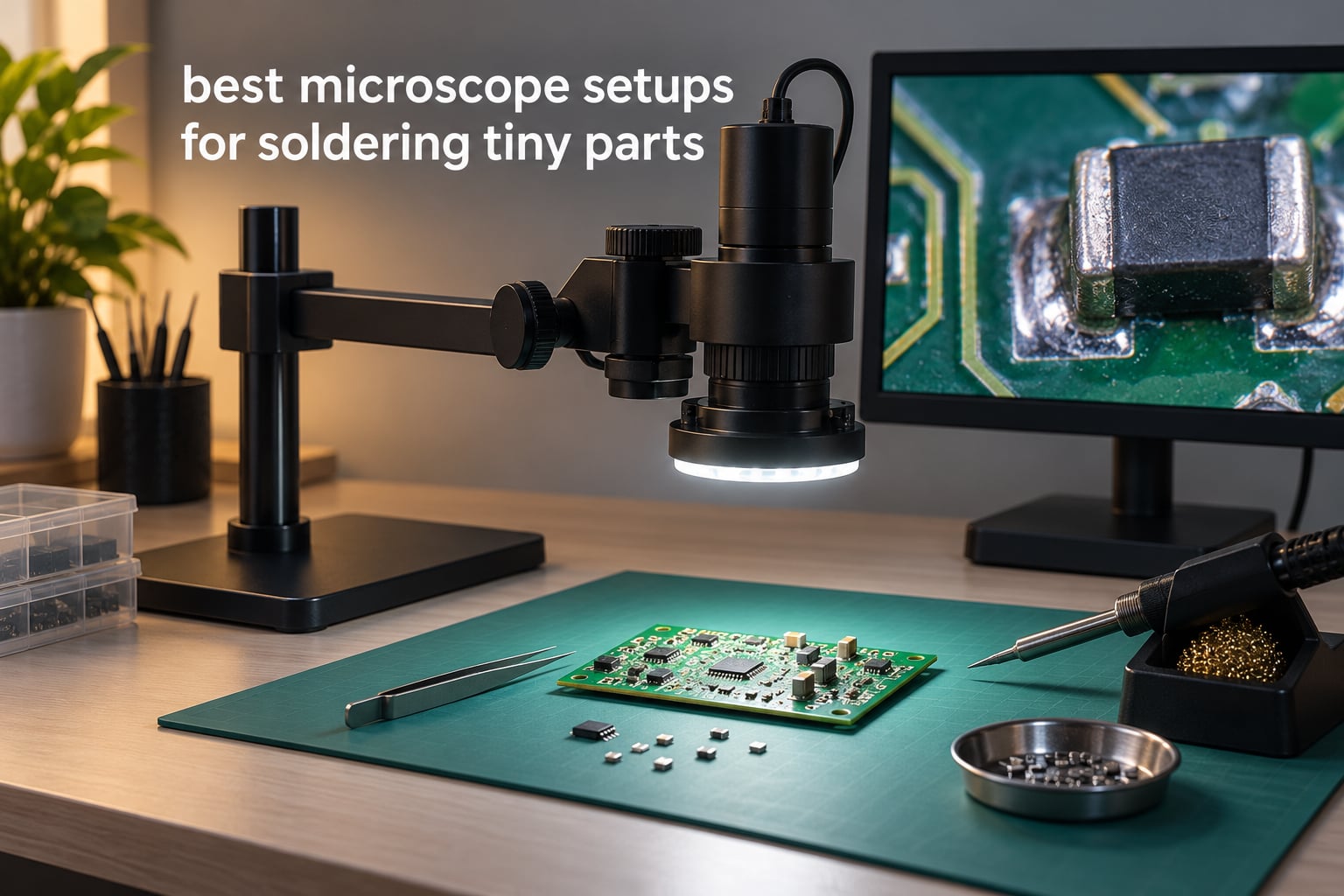
Short answer: the best microscope setups for soldering tiny parts are complete bench systems, not handheld loupes. You want 7x-45x magnification, roughly 100mm of working distance so an iron and tweezers fit under the objective, a stand heavy enough not to bounce, and bright LED ring lighting. Our top pick is the Andonstar AD246S-M, and the AmScope SM-4NTP wins for anyone who wants true optical depth perception.
That matters more than most people expect. At 0201 and 0402 sizes a single pad can be smaller than the head of a sewing pin, so without magnification you are aligning by feel and hoping. Magnification is what lets you see a solder bridge form before it wicks under a neighbouring pad, and what lets you confirm wetting on a joint instead of assuming it worked.
Every ranked setup below was judged as a system rather than as a standalone scope, because a great camera on a flimsy arm is a frustrating bench tool. Each one needs five things working together: the optics, a stand that resists vibration, lighting that does not create glare on reflective solder, a clean video or eyepiece path, and an ergonomic position that does not wreck your neck after two hours. We also have a broader guide to soldering microscopes if you want the optics side covered separately from the bench setup.
Table of Contents
Top 3 Microscope Setups For Soldering Tiny Parts (October 2026)
Three setups came out ahead on the combination of working clearance, image quality and how little they made us fight the bench. The Andonstar AD246S-M has the deepest review base in the group and a metal boom arm that holds position while the iron touches down. The Andonstar AD249S-M Plus is the highest rated and arrives as a full soldering station rather than a bare scope. The TOMLOV DM602 Flex is the value pick, with a 144-LED ring light and a folding arm that folds out of the way when you need bench space.

Andonstar AD246S-M 7 inch HDMI
- Three lenses including a soldering lens
- 2160P HDMI output
- Metal boom arm stand

Andonstar AD249S-M Plus 10.1 inch
- Highest rating in the group
- Extension base adds 230% work area
- Two year warranty

TOMLOV DM602 Flex 10.1 inch
- 144-LED ring light with dimmer
- Folding flex arm
- Heat resistant soldering mat
All 10 Setups at a Glance
The table below lists every setup in this roundup with the specification that actually decides whether it works at your bench: working distance, stand type, lighting and whether you look through eyepieces or at a screen. Two optical stereo setups, one trinocular kit, and seven digital systems are represented, because the honest answer for tiny-part soldering genuinely splits along the line between those two families.
| Product | Specifications | Action |
|---|---|---|
| Andonstar AD246S-M 3 Lens 2160P HDMI Digital Microscope |
|
Check Latest Price |
 TOMLOV TM4K-AF Flex 8 inch Autofocus TOMLOV TM4K-AF Flex 8 inch Autofocus |
|
Check Latest Price |
| Andonstar AD249S-M Plus 10.1 inch HDMI |
|
Check Latest Price |
| TOMLOV DM602 Flex 3 Lens HDMI |
|
Check Latest Price |
 Aikokkl 5 inch LCD C-Clamp Microscope Aikokkl 5 inch LCD C-Clamp Microscope |
|
Check Latest Price |
 DZQ ZQ-1 Stereo 7X-45X with 0.5X Barlow DZQ ZQ-1 Stereo 7X-45X with 0.5X Barlow |
|
Check Latest Price |
 AmScope SM-4NTP Simul-Focal Stereo Microscope AmScope SM-4NTP Simul-Focal Stereo Microscope |
|
Check Latest Price |
 ZTEEERS Trinocular Stereo Kit with 0.5X Objective ZTEEERS Trinocular Stereo Kit with 0.5X Objective |
|
Check Latest Price |
 SWIFT Trinocular Stereo with Pillar Stand SWIFT Trinocular Stereo with Pillar Stand |
|
Check Latest Price |
 TOMLOV TM3K-AF Max 10.1 inch Autofocus TOMLOV TM3K-AF Max 10.1 inch Autofocus |
|
Check Latest Price |
How We Tested 10 Microscope Setups?
We spent several weeks moving ten microscope setups through the same bench routine, because the differences that matter only show up when you are placing a 0201 part rather than reading a spec sheet. Nothing here is a lab measurement of resolution; it is a practical read on how each setup behaved under real soldering conditions.
Every setup was judged on the same five points:
1. Tool clearance. Can you get an iron tip, a pair of tweezers and a hot air nozzle into the field at your working magnification without touching glass? Many units fail this and nothing else matters.
2. Image quality at soldering distance. We looked at real joints on populated boards, not coins. Contrast on a shiny fillet and the ability to resolve a single 0201 pad separated by a hairline gap decided this score.
3. Focus behaviour under contact. When your iron touches the board, the stand gets a shock load. We checked whether the image swam, vibrated or lost focus entirely.
4. Lighting behaviour on reflective solder. A ring light that flatters a matte coin can hide a cold joint. We looked specifically for glare, shadowing under the tweezer tips and hot spots in the middle of the field.
5. End of session fatigue. After a couple of hours, does the viewing posture hurt? A screen setup and an eyepiece setup fail this test in completely different ways.
1. Andonstar AD246S-M 3 Lens 2160P HDMI Microscope
Andonstar AD246S-M 3 Lens 2160P HDMI Digital Microscope 2000x for Adults
- Three interchangeable lenses cover soldering coins and slides
- 2160P HDMI output drives a larger monitor hands-free
- Metal boom arm adjusts in six directions and tolerates heat
- Windows measurement software and 32GB microSD included
- On-screen magnification of the L lens sits well below the 2000X headline
- Every lens change needs a refocus
- Screen-only viewing with no binocular eyepiece
The Andonstar AD246S-M is the setup we kept reaching for during testing, and the reason is boring but decisive: 1271 reviews behind a 4.5 rating tells you a lot more about a bench tool than a marketing page does. The scope itself is a 7-inch LCD unit with a metal boom arm, and the whole thing weighs 2.25 kg, which is enough mass that the image stays put when the iron touches the board.
The headline number is 2040x maximum magnification and the real number is 15-60x on the built-in screen with the L lens, which is 60-240x when you pipe the 2160P HDMI signal to a 28-inch monitor with 3x digital zoom. That gap is the single most common complaint in the reviews and it is worth understanding rather than being annoyed by: the advertised figure is lens capability, not screen capability. Connected to a proper monitor, the working image is genuinely good for placing 0201 parts.
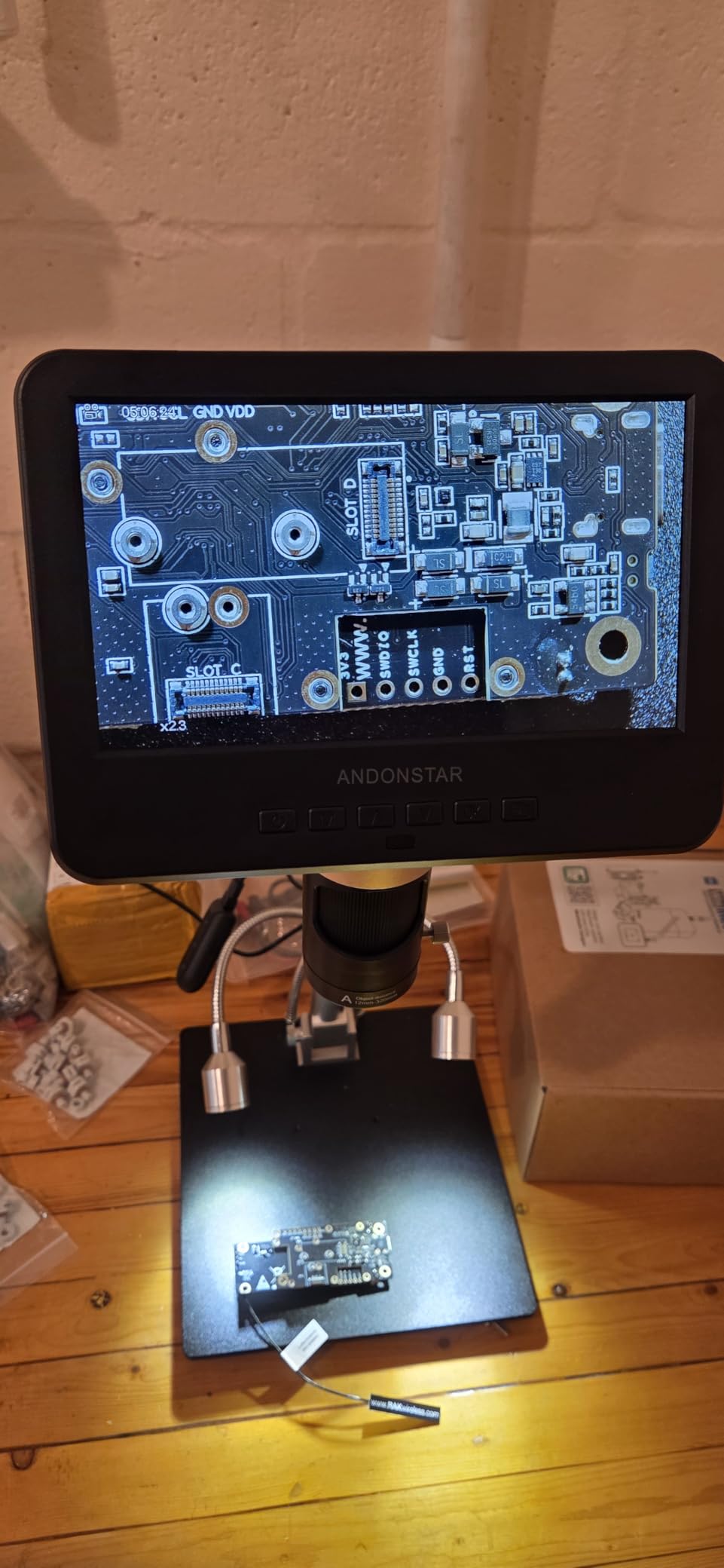
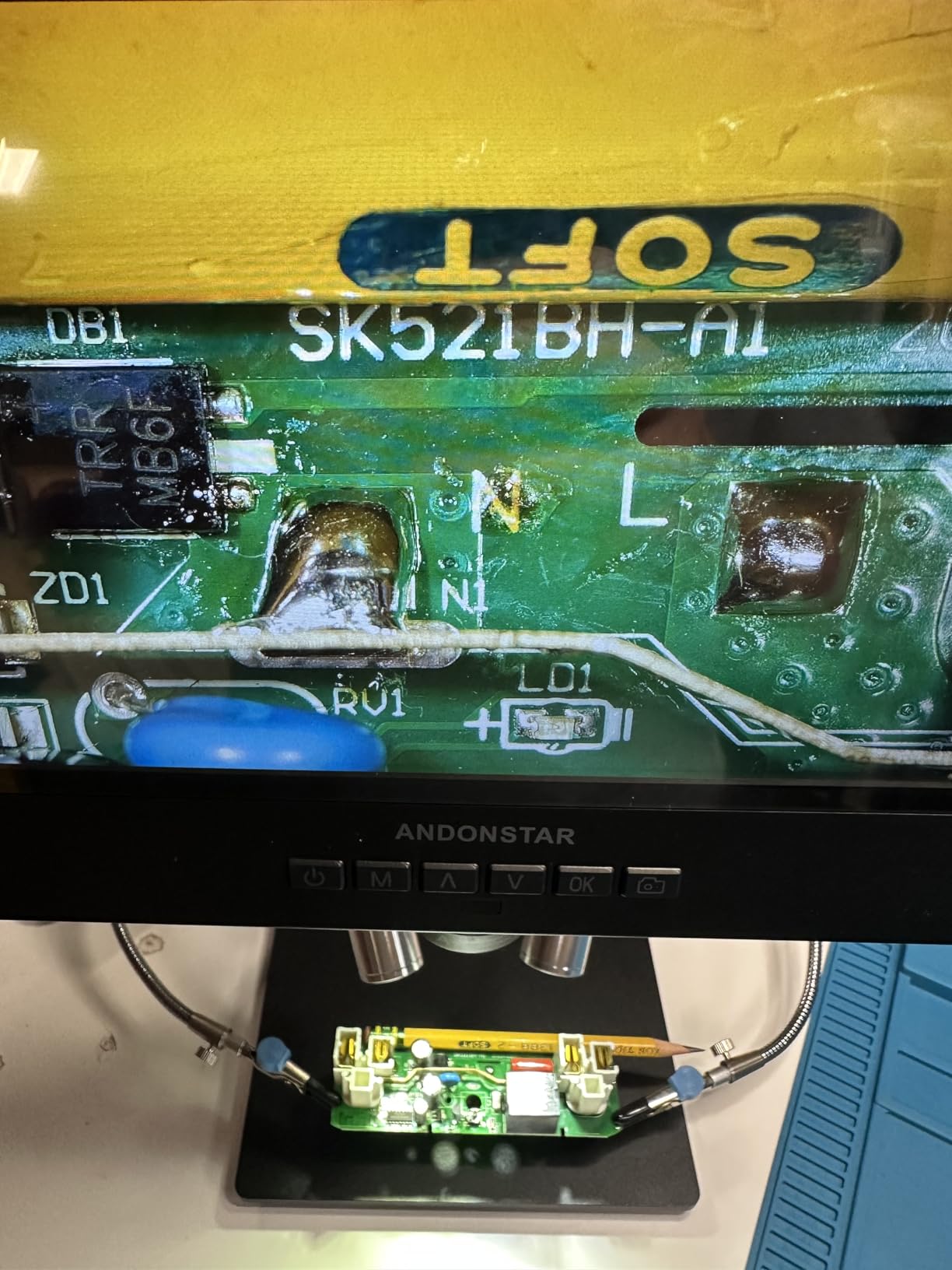
Physically it is 12.99 by 6.69 by 11.02 inches, which leaves room on a small bench, and the boom arm adjusts front to rear, side to side and in angle. The focusing wheel and bracket knob make object distance easy to dial in, and eight LED intensity levels let you drop the light when you are inspecting a hot joint rather than reading a cold one. There is a wireless remote for image flip, discoloration and digital zoom, so you can keep one hand on the iron.
Inside the box you get the host, three lenses, a slide holder, a 32GB microSD card, USB and switch cables, an HDMI cable, the remote, five slides, an observation box and tweezers. The bundled tweezers are nothing special, but the fact that they are there tells you this is aimed at a soldering bench rather than a classroom. If you want a camera you can point at a larger monitor or a separate machine, our microscope camera guide covers that route.

What tells you this is the right bench scope?
The metal boom arm is the deciding factor. Flex arms and goosenecks feel cheaper and transmit more shock, and a 2.25 kg metal stand simply does not move when you touch a hot iron to a board. For a bench that sees daily use, that steadiness is worth more than any resolution upgrade you can buy later.
The three-lens arrangement also pays off if you solder and inspect. Lens L is for circuit boards and phone repairs, Lens A covers whole coins and small parts, and Lens D handles biological slides. Most people will only ever use L, but the other two cost nothing extra at this point and turn the unit into a general inspection tool.
What to watch out for?
Lens changes are a real friction point. Each lens has a different physical magnification, so swapping them means unscrewing, refocusing and relearning where the working height sits. If you jump between soldering and coin work all day, budget for that annoyance. If you solder and nothing else, set L once and leave it.
There is no binocular eyepiece option, so everything is viewed on a screen. If you have done fine solder work with a stereo eyepiece before and found the direct hand connection hard to give up, this will not replicate it. That is a real preference difference rather than a quality gap, and it is why the optical scopes later in this list exist.
2. TOMLOV TM4K-AF Flex 8 inch Autofocus Microscope
TOMLOV Autofocus 4K Digital Microscope, 8″ TM4K-AF Flex Arm for Soldering
- TOF autofocus locks on quickly and tracks moving parts
- P1 and P2 presets store two working focus heights
- 4K video and 52MP stills on a 100% sRGB screen
- Four inch stand and cables included in the box
- Thin plastic scope housing
- External monitor output drops to 1080p
- PC mode disables menus recording and digital zoom
- Narrow field of view for orienting on a board
Autofocus is the pitch here, and the time-of-flight sensor is a genuine answer to a problem digital microscope users complain about constantly: after every nudge of the board or every lift of the iron, you refocus by hand. This unit locks onto a subject quickly and adjusts as parts move, which during testing removed more manual focus fiddling than we expected from a scope at this level.
The P1 and P2 preset focus points are the detail we appreciated most. You store a close soldering height and a wider orientation height, then jump between them with the remote instead of cranking the focus wheel. The screen is a 1280×800 8-inch panel at 100% sRGB, with 4K UHD video and 52MP stills, and the sensor covers up to 2000x. The 360-degree articulating flex arm has a rail knob for small height changes without moving the whole arm.
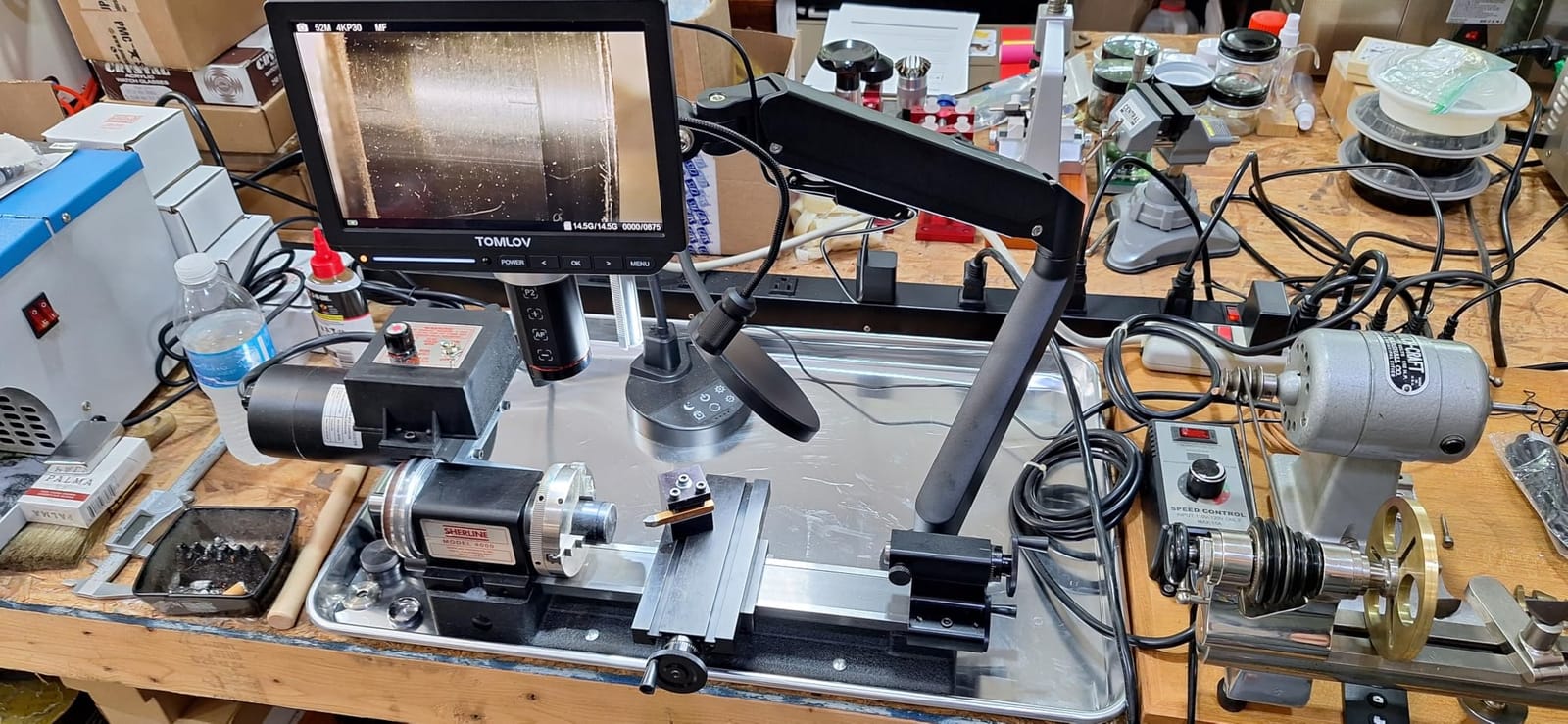
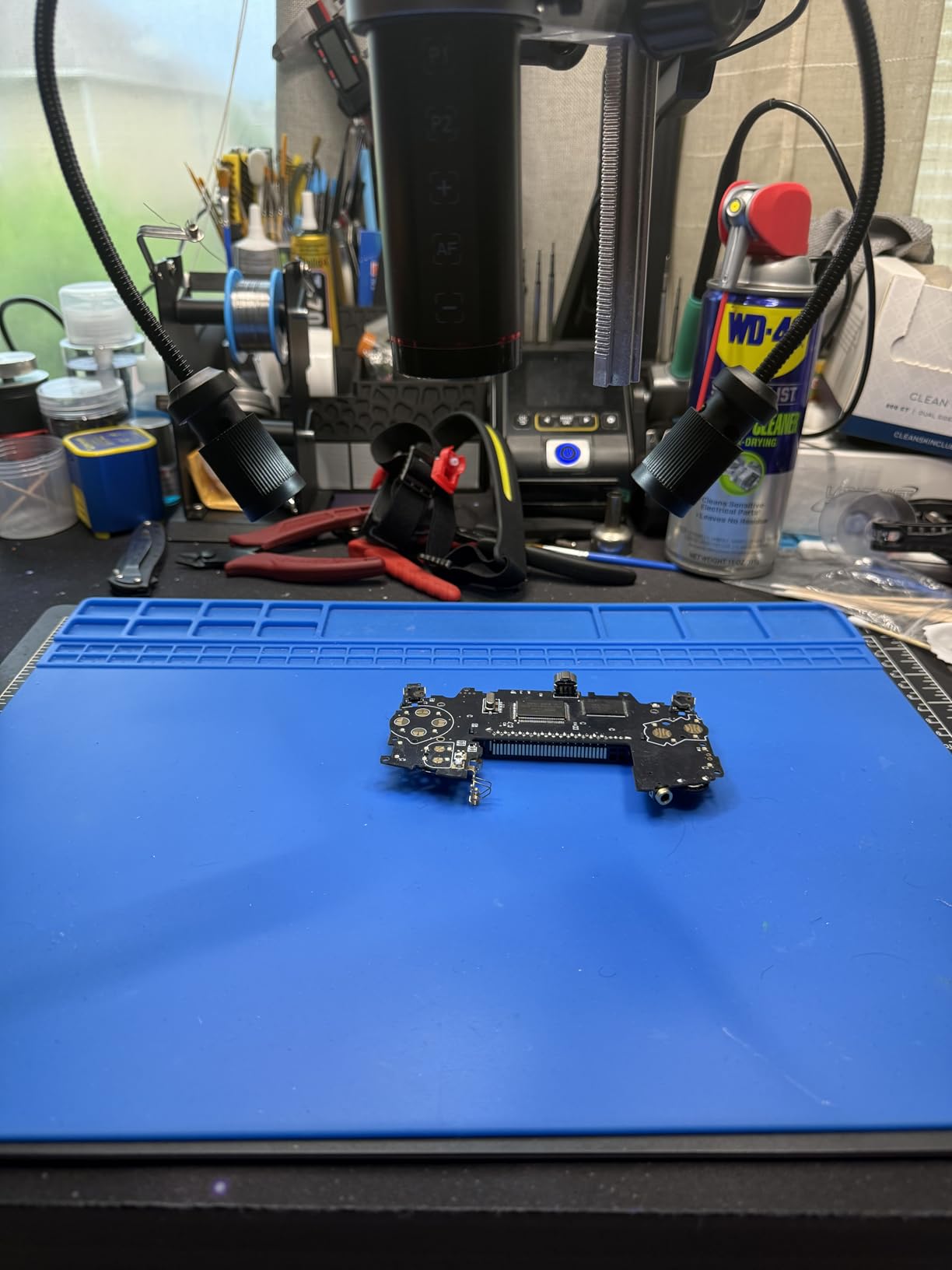
Lighting is a ring light plus two adjustable gooseneck lamps with independent brightness, which is the right combination when a board has tall components that cast shadows into a ring-only setup. A soldering mat is included in the box, along with the flex arm, a 4-inch stand, HDMI and USB cables, a microSD card and a remote. Battery powered at 3 pounds, it is the one setup in this roundup we can move to a different bench without unplugging anything.
The 4.2 rating is the lowest among the four digital TOMLOV and Andonstar scopes here, and the reviews explain why. The scope housing is thin plastic, and while the stand is metal, the two do not feel like the same product. External monitor output is 1080p rather than 4K even though the sensor is 4K, which only matters if you planned to run this as a main capture source.
Where autofocus genuinely earns its place?
Autofocus helps most when your working height keeps changing: dragging a board across the mat, flipping a phone assembly, working around a heat sink. The TOF sensor adapts to those shifts, and the stored P1 and P2 heights mean you are not re-dialing the same two positions all session. For a hobbyist who moves between tasks, that convenience is worth the plastic body.
The gooseneck pair is also more useful than it sounds. A single ring light throws a shadow from any component taller than your work, and a second off-axis source fills it. If you routinely work on boards with raised shields or connectors, this lighting layout will save you more time than another 200x of digital magnification would.
What to watch out for?
Plugging it into a PC changes the feature set significantly. Reviewers report that in PC mode the menus and recording become unavailable and digital zoom is disabled, which makes it a viewing device rather than a capture device on a computer. The field of view is also narrow, so orienting yourself on a large board means leaning back and losing the work area.
Base mounting is awkward, and the base clamp may not suit every bench edge. If your bench is a fixed table with no clamp-able edge, budget time and hardware for a mount. Manual zoom through the on-device control shakes the image, and focus and zoom are not on the remote, so plan on using the presets rather than live adjustments.
3. Andonstar AD249S-M Plus 3 Lens 10.1 Inch HDMI Microscope
- Highest rating in the roundup at 4.7
- Extension base turns the boom arm into a full soldering station
- Tool holder helping hands and anti-static mat included
- Component storage boxes keep the bench clear
- Two year manufacturer warranty
- Lens changes require unscrewing and refocusing
- Plastic accessory parts add bulk
- Corded power only with no battery option
This is the highest rated setup in the roundup at 4.7, and the reason is not the optics so much as what arrives in the box. Where most digital scopes ship as a scope on a bare arm, the AD249S-M Plus includes an extension base, a tool holder, solder-free helping hands with rotatable clamps, a heat-resistant soldering mat and component storage boxes. The extension base is advertised as increasing the soldering work area by 230%.
In use that turns the unit from a camera on a stick into something closer to a small soldering station. The work area increase matters because the working problem on a tiny-parts bench is not magnification, it is room to rest your wrist while an iron and a pair of tweezers converge on a 0.6mm pad. More flat space in front of the arm means fewer clamped-fixture situations.
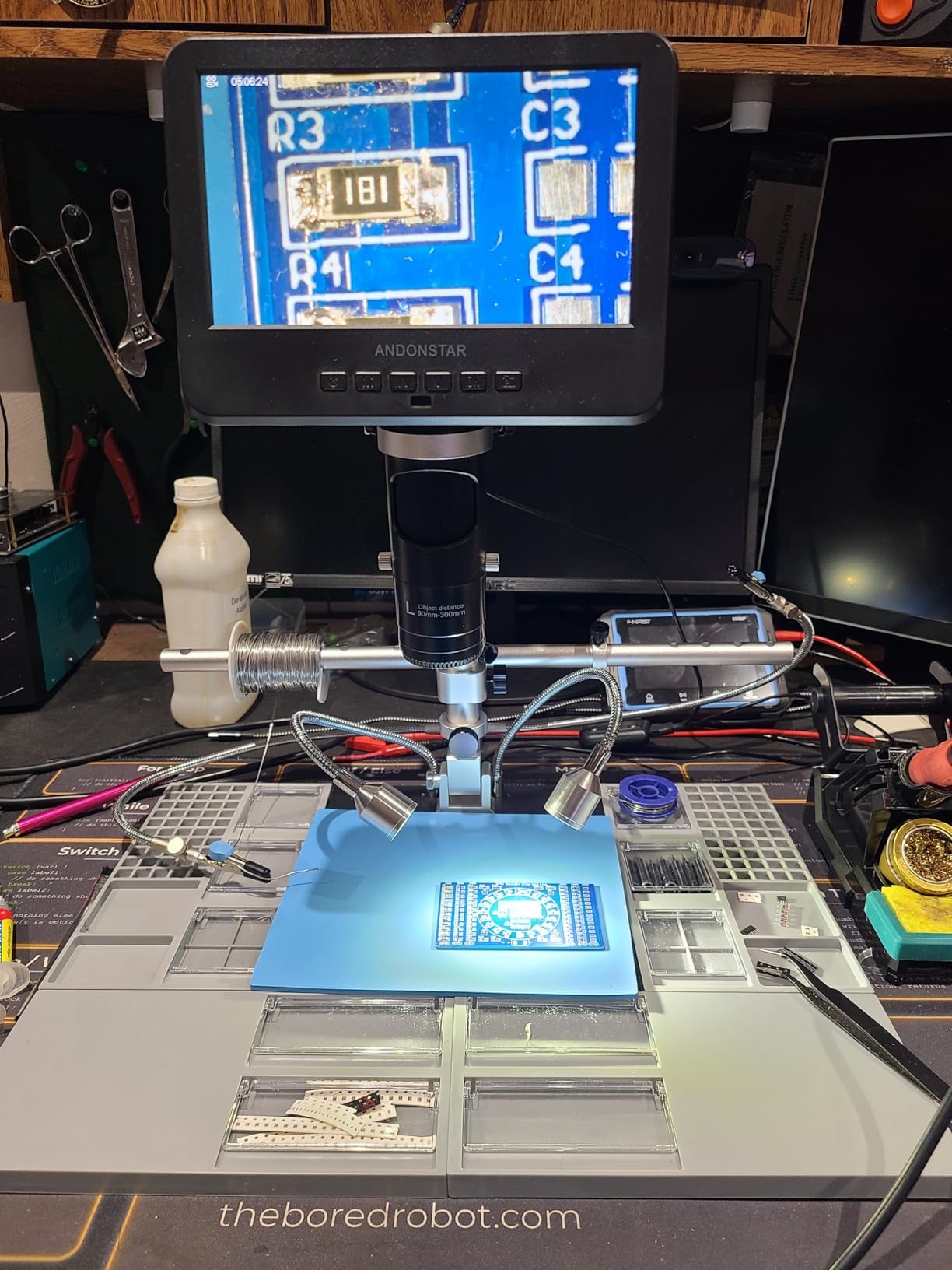
The display is a 10.1-inch screen with UHD 2160P capture and HDMI output to a larger monitor, and the three lenses span 60-240x for soldering and repair, 18-720x for coins and objects and 1560-2040x for slides. On the built-in screen the same lenses read 15-60x, 4.5-180x and 450-510x respectively, with 3x digital zoom available over HDMI to a 28-inch monitor.
A 32GB microSD card, the remote with discoloration and digital zoom, eight LED brightness levels and Windows measurement software are all included, and the warranty runs two years from the manufacturer. That is the longest warranty in the roundup apart from the AmScope, and on a tool that sits on a bench every day it is not a trivial detail.
When this is the correct upgrade?
If your current digital scope works but you are constantly fighting for bench space, this is the model that fixes the space problem rather than the image. The helping hands with rotatable clamps hold a board at a workable angle so both hands stay on the tools, and the storage boxes stop parts migrating across the mat mid-task. On a cluttered desk that combination matters more than a sensor upgrade.
The 10.1-inch panel is also the right size for work that moves around a board. An 8-inch screen forces you to lean or move your head to track a large PCB, and that neck movement across a session is a real contributor to the eye fatigue people report. A larger panel means less head travel for the same work.
What to watch out for?
The accessories are largely plastic, and the extension base and storage boxes add real bulk to an already large footprint. Measure your bench depth before you commit, because the 15.75 by 11.81 by 12.99 inch frame plus the extension base is not a compact arrangement. It suits a dedicated workbench better than a laptop shelf.
The same lens-change friction applies as on the smaller Andonstar: each lens needs unscrewing and refocusing, and the on-screen magnification of the soldering lens is far below the 2040x headline. Power is corded only, so there is no battery option if you want to move this between a bench and a field job. If you need portability, look at the flex-arm TOMLOV instead.
4. TOMLOV DM602 Flex 3 Lens HDMI Soldering Microscope
TOMLOV DM602 Flex 3 Lens HDMI Digital Soldering Microscope, Flexible Arm
- 144-LED ring light with a smooth front dimmer
- Flex arm with 360-degree base rotation and a foldable design
- Silicone mat rated to 932 degrees F with a ruler scale
- Lens L covers 60-200x for micro-soldering
- 24MP stills and 2K video to microSD
- No master power switch
- Separate 12V cable for the under-scope light
- Scope sits loosely in the mount
- Image shakes unless the arm is fixed to a rigid surface
The DM602 Flex is the one we would build around if a single unit has to cover soldering, coin work and slides. Three lenses handle it: L at 60-200x for micro-soldering, A at 2-700x for full coin views and D at 1000-2000x for biological slides. That breadth is unusual at this tier, and it means the unit does not become a single-purpose prop when you are not soldering.
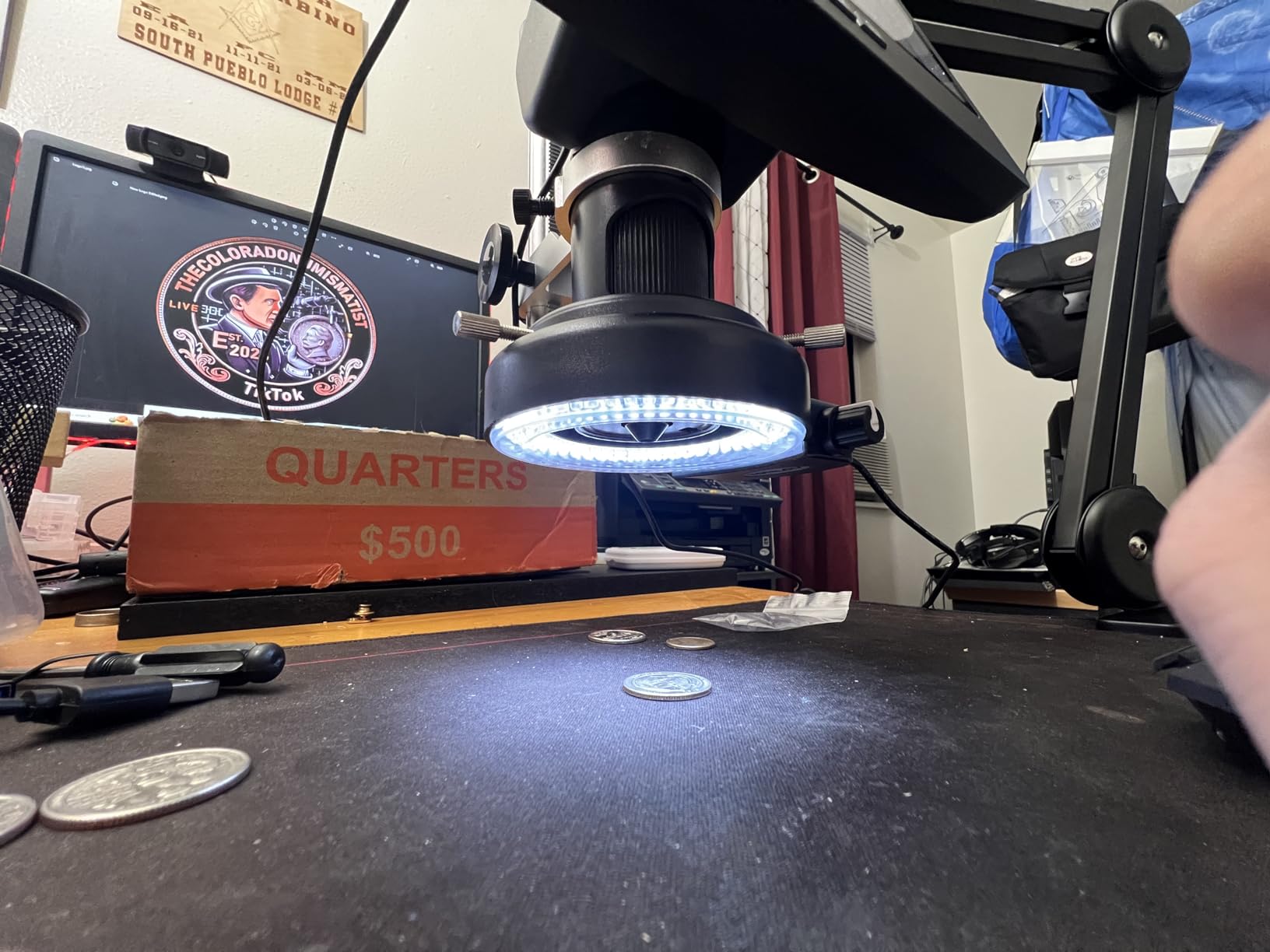
The 144-LED ring light is the standout feature, with a front-mounted dimmer knob rather than menu digging. Brightness control matters more than people expect on reflective solder: a fillet is a curved mirror, and at full brightness it throws a hot spot that hides the very defect you are looking for. A smooth external dimmer lets you drop the level for inspection, which is a genuinely practical design choice. We cover the wider lighting argument in our microscope lighting guide.
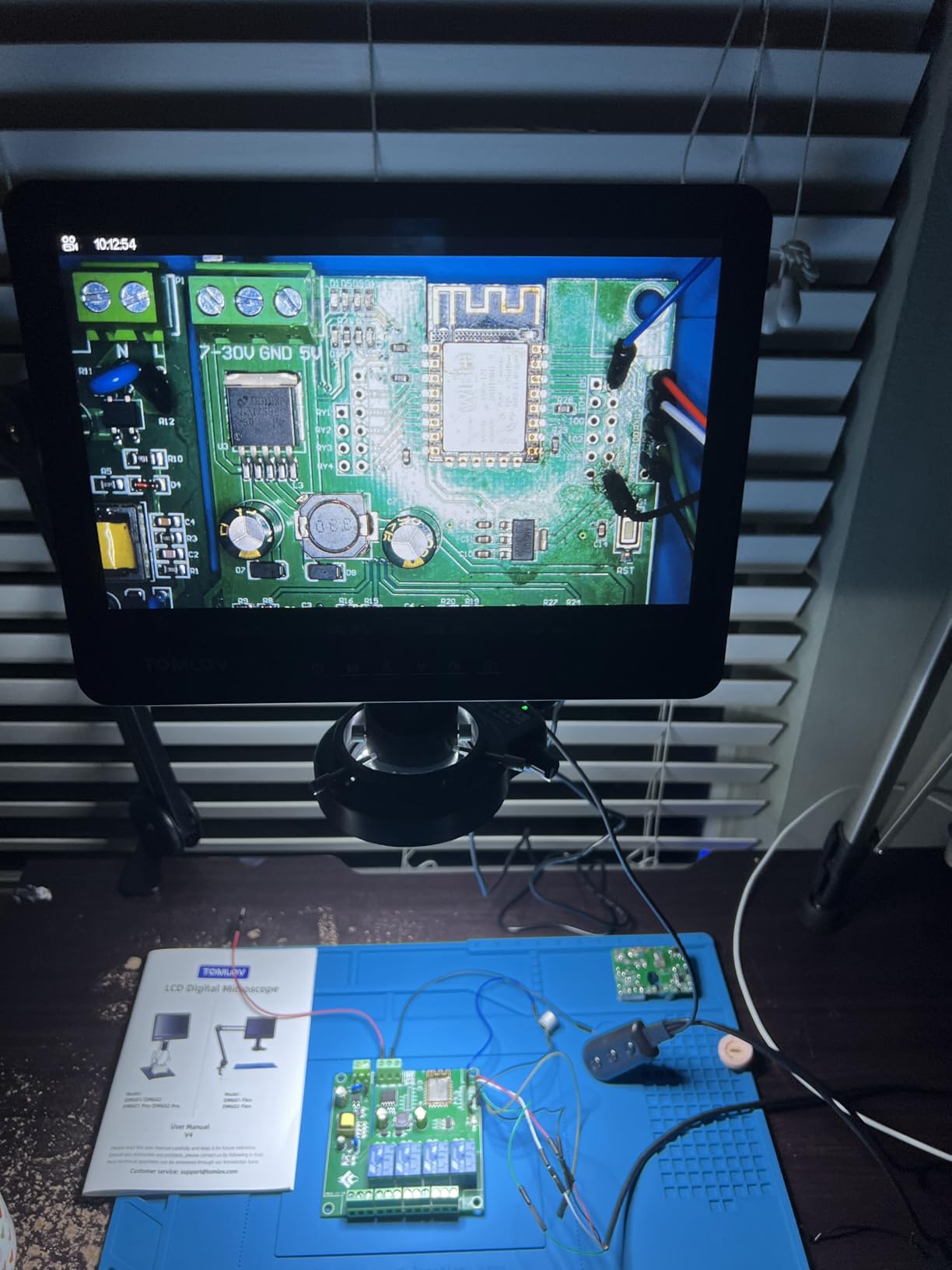
The flex arm is unusually adjustable: 360-degree base rotation, 135-degree horizontal extension, 180-degree vertical movement, and it folds flat when you need the bench space. The silicone soldering mat is 13.8 by 9.8 inches, rated to 932 degrees F, and printed with a ruler scale and part boxes. The screen is a 10.1-inch IPS panel at a 178-degree viewing angle, and capture is 24MP stills and 2K video to microSD with one-button capture.
HDMI output and a USB interface handle monitor and PC connection, and a remote keeps your hands on the work. It ranks #26 in lab handheld digital microscopes, which tells you the category is crowded and this one is holding a solid position in it at 1623 g.
Why the light and the arm earn the badge?
Two things separate this from the other digital scopes here. The 144-LED ring gives a genuinely even field, and combined with the 178-degree IPS panel the centre of the image is no brighter than the edges. Uneven lighting on a shiny pad makes you chase brightness as you move the board, which is tiring and slow.
The folding arm is the second one. A scope that collapses to a flat footprint lets you share a bench between soldering and anything else, which is the normal reality of a hobbyist desk. The ruler printed on the mat is a small thing, but for placement work where you are matching a pad to a footprint, having a scale right in the field is a time saver.
What to watch out for?
Power management is untidy. There is no master power switch, so the unit wakes with the bench power strip, and the under-scope illuminator runs on its own 12V cable of a different length. Expect to add an inline switch and to plan your cable routing before you start work rather than after.
Reviewers report the scope sitting loosely in the mount, and the image shaking if the arm is attached to anything that is not a rigid surface. That second point is a physics limitation, not a defect: a long arm on a soft desk transmits every touch. If your bench is not solid, either bolt the base down or accept that precision work will suffer.
5. Aikokkl 5 Inch LCD Digital Microscope with C-Clamp
Aikokkl 5″ LCD Digital Soldering Microscope for PCB Repair with C-Clamp
- Lowest cost in the roundup while holding a 4.5 rating
- C-clamp keeps both hands free for the iron
- PC Camera mode works with the built-in Windows app
- 5 inch IPS screen eases eye strain
- One year manufacturer warranty
- No autofocus
- microSD card not included
- 5 inch screen is small for a large board
- Magnification is digital only past about 1000x
Not everyone needs three lenses and a steel base. If your soldering is 0402 and above, you mostly need to see what you are doing, and this 5-inch LCD scope on a C-clamp does that for the least money of anything in the roundup. The rating is 4.5 across 191 reviews, which for an entry-level tool is a strong showing and suggests the limitation is understood by buyers rather than discovered later.
The C-clamp mount is the design decision that makes it viable for soldering rather than just inspection. A base-stand scope has to be positioned in a footprint, and a C-clamp attaches to the edge of a desk so the arm reaches over your work and leaves the surface free. Both hands stay on the iron and the tweezers, which is the entire point of a soldering microscope.
Focus is manual via a silver focus wheel, and magnification up to 1000x is achieved by physically moving the lens and turning that wheel. That sounds like a downgrade until you accept that at soldering distances the useful magnification is far lower than the number suggests, so you are making small deliberate adjustments rather than hunting for focus. The multi-angle flexible goose-neck stand fits tight workspaces and irregular objects.
The PC Camera mode is a genuinely useful freebie: select it and the unit appears as a webcam in the built-in Windows Camera app or Mac Photo Booth, with no drivers and no third-party software. Video is 1080P with high-resolution photo batches, written to a microSD card up to 32GB, though the card itself is not included.
What you get for very little?
At 1.2 pounds and 12.52 by 9.53 by 2.28 inches, this is the easiest setup here to move, stow and point at a different project. The 5-inch IPS panel is small but flat and even, and reviewers consistently note it is easier on the eyes than a curved or reflective small screen over a long repair session. It also ranks #10 in microscopes, which shows it competes above its class in the general category.
The one-year manufacturer warranty and the stated replacement offer for black screen, charging or PC connection problems are both better than what unbranded alternatives tend to offer. For a first scope, a warranty with an actual service commitment behind it removes the main risk of buying cheap.
What to watch out for?
The missing microSD card is the first surprise. Without it you get a live view and nothing recorded, so add a card before your first board. The 5-inch screen is also genuinely small when you need to orient across a large PCB, so expect to lift your head and re-centre more often than on a 10-inch panel.
Digital-only magnification means detail beyond roughly 1000x is upscaled rather than resolved, and there is no autofocus to save you when the board moves. It is built for micro-details such as solder joints, not for full-screen views of large objects. If your work regularly includes 0201 placement or fine-pitch QFN rework, plan to move up a tier rather than pushing this one.
6. DZQ ZQ-1 Stereo Microscope 7X-45X with 0.5X Barlow Lens
DZQ ZQ-1 Multi-Directional Microscope 7X-45X Magnification 0.5X Barlow Lens
- 95-300mm working distance leaves room for an iron at 45X
- 60-LED ring light with a 0-100% dimmer
- Spring mount and adjustable headrest for long sessions
- 0.5X Barlow reduces magnification and extends clearance
- Continuous 7X-45X zoom rather than stepped
- Eyepiece viewing only with no screen or camera output
- No trinocular port for adding a camera
- 11.1 kg base limits where it can sit
- Ring light and bracket need screw-on assembly
Here is the setup that answers the complaint that appears most often in forum threads about digital microscopes: you cannot get your tools into the field. The DZQ ZQ-1 is an optical stereo scope with a 95-300mm working distance, which is more than double what most digital scopes offer. At the top of the zoom range you can still bring an iron, tweezers and a hot air nozzle in under the objective without moving the work.
Optics also means zero latency and true binocular depth perception. Your hands and the tip are in the same visual space, so hand-eye coordination behaves the way it did when you learned soldering. No camera processing sits between your hand and the board, and there is no screen to look away from. The 7X-45X range is continuous, so zoom is a smooth wheel rather than a step between presets.
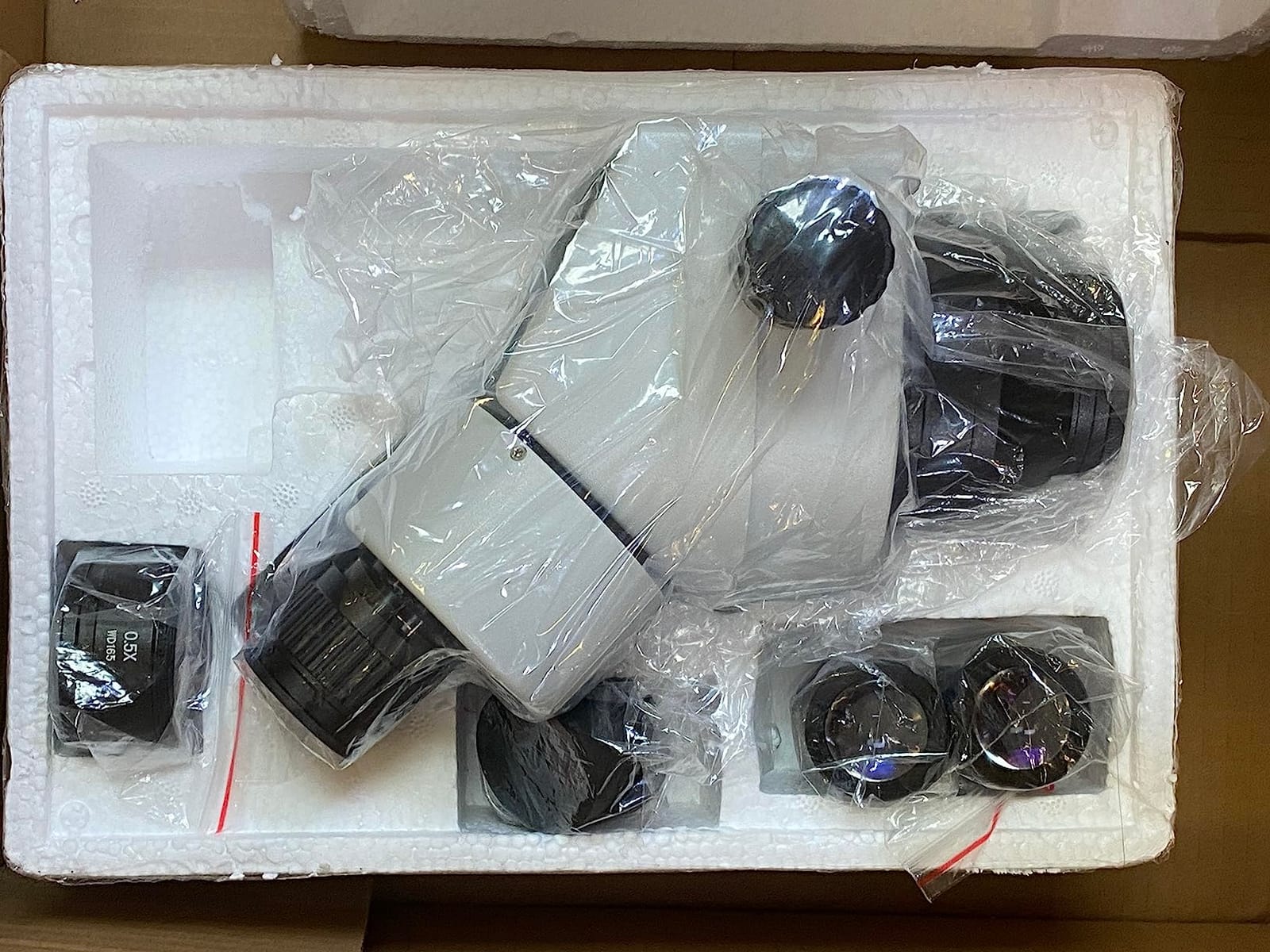
The 0.5X Barlow lens is included, and it is the reason SMD-scale work is possible on this scope. It reduces magnification while pushing the working distance out further, which is exactly the trade you want when a pad is small but your hands are large. The 60-LED ring light has a 0-100% dimmer, and the spring-mounted support with an adjustable headrest spreads the load across a long session.
A multi-directional spring bracket lets you swing the head to any angle and out of the way when you are not looking, which is a small ergonomic win that adds up across a day. Construction is aluminum alloy, and the whole unit is 24 by 17 by 9 inches at 11.1 kg, so it needs a real surface rather than a shelf.
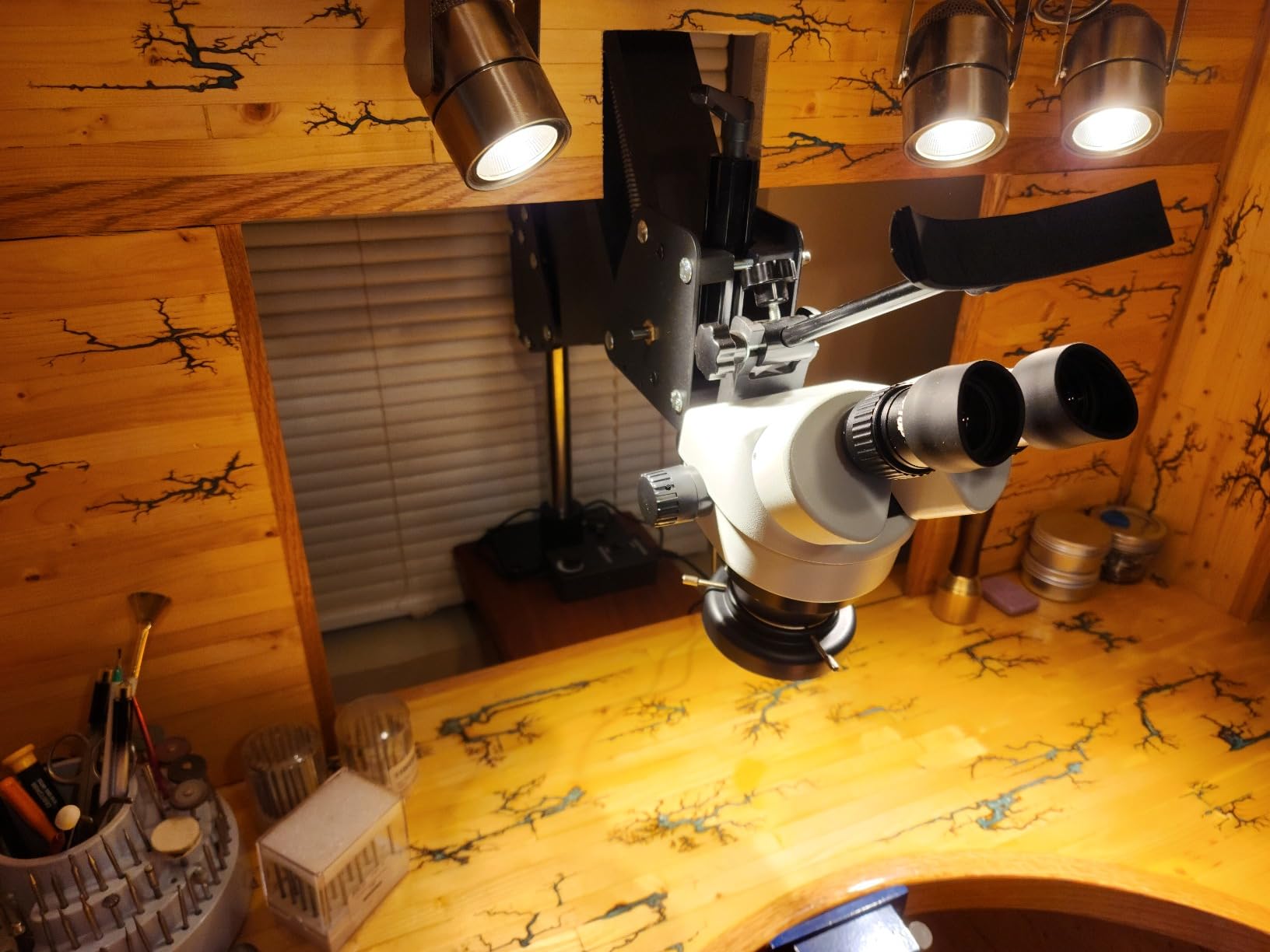
When optical beats a screen?
Pick this style if you are the kind of person who finds it hard to translate a screen image back to hand position. The classic complaint about digital soldering microscopes is not resolution, it is the disconnect between what you see and where your hand is. Stereo eyepieces remove that disconnect, and at 95-300mm of clearance you can work at the top of the zoom range instead of craning past the objective.
The included 0.5X Barlow is what makes the difference between this being a coin scope and being a soldering scope. A 7X-45X optical body on its own is hard to use under an iron because the working distance is short. Add the reducer and you get clearance plus enough resolution to resolve a 0201 pad. That pairing is why this setup earns its badge over cheaper binocular options.
What to watch out for?
There is no trinocular port and no camera output, so nothing you see can be recorded, shared or used as before-and-after documentation. If your work involves client reports, failure analysis or teaching, that is a genuine limitation rather than an inconvenience, and you would need a different model to add a camera later.
At 11.1 kg it is a bench-filling object, and first setup requires screw-on assembly of the ring light and bracket. The trade-off for all of this clarity is that you are buying an instrument, not a gadget, and it will not double as a webcam for documenting your coin collection.
7. AmScope SM-4NTP Simul-Focal Stereo Microscope on Boom Stand
AmScope SM-4NTP 45X Simul-Focal Stereo Lockable Zoom Microscope on Dual
- Simul-focal head shows eyepieces and camera port at once
- Zero-lag optical view keeps hand-eye coordination natural
- Counter-balanced boom reaches across the bench
- Trinocular port accepts a camera upgrade
- Five year manufacturer warranty
- 0.5X Barlow sold separately and effectively required for SMD
- Ring light sold separately
- Manual may not match the shipped model
- At 25.38 kg it needs dedicated space
The AmScope SM-4NTP is the one most experienced hobbyists in the forums compare everything else against, and the reason is the simul-focal trinocular head. Unlike a switchable trinocular, which forces you to choose between the eyepieces and the camera, simul-focal lets you look through both eyepieces and the camera port at the same time. You work through the eyepieces and still record what you are doing.
For finding faults it sits in a category of its own. A hairline trace break on a dense board is something you can trace visually with a good optical scope under even light, and reviewers specifically credit this unit for finding breaks that a 5x lighted magnifier simply does not show. The 7X-45X simul-focal zoom with 1-1/4 inch super wide field view gives a broad view at low power and useful detail at high power.
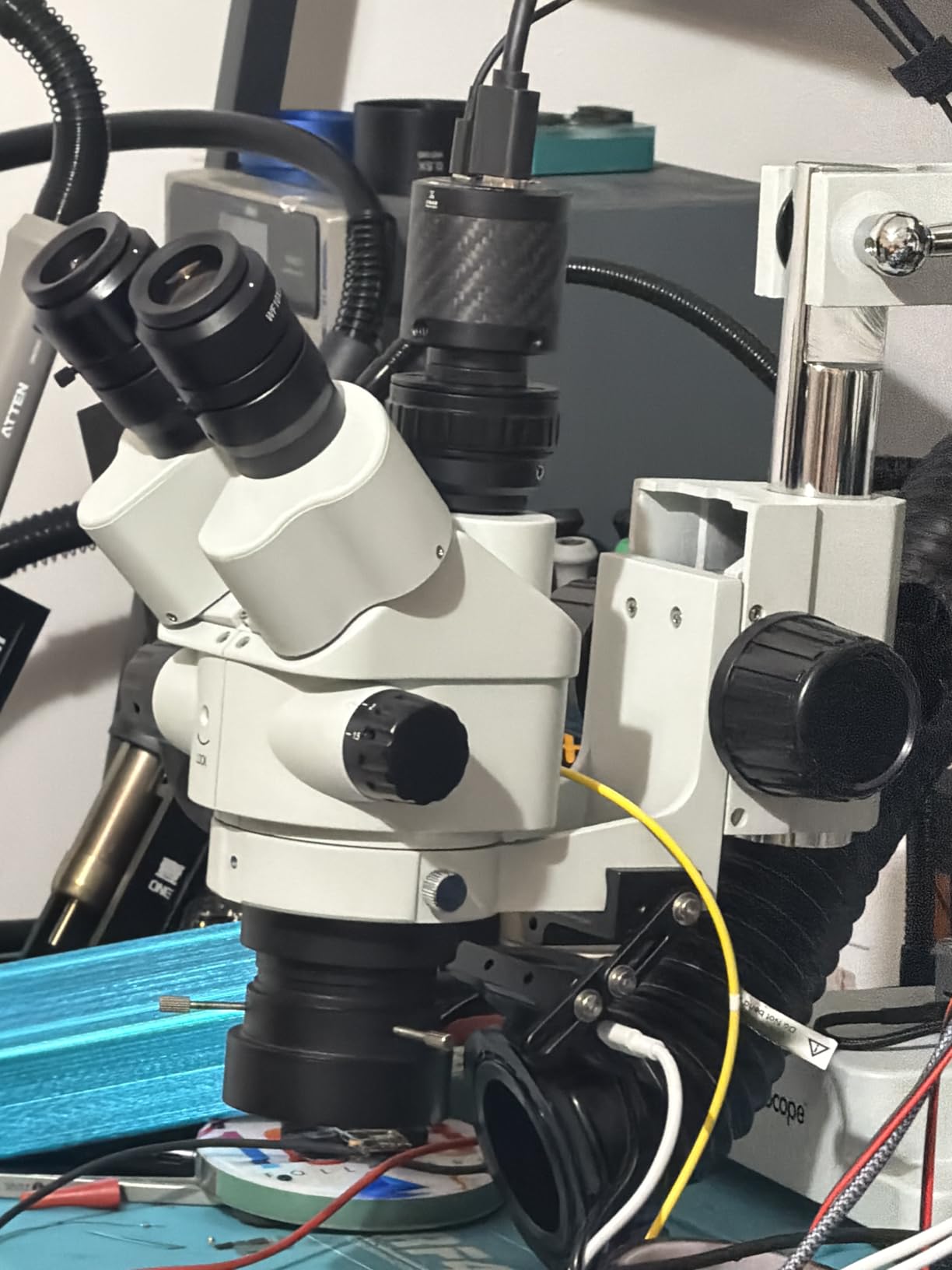
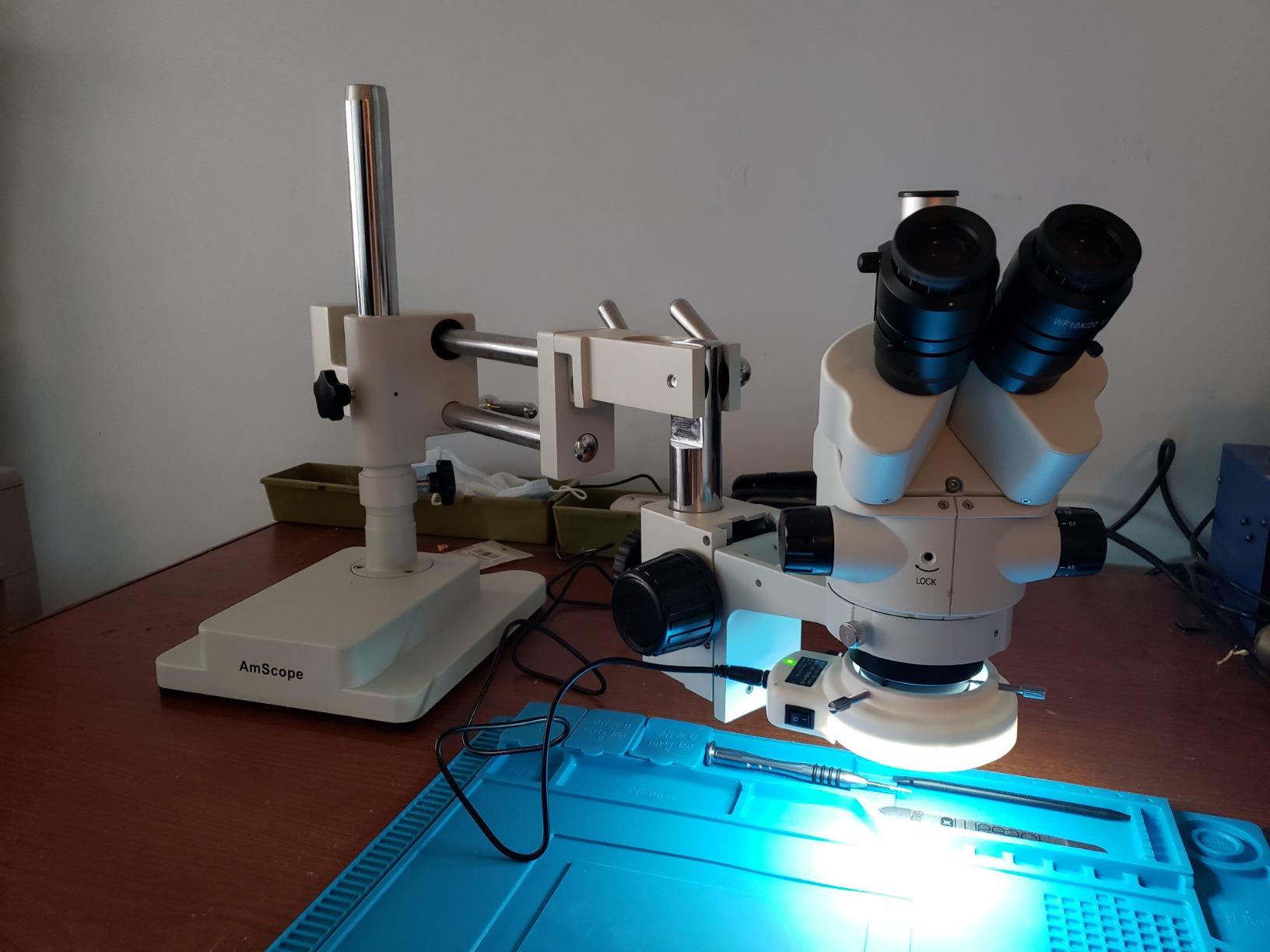
The stand is a 3D counter-balanced boom that reaches across the bench and rotates the head out of the way when you are not using it. Mechanisms are smooth through pan, tilt and focus, and the optics barely shift once tightened, which is the difference between a microscope that stays calibrated for months and one that needs adjusting weekly. The build is lockable, the magnification is described as lockable, and the warranty runs five years.
Working distance is 4 inches out of the box, and reviewers consistently advise adding a 0.5X Barlow for soldering clearance. That is the standard practice in the community and the reason many owners end up with a second objective. The boom stand is the right support for it, since a counter-balanced arm holds position when you rest your forearms on the base.
What separates this from a cheaper stereo scope?
Simul-focal is the feature, and it is not a subtle one. Being able to document a repair without stopping, lifting your head and switching the optical path means your work record matches what you actually did. For anyone who writes up repairs, teaches, or needs before-and-after images of a joint, that is a workflow improvement no screen-based scope in this roundup can match.
Lockable focus and zoom are the second difference. On a cheaper stereo scope, a bumped bench or a heavy-handed grip gradually walks the optics out of alignment, and you spend the session re-focusing. Here the elements lock once and stay. Over months of daily use that reliability is what justifies the class of instrument.
What to watch out for?
The magnification out of the box is too strong for SMD work, so treat the 0.5X reduction lens as required rather than optional. The ring light and auxiliary lenses are also sold separately, so budget for them as part of the setup cost rather than discovering them later. The listed configuration is the microscope and stand only.
Documentation issues are real. The manual may not match the model shipped and contains translation errors and misspellings, some units arrive with the wrong trinocular head, and a few report debris inside the zoom mechanism. Inspect the head on arrival. At 25.38 kg and 22.44 by 20.24 by 21.65 inches, it also needs dedicated floor or heavy-desk space, and the rear height stem uses plain set screws that can develop divots over time.
8. ZTEEERS Trinocular Stereo Zoom Microscope Complete Kit
- Ring light and 0.5X and 2X lenses included in the box
- Ball-bearing boom glides and holds position
- 18 lb steel base keeps the image steady
- 0.5X objective gives about 8 to 10 inches of clearance
- Camera adapters included for eyepiece and camera use
- Very heavy and awkward to move
- Listed dimensions understate the real footprint
- Poor instructions
- Small review base and little online documentation
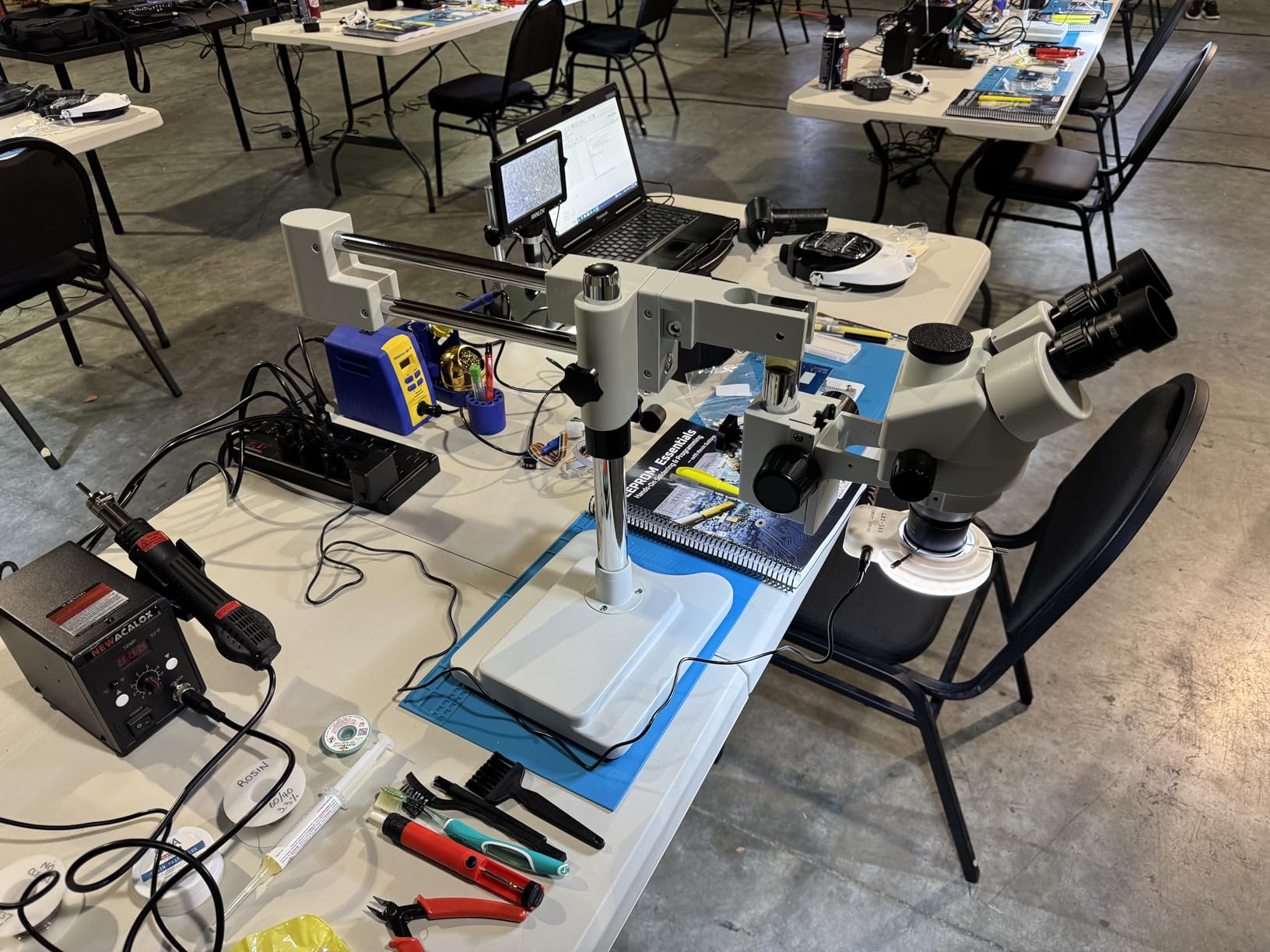
This is the kit answer to the AmScope, and the value proposition is straightforward: broadly the same hardware, plus the accessories the AmScope sells separately, in one box. You get 0.5X and 2.0X auxiliary lenses, a 56S LED ring light with a dimmer, a boom stand and two camera adapters for electronic eyepieces and digital cameras. For someone building a soldering setup from nothing, that removes an entire round of shopping.
The 0.5X auxiliary objective is the piece that matters for soldering. It gives roughly 20cm, about 8 to 10 inches, of working distance, which is a lot of room to bring an iron and a pair of tweezers to a fine-pitch pad. Magnification runs 3.5x-90x overall with the 0.7x-4.5x zoom objective, and the trinocular head uses 10X super widefield eyepieces with 48-75mm interpupillary adjustment and plus or minus 6 diopter per eye.
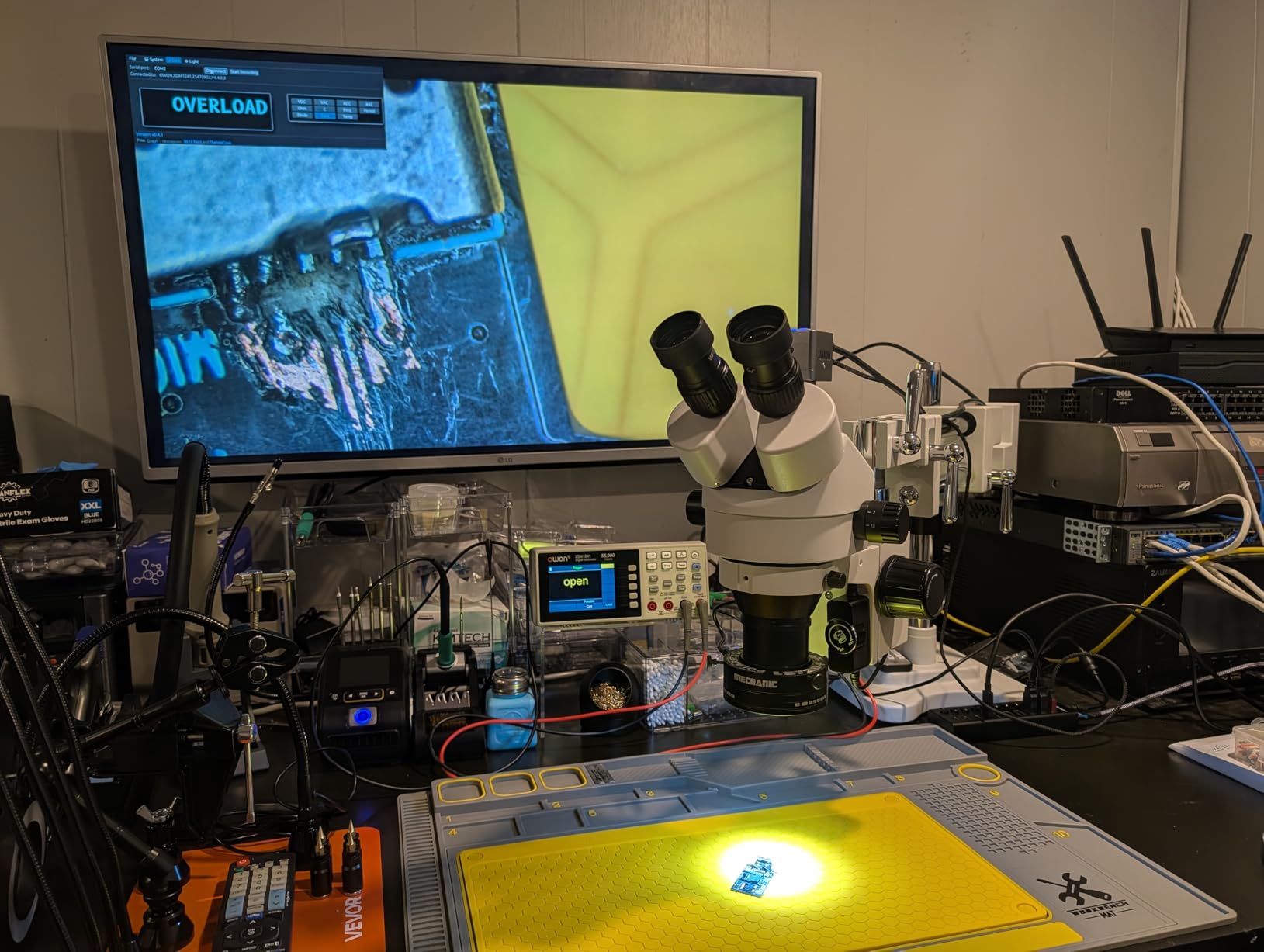
The base is an 18 lb solid steel rectangle, and buyers consistently credit it with a rock-steady image under magnification. The single arm boom stand uses a ball-bearing glide that moves with little resistance and stays where you put it rather than sagging. The head is inclined 45 degrees with 360-degree rotation, which reduces the neck angle you have to hold during a long session, and the synchronous optical channel lets you view through both eyes and the camera at once.
It ranks #4 in lab stereo microscopes, which is a strong position for a brand most buyers have not heard of. That ranking, plus the reviewer consensus treating it as an alternative to the AmScope at roughly half the cost, is the reason it made this list despite a small review base.
Why the included lenses change the economics?
Accessories are where optical microscope budgets quietly expand. If the reduction lens and the ring light are add-ons, a complete soldering-capable setup costs more than the headline figure and you will discover it after the box arrives. Having the 0.5X and 2.0X objectives and the 56S ring light in the box means the working configuration is available the day it is assembled.
The steel base is the second economic advantage. A heavier base means you do not have to buy a separate anti-vibration mat, a monitor arm or a clamp to stop the image shaking, because the mass is already in the product. Over a year of daily soldering that is a saving that is easy to miss at purchase time and easy to feel at the bench.
What to watch out for?
It is heavy and awkward to move, and one buyer reported being unable to return it because of shipping cost. That is a real consideration: this is a purchase you should be confident about before it arrives, not a casual swap. The listed 19.5-inch dimensions understate the real footprint, which several buyers report as around 30 inches with the arm extended, so measure your bench properly.
Assembly instructions are poor and buyers frequently resort to online guides. Build quality is adequate rather than premium and can feel fragile next to a name-brand scope. With only 37 reviews and a no-name brand, there is also very little written troubleshooting help available, so allow extra time for the initial build and know that a long arm on a heavy base can tip if extended without securing the base.
9. SWIFT Trinocular Stereo Microscope with Pillar Stand
- 100mm working distance at 7x-45X
- 0.5X and 2.0X auxiliary objectives included
- 56-bulb ring light with low heat output
- 4.2 kg weight moves without a dolly
- 45-degree head with 360-degree rotation
- Switchable third port so you leave the eyepieces to use the camera
- Pillar stand gives less reach than a boom arm
- Fixed base does not rotate for side viewing
- Small review base of 46
Every boom-stand stereo scope in this roundup weighs enough that moving it is an event. The SWIFT comes in at 4.2 kg, which changes the practical reality of owning optical microscopy: you can take it to a different table, turn it to face a collaborator, or clear the bench between projects. For a hobbyist whose soldering does not always happen in the same corner, that is a more valuable property than it sounds.
Optical quality is where the trade-off shows. The 7x-45x zoom objective has a 6.4:1 zoom range and 4 inch, or 100mm, working distance, which gives room to work under the objective with a tool. The 0.5X and 2.0X auxiliary objectives are included and extend the total range to 3.5x-90x without a separate purchase, which is unusual and genuinely useful for fine-pitch work.
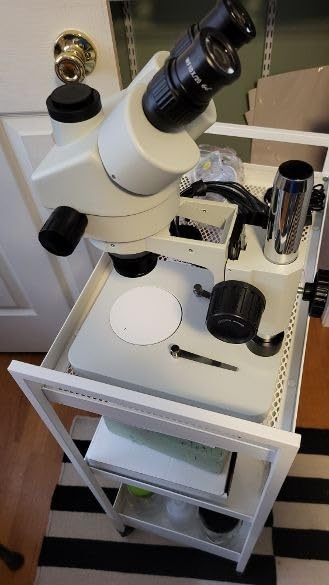
The trinocular head is tilted 45 degrees with full 360-degree rotation and is designed to be comfortable for eyeglass wearers, which matters if you spend long sessions with glasses on rather than working without them. The 56-bulb LED ring light floods the field with low-heat illumination, which is the correct choice when you are working near components that care about temperature. The base is sturdy metal with a plain pillar stand.
It is aimed at researchers, gemologists, engravers, collectors and semiconductor work, and SWIFT is an established optical brand rather than a new listing name. For someone who wants a stereo microscope they can move, store and use across several kinds of work, that combination of weight and brand is the argument.
When a pillar stand is the right call?
A pillar stand fixes the post to a base plate and puts the objective directly over a defined spot. That gives a repeatable working position, which is what you want if you are doing repetitive placement work at one station: the same board, the same angle, the same lighting, every time. Consistency across a production run of small assemblies is easier on a pillar than on a swinging arm.
The 100mm working distance plus the included 0.5X objective is the combination to check before buying. It is enough clearance to get an iron tip in at working magnification, and because the 2.0X objective is also in the box you have somewhere to go when you need to inspect a joint rather than work on it.
What to watch out for?
The third port is switchable rather than simul-focal, so to use the camera you pull away from the eyepieces. If simultaneous viewing and capture matters to you, this is the wrong head and you need the AmScope instead. The vertical port does double as a photo port, so documentation is possible, just not concurrent with working.
Reach and flexibility are the other limits. A pillar stand offers less reach and less ability to swing the head out of the way than a boom arm, and the fixed base does not rotate 360 degrees for side viewing. If you alternate between soldering and inspecting a board held at an angle, that rigidity will frustrate you. The small review base of 46 also means less long-term field feedback than the digital scopes above.
10. TOMLOV TM3K-AF Max 10.1 Inch Autofocus Digital Microscope
TOMLOV Autofocus Digital Soldering Microscope, 10.1″ TM3K-AF Max Coin Scope
- Autofocus with two stored focus heights
- 3K video and 38MP stills with accurate color
- HDMI and USB output to three screens at once
- Gen 6 flex arm moves without knobs
- Split-screen and grid overlays for board navigation
- Autofocus struggles inside about 3 inches
- Mount screws thread into a plastic shell
- Stand joints have uneven friction
- Corded power only
The TM3K-AF Max is the newest and least tested of the digital scopes here at 43 reviews, and it holds a 4.6 with no one and two-star feedback. What separates it from the other autofocus models is the three-screen output. HDMI and USB let you mirror the work to a monitor, a TV and a PC simultaneously, so you can record a repair while a client or a video call sees it live.
Autofocus locks on quickly and the P1/P2 preset memory stores two focus heights, letting you jump between close soldering work and a wider view without redialing. Video is 3K with 38MP stills, and the colour and depth reproduction on fine solder joints and reflective metal is what reviewers single out. The screen is a 10.1-inch IPS panel with a wide colour gamut.
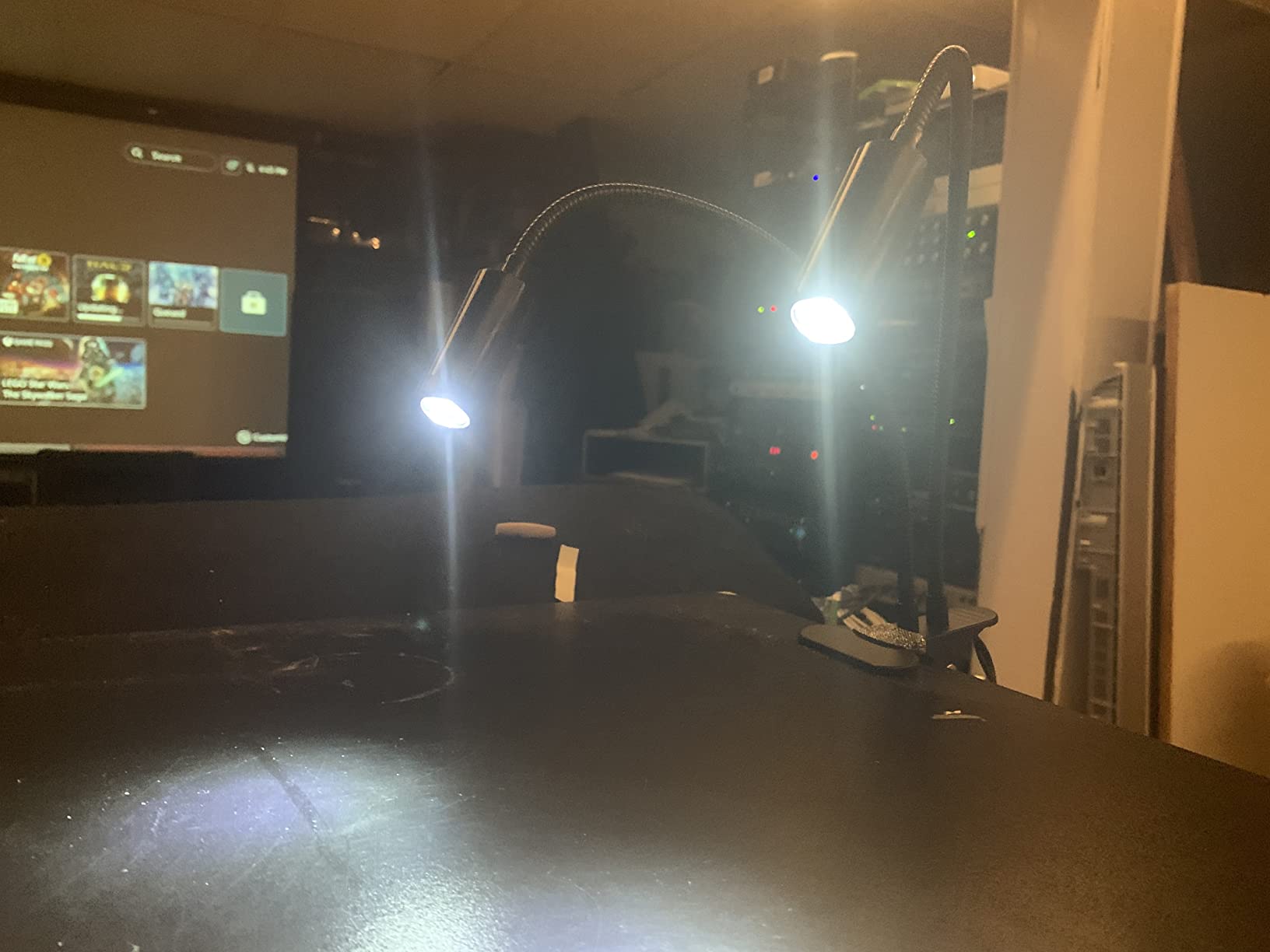
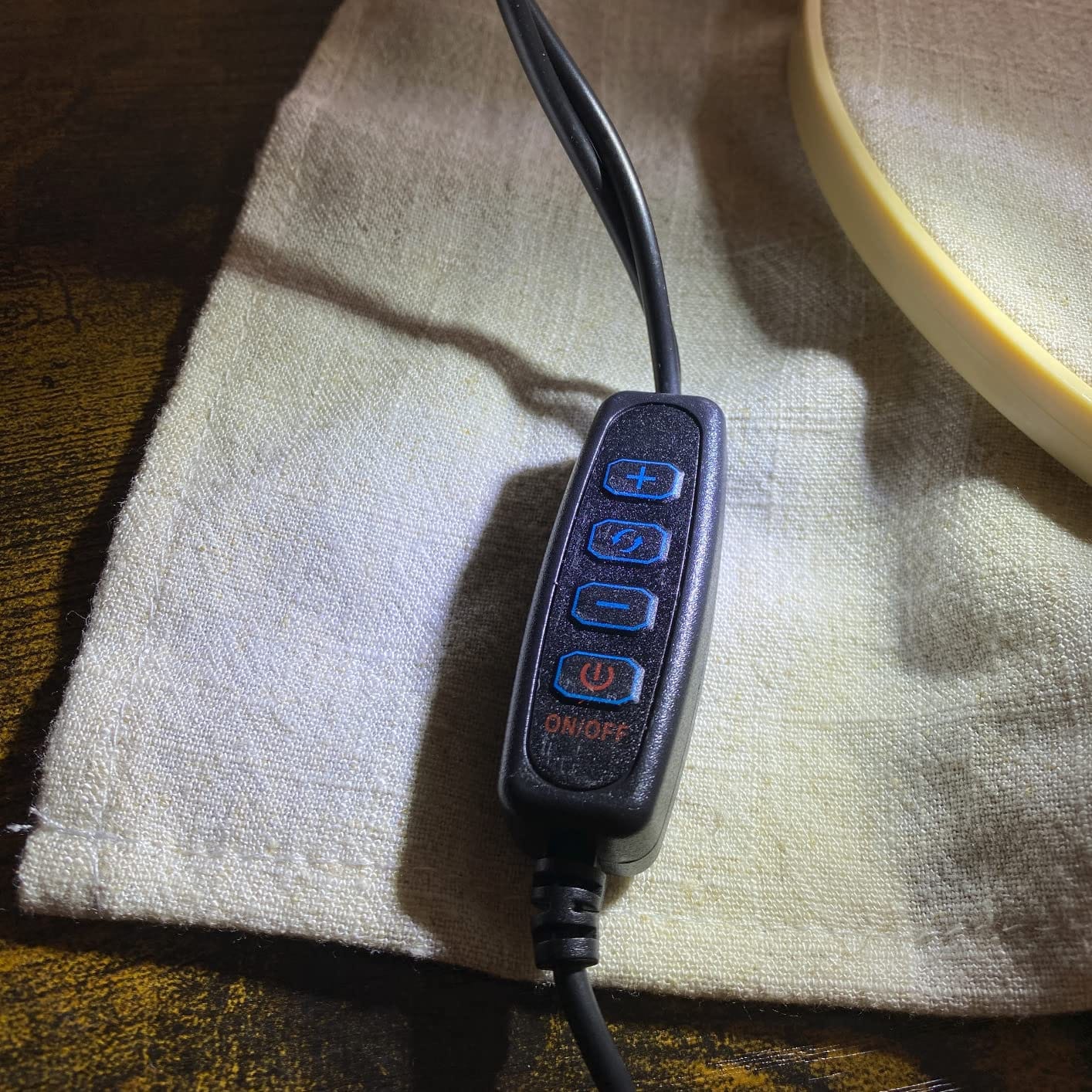
The Gen 6 flex arm moves smoothly in all directions with no knobs or stiffness to fight, and the dual gooseneck LEDs have adjustable brightness and aperture for shadow-free light. A wireless remote handles hands-free photo capture, video recording and menu navigation while the scope stays still, and a heat-resistant silicone soldering mat keeps the bench organised. Overlays are useful rather than decorative: 4x digital magnification plus split-screen and grid lines help you keep your place on a large board.
It ranks #123 in lab handheld digital microscopes, a much lower placement than the TOMLOV models above it, which is consistent with a newer listing. Treat the specification as promising and the long-term reliability as unproven.
Where three-screen output changes the workflow?
Mirroring to three screens at once is not a gimmick for teaching or client work. When the live image is on a large monitor at arm height, your head stays neutral instead of dropping toward a small panel, and the eye strain that people blame on soldering is often really caused by the neck angle. Sending the same feed to a PC for capture means your recording is not a separate task.
The grid-line and split-screen overlays are the second quiet feature. On a dense board, losing your position after a two-minute interruption is a common and expensive interruption: you end up re-tracing a net to find where you were. A grid reference turns that from guesswork into a glance, and the aperture control on the goosenecks lets you narrow the light onto one region when you are inspecting a specific joint.
What to watch out for?
Autofocus struggles at very close range, roughly 3 inches or less, and that is exactly the range fine rework such as BGA reballing needs. You will be back to manual adjustment for the most demanding work, which makes the autofocus a convenience for board-to-board work rather than a solution for close fine-pitch tasks.
The plastic housing draws criticism, and the mount screws thread directly into the plastic shell, which is fragile if you overtighten. Stand joints have uneven friction, so repositioning can be awkward. Power is corded electric only, and with 43 reviews there is no long-term ownership history to lean on. If you want proven durability instead of the newest feature set, the older Andonstar models are the safer bet.
How to Choose a Microscope Setup for Tiny SMD Work?
Magnification: work at 10x-20x and zoom only to inspect
The most common buying mistake is chasing maximum magnification. The useful rule is simple: perform the soldering at 10x-20x and zoom in only to inspect the result. At working magnification you need to see the pad, the part and your tool tip together, and that requires a wide field of view rather than a tight one. Zooming to 45x or 90x to work shoves your hands out of the field and forces you to work blind.
A second rule follows from the specs in this roundup. A digital scope claiming 2000x delivers 15-60x on its built-in screen, and 60-240x over HDMI to a 28-inch monitor. Compare the on-screen number, not the headline. For optical bodies, compare the working range at your usable working distance, because a 7x-45x body paired with a 0.5X objective gives you a different effective range than the same body without it.
Working distance and tool clearance
Working distance is the distance from the front of the objective to your work, and it decides whether you can physically do the job. The reference points that matter: a fine-pitch tweezer and an iron tip together want roughly 40-60mm of clearance, and a hot air nozzle wants considerably more. Many entry scopes offer only 60-70mm, which is why buyers report being unable to get an iron in at all.
Anything at 100mm or above handles iron and tweezers comfortably. The DZQ at 95-300mm and the ZTEEERS with its 0.5X objective at roughly 200mm are the two in this roundup with genuine room to work under the objective. If your rework involves hot air as well as an iron, treat clearance as the deciding specification rather than an afterthought.
Lighting: ring versus oblique on reflective solder
A solder fillet is a curved mirror, and that single fact drives most lighting complaints. A bright ring light centred on the objective reflects straight back at you from the middle of the joint, creating a hot spot exactly where you want to see whether the fillet has wetted. The result is glare that hides bridges and cold joints rather than revealing them.
Two solutions work well. The first is dimming, and it is why a unit with a real external brightness control beats one that makes you dig through menus. The second is angle: a gooseneck or side light placed off-axis kills the mirror reflection, which is why the scopes with two adjustable goosenecks show fewer glare problems in practice. If you inspect joints regularly rather than only inspecting after rework, budget for off-axis light.
Stereo versus digital, and HDMI versus USB latency
A stereo microscope gives true binocular depth perception, so your hands stay naturally coordinated and there is no processing between your eyes and the work. A digital setup replaces the eyepieces with a camera and a screen, which adds latency, removes depth cues, and gives you a large image plus recording. Neither is better; they suit different people and different work.
Within digital setups, the output path matters more than most buyers expect. USB on a PC goes through a compression pipeline and introduces lag that makes fine hand motion harder, and this is the single most common complaint about cheap digital microscopes in forums. HDMI to a monitor bypasses that and is widely preferred for soldering for exactly this reason. If you only intend to use the built-in screen, check that it is IPS, because a small glossy panel at close range is a fatigue generator.
Stand type and vibration
Stands come in four forms. A base stand sits on its own footprint and takes bench space. A pillar stand fixes a post to a base plate for a repeatable position. A flex or gooseneck arm swings in and folds away. A boom arm hangs the head from a counter-balanced arm that reaches across the bench and rotates out of the way. For soldering, a boom or clamp arm is the most flexible because it leaves the work surface clear.
Vibration is the factor people underrate. When your iron touches the board, the shock travels through whatever the head is mounted on. Long arms, soft desks and light stands transmit that directly into the image. Heavier bases, shorter arms and rigid mounting surfaces all reduce it, and reviewers consistently describe a cheap stand as the thing that ruins an otherwise good camera.
The buyer checklist and the mistakes people regret
Before you buy, confirm these six items. A working distance of at least 100mm if you use an iron. A stand that is rigid and that either clamps to a solid surface or has a base heavy enough not to bounce. Lighting you can dim without opening a menu. A magnification figure quoted at the working distance, not the maximum. A stand or arm that leaves your bench surface usable. And a decision about eyepieces versus screen, made honestly.
The most regretted purchases follow a pattern. Prioritising camera resolution over optics, which produces a sharp image of a blurry image. Buying excessive magnification and then finding the working distance is unusable. Ignoring the stand because the scope looked good in a video. And buying a cheap unit, using it for a month, and replacing it later, which costs more in time than it saves in money. Choosing an eyepiece model when you need a screen, or the reverse, is the other common regret, and it is entirely avoidable by thinking about your own hands before the spec sheet.
Upgrading a cheap LCD microscope instead of replacing it
If you already own an entry-level LCD microscope, a full replacement is often unnecessary. The cheapest improvement, in order, goes like this. First, replace the stand: swap the small base for a C-clamp or a proper boom arm, which removes shake and the largest source of frustration. Second, add controllable lighting: an off-axis gooseneck source plus a dimmer fixes glare on shiny joints. Third, move the screen: if the unit has HDMI, drive it to a proper monitor at arm height, which fixes both neck angle and apparent resolution. Fourth, upgrade the optics path by choosing a longer-working-distance lens if the unit accepts one.
That sequence addresses complaints in the order they actually matter, and it costs far less than a new setup. The one thing no upgrade fixes is a stand that transmits every touch, so if your current base bounces, start there. Plenty of forum users have made a rigid arm adaptor for a cheap scope and been perfectly happy, which tells you how much of the perceived quality gap is really mechanical rather than optical.
Frequently Asked Questions
What is the best microscope for micro soldering?
The best microscope setups for soldering tiny parts are complete systems, not handheld loupes: 7x-45x magnification, at least 100mm of working distance so an iron and tweezers fit under the objective, a rigid stand, and dimmable LED ring lighting. Our top pick is the Andonstar AD246S-M, while the AmScope SM-4NTP is the choice for true optical depth perception.
What magnification is good for soldering?
Work at 10x-20x and zoom in only to inspect the finished joint. Working magnification has to show the pad, the component and your tool tip in one field of view, which needs a wide field rather than a tight one. Also compare the on-screen figure, not the headline: a digital scope advertised at 2000x often delivers 15-60x on its built-in screen and 60-240x over HDMI to a large monitor.
Is a stereo microscope better than a digital microscope for soldering?
A stereo microscope gives true binocular depth perception and zero latency, so your hands stay naturally coordinated and there is nothing between your eyes and the board. A digital setup replaces eyepieces with a camera and screen, which removes depth cues and adds latency but gives a larger image, easy recording and remote control. Stereo suits people who want their hands in the visual field; digital suits people who need documentation or a big image.
What working distance do I need for a soldering microscope?
Aim for at least 100mm. A fine-pitch tweezer and an iron tip together want roughly 40-60mm of clearance, and a hot air nozzle needs considerably more. Scopes offering only 60-70mm leave no room to bring a tool in, which is a common and expensive regret. If your rework includes hot air, treat working distance as the deciding specification rather than an afterthought.
Why is lighting important when inspecting solder joints?
A solder fillet is a curved mirror. A bright ring light centred on the objective reflects straight back from the middle of the joint, creating a hot spot that hides bridges and cold joints instead of revealing them. Two fixes work: dimming the light for inspection, and moving a light source off-axis so the reflection misses your eye. That is why setups with adjustable brightness and gooseneck lights tend to show fewer glare problems.
Do I need a digital microscope to solder?
If you work above roughly 0402 with a steady hand, a good magnifier or a lighted loupe is enough. Below that, on 0201 parts and fine-pitch QFN or BGA packages, magnification directly reduces bridging and cold joints because you can see the joint form instead of assuming it worked. Note that eye fatigue sets in well before accuracy stops improving, so a mid-tier setup often pays for itself in reduced rework rather than in first-time success.
Can a cheap LCD microscope be upgraded for soldering?
Yes, and in most cases you do not need a new unit. Replace the small base with a C-clamp or boom arm first, since a bouncing stand is the biggest source of frustration. Then add an off-axis light with a dimmer to kill glare, and drive the screen over HDMI to a monitor at arm height to fix neck angle and apparent sharpness. A better stand, better light and a bigger screen cost far less than replacing the scope.
Which Microscope Setup Should You Buy?
The best microscope setups for soldering tiny parts are the ones that keep a tool in your hand and the joint in your eye at the same time. For most benches the Andonstar AD246S-M is the right first buy, because its metal boom arm holds still under contact and its review base is deep enough to trust. If your bench space is the problem rather than your optics, step up to the Andonstar AD249S-M Plus for the extension base and accessory kit.
Choose differently if your hands disagree. If you cannot get used to a screen image, the AmScope SM-4NTP gives you optical depth and simultaneous camera capture, and the DZQ ZQ-1 gives you the most working distance in the roundup. If you move between benches, the SWIFT trinocular moves like a tool rather than a fixture. If you are starting with a limited budget and mostly 0402 work, the 5-inch C-clamp scope is the cheapest way to stop guessing, and you can upgrade its stand before anything else.
Whichever you choose, the two specifications that will decide whether you enjoy the work are working distance and stand rigidity. Get those right and almost any scope in this roundup will serve you well for 2026. Our magnetic parts trays roundup covers the other half of the problem, which is not losing the 0201 you just placed while you reach for the iron.