
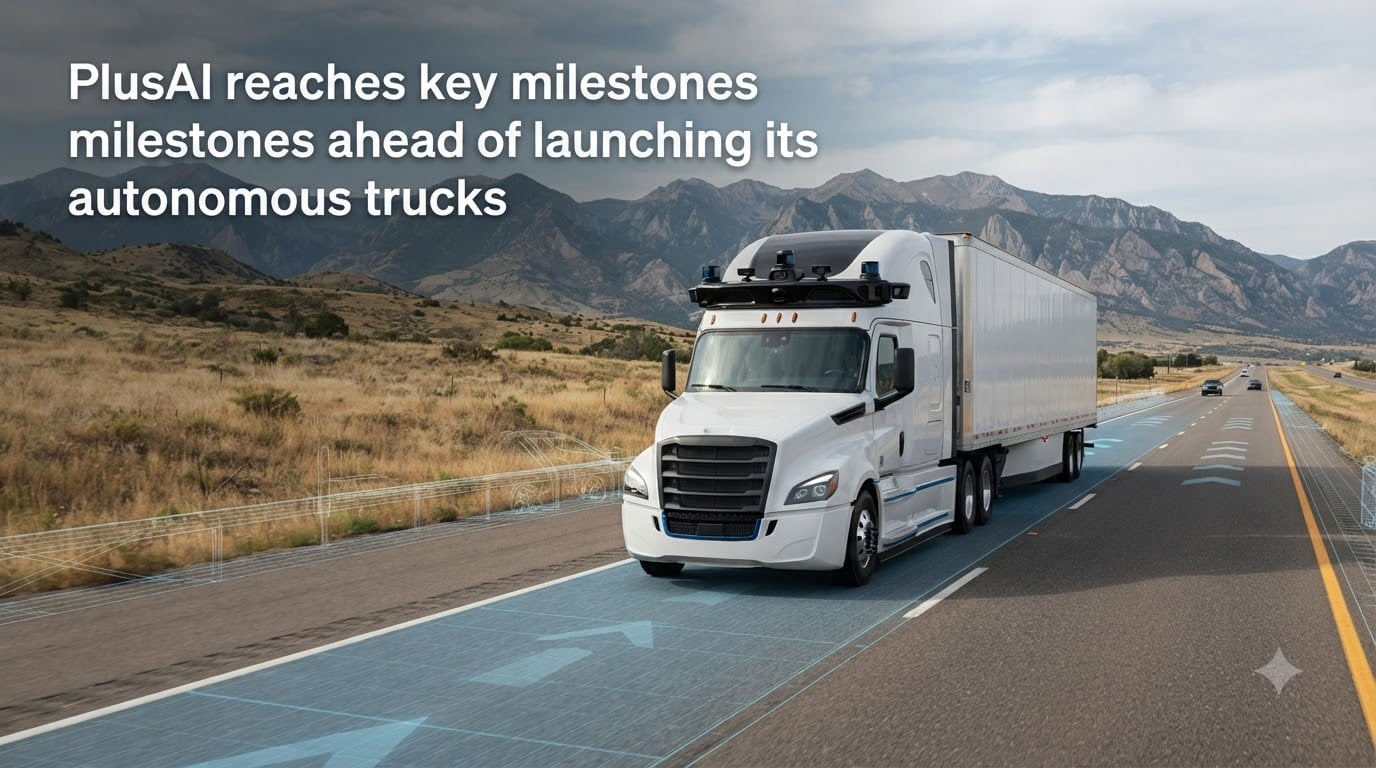
PlusAI just crossed a series of benchmarks that put its autonomous trucks on a clear path to commercial deployment. The Santa Clara-based company reported its first-half 2026 commercial readiness metrics on August 10, and the numbers paint a picture of a technology stack that is rapidly maturing toward Level 4 autonomous freight operations.
For those tracking the autonomous trucking space, PlusAI’s progress matters because the company is one of only a handful pursuing factory-built autonomous trucks with global OEM partners rather than retrofitting existing vehicles. That approach means the autonomy system is designed into the truck from the ground up, which changes both the safety profile and the scalability equation. We have been covering autonomous vehicle infrastructure companies and the broader freight autonomy race for months, and PlusAI’s latest update is one of the most detailed data drops we have seen from any player in this space.
In this article, we break down exactly what PlusAI autonomous trucks have achieved, what the commercial readiness metrics actually mean, how the company stacks up against competitors like Aurora and Kodiak, and what the road to 2027 looks like for self-driving freight.
Table of Contents
PlusAI Reaches Key Milestones Ahead of Launching Its Autonomous Trucks
On August 10, 2026, PlusAI published its first-half 2026 commercial readiness metrics update, and the results show meaningful progress across every category the company tracks. Safety Case Readiness reached 93.4%, up from earlier benchmarks and on track to hit 100% before commercial launch. Autonomous Miles Percentage hit 99.8%, meaning nearly every mile driven by the system in testing required zero human intervention. Remote Assistance-Free Trips reached 85.2%, which measures how often a truck completes an entire route without needing any input from a remote operator.
Those three numbers, taken together, represent the core argument PlusAI is making to fleet operators and regulators: the technology is not just working in controlled conditions, it is working reliably enough to plan a commercial deployment around. The company also released SuperDrive 6.0, the latest version of its virtual driver software, during this reporting period. SuperDrive 6.0 brings improvements in construction-zone handling, night driving capability, and complex merge scenarios, all of which are edge cases that separate a demonstration from a deployable product.
PlusAI also secured several ISO certifications during the first half of 2026, including ISO 26262 for functional safety and ISO 21448 for SOTIF (Safety of the Intended Functionality). These certifications matter because they provide independent, third-party verification that PlusAI’s engineering processes meet automotive industry safety standards. For fleet operators evaluating whether to bet their freight operations on a new technology, that independent verification is a significant trust signal.
Over the past six months, PlusAI has continued safety validation of SuperDrive with global OEM partners on factory-built trucks. The testing spans multiple freight corridors, with the I-35 corridor between Texas and the Midwest serving as a primary testing ground for long-haul operations. The company has also expanded testing to Spain through its partnership with IVECO, marking its push into European freight markets.
What Is SuperDrive? PlusAI’s AI-Based Virtual Driver Explained
SuperDrive is the core product, an AI-based virtual driver designed to handle Level 4 autonomous driving on highways. Level 4 autonomy means the system can operate without human intervention within a defined operational design domain, which for PlusAI means highway and interstate driving under specified conditions. The human driver is not needed in that domain, though the truck may still require a driver for local roads, loading docks, and first or last-mile segments.
The system relies on a sensor fusion architecture combining cameras, lidar, and radar to build a 360-degree awareness model of the truck’s surroundings. This multi-sensor approach is deliberate, because each sensor type has different strengths and weaknesses. Cameras provide high-resolution detail for reading signs and detecting lane markings. Lidar provides precise distance measurements and works in low light. Radar performs well in rain, fog, and other conditions where optical sensors struggle. Fusing all three creates redundancy, which is the foundation of a safe autonomous system.
Under the hood, SuperDrive runs on the NVIDIA DRIVE AGX Hyperion platform, a production-grade compute architecture designed specifically for autonomous vehicles. The AI processing is powered by PlusAI’s Alpamayo foundation model, which handles perception, prediction, and planning. For readers interested in the deeper technical layer, we have written about perception systems for autonomous vehicles and why perception is the bottleneck for scaling any autonomous system. PlusAI’s Halos safety technologies layer on top, providing failover mechanisms and redundant safety monitoring that can bring the truck to a safe stop if the primary system encounters a problem.
Commercial Readiness Metrics Explained: SCR, AMP, and RAFT
One of the most confusing things about following the autonomous trucking industry is the jargon. PlusAI uses three specific metrics to track its progress toward commercial deployment, and understanding what each one measures helps you evaluate whether the company is actually ready or just generating press releases.
Safety Case Readiness (SCR) is the most comprehensive metric. It measures how close PlusAI is to completing its full safety case, which is a structured argument backed by evidence that the system is acceptably safe for commercial operation. Think of it as a giant checklist of safety requirements that must be satisfied before regulators and fleet operators sign off. At 93.4%, PlusAI has completed most of this checklist, and the company says it is on track to reach 100% before the 2027 commercial launch.
Autonomous Miles Percentage (AMP) measures the percentage of miles driven in testing where the autonomous system handled the driving without a human safety driver needing to disengage. At 99.8%, the system is handling virtually all driving situations on its own. This is a strong number, though it is worth noting that AMP is measured within the operational design domain, meaning highway driving under conditions the system is designed for.
Remote Assistance-Free Trips (RAFT) is arguably the most operationally significant metric. It measures the percentage of complete trips where the truck did not need any assistance from a remote operator. Remote operators are humans who can monitor fleets of autonomous trucks from a control center and intervene if needed. A high RAFT percentage means the system can handle the vast majority of situations on its own, which directly affects the economics of running an autonomous fleet. At 85.2%, roughly six out of seven trips require zero remote intervention. Getting this number to the high nineties is the difference between a service that needs a large remote operations staff and one that can scale efficiently.
Key Partnerships Powering PlusAI’s Path to Commercial Launch
PlusAI’s strategy differs from many competitors in a critical way: it is building autonomy into factory-built trucks rather than retrofitting existing vehicles. This approach requires deep partnerships with truck manufacturers, and PlusAI has assembled a roster that gives it both reach and credibility.
The partnership with International (Navistar) is the cornerstone of the North American strategy. International is one of the largest Class 8 truck manufacturers in the United States, and together the companies are developing factory-built autonomous trucks that will roll off assembly lines with SuperDrive integrated from the start. This is fundamentally different from bolting sensors onto an existing truck, because it means the autonomous system is designed in coordination with the vehicle’s braking, steering, and electrical systems.
Ryder, one of the largest commercial fleet management companies in North America, is the operational partner. Ryder brings the fleet management expertise, maintenance infrastructure, and customer relationships that turn a technology into a service. The idea is that fleet operators can adopt autonomous trucks through Ryder without having to build their own maintenance and support systems from scratch.
In Europe, PlusAI is working with IVECO, and the companies have been testing autonomous trucks in Spain. This expands the addressable market beyond the United States and positions PlusAI as a global player rather than a purely domestic one. The European freight market has different regulatory requirements and road conditions, so successful testing there is a meaningful validation of the system’s adaptability.
PlusAI also has history with Amazon, which invested in the company and tested PlusAI’s earlier driver-assistance technology. While the current focus is on Level 4 autonomy rather than driver assistance, that relationship gave PlusAI early real-world operational data at scale. For context on the broader AI infrastructure for autonomous vehicles shaping the industry, PlusAI’s partnership-driven approach is one of several models competing for dominance.
PlusAI vs Aurora, Kodiak, and Waymo Via: Who Leads Autonomous Trucking?
The autonomous trucking landscape has narrowed to a handful of serious contenders, and each is taking a different path to market. Understanding the differences helps explain why PlusAI’s latest milestones matter in context.
Aurora Innovation is the competitor most frequently mentioned alongside PlusAI in forum discussions. Aurora launched its commercial driverless trucking service, Aurora Horizon, on Texas freight corridors and has been running driverless operations with real freight. Aurora’s approach relies on its own proprietary sensor suite and the Aurora Driver platform. In discussions on communities like Reddit’s SelfDrivingCars, users frequently debate whether Aurora’s head start in driverless operations or PlusAI’s factory-built truck strategy will prove more durable. Aurora’s advantage is that it is already running driverless freight, while PlusAI’s advantage is that factory-built trucks should scale more cleanly than retrofitted ones.
Kodiak Robotics is another major player, focused on the same long-haul freight corridor use case. Kodiak has been testing its autonomous trucks on routes between Texas and the Southeast and has partnerships with companies like Werner Enterprises and U.S. Xpress. Kodiak’s approach is closer to a retrofit model than PlusAI’s factory-built strategy, which creates different tradeoffs in terms of deployment speed versus long-term scalability.
Waymo Via is the freight arm of Waymo, which brings enormous resources and arguably the most advanced autonomous driving technology stack in the world from its passenger car operations. Waymo Via has been testing autonomous freight operations but has been more measured in its commercial rollout timeline compared to Aurora and Kodiak. The question for Waymo Via is how much priority the company places on trucking versus its ride-hailing business.
So who is the leader? As of 2026, Aurora has the strongest claim to leading in terms of actual driverless commercial operations on public roads. But PlusAI’s commercial readiness metrics, OEM partnerships, and factory-built truck strategy make it a serious contender that could leapfrog competitors when production trucks start rolling off assembly lines in 2027. The honest answer is that leadership depends on what you measure: driverless miles today favors Aurora, production readiness for 2027 and beyond favors PlusAI.
What PlusAI’s Milestones Mean for Drivers and the Freight Industry
The question we see most in forums and comment sections is straightforward: what does this mean for truck drivers? It is a fair question and one that competitors in this space have largely avoided addressing directly.
The near-term reality is that Level 4 autonomous trucks operate within a defined domain, meaning highway driving between designated points. The first and last mile, loading docks, urban delivery, and exception handling still require human drivers. What autonomous trucks are likely to do first is handle the long, monotonous highway stretches that are the least desirable and most fatiguing part of a driver’s day. This could actually address the trucking industry’s persistent driver shortage, which has been estimated at over 80,000 unfilled positions in the United States alone.
The regulatory landscape is the other major factor. As of 2026, Texas has emerged as the primary hub for autonomous trucking testing and early commercial operations, largely because its regulatory environment is permissive and its freight corridors are well-suited to autonomous operations. Other states have taken more cautious approaches, and the patchwork of state-by-state regulations is one of the biggest barriers to nationwide deployment. Forum discussions reveal significant skepticism about whether 2027 timelines are realistic given the regulatory uncertainty, and that skepticism is well-founded.
Cost is another open question that nobody in the industry has fully answered. Autonomous trucks carry significant upfront costs in sensors, compute hardware, and software. Whether those costs are offset by labor savings, improved safety, and better fuel efficiency at highway speeds is an equation that will only become clear once commercial operations scale. What is clear is that the freight industry, which operates on thin margins, will adopt autonomous trucks only when the economics are provably better than human-driven alternatives.
Which states allow driverless freight trucks?
As of 2026, Texas leads the United States in permitting driverless freight truck testing and operations on public roads. Arizona, New Mexico, and parts of the Sun Belt also have permissive regulatory environments for autonomous trucking. Most other states are still developing their regulatory frameworks, creating a patchwork that companies must navigate state by state.
How much does a driverless truck cost?
The exact cost of a fully autonomous commercial truck has not been publicly disclosed by PlusAI or its partners. Industry estimates suggest that the sensor, compute, and software stack adds a significant premium to the base cost of a Class 8 truck, which typically runs between $150,000 and $200,000 for a conventional model. As production scales, these costs are expected to decrease.
Who is the leader in autonomous trucking?
As of 2026, Aurora Innovation leads in terms of actual driverless commercial freight operations on public roads, having launched its Aurora Horizon service on Texas freight corridors. PlusAI is a strong contender for leadership in factory-built autonomous trucks with its 93.4% safety case readiness and OEM partnerships. Kodiak Robotics and Waymo Via are also serious competitors with active testing programs.
How long will it be before AI takes over trucking?
Full automation of the trucking industry is unlikely to happen overnight. Most experts expect a phased transition starting around 2027, when companies like PlusAI plan to begin commercial deployment of Level 4 autonomous trucks. These systems will initially handle only highway driving within defined corridors, with human drivers still needed for local roads, loading docks, and exception handling. Broader industry transformation is expected to unfold over the following decade.
The Road Ahead for PlusAI Autonomous Trucks
PlusAI autonomous trucks are not yet hauling freight commercially, but the gap between testing and deployment is narrowing fast. With Safety Case Readiness at 93.4%, Autonomous Miles Percentage at 99.8%, and Remote Assistance-Free Trips at 85.2%, the company has published concrete data showing a technology stack that is approaching commercial maturity rather than just promising it.
The 2027 commercial launch target gives PlusAI roughly 18 months to close the remaining gaps in its safety case, finalize OEM production with International, and secure the regulatory approvals needed to operate at scale. The partnerships with Ryder for fleet operations and IVECO for European expansion suggest the company is thinking beyond technology development and into the operational and geographic layers required for a real freight business.
What we will be watching next is whether the Remote Assistance-Free Trips metric can climb from 85.2% into the high nineties, because that is the number that determines whether autonomous trucking is economically viable at scale. The technology is impressive. The question now is whether the economics, regulation, and operational readiness can catch up to match.