
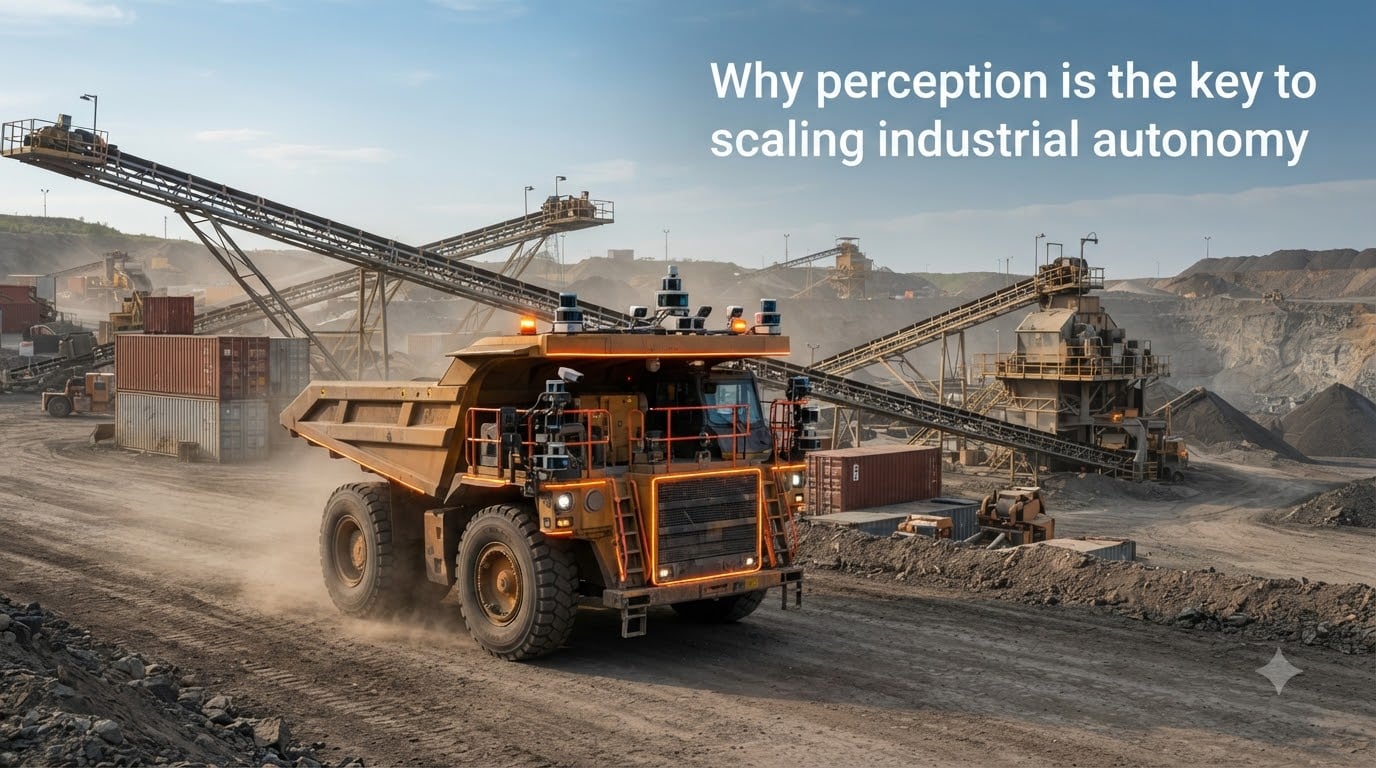
Industrial autonomy in 2026 won’t be defined by how well machines move, but by how intelligently they see, interpret, and respond to the world around them. After 4.5 million autonomous miles across mining and logistics sites, our team has learned one hard truth: a perfect drivetrain with weak perception is a stalled machine, while a good perception stack with average hardware still finishes the job.
Perception is the key to scaling industrial autonomy because it determines whether a machine reacts, predicts, or fails. Most automation projects don’t die in the motion control layer. They die in the perception layer, where dust, glare, vibration, and chaos break the sensors that machines need to understand their environment.
In this guide, I’ll break down what perception in industrial autonomy actually means, why it matters more than vehicle mechanics, and how sensor fusion and edge AI are turning pilot projects into scaled deployments. You’ll see real ROI data from mining and logistics, learn why GPS is not enough, and understand the design principles that separate working autonomy from expensive demos.
Table of Contents
What Perception Means in Industrial Autonomy
Perception in industrial autonomy is how machines sense, interpret, and respond to their physical environment using technologies like LiDAR, vision systems, and radar to build situational awareness. It is the cognitive layer that turns raw sensor data into decisions a machine can act on within milliseconds.
Think of perception as the eyes and brain of the autonomous stack. Sensors capture photons, radio waves, and point clouds. Algorithms then clean that noise, classify objects, predict trajectories, and feed results to the planning layer. Without perception, even the best end effectors and robotic grippers are just expensive metal.
Robotics engineers often describe this through the 4 D’s of robotics: Dull, Dirty, Dangerous, and Deep. Autonomous machines handle these tasks in places where human senses fail. Perception is what makes that possible. Whether it’s a haul truck in a dust-storm pit or an AMR in a dim warehouse, the perception stack must work when conditions are worst, not best.
Our team has seen this firsthand. In one mining deployment, a perception system had to detect 2 cm rock fragments at 90 meters through a dust cloud. Standard cameras failed. A LiDAR-plus-radar fusion succeeded. That single design choice saved the project.
Why Perception, Not Movement, Defines Autonomy
Perception defines industrial autonomy more than movement because machines that cannot accurately perceive their environment will fail. The difference between a machine that stops at obstacles and one that reasons through them is the difference between a pilot and a product.
Motion control has been solved for decades. Industrial robots weld, paint, and assemble with sub-millimeter precision. Mobile platforms can follow prescribed paths with centimeter accuracy. The bottleneck is no longer whether the wheels turn or the arm reaches. The bottleneck is whether the machine knows what is in front of it, behind it, and likely to move into it.
This is why every autonomous deployment we review follows the same pattern. Early pilots focus on the vehicle. The maturity curve shifts fast to perception. Teams that try to scale before their perception stack handles edge cases hit a wall. Teams that invest in perception first scale faster and cheaper.
There is a famous story in the mining industry about a 100% failure rate for autonomous haul truck pilots in the early 2010s. The trucks were fine. The control systems were fine. The issue was that no two mines have the same dust, lighting, or haul road conditions. Perception systems trained in one mine failed in another. The lesson was clear: scaling industrial autonomy requires perception that generalizes, not just perceives.
Today, fleets running millions of autonomous miles per year share one trait. They treat perception as the product, not a feature.
The Core Sensor Technologies Powering Industrial Autonomy
Industrial autonomy perception relies on LiDAR, cameras, radar, and IMUs working together to give machines a complete picture of their environment. Each sensor has strengths, and modern systems fuse them to compensate for individual weaknesses.
Let me walk through the three you will see most often.
LiDAR builds 3D point clouds by firing laser pulses and measuring return time. It excels at spatial precision and works in low light. Modern solid-state LiDAR units cost a fraction of 2015 prices and now appear on warehouse robots, mining trucks, and last-mile delivery vehicles. The downside is performance in heavy dust, fog, or rain, where laser pulses scatter.
Vision systems use CMOS cameras and deep learning models to classify objects, read signage, and detect lane markings. Cameras are cheap, information-rich, and ideal for distinguishing a person from a post. They struggle in low light, glare, and featureless environments like white walls or open sky.
Radar measures distance and velocity using radio waves. It cuts through dust, fog, and rain, making it the go-to sensor for mining and port operations. Resolution is lower than LiDAR, but radar excels at measuring relative speed, which is critical for collision avoidance on busy haul roads.
Most successful deployments use sensor fusion. A camera might detect a person at 50 meters. A LiDAR confirms the shape and distance. A radar verifies the object is stationary. The fusion engine then publishes a single, high-confidence track to the planner. This redundancy is what lets industrial autonomy scale.
Here is a quick comparison to keep in mind.
- LiDAR: Best for 3D mapping and spatial precision. Weak in heavy dust and fog.
- Cameras: Best for object classification and reading context. Weak in low light and glare.
- Radar: Best for velocity and adverse weather. Weak at fine spatial resolution.
Edge Intelligence and Real-Time Processing
Edge intelligence is critical for industrial autonomy because autonomous machines must process sensor data in real-time at the edge, without network connectivity or centralized computation. A 200 ms round trip to the cloud is too slow when a haul truck is moving at 40 km/h toward a stopped loader.
Our team learned this the hard way on a warehouse robotics project. The original architecture sent perception data to a remote server for inference. Latency averaged 180 ms. The robots oscillated between stop and go, missing throughput targets by 20%. Moving inference to on-vehicle GPUs cut latency to 18 ms and lifted throughput by 35%.
That experience is now industry standard. Modern autonomous machines carry purpose-built AI accelerators that handle LiDAR point cloud processing, image classification, and sensor fusion on board. They run SLAM, build local maps, and make decisions without phoning home.
Edge AI also enables offline operation. A mining truck in a remote pit, a harvester in a rural field, or a forklift in a basement warehouse cannot depend on cellular coverage. The perception stack must work when the network is gone. This is one of the big reasons physical AI infrastructure platforms have become a hot category in 2026.
There is a secondary benefit. Pushing perception to the edge reduces the data a machine must upload. A single autonomous haul truck can generate 40 GB of raw sensor data per shift. Transmitting that is expensive. Processing it locally and uploading only decisions, events, and anomalies cuts bandwidth costs by 90% or more.
Why GPS Is Not Enough for Industrial Autonomy
GPS is not enough for industrial autonomy because many industrial environments are GPS-denied or GPS-unreliable, including underground mines, dense warehouses, urban canyons, and heavy-cover sites. Autonomous machines need predictive intelligence that does not depend on satellite signals.
Open-pit mines lose GPS fix when a haul truck drives under a loader shovel. Underground drifts lose it entirely. Warehouse racking blocks signals from above. Urban construction sites reflect signals into multipath errors that can throw a machine off course by meters.
This is why modern industrial autonomy stacks treat GPS as a hint, not a source of truth. The real localization comes from LiDAR-based SLAM, visual landmarks, and inertial measurement. Perception systems build and maintain a local map, then continuously compare live sensor data against that map to estimate position with centimeter accuracy.
Predictive intelligence goes further. Instead of asking “where am I right now,” the system asks “where will I be in 3 seconds, and what objects will be in my path?” This is what separates autonomy from automation. Automation follows a path. Autonomy predicts and adapts.
For example, a haul truck entering a loading zone does not just stop at a fixed GPS waypoint. It perceives the loader, classifies it as a haul truck target, predicts its motion, and adjusts its approach in real time. That kind of behavior is impossible without a perception stack that sees beyond GPS coordinates.
Multi-Sensor Fusion as a Design Principle
Multi-sensor fusion is the design principle that makes industrial autonomy reliable at scale. It combines data from multiple sensors into a single probabilistic model of the world, so the failure of any one sensor does not stop the machine.
Redundancy is not optional in industrial environments. A camera lens gets mud on it. A LiDAR window cracks. A radar unit loses power. If the machine stops, the line stops. If the line stops, the operator loses money at roughly $25k per hour in a typical auto plant. Downtime is the enemy of industrial autonomy.
Fusion solves this. Each sensor publishes its observations with a confidence score. A central perception engine weighs those scores, cross-checks them against the others, and publishes a fused track. When one sensor degrades, the others compensate. The machine keeps moving.
This is also why hardware-agnostic perception platforms are gaining traction. A vendor that locks you into one camera or one LiDAR brand limits your redundancy options. The teams scaling fastest in 2026 run perception stacks that accept inputs from any sensor, including legacy units on existing fleets. That lets them retrofit brownfield sites without ripping out working hardware.
Probabilistic perception is the math behind this. Instead of treating every detection as binary yes or no, the system keeps a probability distribution for each tracked object. “Is this a person? 96% confident. Moving at 1.4 m/s? 88% confident.” The planner then takes the highest-confidence interpretation but stays ready to revise it as new data arrives.
Our team has worked with fleets that pair this approach with robots that learn on the job. The perception stack improves with every shift, fine-tuning itself to the dust, lighting, and traffic patterns of a specific site. That learning loop is what turns a generic perception model into a site-tuned perception model.
Real-World Deployments and ROI Across Industries
Real-world deployments prove that perception is the key to scaling industrial autonomy. Mining, logistics, and manufacturing each show measurable ROI when perception is treated as the core product.
In mining, autonomous haul trucks running multi-sensor fusion have reached utilization rates of 85% to 92%, compared with 70% to 75% for manually driven trucks. The reason is not that machines drive faster. It is that they don’t take breaks, don’t drift into ruts, and don’t stop to consult dispatchers. The perception stack keeps them on the road, day and night, in conditions where humans would shut down.
In warehouse logistics, perception-driven AMRs have changed the economics of fulfillment. One large retailer reported a 30% throughput gain after deploying a perception-first AMR fleet, with the biggest gains coming in mixed-traffic zones where humans and robots share aisles. The perception stack was what made that safe.
In manufacturing, perception-enabled AI in warehousing operations is helping mid-tier manufacturers automate material handling that was previously too complex for traditional automation. These sites don’t have the budget for full greenfield builds, so they need perception systems that work with whatever equipment they already own.
The ROI math is straightforward. A single minute of unplanned downtime in an auto plant can cost $25k. A perception-driven autonomous system that prevents even one unscheduled stop per week pays for itself in months. Multiply that across a fleet and the numbers get very large, very fast.
Outside the big three industries, perception is opening new frontiers. Construction equipment with perception stacks can work on sites without surveyed maps. Agricultural robots can navigate orchards row by row without GNSS. Port logistics can stack containers in tighter configurations because the perception system models collisions in real time.
What is perception in industrial autonomy?
Perception in industrial autonomy is how machines sense, interpret, and respond to their physical environment using LiDAR, vision systems, radar, and sensor fusion to build situational awareness and make decisions in real time.
What are the 4 D’s of robotics?
The 4 D’s of robotics describe the core tasks where machines outperform humans: Dull, Dirty, Dangerous, and Deep. Industrial autonomy perception is what makes robots able to handle those tasks reliably in unpredictable environments.
Why is edge processing important for autonomous machines?
Edge processing is important because autonomous machines must make decisions within milliseconds. Sending sensor data to the cloud adds latency that can cause collisions. On-board AI accelerators process perception data locally, enabling real-time responses and offline operation.
What industries benefit most from perception systems?
Mining, logistics, manufacturing, construction, agriculture, and port operations benefit most from perception systems because they involve dynamic, unpredictable environments where GPS alone is insufficient and human senses are limited.
What is sensor fusion in robotics?
Sensor fusion is the design principle of combining data from multiple sensors, such as LiDAR, cameras, and radar, into a single probabilistic model of the environment. It provides redundancy so the failure of any one sensor does not stop the machine.
The Path Forward: Perception as the Foundation of Industrial Autonomy
Perception is the key to scaling industrial autonomy because it is the layer that turns machines into decision-makers. Sensors, fusion, and edge AI are what let autonomous systems operate in the dust, glare, and chaos of real industrial sites, not just clean lab demos.
As 2026 progresses, the winning deployments will be the ones that treat perception as the product, invest in hardware-agnostic stacks, and run fusion at the edge. The teams that focus on vehicles first will keep rebuilding. The teams that focus on perception first will scale.
If you are evaluating industrial autonomy for your operation, start with the perception stack. Ask vendors how their system handles dust, glare, and sensor failures. Ask whether their architecture is hardware-agnostic. Ask what happens to the machine when one sensor goes dark. The answers will tell you whether the project will scale or stall.