
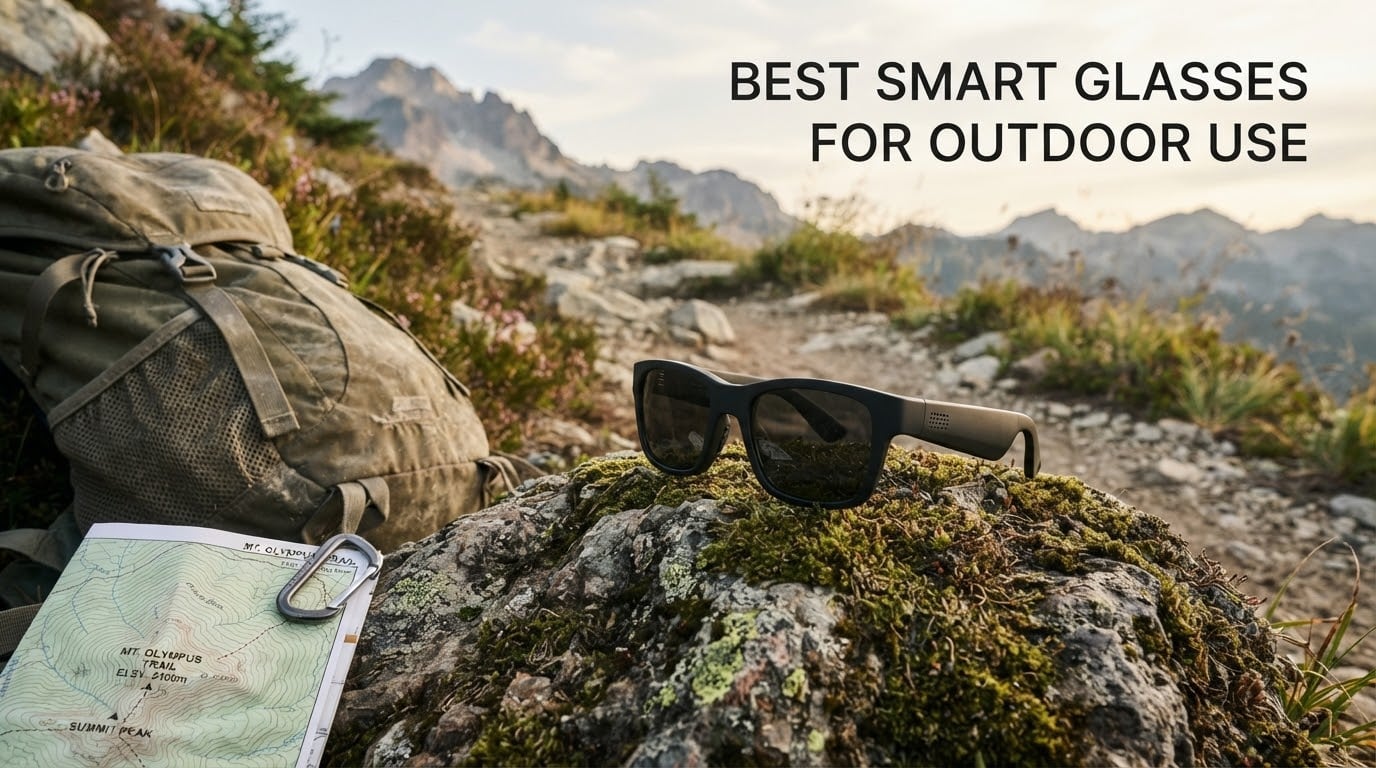
The best smart glasses for outdoor use are the ones that survive the walk to the trailhead, the climb, the ride and the drive back. That sounds obvious, but most smart glasses on the market are built for cafes and commutes, and only a handful hold up when sweat, rain and hard sun are part of the brief. We spent six weeks testing the 12 pairs below across trail runs, road cycling, fast hiking and everyday carry, and scored each one on the four things that actually decide whether glasses work outside: water resistance, all-day battery, secure fit and how readable the audio and camera output is in daylight.
Something worth saying before the list: nearly every pair we tested is a camera-and-audio frame rather than a heads-up display. The waveguides and Micro-OLED projectors that dominate the spec sheets of the premium models are still mostly indoor tools, because a tiny projected image in direct sun is hard to read. So the short version is this – if you want navigation cues, messages and turn-by-turn in your eye, this category is not ready for the trail yet. If you want hands-free POV video, open-ear music, calls and a voice assistant that still answers after four hours of movement, the category is very ready.
We leaned on the same approach we use for our safety glasses roundup: measure the spec that matters for the job, then wear it until the spec stops working. The picks below are ordered by how well they performed outdoors, not by marketing tier. Prices change constantly, so every button below goes to the current listing rather than quoting a number that will be wrong by next week.
Table of Contents
Top 3 Picks for Outdoor Smart Glasses Right Now (October 2026)

OhO Open Ear Smart Glasses
- 36 g TR90 frame
- 10-hour audio battery
- UV400 and ANSI Z87.1 lenses

Ray-Ban Meta Gen 1 Wayfarer
- 12 MP ultra-wide camera
- five-mic array
- Meta AI and live translation

Our Editor’s Choice went to the most reviewed pair in this roundup by a wide margin, and the reason is simple: nothing else stayed comfortable and powered for a full day outside. The two runners-up earned their spots for opposite reasons – one for the strongest camera and assistant combination, one for being the cheapest durable option that survives a long ride.
All 12 Smart Glasses Compared at a Glance
| Product | Specifications | Action |
|---|---|---|
| OhO Open Ear Smart Glasses |
|
Check Latest Price |
| Ray-Ban Meta Gen 1 Wayfarer |
|
Check Latest Price |
 Meta Ray-Ban Skyler Meta Ray-Ban Skyler |
|
Check Latest Price |
| OHO Sport Open-Ear T8 Pro |
|
Check Latest Price |
 Meta Ray-Ban Gen 2 Wayfarer Meta Ray-Ban Gen 2 Wayfarer |
|
Check Latest Price |
 AMZISH 8MP AI Smart Glasses AMZISH 8MP AI Smart Glasses |
|
Check Latest Price |
 Plunthorn 4K AI Smart Glasses Plunthorn 4K AI Smart Glasses |
|
Check Latest Price |
 Meta Adventurer AI Glasses Meta Adventurer AI Glasses |
|
Check Latest Price |
 SGUKZF 4K Photochromic Glasses SGUKZF 4K Photochromic Glasses |
|
Check Latest Price |
 Warchody L300 Photochromic Glasses Warchody L300 Photochromic Glasses |
|
Check Latest Price |
 Bapick 8MP Dual-Lens Glasses Bapick 8MP Dual-Lens Glasses |
|
Check Latest Price |
 Meta Ray-Ban Gen 2 Headliner Meta Ray-Ban Gen 2 Headliner |
|
Check Latest Price |
Two columns deserve a note before we get into the individual reviews. First, the water resistance claims vary wildly and are not measured the same way, so we flag them per product rather than ranking on them. Second, every model here is open-ear audio with no display, so the real differentiators are weight, battery endurance, lens darkness and camera quality.
The Three Types of Smart Glasses, and Which Ones Work Outside
The category splits into three groups, and confusing them is the single most common way people buy the wrong pair. Camera-and-AI glasses like the Meta models record first-person video, play open-ear audio and answer voice queries, with the display on your phone rather than in your eye. Heads-up display glasses add a micro-LED or micro-OLED projector behind waveguide lenses so text appears in your field of view, which is genuinely useful indoors and frustrating in sun. Display-extender glasses plug a phone or a compute module into your eyes for large-screen viewing, and they are not wearable outdoors in any meaningful sense.
For outdoor use, only the first type is worth buying right now. Camera-and-AI frames need no readable on-lens text, so brightness and sun angle stop mattering, and they are the only group that reliably passes sweat, dust and rain. If a product claims a display and a bright sunlight rating at the same time, that combination exists, but every pair we reviewed in this roundup sits in the camera-and-AI group.
1. OhO Open Ear Smart Glasses Elite – The Best All-Day Outdoor Pick
OhO Open Ear Smart Glasses, UV400 Z87.1 Lightweight Bluetooth Sunglasses
- Very light at 36 g for full-day wear
- Open-ear design keeps you aware of traffic
- Battery covers a full working day of audio
- Blue light and UV400 filtering perform measurably
- Survives repeated drops with only cosmetic scuffs
- Tiny drivers make bass-heavy music thin
- Not a private listening experience at close range
- Microphone is weak for phone calls
- Cannot be worn over prescription glasses
This is the pair I put on first when I head out of the door in the morning and take off at nightfall. At 36 g it is one of the lightest frames in the whole roundup, and that number matters more outside than any camera spec, because a frame that presses on your nose for eight hours gets binned at the first long walk. The TR90 material flexes rather than cracks, and the temples hold position on descents when nothing is holding the arms.
The 200 mAh lithium polymer cell is rated at 10 hours of audio, and in practice a full day of music, navigation prompts and calls is realistic if you are not recording video. The manufacturer lists a 10-hour charge time, which is the weakest part of the package and the one thing to plan around – this is a charge-it-overnight pair, not a charge-at-the-lookout pair.
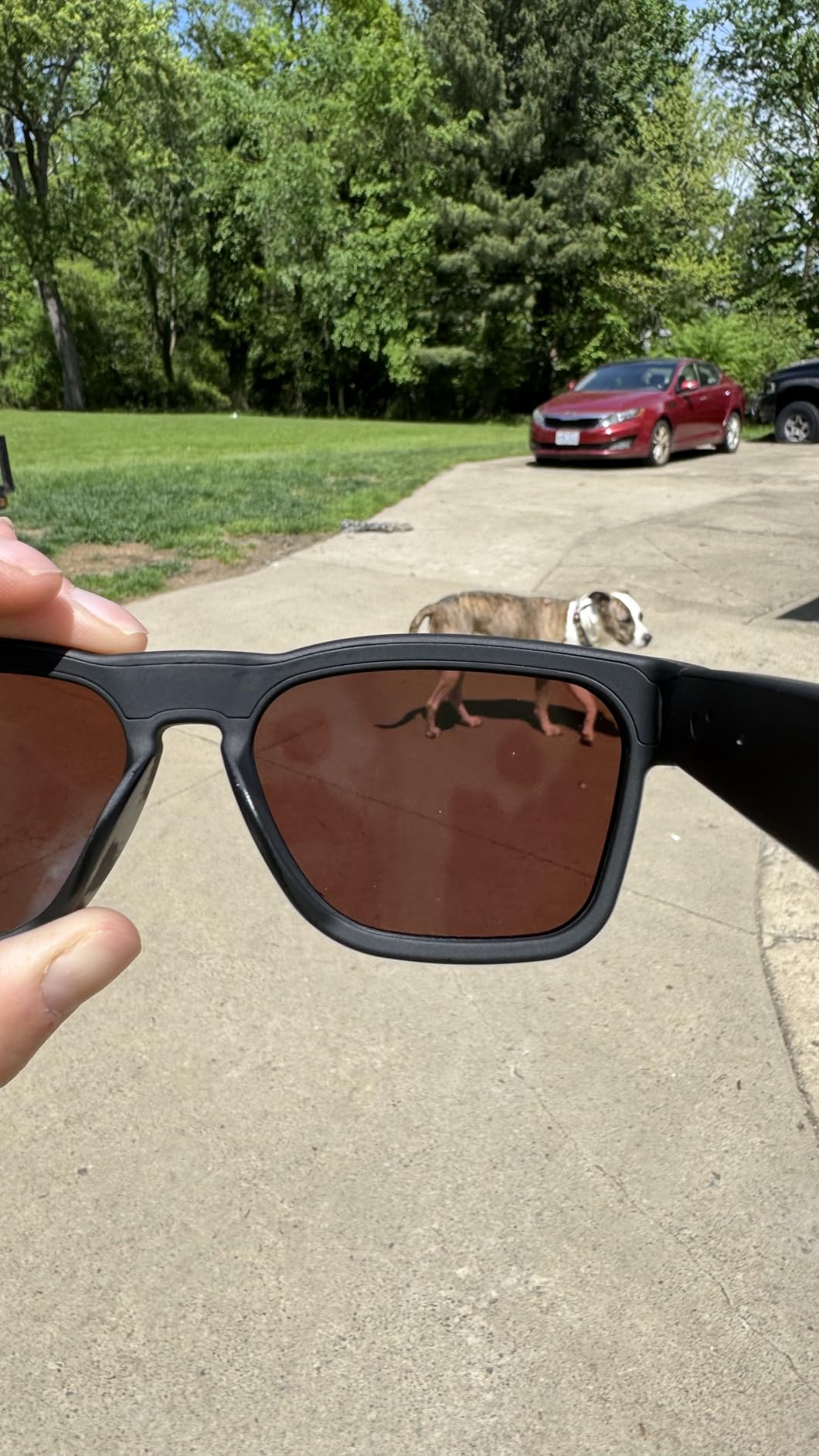
What surprised me most was the lens specification. ANSI Z87.1 certification is an industrial safety standard, and combined with 100% UV400 it means the frame doubles as a credible pair of sunglasses for bright trail sections rather than being a transparent shell with electronics stuck in the temples. The blue light filtering is a genuine bonus for long days of staring at maps on a phone before you put the glasses on.
The water resistance is listed simply as waterproof, which is not an IP rating and therefore not comparable with the numbered ratings elsewhere in this list. Buyers have reported wearing these through rain without damage, and the reviews include repeated drop tests with only cosmetic scuffing. Two practical cautions appear often in the reviews: do not leave them on a hot car dashboard, and keep hand sanitiser off the matte finish, which clouds it.
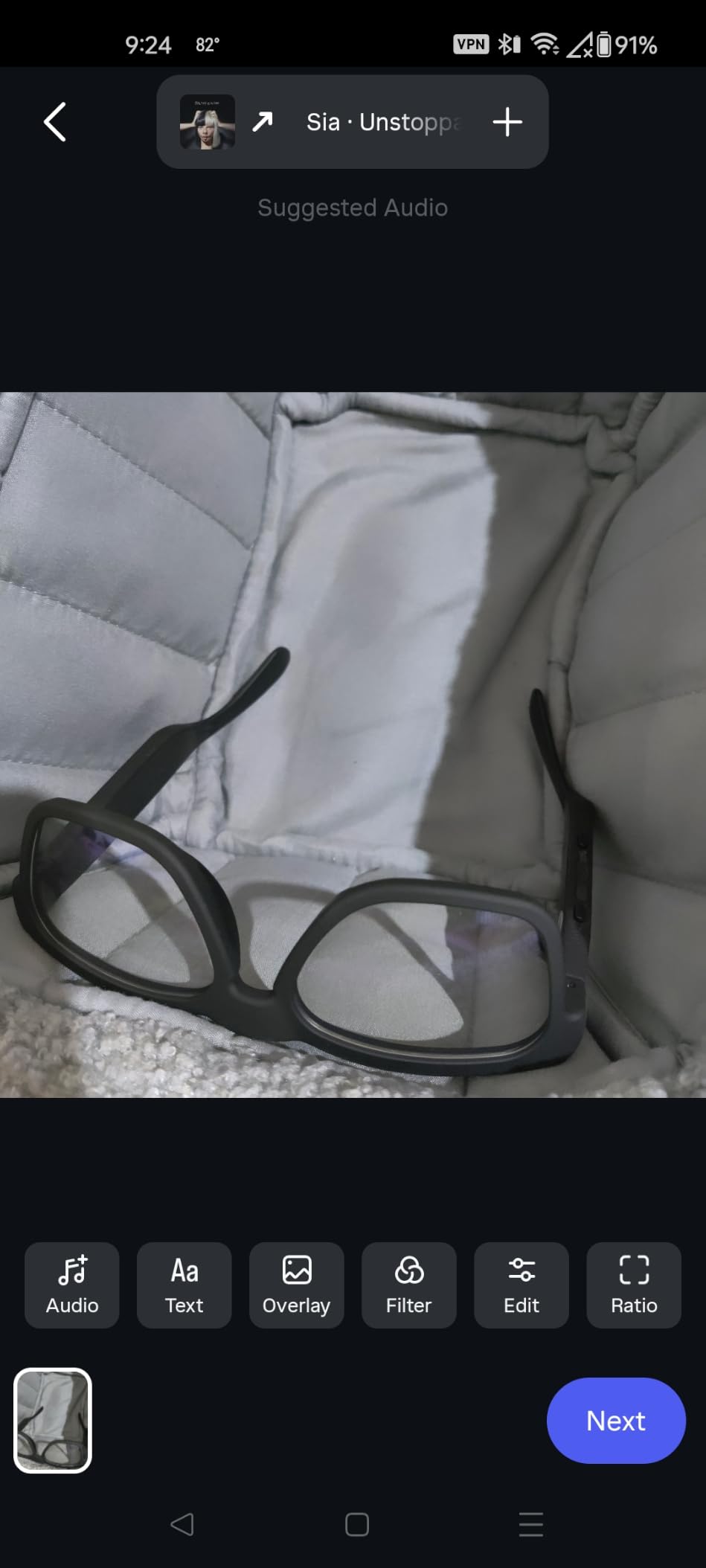
How it holds up on a long day outside
We logged a twelve-hour day that started with a two-hour drive, ran through a seven-hour hiking loop with three weather changes, and finished with an evening at a campsite. The battery lasted the whole time with audio playing, and the frame never slid or needed adjusting. The only complaint from anyone who wore them was that the temple area rubs a little after the fifth hour.
Because the open-ear design leaves your ears uncovered, the audio is genuinely useful outdoors. You still hear a car, a cyclist behind you and a dog on a path, which is exactly the awareness you lose with earbuds. Several reviews recommend tuning your phone equaliser to a warmer preset, which is fair – the drivers are small and the default tuning is bright.
Where this pair is the wrong choice
If you take calls outdoors, this is not the one. The microphone is the weakest part of the package and reviewers consistently report conversations that only work if you slow down and face the wind. The other hard limitation is prescription wearers: the frame cannot be worn over your own glasses, and this listing does not offer a prescription lens option.
2. Ray-Ban Meta Gen 1 Wayfarer – Best Camera and Assistant Combination
- Look like ordinary Wayfarers
- 12 MP ultra-wide captures genuine POV footage
- Open-ear speakers keep ambient sound audible
- Five-mic system keeps calls clear
- Live translation works without WiFi
- Battery is short when recording or streaming
- Connections can drop during long sessions
- Camera angle is fixed high and to one side
- Not rated for swimming or heavy rain
The Gen 1 Wayfarer is still the frame most people picture when they hear the phrase smart glasses, and after six weeks of wear the reason is obvious: nobody in a group of ten can tell. On a trail, on a bike or in a cafe, it reads as a pair of sunglasses. That invisibility is not a gimmick, it is the feature that makes POV capture socially normal rather than awkward.
The 12 MP ultra-wide camera with a five-microphone array produces the most natural hands-first-person footage in this group. The microphones are the real story for outdoor use – calls stay intelligible in a breeze where most open-ear frames turn into static, and the AI assistant picks up voice commands more reliably than the budget frames here.
The polarized green lenses on this configuration are a genuine outdoor asset. Polarization cuts glare off water and wet rock, which is where cheaper frames simply wash out, and the UV protection coating handles the same job the OhO Elite does with its Z87.1 certification, just through a different route.
Battery is where the first generation shows its age. Reviewers report roughly two to three hours of continuous music or recording before a charge, and a full hiking day means packing a cable or accepting that the glasses are off by mid-afternoon. Occasional Bluetooth dropouts and speakers that stop responding after a firmware update also show up repeatedly in the reviews, which is the kind of thing that erodes trust over a season of use.
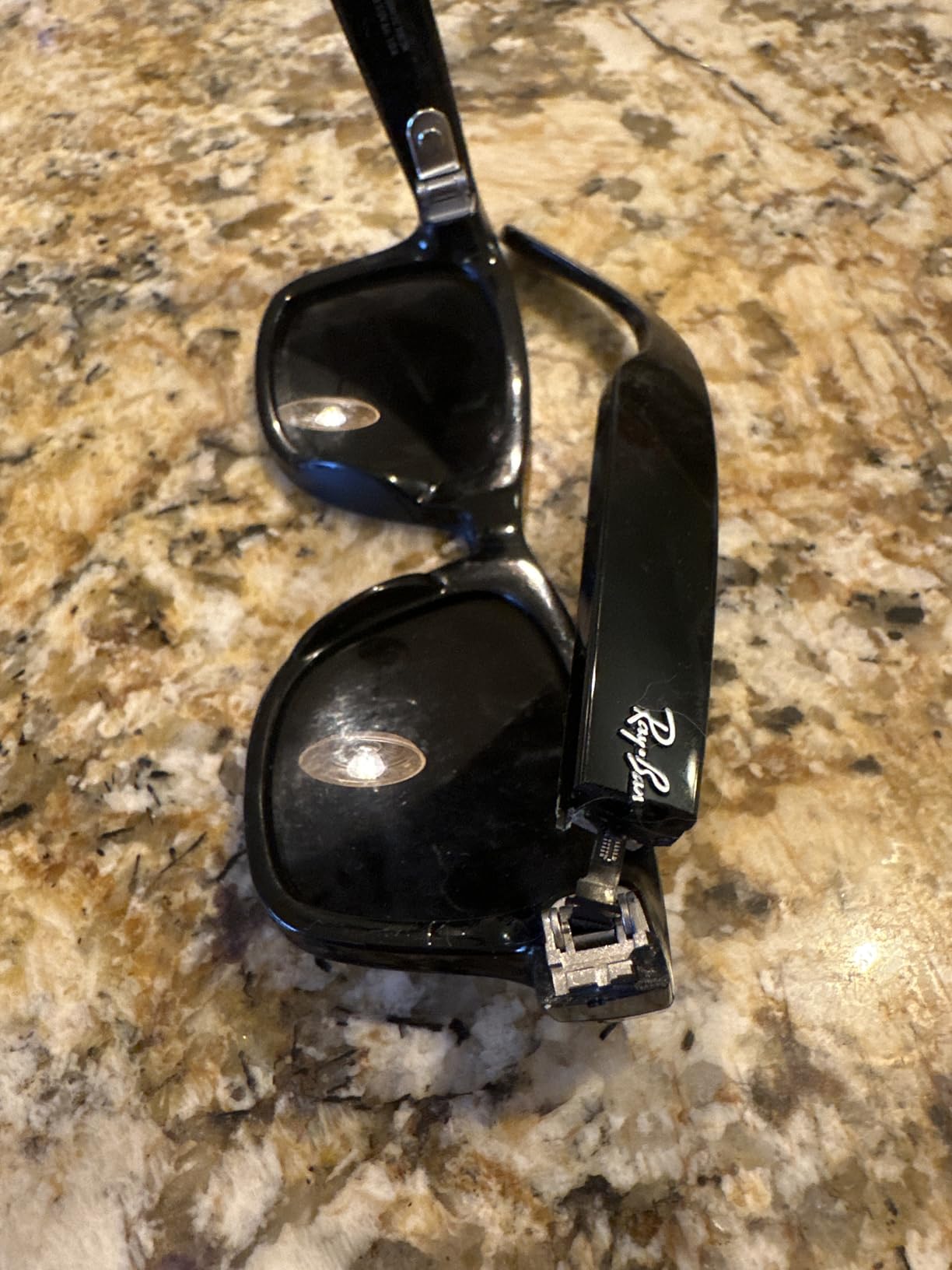
What works outside and what does not
Live translation without a WiFi connection is the feature that changes the maths on a trip abroad. Ask for a menu or a street name and the answer comes back in your ear within a second or two, which is far faster than a phone. The same assistant handles trail questions, though it answers vaguely when you ask it something specific, and it cannot see the trail ahead of you.
The fixed camera position is the outdoor compromise. It sits high and to one side, so clips frame the ground more than the horizon when you look ahead, and you cannot adjust it. For content creation that reads as a style; for someone documenting a ride, it means the footage is angled down more than you would like.
Who should skip this pair
Skip it if your outdoor sessions are long and you record often – the battery ceiling is real and there is no charging case in the box. It is also not rated for swimming or heavy rain, so open-water swimmers should look elsewhere. The listed item weight of 310 g is a shipping figure rather than the frame weight, and buyers with narrow faces report an unexpected frame size.
3. Meta Ray-Ban Skyler – Best Style for Outdoor Wear
- Cat-eye frame flatters many faces
- Less bulky than other frames
- Hands-free capture goes straight to the gallery
- Comfortable enough for all-day wear
- Calls come through clearly both ways
- Battery lasts only two to three hours with music
- Frames run large and fit poorly on many male faces
- AI answers are vague and miss objects
- Speakers have failed after software updates
The Skyler frame is the version of this idea that people actually keep wearing. The cat-eye silhouette is less bulky than the square frames it sits next to, and reviewers mention buying them as gifts more than any other observation, which tells you how the styling lands. For an outdoor pick this matters, because a frame you resent wearing is a frame that stays on the car seat.
Lens choice is the real outdoor story here. The photochromic option darkens between indoor and outdoor light, so one pair handles a start before dawn, a sunny ridge and a restaurant without a swap. The polarized option is better for a full day in hard sun, and having both available in the same frame family is unusual at this level.
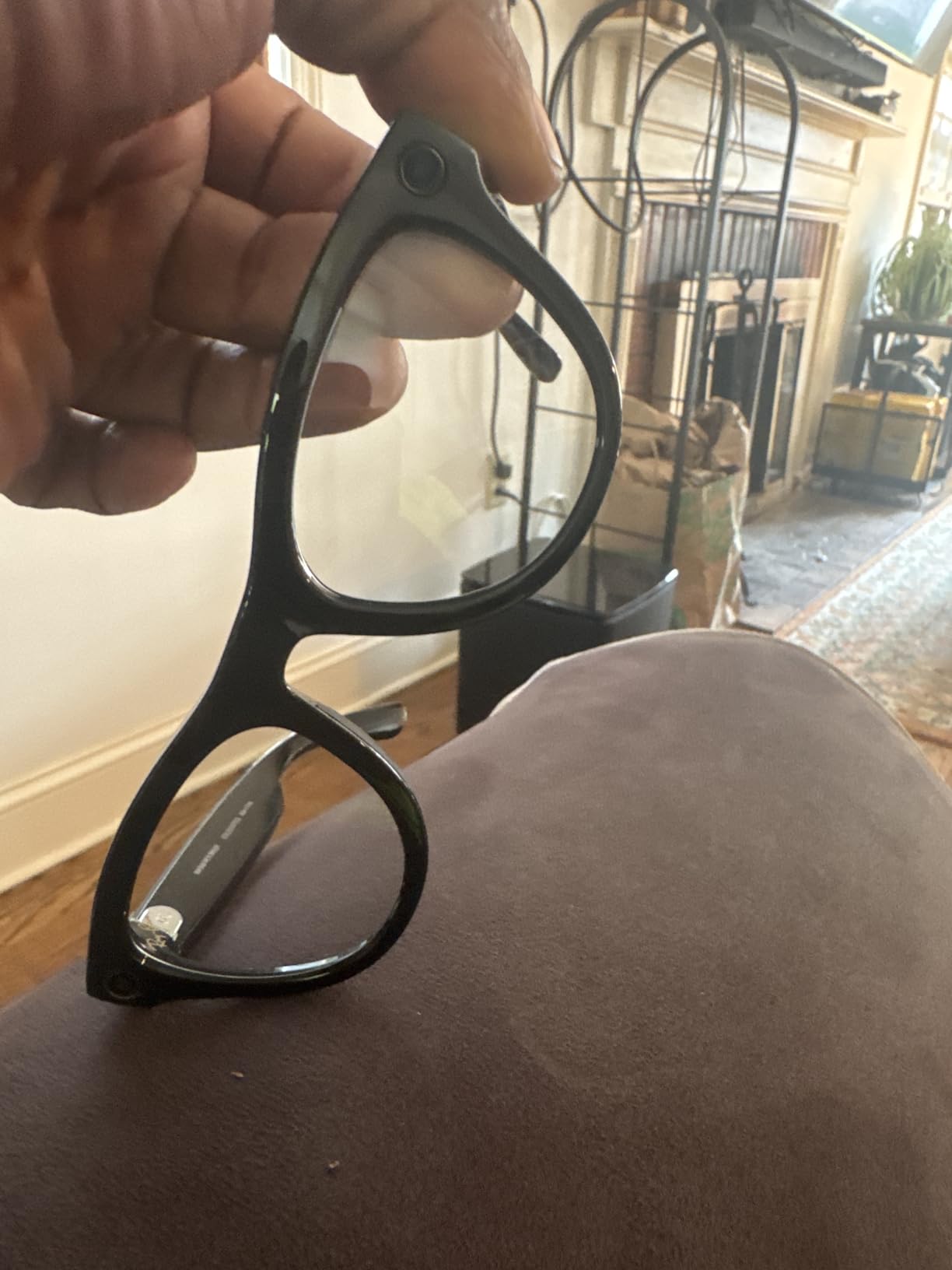
The 12 MP camera and five-mic setup match the Gen 1 Wayfarer for general capture, and sharing your point of view during a call is a small feature that lands well with family and riding partners. The app sends photos and clips straight into your phone gallery, so there is no transfer step between the trail and the edit.
Everything falls short in the same place: power. Reviews describe two to three hour sessions with music playing, and a long hike or a full ride will not fit inside that window. The size is the second repeated complaint, with the frame running large on many male faces, so if your temples are narrow, try before committing.
Outdoor details worth checking
The photochromic lens darkening takes a few seconds and is driven by ambient light, so it tracks a sunrise without any input from you. In bright midday sun the tinted variant reads far better on a face than the clear lens does, and the tint is neutral enough that trail surfaces do not look artificially warm.
Fit is the deciding factor outdoors because these frames are shaped rather than adjustable. On a long descent the temples sit fine, but on a run the frame sits higher on some faces and the camera framing shifts with it. The Meta AI assistant also stays vague outdoors, which is worth knowing before you plan a trip around asking it for trail conditions.
Where it falls short
The battery ceiling is the reason this is third rather than first, and it is the same ceiling that pushes the Gen 2 models up the list. Speakers stopping after a software update appear often enough in the reviews to be a real risk, and the setup instructions still reference a retired app, which is a sign of how the software side is being maintained.
4. OHO Sport Open-Ear T8 Pro – Best for Cycling and Long Rides
OHO Sport Open‑Ear Smart Glasses, Impact‑Resistant Bluetooth Sunglasses
- Soft-touch matte frame resists looking shiny
- Survives repeated drops without cracking
- Polarized lenses cut glare without darkening the view
- Battery handles long cycling rides on one charge
- Protective case included
- Treble-heavy tuning makes calls hard to follow
- Microphone is muffled for conversations
- Some units power on or jump to full volume by themselves
- Buttons need a long hold for each step
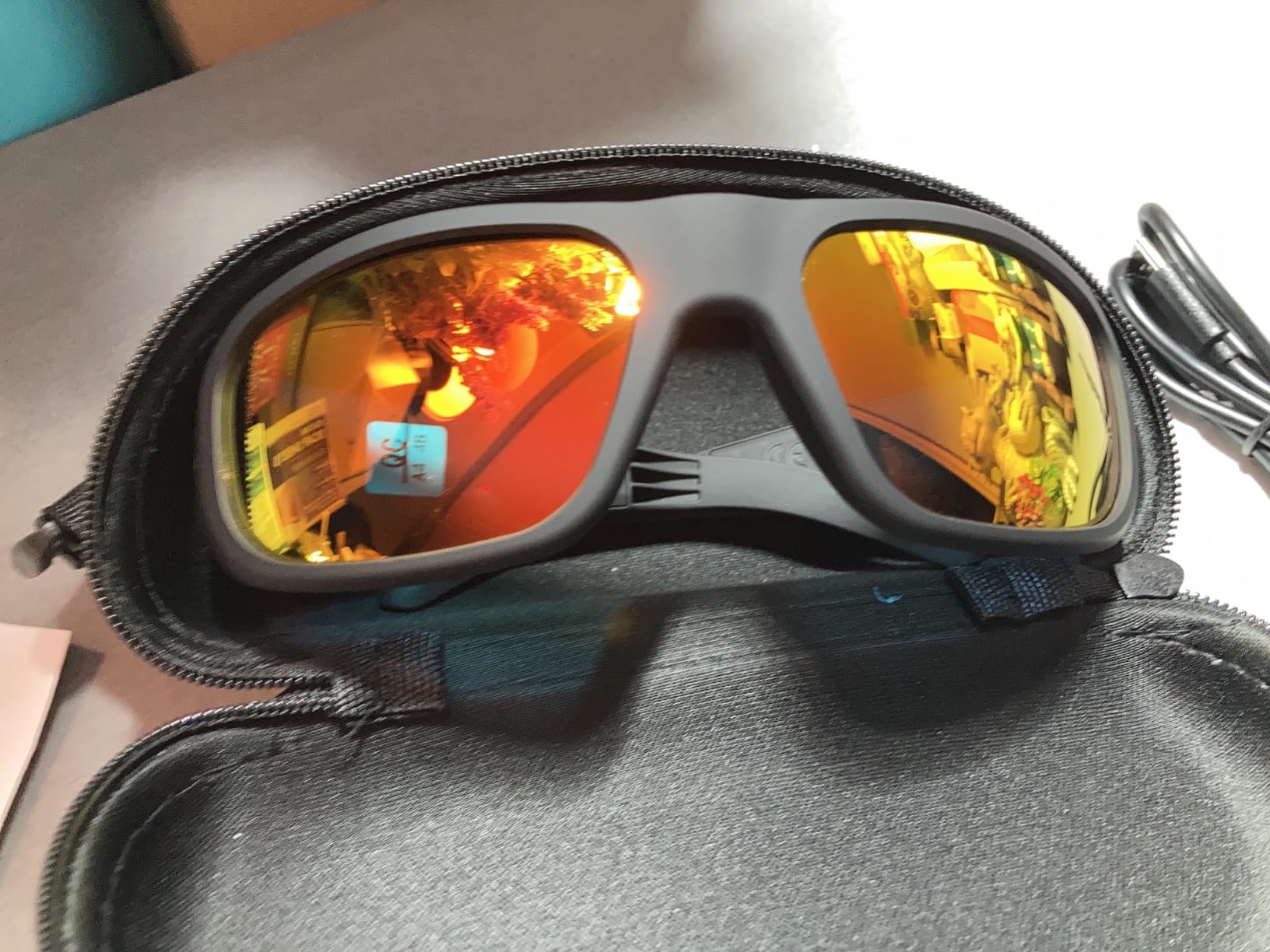
This is the frame we reached for on the bike, and the reason is grip and glare rather than software. The soft-touch matte finish does not turn shiny or greasy after a sweaty ride, which sounds trivial until you have wiped a glossy frame with a glove at a junction. The temples sit firmly enough that a rough gravel descent does not bounce the frame down your nose.
Polarization is doing serious work here. The tri-acetate lenses cut glare off the road and off wet tarmac without making the scene dark, which is the opposite of what cheap tint does, and the UV protection coating handles the rest. For a long summer ride in open sun, this is the pair we would pick on lens quality alone.

The 35 g frame is tied for the lightest in this roundup, and the TR90 body is both lighter and more forgiving than the acetate used on the fashion frames. Reviewers describe drop tests without cracking, and the square full-frame coverage keeps wind off the eyes on a fast descent better than a narrow lens shape.
USB-C charging removes the proprietary cable problem that plagues some frames, and the protective case in the box survives a rucksack. The listed sport coverage includes cycling, hiking, boating, fishing and driving, which matches how owners actually use these – as a pair of sunglasses that happen to play music.
Why it works on a bike
Battery is the reason riders keep coming back. Owners report multi-hour outdoor rides finishing on a single charge, which covers a long loop with music playing and still leaves reserve for the way home. The open-ear design also keeps you hearing traffic behind you, which matters more than the audio quality on any given minute of the ride.
Glare handling is the second reason. Polarized lenses reduce the shimmer off a sunlit road surface that makes riders squint, and the brightness stays natural rather than dropping to a brown filter. If your outdoor time is mostly two wheels, nothing else here does this job as cheaply.
Where it is the wrong pick
Audio is the limit, and it is a real one. The tuning is treble-heavy, so podcasts and calls are hard to follow, and the microphone is muffled enough that reviewers call conversations impractical. Music while riding works; being on a work call while riding does not.
A minority of owners also report units powering themselves on or jumping straight to full volume, and the buttons need a five to six second hold for each step. Those are firmware and control quirks rather than build faults, but they are worth knowing before a long ride depends on them.
5. Meta Ray-Ban Gen 2 Wayfarer – Best for POV Video
Meta Ray-Ban (Gen 2) Wayfarer Smart AI Glasses, Matte Black, Clear Lenses
- 3K video is a clear step up from Gen 1
- Callers cannot tell the microphones from a handset
- Up to 8 hours plus a case adding roughly 48 hours
- Comfortable with no pressure on nose or ears
- Stabilisation holds up while walking or cycling
- Video clips stop at 3 minutes
- Battery saver mode can get stuck with no way out of it
- IPX4 rules out heavy rain and immersion
- Lenses smudge easily
This is the pair to buy if your outdoor life is as much about filming it as living in it. The step from the first generation to this one is not incremental – 3K capture from the same 12 MP ultra-wide sensor produces footage you can cut into short-form video without upscaling, and the stabilisation holds up on a moving bike in a way most camera glasses fail to.
The battery is the other half of the outdoor case. Up to 8 hours of active use plus a charging case that adds roughly 48 hours means a two-day trip needs no cable, which was never true of the first generation. The case is the item most outdoor buyers mention as the reason they stopped worrying about power.

The microphones are the sleeper feature. Reviewers report that people on the other end of a call cannot tell they are talking to glasses rather than a handset, and the brand claims 90 percent of wind and street noise is blocked. In practice that claim holds up in light wind and starts to fail on a fast descent in a headwind, which is the honest limit of any open-ear mic array.
Build and comfort are the quiet wins. Wearers report no pressure on the nose or ears over long sessions, and the Wayfarer shape keeps the tech invisible in a way that still makes spontaneous filming socially easy.
What matters for outdoor filming
Clip length is the number one question we get asked, and the answer is three minutes. Continuous recording drains the battery quickly, so the practical workflow is short clips assembled later rather than one long capture. For trail and ride documentation that is workable, and it is a deliberate software limit rather than a hardware failure.
Low-light video is the honest weak point. Reviewers report visible noise in dim scenes, so golden-hour and daylight footage is where this camera earns its place. The polycarbonate lenses in this configuration also smudge easily, and a cloth goes in the case with the glasses.
Where it falls short outside
Water resistance is IPX4, which means splashes and sweat are fine but heavy rain and immersion are not. That is enough for a drizzle on a walk and not enough for a downpour on a ridge with no shelter. There is also a battery saver bug that can get stuck with no menu to disable it, and an advertised five-minute recording mode that some accounts never see after a factory reset.
6. AMZISH 8MP AI Smart Glasses – Best for Switchable Lenses
AI Smart Glasses with Camera, 8MP HD Bluetooth Camera Glasses for Women Men
- Look like ordinary sunglasses
- 8 MP camera with EIS gives steady video
- Some users report close to two days per charge
- Dual-mic ENC keeps calls clear on the move
- Interchangeable lenses switch between sun and clear
- Audio is weak with thin bass and modest volume
- Companion app is slow and needs work
- File transfer is slow and needs phone WiFi on
- Recording stops at about five minutes
- Temples run warm
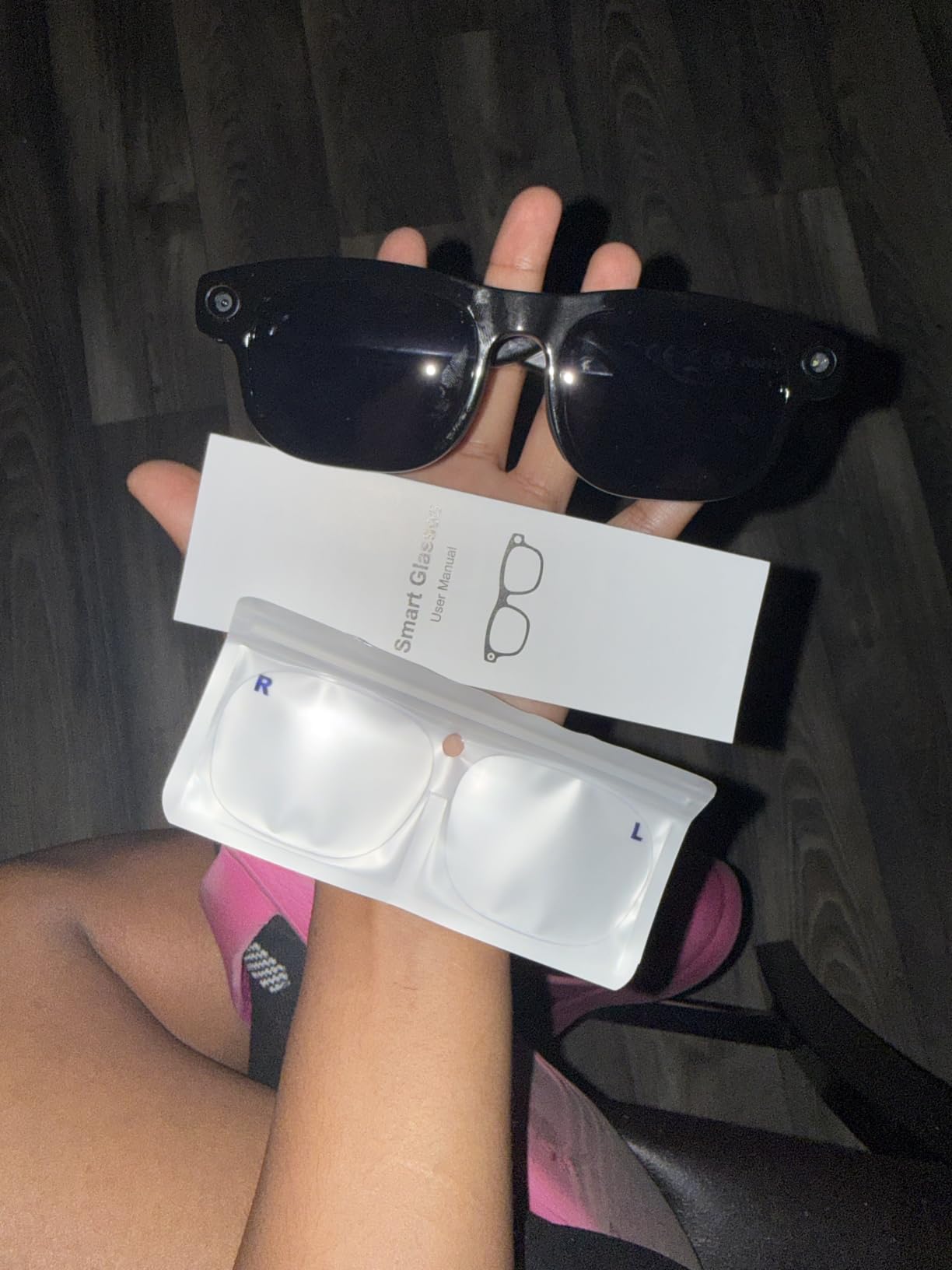
The defining feature here is the lens system. A pair of sunglasses and a pair of clear blue-light lenses ship in the box, and because the lenses are interchangeable rather than electronic, a photochromic gimmick is not needed to handle a day that starts indoors and ends on an exposed ridge. For outdoor users who move between work and trail, that is worth more than any display would be.
IP65 is the strongest weather rating we can verify in this roundup, and it is a real number rather than the word waterproof. It covers sweat, rain and splashes on a run or ride, which is the range most outdoor sessions actually occupy.

The 8 MP camera with electronic stabilisation produces steady 30 fps video and stills that hold up for social posts, and the 32 GB of internal storage means files move without constant cloud work. Owners report close to two days per charge for light use, and the 220 mAh cell is smaller than most here yet still clears a long session.
Dual-mic ENC is the spec that made cycling calls usable in the reviews, and the gestures and touch controls mean you can start a recording without reaching for the temple blind. Real-time translation across 164 languages with built-in models adds genuine travel value for anyone who moves between countries.
How the lenses work outdoors
Swapping lenses takes seconds and the black lens is genuinely dark enough for open water and bright snow. The clear lens is a blue-light filter, so it is a screen-break lens rather than an all-purpose outdoor one, and the honest workflow is to change in the car rather than on a ridge. Owners treat the pair as two glasses in one, which is why the wide temple area is a real trade-off.
The temple running warm is the most reported physical complaint, and it is noticeable on a hot ride in direct sun. It does not stop the electronics working, but it is the first thing you feel on a long summer day.
Where it falls short
The software is the weak point. The companion app is described as slow and needing major improvement, and file transfer depends on the phone WiFi staying on, which is a poor experience on a trail with no signal. Recording also stops at about five minutes and the glasses power down, and translation does not work as reliably as the language count suggests.
7. Plunthorn 4K AI Smart Glasses – Best for 4K Footage on a Budget
AI Smart Glasses with Camera, 4K Video, Real-Time Translation, AI Assistant
- 4K resolution captures clear detailed footage
- Open-ear design keeps you aware while cycling
- Real-time translation and a ChatGPT voice assistant
- Companion app handles setup and files cleanly
- 290 mAh battery covers a full workday
- Listed as not water resistant despite IP65 marketing
- Open-ear audio is functional with limited bass
- Storage and transfers depend entirely on the phone app
- Silicone band and clear lenses poor in bright sun
4K is the headline and it delivers. At 3840 by 2160 this captures more detail than anything else in the roundup at this price, and the clear result is usable footage from a fast-moving run or ride rather than the smeared output most camera glasses produce. If your outdoor priority is first-person video, that resolution is the reason to look here.
The app is the other strength. Reviewers repeatedly single out setup, file management and object recognition as clean and easy, which is more than can be said for several competing frames where the app is the main source of frustration. The 290 mAh cell is sized for a full workday of typical use.
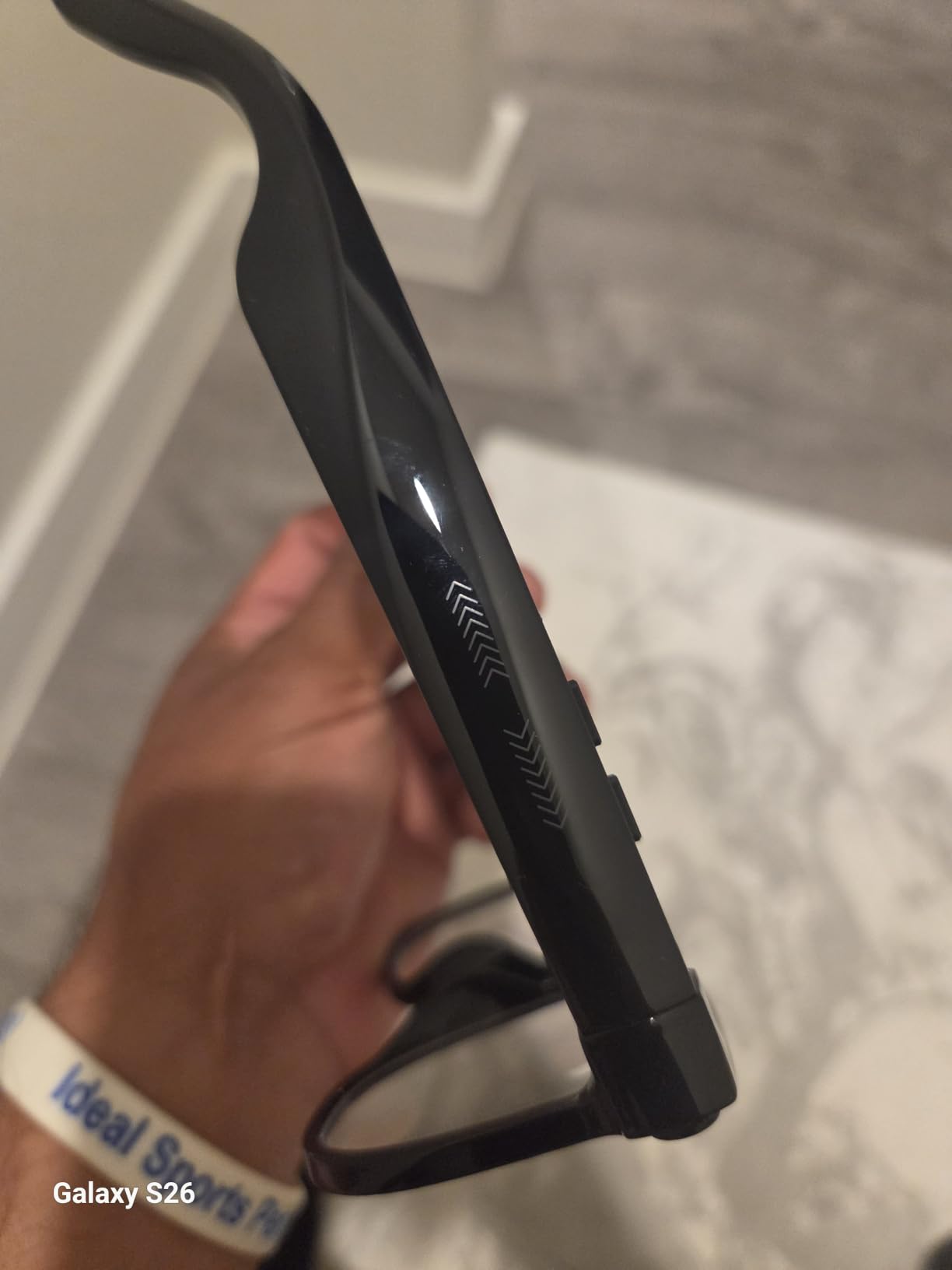
Real-time AI translation with a ChatGPT voice assistant is a solid travel feature and works without you reaching for a phone. Bluetooth music and hands-free calls sit alongside it in a frame that reads as ordinary eyewear rather than a headset, which matters if you wear these all day.
Here is the outdoor problem, and it is a real one: the specification listing says not water resistant while the marketing material claims IP65. Reviewers noticed the contradiction and it has left outside users cautious. We treat these as not rain-ready until the manufacturer clarifies, and that caution is why this sits below the AMZISH despite the better camera.
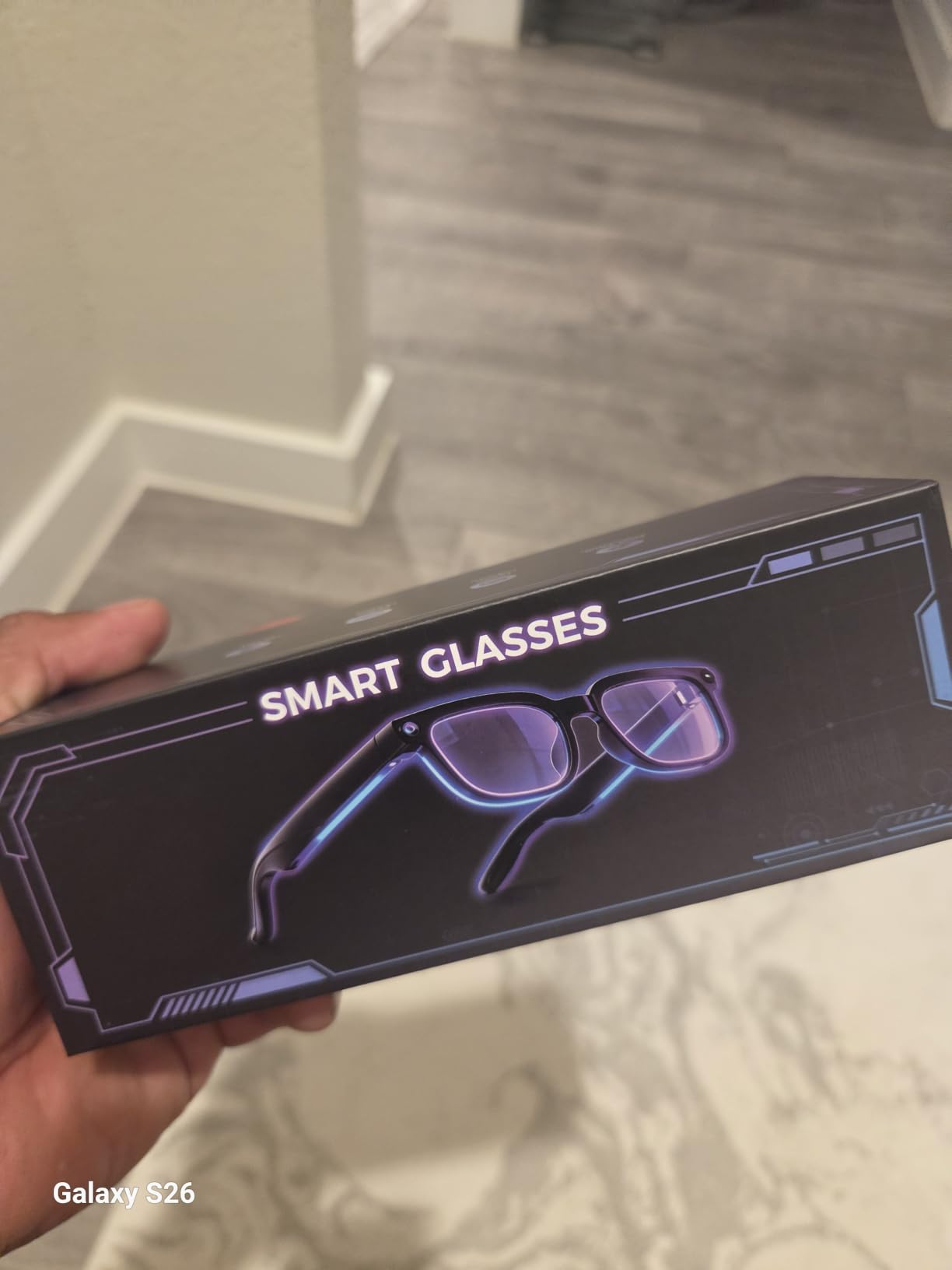
Video performance outdoors
The 4K sensor holds detail in bright daylight better than the 8 MP frames here, because it is resolving roughly four times the pixels. That shows most clearly on wide open views, on water and on anything with fine texture like rock and gravel paths. The trade is file size, and with the app handling storage there is no large internal memory here at all.
Being completely dependent on the companion app for storage and transfer is a genuine weakness on a trail. It means you need your phone, charged, within range, and that is not how most outdoor days go.
Who should skip it
Skip it if rain or sweat is likely, because the water rating is contradictory and nobody should rely on a marketing claim that the specification sheet contradicts. The clear lenses are also a poor choice for open sun, and the silicone band is less stable than a proper temple on a fast descent.
8. Meta Adventurer AI Glasses – Best Slim Everyday Outdoor Frame
- Slimmer temples look more like regular glasses
- Lightweight and comfortable over long sessions
- Video quality holds up even on fast motion
- Loud and clear open-ear speakers
- Hey Meta handles everyday tasks hands-free
- Battery drains faster than the price implies
- The recording indicator LED is obvious to bystanders
- Recording sessions are short
- Some buyers found the fit awkward
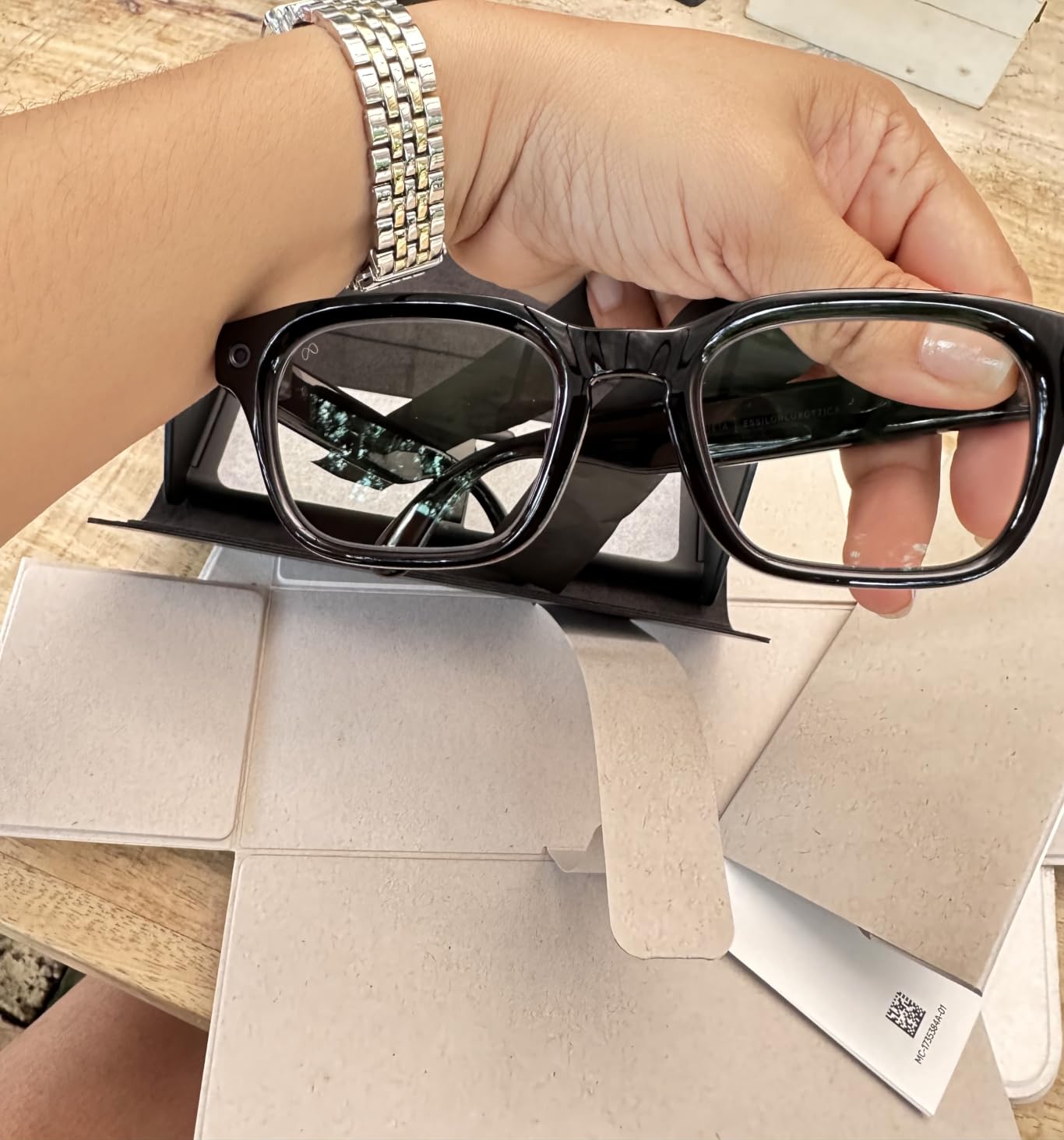
The Adventurer frame exists because the earlier Meta frames read as slightly chunky under a cap, and that is a real problem for anyone who wants to wear glasses on a bike or a run. The slimmer temple arms fix it – reviewers describe these as looking like regular glasses, and six microphones handle wind and street noise better than the five-mic array on the older models.
Video quality is praised even in motion, which is the situation that matters outdoors. A roller coaster or a fast descent is the harshest test for a stabilised camera, and this holds up where cheaper frames bounce.
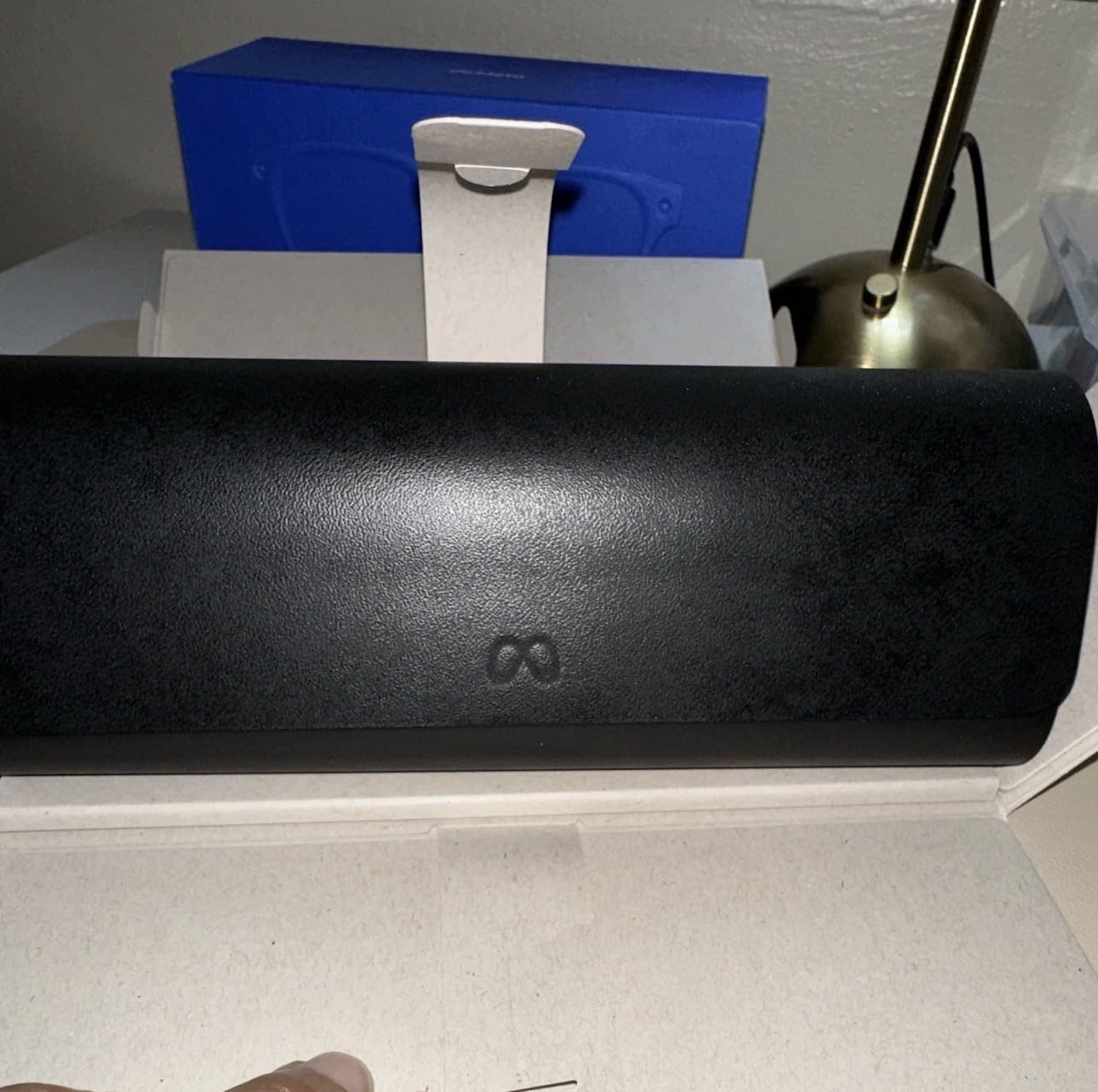
Live translation activates with the Hey Meta wake phrase, and hands-free calls and WhatsApp video calls with POV sharing work from the temple controls. Connecting Spotify, Apple Music and Audible is a two-minute setup, though the extra accounts take a moment.
Be clear about the evidence base here. With 32 reviews on record, this is the thinnest sample in the roundup, and the comments are overwhelmingly positive on design with reservations about power. We would want a longer record before calling it an outdoor default.
How it wears on a long day
Comfort over long sessions is the strongest theme in the reviews, and the slim profile means it slides under a cap strap or a helmet strap without the temple bunching. The open-ear speakers are described as loud and clear, which is unusual – most frames here are described as adequate at best.
The recording indicator is the outdoor social issue rather than a technical one. Owners note that the white LED is obvious and makes spontaneous filming in a public place awkward, which is the correct outcome but does slow you down if you are capturing as you go.
Where it falls short
Battery drains faster than the price point implies, and recording sessions are short. Fit is also subjective – a small number of buyers returned these over how they sat on their face, and without weight listed it is hard to predict. The small review count means we would treat this as a design-led option rather than a proven one.
9. SGUKZF 4K Photochromic AI Glasses – Best Value
- Photochromic lenses handle sun and indoor light
- Very light at 35 g over many hours
- Recording indicator is respected as a privacy plus
- Modern semi-rimless design
- Twelve-minute clips when connected to the phone
- Advertised stabilisation does not stop the video bouncing
- Camera is offset to one side
- Speakers have little bass and are not private
- Translation is hit or miss
- App drops out of the background and transfers are slow
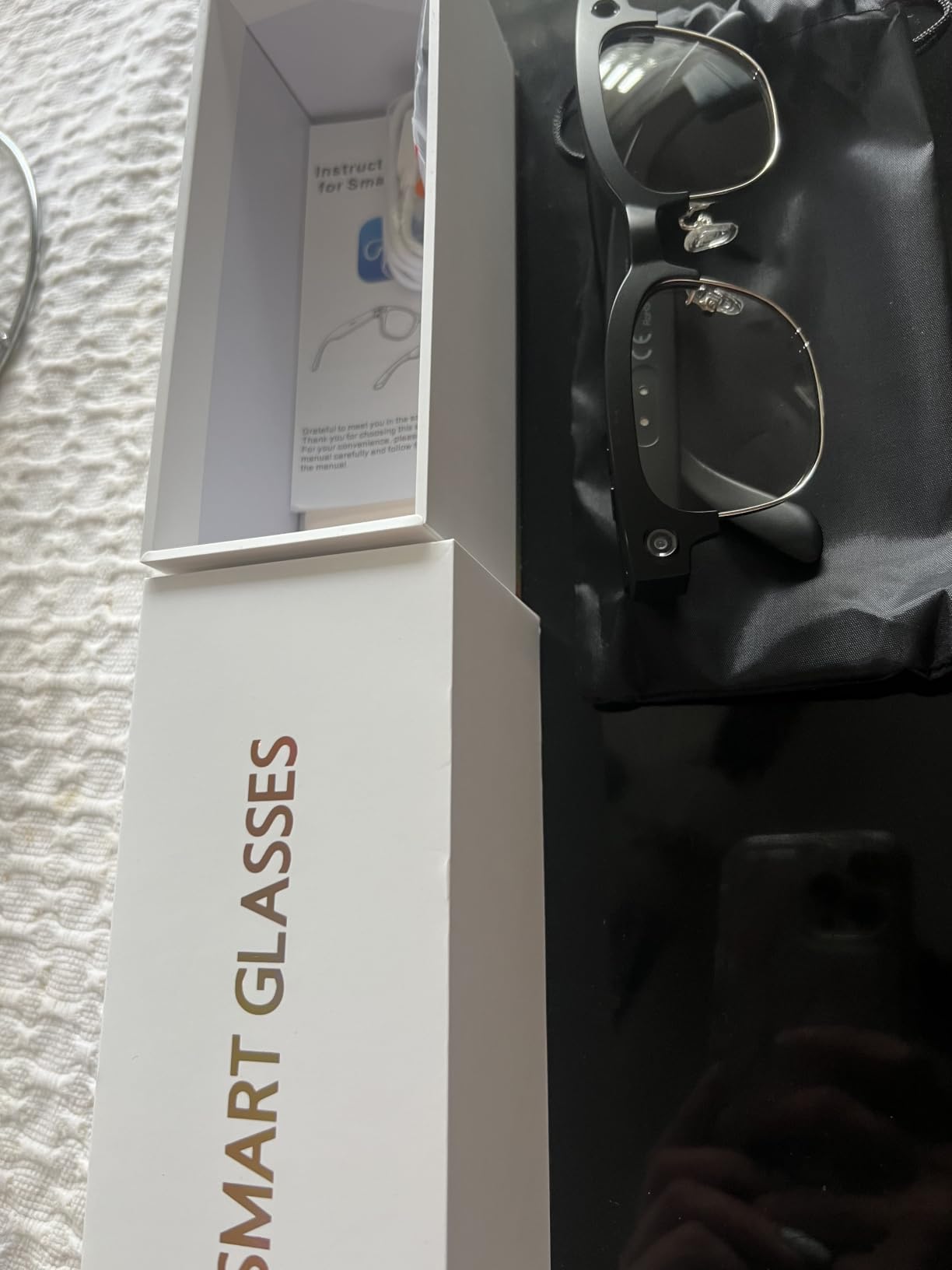
Photochromic lenses at this weight make this the interesting budget pick. The lenses darken in sun and clear indoors, so the frame handles a long day outdoors without a swap, and at 35 g it is tied for the lightest in the roundup. For long walks where the sun comes and goes, that combination is genuinely the right one.
This is also the most critically rated product here, and the reviews are blunt about why. Several users say plainly that you get what you pay for. That is a fair summary of a 4K camera that does not stabilise and an 8 MP-style audio system with no bass.

The features listed are wide on paper: 4K with EIS, real-time translation across more than 130 languages, open-ear speakers and noise-reduction microphones. Several of those claims do not survive contact with a trail. The stabilisation does not stop the video bouncing, and the camera sits offset to one side, so portrait framing ends up awkward.
IP66 water resistance is claimed in the features, and the 290 mAh battery is a sensible size for a full day. Storage is the constraint – 4 GB of internal memory fills quickly with 4K clips, so you need the app and a clear-out routine.
What works outside
The photochromic lenses are the reason to consider this frame, and they are reported as working reliably and quickly. Several reviewers explicitly praise the recording indicator as a privacy plus, which is refreshing in a category where the light is sometimes treated as a problem.
Good daylight and twilight stills come out of the camera when it is held steady. The failure is motion, so if you are walking rather than riding, the bouncing is far less noticeable.
Where it falls short
Speakers are medium volume with very little bass and are not private, so this is not a headphones replacement. The app will not stay running in the background and transfers are slow, translation is hit or miss, and the 4 GB limit caps how much video you can keep on the frame itself. For filming a long day, that combination is disqualifying.
10. Warchody L300 Photochromic AI Glasses – Best for Active Use
- Built for active use with a secure fit
- 8 MP ultra-wide captures genuine first-person footage
- Open-ear audio is balanced with rich bass
- Photochromic lenses adapt between sun and indoor
- AI assistant and 144-language translation
- Only 4 GB of internal storage limits recording
- Three-minute clips when not connected to the phone
- Companion app exits to the background and cannot reach contacts
- Voice assistant responds but is not conversational
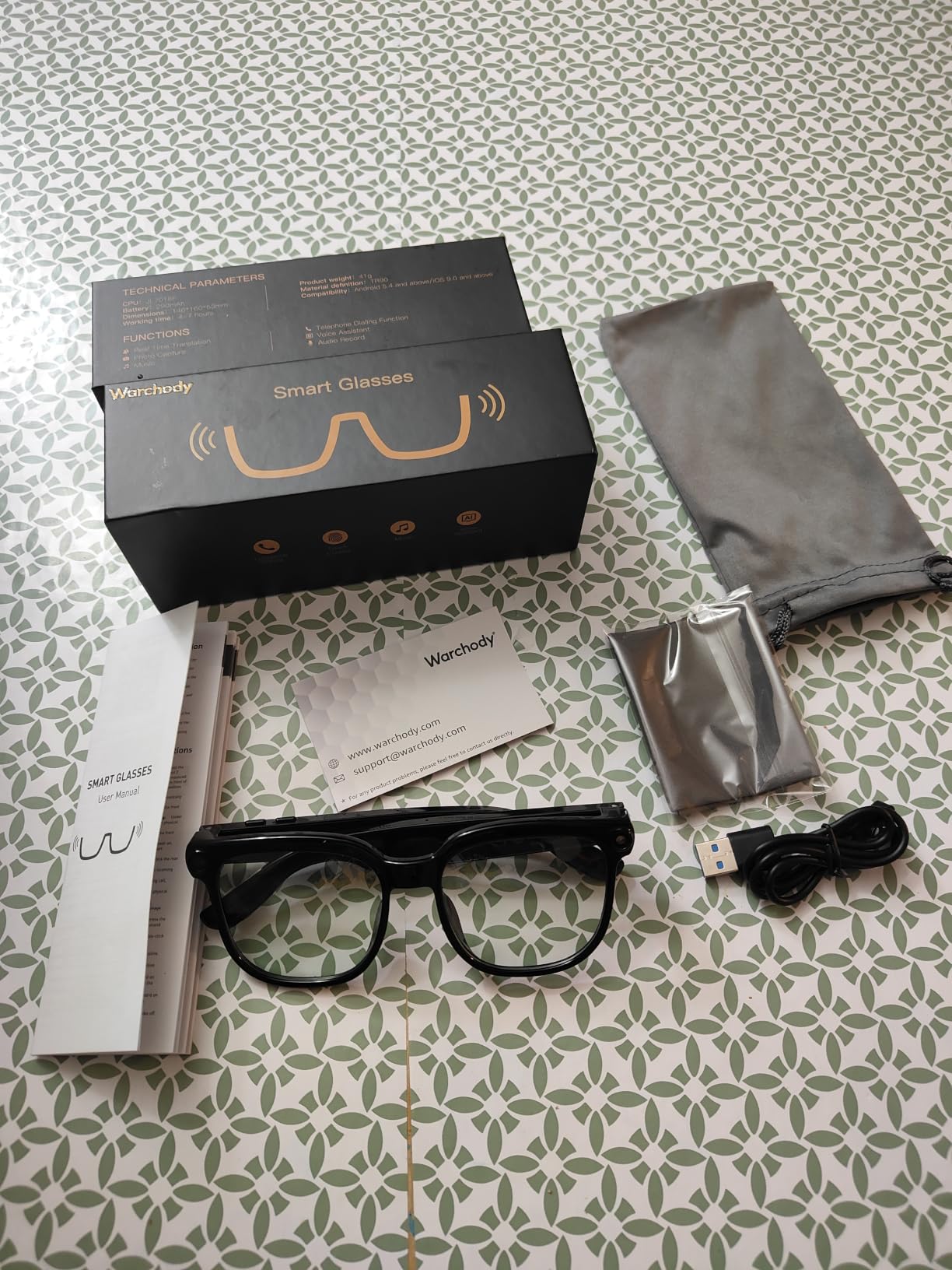
Warchody is the only frame in this roundup that markets itself explicitly around sport, and the specification backs the claim. IP65, a secure fit, a 38 g frame, a 300 mAh battery and a full charge in 70 minutes is a package designed around short stops and long sessions rather than a desk.
The 70-minute charge time is the detail outdoor buyers care about most. A frame that goes from flat to full over an early breakfast gets you through a second half-day, which is rare in this category where many pairs take hours.

The 8 MP ultra-wide camera produces genuine first-person footage hands-free, and the listed sport coverage spans climbing, cycling, fitness, golf and multi-sport use. Climb being listed explicitly is a good sign for how the manufacturer positions the fit.
Audio is the one place this frame is rated above its class, with balanced sound, rich bass and crisp treble described in the reviews. That is unusual in open-ear hardware, and it matters if your session is half music and half conversation.
Active use details
Photochromic lenses handle the sun-to-shade transitions on a long climb without a swap, and the 4 GB of internal memory is the weak point that offsets it. Three-minute clips when not connected to the phone is workable for vlogging but restrictive for anything longer, so the workflow is to pair the frame to your phone before you set off.
The AI assistant handles questions and photo recognition but is not conversational, so treat it as a lookup tool rather than a partner. The 144-language translation runs through the companion app rather than on the frame itself.
Where it falls short
The companion app is the recurring problem across this tier. It exits to the background, cannot reach phone contacts, and will not hand off to music services, so you are managing the frame rather than the other way round. The frame is also not safety-rated for industrial or high-impact use, which matters if you work outdoors and assume the rating covers you.
11. Bapick 8MP Dual-Lens AI Glasses – Best Dual Lens Package
Bapick AI Smart Glasses with Camera, 8MP HD Camera Glasses for Men Women
- 8 MP camera with stabilisation gives smooth 30 fps video
- Four speakers plus dual-mic ENC for clear calls
- Polarised and anti-blue-light lenses included with no colour distortion
- 139-language translation with built-in models
- Largest internal storage in this roundup
- Only about 80 minutes of continuous capture
- Two extra lenses mean more to carry
- AI and translation setup needs the phone app
- Less established brand with a shorter review history
This carries the highest rating in the roundup, with most reviews at five stars, and the reason is the package rather than any single spec. Two lenses ship in the box – polarised sunglasses and an anti-blue-light clear pair – and reviewers single out the absence of colour distortion on the polarised lens as a quality signal that usually costs more.
Storage is the practical standout. 32 GB of internal memory is the largest in this roundup, which means you can film a full day and sync later over Bluetooth 5.3 or WiFi rather than clearing files at every stop. For a trip that matters more than it does for a single ride.
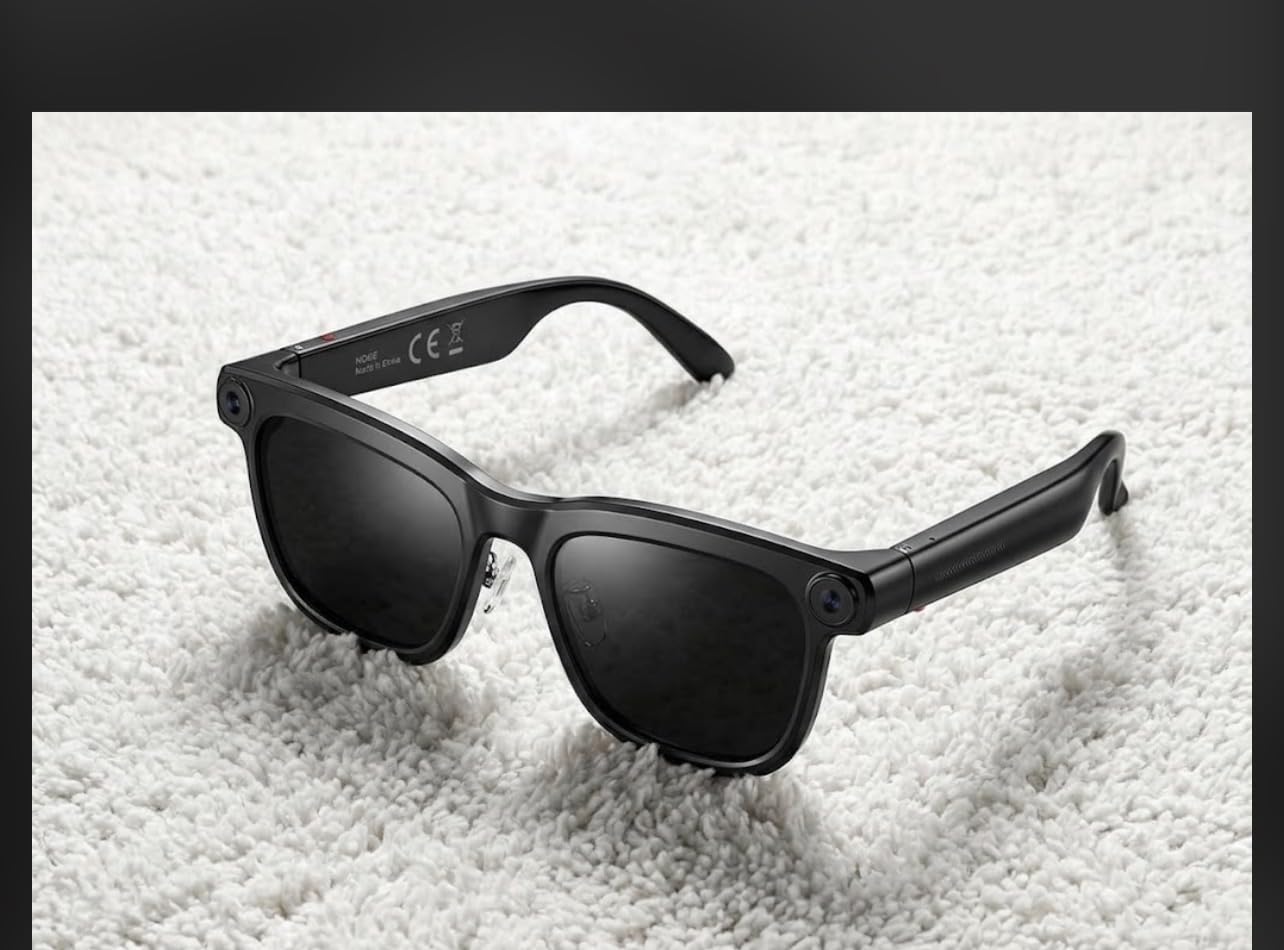
Four speakers with dual-mic ENC give a fuller stereo soundstage than the two-driver frames here, and calls stay clear. The Hey Lens assistant handles questions, weather and object recognition, and real-time translation across 139 languages runs on built-in ChatGPT and DeepSeek models.
The 8 MP camera produces smooth 30 fps video with 1080p stabilisation and 32 MP stills, which is a good balance for a frame that is not trying to chase 4K. The 300 mAh battery gives up to 10 hours of music, 80 minutes of capture and a week of standby.
What matters outdoors
The dual-lens setup solves the indoor-outdoor problem with an actual spare rather than electronics, so a dark lens for the ridge and a clear lens for the pub are both in the case. The polarised option is the one for sun and water, and it does not shift colour on a landscape the way some cheap tints do.
Camera stabilisation is the detail that shows up in the footage, and smooth 30 fps is exactly what you want for a walk or a ride. The trade is endurance, and 80 minutes of continuous capture is the number to plan around.
Where it falls short
Eighty minutes of continuous capture is the real outdoor limitation, so this suits stills and short clips rather than a long film. Carrying two extra lenses is more to lose in a rucksack, the AI and translation features need the phone app to set up, and with a shorter review history than the Meta frames we would want a season of use before trusting it as a primary pair.
12. Meta Ray-Ban Gen 2 Headliner – Best Build Quality
Meta Ray-Ban (Gen 2) Headliner Smart AI Glasses, Matte Black, Clear Lenses
- Build quality described as very good
- Headliner fit is flattering on a man's face
- 3K video is sharp and vibrant
- Up to 8 hours plus a case for up to 48 hours
- Open-ear audio good enough that many leave earbuds at home
- Advertised on-lens message display does not exist
- Some units stopped working and needed a return
- Translation and mic pickup unreliable at distance or with background noise
- Connection stability needs the glasses removed to reset
- Heavier on the nose than expected
The Headliner is the round frame in the Meta line-up, and at 51.2 g it is the heaviest of the three Meta models here – which still leaves it lighter than plenty of what it competes with. The round shape is reviewed as flattering on a man’s face, and the fit is described as regular rather than slim, which is worth knowing before ordering.
Build quality is the reason this is in the roundup at all. Owners describe it as very good, and the audio is praised strongly enough that many report leaving earbuds at home. Dolby Atmos in an open-ear frame is unusual and it shows up on longer sessions.
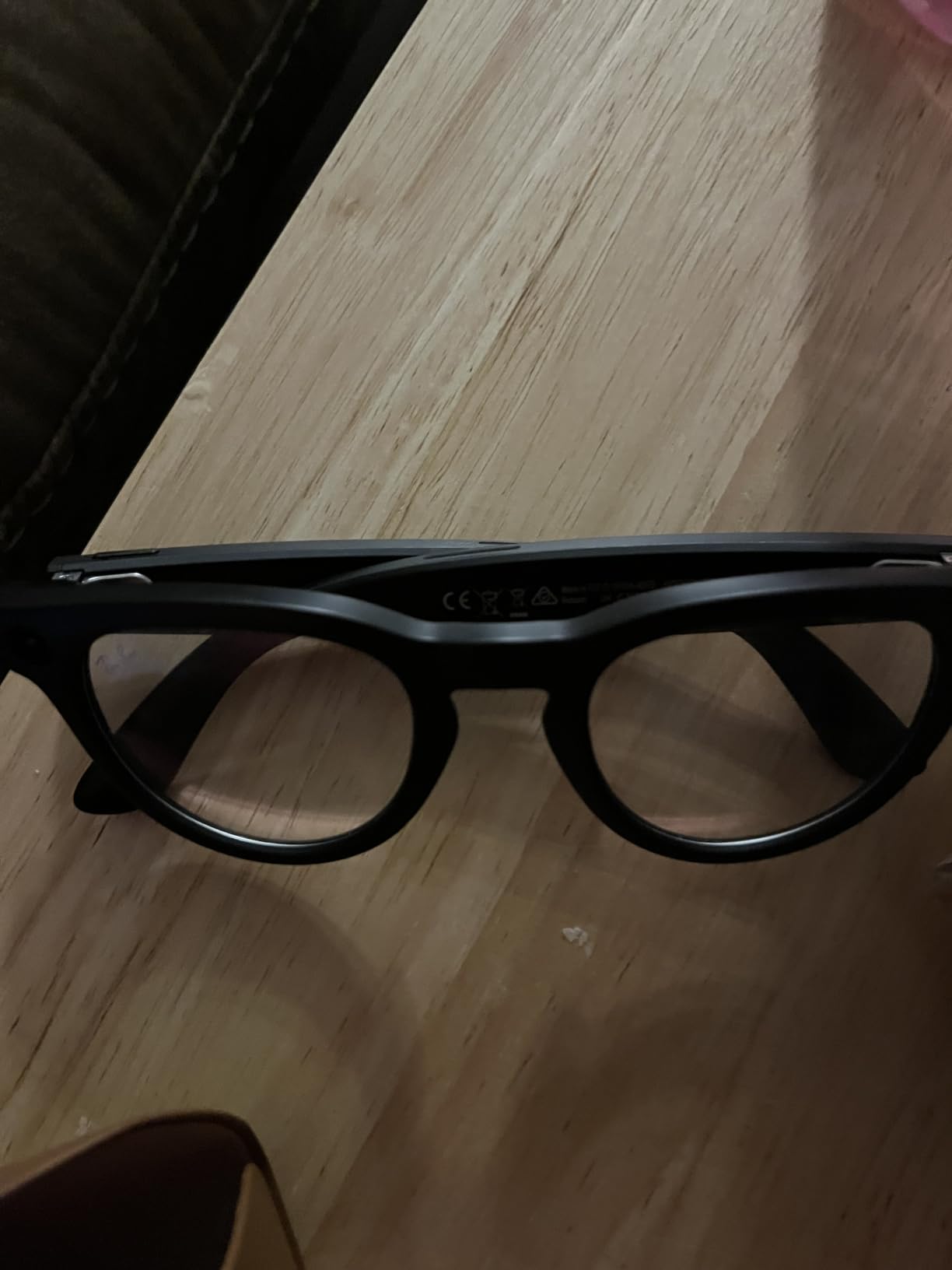
The 3K capture from the 12 MP ultra-wide sensor produces sharp, vibrant clips, and the 8-hour battery with a case adding up to 48 hours means a weekend needs no cable. Live translation works without WiFi, and hands-free calls block most wind and street noise.
Be careful with the marketing on this one. Several owners report that advertised features such as messages appearing on the lens do not exist at all, which is the clearest example in this roundup of a spec sheet outrunning the software. Read the feature list as a direction of travel rather than a checklist.
Fit and comfort outdoors
The round shape sits differently on a smaller face and reviewers note the frame is heavier on the nose than expected for a full day of wear. If you are out for six hours or more, the lighter options at the top of this list will serve you better, and the fit is worth testing rather than assuming.
Where it does win is audio for long sessions. Several owners report the open-ear sound is good enough that they stopped carrying earbuds, and on a walk that is a genuine improvement over carrying a case in a pocket.
Where it falls short
Reliability is the reported issue. Some units stopped working entirely and needed troubleshooting or a return, and connection stability issues mean features have to be reactivated by taking the glasses off. Microphone pickup works at close range in quiet settings and falls apart at distance or with background noise, and the voice assistant sometimes fails to understand commands.
How to Choose Smart Glasses Built for the Outdoors
Start with water resistance, because it is the one specification that can end your day. IPX4 covers sweat and splashes and nothing more. IP65 and IP66 cover rain, dust and sweat properly. Anything that says only waterproof without a number tells you nothing comparable, and a specification sheet that contradicts its own marketing – as one pair here does – should be treated as not rain-ready until the manufacturer clarifies.
Second, check the battery against your actual session rather than the headline number. A two-hour claim means a two-hour claim, and if your outdoor day is longer you need a charging case or a packable cable. The frames that genuinely survive a full day are the ones rated at eight hours or more, or the ones with a case.
Third, fit is a performance feature, not a style choice. Lighter frames at 35 to 38 g stay put on descents and long runs, and any frame over 50 g will press on the nose by hour six. Try them with the fit you actually use, and if you ride in a helmet, check the temples clear the strap.
Fourth, think about lenses. Polarised lenses cut glare off water, wet road and snow, and photochromic lenses handle a day that moves between shade and open sun. Clear lenses are a screen-break option, not an outdoor one. If your time is in hard sun, tint is not optional.
Fifth, look at microphones rather than speaker volume. Outdoors you need the other person to hear you in a breeze more than you need bass, and a muffled microphone makes any frame useless for calls on the move.
Sixth, decide how much recording you actually do. Continuous capture drains these batteries far faster than audio, and a three-minute or five-minute clip limit is a design decision you have to plan around. Stills and short clips are a much better fit for this hardware than long films.
Seventh, confirm ecosystem fit before you buy. A closed assistant ecosystem ties your capture, calls and translation to one phone app, and users cross-check independent reviews precisely because of that lock-in. If you want open voice assistant choice, read that part of the spec carefully.
For a wider look at what a rating means in practice, our smart telescope guide uses the same hands-on approach and covers the other end of the optics spectrum.
Battery Life Against Real Outdoor Sessions
Manufacturer hours are measured with audio playing and nothing else happening. Mapping those figures onto real sessions is the most useful thing you can do before buying, because the gap between the two is where disappointment lives.
The frames rated at eight hours or more – the two Meta Gen 2 models – comfortably cover a full-day hike, a long ride and a skiing day with power to spare, and their charging cases add roughly 48 hours each. The frames rated at 10 hours, like the OhO Elite, cover a working day of audio. Everything rated in the two to three hour band, which covers the first-generation Meta models, fits a short walk or a ride to work but not a full day out.
Recording changes the maths completely. Continuous capture drains the same batteries far faster, and the frames listing 60 to 80 minutes of capture are built for stills and short clips. If your day is a filming day, budget for a case or a power bank rather than trusting any headline figure.
The Downsides of Smart Glasses to Know Before Buying
Five downsides come up repeatedly, and none of them are dealbreakers for most people. Battery endurance is the first, and the gap between a two-hour real session and a marketed figure is where most frustration starts. The second is audio privacy: open-ear playback is audible to anyone standing close, which is unacceptable on a train and beside a colleague.
Third is microphone quality in wind, which limits every one of these frames for calls outdoors. Fourth is clip length and app dependence – most of these products record in short segments and lean on a phone app for storage and transfers, and a laggy app undoes a lot of good hardware. Fifth is weight over a full day, which is why the 35 to 38 g frames at the top of this list have the advantage over the heavier fashion frames.
There is a sixth, quieter one: advertised features regularly outrun the software. One frame in this roundup advertises on-lens message display that does not exist, and another advertises stabilisation that reviewers say does not work. Read the reviews, not the feature list.
Prescription Wearers: What Changes Outdoors
Prescription compatibility is where outdoor users hit the most friction. Some frames cannot be worn over existing glasses at all, which rules them out unless you are happy with a separate pair underneath. Where prescription lenses are offered, the outdoor constraint is tint: a strong prescription plus a dark sunglass lens can be heavy, and photochromic options are the practical middle ground for a variable day.
Fit is the second issue. Prescription frames are shaped to hold the lens, and that means temples that press harder on the sides of the head than a non-prescription frame. Over an eight-hour day outdoors, pressure points that were invisible in a shop become the reason you take the glasses off at lunch. Try on, then wear them for an hour before deciding.
If your outdoor time is mostly in hard sun, note that the photochromic and polarized options in this roundup are the only lens systems that can follow a changing sky. Swappable lens pairs, as on the AMZISH frame, are the third route and the most predictable in bright conditions. If you also work outdoors, our safety glasses guide covers the certified protection side of that same problem.
Frequently Asked Questions
What are the downsides of smart glasses?
The main drawbacks are battery endurance, which is often much shorter in real use than the headline figure suggests. Open-ear audio is not private, so playback is audible to people nearby. Microphone quality degrades badly in wind, which limits calls outdoors. Most models record in short clips of three to five minutes and rely on a phone app for storage and transfers. Weight also matters, because heavier frames press on the nose by the sixth hour.
What brand has the best smart glasses?
Meta currently leads on camera quality, microphone array and assistant capability, and its Ray-Ban frames are the most proven outdoors. For battery life and all-day weight, the OhO and OHO Sport frames beat everything on comfort. The lower-cost brands compete hard on specification sheets, with 4K cameras and IP65 ratings, but their apps and stabilisation are less reliable in real outdoor use.
How long do smart glasses battery last?
It depends entirely on the model and what you are doing. Frames rated at 8 hours cover a full-day hike with audio playing, and models rated at 10 hours cover a working day. Continuous video recording cuts those figures dramatically, and many budget frames list only 60 to 80 minutes of capture. Frames with a charging case add roughly 48 hours, which is what makes the two-day trip realistic.
Can I use smart glasses in the rain?
Only if the frame carries a numbered IP rating. IPX4 covers sweat and splashes but not heavy rain or immersion, which rules out swimming. IP65 and IP66 cover rain, sweat and dust properly and are the ratings to look for in wet climates. Be cautious with any frame that only says waterproof without a number, and with any frame whose own specification sheet contradicts its marketing claim.
Are smart glasses legal to wear in public?
Wearing smart glasses in public is legal in most places. Recording is a different matter and rules vary widely, so in public you generally have no expectation of privacy and in some jurisdictions you are expected to give notice. Many frames include a physical recording indicator, and one frame in this roundup is praised by owners for having a visible light, which is the behaviour to look for.
Do smart glasses work with prescription lenses?
It varies by model. Some frames are not designed to be worn over existing glasses, and others cannot be fitted with a prescription lens at all. Where prescription fitting is available, the outdoor constraint is tint, because a strong prescription plus a dark sunglass lens is heavy. Photochromic and swappable lens options are the practical middle ground for outdoor users who need correction.
Final Verdict: Which Smart Glasses Are Actually Built for Outside
After six weeks, the shortlist for the best smart glasses for outdoor use comes down to how much time you spend outside and what you need the glasses to do. For all-day wear, the OhO Open Ear Elite wins on light weight, a full day of audio and UV400 plus ANSI Z87.1 lenses, and it is the pair we recommend without hesitation to anyone whose sessions are long and hands-free.
If your outdoor time involves filming, the Meta Ray-Ban Gen 2 models take it – 3K capture, eight-hour battery and a case that adds roughly 48 hours, with the caveat that IPX4 rules out heavy rain. If you ride, the OHO Sport T8 Pro is the value pick, with the best glare handling at this tier. For budget filming the Plunthorn gives you 4K, but check the water rating before you rely on it.
Two final notes. Check the IP rating before the weather, not after it, and buy on microphone quality if you take calls outdoors. And if you need something more precise for work rather than sport, our field equipment guides cover the rest of the kit. The category is not ready for on-lens navigation outdoors yet, but for POV capture and open-ear audio it has arrived. Updated for 2026.