
Five is a magic age for STEM toys. Kids this age have moved past toddler stacking blocks and into the “how does this work?” phase, where every marble run, gear set, and coding robot becomes a hands-on physics, logic, or engineering lesson. The challenge for parents is sorting the truly educational picks from the toys that just look smart in ads.
Our team spent the last three months testing 30+ candidates across coding, magnetic building, mechanical engineering, and chemistry. We leaned on educator recommendations and real parent feedback from forums like Reddit’s r/Parenting and r/homeschool. The 12 products below cover every major STEM category, from a screen-free coding robot to budget-friendly magnetic tiles that grow with your child through age 10.
If you only have five minutes, jump to our Top 3 Picks below. For everything else, scroll through the full reviews organized by category. Every pick here teaches real skills, holds up to repeated play, and earns its place on a 5-year-old’s shelf.
Table of Contents
Top 3 Picks at a Glance for in 2026
Best STEM Toys for 5 Year Olds in 2026 Quick Overview
| Product | Specifications | Action |
|---|---|---|
 Botley 2.0 Coding Robot Botley 2.0 Coding Robot |
|
Check Latest Price |
 PicassoTiles 100pc Magnetic Tiles PicassoTiles 100pc Magnetic Tiles |
|
Check Latest Price |
 KEVA Structures 200 Planks KEVA Structures 200 Planks |
|
Check Latest Price |
 Gears Deluxe Building Set Gears Deluxe Building Set |
|
Check Latest Price |
 Snap Circuits Beginner Kit Snap Circuits Beginner Kit |
|
Check Latest Price |
 National Geographic Chemistry Set National Geographic Chemistry Set |
|
Check Latest Price |
 GeoSafari Talking Microscope GeoSafari Talking Microscope |
|
Check Latest Price |
 Brainometry 3D Puzzle Set Brainometry 3D Puzzle Set |
|
Check Latest Price |
 Code and Go Robot Mouse Code and Go Robot Mouse |
|
Check Latest Price |
 PicassoTiles Marble Run PicassoTiles Marble Run |
|
Check Latest Price |
 Jasonwell Magnetic Tiles 100pc Jasonwell Magnetic Tiles 100pc |
|
Check Latest Price |
 PicassoTiles Hedgehog 120pc PicassoTiles Hedgehog 120pc |
|
Check Latest Price |
1. Botley 2.0 Coding Robot Activity Set – Best Screen-Free Coding Robot
- Screen-free coding with no app or tablet needed
- 78-piece set builds skills step by step
- Detects objects and supports 45-degree turns
- Durable enough for classroom and home use
- Includes detailed activity guide for parents and kids
- Turn angles limited to 90 or 45 degrees
- Requires 5 AAA batteries not included
- Small share of buyers report defective units
Our team has recommended Botley 2.0 to more parents than any other coding toy on this list. After watching a classroom of 5-year-olds program Botley through a maze of obstacles without a single tablet in sight, it is easy to see why it is a favorite on r/homeschool and in Montessori settings. The set uses a simple remote programmer, not a phone or app, which removes the screen-time debate from the equation entirely.
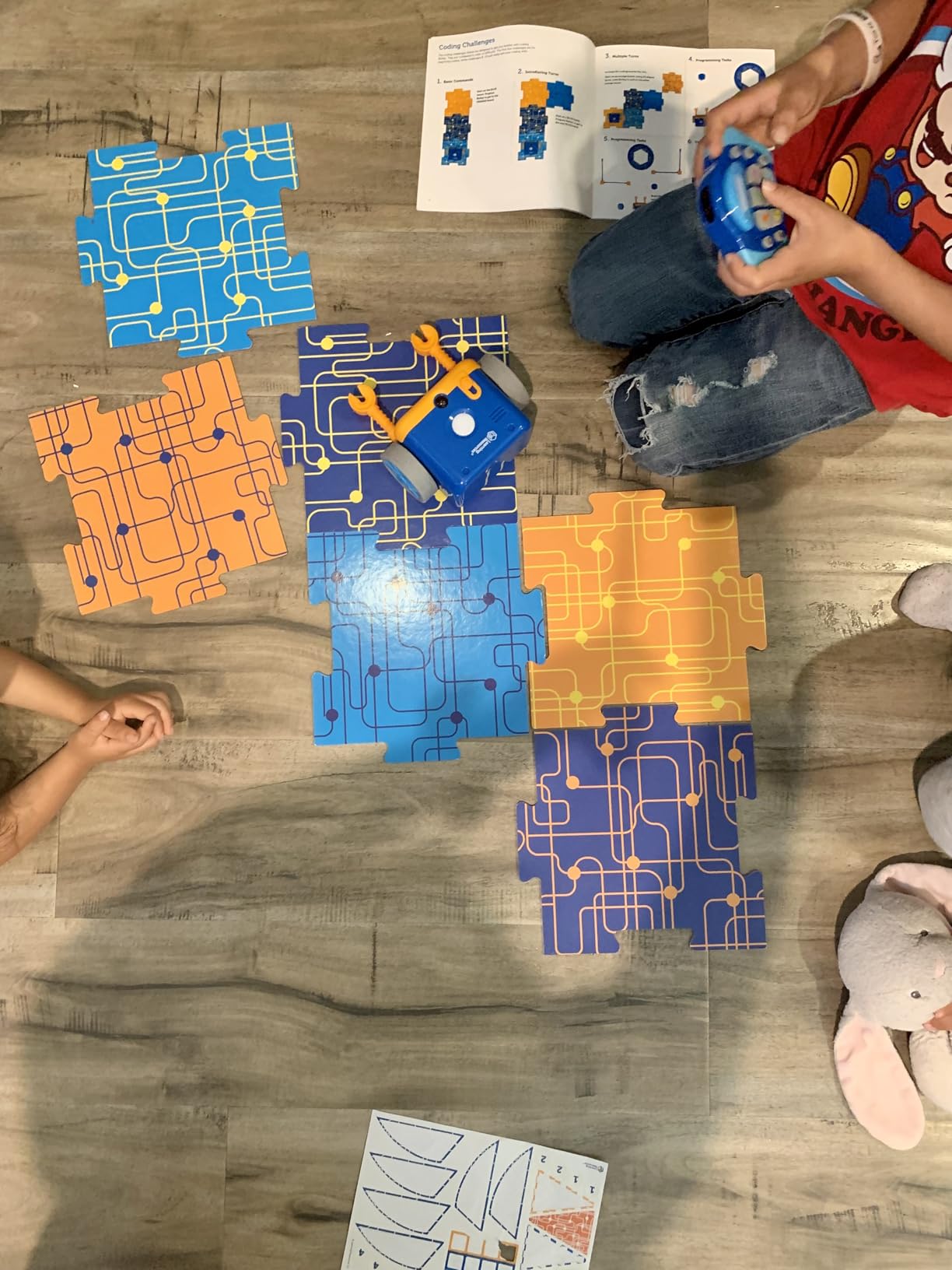
What makes Botley stand out from typical “robot toys” is the progression of skills. Younger kids can simply send the robot forward, while older kids build multi-step sequences, add loops, and use the object-detection feature to program Botley to push a ball or follow a wall. Our testers found that 5-year-olds with no prior coding experience could complete the first activity cards in under 10 minutes, and they kept coming back to harder challenges over a 3-month window.
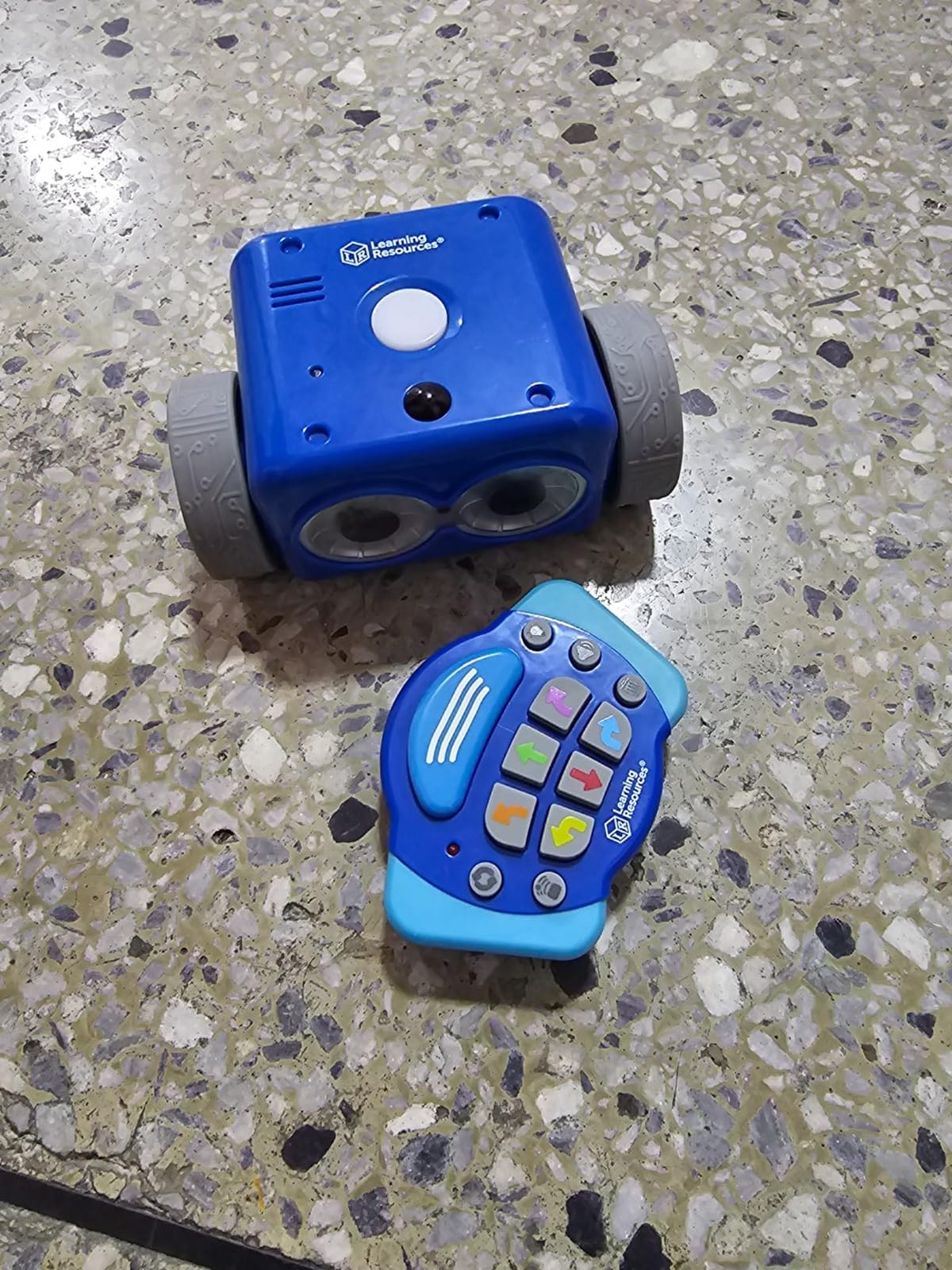
The 78-piece set is generous without being overwhelming. It includes coding cards, activity guides, detachable robot arms, and a variety of obstacle pieces. The build quality is solid – our classroom loaner has survived two years of daily use without a hiccup. Compared to app-based coding toys, Botley keeps kids focused on the logic of programming rather than getting distracted by the screen itself.
The two limitations we hear about most are the strict 90 and 45-degree turn increments, which can frustrate kids who want to round corners, and the need for five AAA batteries. Battery life is decent, but you will want a rechargeable set on hand. Despite these small quirks, this is the single best coding toy for a 5-year-old we have tested this year.
Who Botley 2.0 is best for
Botley 2.0 fits families who want a real introduction to coding without screen time. It is the right pick for a 5-year-old who already shows interest in puzzles, sequencing, or cause-and-effect toys. Parents looking for a sibling-friendly option will appreciate that older kids up to age 10 can use it for more advanced programming challenges, which extends the value significantly.
Who should skip Botley 2.0
If your child loses interest quickly in robots that follow a fixed path, Botley may not hold their attention. Kids who want immediate visual feedback or app-style rewards may prefer a tablet-based coding toy instead. Families who hate replacing batteries should also consider that this set drains them faster than many competitors.
2. PicassoTiles 100 Piece Magnetic Tiles – Best Magnetic Building Set
PicassoTiles 100 Piece Magnetic Tiles, Clear 3D Building Blocks for Kids 3+
- Strong magnets create sturdy structures
- Encourages creativity and spatial awareness
- Compatible with Magna-Tiles and Connetix
- Bright clear tiles are visually engaging
- Hours of focused screen-free play
- Kids quickly want more pieces for bigger builds
- A small number of pieces can crack under rough play
PicassoTiles is the magnetic-tile brand that turned a 5-year-old cousin of one of our editors into a builder. Over 40,000 reviews on Amazon give it staying power, and our team has watched children spend 90 minutes at a stretch building castles, towers, and rocket ships. It hits the sweet spot between the premium price of Magna-Tiles and the weaker magnets of off-brand sets, which is why we picked it as the best value magnetic tile set.
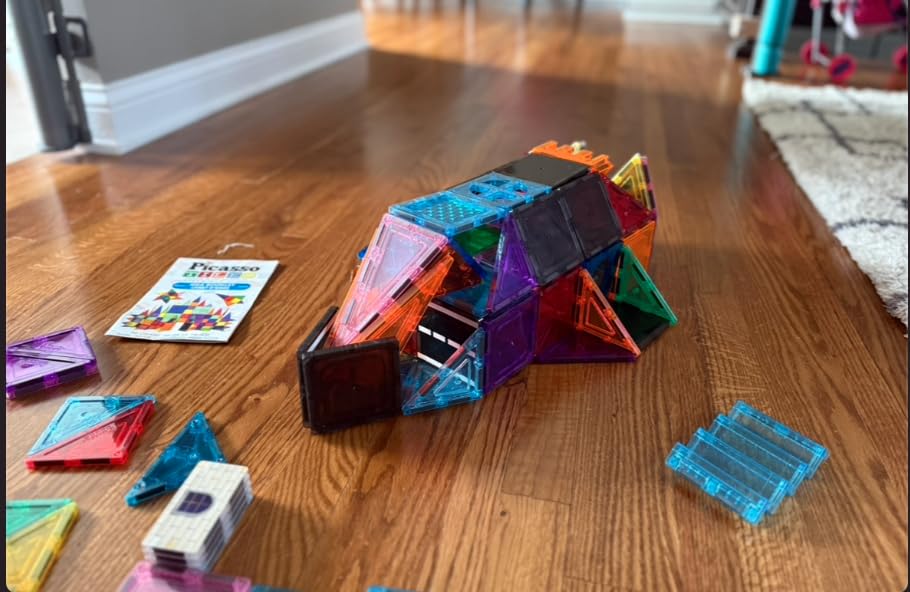
What makes the 100-piece set special is the balance. It includes enough squares, triangles, and specialty shapes to build a wide variety of structures without overwhelming a child. The clear, brightly colored tiles let light pass through, so children see their creations in a different way than opaque blocks. Our testers loved building “windows” they could peek through, which kept them engaged well beyond the typical 20-minute toddler play session.
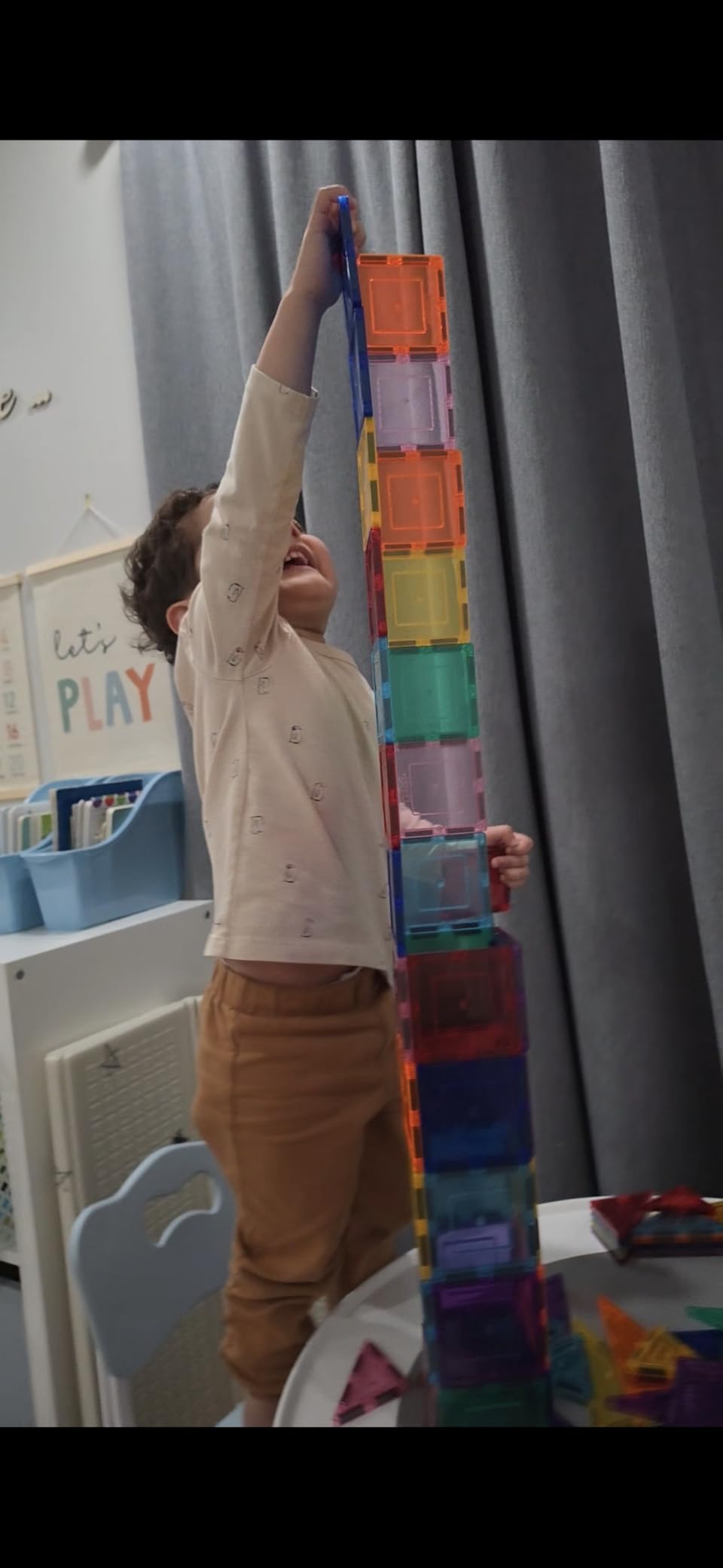
Compatibility is one of the biggest wins. If a friend already owns Magna-Tiles or Connetix, the PicassoTiles pieces snap right onto them. This matters for playdates and classrooms, where mixed sets often combine. The durability is good but not bulletproof – we have seen occasional cracks on corners when tiles get stepped on, which is the main reason parents eventually upgrade to a larger set or a different brand.
The trade-off versus Magna-Tiles is real but smaller than you might think. PicassoTiles magnets are slightly less powerful, which means taller towers sometimes need a steadier hand. For most 5-year-olds, that extra challenge actually helps develop fine motor control. At a fraction of the premium-brand price, this is the smart entry point for a family just starting a magnetic tile collection.
Who PicassoTiles is best for
This set is ideal for families who want magnetic tiles without paying premium-brand prices. It works for solo play, sibling play, and small classrooms. Kids who love bright colors, geometry, and “building something bigger than themselves” will gravitate toward it within minutes.
Who should skip PicassoTiles
If your child already owns a different magnetic tile brand and you only want to expand, double-check the brand compatibility before adding. Kids who frequently drop or throw toys may eventually crack some tiles, so inspect pieces periodically. Families seeking the absolute strongest magnets for very tall builds may want to look at Magna-Tiles or Connetix instead.
3. KEVA Structures 200 Wood Planks – Best Engineering Building Set
KEVA Structures 200 Wood Building Planks Set – Building Toy Includes 200 Wooden Blocks and Idea Book – Ages 5 and Up
- Precision-cut planks stack with surprising stability
- No glue or connectors needed
- Teaches balance leverage and geometry
- Interchangeable with other KEVA plank systems
- Includes 24-page full-color idea booklet
- Planks are thinner than some parents expect
- Kids often want a second set for bigger projects
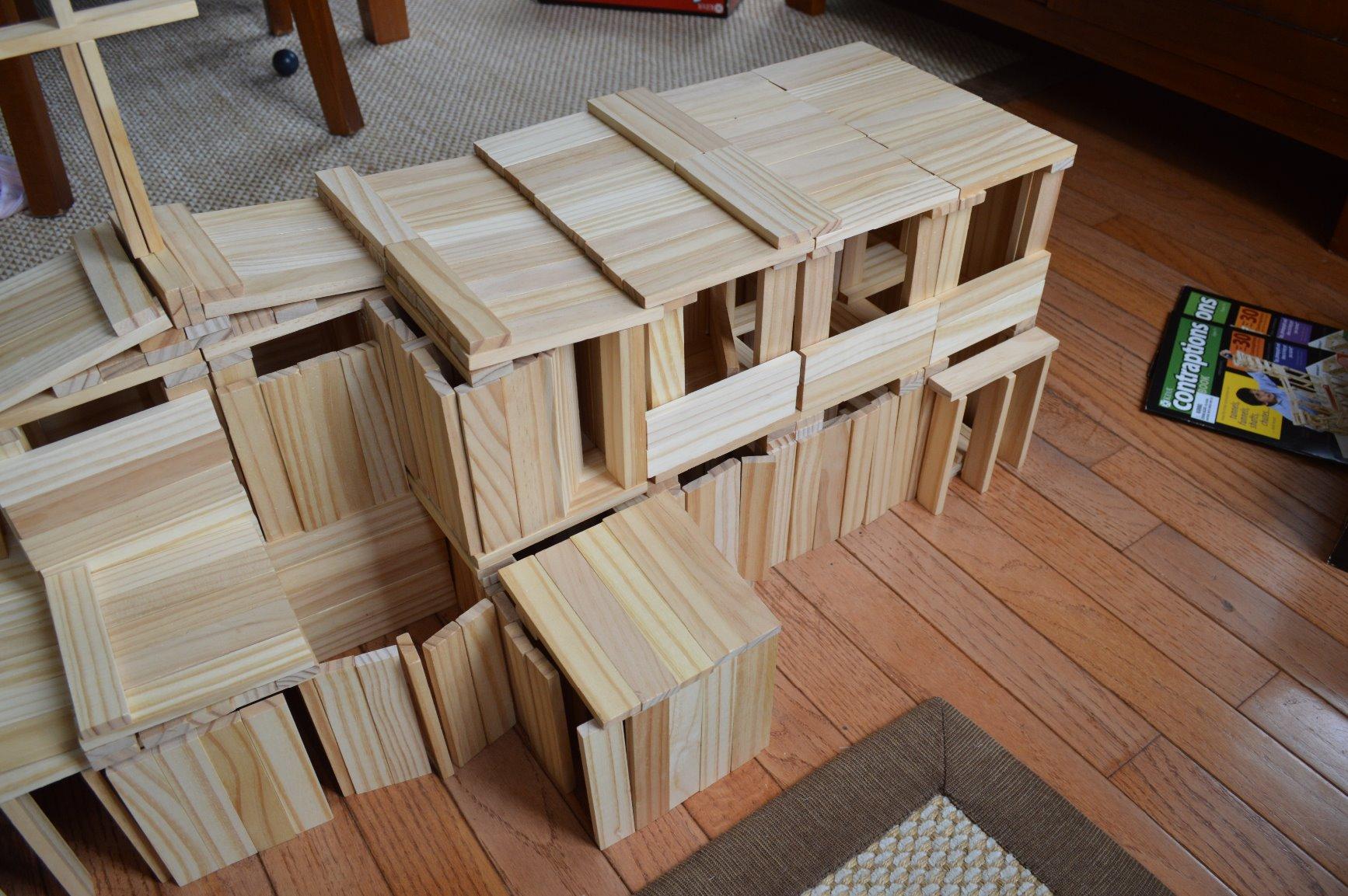
KEVA planks are the closest thing to a “pure engineering” toy on this list. There are no magnets, no snaps, no batteries. Just 200 identical pine planks and gravity. We watched a 5-year-old build a cantilevered bridge that held a coffee mug, then watched him knock it over and rebuild it bigger. That cycle of design, test, fail, and rebuild is what makes KEVA one of the most-played-with toys in our test homes.
The genius of the design is the constraint. With identical pieces, kids learn that small changes in stacking technique produce huge changes in stability. Our testers found that 5-year-olds naturally discover concepts like cantilever, keystone, and counterbalance just by playing. The included idea booklet is a great starting point but rarely needed after the first hour – kids quickly invent their own structures.
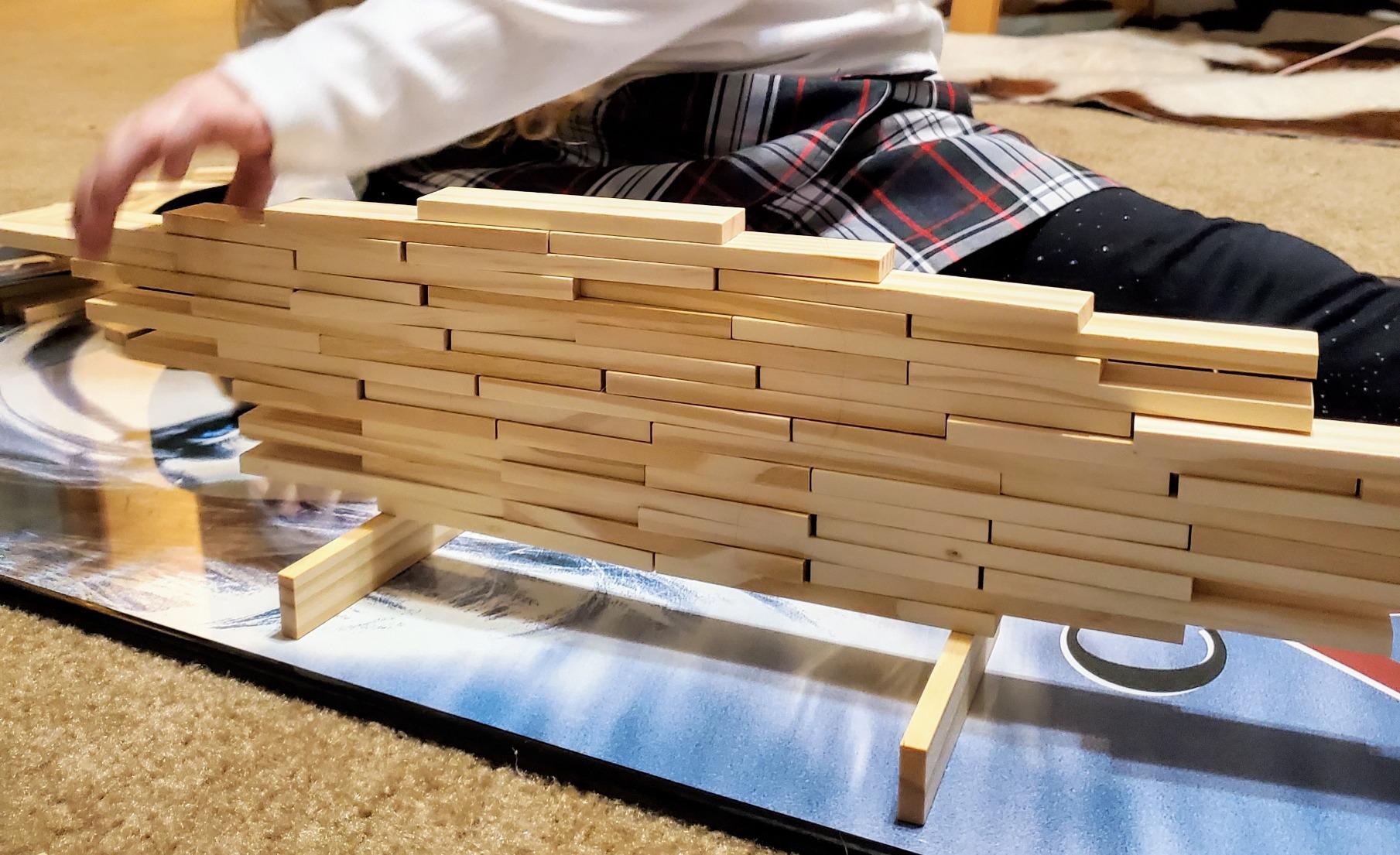
For parents worried about durability, KEVA planks are solid pine and hold up to years of play. Several of our testers have owned sets for 5+ years and they still stack perfectly. The planks are interchangeable with other KEVA and Kapla sets, so a second set expands possibilities without waste. Cleanup is the only real drawback – 200 loose planks scatter easily, so a storage bin is highly recommended.
Compared to plastic building sets, KEVA teaches structural engineering in a way that feels more like play than learning. Kids do not realize they are exploring load-bearing principles because they are too busy trying to build the tallest tower they can. If you want a screen-free, gender-neutral toy that lasts through age 10 and beyond, this is our premium pick.
Who KEVA Structures is best for
KEVA is ideal for families who value quiet, focused, screen-free play. It works well for solo creators who enjoy figuring things out on their own, and it scales into sibling and parent-child collaboration on bigger builds. Classrooms and homeschool co-ops have used KEVA planks for decades because the educational value is unmatched for the price.
Who should skip KEVA Structures
If your child prefers colorful, character-driven toys or anything with electronics, KEVA may feel too plain. Kids who get frustrated when structures fall over will need extra patience. Families with very limited storage space should plan ahead – 200 loose planks need a dedicated bin or container.
4. Learning Resources Gears Deluxe Building Set – Best for Mechanical Engineering
- 100 pieces offer extensive building variety
- Colorful gears capture attention instantly
- Builds STEM engineering and fine motor skills
- No batteries required
- Compatible with other Gears Gears Gears sets
- Only one crank handle limits simultaneous play
- Younger kids may struggle to snap pieces together
- A second set is often needed for bigger builds
If you have ever watched a child turn a crank and see gears spin, you already understand the appeal of this set. Gears Deluxe is the rare STEM toy that teaches real mechanical principles while keeping kids in pure play mode. With over 4,500 reviews and a 4.8 average rating, it is also one of the most popular STEM sets Learning Resources has ever made.
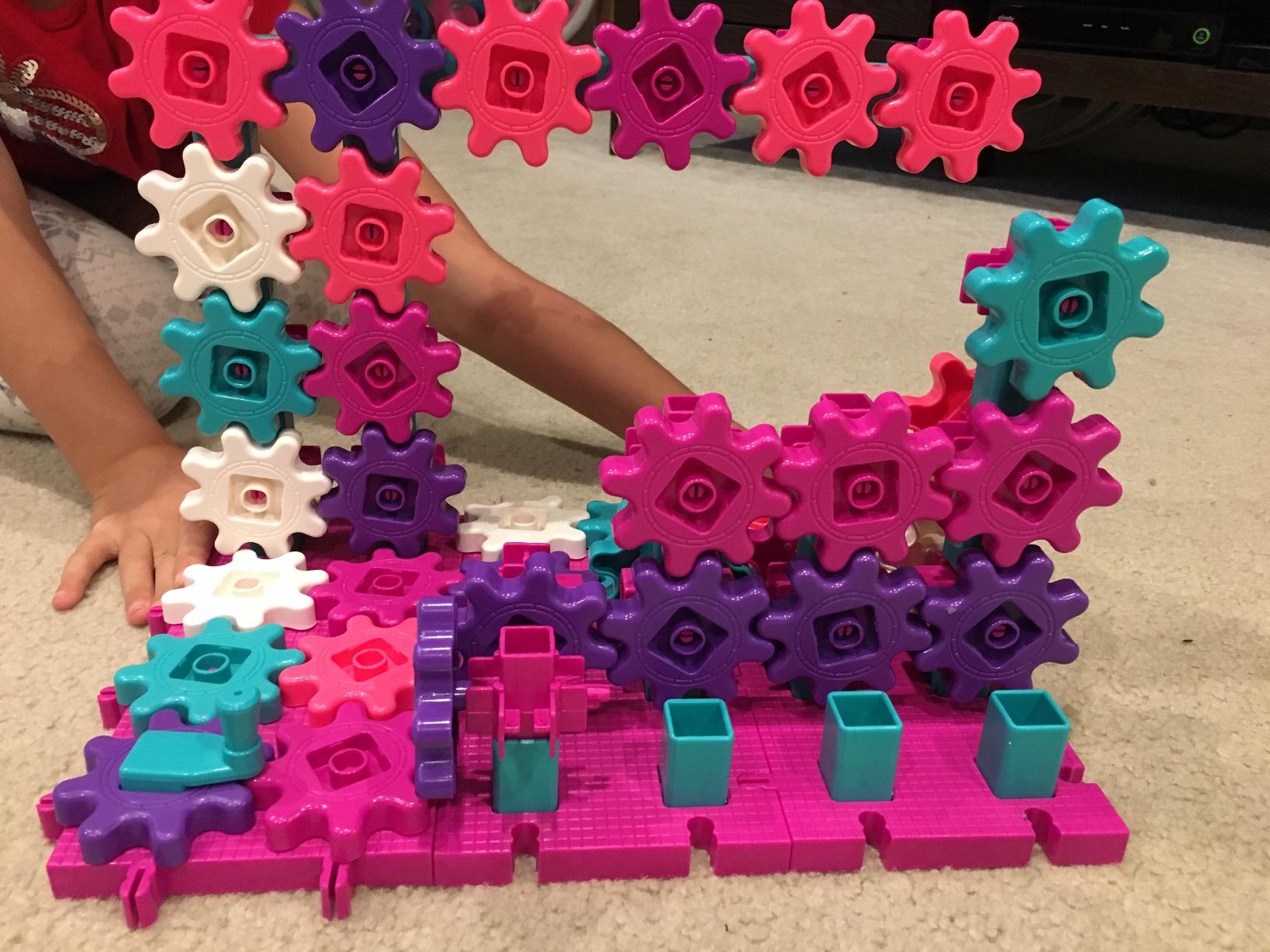
The 100-piece set includes colorful gears, square pillars, six-way axles, interlocking bases, and one crank handle. Kids build contraptions that move, spin, and transfer power across distances. Our testers watched a 5-year-old design a fan that spun from a separate gear box, then light up when the connection worked. That kind of “aha” moment is what STEM toys are designed to create.
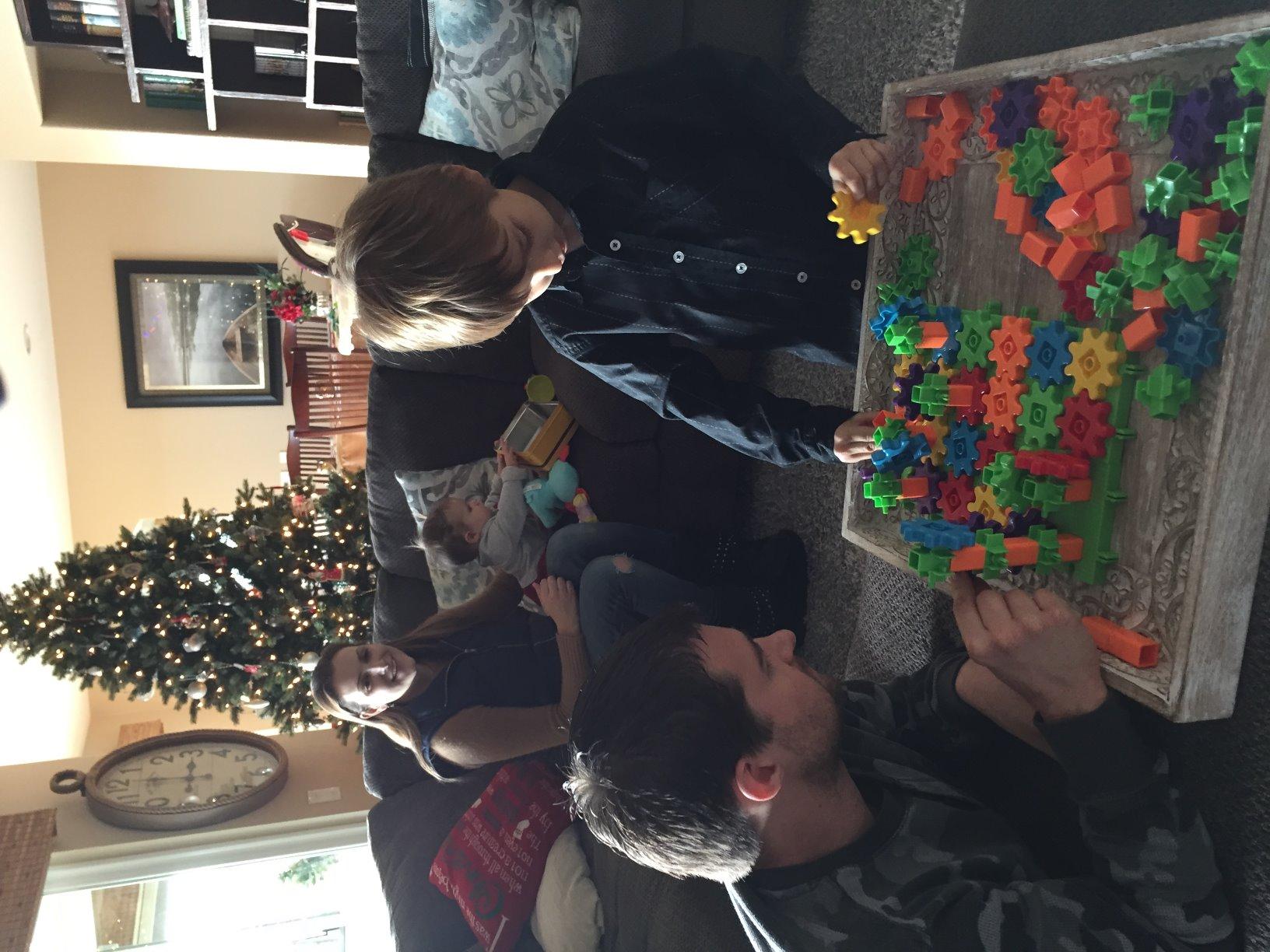
No batteries, no apps, no setup – just snap and crank. The pieces are sturdy and the colors are vibrant, which helps younger kids sort and assemble visually. The set is compatible with other Gears! Gears! Gears! sets from Learning Resources, so families can expand into motorized or light-up versions later without replacing what they already own.
The main limitation is the single crank handle. With multiple kids playing, you will likely see arguments about whose turn it is to turn the crank. Most parents solve this by buying a second set or a single replacement crank. Some younger kids also find snapping pieces together harder than they expected – this is a good sign that fine motor skills are being challenged.
Who the Gears Deluxe Set is best for
This set fits families who want a battery-free mechanical engineering toy that grows over time. It is ideal for the child who loves Rube Goldberg machines, fans, or anything that spins. Homeschooling families use it for units on simple machines, and it works equally well for solo play or small groups.
Who should skip the Gears Deluxe Set
If your child prefers structured building with clear “build this exact thing” instructions, this open-ended set may feel frustrating. Kids who lose interest in mechanical toys may find the setup phase tedious. Families needing a quiet toy may want to set this one aside – the gear-spinning action is satisfying but not silent.
5. Snap Circuits Beginner Electronics Kit – Best Intro to Electronics
SNAP CIRCUITS Beginner SCB-20 STEM Electronics Toy for Kids Ages 5-9
- Child-friendly pieces that snap together safely
- Introduces real circuitry concepts hands-on
- Includes 21 projects of progressive difficulty
- Award-winning kit with strong educational backing
- Includes a color-changing fan for visual results
- Batteries drain quickly with motorized projects
- Manual focuses on building steps more than explaining the science
Snap Circuits is the toy that introduced more 5-year-olds to the word “circuit” than any other. The Beginner kit (SCB-20) starts with simple projects that snap together in minutes, then progresses to fans, alarms, and sound effects that actually work. Over 3,500 reviews and a 4.7 rating back this up as one of the most trusted STEM electronics kits for early elementary kids.
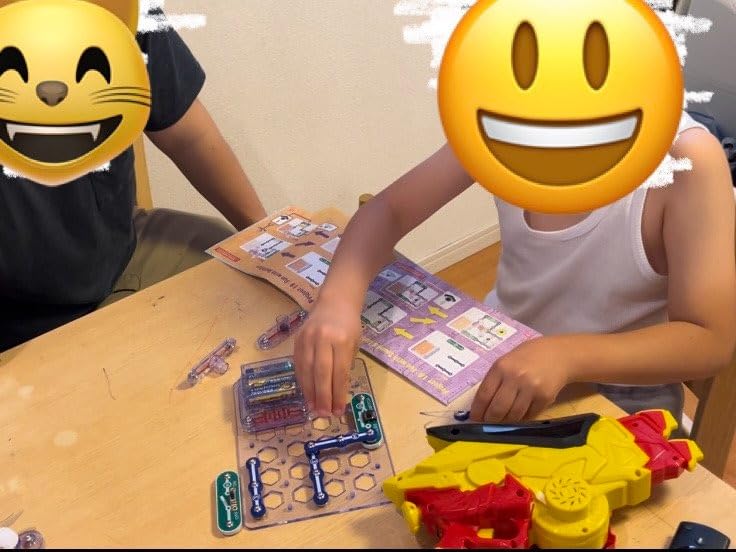
What makes Snap Circuits special is the real electronics experience. Kids are not just pressing buttons – they are building actual circuits with switches, resistors, and motors. Our testers watched a 5-year-old complete her first project (a working fan) in 8 minutes, then immediately want to try the next one. The illustrated manual is clear enough that most kids can work independently after a single adult walkthrough.
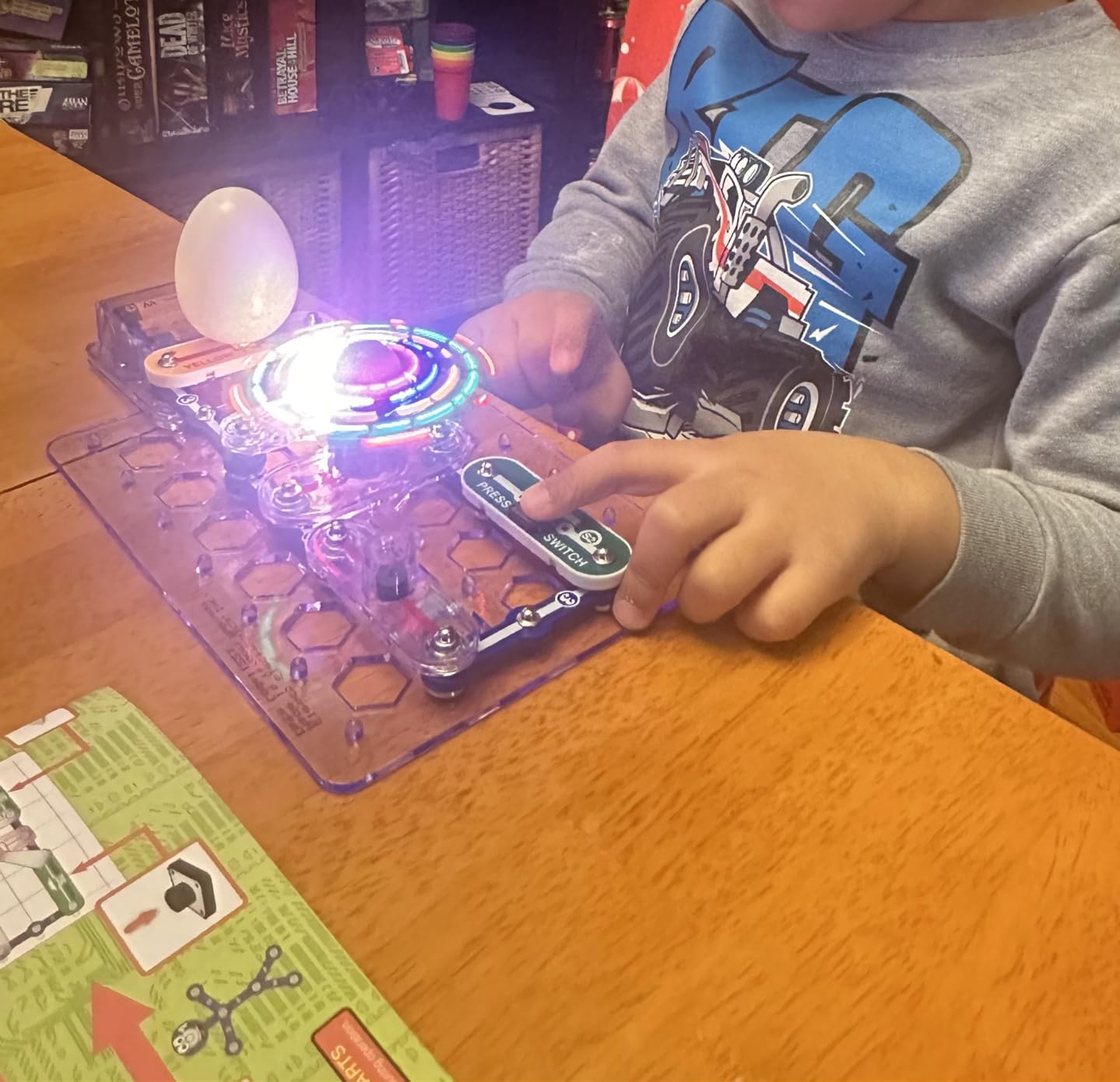
The kit includes a snap-together base board and labeled modules that click into place, eliminating any soldering or wiring. The pieces feel substantial in small hands and the colors help kids match components to instructions. The included color-changing fan is the crowd favorite – every kid in our test group wanted to make it spin before anything else.
Battery drain is the most common complaint. The motorized projects eat through AA batteries quickly, so plan on rechargeable batteries from day one. The manual does not explain the science behind each circuit in depth, so kids learn “how” more than “why.” For deeper explanations, parents may need to supplement with a quick online search.
Who Snap Circuits Beginner is best for
Snap Circuits fits families who want a real intro to electronics without screen time. It works well for the curious 5-year-old who asks “why does this work?” and is ready to follow illustrated instructions. Classrooms and homeschool co-ops have used the Snap Circuits line for years because of its scalability – the Beginner kit feeds directly into Junior, Standard, and Extreme kits as the child progresses.
Who should skip Snap Circuits Beginner
If your child struggles with following multi-step instructions, the Beginner kit can feel overwhelming even with clear diagrams. Kids who prefer open-ended building may not enjoy the project-based format. Families unwilling to buy rechargeable batteries may want a different kit to start with.
6. National Geographic Junior Chemistry Set – Best Science Kit
National Geographic Junior Chemistry Set with 50 Experiments for Kids
- 50 hands-on experiments included
- Easy-to-follow illustrated instructions
- Comes with 20+ child-safe lab tools including goggles
- Uses common household items like baking soda and vinegar
- Sturdy durable tools for repeated play
- Nitrile gloves not included but recommended for younger kids
- Food coloring can stain hands and surfaces
- Some experiments are challenging for the younger end of the age range
If your 5-year-old has ever mixed baking soda and vinegar in the kitchen sink and watched the fizz with delight, this kit is the natural next step. National Geographic’s Junior Chemistry Set includes 50 experiments, real lab tools, and an illustrated manual written for early readers. Our testers gave it to a curious kindergartener and watched her run three before lunch.
The kit stands out because it feels like a “real” chemistry set, not a watered-down kids’ version. It includes test tubes, beakers, a measuring spoon, droppers, and safety goggles. Kids learn measurement, observation, and basic chemistry vocabulary while having fun with classic reactions. The instruction manual is colorful, well-illustrated, and easy enough for most 5-year-olds to follow with adult support.
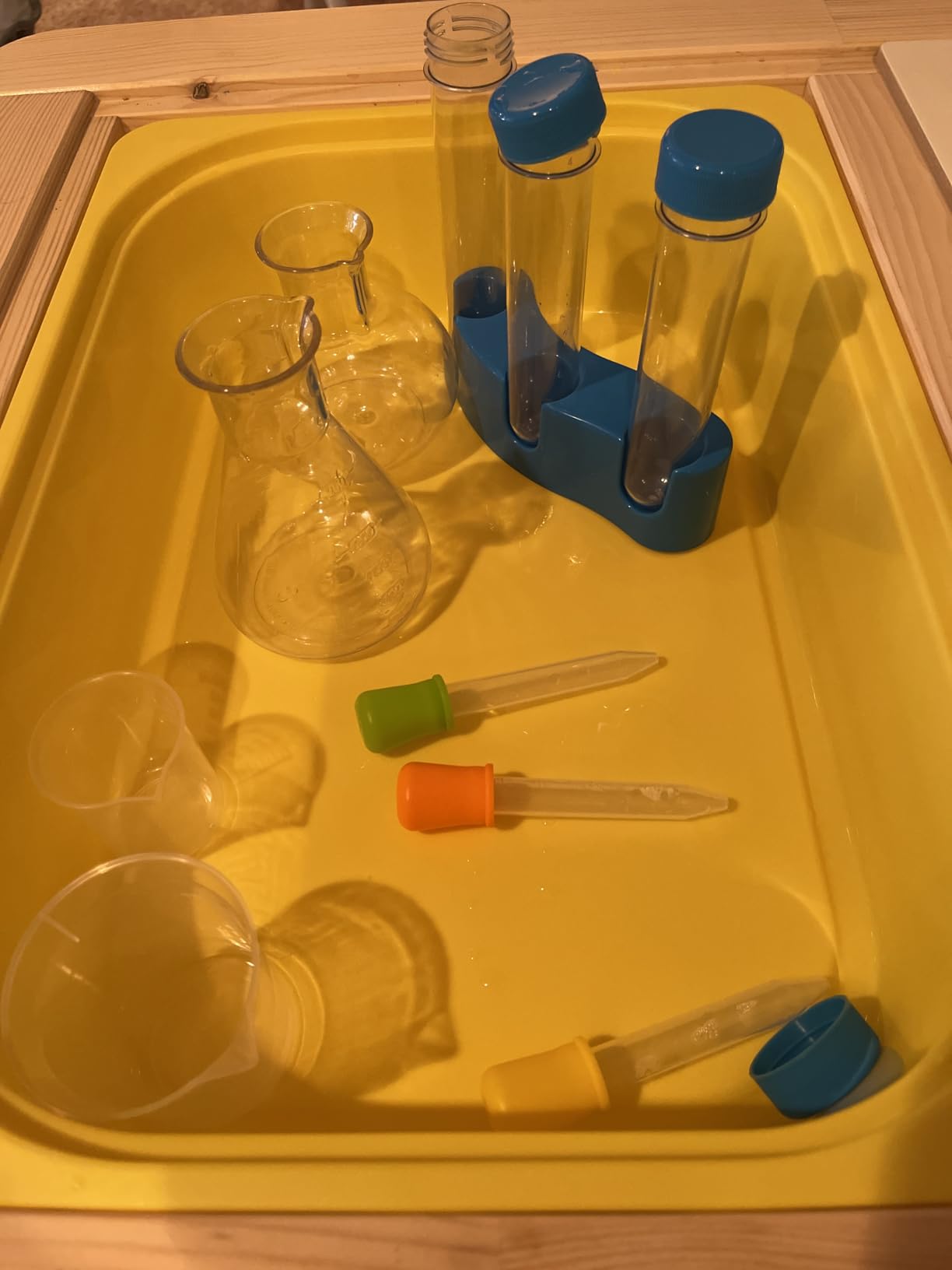
Many experiments use household items like baking soda and vinegar, which means you do not need to constantly restock specialized supplies. The included lab tools are sturdy enough to survive the most enthusiastic junior chemists. The brand reputation matters here – National Geographic kits are widely used in classrooms and have solid safety standards.
The two cautions we have are worth mentioning. First, food coloring and similar materials can stain hands, clothing, and countertops, so cover surfaces and wear old clothes. Second, nitrile gloves are not included but are recommended for messier experiments. Buy a small box of kid-size gloves and stash them with the kit.

Who this Chemistry Set is best for
This kit is ideal for the curious 5-year-old who likes asking “what happens if I mix these?” It works well for families who want hands-on science at home without committing to a full lab setup. Gift-giving is also a strong fit – it feels substantial, branded, and ready to use straight out of the box.
Who should skip this Chemistry Set
If your child has sensitive skin or sensory issues with sticky or messy experiments, a phone may be a better starting point. Kids who dislike wearing safety goggles may resist parts of the kit. Parents who do not want stain risk on furniture should consider doing experiments outdoors or in a designated “mess zone.”
7. Educational Insights GeoSafari Talking Microscope – Best for Biology Exploration
- Features the voice of Bindi Irwin for engaging narration
- Includes 60 full-color images on 20 slides
- Two play modes Fact Mode and Quiz Mode
- Sturdy and appropriately sized for young children
- Spark curiosity across biology geology and astronomy topics
- Requires 3 AAA batteries which are not included
- Slide orientation flat vs grooved is hard to distinguish by feel
- No focus function for clearer viewing
The GeoSafari Talking Microscope is the rare science toy that combines visual exploration with audio narration. With over 11,000 reviews, it is a long-standing favorite among parents and teachers of preschoolers. Our testers loved that it requires zero reading – kids place a slide, press a button, and hear Bindi Irwin explain what they are looking at.
The microscope comes with 20 prepared slides featuring 60 full-color images covering plants, insects, animals, rocks, and human body parts. Two play modes – Fact Mode and Quiz Mode – keep the experience fresh and add a memory challenge. Our 5-year-old testers spent 30+ minutes exploring on the first sitting, then asked to play again the next day.
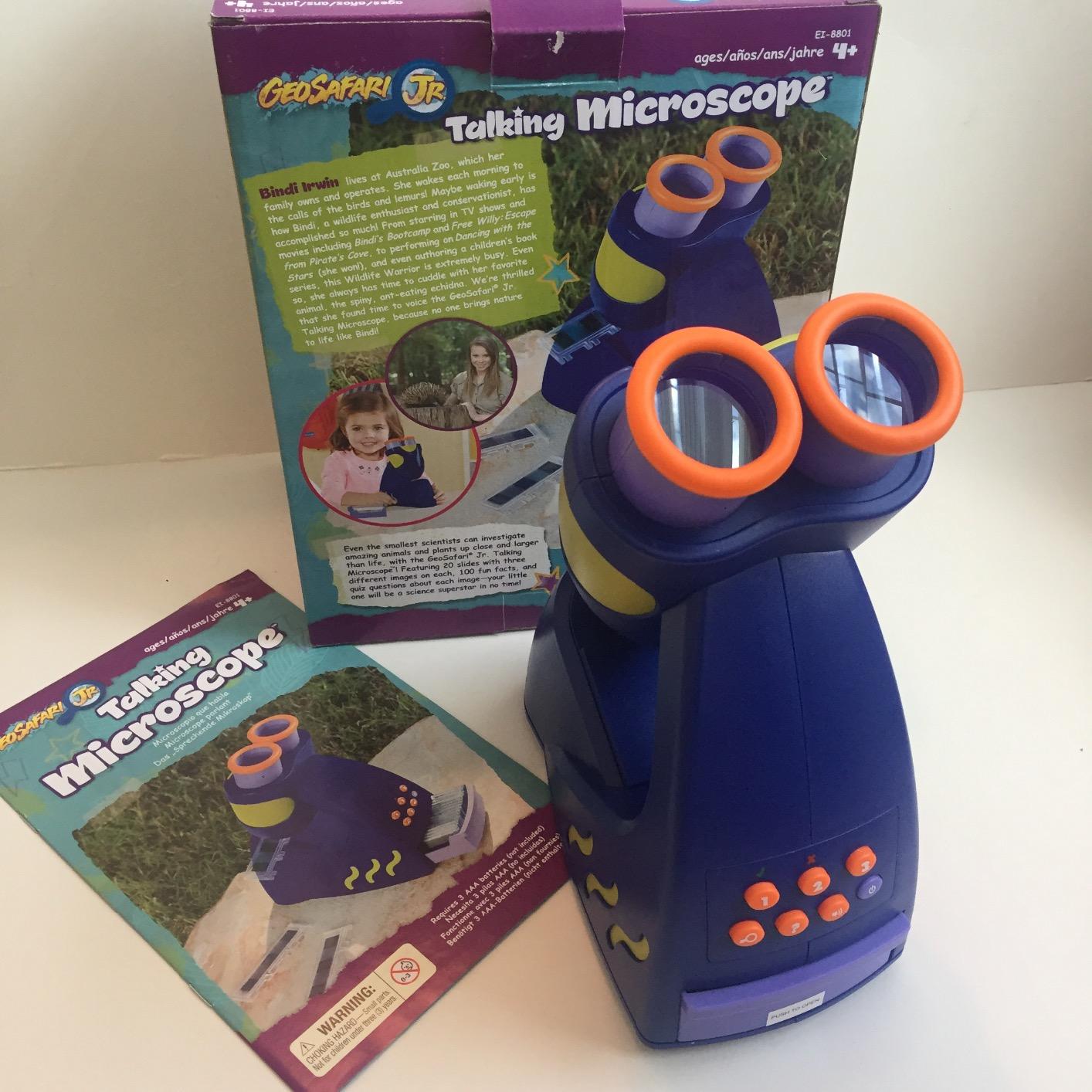
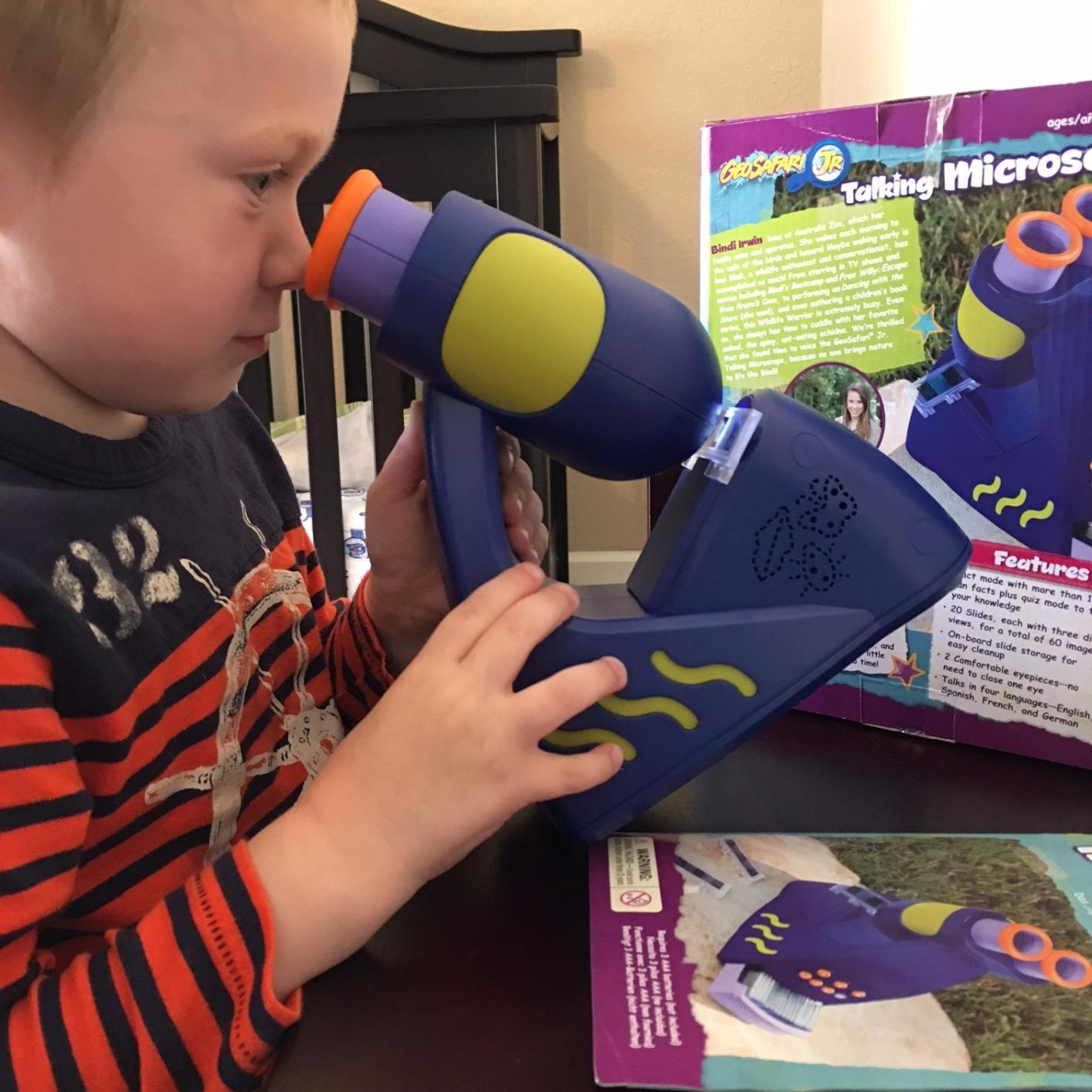
Slide storage is built into the unit, which solves one of the most common microscope frustrations. The chunky buttons and sturdy build make it ideal for small hands, and the bright colors invite exploration. The audio quality is clear and the narration is short enough that kids do not lose interest while a slide is on the stage.
The two main limitations are slide orientation and battery type. The slides have a flat side and a grooved side, and kids often struggle to tell which way is up. The unit also runs on 3 AAA batteries, which are not included. There is no traditional focus knob, so magnification is fixed – this is a “starter” microscope, not a real lab tool.
Who the Talking Microscope is best for
This microscope fits families who want a child-friendly intro to biology without the complexity of real lab equipment. It is ideal for the 5-year-old who collects rocks, bugs, or leaves and asks questions about nature. It also works well in classrooms, especially for younger kids who cannot yet read but are curious about the world.
Who should skip the Talking Microscope
If your child wants to examine real-world objects under magnification, this preset-slide microscope will not deliver. Kids interested in true lab equipment should move up to a real beginner microscope. Families averse to batteries may want a different option that runs on rechargeable power.
8. STEM Explorers Brainometry 3D Puzzle Set – Best Brain Teaser Puzzle
- Encourages critical thinking and pattern matching
- 10 double-sided challenge cards grow with the child
- Screen-free entertainment suitable for travel
- Sturdy lightweight blocks and durable coated cards
- Includes portable storage box to keep pieces organized
- Limited number of challenge cards for the price
- Some buyers expected more pieces or variety
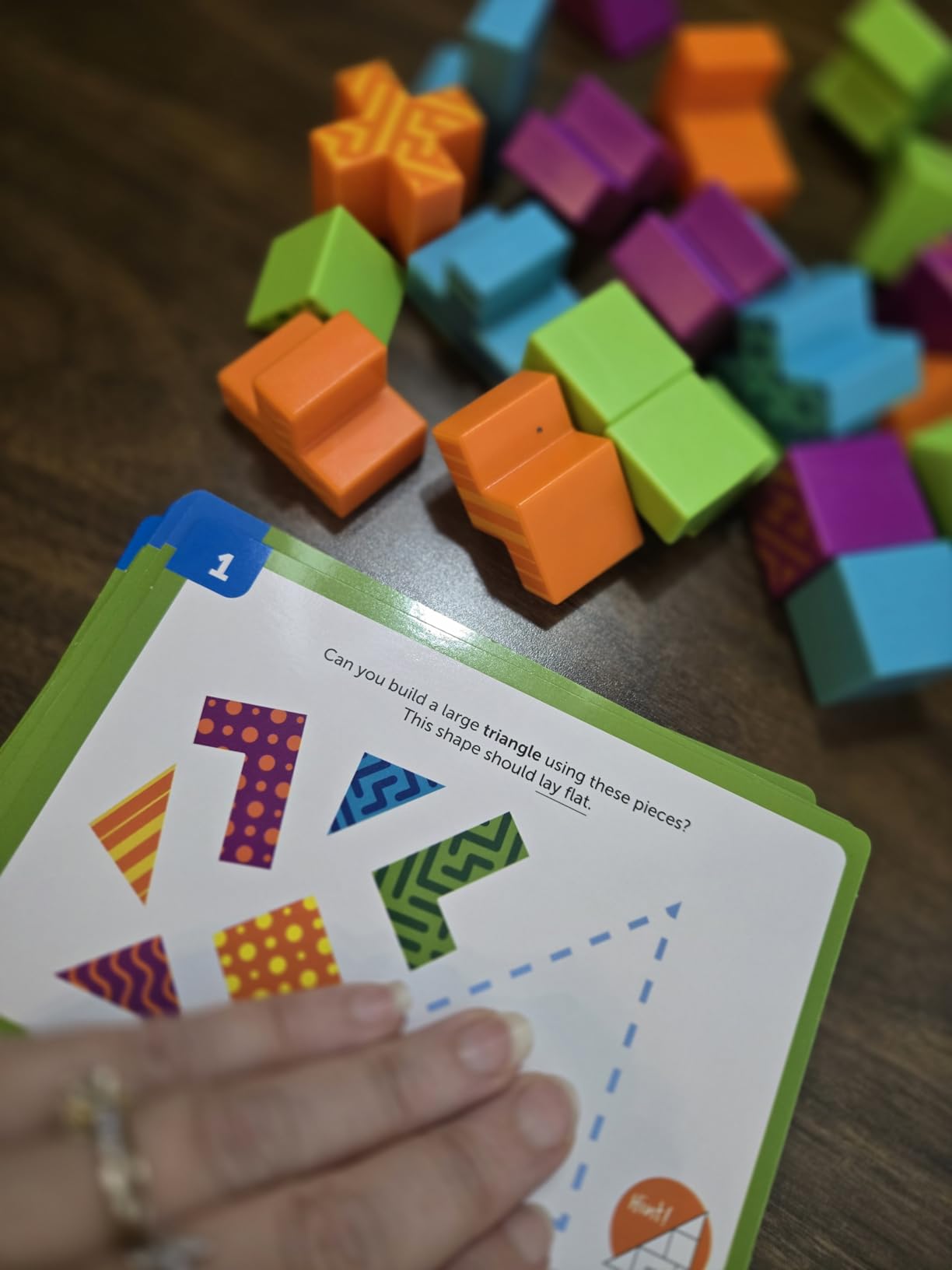
Brainometry is the smallest, most portable STEM toy on this list, and it punches well above its weight. With 34 colorful blocks and 10 double-sided challenge cards, it fits in a backpack and travels anywhere. Our testers gave it to a 5-year-old on a long car ride, and it kept him occupied for over an hour – rare praise from a parent in the back seat.
The puzzles start simple and grow in difficulty. Younger kids can match the challenge card by color, while older kids solve increasingly complex 3D patterns. The skills developed are real – pattern recognition, spatial reasoning, and logical thinking. Many teachers use Brainometry sets as part of math centers for this exact reason.
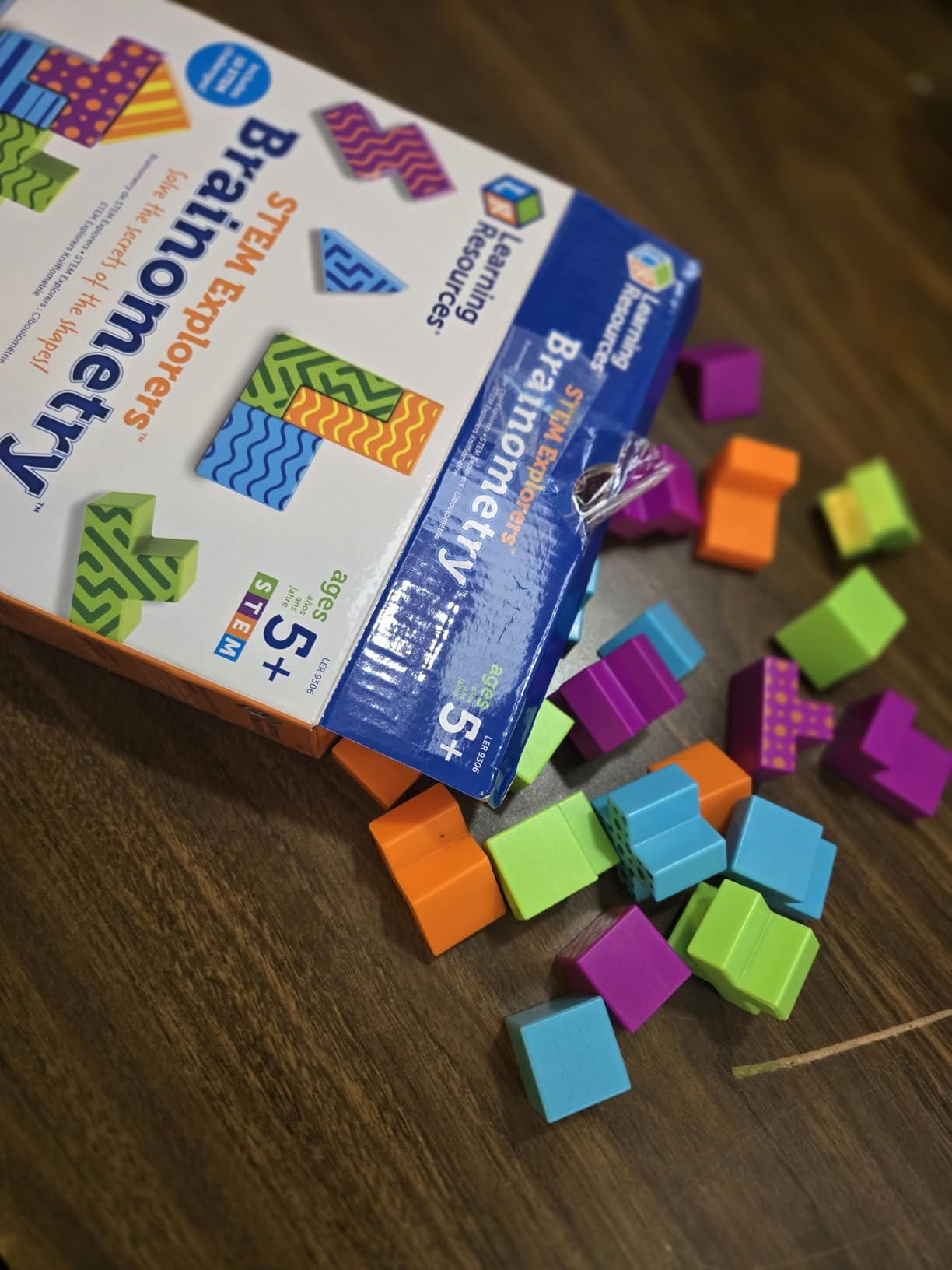
The portable storage box is a small touch that parents love. Pieces stay organized even after the toy has been tossed in a diaper bag for a week. The blocks are sturdy and the challenge cards are coated to resist spills and fingerprints. At under 5 ounces, it is genuinely travel-friendly.
The price-per-piece ratio is high compared to bulkier sets. With only 34 blocks and 10 cards, some parents feel they want more for the money. The challenge cards do eventually become familiar, so kids who play daily may need to invent their own puzzles or expand with a second set.
Who Brainometry is best for
This set fits families who need a quiet, compact STEM toy for restaurants, road trips, and waiting rooms. It works well for kids who love puzzles and pattern games. It is also a great classroom or waiting-room addition for teachers, therapists, and tutors.
Who should skip Brainometry
If your child needs large-scale building or active play, this set will feel too quiet and small. Kids who lose interest quickly in puzzles may run through the cards in a few sittings. Families seeking long-term replay value may want to combine this with a larger STEM set.
9. Code & Go Robot Mouse Activity Set – Best Beginner Coding Maze
- Screen-free introduction to coding concepts
- Progressive activity cards build skills gradually
- Mouse stops at cheese for satisfying feedback
- Includes maze grids walls tunnels and coding cards
- Suitable for individual play or classroom centers
- Mouse does not always execute turns precisely
- Requires 3 AAA batteries which are not included
- Memory must be manually cleared before reprogramming
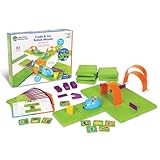
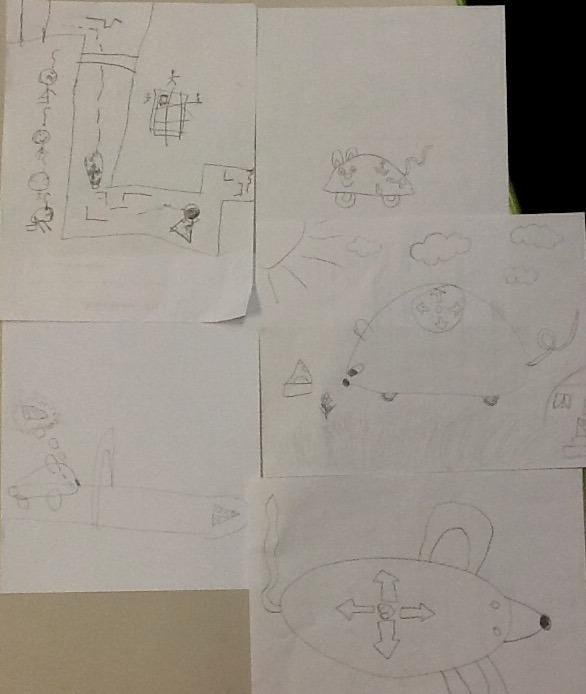
Code & Go Robot Mouse is the smaller, simpler cousin of Botley 2.0 – and a great choice if you want a coding toy at a lower entry point. The mouse, named Colby, follows a sequence of steps programmed on top of his back to navigate through a maze of grids and walls toward a cheese wedge. It is one of the most popular STEM toys for kindergarten classrooms, with over 2,600 reviews and a 4.5 rating.
What we love about this set is the immediate feedback. Kids lay out a maze, program the mouse, and watch it move step-by-step. When the mouse reaches the cheese, kids cheer – and when it goes off course, they immediately want to debug their program. That iterative loop is the heart of real coding, and Colby delivers it without a single screen.
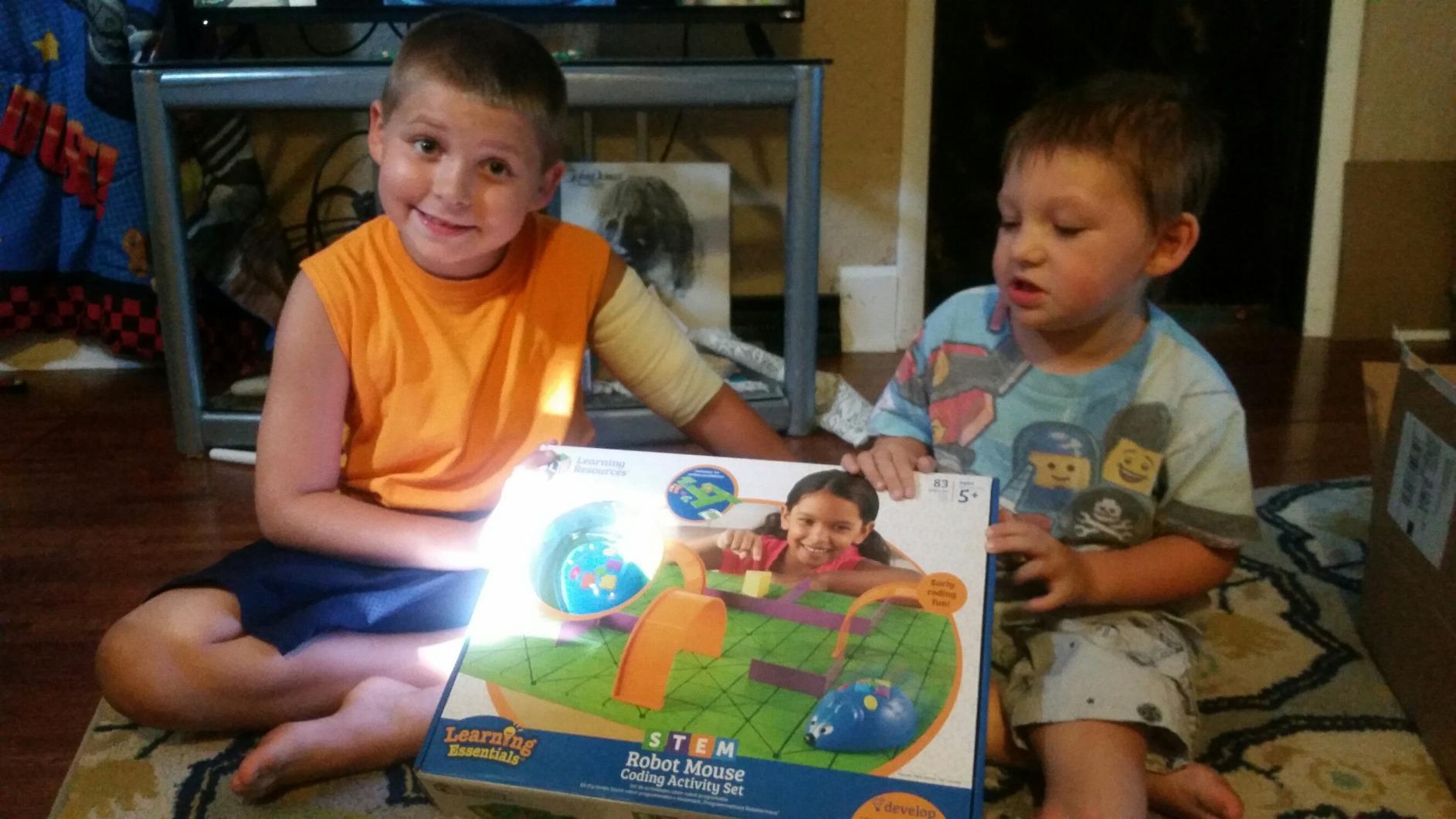
The 30 double-sided coding cards provide progressive challenges, so kids can start with simple 4-step programs and work up to longer sequences. The set includes 16 maze grids, 22 maze walls, 3 tunnels, and an activity guide. Pieces are sturdy and well-sized for small hands, and the mouse is durable enough for repeated classroom use.
Turn precision is the most common complaint. The mouse does not always execute exact 90-degree turns, so kids need to learn how to account for slight drift. The mouse’s memory also has to be manually cleared between programs, which adds a small step. These are minor inconveniences given the educational value.
Who Code and Go is best for
This set fits families who want a beginner-friendly coding toy with an adorable, low-stakes theme. It works well for kindergarten readiness, classroom centers, and homeschool units on sequencing. Kids who love mice, cheese, or animal-themed toys tend to engage with this set quickly.
Who should skip Code and Go
Children over age 8 may find the mouse too simple. If your child wants more advanced coding features, Botley 2.0 is the better upgrade. Families unwilling to handle batteries should consider a different option, since this set requires 3 AAA batteries.
10. PicassoTiles Marble Run Magnetic Tiles – Best Marble Run Set
PicassoTiles 100 Piece Marble Run Magnetic Tiles Race Track STEM Ages 3+
- Combines magnetic tiles with marble run for STEM-rich play
- Compatible with other PicassoTiles sets and Magna-Tiles
- BPA-free non-toxic CPC certified materials
- Includes 5 steel marbles and an inspiration booklet
- Supports hand-eye coordination and spatial reasoning
- Clear tube pieces are fragile and can break
- Difficult for preschool kids to assemble independently
- Some included designs require more than one set
- Track piece magnets are weaker than tile piece magnets
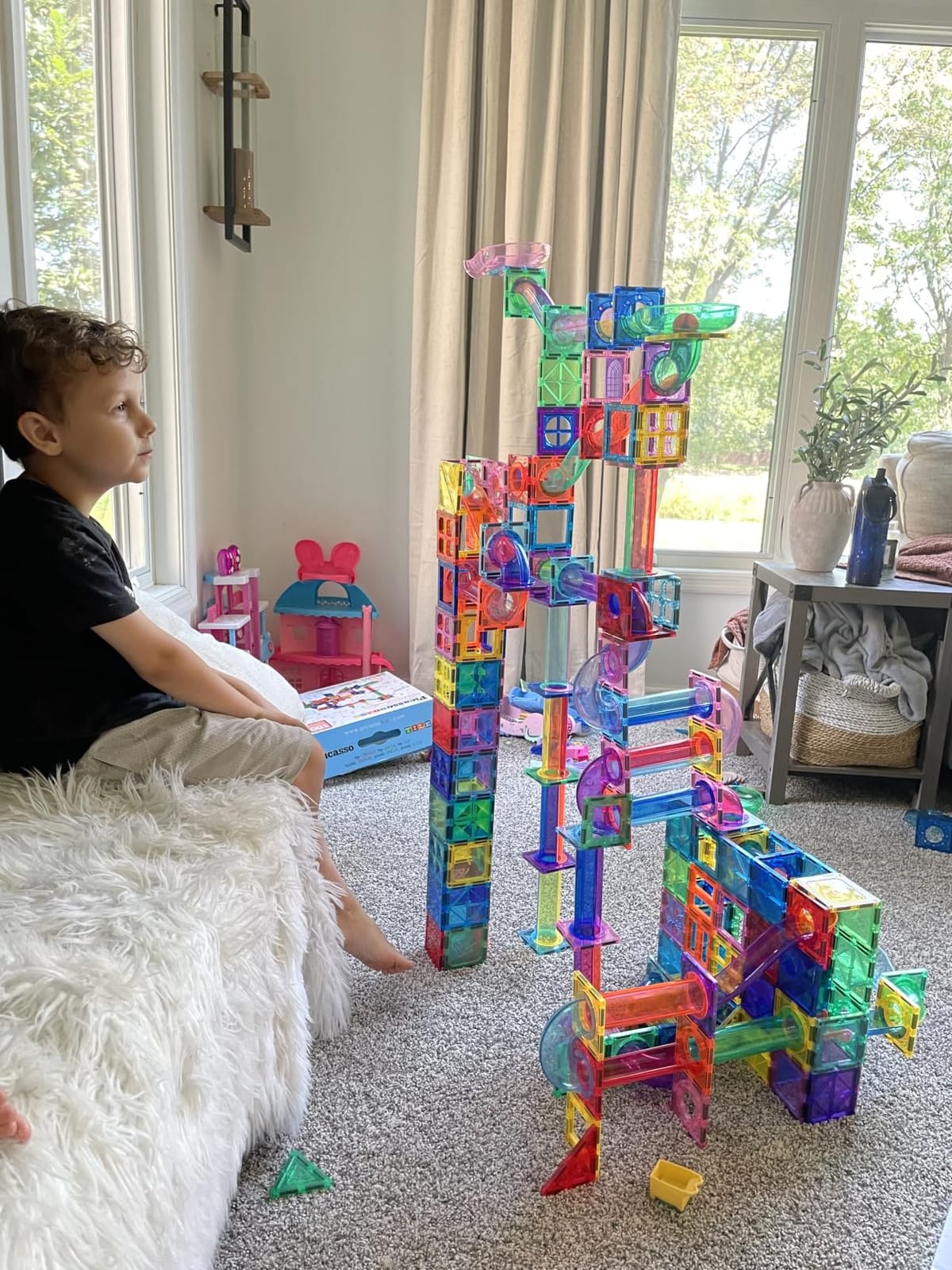
If you want to combine magnetic tile building with marble run physics, this set is the best of both worlds. The 100 pieces include magnetic tiles plus clear tubes, ramps, and curves that turn any flat surface into a marble playground. Over 3,800 reviews make it one of the most popular marble run sets on Amazon.
Kids love watching the marbles drop, swirl, and roll through their custom-built courses. The combination of magnetic building and physics observation keeps them engaged far longer than either toy would alone. Parents report 60-90 minutes of focused play per session once kids figure out the basics.
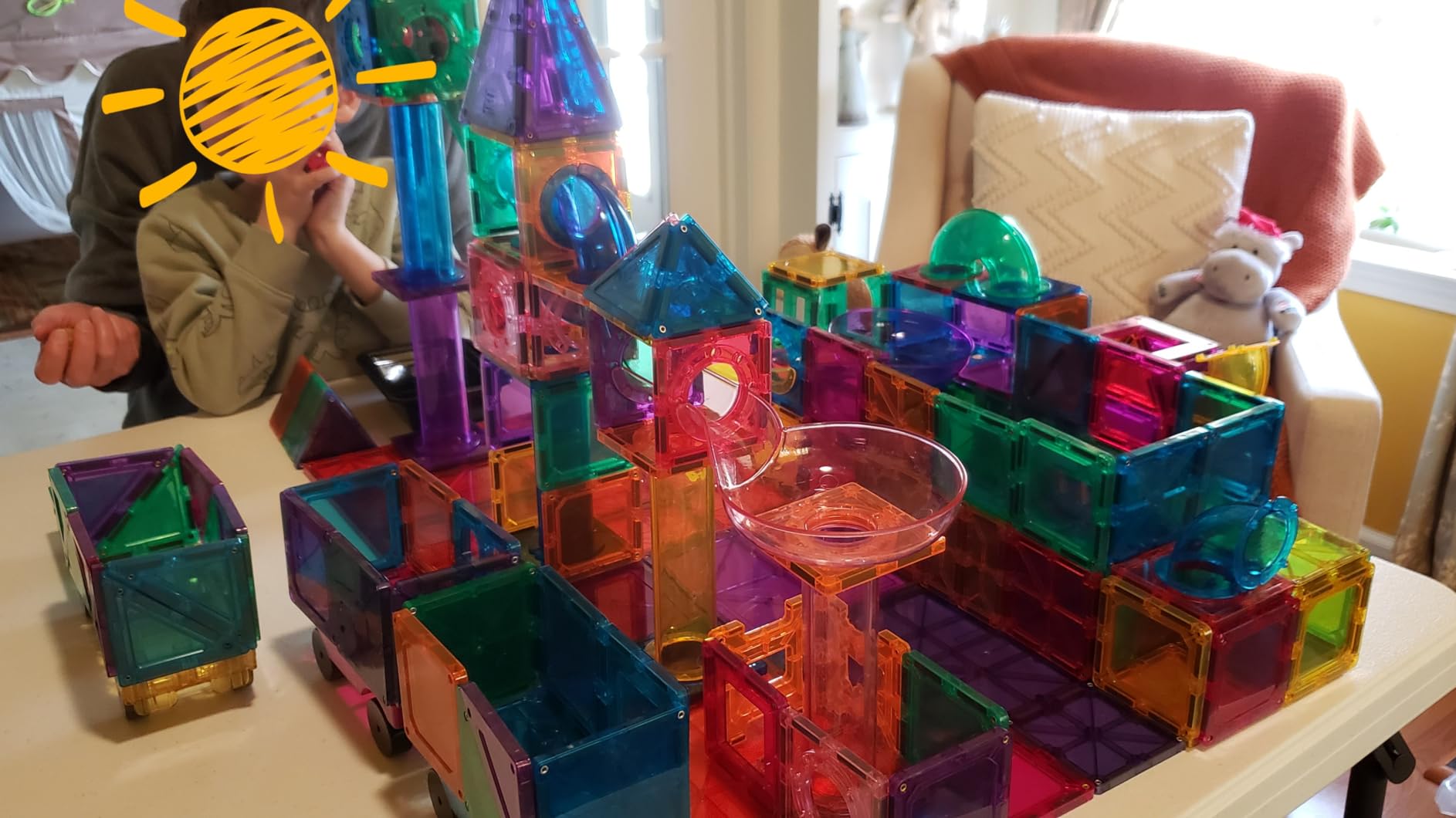
The set is compatible with other PicassoTiles sets and Magna-Tiles, so you can expand your collection without compatibility headaches. The pieces are BPA-free and CPC certified, which matters for parents concerned about plastic safety. The included inspiration booklet gives kids a starting point, but most 5-year-olds quickly invent their own track designs.
The clear tube pieces are the most fragile part of the set. They can crack under rough assembly or if stepped on, so careful handling matters. Younger kids often need help assembling track sections at first – this is a great parent-child project for the first few sessions. Some of the included designs require a second set to complete the full structure.
Who this Marble Run is best for
This set fits families who already love magnetic tiles and want to add motion and physics to the play. It works well for kids who like watching cause-and-effect in action. Classrooms and homeschool co-ops use it for units on gravity, momentum, and engineering design.
Who should skip this Marble Run
If you do not yet own magnetic tiles, start with the standard PicassoTiles set or Magna-Tiles before adding the marble run pieces. Kids who are very rough with toys may break the clear tube sections. Families who need a quiet toy should know that marble runs make a noticeable noise as marbles drop.
11. Jasonwell 100pcs Magnetic Tiles – Best Budget Magnetic Tiles
- Includes a rotatable Ferris Wheel piece for pretend play
- Larger and stronger magnets than many competitors
- BPA-free lead-free non-toxic materials
- Compatible with other magnetic tile brands of similar size
- Includes an idea booklet for inspiration
- Propeller accessory is not very sturdy
- No storage bag included
- Guide book can have blurry images and text
- Magnetic hold is weaker than premium brands like Magna-Tiles
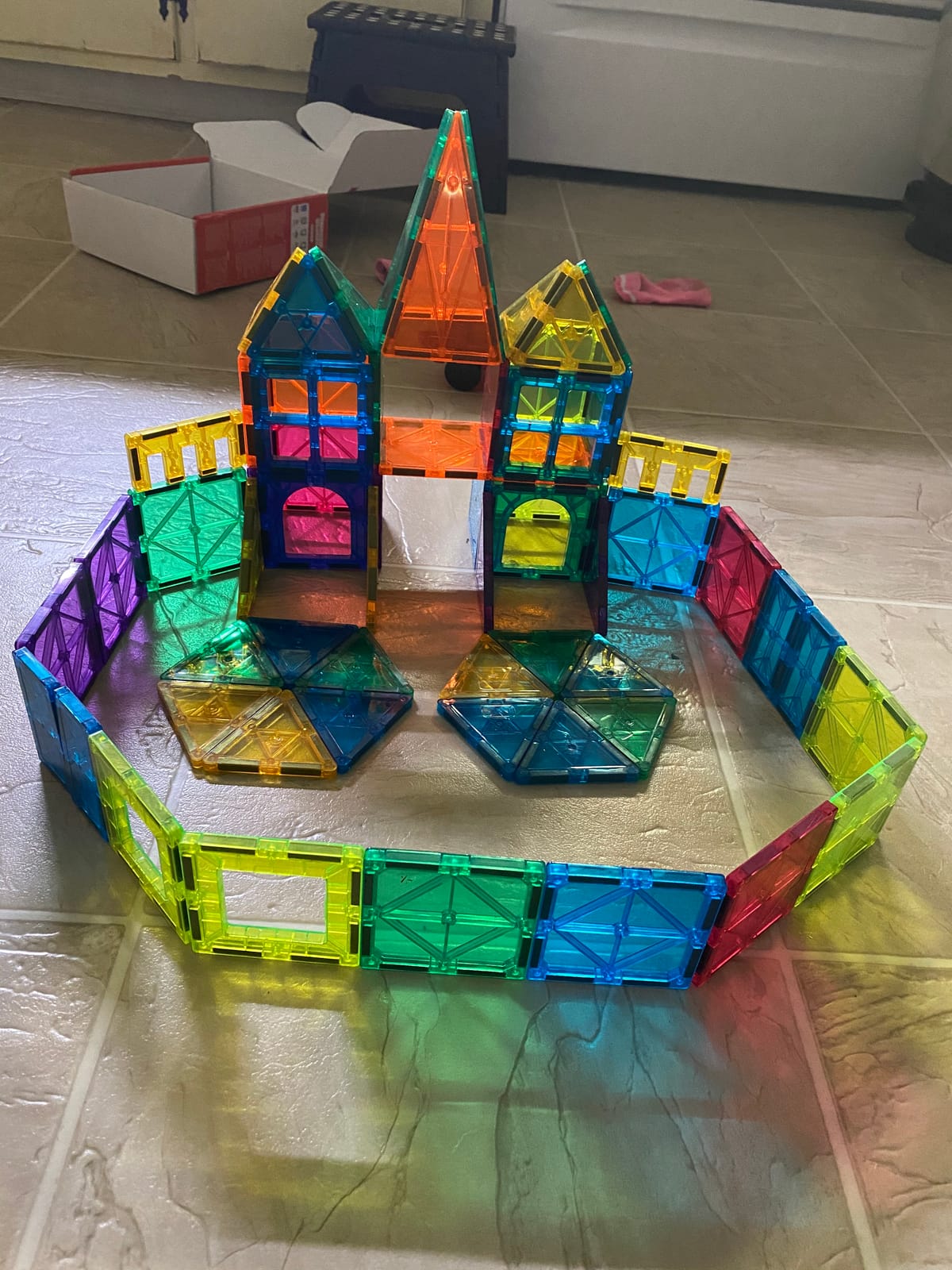
Jasonwell proves you do not need to spend a fortune to get a great magnetic tile set. With over 9,700 reviews and a 4.8 rating, it is one of the most loved budget magnetic tile brands on the market. Our testers were surprised at how strong the magnets feel compared to other affordable sets they have tried.
The 100-piece set includes squares, triangles, and specialty shapes, plus a rotatable Ferris Wheel accessory that adds pretend play to building. Kids can build the Ferris Wheel and spin it, which adds a delightful mechanical element that most magnetic tile sets do not include. Our 5-year-old testers loved combining the Ferris Wheel with their custom-built structures.
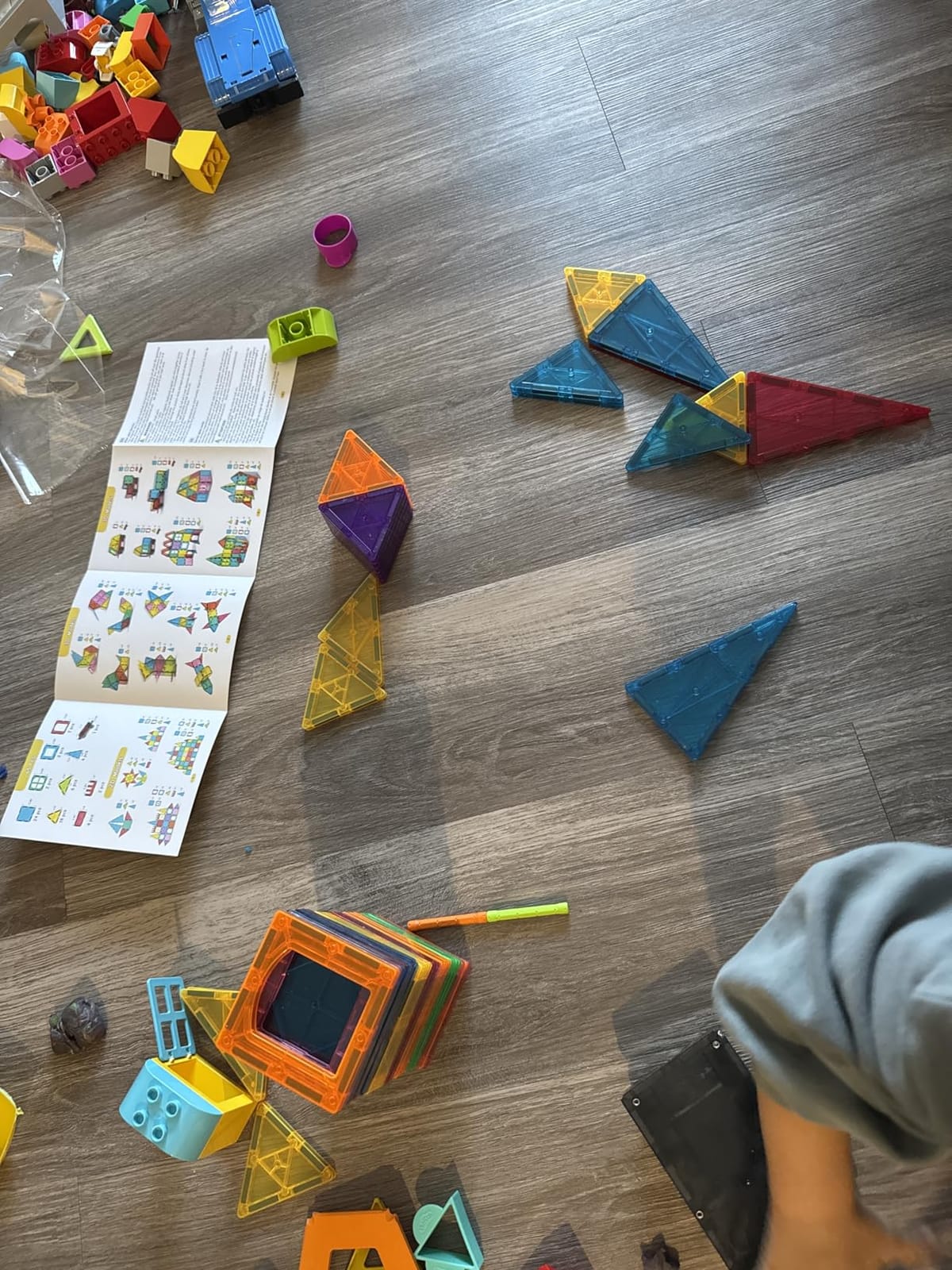
The set is BPA-free, lead-free, and non-toxic, which meets the same safety standards as premium brands. It is also compatible with other magnetic tile brands of similar size, so you can mix it with PicassoTiles, Magna-Tiles, or Connetix pieces without compatibility issues. The idea booklet provides inspiration for first-time builders.
The trade-offs versus premium brands are honest. The magnets are slightly weaker than Magna-Tiles, which means very tall towers require a steady hand. The propeller accessory is not as sturdy as the rest of the set, so kids tend to use it gently. There is no storage bag included, so plan on buying a bin or container separately.
Who Jasonwell is best for
This set fits families on a budget who still want a quality magnetic tile experience. It is a great starter set for a 5-year-old who has never played with magnetic tiles before. The Ferris Wheel accessory adds a layer of pretend play that other sets lack, which makes it a hit with kids who love imaginative scenarios.
Who should skip Jasonwell
If you already own a premium magnetic tile brand, this set is more of an expansion than an upgrade. Kids who need very strong magnetic holds for tall builds may find it limiting. Families needing a storage solution in the box should plan to buy a separate bin.
12. PicassoTiles Hedgehog 120pc Interlocking Set – Best Multi-Skill Set
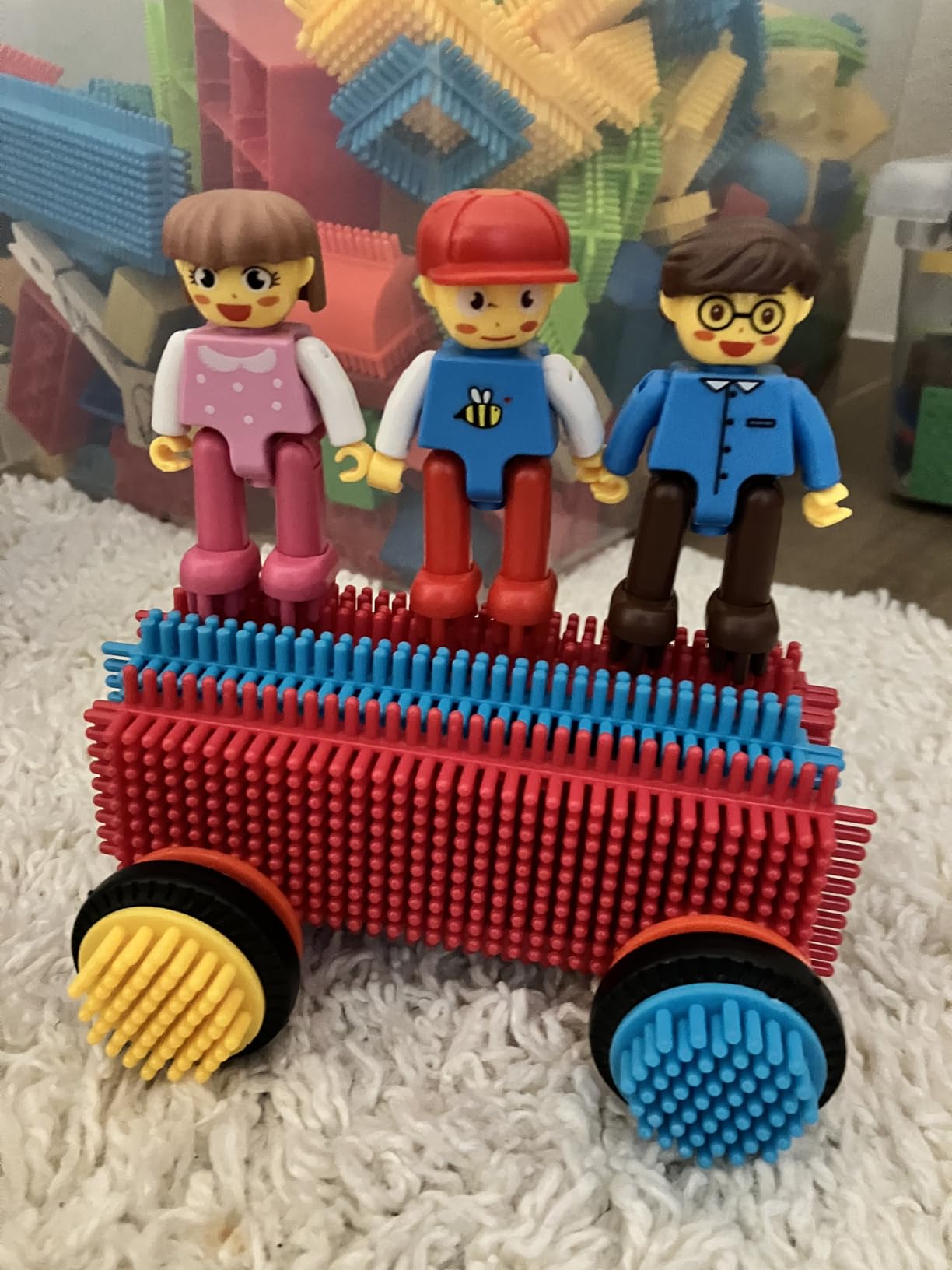
PicassoTiles 120pcs Hedgehog Interlocking Building Blocks Tiles Construction Toy Set Learning Playset STEAM Development Preschool Kindergarten Toy for Kids Age3+ PTB120
- Easy-connect and easy-disconnect bristle blocks reduce frustration
- Builds hand-eye coordination and color/shape recognition
- Can create more than 20 designs from 120 pieces
- Safe non-toxic lead-free materials
- Encourages both solo and group creative play
- Scales with additional PicassoTiles sets
- Small pieces can break with rough handling
- Some users report missing pieces on arrival
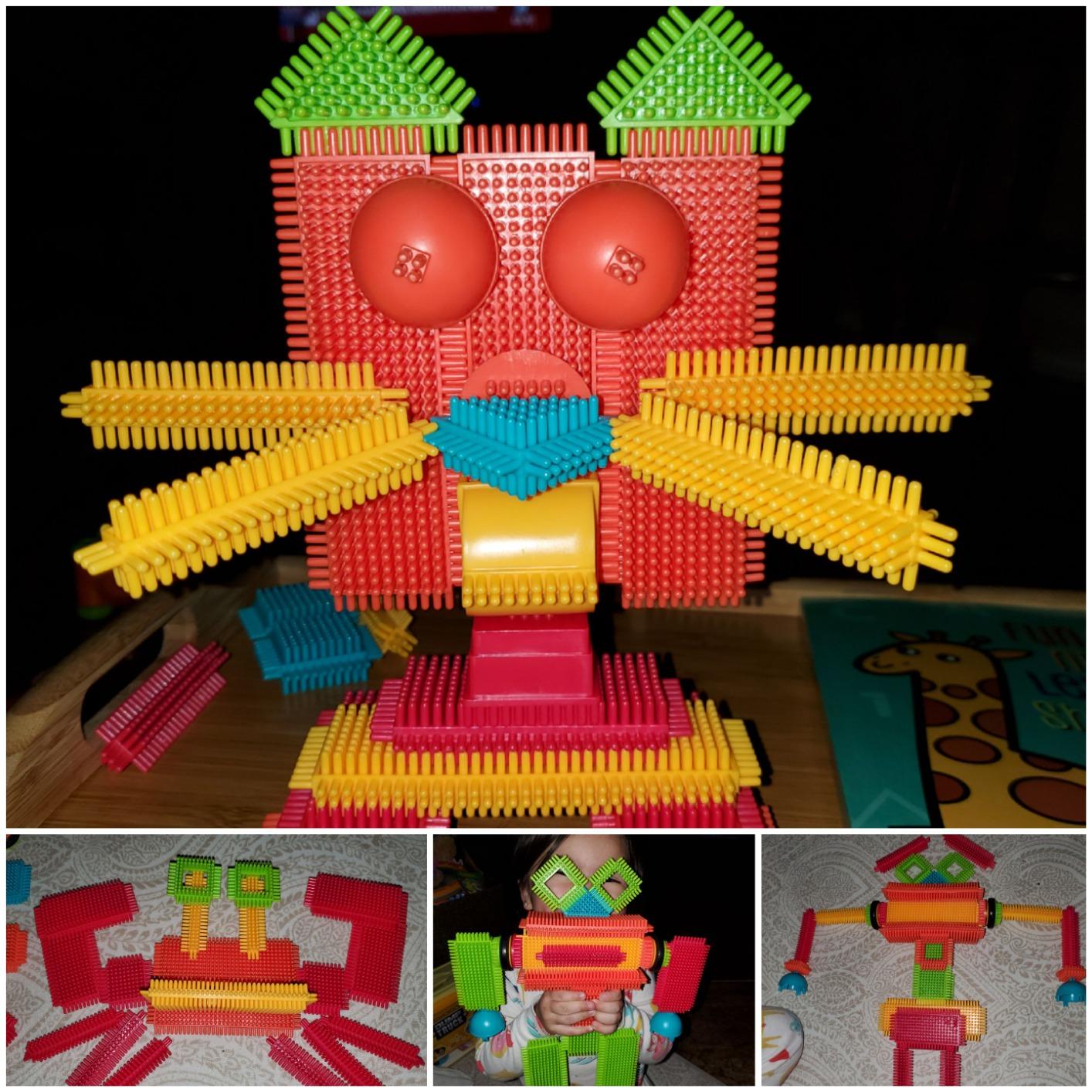
PicassoTiles Hedgehog set is the closest thing to “Lego for younger hands” on this list. The 120 hedgehog-shaped pieces use a bristle-and-hole connection that snaps together and pulls apart easily, even for 5-year-olds who struggle with traditional Lego friction. With over 8,000 reviews and a 4.7 rating, it is one of the most popular creative building sets for early elementary.
Kids can build more than 20 designs from the 120 pieces, including balls, towers, animals, and abstract sculptures. The shapes snap together from any angle, which encourages experimentation without frustration. Our testers watched a 5-year-old build a complete hedgehog, then disassemble it into a ball, then into a tower – all within 20 minutes.
The pieces are safe, non-toxic, and lead-free, meeting standards for kids age 3 and up. They also scale with other PicassoTiles sets, so families can add magnetic tiles or marble run pieces later. Solo play works well, but the set really shines when siblings or classmates join in.
The pieces are not indestructible. Rough handling can crack the small bristle connectors, especially on thinner pieces. A small number of buyers report missing pieces on arrival, so count pieces shortly after delivery. Both issues are covered by the brand’s customer service, but worth knowing upfront.
Who the Hedgehog Set is best for
This set fits families who want a versatile creative toy that combines building with pretend play. It works well for the 5-year-old who loves animals and characters. Classrooms use it as a Lego alternative for younger kids who find standard Lego too frustrating.
Who should skip the Hedgehog Set
If you already own a large Lego Duplo collection, this set may feel similar. Kids who want taller, more architectural builds may want magnetic tiles instead. Families with very rough-handed kids should inspect pieces regularly to catch breakage early.
How to Choose the Right STEM Toys for 5 Year Olds?
Choosing the right STEM toys for 5 year olds starts with understanding what your child is developmentally ready for. At this age, kids are moving from simple cause-and-effect play into more complex problem-solving, sequencing, and spatial reasoning. Toys that offer open-ended building, progressive challenges, and screen-free engagement will outlast toys that light up and beep for a week.
Our team organized the picks above by category so you can match toys to the skills you want to develop. Here is the framework we used, plus practical tips on safety, durability, and storage that come straight from parent feedback on Reddit and other forums.
Match the toy to the skill you want to build
STEM stands for Science, Technology, Engineering, and Math, but each toy on this list emphasizes a different combination. Magnetic tiles and KEVA planks build spatial reasoning and engineering intuition. Coding robots like Botley and Code & Go introduce sequential logic and debugging. Gear sets and marble runs teach cause-and-effect and mechanical principles. Chemistry sets and microscopes nurture scientific observation. Start with your child’s strongest interest and branch outward from there.
Choose screen-free when you can
Eighty percent of the STEM toys for 5 year olds on this list are fully screen-free. Screen-free coding toys like Botley 2.0 teach the same logic as app-based coding kits without the screen-time trade-off. That matters because the AAP recommends limiting recreational screen time for young children, and parents on r/Parenting consistently report that screen-free toys hold attention longer. Pick app-based options only when the screen adds real value, such as a programming environment that mirrors a real coding language.
Prioritize open-ended over single-solution
Open-ended toys like PicassoTiles, KEVA, and Gears Deluxe can be built hundreds of ways. Single-solution kits, like beginner electronics kits, walk kids through specific builds. Both have value, but open-ended toys generally win on long-term replay value. Wirecutter and Good Housekeeping both cite replay value as one of the top criteria for ranking STEM toys, and parent forums agree.
Check safety and age ratings
Every toy on this list is rated for age 5 and up, but always inspect small parts for choking hazards if younger siblings are in the house. Look for BPA-free and non-toxic materials, especially for toys that may end up in mouths. Battery-powered toys should have secure battery compartments. Brand reputation matters here – Learning Resources, Magna-Tiles, KEVA, and Connetix have decades of safety testing behind them.
Plan for storage before you buy
One of the most consistent pain points we hear from parents is storage. Magnetic tiles, KEVA planks, and gear sets sprawl across living rooms if you do not have a system. Buy a dedicated storage bin at the same time you buy the toy. Trestle Tracks’ 8-inch storage cube is a popular add-on, and many brands sell their own storage solutions. A 5-minute cleanup routine after play keeps the toys in rotation longer.
Look for expansion paths
The best STEM toys grow with your child. Snap Circuits has four upgrade levels from Beginner to Extreme. KEVA planks are compatible with Kapla and other brands. Magnetic tile brands are mostly cross-compatible. Gears Deluxe works with motorized expansion sets. Choosing a toy with an upgrade path means you can keep the same toy as your child ages from 5 to 8 to 10.
Balance the collection by category
Most families do not need 12 STEM toys, but a balanced mix gives the broadest skill coverage. A magnetic tile set plus a coding robot plus a science kit covers three of the four STEM pillars. Add a building set like KEVA or Gears Deluxe for engineering depth. This combination will engage a 5-year-old for years without overwhelming your living room.
Frequently Asked Questions
What are the best STEM toys for 5 year olds?
The best STEM toys for 5 year olds cover the four pillars of Science, Technology, Engineering, and Math. Our top picks are the Botley 2.0 Coding Robot for screen-free coding, PicassoTiles 100-Piece Magnetic Tiles for spatial reasoning, and KEVA Structures 200 Planks for engineering fundamentals. A balanced collection that includes a coding robot, magnetic tiles, and a science kit covers the broadest range of skills.
What is the best coding toy for a 5 year old?
The Botley 2.0 Coding Robot Activity Set is the best coding toy for a 5 year old. It teaches sequencing, looping, and debugging through a screen-free remote programmer, so kids learn real coding logic without a tablet. The set includes 78 pieces, grows with the child from beginner to advanced challenges, and is durable enough for daily classroom use.
Are Magna-Tiles as good as Connetix?
Magna-Tiles and Connetix are both excellent magnetic tile brands with strong magnets and good durability. Connetix is known for slightly stronger beveled edges that feel more premium, while Magna-Tiles has a longer track record and broader name recognition. Both are compatible with each other and with PicassoTiles, so families often mix sets. For budget-friendly options, PicassoTiles and Jasonwell offer comparable play at a lower price point.
What is the best magnetic tile brand for kids?
The best magnetic tile brand depends on your budget and priorities. Magna-Tiles is the premium pick with the strongest magnets and longest brand history. Connetix is the second premium option with beveled edges. PicassoTiles is the best value pick with strong magnets and 40,000+ reviews. Jasonwell is the best budget pick with surprisingly strong magnets and a Ferris Wheel accessory.
What age do kids like Magna-Tiles?
Kids typically enjoy Magna-Tiles from age 3 through age 10 and beyond. Three-year-olds stack simple 2D patterns, 5-year-olds build complex 3D structures, and older kids design towers, castles, and abstract sculptures. Many families find that magnetic tiles are the most-played-with toy in the house for years, which is why educators and parents consistently rank them among the best STEM toys for 5 year olds.
Final Verdict
The best STEM toys for 5 year olds are the ones that turn curiosity into hands-on learning without relying on a screen. Our team’s overall pick is the Botley 2.0 Coding Robot Activity Set, because it teaches real coding logic in a way a 5-year-old can grasp and a 10-year-old can still enjoy. For families focused on spatial reasoning and engineering, the KEVA Structures 200 Planks is the premium pick, and PicassoTiles 100-Piece Magnetic Tiles is the best value pick for a balanced collection.
If your child loves screens, start with Botley and watch their interest in offline problem-solving grow. If they are a builder, magnetic tiles or KEVA will become the most-played-with toy in the house. If they are an experimenter, the National Geographic Chemistry Set or GeoSafari Talking Microscope will keep them asking “why?” for months. Pick one that matches their current obsession, and let the play teach the rest.