
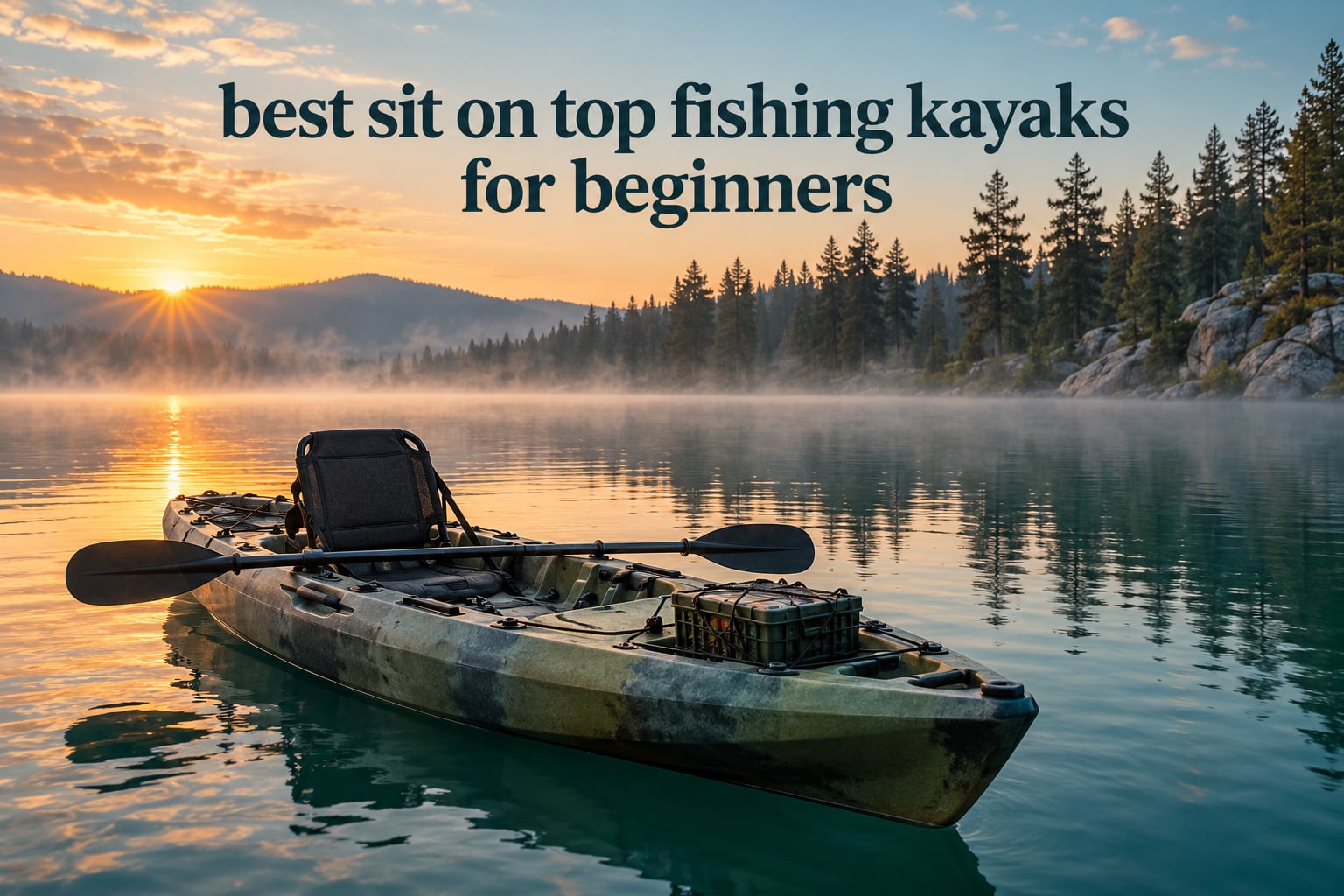
Short answer: the Lifetime Tamarack Angler 100 is the best sit on top fishing kayak for beginners. It weighs 51 lb, measures 31 inches across the beam, carries a 275 lb rating and comes with a paddle in the box, which covers the three numbers that matter most to a first-time angler.
That combination matters more than any feature list. Most new paddlers do not quit kayak fishing because of a bad lure. They quit because the boat they bought is too narrow for their height, too light for their gear once a cooler is loaded, or too heavy to lift onto a car roof alone at the end of a long day. Get those three numbers right and almost anything else in the class will work for you.
We compared ten sit-on-top fishing kayaks for this guide, looking at beam width, hull weight, rated capacity, seat layout, rod holder count and what owners actually say after a season on the water. Several of these boats carry hundreds or a thousand-plus owner ratings, which gives you real evidence rather than marketing copy. Others have thin review bases, and we flag those where it changes the decision.
Before you scroll any further, two honest caveats. We do not claim to have paddled every hull on this list, so the ratings and review counts you see come from owner feedback rather than our own float times. And the phrase for beginners here means a first angler boat on lakes, ponds, reservoirs and slow rivers, not a coastal or open-ocean platform.
If you also scout water from the air before you launch, our picks for drones for fishing are worth a look. It is the fastest way to find structure and access points without spending a whole morning on the lake.
Table of Contents
Our Top 3 Picks for Sit-On-Top Beginners (October 2026)
Three boats carry most first anglers. One balances everything, one is built for tight storage, one is the widest casting platform in the group.


All 10 Kayaks Compared Side by Side (October 2026)
Here is every boat in the guide on one page, with the specs that drive the decision.
| Product | Specifications | Action |
|---|---|---|
| Lifetime Tamarack Angler 100 |
|
Check Latest Price |
| Pelican Sentinel 100X Angler |
|
Check Latest Price |
| Pelican Catch Mode 110 |
|
Check Latest Price |
 Perception Outlaw 11.5 Perception Outlaw 11.5 |
|
Check Latest Price |
 Reel Yaks Raptor Modular Reel Yaks Raptor Modular |
|
Check Latest Price |
 Pelican Catch Classic 100 Pelican Catch Classic 100 |
|
Check Latest Price |
 Perception Access Perception Access |
|
Check Latest Price |
 Lifetime Tahoma 100 Lifetime Tahoma 100 |
|
Check Latest Price |
 Albott Modular Fishing Kayak Albott Modular Fishing Kayak |
|
Check Latest Price |
 Lifetime Lockport 94 Modular Lifetime Lockport 94 Modular |
|
Check Latest Price |
1. Lifetime Tamarack Angler 100 – The Boat We Would Start On
- Largest owner review base in the class at over 1300 ratings
- Light enough for one person to solo-load onto a roof rack
- Stable flat bottom with deep tracking channels
- Three rod holders and two 6 in storage compartments
- Five year limited warranty
- Veers off line once you stop paddling
- Molded plastic seat connector clips bend under load
- Storage hatch inserts not included
- Paddle included is short and flimsy
The Tamarack Angler 100 is the boat we would put a first-time angler in. At 51 lb it is one of the few angler kayaks in this group that one person can genuinely lift onto a roof rack without a second set of hands, and at 10 ft long with a 31 inch beam it tracks predictably enough to cast from while drifting.
The hull is UV-protected high-density polyethylene with a flat bottom and deep tracking channels, which is the stability recipe beginners want. It does not feel as planted as a 34 inch tunnel hull when you shift weight hard, but nothing in this roundup from a 275 lb rating class feels more balanced on a first outing.
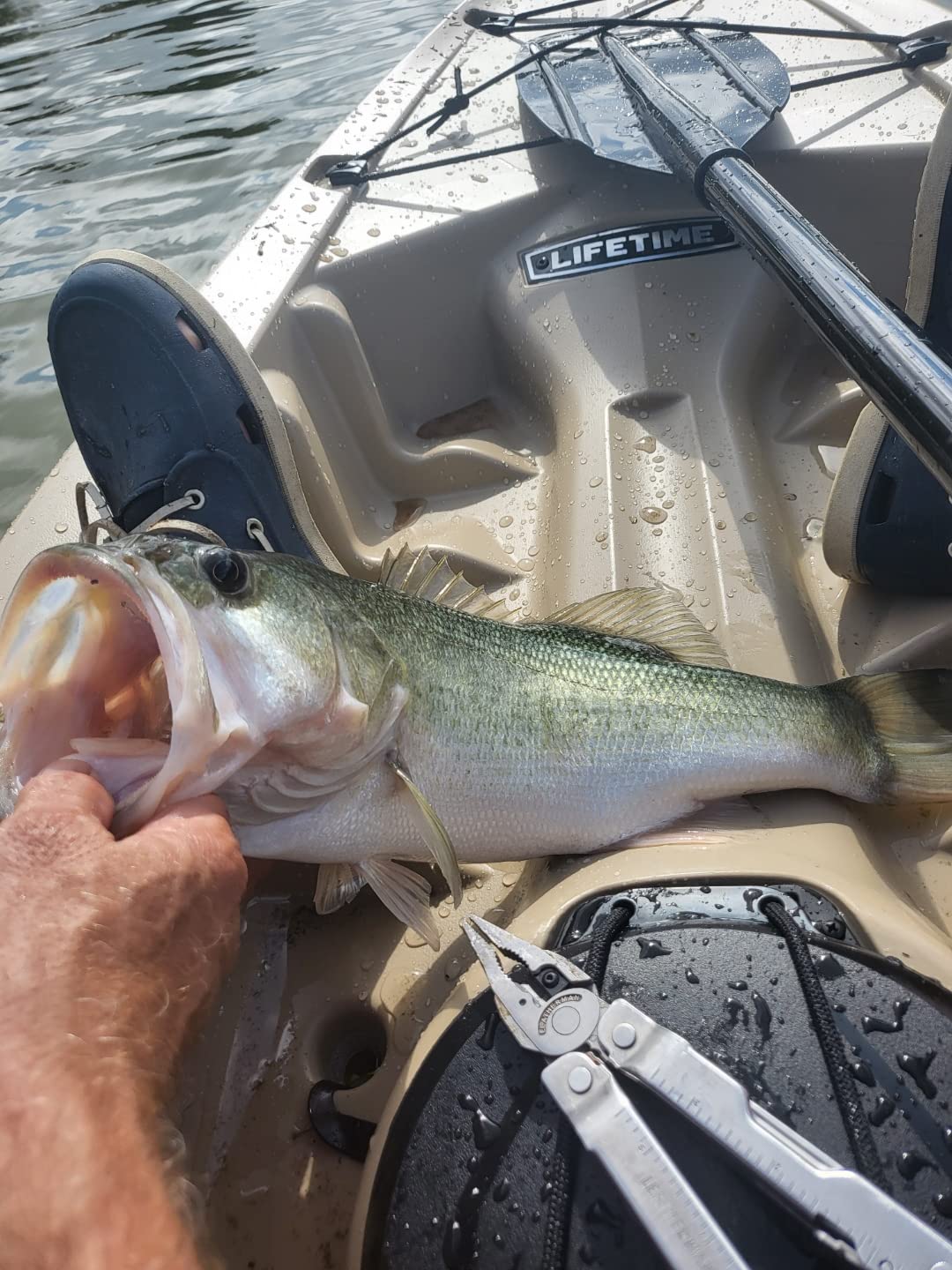
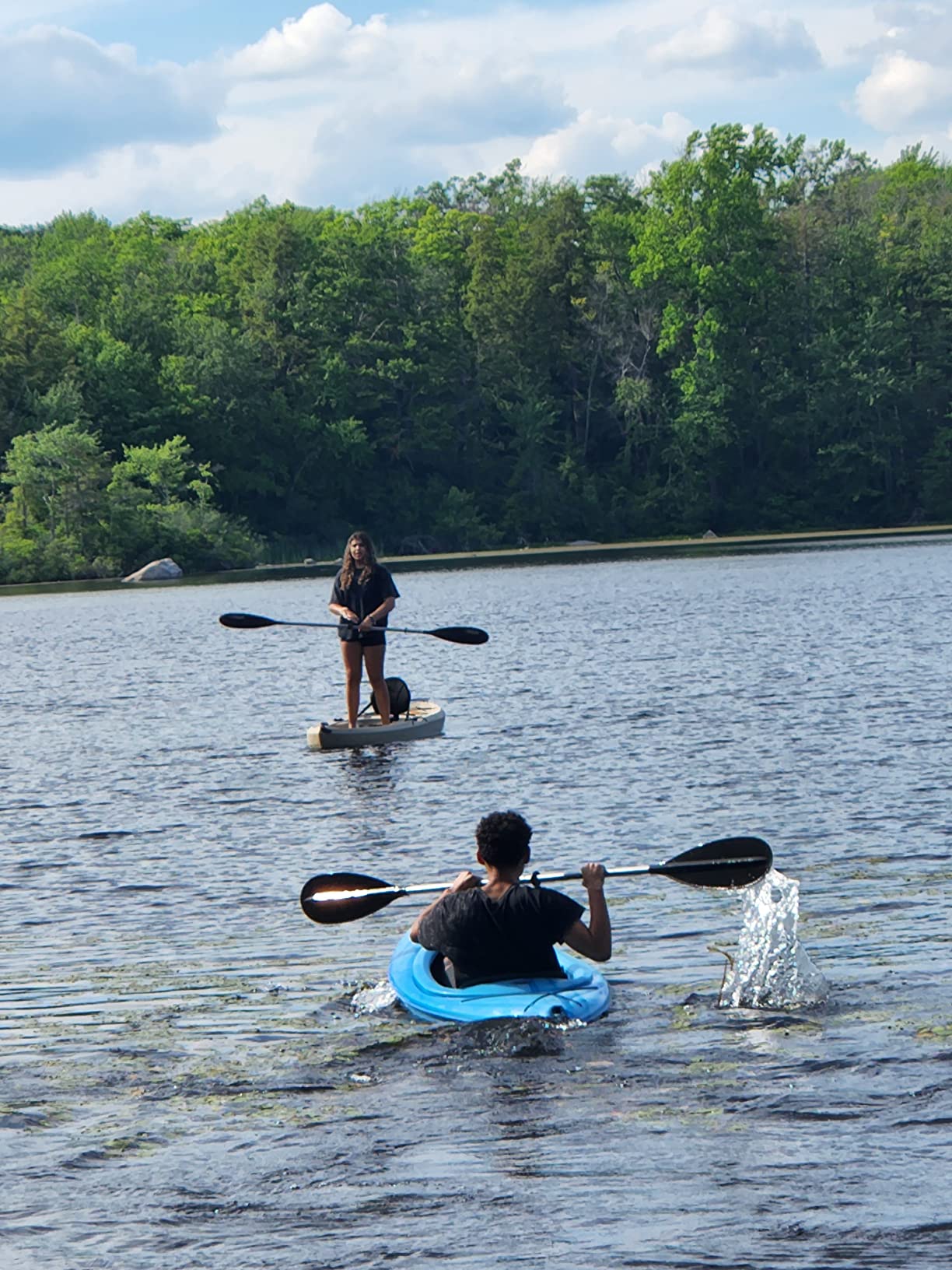
The owner evidence here is the strongest argument for it. With over 1300 ratings and a 4.4 average, the sample is large enough that the pattern is trustworthy: roughly three quarters of owners give it five stars, and the recurring praise covers stability, solo handling and durability through beaching and dragging.
Rigging is decent rather than generous. Two flush-mounted rod holders and one top-mount holder cover a one-rod setup, and the two 6-inch storage compartments in the rear and center are bare hatches with no bucket or insert in the box. Front and rear T-handles make the carry from the car noticeably easier than a hull with only molded-in side grips.
What makes it work for a first boat
The three numbers line up for a typical angler. A 31 inch beam is wide enough that a 5 ft 10 in paddler sits with knees bent rather than splayed, and the 275 lb rating covers a 170 lb angler with a realistic light gear load. The 51 lb hull weight means after-work trips stay possible, which is where most beginners either build a habit or give up.
Owner reports also confirm the open cockpit is easy to get into and out of, which sounds minor until you have climbed out of a sit-on-top in 3 ft of water with a wet fly rod in one hand. The multiple footrest positions let a heavier paddler set their legs correctly.
What to plan around
Tracking is the honest weakness. Owners consistently report that the wide flat hull drifts and veers once the paddle stops, so wind pushes you off line while you fish. It is manageable with the molded-in skeg and deliberate steering corrections, but it is the first thing a new angler notices.
Two smaller items will show up in your first week. The molded plastic seat connector clips bend under load for some owners, and many of them upgrade the seat anyway. Hatch inserts are sold separately, so plan a couple of buckets rather than expecting usable storage on day one.
2. Pelican Sentinel 100X Angler – Short Hull With a Real Seat
- Full-size angler hull at only 44.6 lb
- Short 9 ft 6 in footprint fits in closets and vehicle trunks
- Ergolounge seat with thick padding and tall backrest
- ExoPak adds storage and two rod holders
- Molded-in side handles
- ExoPak and seat add weight over a bare hull
- Only four rod holders and two depend on the ExoPak
- Modular accessories cost extra
If storage is your problem, this is a full-size angler hull at a weight most beginners can carry in one hand. At 9 ft 6 in long and 44.6 lb total, it lives in an apartment closet, a garage corner or the back of a small hatchback without a roof rack, and one person can carry it from the car.
The Ergolounge seating system is the feature that converts people. It has extra-thick cushioning and a high, wide padded backrest that sits noticeably higher than a molded plastic perch, which is exactly the fix owners give for the sore lower back that ends a long day on an entry-level boat.
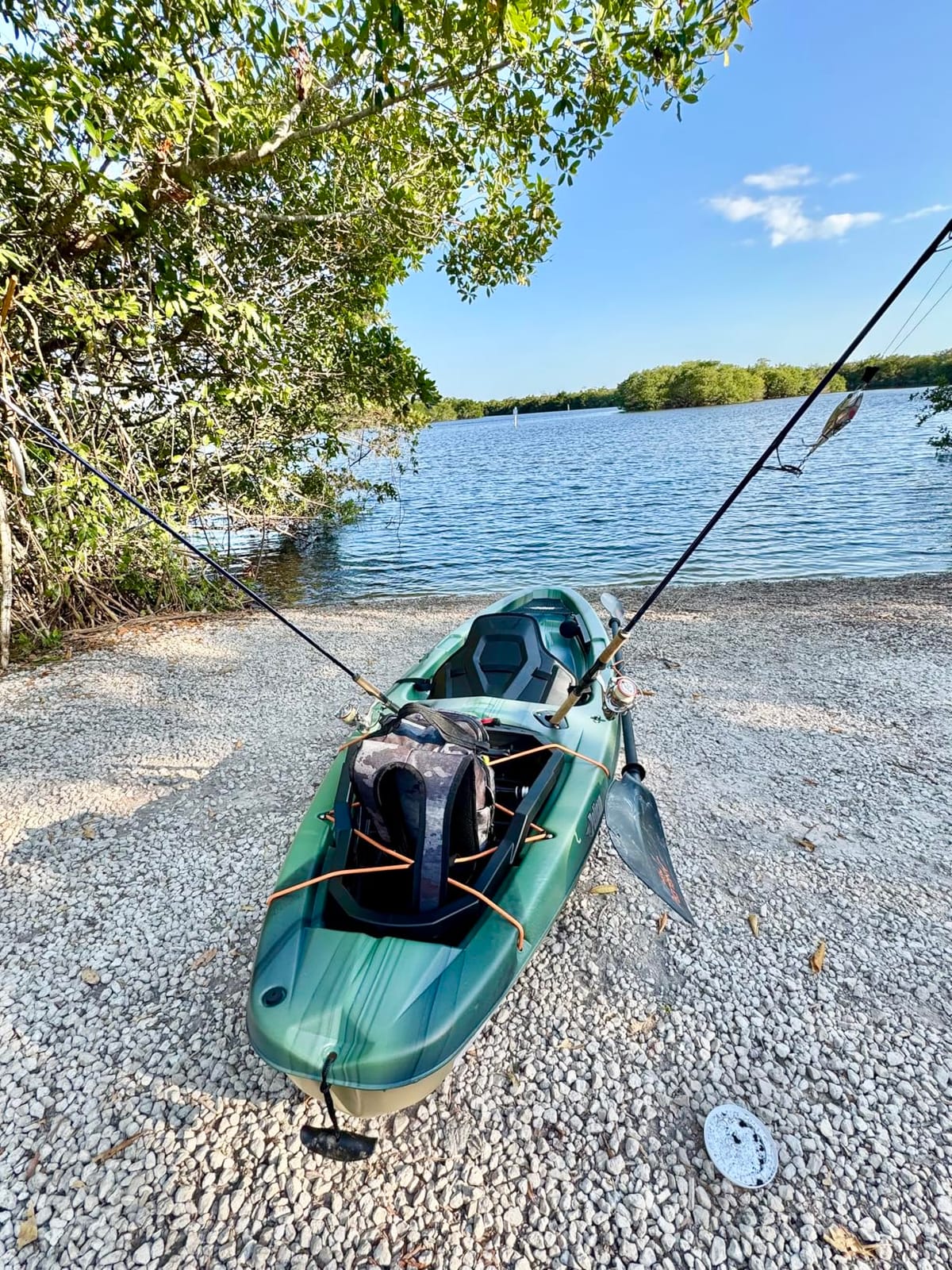
With 528 ratings at a 4.4 average, this is the second best-evidenced boat in the roundup, and the review pattern is consistent. Owners highlight the backrest comfort, the short footprint and the removable ExoPak compartment, which packs flat at home and drops into the kayak to add gear capacity and two vertical rod holders without permanently cluttering the deck.
Total rod holder count reaches four once the ExoPak is installed: two flush-mounted in the hull plus two vertical on the removable unit. It is a clever design rather than a cluttered one, and it is the reason this boat ranks near the top of its category by owner sales.
Where it beats the rest of the field
Transport. A 9 ft 6 in hull with a real angler layout is unusual in this class, and the light mass means you can carry it from a parking lot to a launch ramp in one trip without planning a second person into your morning. For a beginner fishing alone on a weekday evening, that is a decisive advantage.
The seat is the other one. Owners report hours-long sessions without the numbness that comes with a hard molded perch, and the elevated backrest gives a better sightline for spotting fish in clear water. The 275 lb rating is on the modest side, so this suits a lighter angler with a disciplined gear load.
Where it falls short
That 275 lb rating is the first limitation. It handles an adult paddler, but a loaded cooler plus a second person plus a catch pushes the practical ceiling quickly, and owners who load it up are the ones who notice the boat getting less pleasant.
The modularity is also a double-edged feature. Two of the four rod holders only exist when the ExoPak is fitted, and extra storage or accessories cost additional spend. If you leave the ExoPak off to save weight, you lose more than a box.
3. Pelican Catch Mode 110 – the Platform for Casting From the Boat
Pelican Catch Mode 110 Fishing Kayak – Premium Angler Kayak with Lawnchair seat, Granite – 10.5 Ft.
- Wide 34.5 in beam with a 375 lb rating
- ErgoBoost seat stays supportive over long sessions
- Front and rear tank wells fit a large crate
- Three flush-mount rod holders plus two rigging tracks
- In-hull flotation meeting ABYC standards
- 67 lb is a two-person roof rack job
- Slow in current because the hull is so wide
- Deck flexes for paddlers over 200 lb
- No dry storage compartments
- Hull scratches easily
The Catch Mode 110 is a wide, deliberately platform-shaped fishing boat and one of the two highest rated here, at 4.6 across 347 ratings. The tunnel hull, 34.5 inch beam and 375 lb capacity give you a wide flat platform that stays steady while you cast, which is a genuinely different experience from fishing in a narrow 31 inch hull.
Deck layout is where it earns that rating. You get front and rear tank wells that owners report fitting a large milk crate, two 4-inch rigging tracks for accessory setup, three flush-mount rod holders, two bottle holders, anti-slip deck carpet and an ErgoBoost adjustable seat with an EVA pad and under-seat storage.

It also carries additional in-hull flotation to meet or surpass ABYC standards, which matters if a larger angler plans to bring a dog or a second person on calm water. Owners describe it as stable even with a heavy paddler and a large dog aboard, and it tracks straight under 11 ft with the skeg down.
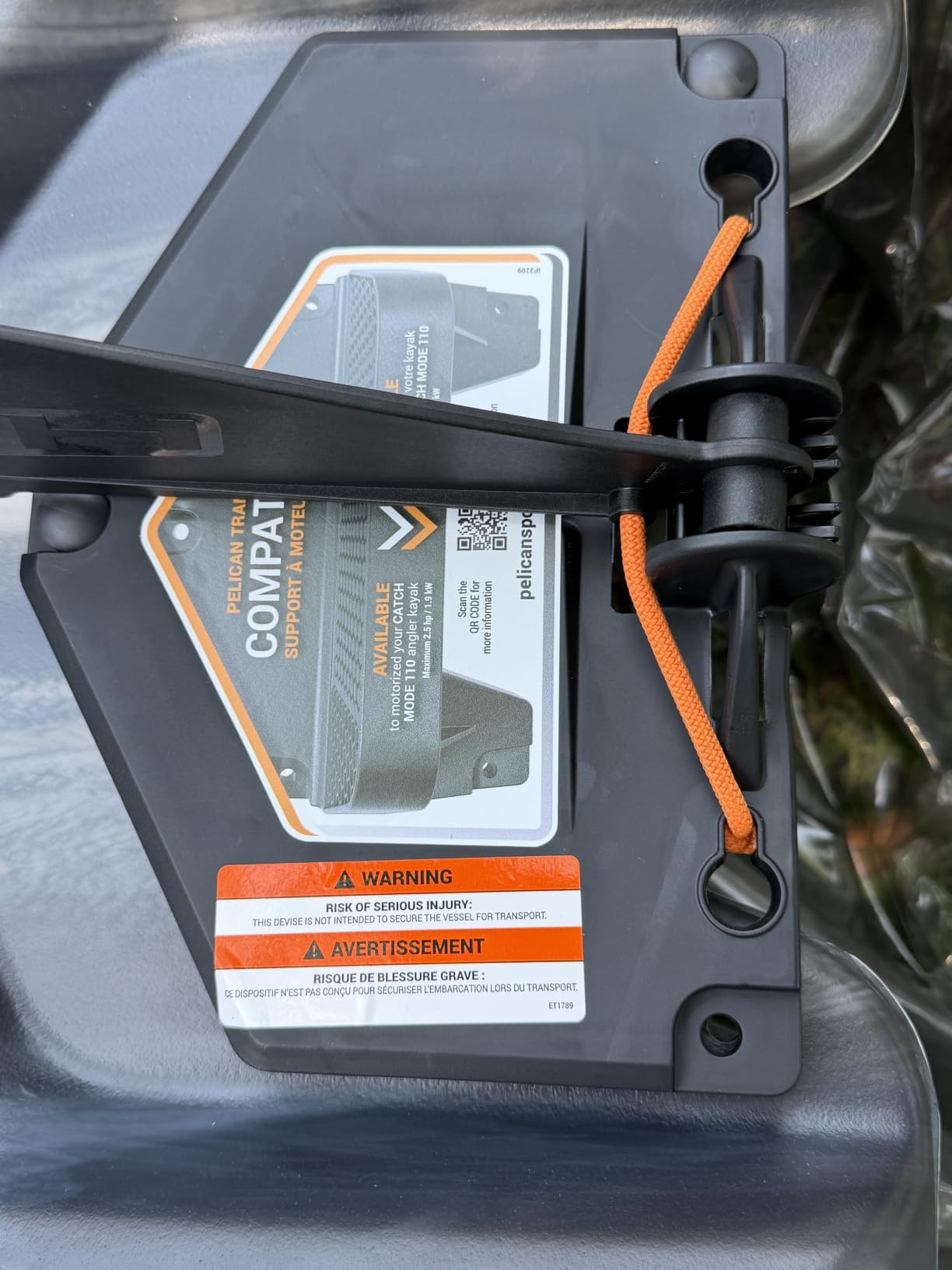
The transom also accepts a trolling motor up to 2.5 hp, and scupper plugs are included. Those two details put it in a different category from the rest of this roundup, which is why it earns the premium pick here rather than the top spot.
What makes it worth the extra mass
Stability under load. A 34.5 inch beam with a tunnel hull means a 250 lb angler can move around the cockpit, reach for a crate and cast without the twitchy feeling that comes with a narrow hull. If your plan involves standing casts, sight fishing or carrying a dog, this is one of the boats in the group built for that.
The rigging rails are the quiet advantage. Two 4-inch tracks accept accessories you add later rather than forcing you to buy the fully kitted version on day one, and the flush-mounted holders keep rod tubes clear of the deck where you walk.
Where beginners feel the cost
Weight is the honest drawback. At 67 lb this is a two-person job on the roof rack and awkward to carry down a ramp without a kayak cart. Owners who fish after work tend to report this as the main source of regret, and it is why it sits at number three rather than number one.
Width also costs speed. The hull is slow and inefficient against a current, and the deck flexes noticeably for paddlers over 200 lb, which is odd on a 375 lb rated boat but is a real owner complaint. The hull scratches easily, so a keel guard makes sense. There are no dry storage compartments either, only tank wells and under-seat space.
4. Perception Outlaw 11.5 – Most Room and Most Capacity
- Highest weight capacity in this roundup at 425 lb
- Fishing-optimized deck with 4 rod holders and tackle trays
- Large rear tankwell plus front storage
- Fold-away lawn chair seat for long sessions
- Five year hull warranty
- Long and heavy
- so solo transport is harder
- 11 ft 6 in is difficult to store in a small space
- Premium tier pricing versus entry models
The Outlaw 11.5 solves the opposite problem from the Sentinel: what if you need room? At 11 ft 6 in long, 35 inches wide and rated to 425 lb, it has the widest beam and the highest capacity rating of any boat in this roundup, and it is the one to look at if you carry serious gear or fish with a partner.
The deck is laid out for angling rather than for looks. Four integrated rod holders, integrated tackle trays within reach, a large rear tankwell and a front storage area means you can organize a full day of tackle without a crate taking over the deck.
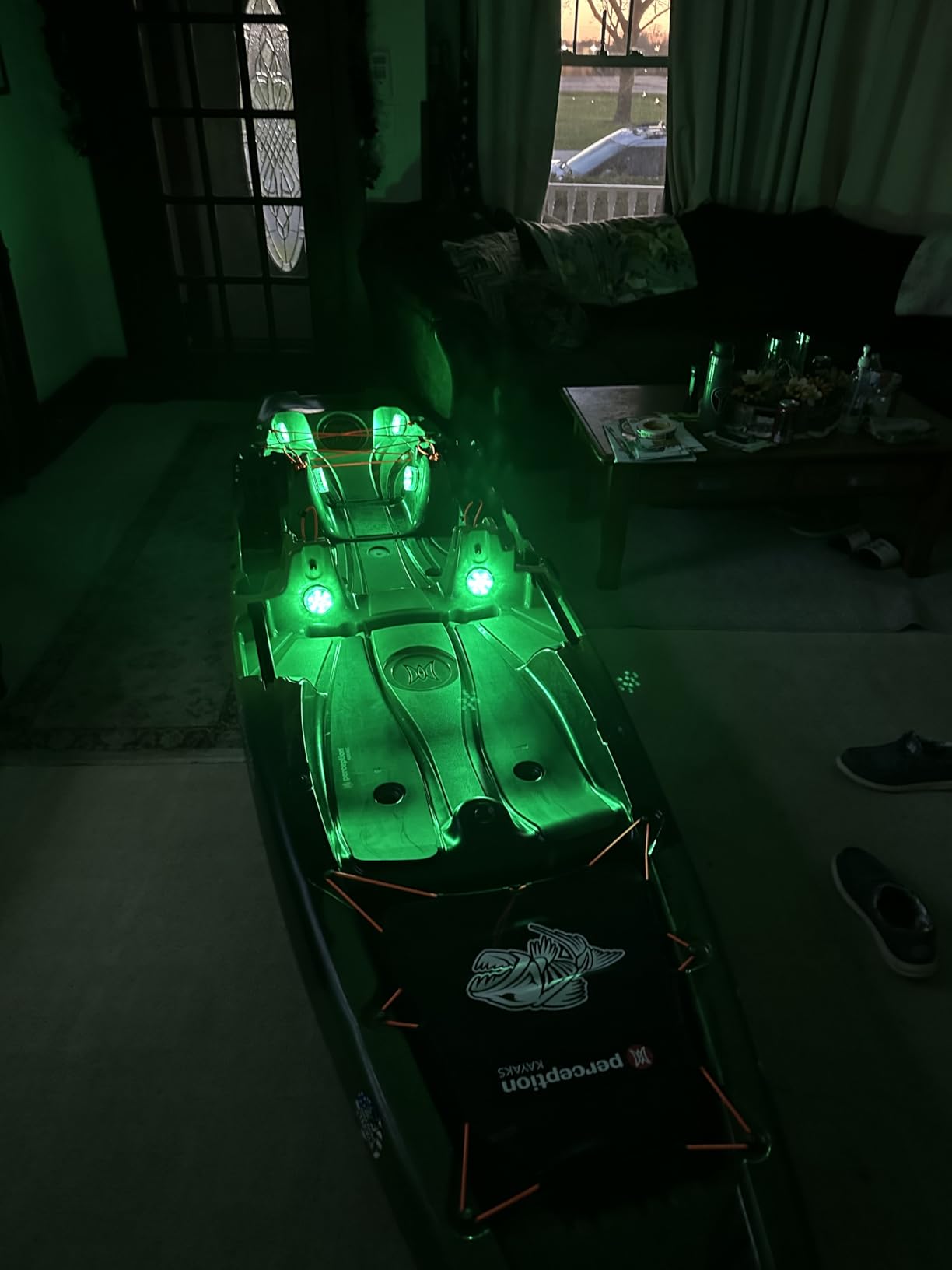
Build quality is a genuine strength here. It is made in the USA and carries a five year limited warranty on hull and deck with one year on installed accessories, which is a longer hull warranty than most of the group offers.
The rating is 4.4 across 306 ratings, and the pattern is favorable. Owners consistently mark the stability, the seat comfort and the sheer amount of fishing capacity, with the made-in-USA construction and warranty showing up as repeat positives.
Who this hull is sized for
Anglers who carry more than the minimum. A 425 lb rating leaves real headroom for a 250 lb paddler with a full cooler, a tackle crate, electronics and a limit of fish, and the 35 inch beam means a larger angler does not feel squeezed in the cockpit.
The fold-away frame lawn chair seat is the other reason it works over long sessions. Back problems are the most common reason anglers stop fishing after a full day on an entry-level perch, and a proper framed seat removes that failure mode.
Why it is not a first boat for everyone
Length is the problem. At 11 ft 6 in it is tied for the longest boat here, which makes it difficult to store, hard to fit on a small vehicle and slower to turn in tight spots. It is a poor match for someone with a garage the size of a single car and a strong preference for short solo outings.
The hull weight is not listed by the manufacturer, which is itself a limitation when the number that decides whether you can solo-load matters most to you. At this length you should assume you need a second person and a cart. It also sits in the premium price tier, so it is a bigger first commitment than most beginners need.
5. Reel Yaks Raptor Modular – Pedal Drive That Fits in a Closet
Reel Yaks Raptor Modular Fishing Kayak, Fin Drive 9.5ft, 380 lbs Capacity
- Two halves carry in one arm and fit in a car trunk
- Quiet efficient pedal drive that works in weedy water
- Snaps together in seconds with no tools
- Track rails with extra T-nuts accept third party gear
- Stadium seat included
- Rudder hardware has failed for multiple owners
- Seat sits very low with no under-seat storage
- Rudder tends to float up when deployed
- Included paddle is a basic cheap model
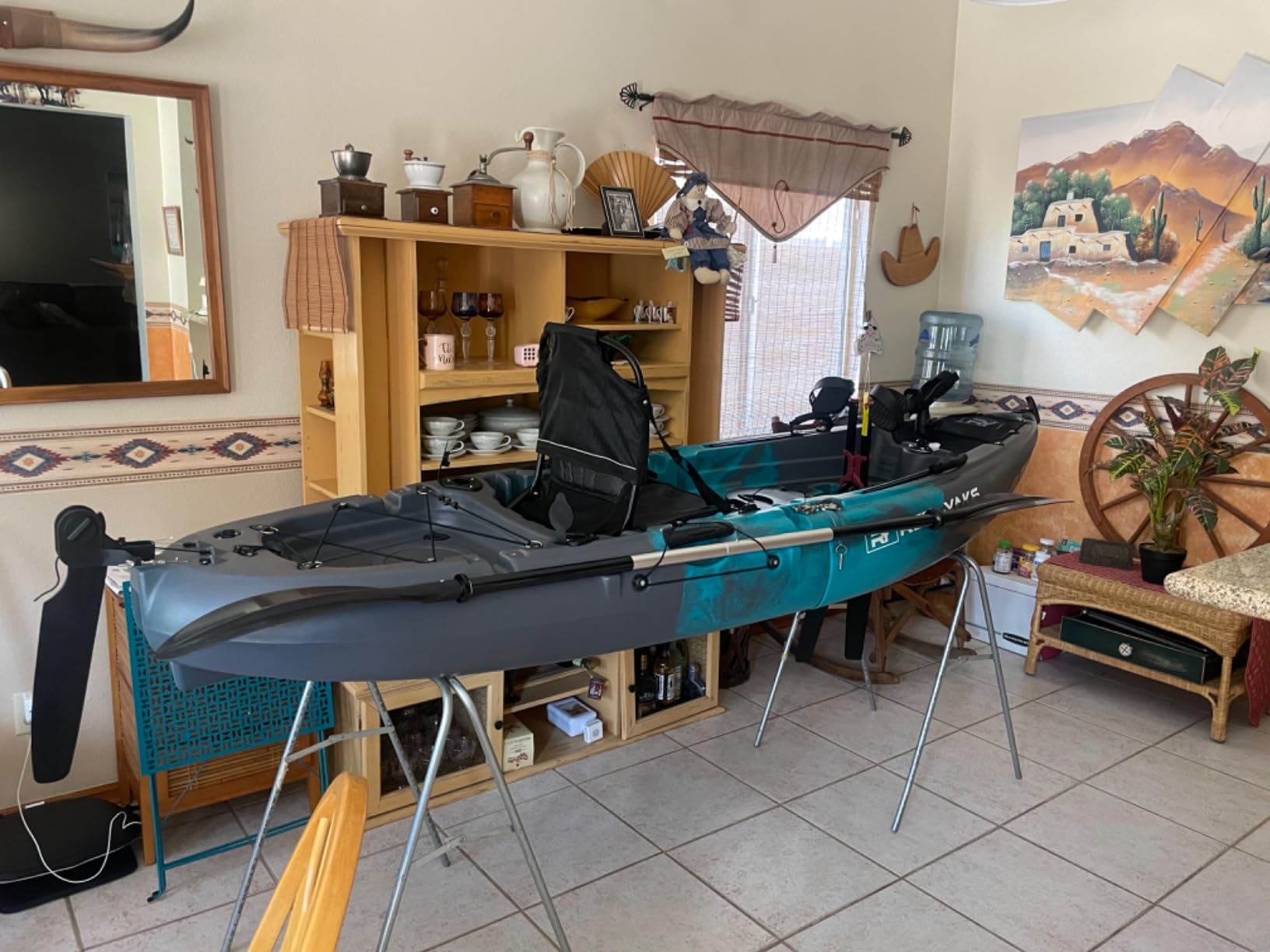
The Raptor is the only pedal-driven boat in this guide, and the reason is not the drive so much as the modular hull. It separates into two pieces that nest, and each half is light enough to carry in one arm, which means it lives in a closet and travels without a roof rack.
The pedal system is a smooth fin drive rather than a propeller. Owners like how quietly it moves and how well it works in weedy or shallow water where a propeller would foul, and the wide W-hull at 380 lb rated capacity gives casting and reeling stability that feels solid for a 9.5 ft boat.
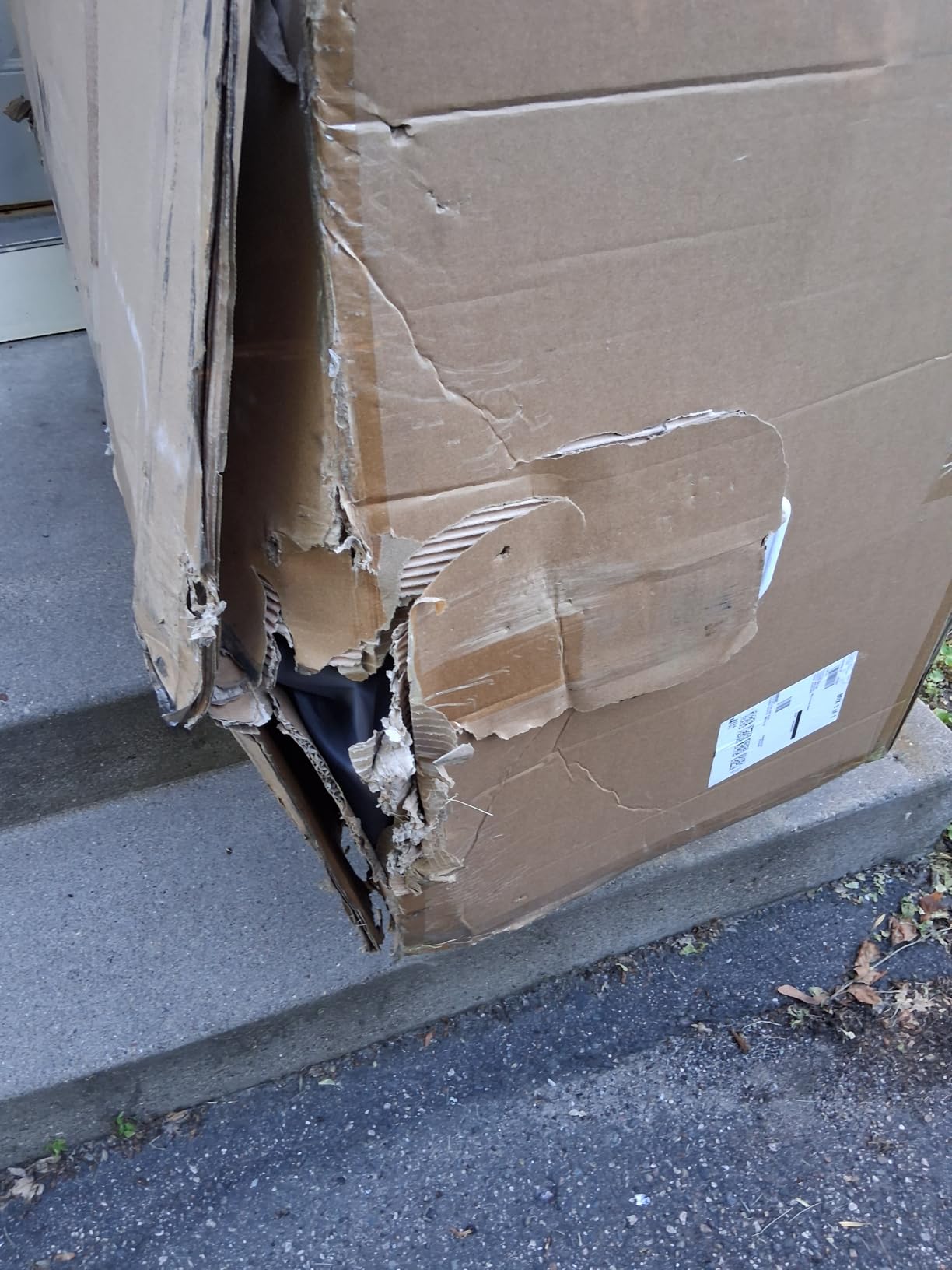
Rigging is unusually well accessorized out of the box. You get flush-mount rod holders, track rails with extra T-nuts that accept third-party accessories, storage hatches, a stadium seat and a paddle, with a 62 lb total weight across both halves.
The review picture is mixed in one specific area. At 4.2 across 172 ratings, that is the lowest average of the six boats in this guide rated above 4.0 on a comparable owner sample, and roughly one review in eight is a single star. That one-star share is driven almost entirely by rudder failures rather than by the hull or the drive.
Where the modular design wins
Apartment and small-garage storage. This is the boat to buy if a 10 ft hardshell hull is simply not going to fit in your life. Both halves latch together in seconds with no tools, and each half floats independently, so a half can be launched or landed on its own.
Hands-free movement is the other argument. If you cover long distances alone, want to troll without holding a paddle, or fish water where your hands are busy casting and reeling, pedal propulsion removes a whole category of fatigue. The optional center section converts the boat to a tandem later if you want it.
Where the complaints concentrate
The rudder is the weak point and you should read those reviews before buying. Multiple owners report a broken rudder guide screw and failed rudder control wires and ferrules, and the rudder also tends to float up rather than stay deployed. That is a parts problem, not a hull problem, and customer service responds quickly to it.
The low seat position is the second limitation. It sits very close to the floor, so there is no under-seat storage and no height-extender options. The included paddle is also a basic model, and accessory add-ons for storage or the tandem section cost extra.
6. Pelican Catch Classic 100 – Rigging Tracks Without the Length
- Stable tunnel hull that is easy to enter and exit
- Dual position seat for a high sightline or a low stable ride
- Front quick-lock hatch plus rear tank well
- Rigging tracks and accessory eyelets for add-ons
- Shorter and lighter than the Catch Mode 110
- Only two flush-mount rod holders
- Flat wide hull is slow on the water
- Minimal tank well space next to the larger Catch models
- Paddle not included in the base package
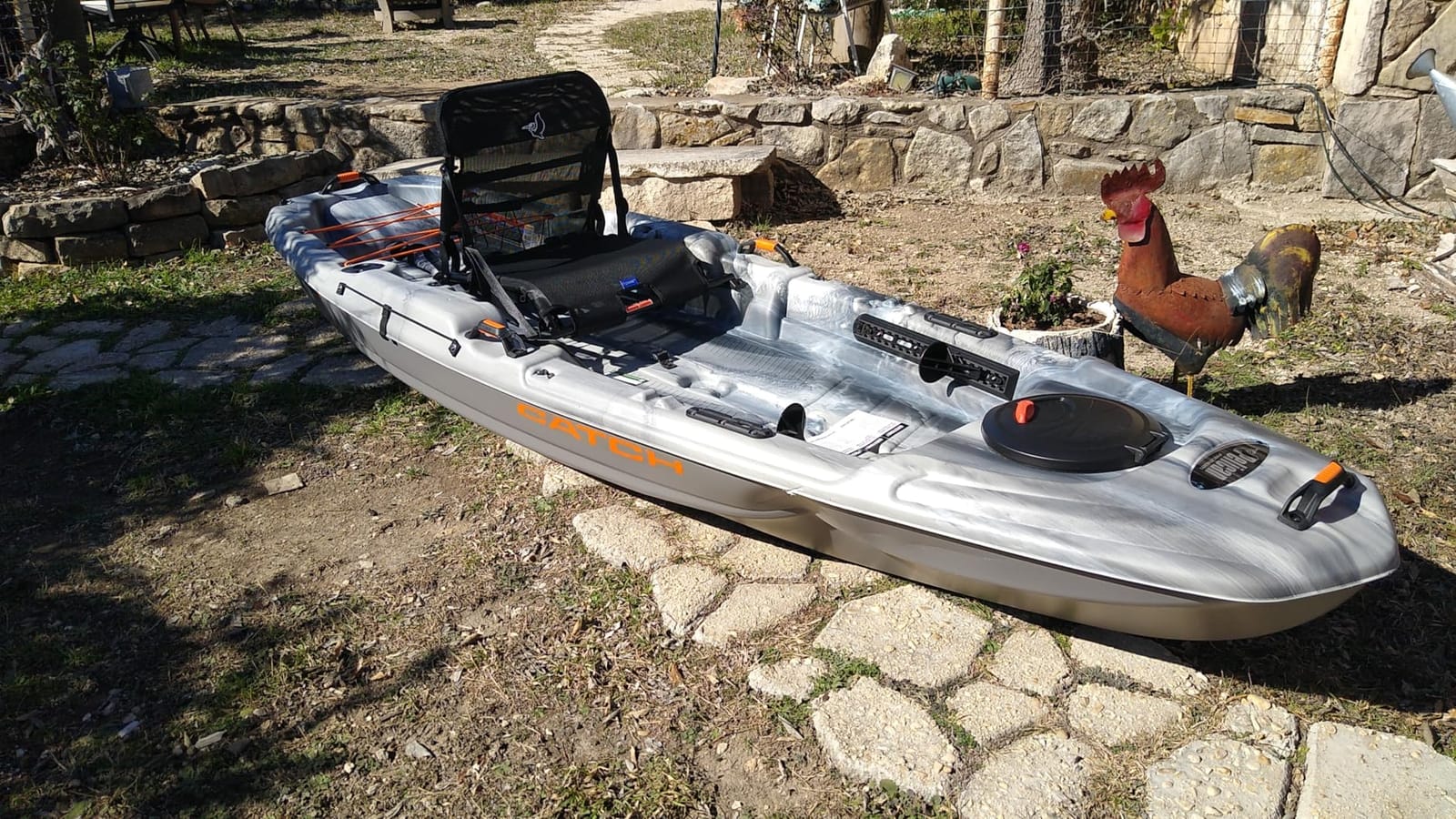
The Catch Classic 100 is a shorter, lighter take on the same idea as the Catch Mode 110. At 10 ft and 57 lb with a 34 inch beam and a 350 lb rating, it keeps the wide stable tunnel hull and the rigging tracks while cutting two feet of length and ten pounds.
Its standout feature is the ERGOCAST CLASSIC dual-position seat. You can set it high for a better sightline when spotting fish in clear water, or drop it lower for a more stable and comfortable ride on rough water. That flexibility is unusual at this level and is the reason many owners keep the boat rather than upgrade.
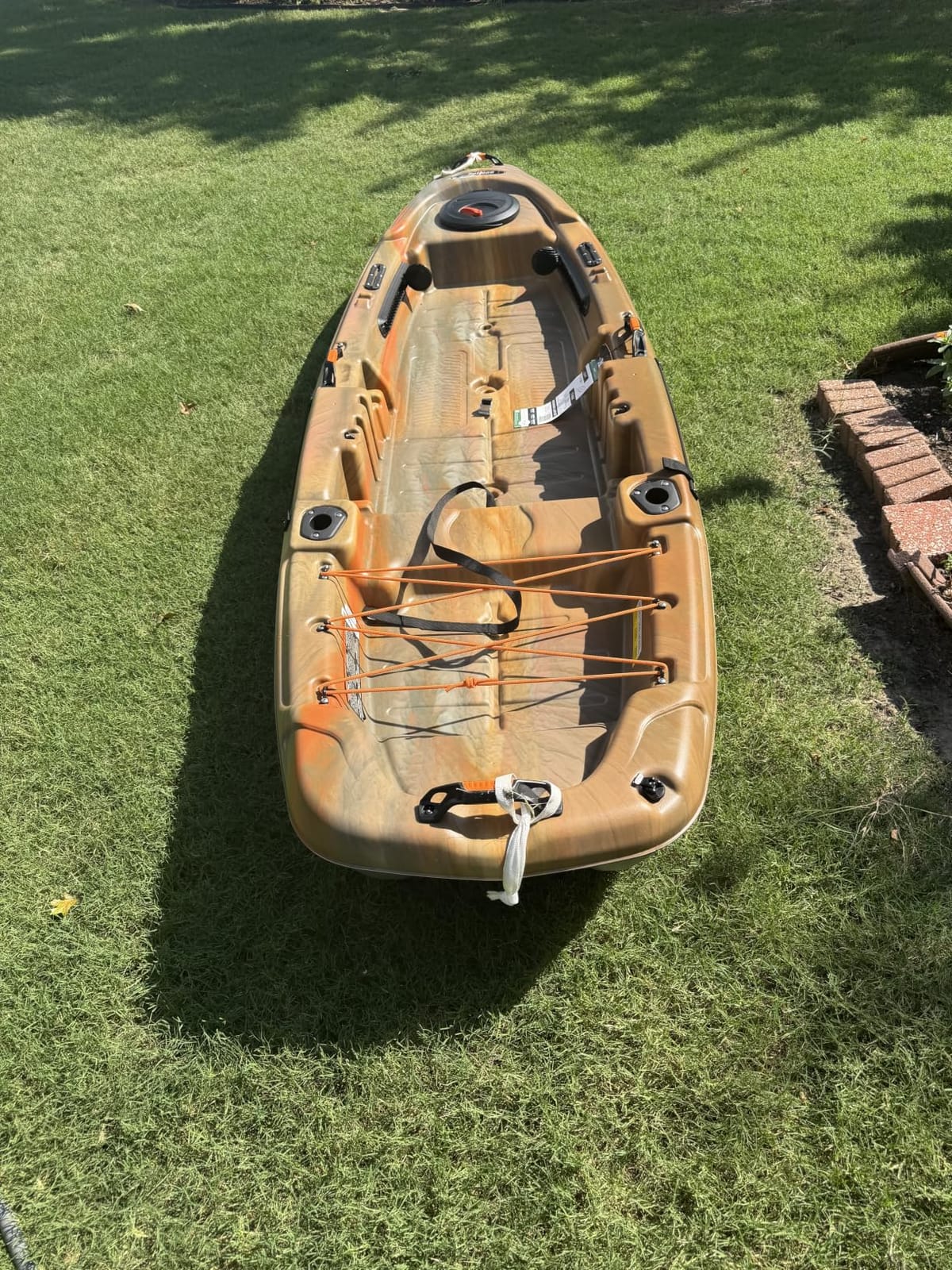
Storage is a good mix for a 10 ft hull: a front quick-lock hatch, a rear tank well with bungee cords, two 4-inch rigging tracks, two accessory eyelets, adjustable footrests and a bottle holder. Two flush-mount rod holders are the only firm anchors, so most anglers add a clamp-on within a season.
The rating is 4.2 across 132 ratings. Owners like the hull, the adjustable seat and the accessory mounting points, while the recurring criticism is that two rod holders and modest deck space feel thin relative to what the boat otherwise offers.
What you get for the size
Stability without the bulk. If you want a wide hull that stays steady while you cast but you do not want to carry 67 lb to the water, this is the compromise. The tunnel hull profile makes getting in and out easy, which is a real advantage over a narrow sit-on-top when you are launching from a shallow bank.
The rigging tracks matter over time. They are the difference between bolting accessories onto bare deck and sliding them onto rails later. Track-equipped boats hold their value better for owners who add a rod holder, a paddle leash anchor or a camera mount in the second season.
What to set expectations on
Speed and rod holders. A wide flat hull is efficient at staying put and inefficient at covering distance, so paddling across a big lake takes real work. Two flush-mount rod holders also means planning a clamp-on if you ever fish with more than one rod.
Accessories are the other gap. There is minimal large tank well space compared with the bigger Catch models, and the base package does not include a paddle. Plan to buy a paddle separately and budget for one clamp-on holder.
7. Perception Access – Comfortable With Zero Assembly
Perception Access 11.5 | Sit on Top Kayak | High Back Seat | Rod Holders | 11′ 6″ | Dapper
- Molded-in high back seat needs no separate chair
- Light enough at 55 lb for a solo roof lift
- Replaceable skid plate tolerates dragging to launch
- Simple uncluttered deck with few snag points
- Integrated rod holders and center console
- Molded seat straps dig into larger paddlers
- 11 ft 6 in length is bulky to store
- Limited attachment points in the mold
- Several buyers report arrival damage
The Access is the pick for anyone who wants to sit in the boat and fish rather than sit on the floor and fish. The molded-in high seat back and leg lifter create a chair as part of the hull, so there is nothing to bolt on, clip on or adjust before your first outing.
It is also made in the USA with a five year hull warranty, and at 55 lb it is light enough for one person to put on a car roof solo. Owners report it as sturdy in the water and stable for a paddler around 280 lb, with a replaceable skid plate that survives being dragged to the launch.
Be aware of the evidence base here. At 4.1 across 43 ratings, this is a much thinner sample than the top three boats, and roughly one rating in ten is a single star. Those negative reviews cluster on seat straps, length and delivery condition rather than on the hull itself.
The deck is deliberately plain. Integrated rod holders and a center console give you somewhere to put a rod and a small item, and there are few protruding parts to snag a line on when you are moving around the cockpit.
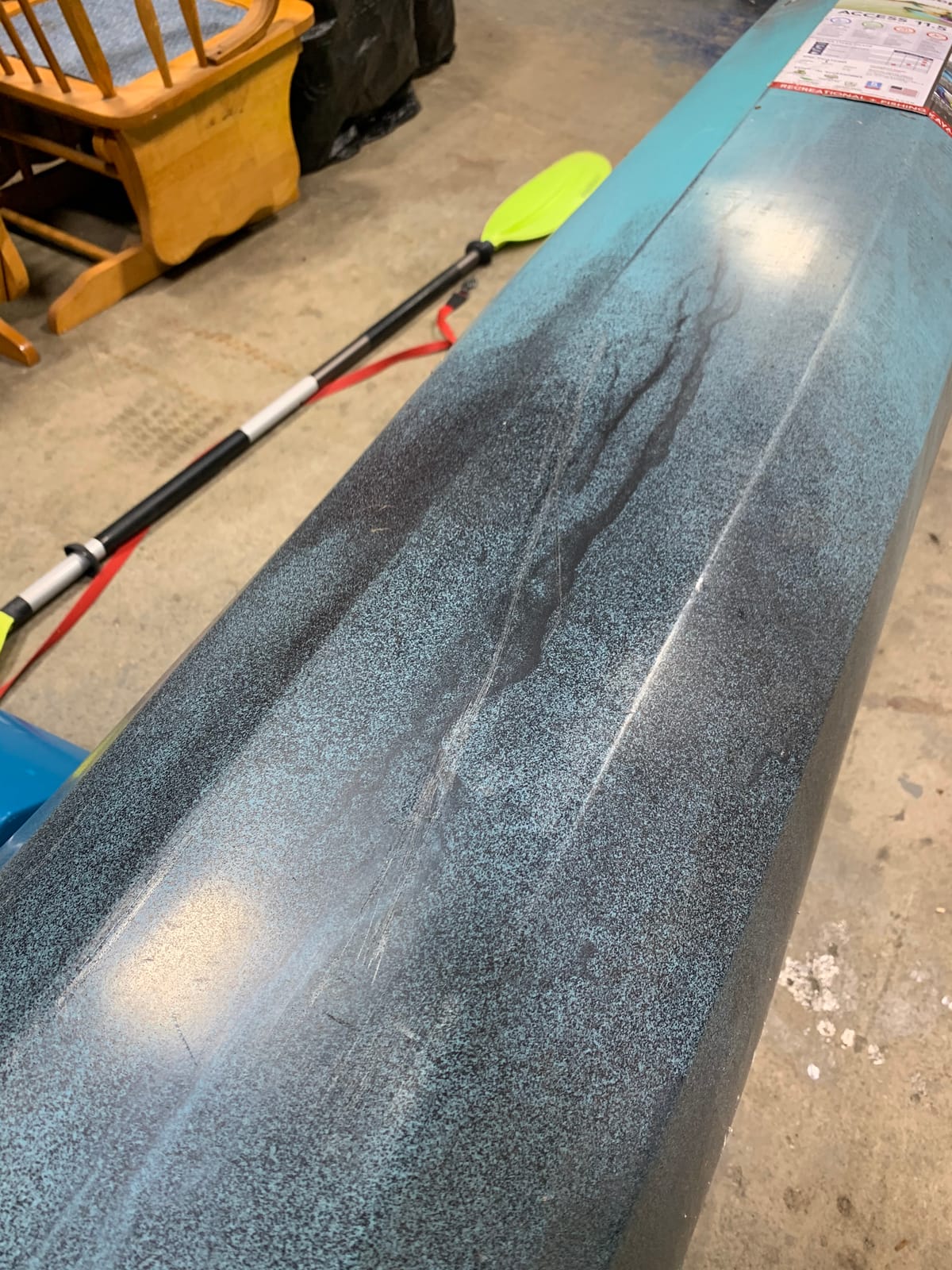
Why the molded seat is the deciding factor
It removes the most common year-one upgrade. Owners across this whole class swap molded plastic perches for a framed or stadium seat, and that change costs money and time. Here it is part of the boat from the factory, which several owners say is why they can fish for hours without the numbness that ends a day.
The replaceable skid plate is a smaller but real advantage. Beginners drag their kayak to the water more than experienced paddlers do, and a plate that can be swapped instead of replaced keeps the hull usable.
Where it falls short for a larger angler
The seat straps are the issue reported most often. For wider paddlers, the molded straps press into the sides of the hips over a long session, which is uncomfortable enough that some owners add padding. The limited attachment points in the mold also make it awkward to add paddle straps or accessories compared with a boat that has rigging tracks.
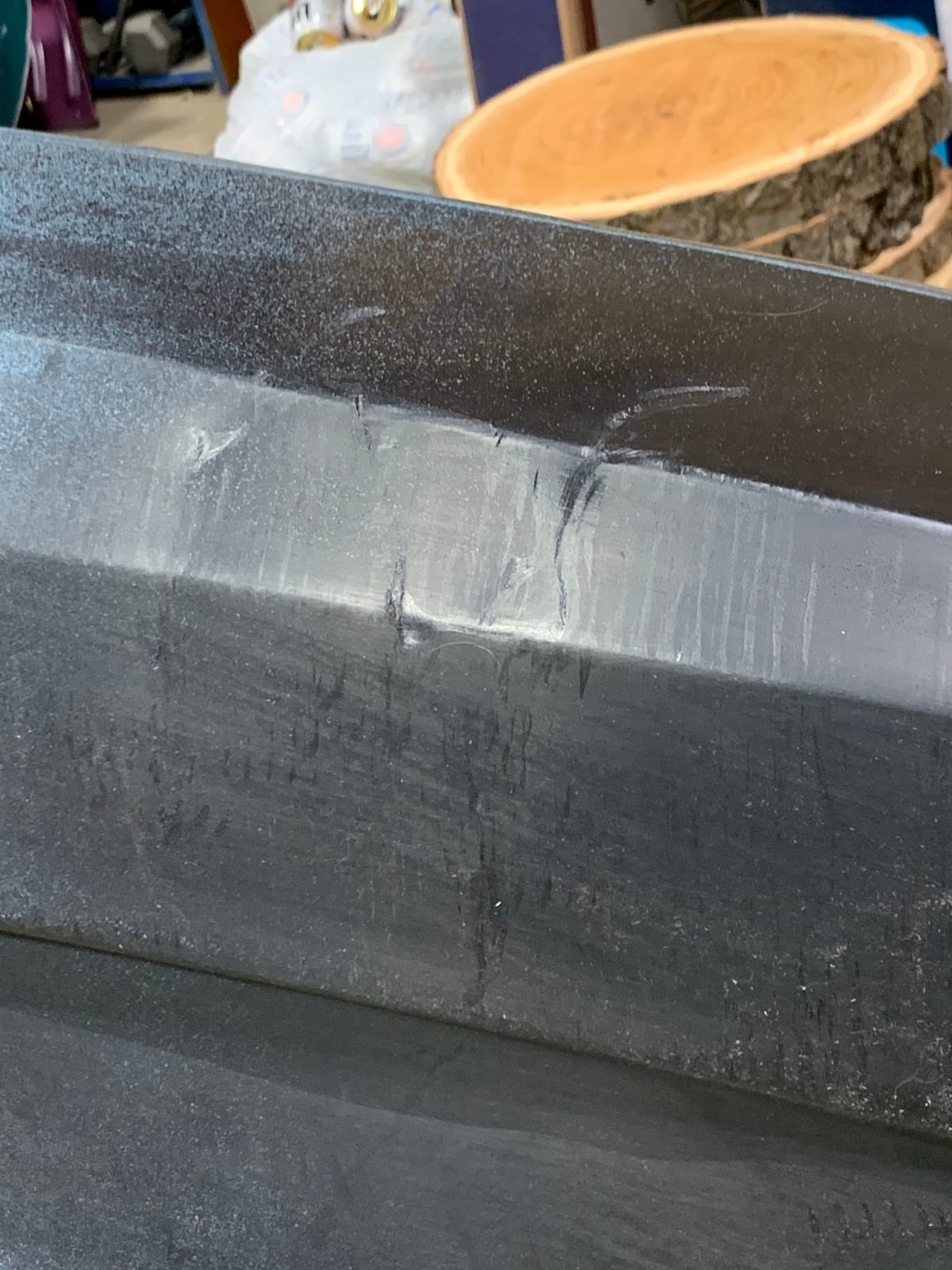
Two more practical points. At 11 ft 6 in it is bulky to store and awkward for smaller vehicles, and several buyers report the boat arriving dented, gouged or cracked, so inspect the hull carefully before your first float.
8. Lifetime Tahoma 100 – Paddle In The Box, Nothing Else Needed
- Stable flat bottom with chine rails for open water
- Light and simple enough for two people to carry
- Paddle included so it is usable immediately
- Durable UV-protected HDPE build
- Multiple footrest positions for different paddlers
- Slower than pointier hulls on long distances
- Hard plastic seat base is uncomfortable on long trips
- Plastic backrest can crack when leaning back hard
- Included paddle is short
The Tahoma 100 is the simplest boat on this list to start fishing in. A paddle is in the box, the hull is 50 lb, and the flat bottom with chine rails gives you the tipping resistance a beginner needs on open water with a bit of wave.
It shares the Lifetime approach that makes the Tamarack such a solid first choice: UV-protected HDPE, a sharp bow, deep hull tracking channels for straight-line travel, an adjustable padded seat back, multiple footrest positions and a top-mount rod holder. Add a 6-inch center storage hatch, front and rear shock cords and a paddle keeper.
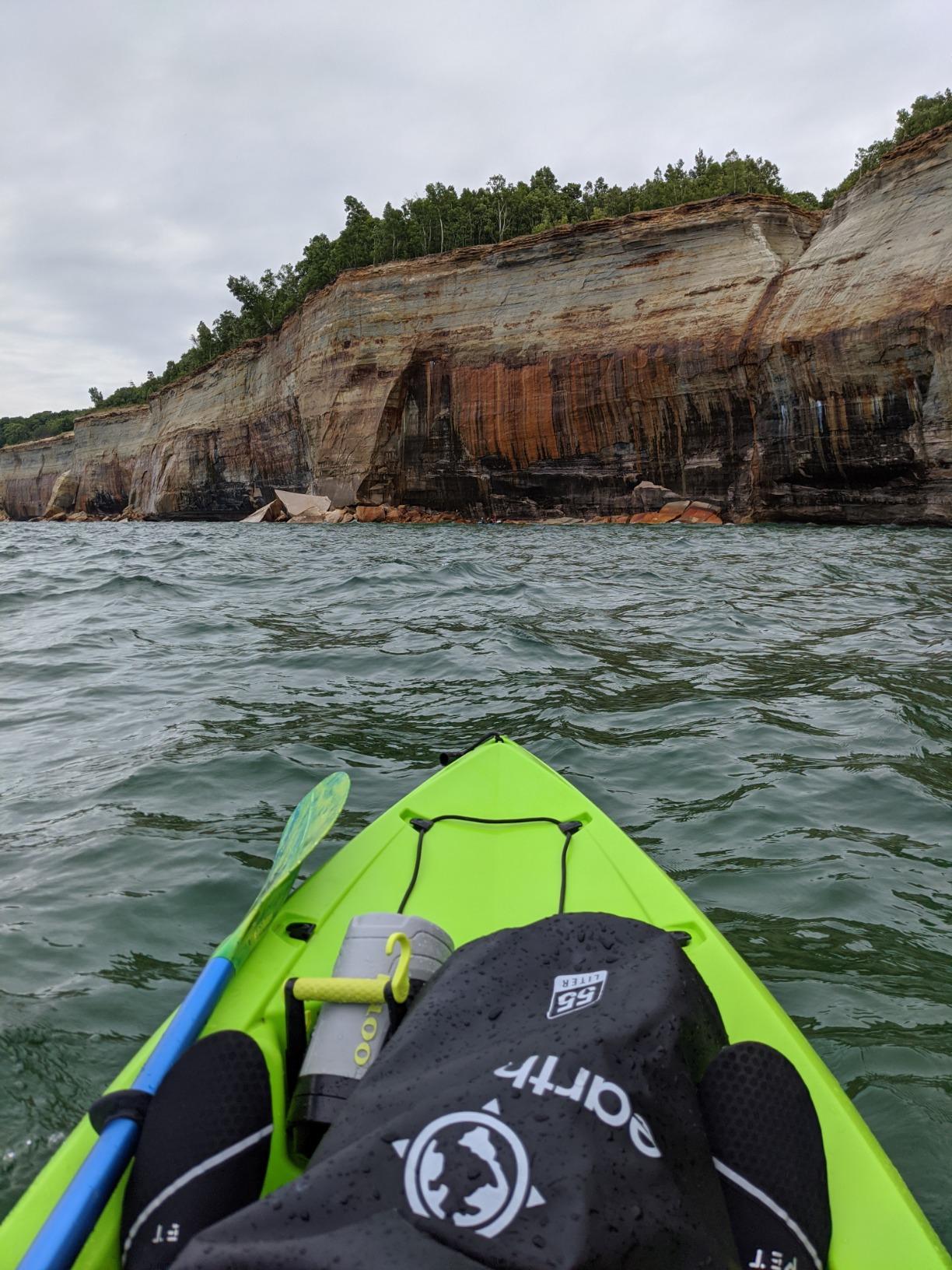
Owner feedback at 4.0 across 37 ratings is favorable on the fundamentals. Reviewers describe a sturdy first or second kayak that survives beach use and repeated hauling, and they like that the front and rear T-handles let two people carry it comfortably.
The rating average is the lowest in the group, and the reason is comfort over distance rather than any problem with the boat. The hard plastic seat base gets uncomfortable on long 15 to 20 mile trips, and the plastic backrest can crack if you lean back hard on it.
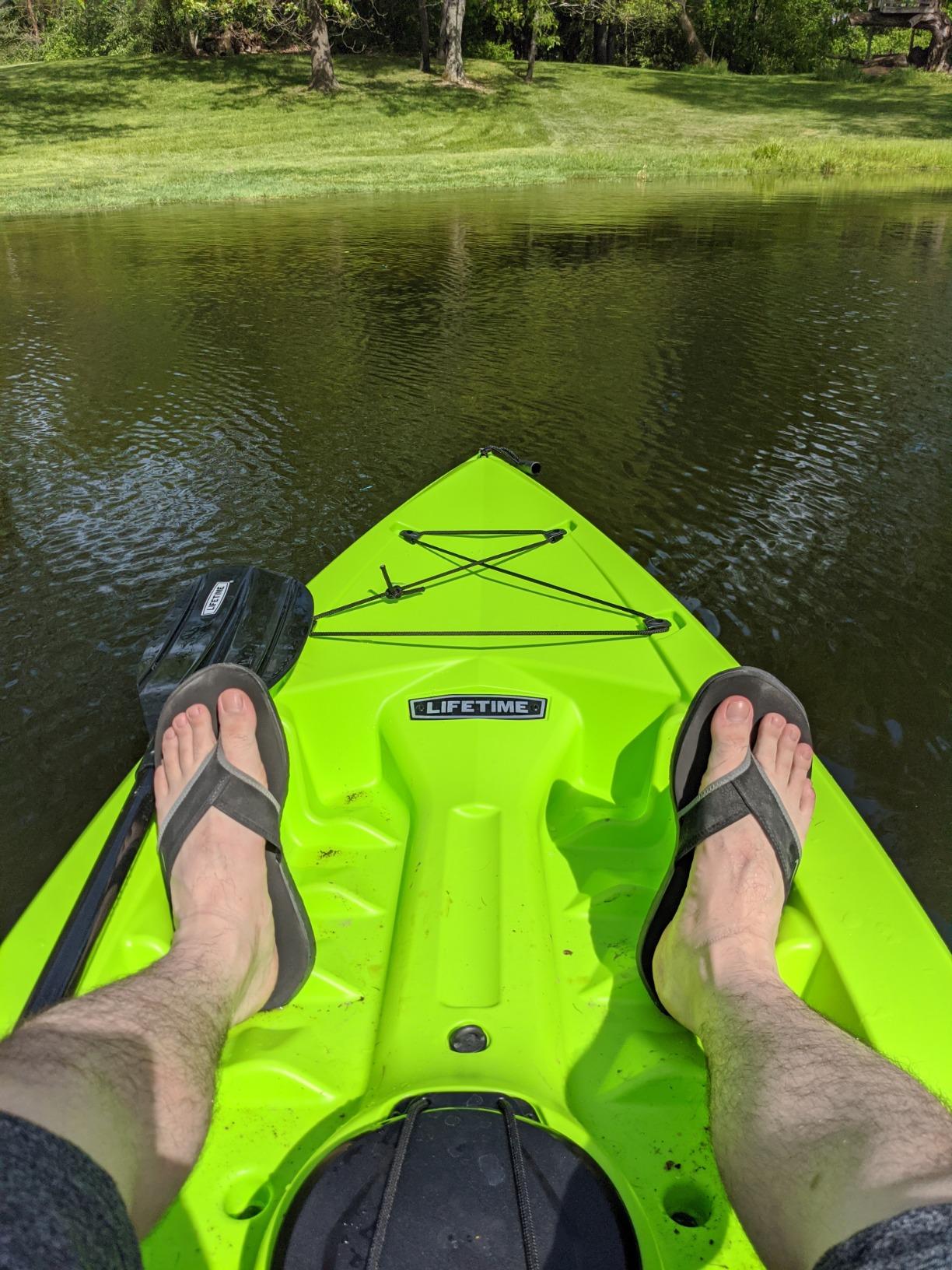
Where it beats the pricier boats
Simplicity. You can launch and fish the same afternoon it arrives. That matters when you have never paddled before, because every accessory you need to source first is a reason to put it off until next season.
Stability for its size. The flat bottom and chine rails handle open water waves without flipping, and the deep tracking channels give it enough speed to paddle against a current, which is not something a narrow 10 ft hull can do as comfortably.
Where you will feel the trade-offs
The hull is a stability-first design, so it is slower than a pointier boat such as a longer fishing kayak with a sharper entry. If you like to cover distance quickly rather than hold position, that trade-off shows up immediately.
The seat and the paddle are the two upgrades almost everyone makes. The included paddle is short, and a longer fishing paddle improves both speed and effort. The unpadded seat base is fine for a half day and unpleasant past that. Heavy enough to be awkward to carry solo, this is still a lighter boat than most 10 ft angler hulls.
9. Albott Modular Fishing Kayak – Propeller Power for Two
Albott Modular Fishing Kayak with Propeller Drive System & Durable HDPE
- Quiet propeller drive with easy reverse in tight docks
- Modular sections with internal carry handles
- Adjustable seat and multiple accessory upgrade points
- 400 lb capacity suits heavier users
- Cable-operated stern rudder steers smoothly
- 109.7 lb total weight makes solo handling a real effort
- Only a 6-month warranty which is the shortest here
- Propeller drive adds maintenance complexity
- Far fewer owner reviews than established brands
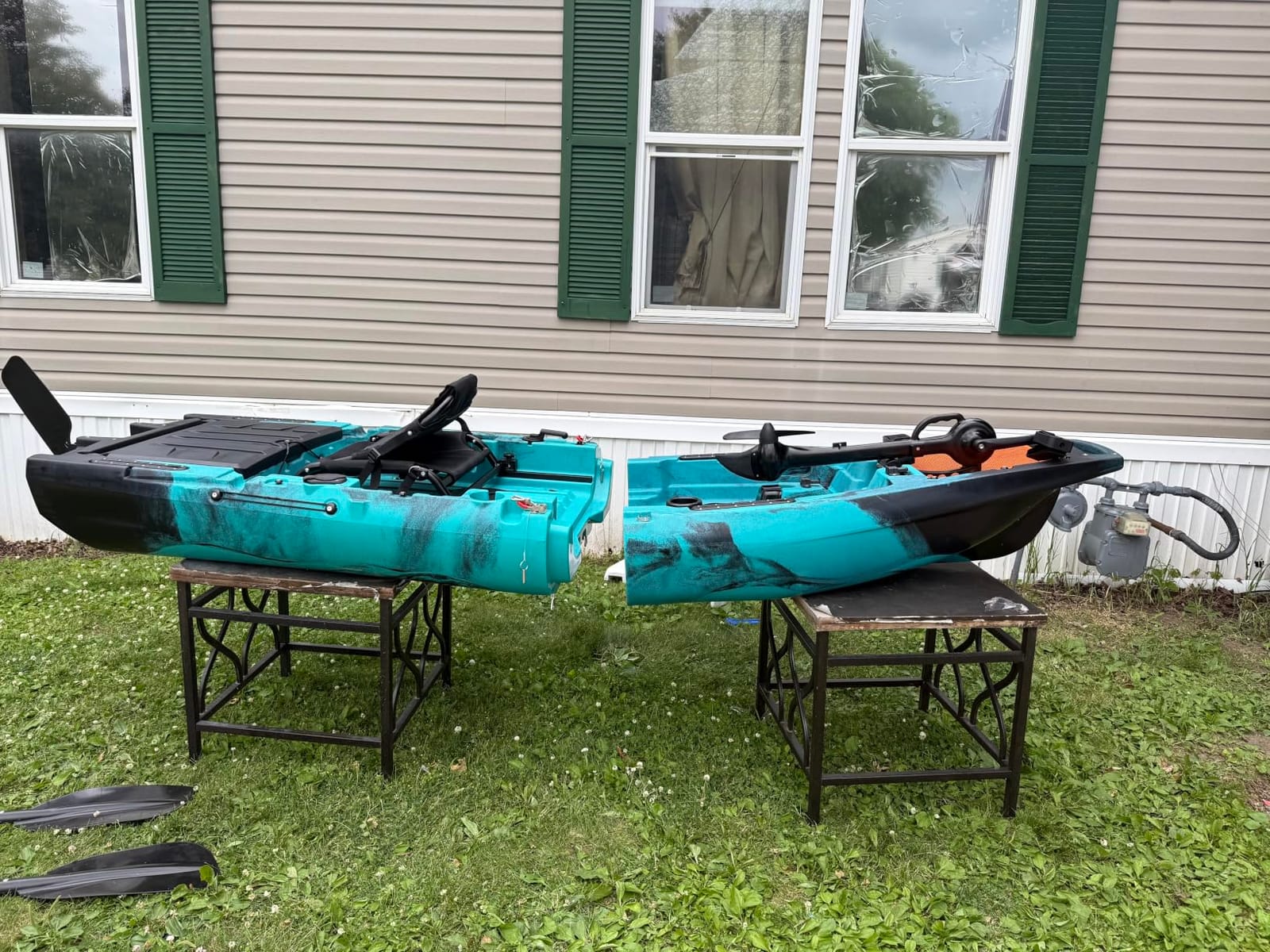
The Albott is the newest name in this roundup, and the only boat here whose published spec sheet lists a two-person seating configuration. It assembles from modular sections in a three-step process, seats two, and carries a 400 lb rated capacity on a reinforced HDPE hull.
Propulsion is a propeller drive rather than a fin drive or a paddle. The practical advantage is maneuverability in tight water: owners highlight quiet hands-free power and easy reverse for backing out of a dock, working a mangrove edge or repositioning in a small pond without fighting a paddle.
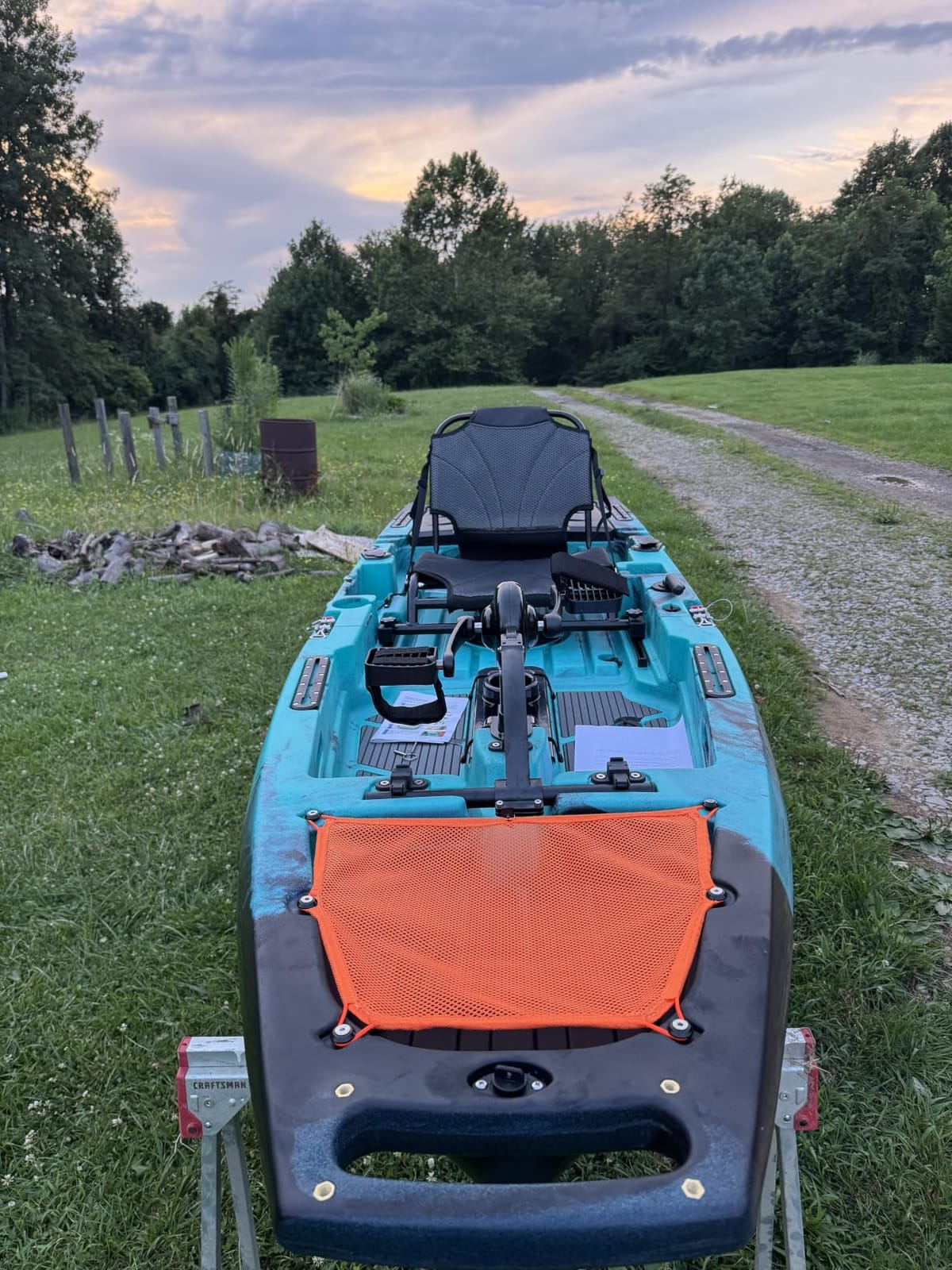
Construction details suggest this was designed partly for rental fleets. The sections use internal carry handles and secure pin connections with 304 stainless steel fittings, and the maker explicitly targets commercial rental use as well as private anglers.
At 4.5 across 34 ratings it holds an encouraging average with a small one-star share, but the sample is thin and the product is new. Treat the rating as encouraging rather than settled. The cable-operated stern rudder is a step up in feel from handle-mounted rudders, and the adjustable seat with multiple modular upgrade points lets you change the layout later.
Where it makes sense
Two anglers, or one angler and a lot of gear. A 400 lb capacity, a 34.68 inch beam and two-person seating configuration give you real room, and the propeller drive means neither paddler has to hold a paddle while casting.
Reverse steering is the quiet winner. Anyone who has spent an hour paddling a sit-on-top back up-current against the wind will understand why a drive with instant reverse changes a fishing day.
Where to be cautious
Weight is the biggest hurdle for a beginner. At 109.7 lb, this is by far the heaviest boat in the guide, and solo handling and launching take real effort even with the modular sections split apart.
Two other cautions. The warranty is six months, the shortest of any product we analysed, so hull problems would need a quick claim. A propeller drive also carries more mechanical complexity and maintenance than a paddle or a fin drive, and you should read more owner reviews before committing, simply because the evidence base is still small.
10. Lifetime Lockport 94 Modular – 40 lb In Two Nesting Halves
Lifetime Lockport 94 Modular Sit-on-Top Kayak with Paddle, Two-Piece Design with SlideLock System, Rod Holders, Adjustable Seat
- 40 lb total weight and two halves at about 24 lb each
- Halves latch together in seconds with no tools
- Durable sealed HDPE that will not leak easily
- Molded-in skeg tracks well and there are fewer parts
- Heavy for its size so it is slow and less agile
- No rudder and no adjustable seat height
- Molded footrests are fixed
- Unpadded seat with an uncomfortable center handle
- Lowest capacity here at 250 lb
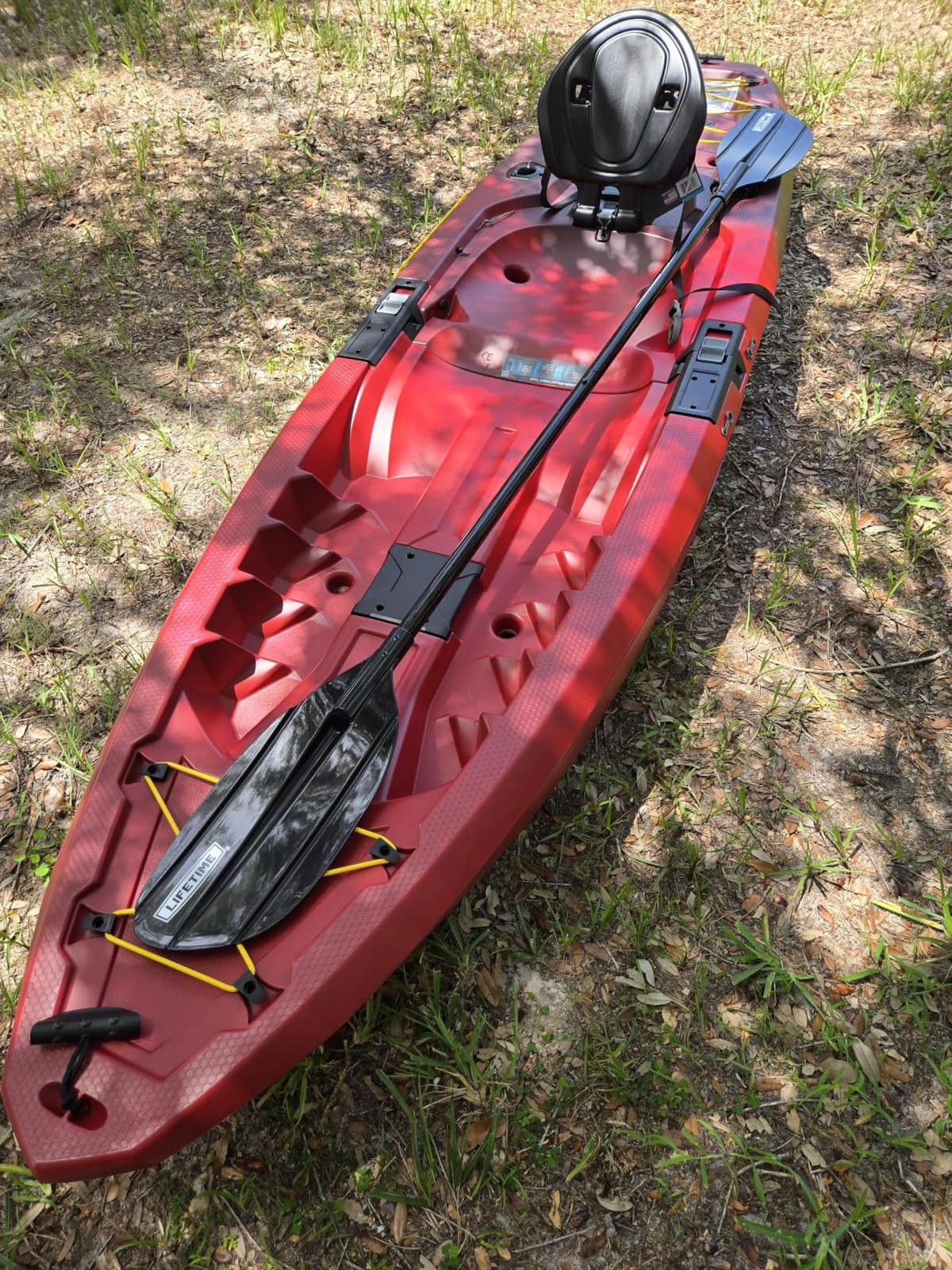
The Lockport 94 is the lightest hull in this guide at 40 lb, and the reason is the two-piece design. It joins with a SlideLock system into a 9 ft 4 in sit-on-top, then separates again so both halves nest and stack for storage or fit inside a small vehicle.
The rigging is more complete than the length suggests. You get two flush-mounted rod holders, a tank well with bungee lacing, a bottle holder, a paddle keeper, deep hull channels, chine rails and a molded-in skeg for straight tracking, with UV-protected impact-resistant HDPE throughout.
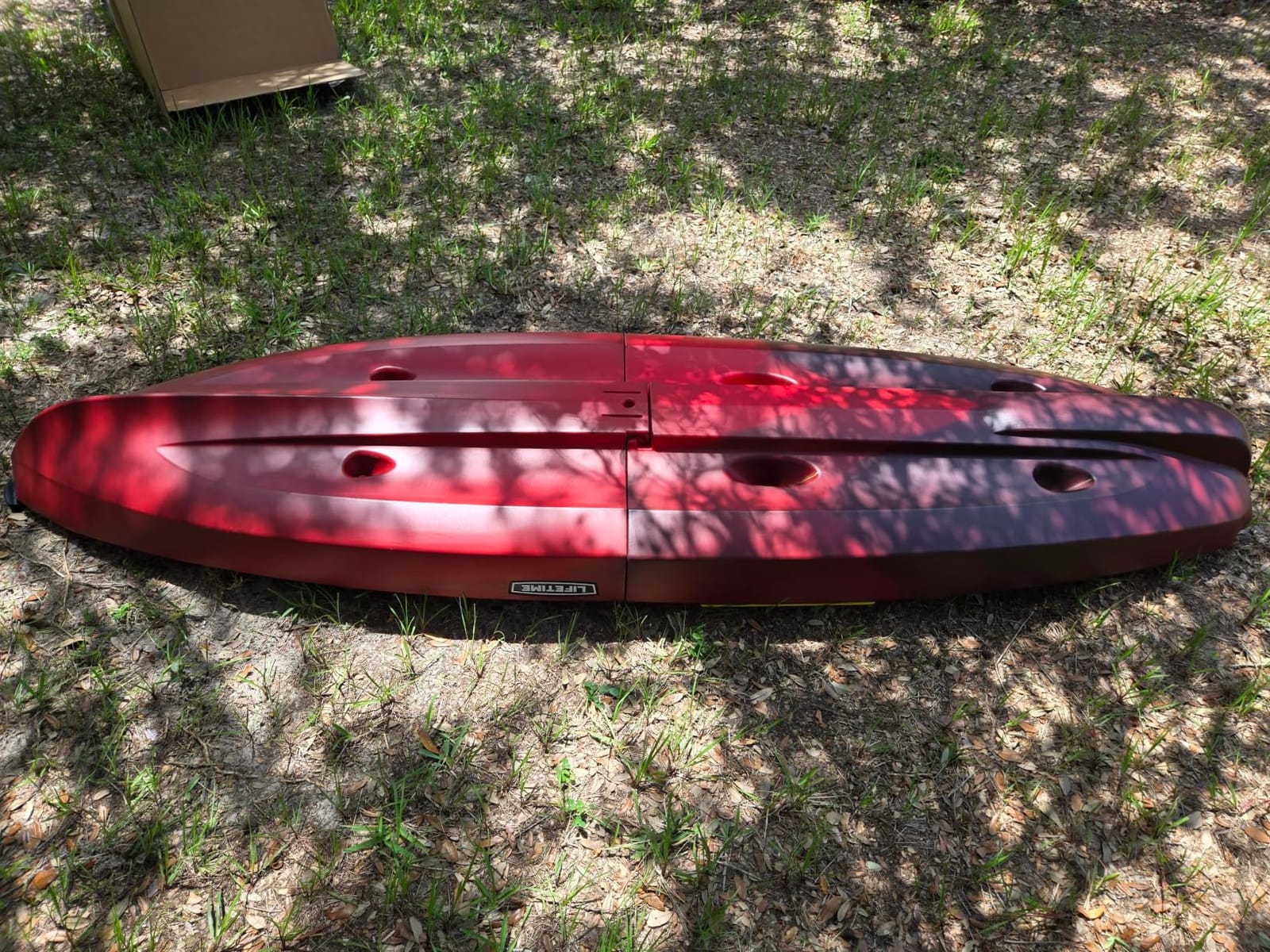
At 4.6 across 31 ratings it matches the Catch Mode 110 for the highest average in the group, and the one-star share is small. Owners describe halves that latch quickly with no tools and hold secure through boat wakes, and they like that fewer parts overall means less that can break.
The carry is the practical headline. Each half weighs about 24 lb with a mid-point grip, which is the difference between launching from a parking lot alone and needing a second person. Several owners also point out that the halves fit in a small SUV without a roof rack at all.
Why the split hull changes daily use
It converts storage from a problem into a non-issue. A 9 ft kayak normally occupies a garage wall or a ceiling rack for years. This one breaks into two pieces that nest, so a beginner who fishes two evenings a month is not paying for permanent floor space.
It also removes the temptation to skip the trip. Owners repeatedly say the reason they fish more often is that the boat is already in the car. For a first angler, that habit is worth more than any accessory.
What the trade-off costs
It is heavy for a 9 ft 4 in boat, which limits speed and turning agility on the water. There is no rudder and no height-adjustable seat, and the molded-in footrests are fixed rather than adjustable, so a much larger paddler will find the leg position cramped.
The seat is unpadded and a cushion is a common addition, and the center carry handle is reported as uncomfortable. Most importantly, the 250 lb rating is the lowest in this roundup, so it suits a lighter angler with a light gear load rather than a cooler-and-crate setup.
What Size Sit-On-Top Fishing Kayak Do You Need?
Most beginners should look at a hull between 10 and 13 ft long and at least 31 inches wide. Shorter boats under 9 ft feel twitchy to anyone above roughly 5 ft 10 in, because your knees and hips sit higher relative to the beam, and the boat rolls under small movements.
Community guidance on kayak fishing forums is consistent on that threshold: if you are taller than about 5 ft 10 in, go to a 12 ft hull or longer. That advice is why the 11 ft 6 in Perception models and the 11 ft 6 in Outlaw appear in this roundup rather than 9 ft boats for everyone.
Length buys tracking and speed but costs storage and turning radius. Width buys initial stability but costs efficiency against a current. A 34 inch tunnel hull such as the Pelican Catch models stays still while you cast; a 30 inch hull such as the Sentinel 100X moves more easily in a tight pond.
A rough capacity heuristic from the forums is useful as a sanity check: a 10 ft kayak supports roughly 250 lb of total load, and a 12 ft kayak roughly 350 lb. Use the manufacturer rating rather than the length, but the heuristic catches obviously undersized boats before you fall in love with one.
Weight Capacity Math: Body Weight Plus Gear Plus Fish
Rated capacity covers your body, your gear, your electronics, your anchor system and any fish you keep on board. That last term is the one buyers forget, and it is why a 275 lb rated boat feels cramped long before the number on the sticker is technically exceeded.
Run the arithmetic like this: take your body weight, add 50 to 80 lb for a realistic angler’s gear load, then add the fish you plan to keep. Your total load should sit at least 100 to 150 lb below the kayak’s rated capacity.
A worked example. A 170 lb angler carrying a cooler, tackle bag, dry bag, anchor, paddle and safety kit lands at about 245 lb of real load. A 275 lb rated hull clears that with 30 lb of room, which is tight once you keep a limit of fish. The same angler in a 350 lb rated hull has 105 lb of headroom and can fish all day without trimming the trip.
Forum regulars treat 300 lb as a practical minimum rating for an adult angler plus gear, and anything lower feels cramped quickly. If you weigh close to 300 lb yourself, look for 400 lb rated hulls or higher. The Outlaw 11.5 at 425 lb and the Albott Modular at 400 lb are the two options in this guide built for that.
Hull Type and Stability Explained
Beam width is the single clearest predictor of how stable a boat feels, and it is the first number to check. At 30 to 31 inches you get a boat that moves with you but stays manageable. At 34 inches and up you get a platform you can stand on in calm water, at the cost of speed.
Within width, hull shape decides behaviour. A flat bottom with chine rails is the traditional angler setup and resists tipping until the chine goes under, which is why the Lifetime Tamarack and Tahoma feel steady when you shift weight. A tunnel hull has a raised center section with channels down each side, giving a flat standing platform and easy entry, which is how the Pelican Catch models behave.
Multi-chine hulls step up through two or three chines and balance tracking with forgiveness. Pontoon hulls use two separate pontoons and are built for maximum stability at low speed, though none of the ten boats here uses that design. Ask about it if standing casts are your priority.
Initial stability is how the boat feels right as you get in and move around, and beam drives it. Secondary stability is what happens after the boat is tipped onto one chine and how fast it recovers, and that is where hull shape and length take over. Beginners care far more about the first number than the second.
Sit-On-Top vs Sit-In for Beginners
Sit-on-top wins on the things that matter for fishing. You get a flat open deck for gear, high initial stability, scupper drains that empty the boat once you are out of it, and easy re-entry after a capsize because you are not under a deck getting water.
Sit-ins win on warmth and dryness. They keep spray off you, and in cold water that matters. If your fishing happens in early spring on a northern lake, a sit-ins or a kayak with a skirt is worth considering, but you give up the deck space and casting position.
For a beginner angler, the deciding factor is not comfort in a photograph. It is whether you can get in, get out, and land a fish without a wrestling match. That is why every boat in this roundup is a sit-on-top.
Paddle vs Pedal Drive for a First Boat
Start with a paddle. The consensus across kayak fishing forums is clear that paddle-first beats pedal-first for beginners, because paddling teaches you balance, steering and self-rescue skills you need regardless of what drives the boat.
A pedal drive earns its place when you cover long distances alone, when you want hands-free movement for trolling or sight fishing, or when you fish water that is too shallow or weedy for a paddle to be efficient. The Raptor in this guide is the pedal option, and its two-piece hull is what really sets it apart.
A trolling motor sits in between for sheltered water, and one of the boats here, the Catch Mode 110, accepts up to 2.5 hp on the transom. That is a good middle path: paddle to the spot, then motor while you fish.
Safety Before Your First Float and the 120 Rule
The leading cause of death for kayakers is drowning, almost never the capsize itself. People fall out of a boat, cannot get back in, get cold, and drown. That is why the kit list matters more than the boat choice.
Wear a properly fitted personal flotation device every trip, and in cold water wear one you can swim in. Carry a whistle on a lanyard around your neck so it stays with you if you are separated from the boat, and use a paddle leash. Tell someone your route and launch time as a float plan, and practice re-entry from shore before your first real outing.
One more piece of self-bailing confusion to clear up. Scupper drains only empty water once you are out of the boat. While you are seated in the cockpit you will sit in whatever came in with you, so plan for a wet seat and a bilge sponge rather than assuming the boat drains itself.
The 120 Rule is a sizing guideline used across the paddling community: add your body weight in pounds to your gear weight in pounds, and that total should not exceed 120 percent of the hull length in inches. A 120 inch hull therefore points to a 144 lb combined load ceiling as a conservative figure, which is stricter than most manufacturer capacity ratings.
Use it as a safety margin, not a certification. Manufacturer ratings are load limits; the 120 Rule is a comfort guideline intended to keep you from riding a hull at its maximum. It is most useful as a warning that a short 94 inch hull like the Lockport 94 is a light-load boat.
The Year-One Upgrades Owners Actually Make
The most common owner complaint in this class is the seat, and the most common fix is a framed or stadium seat. Nearly every angler who fishes full days swaps the molded perch for one, which is why the Perception Access and the Sentinel 100X stand out for their factory seating.
The second is the paddle. Included paddles on budget boats are frequently too short, and a longer fishing paddle reduces effort and improves speed more than most beginners expect. Third is rod holders: two flush mounts means a clamp-on is worth adding early if you ever fish with more than one rod.
After that come the small parts. Buckets or cup inserts for bare hatches, since a hatch without an insert is just a hole with a lid. Cup holders if your boat lacks one. An anchor trolley with a stake-out pole for fishing a spot rather than drifting past it. An anchor kit is worth buying before you trust wind or current.
A final tip if you want to find structure before you launch: our guide to drones for beginners covers scouting from the air, which pairs well with a slower, wider boat like one of the Pelican Catch hulls.
Frequently Asked Questions
What is the best sit-on-top kayak for beginners?
The Lifetime Tamarack Angler 100 is our default pick. It weighs 51 lb, has a 31 inch beam, carries a 275 lb rating and includes a paddle, which covers the three numbers that decide most first boat purchases: solo lift weight, stability and loaded capacity.
What size kayak is best for a beginner kayaker?
Look at a hull between 10 and 13 ft long and at least 31 inches wide. Community guidance is that anyone taller than about 5 ft 10 in should choose 12 ft or longer, because a short narrow hull rolls under small movements. A rough check is that a 10 ft boat supports about 250 lb of load and a 12 ft boat about 350 lb.
Do sit-on-top kayaks have a weight limit?
Yes, and the limit covers your body, your gear, your electronics and any fish you keep on board. Add your body weight to a realistic 50 to 80 lb gear load and you want the kayak rated at least 100 to 150 lb above that total for a comfortable day on the water.
Are sit-on-top kayaks more stable than sit-ins?
On stability, deck access and easy re-entry, yes. A sit-on-top gives you a flat deck for gear, high initial stability and scupper drains that empty once you are out of the boat. Sit-ins win on warmth and dryness in cold water, which is the main reason to consider one instead.
Can a 300 lb person kayak?
Yes, with the right rating. A 300 lb angler plus a realistic gear load needs a 400 lb rated hull or higher for comfort. The Perception Outlaw 11.5 at 425 lb is the highest capacity boat in our roundup, and the Albott Modular at 400 lb is the other option for larger paddlers.
What is the 120 rule for kayaking?
Add your body weight in pounds to your gear weight in pounds. That total should not exceed 120 percent of the hull length in inches, so a 120 inch hull points to a 144 lb combined load ceiling. Treat it as a comfort and safety guideline rather than a certification, since it is stricter than most manufacturer capacity ratings.
Do beginners need a pedal drive fishing kayak?
No, not usually. Forum consensus is paddle-first because paddling teaches balance, steering and self-rescue skills you need either way. A pedal drive earns its place if you cover long distances alone, want hands-free movement for trolling, or fish shallow and weedy water where a paddle becomes tiring.
What is the leading cause of death for kayakers?
Drowning, almost never the capsize itself. People fall out of a boat, cannot get back in, get cold and drown. Wear a properly fitted PFD every trip, carry a whistle on a lanyard, use a paddle leash, tell someone your float plan and practise re-entry from shore before your first real outing.
Which Sit-On-Top Fishing Kayak Should You Buy First?
Buy the Lifetime Tamarack Angler 100 if you want one boat that gets almost everything right for a first season: a 51 lb hull one person can solo-load, a 31 inch beam that suits most paddlers, a 275 lb rating, three rod holders and a paddle in the box, backed by the largest owner review base in this class.
Switch to the Pelican Sentinel 100X if storage is your constraint, to the Pelican Catch Mode 110 if you want a wide casting platform and gear capacity, and to the Perception Outlaw 11.5 if you need the room for heavy gear or a partner. Whichever you choose, work out your loaded weight before you order, and put a proper PFD on before you launch.
Use the Check Latest Price buttons on each review to compare current listings, and check your local outfitter for demo days where you can sit in the cockpit before you commit.