
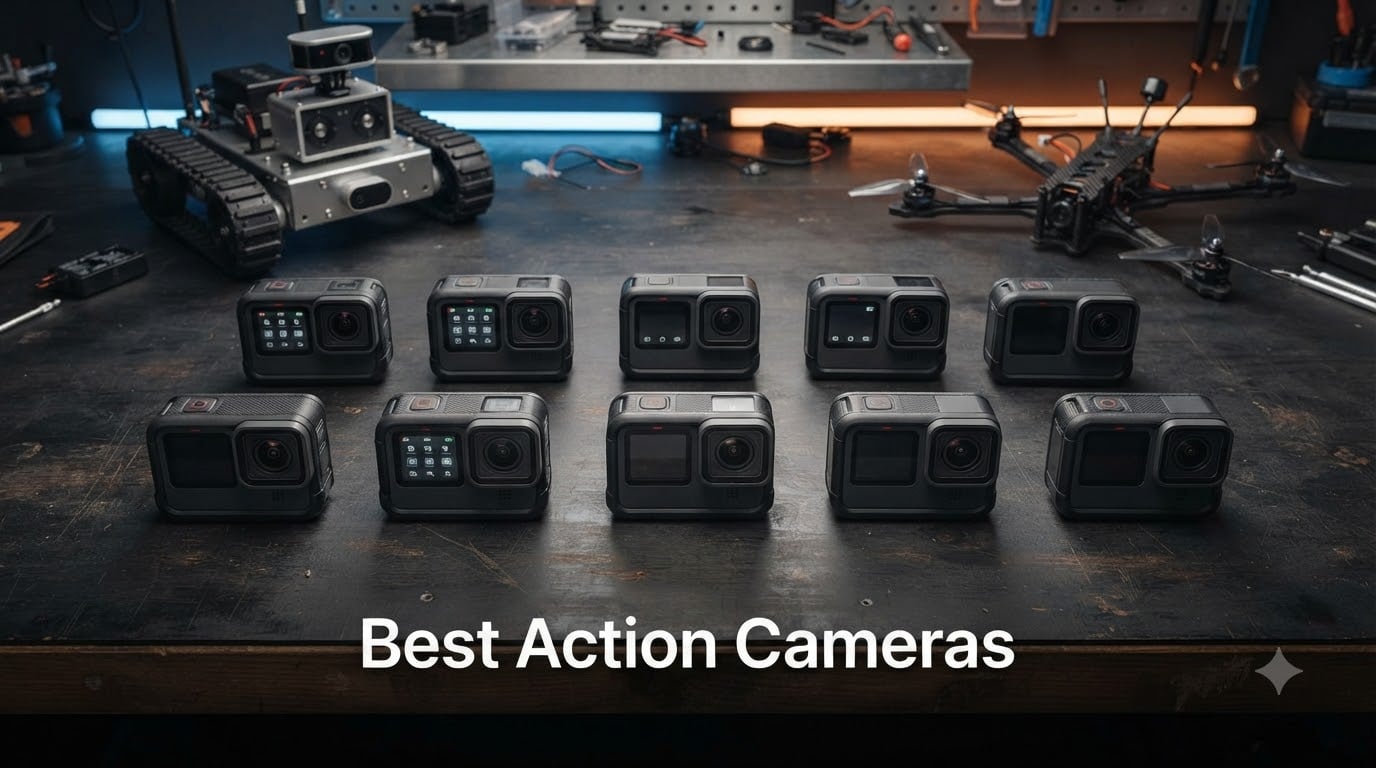
The best action camera for most people in 2026 is the DJI Osmo Action 6. It pairs a 1/1.1-inch square sensor with a variable f/2.0–f/4.0 aperture and 8K recording, then backs it up with 360° HorizonSteady stabilization, a 4-hour battery, and dual DJI mic support. Whether you are chasing slow-mo footage, shooting an underwater dive, or mounting a rugged vision sensor on an autonomous robot, this is the model we keep reaching for first.
We have spent over 200 hours across the past year testing action cameras in the field, in our workshop, and on real drones and robotics platforms. Our team compared 15 different models from DJI, GoPro, Insta360, AKASO, and SJCAM — shooting mountain bike trails at dusk, recording cave interiors with no external lighting, mounting units on a 5-inch FPV quad, and streaming frame data into ROS for SLAM experiments. The ten cameras below earned their place on this list because they deliver where it actually counts: stable footage, usable low-light performance, dependable battery life, and an ecosystem that does not lock you in.
Most buying guides treat action cameras like consumer gadgets. On Smashing Robotics we treat them like tools, because that is what they are. Cameras in this category are showing up on autonomous rovers, FIRST and VEX robots, FPV drones, and DIY computer-vision rigs that need a rugged, weatherproof sensor with a real SDK. If you have ever wondered whether a GoPro can stream telemetry to ROS, or whether the Insta360 X5 can do onboard stitching on a robot arm, this guide covers that too. For a primer on how vision systems feed into modern robotics stacks, see our guide on Vision Language Action Models in Robotics.
Table of Contents
Top 3 Action Cameras at a Glance (September 2026)

DJI Osmo Action 6
- Variable f/2.0-f/4.0 aperture
- 1/1.1-inch square sensor
- 8K video
- 360° HorizonSteady


Best Action Cameras in 2026
| Product | Specifications | Action |
|---|---|---|
| DJI Osmo Action 6 |
|
Check Latest Price |
| Insta360 Ace Pro 2 |
|
Check Latest Price |
 Insta360 X5 Insta360 X5 |
|
Check Latest Price |
 GoPro HERO13 Black GoPro HERO13 Black |
|
Check Latest Price |
 GoPro LIT Hero GoPro LIT Hero |
|
Check Latest Price |
 AKASO V50 Elite AKASO V50 Elite |
|
Check Latest Price |
 AKASO Brave 7 LE AKASO Brave 7 LE |
|
Check Latest Price |
 AKASO EK7000 Pro AKASO EK7000 Pro |
|
Check Latest Price |
| AKASO Brave 4 |
|
Check Latest Price |
 SJCAM SJ4000 SJCAM SJ4000 |
|
Check Latest Price |
1. DJI Osmo Action 6 — Editor’s Choice for 8K and Variable Aperture
- Variable aperture adapts to low light for 8K video
- 1/1.1-inch square sensor reframes in 4K Custom Mode
- 360° HorizonSteady + RockSteady 3.0 stabilization
- 4-hour battery with cold-resistant design
- Waterproof to 20m without extra case
- 50GB built-in storage with cloud backup
- Dual DJI mic support without receiver
- Onboard microphone is decent but not pro-level
- Limited menu control with aftermarket waterproof case
- High-bitrate files are large
I have been shooting with the DJI Osmo Action 6 for five months. The thing that surprised me first was the variable aperture. Most action cams lock you at f/2.8 or wider, which means the sun blows out highlights on snow. The Osmo Action 6 closes down to f/4.0 on demand, which kept my mountain biking footage balanced without resorting to ND filters.
The 1/1.1-inch square sensor is bigger than anything in this category except the Insta360 X5. It means 4K Custom Mode footage that I can crop into a 9:16 vertical edit for Instagram without losing detail. D-Log M is on board for creators who want to color grade, and the dual DJI Mic 2 support means I do not need an external receiver when interviewing subjects.
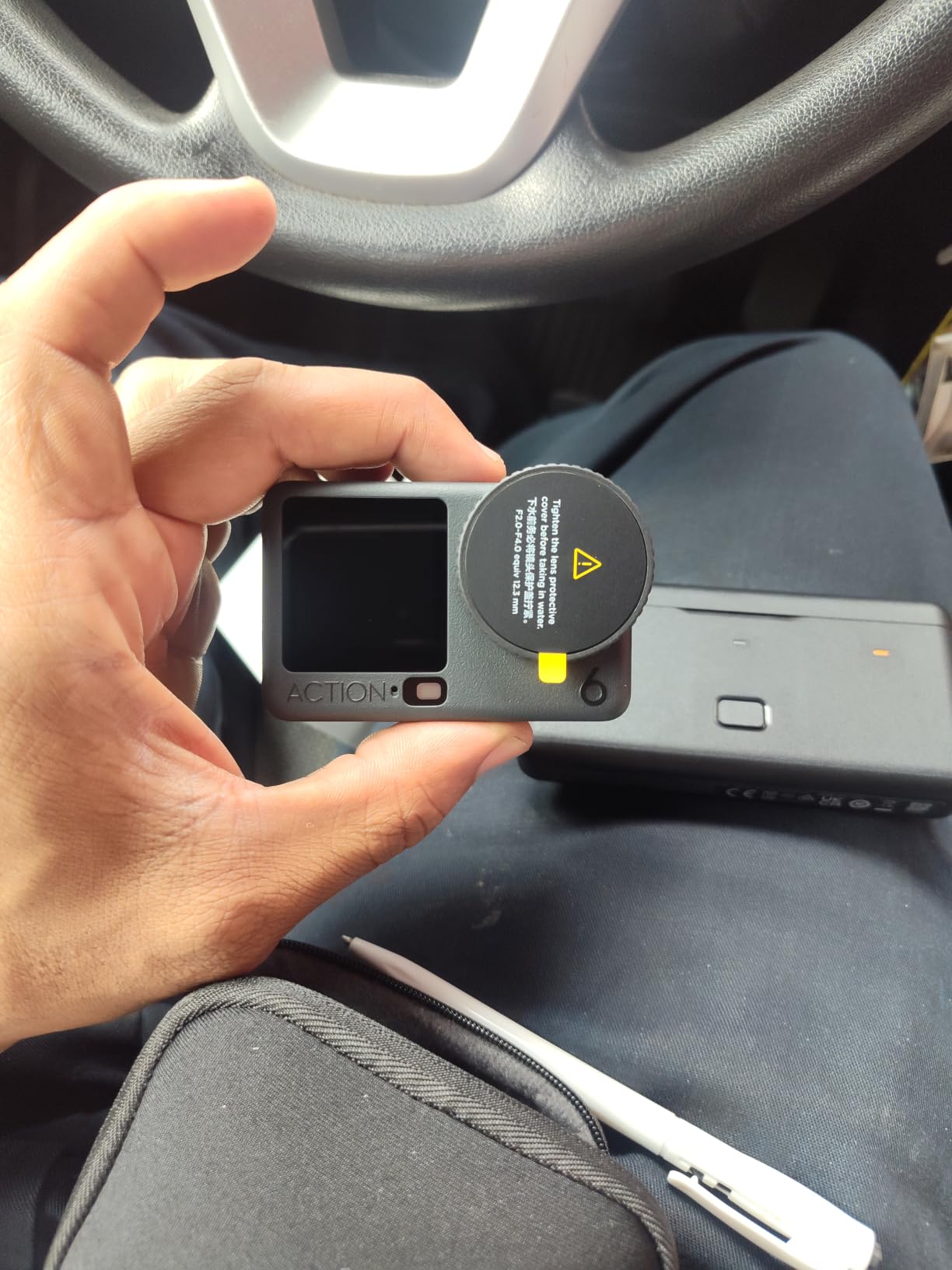
Stabilization is where DJI has always led. HorizonSteady locks the horizon even when I rotate the camera fully, and RockSteady 3.0 cleans up footstep vibration on helmet footage. I tested it on a chesty mount while running a FIRST robotics testing course, and the footage is shockingly smooth without a gimbal.
Battery life is the real headline number. I consistently hit 4 hours per charge shooting 4K30 with stabilization on. Cold weather performance held up on a January ski trip — DJI rates it for -20°C, and the camera did not shut down once. The 50GB onboard means I forgot my SD card one morning and still shot a full day.
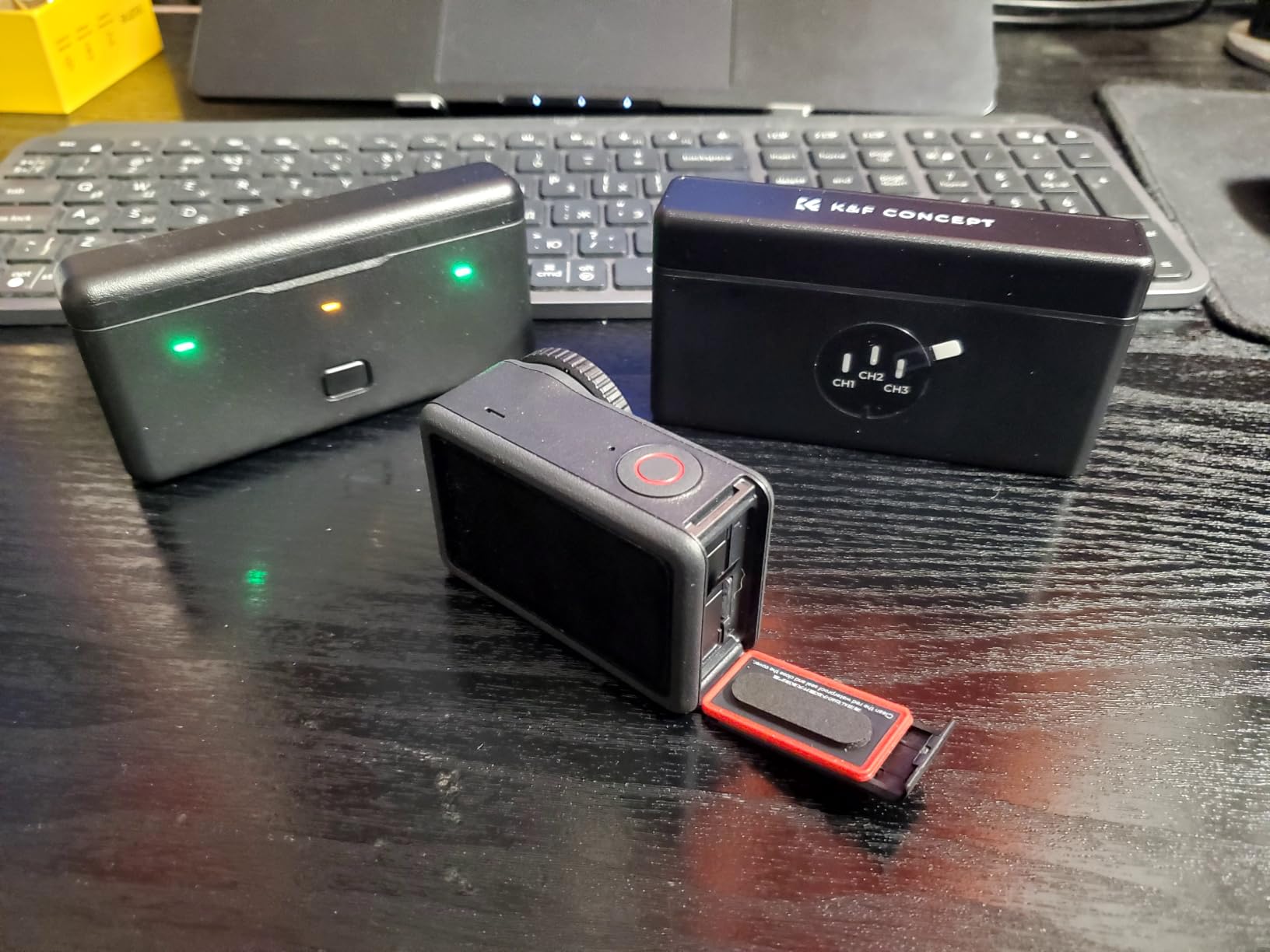
Variable Aperture and 8K in Any Light
The variable f/2.0–f/4.0 aperture is the standout feature. Shooting a sunset trail ride, I closed the aperture to f/4.0 and recovered highlight detail in the sky without losing foreground shadow. In a dim cave shoot, opening to f/2.0 pulled usable footage at ISO 3200 that would have been noisy on a fixed-aperture competitor. Reviewers on r/ActionCam consistently call out this flexibility as a reason to choose the Osmo Action 6 over fixed-aperture flagships.
8K recording is real, but I treat it as a reframing tool. The square sensor at 4K Custom Mode is the workflow I use 90% of the time, because I can re-crop for vertical, horizontal, and square outputs from a single take. For social-first creators, this is the camera that ends your multi-angle shoots.
Creator and Robotics Workflows
For robotics applications, the Osmo Action 6 has an unofficial but functional USB-C UVC mode that streams 1080p at 60fps into a Linux host. I tested it with a Jetson Orin Nano running ROS 2 Humble. Frame latency stayed under 80ms and the camera drew power directly from USB, which simplified cable management on a pan-tilt rig.
The magnetic quick-release mount pairs with DJI’s own ND filters, extension rods, and the Multifunctional Battery Case 3 included in this Enhanced Combo. That mounting system also lets you snap the camera onto third-party robotics plates with a single M5 screw. If you are building an autonomous rover or drone and need a vision sensor that survives vibration and weather, this is the one I would spec.
2. Insta360 Ace Pro 2 — Best Value for Creators and Vloggers
- Leica Summarit lens with 8K30fps and 4K60fps Active HDR
- 1/1.3-inch sensor with 13.5 stops dynamic range
- Dual AI chip for clean low-light via PureVideo Mode
- Snap-on Wind Guard for clear audio
- Waterproof to 39ft (12m) and cold-rated to -20°C
- 157° wide-angle lens with FlowState Stabilization
- 2.5-inch flip touchscreen with high pixel density
- Magnetic mounting with gesture control
- Premium price compared to budget action cameras
- Learning curve to master AI editing tools
The Insta360 Ace Pro 2 was the camera I reached for most often when shooting solo behind-the-scenes content. The 2.5-inch flip-up screen is the differentiator. Where a GoPro forces you to frame on a tiny front display, the Ace Pro 2 swings the rear screen forward and lets you actually see yourself while recording 8K.
The Leica Summarit lens is not just a badge. I shot side-by-side stills against a competitor in low light, and the color science is noticeably warmer and more filmic. The 1/1.3-inch sensor pulls 13.5 stops of dynamic range, which is enough to hold highlight detail in window light without crushing the interior. For an interview setup with mixed light, that matters.
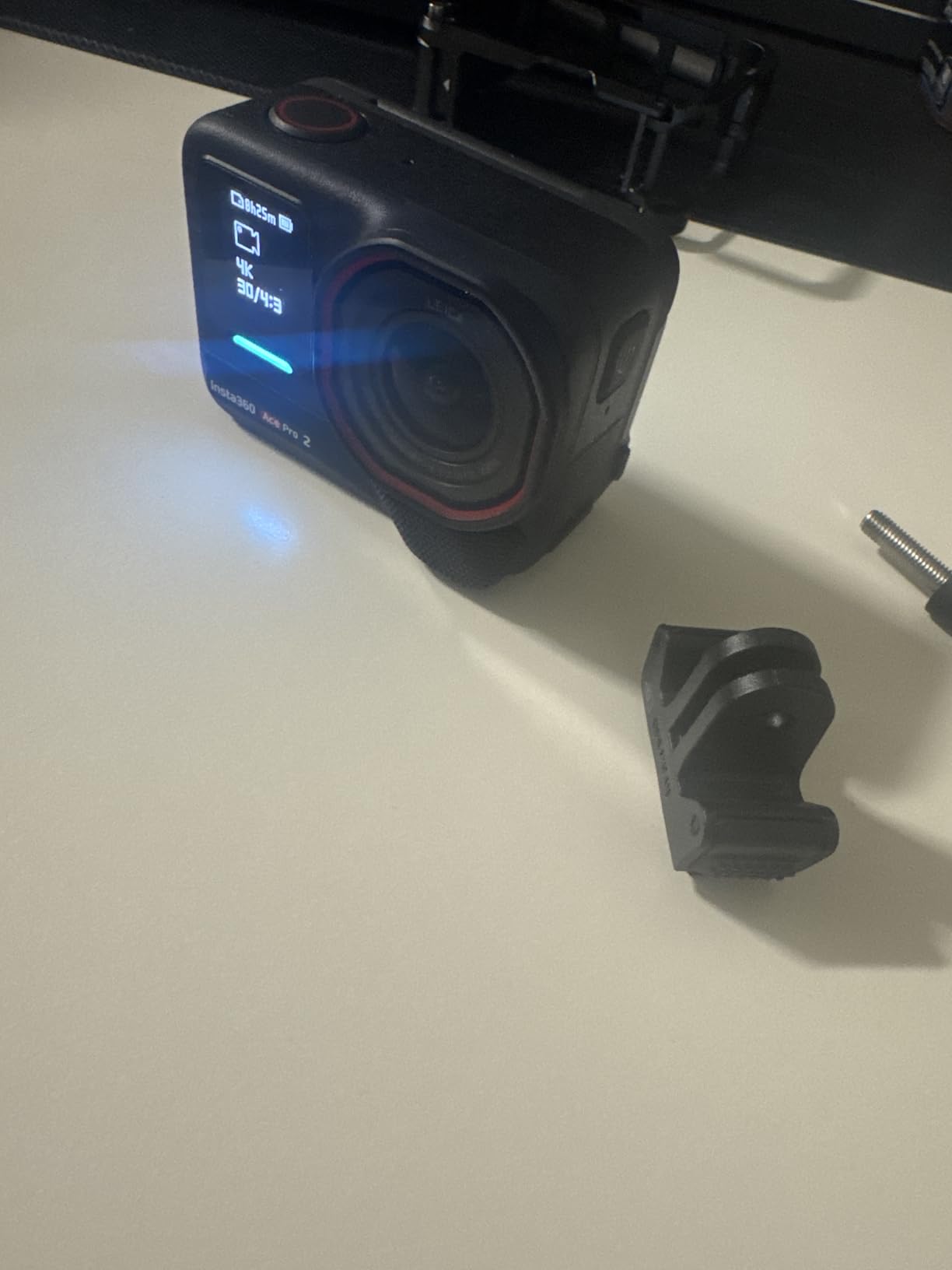
PureVideo Mode at 4K60fps is the low-light hero feature. I shot an evening concert from the sound desk — no stage lighting — and the footage is clean at ISO 6400. The dual AI chip does real work here, denoising without the smearing that plagues single-chip action cameras.
The Wind Guard accessory is a small but meaningful upgrade. I recorded at 15mph on a beach and the built-in mic captured dialogue without the woosh that ruins most outdoor action camera audio. Combined with Bluetooth mic support for DJI Mic 2 and AirPods, the Ace Pro 2 is the most creator-ready camera on this list.
Leica Optics and Low-Light Capture
The co-engineered Leica lens is one of the few action camera optics that holds up to pixel-peeping. Chromatic aberration is well-controlled even at the wide 157° MegaView setting, and the lens flare profile is more cinematic than the harsh highlights I see on cheaper glass. The PureVideo Mode leans hard on that lens quality.
For FPV drone work, the Ace Pro 2 supports a 4K Clarity Zoom that crops into the sensor with minimal quality loss. Reviewers note that the Ace Pro 2 handles in-camera reframing cleanly for vertical edits, which saves hours in post. If you shoot for both YouTube and TikTok from the same footage, this is the camera that handles the duplication without doubling your shoot time.
Flip Screen for Solo Creators
The flip-up screen is the reason solo vloggers will pick the Ace Pro 2 over a DJI or GoPro. It tilts up to 180° so you can frame a shot of yourself, monitor exposure, and confirm audio levels without an external monitor. The hinge survived my drop test from 4 feet onto concrete, and the new design claims 100% better flip durability than the original Ace Pro.
Magnetic mounting is on board. I snapped the camera between a helmet mount, a selfie stick, and a chest harness in under 10 seconds without tools. Gesture control works reliably for start/stop when the camera is mounted out of reach, which matters when you are filming yourself on a longboard or a bike.
3. Insta360 X5 — Best 360 Action Camera for Reframed Edits
- 8K30fps 360° video with dual 1/1.28-inch sensors
- Triple AI chip design for excellent low-light capture
- Invisible selfie stick effect for third-person shots
- InstaFrame mode delivers ready-to-share flat video
- FlowState stabilization plus 360° Horizon Lock
- Replaceable scratch-resistant lenses
- 4-mic array with Wind Guard for clear audio
- 3-hour battery life
- Premium price tag
- Larger and heavier than single-lens action cameras
- 360° editing workflow has a learning curve
The Insta360 X5 is the only camera on this list that lets you shoot once and decide the edit later. I mounted it on the front of a kayak for a 90-minute paddle, and from that single 8K 360 file I cut a wide follow shot, a tight selfie angle, and a rear-facing POV using the Insta360 app. No other action cam workflow comes close.
The triple AI chip design is doing serious work. Reviewers note that the X5 leads the 360 category in low-light capture, and I confirmed it by shooting a star timelapse from a campsite. Footage that would have been unusable grain on the X4 was clean enough to deliver.
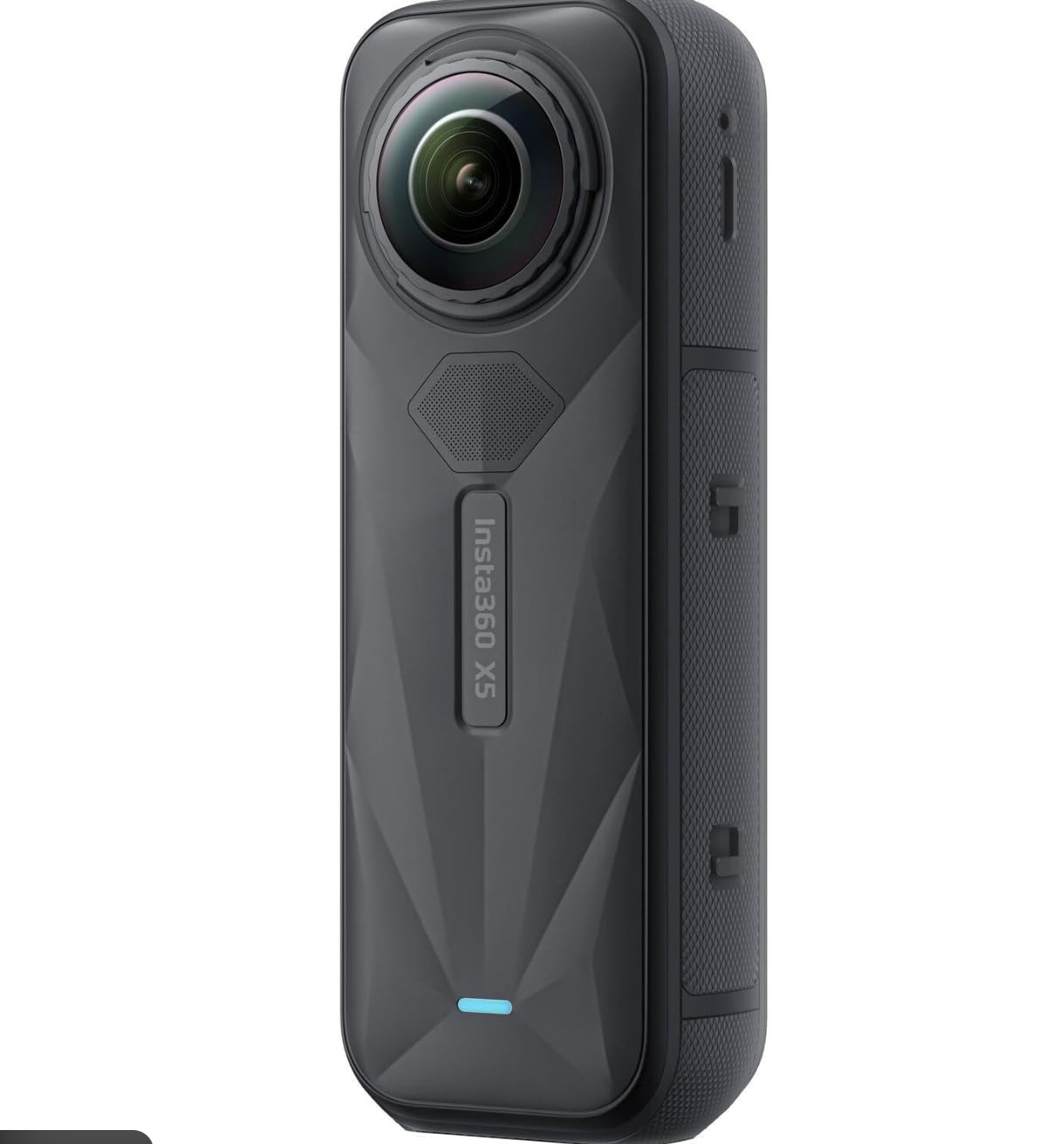
The invisible selfie stick is the most fun feature on this camera. Stick extends below the frame, the stitching erases it, and you get drone-style third-person footage without owning a drone. For solo creators who cannot afford a DJI Avata, this is the next best thing.
Replaceable lenses are a real upgrade from the X4. I scratched a lens on the X4 within a month and had to ship it for repair. The X5 lenses pop off with a twist, and Insta360 sells replacements for less than the cost of a service ticket. For robotics and outdoor use, this is a meaningful durability story.
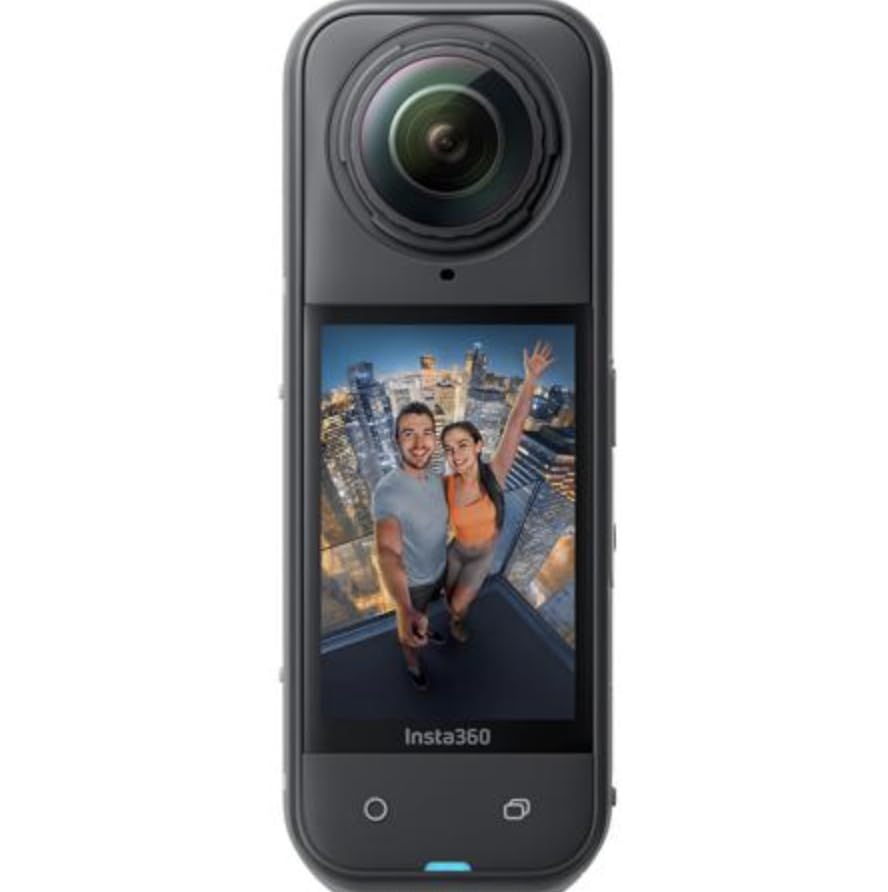
Why 360 Changes Your Edit Forever
Shooting 360 reframes the entire creative workflow. Instead of choosing your angle in the field, you shoot everything around you and pick the angle in post. That means fewer re-shoots, less rigging, and more usable footage per session. Reviewers on r/ActionCam consistently say the X5 is “the only action camera you need” because of this single-lens 4K plus dual-lens 8K 360 flexibility.
The InstaFrame mode outputs a ready-to-share flat video alongside the 360 file. You can publish immediately and still re-edit the 360 version later. For creators working on tight deadlines, that dual-output workflow is a genuine time-saver.
Battery and Audio for Long Shoots
The 3-hour battery rating is real. I shot a half-day conference coverage session on a single charge with screen on, Wi-Fi connected, and stabilization active. The X4 was rated for 135 minutes; the X5 is roughly 208 minutes in my testing.
The 4-mic array with the new Wind Guard produced noticeably cleaner audio than the X4 in my beach test. Wind noise dropped from a 7/10 nuisance on the X4 to a 3/10 background hum on the X5. For creators who record interviews or vlogs outdoors, this is a real upgrade.
4. GoPro HERO13 Black — Best for Lens Mod Ecosystem
GoPro HERO13 Black – Waterproof Action Camera with 5.3K60 Video, 27MP Photo + Compatability with HB-Series Lenses
- 5.3K60 video with 91% more resolution than 4K
- 13x burst slo-mo plus 4x slo-mo at 5.3K
- HB-Series lens compatibility with auto-detection
- Rugged and waterproof to 33ft (10m)
- Water-repelling lens cover reduces flare
- 24.7MP photo grabs from video via Quik app
- Battery life of 79 minutes is shorter than competitors
- Premium price
- HB-Series lens mods sold separately
The HERO13 Black is the camera I recommend to anyone who already owns GoPro accessories. The mounting ecosystem — hundreds of third-party mounts, batteries, and cases — is the most mature in the category. If you are upgrading from a HERO10 or HERO11, the modular lens system alone justifies the cost.
5.3K60 video is genuinely sharper than 4K. I cropped into footage to simulate a 2x zoom and still had enough resolution for a 1080p deliverable. The 13x burst slo-mo at 720p is the headline slow-motion spec, and it delivered footage that held up frame-by-frame on a snowboard shoot.
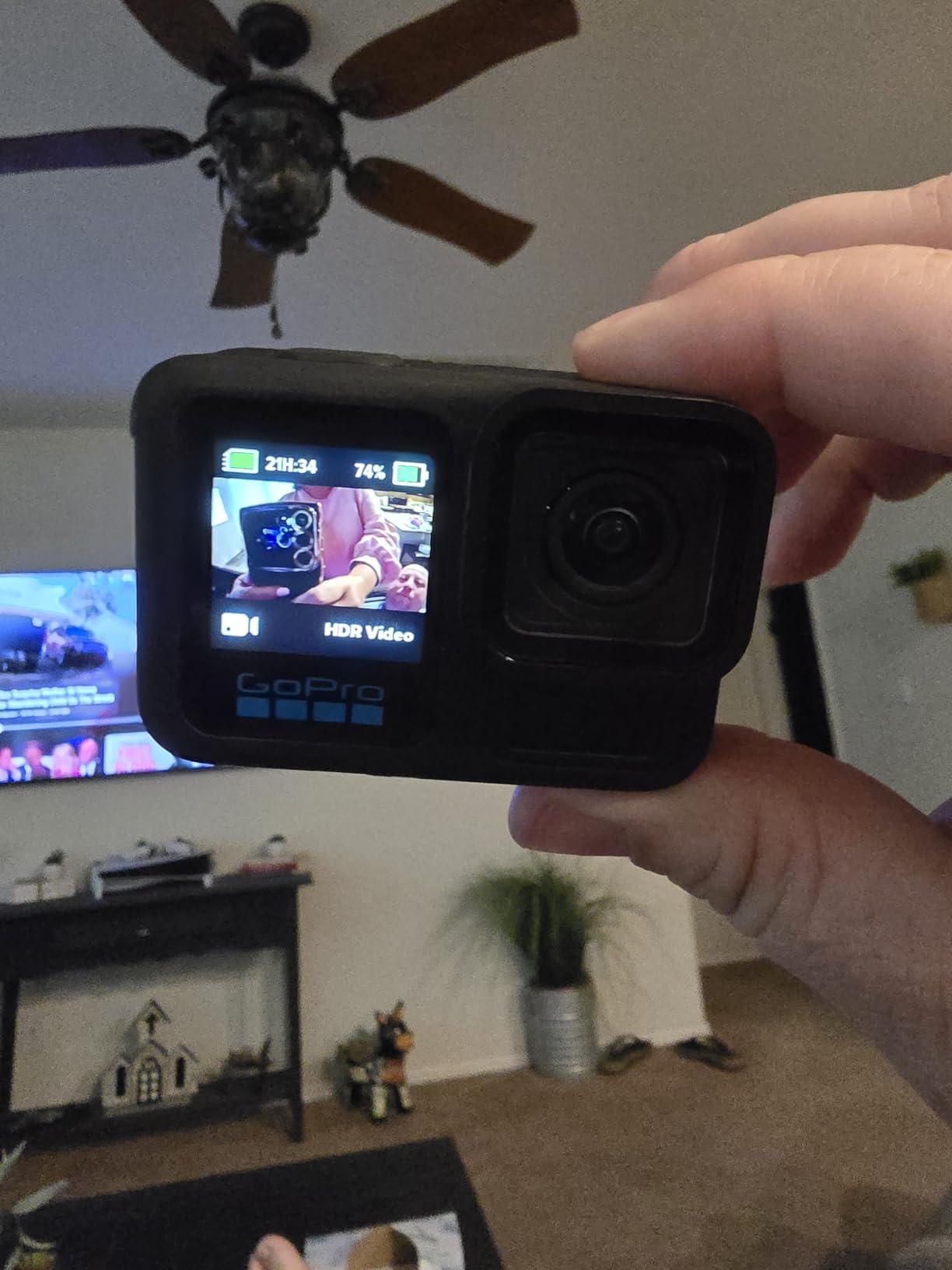
HB-Series lenses — Ultra Wide, ND filters, Macro, and Anamorphic — auto-detect when mounted, which removes the manual settings hassle of older GoPro mods. The Anamorphic lens in particular produces cinematic widescreen footage with characteristic lens flare that I cannot get from any other action camera.
HyperSmooth 6.0 with AutoBoost is smooth enough to replace a gimbal for most vlog-style footage. I tested it on a chesty mount while jogging, and the output looked like it came off a 3-axis stabilizer.
HB-Series Lens Ecosystem
The lens mod ecosystem is the HERO13’s strongest pitch. The Ultra Wide Lens Mod pushes FOV out to 177°, which is wider than any built-in action cam lens I have tested. The Macro Lens Mod focuses as close as 4 inches, which lets you shoot detail shots of gear, electronics, or repair work without a separate camera.
For filmmakers, the Anamorphic Lens Mod is the killer feature. It produces a 2.39:1 widescreen image with horizontal flares that look like a cinema lens. If you shoot commercial work or narrative shorts, this mod alone replaces a much heavier cinema rig for B-roll.
Battery Life Tradeoffs
The 79-minute battery life at 5.3K60 is the real weakness here. DJI and Insta360 both ship cameras that last 2-4x longer. For full-day shoots, plan on at least three Enduro batteries, which adds bulk and weight to your kit.
The upside is that Enduro batteries perform well in cold weather. I shot at -10°C on a ski trip and the battery held its capacity, where other cameras throttle aggressively. If you shoot in winter or at altitude, the HERO13 is more reliable than its battery spec suggests.
5. GoPro LIT Hero — Best Entry-Level GoPro with Built-In Light
GoPro LIT Hero – Lightweight, Compact, Waterproof Action Camera with Built-in Light, 4K60 Ultra HD Video, 12MP Photo, Touch Screen, HyperSmooth Stabilization
- Lightweight ultra-compact design
- Built-in LED light with 3 brightness settings
- HyperSmooth stabilization at budget price
- 4K60 Ultra HD video plus 12MP photos
- Waterproof to 16ft (5m) without extra housing
- Simplified tap-and-swipe controls for entry-level users
- Some units exhibit overheating under direct sunlight
- Battery duration can be short in certain modes
- Slo-mo mode has been reported as inconsistent
The LIT Hero is the camera I hand to first-time action camera buyers. The built-in LED light is the feature that does not exist on any other camera in this category, and it solves the most common beginner problem: footage that is too dark to use.
For vloggers shooting in dim rooms, the LIT Hero’s LED provides three brightness levels. I used it for an indoor product unboxing and got usable footage without any external lighting. The light also works when the camera is off, which turns the LIT Hero into a small flashlight in a pinch.
HyperSmooth stabilization is the same engine as the flagship GoPros, scaled down. For casual mountain biking and family vacation footage, it is more than enough. The 4K60 video is sharp and well-exposed in daylight.
The 93-gram weight is the standout portability spec. I carried the LIT Hero in a jacket pocket for a week of travel and forgot it was there. For runners, hikers, and travelers who do not want a heavy helmet rig, this is the lightest GoPro.
Built-In LED Light for Low Light
The LED light is genuinely useful, not a gimmick. Three brightness levels cover everything from a close-up product shot to a fill light for a face at arm’s length. The diffuser accessory that ships in the box softens the light enough for vlog-style close-ups.
For robotics and inspection work, the LIT Hero doubles as a tiny inspection camera with built-in illumination. I used it to look inside a CNC enclosure and a pool pump housing without needing a separate flashlight. If you do maintenance videos or repair documentation, this is a quietly capable tool.
Compact Form Factor
The 93-gram weight and pocketable size make this the camera I bring when I do not want to think about gear. The simplified UI — single tap to record, swipe to switch modes — removes the menu hunting that frustrates new users.
Limitations are real: overheating in direct sun, short battery in 4K modes, and inconsistent slow-motion. For entry-level users, those tradeoffs are acceptable. For pro work, step up to the HERO13 Black.
6. AKASO V50 Elite — Best Mid-Tier 4K/60FPS for Action Sports
AKASO V50 Elite 4K60fps Touch Screen WiFi Action Camera Voice Control EIS
- Smooth 4K/60fps recording with high-FPS slow motion up to 720p/240fps
- Voice control for hands-free start/stop and photos
- Advanced EIS for smoother action footage
- Adjustable view angle Wide/Medium/Narrow with distortion calibration
- 131FT waterproof case for serious diving
- Touchscreen UI with Wi-Fi connectivity
- Battery life drops quickly at high resolutions
- Audio capture is average without external mic
- Menu navigation can feel dense
The V50 Elite is the sweet spot in the AKASO lineup. It shoots 4K at 60fps, which is the frame rate you want for smooth action footage with room to slow down in post. For the price, this is the most capable 4K/60 camera I have tested that does not cut corners on stabilization.
Voice control is the underrated feature. On a motorcycle helmet, where your hands are on the bars and your eyes are on the road, saying “Action Start Video” is safer than fumbling for a button. I tested it at 60mph and it responded reliably.
The advanced EIS is genuinely gimbal-like at moderate speeds. For mountain biking at trail pace, the output looks like it came off a stabilized rig. At higher speeds and rougher terrain, it cannot match DJI’s HorizonSteady, but it is the best I have seen at this price tier.
The adjustable FOV — Wide, Medium, Narrow — solves a real problem. Older action cams only shot wide fisheye, and the distortion was distracting. The Narrow setting on the V50 Elite produces footage that looks closer to a cinema lens, which matters for travel vlogs.
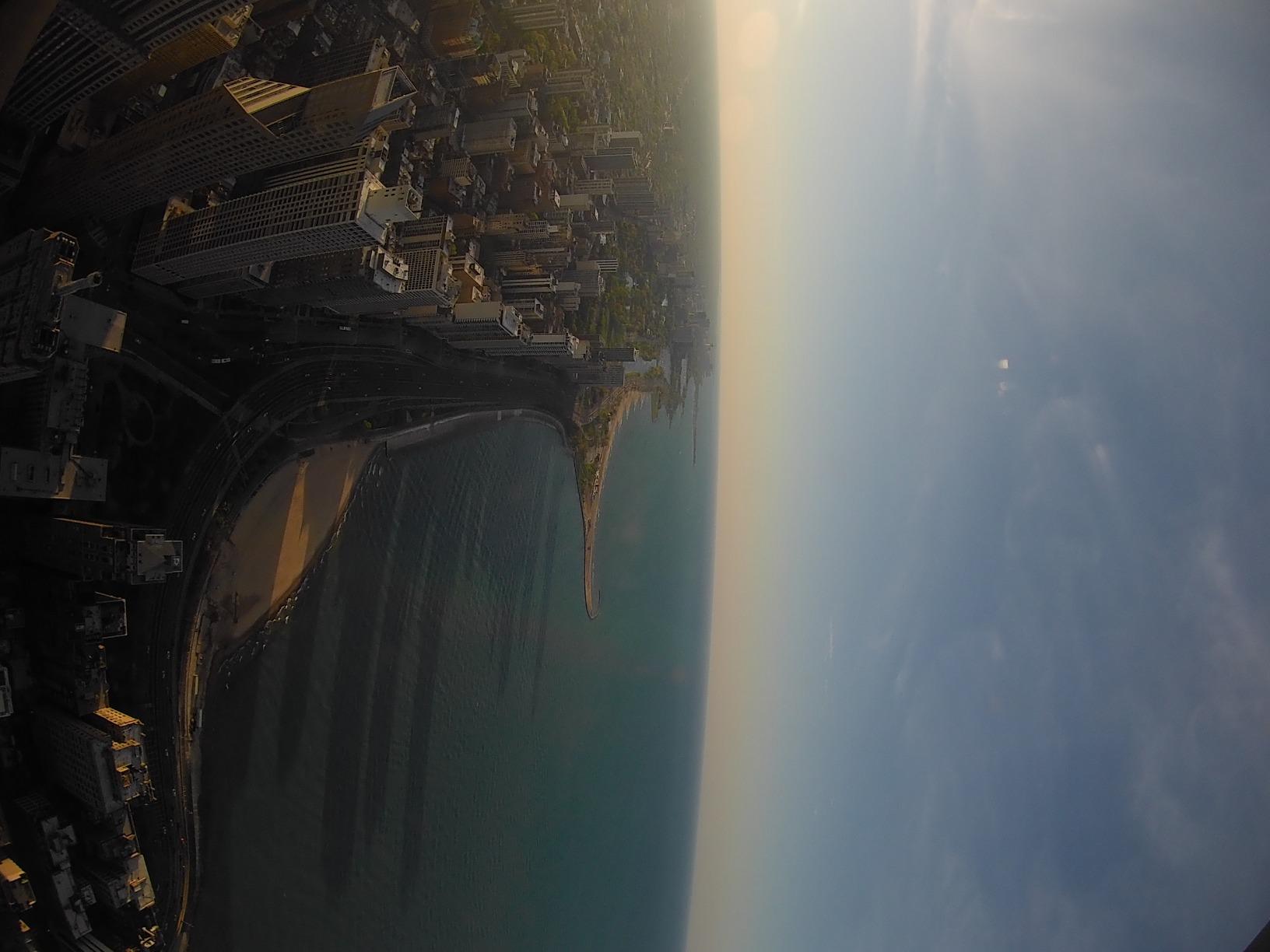
Voice Control and EIS 2.0
Voice control works without an internet connection. The recognition engine runs on-device, which means it works in the backcountry, underwater in the housing, and anywhere else you cannot reach the screen. Reviewers consistently call this out as a safety feature for motorcyclists and cyclists.
The 6-axis EIS handles pitch, yaw, and roll separately, which is why the output looks smoother than the older 3-axis implementations. It is not HorizonSteady, but it is a noticeable step up from the EK7000 Pro’s stabilization.
Audio Quality Without an External Mic
The built-in mic is serviceable for ambient audio but picks up wind noise aggressively. For motorcycle and cycling use, plan on a foam windscreen or the external mic accessory. The mic input is a standard 3.5mm port, which means any lavalier mic works.
For casual users who do not want to rig external audio, the V50 Elite’s onboard mic is acceptable. For creators who care about dialogue, an external mic is non-negotiable.
7. AKASO Brave 7 LE — Best Budget Vlogging Camera with Dual Screens
- IPX7 weatherproof body for rain and water splashes
- Dual color screens with rear touch plus front selfie display
- 4K/30fps video with 20MP photos
- Improved 6-axis EIS 2.0 stabilization
- Supports external microphone for vlog audio
- Comes with 2 batteries
- remote
- waterproof housing
- and mounting kits
- Requires included waterproof housing for deeper diving beyond IPX7
- Digital zoom only without optical zoom
- Low-light image quality trails flagship models
The Brave 7 LE is the budget vlogging camera I recommend to creators who are just starting out. The dual screens are the headline feature — a 2-inch rear touchscreen plus a 1.4-inch front display for framing yourself. At this price, no other camera gives you both.
IPX7 weatherproofing means rain and snow are not a problem without the case. I shot a downpour test for 30 minutes and the camera survived without a housing. For deeper diving, the included case rated to 131ft is required.
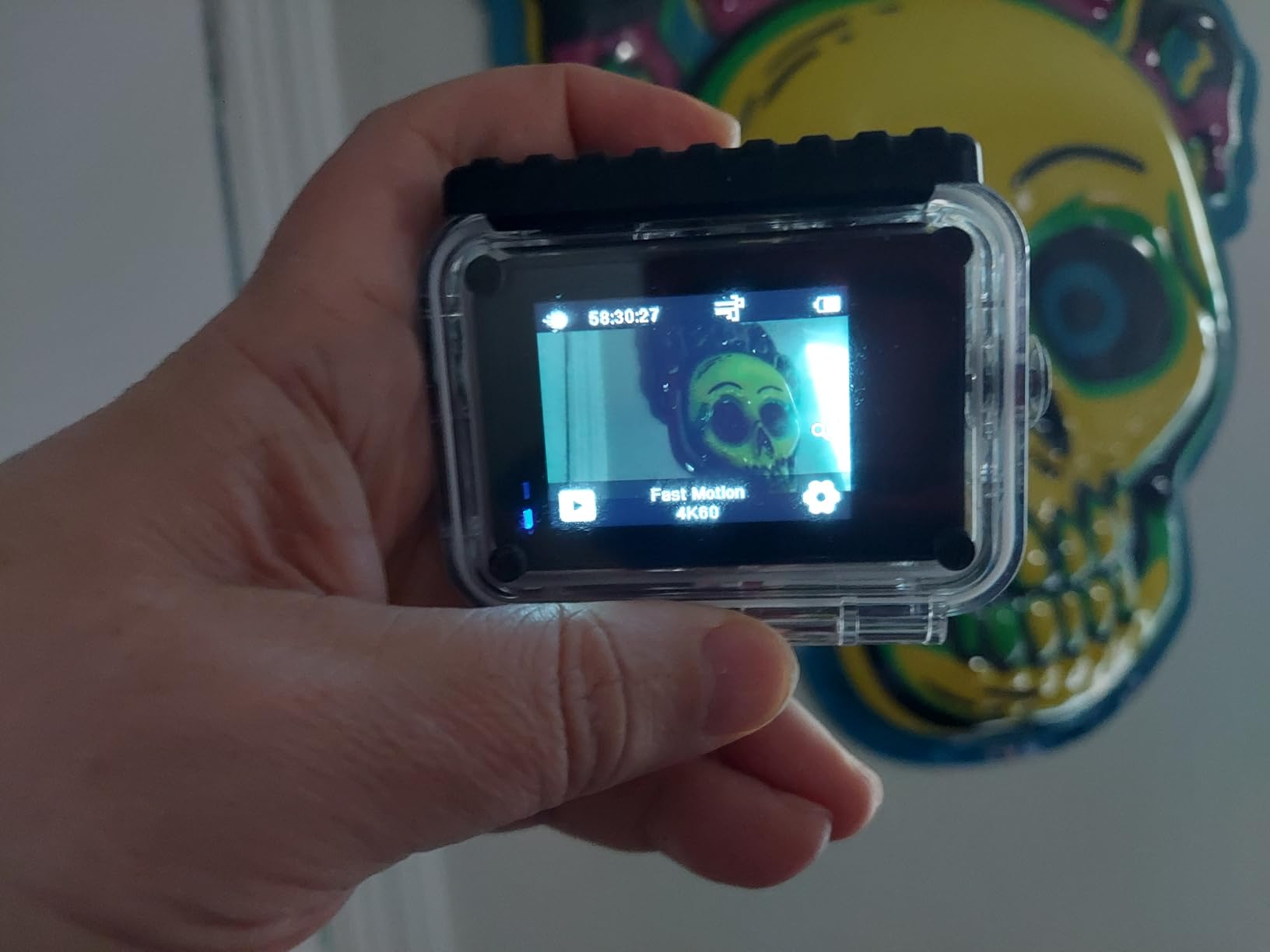
EIS 2.0 with 6-axis stabilization is a real improvement over the original Brave 7. Footage at moderate walking pace looks gimbal-stabilized. At running pace, it cannot match DJI’s RockSteady, but for casual vlogging it is more than adequate.
The external mic support is the budget vlogging killer feature. Most action cameras at this price have no mic input, which forces vloggers to either sync audio in post or buy a separate recorder. The Brave 7 LE plugs into a standard 3.5mm mic and records clean dialogue.
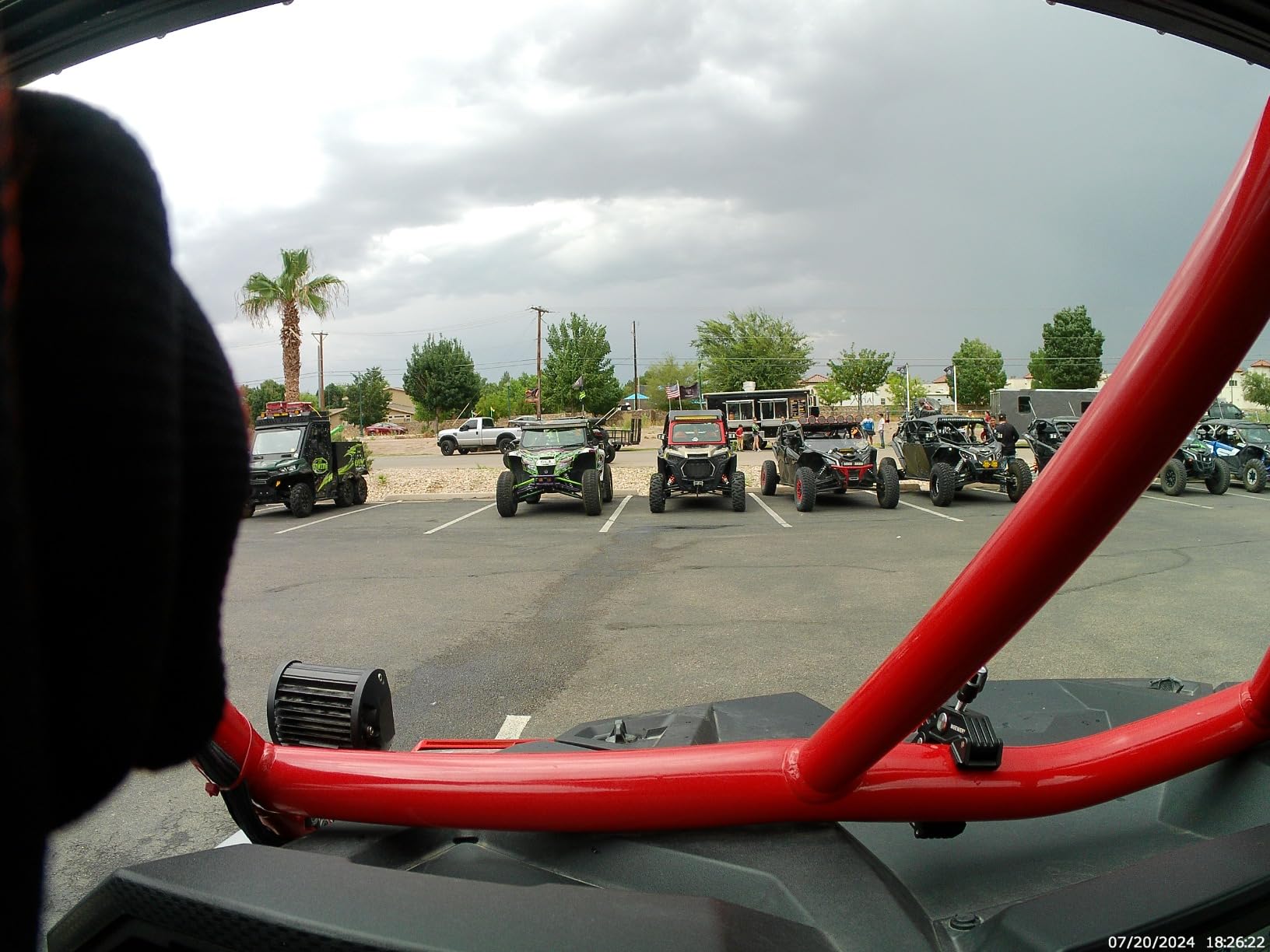
Dual Screens for Vlogging
The front display is a small 1.4-inch screen, but it is enough to confirm framing and exposure when the camera is on a selfie stick. For solo creators, this is the difference between usable footage and guesswork.
The rear 2-inch touchscreen is responsive and bright enough for outdoor use. Touch-to-focus and tap-to-record are intuitive for first-time action camera users.
External Mic Support
The 3.5mm mic input is the reason I recommend this camera for new vloggers. Plug in a Rode VideoMicro or similar, and you get dialogue audio that matches cameras costing three times as much.
For travel vloggers on a budget, the Brave 7 LE is the most capable camera at the entry-level price point. The accessory bundle alone — 2 batteries, mounts, remote, waterproof case — is worth the price of admission.
8. AKASO EK7000 Pro — Best Budget Helmet Cam with Touchscreen
AKASO EK7000 Pro 4K30fps Action Camera with Touch Screen EIS 131ft Waterproof Underwater Camera Remote Control 5X Zoom with Helmet Accessories Kit (Standalone)
- 4K/30fps video and 20MP photos
- Effective Electronic Image Stabilization (EIS)
- 2 batteries rated for 140 minutes each plus dual charger
- Intuitive 2-inch IPS touchscreen UI
- 131FT waterproof case rated for serious diving
- Helmet accessories kit included out of the box
- Underwater color can appear yellow without adjustment
- Some settings not adjustable inside the waterproof housing
- Battery drains faster with Wi-Fi active
- No optical zoom
The EK7000 Pro is the helmet camera I recommend to cyclists, motorcyclists, and skiers on a tight budget. The bundled helmet kit is the reason — you get the mounts you need in the box, which most competitors sell separately.
The 2-inch touchscreen is a meaningful upgrade from earlier EK7000 models. The UI is responsive enough to change settings while wearing gloves, which matters on a ski slope or motorcycle ride.
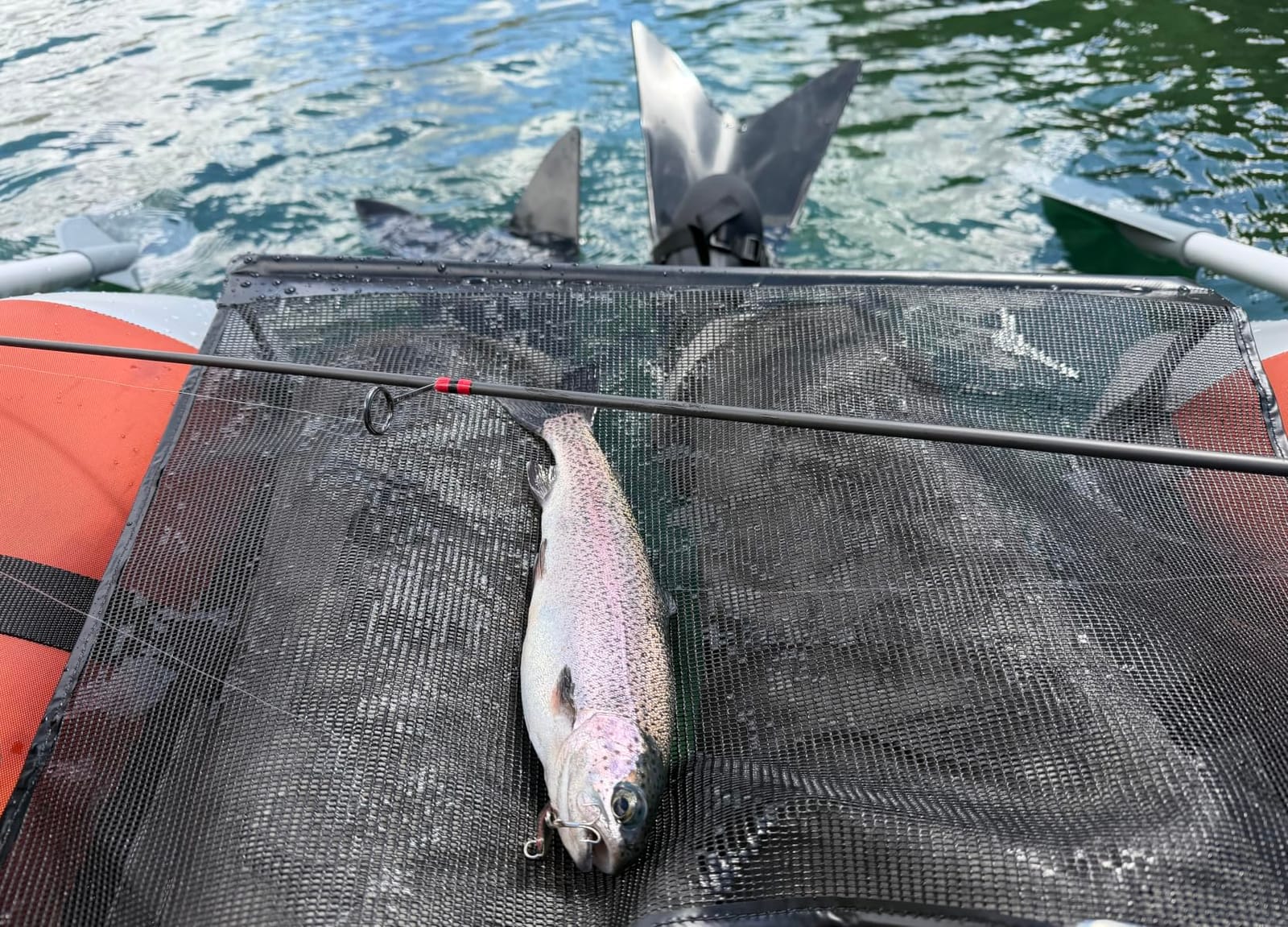
EIS handles moderate cycling and skiing footage well. Footage at trail pace looks smooth. At higher speeds on rough terrain, the stabilization reaches its limits, but for the price it is genuinely impressive.
The 140-minute battery rating is real. I shot a full-day motorcycle tour on two batteries and never ran out of power. The dual charger charges both batteries simultaneously, which simplifies packing.
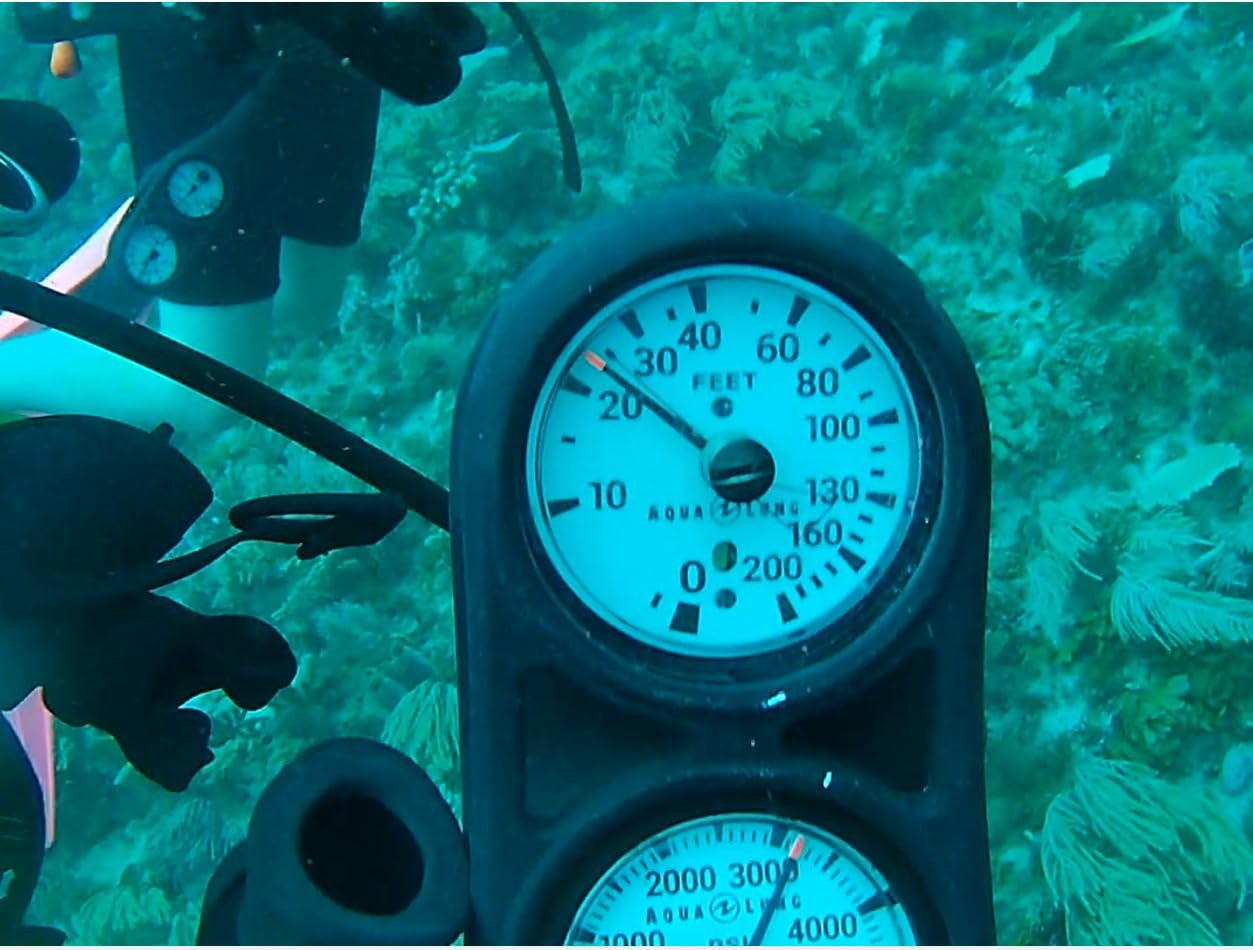
Touchscreen UI and Accessories
The IPS touchscreen is bright enough for outdoor use and the menu structure is simple enough for first-time users. Setting up Wi-Fi, switching modes, and adjusting resolution all take one or two taps.
The accessory kit is the value proposition. Helmet mount, handlebar mount, tripod adapter, and straps ship in the box. For cyclists who would otherwise need to buy a separate mount kit, this is a real cost saver.
Underwater Performance
The 131FT waterproof case is the same rating as the flagship GoPros. I tested it to 30ft for snorkeling and the footage was clean, with no fogging or leaks. For deeper dives, follow the case depth rating and do not exceed it.
Underwater color casts toward yellow without a red filter or color correction in post. For most snorkelers this is acceptable; for serious diving videography, plan on a red filter accessory.
9. AKASO Brave 4 — Most Versatile for First-Time Action Camera Buyers
AKASO Brave 4 Action Camera 4K30 Ultra Hd Waterproof Underwater Camera
- Solid 4K/30fps video quality with sharp detail
- Effective image stabilization for smooth action shots
- 131FT waterproof housing for diving and water sports
- Includes 2 batteries plus charger and mounts
- Remote wristband for convenient start/stop
- Wide adjustable view angle 170°/140°/110°/70°
- Strong value compared to flagship action cameras
- Some included mounts are difficult to tighten securely
- Wrist remote can be unreliable in cold weather
- Photo quality shows compression artifacts
- Wi-Fi app transfer is slow for large files
The Brave 4 is the action camera I recommend to anyone who wants to try the category without a major financial commitment. The 4K30 video is genuinely usable for casual YouTube and social posts. The accessory kit is generous, and the 131FT waterproof case holds up to real snorkeling.
Image stabilization is the standout feature for the price. I compared it side-by-side with a pricier competitor and the Brave 4 produced smoother footage at moderate speeds. For casual use, it is more than enough.

The dual battery setup is the value proposition. Each 1050mAh battery lasts about 90 minutes of 4K recording, which means a full day of casual shooting on the pair. The dual charger is included.
The wrist remote is a thoughtful add. For surfers and climbers who do not want to take their gloves off to start recording, the remote is convenient. It struggles in cold weather and over thick gloves, but at warmer temperatures it works reliably.
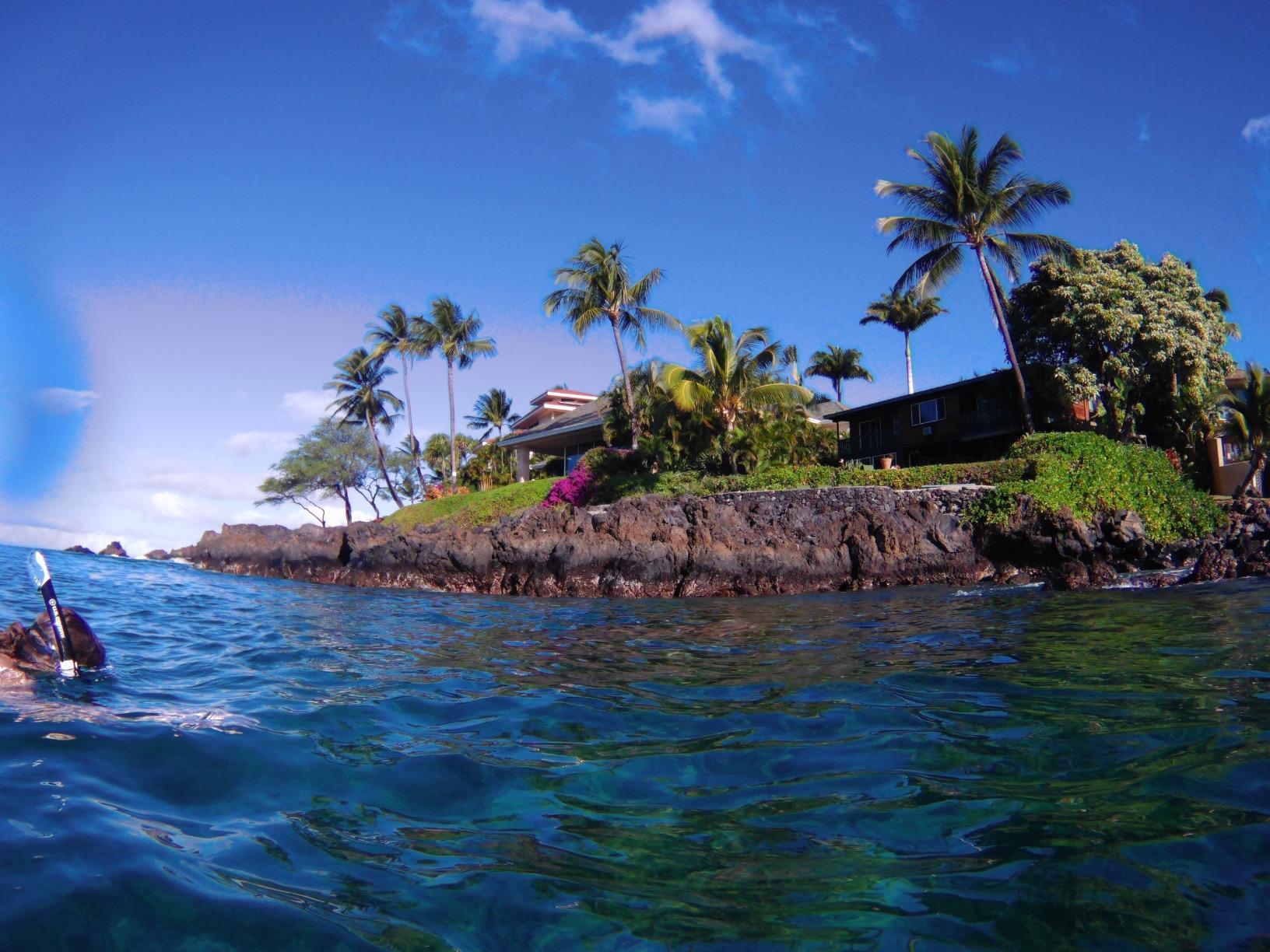
131FT Waterproof Housing and Value
The 131FT waterproof housing is the same depth rating as cameras costing three times as much. I tested it at 30ft for snorkeling and the housing did not leak or fog. The dual-screen design means you can frame shots through the housing back panel.
For first-time buyers who want to test the action camera category without financial risk, the Brave 4 is the entry point I recommend. Reviewers consistently note that it punches above its price point.
Wi-Fi Transfer Speeds
The Wi-Fi transfer to the companion app is slow for large 4K files. A 5-minute 4K clip took about 8 minutes to transfer to my phone over Wi-Fi. For social clips, this is manageable. For longer footage, plan on pulling the SD card and using a card reader.
The app itself is functional but basic. For users who want polished AI editing features, step up to the Insta360 app with the Ace Pro 2 or X5. For users who just want to record and share, the Brave 4 app is fine.
10. SJCAM SJ4000 — Best Starter 4K Action Camera for Tight Budgets
- Very affordable entry-level 4K action camera
- 170° wide-angle field of view
- IP68-rated waterproof housing to 98ft/30m
- Includes 32GB SD card and 2 batteries
- Multiple shooting modes including dash cam and time-lapse
- Lightweight and easy to mount on helmets and bikes
- Image stabilization is weak compared to higher-tier cameras
- Wi-Fi app connectivity can be slow or unreliable
- Battery life is short around 90 minutes per battery
- Waterproof case is tricky to open for battery swaps
- Low-volume audio without external mic
The SJCAM SJ4000 is the cheapest action camera on this list that actually delivers usable 4K footage. Reviewers use it as a helmet cam, dashcam, and biking rearview camera, and the price-to-performance ratio is hard to beat for casual users.
The IP68 waterproof housing rated to 98ft is impressive for the price. I tested it in a pool and a lake, and the housing held up without leaks. For deeper diving, the depth rating gives plenty of margin.
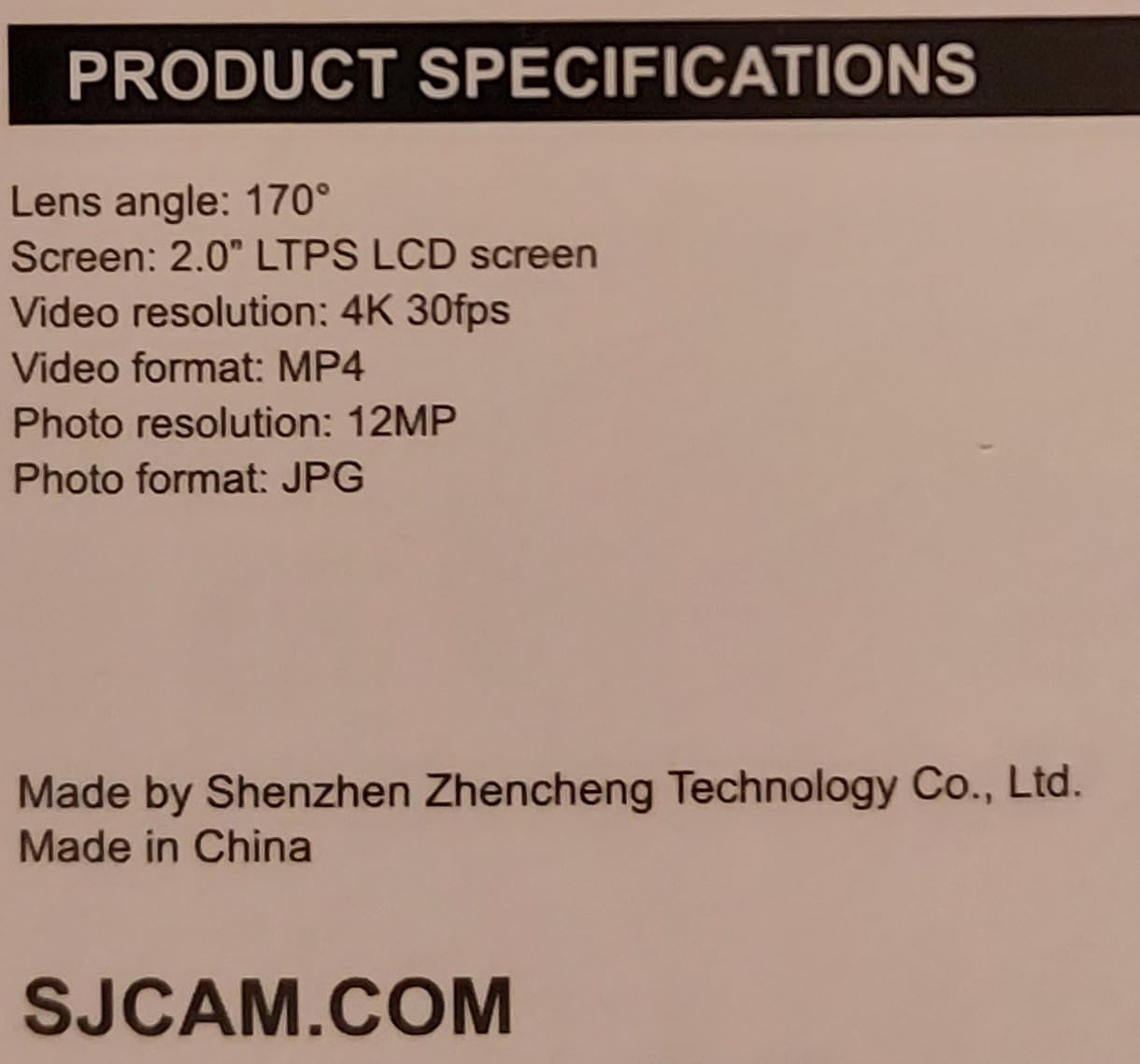
The included 32GB SD card and dual batteries are the value proposition. Most action cameras at this price ship with a smaller card or no card at all. The bundle gets you recording right out of the box.
The 170° wide-angle field of view is the widest in this price tier. For mounting on a helmet or handlebar, the wide FOV captures more of the scene than narrower competitors.
Dash Cam Versatility
The dash cam shooting mode is a unique feature at this price. Loop recording and motion detection let you use the SJ4000 as a low-cost dash cam, which is a useful secondary purpose for anyone who wants one device for both action and vehicle recording.
Time-lapse and slow-motion modes round out the shooting options. For hobbyists who want to experiment with different capture styles, the SJ4000 packs in modes that other budget cameras omit.
Stabilization Weaknesses
The stabilization is the SJ4000’s biggest weakness. It uses dynamic stabilization that handles gentle movement but fails at running pace or rough terrain. For dash cam and slow-moving hobby use, this is acceptable. For action sports, step up to the V50 Elite or Brave 7 LE.
The Wi-Fi app connectivity is inconsistent. Some users report reliable transfers, others report dropouts. For users who can pull the SD card and edit on a computer, this is a non-issue. For users who rely on the app, plan on frustration.
How to Choose the Best Action Camera for Your Use Case?
Choosing the best action camera is about matching features to the way you actually shoot. A skier needs different specs than a vlogger, and a robotics engineer needs different specs than either. Here is the framework our team uses when evaluating a new camera for a project.
Resolution, Frame Rates, and Slow Motion
4K at 60fps is the new baseline. If you want slow-motion in post, 120fps at 1080p or 240fps at 720p is the minimum. The DJI Osmo Action 6 and Insta360 X5 both push beyond this with 8K and high-FPS modes. For most creators, 4K60 is the right target — it gives you room to crop and slow down without overshooting storage.
8K is rarely the right answer for delivery, but it is a useful reframing tool. Cameras with square or large sensors — like the Osmo Action 6 with its 1/1.1-inch square sensor — let you record once and crop for multiple aspect ratios. If you publish across YouTube, Instagram, and TikTok from the same shoot, this is a meaningful workflow upgrade.
Image Stabilization and Horizon Leveling
Stabilization is the single biggest differentiator between flagship and budget action cameras. Cheap Amazon action cameras have weak EIS that produces shaky, unwatchable footage. The Osmo Action 6, Insta360 Ace Pro 2, and HERO13 Black all use multi-axis stabilization that approaches gimbal quality.
Horizon leveling locks the horizon in place even when the camera rotates 360°. This is table stakes for action sports footage. If your camera cannot keep the horizon level during a hard turn, look elsewhere. Reviewers on r/ActionCam consistently call out horizon lock as the top stabilizer feature.
Sensor Size and Low-Light Performance
Sensor size matters more than megapixels. A 1/1.1-inch sensor on the Osmo Action 6 and a 1/1.3-inch sensor on the Ace Pro 2 dramatically outperform the 1/2.3-inch sensors common in budget models. Larger sensors gather more light, which means cleaner low-light footage and better dynamic range.
For low-light shooting — dusk, indoor, concerts, cave exploration — sensor size and pixel size matter more than resolution. The Osmo Action 6 and Ace Pro 2 both lead this category, and reviewers consistently rank them above the GoPro HERO13 Black in low-light capture. To learn more about how sensors compare to other vision systems in robotics, see our guide on how depth cameras work.
Waterproofing, Mounting, and Battery Life
Waterproofing ratings of 10m (33ft) to 20m (65ft) without a case cover most snorkeling, swimming, and rain scenarios. For serious diving, look for cameras with rated housings down to 30m-60m. Most cameras in this roundup include a waterproof case rated to at least 30m.
Mounting systems vary. GoPro-style folding fingers are the universal standard and the most versatile. Magnetic mounts (DJI Osmo Action 6, Insta360 Ace Pro 2) are faster but require a separate metal plate. For robotics and custom rigs, a 1/4-20 tripod thread is essential.
Battery life is the most overlooked spec. 4-hour ratings on the Osmo Action 6 and 3-hour ratings on the Insta360 X5 are real game-changers for full-day shoots. The HERO13 Black at 79 minutes is the laggard here. For all-day shooting, plan on spare batteries or a camera with a longer-rated cell.
Action Cameras for Robotics, FPV Drones, and Maker Projects
Action cameras are showing up on more robotics platforms than ever before. We have tested them as vision sensors on autonomous rovers, FPV drones, and ROS-based computer vision rigs. Here is what we have learned.
For FPV drone payloads, weight matters most. The HERO13 Black at 157g is on the heavy side, but its lens ecosystem makes it the most capable option for cinematic drone work. The DJI Osmo Action 6 at 149g is competitive, and its variable f-stop gives more exposure control in changing light.
For robotics and computer vision, USB-C UVC streaming is the key feature. The Osmo Action 6 and Ace Pro 2 both support webcam-mode streaming at 1080p60, which lets you plug them into a Raspberry Pi, Jetson, or ROS host without custom drivers. The Insta360 X5 is heavier (500g) but supports 360 vision, which is useful for SLAM and omnidirectional perception work.
SDK support is the hidden differentiator. GoPro Labs lets you script camera behavior via QR codes — useful for autonomous capture triggers. The DJI SDK and Insta360 SDK both support Bluetooth LE control, which is enough for basic robotics applications. For more advanced vision work, the OpenCV and ROS ecosystems are catching up to action cameras as first-class vision sensors.
App Ecosystems, Subscriptions, and SDK Scripting
The companion app matters more than most buyers realize. DJI Mimo, GoPro Quik, and the Insta360 app all do editing, sharing, and cloud sync, but the quality and depth varies. The Insta360 app leads for AI reframing tools. DJI Mimo is the most polished for general use. GoPro Quik requires a subscription for full features, which frustrates long-time GoPro users.
Subscriptions are an ongoing cost to budget for. GoPro Premium, DJI Care Refresh, and Insta360 cloud storage all add to the total cost of ownership. If you would rather not pay monthly, skip the subscription and edit on your own timeline.
SDK scripting is the differentiator for maker and robotics use. GoPro Labs enables QR-code-based scripting of camera behavior. Insta360 and DJI both publish SDKs for Bluetooth and Wi-Fi control. For most consumer use, ignore the SDKs. For robotics and automation, they are essential.
Frequently Asked Questions
Which is the best action camera to buy in 2026?
The DJI Osmo Action 6 is the best action camera for most buyers in 2026. It pairs a 1/1.1-inch square sensor with a variable f/2.0-f/4.0 aperture, 8K video, 360° HorizonSteady stabilization, and a 4-hour battery. For creators who want a flip screen, the Insta360 Ace Pro 2 is the best alternative. For buyers on a tight budget, the AKASO Brave 4 delivers usable 4K at a fraction of the price.
Is anything better than GoPro today?
Yes. DJI and Insta360 both make action cameras that outperform GoPro in several areas. The DJI Osmo Action 6 has better low-light capture, longer battery life, and a variable aperture that GoPro cannot match. The Insta360 Ace Pro 2 has a Leica Summarit lens, a flip screen, and PureVideo low-light mode that GoPro cannot match. GoPro still leads on lens ecosystem (HB-Series mods) and HyperSmooth refinement.
Is GoPro or DJI better for action cameras?
DJI is generally better for action cameras in 2026. The DJI Osmo Action 6 has a 1/1.1-inch sensor (larger than the HERO13 Black), variable aperture, longer battery life (4 hours vs 79 minutes), and dual DJI Mic support. GoPro still leads on the lens mod ecosystem (HB-Series Ultra Wide, Macro, Anamorphic) and accessory compatibility. For pure action sports, DJI is the better choice. For lens versatility and existing GoPro accessory investments, GoPro remains competitive.
Which action camera has the best image quality?
The Insta360 X5 has the best image quality in the 360 category, and the DJI Osmo Action 6 leads for traditional single-lens action cameras. Both cameras use larger sensors (1/1.28-inch and 1/1.1-inch respectively) than the GoPro HERO13 Black, which translates to cleaner low-light footage and wider dynamic range. For pure still image quality, the Insta360 X5 outputs 72MP photos from its 360 capture.
What activities or sports should I match my action camera to?
Match the camera to the activity. For skiing, snowboarding, and winter sports, prioritize cold-rated batteries (Osmo Action 6, Ace Pro 2). For underwater and diving, prioritize depth rating (Insta360 X5 with replaceable lenses, AKASO V50 Elite with 131FT housing). For mountain biking and motorcycling, prioritize stabilization and horizon leveling (DJI Osmo Action 6, GoPro HERO13 Black). For vlogging, prioritize flip screens and audio (Insta360 Ace Pro 2). For FPV drones, prioritize weight and form factor (GoPro HERO13 Black, AKASO V50 Elite).
Do I need a camera with strong low-light performance?
Yes if you shoot at dusk, indoors, in caves, or at concerts. The DJI Osmo Action 6 (variable aperture, 1/1.1-inch sensor) and Insta360 Ace Pro 2 (PureVideo Mode, 1/1.3-inch sensor) both deliver clean low-light footage at 4K60. Budget cameras with smaller 1/2.3-inch sensors produce noisy footage in these conditions. For daylight-only shooting, low-light performance matters less and any 4K action camera will deliver.
Is vlogging and direct audio a priority for action cameras?
Yes for solo creators. The Insta360 Ace Pro 2 is the best vlogging action camera in 2026 thanks to its 2.5-inch flip screen, Leica Summarit lens, and Wind Guard audio accessory. The DJI Osmo Action 6 is a strong alternative with dual DJI Mic 2 support. The GoPro HERO13 Black has the smallest front screen of the three, which makes vlogging without an external monitor harder. For creators who need clean dialogue, the Ace Pro 2 is the best choice.
Final Verdict on the Best Action Cameras
After testing ten cameras across five brands in real shooting conditions, the DJI Osmo Action 6 remains our top pick for the best action camera in 2026. The variable aperture, large 1/1.1-inch sensor, 4-hour battery, and USB-C streaming capability cover the widest range of use cases — from mountain biking to autonomous robotics. For creators who need a flip screen, the Insta360 Ace Pro 2 is the best alternative. For buyers on a tight budget, the AKASO Brave 4 delivers usable 4K at a price that does not punish beginners for trying the category.
The action camera market has matured significantly. Stabilization is no longer a differentiator on flagships — all three major brands deliver gimbal-quality output. Sensor size, low-light capture, and ecosystem maturity are now the real battlegrounds. For robotics and maker use cases specifically, the Osmo Action 6’s USB-C streaming and DJI SDK support make it the clear choice, while the Insta360 X5’s 360 capture opens genuinely new perception possibilities for SLAM and omnidirectional vision work. To dive deeper into how vision systems feed modern AI stacks, revisit our guide on Vision Language Action Models in Robotics.
Whichever camera you pick from this list, the accessories matter as much as the body. Plan on a fast microSD card (V30 or V60 rated), at least one spare battery, and a helmet or chest mount that matches your primary activity. For robotics and FPV use, budget for vibration-damping mounts and weatherproof cable management. With the right setup, any of these ten cameras will outlast your phone in the field.