
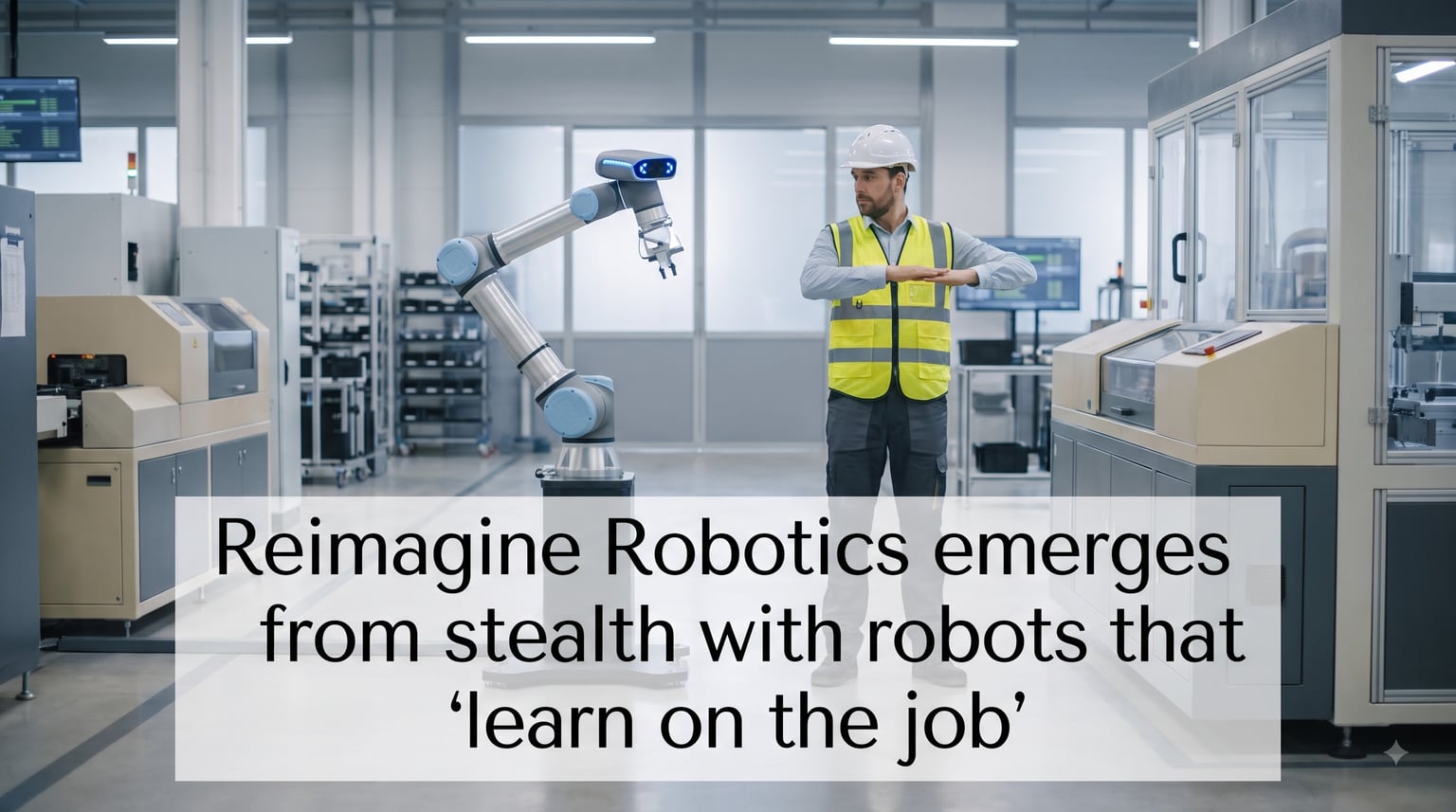
A new AI robotics company just walked out of stealth mode with a pitch that flips the script on factory automation. Reimagine Robotics, founded by a former Google DeepMind Applied Robotics team, says its platform lets any factory worker train a robot by simply showing it the task, correcting mistakes on the fly, and adapting it as the production process changes.
For decades, industrial automation has required specialist programmers, rigid fixtures, and weeks of integration. Reimagine Robotics is betting that the next wave of robotics will look more like teaching a new coworker than writing code. The startup emerged publicly today with pre-seed funding from Fly Ventures and firstminute capital, and it is already running real deployments on factory floors.
In this article, I’ll break down who is behind the company, how the learn-on-the-job system actually works, where it is already deployed, and what the technology means for the broader competitive landscape of physical AI infrastructure platforms in 2026.
Table of Contents
Who Is Reimagine Robotics and Why the DeepMind Pedigree Matters
Reimagine Robotics was founded by Oleg Sushkov, Akhil Raju, and Misha Denil, three engineers who worked together on the Google DeepMind Applied Robotics team before leaving to start the company. The trio carries serious research credentials, including work on robotic learning systems that combined classical control with modern machine learning. Their time at DeepMind gave them direct exposure to one of the most ambitious robotics research programs in the world.
The company stayed in stealth mode while it built prototypes, signed early access partners, and locked in its pre-seed round. The funding was led by Fly Ventures, a Berlin-based seed fund known for backing technical founders, with participation from firstminute capital, a London firm that invests in early-stage European and U.S. startups. Both investors have a track record of supporting deep-tech founders who come out of world-class research labs.
Why does the DeepMind pedigree matter? DeepMind’s robotics group has spent years pushing the boundary of what robots can learn through simulation and demonstration. The founders saw a gap between cutting-edge research and the reality of factory floors, where most automation still needs engineers to write or modify code every time a part changes. They decided the most useful place to apply that research was not in a humanoid demo video but in the unglamorous middle of real production lines.
That gap is where Reimagine Robotics is aiming. The startup’s mission is to make industrial automation something a line worker can handle directly, without going through a systems integrator every time the workflow shifts. The pitch is that flexibility and ease of use are the real bottleneck, not raw robotic capability.
“We want to put the people who actually run the process in control of the robot,” co-founder Oleg Sushkov said in the announcement. The company is positioning itself as a worker-friendly alternative to traditional automation vendors. That framing matters because most factory automation is sold to executives and engineers, then handed down to the operators who actually live with it.
The timing lines up with a broader push across the industry. Companies are looking for flexible automation that can handle smaller batch sizes and more frequent product changes. Reimagine Robotics believes the answer is to teach robots the way humans already teach each other on the job, with demonstrations, corrections, and gradual refinement.
Pre-seed rounds of this size are typically used to validate technology with a handful of paying customers, hire the first few engineers beyond the founders, and lock in a roadmap. Reimagine Robotics is using the funding to expand its deployment team and harden the platform for broader rollouts in 2026. The fact that the company is shipping in production before raising a larger round is one of the more concrete signals in the announcement.
How Robots That Learn on the Job Actually Work
The core idea behind Reimagine Robotics is a concept the team calls “monkey-see, monkey-do” learning. It is a deliberately simple phrase, but the technical stack behind it is anything but. The name is meant to communicate the same intuition most people already have about how apprentices pick up new trades: watch, try, get corrected, try again.
In practice, a worker performs a task in front of the robot, like loading a 3D printer, picking a part from a bin, or placing a hard drive into a disassembly fixture. The robot observes the demonstration using cameras and force sensors, then attempts to repeat the motion. When the robot gets something wrong, the worker corrects it directly, and the system updates its behavior in real time. The worker does not need to understand anything about the underlying policy, the loss function, or the network architecture.
That correction loop is what makes the system different from traditional “teach pendant” programming or pre-scripted automation. The robot is not just replaying a recorded motion. It is building a flexible policy that can handle small variations, like a part slightly out of position, without breaking the cycle. This generalisation is the part that historically has been hardest to deliver in industrial settings.
Behind the scenes, the platform combines several technologies. Vision models identify parts and their orientation, even in cluttered bins or under variable lighting. Imitation learning maps the worker’s demonstration to motor commands, and a behavior layer lets the worker prototype and test new tasks quickly without writing code. The whole stack is designed to be operated by non-engineers, which is a meaningful departure from typical robotics tools.
Reimagine Robotics says prototype testing time has dropped from roughly one day to about 10 minutes using this approach. For a factory that changes over a line every few weeks, that compression is the real story. It turns automation from a capital project that requires a planning meeting into a daily tool that a line lead can reconfigure between shifts.
The technical challenge is not just teaching a single task. It is teaching a robot to generalize, so when a slightly different part shows up, the system adapts instead of failing. This is where the DeepMind background shows up, in the team’s familiarity with simulation, reinforcement learning, and large-scale data collection. The founders are applying the same playbook that powered DeepMind’s work on dexterous manipulation to a much more grounded factory use case.
The company is also leaning on advances in adaptive robotic grippers that can handle a wider range of part geometries without custom tooling. When the perception improves, the gripper gets smarter, and the demonstration loop becomes more forgiving. A small perception win upstream translates into a much larger usability gain downstream.
One of the underappreciated parts of the system is the “behavior prototyping” layer. This is the piece that lets a worker sketch out a new task, try it, fail, adjust, and try again without leaving the floor. It feels closer to sketching on a whiteboard than to programming a robot, and it is the part that most directly addresses the “no programming required” claim the company is making.
Real-World Deployments Where Reimagine Robots Are Already Working
Reimagine Robotics did not come out of stealth with a roadmap. It came out with deployments. The company says its systems are already running in production environments, not just pilot projects. That is a meaningful distinction in a space where many startups show polished demos but rarely ship into a real factory.
One early application is 3D printer tending. Workers showed the robot how to open a printer, remove a finished part, and place the next build plate. Cycles that would normally require an operator to stop what they are doing now run continuously. The robot checks the printer, swaps the plate, and signals the worker when a part is ready for post-processing. The setup is especially valuable for print farms that run unattended overnight and need a consistent tending routine.
Another deployment focuses on electronics disassembly. Hard drives, circuit boards, and small consumer electronics contain recoverable materials, including rare earth magnets and copper, but taking them apart by hand is slow and repetitive. Reimagine Robotics uses a three-robot disassembly cell that breaks down hard drives and similar components into streams of sorted materials. Each robot in the cell handles a different stage of teardown, and the workflow can be retaught in minutes when a new device variant arrives.
This kind of work matters because critical materials recovery is becoming a strategic priority. Manual disassembly does not scale, and fully custom robotic cells are too expensive for the volumes in question. The company’s approach is to teach the robot each new device on the floor, rather than programming a new fixture for every product. For an industry where product models turn over every year, that flexibility is the entire value proposition.
Workers add the deployment to the line by demonstrating the task once. The robot adapts when the device model changes, and the workflow can be retaught in minutes. For a recycler handling dozens of product variants, that is the difference between a viable business and a non-starter. A traditional automation cell for each model would balloon the capex and the integration timeline.
There are also shorter, more focused deployments, like machine tending for CNC mills and small-batch assembly. In each case, the visible benefit is the same. A worker who does not write code can still get a robot to do useful work, and adjust it when the job changes. That profile lines up with the kind of high-mix, low-volume manufacturing that has historically been left behind by the automation wave.
Across all of these examples, the company emphasizes that the robot is not replacing the worker. It is taking over the repetitive chunk of the job, so the worker can focus on the parts that actually need human judgment. That distinction comes up often in robotic end effector discussions, where the right tool on the right robot makes the whole collaboration feel natural. The hardware matters, but the teachability of the system is what unlocks the use case.
For the team’s perspective, the deployments are also a learning feedback loop. Every production task generates data that improves the next prototype, which makes the system more capable for the next customer. That data flywheel is one of the more underrated advantages a production-deployed system has over a lab demo, and it is a major reason the company is shipping before raising a much larger round.
The Competitive Landscape of Adaptive Robot Learning
Reimagine Robotics is not the only company trying to make robots easier to deploy. It is entering a crowded field that includes general-purpose humanoid robots, AI-first manipulation startups, and established automation vendors adding learning features to their products. The difference is in the assumptions each player is making about who actually trains the robot.
Companies like 1X Technologies, AgiBot, Apptronik, BrainCo, NEURA Robotics, Sanctuary AI, and Tutor Intelligence are all working on related problems. Some focus on full humanoid platforms, others on manipulation arms, and a few on teaching interfaces that sit on top of existing robots. Most of them are also chasing the same underlying thesis: that the biggest bottleneck in robotics is not hardware, but how easily the system can be taught by someone who is not a robotics engineer.
What makes Reimagine Robotics different is the bet on the worker, not the hardware. The company is not trying to build a humanoid robot that walks around the factory. It is trying to make the existing robot arms and grippers easier to teach, so the people closest to the work can drive automation decisions. That positioning matters because most factories already have some level of robotic hardware, and replacing it is expensive.
This places the company closer to software-focused players than to hardware manufacturers. In practice, that means the competitive edge depends less on motor torque and more on the quality of its learning system, the responsiveness of its correction loop, and the experience of its interface for non-engineers. That is also where the DeepMind background pays off, because the core IP is in the model and the training pipeline, not the arm.
The wider set of physical AI infrastructure platforms shaping robotics in 2026 is also relevant here. As more vendors offer data, simulation, and deployment tooling, the line between a robotics company and an AI infrastructure company starts to blur. Reimagine Robotics is engaging with that overlap directly, and its platform could end up being used alongside, or even on top of, some of these other infrastructure providers.
For factories evaluating options, the practical question is not which robot is the most advanced. It is which system can be set up and maintained by the people already on the payroll. That is the bar Reimagine Robotics is trying to clear, and it is the bar most competitors are not explicitly optimizing for. Time will tell whether the worker-first framing becomes a durable advantage or just a marketing angle.
What This Means for Manufacturing Automation and the Factory Workforce
One of the loudest conversations in online forums like r/robotics and r/Futurology is about job displacement. Workers worry that automation will replace them. Companies worry that they cannot find enough workers to fill repetitive roles. Reimagine Robotics is trying to land somewhere in the middle, with a story that frames the worker as the robot’s teacher rather than its casualty.
The pitch is that the worker becomes the trainer, the supervisor, and the problem-solver for the robot. Repetitive motion gets handed off. Judgment, edge cases, and process changes stay with the human. In the deployments the company has shown, that structure seems to match how factory workers already think about their jobs. Most line workers are not opposed to automation, they are opposed to feeling like their expertise is being thrown away.
For manufacturers, the bigger implication is economic. Traditional automation makes sense for high-volume, low-variation production. It struggles with the long tail of small batch runs, custom orders, and frequent product changes that define a growing slice of modern manufacturing. If a robot can be retrained in minutes instead of days, the math changes for that entire segment. Automation becomes a variable cost instead of a fixed one.
There are real challenges. The technology still depends on good lighting, consistent fixturing, and a worker who is willing to interact with the system. Safety and liability frameworks for human-robot collaboration are still catching up. And the flood of “easy to train” robotics claims over the past decade has set high expectations for proof. Reimagine Robotics will need to show that its deployments hold up over months, not weeks.
Even with those caveats, the trajectory is clear. The next generation of industrial automation will be measured by how quickly a line worker can teach a new task, not by how many engineers it takes to install a cell. Reimagine Robotics is one of the more concrete bets on that shift, and it has real deployments to show for it. If the approach holds up, it will reshape how factories think about the trade-off between automation and adaptability for the rest of the decade.
FAQ: Reimagine Robotics and Learn-on-the-Job Robots
What is Reimagine Robotics?
Reimagine Robotics is an AI robotics startup founded by former Google DeepMind Applied Robotics engineers Oleg Sushkov, Akhil Raju, and Misha Denil. The company develops technology that lets factory workers train, correct, and adapt robots directly, without specialist programming.
How do robots learn on the job?
The system uses a monkey-see, monkey-do approach. A worker demonstrates a task, the robot attempts to repeat it, and the worker corrects mistakes in real time. The system updates its behavior from each correction, which compresses prototype testing time from roughly one day to about 10 minutes.
What jobs will robots take over in factories?
Reimagine Robotics focuses on automating repetitive tasks like machine tending, 3D printer loading, and electronics disassembly. The company emphasizes that workers move into training, supervising, and problem-solving roles rather than being replaced outright.
Who funded Reimagine Robotics?
The company emerged from stealth with pre-seed funding led by Fly Ventures, with participation from firstminute capital. Sushkov, Raju, and Denil previously worked together on the Google DeepMind Applied Robotics team.
Where is Reimagine Robotics already deployed?
The company has deployed systems for 3D printer tending, electronics disassembly (including a three-robot hard drive disassembly cell), and machine tending for small-batch manufacturing. The deployments are running in production environments, not just pilot projects.
Conclusion: Robots That Listen to the People Who Already Run the Floor
Reimagine Robotics is making a bet that the next breakthrough in industrial automation is not a better robot arm. It is a better interface for the people who already understand the work. By collapsing the loop between demonstration and deployment, the company is positioning itself for the long tail of manufacturing that traditional automation cannot touch.
For factory leaders, the takeaway is practical. If your production changes often, and your team does not include a robotics engineer, the next automation decision might not be about hardware at all. It might be about who gets to teach the robot how the job actually works. Reimagine Robotics is one of the more concrete bets on that future, and it is worth watching as it scales through 2026 and beyond.