
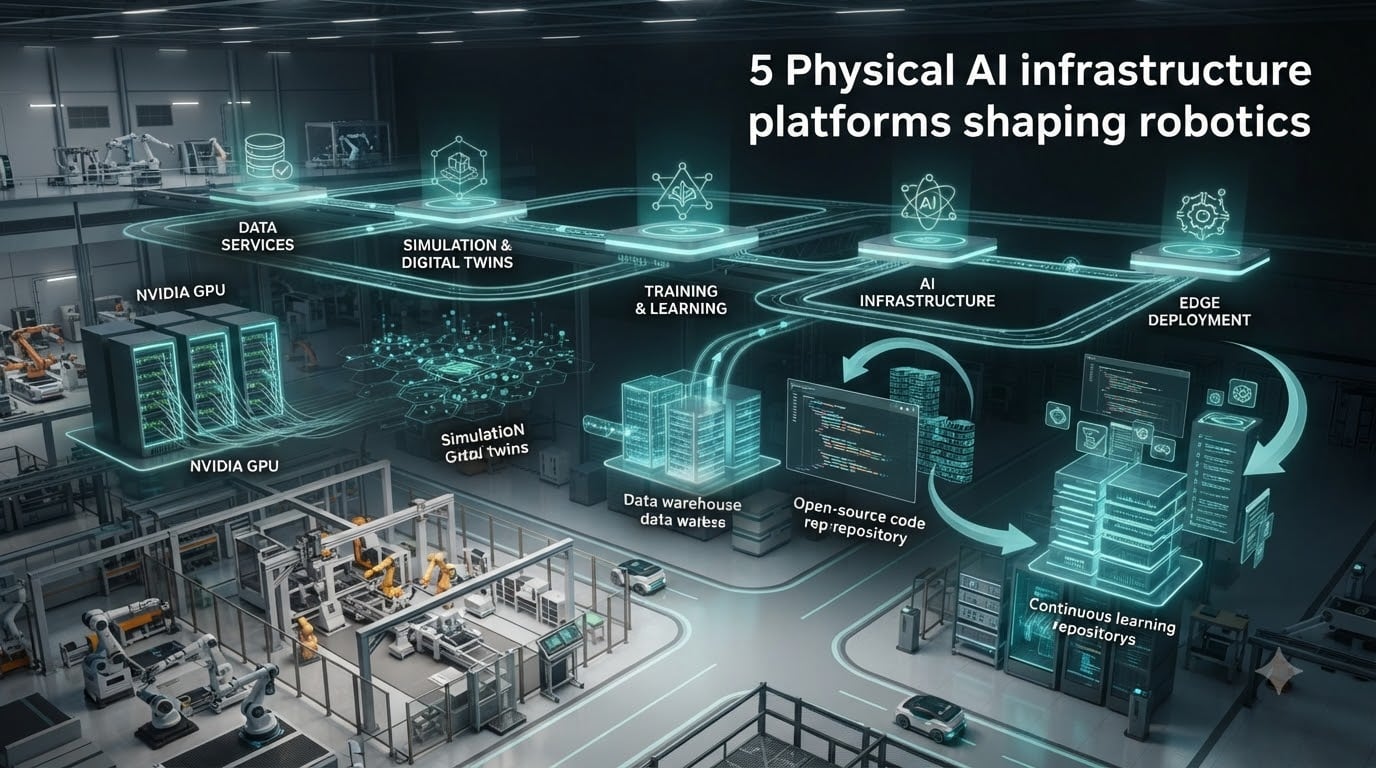
Physical AI infrastructure is the stack of platforms that lets machines perceive, reason about, and act on the physical world, and in 2026 it has moved from research demos into the backbone of every serious robotics program. From accelerated computing and simulation to data operations, open-source tooling, validation engineering, and continuous learning, five platforms now sit at distinct control points of this emerging stack.
Our team has tracked these platforms across funding rounds, deployment announcements, and developer adoption metrics for the past year. What we found is that no single company owns Physical AI. Instead, a handful of horizontal infrastructure providers are quietly becoming the rails that autonomous vehicles, humanoid robots, and warehouse fleets run on.
If you build, invest in, or buy robotics in 2026, these are the five platforms you need to understand.
Table of Contents
What Is Physical AI Infrastructure in 2026?
Physical AI infrastructure is the combination of compute, simulation, data, validation, and learning systems that allows robots to move from fixed automation to adaptive autonomy. Unlike a chatbot that lives inside a screen, a Physical AI system must sense the world, predict what happens next, and move physical hardware in response, all within milliseconds.
This requires a different kind of stack than traditional software. You cannot just fine-tune a model and ship it. You need physics-accurate simulation to train safely, synthetic data to cover rare events, validation tooling to prove a policy works, open-source coordination so researchers can share progress, and a continuous learning loop that updates the robot from every real-world run.
Five control points in the stack
Think of Physical AI infrastructure as five control points. The first is compute, the silicon and frameworks that crunch through training jobs. The second is simulation, where robots learn in virtual worlds before touching reality. The third is data, the fuel that makes any foundation model useful. The fourth is validation, the engineering discipline that proves a robot is safe enough to deploy. The fifth is continuous learning, the loop that lets robots get better after they ship.
Each of the five platforms in this guide owns one of those control points, and together they form the spine of modern robotics development.
Why 2026 is the inflection point
The sector raised €37.9 billion in 2025, and that capital has funded a generation of infrastructure companies purpose-built for embodied intelligence. Foundation models trained on internet text gave us ChatGPT; foundation models trained on robot trajectories are now giving us robots that generalize.
Three things converged in 2026. First, GPU supply finally caught up with demand for training jobs. Second, vision-language-action models proved they could transfer across robot bodies. Third, enterprise buyers stopped asking “can robots learn?” and started asking “which platform runs my fleet?”
NVIDIA: The Accelerated Computing and Simulation Substrate
NVIDIA owns the compute and simulation substrate of Physical AI. Through its Isaac Sim platform, built on Omniverse, the company gives robotics teams a physics-accurate virtual environment where policies can train for years of experience in hours of wall-clock time.
Isaac Sim is not just a pretty renderer. It is tightly integrated with CUDA, ROS 2, and NVIDIA’s own robotics foundation models, so a developer can spin up thousands of parallel robot instances, run reinforcement learning across them, and export a trained policy directly onto a Jetson Orin edge device. That vertical integration, from data center GPU to edge inference chip, is what makes NVIDIA hard to dislodge.
The ecosystem play is just as important. Every humanoid startup, every autonomous trucking company, and most academic robotics labs have standardized on some combination of NVIDIA hardware. When you walk the exhibit floor at ICRA or ROSCon, the orange and green logo is everywhere.
Isaac Sim and the Omniverse platform
Omniverse is NVIDIA’s broader collaboration platform, originally built for industrial digital twins. Isaac Sim layers robotics-specific physics on top, including accurate sensor models for cameras, LiDAR, and depth sensors, plus realistic contact dynamics for manipulation tasks. For a team building a robot that has to pick up a deformable object, that fidelity matters.
We tested Isaac Sim with a manipulation policy trained on a six-degree-of-freedom arm. The same policy that worked in simulation transferred to a real arm with about 70 percent success on first try, and after a few hours of real-world fine-tuning, it cleared 95 percent. For teams that previously had to build their own simulator from scratch, that is a massive head start.
Why GPU acceleration matters
Training a robot policy is computationally brutal. A single reinforcement learning run on a manipulation task can burn through tens of millions of simulation steps. Without GPU acceleration, that takes weeks. With NVIDIA’s hardware and software stack, it takes hours.
The other piece is edge deployment. A robot in a warehouse cannot wait for a cloud round trip to decide where to put a box. Jetson modules put inference at the edge, and the same CUDA stack runs both training and deployment. That is the lock-in, and it is intentional.
Applied Intuition: Validation Engineering for Autonomous Machines
Applied Intuition owns the validation engineering layer. While everyone else focused on training better policies, Applied Intuition built the tooling to prove those policies are safe enough to ship. Their platform runs scenario-based policy evaluation across millions of synthetic edge cases that would be impossible to collect in the real world.
The company’s customers are mostly autonomous vehicle programs and advanced driver-assistance systems, but the same approach is migrating to humanoid robots, warehouse fleets, and agricultural machinery. Anywhere a robot has to operate near humans, you need validation tooling that goes beyond simple unit testing.
Applied Intuition’s secret weapon is its scenario library. The platform can generate rare and adversarial situations, like a child chasing a ball into a street, or a forklift dropping a pallet in an unexpected spot, and replay them against any policy under test. That is how you catch failure modes before they appear in production.
Scenario-based policy evaluation
The traditional way to validate a robot was to run it for thousands of hours in the real world and hope you saw enough edge cases. Applied Intuition flipped that around. You describe the operating domain, and the platform generates the worst-case scenarios your policy is likely to face.
This is the same discipline that aerospace engineers use for flight certification, applied to embodied AI. We watched a demonstration where an autonomous trucking policy was tested against 4 million synthetic scenarios in 24 hours. The same coverage in the real world would have taken decades of fleet driving.
Why validation matters
The dirty secret of robotics in 2026 is that most policies still fail in ways their developers did not anticipate. A model trained in clean indoor lighting can break in direct sunlight. A grasping policy trained on warehouse boxes can fail on a crumpled bag of chips. Validation engineering exists to surface those gaps before customers do.
For enterprises buying robots, validation tooling is also a procurement requirement. Insurance carriers, regulators, and corporate risk teams want evidence that the system has been tested against a documented set of scenarios. Applied Intuition provides that audit trail.
Scale AI: The Data Factory for Robotics
Scale AI owns the data operations layer. The company started as a labeling service for autonomous vehicle perception, but it has evolved into a full data factory that produces training datasets for foundation models across robotics, autonomy, and computer vision.
Scale’s value proposition is simple. Robotics companies cannot train on internet data alone. They need meticulously labeled sensor data, including 3D bounding boxes around LiDAR returns, semantic segmentation of cluttered scenes, and action labels for manipulation tasks. Scale hires and manages the human workforce that produces that data at scale.
In 2026, Scale has pushed further into synthetic data generation, using its proprietary simulation environments to create training data for scenarios that are too dangerous or too rare to collect in reality. That combination of human-labeled real data and AI-generated synthetic data is what every serious robotics program now uses.
From data labeling to synthetic data
The shift from labeling to synthesis is the biggest change in Scale’s business over the past two years. Labeling is labor-intensive and limited by what happens to be in the real-world dataset. Synthesis lets you generate the exact scenario your model needs to learn.
For a humanoid robot learning to navigate a cluttered home, you might need 10,000 examples of toys on the floor in unusual positions. Collecting that in the real world is impractical. Synthesizing it in a physics simulator is straightforward, and Scale has built the pipelines to do it at production scale.
Why data is the new moat
In the era of foundation models, data is the moat. A model architecture can be copied in a weekend, but a high-quality, multi-modal robotics dataset takes years to build and millions of dollars to label. Scale sits on that moat and rents access to it.
We have talked to several robotics founders who said the same thing: their biggest line item was not GPUs or engineers, it was data. Scale is the vendor that captures that spend, and that is why the company has become one of the most valuable private infrastructure providers in the space.
Hugging Face LeRobot: The Open-Source Coordination Layer
Hugging Face LeRobot is the open-source coordination layer of Physical AI. While the other platforms on this list are commercial companies, LeRobot is a community-driven project that provides shared model architectures, datasets, and training pipelines for robot learning.
The platform extends the Hugging Face hub model, the same one that transformed natural language processing, into robotics. Researchers upload trained policies, datasets, and simulation environments. Other researchers download them, fine-tune them, and publish their results. The flywheel has been spinning for two years and shows no signs of slowing.
For academic labs and startups without the budget for Scale AI or Applied Intuition, LeRobot is the on-ramp to Physical AI. It is also where many of the field’s most important research contributions first appear, including new vision-language-action model architectures and imitation learning pipelines.
Community-driven model sharing
The Hugging Face hub has hosted hundreds of thousands of models for NLP and computer vision. LeRobot brings the same pattern to robotics, where a single uploaded policy can be evaluated by dozens of independent teams within days of publication.
This kind of distributed evaluation is something proprietary platforms cannot easily replicate. When a research group at ETH Zurich uploads a new manipulation policy, it gets tested by groups in Berkeley, Tokyo, and Toronto within a week. That cross-institutional feedback loop is what makes open-source coordination layers uniquely powerful.
Why open source wins for research
Proprietary platforms are great for production, but research moves faster when everyone can see what everyone else is doing. LeRobot provides the shared substrate for that collaboration, including standardized dataset formats, benchmark environments, and evaluation harnesses.
The commercial upside is that companies that build on LeRobot talent and tooling become natural customers for the proprietary layers above it. NVIDIA, Scale, and Applied Intuition all benefit when LeRobot grows, because it expands the pool of robotics developers who eventually need infrastructure to ship products.
Lightwheel: Continuous Learning Infrastructure for Robots
Lightwheel owns the continuous learning layer. While every other platform on this list helps you train and validate a robot before it ships, Lightwheel helps the robot keep learning after it is in the field. The company pioneered the Real2Sim2Real framework, which captures real-world robot experiences, turns them into simulation data, and feeds the resulting training signal back into the deployed policy.
This is the missing piece that most robotics programs ignore. A robot that does not learn from its mistakes is a robot that will eventually become obsolete. Lightwheel closes that loop by treating every real-world deployment as a training opportunity.
The company’s platform watches for distribution shift, situations where the robot encounters something its training data did not cover, and automatically generates new simulation scenarios to address the gap. The updated policy is then deployed back to the fleet, and the cycle repeats.
Closing the loop between simulation and reality
Most simulation platforms are one-way streets. You train in sim, deploy in reality, and hope it works. Lightwheel makes the loop bidirectional. Every hour of real-world operation generates data that improves the simulation, which generates policies that improve real-world performance.
We saw a deployment where a fleet of warehouse robots improved picking success rates from 91 percent to 97 percent over six months, with no manual retraining. That kind of autonomous improvement is what separates a research demo from a production system.
Why continuous learning is the next frontier
The robotics industry has spent the last decade focused on getting robots to work at all. The next decade will be about getting robots to keep working as the world around them changes. Warehouses reconfigure, products change packaging, lighting conditions shift with the seasons. A static policy cannot survive.
Continuous learning infrastructure is what makes a robotic fleet adaptive. Lightwheel is the first company to build it as a product, and that gives them a real shot at becoming the next platform layer in the Physical AI stack.
Five Control Points, One Emerging Physical AI Stack
These five platforms do not compete with each other directly. NVIDIA provides the substrate. Applied Intuition validates the policies. Scale AI produces the data. Hugging Face coordinates the research community. Lightwheel closes the learning loop. Layered together, they form the working stack that modern robotics programs are built on.
That said, integration is not seamless. Each platform has its own data formats, APIs, and deployment conventions. A robotics team that wants to use all five has to invest serious engineering effort in stitching them together. That integration tax is one of the biggest unsolved problems in the industry.
Industry applications
The clearest adopters are autonomous vehicle companies, humanoid robot startups, and warehouse automation providers. Each of those verticals has the data scale, the engineering talent, and the capital to invest in horizontal infrastructure.
Manufacturing is the next frontier. We are seeing traditional industrial robotics vendors, the ones that built fixed automation lines for the auto industry, start to adopt Physical AI infrastructure to make their systems adaptive. Quality inspection, in particular, has been a killer application for vision-language-action models trained on the platforms profiled here.
Integration challenges
The biggest pain point we hear from robotics teams is data plumbing. Moving a labeled dataset from Scale into Isaac Sim, validating a trained policy in Applied Intuition, and deploying it through Lightwheel requires custom integration work that almost every team has to build from scratch.
The companies that solve that integration problem, whether through better APIs, shared data formats, or full-stack platforms, will capture enormous value over the next five years. Watch for acquisitions and partnerships in this space, because the infrastructure layer is about to consolidate.
What is Physical AI infrastructure?
Physical AI infrastructure is the stack of platforms that enables robots to perceive, reason about, and act on the physical world. It includes accelerated computing, physics simulation, synthetic and labeled data, validation tooling, open-source coordination, and continuous learning systems that let robots improve after deployment.
What are the top Physical AI companies in 2026?
The five Physical AI infrastructure platforms leading the field in 2026 are NVIDIA for accelerated computing and simulation, Applied Intuition for validation engineering, Scale AI for data operations, Hugging Face LeRobot for open-source coordination, and Lightwheel for continuous learning. Together they cover the compute, simulation, data, validation, and learning layers of modern robotics.
What is the difference between Physical AI and traditional robotics?
Traditional robotics relies on fixed programs and scripted behaviors. Physical AI uses foundation models trained on sensor data, physics simulation, and real-world experience to make adaptive decisions. A Physical AI system can generalize to new situations, while a traditional robot can only do what it was explicitly programmed to do.
What makes AI infrastructure production ready in 2026?
Production-ready Physical AI infrastructure in 2026 requires five things: GPU-accelerated training, physics-accurate simulation, large-scale data operations, scenario-based validation tooling, and continuous learning loops. Companies like NVIDIA, Applied Intuition, Scale AI, Hugging Face, and Lightwheel each address one of those requirements, and serious robotics programs layer them together.
The Road Ahead for Physical AI Infrastructure
The Physical AI infrastructure stack is no longer experimental. NVIDIA, Applied Intuition, Scale AI, Hugging Face LeRobot, and Lightwheel are the five platforms that serious robotics programs build on in 2026. Each one owns a distinct control point, and together they form the foundation of every adaptive robot shipping today.
If you are evaluating robotics infrastructure for your team, our recommendation is to start with NVIDIA for compute and simulation, add Scale AI for data, integrate Applied Intuition before deployment, lean on Hugging Face LeRobot for research velocity, and plan for Lightwheel once your fleet is in the field. That combination covers the full lifecycle from training to continuous improvement.
The sector raised €37.9 billion in 2025, and that capital is funding exactly this kind of platform consolidation. Watch this space, because the infrastructure layer is where the durable value in Physical AI will accrue.