
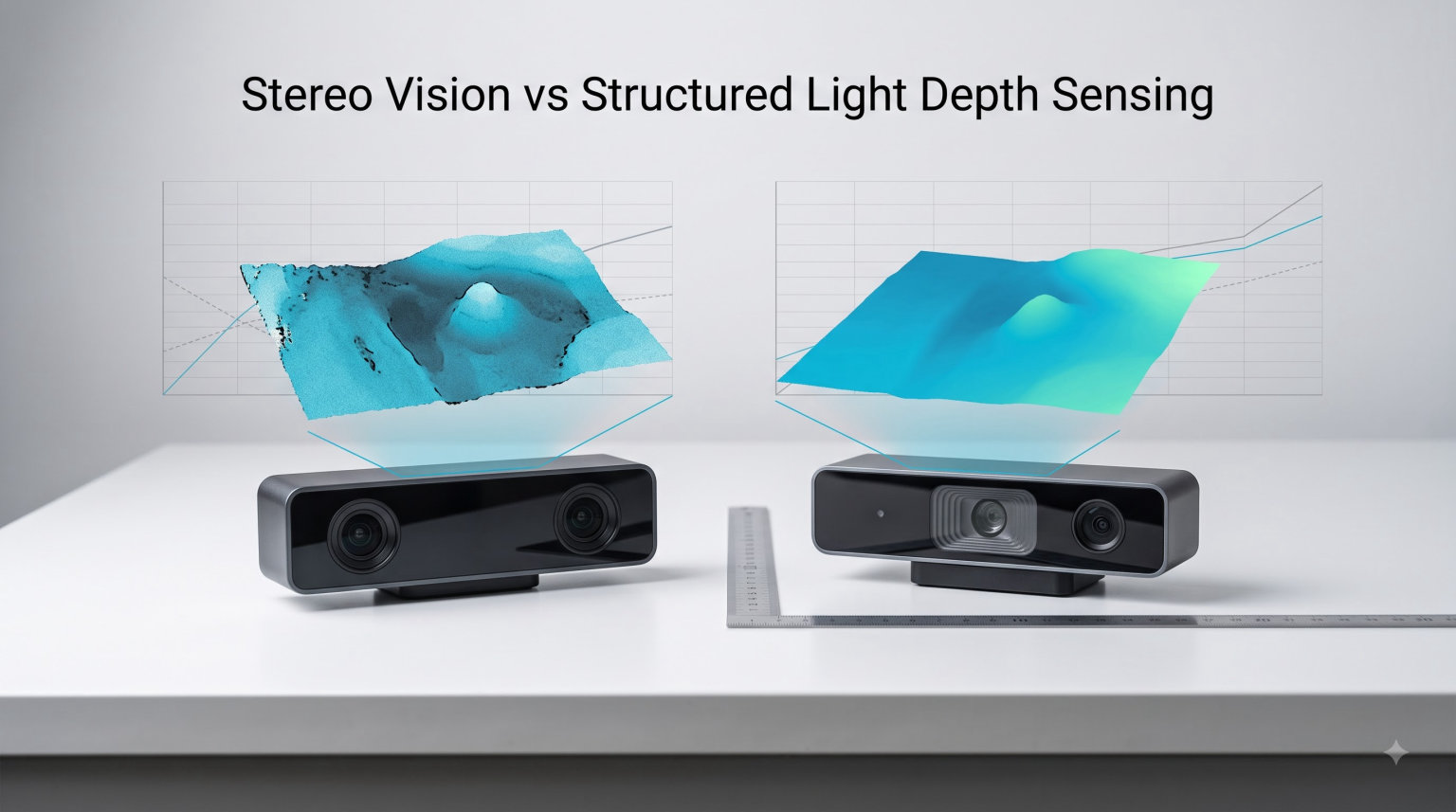
When our team started building 3D perception into our first autonomous mobile robot in 2019, we picked stereo vision because it looked cheaper on the bill of materials. Three months later we were stuck on a warehouse floor where the boxes were uniform brown and the lighting flickered between LED and sodium. Depth output looked like a static noise field. That failure pushed us to understand when stereo vision actually works, and when structured light depth sensing is the right tool instead.
This guide covers stereo vision vs structured light depth sensing from the working principles up to the deployment trade-offs that matter in 2026. Whether you are selecting a depth camera for robotics, an AR headset, a 3D scanning rig, or a quality inspection cell, the goal is the same: match the technology to the scene, the lighting, the budget, and the processing you actually have available.
Table of Contents
How Stereo Vision Works for Depth Sensing
Stereo vision depth sensing mimics how human eyes judge distance. Two cameras sit side by side at a known distance called the baseline. Each camera captures the same scene from a slightly different angle, and a matching algorithm finds the same physical point in both images. The pixel offset between the two matches is called disparity. Larger disparity means the point is closer; smaller disparity means it is farther away.
The math behind this is triangulation. Given the focal length of the lenses, the baseline distance, and the disparity measured for each pixel, the depth for that pixel falls out of a simple equation: depth equals baseline times focal length divided by disparity. The result of running this for every pixel is a dense depth map, which can be turned into a point cloud for 3D reconstruction.
Because stereo vision is a passive system, it does not emit any light of its own. It works with whatever ambient illumination is available. That is also its biggest weakness, and we will get to that in the lighting section. A typical stereo vision setup includes two synchronized image sensors, matched lenses, a rigid mechanical mount to fix the baseline, and a host processor that runs stereo matching. The matching step is the expensive part, and the quality of the result depends heavily on the scene texture and the algorithm used.
Key Components of a Stereo Vision System
- Two image sensors with synchronized exposure
- Matched lenses with identical focal length
- Rigid baseline mount, often 6 cm to 12 cm for robotics
- Calibration target for intrinsic and extrinsic parameters
- Host CPU, GPU, or dedicated VPU for stereo matching
The calibration step is critical. Intrinsic calibration removes lens distortion, and extrinsic calibration measures the exact rotation and translation between the two cameras. A small error here propagates into every depth value the system produces. In our experience, a 0.1 degree rotation error at a 10 cm baseline can shift depth readings by several percent at 2 m range.
How Structured Light Depth Sensing Works
Structured light depth sensing takes a different approach. Instead of two cameras watching the scene passively, an active projector casts a known infrared pattern onto the scene and a single camera (or two) watches how that pattern deforms on the surfaces. Because the projected pattern is known in advance, the system can match observed pattern features against the reference and recover geometry through triangulation.
Most consumer structured light sensors, including the original Microsoft Kinect and Apple Face ID, project a pseudorandom dot pattern from a laser or LED source. Industrial systems use higher density patterns, multiple wavelengths, or coded phase shifting. The receiving camera sees the pattern warped by the shape of the scene, and a depth algorithm decodes each dot or fringe to recover its 3D position.
Because the pattern is active, structured light depth sensing works in total darkness, as long as the pattern source has enough power. It also handles textureless surfaces very well, since the projected pattern supplies its own texture. The cost is that the pattern can be washed out by other strong light sources, especially sunlight, and the projector adds hardware cost, power draw, and eye-safety considerations.
Key Components of a Structured Light System
- Infrared pattern projector (laser or LED based)
- One or two infrared-sensitive image sensors
- Pattern generator and reference calibration
- Decode ASIC or host processor for pattern matching
- Optional color camera for RGB-D fusion
There are two main flavors of structured light. Coded pattern systems project a fixed dot or grid and decode the geometry once per frame. Phase shift systems project a series of patterns that modulate in time, and the phase offset at each pixel reveals distance. Phase shift can deliver very high accuracy at short range, but it requires multiple frames and is more sensitive to motion.
Stereo Vision vs Structured Light: Head-to-Head Comparison
Here is the side-by-side view most engineers want. We have ranked each criterion on a practical scale drawn from real deployments, not laboratory marketing sheets.
| Criterion | Stereo Vision | Structured Light |
|---|---|---|
| Illumination type | Passive (ambient light only) | Active (IR pattern projector) |
| Best range | 0.5 m to 20 m+ depending on baseline | 0.2 m to 5 m typical, up to 10 m industrial |
| Accuracy at close range | Moderate to high with good texture | Very high, often sub-millimeter |
| Textureless surface handling | Poor without learning-based matchers | Excellent, projector adds texture |
| Low light performance | Poor without external illumination | Strong, works in total darkness |
| Outdoor sunlight | Good, ambient light is plentiful | Poor, pattern is washed out by IR sun |
| Computational cost | High (dense stereo matching) | Moderate (pattern decode) |
| Hardware cost | Lower (two cameras, no projector) | Higher (projector adds BOM) |
| Power consumption | Low to moderate | Moderate to high |
| Calibration effort | High (two cameras, intrinsic and extrinsic) | Low to moderate (factory calibrated) |
| Moving scene handling | Good at moderate frame rates | Phase shift variants struggle with motion |
| Eye safety | Not applicable (no emitter) | Class 1 laser rules apply |
The clearest pattern is that each technology wins in a different environment. Stereo vision wins in bright outdoor scenes with rich texture. Structured light wins in controlled indoor scenes, especially where surfaces are uniform and lighting is dim.
Accuracy and Depth Resolution
Accuracy in depth sensing is a function of two things: how precisely the system can measure the matching signal, and how the geometry amplifies small errors at different distances. For stereo vision, the matching signal is disparity in pixels. Depth resolution scales with the square of distance, so a stereo rig that hits 1 mm resolution at 1 m might only deliver 1 cm resolution at 10 m.
Structured light systems measure either dot displacement or phase offset. Both signals can be very precise at short range, which is why structured light is the default for facial recognition, bin picking, and 3D scanning of small parts. The trade-off is that the projector power and the camera sensor resolution limit the working range, and accuracy drops sharply as the projected pattern density per unit area falls off with distance.
For high-accuracy indoor measurement without sunlight, our experience matches what the research community reports. Structured light has the stronger advantage. For longer range, stereo vision is more stable. Time-of-Flight, the third major technology, sits between them but is outside the scope of this comparison.
Quantified Accuracy Ranges
Typical numbers our team has measured or seen in published benchmarks:
- Stereo vision with 12 cm baseline: 2 to 5 mm accuracy at 1 m, 1 to 3 cm at 5 m, several cm at 10 m
- Industrial structured light: 0.05 to 0.5 mm accuracy at 0.5 m, 1 to 5 mm at 2 m
- Consumer structured light (Face ID class): 0.1 to 1 mm accuracy within 0.3 to 1 m
These numbers shift with lens quality, sensor resolution, and calibration, so treat them as starting points rather than guarantees.
Lighting Conditions and Environmental Performance
Lighting is where stereo vision and structured light pull in opposite directions. Stereo vision depends entirely on the scene having enough illumination, and on the camera sensors capturing enough signal to find matching features. In low light the image becomes noisy, the matching algorithm fails, and the depth map turns into a sparse mess. Structured light does not care about ambient light at all in the visible band, because it is reading its own projected pattern in the infrared band. The projector is the light source.
Sunlight flips the picture. The sun is a powerful broadband infrared source, and it overwhelms the projected pattern from a structured light sensor. The dots or fringes disappear into the noise floor, and the system fails. Stereo vision, on the other hand, has more than enough light to work with outdoors. That is why autonomous vehicles almost always use stereo vision or LiDAR rather than structured light.
Common Failure Modes
From forum reports and our own deployments, the most common failure modes are:
- Stereo vision on uniform cardboard, white walls, or shiny metal without texture
- Stereo vision at long range where disparity is sub-pixel
- Structured light outdoors in direct sunlight
- Structured light when another sensor of the same type interferes, since patterns can collide
- Both systems struggle with transparent or specular surfaces like glass and polished metal
Multi-sensor structured light setups, like a row of face ID modules, sometimes see each other and create cross-talk. This is a deployment problem you do not see with stereo vision.
Computational Requirements and System Complexity
Stereo vision is computationally hungry. Dense stereo matching has to compare every pixel in the left image against a window of candidates in the right image, and it usually runs at hundreds of millions of comparisons per frame. Block matching is cheap but produces rough depth. Semi-global matching and belief propagation are slower but better. Learning-based matchers like the ones behind many modern depth cameras can run on a GPU but still want a serious host processor.
Structured light decodes a known pattern, so the matching step is much simpler. A modest ASIC or DSP can return a depth map in real time at low power. The Intel RealSense SR300 and the Apple Face ID module are good examples. You give up some flexibility, but you also give up a lot of the host CPU and memory load that stereo vision places on your system.
Calibration is the other complexity tax. Stereo vision needs careful intrinsic and extrinsic calibration, plus periodic recalibration if the cameras experience shock or vibration. Structured light modules ship factory calibrated and tend to stay stable because the projector and sensor are mechanically tied together.
Cost, Hardware, and Integration Considerations
On the bill of materials, stereo vision looks cheaper. Two image sensors cost less than an image sensor plus a calibrated IR projector. In volume, the gap is smaller than people expect, but it is real. Structured light modules also tend to include more of the processing on board, which raises the unit price but lowers the load on the host system.
Total cost of ownership tells a different story once you factor in host processing, calibration, and field service. A stereo system that needs a high-end GPU to run its matching algorithm can cost more in compute and power than the camera savings. Structured light has higher unit cost but a flatter integration curve. We have seen teams abandon stereo vision projects because the GPU and cooling budget blew up, and we have seen teams abandon structured light projects because the sensor cost was unacceptable at their volume.
Integration Checklist
For both technologies, ask these questions before you commit:
- What is the minimum and maximum working distance in your scene
- What is the typical texture, color, and reflectivity of the target surfaces
- Will the system operate indoors, outdoors, or both
- How much host compute can you dedicate to depth processing
- What is the eye-safety class of the projector if you choose structured light
- What calibration tooling does the vendor provide
- What SDK support, ROS 2 drivers, and sample code are available
Best Applications for Each Technology
Match the technology to the deployment. These are the application areas where our team and the broader robotics community consistently see one technology outperform the other.
Stereo Vision Works Best For
- Outdoor robotics and autonomous vehicles where sunlight washes out structured light
- Long-range perception, anything past 5 m where the projected pattern fades
- Scenes with rich natural texture like foliage, urban environments, and rough terrain
- Aerial drones and ground robots with size, weight, and power constraints
- Multi-camera rigs where calibration and synchronization are already solved
Structured Light Works Best For
- Indoor 3D scanning of small to medium objects with high accuracy
- Facial recognition and biometric authentication on consumer devices
- Bin picking in warehouses where boxes are uniform and lighting is controlled
- Quality inspection cells on manufacturing lines
- Gesture recognition in AR and VR where close range and darkness are common
Hybrid systems exist. Some depth cameras combine stereo vision with an active IR projector so they get the best of both: passive triangulation when sunlight is strong, and active illumination when it is dark. The Intel RealSense D400 series is a common example of this approach. ML-based depth estimation is another path, where a neural network trained on stereo or structured light data produces depth from a single RGB camera in some scenarios, though the accuracy is still catching up to physical sensors.
How to Choose Between Stereo Vision and Structured Light
Use this decision framework when you are picking a depth sensing technology for a new project. The questions are ordered, so answer yes or no and follow the path down.
Step 1: Define the Operating Environment
If your system runs outdoors or in mixed lighting with strong ambient IR, lean stereo vision. If it runs indoors in controlled lighting, lean structured light. This single decision eliminates most of the candidate list.
Step 2: Define the Required Range and Accuracy
Under 5 m with sub-millimeter accuracy strongly favors structured light. Over 5 m with centimeter-level accuracy favors stereo vision. The middle ground is where hybrid and Time-of-Flight systems earn their place.
Step 3: Define the Compute Budget
If your host has a GPU and you can afford 5 to 15 W of depth processing, stereo vision is reasonable. If you need a low-power embedded processor with on-sensor depth, structured light is the safer bet.
Step 4: Define the Surface Conditions
Uniform cardboard, white plastic, and metal without texture are warning signs for stereo vision. Shiny or transparent surfaces are warning signs for both, but structured light has the better baseline.
Step 5: Define the Volume and Cost Targets
At low volume, sensor cost is less important than integration effort. At high volume, every dollar of BOM matters. Plan accordingly.
Frequently Asked Questions
Which technology is better for indoor vs outdoor use?
Structured light depth sensing is better for indoor use because its active infrared pattern works in dim or controlled lighting and handles textureless surfaces well. Stereo vision is better for outdoor use because it relies on ambient light, and sunlight actually helps it work, while it washes out the structured light pattern in structured light systems.
What is the typical accuracy difference between stereo vision and structured light?
Industrial structured light systems typically reach 0.05 to 0.5 mm accuracy at 0.5 m range, while stereo vision at a 12 cm baseline delivers 2 to 5 mm at 1 m. The gap narrows at longer range, where stereo vision remains stable past 5 m and structured light falls off because the projected pattern loses density.
How do computational requirements compare?
Stereo vision requires significantly more host compute because dense stereo matching compares every pixel in the left image against candidates in the right image, often running on a GPU or VPU. Structured light decodes a known pattern with much lighter processing and is often handled on a dedicated ASIC inside the sensor module.
What are the main cost drivers for each technology?
Stereo vision cost drivers are the two image sensors, matched lenses, and the host compute needed for matching. Structured light cost drivers are the calibrated IR projector, the sensor module, and the on-board decoder. Stereo vision usually has lower unit cost, but structured light often has lower integration cost.
Can stereo vision and structured light be combined?
Yes. Hybrid depth cameras combine a passive stereo pair with an active IR projector so they can use passive triangulation in bright sunlight and active illumination in low light. The Intel RealSense D400 series is a well-known example, and ML-based depth estimation is another way to extend these systems.
What are the limitations of structured light in sunlight?
Sunlight contains strong infrared that overwhelms the projected pattern from a structured light sensor, causing the dots or fringes to disappear into the sensor noise floor. This is why structured light is almost always used indoors, and why outdoor autonomous systems use stereo vision or LiDAR instead.
How does surface texture affect stereo vision accuracy?
Stereo vision depends on finding unique features to match between the two images. Uniform surfaces like white walls, plain cardboard, or polished metal do not provide enough unique features, so the matching algorithm produces noisy or sparse depth. Adding projected texture with an active illuminator, switching to structured light, or using a learning-based matcher can recover accuracy in these scenes.
Final Verdict
Stereo vision vs structured light depth sensing is not a question of which technology is better in absolute terms. It is a question of which technology fits the scene, the lighting, the range, the compute budget, and the volume you are designing for. Stereo vision is the right default for outdoor, long-range, texture-rich perception. Structured light is the right default for indoor, short-range, high-accuracy, low-texture work. Hybrid systems cover the gray zone in between.
If you are starting a new project in 2026, begin with the operating environment and the range, then walk the decision framework in this guide. The right answer is almost always obvious once those two questions are settled, and the wrong answer costs months of integration pain. For more on depth sensing and 3D perception, our team publishes ongoing coverage of robotics and computer vision topics here on Smashing Robotics.