
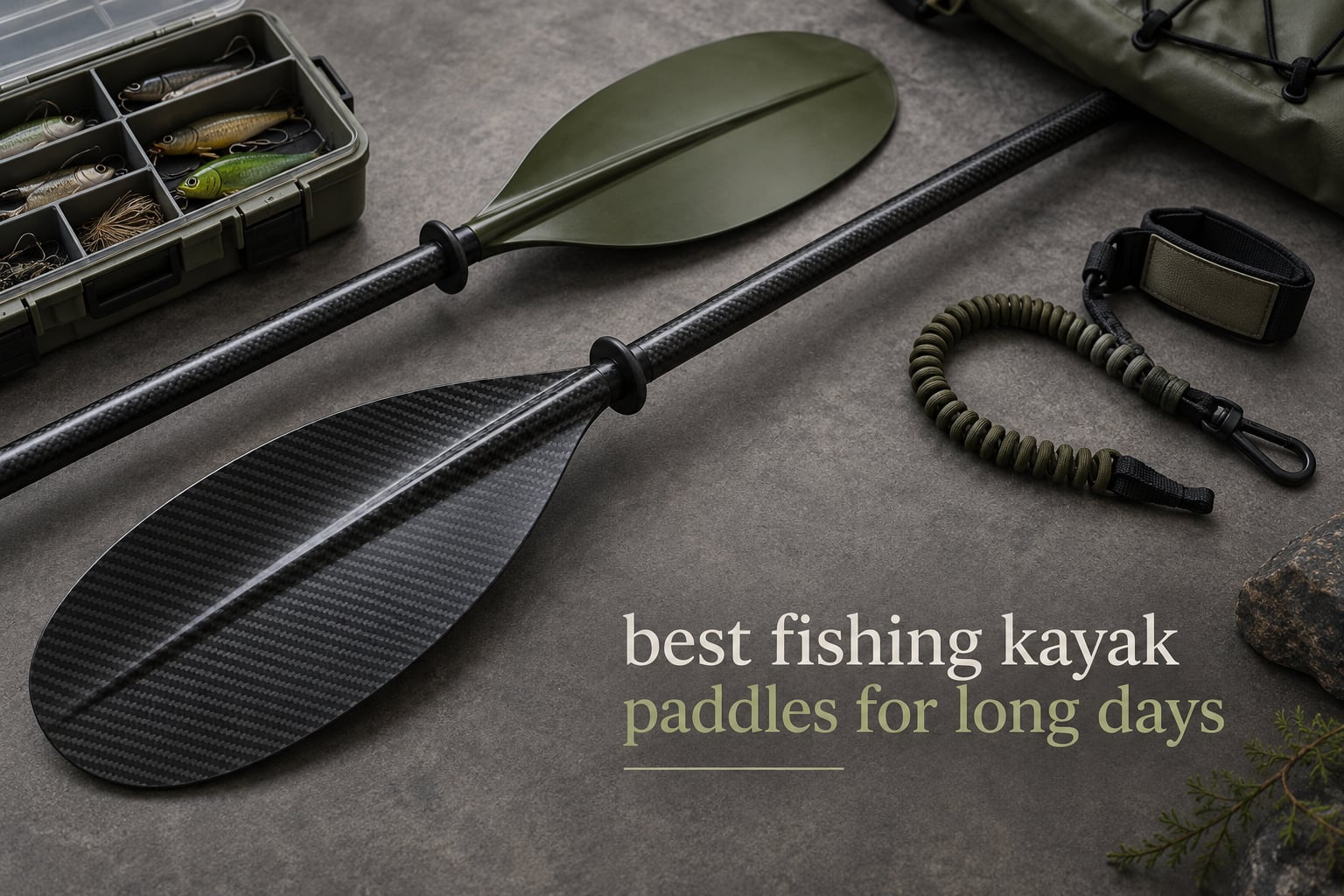
Six hours on the water rarely ends because the fishing went bad. More often it ends because the paddling went bad. By hour three the arms feel like a wet telephone pole, the wrist starts clicking, and the last three casts of the day are the weakest ones you have ever made.
That is why the best fishing kayak paddles for long days are not simply the lightest paddles on the market. They are the ones that match your hull width, your torso length, and your cadence, and that keep their blades stiff enough that you are not fighting flex on every single catch. Get that combination right and the fishing day ends when you decide it ends.
We compared 12 fishing kayak paddles for this guide, weighing the things anglers actually talk about in the forums: total weight in ounces, swing weight, blade size against hull beam, grip comfort after hours, whether the shaft loosens mid-session, and whether the paddle floats when it goes over the side. Every weight, length range, material, and rating below comes straight from the manufacturer data and owner reviews. Updated for 2026.
Table of Contents
Top 3 Fishing Kayak Paddles for Long Days (October 2026)
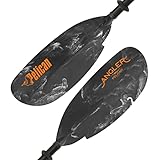
Pelican Poseidon Angler
- Aluminum shaft at 16 ounce listed weight
- Fiberglass reinforced polypropylene blades
- Hook retriever and shaft tape measure
- 0 and 65 degree feathering

Carbon Fiber 2-Piece Paddle
- 30 to 32 ounce carbon fiber build
- Two-piece locking joint
- Blade angles in 60 degree increments
- 220
- 234 and 250 cm options

Pelican Catch Angler Paddle
- Fiberglass shaft with nylon blades
- Hook retriever and 40 inch scale
- Adjustable drip rings
- 0 to 65 degree blade angle
The Poseidon Angler earns the top spot on evidence, not prestige. It carries a 4.6 rating across more than 2,700 reviews, it is built around angler-specific hardware rather than bolt-ons, and the ovalized indexing shaft is a genuine fatigue feature that most paddles in this group cannot match.
The carbon fiber two-piece from Best Marine and Outdoors is the value pick, and the closest thing to a real carbon shaft you will find at this end of the market. The Pelican Catch is the angler-feature pick for people on 34 inch and wider hulls who want a 250 cm paddle and adjustable drip rings.
Every Fishing Kayak Paddle We Compared in 2026
The table below is the fastest way to see the whole field. Weight is the number that decides most long days, so it is the first column on every review that follows.
| Product | Specifications | Action |
|---|---|---|
| Pelican Poseidon Angler Paddle |
|
Check Latest Price |
| Carbon Fiber Kayak Paddle 2-Piece |
|
Check Latest Price |
| Pelican Catch Angler Paddle |
|
Check Latest Price |
 Backwater Assassin Paddle Backwater Assassin Paddle |
|
Check Latest Price |
 Hornet Watersports Fiberglass Paddle Hornet Watersports Fiberglass Paddle |
|
Check Latest Price |
 Bending Branches Angler Ace Bending Branches Angler Ace |
|
Check Latest Price |
 Aqua Bound Manta Ray Hybrid Aqua Bound Manta Ray Hybrid |
|
Check Latest Price |
 Bending Branches Angler Drift Bending Branches Angler Drift |
|
Check Latest Price |
 Perception Pescador Adjustable Perception Pescador Adjustable |
|
Check Latest Price |
 OCEANBROAD Carbon Fiber Adjustable OCEANBROAD Carbon Fiber Adjustable |
|
Check Latest Price |
 WONITAGO Angler Kayak Paddle WONITAGO Angler Kayak Paddle |
|
Check Latest Price |
 OCEANBROAD Adjustable Aluminum Paddle OCEANBROAD Adjustable Aluminum Paddle |
|
Check Latest Price |
1. Pelican Poseidon Angler Paddle – the angler paddle with the most owner history
Pelican – Poseidon Angler Fishing Lightweight Kayak Paddle, Grey, 94.5″
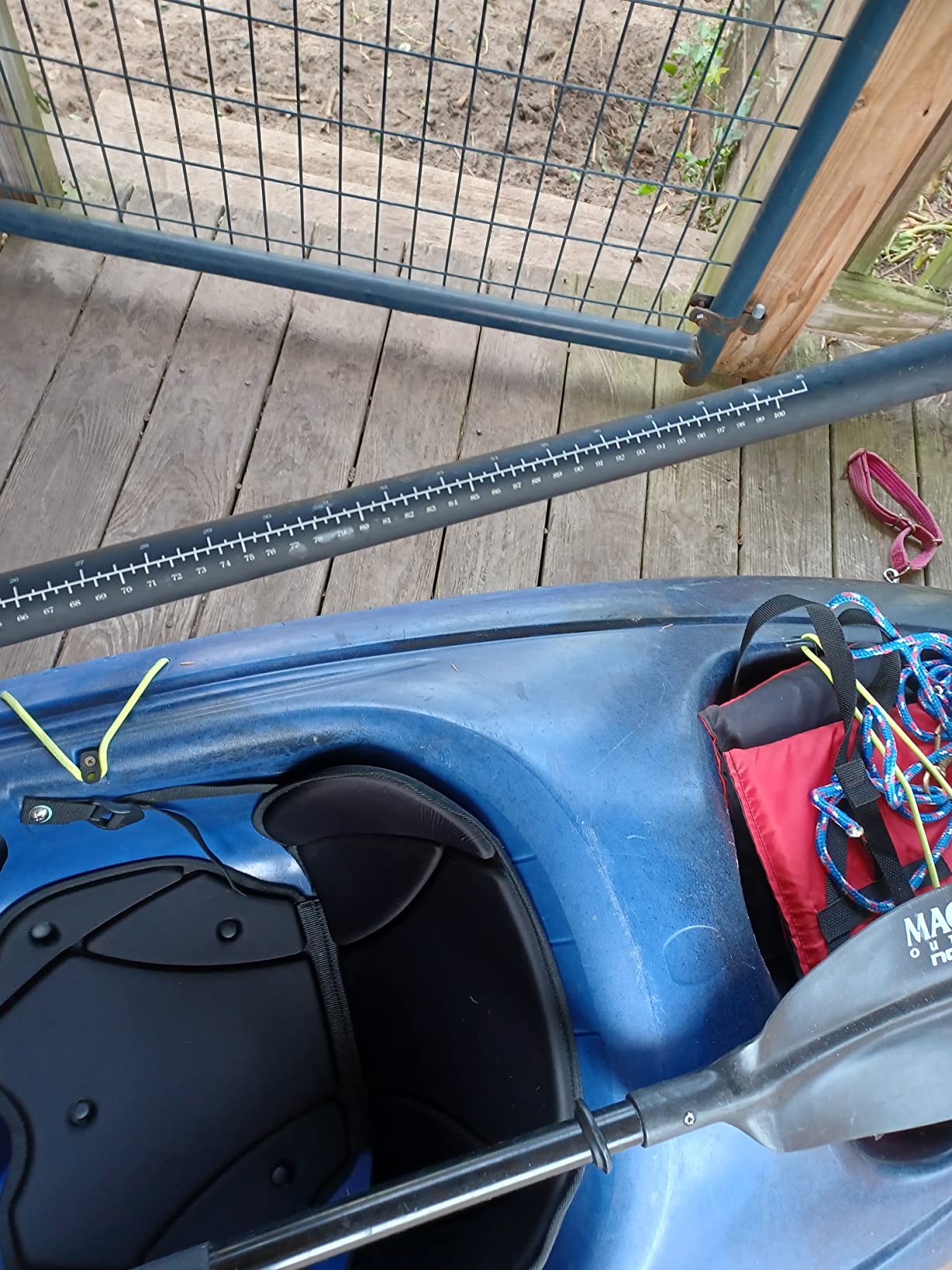
- Hook retriever and shaft tape measure built in
- Indexing ovalized shaft guides hand placement
- Push button feathering at 0 or 65 degrees
- Over 2700 reviews at a 4.6 rating
- Aluminum shaft is heavier than carbon builds
- Suits paddlers 152 cm and up in hulls over 86 cm wide
The Poseidon Angler is the paddle I would hand to an angler who fishes a wide hull and does it for a full day. It is not the lightest paddle here, but it is the most thoroughly angler-designed one, and that combination of hardware and proven owner history is why it tops this list.
The hook retriever on the blade and the tape measure running down the shaft are the small things that stop you from improvising with a fishing line and your teeth while your hands are busy. More important for long days is the indexing ovalized shaft, which gives your lower hand a physical reference for where it belongs every time you reach forward.
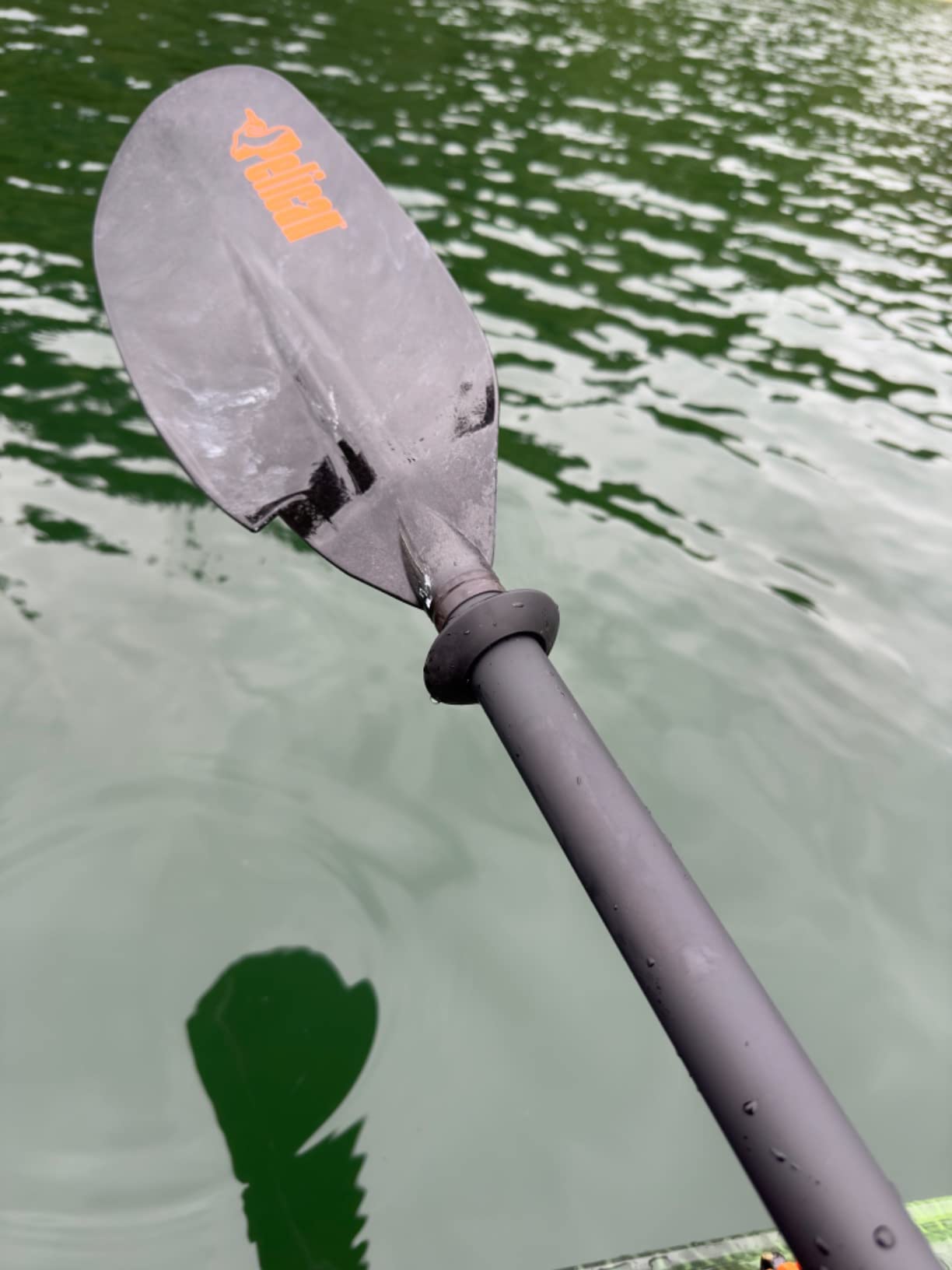
Feathering is set with a push button at either 0 or 65 degrees, which is a narrower range than several rivals but covers the two positions that matter for most anglers. Owners praise the anti-slip grip and the fact that the two-piece shaft breaks down cleanly for a truck bed or a rod locker.
At 94.5 inch, or 240 cm, it is sized for paddlers 152 cm and up working kayaks wider than 86 cm, so check your hull before you order. It is not a universal fit for narrow touring kayaks or shorter paddlers.
Who the Poseidon Angler suits
This is the right pick for anglers on 34 to 36 inch fishing hulls who want angler hardware on the paddle instead of clipped to the deck. It is also the safe choice if you fish cold mornings with wet hands, because the grip stays predictable when everything else is slippery.
Reviewers consistently point to durability for the money, and the one-year limited warranty on materials and workmanship is typical for the category. If you also paddle a canoe occasionally, the same shaft style translates directly.
Where the Poseidon Angler falls short
The aluminum shaft is the compromise that drives the main complaint in kayak-fishing forums. Users with an existing shoulder or wrist issue say a heavy shaft is the first thing they would replace if the model were not also their angler paddle.
Weight and the 240 cm length also limit it. On a hull narrower than 34 inches or for a paddler under 152 cm, the blade will over-reach and you will feel it in the lower back by the afternoon.
2. Carbon Fiber Kayak Paddle 2-Piece – the best value in real carbon
- Real carbon fiber at a mid-range price point
- 30 to 32 ounces keeps long sessions manageable
- Locking joint feels solid under load
- Length options from 220 to 250 cm
- Size chart is based on width and height and can mislead
- Some units arrived with an unsecured blade
- Slight twist flex reported by some users
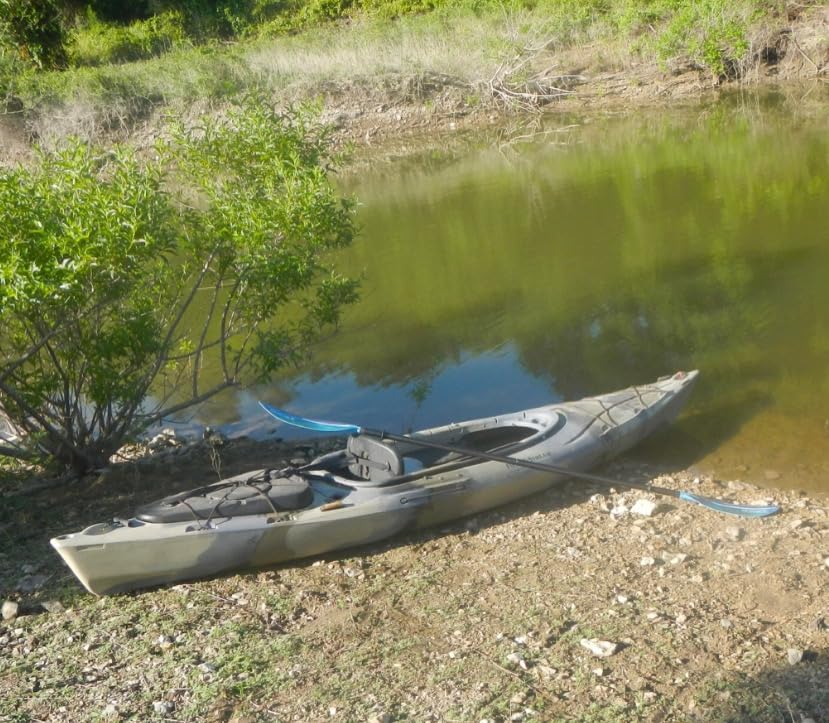
When we asked what a genuine carbon shaft feels like after a full day, this is the paddle that came up most often as the value answer. The shaft measures around 920 g, which is well under the roughly 1,100 g of a premium aluminum paddle of the same length.
At 30 to 32 ounces it is one of the lighter full-size paddles in this group, and that is the whole argument for it on a long paddle-and-fish cycle. Owners who upgraded from a stock plastic paddle describe it as a night-and-day change in how the boat moves.
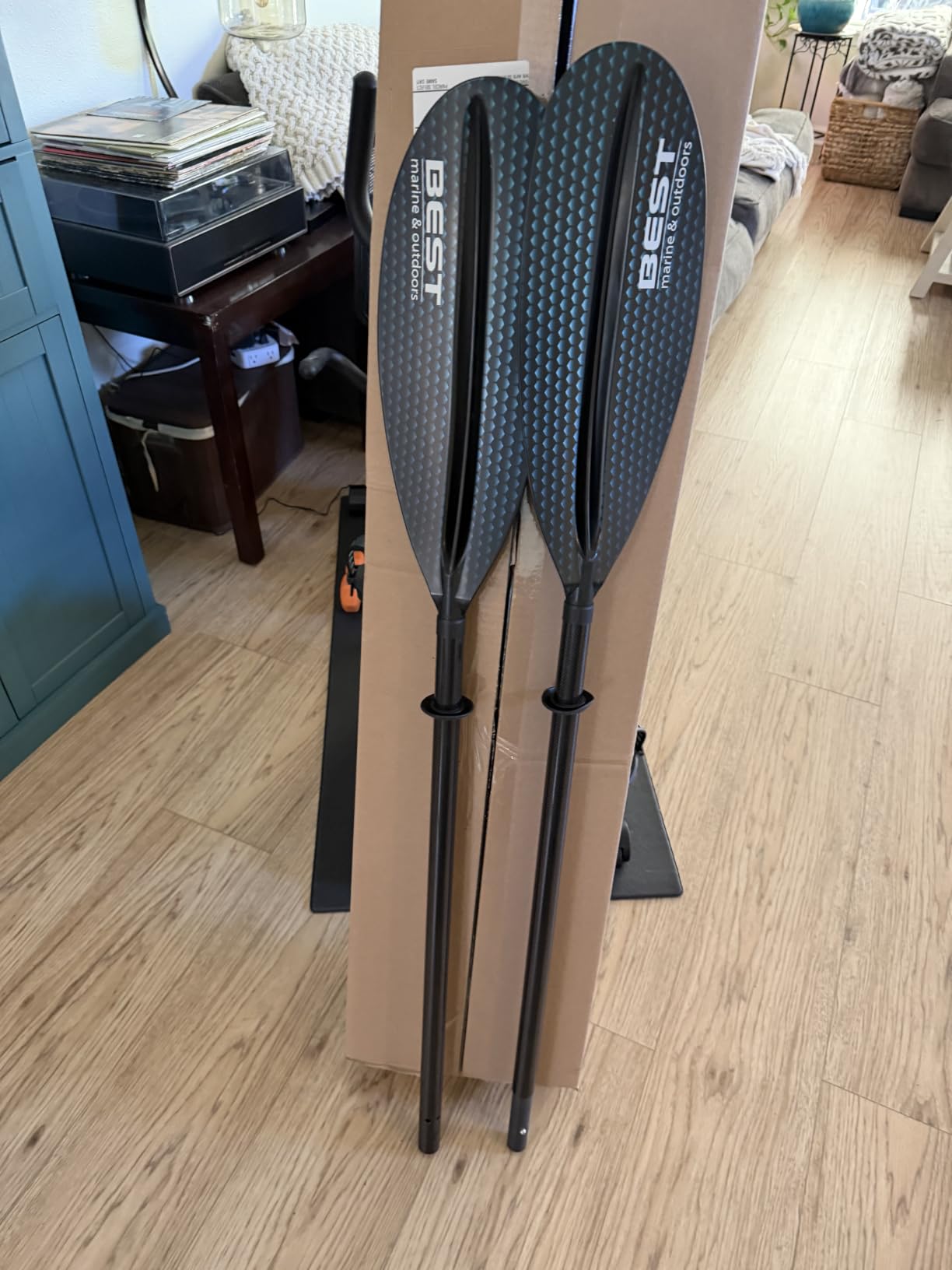
The two-piece joint uses a locking connection that reviewers say has no wobble or play under load, which is the failure mode that ruins long trips. Blade angles set in 60 degree increments give you two useful positions without overcomplicating the setup.
It also works as a canoe paddle, and multiple lengths mean one paddle can cover a narrow touring hull and a wider fishing boat. Double-sided blades let you match the hull color if that matters to you.
Who the Carbon Fiber 2-Piece suits
This is the pick for an angler who wants carbon weight savings without paying for a premium brand, and for anyone paddling three to five hours of travel inside a six hour trip. The carbon shaft keeps its stiffness, so flex is not stealing your power at the catch.
It is also a good sharing paddle. Two people of different heights can use the 220, 234 and 250 cm options from the same model rather than owning two separate paddles.
Where the Carbon Fiber 2-Piece falls short
The sizing chart is the single most common complaint, and it has caused at least one return for a paddle that arrived too short. Use kayak width and your own height together rather than trusting the printed chart on its own.
A minority of buyers reported a blade that was not fully secured to the shaft out of the box, and some noticed slight twist flex in the blades. Both are worth checking in the first five minutes, and both were resolved quickly by replacement in owner reports.
3. Pelican Catch Angler Paddle – 250 cm built for wide hulls
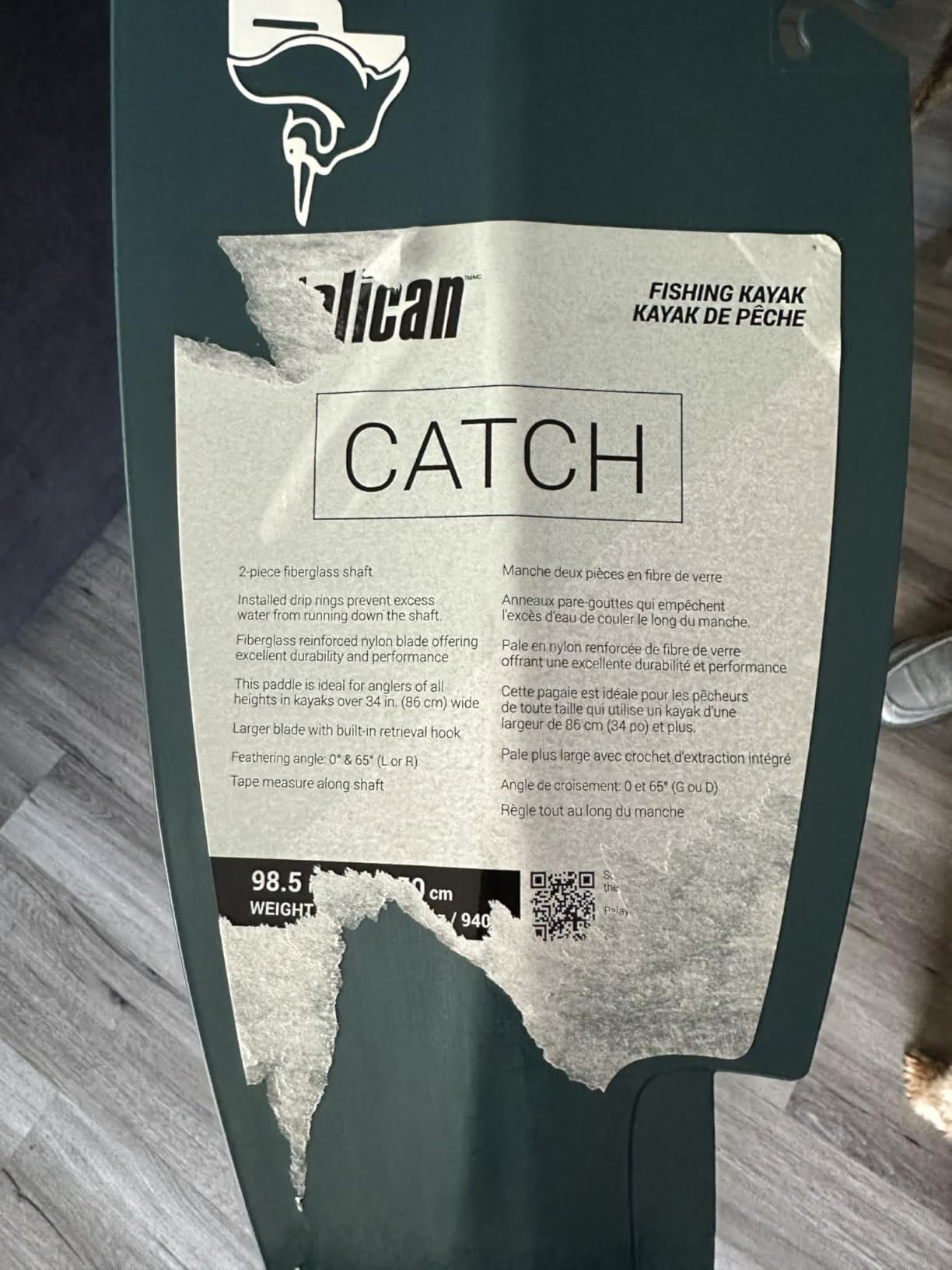
- Wide 0 to 65 degree feathering range
- Adjustable drip rings keep hands dry
- Fishing hook and tape measure included
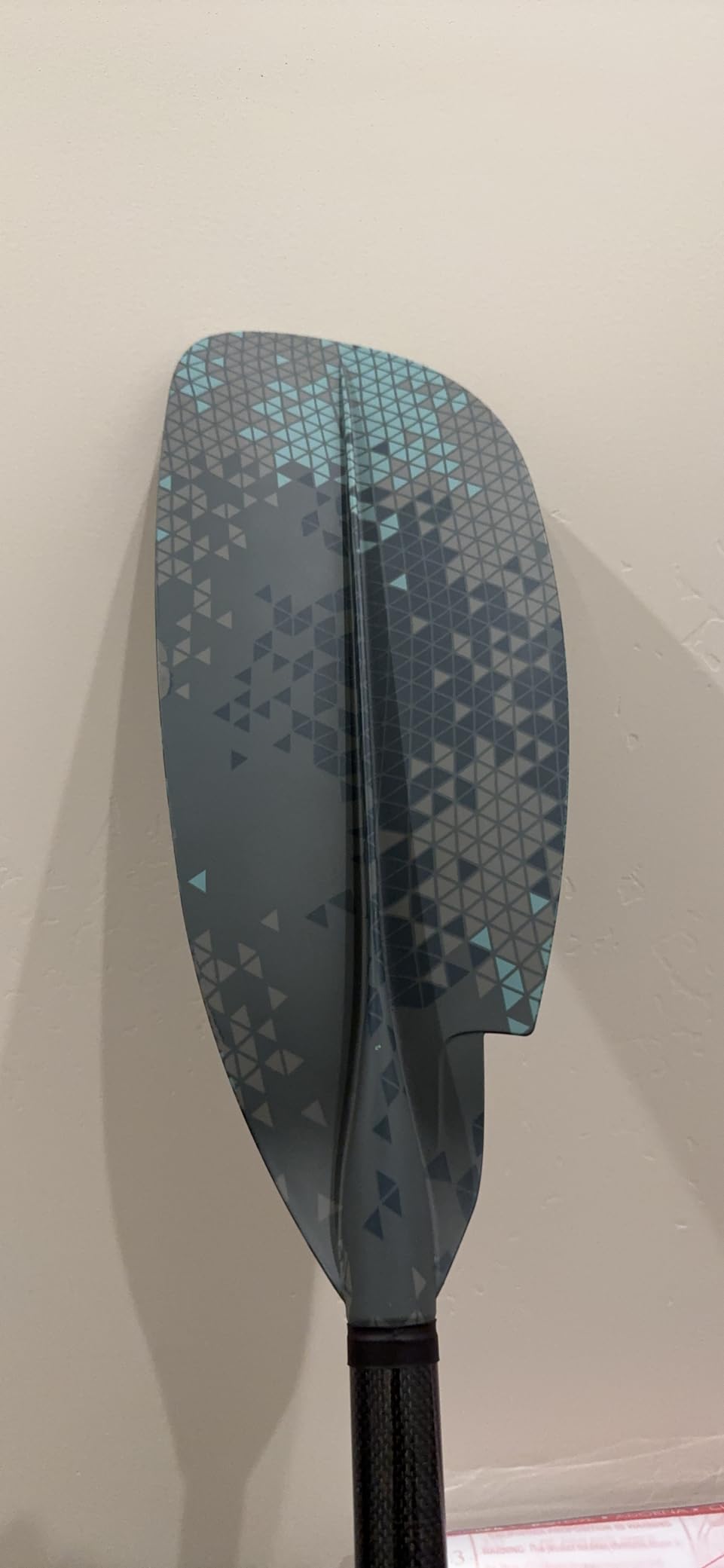
- Impact resistant fiberglass reinforced nylon blades
- 250 cm length suits taller paddlers and wider hulls only
- Fiberglass shaft is heavier than carbon options
The Catch is the longer sibling of the Poseidon, and it exists for one reason: anglers over 6 feet on kayaks wider than 34 inches. At 250 cm it puts more blade in the water per stroke, which matters when you are paddling a heavy outfitted fishing hull loaded with tackle.
Feathering adjusts across a full 0 to 65 degree range, the widest in this group, and the adjustable drip rings are a genuinely underrated long-day feature. They keep water off the grip without a wrist strap, and they are the first thing owners mention when they describe grip comfort after four hours.
The indexing ovalized shaft works the same way as the Poseidon, giving your lower hand a repeatable position on every stroke. That consistency is what keeps a long session from turning into a slow shoulder ache.
The fiberglass reinforced nylon blades are impact resistant, which is the right material for shallow grass flats and brushy shorelines where a thin carbon blade would be a liability. Arctic Blue finish is also easier to spot on the water than black.
Who the Pelican Catch suits
Pick this if you are over 6 feet, fish a wide fishing kayak, and want a full-featured angler paddle in a long length. It is a natural match for anglers moving from a 240 cm paddle who keep hitting the ends of their range.
It also works well for anyone who paddles in cold or wet conditions, since the drip rings and the nylon blade grip well when everything is soaked.
Where the Pelican Catch falls short
The 250 cm length is the main limitation. On a narrow hull or for a paddler under 6 feet, you will be stabbing at the water and leaning forward constantly, which loads the lower back.
Manufacturer weight is not published for this model, so if you are buying strictly on weight, you are guessing. A fiberglass shaft is also measurably heavier than a carbon one, which makes it a weaker choice for pure all-day touring.
4. Backwater Assassin Paddle – the utility paddle with teeth
Backwater Assassin Paddle 06-0017 Full-Size Carbon-Fiber Hybrid Kayak Paddle – 98.5′ to 102.5′ Length
- Dual-purpose hook for line
- decoys
- docks and limbs
- Serrated teeth edge for pushing off surfaces
- Two adjustable length ranges
- Longest warranty in this group at 3 years
- Heavier listed weight than typical carbon touring paddles
- ABS blade is basic compared to composite blades
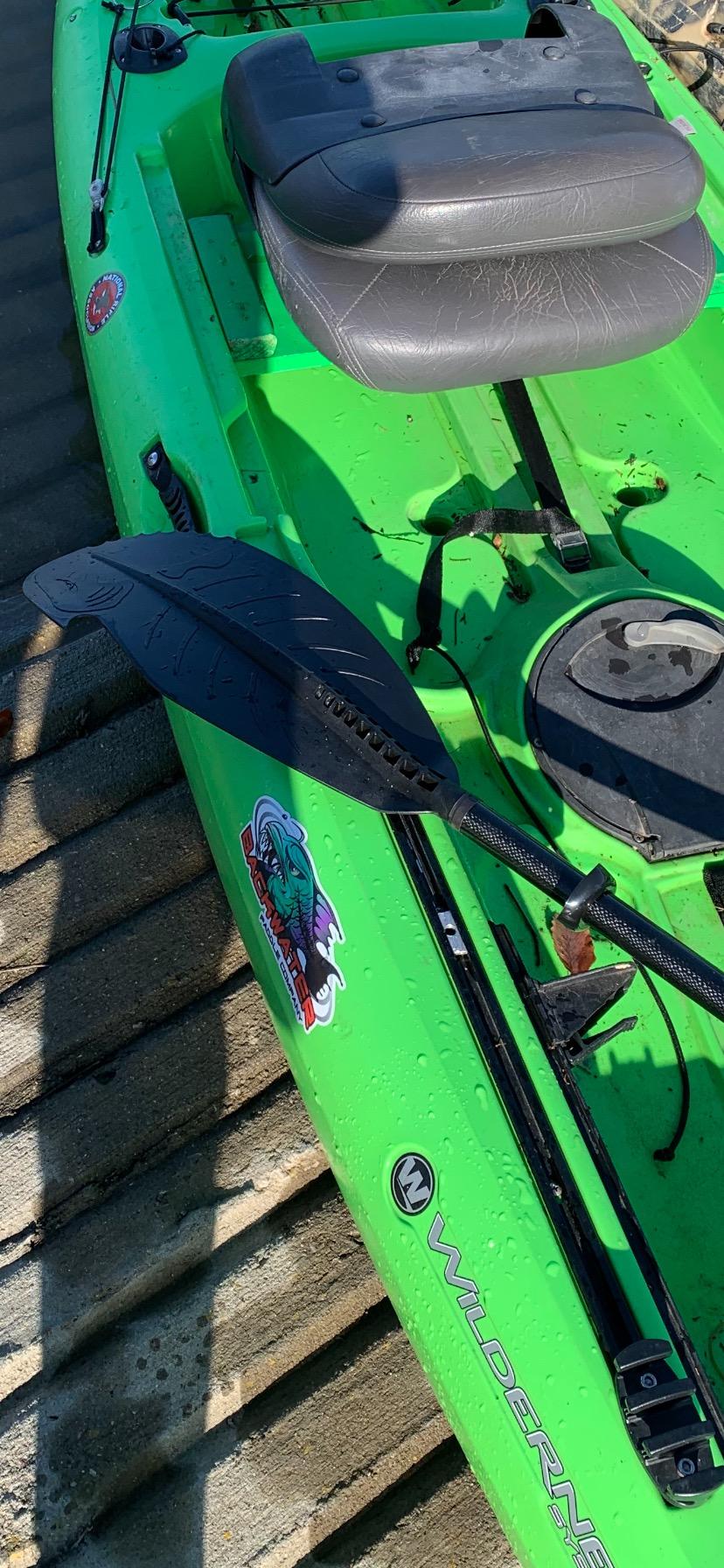
The Assassin is not a lightweight endurance paddle, and it does not pretend to be one. It is a tool paddle, built around a dual-purpose hook and a serrated teeth edge that let you grab a line, a decoy, a dock line, or a tree limb without switching hands.
That is a real advantage on snag-prone water. An angler working flooded timber or duck blinds can retrieve a snag line, or push off a rock or a submerged log, with the same paddle they paddled in with.
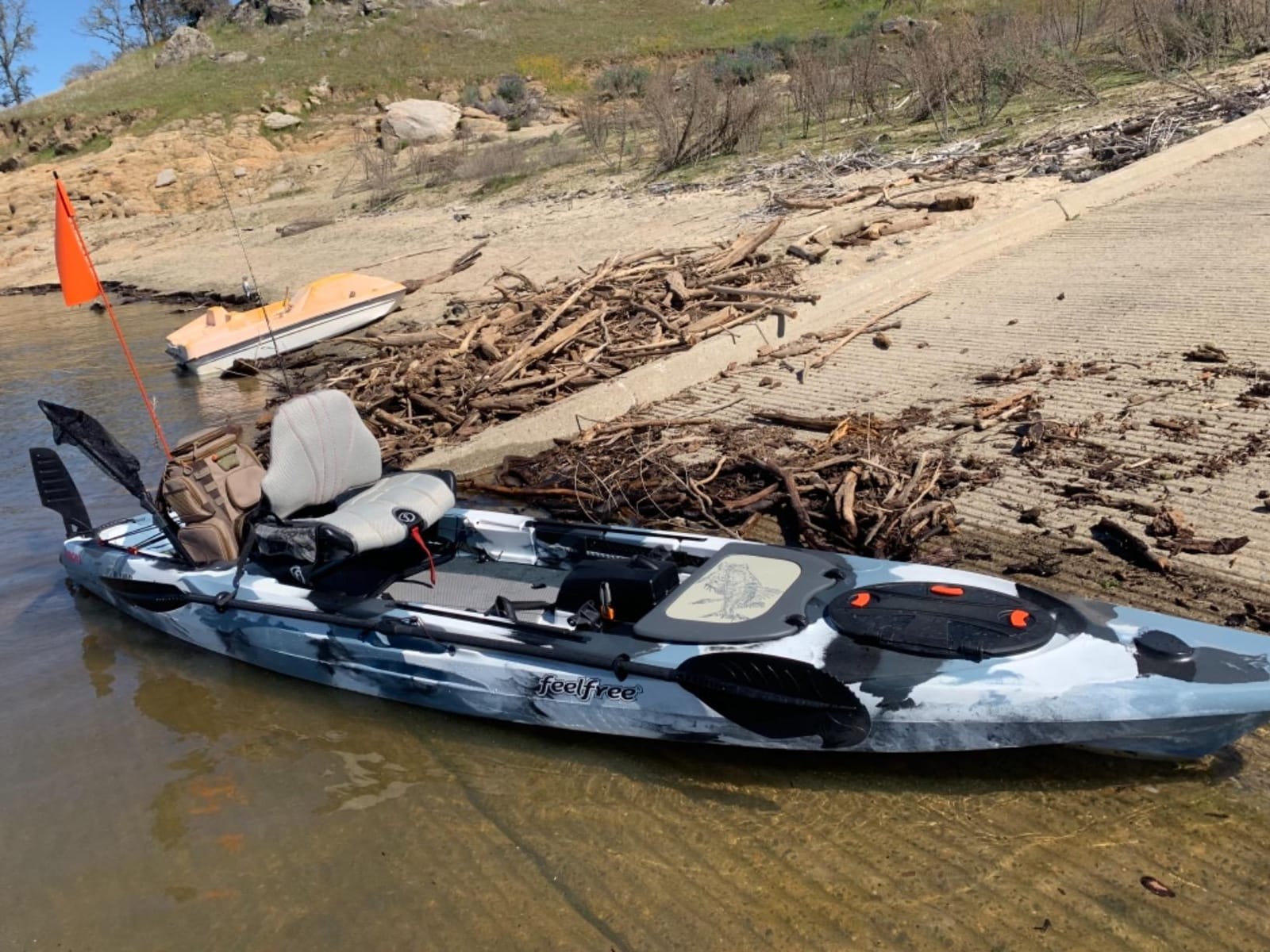
Two length ranges are offered, 230 to 240 cm and 250 to 260 cm, so the same model covers both a mid-size hull and a wide fishing boat. Drip rings are included, and the 3 year warranty is the longest coverage in this group.
The ABS injected nylon blade is impact resistant, which is the correct trade for the utility features. It is a blade that tolerates being used as a lever rather than one optimized for an efficient catch.
Who the Backwater Assassin suits
This is the pick for anglers who work heavy cover, snag a lot of line, or fish water with plenty of structure to push off. Waterfowl hunters get the same benefit from the hook and teeth edge.
It is also a good choice for a fishing kayak that lives on a trailer and takes a beating on the way to the launch.
Where the Backwater Assassin falls short
It is the wrong paddle for a pure long-touring day, because the listed weight is heavier than the carbon touring paddles in this group. Buy it for what it does, not for what it weighs.
With a 251 review base, owner feedback is thinner than the top two picks, and the ABS blade gives up some efficiency in open water. If you paddle long and fast rather than digging and prying, that efficiency is the part you will feel.
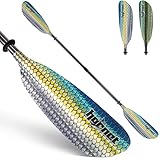
5. Hornet Watersports Fiberglass Paddle – 26 ounces of long-day relief
- 26 ounces is genuinely light for a full-size paddle
- Stiff flex-free feel on multi-hour trips
- Dihedral blade pulls cleanly
- Double-sided fish scale blade design
- Some orders arrived broken in three pieces
- Shorter adjustment range than most competitors
- Blades feel less substantial than premium paddles
At 26 ounces this is the second-lightest paddle in the group and the one most likely to change how a long day feels. Owners report finishing 10-mile and 3-hour sessions without the soreness that used to show up the next morning.
The shaft is a carbon fiber and fiberglass blend, which is a sensible middle ground. It gives you most of the stiffness benefit of carbon at a lower cost, and the dihedral blade pulls efficiently without the flutter you get from a flat blade.
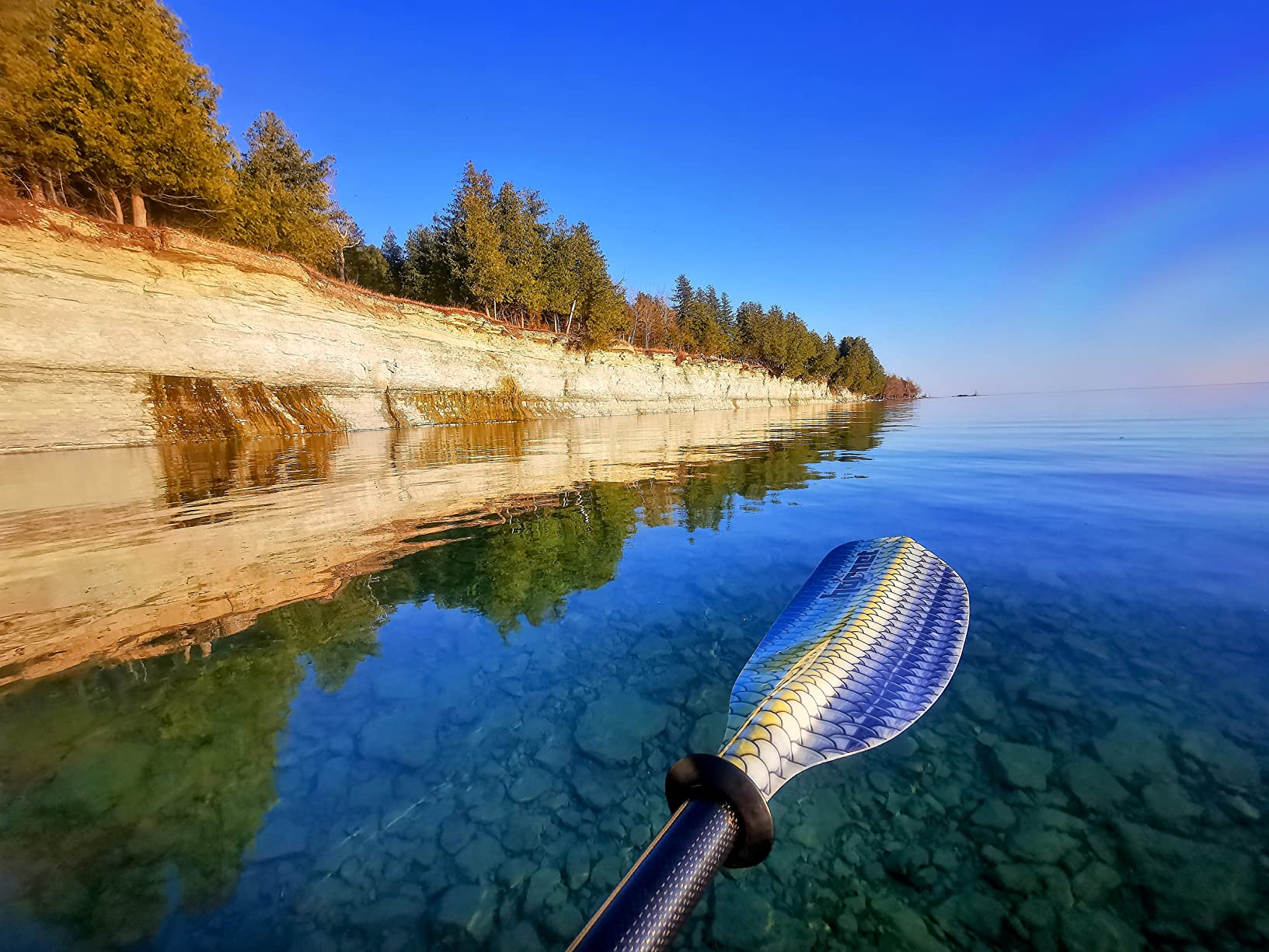
Blade angle adjusts from 0 to 60 degrees in 15 degree steps, which is finer control than most two-position paddles. The grippy shaft texture works bare-handed, and the two-piece breakdown makes it easy to stow on a deck.
The double-sided fish scale blade design is a visual detail, but it also gives the blade a slightly stiffer feel in the water than a plain flat surface.

Who the Hornet Paddle suits
This is the pick for cover anglers who log serious mileage between spots, or for anyone whose current paddle is a heavy aluminum shaft and who wants the change immediately. 26 ounces is close to the practical floor for a full-size paddle.
It suits a hull in the 90 to 94 inch range, so it works for a mid-size fishing kayak. It is a good paddling-only travel companion for a narrower touring hull too.
Where the Hornet Paddle falls short
Shipping damage is the standout problem and the source of nearly all the one-star reviews. Several buyers received a broken three-piece paddle, which is worth planning for if you are buying far from home.
The adjustment range is only 4 inches, so it cannot cover a wide spread of paddler heights, and reviewers describe the blades as less substantial than premium paddles. It is a 4.4 rating, the lowest here, though 75 percent of its reviews are still five star.
6. Bending Branches Angler Ace – the carbon shaft wide-hull workhorse
- Carbon shaft cuts arm fatigue on long fishing days
- Blades survived oyster beds and rock strikes
- Snap button joint has no wobble
- Available from 240 to 280 cm
- Premium pricing in this category
- Hulls over 35 inches may need 270 or 280 cm
- Minimal protective packaging
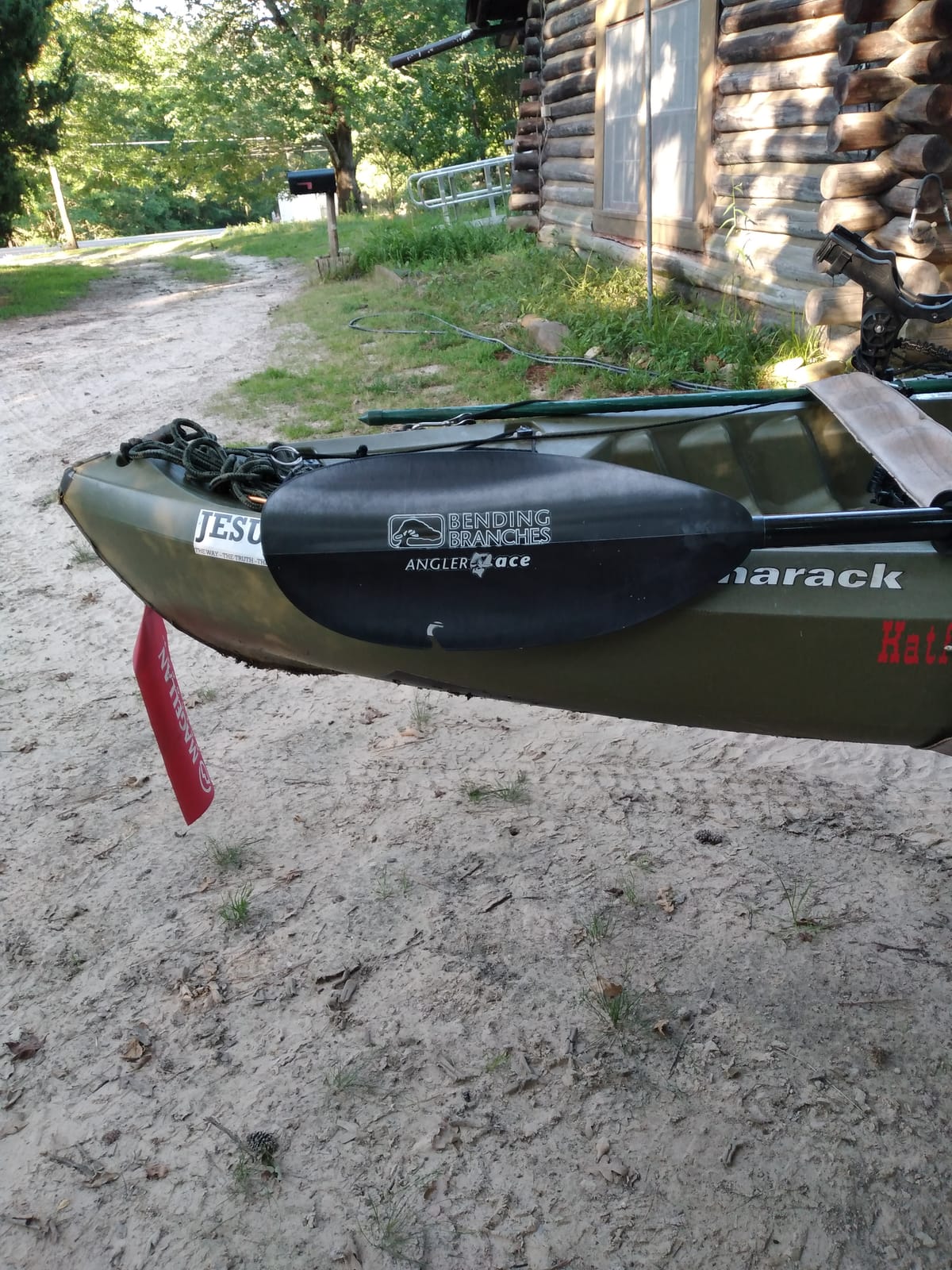
The Angler Ace is the paddle forum anglers name when they describe a long day well spent. Anglers on forum.gon.com called the 260 cm version the best investment they have made for kayak fishing and for long day paddling generally, particularly when a fish pulls hard on the line.
The carbon shaft is the reason. It keeps the paddle stiff under load, so you are not absorbing flex in your shoulders every time you catch, which is the failure that quietly ends productive days.
Durability is the second story. Owners report blades that took oyster beds, rock strikes, banks and debris without damage, and the paddle is sturdy enough to use as a brace getting in and out of the kayak, which happens far more often than paddlers admit.
The ergonomic ovalized grip is worth a mention because hot spots show up around hour five. The snap button ferrule joins tight with no play, so you are not re-tightening it before every launch.
Who the Angler Ace suits
This suits dedicated anglers on wide fishing hulls, including pedal and accessory-heavy boats where the hull is heavy and tracking is work. Anyone with a shoulder or wrist history should shortlist it first.
The 240 to 280 cm range means you can size up for a 35-plus inch hull or down for a lighter setup, and the 260 cm is the version most anglers gravitate toward.
Where the Angler Ace falls short
It sits at the top of the price range in this roundup, and that matters if you are buying your first angler paddle on a budget. It is a poor fit for rentals or for kids who will outgrow it in a season.
Packaging has been reported as minimal, so a rough carrier is worth planning for if you transport it regularly. And hulls over 35 inches may want the 270 or 280 cm length rather than the 260.
7. Aqua Bound Manta Ray Hybrid – the highest rated paddle here
- Highest average rating in this roundup at 4.8
- High-angle dihedral blades give power with no flutter
- Carbon shaft at roughly half the weight of aluminum
- Posi-Lok ferrule adjusts offset in 15 degree steps
- Carbon handle grip feels rough out of the box
- High-angle design has more resistance than a flat blade
- Small review base of 45 ratings
The Manta Ray Hybrid carries a 4.8 average, the highest rating in this group, and it earns the high-angle badge for a specific reason. The dihedral fiberglass reinforced nylon blades deliver real power without the flutter that makes a flat blade feel vague at the top of the catch.
The carbon shaft is roughly half the weight of a comparable aluminum paddle, and owners upgrading from a cheap stock paddle describe large gains in speed, power and stamina. It is balanced in the hand and moves heavy kayaks easily.
Who the Manta Ray Hybrid suits
This is the pick for an angler who wants a touring-grade paddle that doubles as a fishing paddle. Its lack of hook-retrieval slots is actually a benefit in weed-heavy water, which is why it comes up so often in kayak fishing circles.
The Posi-Lok ferrule adjusts the blade offset in 15 degree increments, so you can tune the paddle to your own stroke rather than living with one fixed angle. Lengths from 210 to 260 cm cover both narrow touring hulls and wide fishing boats.
Where the Manta Ray Hybrid falls short
The carbon handle grip has a rough, unfinished feel out of the box. One owner reported it improved with use, but it is worth feeling before you commit.
The high-angle design also creates more resistance than a flat blade, and the review base is only 45 ratings, so there is less long-term owner data behind the rating than the top picks have.
8. Bending Branches Angler Drift – the aluminum-shaft angler paddle
- Predictable handling suits beginners and casual paddlers
- Snap button ferrule assembles quickly
- Durable nylon blades give smooth strokes
- 250
- 260
- 270 and 280 cm options
- Heavier than carbon shaft alternatives for touring
- Nylon blades give less bite in heavy water
The Angler Drift is the entry point into the Bending Branches fishing line, and it is a deliberate compromise. The aluminum shaft is balanced in a way that reduces arm fatigue for casual paddling, but it is not the lightest option here.
What it does give you is predictability. The handling is stable and easy to control, which is exactly what a new angler needs when they are also learning to read water and cast from a moving platform.
Who the Angler Drift suits
Beginners, casual weekend paddlers, and anyone who wants a Bending Branches angler paddle without the premium carbon price. The snap button ferrule means assembly takes seconds, with no pin or lever to fumble at a wet launch.
The 250 to 280 cm range covers wide fishing hulls, and the durable nylon blades handle the contact with boat decks, rod holders and anchor lines that a thinner blade would not.
Where the Angler Drift falls short
An aluminum shaft is measurably heavier than carbon, and that is precisely the complaint that dominates kayak-fishing forums when anglers describe a long day going bad. It is the wrong place to economize if your trips run past four hours of travel.
Nylon blades also give less bite in heavy or rough water than carbon-reinforced blades, and the 45-review base means less long-term feedback than the established models have.
9. Perception Pescador Adjustable Paddle – the hull-matching option
Perception Kayaks Pescador Adjustable Kayak Fishing Paddle -2 Piece Moss camo, 230-250cm/90.5-98.5”
- Adjustable range fits a wide spread of paddler sizes
- Dihedral two-plane blade gives smooth stealthy strokes
- Sturdy blade built for maneuvering heavier fishing kayaks
- Moss camo finish suits fishing environments
- Heaviest option in this group at 34 ounces
- Plastic construction is the entry tier here
- Blades can feel vague in strong current
The Pescador is bought for one primary reason: it matches Perception hulls, and the adjustable 230 to 250 cm range covers a lot of paddler heights on the same paddle. If you already fish a Perception boat, that fit argument is hard to argue with.
The dihedral two-plane blade is genuinely good for fishing, because it gives smooth, stable strokes with minimal noise and splash. Quiet approach matters more than raw power when you are working fish that spook easily.
Who the Perception Pescador suits
This suits anglers who want one paddle that covers a range of heights, and people who fish heavier fishing kayaks where a sturdy blade gives more control. The camo finish also disappears against a shoreline.
It is a sensible pick for a first fishing kayak, where predictable and adjustable beats ultralight.
Where the Perception Pescador falls short
At 34 ounces it is the heaviest full-size paddle in this group, and weight is exactly what you are trying to reduce on a long day. It is the wrong choice for high-mileage cover anglers.
Plastic is the entry-level material here, and reviewers note the blades can feel vague compared to nylon or carbon-reinforced builds in strong current. It is a 4.4 rating across 97 reviews, with 74 percent five star.
10. OCEANBROAD Carbon Fiber Adjustable Paddle – carbon in 5 cm steps
OCEANBROAD Adjustable Carbon Fishing Kayak Paddle – 94in/240cm-98in/250cm-102in/260cm Carbon Fiber Shaft Paddles Kayaking Fishing Oar with Paddle Leash, Black
- 1.1 mm carbon shaft shell gives a stiff responsive feel
- Fine 5 cm adjustment steps fit many hulls and paddlers
- Three blade locking positions for angle preference
- Leash and drip rings included
- Heaviest listed item weight in this group at 3.5 pounds
- Three-piece construction needs more assembly
- Fiberglass reinforced PP blades are less refined than nylon or carbon
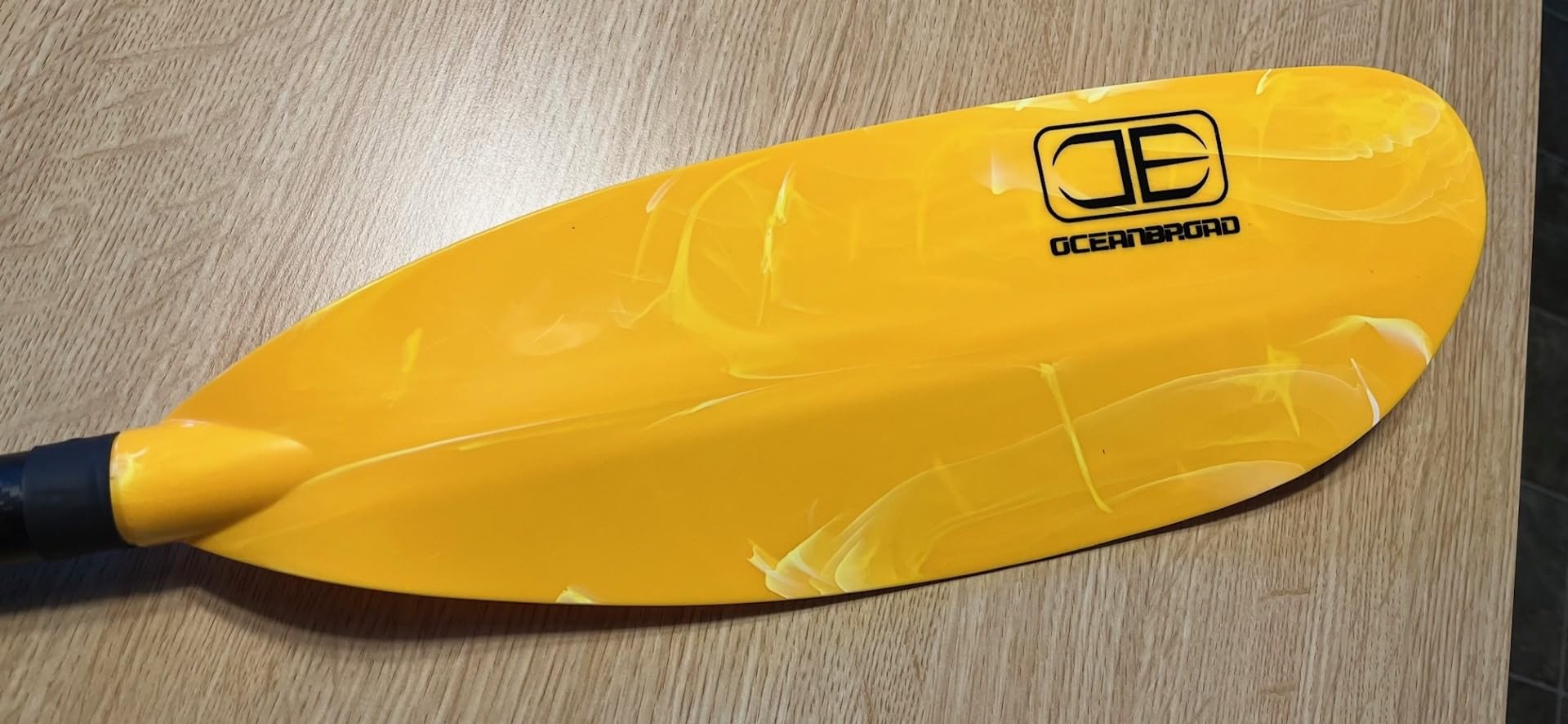
The carbon shaft here has a 1.1 mm shell thickness, and that detail is why the paddle feels stiff and responsive rather than springy. Owners treat it as a step up from an entry paddle, and they single out joint comfort as much as the weight.
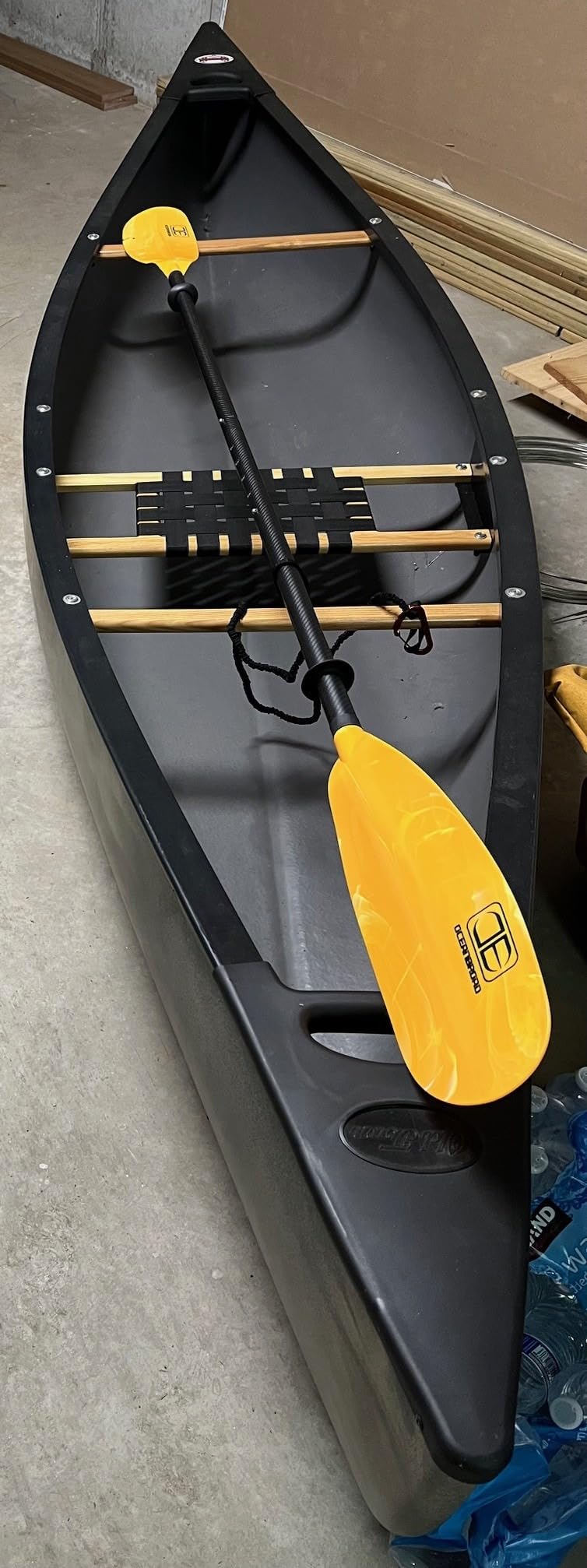
What sets it apart is the adjustment granularity. Running from 240 to 260 cm in 5 cm increments lets you fine-tune the length to your hull and your height, which is the most useful thing you can do for a long day on a wide fishing kayak.
Who the OCEANBROAD Carbon suits
This is the pick for an angler sharing a kayak with a differently sized paddler, or for anyone who wants to dial in the exact length rather than choosing between two fixed options. Three locking blade angle positions handle wind and cadence preferences.
The bungee paddle leash and drip rings at both ends are the practical touches anglers on deep water care about. The hook retrieval system in the blade is integrated rather than clipped on.
Where the OCEANBROAD Carbon falls short
The listed item weight of 3.5 pounds is the heaviest in this group, which is a packaging-inclusive figure and not the bare paddle weight, but it is still a flag if you are shopping on weight. Measure or verify before you assume it is a heavy paddle in the hand.
Three-piece construction means more assembly than a two-piece paddle, and fiberglass reinforced polypropylene blades are less refined than the nylon or full carbon blades higher in this list.
11. WONITAGO Angler Kayak Paddle – the Most Versatile with a leash
WONITAGO Angler Kayak Paddle Adjustable Fishing Kayak Oar with Paddle Leash
- Included paddle leash at this price point
- 40 inch engraved measuring scale on the shaft
- Blades float in salt and fresh water
- 20 cm of length adjustment for sharing
- Plastic blades are the least refined material in this group
- Heavier feel than carbon on long days
- Not as stiff or responsive as full carbon builds
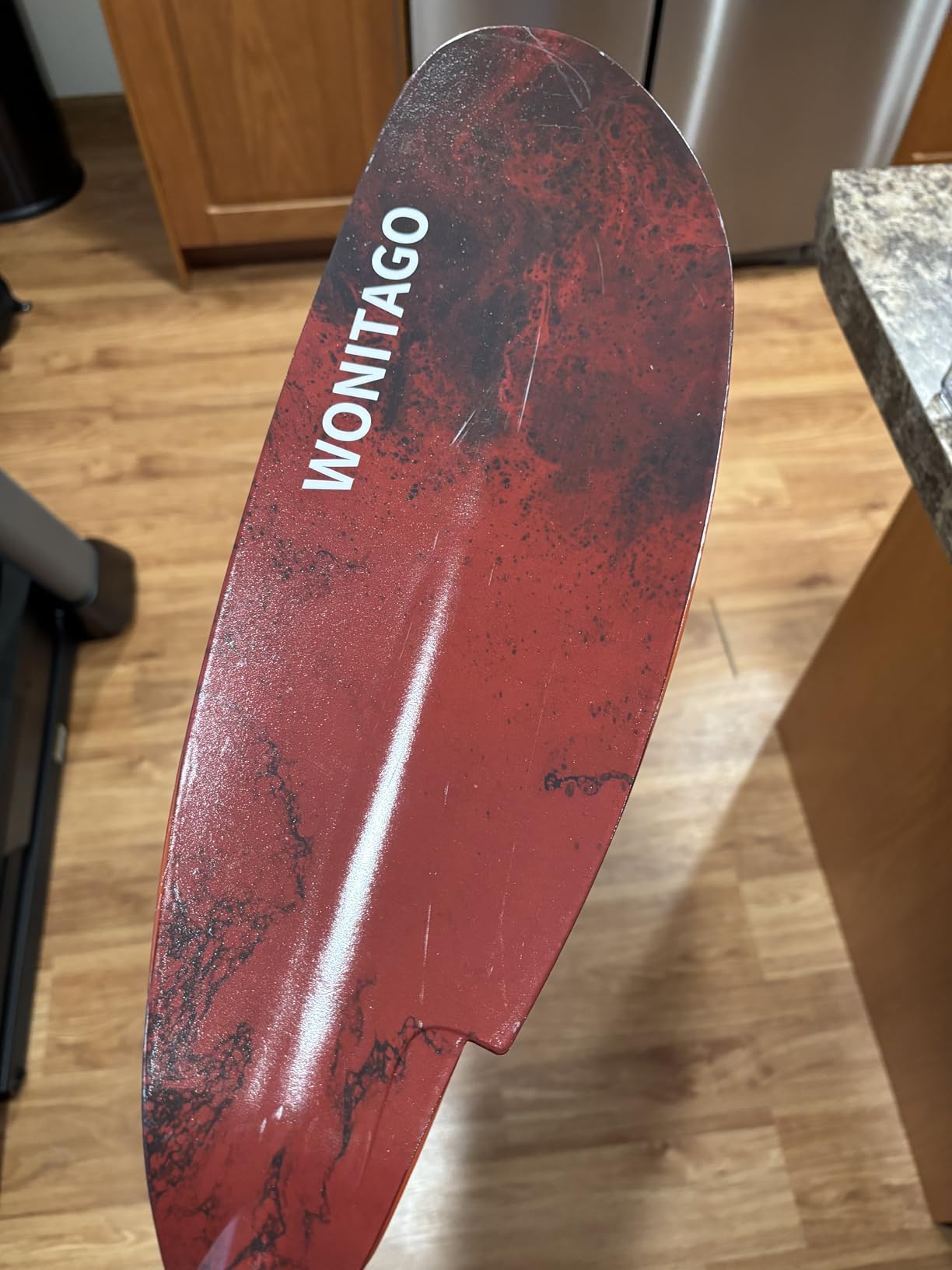
This is the cheapest way into angler-specific paddle hardware, and the features are real rather than decorative. You get an included paddle leash, a 40 inch engraved measuring scale on the shaft, and a fishing hook on one blade face.
For a beginner, that leash and the 20 cm adjustment range solve the two problems that cause the most frustration in a first season: losing your paddle in deep water, and one paddle not fitting everyone who shares the boat.
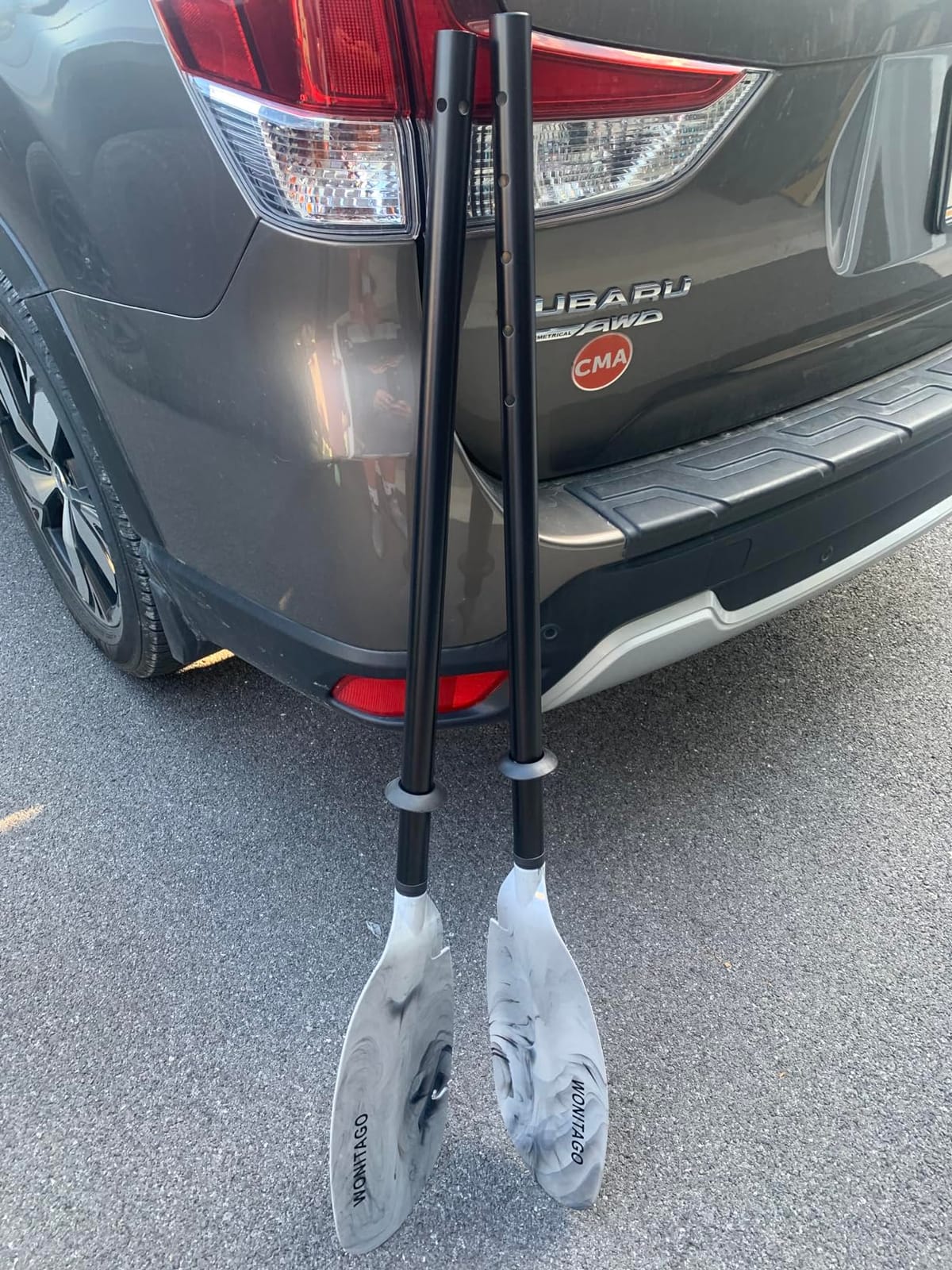
The blades float in both salt and fresh water, which is exactly the property anglers want on a bay or a lake with deep drop-offs. The quick pin button lock sets blade angle at plus or minus 60 degrees with no tools.
Three-piece construction makes it easy to store in a car or strap to a deck as a backup. Total weight is listed at 2.64 lbs, so it is not a light paddle by the standards of this list.
Who the WONITAGO Paddle suits
Beginners, rentals, and anyone who needs a second paddle strapped to the deck as a backup. The included leash removes a real risk that most competitors sell as an add-on.
It is also a good fit for families sharing one boat, because the 90 to 98 inch range covers a wide spread of paddler heights from a single paddle.
Where the WONITAGO Paddle falls short
Plastic blades are the least refined material in this group, and they are not as stiff or responsive as full carbon builds. In current or wind you will feel that softness at the catch.
It is also heavier than carbon on a long day, so if your trips run six hours or more, this is a stepping stone rather than a destination.
12. OCEANBROAD Adjustable Aluminum Fishing Paddle – the best-selling long paddle
OCEANBROAD Adjustable Fishing Kayak Paddle – 94in/240cm-98in/250cm-102in/260cm Aluminum Alloy Shaft Paddles Kayaking Fishing Oar with Paddle Leash, Black
- Best Kayak Paddles sales rank in this group
- 240 to 260 cm range fits wide sit-on-top hulls
- Integrated hook retrieval and included bungee leash
- Three blade locking positions with end drip rings
- Heavier than some buyers expected for the size
- Blades are smaller than many competing paddles
- Grips fit loosely for some paddlers
This is the top-ranked paddle in its category by best-seller position, and the reviews explain why. Paddlers hunting for a length between 250 and 260 cm for wide sit-on-top hulls say this is one of the few affordable options that actually covers that range.
The 1.1 mm aluminum alloy shaft is stiff enough to propel well, and the fiberglass reinforced polypropylene blades hold an edge against the kind of contact a fishing kayak generates. Drip rings at both ends keep the lower shaft dry.
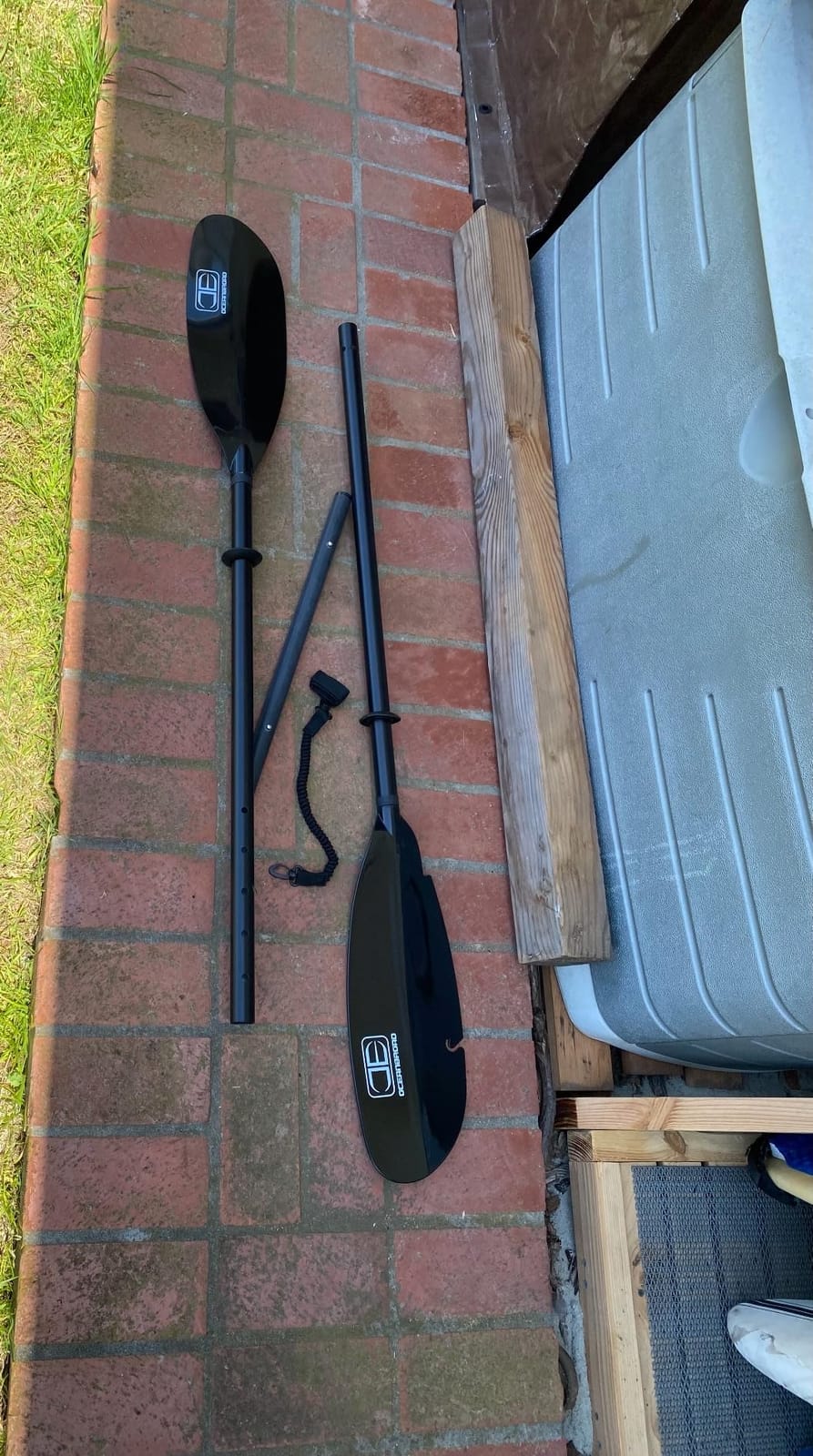
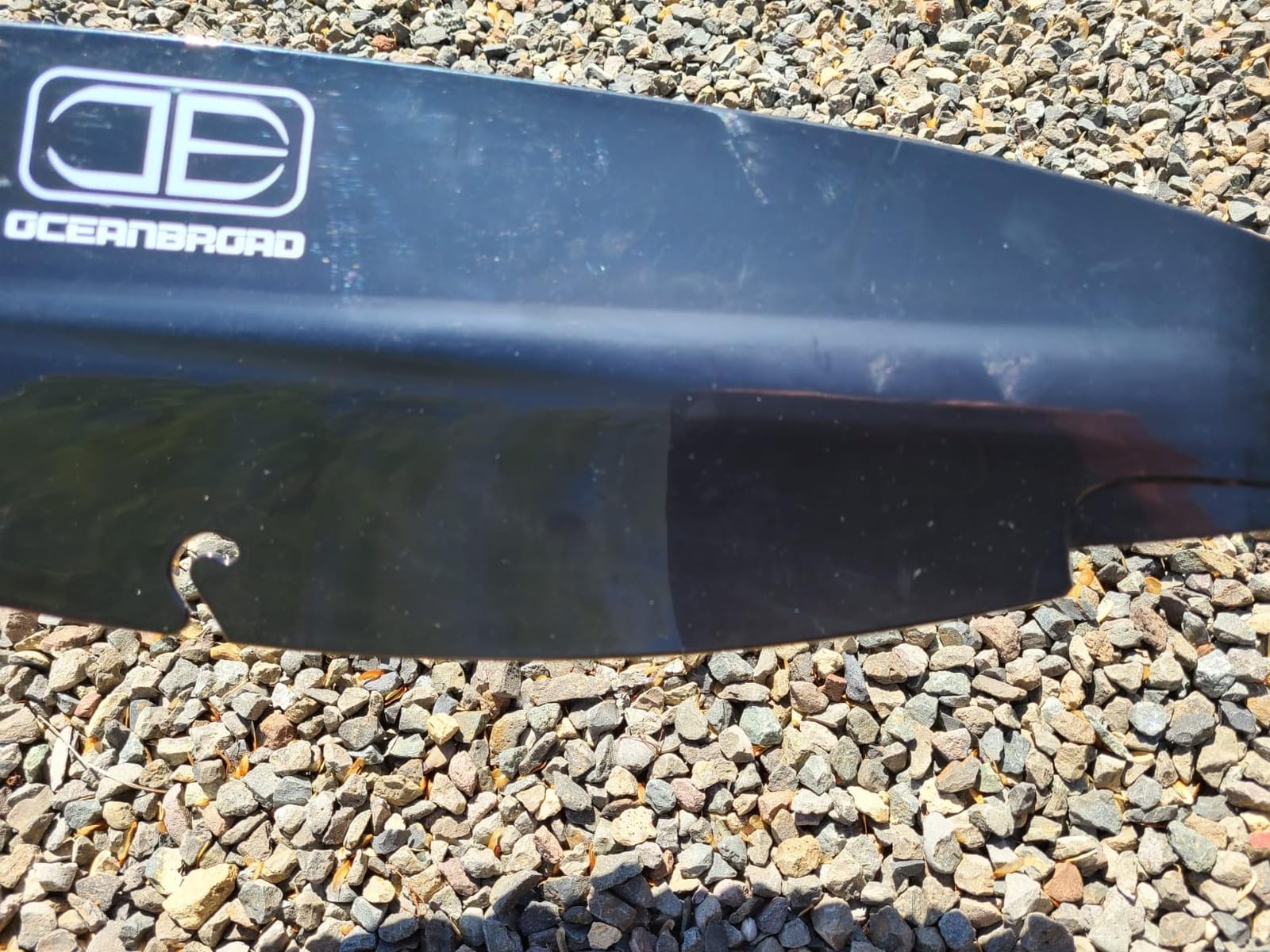
The integrated hook retrieval system and the included bungee leash are the two features anglers point to most. Keeping a paddle attached to the hull matters when you are fighting a fish and the boat is drifting.
Three blade locking positions let you change the angle of attack, and three-piece construction means it stores flat in a garage or a truck bed.
Who the OCEANBROAD Aluminum suits
This is the pick for anglers on wide sit-on-top and fishing kayaks who need a long paddle with fine length adjustment and do not want to move up to carbon. It also makes sense as a boat-shared paddle.
If you already have a narrow touring hull and want one paddle to cover a wide range of situations, the 240 to 260 cm span is the strongest argument for it.
Where the OCEANBROAD Aluminum falls short
Weight is the recurring complaint, and some buyers found it heavier than they expected for the size. On a genuinely long day, that is the trade-off you are accepting.
Blades are smaller than many competing paddles, grips fit loosely for some paddlers, and one order arrived missing a component. It is a 4.5 rating across 167 reviews, with 78 percent five star.
How We Picked
Every paddle in this list was evaluated against the same five things. First, total weight in ounces, because that is the number anglers actually compare and the one that determines whether hour six hurts.
Second, swing weight and blade stiffness, which we weight heavily. A light paddle with a floppy blade can be worse than a slightly heavier stiff one, because flex is absorbed by your shoulders.
Third, correct sizing for the hull you fish, with wide fishing hulls treated as their own category rather than folded into generic kayak advice. Fourth, angler-specific hardware such as a hook retriever, a shaft ruler, drip rings and an included leash. Fifth, durability against boat decks, rod holders and anchor systems, plus whether the shaft stays tight once assembled.
Ratings and review counts are copied from the product listings as they stood when this guide was updated, and we do not place sponsored products ahead of owner feedback.
How to Choose a Fishing Kayak Paddle for a Full Day
How long should a fishing kayak paddle be?
For a sit-on-top or wide fishing kayak, most paddlers land between 230 and 260 cm, and the wider your hull the longer your paddle needs to be. Start with the widest part of your hull, then add roughly 1 inch of paddle length for every inch the boat is wider than 27 inches, and check that you sit fully upright in the boat with your knees under the deck.
A rough sizing matrix, using hull beam as the starting point:
Hull under 28 inches wide: 220 to 234 cm for paddlers up to 5 foot 10, 234 to 250 cm above that.
Hull 28 to 32 inches wide: 234 to 250 cm for paddlers up to 5 foot 10, 250 to 260 cm above that.
Hull 32 to 36 inches wide: 250 to 260 cm for paddlers under 6 feet, 260 to 270 cm for paddlers over 6 feet.
Hull over 36 inches wide: 260 to 280 cm, and do not go shorter.
The most common mistake anglers report is running a touring paddle on a 34 inch wide fishing kayak. One poster on r/OutdoorObsessed described having their arms completely cooked by mid-afternoon before realising the hull was the problem, not the fitness. If your kayak is wide, your paddle should be too.
Aluminum vs fiberglass vs carbon
Carbon fiber is the best material for a long day because it is the stiffest and lightest combination available: it is roughly half the weight of a comparable aluminum paddle and holds its shape under load. Fiberglass sits in the middle, offering good durability at a moderate weight, and aluminum is the heaviest but the most affordable and the most tolerant of abuse.
The forum consensus is blunt about aluminum on long trips. Users warned that an aluminum shaft will wear you out on long paddles, and that complaint is the single loudest theme in kayak-fishing discussions. Where aluminum still wins is in shallow mashes, rentals, and situations where the paddle will be used to push off rocks. One forum group noted that fiberglass shafts with reinforced blades will last forever at the mid-range price point.
Blade size and shape for a long-day cadence
Wider fishing hulls need more blade area, and the commonly recommended class for a 34 to 36 inch fishing kayak is around 105 square inches. A larger blade is a lower gear: it moves more water per stroke and lets you hold a steady, relaxed cadence, which is exactly what you want over three to five hours of travel.
Shape matters too. A dihedral blade has a V-shaped cross section that reduces flutter and wobble on the catch, and a high-angle design gives you power at the cost of a little more resistance. Asymmetrical long narrow blades are a common angler favourite for a smooth, low-effort stroke.
Weight and swing weight
Choose by weight relative to your day, not by a number in isolation. Under 28 ounces is a strong long-day number, 30 to 34 ounces is workable for a half-day, and anything heavier works against you once you add up the strokes. It is the same logic that decides whether a bike saddle is still comfortable after a full day in the saddle, which we cover in our guide to the best bike saddles for long rides.
Swing weight is the blade’s momentum at the top of the catch, and it matters more than static weight. On a paddling.com thread, users established that fiberglass blades without enough stiffness cannot control flex under load, and that paddlers are much less fatigued after using a paddle with good swing weight. In practice, a stiff 32 ounce paddle often beats a floppy 28 ounce one.
There is also a heritage option worth knowing about. Users on the Paddling.com forum specifically praise Greenland paddles because a Greenland paddle puts less stress on your shoulders, wrists and elbows and can be less fatiguing for long days. The trade-off is a larger blade that catches wind, and a slower cadence, so it suits protected water and patient distance paddlers rather than open-water sprinting.
Feathering and ferrule systems
Feathering rotates one blade relative to the other, usually between 0 and 60 degrees, to reduce wind resistance. For an angler, a mid-range setting around 45 degrees is a good starting point, and the models here range from a simple two-position push button to a full 0 to 65 degree adjustment.
The ferrule is the joint connecting the two halves of a two-piece paddle, and it is the most common failure point on a long trip. Snap buttons and quick pin locks assemble without tools and rarely loosen. Threaded and bolted connections tighten well but need checking before every use, and plastic connectors can crack if you over-tighten them, which is a complaint anglers voice regularly.
One-piece, two-piece, three-piece and adjustable shafts
One-piece shafts are the strongest and the least likely to fail, and they are worth it if you have a roof rack and the paddle always travels with you. Two-piece paddles are the most common compromise, splitting in the middle for transport. Three-piece paddles, like the two budget OCEANBROAD models and the WONITAGO, pack flat into a car but have more joints to check.
Adjustable shafts, which run from 230 to 250 cm or 240 to 260 cm, are the practical choice if you share a kayak with a differently sized paddler or fish more than one boat. Fine increments such as 5 cm are better than a coarse telescoping range if you care about getting the length exactly right. Telescoping shafts are worth it for a family, less so for a single angler with one hull.
Angler features, leash and floatation
Angler extras are scattered across this group rather than consistent, so check what is included. A hook retriever on the blade tip and an etched ruler on the shaft are the two most common, and both are built in on the Pelican models and the OCEANBROAD paddles rather than sold separately.
A paddle leash matters more than most buyers expect. Anglers talk constantly about losing gear in deep water while fishing, and a leash keeps the paddle with the hull while you are focused on a fish. Both budget OCEANBROAD models and the WONITAGO include a bungee leash; the premium models often do not. Blades that float, like the plastic ones, are forgiving if you do lose the paddle. If you are on shallow, snag-prone water, prefer a blade without hook-retrieval slots so nothing catches in weeds.
Quick Glossary for Angler Paddles
Swing weight: the momentum of the blade at the top of the catch, and the single best predictor of shoulder fatigue over a long day.
Feathering: rotating one blade relative to the other, typically between 0 and 60 degrees, to cut wind resistance.
Dihedral: a V-shaped blade cross section that reduces flutter and wobble, giving a smoother catch.
Ferrule: the joint that connects the two halves of a two-piece paddle, and the part most likely to loosen on a long trip.
Frequently Asked Questions
How long should a fishing kayak paddle be?
For a sit-on-top or wide fishing kayak, most paddlers land between 230 and 260 cm, and the wider the hull the longer the paddle needs to be. Use hull beam as your starting point, then add roughly 1 inch of paddle for every inch the boat is wider than 27 inches. Hulls 32 to 36 inches wide usually call for 250 to 260 cm, and over 36 inches calls for 260 to 280 cm.
What is the best material for a kayak paddle?
Carbon fiber is the best material for long days because it is the stiffest and lightest option, at roughly half the weight of a comparable aluminum paddle. Fiberglass offers good durability at a moderate weight, and aluminum is the heaviest but most affordable and the most tolerant of abuse. On long trips, stiffness matters as much as weight because blade flex is absorbed by your shoulders.
What is the best carbon fiber kayak paddle?
Among the paddles we compared, the Aqua Bound Manta Ray Hybrid stands out for high-angle dihedral blades with a carbon shaft, a 4.8 average rating, and a Posi-Lok ferrule that adjusts blade offset in 15 degree increments. For pure value, the two-piece Carbon Fiber Kayak Paddle gives you a real carbon shaft at 30 to 32 ounces for less money.
What size paddle for a sit on top kayak?
Sit-on-top fishing kayaks are usually 32 to 36 inches wide, so aim for 250 to 260 cm if you are under 6 feet tall and 260 to 270 cm if you are taller. Short paddlers on narrower sit-on-top hulls can get away with 234 to 250 cm. The most common mistake is using a short touring paddle on a wide fishing hull, which loads the shoulders and lower back by mid-afternoon.
How far can you paddle a kayak in a day?
Plan the day around distance rather than time and the answer stops being theoretical. A relaxed angler covering ten-plus miles of travel in a six hour trip needs a genuinely light, stiff paddle, while a paddler covering two miles of shoreline can get away with considerably more. Whatever the distance, the paddle is doing three to five hours of work before you have landed a fish.
How do I choose the weight of my kayak paddle?
Match the weight to the length of your paddling day. Under 28 ounces is a strong all-day number, 30 to 34 ounces works for a half day, and heavier paddles fatigue you quickly over six hours. Stiffness matters as much as the number, so a stiff 32 ounce paddle can beat a floppy 28 ounce one by reducing the flex your shoulders absorb.
Best Fishing Kayak Paddles for Long Days: The Final Call
After comparing 12 paddles, the Pelican Poseidon Angler is the best fishing kayak paddle for long days for most anglers. It has the deepest owner history in this group at more than 2,700 reviews, a 4.6 rating, and the angler hardware built in rather than added on, all at a listed weight that surprises people who assume angler paddles are heavy.
Match it to your situation and the picks change quickly. Take the two-piece Carbon Fiber Kayak Paddle if you want the lightest-feeling shaft and you are comfortable sizing it yourself. Take the Bending Branches Angler Ace if you fish a very wide hull or you have a shoulder that already complains. Take the Hornet Watersports paddle if pure weight reduction is the goal, and take the WONITAGO or the aluminum OCEANBROAD if you are starting out, sharing a boat, or need a leash included.
The real upgrade is not always a more expensive paddle. It is a correctly sized one. Match the length to your hull beam before you match the material to your budget, and your arms will thank you at hour six. If you are still choosing, our guides to drones for fishing and long range drones cover the other gear that runs all day on the water with you.
This list was updated for 2026. Recheck the length chart against your own hull before ordering, and take the manufacturer size chart as a hint rather than a verdict.