
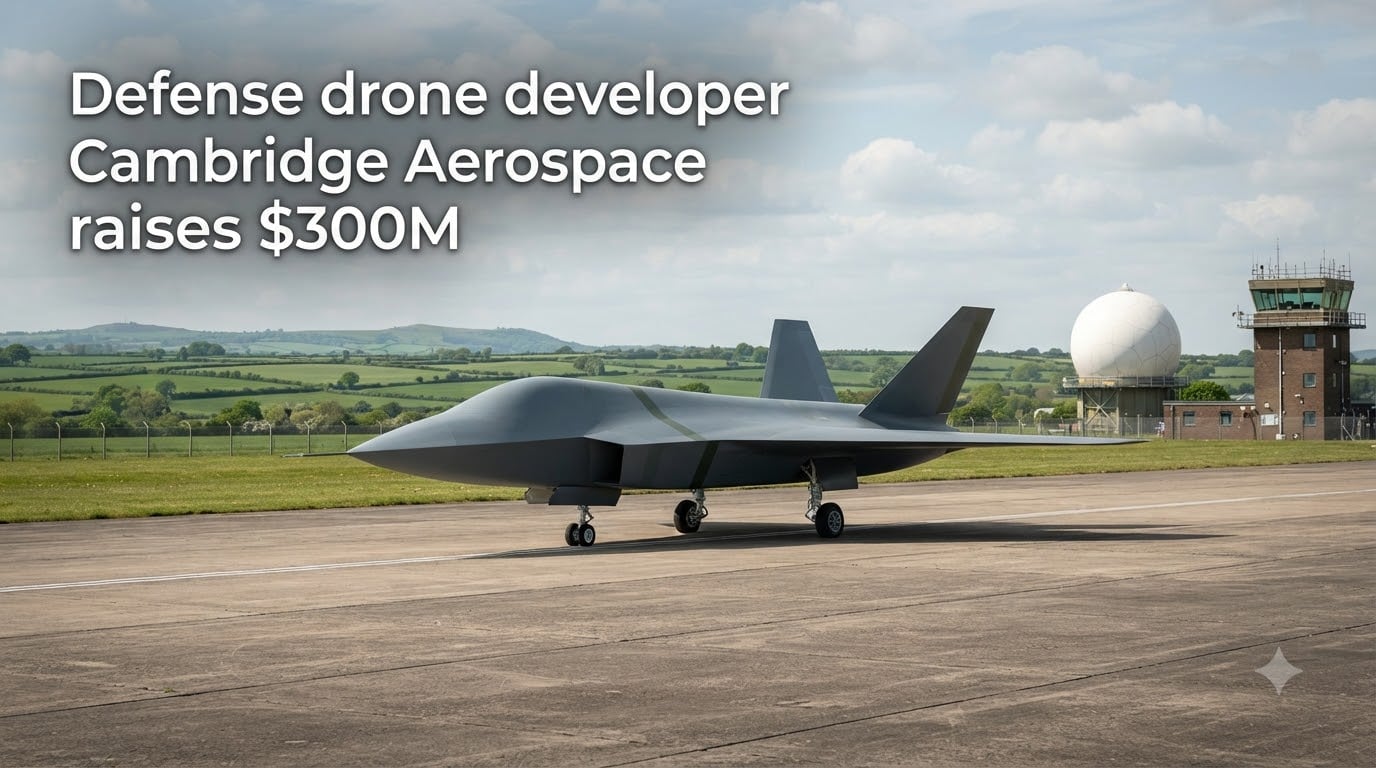
Cambridge Aerospace, a British defense drone developer focused on low-cost interceptor systems, just closed a $300 million Series C funding round at a $3.4 billion post-money valuation. The round signals how fast capital is flowing into counter-UAS technology as cheap drones reshape modern warfare.
The company is less than two years old. That a startup that young can command a valuation north of $3 billion tells you everything about how urgently militaries want affordable air defense solutions right now.
Our team has been tracking the defense drone space closely, and this round stands out for its size, its lead investor, and the product it will accelerate: a drone interceptor called Skyhammer that flies at 700 km/h and costs a fraction of traditional interceptors.
Table of Contents
The $300 Million Series C Round
Cambridge Aerospace raises $300M in its Series C, putting the company’s post-money valuation at $3.4 billion. DFJ Growth led the round, with participation from a syndicate of existing and new investors who have backed the company since its earlier funding stages.
The capital is earmarked for scaling production of Skyhammer interceptor systems and expanding the engineering team. Cambridge Aerospace previously raised a Series B round that helped fund initial testing and early UK Ministry of Defence contracts.
For a company founded less than two years ago, reaching a $3.4 billion valuation in a Series C is rare even by defense tech standards. It reflects both the maturity of the Skyhammer platform and the demand pipeline from allied militaries.
Skyhammer: The Drone Interceptor Making It Possible
The Skyhammer drone interceptor is the centerpiece of Cambridge Aerospace’s product line. It is designed to autonomously identify, track, and neutralize aerial threats including enemy drones and cruise missiles.
Skyhammer flies at speeds up to 700 km/h and has an operational range of approximately 30 kilometers. Those specs put it in the sweet spot for countering the types of small, cheap drones that have overloaded legacy air defense systems in recent conflicts.
What makes Skyhammer different is the cost model. Traditional interceptor missiles can run hundreds of thousands or even millions of dollars per shot. Cambridge Aerospace built Skyhammer from the ground up as a low-cost interceptor, meaning militaries can deploy it at scale without burning through defense budgets on every engagement.
A British Startup Less Than Two Years Old
Cambridge Aerospace was founded in the Cambridge tech corridor, leveraging the region’s deep talent pool in aerospace engineering, autonomous systems, and sensor technology.
The company moved from founding to Series C in under two years. That timeline compressed what typically takes defense contractors five to ten years, largely because the team focused on rapid prototyping and scalable manufacturing from day one.
Before this Series C, Cambridge Aerospace closed a Series B round that funded the initial Skyhammer development cycle and helped secure its first government contracts. Each round has attracted larger syndicates as the technology has proven itself in testing.
UK Ministry of Defence Contracts
The UK Ministry of Defence has been an early backer of Cambridge Aerospace, contracting the company to supply Skyhammer systems for the UK Armed Forces. These contracts provided both revenue and real-world validation that the interceptor performs as advertised.
Securing a military contract this early in a startup’s life is uncommon. It gave Cambridge Aerospace the credibility that DFJ Growth and other investors needed to commit $300 million at a multibillion-dollar valuation.
The MoD relationship also positions the company as a strategic supplier for allied nations looking for affordable counter-UAS solutions under existing UK defense partnerships.
Why This Funding Matters Right Now
The timing of this round is no accident. Cheap commercial drones have become one of the most significant threats on the modern battlefield, from the conflict in Ukraine to drone swarms in the Middle East.
Legacy air defense technology was built for ballistic missiles and manned aircraft. Shooting down a $2,000 drone with a $500,000 interceptor missile is not sustainable. That mismatch is exactly the gap Cambridge Aerospace is targeting with Skyhammer.
Investors have noticed. Counter-UAS startups across Europe and North America have seen a surge in funding over the past 18 months, as governments scramble to field affordable defenses against mass-produced drones. Cambridge Aerospace’s $300 million round is one of the largest in the subsector to date.
What Comes Next: The Starhammer Roadmap
Cambridge Aerospace is already developing Starhammer, a next-generation interceptor platform that will extend the company’s range and engagement capabilities beyond what Skyhammer currently offers.
The Series C capital will fund both Starhammer development and a major expansion of Skyhammer manufacturing capacity, allowing the company to meet growing demand from the UK and allied militaries.
What is Cambridge Aerospace?
Cambridge Aerospace is a British defense technology startup that develops low-cost drone interceptor systems for air defense. Founded less than two years ago in the Cambridge tech corridor, the company builds the Skyhammer interceptor designed to neutralize enemy drones and cruise missiles.
How much did Cambridge Aerospace raise in Series C funding?
Cambridge Aerospace raised $300 million in its Series C funding round. The round valued the company at $3.4 billion post-money and was led by DFJ Growth with participation from existing and new investors.
What is the Skyhammer drone interceptor?
Skyhammer is Cambridge Aerospace’s flagship drone interceptor, designed to autonomously identify, track, and neutralize aerial threats. It has an operational range of approximately 30 kilometers, reaches speeds up to 700 km/h, and is built as a low-cost alternative to traditional interceptor missiles.
Who led the Cambridge Aerospace Series C round?
DFJ Growth led the $300 million Series C round for Cambridge Aerospace. The round also included participation from a syndicate of existing investors from prior funding stages.
What is Cambridge Aerospace’s valuation after the funding round?
Cambridge Aerospace’s post-money valuation after the Series C round is $3.4 billion. This valuation reflects the company’s Skyhammer technology, its UK Ministry of Defence contracts, and growing demand for counter-UAS systems.
The $300 million Series C gives Cambridge Aerospace the runway to scale Skyhammer production while pushing Starhammer through development. As counter-UAS becomes one of the fastest-growing segments in defense technology, expect this British startup to stay in the headlines.
Watch for Starhammer test milestones and new international contract announcements as the company puts this capital to work.