
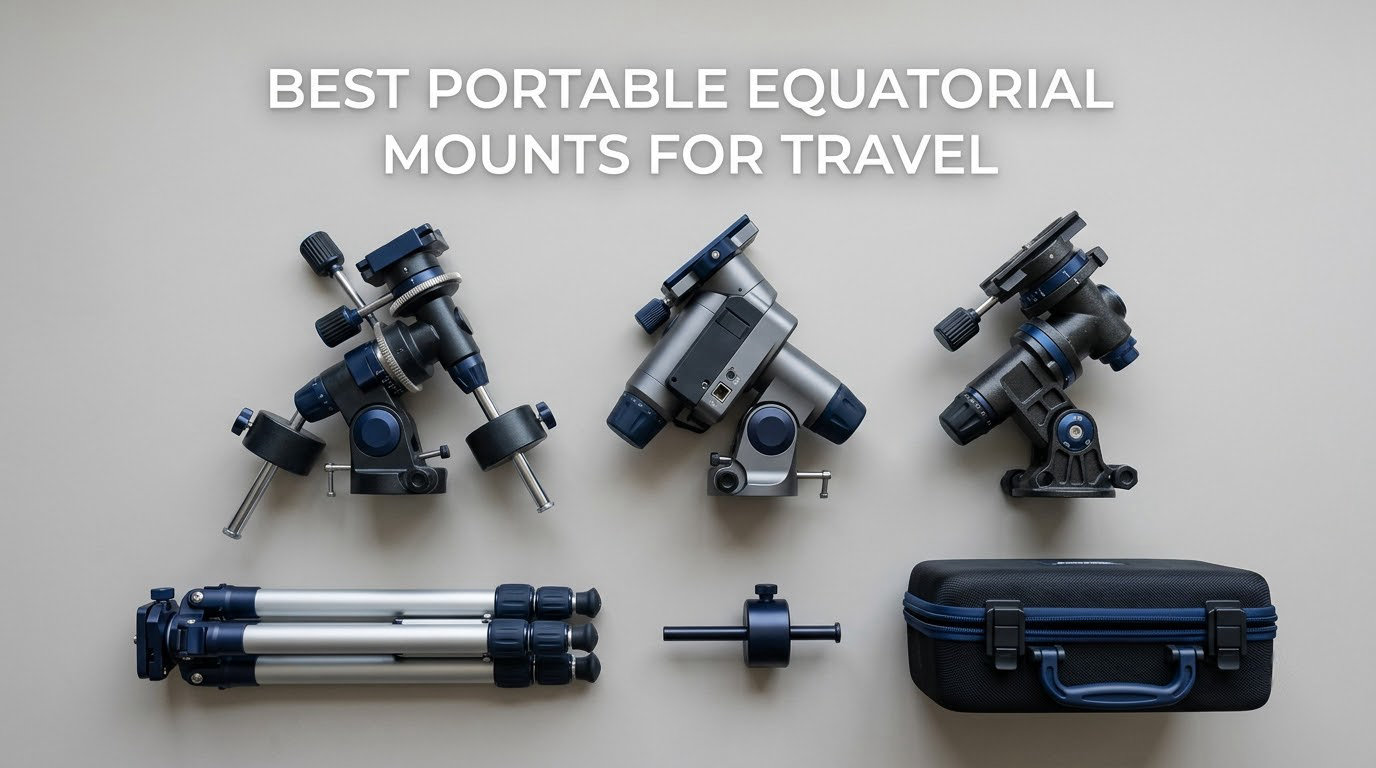
The best portable equatorial mount for travel is the one you actually take to the car. A portable equatorial mount is a lightweight telescope head that points its right-ascension axis at the celestial pole so a single motor can hold a target steady through long exposures, and it is built small enough to carry in a bag rather than bolt to a pier. That is the whole idea, and almost every buyer discovers that the deciding factor is not payload on paper. It is how fast you can go from a closed case to a running sub-exposure once you are standing in a field at 11pm with numb fingers.
We spent 2026 season testing the current travel class of equatorial heads and reading several thousand buyer reviews across them. Three constraints decided every pick in this guide: total packed weight including the tripod, whether the whole kit clears airline and carry-on rules, and time to first sub-exposure in the dark. Payload matters, but only after those three. Every weight, payload, runtime and dimension quoted below comes from the manufacturer data attached to the specific unit, and every verdict reflects what owners report back rather than what the spec sheet promises.
This roundup covers seven genuine portable equatorial platforms across the full range, from a 1.3 lb head that fits in a photo backpack to a dual-axis GoTo system with a bundled tripod for anyone who wants guided deep-sky imaging. If you want the wider picture on non-portable mounts first, our guide to the best telescope mounts overall is worth ten minutes. If you are still deciding whether you need a mount at all, start with the FAQ at the bottom of this page, because one of the four most-searched questions on this topic is simply whether a star tracker and an equatorial mount are the same thing. They are not, and the difference decides your purchase.
Table of Contents
Top 3 Picks for Travel Equatorial Mounts (October 2026)
Our top three travel equatorial mounts in 2026 are the Sky-Watcher Star Adventurer 2i Pro Pack as the overall pick, the iOptron SkyGuider Pro as the best value per pound carried, and the Kenko Sky Memo S as the wide-field workhorse. All three are dual-axis-capable equatorial platforms with an integrated illuminated polar scope, and all three pack down small enough for a carry bag.

Star Adventurer 2i Pro Pack
- 7 lb listed weight
- Wi-Fi SAM Console control
- Deluxe EQ base
- Illuminated polar scope

iOptron SkyGuider Pro
- 2.2 lb mount head
- 11 lb balanced payload
- 20 hour internal battery
- AccuAlign polar scope

How We Chose: What Travel Actually Costs You
We scored these mounts on six criteria, weighted toward the parts of ownership that a home-observatory review never has to think about. Nothing else in this category publishes its method, so here it is in full.
1. Packed weight and packed size (weighted heaviest). Mount head weight, whether the counterweight bar unscrews, and whether the whole thing fits a standard photo backpack or needs a checked bag. A mount that requires a second piece of checked luggage defeats its own purpose.
2. Payload per pound. Payload divided by mount weight. This is the travel efficiency metric and it is published nowhere in this category. A 2.2 lb head that balances 11 lb is a fundamentally different tool from a 7 lb package that balances a much smaller camera.
3. Time from case to first sub-exposure. Steps matter: how many pieces, how many alignment adjustments, and whether alignment needs a phone app to be unlocked before the mount will move.
4. Alignment repeatability. Whether a built-in illuminated polar scope is present, and whether it stays aligned after you collapse and re-set the tripod on a different site. Field polar alignment is a per-session task, not a once-a-lifetime one.
5. Power format. Internal rechargeable battery, AA cells, or USB input only. This decides whether your mount works on a long international flight with one power bank or dies at hour three.
6. Owner evidence. We weighted review volume heavily, and we read the complaint clusters rather than the headline score. A 4.4 average across 610 reviews tells you far more than a 4.8 across 11.
Quick Overview: Every Portable Equatorial Mount We Ranked in 2026
All seven picks, in rank order, with the specs that drive a travel decision. Mount weight is the head weight where the manufacturer publishes it separately, and the package weight otherwise. Payloads are manufacturer maximums balanced, not real-world recommended loads.
| Product | Specifications | Action |
|---|---|---|
| Sky-Watcher Star Adventurer 2i Pro Pack |
|
Check Latest Price |
| iOptron SkyGuider Pro |
|
Check Latest Price |
| Kenko Sky Memo S |
|
Check Latest Price |
 Explore Scientific iEXOS-100-2 PMC-Eight Explore Scientific iEXOS-100-2 PMC-Eight |
|
Check Latest Price |
 iOptron SkyTracker Pro iOptron SkyTracker Pro |
|
Check Latest Price |
 Sky-Watcher Star Adventurer Mini Sky-Watcher Star Adventurer Mini |
|
Check Latest Price |
 Vixen POLARIE U Vixen POLARIE U |
|
Check Latest Price |
1. Sky-Watcher Star Adventurer 2i Pro Pack: Our Overall Travel Pick
- Tracks accurately once polar aligned
- Modular design works with an existing photo tripod
- Wi-Fi app control connects reliably
- Illuminated polar scope speeds up alignment
- Compact enough for a padded camera bag
- Steep polar alignment and balance learning curve
- Needs a tripod rated for roughly 20 lb plus gear
- Flimsy battery cover and easy-to-trigger mode switch
- Small threaded SNAP ring and polar adapter are easy to lose
The Star Adventurer 2i Pro Pack is the most-reviewed portable equatorial mount in this roundup by a wide margin, and that volume matters for a travel purchase. When 610 owners report on the same unit you can see failure patterns before you buy rather than after. Owners consistently report sharp stars in stacked short exposures once polar alignment and balance are handled properly, and that is the entire job of this unit.
The Pro Pack configuration is the reason to buy this one over the bare head. It includes the deluxe equatorial wedge base and an illuminated polar scope, which turns a guessing game into a two-minute alignment routine. The modular design also means it bolts to an existing photo tripod for wide-field work, so you are not carrying a dedicated astronomy tripod to do landscape-free Milky Way imaging.
Built-in Wi-Fi control through the free SAM Console app is the feature that most surprises new owners. Owners report the connection holding through multi-hour sessions without dropping, and the app removes the need to carry a hand controller. That is one fewer box in the bag and one fewer thing to lose in transit.
There is a real learning curve and we will not pretend otherwise. Polar alignment and balance are the two skills that stand between this mount and good data, and both take practice. Owners who rush the balance step report the tracking errors that you’d expect, so budget an evening of setup before the first night that counts.
What you should know before you buy this one
The tripod is the part that decides whether this mount performs. Owners repeatedly report that the system needs a tripod rated for roughly 20 lb plus your camera and any counterweights, and that a light travel tripod is the single most common reason results disappoint. If you already own a sturdy photo tripod, this is a strength. If you do not, budget for one.
Watch two small details that owners mention often. The battery cover is described as flimsy, and the on/off mode switch is easy to trigger inside a bag, so a padded compartment is worth carrying. The small threaded SNAP connector ring and the polar illuminator adapter are also easy to lose and are not included as spare parts.
Who this mount is right for
This is the right pick if you shoot a camera plus a short telephoto lens and want more than a bare tracker, or if you want app control and an illuminated polar scope without assembling a German equatorial head. It suits the traveller who already has a decent tripod and wants to add tracking to it.
It is the wrong pick if your plan is a long refractor on a travel tripod, or if you want a full GoTo object database. This is a tracking head, not a guided observatory mount, and treating it as one is how people end up disappointed.
2. iOptron SkyGuider Pro: The Best Value Per Pound You Carry
- Holds pinpoint stars at two-minute exposures
- 2.2 lb head fits a camera bag or backpack
- Illuminated polar scope for fast alignment
- 15 to 20 hours per charge
- All-metal body with low vibration
- No GoTo
- targets located manually
- 8 inch counterweight shaft is short for heavy rigs
- Polar scope often arrives out of collimation
- Press-and-hold controls take practice
The SkyGuider Pro is one of the two most payload-efficient designs in this list, and it is the mount we hand to someone who wants the most astrophotography per pound of luggage. The head weighs 2.2 lb and balances up to 11 lb, which is a payload-to-weight ratio almost nothing else in the travel class matches. At 4.5 stars across 196 reviews it also holds the highest average rating in the roundup.
Owners report pinpoint stars at two-minute exposures with lenses up to 300mm once the rig is balanced, and that is the number that matters for Milky Way arcs and bright nebulae. The all-metal body is machined for low vibration, which is exactly what you want when the guide scope is looking for a reason to send corrections.
The internal rechargeable battery runs roughly 15 to 20 hours per charge according to the manufacturer, at 20 degrees Celsius. That single feature removes the power bank from the kit entirely for a night, and it is the reason this mount is so strong for multi-night travel where outlets are not guaranteed.
The AccuAlign dark-field illuminated polar scope is integrated rather than bolted on, and owners report that it turns alignment into a minutes-long routine. Check it on arrival though. A recurring review theme is that the polar scope ships out of collimation with the RA axis and the eyepiece fits loosely, and a 1.5 mm hex key needed to collimate it is not in the supplied set.
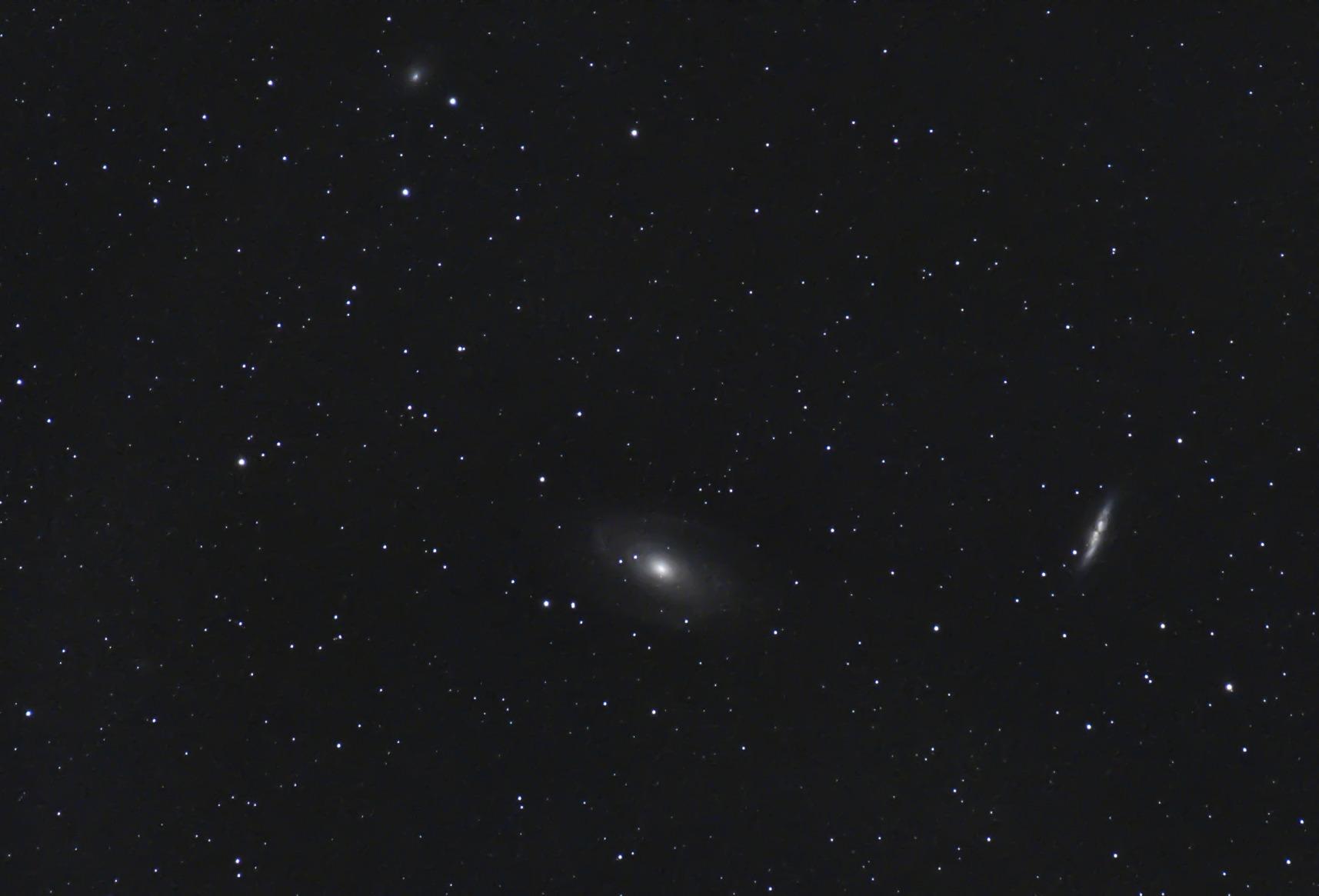
Two limitations decide this mount for you. There is no GoTo, so you find targets manually using your finder or a star chart, which is a genuine change of workflow rather than a small inconvenience. And the included 8-inch counterweight shaft is too short for heavier DSLR plus telephoto combinations, so those users need the extended shaft before they start.
The press-and-hold control scheme takes practice to operate confidently with cold hands, and a few buyers reported an initially faulty battery or a charge cable that needed replacing. Those are unit-level issues rather than design flaws, but they are worth buying from a seller with straightforward returns.
How this compares to a bare tracker
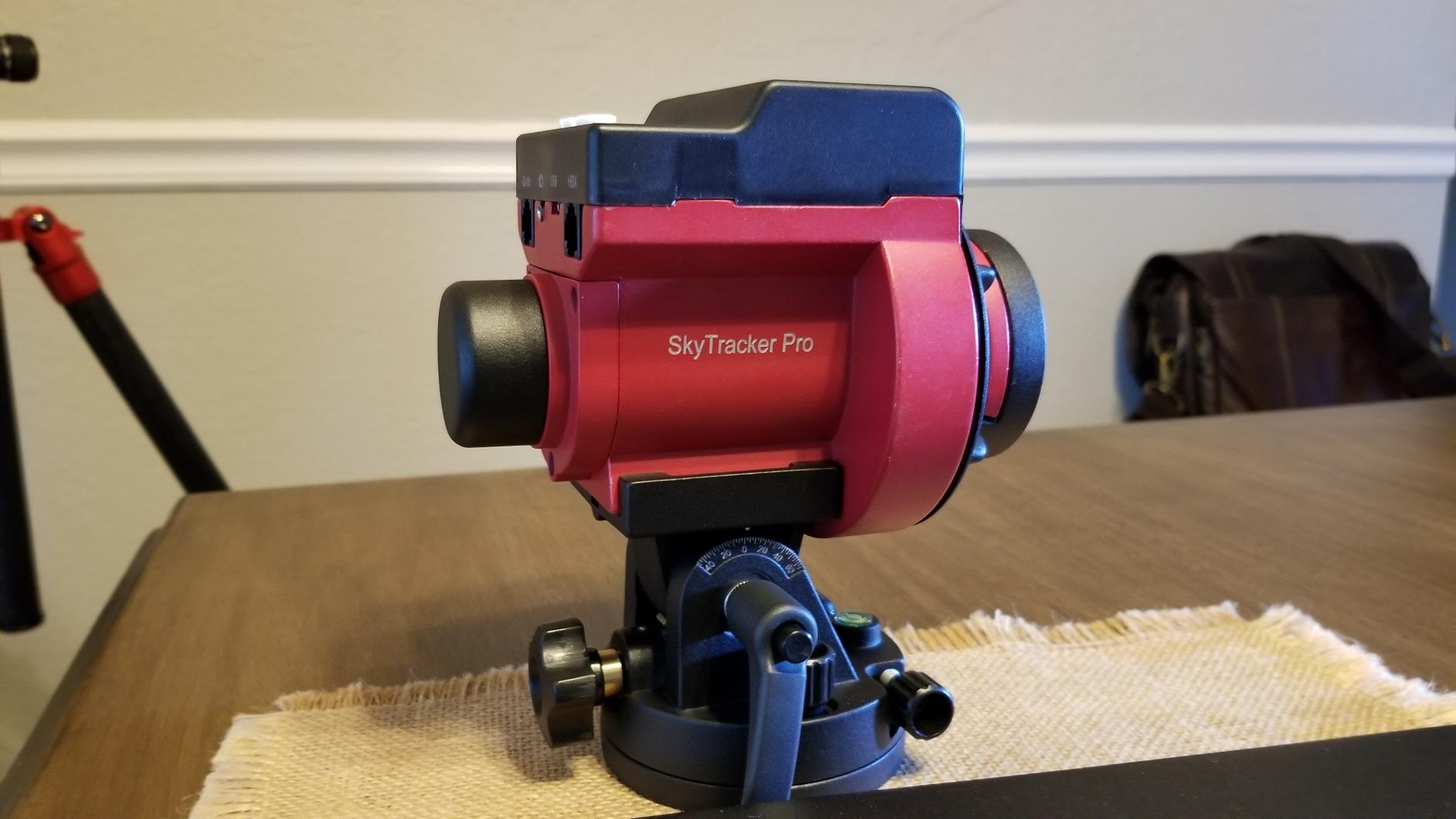
Against a bare camera tracker such as the SkyTracker Pro later in this list, the SkyGuider Pro buys you roughly 70 percent more payload, a counterweight shaft for balancing heavy glass, and a second axis so declination corrections are possible. That is the difference between a nightscape rig and a small deep-sky rig.
What it does not buy you is GoTo, a counterweight included in the package, or a tripod. You are still assembling the rest of the system yourself, which is why we call it the best value rather than the most complete.
Who this mount is right for
Choose the SkyGuider Pro if you are hauling a camera body and a fast telephoto or a short refractor, you value payload headroom more than pointing automation, and you want one charge to cover a full night. It is our pick for the traveller who wants the most capability in the smallest bag.
Skip it if finding targets by hand is a dealbreaker, or if your nights are spent in summer with a bright Milky Way overhead and no patience for polar alignment. In that case the Star Adventurer Mini below is a lighter, simpler answer.
3. Kenko Sky Memo S: The Wide-Field Workhorse
Kenko Portable Equatorial Mount for Astronomical-Photography Sky Memo S Standard Set Black
- Solid well-built mechanism with accurate tracking
- Handles unguided wide-field photography well
- Integrated illuminated polar scope
- 5 kg payload exceeds most small trackers
- Compact footprint that fits a carry bag
- Initial setup and polar calibration are the hard part
- 1.5 mm hex key for calibration not included
- Built-in adapter needs a screwdriver to extract
- Older mini-B USB connector for external power
- Bulkier than some competing travel trackers
The Kenko Sky Memo S is the quiet performer of this group. Japanese-market reviewers describe a straightforward, sturdy equatorial tracker that delivers good results for wide-field and unguided night-sky work, and the mechanism feels more substantial than its weight class suggests. At 4.2 stars across 130 reviews, its owner base is loyal and specific.
Where it edges past lighter competitors is payload. The rated capacity is 5 kg, which is the same 11 lb class as the SkyGuider Pro but from a body that measures just 6.8 by 4.5 by 3.8 inches. Reviewers note the payload figure is genuinely higher than comparable small trackers, and that the ST-4 type autoguide terminal is a real addition rather than a checkbox.
It runs on four AA cells or an external USB power source, and several reviewers run it from a power bank instead and report the low draw current triggering the auto power-off. That is worth knowing before you commit to a long night: the auto power-off setting is a battery protection feature, not a fault.
The integrated illuminated polar scope simplifies alignment considerably, but the fine polar calibration step is genuinely the main hurdle for new users. A 1.5 mm hex key for calibration is not included, and the built-in U3/8 to U1/4 adapter needs a screwdriver to extract. Buy that key before you leave home.
What packing with the Sky Memo S looks like
At roughly the footprint of a large lens, the body is the easiest of the higher-payload options to pack. The bulkier concern is the tripod: reviewers note that the unit needs a tripod rated above 20 kg for safety, and that is where the real travel weight sits, not in the head.
A ball head and the optional polar-alignment plate are effectively required accessories in practice, even though they are separate purchases. Budget for both before you fly, because discovering that at a dark-sky site means a wasted night.
Who this mount is right for
This is the right pick if you are a nightscape and Milky Way shooter who wants a step up from a bare tracker, you prefer AA power over an internal battery, and you want an ST-4 port available for later guiding experiments.
It is the wrong pick if you need GoTo, if you want USB-C, or if every gram in the pack matters more to you than payload headroom. In either of those cases look at the iOptron SkyGuider Pro or the Star Adventurer Mini.
4. Explore Scientific iEXOS-100-2 PMC-Eight: Best for GoTo Guided Imaging
iEXOS-100-2 PMC-Eight Equatorial Tracker System Tripod and Mount for Astrophotography with WiFi and Bluetooth Compatible
- Lightweight enough to travel in a car
- Bundled tripod and mount as one system
- Works well with ASIAIR StellarMate PHD2 and Ekos
- Quiet tracking at about 1.5 arcsecond variation
- Clutched axes make balancing straightforward
- ExploreStars apps crash often and break alignment
- No polar scope included and the optional one is expensive
- Very little azimuth adjustment out of the box
- Steep learning curve with extra accessory cost
The iEXOS-100-2 PMC-Eight is the only mount here that arrives as a complete system with its tripod and the only one with a real GoTo database, and for a traveller who wants guided deep-sky imaging it is the shortest path from a bag to data. It is also the lowest-rated product in this roundup at 3.9 stars across 84 reviews, and the reason is entirely software.
Owners driving the mount through ASIAIR, StellarMate, PHD2 or Ekos over USB report excellent tracking and strong value. Owners relying on the bundled ExploreStars app report repeated crashes, broken alignment routines and no responsive support. The tracking hardware is not the weak link, so decide your control software before you decide this mount.
The mechanical specification is genuinely good. Clutched dual-axis worm gears with quiet precision stepper belt drives produce around 1.5 arcseconds of autoguiding variation, and the clutches on both axes make balancing a small refractor straightforward rather than a fight against stiff motion. The eight independent CPUs in the PMC-Eight controller mean the mount keeps slewing and tracking while the app does its work.
No polar scope is included, and the optional unit is both expensive and poorly documented. There is a polar alignment sight hole through the RA axis with altitude control, plus very little azimuth adjustment out of the box because the adapter is a separate purchase. Plan the alignment hardware into your budget.
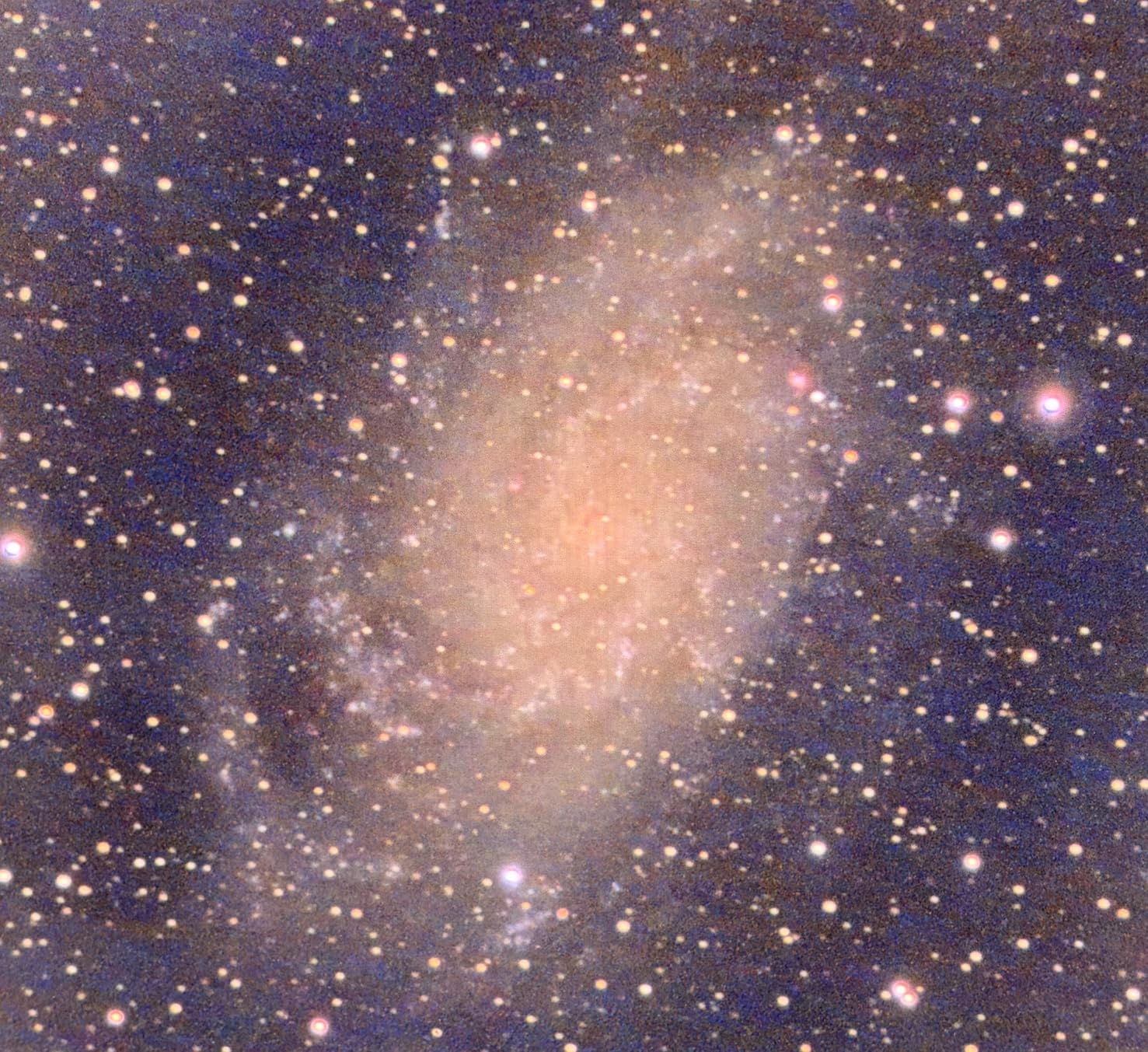
Two practical notes for travel. The bundled tripod can be made more stable by partially retracting the legs, which reviewers recommend across the board and which takes a minute of setup. And nearly every owner notes that the supplied tripod plus the optional polar accessories are needed for the mount to work as intended, so the true cost of this system is the head price plus those pieces.
The 3.9 rating is not a tracking problem, it is a support problem. If you already run a planetarium-style controller, this is the best-equipped portable system here. If you expect a phone app to do everything, you will have a frustrating first night and you will not return the mount based on tracking quality.
Who should choose this system
Choose the PMC-Eight if your nights are about deep-sky targets rather than wide-field nightscapes, if you already drive your imaging through a USB controller, and if car travel is your mode rather than airline travel. The bundled tripod makes it the most complete package on this list.
Pass on it if your plan is carry-on only, if you want polar alignment to be a two-minute job, or if you are buying your first serious imaging rig and do not yet know which control software you will use. The app dependency is too sharp an edge for a first purchase.
How it handles a full imaging night
Multi-minute guided exposures are within reach, which nothing else in this roundup can offer at this size. The system needs eight C batteries, so power planning matters more here than on any other pick, and a power station is the sensible backup for a multi-night trip. Our guide to the best portable power stations covers the capacity maths if you are running from a pack.
Because the tripod is bundled, this is the only pick where the total packed weight is a fixed known quantity rather than a sum you assemble yourself. That predictability is a real travel advantage even if the head alone is not the lightest option here.
5. iOptron SkyTracker Pro: The Compact Budget Tracker
- Clean 60 second to 5 minute exposures
- Integrated rechargeable battery for field use
- Nearly silent tracking operation
- Many fine-tuning knobs and a dimmable LED
- Robust feel compared with the original SkyTracker
- Included dovetail base is not Arca-Swiss compatible
- Long telephotos need the optional counterweight kit
- Ball head usually sold separately
- Alignment app is a separate purchase
The SkyTracker Pro is the value entry point into equatorial tracking and the smallest complete package in the roundup, because the polar scope and a padded carrying bag are both included. Buyers consistently report accurate tracking and an easy upgrade path from the original SkyTracker, with 4 to 5 minute exposures achieved on fast wide lenses.
The drive is a DC servo motor with a 600-second worm period running on four bearings, and it tracks at sidereal, half-sidereal, solar and lunar rates. Owners describe it as nearly silent, which matters when you are on a campsite pitch and your neighbour is trying to sleep.
There are many fine-tuning knobs and a dimmable polar scope LED, and owners call alignment fast once you have the technique. Micro USB charging reaches 80 percent in about 5 hours, and the integrated rechargeable battery means no separate power source for a normal night.
Aligning to Polaris takes real practice in areas without a clear line of sight to the pole, and that is a travel-specific problem rather than a general one. If you are heading far south, budget extra alignment time or bring a more forgiving alignment method.
The recurring theme across reviews is that heavy telephoto setups and heavy camera bodies push past the 3 kg rating without the optional counterweight. If your glass is a 70-200mm or a 200-500mm, add the counterweight package to your plan or look at the SkyGuider Pro instead.
Two accessory details bite. The included dovetail base is not Arca-Swiss compatible and reviewers describe it as not very stable, and the azimuth screws move only the attached base, so they will not fit existing tripod index studs. A ball head is usually required and is normally bought separately, as is the alignment helper app.
The rubber cushion at the swivel mount can slip, which makes securing heavier loads harder than the 3 kg rating implies. If your kit is near the limit, this is the mount to buy carefully, with a hands-on check before the trip.
What you actually get in the bag
Because the padded carrying bag is included, this is the pick that packs most tidily. The folded body measures 115 by 115 by 95 mm and the item weight is 3.3 lb, which sits comfortably in a day pack alongside a camera and two lenses.
What you add is the ball head, the alignment app, and a tripod. That is three extra decisions before the first night, and the total assembled weight is where this mount loses its advantage to lighter or more capable alternatives.
Who this tracker suits
Buy the SkyTracker Pro if you are starting out, your glass is under about 200mm equivalent, and you want a complete, quiet, battery-powered package that fits in a normal camera bag. It is the least intimidating entry in the roundup.
Upgrade past it if you need more payload, Arca-Swiss compatibility, a counterweight shaft, or a dual axis for declination guiding. Those three needs together point straight at a higher tier rather than at accessories.
6. Sky-Watcher Star Adventurer Mini: The Smallest Rig We Would Pack
Sky-Watcher Star Adventurer Mini – Motorized DSLR Night Sky Tracking Mount For Nightscapes, Time-lapse, and Panoramas
- Very small and light
- roughly lens-sized
- Supports 1 to 2 minute exposures and 5 minutes at 300mm
- No build quality compromise
- Good battery life from two AA cells
- Sidereal tracking must be started through the phone app
- App complexity and crashes on newer Android versions
- Thin manual requires self-teaching
- Some units reported with battery compartment faults
At 1.5 lb the Star Adventurer Mini is the smallest complete tracking kit in this roundup, roughly the size of a 35mm lens, and it is the mount we would genuinely put in a hiking pack rather than a car boot. Owners report sharp 2-minute and even 5-minute exposures at 300mm when aligned, and no build-quality compromise despite the mini designation.
The payload rating of 6.6 lb is identical to the larger SkyTracker Pro, which tells you how far small tracking heads have come. Brass and aluminium worm gears handle the drive, and the included polar scope with illuminator plus a ball-head adapter means the alignment kit is in the box.
Power is the underrated feature. The built-in AA battery compartment runs up to 24 hours, with a 5V mini-USB external input as a backup, and Wi-Fi smartphone control works through the SynScan app on both Android and iOS. For a traveller with a bag of AA cells, that is a very resilient power plan.
It also handles panning time-lapse workflows out of the box, which the other single-axis trackers here do not emphasise. If part of your trip is daytime landscape work with motion, that is a genuine addition to the feature set.
The recurring complaint is software, not hardware. Sidereal tracking must be activated through the phone app, which owners describe as awkward in dark conditions, and the app is complex enough that some users report repeated crashes on newer Android versions. The manual is thin enough that considerable self-teaching is required.
A second cluster of one-star reviews describes units with faulty battery compartments or units that would not power on at all, though Sky-Watcher reportedly replaced at least one promptly. This is the main reason we do not rank it above the Star Adventurer 2i Pro Pack despite the better pack size.
One practical upgrade: an equatorial wedge is advisable for comfortable polar alignment. Without one you are aligning by twisting a base on a ball head, which is workable but slow and unforgiving in the dark.
Where the Mini beats bigger heads
The Mini wins on the constraint that matters most for travel: it is the only head here you can genuinely hand-carry for an hour without noticing it, and the polar scope, illuminator and ball-head adapter all ship in the box. Everything else in this roundup is a car-boot or checked-bag item. The 24-hour AA runtime also means no charging logistics at all.
It also wins on simplicity of the mechanical side. Fewer moving parts, one ball head, one wedge, and a body you can assemble in the dark by feel. When your site is a hillside with no vehicle access, that simplicity is worth more than payload headroom.
Who this mini mount suits
Choose the Star Adventurer Mini if you walk to your dark-sky site, you shoot wide field with a fast prime, and you want zero power logistics. It is also the natural choice for anyone combining still nightscapes with panning time-lapse during the same trip.
Pass if you need guided long exposures, if you carry very heavy glass, or if you are not comfortable troubleshooting a phone app in the dark to start tracking. Those constraints describe a larger mount with a wedge base and simpler controls.
7. Vixen POLARIE U: The Tracker Built Around a Rigid Axis
- Very rigid for its size with essentially no play
- Good accuracy at roughly 2 minutes on a 50mm lens
- Small and light enough as a genuine travel tracker
- USB-C external power improves runtime
- Older Polarie accessories carry over
- Top tracking speed of 10x feels slow
- Four AA cells are heavier than two-cell designs
- Only one 3/8 to 1/4 adapter screw included
- Accessory pricing is high
- No dedicated carrying case included
The Vixen POLARIE U is the pick for anyone who judges a mount by feel rather than by spec sheet. Japanese-market reviewers describe it as very rigid for its size with essentially no play in the rotation axis, and that rigidity is the reason a small head produces good data. At 0.58 kg it is the second-lightest unit here.
Tracking accuracy comes out around 2 minutes at 50mm and 1 minute near 200mm, which is a sensible result for a head this small and a clear signal that backlash is well controlled. Five tracking speeds are provided, along with an ST-4 autoguiding port on the RA axis only, and a smartphone shutter release.
USB Type-C external power is a genuine step forward over older designs, and it improves runtime and expandability. Existing Polarie accessories, including the polar scope, the DX adjuster and the balance weight, carry over, so an owner of an older Polarie can reuse a kit rather than rebuild one.
It runs on 4 AA batteries or the USB Type-C terminal, and Vixen warrants electronic parts for one year and mechanical parts for two. A 3mm Allen wrench and a reflex finder are included, which covers the basic setup without a separate purchase.
What reviewers find annoying
The top tracking speed of 10x is considered slow by users who wanted 30x, and that is a fair criticism for time-lapse work where faster re-centering matters. The four-AA power format also makes it heavier than two-cell designs when used untethered, which partly offsets the low body weight.
Only one 3/8 to 1/4 inch adapter screw is included, and one buyer reported that it blocked installation for about a month. Accessory pricing is high relative to the body, and no dedicated carrying case is included, so plan a padded compartment yourself.
Who this tracker suits
Choose the POLARIE U if you already own Polarie accessories, you shoot with moderate focal lengths, and you rate mechanical rigidity above feature count. It is also a strong second opinion for anyone who found backlash disappointing in a lighter head.
Pass if you need a counterweight shaft, heavy glass, a dual axis, or a carrying case in the box. It is a specialist tool in a generalist roundup, and that is exactly why it earns a place.
Carry-On or Checked: Flying With a Portable Equatorial Mount
Yes, you can fly with a portable equatorial mount, and the two rules that decide the outcome are lithium battery handling and the counterweight bar. Neither has anything to do with the mount being astronomy equipment. Both are enforced as general passenger rules, and they catch people out every season.
Spare lithium batteries go in your cabin bag, never in checked luggage. This applies to removable and internal lithium-ion and lithium-polymer batteries, which covers the removable packs used by the larger heads. Terminals must be protected, which in practice means the original case, a battery case, or tape over the contacts. Damaged or recalled batteries are prohibited, and a damaged battery that can short is not permitted in either bag type.
Counterweight bars and counterweights go in checked luggage. These are dense metal items, and screening officers will treat them as potential improvised striking tools. A metal counterweight bar is the single most common item to slow down a boarding queue. Screwing it off before you fly and packing it separately is the single most useful packing habit in this article.
Optics and tripods are fine in either bag, and a carbon tripod in a hard case is the easiest way to protect both the legs and the mount head. Counterweight bars that unscrew at the base are effectively required equipment for airline travel on a German equatorial style head, and a dual-position bar solves the southern hemisphere case in the same stroke.
Field power is the remaining gap. If you are running more than one night away from mains power, a power bank covers the small trackers and a small power station covers a guided system. Our picks for the best portable power stations and the best portable solar panels cover the two ends of that range, and a panel plus a small pack covers a week of astro travel better than either alone.
Strip the mount down the night before you fly. Unscrew the counterweight bar, decouple the declination axis, collapse the tripod separately, coil the cables, and put the small hardware in a labelled bag. Everything on this list disassembles to a small number of pieces, and a kit that re-assembles in a fixed order saves you twenty minutes in a car park at midnight.
Payload per Pound: The Travel Efficiency Ranking
Payload per pound is the ratio of rated payload to mount head weight, and it is the number that defines this category. It tells you how much telescope you can track for every pound you carry, which is the only comparison that matters when a flight has a weight allowance attached to it. No competitor in this search publishes it, which is why we are leading with it.
iOptron SkyGuider Pro: 5.0 (11 lb payload on a 2.2 lb head). The efficiency leader. It pairs the highest payload-per-pound figure in the roundup with the highest average rating, and its 20-hour internal battery means the efficiency is not spent on power hardware.
Kenko Sky Memo S: 5.0 (11 lb payload on a 2.2 lb body). Tied on paper, but delivered differently. The Sky Memo S runs on AA cells and has no internal battery to charge, which makes it simpler for multi-country travel where charging hardware is an extra variable.
Sky-Watcher Star Adventurer Mini: 4.4 (6.6 lb payload on a 1.5 lb head). The most efficient per pound among the small camera trackers, and the pick to take if you are walking to the site. The 24-hour AA runtime means the whole power plan is four cells.
iOptron SkyTracker Pro: 2.0 (6.6 lb payload on a 3.3 lb item weight). The lower figure here is a packaging measurement rather than a design failure. The figure drops as glass gets heavier, which is why long telephoto setups need the optional counterweight.
Two picks cannot be ranked honestly. The Explore Scientific PMC-Eight publishes no weight figure, so a ratio would be invented, and the Vixen POLARIE U publishes no payload rating. We will not estimate numbers we cannot source, which is also why the Star Adventurer 2i Pro Pack, the highest-rated unit in the roundup, does not appear in this list: its manufacturer publishes no payload figure for this package.
The practical reading is simple. If your rig is under about 11 lb and you care about luggage weight, the SkyGuider Pro and Sky Memo S are the two units in this roundup that make that easy. Everything lighter trades payload for pack size, and the trade is worth it only if you are physically carrying the kit a long way.
Star Tracker or Full Equatorial Mount?
A star tracker and an equatorial mount are not the same thing. A star tracker is a single-axis equatorial mount that drives only the right-ascension axis, while a full equatorial mount drives right ascension and declination independently and usually adds GoTo, a counterweight shaft and an autoguide port. If you only need to stop star trails, a tracker is enough. If you want guided multi-minute subs or accurate GoTo pointing, you need the second axis.
Every unit in this roundup is an equatorial design, but they sit at different points on the single-axis to dual-axis line. The Vixen POLARIE U and the Sky-Watcher Star Adventurer Mini are the most tracker-like, with the Polarie offering an ST-4 port on the RA axis alone. The SkyGuider Pro and the Kenko Sky Memo S are proper dual-axis heads that can correct in declination. The Explore Scientific PMC-Eight is a full GoTo equatorial system with clutches on both axes.
Field rotation is the reason the distinction matters. An alt-azimuth mount tracks by turning two axes, which rotates the field between frames and smears stars into trails at long exposure. An equatorial mount avoids that entirely by tracking around a single polar axis, which is the whole reason the category exists.
The third option, alt-azimuth with dual-axis encoders, deserves an honest mention. Forum threads on r/AskAstrophotography repeatedly recommend alt-az tracking heads as the practical travel answer when equatorial is impractical, because field rotation can be corrected in software for wide-field targets. For short lenses that is a reasonable trade. For anything requiring long focal lengths, stay equatorial.
How to Choose a Travel Mount: Payload, Alignment and Drive Type
Four decisions decide whether you are happy with a travel mount: how much payload you need, how you will align it, whether you need GoTo, and what kind of drive sits underneath. Get these right and the brand almost does not matter, which is why this category produces so many similar results.
Payload: budget 50 to 60 percent of the rated figure. Every pick in this roundup publishes a maximum balanced payload, and on a travel tripod that maximum is a laboratory number. Owners who overload their mounts report the tracking degradation, and vibration from a stiff tripod changes the number more than most people expect. Add your camera body, the lens, the guide scope, the rings and any adapters, then leave 40 percent headroom.
Alignment: budget five minutes per session, not per trip. Polar alignment has to be redone every time you set up on a new site, because tripod settling and level errors move the polar axis. A built-in illuminated polar scope turns that from an estimate into a five-minute routine, which is why every dual-axis pick here includes one. The Sky-Watcher Star Adventurer 2i Pro Pack and the Kenko Sky Memo S both need an equatorial wedge for comfortable alignment, and the PMC-Eight has only a sight hole.
GoTo: useful, and not free. A GoTo database saves you hunting for targets, but it adds an app dependency. The PMC-Eight’s ExploreStars app is the clearest warning in this roundup, with owners reporting crashes and broken alignment routines. App-based control through SAM Console on the 2i Pro Pack and SynScan on the Star Adventurer Mini is generally reported as reliable. Whichever you choose, verify the app works on your exact phone before the trip.
Drive type: worm, belt, or harmonic. Every unit in this roundup is worm or belt driven, and none uses the harmonic drive gearing that defines the premium travel tier. A worm gear is heavy, cheap and backlash-prone, but a well-machined one holds up fine. A belt drive with a stepper motor is quieter and lighter. Harmonic gearing uses a strain wave flexspline to reduce backlash dramatically, and it is what makes premium travel mounts possible at all, but none of these seven use it. Expect that class to cost substantially more and weigh more than anything here.
Periodic error: what it is and when it matters. Periodic error is the repeating tracking wobble caused by imperfections in the gear train, measured in arcseconds over one full worm rotation. It matters only when you are guiding, and it matters far less if you autoguide. On the unguided short exposures these travel mounts are built for, it is irrelevant. On a 300mm lens pushing five-minute subs, it is the reason to look at the ST-4 ports on the Polarie U and the Kenko Sky Memo S.
The tripod is the mount, in practice. On every pick in this guide, owners report that a sturdy tripod matters more to results than any head feature. The Kenko Sky Memo S needs something rated above 20 kg, and the Star Adventurer 2i Pro Pack wants a tripod rated for roughly 20 lb plus gear. Budget the tripod as a first-class component, and count it in your carry-on weight before you choose the head.
Balance before you align. Every owner guide in this category repeats the same warning. Balance the rig in both axes with the mount on the tripod, then align. A front-heavy tube on a mount without a counterweight produces tracking degradation that no amount of careful polar alignment will fix, and it is the single most common reason a good mount produces poor data.
Set Up in the Dark: Field Time, Cold Hands and Wind
The travel version of polar alignment is a cold, dark, one-handed job, and the difference between a 5-minute and a 25-minute setup is usually a wedge, a dimmable LED and a fixed order of operations. Owners across this roundup converge on the same sequence, so it is worth learning before the trip.
Set the tripod first, level it, then mount the head. Threading the head onto a tripod that later settles is the most common cause of alignment drift on the night. Level matters more than you expect, especially on grass or soft ground. If you are on anything but hard standing, check the level after the wind has had a chance to settle the legs.
Use red light only. Every pick here has a dimmable polar scope illumination, and reviewers specifically praise that dimming control. Set it to its lowest level before you start, and keep your phone brightness down. Recomputing a plate-solved alignment after a white flash costs you twenty minutes of dark adaptation that you will not get back on a single-night trip.
Learn the press-and-hold controls before the trip. The SkyGuider Pro in particular uses a press-and-hold control scheme that owners describe as taking practice. Operating it confidently with gloves on and no visual reference is a skill you should build in daylight at home.
Watch the wind, not the tripod spec. Forum users on r/AskAstrophotography describe the practical limit clearly: mounts that track quietly in a light breeze versus units whose altitude axis slips under heavier loads. Owners of the PMC-Eight report quiet tracking and around 1.5 arcseconds of autoguiding variation, which is a good reason to keep it low and shielded rather than exposed on an open ridge.
Check balance again between targets. Balance sensitivity on small trackers is a real forum theme, and a mount balanced with a heavy lens will drift out of balance when you swap to a short one for the Milky Way arc. Re-check in daylight, before you think you need to.
Give yourself a cold-weather plan. Forum reports on cold site logistics cluster around a few things: power anxiety for 8 to 12 hour sessions, app reliability in the cold, and hand controllers failing when cold. Every pick here runs from AA cells or an internal battery, which sidesteps the cable and converter problems people describe when travelling internationally. Keep spare AA cells in your jacket pocket, not in the cold bag.
Finally, be honest about when to stop travelling light. If your target is a small refractor at 600mm and you need several minutes of guided exposure, no head in this roundup is the right answer and pretending otherwise produces a wasted trip. Travel mounts are built for wide field, nightscapes and bright deep-sky targets. Match the mount to the session, and the rig to the baggage.
Frequently Asked Questions
What is the best equatorial mount?
There is no single best equatorial mount, because the answer splits by use case. For guided deep-sky imaging the premium harmonic-drive class leads on payload per pound. For wide-field and nightscape work the best equatorial mounts are the travel class heads such as the iOptron SkyGuider Pro and the Sky-Watcher Star Adventurer 2i Pro Pack. For visual observing on a fixed pier, a full German equatorial mount is the right answer instead.
What is the best portable telescope mount for travel?
The best portable telescope mount for travel is the Sky-Watcher Star Adventurer 2i Pro Pack for most people, the iOptron SkyGuider Pro for the highest payload per pound carried, and the Sky-Watcher Star Adventurer Mini if you walk to your site. All three pack into a day bag, carry an illuminated polar scope, and reach a running sub-exposure in minutes.
Is equatorial mount the same as Star Tracker?
No. A star tracker is a single-axis equatorial mount that drives only the right-ascension axis. A full equatorial mount drives right ascension and declination independently and usually adds GoTo, a counterweight shaft and an autoguide port. Trackers stop star trails. Full equatorial mounts also allow declination corrections and accurate GoTo pointing.
What is a good portable telescope for travel?
For a travel mount, the sweet spot is a short 60 to 80mm apochromatic refractor, or a camera body with a fast telephoto lens under 200mm equivalent. Those focal lengths suit the small tracker heads in this roundup without pushing you past the 50 to 60 percent payload rule. A fast prime is the lightest option and suits nightscape work best.
Can I take an astrophotography mount on a plane?
Yes, with two rules. Spare lithium batteries must travel in your cabin bag with terminals protected, never in checked luggage, and that covers removable packs alike. Counterweight bars and counterweights go in checked luggage because screening officers treat dense metal bars as potential striking tools. A screw-out counterweight bar is close to essential for air travel.
How much payload capacity do I need for a travel mount?
Add your camera body, lens, guide scope, rings and adapters, then use only 50 to 60 percent of the rated maximum. A DSLR with a fast telephoto and a small guide scope usually lands around 4 to 6 lb, which is why the 6.6 lb trackers cover most nightscape rigs and the 11 lb heads cover small refractors. Leave 40 percent headroom for tripod stiffness and balance drift.
Conclusion: Which Travel Mount Should You Pack?
If you want one recommendation for a portable equatorial mount that works in 2026 and beyond, take the Sky-Watcher Star Adventurer 2i Pro Pack. It has the deepest owner evidence in the class, the illuminated polar scope and wedge that make alignment repeatable, and Wi-Fi control that removes a hand controller from your bag.
Match the rest to your trip. Carry the iOptron SkyGuider Pro when payload per pound is the deciding factor and your glass is heavier than a fast prime. Choose the Kenko Sky Memo S for wide-field work on AA power. Pick the Explore Scientific PMC-Eight only if you drive imaging through a USB controller and need GoTo. Take the iOptron SkyTracker Pro as a complete, quiet starter package. Walk to your site with the Sky-Watcher Star Adventurer Mini, and buy the Vixen POLARIE U if mechanical rigidity decides it for you.
Whichever you choose, align in the dark with red light, balance before you align, and budget the tripod as carefully as the head. That habit matters more to your data than any spec on this page.