
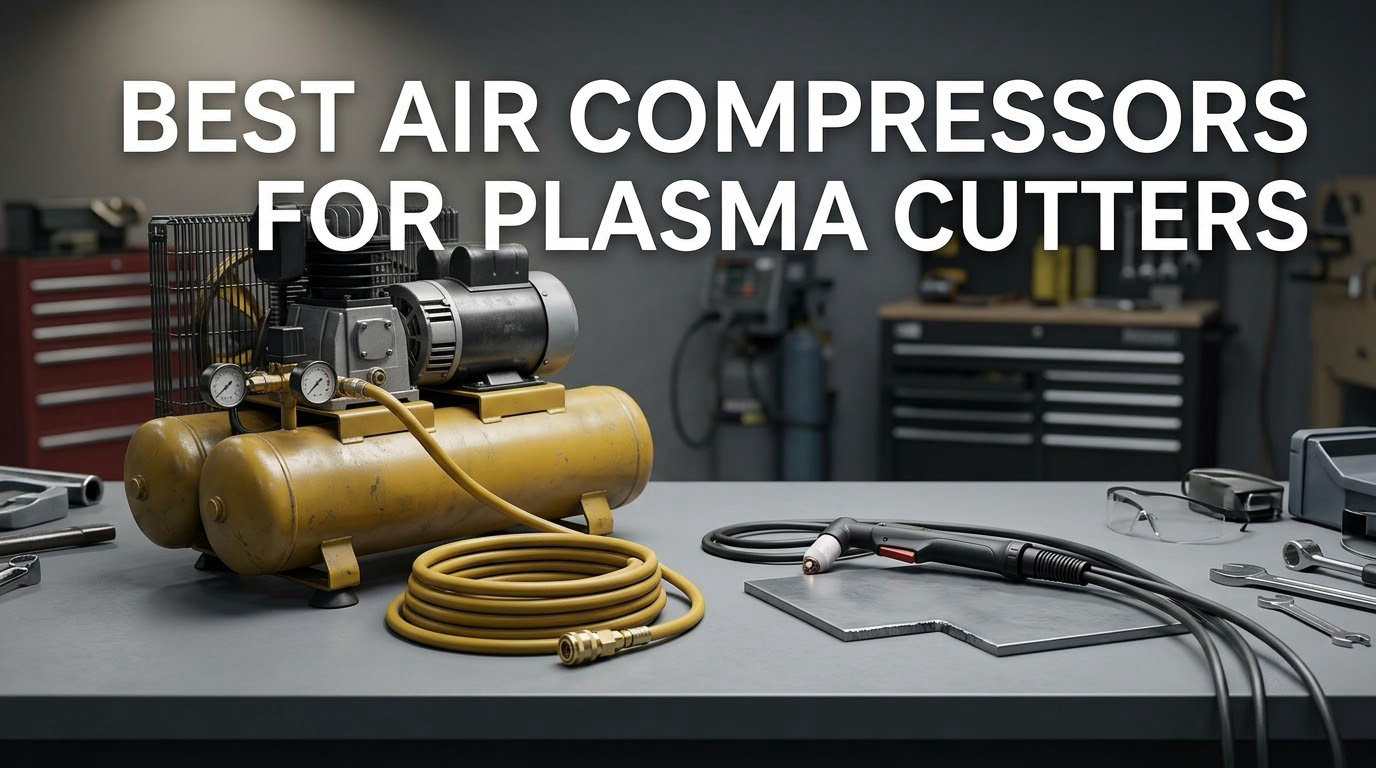
A plasma cutter does not run on electricity alone, no matter how big the power supply is. It runs on compressed air, and it needs that air delivered at a steady working pressure of roughly 60 to 100 PSI and at a flow rate measured in CFM at 90 PSI. Handheld torches in the 20 to 30 amp class ask for around 3 to 5 CFM, 40 to 50 amp torches climb to 5 to 7 CFM, and a CNC plasma table running a 45 to 65 amp torch wants 8 to 12 CFM delivered continuously.
That is the whole sizing conversation, and it is the part most guides get wrong. Manufacturers advertise peak CFM measured at 40 PSI, where every piston compressor looks generous, while your torch actually pulls its air at 90 PSI where flow is at its lowest. Buy on the 40 PSI number and you will own a compressor that starves the arc a few seconds into every cut.
Below, we sized ten compressors against those working-pressure numbers, and the gaps turned out to be large. Two units that most roundups group together are separated here by a full CFM class, and the honest answer for many readers is that the compressor already in the garage is either exactly right or short by half. If you are still choosing a cutter, our guide to the best CNC plasma cutters maps amperage classes to table sizes, and our workshop compressor guide covers the larger commercial machines that general fabrication shops run.
Table of Contents
Top 3 Picks for Plasma Cutting (October 2026)
Three units earned a place here for different reasons, and the gap between first and third is mostly about airflow class rather than build quality.

Makita MAC2400 Big Bore
- 4.2 CFM at 90 PSI
- Oil-lubricated cast iron pump
- 1730 RPM low-speed pump
- Only 12.3 A draw

Klutch 29-Gallon Vertical
- 5.1 CFM at 90 PSI
- 29-gallon oil-free tank
- 175 PSI max
- 120V operation
Campbell Hausfeld 80-Gallon
- 11.9 CFM at 90 PSI
- Two-stage cast iron pump
- 230V single phase
- 80-gallon ASME tank
The Makita takes the top slot on the strength of its rating and its review volume, which together make it the most-proven piston compressor in this group. The Klutch is the pick for anyone who wants stored air rather than raw flow. The Campbell Hausfeld is the only unit here that meets a CNC table’s demand without stopping, and it demands a 230V circuit and a permanent location in return.
Best Air Compressors for Plasma Cutters in 2026
Every CFM figure below is rated at 90 PSI where the manufacturer publishes it, because that is the pressure your torch works at. Where a maker advertises only a 40 PSI peak figure, that is called out rather than quietly substituted.
| Product | Specifications | Action |
|---|---|---|
| Makita MAC2400 Big Bore |
|
Check Latest Price |
 Metabo HPT EC914S Pancake Metabo HPT EC914S Pancake |
|
Check Latest Price |
| Klutch 29-Gallon Vertical |
|
Check Latest Price |
 VEVOR 15-Gallon Oil Free VEVOR 15-Gallon Oil Free |
|
Check Latest Price |
 Stealth 20-Gallon Quiet Stealth 20-Gallon Quiet |
|
Check Latest Price |
 Craftsman 20-Gallon 175 PSI Craftsman 20-Gallon 175 PSI |
|
Check Latest Price |
 Craftsman 10-Gallon Horizontal Craftsman 10-Gallon Horizontal |
|
Check Latest Price |
 DEWALT 27-Gallon Vertical DEWALT 27-Gallon Vertical |
|
Check Latest Price |
| Campbell Hausfeld 80-Gallon 2-Stage |
|
Check Latest Price |
 Rolair FC2002 Twin Stack Rolair FC2002 Twin Stack |
|
Check Latest Price |
Read the table across and one pattern stands out. Every compressor here except the Campbell Hausfeld delivers between 4 and 5.3 CFM at 90 PSI, which is a tight cluster around the demand of a mid-size handheld torch. If your torch is rated above 50 amps, or if a CNC table holds the arc for minutes at a time, none of the small tanks in this group is the right shape of answer.
1. Makita MAC2400 Big Bore – The Best Proven Piston Pump for Handheld Torches
- Cast iron Big Bore cylinder and piston
- 4.7-star average across 1319 reviews
- Low 12.3 A start-up draw reduces breaker trips
- 1730 RPM pump speed runs cooler and quieter than typical small compressors
- 4.2-gallon tank refills constantly under sustained demand
- Oil-lubricated pump needs periodic oil checks
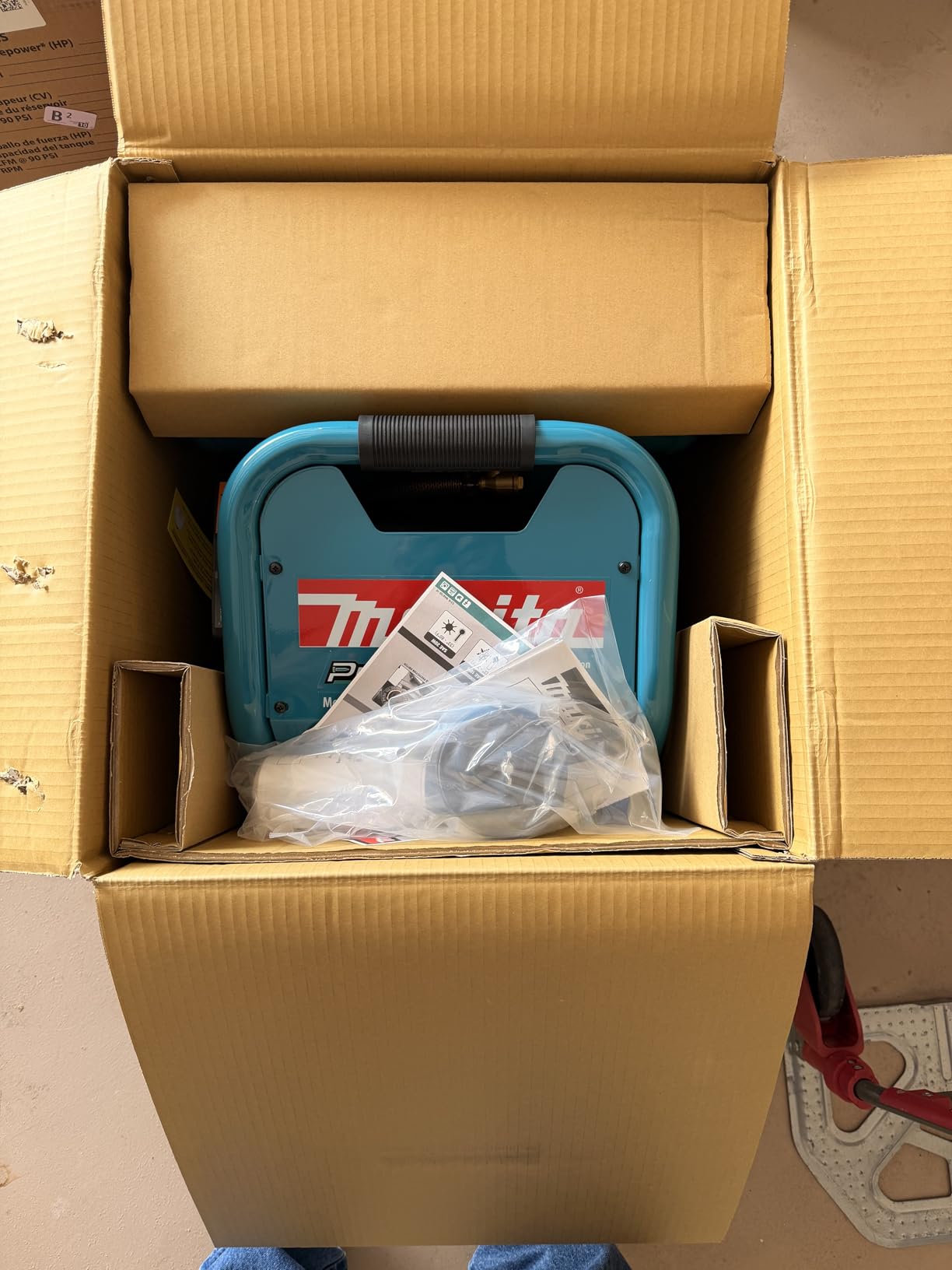
The MAC2400 is a horizontal machine with a 4.2-gallon receiver, which sounds wrong until you understand what it is optimised for: recovery speed, not stored volume. The cast iron Big Bore cylinder and piston move more air per stroke than a typical small pump, and at 1,730 RPM the pump turns slowly enough to run cooler and quieter than the 3,400 RPM class of machine.
That slow speed is the quiet advantage in a residential garage. The 79 dB figure is measured at the unit, and at working distance with a torch on the end of 25 feet of hose it is a background hum rather than a conversation stopper. It draws 12.3 amps, which is the other reason owners like it: starting against a charged tank on a shared 15 amp circuit rarely trips anything.
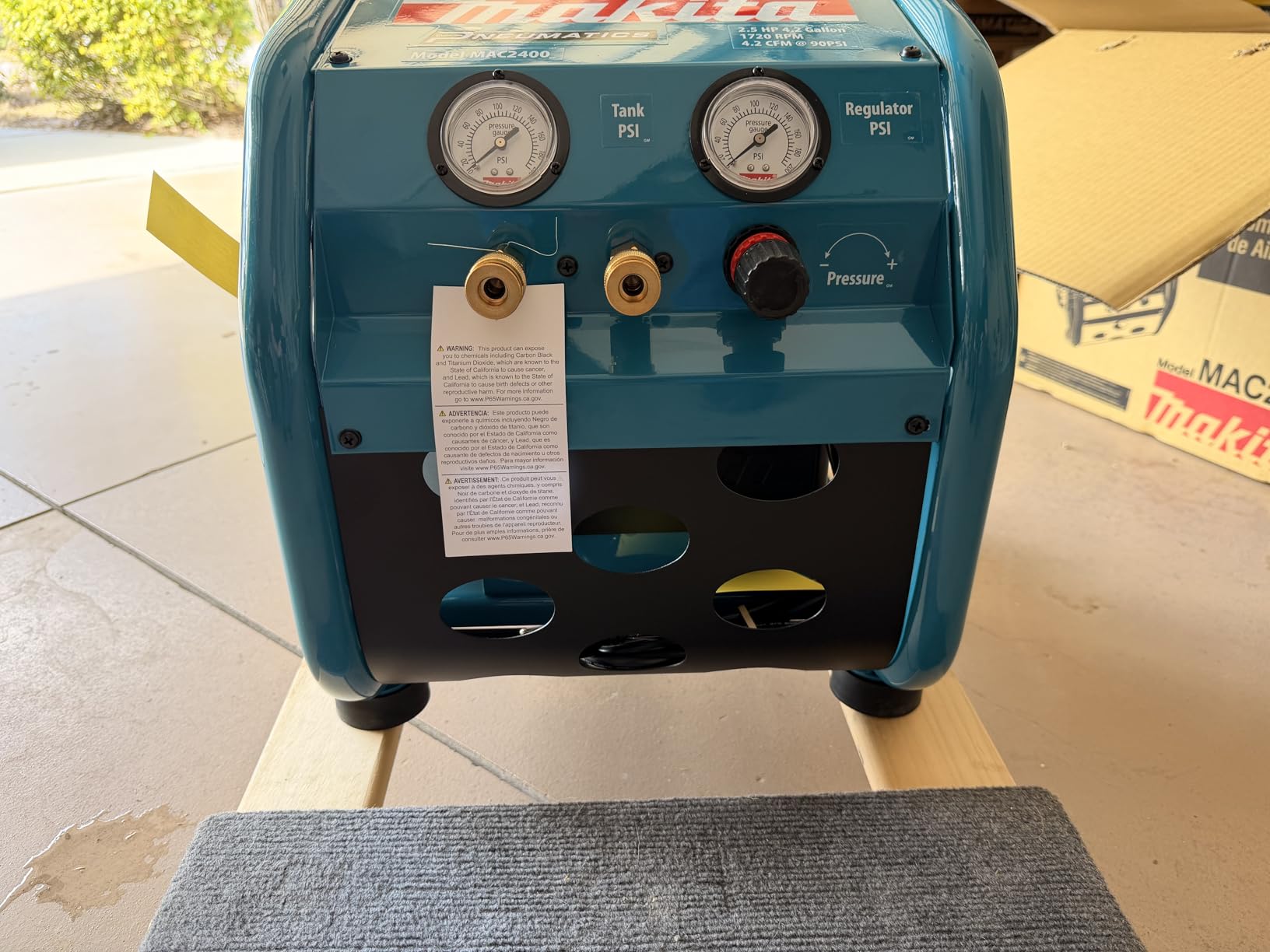
Where it falls short is storage. Four point two gallons is the smallest tank in this group along with the Rolair, so the compressor cycles constantly during a long cut. A torch that pulls 4 CFM empties a 4.2-gallon tank in well under a minute, and the pump spends most of the cut running rather than resting.
Oil lubrication is the other tradeoff. It is a feature rather than a flaw for a machine that will sit in a dusty garage and run hard, but it does mean an oil sight glass to check and oil to change on a schedule. If your shop cannot tolerate oil aerosol near the torch, this is the wrong architecture and you want an oil-free pump instead.
How much air does a plasma cutter need from this compressor?
The 4.2 CFM at 90 PSI rating covers handheld torches in the 20 to 30 amp class with room to spare, and it comfortably feeds a 40 amp torch during intermittent cut-and-travel work. The 1.5x headroom rule means you want a compressor rated roughly 50 percent above the torch’s rated CFM, so a torch calling for 3.5 CFM is well matched.
It is not enough for a 50 amp CNC table running continuous kerfs. Gouging demand on the same torch is higher again, and the tank will not hold enough reserve to smooth out a long pierce. For that class of work the airflow has to come from a pump with a bigger bore, not a bigger tank.
Who should skip this compressor?
Skip it if you are buying for a CNC table or a production plate job, because 4.2 CFM is one full CFM class below what a 45 to 65 amp torch pulls. Skip it if you have no 120V circuit to spare, since the machine needs a dedicated 15 amp outlet to start reliably against a charged tank.
Do not skip it if you cut a few inches of sheet metal per week from a garage and want something that starts quietly, survives dust, and does not demand electrical work. That is exactly the job this machine was built for, and its 4.7-star average across 1,319 reviews reflects how few owners feel otherwise.
2. Metabo HPT EC914S Pancake – Maximum Pressure in the Smallest Package
Metabo HPT Portable Pancake Air Compressor, 6 Gallon 200 PSI, EC914S
- 200 PSI max is 25 percent above a basic pancake unit
- 73 dB keeps it usable indoors
- Only 42 lb so it moves between jobs easily
- 4 CFM at 90 PSI runs several nailers at once
- 4 CFM will not sustain a mid-size plasma torch
- 6-gallon tank refills between passes on long cuts
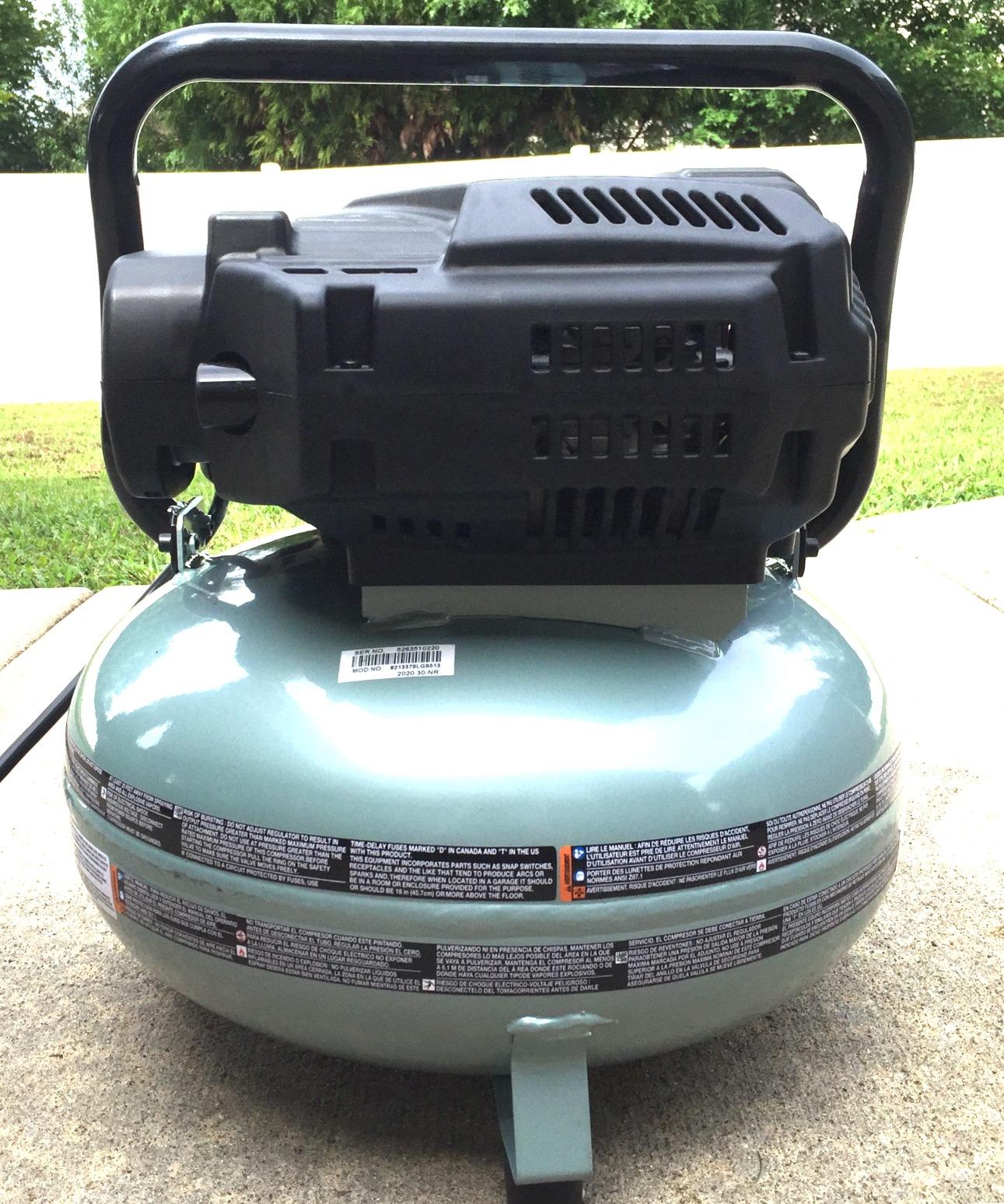
The EC914S is a 6-gallon vertical pancake, and the number that matters here is 200 PSI. That is 25 percent more ceiling than a standard pancake design, and a higher ceiling is what lets the regulator hold a torch’s working pressure while the pump is between strokes.
At 42 pounds it is the second-lightest machine here and the easiest to carry to a job site or lift onto a bench. Metabo HPT rates it at 73 dB, which fits indoor finishing work. The 1-year warranty is short compared with some machines in this group, but the brand is well established in nailers.
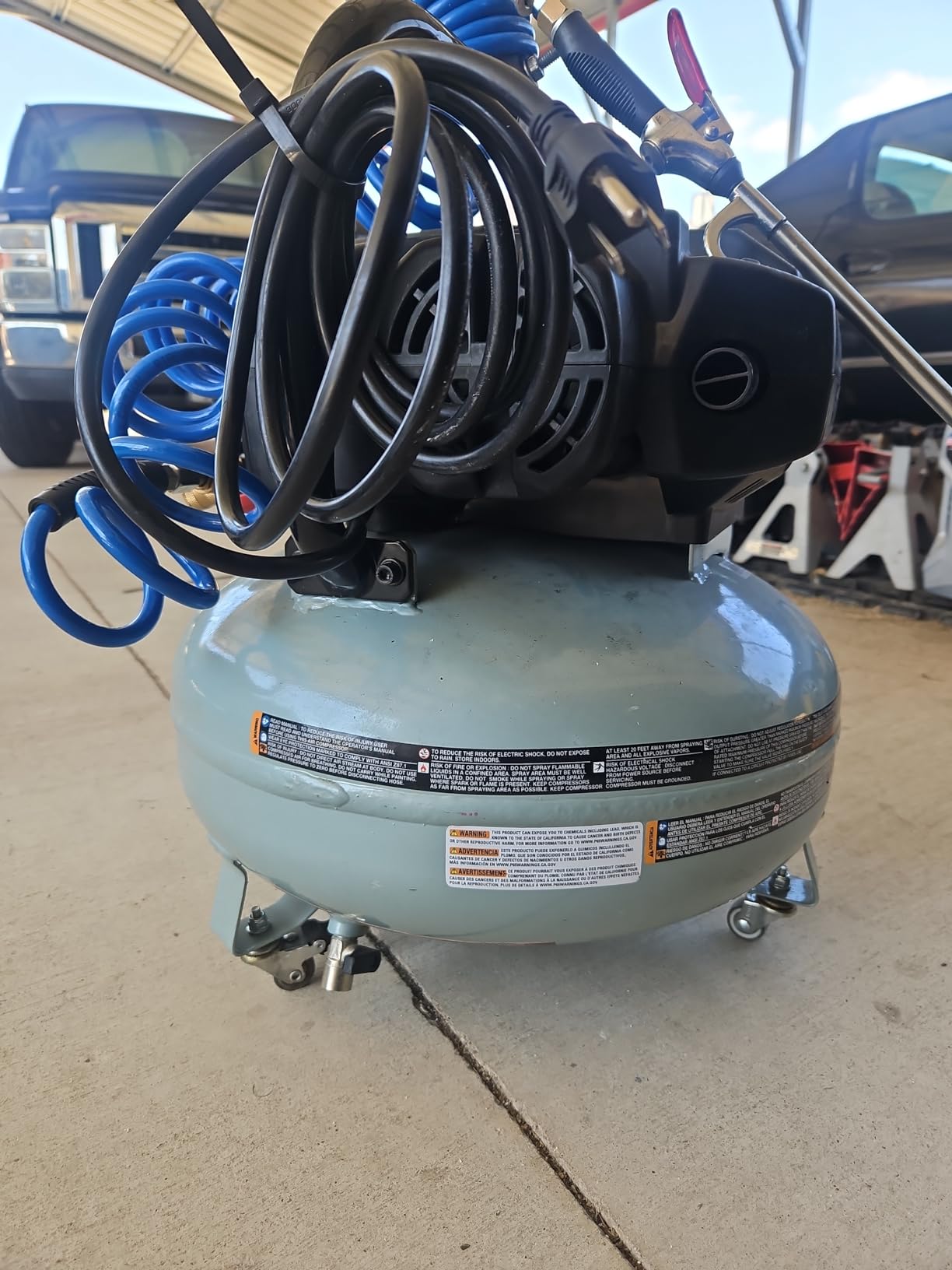
Where the pancake format hurts is flow and recovery. Four CFM at 90 PSI is enough for two framing nailers or several finish nailers, which is what this machine was designed around. A plasma cutter in that class can run for a few seconds before the tank pressure sags and the arc begins to sputter.
Reviews describe it as an excellent nailing and inflating compressor with genuinely low noise and easy portability. The limitation that shows up is exactly the plasma one, and it is a limit of the architecture rather than a fault in the machine.
Will a 30 gallon air compressor run a plasma cutter, and can a 6 gallon one?
A 30-gallon tank will run a 20 to 40 amp torch comfortably, because the stored volume covers the gaps between pump cycles. A 6-gallon pancake will not, for anything larger than a 20 amp cutter used in short bursts. Tank volume smooths demand, it does not create airflow, and at 4 CFM this unit simply does not refill fast enough.
If you need portability and plasma capability in the same machine, the more sensible route is a 20-gallon unit at 5 CFM, which weighs about three times as much but carries a real air reserve between passes.
Who should skip this compressor?
Skip it if a plasma cutter is the primary tool you own. Its honest use is framing, roofing, trim, inflating and spray work, and it earns its place in a package with those tools rather than with a torch.
Also skip it if you plan to grow into thick plate work later. The 200 PSI ceiling is genuinely useful, but flow is the constraint you hit first, and you cannot add it without replacing the whole machine.
3. Klutch 29-Gallon Vertical – The Best Air Compressor for Plasma Cutters on 120V
Klutch 29-Gallon Air Compressor, 2.5 HP, 120V, 175 PSI, 5.1 CFM at 90 PSI
- 5.1 CFM at 90 PSI with quick recovery
- 29-gallon vertical tank stores real air volume
- Oil-free pump means no oil changes
- 120V and 15A so no new circuit needed
- 81 dB is loud for a unit of this size
- 127 lb needs two people or a ramp to reposition
- One report describes an internally bypassed power switch
This is the configuration most people searching for an air compressor for a plasma cutter in a residential garage actually need. A 29-gallon vertical tank, an oil-free pump, 5.1 CFM at 90 PSI, 175 PSI max, and standard 120V power with a 14.5 amp draw.
That combination is why it works so well with a torch. The 29-gallon receiver stores enough air to ride through a pierce and a reposition without dropping below the torch’s working pressure, and the 5.1 CFM figure is the highest sustained-flow number available from a 120V machine in this group. The vertical format keeps a 29-gallon footprint under about 2 feet of floor width.
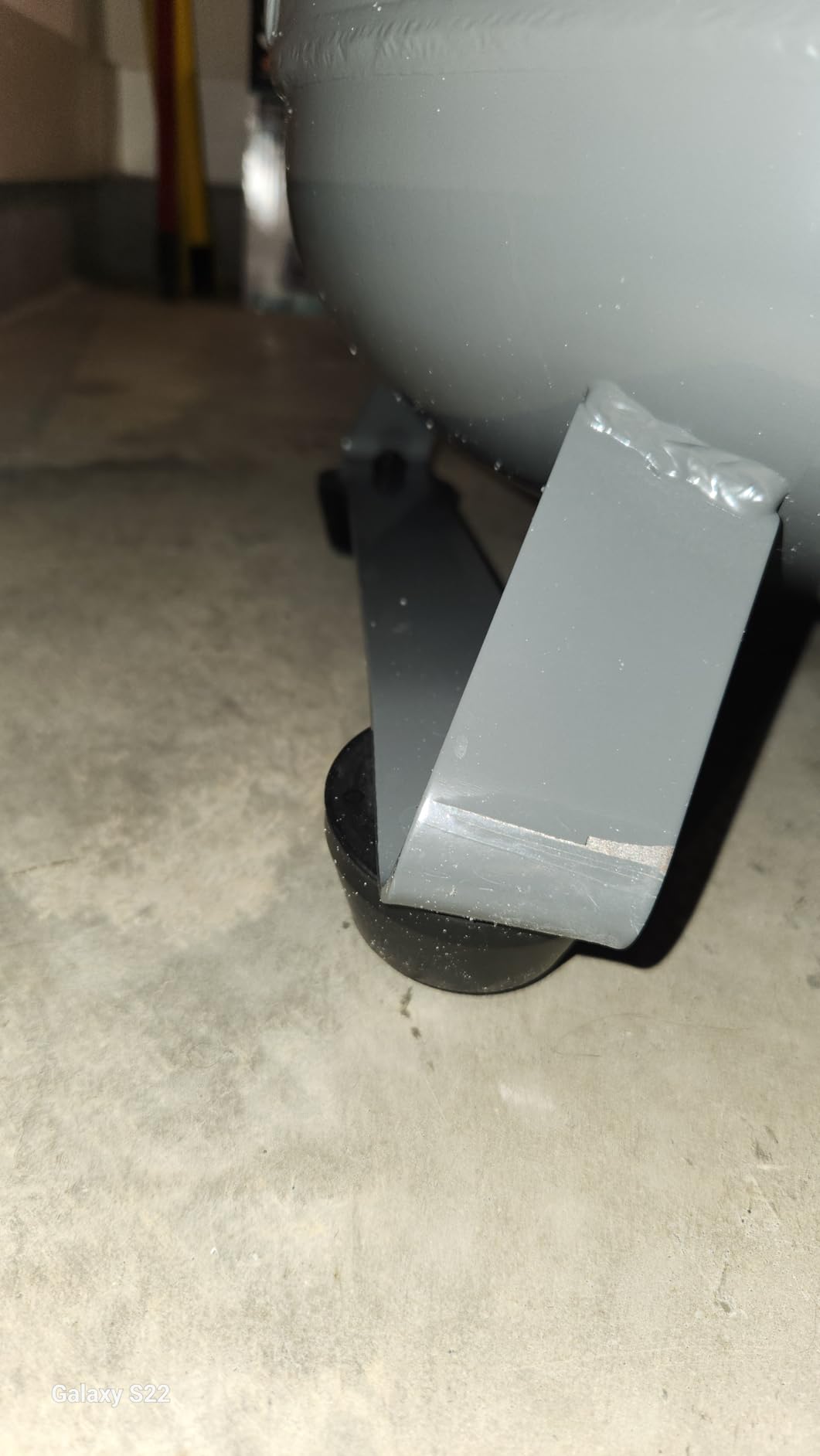
Owners report holding pressure for extended periods with no measurable loss, and the oil-free pump removes the maintenance question entirely. No oil to change, no oil separator to buy, and no oil carryover reaching the torch regulator. For air quality near a plasma cut, that matters more than most spec sheets suggest.
Two things deserve attention before you commit. The 81 dB rating is the loudest figure among the 120V vertical machines here, and experienced buyers treat decibel ratings as unstandardised across manufacturers, so treat it as a relative signal rather than an absolute one. At 127 pounds the unit is a two-person move.
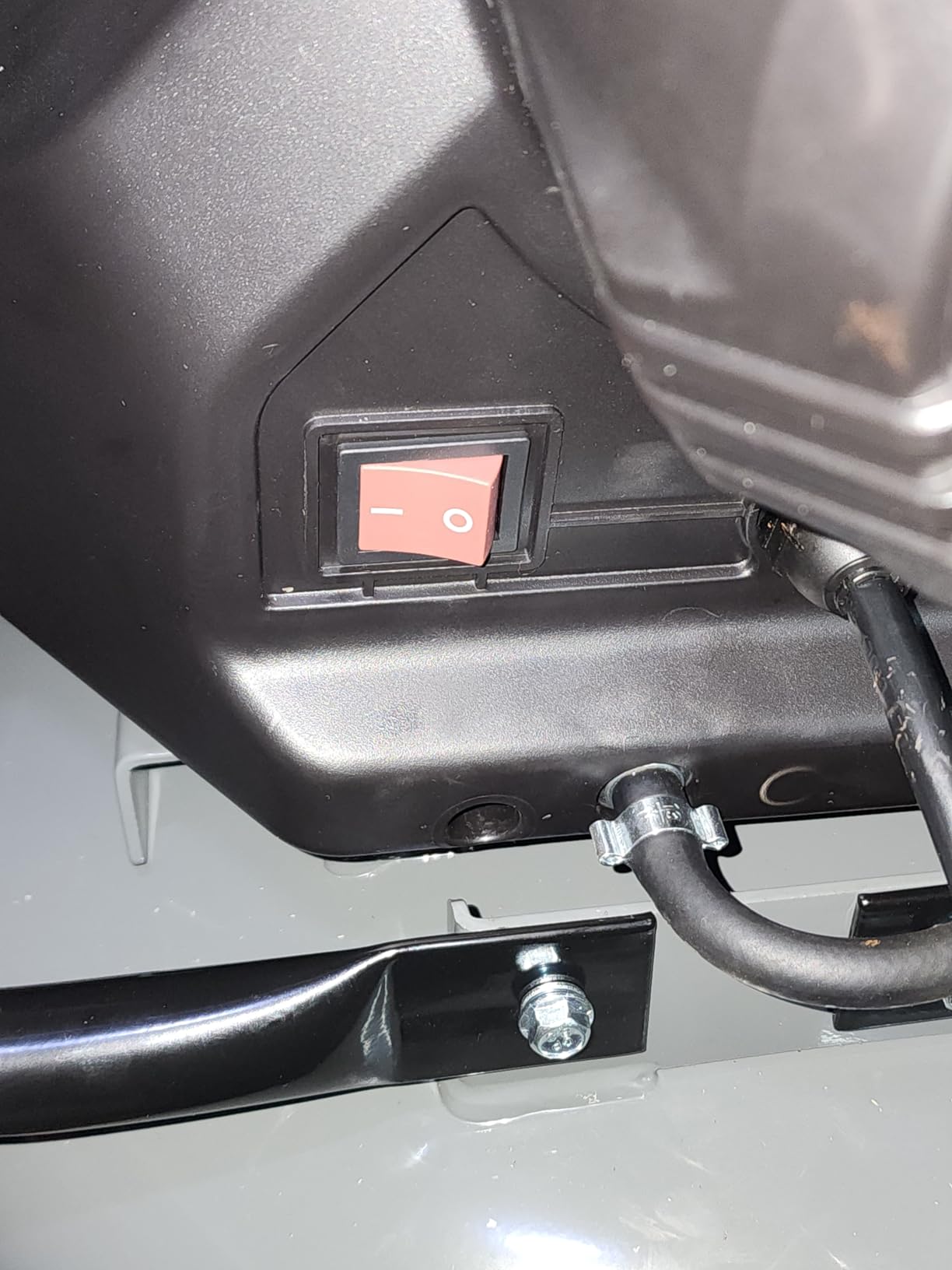
There is also a single detailed report of a power switch that arrived internally bypassed, forcing disconnection under load and producing an arc flash event. One report is not a pattern, but it is exactly the kind of electrical fault worth inspecting for on arrival, before the machine goes near a plasma cutter and a long hose run.
How many CFM does a 50 amp plasma cutter need?
A 50 amp handheld torch typically lists around 7 to 8 CFM of air demand at its working pressure, and the 1.5x consumption rule pushes the target compressor figure to roughly 10 to 12 CFM. The Klutch’s 5.1 CFM at 90 PSI sits below that, so it will not keep a 50 amp torch cutting continuously without pressure sag.
It is well matched to a 40 amp torch used in a garage, and the 29-gallon tank gives it more reserve than any other 120V unit here. If your torch is rated at 50 amps and you want to gouge as well as cut, budget for a two-stage 230V machine instead.
Who should skip this compressor?
Skip it if noise rules out a residential garage, since 81 dB is genuinely intrusive in a small workspace. Skip it if you have 240V service available, because a two-stage 230V pump at the same tank size will out-deliver it on sustained flow.
Do not skip it if you want a torch that never starves without running new wiring. Oil-free, 120V, 175 PSI and 29 gallons of reserve is the most complete answer to the 40 amp class in this list.
4. VEVOR 15-Gallon Oil Free – Quiet Airflow With One Real Limitation
- 5.3 CFM at 90 PSI is the highest flow figure among the 120V machines here
- 78 dB is genuinely quiet for this class
- Three-layer seamless-welded steel tank
- No overheating reported in normal use
- 125 PSI max is below the 150 PSI most plasma torches want
- Short cord and sensitivity to extension cords
- Motor housing runs hot during long runs
The headline here is 5.3 CFM at 90 PSI, the highest sustained-flow figure in this group apart from the 80-gallon two-stage. It comes from a 2 HP oil-free motor running at 1,680 rpm, which is a slow speed for a compressor of this size and explains the 78 dB operating level.
Builders who moved down from larger-name brands report being pleasantly surprised by the tank build, described as three layers including a rust-resistant outer layer over Q235B structural steel with seamless welding. The 15-gallon vertical tank is a sensible compromise between stored volume and footprint, and the large cooling fan keeps the motor out of thermal shutdown in ordinary use.
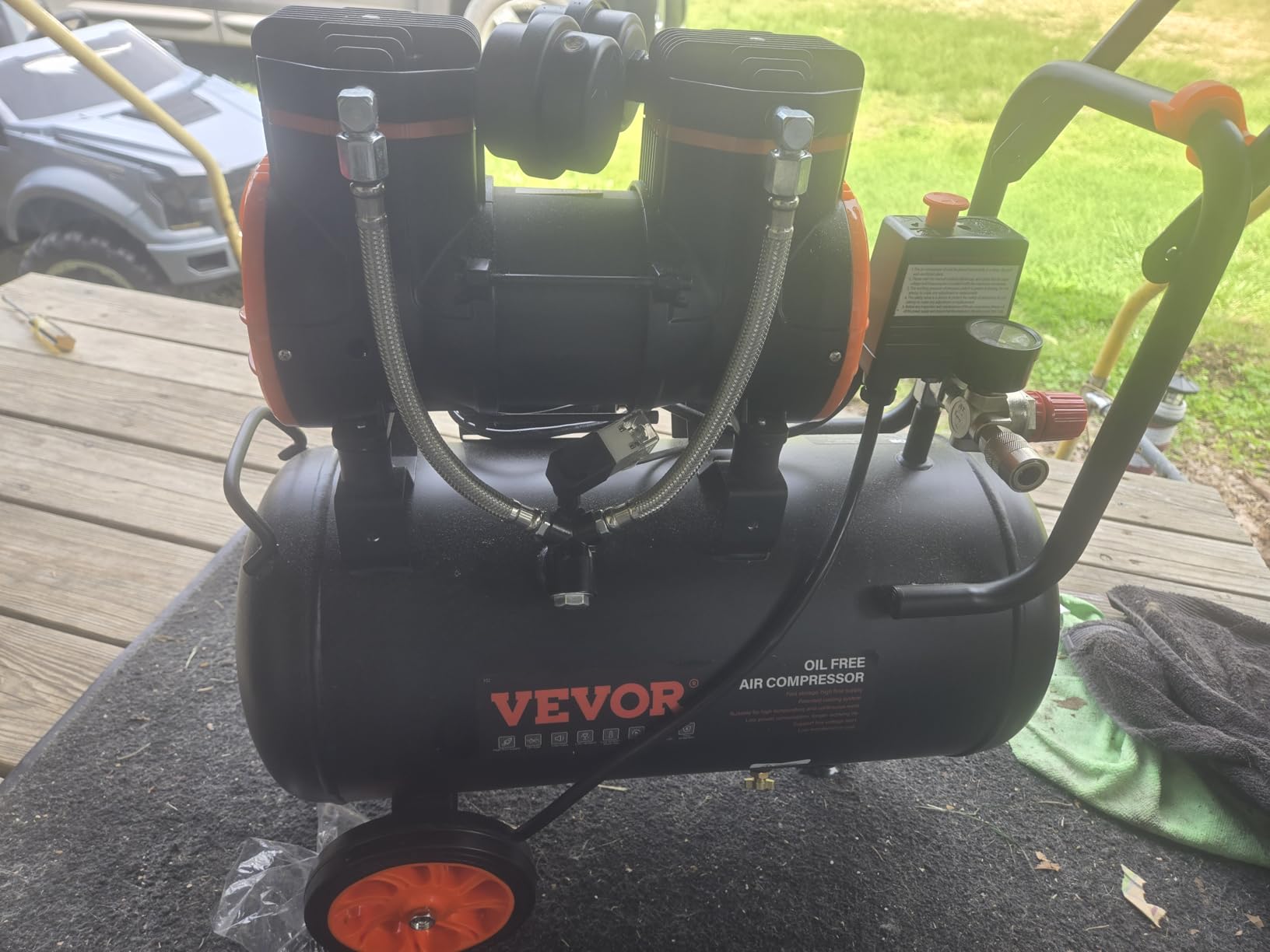
Now the limitation, and it is a structural one rather than a quality complaint. The tank’s 125 PSI ceiling sits below the 150 PSI working pressure that most plasma cutter manuals specify, and the regulator cannot deliver what the tank does not store. This compressor will run a torch, but it runs it near the edge of the machine rather than comfortably inside it.
The electrical complaints are the ones that show up most often in reviews. The cord is roughly 40 inches, so the machine has to sit within about 2.5 feet of an outlet, and several owners report it will not start or shuts down when fed through an extension cord. A plasma cutter already draws meaningful current, so plan the circuit layout around that constraint.
One further note worth raising: the motor housing reportedly gets hot enough to burn skin during extended runs. That is a reason to keep hands clear during long duty cycles, not a reason to rule the machine out.
What air pressure should I run my plasma cutter at?
Handheld torches in the 20 to 40 amp class specify roughly 60 to 80 PSI, while CNC tables and plate work typically run 100 to 120 PSI at the torch. The important distinction is that this is the pressure at the torch, not the pressure on the tank gauge, and the two are rarely the same number.
A 125 PSI tank ceiling leaves very little margin above a 100 PSI torch setting even before line pressure drop. If your torch manual calls for 100 PSI or more at the torch, this machine is short on both counts and you should size up.
Who should skip this compressor?
Skip it if your torch is specified for 100 PSI or higher at the torch, since the 125 PSI tank ceiling makes that a fight you will lose. Skip it if you need more than about 6 feet of cord length from the outlet, because extension cords are a reported no-start condition.
Do not skip it if your cutting is sheet metal and light plate at 30 amps, and quiet operation in a residential space is the priority. The flow rating is genuinely the strongest in the affordable 120V class.
5. Stealth 20-Gallon Ultra Quiet – The Lowest Published Noise Figure Here
- Claimed 68 dB with one reviewer measuring 65 dB at 8 to 10 feet
- 5 CFM at 90 PSI plus 150 PSI peak suits plasma torches
- 20-gallon tank holds useful reserve
- Limited lifetime warranty
- One unit tripped a breaker within two weeks and brand service is hard to reach
- Will not restart against a charged tank on undersized wiring
- 121.4 lb is heavy to lift
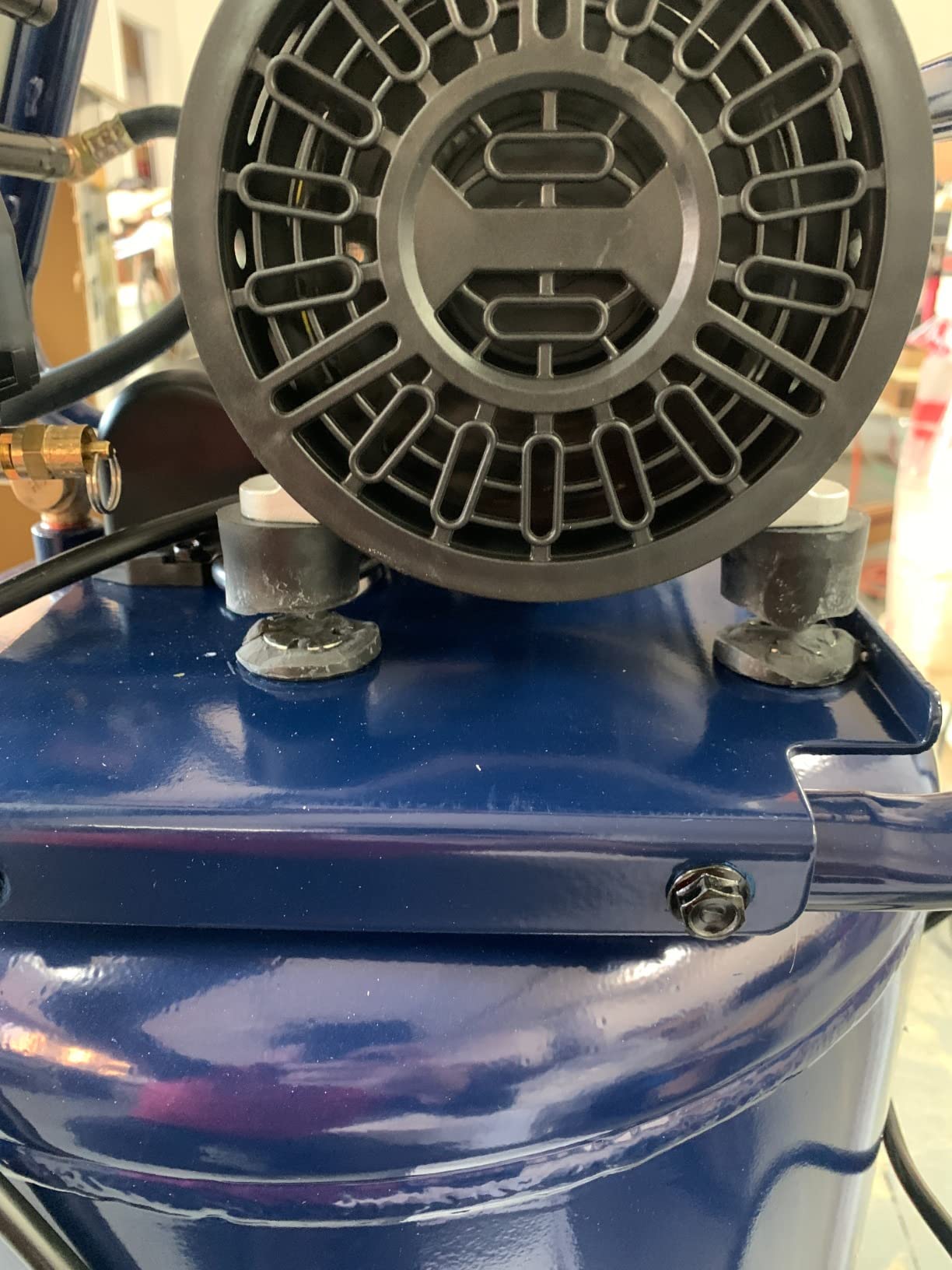
This machine exists for one reason: to run a plasma cutter in a space where a normal compressor would be unusable. The published figure is 68 dB, and one owner with a meter logged 78 dB at point-blank and 65 dB at 8 to 10 feet, which is roughly half what a conventional shop compressor produces at working distance.
Underneath the quiet operation the numbers are genuinely adequate for plasma work. Five CFM at 90 PSI with a 150 PSI peak, a 20-gallon steel tank, and a 1.8 HP oil-free motor. The tank gives more reserve than the pancake units, and the oil-free pump means clean air reaching the torch regulator.
The critical caveat is that decibel ratings are not standardised across manufacturers, so compare this figure cautiously. In practice the qualitative reports are consistent: owners describe a softer, less grating tone than typical piston pumps, and a clear step up from small pancake units.
Two durability points deserve weight. One owner reported a unit that tripped its breaker within two weeks and could not be replaced through the retailer, and reviews repeatedly describe the brand’s customer service as difficult to reach. Separately, the machine will not reliably restart against a charged tank on undersized shop wiring, which is a common issue in older buildings with long extension runs.
At 121.4 pounds, moving it is a two-person job. Budget for that before you decide the noise floor is worth it.
Is this quiet compressor worth it for plasma cutting?
If your shop is a residential garage, a shared workspace or a room where you need to talk over the machine, the answer is yes. A 150 PSI peak with 5 CFM at 90 PSI comfortably runs a 30 to 40 amp handheld torch, and reviewers commonly pair it with lighter plasma work.
If the machine will live in a dedicated shop, the noise advantage buys you less than the same money spent on a two-stage unit with more airflow. Quietness is a genuine feature, not a spec-sheet trick, but it is worth paying for only when your working environment demands it.
Who should skip this compressor?
Skip it if sustained flow matters more than noise, because 5 CFM and 20 gallons will not hold a 50 amp torch or a CNC table. Skip it if you have legacy wiring and expect the machine to restart without draining the tank first.
Skip it if support responsiveness is a deciding factor for you, given the reported difficulty reaching the brand and the durability outlier. Otherwise it is the most considered choice here for cutting sheet metal in a home garage.
6. Craftsman 20-Gallon 175 PSI – Highest Pressure Ceiling in the 120V Class
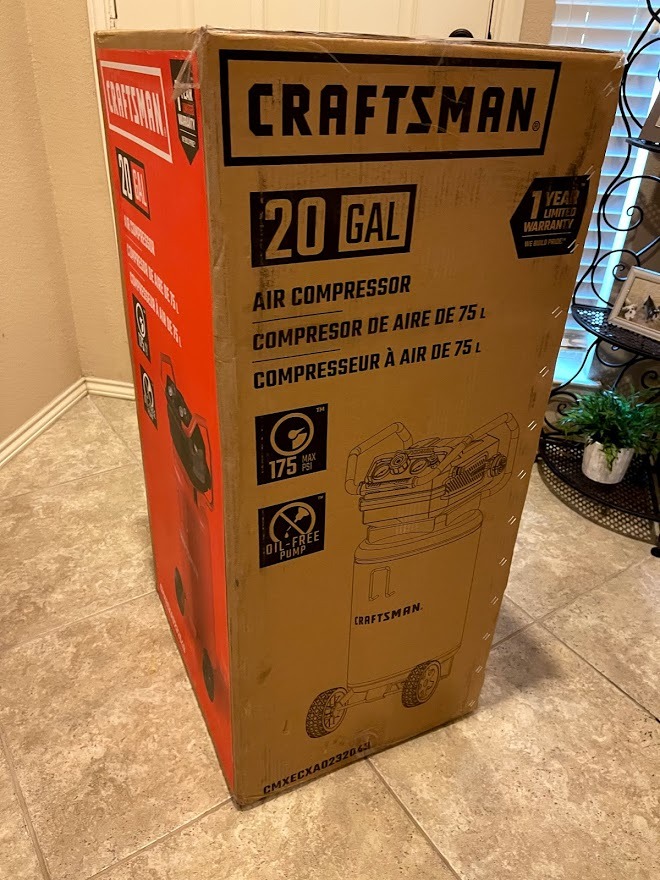
Craftsman Air Compressor, 20 Gallon Oil-Free 1.8 HP Max 175 PSI Pressure Two Quick Couplers Big Capacity, Red- CMXECXA0232043
- 175 PSI ceiling gives real headroom above a 150 PSI torch setting
- Stainless steel tank with an oil-free pump
- Two quick couplers and a 6-foot cord included
- 20-gallon volume gives useful reserve between cycles
- 4 SCFM at 90 PSI is modest for sustained cutting
- 80 dB is not among the quietest in this class
The Craftsman 20-gallon answers a different problem from the Klutch. Where the Klutch wins on flow, this machine wins on pressure ceiling, with a 175 PSI maximum that leaves genuine margin above the 150 PSI many torch manuals ask for.
That margin matters more than it sounds. When the pump is between strokes, the extra stored pressure above the torch setting is what keeps the regulator from sagging, and pressure stability at the torch is what determines whether the arc holds or sputters mid-pass.
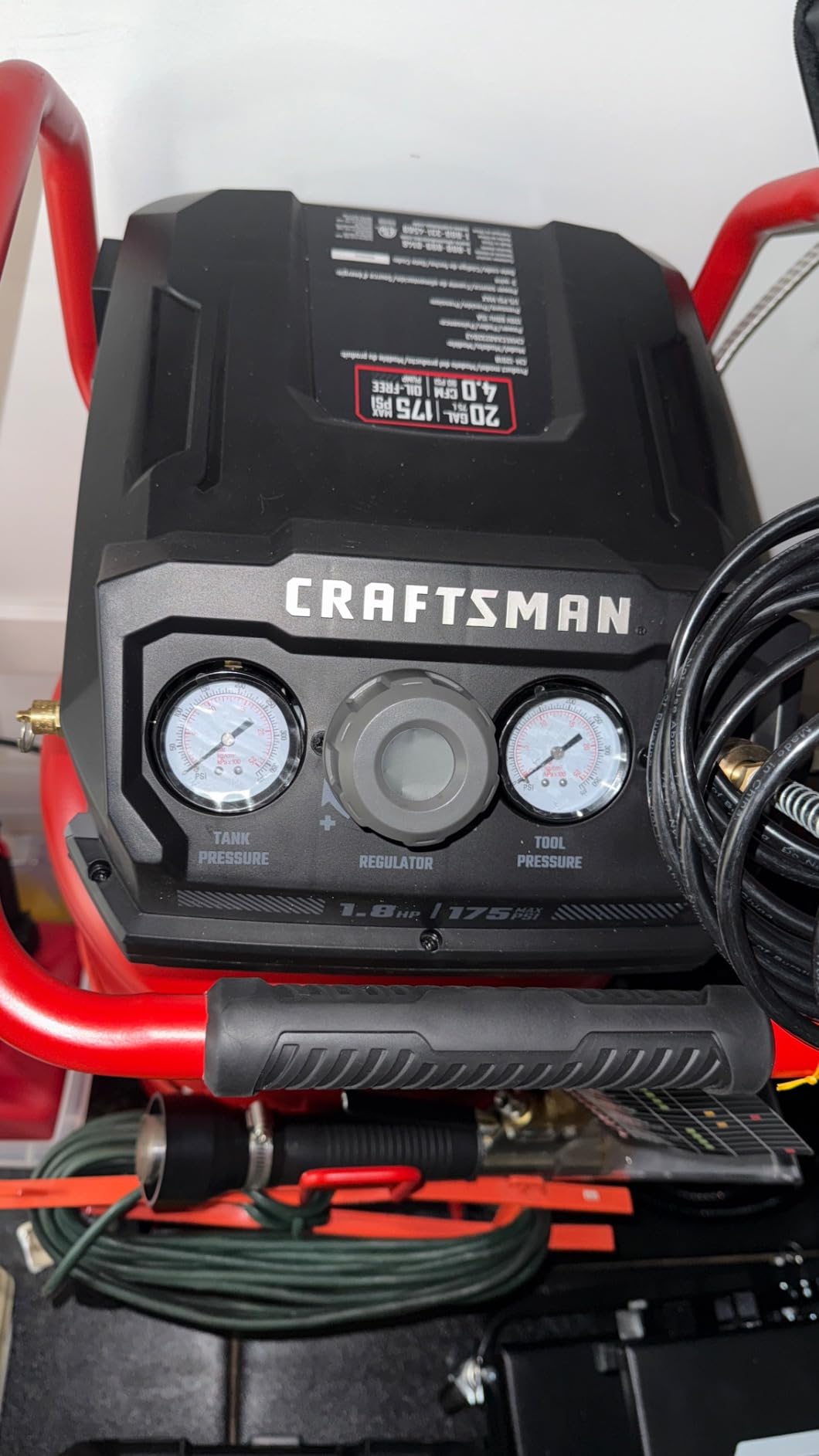
The package is unusually complete for this category: a 6-foot cord, a ball drain valve, a plastic filter, two quick couplers and two rubber wheels all ship in the box. The stainless steel tank with rubber feet and an oil-free pump mean no scheduled maintenance, and the 20-gallon vertical format is a familiar, easy footprint.
The honest limitation is flow. Four SCFM at 90 PSI is enough for trimming, inflating, spraying and short cuts, but it will not hold a torch under continuous load the way a 5-plus CFM machine does. If your work is long kerfs in plate rather than clean cuts in sheet, buy flow instead of ceiling.
How many PSI to run a plasma cutter?
Most handheld torches in the 20 to 45 amp class specify 60 to 80 PSI at the torch, and CNC tables typically run 100 to 120 PSI. A compressor whose maximum tank pressure is only a few PSI above that figure gives you no reserve, which is the argument for a 175 PSI ceiling over a 125 or 150 PSI one.
The 1.5x headroom rule applies to flow, not pressure. Pressure headroom only needs to exceed the torch setting by enough to hold it steady through a pump cycle, and 175 PSI covers every handheld class with room to spare.
Who should skip this compressor?
Skip it if you are cutting plate thicker than about a quarter inch, because 4 SCFM at 90 PSI is below what a 40 amp torch demands for long passes. Skip it if noise is a factor in your workspace at 80 dB.
Do not skip it if your torch manual calls for 80 PSI or more and you want pressure stability without a two-stage machine. The 175 PSI ceiling is the reason to choose this one over a lower-ceilinged machine of similar size.
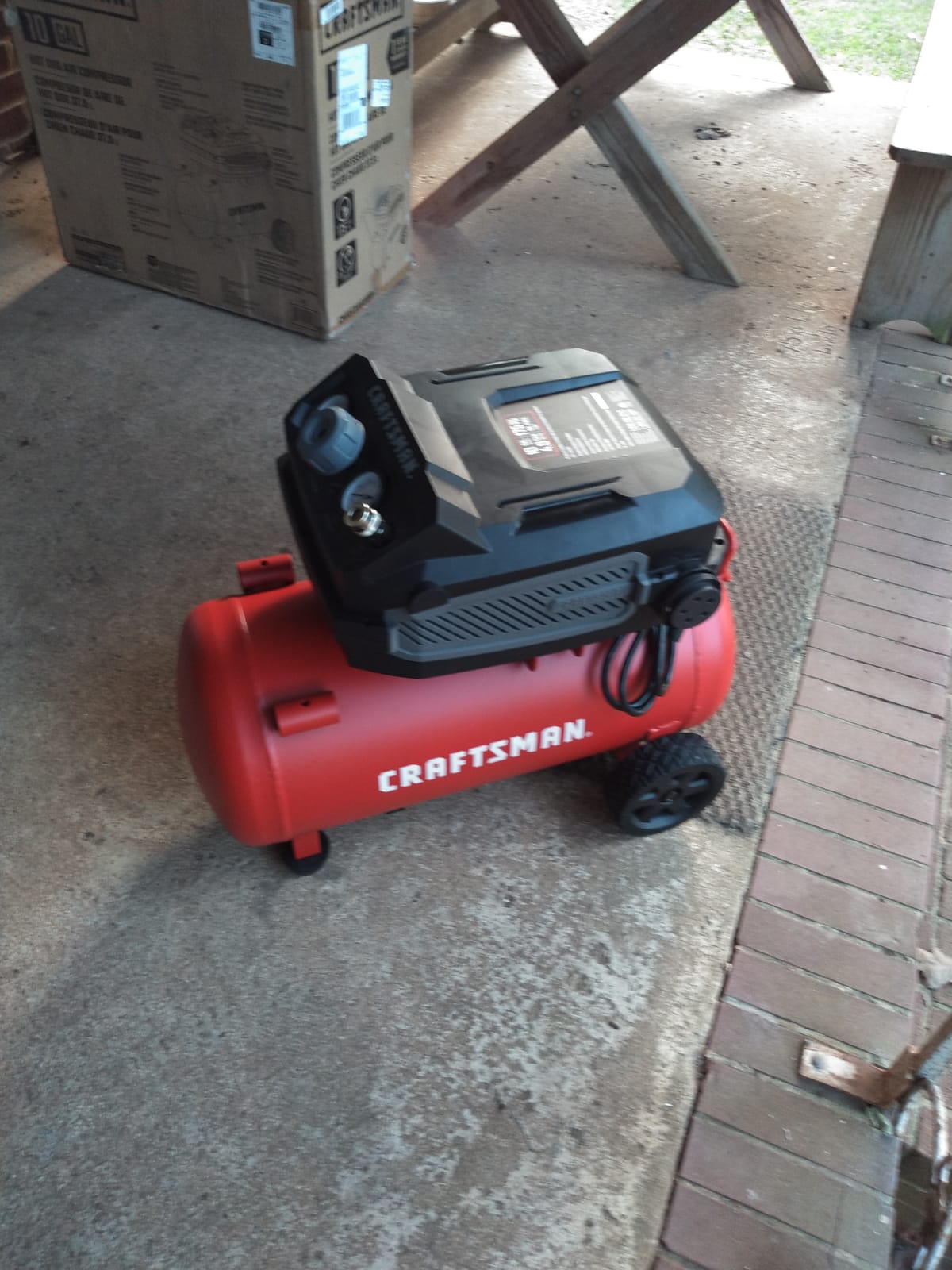
7. Craftsman 10-Gallon Horizontal – Lightest Machine That Stores Any Air at All
- Only 31.5 lb and stores under a workbench
- 175 PSI ceiling with an oil-free pump
- 78 dB and rubber foot stabilisers to cut vibration
- Quick cycle time between light-duty jobs
- 10-gallon tank refills quickly under any sustained demand
- 4.0 CFM at 90 PSI is below a mid-size torch
- Only one quick coupler included
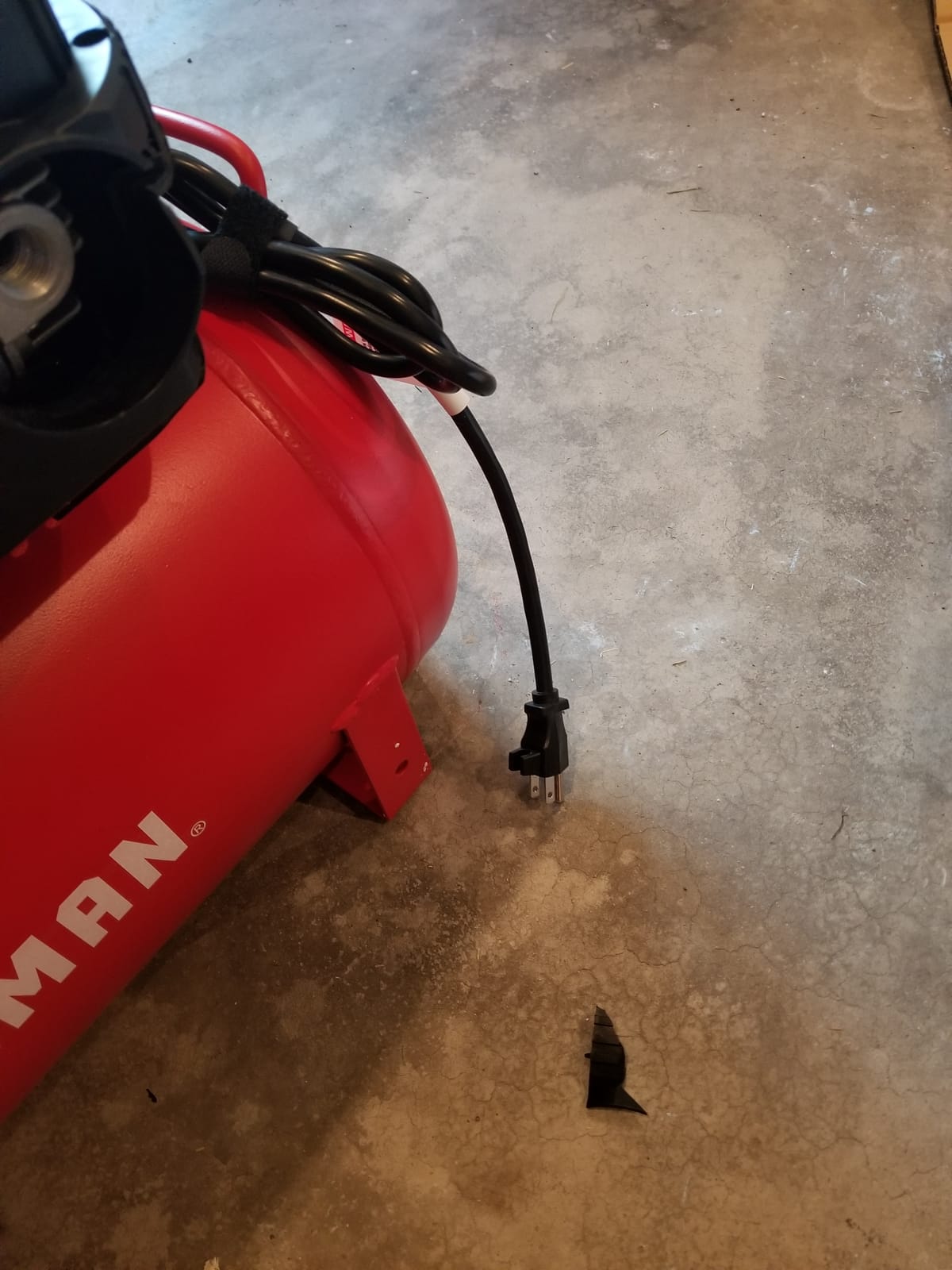
At 31.5 pounds this is the machine you can lift with one hand, slide under a workbench, and pull out when a torch needs topping up. The 10-gallon horizontal tank, 175 PSI maximum and 78 dB oil-free package covers inflating, airbrushing, stapling and short bursts of cutting with nothing more than a standard 120V outlet.
The compact footprint of roughly 23.6 inches long by 24.8 inches high and 15.9 inches wide is the real feature in a small garage. Rubber foot stabilisers reduce transmitted vibration, which protects both the machine and the bench it sits under.
Neither dimension is generous, though. Ten gallons is a small reserve, and 4.0 CFM at 90 PSI is the lowest sustained-flow rating among the machines here. For a 20 amp handheld doing occasional sheet metal cutouts, the tank smooths the demand well enough.
Push past about 30 amps of torch amperage and you will be watching the gauge fall during the cut. Only one quick coupler ships with it, so adding a second one for a torch line is a sensible early purchase.
Will a 30 gallon air compressor run a plasma cutter?
Yes, comfortably, for any torch up to about 40 amps in intermittent work. Thirty gallons of stored air at working pressure covers the gap between pump cycles, and that gap is exactly what causes arc dropout on smaller tanks.
Ten gallons is a different proposition. It gives you enough reserve for a short cut, a pierce and a reposition, and then the pump is running flat out to refill. For a 20 amp torch on thin material that is workable. For anything heavier, spend the difference on a 20-gallon or 29-gallon tank.
Who should skip this compressor?
Skip it if you own anything above a 30 amp torch, because 4.0 CFM at 90 PSI cannot sustain that class. Skip it if you plan to run a plasma table, where continuous airflow rather than portability is the constraint.
Do not skip it if floor space and weight are your binding constraints and your cutting is light sheet metal. There is no smaller machine here that stores any meaningful air at all.
8. DEWALT 27-Gallon Vertical – 200 PSI on a 120V Circuit
DEWALT 27-Gallon Vertical Portable Air Compressor (DXCM271.COM)
- 200 PSI ceiling and 5.1 CFM at 90 PSI on standard 120V power
- Oil-free so no separator needed near the torch
- 27-gallon vertical ASME tank in a small footprint
- Low-volt easy-start motor handles poor power conditions
- Regulator adjusts only to about 160 PSI despite a 200 PSI tank
- 10 to 12 minutes to fill from empty
- 136 lb is heavy to roll
The DXCM271 is the most plasma-specific machine in this group. It delivers 5.1 SCFM at 90 PSI and a 200 PSI maximum from a 1.7 HP single-stage direct-drive oil-free motor on standard 120V power, and one owner specifically confirms the pairing with a plasma cutter as a good match that avoids wiring a second 230V outlet.
That is a rare combination. Most compressors at this flow are 230V-only, and most 120V machines top out at 150 to 175 PSI. Holding both the higher ceiling and the higher flow on 120V means you can grow into thicker plate without touching the electrical panel.
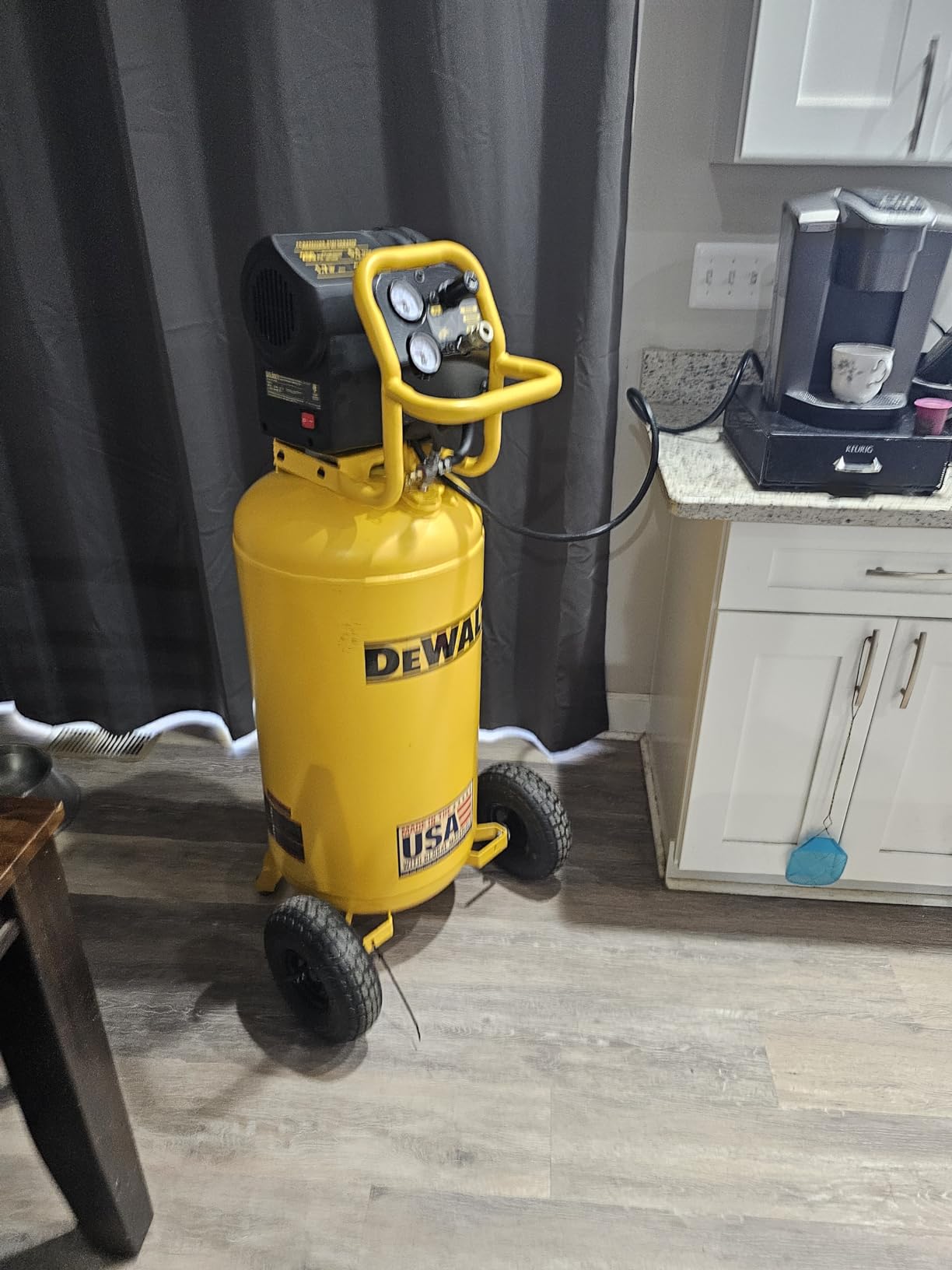
Owners upgrading from 6-gallon pancake machines describe the 27-gallon vertical tank as the decisive change, because it removes the constant refill interruptions. The vertical ASME tank keeps the footprint close to 26.8 by 23.5 inches, and the 78 dBA rating sits at the quiet end of the group.
There is one specification quirk worth knowing before you buy. The regulator itself adjusts only to about 160 PSI even though the tank reaches 200, so on a torch that wants 100 to 120 PSI at the torch you have room to work but the delivered ceiling is lower than the tank figure suggests.
Fill time from empty runs 10 to 12 minutes on a 27-gallon tank, which is normal but noticeable. At 136 pounds the wheels help, and it is not a unit you want to move up stairs alone. One owner also reported a small leak at the safety valve fitting that needed a brass replacement part, worth inspecting at delivery.
What is the best air compressor for a CNC plasma table?
A CNC table wants a compressor that holds roughly 10 to 12 CFM at the working pressure for long uninterrupted passes, with enough tank volume to cover a pierce. The 5.1 SCFM at 90 PSI from this machine will not reach that level, and a table running above 45 amps will visibly suffer.
What the DEWALT does offer is the closest approach to a CNC-class machine without a 230V circuit. For a hobby table running a 30 to 40 amp torch on 3/8 inch plate, with torch-on time kept under a minute at a stretch, it holds up. For production work it is short by a full airflow class.
Who should skip this compressor?
Skip it if you need more than about 160 PSI at the torch, because the regulator caps out well below the tank’s 200 PSI rating. Skip it if you want a machine that refills quickly between jobs, since 10 to 12 minutes from empty is slow.
Do not skip it if your constraint is electrical rather than airflow. A 200 PSI ceiling, an ASME vertical tank and oil-free delivery on 120V is a combination nothing else in this group matches.
9. Campbell Hausfeld 80-Gallon Two-Stage – The Only True CNC and Production Class Machine
Campbell Hausfeld 80-Gallon Vertical Electric Air Compressor (XC802100)
- 11.9 SCFM at 90 PSI comfortably covers 50 to 65 amp torch demand
- Two-stage cast iron pump holds pressure under sustained load
- 80-gallon vertical ASME tank conserves floor space
- 3-year limited warranty and made in the USA
- 326 lb is top-heavy and should not be moved without help
- Needs a dedicated 230V circuit and permanent installation
- Vibrates across the floor unless anchored
This is the only machine here that meets the demand of a CNC plasma table or a production plate job, and the number that settles it is 11.9 SCFM at 90 PSI with 11.3 SCFM still available at 175 PSI. That is more than double the sustained flow of any 120V machine in this group.
The architecture matches the duty. A two-stage cast iron oil-lubricated pump compresses in two steps, which means it runs cooler and delivers more air per unit of motor power than a single-stage pump. The 5 HP single-phase induction motor draws 22 amps on 230V, and the pump is rated for up to 10,000 hours on a B-10 bearing rating.
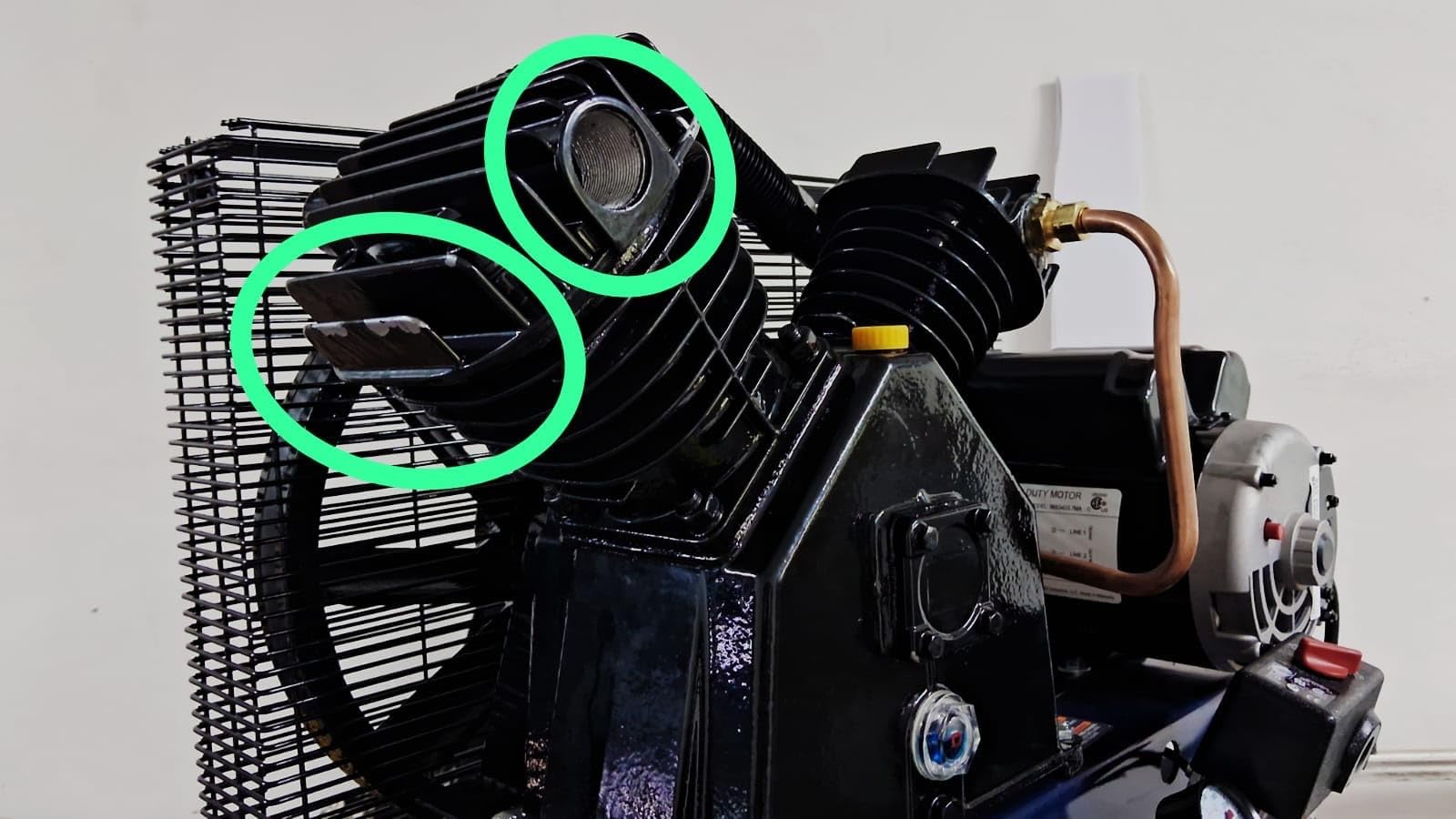
The 80-gallon vertical ASME receiver is what turns that flow into usable cutting time. It stores enough air to cover a thick-plate pierce and a reposition without the torch seeing a pressure drop, and the vertical format keeps a 326-pound machine inside a manageable floor footprint.
Long-time owners describe it as the compressor they had always wanted, with two-stage pressure that stays ahead of dual-action sanding and painting and holds steady during blow-off work at 100 PSI. The 3-year limited warranty is the longest in this group, and the made-in-USA build is a genuine advantage for parts availability.
The installation requirements are real, though. This is a stationary machine that needs a dedicated 230V circuit and permanent anchoring, and unbolted it vibrates enough to travel across the shop floor. At 326 pounds it should not be moved without assistance.
A few smaller items show up repeatedly in owner reports: a weak on/off switch that many owners replace with a lever-type disconnect, oil seeping from the oil fill plug when the O-ring is not seated, and a bottom drain plug placed awkwardly enough that owners extend it with a brass pipe and valve. One buyer received a unit with cosmetic damage and leaking oil and reported poor support, so inspect on arrival.
How much CFM should a compressor have for a 50 amp plasma cutter?
Using the 1.5x consumption rule, a 50 amp torch that lists 7 to 8 CFM of demand should be paired with a compressor rated 10 to 12 CFM at 90 PSI. The Campbell Hausfeld’s 11.9 SCFM lands almost exactly on that target, which is why it is the pick for this class.
The 80-gallon tank then does the job air flow alone cannot, covering the high-demand moments at pierce and gouge. A torch rated above 65 amps, or a shop running two torches at once, needs to move up to a rotary screw or a larger two-stage machine, because 11.9 CFM is the practical ceiling of the piston pump class.
Who should skip this compressor?
Skip it if you cut thin sheet in a home garage, because a two-stage 230V machine is enormous overkill for a 30 amp torch and you would be paying for capacity you never use. Skip it if you cannot commit to a dedicated circuit and an anchored floor location.
Skip it if your work is intermittent rather than sustained. Every advantage here is a continuous-duty advantage, and it only shows up on long kerfs and thick plate. If you are not there yet, the DEWALT or the Klutch is the honest answer for your class of work.
10. Rolair FC2002 Twin Stack – Cast Iron Durability in a 62-Pound Package
Rolair FC2002 2 HP Twin Stack Compressor with Overload Protection and Manual Reset
- Cast iron cylinder with splash lubrication built for decades of service
- Twin-stack design beats similar-priced oil-free units on airflow
- Starts immediately on household current without dimming lights
- Rolair customer service praised for fast next-day replacement
- 90 PSI maximum is well below any plasma torch requirement
- 4.3-gallon tank refills between passes
- No hose or fittings included
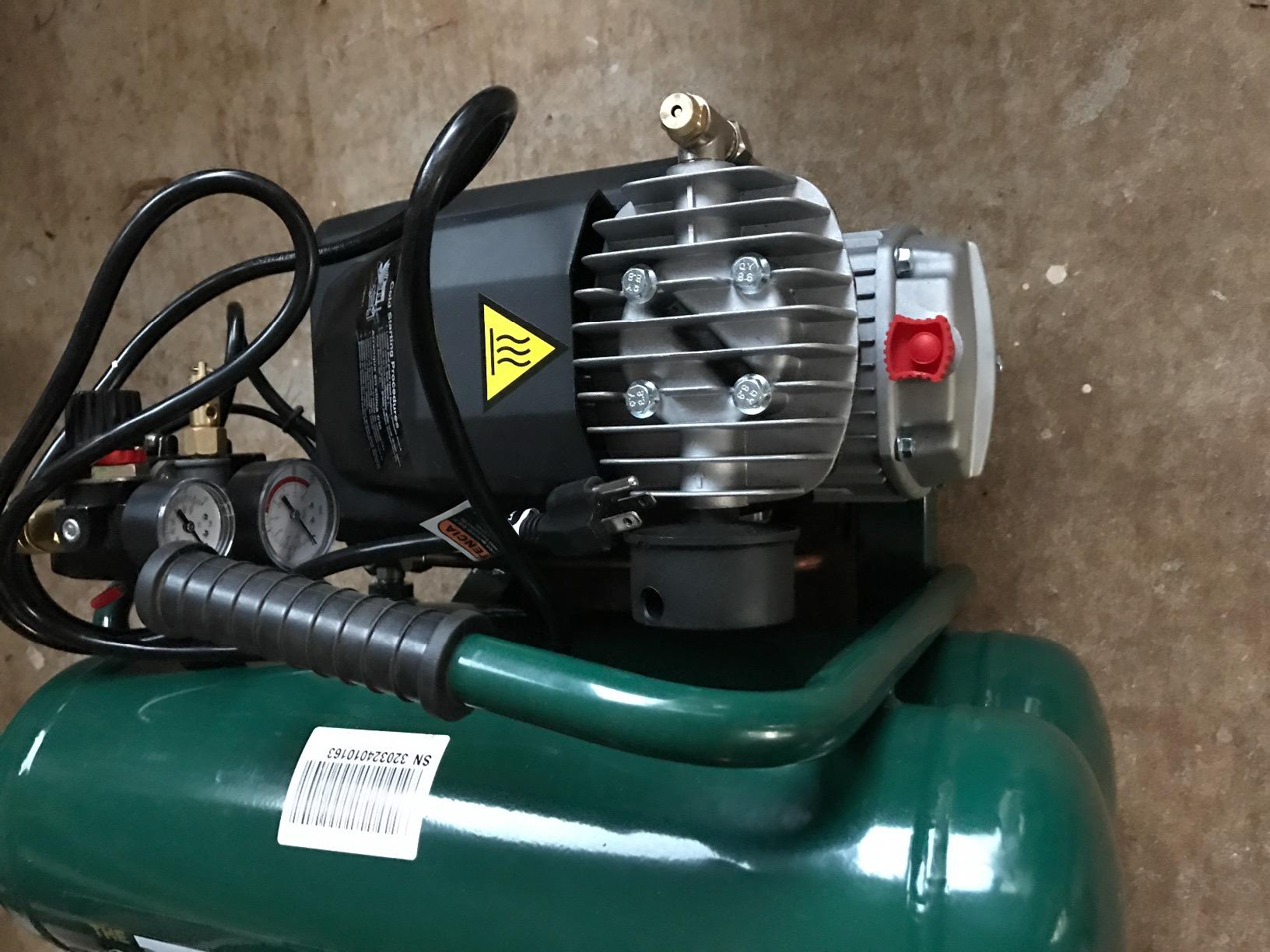
The FC2002 is the oldest machine in this group and the most mechanically traditional. A 2 HP twin-stack pump at 3,400 RPM, a cast iron cylinder, splash lubrication, and a 4.3-gallon tank, all at 62 pounds and 12.96 amps on 115V.
Owners describe it as a professional-grade unit expected to last decades, and one reviewer replaced a 20-year-old Ingersoll Rand twin stack and reported matching its output. The twin-stack layout delivers noticeably more air than oil-free machines of similar size, which is where the 4.1 CFM at 90 PSI comes from on a 2 HP motor.
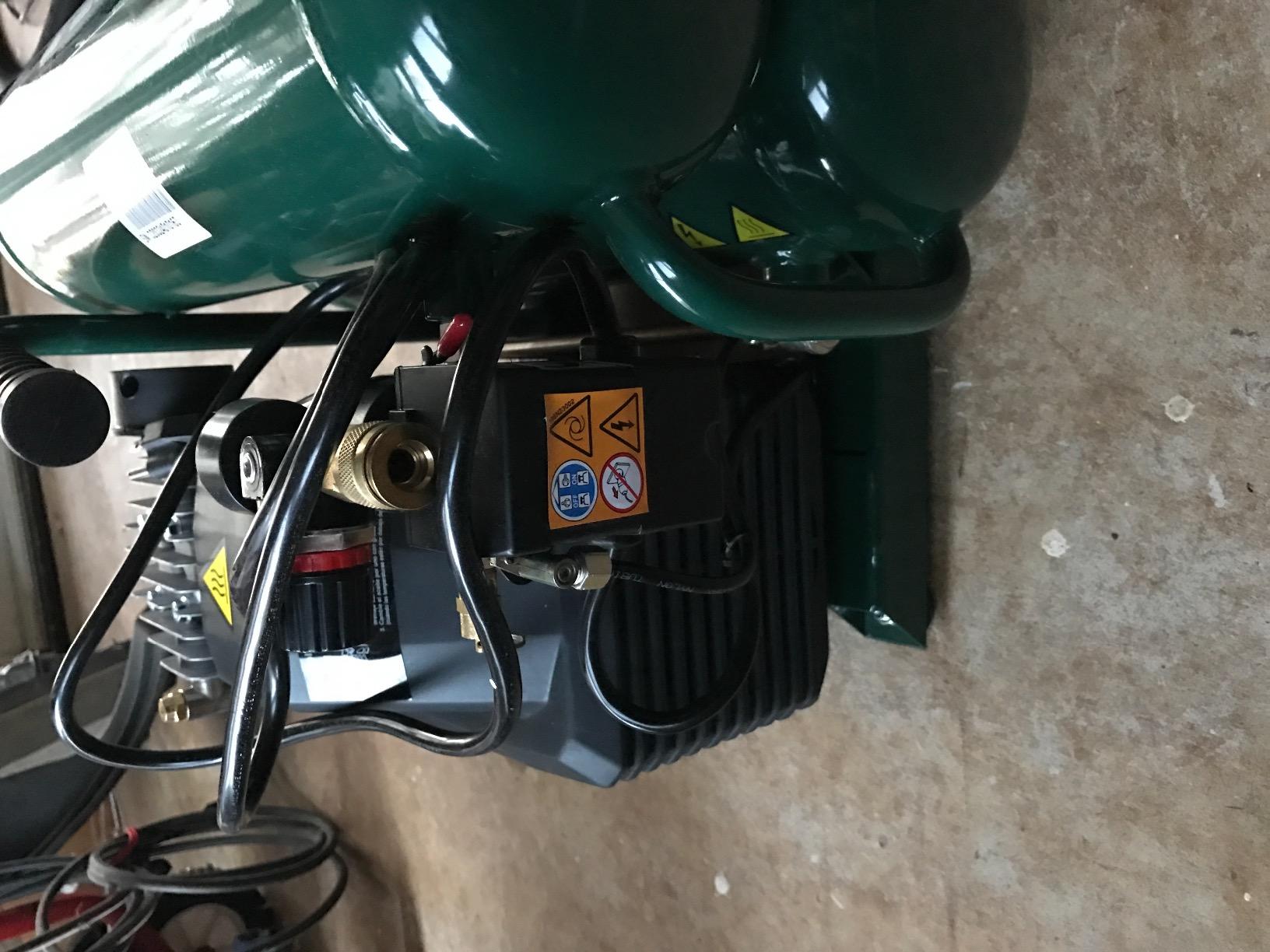
Rolair’s customer service comes up repeatedly and specifically. Owners report fast, professional responses including a next-day replacement arranged through a local supplier, which is worth weighing against larger brands with documented support complaints in this group.
The problems are ergonomic and capacity related rather than mechanical. At 62 pounds it is heavy for something described as portable, and owners report back pain from moving it. The air filter housing is a fragile plastic threaded nipple that can snap off if struck from the side, the secondary gauge placement is awkward, and the tank bleed valves are hard to turn and put hands in the air stream.
No hose or fittings are included, which matters if you are setting this up specifically to feed a torch.
Can you run a plasma cutter off a small air compressor like this?
Not meaningfully. The 90 PSI maximum is the binding problem, and every plasma torch in the classes discussed here specifies a working pressure well above it. Even if a regulator hack let air through at all, there would be no pressure above the torch setting to hold the arc stable.
The second problem is flow. Four point one CFM at 90 PSI sits right at the demand of a 20 amp handheld, with no headroom for a gouging pass or a longer kerf. A 4.3-gallon tank compounds it by refilling constantly.
Who should skip this compressor?
Skip it for plasma work entirely, because the 90 PSI ceiling rules it out regardless of everything else it does well. This is a nailer, inflation and general pneumatic tool machine, and it is a good one.
Consider it only if durability is your priority and you plan to buy a larger compressor later, or if you want a second machine for blowing down and cleanup that does not interfere with your cutting circuit. It also performs poorly as a generator-powered unit, so keep it on mains power.
How to Size an Air Compressor for a Plasma Cutter
The sizing rule that matters is simple enough to state in one line: buy a compressor whose CFM rating at 90 PSI is about 1.5 times the CFM your torch manual specifies, and make sure the tank is large enough to cover the gaps between pump cycles. Everything else on the spec sheet matters less than those two figures.
The headroom exists because compressors are rated at their best moment. Your torch pulls its rated airflow continuously for the length of a cut, and the pump has to replenish the receiver while the cut is still running. Buying exactly to the spec number leaves no margin, and margin is what keeps the arc from sputtering when the pump changes direction.
Builders on welding forums put it more bluntly. The consensus advice from people running real torches is that most plasma cutters want about 6 CFM, and that doubling that to 11 or 12 CFM is the sweet spot for CNC work. Another recurring point from owners is the same one: when there is any doubt about size, go bigger on CFM, because smaller units work harder, run hotter, and produce more moisture to deal with.
Match CFM to your cutter amperage
Here is the requirement set we use, with the 1.5x headroom already applied:
20 to 30 amp handheld: 3 to 5 CFM demand, 60 to 70 PSI at the torch, target 5 to 7 CFM at 90 PSI, 20 to 30 gallon tank.
40 to 50 amp handheld: 5 to 8 CFM demand, 70 to 80 PSI at the torch, target 8 to 12 CFM at 90 PSI, 30 to 60 gallon tank.
45 to 65 amp CNC plasma table: 7 to 10 CFM demand, 100 to 120 PSI at the torch, target 11 to 15 CFM at 90 PSI, 80 gallon tank or larger, two-stage or rotary screw.
85 amp and above production plate: 10 to 14 CFM demand, 100 to 120 PSI at the torch, target 15 CFM or more at 90 PSI, which means a rotary screw or VSD unit rather than a piston pump.
Gouging consumes more air than cutting on the same torch, and so does a long pierce through thick plate. If either is part of your work, size against the higher of the two numbers rather than the cutting figure.
Ignore peak CFM measured at 40 PSI
Nearly every consumer compressor is advertised on its 40 PSI number, which is the maximum flow it produces at low pressure. At 90 PSI, where your torch actually works, output falls substantially. The Stealth machine in this group illustrates the gap clearly: 5.5 CFM at 40 PSI becomes 5 CFM at 90 PSI, and several competitors in the 5 CFM class drop to 4.
The DEWALT shows the same relationship in the other direction, from 6.8 SCFM at 40 PSI down to 5.1 SCFM at 90 PSI. When a listing gives you only one number and does not name the pressure, assume the optimistic one is the advertised value and size accordingly.
Single stage versus two stage, and oil-free versus oil-lubricated
Single-stage compressors compress air in one step, which is simpler and cheaper but hotter and less efficient. Two-stage compressors compress in two steps, running cooler and delivering more air per unit of motor power, which is why they dominate the 60 gallon and larger classes.
Oil-free pumps keep oil out of the air, which removes the need for a separator and reduces contamination risk at the torch. Oil-lubricated pumps are quieter, more efficient and cooler running, but they need scheduled oil changes and a coalescing filter to strip carryover before it reaches the plasma torch. On a machine near your torch, the filter is not optional.
Tank size, duty cycle and electrical supply
Tank volume is a buffer, not a source of flow. It determines how long you can cut at full demand before the pressure sags, so match it to the length of your longest uninterrupted pass rather than to your horsepower.
Most small portables are rated for a 50 percent duty cycle, meaning they run half the time. Sustained plasma work pushes well past that, and for a CNC table or production shop you want a unit rated for continuous duty or at least 80 percent.
On the electrical side, a 120V compressor draws enough current that sharing a circuit with a plasma cutter causes breaker trips, especially when the compressor restarts against a charged tank. If you are stuck on 120V, give the compressor a dedicated 15 amp outlet and never run it through an extension cord, since no-start behaviour on extensions is a reported problem on several of the machines here. If you can wire 240V, the two-stage class opens up considerably.
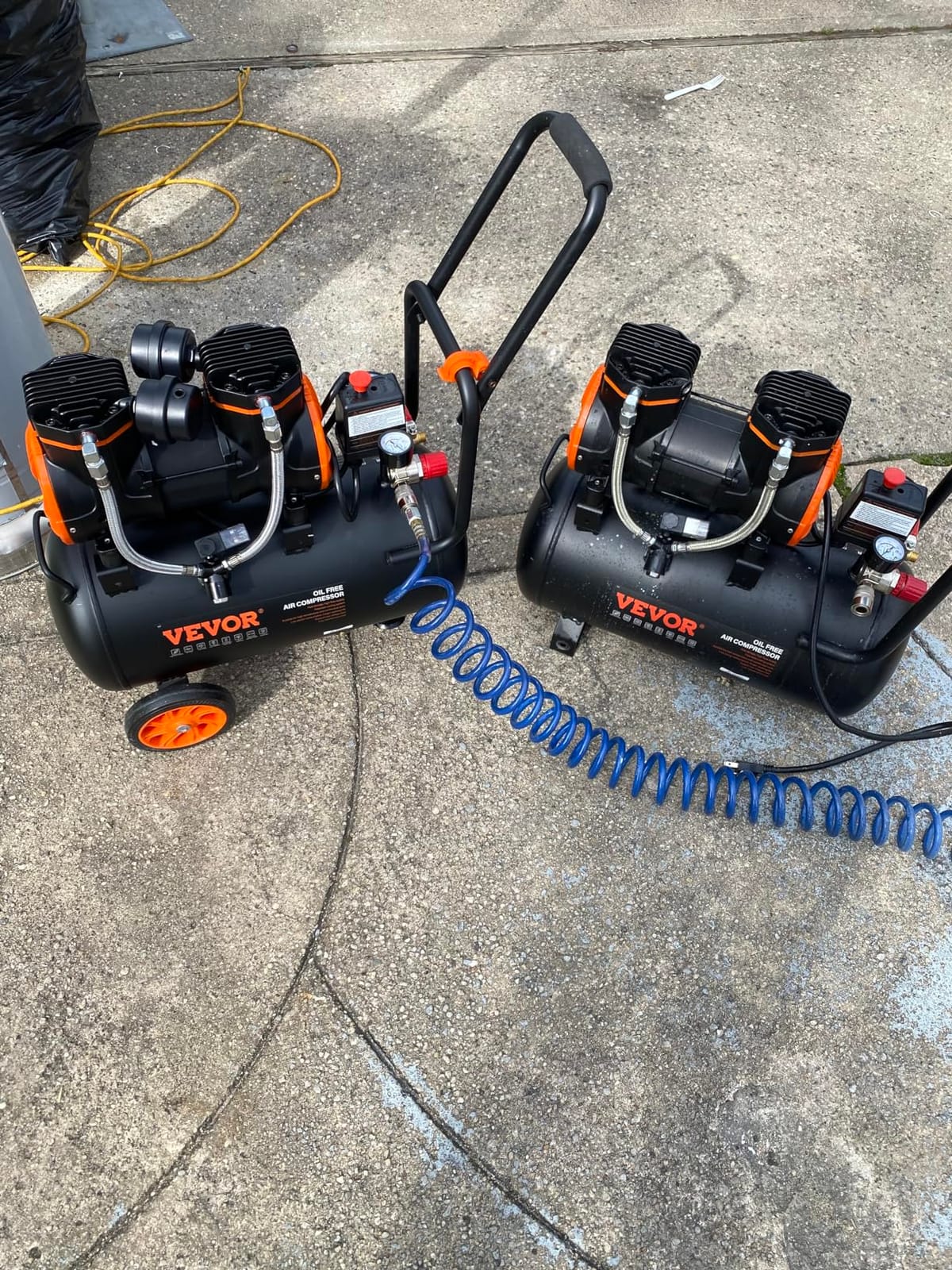
If 240V is genuinely unavailable, combining two 120V compressors through a T-fitting with ball valves is a reported workaround that reaches around 10 CFM. It works, but it needs a crossover tank between them and careful sequencing, and it is worth understanding the failure mode before you rely on it.
Air Quality: Filters, Dryers and Where to Mount Them
Moisture and oil in the supply air are what destroy plasma consumables. Water in the line causes the pilot arc to sputter at arc strike, and the electrode and nozzle show it as rapid burn-up. One builder on a welding forum described about three minutes of good cutting before consumables started failing, despite two desiccant dryers and a copper moisture separator already installed, because the underlying problem was insufficient airflow rather than air quality.
Install the train in this order, starting at the tank: an automatic drain valve, then a moisture separator, then a coalescing filter, then a dryer if your climate needs one, then a high-pressure regulator as the last component before the hose. Mount the whole assembly within about 6 feet of the torch so that any moisture that forms in the hose run has as little distance as possible to travel.
For most garage work a moisture separator plus a coalescing filter is enough. A desiccant dryer earns its place in humid climates and on any setup where consumable cost is a real line item. A refrigerated dryer is a production-shop purchase and is rarely justified below CNC duty.
One safety note that belongs in a different category: the fumes from cutting steel contain hexavalent chromium and need extraction at the torch. Compressor-side filtration protects the consumables, not you.
Two Small Compressors or One Large One?
This is the most argued question in builder forums, and the answer depends on whether you are solving for peak flow or for reliability.
Two small compressors tethered together do not add their ratings in the way people expect. Each machine’s published CFM is measured with its own tank full and its own pump running, and when both are feeding a torch the combined figure depends on the crossover arrangement and on whether the receiver at the torch stays charged between cycles. In practice, builders report that two small machines combined still land on the low end of what a 50 amp torch wants.
One large unit wins for continuous work because the tank does the buffering. A machine in the Campbell Hausfeld’s class, or a 60 gallon two-stage, keeps pressure stable through a long kerf because the receiver is large enough to cover the pump’s off-cycle without the torch noticing.
The exception is space and budget. If you genuinely cannot install 80 gallons and a 230V circuit, a single larger 120V vertical machine such as the DEWALT or the Klutch is still a better outcome than two small tethered compressors, because one tank and one pump is a simpler system to plumb and to fault-find.
Check Pressure at the Torch, Not at the Tank
Most confusing air problems in plasma cutting are not compressor problems. They are restrictions or undersized lines between the tank and the torch, and the symptom is a pressure drop that gets blamed on the machine. People end up replacing good electrodes chasing a fault that is really a supply-line problem.
You can test this yourself with two gauges. Fit one on the outlet of the tank regulator and one at the torch inlet on a short hose run. Start a cut and watch both. If the tank gauge holds steady at 150 PSI while the torch gauge falls to 90, the compressor is fine and the line is starving the torch.
Hose diameter is the usual culprit. A 3/8 inch hose feeding a 50 amp torch should be 1/2 inch or larger, and a 1/4 inch hose on a long run will cost you real pressure no matter how good the compressor is. Quick couplers also restrict flow, and cheap multi-position couplers are a frequent hidden restriction in setups built over years.
A third cause is a choked filter. Once a coalescing filter loads with oil and moisture, flow drops and pressure at the torch falls even though the tank is full. If your gauge at the torch drops mid-cut, check the filter before you blame the pump.
Buying a Used or Refurbished Compressor: What to Inspect
Used 240V machines are repeatedly the best-value route in builder forums, and the reason is straightforward: a 60 gallon two-stage unit that was a shop machine can be had for a fraction of what a new one costs, and the pump is the part that was never underbuilt. What follows is what to look at before you commit.
Receiver corrosion. Look inside the tank through the drain port with a light. Surface rust is cosmetic, but pitting that has perforated the wall is not. Check the ASME data plate is still riveted to the tank and legible, since the working pressure and date of manufacture are on it.
Pressure switch cycling. Listen to it fill. Rapid short-cycling suggests a tired unload valve or a failed check valve inside the pump, which is a teardown job rather than a purchase. Healthy units pump down once, sit at the cut-in pressure, and run for a stretch.
Oil charge and oil colour. On a splash-lubricated pump, check the oil sight glass or fill plug. Dark, gritty or milky oil means water has been circulating in the crankcase, which usually follows a head gasket failure. A two-stage unit that has lost its head gasket is a common forum complaint and it is a replacement-cost problem, not a tune-up problem.
Missing motor. Missing-motor deals are common and can be attractive because the machine itself is intact. Budget separately for a replacement motor and check the pulley diameter matches, since an oversized motor pulley on a small frame will spin the pump faster than it was designed for.
Receiver size versus pump size. Some owners deliberately fit a small pump to a large tank and report the combination works well, because the tank smooths the cycle and the smaller pump runs cooler. Verify the wiring is sized for the motor and that the pressure switch unloader is functional before you trust it with a torch.
Frequently Asked Questions
What size air compressor do I need for a plasma cutter?
Size by flow, not tank size. Take the CFM figure from your torch manual and multiply it by 1.5, then find a compressor rated at or above that number at 90 PSI. A 20 to 30 amp handheld needs roughly 5 to 7 CFM at 90 PSI, a 40 to 50 amp torch needs 8 to 12 CFM, and a 45 to 65 amp CNC table needs 11 to 15 CFM from a two-stage or rotary unit.
How many CFM does it take to run a plasma cutter?
Most handheld plasma cutters in the 20 to 50 amp range need 3 to 8 CFM at their working pressure, and CNC plasma tables at 45 to 65 amps need 7 to 10 CFM. Add 50 percent headroom on top of that figure, and always check whether the CFM is quoted at 90 PSI rather than at the 40 PSI peak that manufacturers tend to advertise.
How many PSI should I run a plasma cutter at?
Handheld torches in the 20 to 45 amp class typically specify 60 to 80 PSI at the torch, while CNC plasma tables and thick plate work run 100 to 120 PSI. Measure at the torch rather than the tank gauge, since line pressure drop can put you 10 to 20 PSI below the tank reading at the point of use.
Will a 30 gallon air compressor run a plasma cutter?
Yes, for any torch up to about 40 amps in intermittent work. Thirty gallons of stored air covers the gap between pump cycles, which is what causes arc dropout on smaller tanks. Tank volume smooths demand but does not create airflow, so the compressor still has to be rated at 1.5 times the torch’s CFM demand at 90 PSI.
Do you have to have an air compressor to use a plasma cutter?
Almost always. A plasma cutter ionises compressed air into the arc, and only a few integrated models carry their own onboard compressor. Those built-in units are sized for the torch they ship with, so they cover light handheld work but do not replace a shop compressor for CNC tables, gouging or sustained plate cutting.
What is the best air compressor for a CNC plasma table?
A CNC plasma table needs roughly 11 to 15 CFM delivered continuously at 90 to 120 PSI, which means a two-stage piston unit on an 80 gallon tank for most shops, or a rotary screw with variable speed drive for production volume. Tanks of 30 gallons or less starve the torch during a long kerf, regardless of how good the pump is.
Final Verdict
For a handheld torch up to 40 amps on 120V power, the Makita MAC2400 is the pick that starts cleanly on a shared circuit, runs quietly through long garage sessions, and carries the strongest rating and review volume in this group. The Klutch 29-Gallon is the alternative if you want stored air rather than raw flow, and the Campbell Hausfeld 80-Gallon two-stage is the only machine here that meets the demand of a CNC table or a production plate job in 2026.
Whichever you pick, size it on CFM at 90 PSI, give it a dedicated circuit, and put a moisture separator and a coalescing filter within a few feet of the torch. Our guide to the best CNC plasma cutters covers the torch side of the same sizing equation, and for laser work that shares your air supply our air assist guide covers a different pressure regime entirely.