
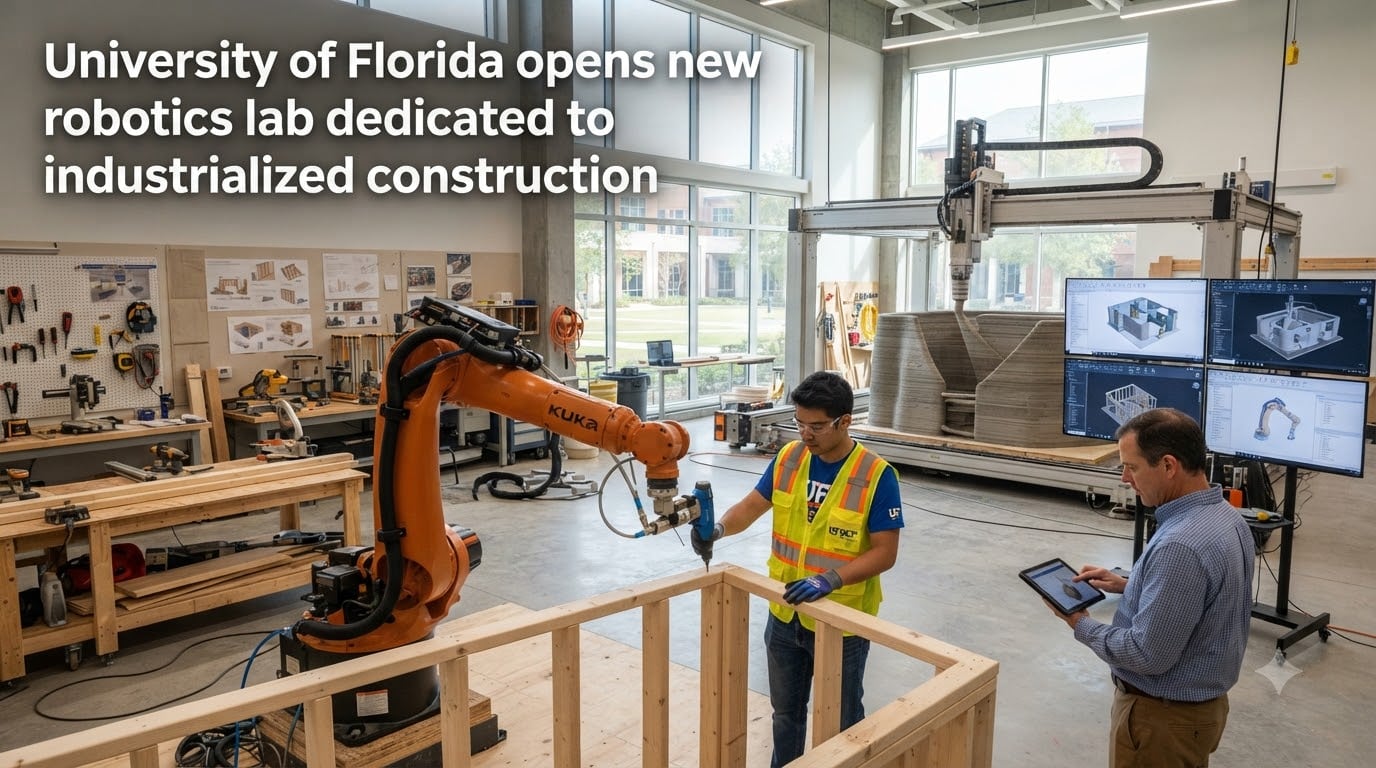
The University of Florida has opened a new robotics lab dedicated to industrialized construction, funded by a $1 million donation from Autodesk. The facility, called the Autodesk Design and Make Laboratory, is now the most advanced robotics lab in the United States focused on industrialized construction, and it opens its doors this fall semester.
The lab launches at a critical moment. Florida faces a shortage of roughly 121,000 homes, and 41% of the state’s construction workers will be near retirement by 2031. By teaching students and industry partners how to build houses using collaborative robots, digital twins, and modular assembly, UF aims to put a measurable dent in both problems.
Our team has been tracking construction robotics research for years, and this is one of the clearest academic commitments we have seen. The University of Florida robotics lab industrialized construction initiative combines a $1M Autodesk donation, a new degree program, and a working factory-style lab inside the College of Design, Construction and Planning.
Table of Contents
The Autodesk Design and Make Laboratory
The Autodesk Design and Make Laboratory sits inside UF’s College of Design, Construction and Planning, often referred to as DCP. The space has been retooled as a working research environment where robots handle framing, panel assembly, and other high-injury-risk tasks under human supervision.
Autodesk contributed $1 million to make the lab possible. The donation funds equipment, software, and integration with Autodesk’s construction cloud tools, including Revit and ACC. The lab also operates under the Smart IDC Lab banner, where IDC stands for Industrialized Design and Construction.
The lab is not a showroom. Students, faculty, and industry partners share the same floor, and the robots are wired into active research projects rather than locked behind glass. Fall semester 2026 marks the formal opening for coursework, though the space has already hosted demonstrations and partner visits.
The Housing Crisis Driving the Mission
The lab exists because Florida cannot build homes fast enough with traditional methods alone. According to the Shimberg Center for Housing Studies at UF, the state is short roughly 121,000 housing units relative to current demand.
Labor is the binding constraint. By 2031, an estimated 41% of the construction workforce will be near retirement, and the industry has struggled to replace those workers at the same pace. Add the cost of hurricane rebuilding and the math stops working.
Industrialized construction offers a way out. By shifting much of the work from outdoor jobsites to indoor factory settings, builders can recruit from a wider pool of workers, reduce weather delays, and tighten quality control. The UF lab is where that shift gets researched, prototyped, and taught.
What Is Industrialized Construction?
Industrialized construction is the practice of manufacturing buildings the way we manufacture cars or appliances. Components like wall panels, floor cassettes, and roof trusses are produced in a factory, then shipped to the site for assembly.
The approach borrows from prefabrication, modular assembly, and off-site manufacturing. What changes with robotics is precision and throughput. A collaborative robot can place studs, fasten sheathing, and lift heavy panels consistently across long production runs without the fatigue or injury risk that human workers face.
For buyers, the practical effect is shorter build times and more predictable costs. For workers, the practical effect is a shift from heavy outdoor labor to higher-skill roles inside factories, with robots handling the repetitive and physically demanding tasks.
Technology Inside the Lab
The lab’s equipment lineup reflects the full industrialized construction stack. Collaborative robots handle wall-framing, panel assembly, and other repetitive fabrication steps. A large-format 3D concrete printer sits alongside them for research into printed building components.
Digital twins are the connective tissue. Each physical piece built in the lab has a virtual counterpart in software, so engineers can simulate how a wall section will perform before it goes into a building. BIM, or Building Information Modeling, ties those digital twins to material data, cost, and schedule.
Computer vision and AI integration close the loop. Cameras mounted on the robots inspect work in real time, flag defects, and feed data back into the digital twin. The combination of robotics, BIM, and digital twins is what makes the UF lab more than a workshop; it is a testbed for how a future construction factory could run.
New ICon Engineering Degree Program
Alongside the lab, UF is launching a new degree track called Industrialized Construction Engineering, often shortened to ICon Engineering. The program is designed for students who want to work at the intersection of construction, manufacturing, and software.
Coursework covers BIM, robotics programming, prefabrication methods, and project delivery for factory-built housing. Students spend significant time inside the lab, working directly with the equipment rather than only studying it.
Graduate researcher Frank Xie, who has been part of the lab’s early work, described the appeal in simple terms. Students get hands-on access to robotics labs that most universities still treat as future ambition. That early exposure shapes career paths into construction technology, automation, and design engineering.
What Industry Leaders Are Saying
Lab leadership framed the opening around collaboration rather than replacement. Dr. Aladdin Alwisy, who directs the lab, has emphasized that the robots are designed to work alongside people. The goal is to remove the high-injury-risk tasks and let human workers focus on quality, design, and problem solving.
Dean Chimay Anumba of the College of Design, Construction and Planning tied the lab to UF’s broader housing mission. With 121,000 missing homes and a workforce on the edge of retirement, the university sees industrialized construction as a core part of the solution, not a side experiment.
Autodesk’s own statements echo that view. The company positioned the partnership as part of its Design and Make initiative, focused on industries where software, data, and automation can reshape how physical things get built. Construction is one of the largest of those industries, and one of the slowest to change.
What is the AI robot for construction?
An AI robot for construction is a machine that uses computer vision and trained models to perform building tasks such as wall-framing, panel assembly, and quality inspection. At the University of Florida robotics lab, these robots work alongside humans on repetitive and physically demanding jobs, while people handle design, oversight, and problem solving.
What is the future of robotics in construction?
The future of robotics in construction points toward factory-style production of building components, with collaborative robots handling framing, panel assembly, and 3D concrete printing under human supervision. Digital twins and BIM software coordinate the work, and graduates from programs like UF’s ICon Engineering degree will lead the shift.
What is construction robotics?
Construction robotics is the use of robots and automation to perform building tasks such as framing, layout, inspection, and material handling. It is a key part of industrialized construction, where buildings are produced in factory-like settings using prefabrication, modular assembly, and digital twins rather than only on traditional outdoor jobsites.
What are the advantages of robotics in construction?
Robotics in construction offers several advantages: it reduces on-site injuries by removing high-risk tasks from human workers, speeds up build times through consistent factory-style production, improves quality through computer vision inspection, and helps address labor shortages by automating repetitive work. It also shifts workers into higher-skill roles inside production facilities.
What degrees does UF offer for construction technology?
The University of Florida offers the Industrialized Construction Engineering (ICon Engineering) degree through its College of Design, Construction and Planning. The program combines coursework in BIM, robotics, prefabrication, and digital twins with hands-on lab time inside the Autodesk Design and Make Laboratory.
What This Lab Means for Construction
The University of Florida’s new robotics lab dedicated to industrialized construction is more than an academic announcement. It ties a $1 million Autodesk donation, a new ICon Engineering degree, and a working robot-equipped lab into a single push to fix Florida’s housing and labor problems.
If the model works, expect copycat programs at other universities, more partnerships between construction software vendors and research labs, and a steady pipeline of graduates who already know how to run a robot on a wall frame. For an industry that has barely changed its tools in a century, that is a meaningful start.
We will be watching the lab’s first research outputs and graduate cohorts closely. The combination of housing pressure, workforce retirements, and falling costs for collaborative robots makes this the right time to test whether industrialized construction can move from pilot projects to real production.