
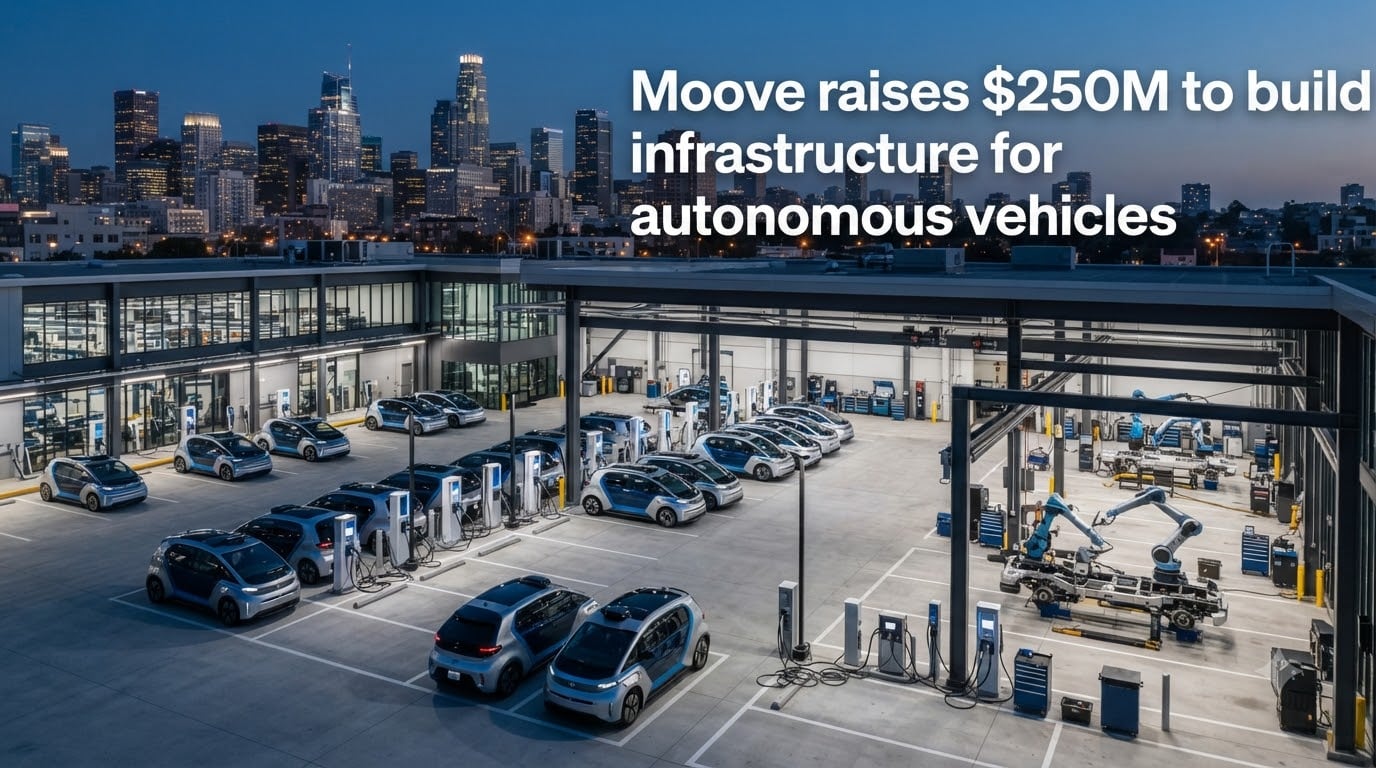
Moove, the UAE-based mobility company, has raised $250 million in Series C funding to build the operational backbone for autonomous vehicles. The round pushes the company’s valuation to $2.1 billion and reflects growing confidence that the robotaxi industry needs specialized infrastructure providers to scale.
I have been following Moove’s transition from a Nigerian vehicle-financing startup to a global mobility operator, and this round tells me investors see the company as a critical piece of the autonomous vehicle stack. The funding is led by Mubadala Investment Company with participation from Woven Capital, the Toyota Growth Fund, and existing backer Uber. The capital will fund expansion of Moove’s autonomous vehicle fleet operations, robotics-first depot facilities it calls “Nests,” and growth in new markets.
Table of Contents
Moove’s $250M Series C Funding: Key Details
Moove announced the $250 million Series C round on August 5, bringing its post-money valuation to $2.1 billion. Mubadala Investment Company led the round, with Woven Capital and the Toyota Growth Fund joining as new strategic investors.
Existing investors also participated, including Uber, which has backed Moove since 2023. The fresh capital brings Moove’s total equity raised to over $500 million, plus debt facilities for vehicle purchases. The company already operates a fleet of 42,000 vehicles across 29 cities and 13 countries, and the new funding will accelerate its push into autonomous fleet operations.
Key Facts About the Funding Round
The Series C structure combines traditional equity with strategic capital from automotive and mobility investors. Mubadala’s lead role signals UAE commitment to autonomous mobility.
- Round size: $250 million
- Valuation: $2.1 billion (post-money)
- Lead investor: Mubadala Investment Company
- Strategic investors: Woven Capital, Toyota Growth Fund
- Existing investor participation: Uber
Who Is Moove and How Did It Get Here?
Moove was founded in Lagos, Nigeria in 2020 by Ladi Delano and Jide Odunsi as a vehicle financing company for ride-hailing drivers. The founding insight was simple: gig drivers could not access traditional credit to buy cars, so the company built a financing product tied to daily ride-hailing earnings.
By 2023, Moove had expanded into ride-hailing and delivery operations across Africa, the Middle East, and Latin America. The company’s profitable traditional mobility business gave it first-hand experience with fleet operations at scale. That operational knowledge became the foundation for what Moove calls the “operating layer for autonomy.”
Co-founder and co-CEO Ladi Delano has said the company saw early on that autonomous vehicle developers would need a partner to handle the real-world logistics of running a fleet. Owning the cars, charging them, cleaning them, repairing them, and putting them back on the road is its own business. Moove is now selling that business to every robotaxi operator that does not want to run it themselves.
What Moove Is Building: Infrastructure for Autonomous Vehicles
Moove’s pitch is that autonomous vehicles need more than just good self-driving software. They need depots, charging infrastructure, maintenance teams, dispatch systems, and the operational glue that keeps vehicles running 24/7. The company has been building this operational layer in-house for years.
The core of Moove’s autonomous infrastructure is what it calls a “Nest.” A Nest is a robotics-first depot designed specifically for autonomous vehicles, where robots handle cleaning, charging, and basic maintenance. The depots are designed for continuous operation, with vehicles cycling in and out without human intervention for routine tasks.
Inside a Nest Depot
Each Nest is built to keep a fleet operating around the clock. Vehicles return to a Nest for charging, cleaning, inspection, and software updates before heading back out. The goal is to maximize the number of autonomous journeys a single vehicle can complete per day.
For autonomous vehicle developers like Waymo, this is the operational backbone they need to scale. Waymo has been moving away from direct fleet ownership toward partnerships with operators like Moove, which handle the physical logistics. Moove’s fleet management experience from running 42,000 vehicles in 29 cities gives it the operational depth to manage this kind of complex deployment.
The Waymo Partnership and Uber Connection
Moove’s most prominent autonomous partnership is with Waymo, the Alphabet-owned robotaxi operator. Moove currently operates Waymo’s fleet in Phoenix, and the two companies are expanding together into additional cities. The deal positions Moove as one of Waymo’s key third-party fleet operators.
Uber’s participation in the Series C is more than a financial signal. Uber has been an investor in Moove since 2023 and is also a strategic partner. As autonomous ride-hailing expands, Uber’s platform could route passengers to robotaxis operated by Moove, creating a tighter integration between the two companies.
For Waymo, working with Moove means it can focus on improving self-driving software and expanding into new cities, while leaving the day-to-day fleet operations to a partner that already does it at scale. For Moove, the partnership is a validation that its infrastructure model works for the most demanding robotaxi operator in the industry.
Industry Context: The Autonomous Vehicle Market in 2026
The global autonomous vehicle market is on track to surpass $400 billion by 2026, according to industry forecasts. Robotaxi services are the most visible commercial application, with companies like Waymo, Cruise, Pony.ai, and Baidu running paid services in select cities. The technology is real, but scaling it remains hard.
Autonomous vehicles are classified across five levels of driving automation, from Level 0 (no automation) to Level 5 (full automation in all conditions). Today’s robotaxi services operate at Level 4, meaning they can drive themselves in defined geographic areas without a human driver, but they still need human-defined operational design domains.
Industry estimates suggest that fully autonomous cars at Level 5 will not be widely available until the late 2026s or beyond. Most experts, including Tesla CEO Elon Musk, have revised earlier timelines and now expect a more gradual rollout tied to specific use cases and cities. Until then, the bottleneck for scaling is not software but operations.
What This Funding Means for the Robotaxi Industry
Moove’s $250M round is a vote of confidence in the idea that the autonomous vehicle industry needs a dedicated infrastructure layer. Self-driving software companies like Waymo have decided they do not want to own and operate fleets directly. That gap is what Moove is filling.
The company has signaled that it expects 220% workforce growth as it builds out Nest depots and expands fleet operations into new cities. Moove is also planning market launches in additional geographies, including expansion in the United States and the Middle East. The combination of Mubadala, Toyota, and Uber as investors positions Moove to operate across multiple continents.
For the broader robotaxi industry, Moove’s rise signals a maturation. The first wave of autonomous vehicle companies focused on proving the technology worked. The next wave will be about who can run the operations at scale. Companies like Moove, with proven fleet management experience and the capital to build depots, are positioned to be the picks and shovels of the autonomous vehicle economy.
Frequently Asked Questions
Below are common questions about Moove and the autonomous vehicle infrastructure market.
What company is leading in autonomous vehicles?
Waymo is widely considered the leader in autonomous vehicles, with the largest commercial robotaxi fleet operating in Phoenix, San Francisco, Los Angeles, and Austin. Other major players include Cruise, Pony.ai, Baidu, and Tesla, each operating at different scales and geographies.
How close are we to autonomous vehicles?
We are already using autonomous vehicles in limited commercial service. Waymo operates fully driverless robotaxi services in multiple US cities, and other companies run pilots globally. However, fully autonomous Level 5 vehicles that work in all conditions are still likely a decade away.
What are the 5 levels of autonomous vehicles?
The five levels of autonomous vehicles are Level 0 (no automation), Level 1 (driver assistance), Level 2 (partial automation), Level 3 (conditional automation), Level 4 (high automation in defined areas), and Level 5 (full automation in all conditions).
What is the current size of the global autonomous vehicle market?
The global autonomous vehicle market is valued at over $200 billion in 2026 and is projected to exceed $400 billion within the next several years. Growth is driven by robotaxi services, autonomous trucking, and advanced driver assistance systems.
How soon will fully autonomous cars be available?
Fully autonomous Level 5 cars are not expected to be widely available until the late 2026s or beyond. Most commercial deployments today are Level 4 robotaxis limited to specific geographic areas. Broader availability depends on regulatory approval, safety validation, and infrastructure readiness.
The Bottom Line
Moove’s $250M Series C is more than a single funding announcement. It signals that the autonomous vehicle industry is shifting from a software race to an infrastructure race. Moove’s combination of fleet operations experience, strategic partnerships with Waymo and Uber, and backing from Mubadala and Toyota positions it as the leading third-party operator in the robotaxi industry. As more autonomous vehicle companies look to outsource fleet operations, Moove is well positioned to own that layer.