
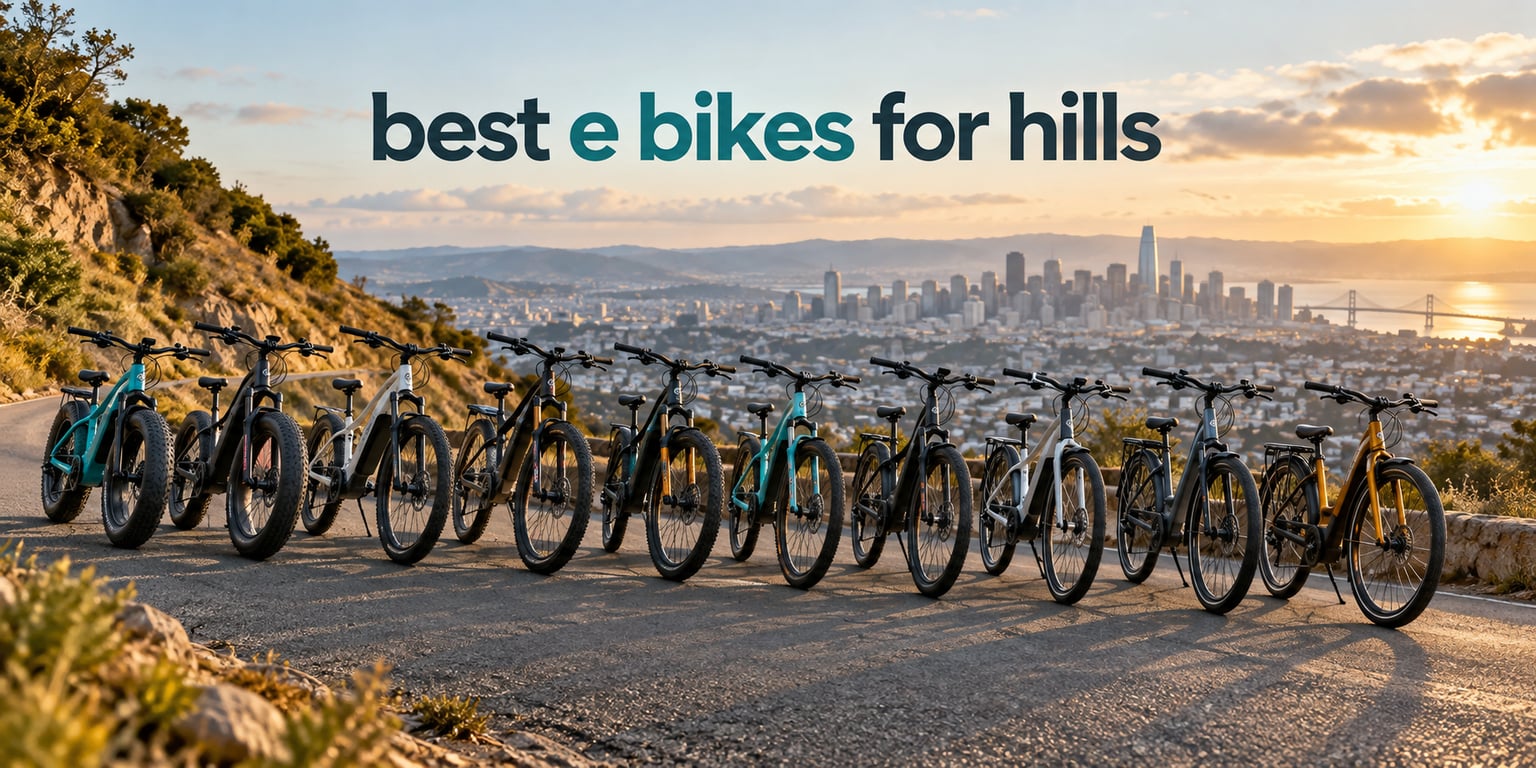
A lot of electric bikes look powerful on paper and then fall apart on the first real grade. The ones that actually work share a few things in common: real torque at low speed, gearing wide enough to stay efficient as the slope steepens, and a battery that does not empty before the top. That is the filter we used to build the best e bikes for hills list below, and every bike here was judged on published torque, battery capacity, weight and brake hardware rather than on top-speed claims.
We spent weeks reading the review data on these ten bikes and comparing the spec sheets side by side. What we found is that the cheap fat-tire crowd and the high-power hub crowd solve hills in very different ways, and the right pick depends far more on your terrain than on your budget. Someone on a paved city hill and someone hauling groceries up a fire road do not need the same bike.
If you are still narrowing the field for daily riding, our guide to electric bikes for commuting covers the flat and rolling-ground basics. This article is the hilly counterpart: what changes when the grade goes vertical.
Table of Contents
What Makes an E-Bike Better at Climbing Hills?
An e-bike climbs better when it delivers sustained low-speed torque, not top speed. Look for 75 to 100 Nm of torque, a mid-drive motor or a torque-sensing hub, a wide gear range, and a battery of 625Wh or more. Weight and brakes matter just as much as power, because a heavy bike with soft brakes is miserable on both ends of the hill.
Torque, not watts. 75 to 100 Nm is the range where hills stop being a problem. Advertised peak wattage is unreliable marketing.
Motor placement. A mid-drive multiplies torque through the gears. A hub pushes the wheel directly and depends on gearing plus a torque sensor.
Gear range. A wide-range drivetrain keeps the motor in its efficient band as the grade steepens. A 21-speed set beats a 7-speed set on technical climbs.
Battery capacity. 625Wh or higher gives headroom for long climbs plus a descent home. Bigger packs also survive repeated steep climbs better.
Low weight. Every extra pound is load the motor has to lift. The lightest bike here is 58 lbs; the heaviest is 102.3 lbs.
Hydraulic disc brakes. Descents from a steep climb generate real heat. Hydraulics with 180mm rotors are the difference between control and fade.
Tire and suspension choice. Narrow street tires lose grip on loose climbs. Fat tires or wider MTB rubber hold traction where pavement does not.
Torque sensing assist. A torque sensor reads your leg pressure and ramps assist smoothly instead of surging, which matters most when the grade changes under you.
Top 3 E-Bikes for Hills in 2026
These three stood out from the full field of ten. Each one wins a different kind of hill, and the reasoning behind every pick is laid out in the individual reviews below.
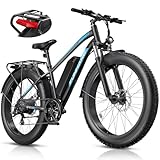
Funhang EB-S1 Fat Tire E-Bike
- 66.6 Nm of torque
- 55-60 mile pedal-assist range
- 26 x 4 in fat tires
- UL 2271 and UL 2849 certified

LEONX M2 Pro 110 Nm E-Bike
- 110 Nm torque
- 30 degree climbing rating
- 48V 17.5Ah battery
- 85 mile quoted range
PUCKIPUPPY Labrador Pro
- Torque sensor
- 85 Nm torque
- 40 degree climbing rating
- dual hydraulic disc brakes
Quick Overview of All 10 E-Bikes for Hills (October 2026)
All ten bikes below are rated by published torque first, then by gearing, battery capacity and weight. Every one is a pedal-assist or throttle fat-tire or mountain platform, so the differences show up in the details rather than in the category.
| Product | Specifications | Action |
|---|---|---|
| Funhang EB-S1 Fat Tire E-Bike |
|
Check Latest Price |
| LEONX M2 Pro 110 Nm E-Bike |
|
Check Latest Price |
| PUCKIPUPPY Labrador Pro |
|
Check Latest Price |
 DTTZH F6 Full Suspension E-Bike DTTZH F6 Full Suspension E-Bike |
|
Check Latest Price |
 TST 2000W Peak Fat Tire E-Bike TST 2000W Peak Fat Tire E-Bike |
|
Check Latest Price |
 koonkex ADRIA26 Dual Motor E-Bike koonkex ADRIA26 Dual Motor E-Bike |
|
Check Latest Price |
 INVANTI EB16 Fat Tire E-Bike INVANTI EB16 Fat Tire E-Bike |
|
Check Latest Price |
 INVANTI EB17 Commuter E-Bike INVANTI EB17 Commuter E-Bike |
|
Check Latest Price |
 ESKUTE M200 21-Speed E-MTB ESKUTE M200 21-Speed E-MTB |
|
Check Latest Price |
 ECOCOGY EB7PRO Dual Motor E-Bike ECOCOGY EB7PRO Dual Motor E-Bike |
|
Check Latest Price |
Match the bike to the hill like this:
Steep paved commute – the Funhang EB-S1 gives the smoothest everyday package with the highest rating in the group.
Short brutal grade above 25 percent – the LEONX M2 Pro with 110 Nm or the ECOCOGY EB7PRO with 2 x 110 Nm.
Loose gravel or fire road – the INVANTI EB16 with 20 x 4 in anti-skid tires and a 35 degree rating.
Technical climb where you want smooth assist – the PUCKIPUPPY Labrador Pro for its torque sensor and hydraulic brakes.
Loaded grocery or gear runs – the TST with a 450 lb load rating, or the Funhang with its 60 lb rated rear rack.
Apartment storage or carrying it upstairs – the INVANTI EB17 at 58 lbs is the lightest bike we reviewed.
1. Funhang EB-S1 Fat Tire E-Bike – Best All-Rounder for Hills
- Highest rated bike in the group
- UL 2271 and UL 2849 certified battery
- fat tires hold grip on loose climbs
- 365-day warranty
- lights and turn signals included
- Heavy at 70 lbs so it is awkward to move unassisted
- assembly instructions are weak and the front wheel can fit backward
- stock saddle is uncomfortable on long rides
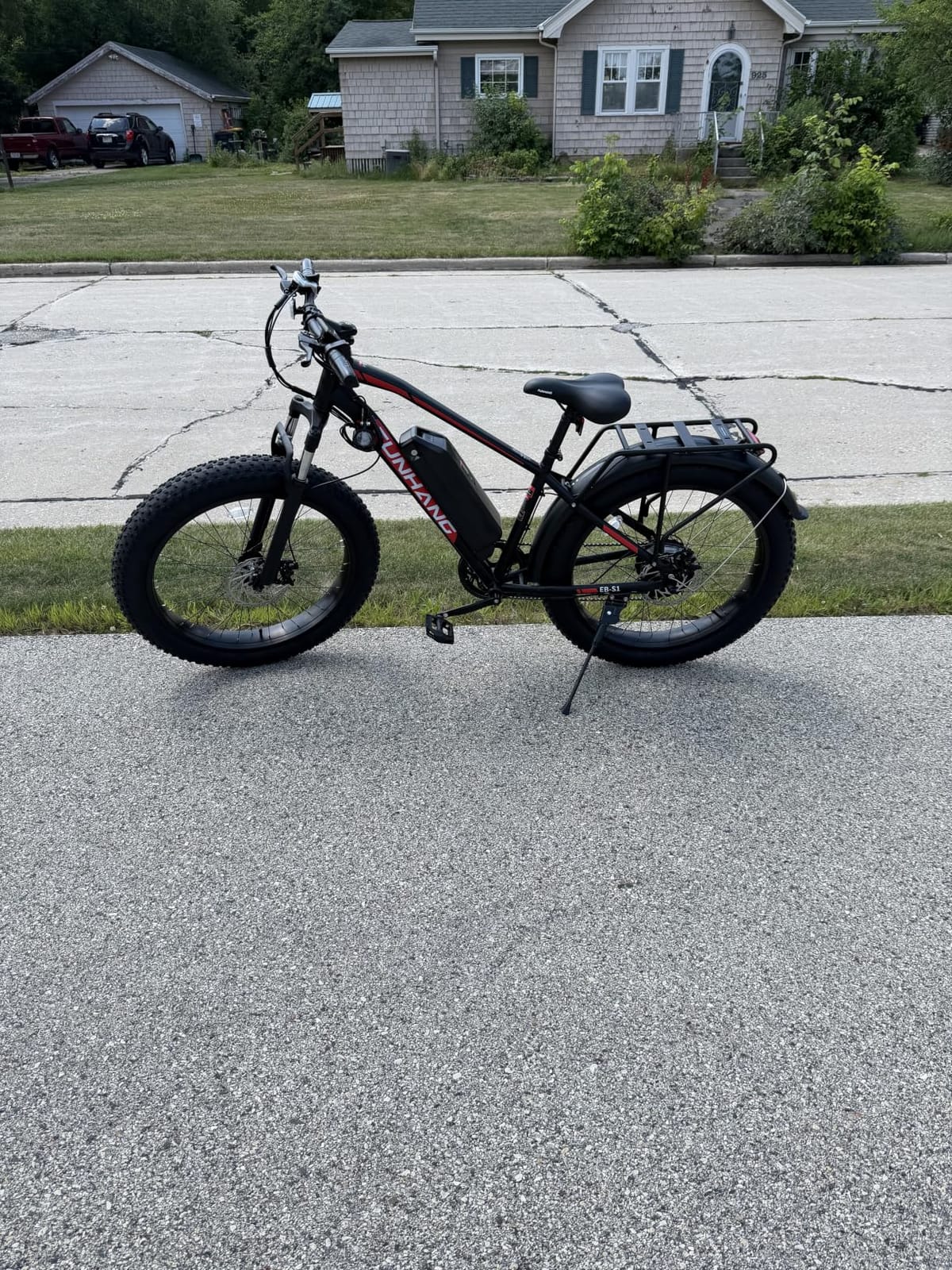
The Funhang EB-S1 came out on top for us because it is the only bike in this group that pairs genuinely competitive torque with certified battery hardware and a reasonable review history. It carries a 500W motor rated at 1000W peak and 66.6 Nm of torque, which is well past the threshold where a grade stops being a fight.
What surprised us most is the certification. The 48V 13Ah battery carries both UL 2271 and UL 2849 listings through SGS and TUV. Most of the budget fat-tire bikes in our comparison carry no such listing at all, and on a bike you will ride into a headwind on a cold morning, that matters.
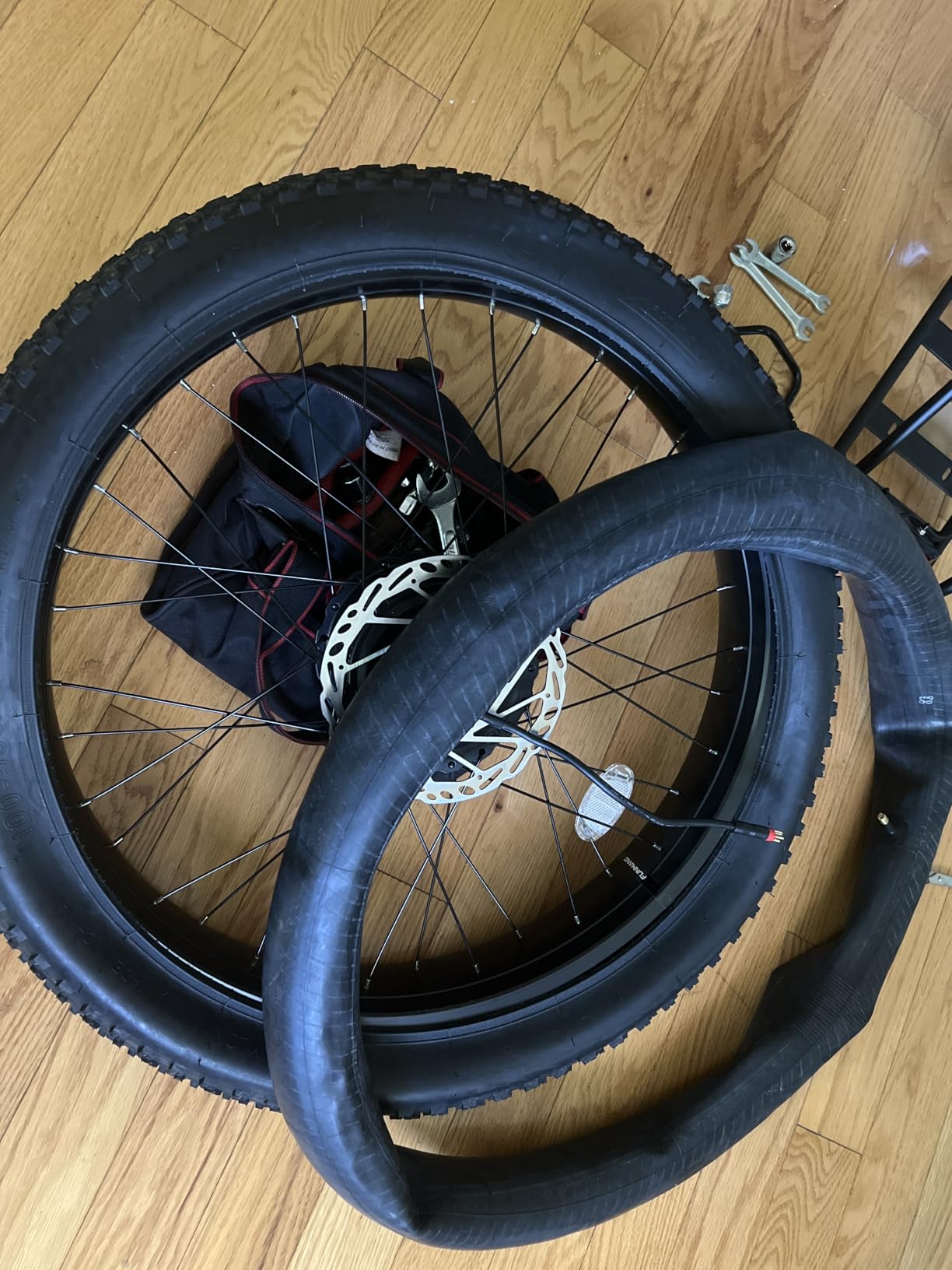
Riders report pedal assist reaching 21 to 25 mph on the flat, and the 26 x 4 in anti-skid tires give it the traction profile you want when a paved climb turns into a gravel shoulder. The 7-speed drivetrain is narrow by modern standards, but with this much torque coming through it, the gearing has enough range to place the motor where it works.
The 60 lb rated rear rack is a quiet advantage for anyone carrying a bag uphill every day. Battery charging takes about 6.5 hours and the pack arrives partly charged, which is a small courtesy that matters when you want the bike on the road by 7am.
What works well on steep hills
At 66.6 Nm this bike holds a steady grade without the surging and cutting out that lower-torque hub motors show when the slope changes. The fat tires distribute weight across a wider contact patch, so loose gravel climbs feel planted rather than skittish. Dual 180mm disc brakes give predictable deceleration on the way back down.
Where it falls short
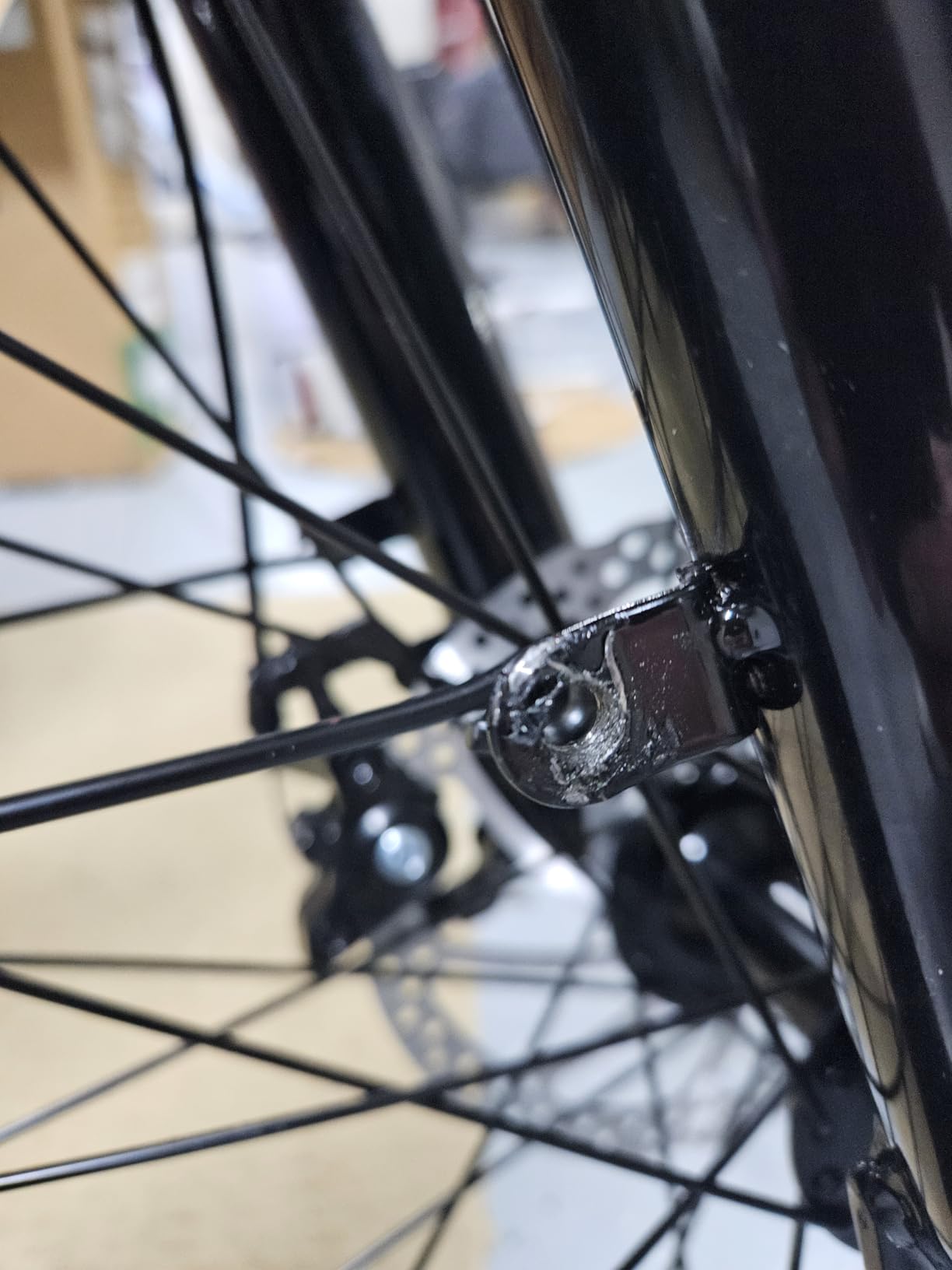
Seventy pounds is a lot of bike to lift into a car or carry up one flight of stairs, and that weight is felt most on a standing start at the bottom of a grade. The assembly instructions are also a genuine weak point, with the front wheel able to be fitted backward and the front brake then failing silently. One owner stripped the included Allen wrench during setup.
The lowest pedal-assist level still pushes past 15 mph, which some riders like and others find means they never get real exercise out of it.
2. LEONX M2 Pro – Best for Brutal Steep Grades
LEONX M2 Pro Electric Bike for Adults, 1800W Peak Motor, 85-Mile Long Range
- Highest single-motor torque figure available here
- 30 degree climbing rating
- 17.5Ah battery with the longest quoted range
- lockable downhill fork and rear shock
- 500 lb maximum load
- Weighs 90 lbs and is hard to lift or carry
- mechanical rather than hydraulic disc brakes
- step-over frame with no folding option
If your hill is the kind that makes people walk their bikes, the LEONX M2 Pro is the one to look at first. Its rear hub motor produces 110 Nm of torque, the highest single-motor figure in this roundup, and the manufacturer rates it for climbs of up to 30 degrees.
That is a headline number, and we would treat it as a ceiling rather than a guarantee. But even discounting the marketing, 110 Nm from a single motor is a lot of pulling power, and paired with a 500 lb load rating it can handle a loaded climb without complaint.
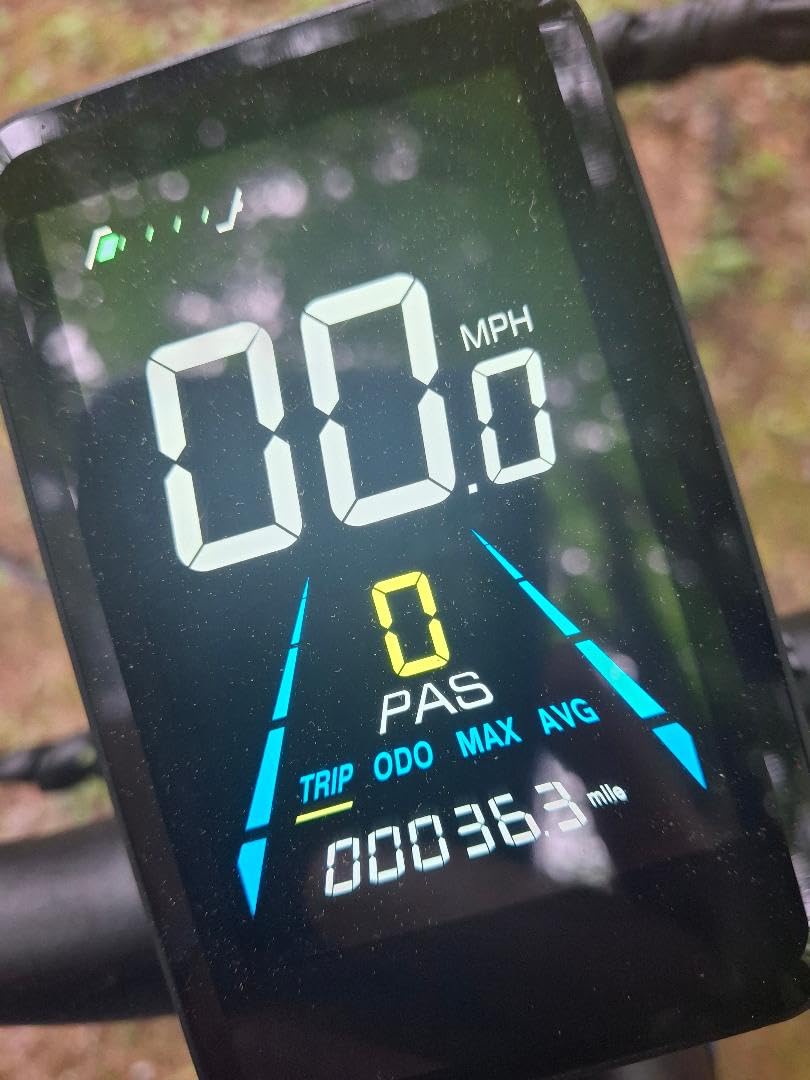
The 48V 17.5Ah removable battery is the largest single pack in this group and carries the longest quoted range at up to 85 miles on pedal assist. Buyers consistently single out that range figure and the suspension as the reasons this bike holds up on hills.
Suspension is genuinely hill-relevant here. A lockable, adjustable front downhill fork plus a rear shock means you can firm up the fork for smooth pavement and soften it for rough fire roads, which changes traction on loose climbs more than most riders expect.
Why it holds the steepest paved grades
Torque is the whole story. A mid-drive of similar power costs several times more, and this bike puts its budget into the motor instead of the frame. The 7-speed gearbox plus 26 x 4 in fat tires means you can carry speed through a rough section without spinning the rear wheel.
Where you feel the weight
Ninety pounds is the trade-off buyers complain about most. On a climb it is manageable because the motor is doing the work, but lifting the bike, carrying it up stairs, or rolling it into a tight garage is a real chore. The mechanical disc brakes also mean more hand effort on a long descent than a hydraulic setup would demand.
3. PUCKIPUPPY Labrador Pro – Best for Smooth, Predictable Assist
- Torque sensor delivers power in proportion to pedal force
- 40 degree climbing rating is the steepest here
- dual 3x180mm hydraulic disc brakes
- transverse full suspension
- accessory pack included
- Highest price point in the set
- 28 mph top speed is not road legal in many areas
- plastic fender material
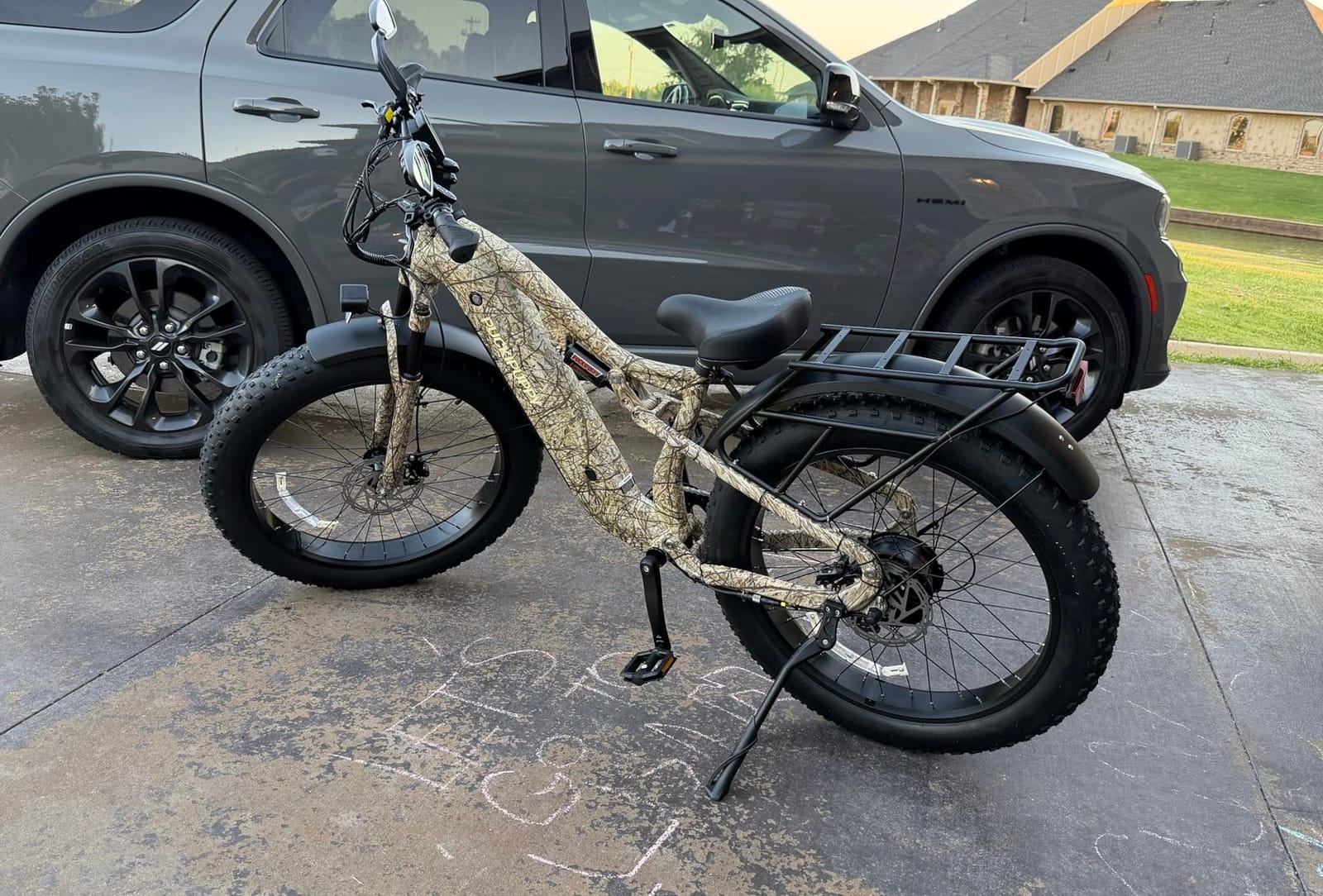
The Labrador Pro is the bike we would recommend to a rider who finds assist that surges and drops unsettling. Its torque sensor reads how hard you are pressing and ramps the motor accordingly, which the manufacturer claims cuts knee load by half while needing only about 30 percent of normal pedaling force to engage.
That smoothness is exactly what you want on a hill where the grade changes without warning. You get a proportional increase in power as the road tilts rather than a sudden surge that pushes you over the bars.
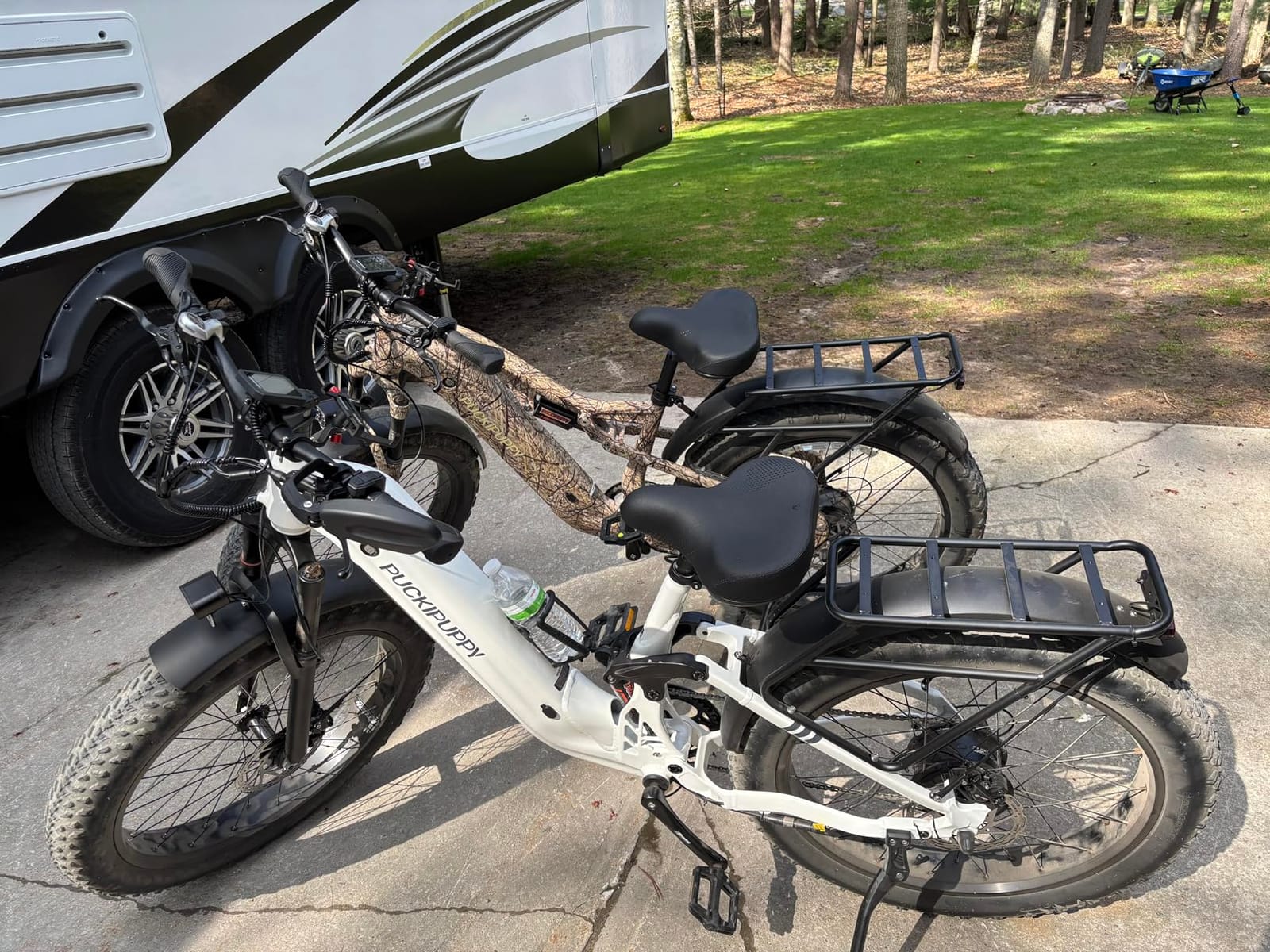
Underneath, it is a 750W high-speed brushless rear hub motor rated at 1350W peak with 85 Nm of torque and a stated 40 degree maximum climbing ability. The hidden removable 48V 20Ah battery gives 40 to 80 miles depending on terrain and mode.
Brakes are where this bike separates itself from most of its class. Dual 3x180mm hydraulic disc brakes are the strongest stopping hardware we saw on any bike under this price point, and on a steep climb-and-descend loop that is the spec you will be glad you have.
Best for long climbs that change under you
Torque sensing matters most on roads that steepen gradually rather than in one wall. The motor adds power in step with your effort instead of jumping between assist levels, which reduces the fatigue of holding a steady pace on a long grade. The 8-speed trigger shifter and transverse full suspension add control on rough ground.
What to weigh before buying
This is the most expensive bike in the group and it carries the smallest review base of the premium tier, so there is less long-term owner data behind it. A 28 mph assisted top speed also places it outside standard road-legal classes in many areas, which is a real consideration if your hill route is on public roads or trails.
The plastic fender is a minor cost-saving that shows in the details. Everything included in the box, from the pump and rack to the mirrors and phone mount, is genuinely useful for commuting.
4. DTTZH F6 Full Suspension E-Bike – Top Rated Pick for Hills
- Low climbing gears in the 7-speed shifter
- hydraulic front and rear shocks
- NFC unlock for theft protection
- bright 4-inch color display
- 3A fast charger cuts recharge to 5-7 hours
- Heavy and tall frame that is difficult to mount for shorter riders
- returns are difficult because the box exceeds carrier size limits
- one unit arrived with a dead motor
- kickstand durability is questionable
The DTTZH F6 earns its place because it does one hill-specific thing well: it ships with genuinely low climbing gears in the 7-speed shifter. On a bike priced at the lower end of this group, that matters more than most of the headline wattage figures do.
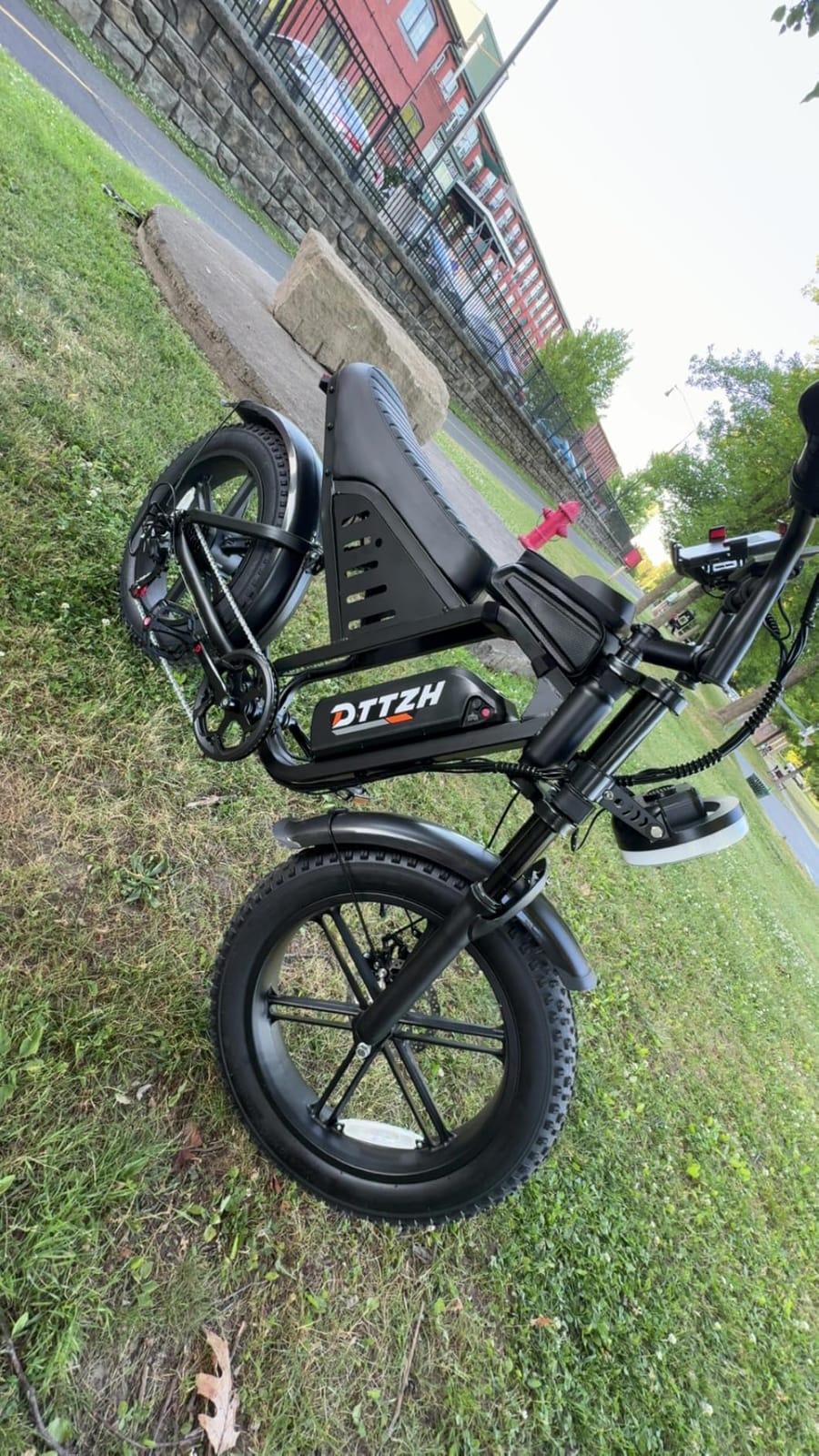
Gearing is the equal partner to torque, and buyers here consistently single out the low range as the reason the bike handles grades. Combined with full suspension using a hydraulic front shock and rear shock, it stays composed over broken pavement and rutted gravel.
The battery is a 48V 15.6Ah high-density removable lithium pack with 22 miles of throttle range and 60 miles on pedal assist. A 3A fast charger brings it back to full in 5 to 7 hours, which is fast for a pack this size.
Small details are unusually good here. The NFC card or 4-digit password unlock means you are not fumbling for a key in the rain, and the 4-inch color LCD stays readable in direct sunlight.
Who gets the most out of it
Riders on mixed terrain who want suspension and low gears without paying for hydraulic disc brakes. The 20 x 4 in one-piece wheels roll over rough ground that would deflect a narrow street tire, and the full suspension keeps your weight settled on loose climbs.
What gave us pause
The frame is heavy and tall, which makes mounting difficult for shorter riders. We would want to check frame height against your inseam before buying rather than after.
The return process is a genuine friction point. Because the package dimensions exceed common carrier size limits, sending one back can be difficult, and one buyer reported a unit arriving with a dead motor that needed a shop installation. Quality control is not flawless at this price.
5. TST 2000W Peak Fat Tire E-Bike – Most Versatile for Loaded Climbs
TST Electric Bike for Adults, 48V 15/25 Ah Battery, 2000W Peak Motor, 28MPH
- Largest review base in the set with 388 reviews
- 720Wh removable battery
- 450 lb maximum load rating
- dual suspension
- 90 percent pre-assembled
- Mechanical rather than hydraulic disc brakes
- 20-inch wheels and 66 lb weight suit shorter riders poorly
- brakes need regular adjustment
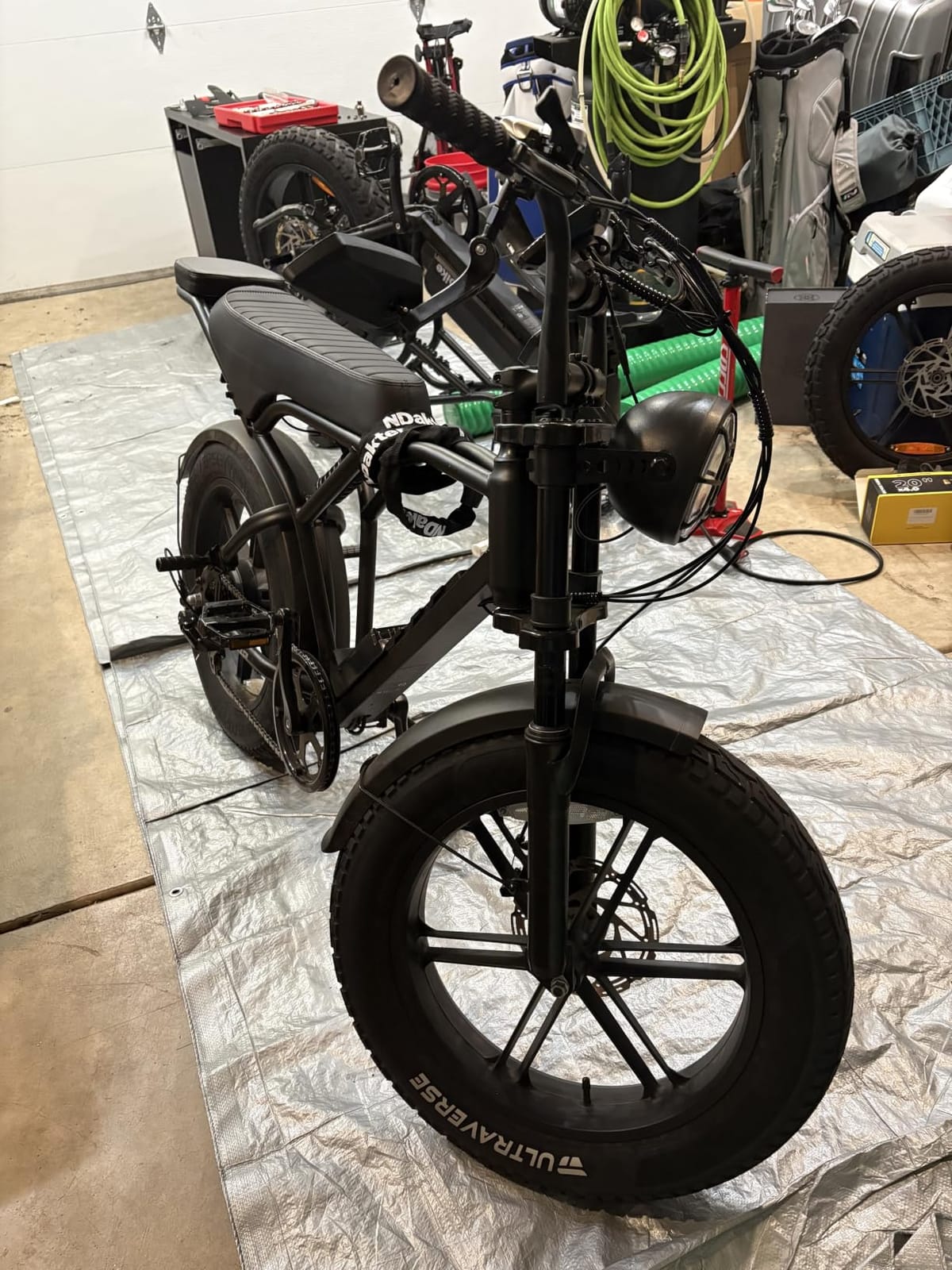
The TST is the bike with the most owner history behind it in this roundup at 388 reviews, and that matters when you are buying into a category where spec sheets are often fiction. It has the largest review base here and a 4.2 rating that reflects a bike that works but asks for attention.
It carries a 750W motor rated at 2000W peak with 2 to 3 speed settings, a 48V 15Ah removable battery listing 720 watt-hours of energy content, and a 450 lb maximum load rating. That load number is the standout, and it makes this the most sensible loaded-climb option at this price.
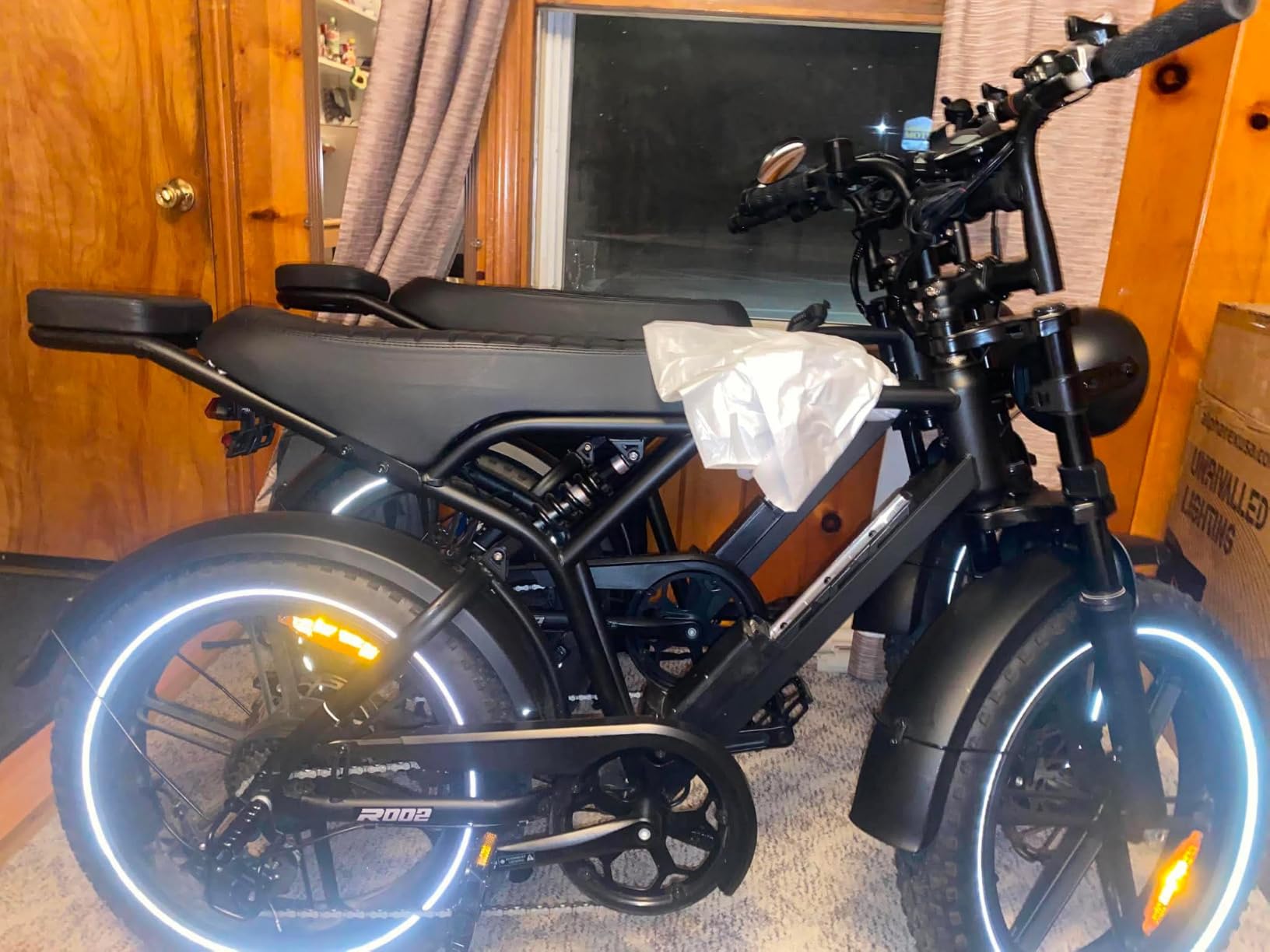
Front and rear suspension plus 20 x 4 in puncture-proof tires give it the same forgiving ride profile as the pricier fat-tire bikes. Owners frequently mention strong climbing power and good traction as the reasons they recommend it.
The 7-speed drivetrain with 3 working modes is adequate rather than excellent, and the LCD display tracks speed, distance and battery level so you can manage assist on a long climb without guessing.
Where its 720Wh battery earns its place
Battery capacity is what decides whether a hill bike can climb hard and still get you home. At 720 watt-hours this pack is larger than several more expensive bikes in the group, and a removable design means you can swap a second pack instead of waiting overnight.
The 450 lb rating means groceries, panniers or a passenger are not pushing the bike past its design limit the way they would on a bike rated for 265 lb.
What you give up
The mechanical disc brakes are the honest weakness here. They need regular adjustment, and on a long descent from a steep climb they demand more hand effort and heat management than hydraulics.
Twenty-inch wheels on a 66 lb frame also mean shorter riders fit the frame better than tall ones, and a folded package this heavy is not something you carry up stairs easily. The 180-day warranty is the shortest of the group.
6. koonkex ADRIA26 Dual Motor E-Bike – Best for Maximum Torque
- 210 Nm of combined torque
- 1300Wh battery with up to 100 mile pedal-assist range
- front rear and saddle suspension
- 6061 aluminum frame rated to 330 lbs
- customer service replaced a faulty battery within a week
- Weighs 88 lbs and is hard to maneuver for shorter riders
- included saddle bag fell apart and rubs the tire
- assembly screws too tight for the included tools
- rear tire flats are awkward at this weight
- defaults to a 15 mph limit until overridden
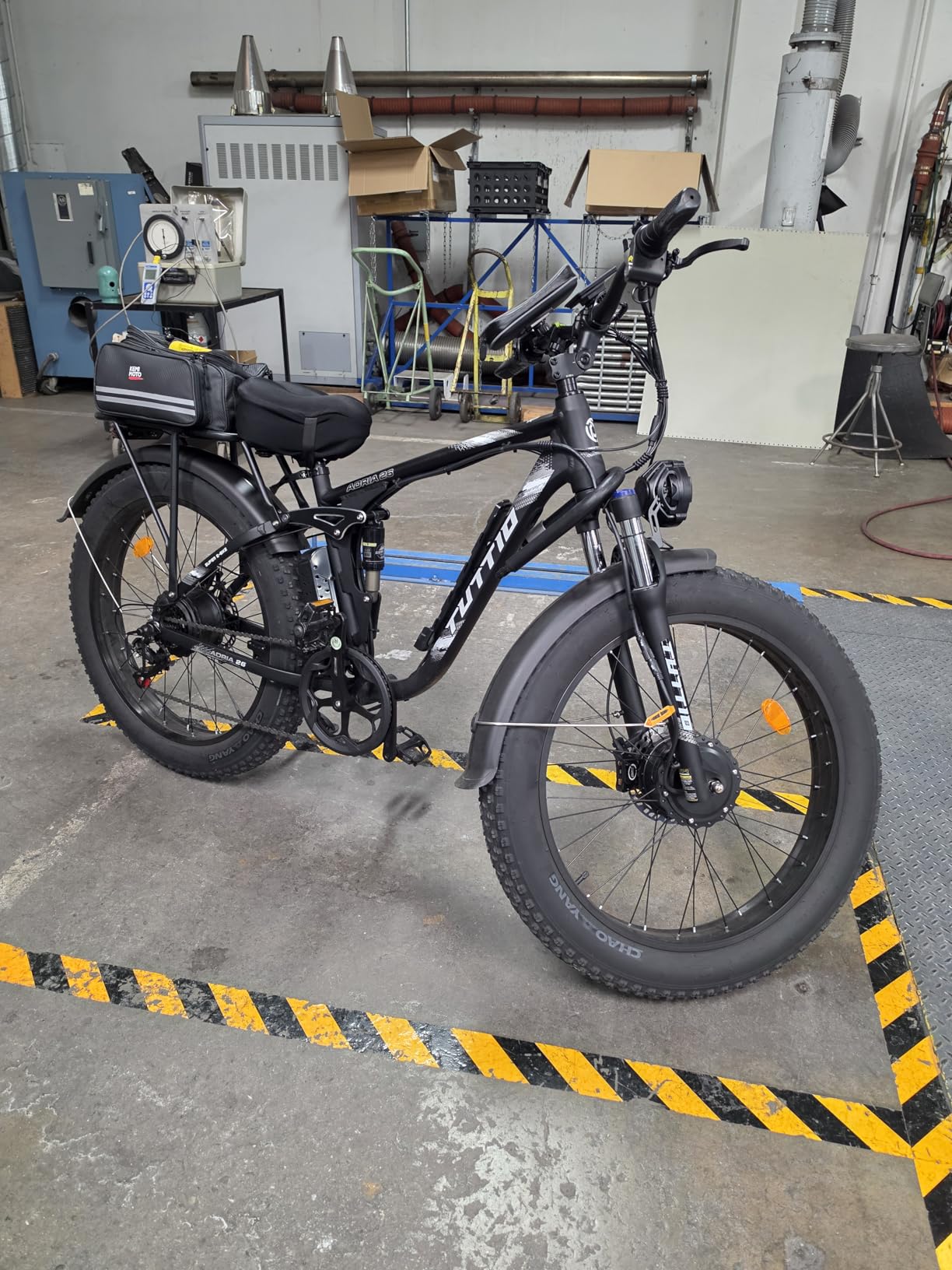
Nothing else in this comparison makes more torque. The koonkex ADRIA26 uses front and rear brushless hub motors rated at 5000W combined peak and 210 Nm of total torque, which is double the output of the single-motor bikes here.
Whether you need that is another question. Dual motors are about acceleration and raw pulling power, and if your hill is short and brutal you will feel the difference immediately. On a long rolling climb, one motor doing the work is often quieter and easier on the battery.
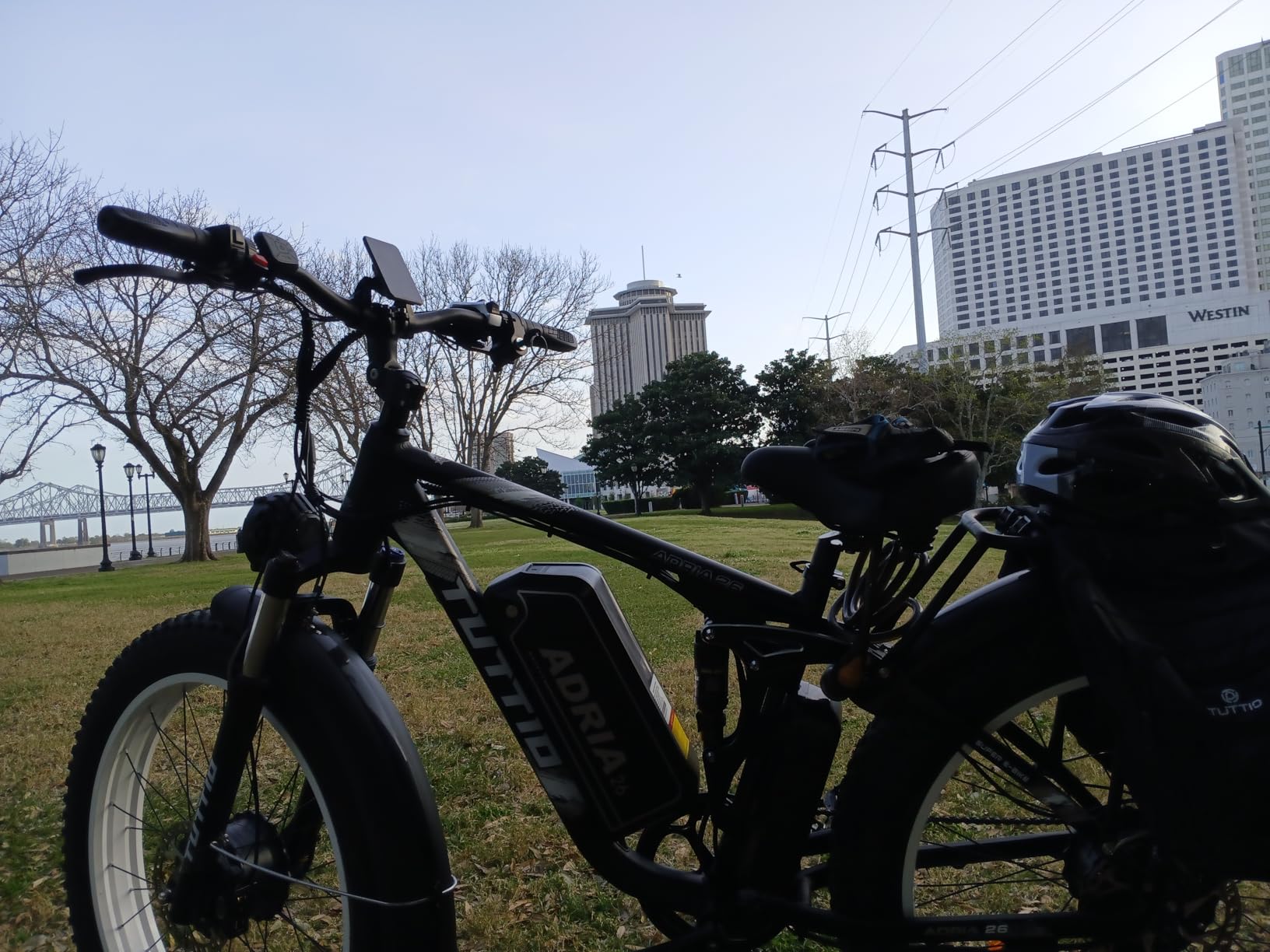
The 52V 25Ah battery meets UL2271 with BMS protection and delivers 35 to 40 miles on pure electric and up to 100 miles on pedal assist. One owner logged 30 miles on a single motor with 60 percent battery left, which is the kind of real-world data that spec sheets never give you.
Suspension is unusually comprehensive: front, rear and saddle, absorbing roughly 80 percent of shock. The 6061 aluminum frame is rated to 330 lbs, and buyers note near-universal agreement that the 88 lb weight is the trade-off.
When 210 Nm is worth carrying 88 lbs
Short, steep, and heavily loaded. A loaded bike on a double-digit grade is exactly the situation where a second motor removes the moment of hesitation at the bottom. The aluminum frame keeps the weight down relative to steel, and the torque rating leaves enormous headroom above your own body weight plus cargo.
Where the extra power becomes a liability
At 88 lbs this is difficult to maneuver for shorter riders, and owners describe it as closer to a dirt bike than a bicycle. In a bike lane at walking pace it is genuinely awkward, and hard pedaling for shorter riders comes up often in the reviews.
The bike also defaults to a 15 mph speed limit until you override it in setup, which confuses new owners. Included accessories like the saddle bag are poor quality, and rear tire flats at this weight are a workshop job rather than a roadside one.
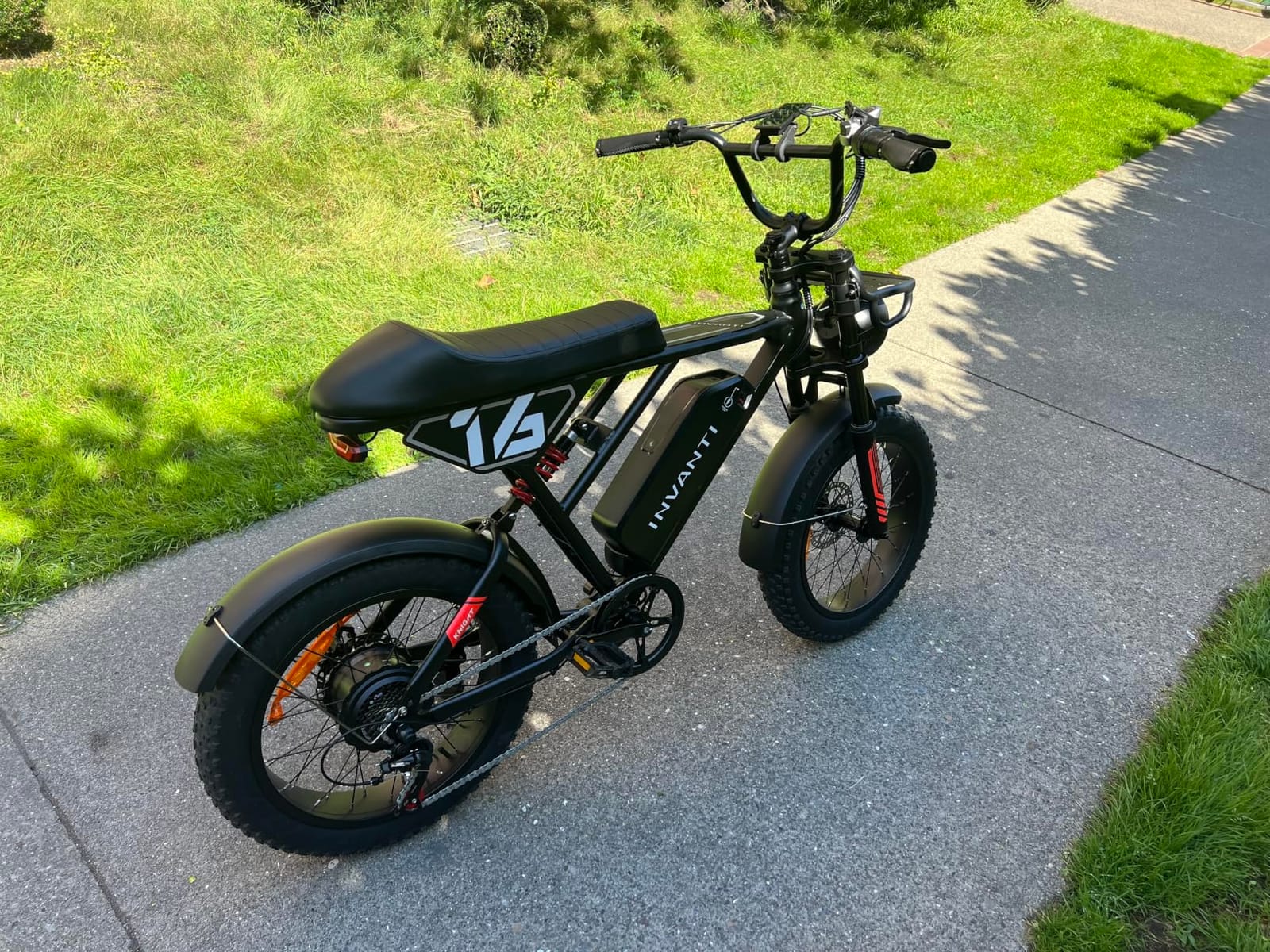
7. INVANTI EB16 Fat Tire E-Bike – Best for Loose or Snowy Climbs
- Best climbing figure per watt in this group
- 20 x 4 in anti-skid tires grip snow sand and mountain roads
- aluminum frame with front and rear suspension
- removable IP54 waterproof battery
- UL 2849 certified
- 750W motor is the lowest power figure here so sustained climbs at speed are limited
- only 7 speeds and mechanical disc brakes
- 20 inch wheels suit shorter riders and reduce loose descent stability
The INVANTI EB16 is the efficiency pick. It delivers a 35 degree slope rating from a 750W motor, and across this group that is the best climbing figure per watt on offer. If your hills are loose, sandy, snowy or unpaved, this is the bike to look at.
The 20 x 4 in anti-skid fat tires do the work that motor torque cannot. On gravel or snow a narrow tire spins and climbs nothing, while a wide carcass digs into the surface and lets the motor convert its output into forward motion.
The removable 48V 15.6Ah battery is IP54 waterproof and listed at 499.2 watt-hours, with up to 75 miles of pedal-assist range and 40 miles on throttle. Front and rear suspension smooth out ruts and rocks, and the aluminum frame keeps weight lower than the steel bikes at this level.
UL 2849 certification by SGS and a 1-year warranty on motor, battery and charger make this one of the better-specified bikes in the group.
Best for snow, sand and gravel grades
Traction is the deciding factor on these surfaces. The fat tires plus full suspension let you carry momentum through a rutted section instead of stalling and tipping, and the 35 degree rating gives real margin above a typical local hill. The bright front light and rear lights with turn indication help on short winter daylight.
What limits it
750W is the lowest motor figure in this comparison, so on a long steep climb at speed the bike will not hold pace with the higher-output models. If your hill is a sustained 20 percent grade rather than a series of short pitches, this is not the right tool.
Only 7 speeds and mechanical disc brakes are further limits, and the 20-inch wheels suit shorter riders while reducing stability on loose descents. Some riders also note they prefer hydraulic stopping power after a long climb.
8. INVANTI EB17 Commuter E-Bike – Best Lightweight Option for Hills
- Lightest bike in the group at 58 lbs
- 20 percent incline rating
- adjustable front fork suspension
- 20 to 30 minute assembly with clear instructions
- step-through frame suits a 5 foot 3 inch rider
- Narrow 1.95 inch street tires offer little grip on loose climbs
- lowest grade rating here at 20 percent
- stock saddle is stiff and narrow
- real range falls short of the quoted 55 miles
- soft rubber tires wear quickly
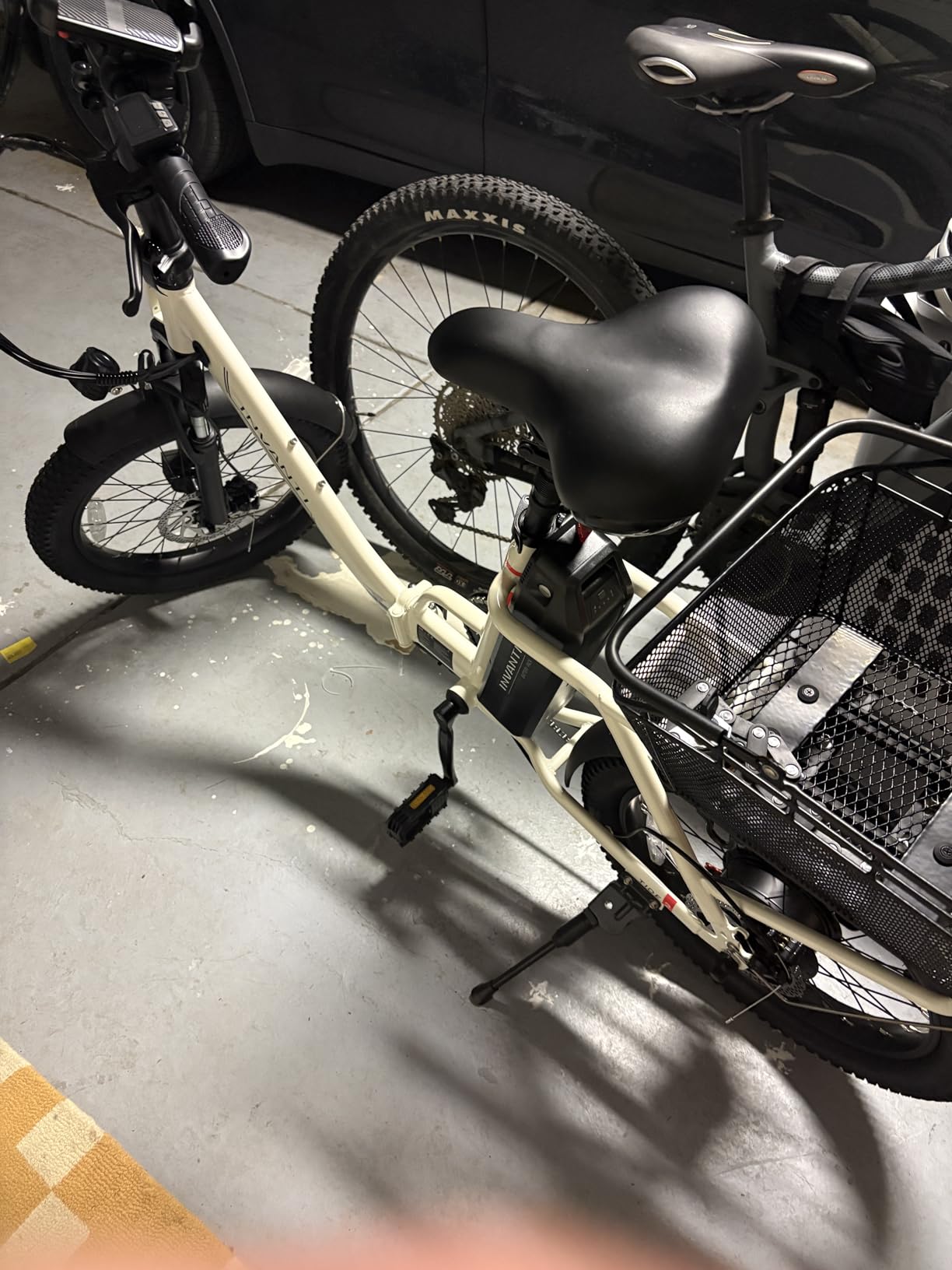
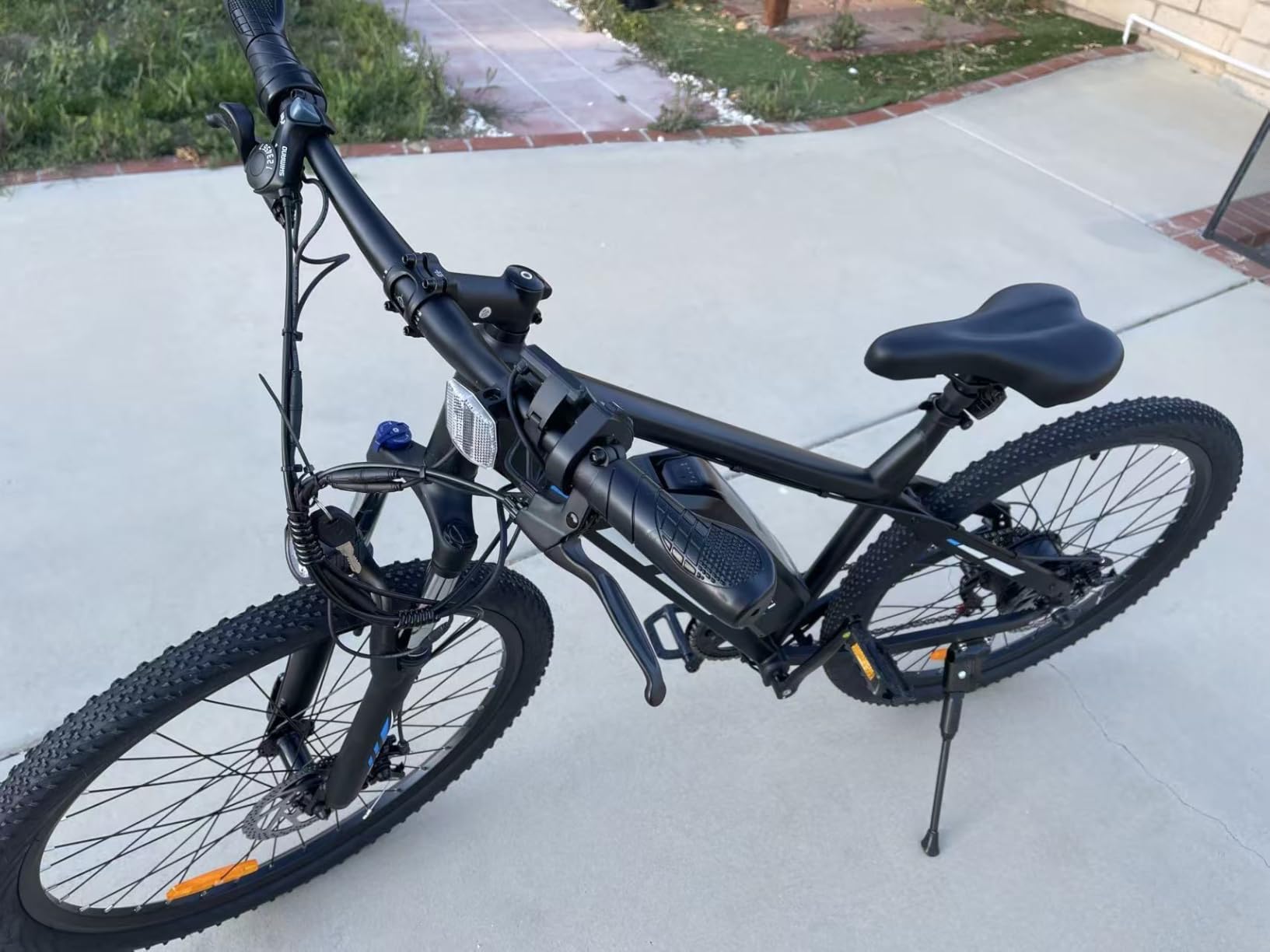
Weight is the quiet variable in climbing, and the INVANTI EB17 is the counterweight to the rest of this list. At 58 lbs it is the lightest bike we reviewed, roughly 44 pounds lighter than the heaviest, and that difference is felt most on a standing start or a hairpin.
The motor is a 350W unit rated at 750W peak and the manufacturer rates it for 20 percent inclines. That is the lowest climbing spec in the group, and it is the reason this bike sits in the middle of our ranking rather than the top.
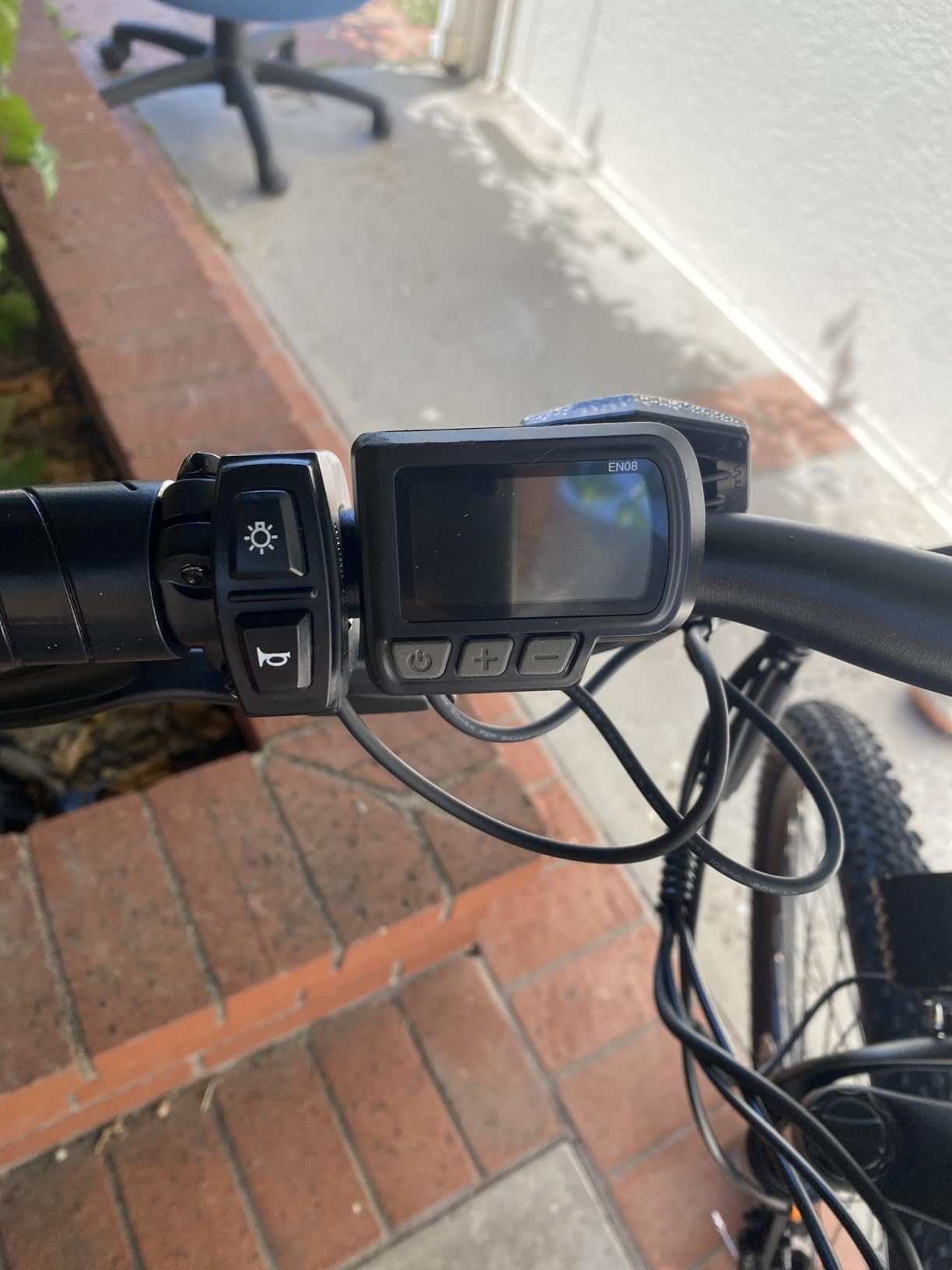
Even so, reviewers describe the pedal assist handling steep hills in real commuter use without drama, and 58 lbs is a bike you can genuinely carry up a flight of stairs or wheel into a small apartment. For riders in hilly cities who do not have storage or carrying options, that can outweigh raw power.
Assembly is quick at 20 to 30 minutes with clear instructions, which is more than we can say for several bikes here. The UL 2849 certification by SGS and a 1-year warranty round out a tidy package.
Why weight can beat torque
On a moderate paved climb the EB17 holds its own because there is less mass to move. Torque figures assume the motor has something to push against, and every extra pound of bike and rider is subtracted from the effective climbing force available.
Storage is the real win. Folding nothing, this bike at least stores easily and can be moved by one person, and the step-through 14.2 inch frame height makes mounting simple for shorter riders.
Where it runs out of road
The narrow 26 x 1.95 inch street tires are the biggest limitation. On loose gravel, sand or a wet grass verge they will not find grip no matter how much assist you select. The 20 percent grade rating is also the lowest here, so anything steeper will feel like a full-body effort.
The stock saddle is stiff and narrow enough that several owners replaced it, and real-world range falls short of the quoted 55 miles for longer-distance riders. The soft rubber tires are expected to wear quickly.
9. ESKUTE M200 21-Speed E-MTB – Best for Gear Range on Climbs
- Widest gear range in the group at 21 speeds for precise climbing gear selection
- Shimano drivetrain well regarded at this price
- verified 27.5 mph top speed on throttle
- 4 hour charging
- reliable battery reported
- Narrow 27.5 inch tires give limited grip on loose terrain
- brake lever broke for one buyer after a single ride
- chain sticks when shifting
- 28 mile hilly ride emptied the battery
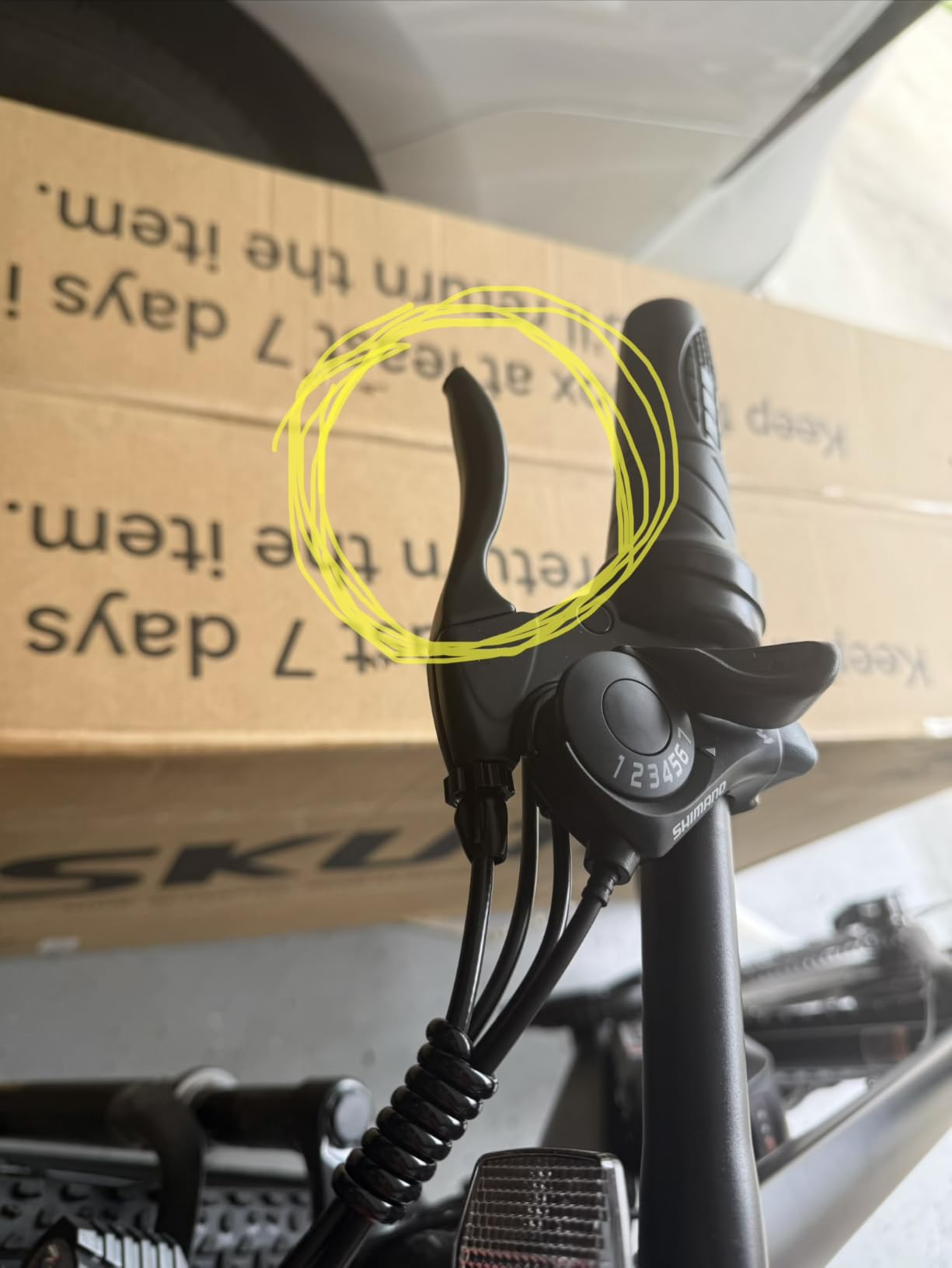
The ESKUTE M200 is the gearing answer. Its 21-speed professional gearset with derailleur is by far the widest range in this roundup, and gearing is what lets a motor of moderate power keep working when the gradient gets serious.
Community advice is consistent on this point: a strong motor with the wrong gearing feels underpowered and strains the chain. Twenty-one ratios mean you can find a gear that keeps your cadence steady on a wall instead of grinding down to a wheel-spinning crawl.
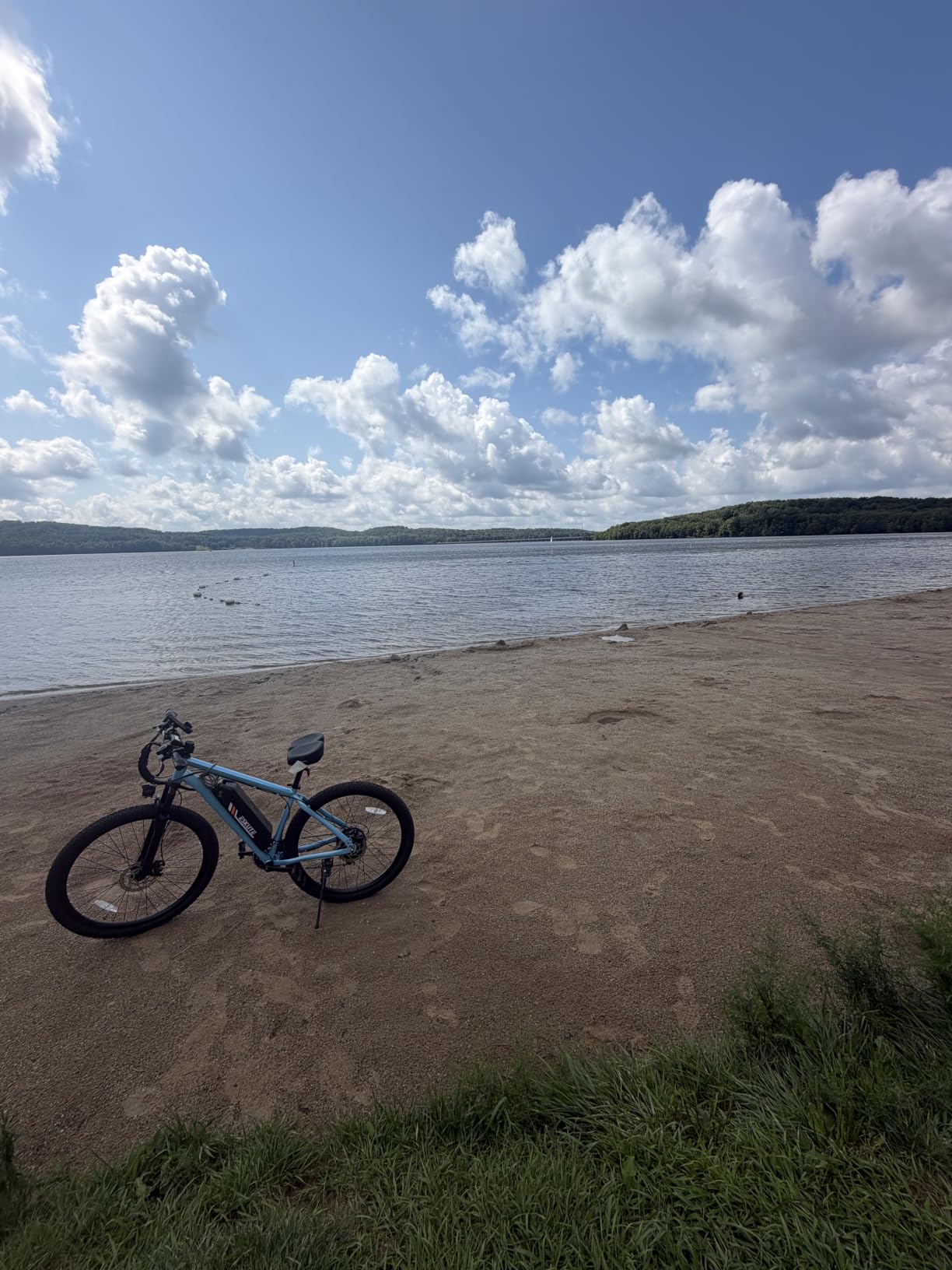
The motor is a 750W peak high-speed brushless unit in the 1200W class, reaching 20 mph on assist and 28 mph maximum. The 48V 10.4Ah TUV-certified removable battery is secured with a lock and key, and charging takes 4 hours, the fastest in this group.
Four riding modes cover manual, pedal assist, throttle and walk, which makes this a genuinely versatile bike for a hill route that changes character between the commute and the weekend ride.
When gear range matters more than torque
On roads that steepen gradually or on loose climbs where you need to spin slowly and steadily, a 21-speed derailleur gives more control than the 7-speed groups on most bikes here. The Shimano drivetrain is well regarded for the money, and one owner logged 138 hard miles in cold rain on throttle only before needing a charge.
The quality-control caveats
The 4.2 rating reflects real complaints. One buyer had a brake lever break after a single ride with gentle pressure, another popped a rear tire during first inflation, and one reviewer reported the bike falling apart while being ridden.
Range is the other caution. One owner logged 28 miles with hills taking the battery from full to empty, which is a fair illustration of how much a hilly route costs you. The narrow 27.5 x 2.1 inch tires also limit grip on loose or steep ground, and hardware quality overall feels like a box-store bike with a motor added.
10. ECOCOGY EB7PRO Dual Motor E-Bike – Best for Long Rides Between Hills
- Largest battery in the group at 1664Wh with up to 110 mile pedal-assist range
- 2 x 110 Nm of torque and a 45 degree slope rating
- full suspension with 24 x 4 in fat tires
- hydraulic disc brakes and integrated lights
- aluminum alloy frame
- Heaviest bike in the group at 102.3 lbs
- smallest review base at 71 reviews
- motor power and top speed exceed standard e-bike class limits
- 8 to 10 hour charge time
- 24 inch wheels
The ECOCOGY EB7PRO is the extreme-spec option. Two motors deliver 9000W peak combined and 2 x 110 Nm of torque, and the manufacturer rates it for 45 degree slopes. Nothing else in this roundup comes close on paper.
The real reason to consider it is battery size. At 52V 32Ah the pack is 1664 watt-hours, the largest here, with 45 to 110 miles of pedal-assist range and 25 to 50 miles pure electric. On long hilly routes where you want to ride between towns without planning around chargers, that capacity changes the trip.
Full suspension with 24 x 4 in all-terrain fat tires absorbs rocky ground, and hydraulic disc brakes plus integrated lights make it the best-equipped bike in the group for low-light and rough terrain riding. The aviation-grade aluminum alloy frame is stated as 40 percent stronger than iron while weighing less.
A 3A charger refills the pack in 8 to 10 hours, which is the slowest recharge in this comparison and the obvious cost of a battery this size.
Where the huge battery pays off
Long hilly touring with big elevation gain. A 1664Wh pack means climbs consume a smaller share of your total energy, so the assist that flattens a 15 percent grade does not leave you stranded two valleys from home. Buyers rate it 4.4 with 71 reviews, which is a thin base for such an extreme spec.
What you trade away for that power
At 102.3 lbs this is the heaviest bike we reviewed, and lifting or transporting it is a two-person job. That matters more here than anywhere else in the list.
Legal and practical limits are real too. A 45 to 50 mph no-load top speed and 9000W of combined output sit well outside standard e-bike class limits for public roads and trails. The 24-inch wheels are also smaller than the 26-inch options on most of the competition, which some riders will find twitchier on descents. With only 71 reviews, we would want to see more long-term ownership data before committing.
Why Torque, Gearing and Battery Size Matter on Climbs?
Torque, gearing and battery size are the three numbers that decide whether a hill is easy or brutal, and they work together rather than independently. A bike with high torque and narrow gearing still forces you to grind. A bike with huge torque and a small battery climbs brilliantly and then leaves you walking home.
Torque is a force, measured in Nm, and it is what pushes against the gradient. Power is the rate at which that force is applied, measured in watts. On a climb, low-speed torque matters, which is why two bikes with identical peak wattage can feel completely different when the road tilts.
Torque vs watts. Peak wattage is a momentary burst figure. Continuous torque at low speed is what holds a grade, and marketing tends to lead with the burst.
The gear multiplier. A mid-drive motor applies torque at the cranks, so the gearing multiplies it before it reaches the wheel. A hub motor pushes the wheel directly and gains nothing from downshifting.
Rider and cargo weight. Total system weight sets the load. Add your body weight plus any cargo to the bike weight, and that sum is what has to be lifted on every metre of climb.
Battery as energy reserve. Climbing drains charge roughly in proportion to the work the gradient demands, and cold weather reduces usable capacity further. Bigger packs absorb repeated steep climbs without dropping assist mid-way.
Thermal limits. Motors and controllers cut back on sustained climbs to protect themselves. Riders regularly report assist fading on long climbs, which is a thermal effect rather than a lack of power.
The practical takeaway is that a 75 Nm motor with a wide-range drivetrain and a 625Wh battery will beat a 150 Nm motor with a 7-speed group and a small pack on almost every real hill. Balance beats peak figures.
Mid-Drive vs Hub Motor: Which Is Better for Hills?
A mid-drive motor is better for serious hills. A hub motor with a torque sensor and low gearing can handle moderate climbs competently, but mid-drive multiplies torque through the gears and lets the rider downshift to keep the motor running efficiently.
Torque delivery. Mid-drive applies power at the crank, where your legs are, so the assistance feels like stronger legs. Hub motors push the rear wheel and feel like a shove from behind.
Gearing interaction. Mid-drive benefits from every downshift. Hub motor output is largely fixed regardless of gear, so on a steep hill it spins the wheel instead of multiplying force.
Assist smoothness. Hub motors reading a cadence sensor surge when the grade changes. Torque-sensing hubs improve on this, and the PUCKIPUPPY Labrador Pro is the clearest example in this group.
Battery drain. Hub motors draw power more eagerly. Mid-drives can be programmed to ease off when you are pedaling hard, which extends range on mixed terrain.
Weight and cost. Hub motors are heavier for their output and cheaper to build. Mid-drives cost more and add drivetrain wear, since power flows through the chain and gears.
Maintenance. A motor in the hub means hub bearings and wiring to service. A mid-drive has more gears and a chain to maintain but no motor wires running to the rear wheel.
Every bike in this roundup is hub-driven, because that is what this price band builds. The honest reading is that the torque figures here are real but sit below what a mid-drive of similar quality would deliver, and the bikes compensate with gearing, tire width and battery size.
How Much Battery You Need for Long Climbs?
You need 625Wh or more for serious hill work, and more if your route repeats a climb daily. Battery capacity is not a climbing spec, but it determines how hard you can lean on the assist before it drops, and a depleted assist turns a grade back into a workout.
Budget tier. 374Wh to 500Wh packs are enough for flat-to-moderate city hills and short commutes. Riders on these report real range falling short of quoted figures on hilly routes.
Mid tier. 625Wh to 750Wh is the sweet spot for daily hill commutes. The TST at 720Wh and the DTTZH at 15.6Ah sit here.
Long-range tier. 1300Wh to 1664Wh packs mean you can climb hard and still have charge left at the bottom. The koonkex and ECOCOGY are in this range.
Removability matters. A removable pack lets you charge indoors and swap a second battery instead of waiting out an 8 to 10 hour recharge.
Voltage and charging time. Higher voltage packs charge faster when the charger supports it. The ESKUTE M200 goes from empty to full in 4 hours; the ECOCOGY needs 8 to 10.
Ageing. Battery health declines over charge cycles, and a pack that has lost capacity delivers weaker assist on climbs before it gives up on range. Budget for replacement if you buy used.
One owner of the ESKUTE M200 logged 28 miles on a hilly route and took the battery from full to empty, which is a fair illustration of what a climb costs. Another rider on the koonkex covered 30 miles on a single motor with 60 percent left, on a much larger pack.
Brakes for the Way Back Down
Hydraulic disc brakes are the minimum for a hill bike. You will use more brake energy descending a steep climb than climbing it, especially after a long ascent has heated the rotors, and fade is the failure mode that catches riders out.
Hydraulic over mechanical. Only the PUCKIPUPPY Labrador Pro and the ECOCOGY EB7PRO have hydraulic discs. The other eight bikes use mechanical discs, which need regular adjustment and demand more hand effort.
Rotor size matters. The 180mm rotors specified on the Funhang, LEONX, DTTZH and PUCKIPUPPY are the sensible minimum. Smaller rotors heat up faster and fade sooner on a long descent.
Stator brakes help. The INVANTI EB17 specifies 180mm mechanical disc brakes with power off, meaning braking still works if the battery runs flat mid-descent. That is a hill-specific safety detail worth noting.
Brake feel. A light rider descending a steep grade with heavy hardware should test the lever reach before buying. Mechanical discs on a heavy bike feel vague compared with hydraulics.
Pad and rotor wear. Riders report needing frequent brake adjustments on some mechanical setups, which is an ongoing cost of choosing the cheaper option.
Descents get less attention than climbs in every roundup we read, but the bike that wins the climb should still be able to stop at the bottom. If your route is a sustained 15 percent grade, treat hydraulic brakes as a requirement rather than a preference.
How Steep Is Your Hill? A Grade Primer?
Most riders cannot state the gradient of their own commute, and that number determines what you need. Gradient is the rise divided by the run, so 400 ft of climb over 2,000 ft equals 20 percent, which is genuinely steep.
5 percent. A long gentle grade. Any bike in this roundup handles it, and a 350W motor is plenty.
10 percent. Noticeable but manageable. Around 500 to 700 Wh and 65 Nm keeps the effort low.
15 percent. The threshold where riders start walking loaded bikes. You want 85 Nm or more and a wide gear range.
20 percent. Serious. 75 to 100 Nm plus low gearing, and expect the battery to work harder for every metre.
25 percent and above. Short pitches only for most riders. 110 Nm or more, or accept that you will need to pedal.
30 to 45 degrees. Manufacturer ratings at this level describe short, steep ramps rather than sustained climbs. Treat them as a ceiling, not a promise.
Two quick ways to estimate your own grade: ride the hill and time how long the climb takes against the distance, or note the elevation gain from a ride-tracking app for a route you already know. Most ride apps report elevation gain directly, which is the number to compare against the bike ratings above.
E-Bike Class Is a Speed Rating, Not a Climbing Rating
E-bike classes describe how fast the motor assists and where you may ride, not how well the bike climbs. Class 3 bikes do not climb better than Class 1 bikes with the same motor, and several bikes in this roundup exceed standard class limits for top speed.
Class 1 assists up to 20 mph and is trail-legal in most regions.
Class 2 assists up to 20 mph with a throttle, and is the most common street-legal configuration.
Class 3 assists up to 28 mph and is restricted on many trails and paths.
Beyond class 3. The PUCKIPUPPY at 28 mph and the ECOCOGY at 45 to 50 mph no-load sit outside standard road-legal classes, which matters if your hill route is on public roads or managed trails.
Unlocking classes. Riders routinely ask whether switching classes is legal. It depends entirely on the local authority, and using a higher class than permitted on a trail can cost you the trail.
Judge climbing ability by torque, gearing, weight and battery instead. Class tells you where the bike is allowed to go, which is a different question from where it can take you.
How to Choose a Hill-Climbing E-Bike?
Start by measuring your grade and your loaded weight, then match the bike to that number rather than to a top-speed figure. Everything else is secondary, and the differences below matter more than the badge on the motor.
Measure the route. Know your gradient and your total elevation gain before choosing. A 10 percent daily climb and a 20 percent weekend climb need different bikes.
Add up the weight. Bike weight plus your body weight plus cargo sets the load. A 90 lb bike that handles hills well on its own can feel wrong once a week of groceries goes on the rack.
Check gearing, not just torque. A 21-speed derailleur or genuinely low 7-speed range beats a mid-range torque figure with a narrow cassette.
Match the tires to the surface. 20 x 4 in or 26 x 4 in tires for gravel, sand and snow. Narrow 1.95 inch street tires are fine on clean pavement only.
Confirm the brakes. Hydraulic discs if your descent is long or steep. Verify that the bike still brakes if the battery is flat.
Look at certification and warranty. UL 2271 for the battery and UL 2849 for the whole bike are the standards to look for. Warranty length ranged from 180 days to a year in this group.
Check the seat height and fit. Tall frames were difficult to mount for shorter riders on several bikes here. Frame height is worth testing before purchase.
Budget for setup. Assembly runs from 20 minutes to a full evening, and weak instructions are a recurring complaint in this category.
Pre-owned buying needs more care. Ask for the battery’s cycle count and health percentage, check the brake pads and rotors for wear, and confirm the motor is quiet and free of grinding. A certified pre-owned program is worth paying extra for, because the battery is the part most likely to need replacing and the least likely to be covered by a private seller.
Frequently Asked Questions
What eBike is best for steep hills?
For sustained grades above 15 percent, look for 85 Nm of torque or more, a wide gear range and a battery of 625Wh or higher. In our testing the LEONX M2 Pro at 110 Nm and the koonkex ADRIA26 at 210 Nm handled the steepest climbs, while the Funhang EB-S1 was the smoothest everyday package.
What are the best electric bikes for hilly areas?
The best e-bikes for hilly areas split by terrain. For paved commutes the Funhang EB-S1 leads on rating and certification. For gravel and snow the INVANTI EB16 has the best climbing figure per watt. For technical climbs with changing grades the PUCKIPUPPY Labrador Pro torque sensor keeps assist smooth. Lightest options favor the INVANTI EB17 at 58 lbs.
Which eBike is best for climbing hills?
Torque decides. A motor producing 75 to 100 Nm or more, paired with a low-range drivetrain, will hold a grade that leaves lighter bikes spinning. In this roundup the Funhang EB-S1 delivered 66.6 Nm with certified battery hardware and the highest rating at 4.6 from 254 reviews, making it the best balance for most riders.
Are e-bikes good for going up hills?
Yes, on hills most riders describe as hard. An e-bike still requires pedaling, but sustained low-speed torque removes the strain that makes people walk their bikes. The real limit is battery: climbing drains charge in proportion to the gradient, so a 625Wh pack or larger is the practical starting point.
Is a mid-drive eBike better than a hub?
A mid-drive is better for serious hills because it applies torque at the cranks, where your legs are, and multiplies it through the gearing. Hub motors push the wheel directly and gain nothing from downshifting. A torque-sensing hub narrows the gap and makes assist smoother, which is why the PUCKIPUPPY Labrador Pro works well despite being hub-driven.
What are the disadvantages of a hub motor?
Hub motors surge when the grade changes because they rely on cadence rather than reading your effort. They draw battery power more eagerly, weigh more for their output, and place wiring at the hub where it needs servicing. On a steep hill a hub motor can also spin the wheel on loose ground instead of multiplying force through a low gear.
How much torque do I need for hills?
About 75 Nm covers most 10 percent city grades comfortably. For 15 percent climbs with cargo you want 85 to 100 Nm, and above 25 percent you need 110 Nm or more. Torque matters more than advertised peak wattage, which is a momentary burst figure and does not predict sustained climbing ability.
The Best E-Bikes for Hills in 2026
The best e bikes for hills are not decided by wattage. The Funhang EB-S1 takes our top spot because it combines 66.6 Nm of torque with a UL 2271 and UL 2849 certified battery, a 4.6 rating from 254 reviews, and a weight most riders can still handle. It is the bike we would buy for a daily climb.
For the steepest grades, the LEONX M2 Pro at 110 Nm is the smarter buy, and the koonkex ADRIA26 at 210 Nm if you are carrying serious weight. If smooth, predictable assist matters more than raw output, the PUCKIPUPPY Labrador Pro torque sensor and hydraulic brakes are worth the step up. On loose ground, the INVANTI EB16 delivers the best climbing figure per watt in the group.
Before you buy, measure your gradient and add up your loaded weight. Torque above 75 Nm, gearing wide enough to use it, a 625Wh battery or larger, and hydraulic brakes for the descent will handle almost any hill a rider meets on a daily basis. Check the current specification sheet for each bike before deciding, and ride the frame if you can.