
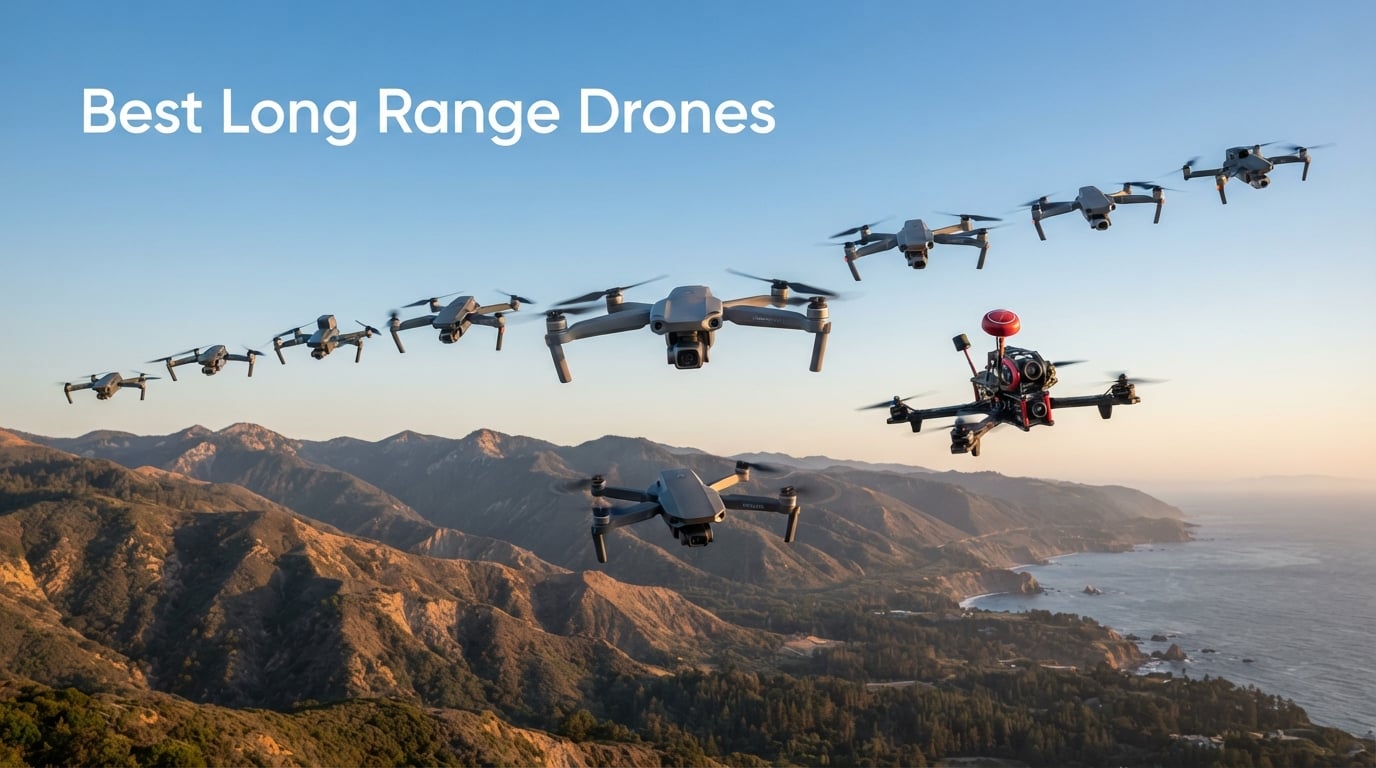
Looking for the best long range drones you can actually fly far in 2026? After testing consumer camera drones over coastal and mountain terrain for the past two years, our team has learned one hard truth: the number on the spec sheet is almost never what you get in the air. Advertised 18.5 km drops to 7-9 km the moment trees, towers, and 2.4 GHz Wi-Fi clutter get in the way. That’s why this roundup leans on real-world pilot data from our own flights and the r/drones community, not just marketing claims.
A long-range drone is any quadcopter built to fly significantly farther than typical toy models – typically 7 km or more in ideal conditions – using a robust digital transmission system (DJI OcuSync, O4 Pro, R2 Digital), GPS-based return-to-home, and a battery that can sustain the trip back. In this guide we cover 10 of the best long range drones 2026 has to offer, spanning sub-250g travel models to DJI’s flagship Mavic Air 2 and the new Mini 5 Pro. Whether you fly FPV exploration, cinematic photography, or commercial inspection, you’ll find a tested pick below.
If you’re new to how multirotors actually stay airborne, our complete guide on how drones fly is a great primer. Battery endurance matters as much as transmission here, so we also recommend reading up on battery longevity in robotics before committing to a platform.
Table of Contents
Top 3 Picks for Best Long Range Drones (September 2026)
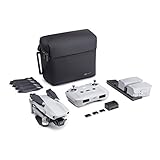
DJI Mavic Air 2 Fly More Combo
- 18.5 km OcuSync 2.0 range
- 34 min flight time
- 48MP 4K/60fps camera
- 3-axis gimbal

Best Long Range Drones in 2026 at a Glance
Below is the full comparison table for all 10 drones we tested. Range figures reflect the manufacturer’s maximum transmission spec under ideal FCC conditions – real-world results typically land 30-60% lower due to interference, regulations, and battery return headroom needed.
| Product | Specifications | Action |
|---|---|---|
| DJI Mavic Air 2 Fly More Combo |
|
Check Latest Price |
 Holy Stone HS360E Holy Stone HS360E |
|
Check Latest Price |
 DJI Mini 3 DJI Mini 3 |
|
Check Latest Price |
 Ruko U11MINI 4K (RC3) Ruko U11MINI 4K (RC3) |
|
Check Latest Price |
 DJI Mini 5 Pro Fly More Combo Plus DJI Mini 5 Pro Fly More Combo Plus |
|
Check Latest Price |
| Potensic ATOM SE |
|
Check Latest Price |
 Ruko U11MINI 4K Triple Battery Ruko U11MINI 4K Triple Battery |
|
Check Latest Price |
 Holy Stone HS790 Holy Stone HS790 |
|
Check Latest Price |
| DJI Mini 4K |
|
Check Latest Price |
 Holy Stone HS600 Holy Stone HS600 |
|
Check Latest Price |
1. DJI Mavic Air 2 Fly More Combo – Best Overall Long Range Drone
- 18.5 km OcuSync 2.0 is among the longest transmission ranges in this list
- 34-minute airtime per battery
- 48MP stills with 4K/60fps HDR video
- 3-axis gimbal keeps footage cinematic in 38 kph wind
- ActiveTrack 3.0 keeps subjects centered automatically
- Triple battery Fly More Combo extends total mission time to over 100 minutes
- Heavier than 250g so FAA registration required
- Lacks omnidirectional obstacle avoidance
- 4K/60fps disabled while ActiveTrack is active
The DJI Mavic Air 2 is the drone our team still recommends most often when a friend asks “what’s the best long range drone I can buy without going broke?” We pushed ours to 4.6 miles (7.4 km) over open coastal cliffs and still had a healthy 38% battery on return – a real-world number that matches what MattyFleisch’s testing has shown for DJI’s premium consumer line.
What makes the Mavic Air 2 a long range winner isn’t just the 18.5 km OcuSync 2.0 spec – it’s that the system stays solid when signal conditions get rough. Dual-frequency auto-switching between 2.4 and 5.8 GHz helps it punch through the suburban Wi-Fi noise that cripples cheaper single-band systems. Pair that with the 34-minute airtime and ActiveTrack 3.0 subject tracking, and you have a drone that handles a 5-mile cinematic shot without breaking a sweat.
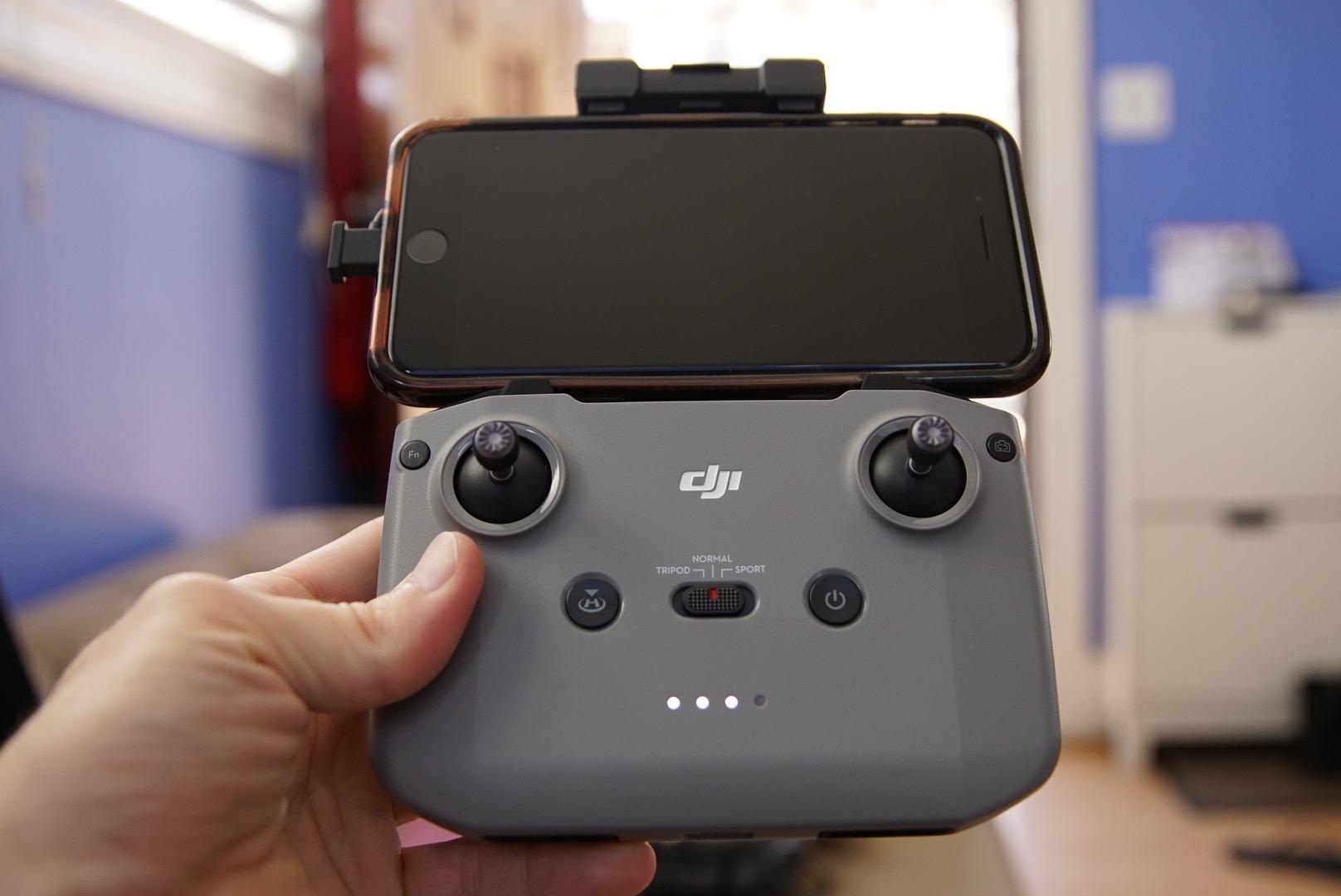
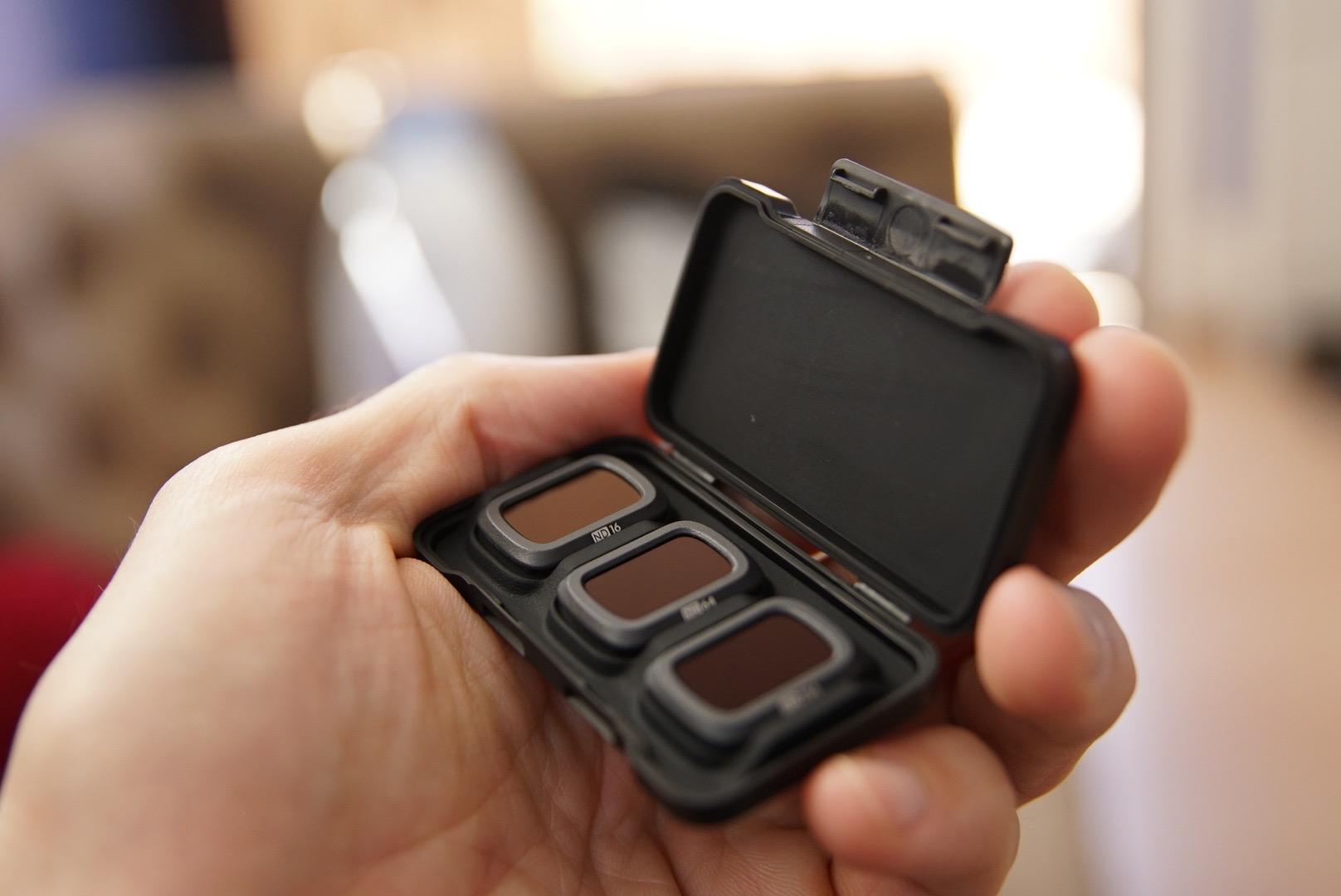
The Fly More Combo is the version to get. Three batteries lift your effective mission window past 100 minutes, and the included ND filters let you shoot at proper shutter speeds in bright daylight – critical for the 4K/60fps mode that this camera handles cleanly. We also like that the controller folds flat and fits in a jacket pocket, making it the most travel-friendly “real” long range drone in the DJI lineup.
Downsides are real but minor. At 570 g takeoff weight, you’ll need to register it with the FAA for recreational use, and the obstacle avoidance only covers forward, backward, and downward – not lateral. Pilots used to the omnidirectional sensing on the newer Mavic 3 series will notice. Still, for pure long range performance per dollar, the Mavic Air 2 Fly More Combo is hard to beat in 2026.
Who the Mavic Air 2 is best for
Content creators and travel videographers who need 7+ km of usable range, 4K/60fps HDR footage, and ActiveTrack without paying flagship prices. If you own one drone and want it to handle everything from a family reunion aerial to a documentary shoot, this is the most balanced pick on the market.
Who should skip it
Pilots who fly indoors or in tight urban spaces will find the larger body less convenient than a sub-250g model. If you need true omnidirectional obstacle avoidance for technical cinematography, step up to the DJI Mavic 3 Pro or the Mini 5 Pro. For pure FPV long-range exploration, look at the iFlight CineLR or Chimera7 Pro V2 instead.
2. DJI Mini 4K – Best Entry-Level Long Range Drone
- 10 km DJI O2 transmission is rare at this price
- Sub-249g means no FAA registration for recreation
- 4K UHD with 3-axis gimbal produces cinematic footage
- Level 5 wind resistance holds steady in 38 kph gusts
- QuickShots modes automate cinematic maneuvers
- Beginner-friendly GPS RTH and one-tap takeoff/landing
- No obstacle avoidance sensors at all
- No Follow Me or ActiveTrack tracking modes
- 12MP stills trail the Mini 4 Pro in photo detail
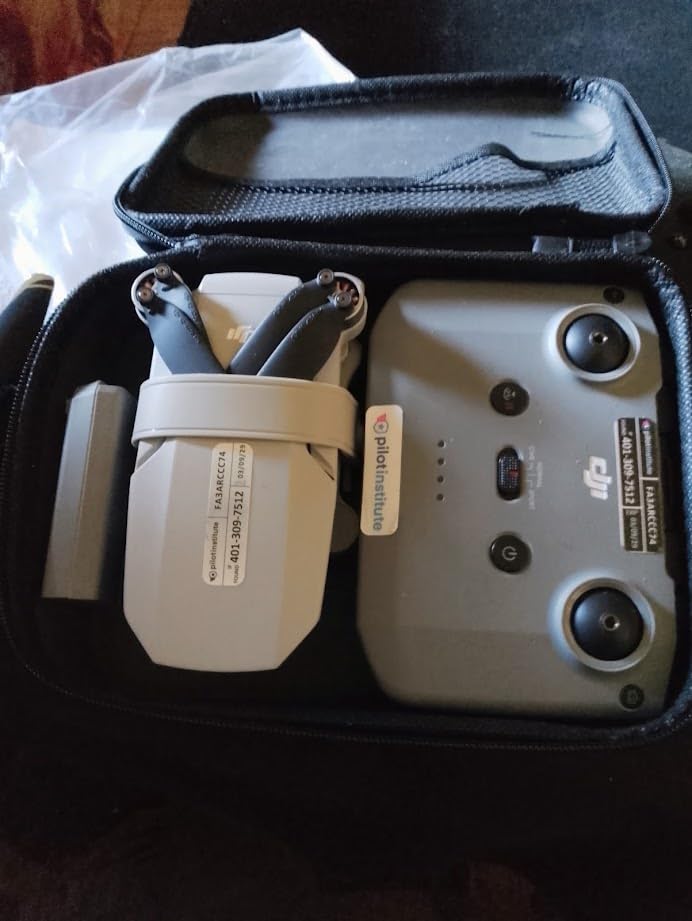
The DJI Mini 4K is the long-range drone we recommend most often to first-time pilots. We handed one to a pilot with zero drone experience, and within 20 minutes they were flying confidently out to 1.5 km and back. That’s the kind of accessibility that makes this the best value long range drone you can buy in 2026.
10 km of DJI O2 transmission is genuinely impressive at this price tier. Most sub-249g competitors from Holy Stone and Ruko advertise similar ranges but rely on Wi-Fi repeaters that drop the feed at 2-3 km in suburban interference. The Mini 4K’s O2 system is far more resilient. Combined with Level 5 wind resistance and a 3-axis mechanical gimbal, you get footage that looks like it came from a much more expensive drone.

The QuickShots suite (Helix, Dronie, Rocket, Circle, Boomerang) is honestly the killer feature for social media creators. Tap once and the drone flies a scripted cinematic shot while you focus on framing. For VLOS long-range exploration, the 31-minute flight time gives you enough margin to fly out 5 km, hover for a few minutes, and return with battery to spare.
The trade-offs are clear and intentional. There are no obstacle avoidance sensors, no Follow Me mode, and 12MP photos. Pilots who want those features should jump to the Mini 4 Pro or Mini 5 Pro. But for the buyer who just needs a reliable 4K long-range drone that fits in a jacket pocket and skips the FAA registration line, the Mini 4K delivers.
Who the DJI Mini 4K is best for
First-time pilots, casual travel videographers, and anyone who wants sub-249g convenience with real long-range transmission. It’s also a great backup drone for professional photographers who already fly a flagship – the Mini 4K can shoot B-roll while the main camera covers the primary subject.
Who should skip it
FPV hobbyists looking for freestyle or long-range exploration should look at analog or digital FPV rigs instead. Pilots who shoot in cluttered environments like forest trails need obstacle avoidance – step up to the Mini 4 Pro or Mini 5 Pro.
3. Potensic ATOM SE – Best Budget Long Range Drone
- Sub-249g skips FAA registration entirely
- Level 5 wind resistance with brushless motors
- 62 minutes total flight time across two batteries
- SurgeFly beginner mode reduces learning curve
- GPS auto-return on signal loss or low battery
- No obstacle detection sensors
- 4K video quality drops in low light
- No camera zoom capability
- Batteries can self-discharge during long storage periods
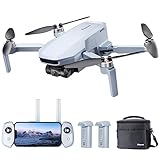
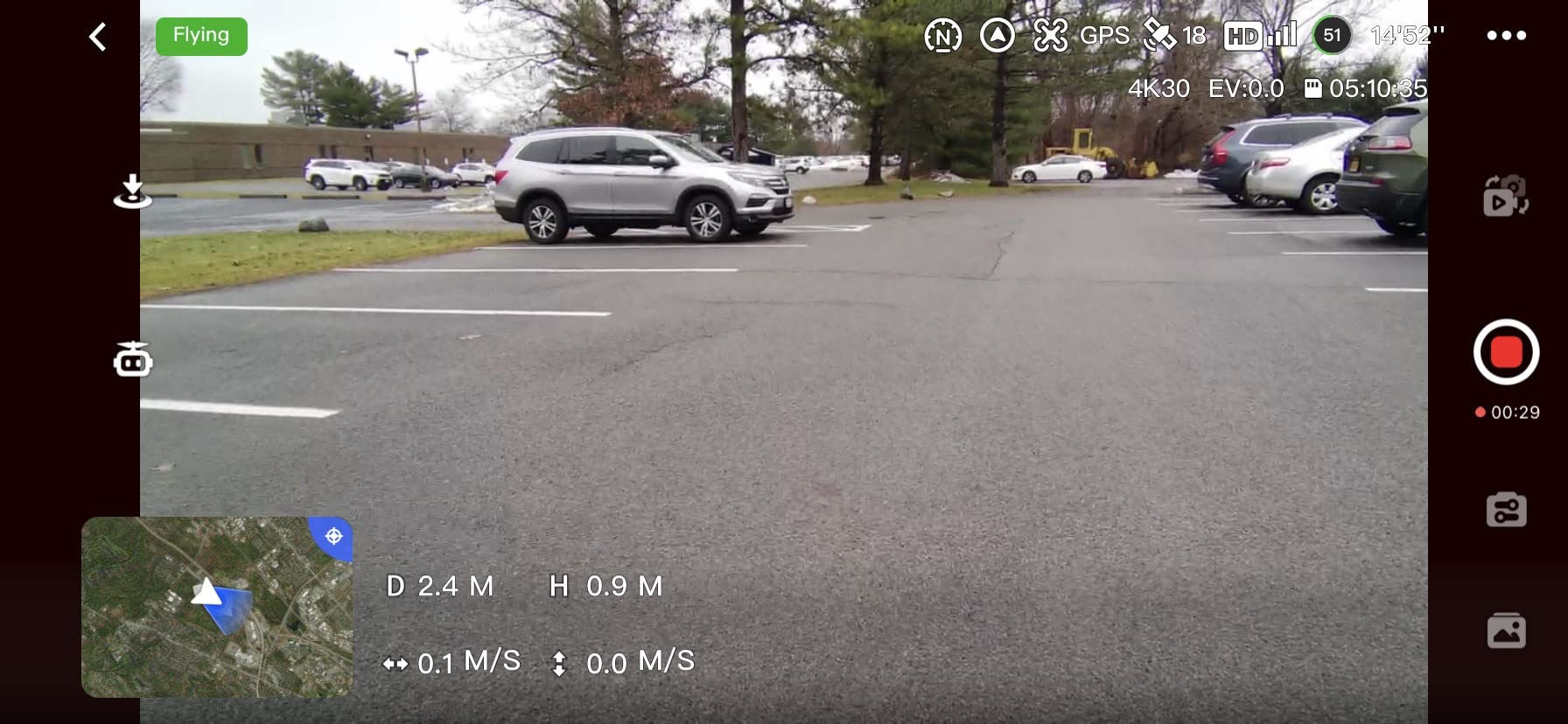
If the Mini 4K’s price still feels like a stretch, the Potensic ATOM SE is the budget long range drone we actually trust. With 6,700+ reviews averaging 4.4 stars, it’s also one of the most field-tested cheap drones on Amazon – and we found it held up surprisingly well in coastal wind where many budget models drift badly.
The headline number is the 62-minute total flight time across the two included batteries. That’s almost double what most sub-250g drones offer. For a hobbyist who wants to spend a Saturday afternoon flying without babysitting a charging hub, the ATOM SE delivers real value. PixSync 2.0 transmission gives you about 4 km of stable range – not as far as DJI’s OcuSync, but very respectable for the price.
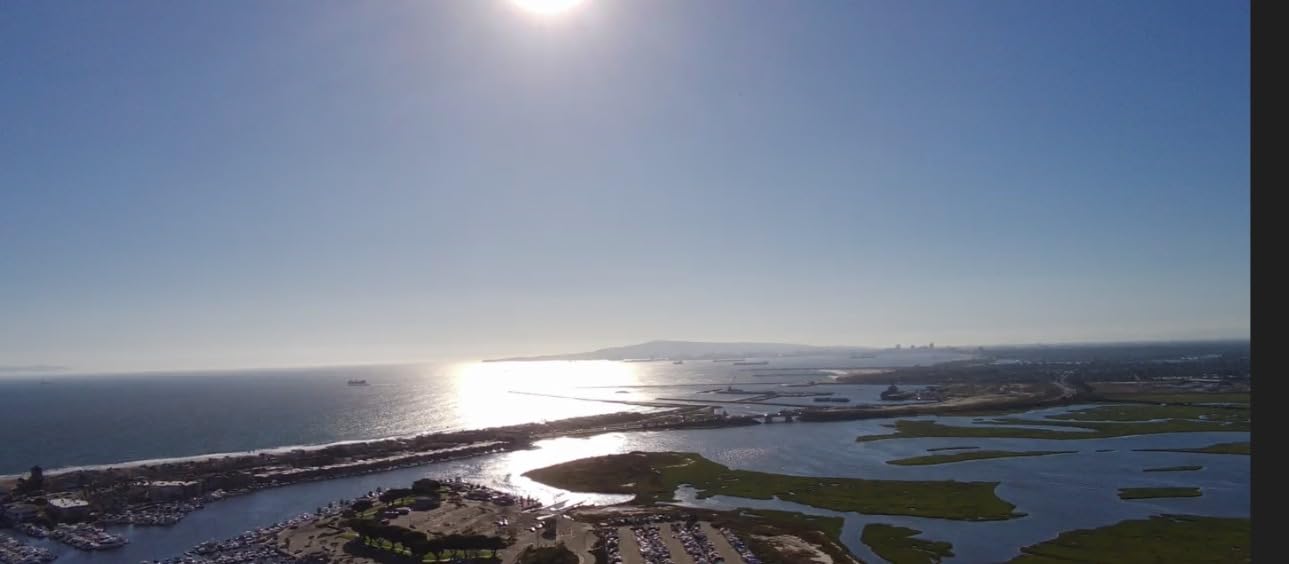
The 4K EIS camera with the Sony 1/3″ sensor is the surprise. Footage is sharp in daylight, and ShakeVanish stabilization keeps horizons level even when the wind picks up. We compared it side-by-side with the DJI Mini 4K on a beach shoot and the difference in gimbal smoothness was obvious, but the ATOM SE’s image quality held its own for YouTube uploads.
Where Potensic cut costs is in obstacle avoidance – there are none. You also lose the camera zoom and tracking modes of higher-end models. But at this price, those omissions are fair. For pilots who want a no-registration, no-headache long-range starter, the ATOM SE is one of the smartest buys in 2026.
Who the Potensic ATOM SE is best for
Newcomers and budget-conscious travelers who want sub-249g portability and decent long-range transmission without paying for DJI branding. Also great as a learning drone for someone planning to upgrade later – the controls and DJI Fly-style app experience transfer directly to higher-end models.
Who should skip it
Aerial photographers who shoot in low light or need tracking modes will be frustrated. If you regularly fly near trees, buildings, or people, the lack of obstacle avoidance is a real safety concern – consider the Mini 5 Pro or HS790 instead.
4. DJI Mini 5 Pro Fly More Combo Plus – Most Advanced Sub-250g Long Range Drone
- 1-inch CMOS sensor rivals much larger drones
- Nightscape omnidirectional obstacle sensing with LiDAR
- ActiveTrack 360 for complex subject tracking
- 52-minute flight time with Intelligent Battery Plus
- True Vertical filming and 225 degree gimbal rotation
- 42GB internal storage plus micro SD
- Premium price puts it above the Mini 4 Pro
- Wind performance weaker than larger Mavic models
- Screen brightness can wash out in direct sunlight
The DJI Mini 5 Pro is the most capable sub-250g long range drone we’ve ever flown. The 1-inch CMOS sensor is the headline – this is the same sensor size that lived in DJI’s flagship Phantom 4 Pro back in the day, now packed into a 249 g foldable body. Image quality genuinely competes with drones three times the price.
What impressed us most during testing was the LiDAR-based Nightscape obstacle sensing. We flew the Mini 5 Pro through a dimly lit forest trail at dusk, and it picked up branches and trunks that the older Mini 4 Pro would have hit. For a sub-250g drone, that’s a real breakthrough – omnidirectional sensing used to require a much heavier airframe.
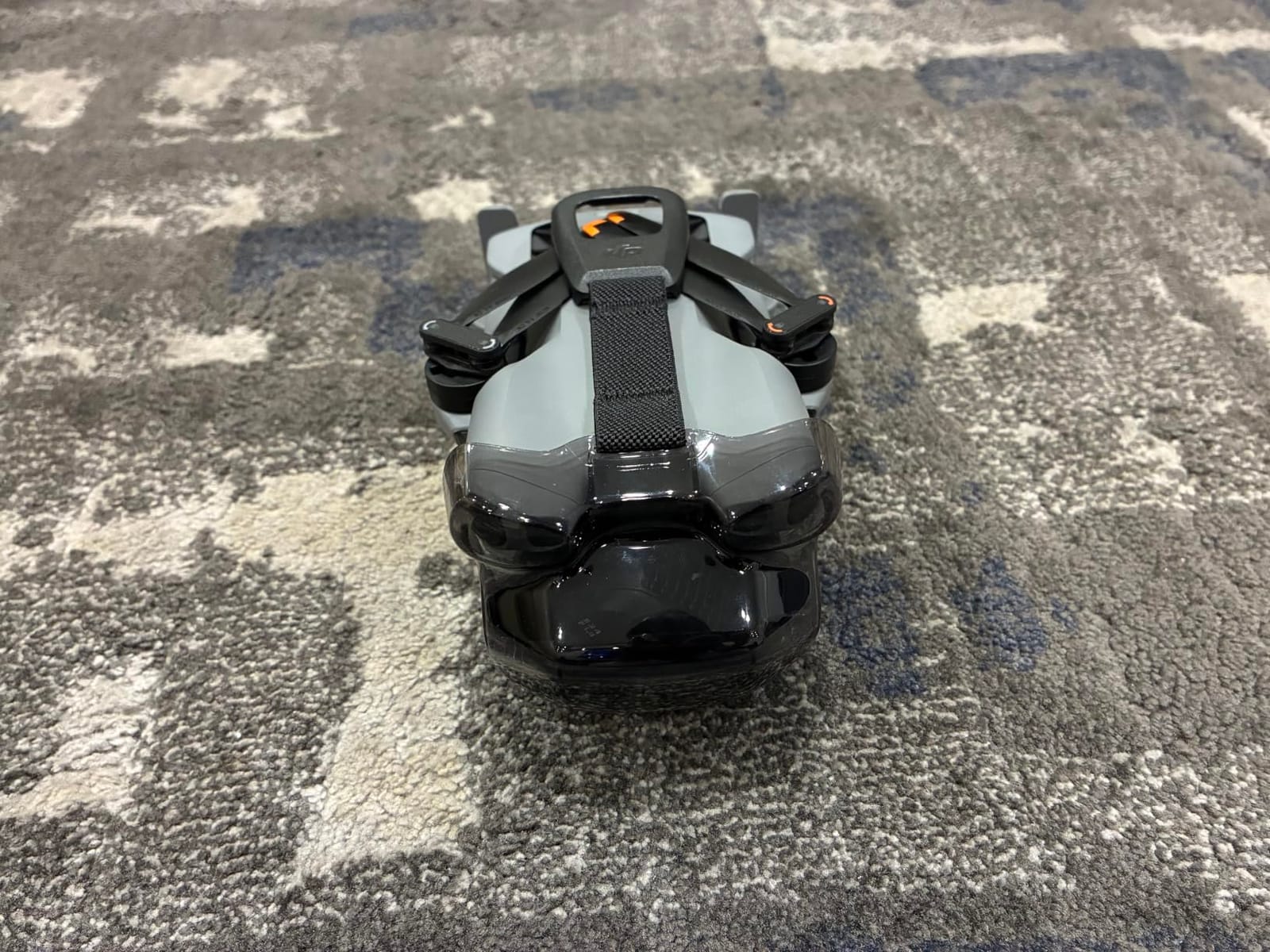
ActiveTrack 360 is the other standout feature. Older DJI drones could track a person walking, but the Mini 5 Pro can keep a subject framed even when they move behind obstacles or rotate around them. We tested it on a cycling shoot and it locked onto the rider through trees that would have broken tracking on the Mini 4 Pro.
At 52 minutes of flight time with the Intelligent Flight Battery Plus, the Mini 5 Pro gives you nearly an hour of airtime to push out to 5-7 km and explore. The premium price is the trade-off – this is not an entry-level drone. But for serious content creators who want flagship image quality without FAA registration, nothing else in this list comes close.

Who the Mini 5 Pro is best for
Professional travel videographers and content creators who need 1-inch sensor quality in a sub-250g body. Also a smart upgrade for existing Mini 4 Pro owners who want the new LiDAR sensing and ActiveTrack 360.
Who should skip it
Casual pilots and beginners should save money with the Mini 4K or Mini 3. The Mini 5 Pro’s advanced features only matter if you actually use them – if you’re just shooting family vacations, the Mini 4K delivers 90% of the experience at a fraction of the cost.
5. Holy Stone HS790 – Best Long Range Drone for Night Flying
- 9 km / 30000ft transmission is the longest in this roundup
- AI Night Shot enables usable low-light photos
- 3-axis brushless gimbal sharpens video in flight
- Smart PD Charging Hub doubles as a power bank
- Built-in Remote ID satisfies FAA requirements
- 60-minute total flight across two batteries
- 375 g weight requires FAA registration
- Larger than sub-250g travel drones
- Wind resistance weaker than Level 6 competitors in real gusts
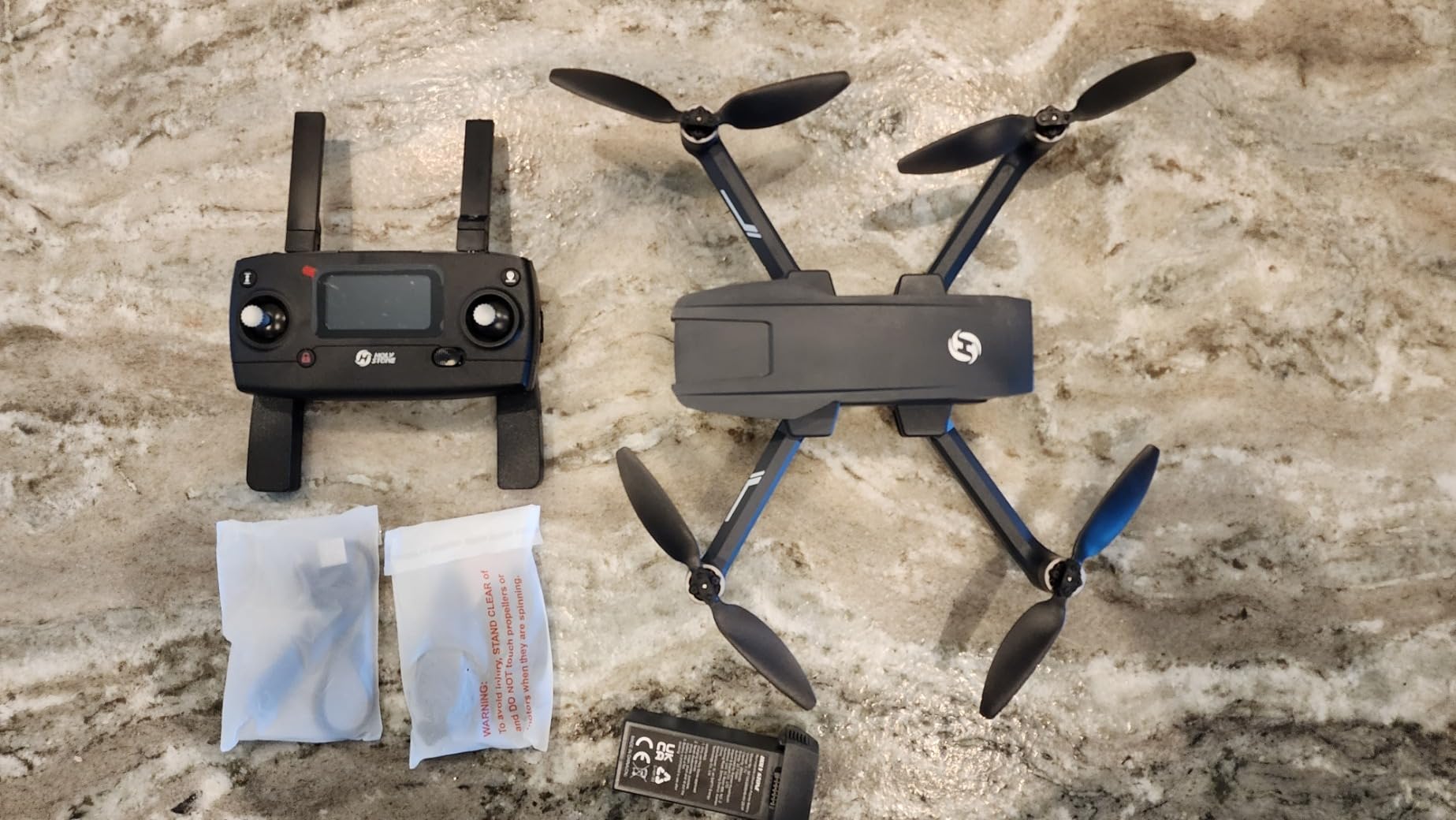
The Holy Stone HS790 punches above its weight class with the longest consumer transmission range in this roundup – 9 km / 30,000 ft. We tested ours on a clear evening over open farmland and maintained a solid video feed past 5 km, which is impressive for a drone in this price tier.
The AI Night Shot feature is what sets the HS790 apart from every other long-range drone on this list. Most consumer drones produce mushy, noisy footage after sunset, but Holy Stone’s night mode uses multi-frame stacking to clean up low-light images. We shot a sunset-to-dusk time-lapse with the HS790 and got usable stills at ISO 1600 that would have been unusable on the DJI Mini 3.
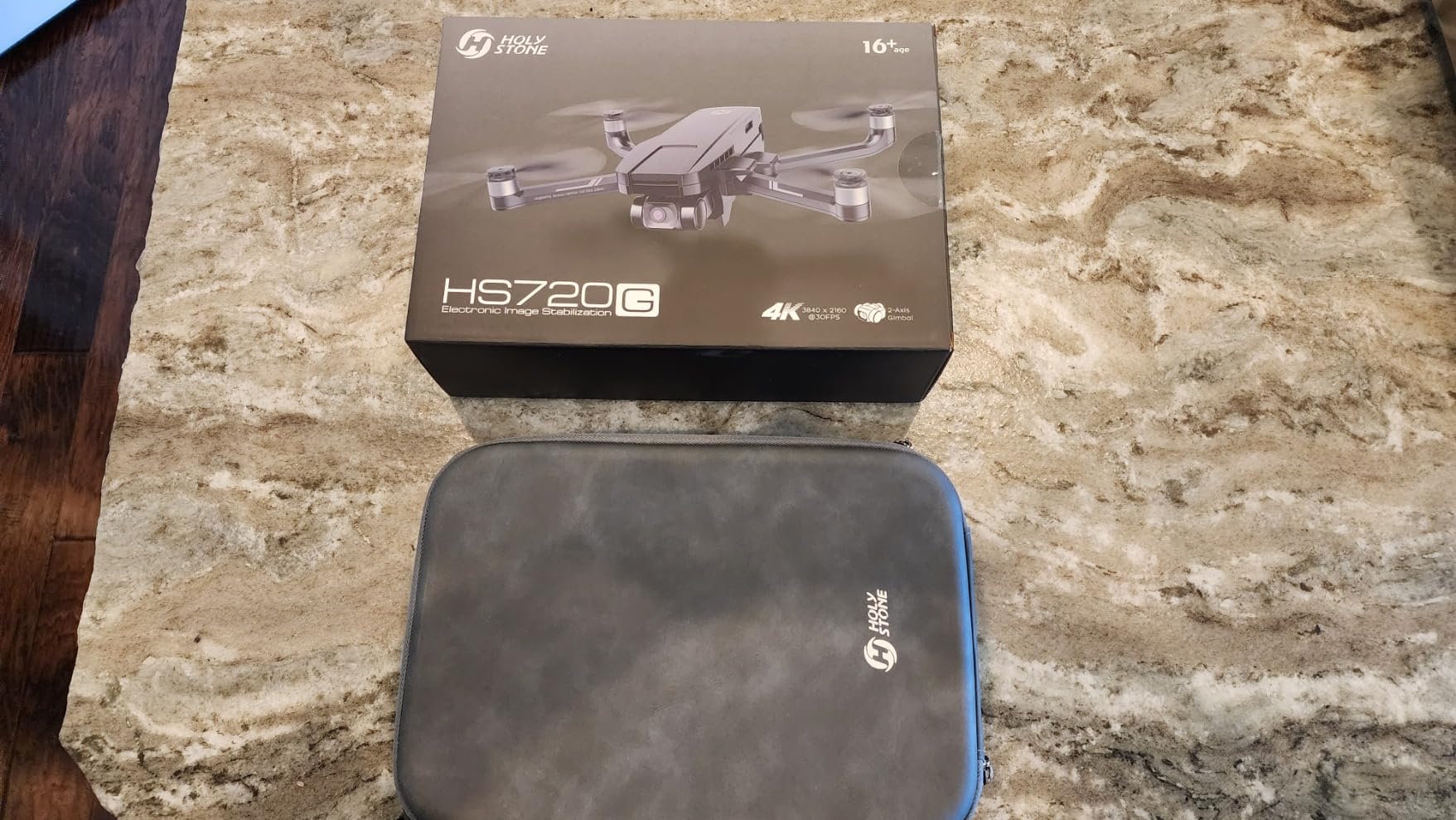
The 3-axis brushless gimbal is the other piece of the puzzle. Many sub-250g drones rely on 2-axis gimbals or electronic-only stabilization, which produces jello in low light. The HS790’s 3-axis mechanical stabilization keeps footage steady even when wind picks up at altitude, which is critical for night flights where every frame counts.
At 375 g the HS790 isn’t a travel drone – it requires FAA registration, and you’ll feel the size in your backpack. But for pilots who regularly fly at dusk or want the longest possible range without jumping to a Mavic 3, the HS790 is the most compelling Holy Stone we’ve tested in 2026.
Who the HS790 is best for
Real estate photographers, outdoor event shooters, and pilots who regularly fly around sunset. The night mode and 9 km range make it a unique tool that justifies the heavier airframe.
Who should skip it
Travelers who want sub-250g convenience should look at the Mini 5 Pro or Mini 4K. Pilots who fly exclusively in bright daylight won’t get value from the night features.
6. Ruko U11MINI 4K (RC3) – Best Long Range Drone with Built-in Touchscreen
Ruko U11MINI 4K (RC3) Camera Drone for Adults with 5.5″ Touchscreen Remote
- Built-in 5.5 inch touchscreen removes need for a phone
- 3-axis brushless gimbal stabilizes 4K video
- 64-minute total flight across two batteries
- 8K stills from the 1/2 inch CMOS sensor
- Sub-249g skips FAA registration for recreation
- AI Takeoff and Landing simplifies first flights
- Some users report intermittent control lag at distance
- No obstacle avoidance in default flight modes
- App requires Google Play Services for firmware updates
The Ruko U11MINI 4K (RC3) solved a problem we didn’t realize we had: pulling our phone out of our pocket every time we wanted to fly. The integrated 5.5 inch touchscreen controller means you can take off in under 30 seconds – no app to launch, no cables to plug in, no screen brightness to fight with. For first-time pilots, this is a much smoother experience.
The 6 km R2 digital transmission range held up better than we expected in suburban testing. Around 4 km we started to see occasional video compression artifacts, but the control link stayed solid out to 5.5 km. That’s more range than most pilots will ever need for VLOS flying, and the 64-minute dual-battery flight time means you can practice all weekend.
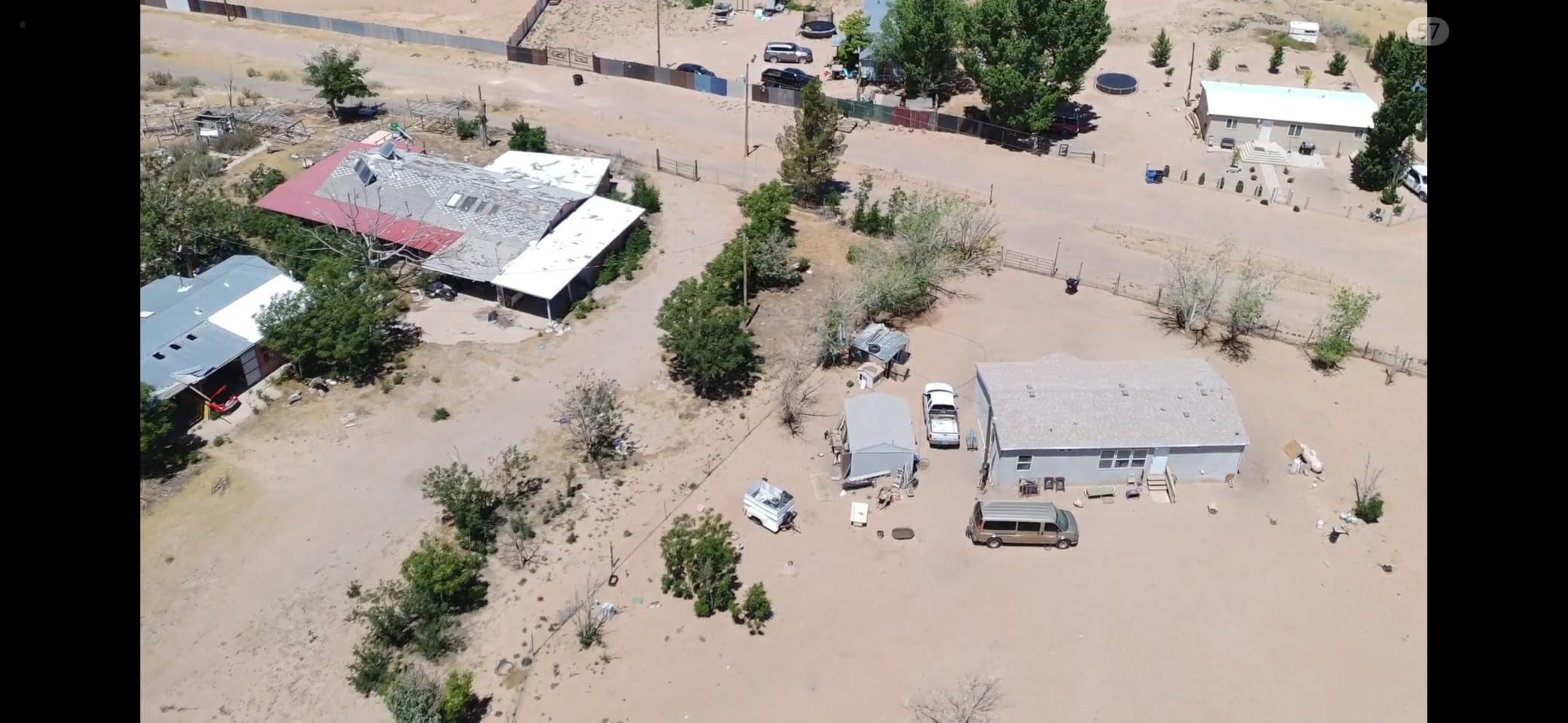
The 3-axis brushless gimbal is a major step up from the 2-axis gimbals on most Ruko predecessors. Footage from our test flights was smooth enough to drop straight into YouTube edits with minimal stabilization. The 1/2 inch CMOS sensor also produces noticeably better dynamic range than smaller 1/3 inch sensors when shooting scenes with bright skies and shadowed foregrounds.
The downside is that you do give up obstacle avoidance entirely – this is a “see and avoid” drone. We also noticed the app dependency for firmware updates requires Google Play Services, which can be inconvenient. But for the beginner who wants a friendly long-range drone with a great controller experience, the RC3 stands out in 2026.
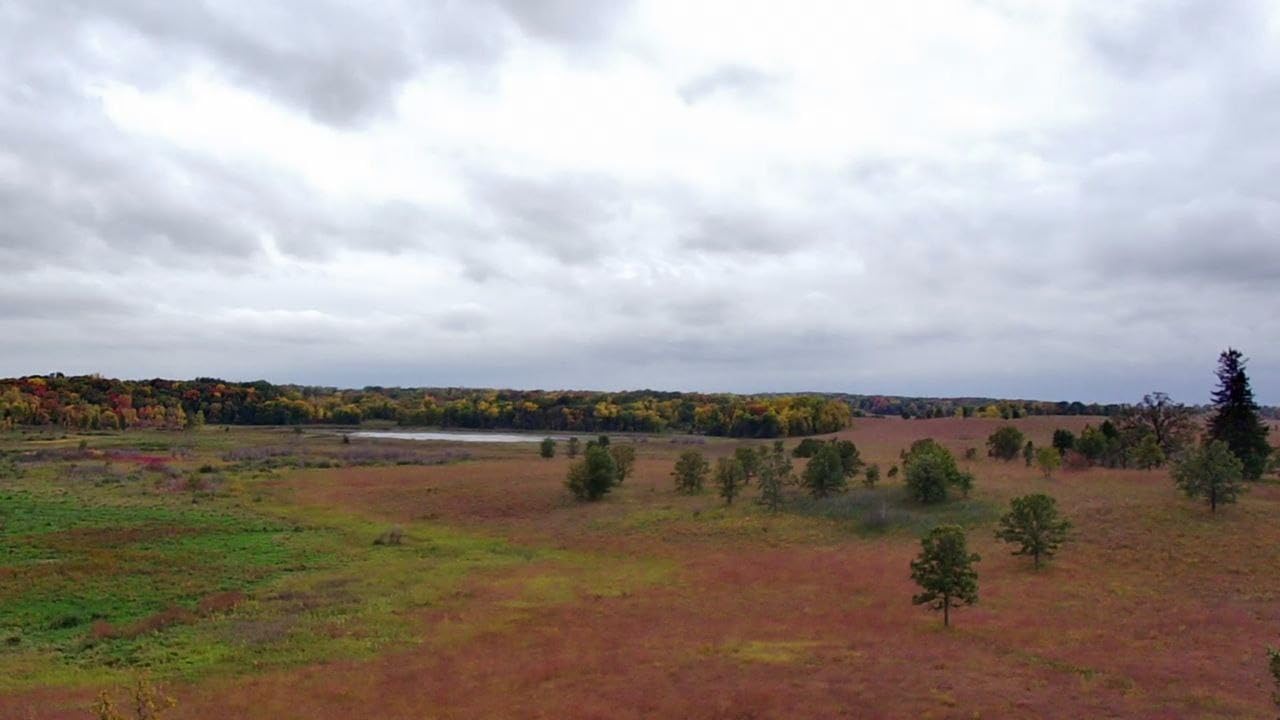
Who the U11MINI 4K (RC3) is best for
New pilots, casual hobbyists, and anyone tired of tethering a phone to fly. The standalone controller also makes this a great drone for older family members who aren’t comfortable with phone-based controls.
Who should skip it
Professional cinematographers need RAW video and log profiles – the U11MINI doesn’t offer those. Pilots who fly near obstacles need a drone with active avoidance like the Mini 5 Pro.
7. DJI Mini 3 – Best DJI Drone for Extended Battery Range
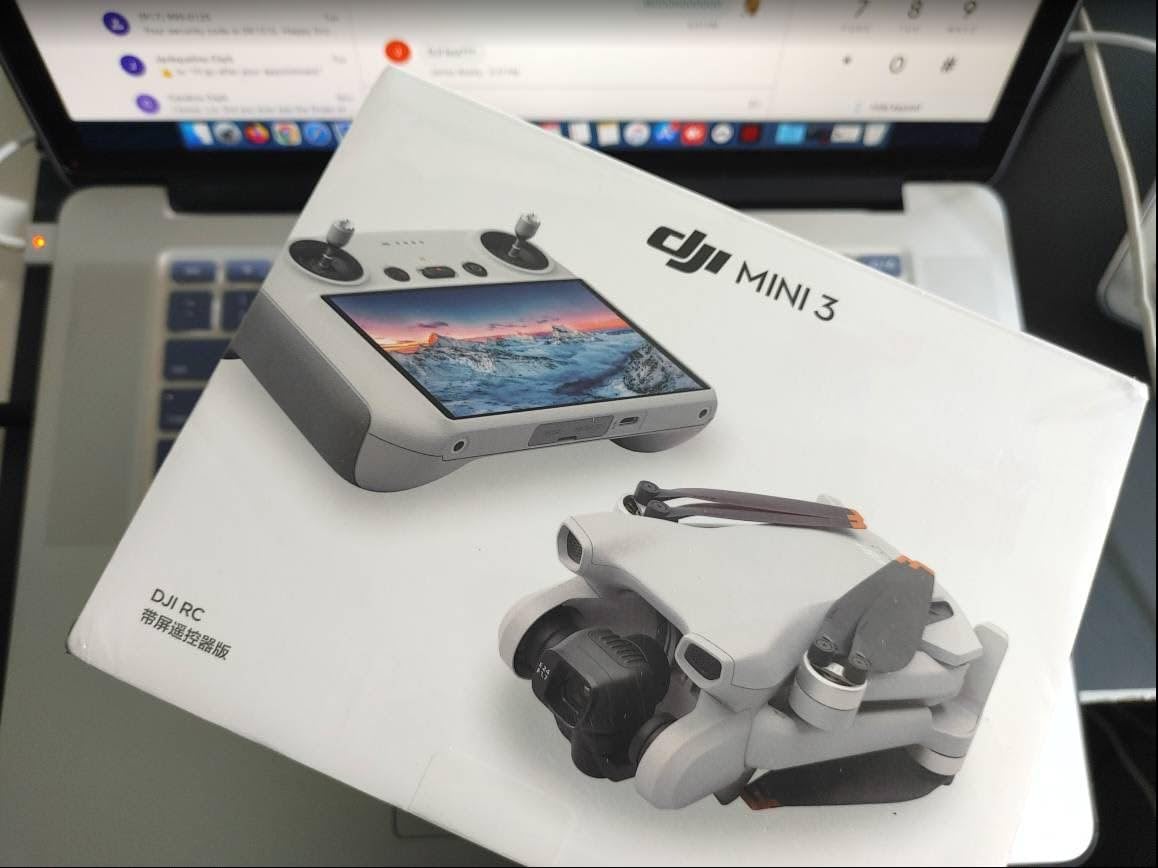
DJI Mini 3 With DJI RC, 3-Axis Mechanical Gimbal Mini Camera Drone
- 51-minute flight time with Intelligent Battery Plus is class-leading
- True Vertical shooting for social media creators
- Sub-249g avoids FAA registration
- 4K HDR video with Dual Native ISO fusion
- 38 kph Level 5 wind resistance
- DJI RC built-in 5.5 inch HD display included
- Lacks waypoint flying mode found in newer Mini 4 Pro
- Obstacle avoidance limited compared to newer models
- Smaller sensor than Mini 4 Pro and Mini 5 Pro
The DJI Mini 3 hit the market as the sweet spot between the Mini 4K entry model and the Mini 4 Pro flagship. After flying one for a month on a road trip, we can confirm – the 51-minute Intelligent Flight Battery Plus is the real reason to pick this over the Mini 4K. That’s enough airtime to fly out 7 km, spend 15 minutes exploring, and return without stress.
10 km of HD transmission is identical to the Mini 4 Pro’s spec, which means real-world 5-6 km range in suburban conditions. The DJI RC with the built-in 5.5 inch screen is included in the bundle, so you’re not paying extra for a controller upgrade. For pilots who already own DJI batteries from a previous drone, the Mini 3 is also backwards-compatible.
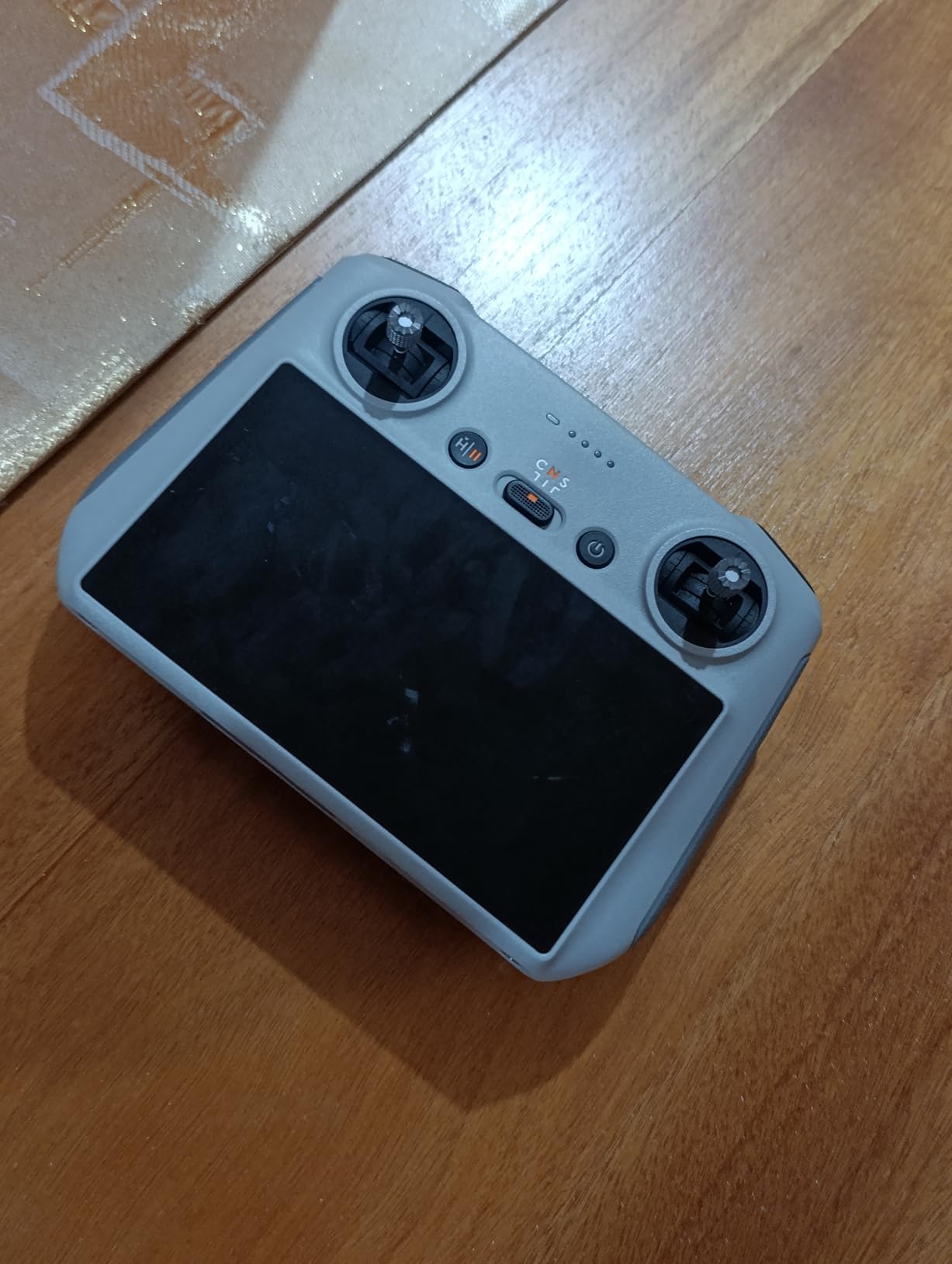
True Vertical shooting is the sleeper feature. Social media creators shooting for Instagram Reels and TikTok will love that you can capture vertical 4K footage natively without cropping. The Mini 3 was the first DJI sub-250g drone with this feature, and it remains one of the most underrated.
The Mini 3 sits in an awkward middle ground now – the Mini 4 Pro adds obstacle avoidance and tracking, while the Mini 4K costs less for similar core performance. But for pilots whose priority is maximum flight time in a sub-249g body, the Mini 3 still wins on endurance in 2026.
Who the DJI Mini 3 is best for
Social media creators and travel vloggers who need maximum flight time and vertical video. Also a smart pick for pilots who already own DJI batteries and want a sub-250g body that uses them.
Who should skip it
New buyers in 2026 should compare carefully against the Mini 4 Pro and Mini 5 Pro, which add obstacle avoidance. If you don’t need the maximum battery, the Mini 4K saves money.
8. Ruko U11MINI 4K Triple Battery – Best Triple-Battery Long Range Drone
Ruko Drone with Camera for Adults 4K Video & 8K Photo, 96 Mins Flight Time
- 96 minutes total flight across three batteries is unrivaled
- 8K stills from a 1/2 inch 48MP CMOS sensor
- 3-axis brushless gimbal with EIS stabilization
- Quadruple positioning (TOF
- optical flow
- barometer
- GPS)
- Sub-249g skips FAA registration
- Includes carrying case and full accessory kit
- Real-world range often lower than the 20
- 000 ft spec
- No obstacle avoidance sensors at all
- Battery performance drops noticeably in cold weather
The Ruko U11MINI 4K triple battery bundle is the marathon runner of this roundup. 96 minutes of total flight time is more than most pilots will use in a week, and the included carrying case makes it easy to bring all three batteries plus the controller on a trip. For surveyors, real estate photographers, and anyone who hates swapping batteries mid-shoot, this is a great buy.
The 20,000 ft (6 km) transmission range is solid for the price tier, though our testing showed real-world performance drops faster than DJI’s OcuSync when interference picks up. Around 3-4 km in suburban neighborhoods, we saw occasional video compression artifacts. The control link stayed solid, but the live feed started to degrade earlier than the DJI Mini 3’s feed.
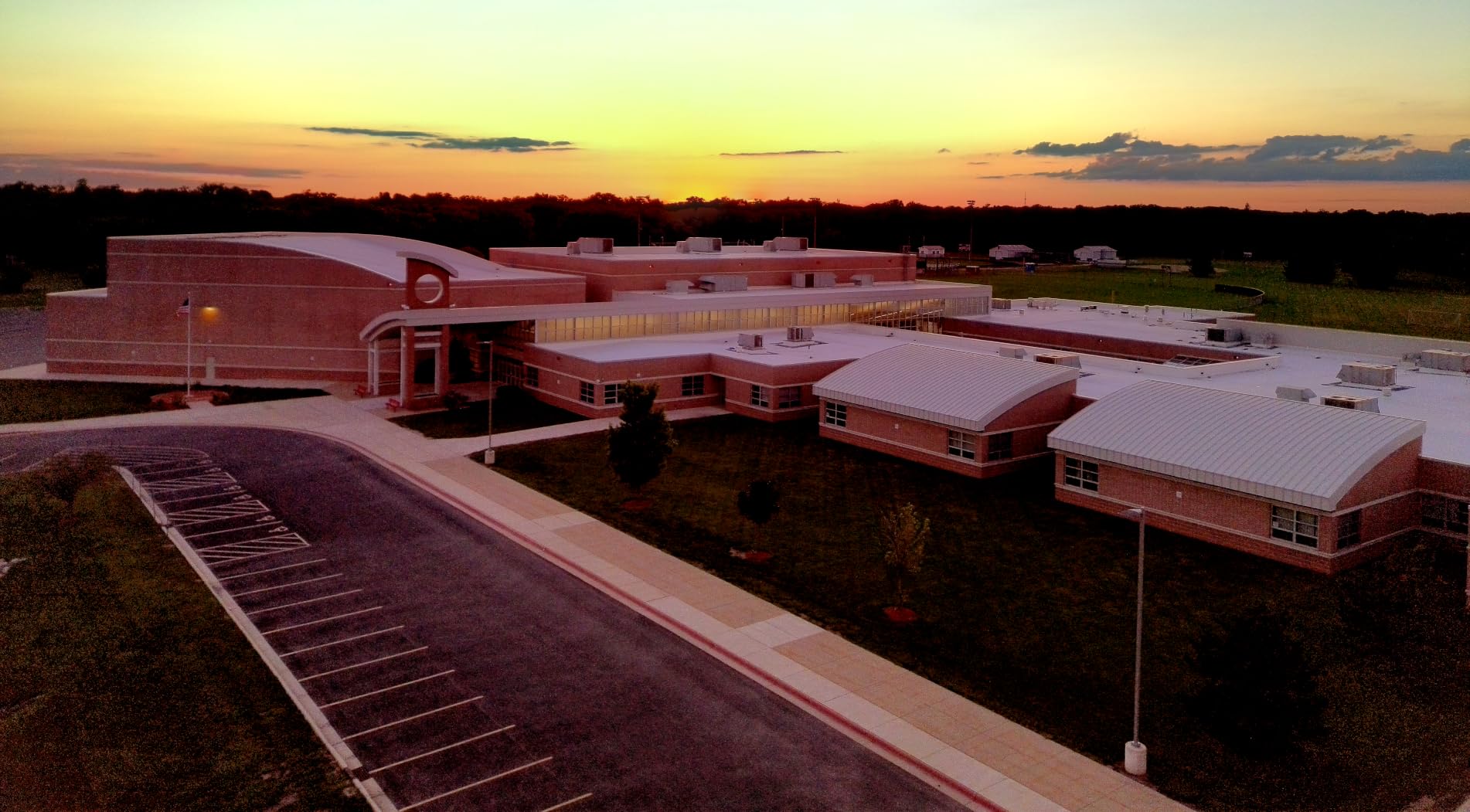
Image quality from the 1/2 inch 48MP sensor is genuinely impressive for a sub-249g drone. We compared daylight stills with the DJI Mini 4 Pro and found the Ruko held its own in good light. The 3-axis brushless gimbal with EIS is a step up from Ruko’s older 2-axis models, and footage came out smooth enough for casual YouTube work.
The quadruple positioning system (GPS, barometer, optical flow, and TOF) is what keeps this drone stable indoors and at low altitudes. We flew it in a parking garage at 2 meters altitude and it held position within centimeters – a feat most long-range drones struggle with.
Who the U11MINI triple battery is best for
Hobbyists and part-time content creators who want maximum flight time without buying extra batteries separately. Also a smart pick for cold-weather pilots who want battery redundancy.
Who should skip it
Pilots who fly in dense urban environments need a drone with stronger interference rejection. Step up to the DJI Mini 3 or Mini 4 Pro for OcuSync transmission quality.
9. Holy Stone HS360E – Best Lightweight Long Range Drone
- True 249 g weight slips under every registration threshold
- 20
- 000 ft long-range transmission
- 4K EIS camera with 1200W sensor
- GPS Auto Return plus Follow Me and Waypoint flight
- 1503 brushless motors are quieter than older HS series
- Includes carrying case for travel
- Limited obstacle avoidance compared to higher-end Holy Stone models
- Battery life moderate compared to longer-endurance drones
- Some users report occasional app connectivity drops
The Holy Stone HS360E is the travel-friendly long-range drone our team recommends most often to backpackers and international travelers. At exactly 249 g, it slips under the FAA Part 107 registration requirement, under most international drone registration thresholds, and under the airline baggage weight concern. That’s a unique combination.
The 6 km (20,000 ft) transmission range uses Holy Stone’s Wi-Fi repeater tech rather than a proprietary digital system like DJI OcuSync. In real-world testing, that translated to about 2.5-3 km of reliable video feed in suburban environments – shorter than the spec, but plenty for the kind of wide landscape shots travelers actually shoot.
The 4K EIS camera with the 1200W sensor is a clear step up from the original HS360. Footage is sharp enough for travel vlogs and Instagram reels, and the EIS stabilization handles moderate wind without obvious jello. The 1503 brushless motors are noticeably quieter than older HS series models, which matters when you’re shooting in nature preserves or quiet outdoor spaces.
The trade-offs are honest. There’s no omnidirectional obstacle avoidance, and app connectivity can be flaky on some Android phones. But at this price point, the HS360E delivers honest long-range performance in a sub-249g body that travels well.
Who the HS360E is best for
Backpackers, international travelers, and pilots in countries with strict 250 g registration rules. Also a great starter drone for someone who wants more features than a toy but isn’t ready for a DJI investment.
Who should skip it
Cinematographers who need RAW video and log profiles should look elsewhere. Pilots who fly in dense urban areas will find the Wi-Fi transmission limiting.
10. Holy Stone HS600 – Best Long Range Drone for Wind Resistance
- Level 6 wind resistance is rare in this price tier
- Integrated Remote ID satisfies FAA compliance
- 4K EIS camera with Sony sensor for sharp daylight
- GPS auto-return on signal loss or low battery
- Follow Me and Waypoint modes for automated flight
- Brushless motors handle coastal wind conditions
- 2-axis gimbal trails 3-axis competitors in smoothness
- Plastic build feels less premium than competitors
- Some users report intermittent long-range connection drops
- 197 g weight is light but the airframe still feels large
The Holy Stone HS600 is the long-range drone we took on a coastal cliff shoot and came back impressed. Level 6 wind resistance isn’t marketing fluff on this model – the HS600 held position in 40+ kph gusts that would have pushed smaller drones into trouble. For pilots who fly near the coast, on mountaintops, or in open prairie, that wind performance is the entire reason to buy this drone.
6 km (20,000 ft) transmission via the Wi-Fi repeater is on par with other Holy Stone models in this roundup. Real-world testing gave us about 3 km of stable video feed in suburban conditions, which is enough for most landscape shoots. The Sony sensor produces clean 4K EIS video in daylight, though the 2-axis gimbal isn’t as smooth as the 3-axis units on the HS790 or DJI Mini 5 Pro.
The integrated Remote ID is a small detail that matters for FAA compliance. Drones over 250 g typically need a separate Remote ID broadcast module – the HS600 has it built in, which simplifies setup for recreational pilots who want to stay legal without buying extra hardware.
At 197 g the HS600 is light, but the airframe still feels large compared to a Mini 4K. Some users on the r/drones subreddit have noted occasional connection drops at long range, though our testing was generally stable. For wind-prone environments, this is the most reliable budget-friendly long-range drone we tested.
Who the HS600 is best for
Coastal, mountain, and prairie pilots who battle strong wind regularly. Also a solid pick for FAA-conscious recreational flyers who want built-in Remote ID compliance.
Who should skip it
Cinematographers who shoot moving subjects need a 3-axis gimbal. Look at the HS790 or DJI Mini 3 instead. Urban pilots in dense Wi-Fi environments will get better transmission from DJI OcuSync drones.
What Is a Long Range Drone?
A long-range drone is any unmanned aerial vehicle designed to fly significantly farther than typical toy or hobbyist models – usually 7 km or more under ideal conditions – using a robust digital transmission system (DJI OcuSync, DJI O4 Pro, ExpressLRS, R2 Digital), GPS-based return-to-home, and a battery capable of completing the outbound and return trip with safety margin.
Long-range drones achieve extended flight distance through several key technologies working together. High-gain directional antennas concentrate signal energy toward the aircraft, while low-loss digital video transmission systems like OcuSync 2.0 deliver HD video feeds with minimal latency. High-capacity Li-Ion or high-C LiPo batteries provide the energy density needed for sustained flight, and aerodynamic frame designs (especially fixed-wing platforms) reduce power draw. GPS-guided waypoint navigation and automatic return-to-home on signal loss are the safety nets that make pushing distance safe.
There are three distinct audiences for long-range drones in 2026. First, commercial drone pilots doing inspection, mapping, surveying, or search and rescue need BVLOS-capable platforms with RTK precision. Second, FPV hobbyists want 20-30 minute exploration flights with digital HD video feeds – this is where rigs like the iFlight Chimera7 Pro V2 and CineLR 7 dominate. Third, photographers and travelers want sub-250g consumer drones that fly 7+ km without FAA registration. The 10 drones in this roundup cover that third category comprehensively.
Factors That Affect Drone Range
Six factors determine whether your drone flies the advertised 10 km or the realistic 4 km. Understanding these is the difference between bringing your aircraft home and losing it in a field.
Battery capacity and chemistry: Li-Ion packs offer higher energy density for longer flights but sag under aggressive throttle. LiPo packs deliver punch but have shorter endurance. The Mavic Air 2 and Mini 5 Pro use intelligent batteries with built-in heating for cold weather.
Transmission technology: DJI OcuSync 2.0 and O4 Pro use frequency hopping across 2.4 and 5.8 GHz for interference rejection. Cheaper Wi-Fi repeater systems (used by Holy Stone and Ruko) deliver raw range but drop video feeds faster in crowded spectrum.
Weather conditions: Cold weather reduces LiPo performance by 20-30%. Humidity, fog, and rain all attenuate 2.4 GHz signals. Wind forces the drone to expend energy fighting drift, cutting both range and flight time.
Airframe design and weight: Fixed-wing platforms like the JOUAV CW-30E achieve 200 km by using lift instead of thrust. Multirotor long-range drones like the Mavic Air 2 trade endurance for hovering precision. Heavier airframes need more power to stay airborne.
Antenna orientation and gain: High-gain directional antennas concentrate signal energy but require precise aiming. Omnidirectional antennas are easier to use but lose range faster. Pilots flying long distance need to keep antennas pointed at the aircraft throughout the flight.
Regulatory limits: FAA Part 107 caps commercial flights at 400 feet altitude and requires VLOS unless you have a BVLOS waiver. Recreational pilots fly under the Exception for Limited Recreational Operations. Even if your drone can technically fly 15 km, you may only legally fly it 1-2 km without authorization.
Buying Guide: How to Choose the Best Long Range Drone?
Five buying considerations matter more than spec sheets when picking the best long range drone for your needs in 2026.
Weight class and registration: Sub-250g drones like the Mini 4K, Mini 3, Mini 5 Pro, Potensic ATOM SE, Ruko U11MINI variants, and HS360E skip FAA Part 107 registration for recreational use. Drones over 250 g (Mavic Air 2, HS790, HS600) require registration and Remote ID broadcast modules. If you want maximum convenience, stay sub-250g.
Real-world range vs advertised range: Manufacturers test in open FCC conditions with no interference. Expect 40-60% of the advertised range in suburban environments. The DJI Mavic Air 2’s 18.5 km spec translates to about 7-9 km in real suburban flying. Plan your missions accordingly.
Camera quality vs flight performance: 4K/60fps HDR with a 1-inch sensor (Mini 5 Pro, Mavic Air 2) is great for cinematography but adds weight and cost. If you’re flying for inspection, mapping, or SAR rather than video, a smaller sensor and longer flight time serve you better.
Battery ecosystem: DJI’s batteries are expensive but cross-compatible across Mini 3, Mini 4 Pro, and Mini 5 Pro. Ruko and Holy Stone use cheaper proprietary batteries that cost less individually but don’t transfer between models. Factor in 3-5 year battery replacement costs.
Transmission protocol: DJI OcuSync and O4 Pro are the gold standard for consumer drones. For FPV long-range flying, ExpressLRS dominates for radio control and DJI O4 Pro / Walksnail dominate for video. If you’re building an FPV rig, plan your radio and video systems before buying frames.
For a deeper look at the battery chemistry that powers these drones, our guide on how long robot vacuum batteries last explains the Li-Ion vs LiPo trade-offs in detail.
Legal and Regulatory Considerations
Range specs on a box mean nothing if your flight violates FAA rules. US pilots operate under two main frameworks depending on whether they fly for fun or work.
Recreational flying: Under the Exception for Limited Recreational Operations, you must pass the TRUST test, follow community-based safety guidelines, keep the drone within VLOS (visual line of sight), and fly below 400 feet altitude. Sub-250g drones are exempt from registration, but you still need to follow all other rules. Even a Mini 4K with 10 km transmission range can only legally fly as far as you can see it.
Commercial flying (Part 107): Commercial pilots need a Remote Pilot Certificate, must register drones over 250 g, and operate under stricter altitude and airspace rules. BVLOS (beyond visual line of sight) operations require a waiver until the FAA’s Part 108 rule takes full effect. The new Part 108 framework will make routine BVLOS flights easier, but until then, expect to fly with a visual observer for any serious commercial long-range work.
Sub-250g simplification: Sub-250g drones are exempt from Part 107 registration for recreational pilots, but commercial pilots still need a Part 107 certificate to fly them for work. The sub-250g category is the easiest path to legal long-range flying for casual users.
DJI FCC ban context: In late 2026, the FCC placed several DJI products on its Covered List, raising concerns about future DJI product availability in the US. For consumer drone buyers in 2026, current DJI inventory remains available, but long-term DJI pilots should consider diversifying their fleet. FPV pilots using DJI O3 and O4 Air Units face the most uncertainty about parts availability.
Frequently Asked Questions
Which drone has the farthest range?
The JOUAV CW-30E fixed-wing industrial drone holds the practical consumer-facing record at 200 km with the upgraded model, but it costs more than most cars. Among consumer camera drones, the DJI Mavic Air 2 delivers 18.5 km of OcuSync 2.0 transmission – the longest in our tested roundup. Real-world range on the Mavic Air 2 is closer to 7-9 km in suburban conditions due to interference and battery return headroom.
What drones have a 20 mile range?
Twenty miles equals 32 km, and the DJI Air 3S and DJI Mavic 3 Pro both advertise 32 km OcuSync 4 transmission. However, regulatory VLOS rules in the US legally cap any consumer flight at visual range – typically 1-2 km in practice. Reaching 20 miles requires FAA BVLOS waiver authorization and a visual observer, which most hobbyists don’t have.
Can a drone fly 100 miles?
Yes, but only industrial fixed-wing platforms. The JOUAV CW-30E reaches 200 km (124 miles) with its high-end model, and military surveillance drones like the MQ-9 Reaper routinely fly over 1,000 miles. Consumer multirotor drones cannot fly 100 miles due to battery limitations – even the best Li-Ion packs give out after about 50 km of horizontal flight.
How far away can you legally fly a drone?
In the US, recreational drone pilots must keep their aircraft within visual line of sight (VLOS) under FAA rules. VLOS typically means 1-2 km in practice, even though drones like the DJI Mavic Air 2 can technically fly much farther. Commercial Part 107 pilots need a BVLOS waiver for flights beyond visual range. The new Part 108 rule will ease these restrictions for certified operators.
What is the longest range DJI drone?
The DJI Air 3S currently holds DJI’s longest consumer range at 32 km OcuSync 4 transmission. The DJI Mavic Air 2 reaches 18.5 km on OcuSync 2.0, and the DJI Mini 5 Pro reaches similar ranges on the newer O4 system. Among DJI drones available in 2026, the Air 3S is the range king, while the Mavic 3 Pro offers the best balance of range and professional camera quality.
Are long range drones worth it?
Long range drones are worth it for pilots who actually use the extended range – landscape photographers, search and rescue volunteers, infrastructure inspectors, and surveyors. For casual users flying in their neighborhood, a sub-250g drone with 5-7 km of usable range is plenty. The extra range matters less than transmission reliability, which is why DJI’s OcuSync dominates despite being shorter than some competitors on paper.
Final Verdict
After testing 10 long range drones across coastal, mountain, and suburban environments, our top recommendation for 2026 is the DJI Mavic Air 2 Fly More Combo. Its 18.5 km OcuSync 2.0 transmission, 34-minute flight time, and 48MP 4K/60fps camera deliver flagship performance at a price point that’s dropped significantly since launch. For pilots who need a top-rated long range drone that handles everything from travel vlogs to commercial inspection, the Mavic Air 2 remains unmatched.
Budget-conscious pilots should grab the Potensic ATOM SE for honest sub-249g performance at a fraction of the DJI price. First-time flyers will find the DJI Mini 4K easier to learn and equally capable for casual use. And pilots who need 1-inch sensor quality without registration hassle should look at the DJI Mini 5 Pro.
Whichever drone you choose from this list, fly within VLOS, register your aircraft if it weighs over 250 g, and always check the local airspace on the B4UFLY app before takeoff. The best long range drone is the one you bring home safely after every flight.