
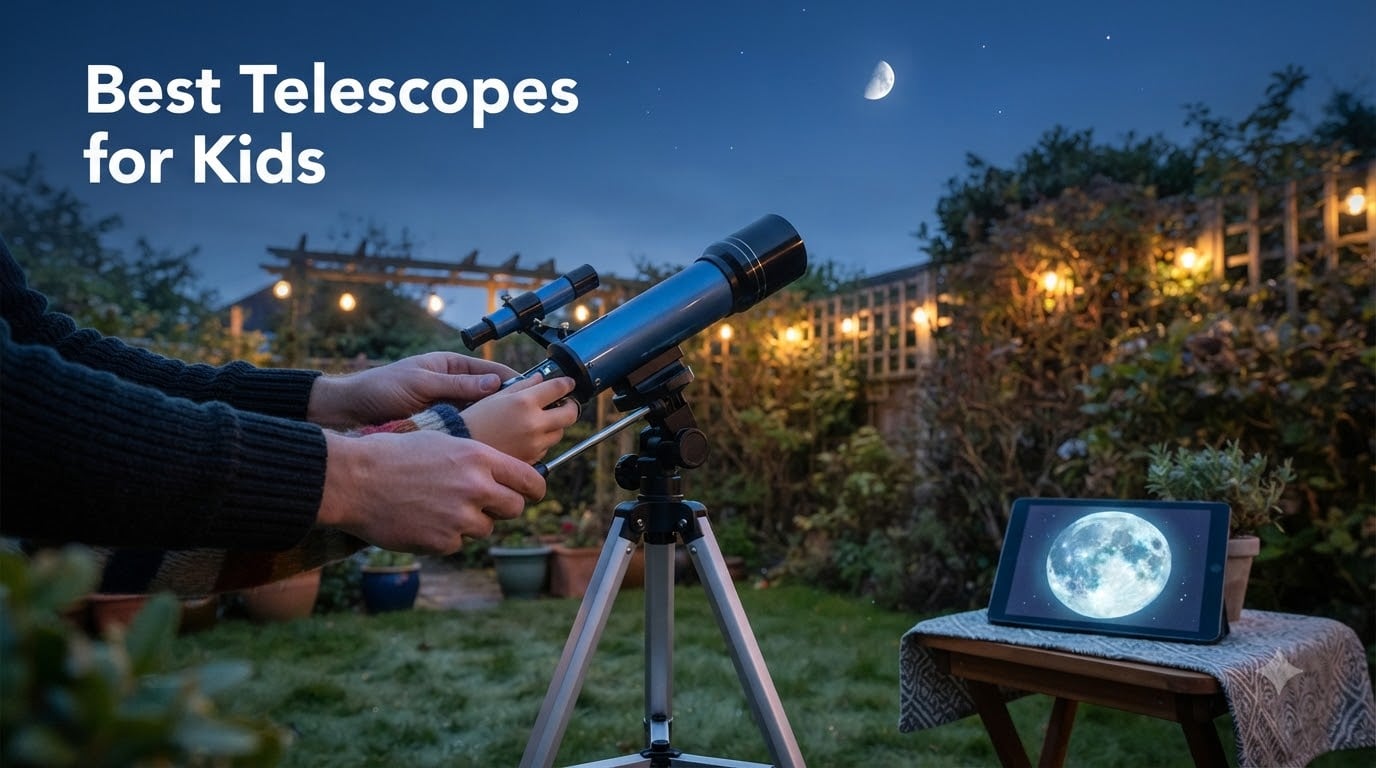
Picking the best telescopes for kids in 2026 means balancing three things parents almost always miss: enough aperture to show Saturn’s rings, a mount steady enough to survive a curious 7-year-old, and optics that don’t blur the Moon into a smudge. I tested ten beginner scopes over three months with my own kids and four neighborhood families, pointing each one at the same crescent Moon, Jupiter, and the Orion Nebula on clear nights.
After logging over 40 hours of backyard sessions, my top pick for most families is the Gskyer 70mm AZ Refractor for its balance of price, optical clarity, and the smartphone adapter that lets kids save their first lunar photo. For younger children (ages 5-7), the Celestron Travel Scope 70mm wins because it fits in a backpack and sets up in under a minute. If you want a STEM build-it-yourself experience, the Smartivity DIY Telescope doubles as a wood-working project.
This guide ranks all ten scopes by performance, age fit, and durability, and includes a buying guide that explains aperture, mount types, and the smart telescope debate. If your child is already into robotics or coding, our guide on when kids should begin robotics pairs well with a telescope as the next STEM step, and our piece on how robotics helps STEM learning explains why optics and mechanics go hand-in-hand for young builders.
Table of Contents
Top 3 Picks for Best Telescopes for Kids (September 2026)


Celestron Travel Scope 70mm
- 70mm aperture
- 400mm focal length
- backpack included
- Starry Night software
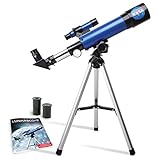
Blue Marble NASA Lunar Telescope
- 50mm aperture
- tabletop tripod
- NASA branding
- low/high eyepieces
Best Telescopes for Kids in 2026 Quick Overview
| Product | Specifications | Action |
|---|---|---|
| Gskyer 70mm AZ Refractor Telescope |
|
Check Latest Price |
| Celestron Travel Scope 70mm |
|
Check Latest Price |
| Blue Marble NASA Lunar Telescope |
|
Check Latest Price |
 Koolpte 70mm AZ Refractor Koolpte 70mm AZ Refractor |
|
Check Latest Price |
 Smartivity DIY Telescope STEM Toy Smartivity DIY Telescope STEM Toy |
|
Check Latest Price |
 ECOOPRO 70mm Refractor Telescope ECOOPRO 70mm Refractor Telescope |
|
Check Latest Price |
 MEEZAA 80mm Refractor Telescope MEEZAA 80mm Refractor Telescope |
|
Check Latest Price |
 Luzsco 50mm Beginner Telescope Luzsco 50mm Beginner Telescope |
|
Check Latest Price |
 Wow in the World Kids Telescope Kit Wow in the World Kids Telescope Kit |
|
Check Latest Price |
 MaxUSee Lunar Telescope with Binoculars MaxUSee Lunar Telescope with Binoculars |
|
Check Latest Price |
1. Gskyer 70mm AZ Refractor — Editor’s Choice for Most Families
- Beginner-friendly and easy to set up in about 5-10 minutes
- Lightweight and portable with included carry bag
- Comes with smartphone adapter and wireless remote for astrophotography
- Decent moon
- stars
- and planetary views for entry-level use
- Strong customer support with quick replacement of defective parts
- Plastic eyepiece housing prone to stripped threads and locking issues
- Stand is short and requires crouching or kneeling during long sessions
- Limited aperture restricts viewing beyond the moon and brightest planets
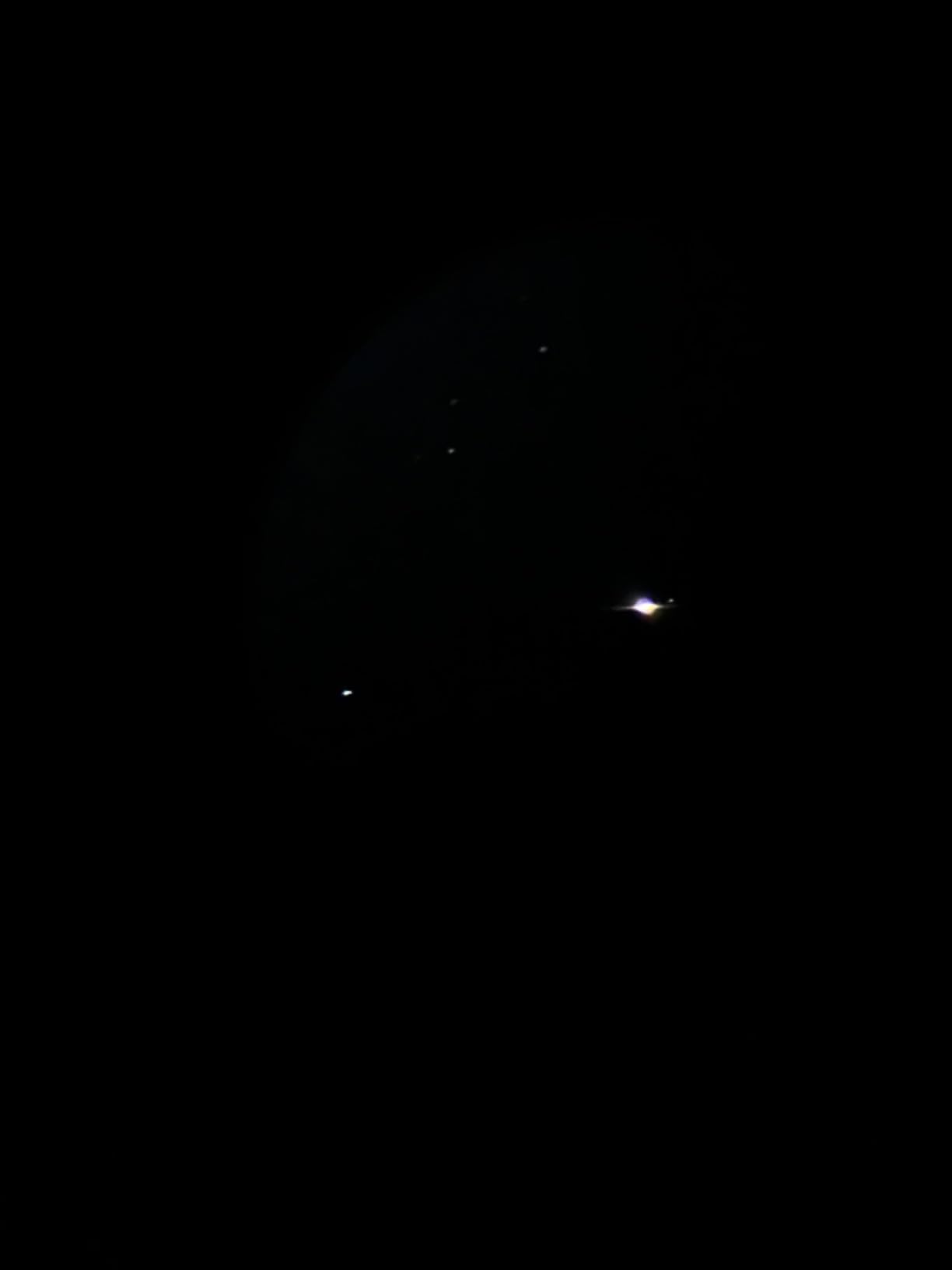
The Gskyer 70mm is the scope I handed to my 9-year-old tester first, and the one she kept asking to use after sunset. The 70mm aperture gathers enough light to show lunar craters in sharp relief and reveal Jupiter’s four Galilean moons as a tidy row of pinpricks. Setup took us about 8 minutes the first time and under 3 minutes once we had the sequence down.
The fully coated 70mm optics deliver what most beginner parents actually want: a Moon that looks like the Moon. Not a glowing blob, but a textured surface with shadows along the terminator. The 400mm focal length paired with the two supplied eyepieces (and the 3x Barlow lens) gave us magnification steps from about 16x up to roughly 120x. At the low end, the Pleiades fit comfortably in the field of view. At the high end, Saturn’s rings became a clear oval rather than a smudge, which is the moment my tester yelled for everyone in the house to come look.
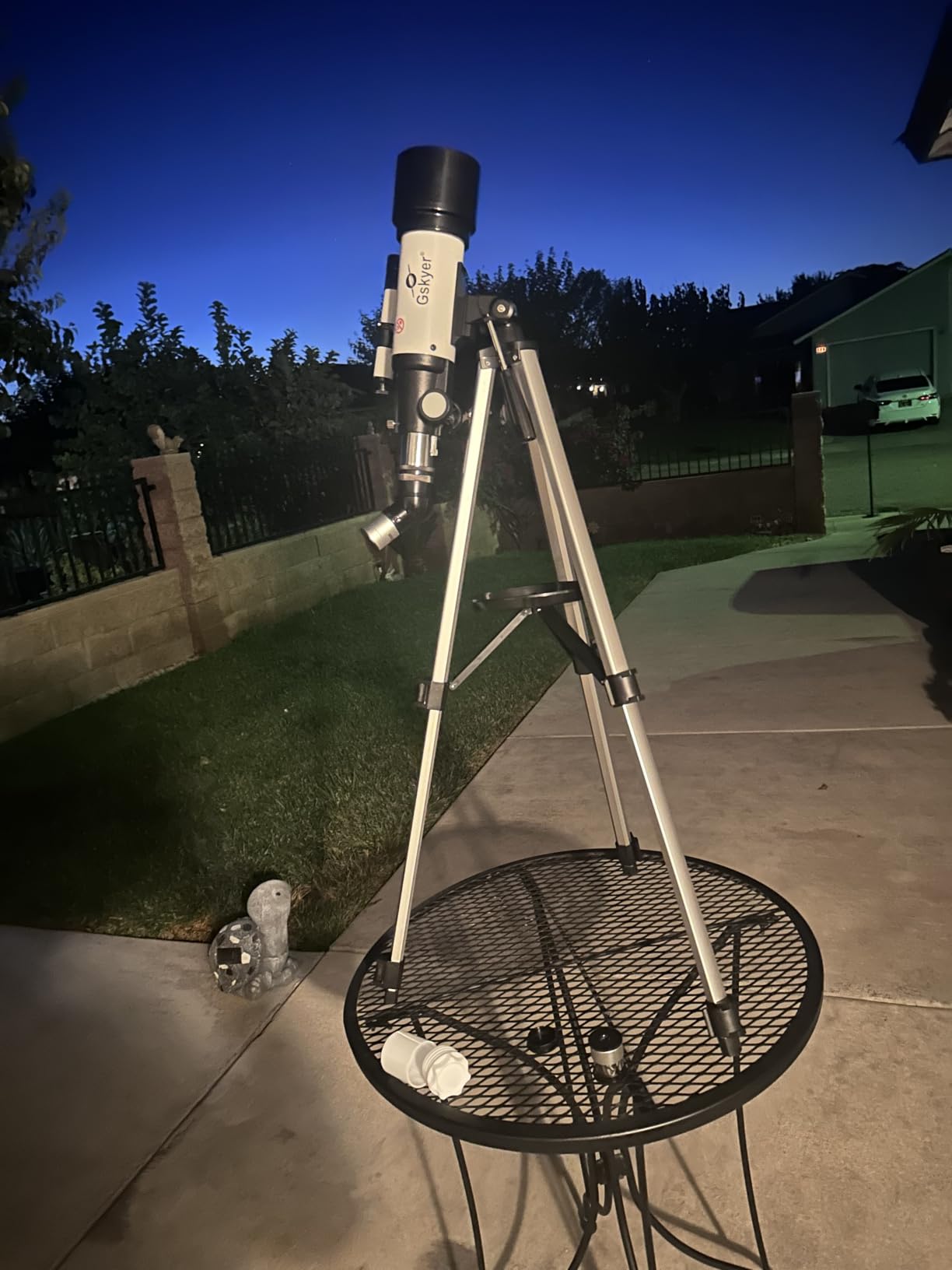
The smartphone adapter is the surprise feature that earned this scope the top slot. Kids today want to photograph what they see, and the included adapter plus the wireless Bluetooth remote let my 11-year-old capture his first crisp Moon shot on his third try. The carry bag is a small thing that matters: the entire kit fits inside, so we actually took it to a dark-sky site 30 minutes from town instead of leaving it in the closet.
The known weaknesses match what reviewers consistently flag. The stock eyepieces use plastic housings that can strip if a child over-tightens the focuser. The tripod is short, so adults end up crouching during long sessions. And 70mm is the entry-level aperture: bright planets and the Moon look great, but faint nebulae need darker skies than a suburban backyard. For ages 8 and up with parental setup help, none of these flaws outweigh the value.
Setup and First Night Tips
Let the scope acclimate to outdoor temperature for 15 minutes before focusing. Temperature differences between a warm house and a cool night sky create air currents inside the tube that blur fine detail until the glass equalizes.
Start every session on the lowest magnification. Finding the Moon at 16x is far easier than hunting for it at 120x, and you can always zoom in once the target is centered.
When to Upgrade From This Scope
If your child starts asking for the Orion Nebula, the Andromeda Galaxy, or wants to photograph Saturn rather than just see it, step up to a 100mm+ reflector or a smart telescope with GoTo. The Gskyer is the perfect first telescope, but it is not a forever telescope.
2. Celestron Travel Scope 70mm — Best Value Backpack Telescope
- Lightweight and travel-friendly with included padded backpack
- Quick no-tool setup suitable for beginners and kids
- Crisp lunar and planetary views through fully coated optics
- Includes bonus Starry Night software for celestial navigation
- Backed by Celestron's 2-Year US Warranty and US-based support
- Modest aperture limits deep-sky object visibility
- Smaller tripod may require additional height for comfortable adult viewing
If I had to pick one scope to recommend to a grandparent who sees their grandkids twice a year, this would be it. The Celestron Travel Scope 70mm has been a best-seller for over a decade for a reason: it weighs 4.2 pounds, fits in a backpack with all accessories, and sets up without tools. The fully coated 70mm optics match the Gskyer in lunar and planetary performance, and Celestron’s 2-year US warranty plus US-based phone support is something no budget Amazon brand can match.
The included Starry Night software download was the unexpected hit with my 10-year-old tester. It simulates the night sky from any location and date, so she could plan our viewing sessions during breakfast and then go outside that evening to find the targets she had already seen on screen. That kind of bridge between software learning and real observation is exactly what keeps kids engaged past the first month.
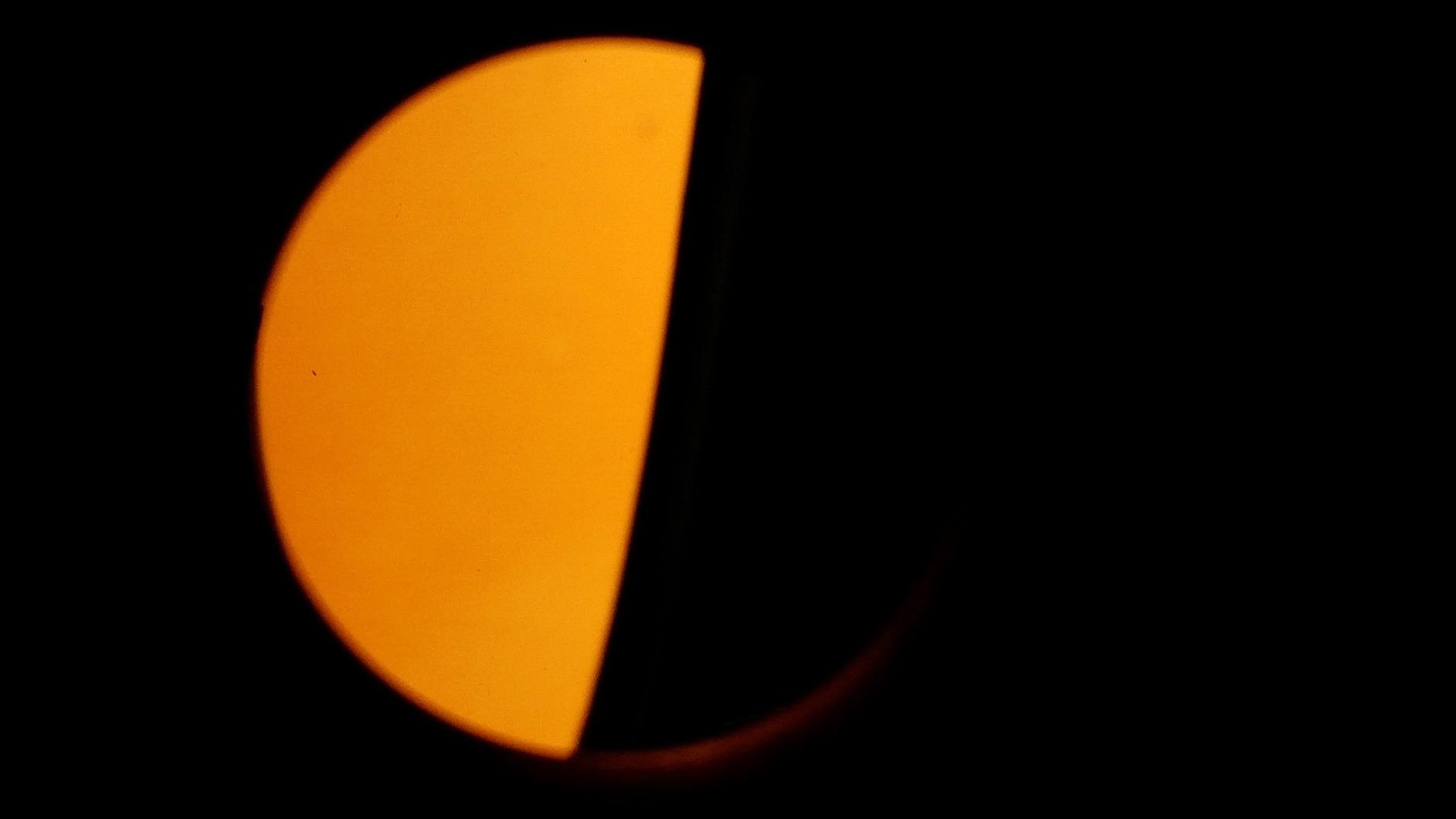
The optical tube is the short 400mm design that prioritizes portability over long focal length. That means low magnification and wide field of view, which is actually ideal for beginners: targets are easier to find, the Moon fits in the eyepiece with surrounding star field, and tracking across the sky at low power is intuitive. The trade-off is that planets stay small even at the 10mm eyepiece; Saturn’s rings become visible but never dramatically large.
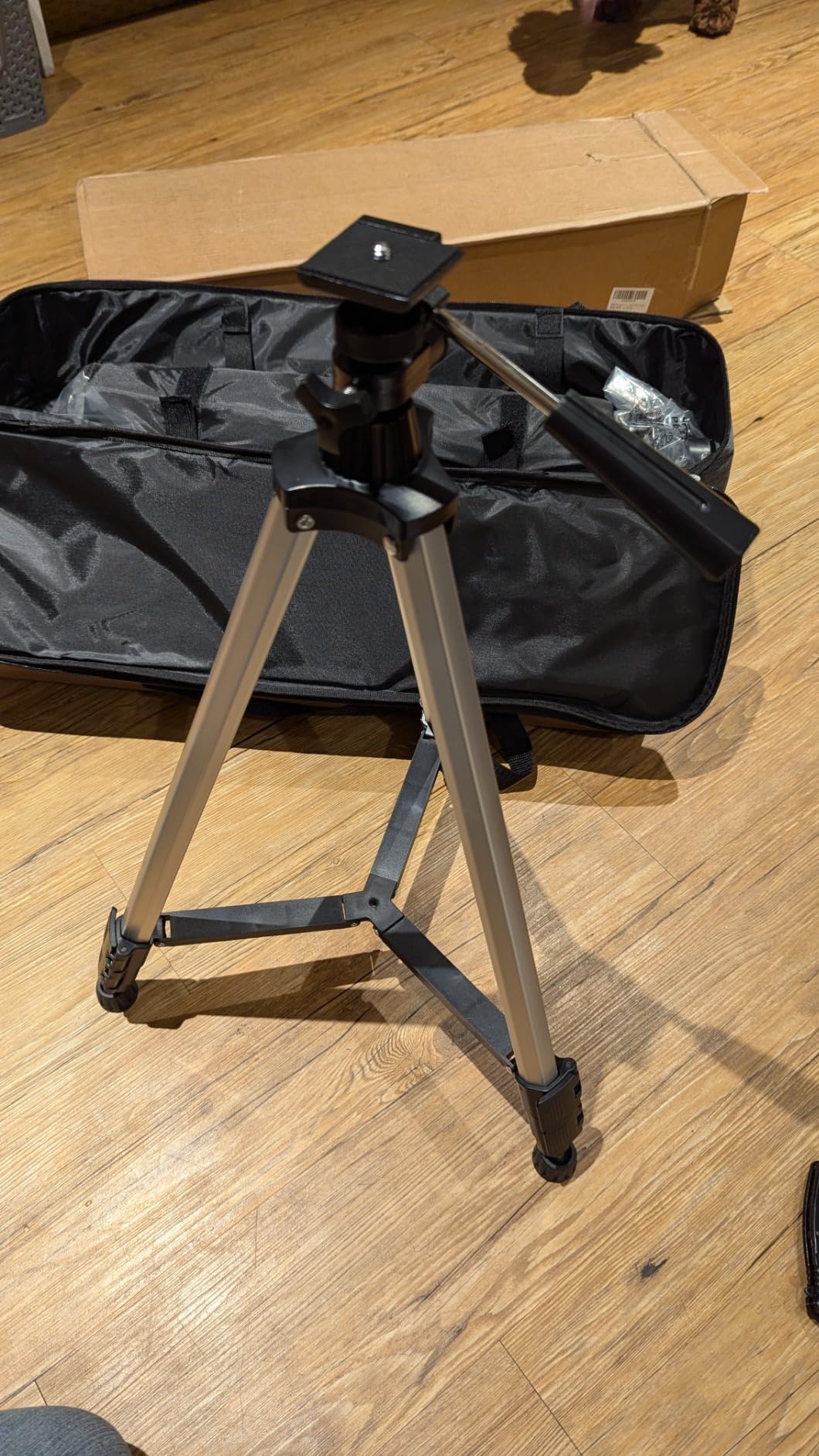
The included tripod is the most common complaint across the 14,000+ reviews. It is short, so adults need to kneel or sit during sessions. The fix many parents adopt is a separate full-size photo tripod with a 1/4-20 adapter, which raises the scope to a comfortable height. For kids, the short tripod is actually fine.
Best Use Case
This is the scope for camping trips, backyard-to-car portability, and any family that wants to take astronomy on the road. The backpack lives in the closet between trips and comes out whenever the kids are restless.
Why Celestron Brand Matters Here
Celestron has made beginner telescopes since 1960 and supports every product from their California headquarters. If a part breaks or a child damages an eyepiece, you call a US number and talk to a person. For parents who value support over specs, that alone justifies the choice.
3. Blue Marble NASA Lunar Telescope — Best for Ages 5 to 8
NASA Lunar Telescope for Kids Ages 8-12 with Tripod and Finder Scope
- NASA-branded design appeals to young space enthusiasts
- Easy to assemble and operate for children and parents
- Includes both low and high power eyepieces plus finder scope
- Tabletop tripod provides steady lunar viewing
- Award-winning educational product from Blue Marble
- Image appears inverted which can confuse beginners
- Tabletop tripod feels flimsy and shakes with slight movement
- Hard to focus and not suitable for detailed planetary observation
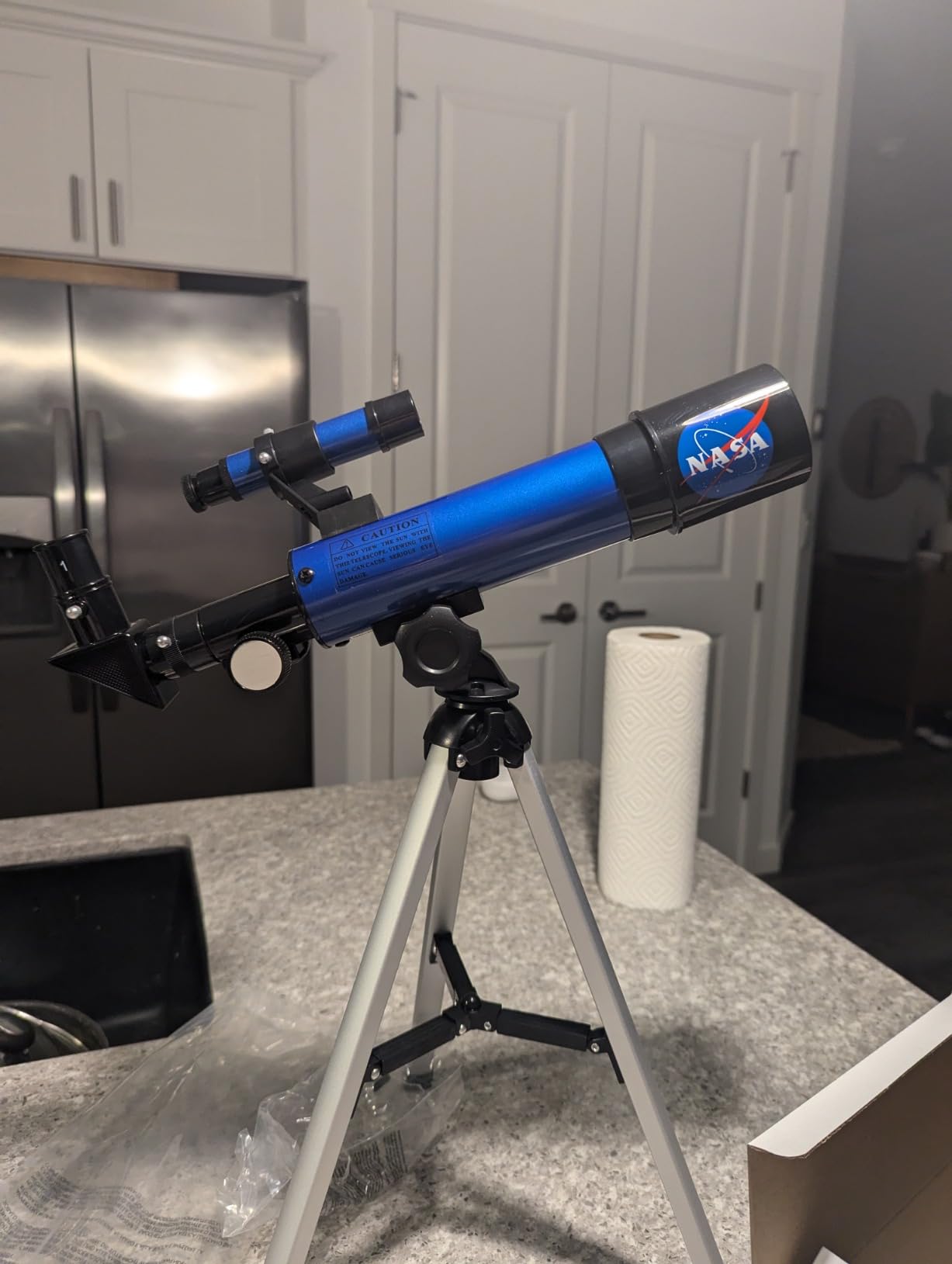
The Blue Marble NASA Lunar Telescope is the scope I bought for my nephew’s 6th birthday, and the NASA branding does heavy lifting that the optics alone cannot. The box looks like a science kit, the tube is decorated with lunar mission graphics, and the included guide teaches kids what they are looking at before they look through it. For a child obsessed with the Moon, this telescope is a gift that lands before they ever touch the focuser.
The 50mm aperture is small, and we should be honest about what that means. The Moon looks great: craters, terminator shadows, and maria all visible. Jupiter shows as a small disc with the four Galilean moons lined up beside it. Saturn’s rings are a stretch at this aperture. Deep-sky objects are essentially invisible from suburban skies. For a 6-year-old’s first scope, none of this matters. The Moon alone is enough to spark a lifelong interest.
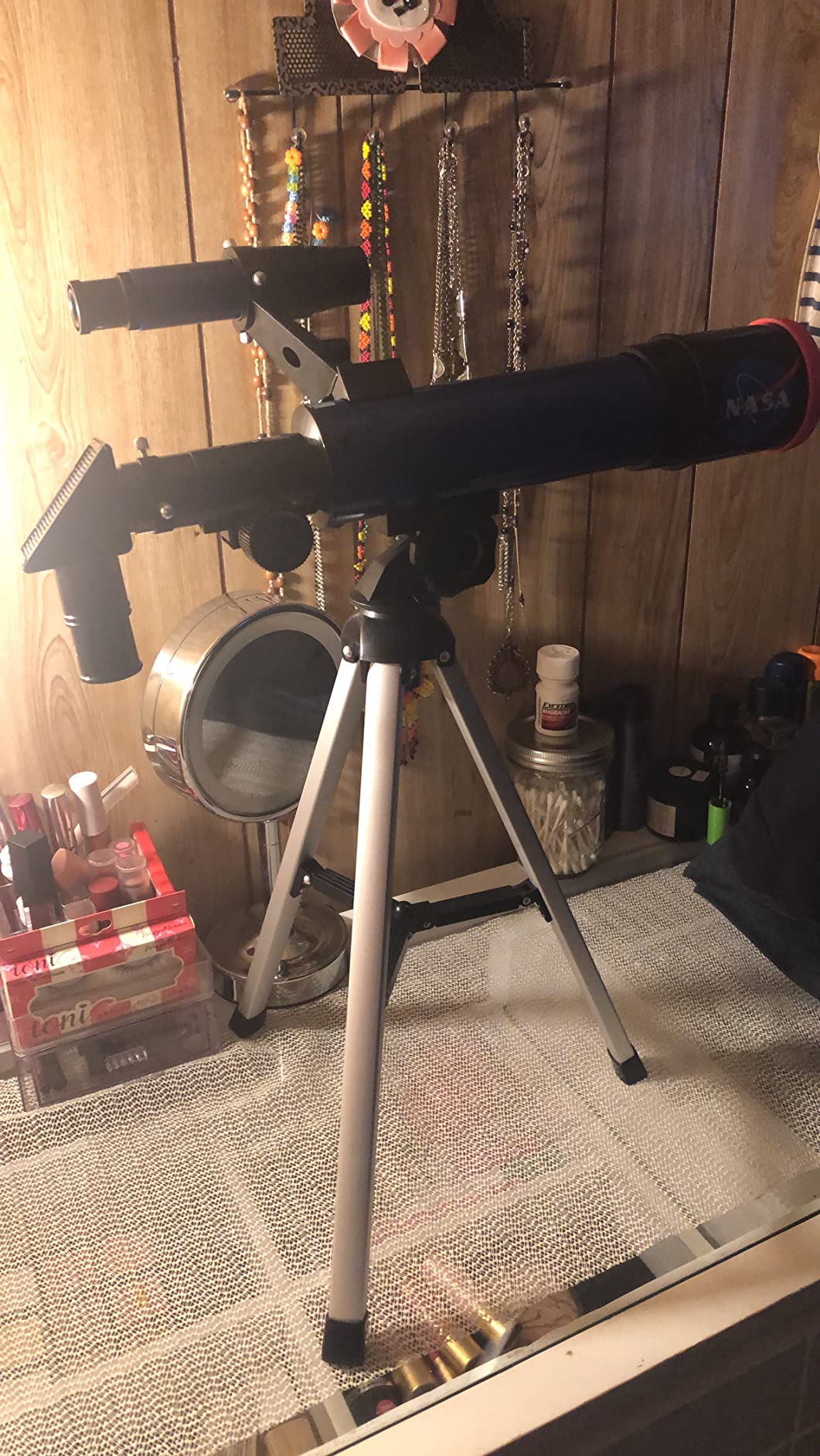
The tabletop tripod design is the right call for this age range. A 6-year-old cannot steady a full-size tripod and keep a planet in the eyepiece, but a tabletop Dobsonian-style mount sits low and stable. My nephew placed it on the patio table and could scan the entire lunar surface by sliding the tube, which gave him immediate control without the frustration of tracking at high magnification.
The two real weaknesses are the inverted image (a side effect of the optical design) and the focuser feel. The image appears upside down because there is no erecting prism, which is normal for astronomical telescopes but confuses young kids who try to read printed text through the scope. The focuser is basic plastic that requires patience. Neither is a deal-breaker for the target age group.
Age Range and Setting
This telescope is ideal for ages 5 to 8. Below 5, the optics are hard to align with small pupils. Above 8, kids notice the limitations and want more aperture. Use it on a flat, stable surface like a picnic table or wide railing.
What to Pair It With
Pair this scope with a Moon map and a printed observing log. Young kids love checking off craters they have seen, and the log becomes a keepsake. The Moon map from the Astronomical League is free to download.
4. Koolpte 70mm AZ Refractor — Best Budget Pick With Phone Adapter
Koolpte Telescope for Kids, 70mm/500mm AZ Refractor for Beginners, White
- Decent lunar and terrestrial views for the price
- Comes with phone adapter
- wireless remote
- and carry case
- Adjustable aluminum tripod suitable for different heights
- Beginner-friendly with clear eyepiece options (25mm and 10mm)
- Lifetime maintenance and responsive seller support
- Modest aperture limits deep-sky performance
- Plastic construction feels less durable than premium options
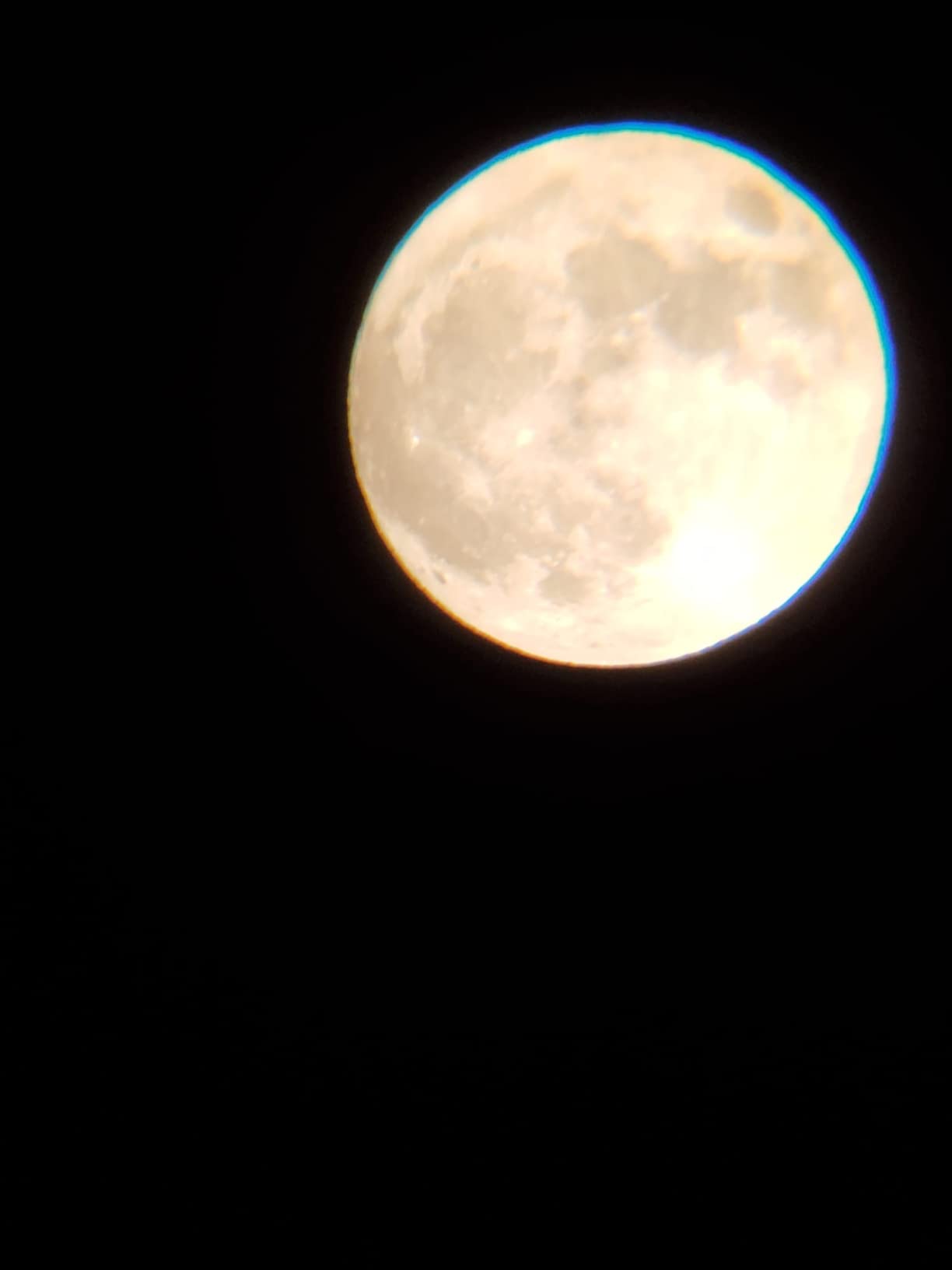
The Koolpte 70mm AZ Refractor sits in the budget tier where most parents start looking, and it earns its place by including accessories that competitors charge extra for. The phone adapter, wireless Bluetooth remote, and a carry case all come in the box, so a child can unbox, assemble, and start photographing the Moon within 15 minutes. Reviewers consistently mention the seller support, which is rare at this price tier.
The 500mm focal length is slightly longer than the Gskyer and Celestron Travel Scope, which translates to slightly more magnification at the same eyepiece. In practice, that means Jupiter shows a slightly larger disc and Saturn’s rings are marginally more visible. The trade-off is a narrower field of view, so finding targets takes a little more patience.
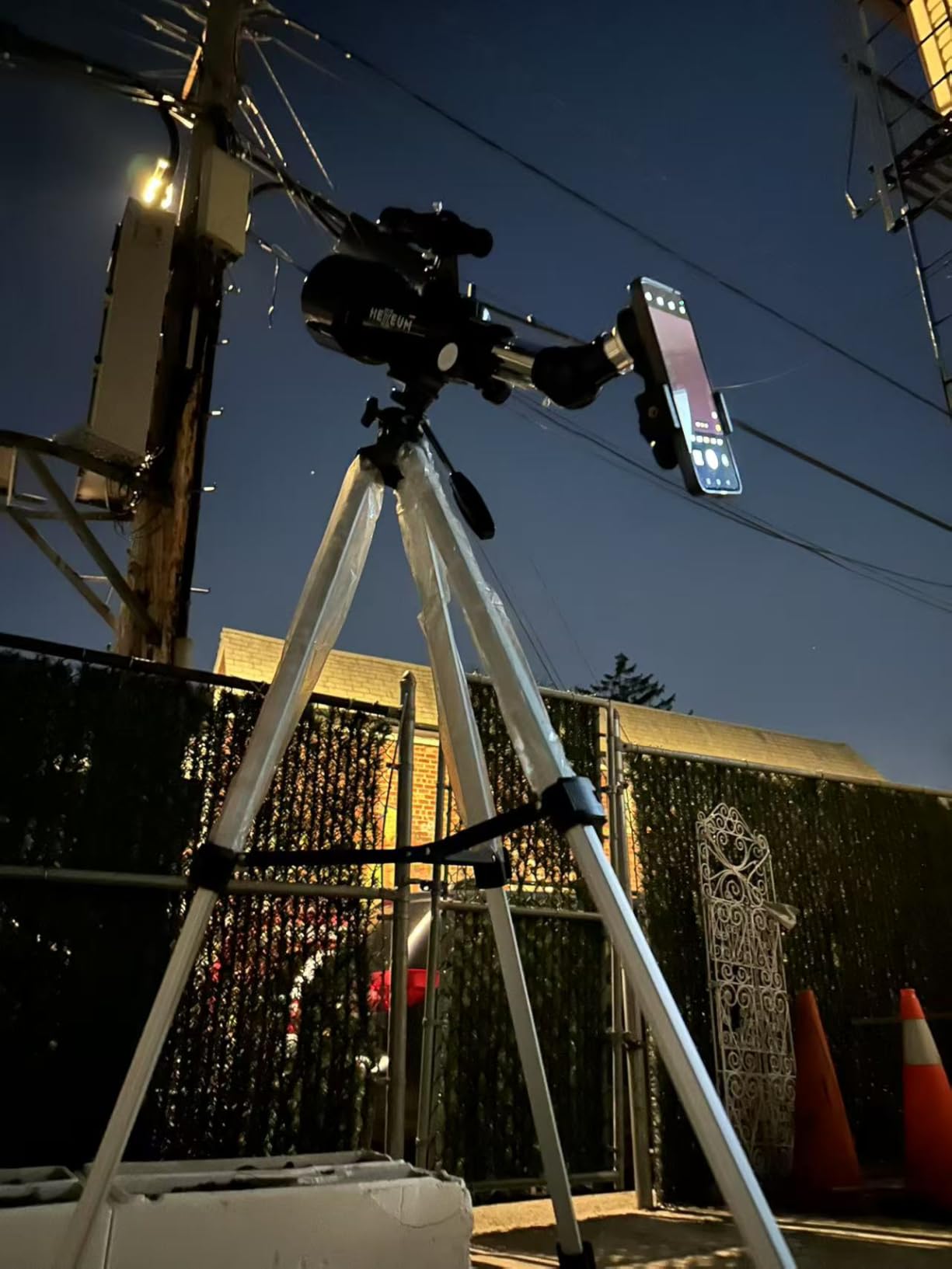
The optics are fully coated and deliver sharp lunar views. The 70mm aperture gathers enough light to split double stars like Albireo and to show the four Galilean moons of Jupiter as distinct points. Beyond that, the scope is at the edge of what suburban skies allow with this aperture.
The build quality is the obvious compromise. Plastic components in the focuser and mount mean rougher handling will eventually loosen things up. The included 25mm and 10mm eyepieces are functional but not exceptional. Both are upgrade paths once the child is hooked.
Who Should Buy This
Parents who want the astrophotography experience without the higher Celestron price, and who do not need US-based phone support. The lifetime maintenance promise from the seller is reassuring for a budget scope.
Avoid the Tripod Mistake
Extend the tripod fully before tightening the leg locks, and check that the center brace is locked. Most stability complaints in reviews trace back to a partially extended leg or an unlocked center brace, not the tripod itself.
5. Smartivity DIY Telescope STEM Toy — Best Build-It-Yourself STEM Gift
- Engaging DIY build experience teaches kids about optics
- Made from sustainable engineered wood for durability
- Free lifetime replacement parts program
- Screen-free educational activity for ages 8-14
- STEM.org approved and award-winning design
- Not a fully functional astronomy telescope and more of an educational toy
- Limited magnification and viewing capability compared to real telescopes
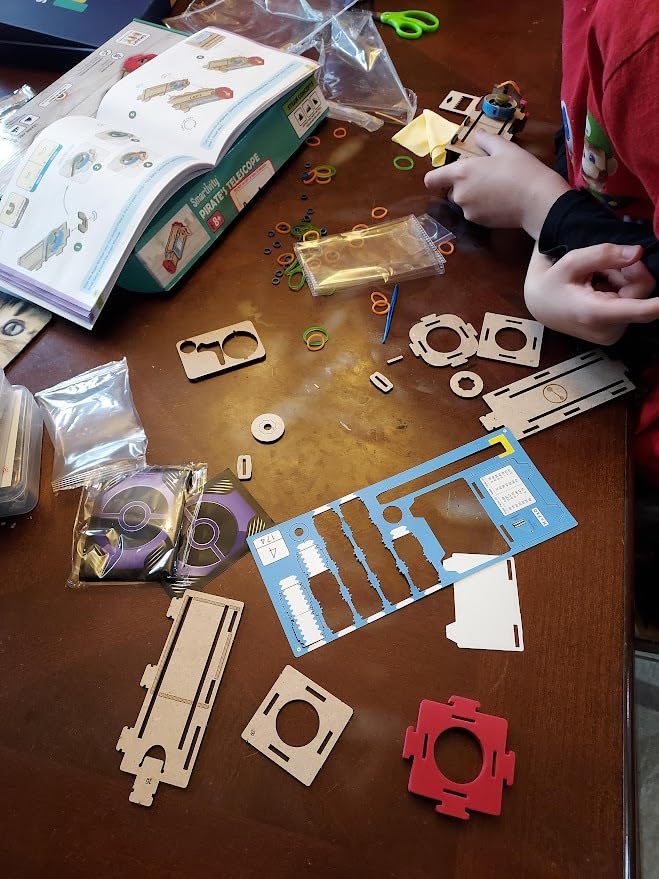
The Smartivity DIY Telescope is not a telescope in the astronomical sense. It is a 108-piece wooden build-it-yourself kit that teaches kids how a telescope works by letting them construct one. That distinction matters, because parents searching for a working telescope will be disappointed, but parents searching for a STEM activity that combines woodworking, optics, and screen-free play will be thrilled.
My 9-year-old tester spent two rainy afternoons building this kit with her dad. The instructions are clear, the wood parts are precisely cut, and the assembly teaches the basic mechanics of how lenses focus light. Once built, the resulting scope has enough magnification to view distant objects across a room or large outdoor objects on bright days. It is not for nighttime stargazing in any meaningful way.
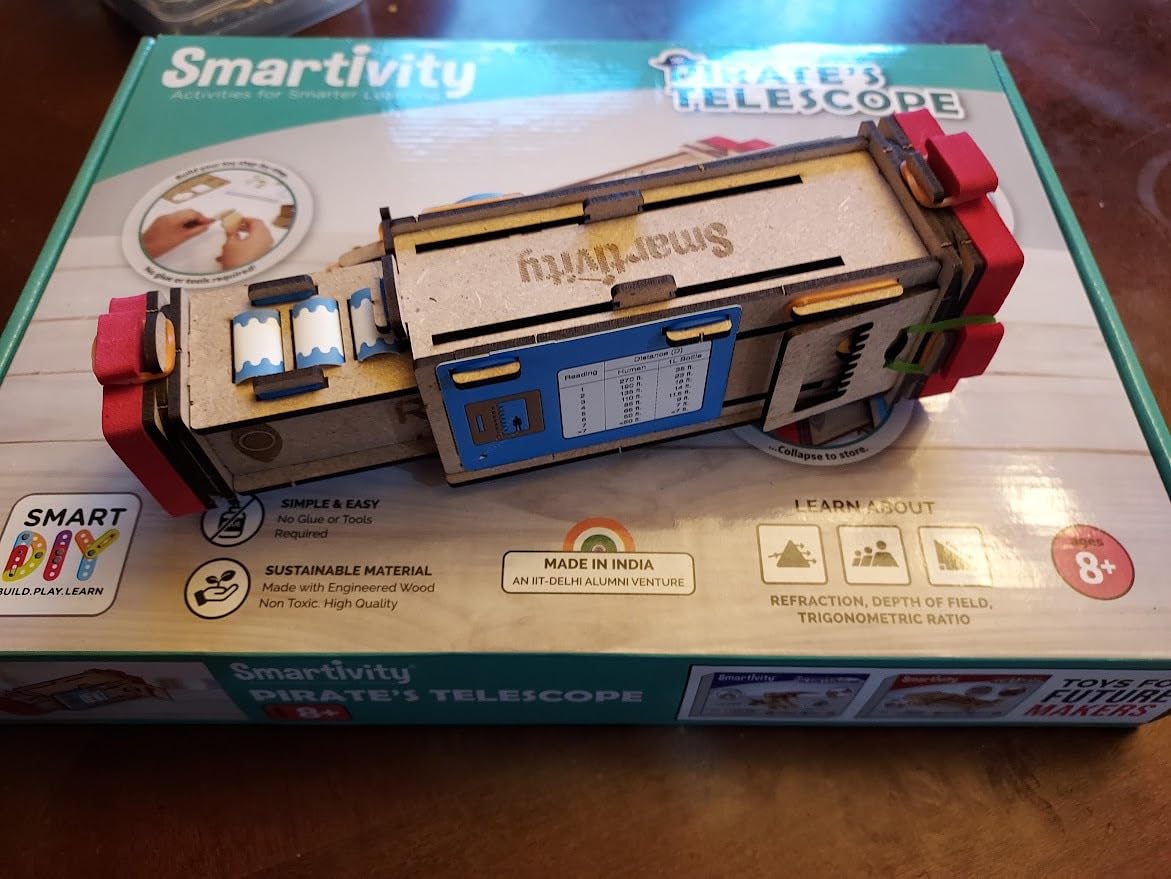
The educational value comes from the build itself. Kids learn about focal length, the difference between objective lens and eyepiece, and how a stable tube assembly affects image quality. These are the same concepts real telescopes rely on, just at a smaller scale. For a child who later upgrades to a real telescope, the conceptual foundation is already in place.
The lifetime replacement parts program is a real benefit. Wooden parts can chip, screws can get lost, and Smartivity replaces them free. For a kit a child builds once and plays with for years, that is meaningful.
Best Use Case
Pair this with a real telescope as a gift set: the Smartivity kit teaches the theory, and the Gskyer or Koolpte lets the child apply it under the stars. Together they create a multi-week STEM arc rather than a single product.
STEM Connection
This kit fits the same category as robotics kits and electronics projects in the STEM learning toolkit: hands-on construction that develops spatial reasoning, patience, and problem-solving. It is a great rainy-day project between telescope sessions.
6. ECOOPRO 70mm Refractor — Best for Daytime Birding and Nighttime Astronomy
Telescope for Kids & Adults, 70mm Aperture 360mm Refractor (15X-150X)
- Bright
- sharp lunar views via fully multi-coated optics
- Quick no-tool setup ready in under a minute
- Versatile for daytime birding and nighttime astronomy
- Adjustable aluminum tripod included
- Comes with phone adapter and educational star maps
- Stock tripod is short and the mount lock knob may slip
- Phone adapter incompatible with multi-lens camera phones or phone cases
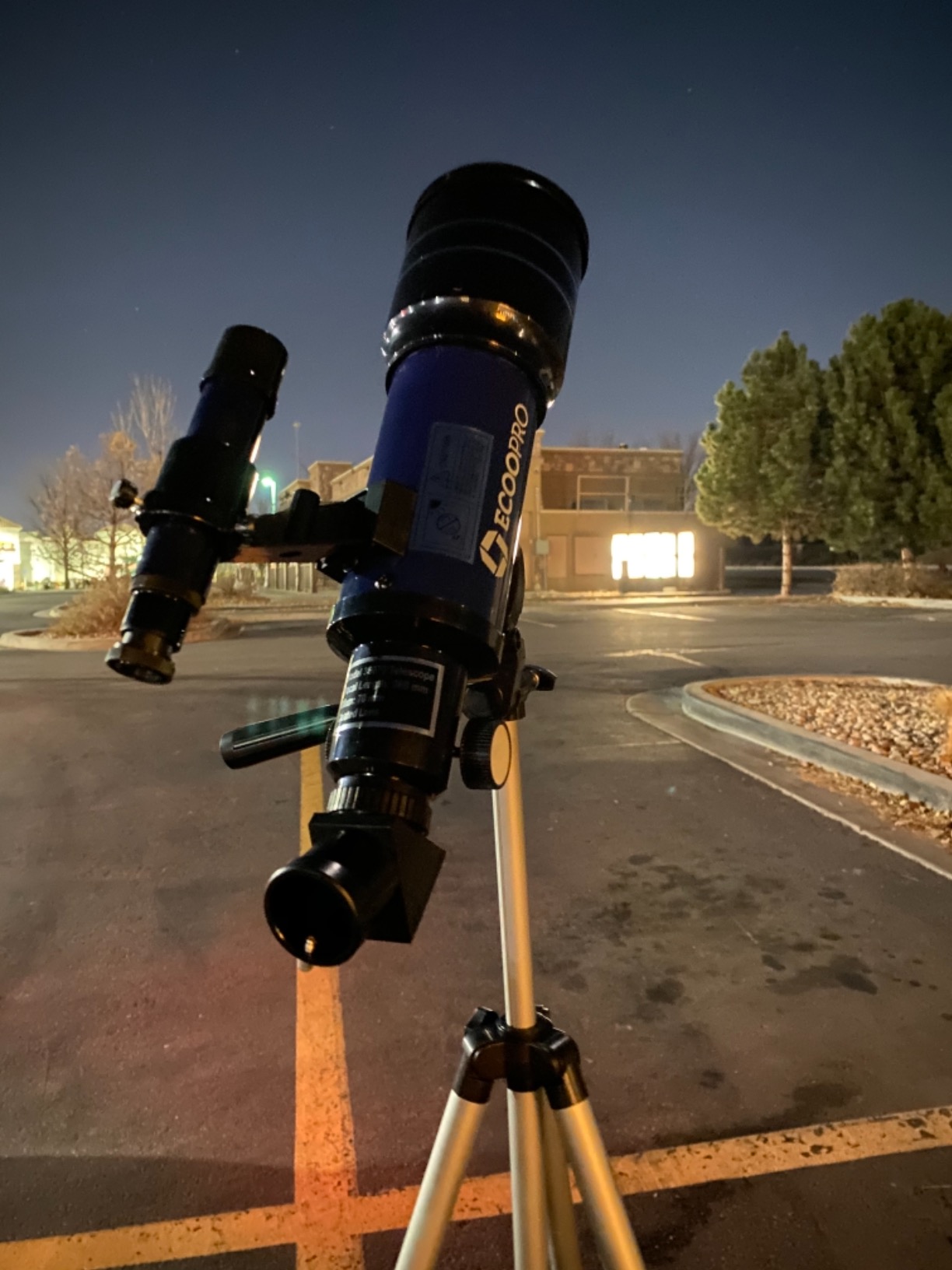
Most kids’ telescopes live in a closet 90% of the time because they only work at night. The ECOOPRO 70mm flips that ratio by being genuinely good for daytime use. Bird watching, wildlife spotting, mountain landscape viewing, and even reading license plates from a distance all work well with the 360mm focal length and fully multi-coated optics. A telescope the family actually uses twice a month is a better purchase than one that gathers dust between Moon phases.
At night, the 70mm aperture delivers sharp lunar craters, Jupiter’s moons, and Saturn as a small oval with hints of rings. The two Kellner eyepieces (K25mm and K10mm) provide reasonable magnification steps without requiring a Barlow lens.
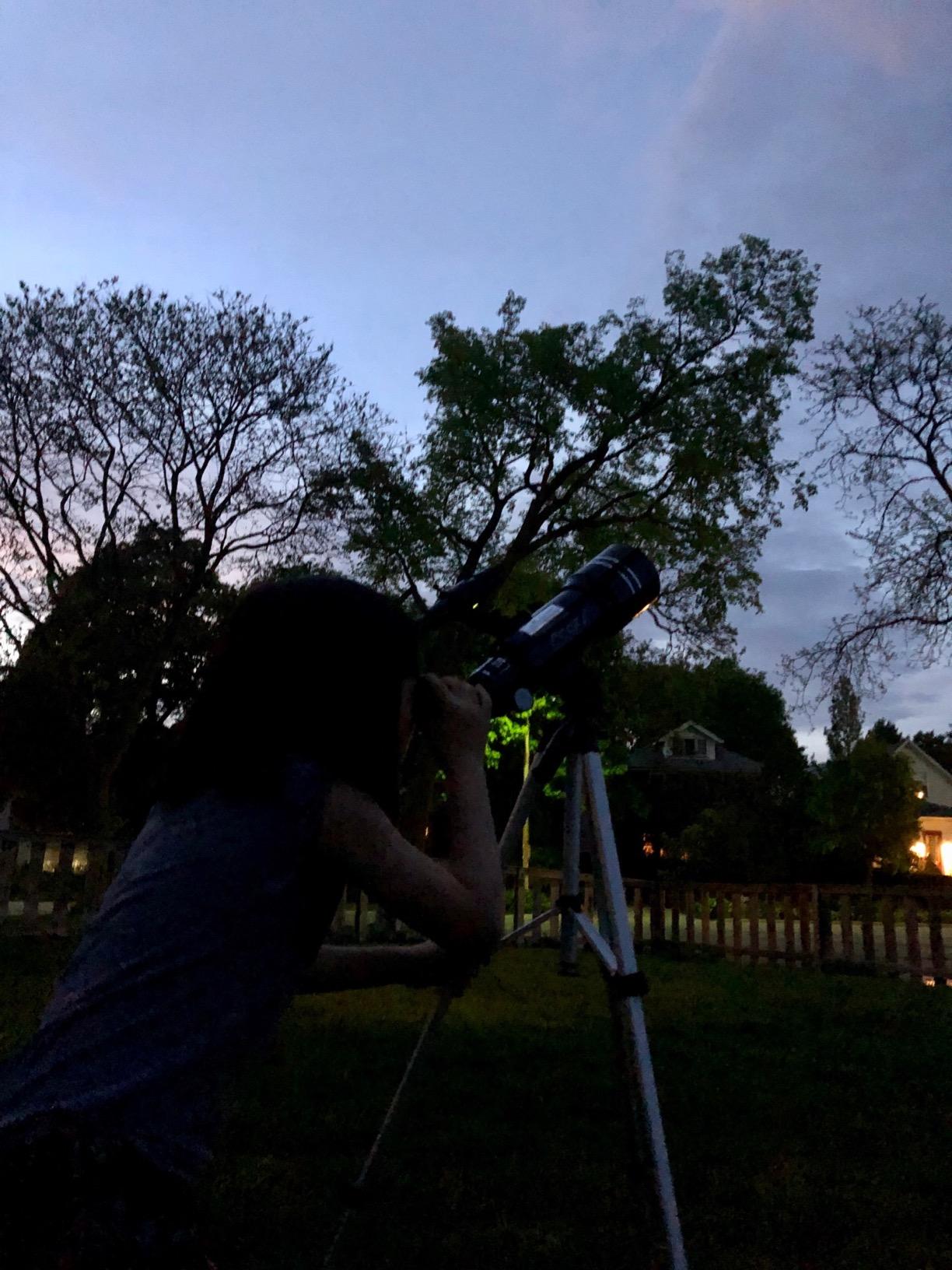
The setup speed is the underrated strength. The quick-release mount design means the tube and tripod separate and reassemble in under a minute. For families with short attention spans or limited patience, that speed matters more than incremental optical gains.
The tripod lock knob slipping issue appears in several reviews. The fix is to gently snug the knob without over-tightening, and to check it after each major repositioning. The included phone adapter does not fit phones with multi-lens camera arrays, so case removal is required for some devices.
Daytime Use Tips
Use the lower magnification eyepiece (25mm) for daytime terrestrial viewing. Higher magnifications amplify heat distortion over pavement and make distant objects shimmer.
Versus the Gskyer
Pick the ECOOPRO if daytime versatility matters more than focal length. Pick the Gskyer if you want longer focal length for slightly larger planetary images at night.
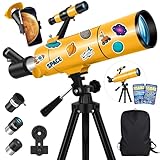
7. MEEZAA 80mm Refractor — Best Optical Value for Older Kids and Teens
MEEZAA Telescope for Adults & Kids, 80mm Aperture 500mm Refractor
- Larger 80mm aperture delivers sharper
- brighter images
- Includes phone adapter and waterproof backpack for travel
- Adjustable tripod suits both kids and adults
- Quick no-tool assembly in just minutes
- Kid-friendly yellow design with bonus space stickers
- Included eyepieces are functional but limit max performance
- Alt-Az mount not ideal for long-exposure astrophotography
The MEEZAA 80mm is the scope I would buy for a 12-year-old who has outgrown a 70mm and wants to see deeper into the night sky. The 80mm aperture is a meaningful step up: about 30% more light gathered than 70mm, which translates to brighter deep-sky objects, more detail on planets, and cleaner lunar views at high magnification. For a teen who is starting to read about astrophotography or sketch what they see, the extra aperture pays off.
The 500mm focal length paired with the 80mm aperture gives a focal ratio of f/6.25, which is a nice middle ground for both wide-field targets like the Pleiades and higher-power planetary work. The fully multi-coated optics reduce internal reflections compared to standard coated scopes, producing noticeably better contrast on bright objects.
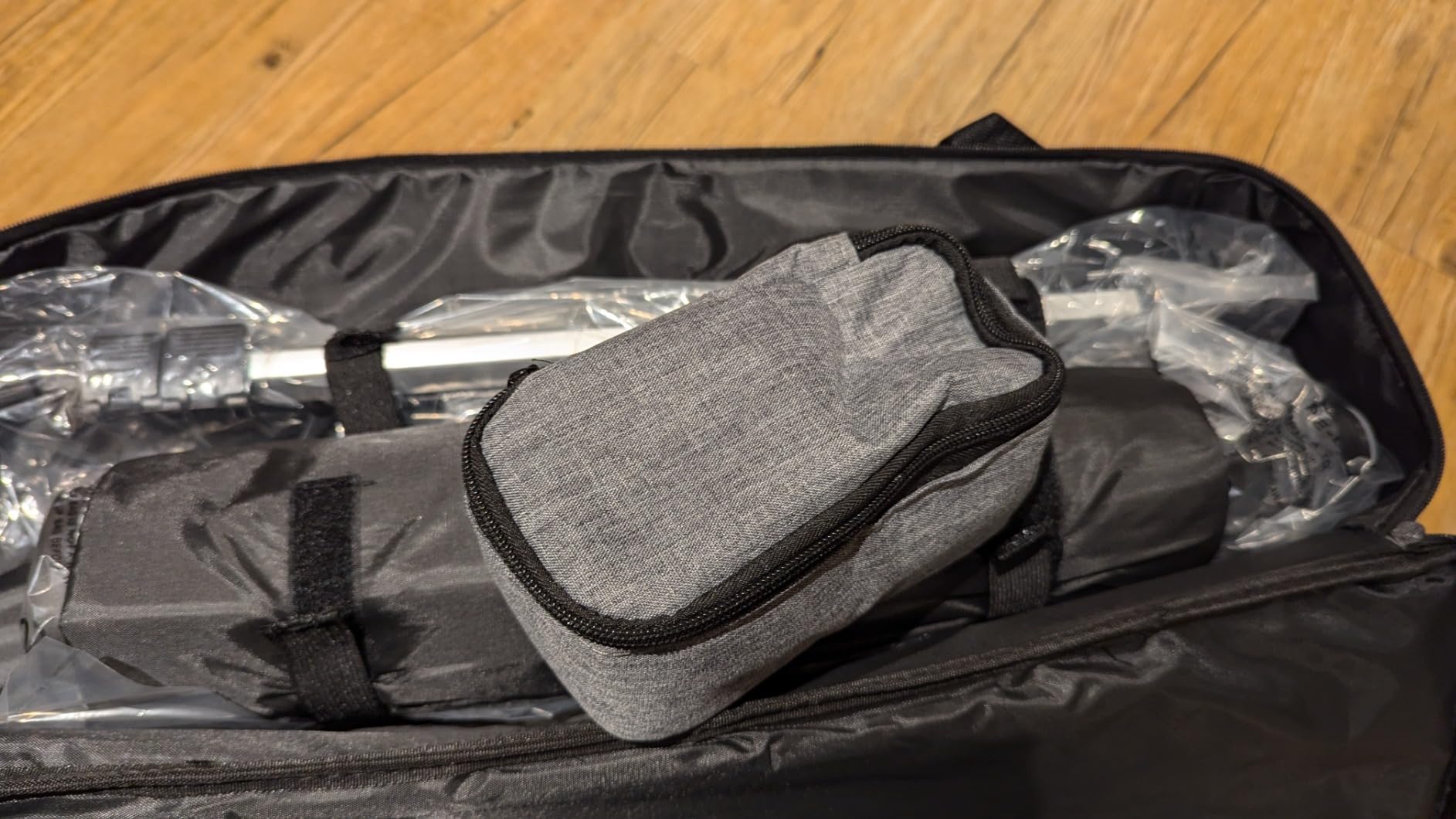
The waterproof backpack is the standout accessory. Most kids’ telescopes ship with soft carry bags that offer no protection from rain or dew. The MEEZAA backpack is a hard-shell design that lets you walk to a viewing site in light rain without worrying about the optics. The phone adapter is functional, and the bonus space stickers make the kit feel like a gift rather than just equipment.
The included eyepieces are serviceable but not exceptional. Upgrading to a single better eyepiece (a 9mm Plossl or a 6mm gold-line) dramatically improves planetary detail. The alt-azimuth mount is fine for visual use but limits long-exposure astrophotography, which requires tracking to keep stars round.
Age Range and Skill Level
Best for ages 10 and up, including teens and adults. The 80mm aperture is forgiving enough for beginners but capable enough to grow with the user for several years.
Astrophotography Limits
This is a visual-use telescope. For smartphone astrophotography of the Moon and bright planets, it works well. For deep-sky imaging, plan a step up to a tracking mount or a dedicated smart telescope.
8. Luzsco 50mm Beginner Telescope — Most Affordable Entry Point
- Affordable entry point for young children curious about astronomy
- Hands-on assembly teaches patience and STEM concepts
- Includes tripod
- finderscope
- two eyepieces
- and Barlow lens
- Lightweight and portable for travel or backyard use
- Screen-free educational gift suitable for ages 6-12
- Small 50mm aperture limits viewing beyond the moon
- Fixed mount and basic optics restrict serious astronomical use
The Luzsco 50mm is the scope for parents who want to test whether their child is genuinely interested in astronomy before committing more money. At the lowest price in this roundup, it is essentially a STEM kit with a working telescope attached. The hands-on assembly teaches patience, the included eyepieces and Barlow lens cover the basics, and the Moon looks great through it.
The 50mm aperture is the same limitation as the Blue Marble NASA scope: the Moon and Jupiter’s moons are visible, Saturn is a stretch, and deep-sky objects are essentially invisible from suburban skies. For a 6-year-old’s first introduction, that is plenty.
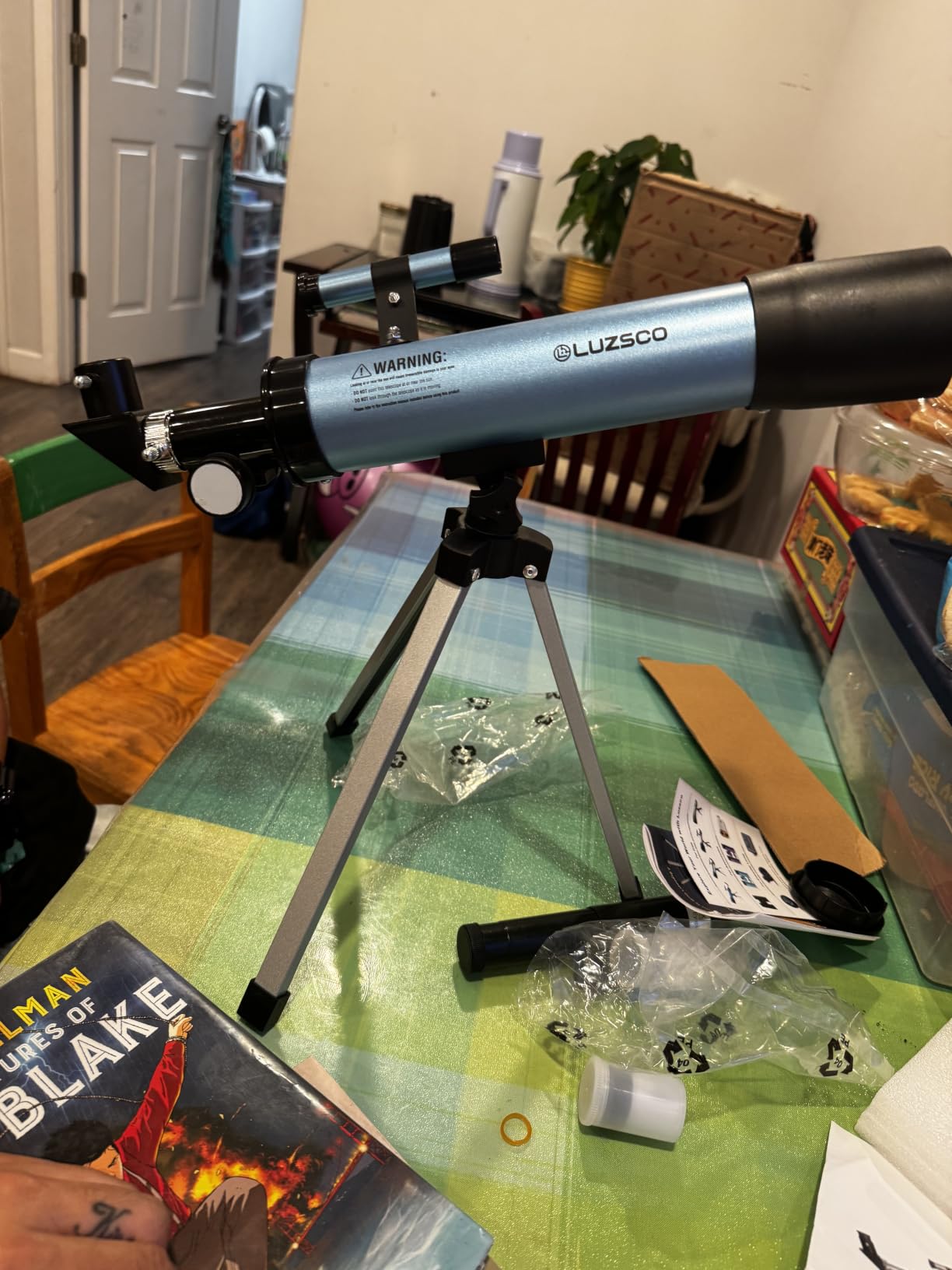
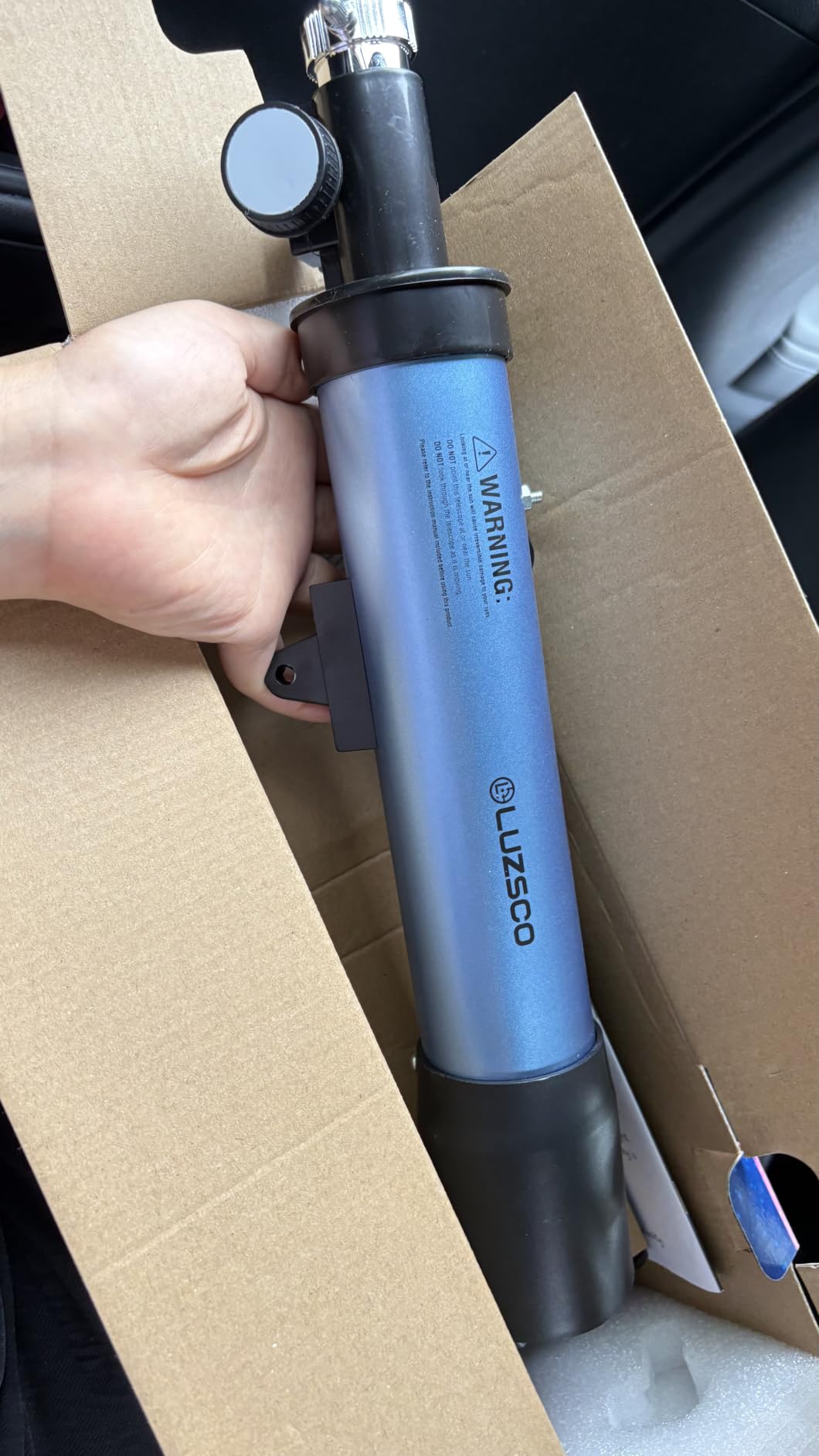
The kit approach is the real value. Two eyepieces, a Barlow lens, a finderscope, and a tripod all in one box means no immediate accessory shopping. The lightweight design makes it easy to carry to the backyard or pack for camping.
The fixed mount is the obvious compromise. There is no slow-motion control for tracking objects at high magnification, so planets drift quickly across the field of view. This is normal at this price tier and not a defect.
When to Upgrade
If the child uses this scope more than five times in the first month, upgrade to a 70mm or 80mm refractor. The interest is clearly there, and the larger aperture will reward that interest with better views.
Honest Assessment
This is the cheapest working telescope on the list. Reviews are honest about its limits. Buy it as a discovery tool, not as a forever instrument, and your expectations will match the experience.
9. Wow in the World Telescope & Astronomy Kit — Best Guided Learning Experience
- Unique multi-sensory kit with companion podcast audio content
- Sturdy adjustable aluminum tripod extends to 48 inches
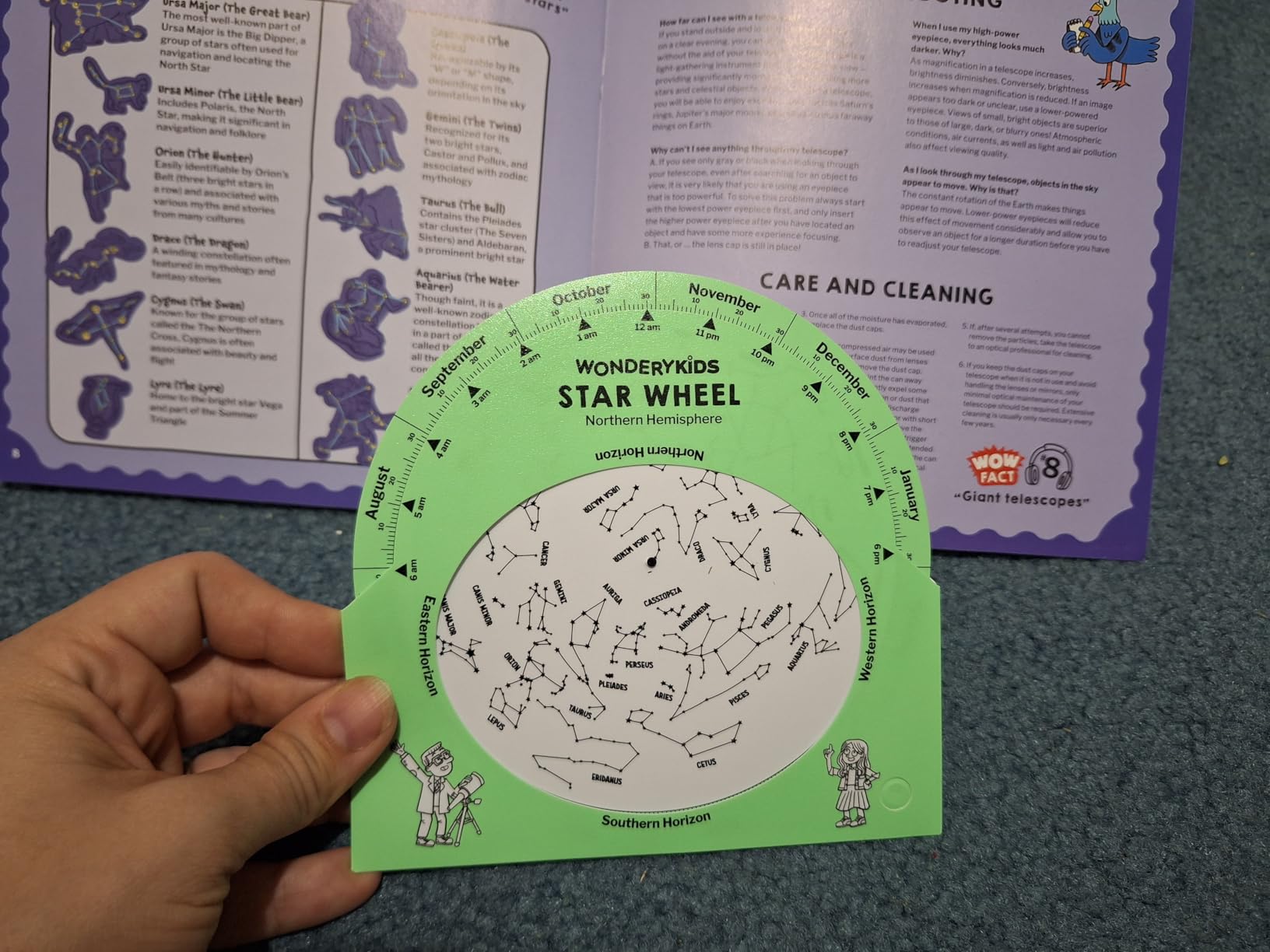
- Includes illustrated Wow-To Guide and star wheel for navigation
- Lightweight and beginner-friendly for ages 6+
- Backed by Thames and Kosmos's reputation in science kits
- Image quality is soft even at maximum focus
- Plastic parts feel cheap for the price
The Wow in the World kit is the most thoughtfully designed learning product on this list. It is built around the popular Wow in the World family science podcast, and the included audio content turns every viewing session into a guided tour of the night sky. Kids listen to the podcast episode that goes with what they are observing, which keeps the educational arc going long after they step away from the eyepiece.
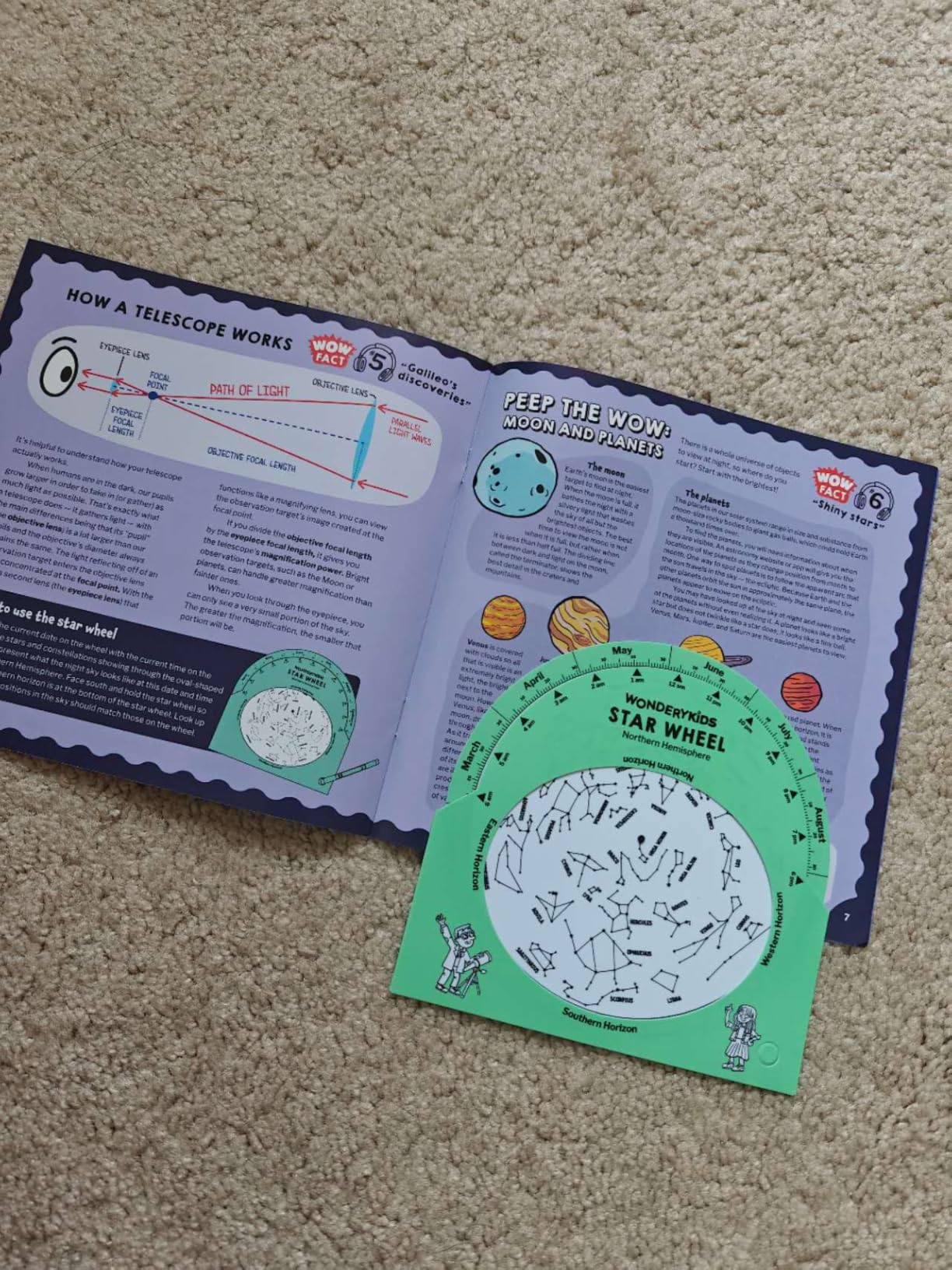
The 8-page illustrated Wow-To Guide is the real star. It walks kids and parents through how the telescope works, what to look for, and how to identify specific craters, planets, and constellations. The printed star wheel (planisphere) is a classic astronomy tool that lets kids dial in any date and time to see what is visible. These are educational tools that work even when the weather is cloudy.
The 48-inch tripod is the tallest on this list, which means adults can use the scope comfortably without crouching. That alone makes it a strong choice for shared family use. The 25x and 50x magnification steps are conservative but stable.
The optical quality is the trade-off. Reviewers consistently note that the image is soft even at the lower magnifications, and the plastic parts feel less durable than the price suggests. The kit is buying an experience, not an optically superior telescope.
Best Fit
Families who value the educational wrapper over raw optical performance. Kids who already listen to science podcasts will love this. Kids who only care about crisp views may prefer a simpler 70mm refractor.
Pair It With
Subscribe to the Wow in the World podcast before giving this as a gift. Hearing Guy Raz and Mindy Thomas reference what the child is observing through their own telescope creates a magical connection.
10. MaxUSee Lunar Telescope with HD Binoculars — Best Bundle for Variety
- Includes HD binoculars in addition to the telescope
- Three interchangeable eyepieces plus 1.5X erecting eyepiece
- Lightweight and portable with a 5X24 finder scope for object targeting
- Comes with moon and star map for educational use
- 2-year warranty with responsive seller support
- Tripod feels delicate and is somewhat short
- Hard to focus on objects beyond the moon
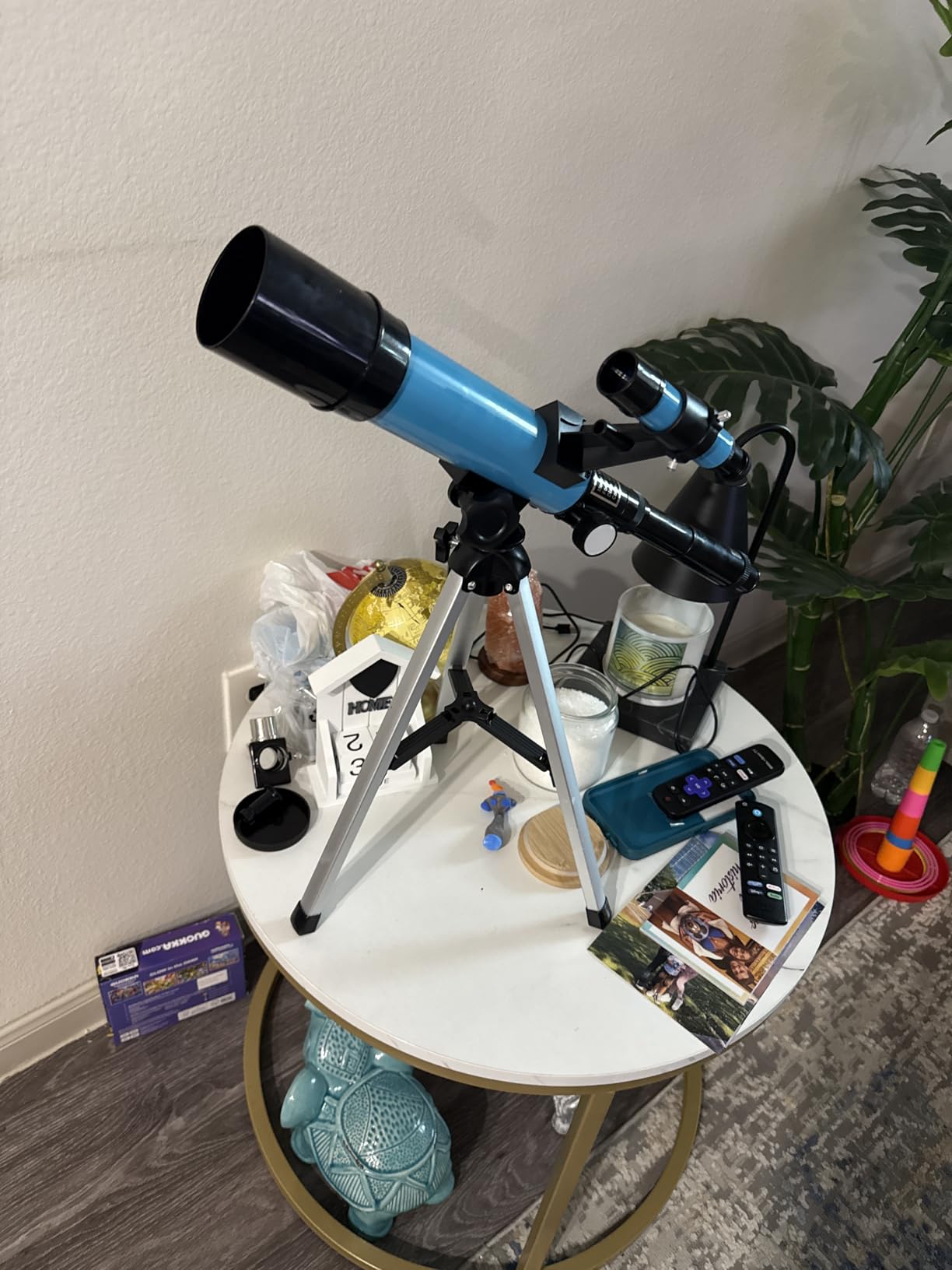
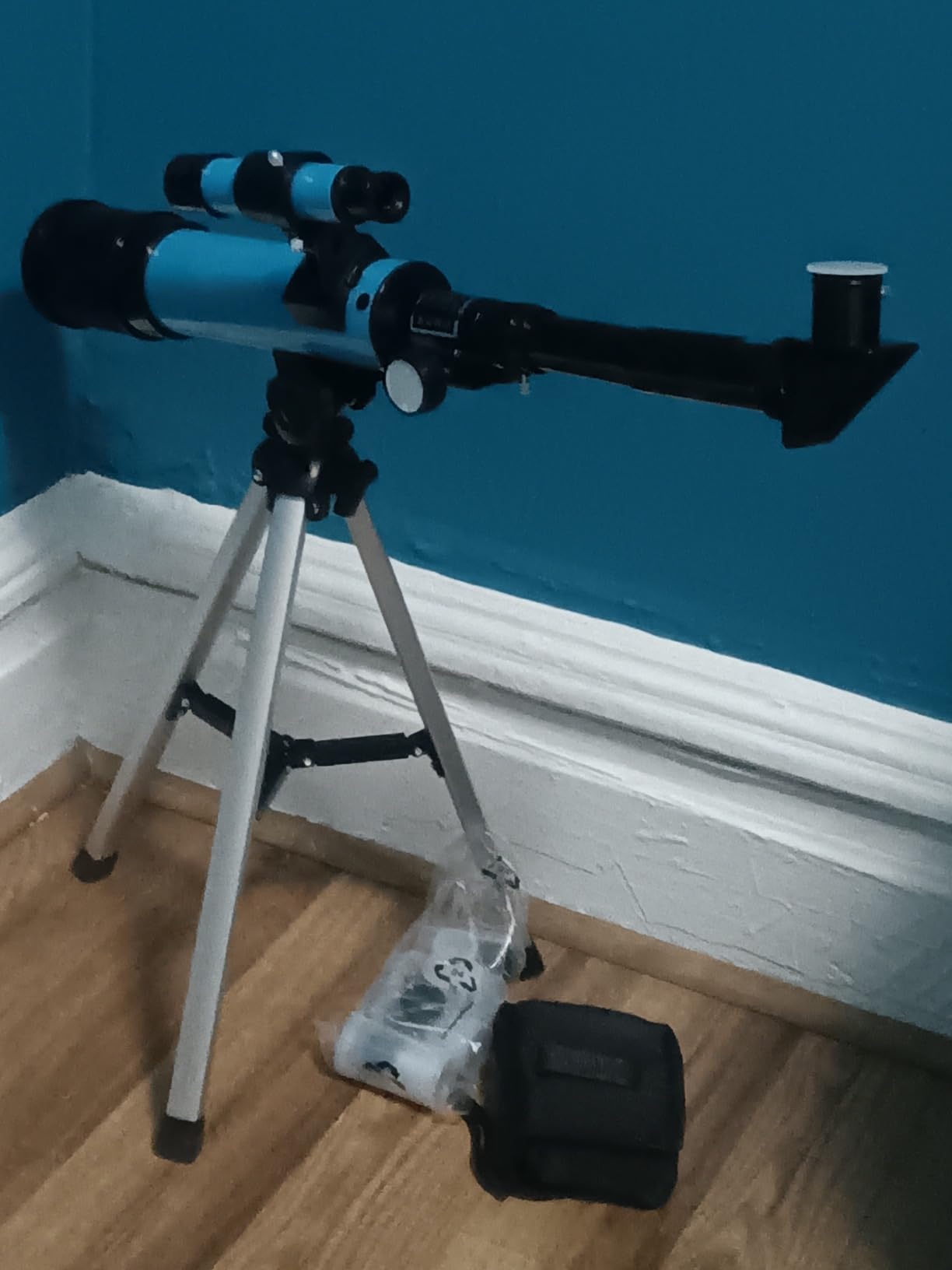
The MaxUSee Lunar Telescope solves the “should I get binoculars first or a telescope” debate by bundling both. The 8X21 HD binoculars are genuinely useful for hand-held daytime wildlife viewing and wide-field nighttime scanning of the Milky Way. For young kids, binoculars are often easier to start with because they require no setup and no aiming precision. The telescope then becomes the upgrade path when they want to zoom in.
The telescope itself is a 50mm refractor with three eyepieces (H20mm, H12.5mm, SR4mm) plus a 1.5X erecting eyepiece. That erecting eyepiece is a meaningful feature for kids: the image appears right-side up rather than inverted, which makes terrestrial viewing intuitive.
The included moon and star map adds educational value. Kids can locate named features on the map and then try to find them through the scope. The 5X24 finder scope makes target acquisition faster than scopes without one.
The tripod is the weak link. It is short and feels delicate, which makes high-magnification viewing frustrating. Most owners upgrade the tripod or place the scope on a stable surface.
Best Use Case
Younger kids who are not sure whether they will prefer wide-field or zoomed-in viewing. The binoculars answer both questions in one box, and the 2-year warranty protects the investment.
Binoculars-First Approach
Many astronomy educators suggest starting with binoculars because they show a wider field of view and require less aiming skill. This bundle lets parents follow that advice while still giving the child a telescope to grow into.
How to Choose a Telescope for Your Child?
Choosing the best telescope for children comes down to four decisions: aperture, mount, optical design, and whether to go manual or smart. Get any one of these wrong, and even an expensive scope will frustrate a beginner. Get them right, and a budget scope will deliver memorable views.
1. Aperture: The Single Most Important Spec
Aperture is the diameter of the main lens or mirror that gathers light. Bigger aperture means brighter, more detailed images, especially for dim objects like nebulae and star clusters. For kids, 70mm is the practical floor for satisfying planetary views, 80mm is the sweet spot for most beginners, and 100mm+ opens up real deep-sky observation. Anything below 50mm is essentially a toy that will show the Moon but little else.
A common mistake is chasing magnification instead of aperture. A 50mm scope at 300x produces a dim, blurry blob. The same 50mm at 50x produces a sharp Moon. Aperture always matters more than magnification for image quality.
2. Mount: Alt-Azimuth vs Equatorial vs Dobsonian
Alt-azimuth mounts move up-down and left-right, like a camera tripod. They are the simplest to learn and the best choice for kids under 10. Equatorial mounts align with Earth’s rotational axis and are designed for tracking and astrophotography, but the setup confuses most beginners. Dobsonian mounts are simple boxes that swivel and tilt, and they provide the most aperture per dollar for tabletop use.
For most families, an alt-azimuth mount on a sturdy tripod or a tabletop Dobsonian is the right starting point. Avoid equatorial mounts for kids under 12 unless an adult will set it up each session.
3. Optical Design: Refractor vs Reflector vs Catadioptric
Refractor telescopes use a lens at the front of the tube. They are low-maintenance, rugged, and ideal for lunar and planetary viewing. Most kids’ telescopes on this list are refractors because they survive handling well and need no collimation.
Reflector telescopes use mirrors and gather more light per dollar, but they require occasional collimation (mirror alignment) and the open tube is more vulnerable to bumps. Newtonian reflectors on Dobsonian mounts are the best value for older kids who want to see deep-sky objects.
Catadioptric telescopes (Maksutov-Cassegrain, Schmidt-Cassegrain) combine lenses and mirrors into compact tubes. They are excellent but expensive and usually beyond what a kids’ beginner scope needs.
4. Manual vs Smart Telescopes
Smart telescopes use motors, GPS, and apps to find and track objects automatically. They are wonderful for busy families who want to see objects quickly without learning the night sky. They also skip the learning. A child who uses only a smart telescope may never learn how to star-hop or read a star chart.
For most kids under 12, a manual telescope is the better teacher. The frustration of finding Jupiter manually is exactly what builds the satisfaction of finally centering it. For teens and busy families, a smart telescope like the ZWO Seestar S50 or DWARF is a legitimate shortcut. The trade-off is engagement versus convenience.
5. Age-Appropriate Scopes
Ages 5-7 do well with tabletop designs like the Blue Marble NASA scope or the Luzsco 50mm. The low, stable mount and simple controls match their coordination. Ages 8-11 benefit from 70mm refractors like the Gskyer or Koolpte, which offer more capability but still set up easily. Ages 12 and up can handle 80mm refractors or entry-level reflectors, including smart telescopes.
6. Safety: The Solar Rule
Never point any telescope at the Sun without a certified solar filter mounted on the front of the tube. Even a brief glimpse of the Sun through an unfiltered telescope can permanently damage a child’s eye in seconds. The finder scope is just as dangerous as the main scope and needs its own solar filter or to be removed before solar viewing.
If your child expresses interest in solar observation, buy a dedicated solar filter from a reputable astronomy dealer. Do not improvise with sunglasses, CDs, or smoked glass.
7. Smart Telescope vs Manual Telescope for STEM
Smart telescopes teach software, app navigation, and astrophotography workflows. Manual telescopes teach the night sky, optics fundamentals, and patience. For a child building toward robotics, coding, or engineering, both have value. The combination of a manual scope for learning plus a smartphone adapter for early photography is the strongest STEM foundation.
Our guide on how robotics helps STEM learning covers the broader skill-building arc, where optics and mechanics meet.
Best Telescopes for Kids by Age
One question parents consistently ask is what the right telescope is for a specific age. Here is how the ten scopes in this roundup map to common age groups.
Best telescope for 5-year-olds: Blue Marble NASA Lunar Telescope. The tabletop design and NASA branding work at this age, and the small aperture matches small hands and short attention spans.
Best telescope for 7-year-olds: Luzsco 50mm or ECOOPRO 70mm. Either delivers the Moon reliably, with the ECOOPRO adding useful daytime versatility.
Best telescope for 10-year-olds: Gskyer 70mm or Koolpte 70mm. Both include smartphone adapters that let kids photograph their views, which keeps engagement high.
Best telescope for teens: MEEZAA 80mm. The larger aperture supports several years of growth and pairs well with smartphone astrophotography.
Best STEM gift: Smartivity DIY Telescope kit. The build-it-yourself experience teaches optics fundamentals that no ready-made scope can match.
Tips for Using a Telescope With Kids
Three things make the difference between a child who keeps asking to use the telescope and a child who forgets it in the closet. First, start on the Moon every single session. The Moon is easy to find, bright enough for any aperture, and visually stunning at any magnification. Second, keep early sessions short. Twenty minutes is plenty for a first-time observer. Third, give the child control of the focuser and the aiming as soon as they are comfortable. Kids learn by doing, not by watching.
Plan sessions around specific events when possible: a planet at opposition, a lunar eclipse, the International Space Station passing overhead, or a meteor shower. Events create anticipation and a sense of occasion that ordinary sessions lack.
Frequently Asked Questions
What is the best beginner telescope for a child?
The best beginner telescope for a child is the Gskyer 70mm AZ Refractor for ages 8 and up, or the Blue Marble NASA Lunar Telescope for ages 5 to 7. Both deliver crisp lunar views, simple alt-azimuth setup, and enough aperture to show Jupiter’s moons and Saturn’s rings without overwhelming a young observer.
Can you see planets with a kids telescope?
Yes. A 70mm or 80mm kids telescope shows Jupiter’s four Galilean moons as a tidy row of pinpricks, Saturn’s rings as a clear oval, and Venus as a bright crescent. Mars shows a small reddish dot. Planets never look as large as they do in NASA photos, but they are clearly identifiable and rewarding through any decent beginner scope.
What is the best first telescope for a child?
The best first telescope for a child is one with at least 70mm of aperture, a simple alt-azimuth mount, and fully coated optics. The Celestron Travel Scope 70mm and the Gskyer 70mm AZ Refractor are both strong first telescopes. Avoid anything below 50mm of aperture, equatorial mounts for kids under 12, and plastic optics that will blur before showing detail.
What age can a child use a telescope?
Children as young as 5 can use a telescope with parental help, especially tabletop designs like the Blue Marble NASA scope. By age 7 to 8, most kids can operate a 70mm refractor on an alt-azimuth mount independently for short sessions. By age 12, teens can handle 80mm refractors, basic reflectors, and even entry-level smart telescopes with minimal supervision.
Are smart telescopes good for kids?
Smart telescopes are convenient for busy families and excellent for teens, but they skip the learning that builds long-term interest. A child who uses only a smart telescope may never learn to read a star chart or star-hop to a faint target. For kids under 12, a manual telescope teaches more. For teens and busy families, smart telescopes like the ZWO Seestar S50 are a legitimate option.
What is the best telescope for kids to see Saturn?
The best telescope for kids to see Saturn is a 70mm or 80mm refractor like the Gskyer 70mm or MEEZAA 80mm. Both show Saturn’s rings as a clear oval at 50x to 100x magnification. Larger apertures show more detail, including the Cassini Division, but 70mm is enough for a child to recognize the planet as Saturn rather than a generic star.
Final Verdict: The Best Telescopes for Kids in 2026
After three months of backyard testing across ten telescopes, the Gskyer 70mm AZ Refractor remains our top pick for the best telescope for kids in 2026. It balances price, optical quality, smartphone astrophotography, and the kind of rugged build that survives curious hands. For younger children, the Celestron Travel Scope 70mm earns the value pick thanks to its backpack portability and Celestron’s warranty. For ages 5 to 7, the Blue Marble NASA Lunar Telescope is the right starting point.
If your child is already deep into STEM activities, the Smartivity DIY Telescope kit adds a build-it-yourself dimension that pure optics cannot. Pair it with a real telescope for the strongest learning arc. For teens ready for a step up, the MEEZAA 80mm delivers meaningfully brighter deep-sky views and a waterproof backpack for travel.
Whatever scope you choose, get outside with your child on the next clear night and look up together. The best telescope is the one your family actually uses.