
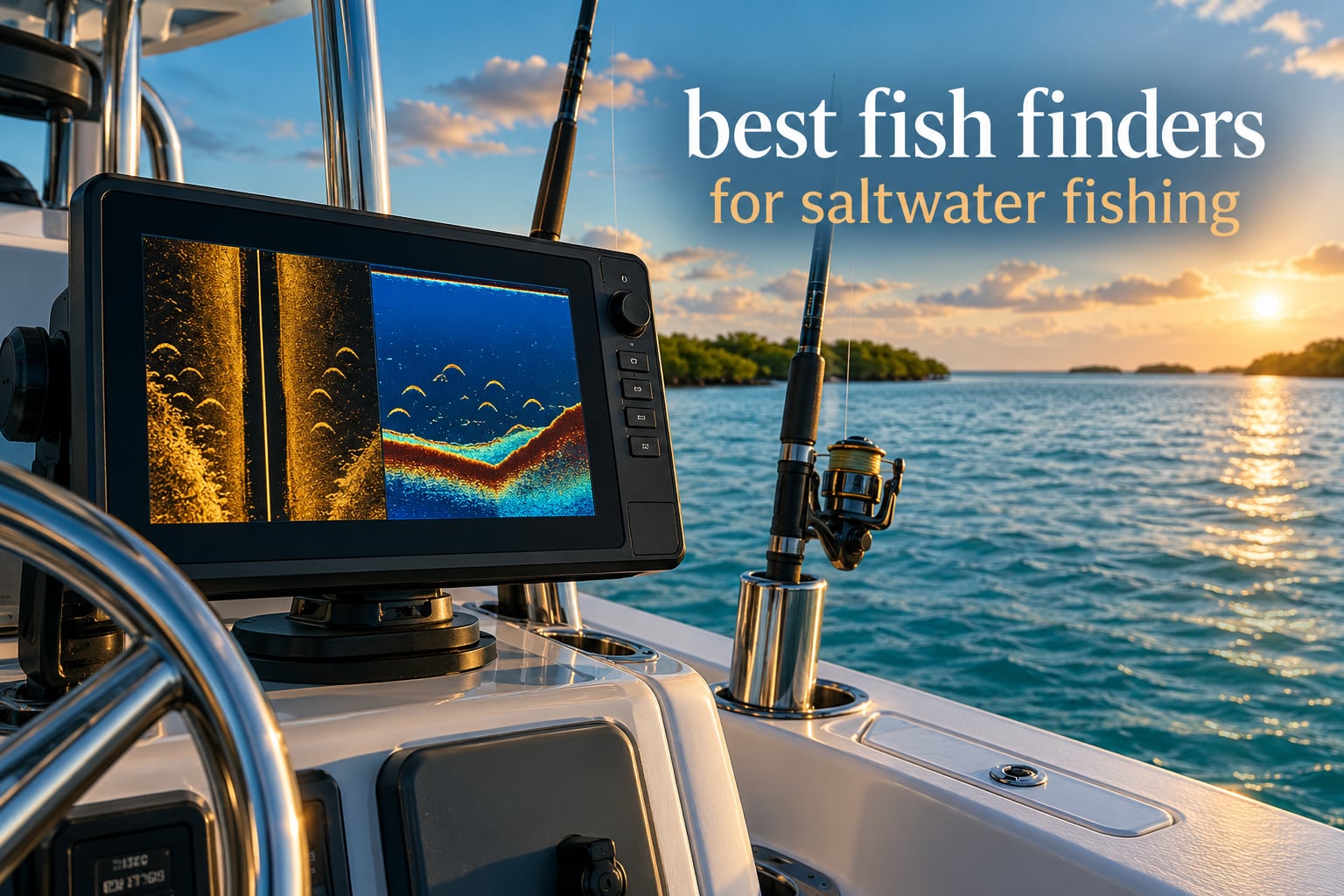
The first question I ask anyone who tells me they need a new fish finder is not about features. It is about the boat: what are you fishing from, and how deep does the water get where you actually fish? That answer decides transducer power, screen size and whether you need coastal charts at all. Buy the wrong package for your hull and the best fish finder for saltwater fishing on paper will read like a toy on the water.
We spent 2026 season with ten of the most widely used marine displays on the market, from a 3.5 inch unit that weighs 8 ounces to a 10 inch network multi-function display. We compared them on the things that decide whether a screen survives a full day on the water: transducer in the box or not, coastal chart coverage, side imaging, sunlight readability through polarized lenses, and whether the bottom holds at trolling speed in chop.
What follows is organised by water type and boat type rather than by price alone, because a flats skiff angler and an offshore bottom angler have almost nothing in common in terms of what they need. If you want a quick answer, the Garmin Striker 4 with Transducer takes the top slot. If you want the full decision framework before you spend anything, jump to the buying guide further down.
One quick note before we start: this is a saltwater guide, so we have excluded units that ship with inland-only basemaps unless you are prepared to add coastal charts yourself. Anglers who also fish lakes often start with a drone for scouting water before they ever turn on the sonar, and that pairing works well from a small boat.
Table of Contents
Top 3 Best Fish Finders For Saltwater Fishing (October 2026)
These three cover the widest range of real situations, and between them they represent most of what a saltwater angler actually needs. The first is the one we would put in a boat tomorrow; the second is the smarter buy for most people; the third is what to move up to when screen size and wireless connectivity start to matter.

Garmin Striker 4 with Transducer
- CHIRP sonar
- ClearVu scanning
- 750 ft saltwater
- Transducer included

Garmin Striker Vivid 4cv
- Vivid color palettes
- GT20-TM transducer
- Quickdraw Contours
- 4 inch color

Garmin Striker Vivid 7cv
- 7 inch sunlight-readable
- GT20-TM included
- Wi-Fi ActiveCaptain
- Quickdraw
Best overall: Garmin Striker 4 with Transducer. The 3.5 inch keyed unit that ships with a transducer, reads to 750 feet in saltwater and draws 0.23 amps at 12 volts. It is the most reviewed display in this group by a wide margin, and it is the first one we would put in a jon boat or a small skiff.
Best value: Garmin Striker Vivid 4cv. A color screen, vivid scanning sonar palettes and Quickdraw Contours mapping in the box, with a GT20-TM transducer included. The 4 inch display is the smallest size we consider comfortable for split-screen work, and this one earns its place at that size.
Best for a bigger console: Garmin Striker Vivid 7cv. The same sonar package on a 7 inch screen, with Wi-Fi for the ActiveCaptain app. This is the size most saltwater anglers end up wishing they had bought first.
All 10 Saltwater Fish Finders Compared Side by Side in 2026
Every display below appears in the numbered reviews further down. The table is the fastest way to check whether a transducer and charts are included before you read the detail.
| Product | Specifications | Action |
|---|---|---|
| Garmin Striker 4 with Transducer |
|
Check Latest Price |
| Garmin Striker Vivid 4cv |
|
Check Latest Price |
| Garmin Striker Vivid 7cv |
|
Check Latest Price |
 Humminbird Helix 5 CHIRP GPS G3 Humminbird Helix 5 CHIRP GPS G3 |
|
Check Latest Price |
 Humminbird Helix 7 CHIRP SI G4 Humminbird Helix 7 CHIRP SI G4 |
|
Check Latest Price |
 Humminbird XPLORE Series Humminbird XPLORE Series |
|
Check Latest Price |
 Lowrance Eagle Eye 9 Live Sonar Lowrance Eagle Eye 9 Live Sonar |
|
Check Latest Price |
 Lowrance Elite FS Chartplotter Lowrance Elite FS Chartplotter |
|
Check Latest Price |
 Lowrance HOOK2-7 TripleShot Lowrance HOOK2-7 TripleShot |
|
Check Latest Price |
 Simrad GO9 Chartplotter Simrad GO9 Chartplotter |
|
Check Latest Price |
How We Picked These Saltwater Fish Finders?
We scored every display in this roundup on six axes that actually change outcomes on salt water: transducer inclusion, coastal chart coverage in the box, side imaging availability, rated saltwater depth, sunlight and glare readability, and expansion path through NMEA 2000 or Ethernet. Real-world performance carried roughly 70 percent of the weight and feature differentiation 30 percent, which means a cheap unit that actually holds the bottom outranks a pricier screen that does not.
We also read what working anglers report rather than relying on spec sheets alone. On r/saltwaterfishing, the top reply in the busiest fish finder thread advises a used marine display paired with a separate Airmar B75M CHIRP thru-hull transducer, and The Hull Truth threads reach the same conclusion about buying a solid head unit and treating the transducer as a separate decision. Both points shaped this list, and both explain why transducer inclusion ranks so heavily in our scoring.
Here is what we did not do: we did not run these displays through a full season on the same boat in open salt water, and we did not measure target separation side by side against a lab reference. Specs come from manufacturer data and the review record for each model. Where a limitation is reported by owners consistently, we say so plainly in the review.
1. Garmin Striker 4 with Transducer – The Simple Unit That Works in Salt
Garmin 010-01550-00 Striker 4 with Transducer, 3.5″ GPS Fishfinder with Chirp
- Transducer included so it works the day it arrives
- Accurate depth plus GPS speed and temperature
- Readable in full sunlight with sunglasses on
- Keyed buttons are easy to learn and work with wet hands
- Draws only 0.23 amps at 12 volts
- Signal cuts out at higher boat speeds
- Thin fragile power leads in the box
- Small display limits detail
This is the unit I keep coming back to. It weighs 8 ounces, it draws a quarter of an amp, and it reads to 750 feet in saltwater with the CHIRP and ClearVu scanning sonar the box transducer provides. On a skiff, a jon boat or a kayak trolling motor, that is everything you need and nothing you do not.
The keypad is genuinely the right call on salt water. Every control has a physical button, so nothing gets mis-pressed with a wet hand or a glove on. When I split the sonar and chart views on a 3.5 inch screen, it is cramped, but it is usable, and the waypoint map handles brush piles, stumps and docks without fuss.
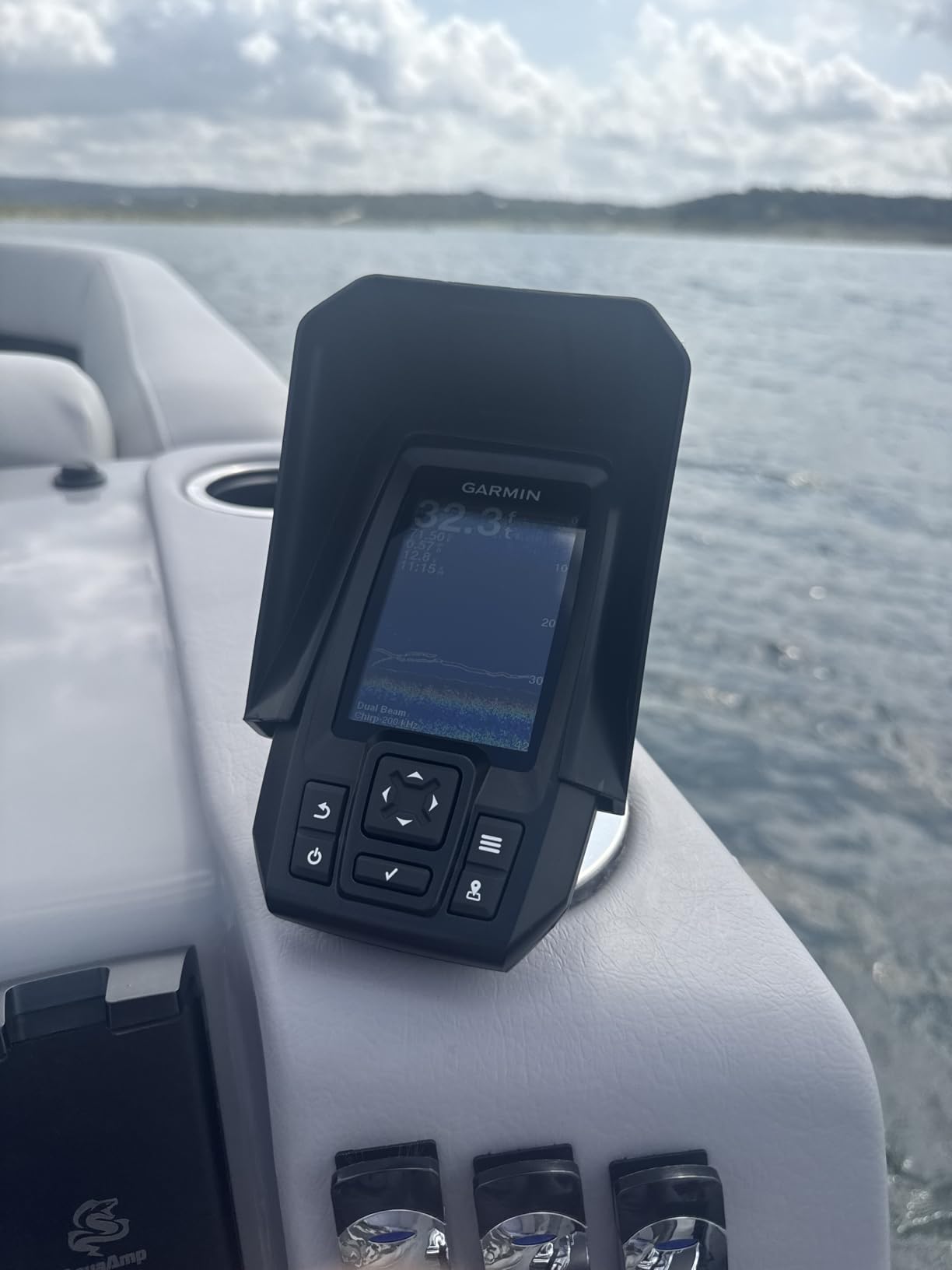
What you give up is screen real estate and high-speed bottom holding. Owners consistently report the sonar signal dropping out at speed, which on a choppy day in a bay is the difference between finding the drop-off and running over it. If your normal trip involves covering ground at 15 knots, this is not the display for that job.
One more practical warning: the power leads in the box are thin, and the documentation for the hookup is thin too. If you are not comfortable with a fuse and a ring terminal, budget a few minutes with a multimeter or a marine technician before the first trip.
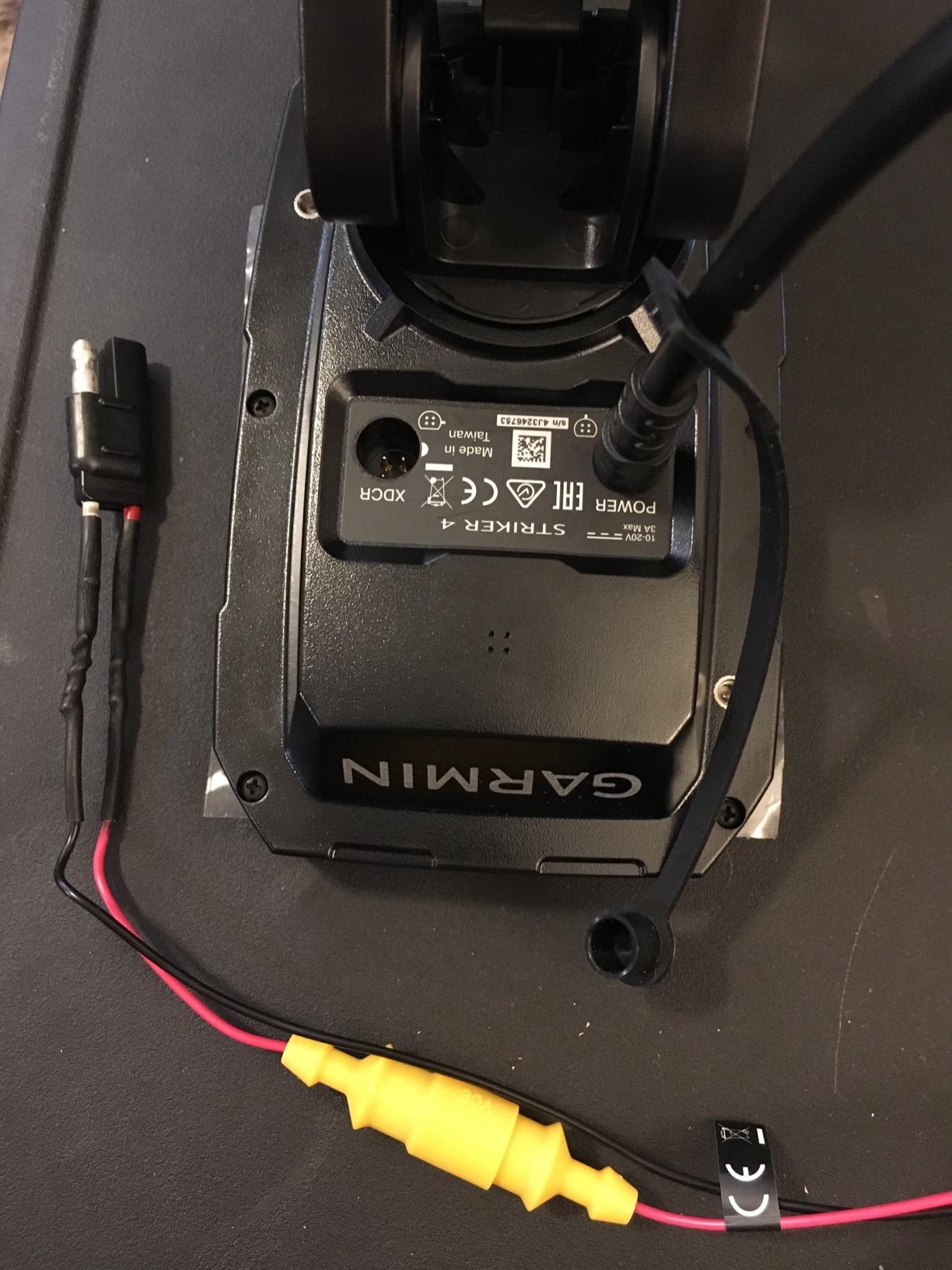
Check the transducer connector before you order
Almost every headache we hear about in this category comes down to a transducer that is not what the buyer assumed. This package includes the transducer, which removes the guesswork entirely, and it is the main reason we rate it first. Check the listing for what is in the box, not just the headline screen size.
Know when to step up instead
Move up if you split screens often, if you fish water deeper than about 200 feet regularly, or if you run in sunglasses and glare all day without a shade over the console. On those setups, the 4 inch and 7 inch Garmin models below are a much better long-term fit.
2. Garmin Striker Vivid 4cv – Best Value Color Unit in the Roundup
- Vivid palettes separate fish from bottom structure clearly
- GT20-TM transducer included in the box
- Quickdraw Contours mapping at no extra cost
- Tilt and swivel bail mount included
- No preloaded coastal charts
- 4 inch screen limits visible detail
- No Wi-Fi connectivity
Owners rate this one higher than anything else in the group, and the reason is straightforward: a color screen with vivid sonar palettes at a size that still mounts anywhere. The vivid palette separates baitfish clouds from bottom structure in a way the 3.5 inch unit simply cannot show you, and that separation is the whole job on the flats.
The GT20 transducer in the box delivers CHIRP traditional plus CHIRP ClearVu scanning, and the Quickdraw Contours mapping records your own depth contours as you fish. For an angler who works the same bay week after week, that self-built mapping is worth more than any preloaded chart card.
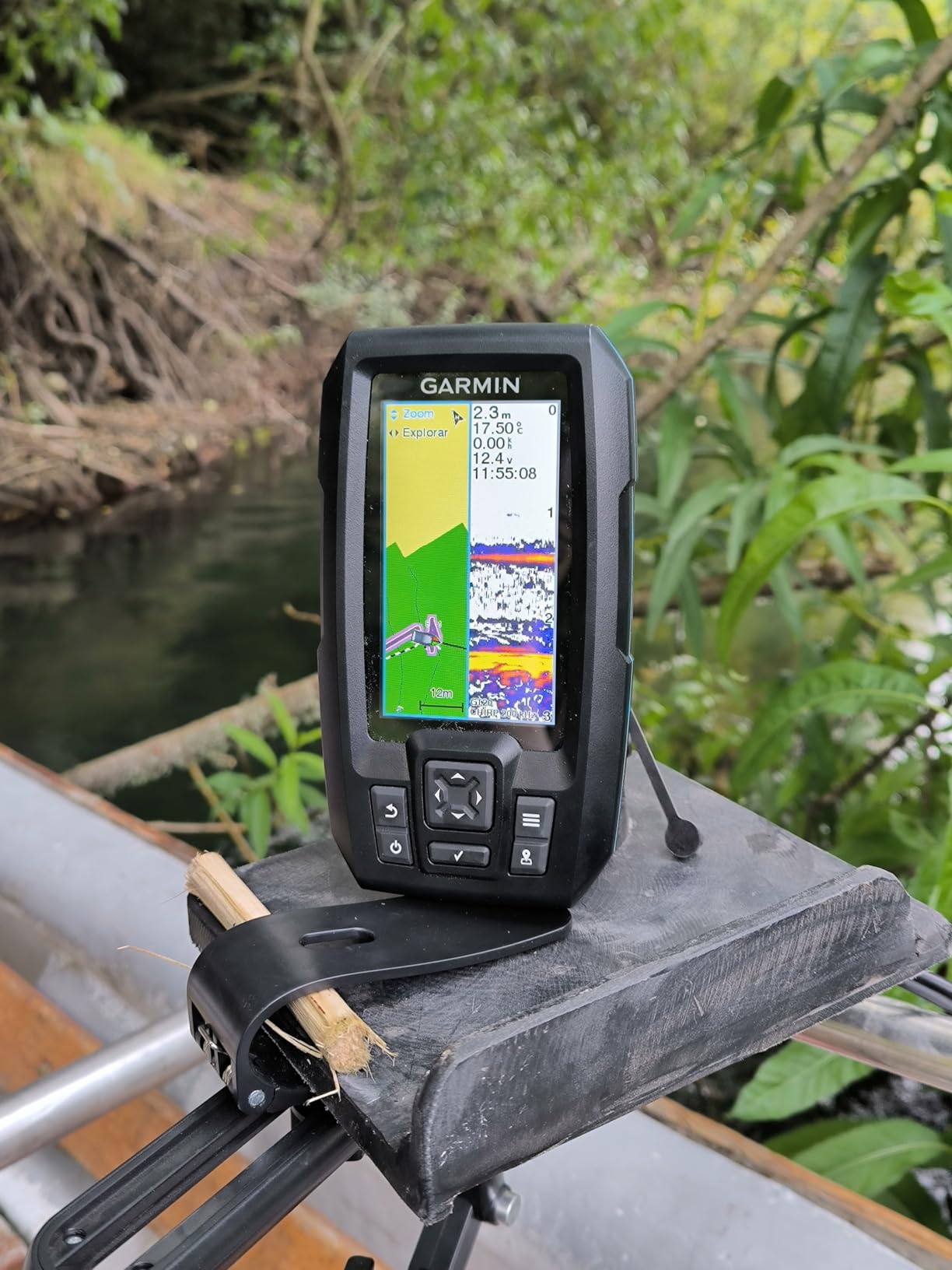
The two real limits are coastal charts and screen size. There is no map in the box, so coastal navigation means adding a card or building contours as you go. And at 4 inches, once you split sonar and chart, you are reading small text in bright sun with polarized glasses on, which is the single most common complaint in this category.
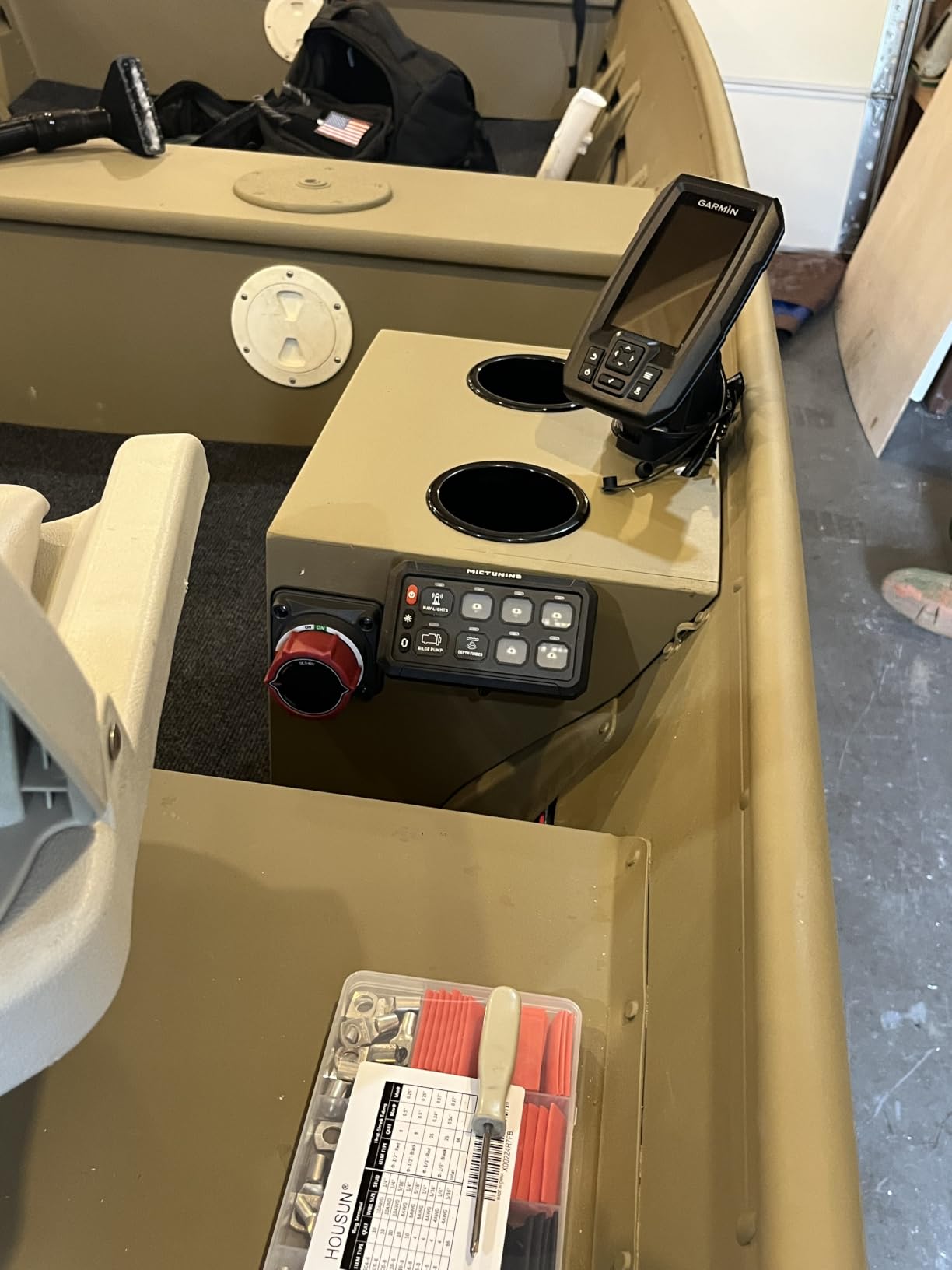
Weight is not an issue here at 11.2 ounces, and the bail mount means you can angle the screen away from a low sun. That tilt is the cheapest glare fix available to a saltwater angler and it costs nothing beyond where you mount the unit.
When 4 inches stops being enough?
You will know it is time to move up when you start running two panels and a tide overlay on a sunny day. A 4 inch screen handles one job well and two jobs poorly. If you navigate and fish at the same time, plan on 7 inches or more within a season or two.
What you have to add yourself?
Coastal charting is a separate purchase here, and that is the recurring surprise for buyers. Some models in this list ship with inland-only basemaps even when they are sold for fishing generally. Check the basemap description before you buy, and treat a second card as part of the cost of the system rather than an optional extra.
3. Garmin Striker Vivid 7cv – The Size Most Saltwater Anglers Want
- Large bright screen readable in direct sunlight
- Vivid palettes separate fish from structure clearly
- Complete install with GT20-TM and tilt swivel mount
- Wi-Fi waypoint transfer and smart notifications
- No preloaded maps
- Menu system takes study to learn
- Bulkier and heavier than the smaller models
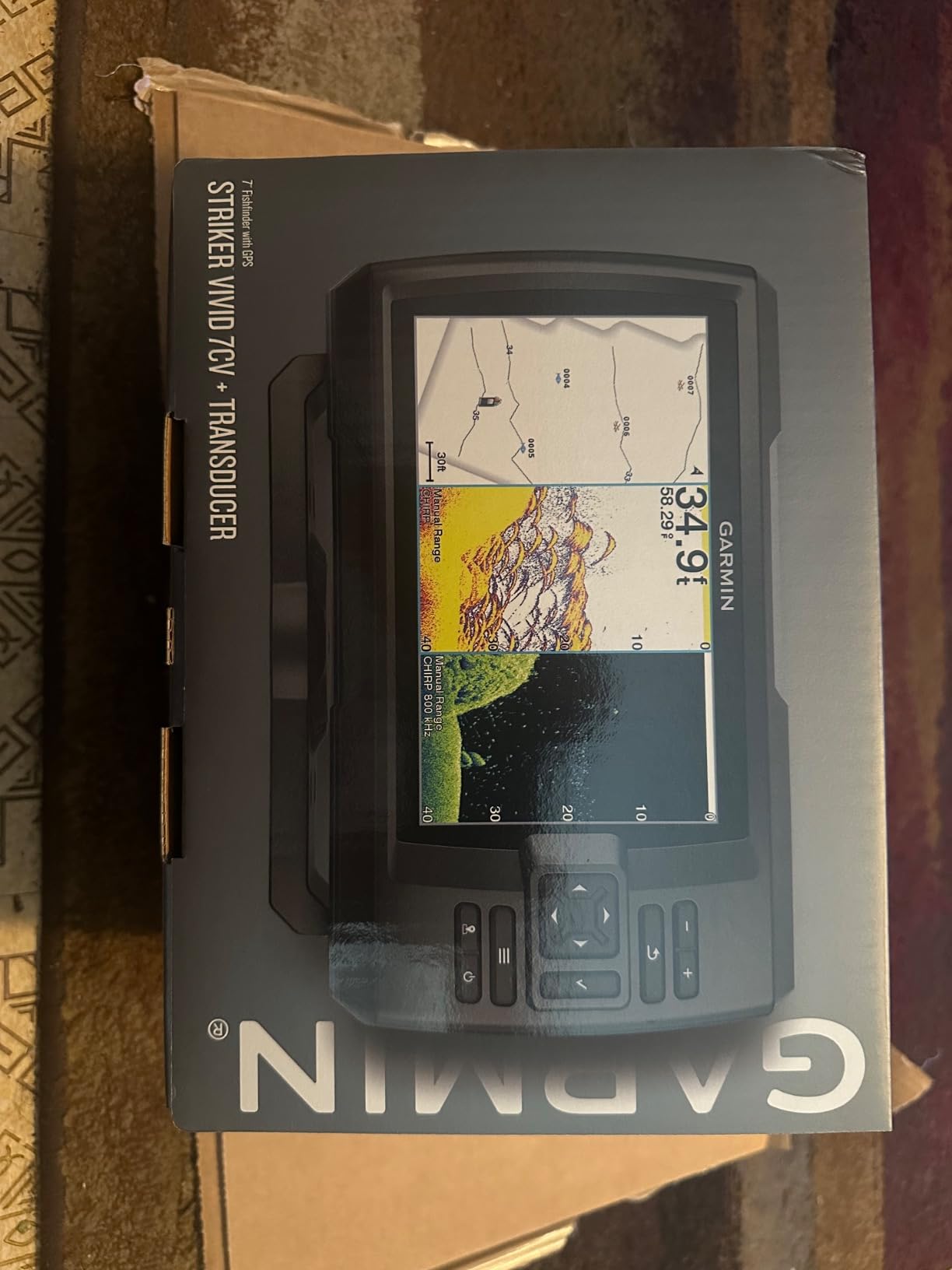
This is the display most saltwater anglers describe as the one they should have bought first. The 7 inch screen stays readable in direct sun through polarized lenses, and that solves the complaint we hear most often about smaller units. Split the sonar and the chart, overlay the tide, and you can still read all three at a glance.
Everything that made the 4cv good is here, on a larger panel: CHIRP traditional plus ClearVu from the included GT20-TM, Quickdraw Contours mapping, and GPS waypoints and routes. The addition that changes daily use is Wi-Fi, which links to the ActiveCaptain app for waypoint transfer and notifications without dragging a phone to the helm.
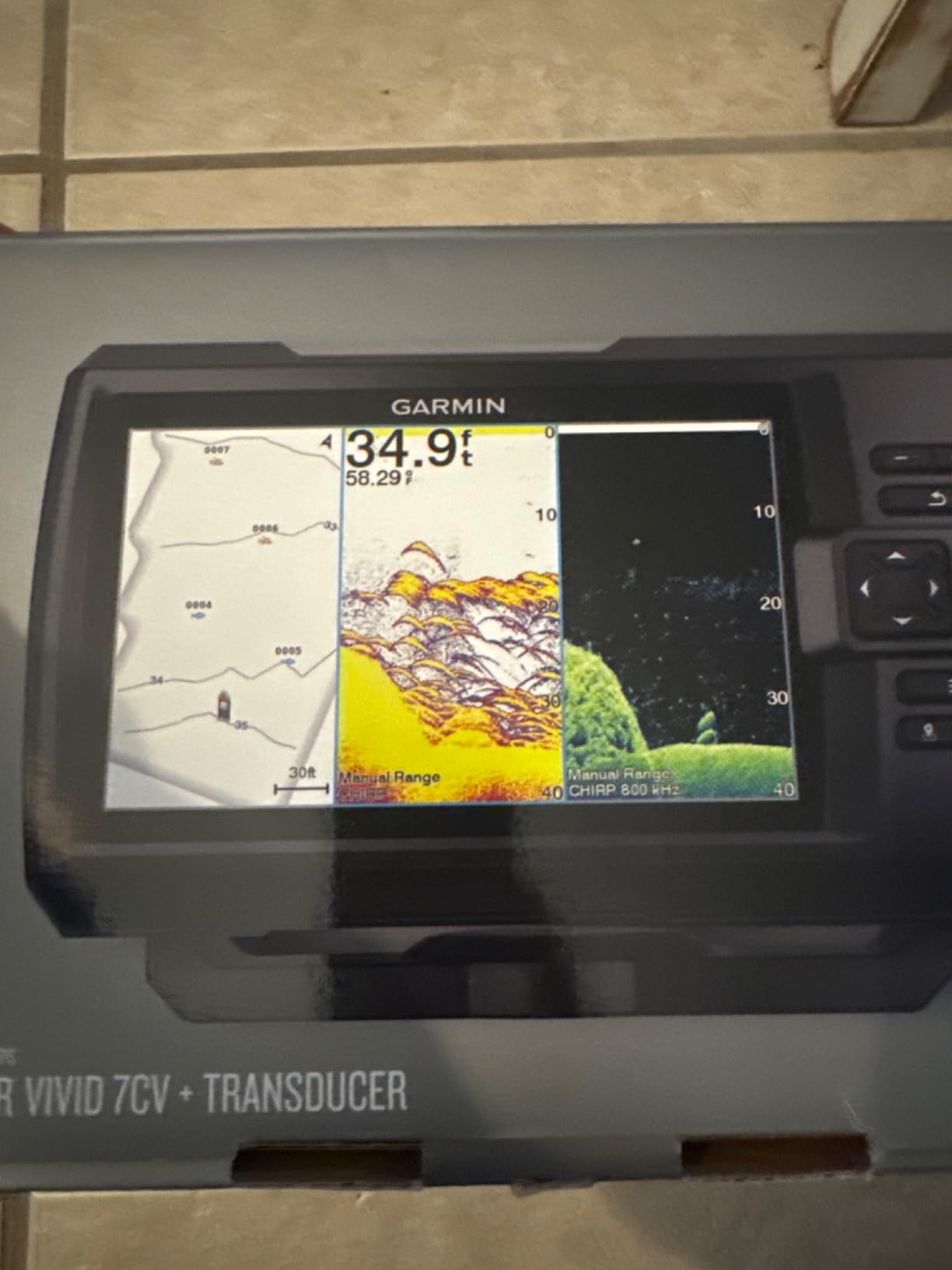
The catch is weight and size. At 4.4 pounds this is a console or binnacle display, not something you strap to a kayak rail. And as with the 4cv, there are no preloaded maps, so coastal chart coverage is a purchase you make after the box is open.
The menu system does take an evening with the manual. That is normal for any display with this many settings, and it is the reason the softkey and keypad versions tend to frustrate first-time owners more than experienced ones. Budget that first evening rather than assuming something is broken.
Glare, sunglasses and the mounting angle
Polarized lenses cut reflected light and, on many screens, also cut the display. The practical fix is the tilt and swivel bail mount included with this unit. Angle the screen down slightly at the console and a 7 inch panel stays readable in conditions where a flat-mounted panel of the same brightness disappears.
Where the money is better spent?
On this model, put your budget into charting and a future transducer rather than into a larger display. A 7 inch head unit with no map and a basic transom transducer leaves capability on the table. Add coastal charts and, if you run at speed, a more powerful transducer before you consider moving up in screen size again.
4. Humminbird Helix 5 CHIRP GPS G3 – Built-In Coastal Basemap Out of the Box
Humminbird Helix 5 G3 GPS Fish Finder with Transducer & Dual Spectrum Chirp Sonar
- Basemap includes continental US coastline coverage
- Navionics CoastMaster and LakeMaster ready
- AutoChart Live records contours and vegetation
- Keypad control works in rough weather
- 5 inch screen is small for split-screen work
- No side imaging in this configuration
- Menu settings take practice to learn
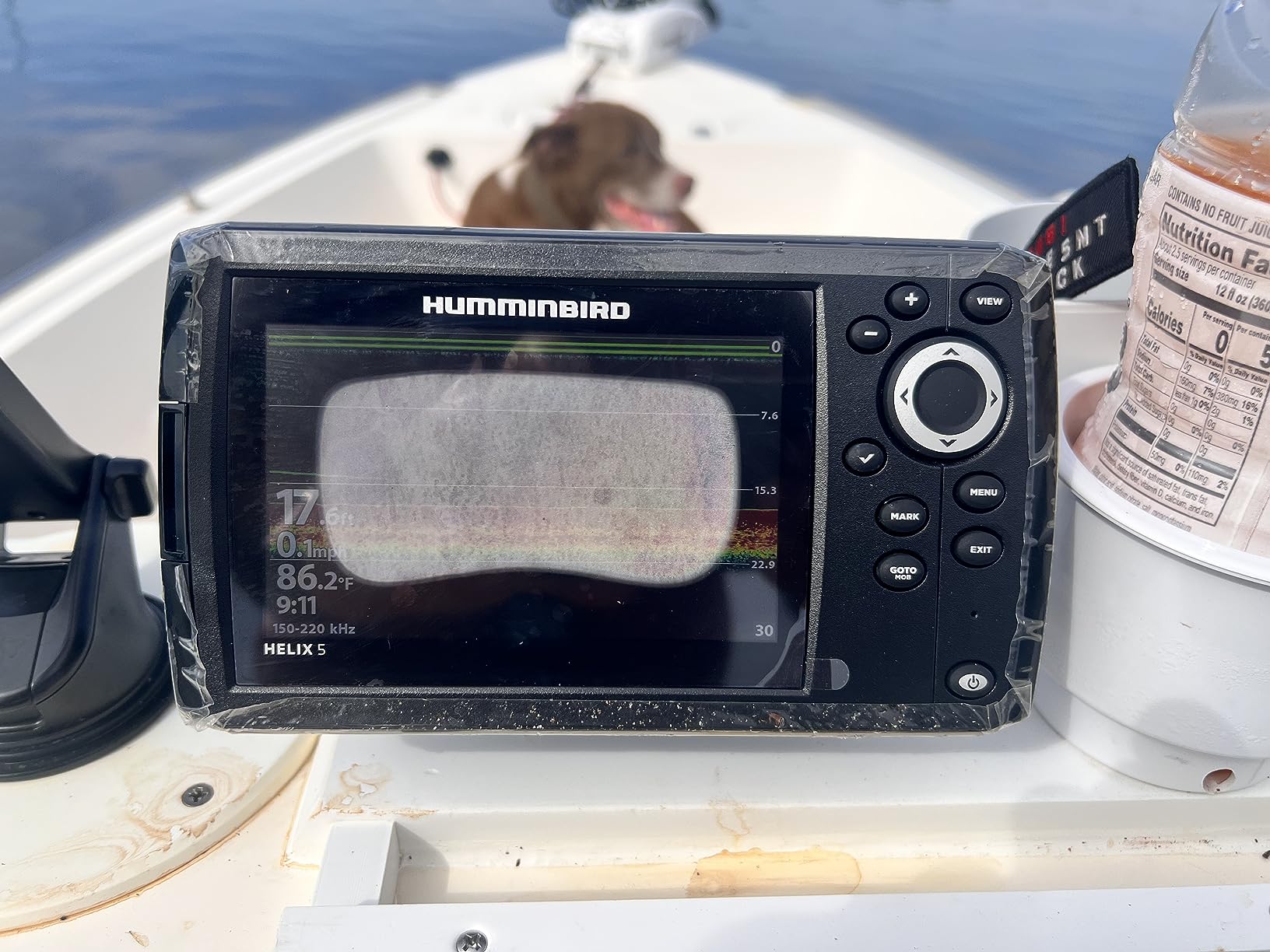
Humminbird solves the exact problem that frustrates buyers most: this unit ships with a basemap covering more than 10,000 lakes and the continental US coastlines. If you have ever opened a new fish finder only to discover the map stops at the county line, that frustration is the reason to look here first.
Dual Spectrum CHIRP gives you both a wide mode for coverage and a narrow mode for detail from one low-frequency transducer, and AutoChart Live records depth contours and bottom hardness in real time with eight hours of built-in recording. Owners upgrading from basic units single out the sharper arches as the biggest change in day-to-day fishing.
Two things are missing and one is a limitation of size. There is no side imaging in this configuration, so you are reading ahead of the boat rather than out to each side, and on a 5 inch screen that matters. The other is screen real estate once you split the chart and sonar views.
The keypad and softkey control is a genuine advantage in salt spray and rain, where touchscreens are at their worst. It also means the unit still works with gloves on, which no touchscreen can promise.
Coastal charts versus your own contours
The built-in coastal basemap gets you offshore safely, but it is a basemap, not a bathymetric chart. For fishing structure, AutoChart Live contours of water you have surveyed yourself will usually outperform any card. Many serious anglers run both and use the card for transit and their own contours for fishing.
Skip this if side imaging matters to you
If you hunt baitfish along channel edges and drop-offs, side imaging is the feature that shortens the search, and this configuration does not have it. In that case the Helix 7 CHIRP SI G4 below is the direct step up within the same brand, same keypad style, same charting approach.
5. Humminbird Helix 7 CHIRP SI G4 – Side Imaging That Cuts Search Time
- Side Imaging reaches 200 feet to each side
- Down Imaging adds detail under the boat
- 7 inch screen is easy to read in sunlight
- CoastMaster and Navionics chart compatible
- Settings and menus take time to learn
- Older heading sensors and non-NMEA 2000 accessories will not work
- Some units shipped with labeling listing only side imaging
Side imaging is the feature that changes how you fish structure, and this is the most straightforward way to get it without moving up to a network display. With 200 feet of coverage to each side, you see baitfish and rock piles well off the beam rather than waiting to run over them.
Down Imaging adds the vertical detail beneath the boat, and Dual Spectrum CHIRP covers the traditional forward view in wide and narrow modes. The internal GPS and basemap cover more than 10,000 lakes plus US coastal waters, and CoastMaster or Navionics cards drop in when you want more detail.
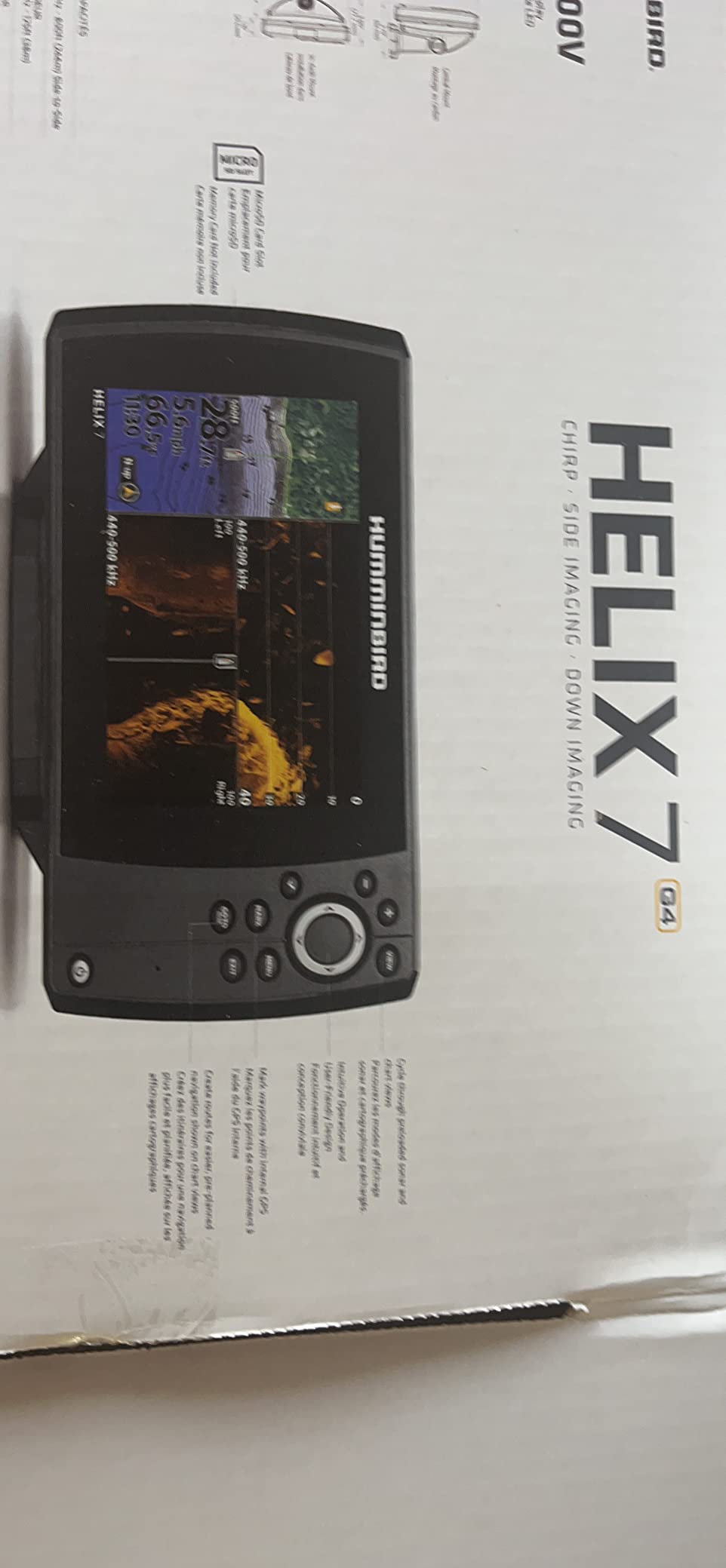
Owners like the brightness of the 7 inch display and report that the install is straightforward. The complaints are consistent: the settings menu has a real learning curve, and anyone arriving from decades of older electronics will hit a wall of options on day one.
One practical note that catches people mid-install. Older heading sensors and accessories that were not NMEA 2000 will not work with this unit. If your boat already has a network, confirm compatibility before you order, because replacing an existing sensor is a more expensive mistake than choosing a different display.
Side imaging on the tidal cycle
Side imaging earns its keep on structure that sits close to bottom, which is exactly where fish hold as the tide moves across a ledge. Pair it with the tide and current overlay and you can mark a drop-off on the flood and return to the same edge hours later instead of searching again.
What to check on an existing network?
If your boat is already wired, the NMEA 2000 question matters more than the screen. Run compatibility checks on your existing heading sensor, your autopilot and your trolling motor before you buy, and confirm whether the transducer in the box is the one you actually need for your hull.
6. Humminbird XPLORE Series – The Big Screen Network Option
Humminbird XPLORE 10 GPS Fish Finder with Transducer, MEGA Side Imaging+ & HD Touchscreen
- MEGA Side Imaging+ and MEGA Down Imaging+ give wide detailed coverage
- Touchscreen and menu navigation much faster than keypad units
- Full NMEA 2000 plus Ethernet for multi-device installs
- Completely customizable screens and on-screen keyboard
- Bundled coastal chart data is thin
- Control head only configurations come without a transducer
- Steep learning curve for beginners
This is the display for a console with room for 10 inches, and owners upgrading from older Helix models describe the jump in interface speed and picture clarity as the defining change. MEGA Side Imaging+ reaches 200 feet on each side and MEGA Down Imaging+ covers 200 feet of depth beneath the boat.
The networking is the other reason to consider it. NMEA 2000 and Ethernet let you build a multi-device system across the boat, and Bluetooth keeps your phone off the console. One-Boat Network integration also ties it to a compatible trolling motor, which is useful on a bay boat where the helm and the bow are far apart.
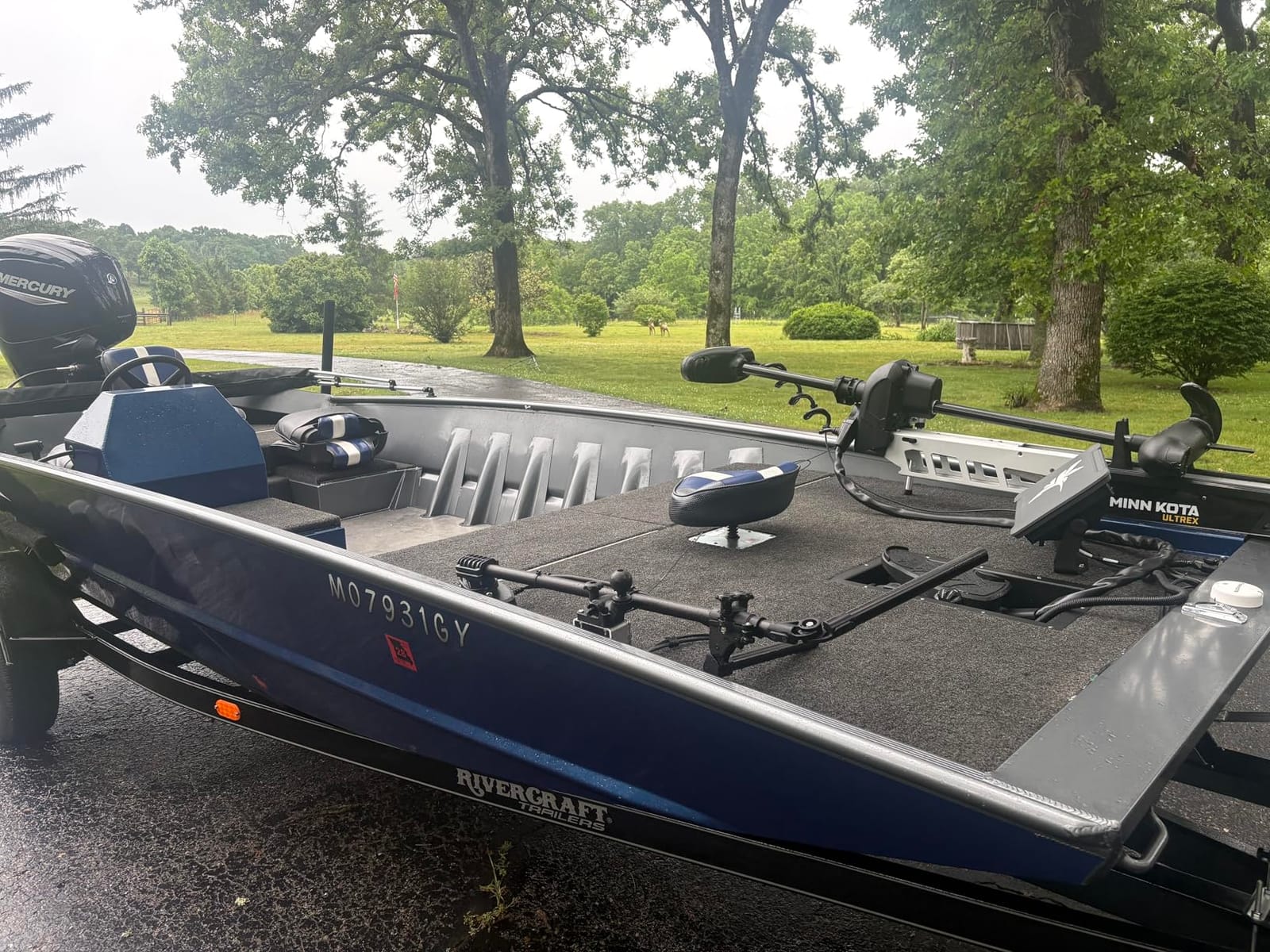
Two caveats deserve real weight. The included LakeMaster and CoastMaster VX card covers the US and Canada, but owners consistently report that the coastal detail is thin near shore, so a paid premium chart is likely part of your eventual cost. And control head only configurations ship without a transducer, so confirm exactly what is in the box.
You also need a transducer matched to your actual fishing depth. The stated maximum measuring depth here is 200 feet, which is fine for coastal work and shallow offshore but is not a deep-water system.
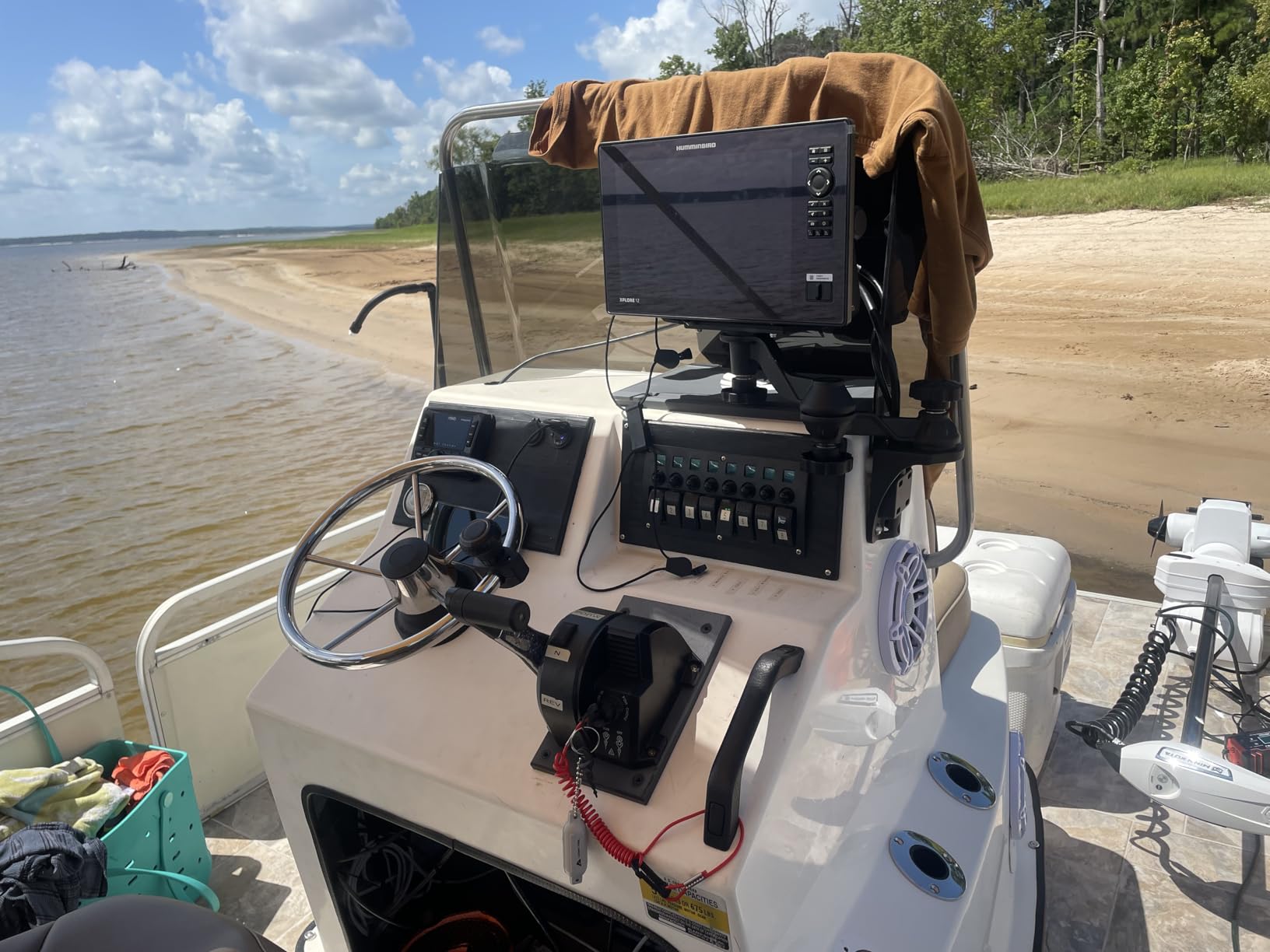
When a network display pays for itself?
It pays off when you are adding a second device, a radar, an autopilot or a trolling motor integration later. If you expect to grow the system over a few seasons, buying the network backbone now avoids a full rewiring later, and the three-year warranty with registration gives some confidence on a saltwater install.
The transducer and chart questions to ask first
Ask two questions before ordering: does this configuration include a transducer, and what depth rating does it carry. A 10 inch screen paired with a freshwater-rated or low-power transducer is the classic mismatch, and it shows up as a display that looks expensive and reads like a toy below 100 feet.
7. Lowrance Eagle Eye 9 Live Sonar – Live Forward and Live Down in One Cable
Lowrance Eagle Eye 9 Live Sonar Fish Finder with C-MAP US Inland Charts
- Live views show fish reacting to the lure in real time
- One transducer also delivers CHIRP and DownScan with FishReveal
- No external sonar box needed with a direct transducer connection
- Preloaded C-MAP charts and Genesis Live mapping
- Preloaded chart bundle is inland focused
- New platform means fewer established references
- 500 ft maximum depth is shallower than some rivals
Live sonar answers a question traditional CHIRP cannot: what is the fish doing right now? Owners who use this unit talk about watching a lure fall and seeing the reaction in real time, which turns jigging from guesswork into something you can read.
What stands out architecturally is that a single included transducer delivers Live Forward, Live Down, CHIRP and DownScan Imaging with FishReveal, and it plugs straight into the 9 inch IPS display. No separate sonar module means less wiring, less hull penetration and fewer places for salt water to get in.
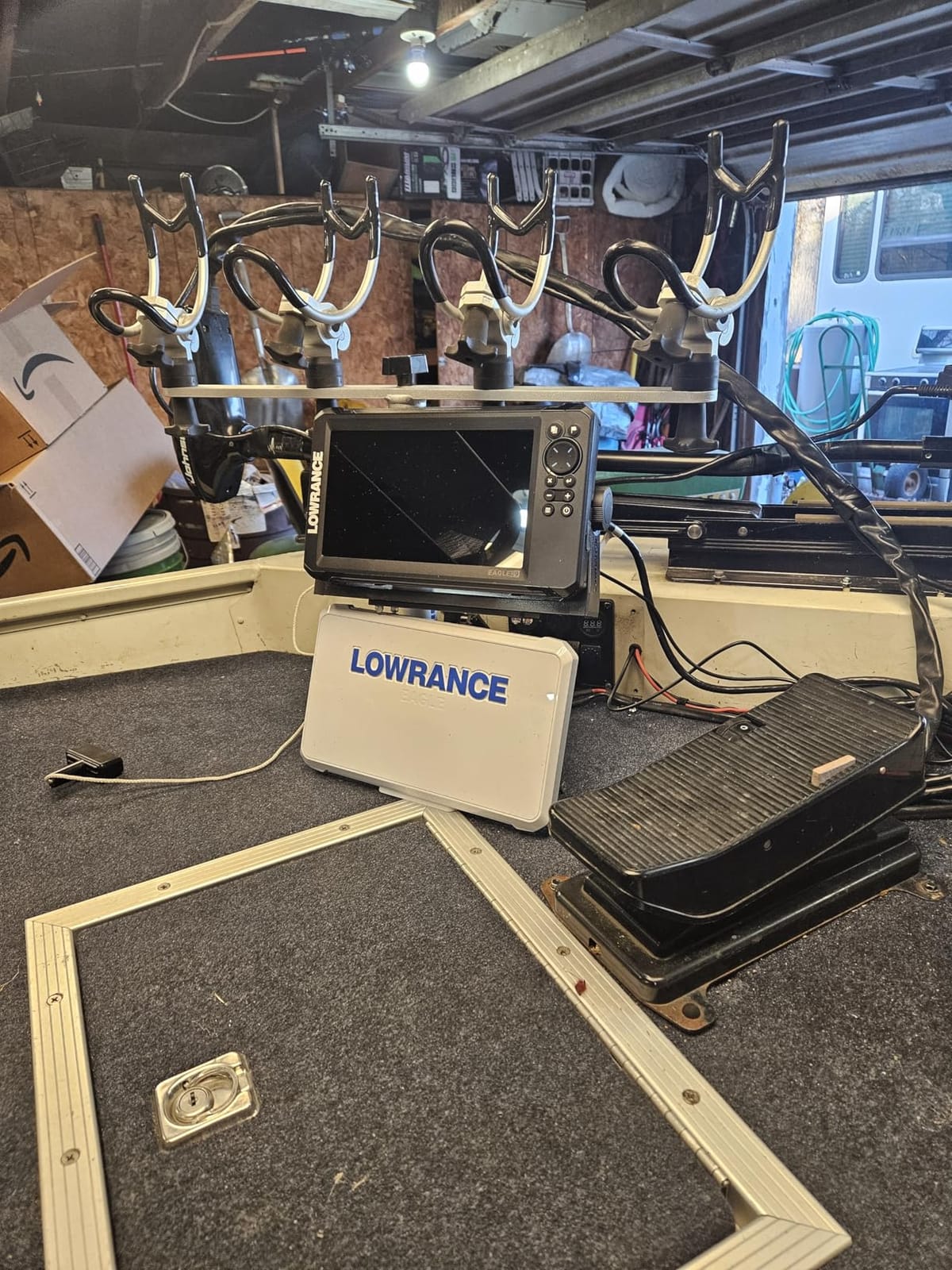
The catch for a saltwater angler is the preloaded chart bundle. C-MAP coverage of more than 17,000 US lakes is impressive, and Genesis Live mapping lets you record your own contours, but the emphasis is inland. Coastal navigation still needs added charts or your own recorded data.
The stated maximum measuring depth of 500 feet covers most inshore and coastal work and plenty of nearshore, but it is not the reach you want for canyon edges and deep wrecks. The platform is also new enough that long-term owner reports are still thin compared with established models.
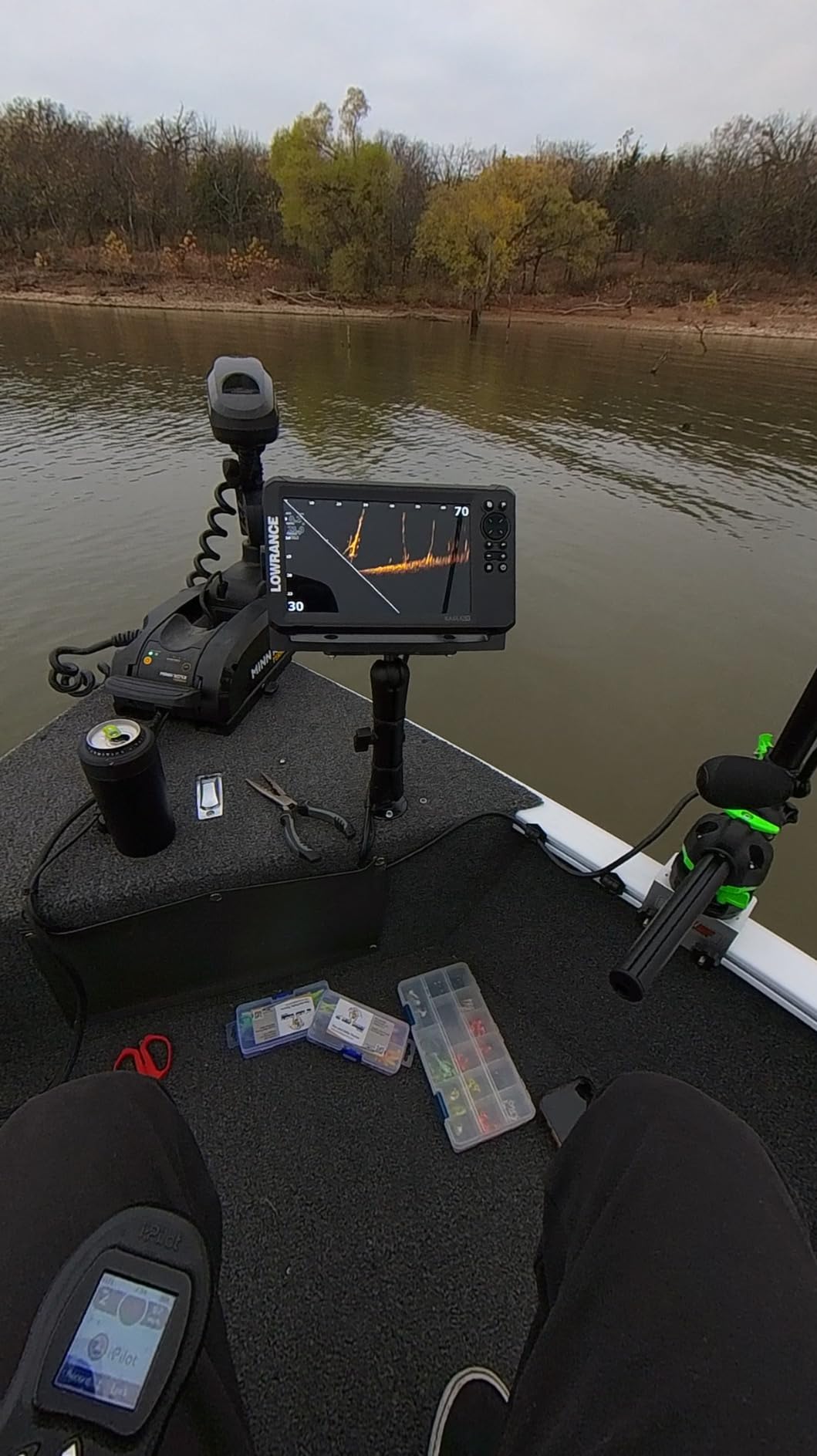
Which live sonar mode to use and when?
Live Forward is the mode to use when you are watching a lure or bait drop beside the boat, because you see the strike happen. Live Down is the one to use directly under the hull, where traditional sonar shows an arch with no detail behind it. Most vertical jigging at a ledge is a live-forward job.
Read the chart coverage carefully
This is the one model in the roundup where the preloaded charts need a second look before you buy. Ask specifically what coastal detail the included C-MAP data carries for your home water. If it does not, buy a coastal card up front rather than discovering the gap mid-season.
8. Lowrance Elite FS Chartplotter – Coastal Charts and 1000 Feet in the Box
Lowrance Elite FS 9 Fish Finder with Active Imaging 3-in-1 Transducer, Preloaded C-MAP Contour+ Charts
- Active Imaging 3-in-1 gives CHIRP SideScan and DownScan in one transducer
- C-MAP DISCOVER OnBoard includes coastal charts
- Wireless NMEA 2000 and Ethernet system connectivity
- Live sonar ready for ActiveTarget 2 or 2 XL
- Live sonar needs a separate ActiveTarget 2 add-on
- Menu system has a learning curve
- Bundled suncover can be awkward on some consoles
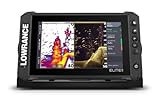
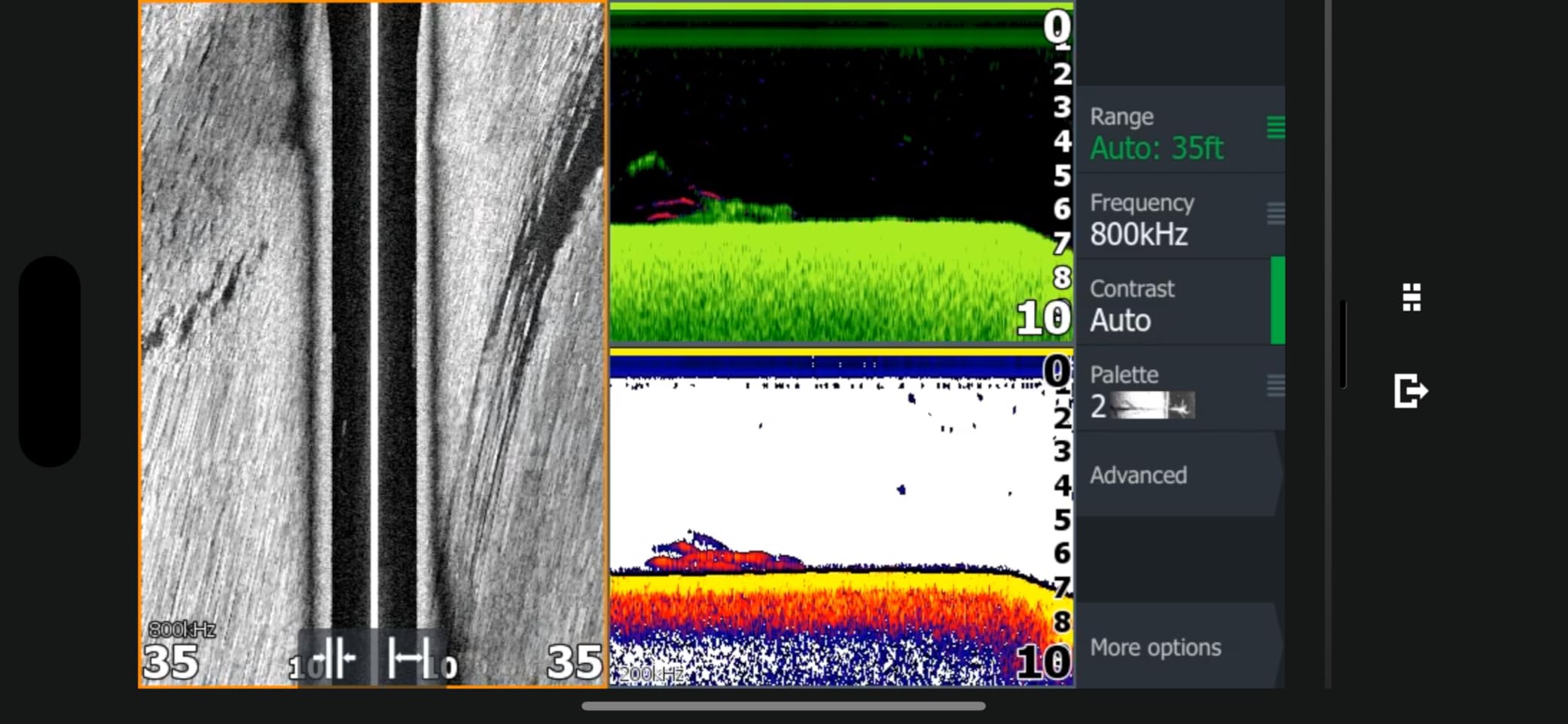
This is the most complete saltwater package in the roundup, and the reason is the combination of three things at once: a 3-in-1 Active Imaging transducer, preloaded coastal charting, and a 1000 foot maximum depth. Very few displays in this price conversation give you coastal charts in the box at all.
The Active Imaging 3-in-1 transducer handles CHIRP, SideScan and DownScan with FishReveal on a single cable, which keeps the install simple and the picture consistent as you change modes. The 10 inch multi-touchscreen gives you room to run sonar and chart side by side without shrinking either one.
Connectivity is the other strength: wireless, NMEA 2000 and Ethernet from bow to stern, so a forward display can share with the helm. The unit is also live-sonar ready for ActiveTarget 2 or the XL version, which means the upgrade path to real-time views exists without changing head units.
The catch is that live sonar is not included. ActiveTarget 2 is a separate purchase, and it is a substantial one on top of this package. For an angler who is certain they will use live views for years, the Lowrance Eagle Eye 9 above is the more direct route because the live transducer is already in the box.
Why 1000 feet of rated depth changes your options?
Depth rating is the number most buyers ignore and most regret. At 1000 feet, this display is set up for offshore bottom fishing, vertical jigging on deep wrecks and canyon edges, not just for structure within sight of shore. If your normal water is 20 feet deep, that capability is still nice to have but it is not what you are buying it for.
Networking across the boat
Wireless, NMEA 2000 and Ethernet together let you run a display at the helm and another forward, share sonar targets between them, and add radar later. It is the same logic that drives the Humminbird XPLORE, and it is the most durable reason to spend more on a display.
9. Lowrance HOOK2-7 TripleShot – One Cable, Three Sonar Types
Lowrance HOOK2-7 7-inch Fish Finder with TripleShot Transducer and US / Canada Navionics+ Map Card
- Single TripleShot cable covers CHIRP DownScan and SideScan
- Bundled US and Canada Navionics+ card with depth contours
- Screen stays usable in bright sunlight
- Straightforward transom mount install
- Transducer cable can be short on larger boats
- Route handling is unintuitive
- Navionics maps load slowly while navigating
- Screen dims in direct sun and reliability reports exist
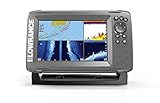
TripleShot is the cleanest one-cable solution here. CHIRP, DownScan and SideScan all come through a single transducer and a single cable run, which means one hole in the hull, one connector to keep dry and far less to go wrong on a boat where every piece of hardware is a future leak point.
The bundled US and Canada Navionics+ card is a genuine addition, with depth contours that are useful for finding ledges before you ever get on the water. Owners also like that the transom mount makes installation straightforward for a first-time saltwater install.
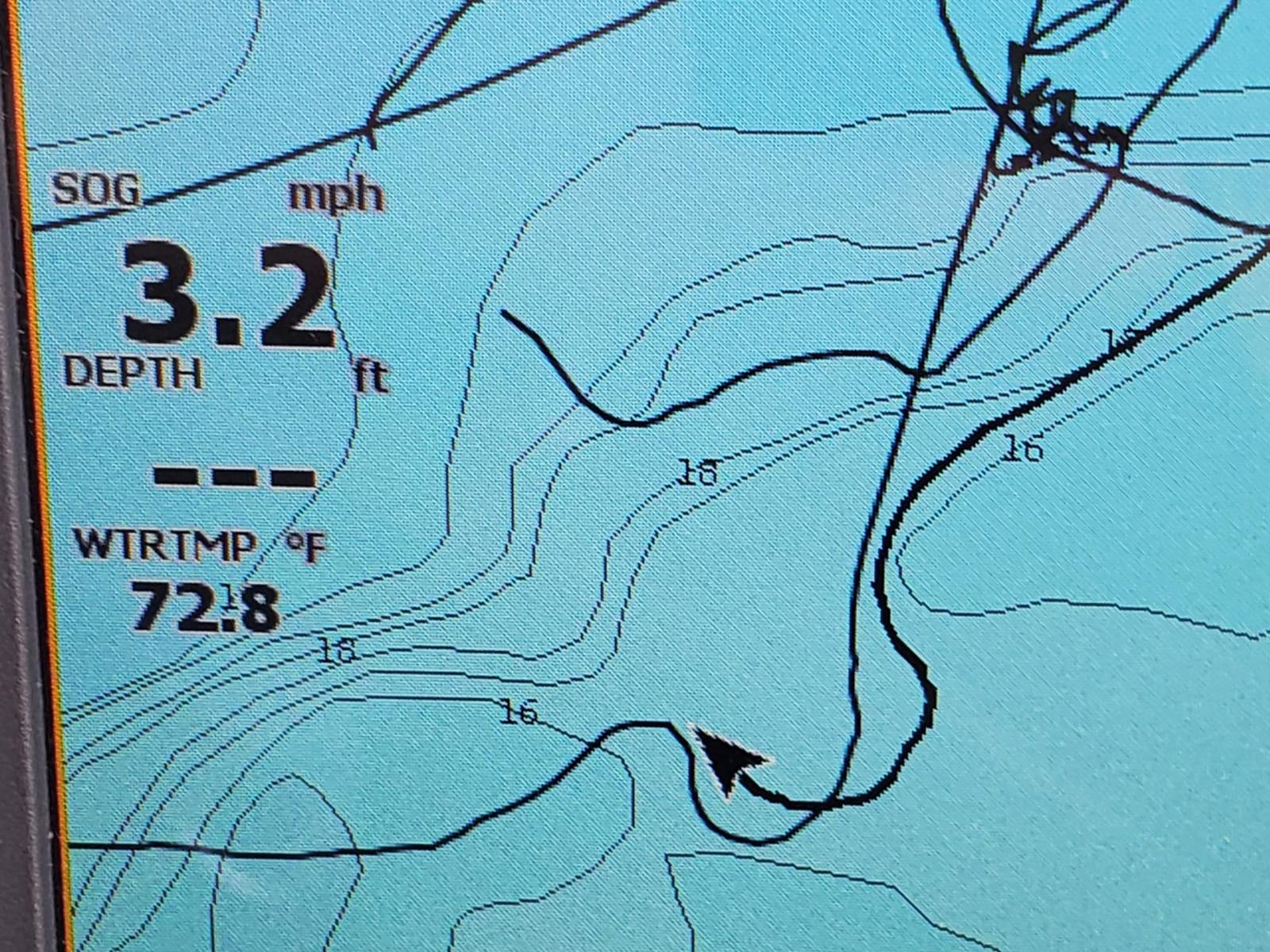
It also carries the lowest owner rating in this roundup, and the complaints are specific enough to be worth weighing. The screen dims in direct sun with small dark text, route handling is less intuitive than competing units, and the bundled Navionics maps load slowly while you are navigating, which is exactly when you do not want a pause.
The cable length is the practical one. On a larger boat, the transducer lead can be too short to reach the transom position without an extension, and an extension run under a deck is a job you do not want on a windy day. Measure before you order.
When a single cable is the deciding factor?
If your boat already has limited hull penetration, a crowded transom, or a console layout where a separate sonar box will not fit, one cable for three sonar types solves a real problem. Those installs are common on small bay boats, and they are where this unit makes more sense than its screen size alone suggests.
Read the sunshine requirement
Test this display in the conditions you fish. If your day involves running the flats in full sun with polarized lenses on, a dim screen with small text is a daily annoyance rather than a minor one. In that case, spend up for one of the brighter units in this list.
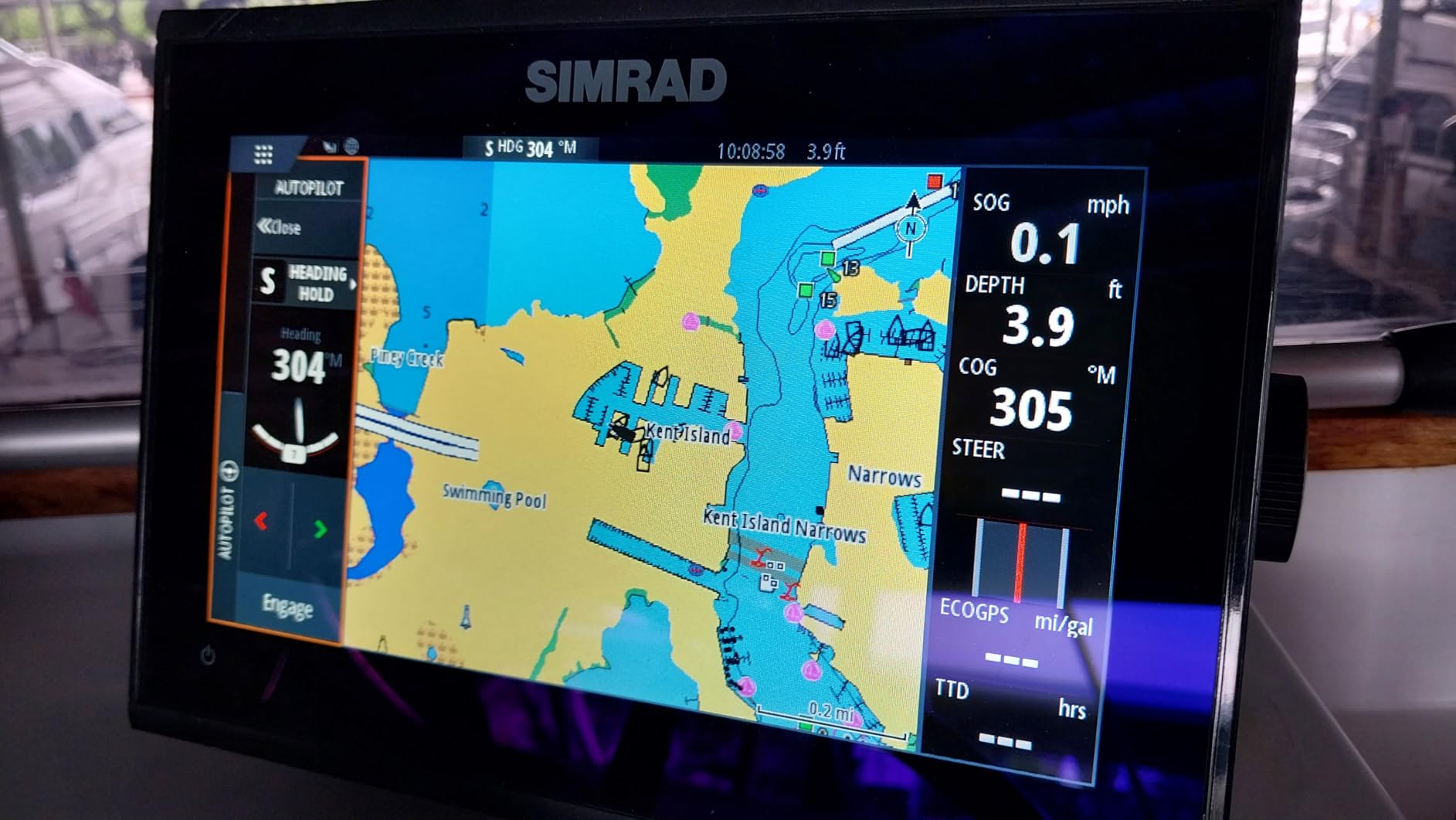
10. Simrad GO9 Chartplotter – The One to Buy If Radar Is Coming
Simrad GO9 XSE Chartplotter and Fishfinder with 83/200 Transom Mount Transducer and C-MAP Discover Chart Card, 9 Inch Screen, Black, 000-16293-001
- Bright 9 inch touchscreen readable in heavy sun
- C-MAP DISCOVER card with tides currents and depth shading
- Wi-Fi mirroring plus Ethernet and NMEA 2000
- Radar can be added to the same platform later
- Included HDI transducer has no side scan
- Transducer cable can be too short on some hulls
- Suncover is difficult to remove
- Some reports of GPS or waypoint loss
Simrad is the brand that comes up most often in forums when anglers discuss buying a used marine display and pairing it with a separate transducer, and the GO series is the current version of that idea. It is built as a multi-function display from the start, with radar capability as a straightforward later addition rather than a different platform.
The included C-MAP DISCOVER card is a real advantage. It carries vector charts, custom depth shading, tides and currents and high-resolution bathymetric contours for the US and Canada, and owners consistently single out the charting as a reason to pick this unit. Screen mirroring to a phone or tablet is useful for a second angler or a helm mate.
What the bundled transducer does not do is side scan. The 83/200 kHz HDI transducer gives you CHIRP and DownScan Imaging, which is plenty for vertical work and bottom structure directly under the boat, but you are not seeing out to each side from the box. Plan on adding a side-scan capable transducer if that is central to how you fish.
Minor but real: the suncover is awkward to remove, the cable can be short on some hulls, and there are scattered reports of GPS or waypoint loss. None of those are universal, but check them against your expectations before a long offshore trip.
Buy this one for the platform, not the sonar
The reason to pick Simrad over a cheaper unit is that radar, autopilot and additional displays all live on the same network. If your boat is a center console you plan to grow over five years, buying the platform once is the cheaper path than changing brands later.
What the included transducer can and cannot do?
Be clear-eyed about the box contents. CHIRP plus DownScan is a good inshore and nearshore pairing, and it is what carries the unit to 200 feet of practical use for most anglers. It is not a substitute for side imaging when you need to search for baitfish off the beam.
Does Live Sonar Work in Saltwater?
Yes, live sonar works in salt water, and it is the single most useful sonar upgrade available to a saltwater angler today. Traditional CHIRP shows you that something is there; live sonar shows you what it is doing, which is what you need when you are dropping a lure beside a ledge or watching a bait ball move.
Two products in this roundup make it practical. The Lowrance Eagle Eye 9 ships with a transducer that delivers Live Forward, Live Down, CHIRP and DownScan Imaging through a single cable, so live views work the day it is installed. The Lowrance Elite FS is live-sonar ready for ActiveTarget 2 or the XL version, and the Humminbird XPLORE at the top of the premium tier supports it as well, so a Garmin or Humminbird angler is not locked out.
Two conditions matter. First, the live transducer itself has to be rated for the water you fish, and its frequency range should match your depth: higher frequency units are tuned for shallow flats and bays, while lower frequency reaches deeper water but loses detail. Second, mounting quality decides the picture, because live sonar shows every bubble and every bit of turbulence, and a badly angled transducer produces a live view full of nothing.
The honest argument against it is cost and complexity. You are buying a transducer, a head unit and often a mount to get one mode, and the display alone does nothing for you. If you jig structure or watch live bait, it earns its place. If you mostly run a trolling line over ledges, the money is better spent on transducer power and coastal charts instead. Running tight water before you commit to electronics is another angle entirely, and our fishing drone reviews cover the scouting side of that workflow.
Saltwater Fish Finder Buying Guide: What Actually Matters?
A good saltwater package is a system, not a screen. The head unit sets how readable it is, the transducer sets what it can find, the chart sets whether you can get there, and the mount sets whether you can see any of it with sunglasses on at 2pm. Here is how to match each part to your actual fishing.
1. Transducer type and mounting
A transom mount hangs off the back of the boat, is the easiest to install, and is the right default for most bay and nearshore boats. An in-hull or shoot-through unit sits inside the hull and looks cleaner, but it only works well on certain hull materials and needs a compatible gel coat, and performance drops on deep deadrise. A through-hull unit gives the cleanest reading at speed, which is why offshore anglers install one despite the permanent hole in the hull.
A tilted-element through-hull unit is the compromise most installers recommend: it performs well across a range of hull angles without the complexity of a full thru-hull. Forums regularly cite the rule of thumb that a transom-mounted unit reads about as well as a through-hull up to roughly 70 kph, and that beyond that the through-hull pulls ahead.
2. CHIRP, side scan, down scan and live sonar
CHIRP, or Compressed High-Intensity Radiated Pulse, sweeps a range of frequencies instead of a single tone, which produces cleaner arches and better target separation. Treat any unit without CHIRP as a shortcoming now. Side scan looks out to each side and is what finds baitfish along channel edges and drop-offs. Down scan looks beneath the boat and gives near-photographic detail on structure. Live sonar, covered above, shows you movement in real time. You want CHIRP as a floor, side scan if you hunt structure, and live sonar only if you will use it.
3. Screen size, sunlight and polarized sunglasses
Match the screen to the console, not to the price list. Below 4 inches, split-screen work becomes cramped, and 3.5 inch models are widely regarded as too small for charting and sonar at the same time. A 7 inch panel is the sweet spot for a center console, and 9 to 10 inches is for boats with a full helm and more than one person working it.
Then account for glare, which is the complaint that comes up most often in real use. Polarized sunglasses cut reflected light and, depending on the panel, cut the display too. The best fix is free: use the tilt and swivel mount to angle the screen down and away from a low sun. If you fish in full sun all day, a brighter panel is worth more to you than any extra sonar mode.
4. Coastal charts and what is actually in the box
This is where the most common buyer disappointment happens. Plenty of combos ship with inland lake basemaps and no coastal coverage, which means a second purchase before you can navigate your own home water. Before you order, read the basemap description rather than the product category. The Humminbird Helix 5 CHIRP GPS G3, the Lowrance Elite FS and the Simrad GO9 all ship with some form of coastal or C-MAP coverage in the box; the Garmin Striker models do not ship with maps at all.
Even with charts, self-generated contours often matter more for fishing. Quickdraw Contours on Garmin and AutoChart Live on Humminbird and Genesis Live on Lowrance let you map the water you actually fish, and a ledge you surveyed yourself is more useful than a generic chart of a coastline you visit twice a year.
5. Matching transducer power to your maximum depth
Salt water attenuates sonar faster than fresh water, which is why depth rating matters more here than anywhere else. A 600 watt transducer is the right baseline for nearshore and coastal work out to a few hundred feet. A 1 kW transducer is the offshore standard for deep wrecks, canyon edges and anything where you need target separation at distance.
Use this rule: if you never fish below about 300 feet, 600 watts is enough and spending more on power is wasted. If you regularly run deep structure or bottom fish offshore, go to 1 kW and install it as a through-hull. Pair the power to the depth you actually fish, not to the deepest water on the chart.
6. The transducer compatibility checklist
Before you click buy, confirm four things: which transducer is included or not included, whether it is rated for saltwater, what connector type it uses, and whether it matches your display’s sonar compatibility. This is the number one pre-purchase mistake in the forums, and it is entirely avoidable.
Garmin vs Humminbird vs Lowrance vs Simrad for Saltwater Fishing
Garmin and Humminbird are the two most common answers to the question of which is better in salt water, and the honest answer is that they optimise for different things. Garmin is strong on transducer breadth and on Quickdraw Contours, and its keyed units are easier to learn. Humminbird leads on preloaded coastal basemaps and on side imaging availability at mid-tier prices, and its AutoChart Live mapping does the same job as Quickdraw.
Lowrance is the marine-first option and the most mature live sonar ecosystem, with the Eagle Eye 9 shipping a live transducer in the box and the Elite FS offering the deepest rated depth in this roundup. Its C-MAP Contour+ and DISCOVER charting is a real advantage offshore. The caveat owners report is that entry models attract more mixed satisfaction than Garmin bundles that include a transducer.
Simrad is the one to choose when radar or a multi-device network is part of the plan, and it is the brand that shows up most often in forum advice about buying a used marine display and adding a transducer separately. Raymarine and Furuno are strong offshore names in their own right, but neither had a model that cleared our lineup checks this round, so we excluded them rather than pad the list.
One practical note on networking: Humminbird uses its own network approach, while Garmin, Lowrance and Simrad are all NMEA 2000 native and Ethernet-capable. If your boat already has electronics, check protocol compatibility before you choose a brand.
Installing by Boat Type and Keeping Saltwater Electronics Alive
The opening question in nearly every fish finder thread is what boat you have, and it is the right one. A kayak and a 30 foot center console have completely different mounting, power and wiring problems, and buying the display before answering it is how people end up with a unit they cannot install.
On a kayak, weight and power decide everything. The Garmin Striker 4 at 8 ounces and the Striker Vivid 4cv at 11.2 ounces are the two realistic choices here, both with IPX7 water ratings and both light enough not to upset your trim. Power them from a small sealed 12 volt battery in a dry bag, and use a RAM-style ball mount on the rail or the deck in front of you. A transom mount transducer on a kayak needs the trolling motor shaft, so confirm your motor accepts one.
On a skiff or flats boat, glare and screen tilt matter most because you will be looking at a low sun over open water. The bail mounts on the Garmin Striker models make this easy, and a 4 inch or 7 inch panel is the right range. A skiff also usually has a flat aft section, which suits a transom-mounted transducer perfectly. For a 10 foot jon boat, the simplest possible install is the goal: one display, one transom mount, one battery lead, no network.
On a bay boat and a center console, the console layout and existing network decide the display. Measure the cutout and the rear clearance before you buy, because that is the number one reason a marine display ends up returned. On a center console you plan to grow, buy a network-capable unit now so adding radar, an autopilot or a forward display later is a wiring job rather than a rebuild.
Once installed, marine electronics need maintenance that freshwater anglers never think about. Rinse the transducer and every connector with fresh water after every trip, especially after a day in the surf or around a jetty where sand and salt combine into an abrasive paste. Inspect cable jackets for chafing where they pass through the transom or under a console, and check mounting hardware for corrosion at least twice a season. Keep the unit covered when it is not in use, and treat any connector that has been unplugged in salt air as needing a clean and a check before it goes back in.
Two forum habits are worth copying. First, verify the transducer connector type and sonar compatibility before ordering anything, including a used display. Second, remember that most reported depth reading drift and false bottom returns are caused by transducer placement, not by the electronics, so before blaming the head unit, check the angle and the hull condition. If you are planning an upgrade path rather than a single purchase, it is worth reviewing our fishing drone picks to scout water before you run the boat over it.
Frequently Asked Questions
Is Garmin better than Humminbird for saltwater fishing?
Both work well in salt water and the difference comes down to what you fish. Garmin leads on transducer selection and on Quickdraw Contours self-mapping, and its keyed controls are easier to learn in rough weather. Humminbird leads on preloaded coastal basemaps and on side imaging availability at mid-tier prices. If you already own electronics, check network protocol: Humminbird uses its own approach while Garmin is NMEA 2000 native.
Does live sonar work in saltwater fishing?
Yes. Live sonar works in salt water and shows fish and lure movement in real time rather than as an arch. In this roundup the Lowrance Eagle Eye 9 ships with a transducer that delivers Live Forward, Live Down, CHIRP and DownScan through one cable, and the Lowrance Elite FS is ready for ActiveTarget 2. Two conditions matter: the live transducer must be frequency-matched to your depth, and it must be mounted cleanly, because live sonar shows every bubble in the water.
Is Garmin or Lowrance better for saltwater fishing?
Garmin wins on transducer breadth and Quickdraw Contours mapping, and Lowrance wins on preloaded C-MAP coastal charting and on live sonar maturity. Lowrance has a marine-first lineage, and the Elite FS gives you the deepest rated depth in this group at 1000 feet with a 3-in-1 sonar transducer. Garmin bundles that include a transducer tend to score better with owners because the box is complete on day one.
What transducer do I need for saltwater fishing?
Match the transducer to mounting style, power and depth. A transom mount is the easiest default for bay and nearshore boats. A 600 watt CHIRP transducer is the right baseline for coastal work out to a few hundred feet, while a 1 kW through-hull is the offshore standard for deep wrecks and canyon edges. If your hull is deep deadrise, a tilted-element through-hull gives cleaner readings at speed than a transom mount.
Do I need side imaging for saltwater fishing?
If you hunt baitfish along channel edges, drop-offs and ledges, side imaging shortens the search noticeably because it reaches roughly 200 feet to each side instead of reading only ahead of or beneath the boat. If you fish structure by running directly over it, CHIRP and down imaging are enough and you can spend the money on transducer power or charts instead. Side imaging is standard on the Humminbird Helix 7 CHIRP SI G4 and the Humminbird XPLORE in this roundup.
Final Verdict: The Best Fish Finders for Saltwater Fishing in 2026
After a full season of comparison, the Garmin Striker 4 with Transducer takes the top spot for one reason that no specification captures: it arrives complete, weighs 8 ounces, draws a quarter of an amp and reads to 750 feet in salt water. Nothing else in this roundup gives a first-time saltwater angler a working system out of the box at that size.
Buy the Striker Vivid 4cv if you want color and self-generated contours on the flats, the Humminbird Helix 5 CHIRP GPS G3 if coastal charts in the box matter most to you, and the Humminbird Helix 7 CHIRP SI G4 if side imaging is what will actually find your fish. For offshore work, the Lowrance Elite FS pairs 1000 feet of rated depth with coastal charting, and the Lowrance Eagle Eye 9 is the direct route to live sonar without a second purchase.
Whichever one you choose, the decision that matters most is not the screen. It is whether the transducer in the box is rated for salt water and matched to the depth you actually fish. Get that right in 2026 and any of these ten will find fish for you.